PART 2: HOA Karen Ordered Me to Move My Family Cemetery—Then the State Historic Office Put Her on Notice
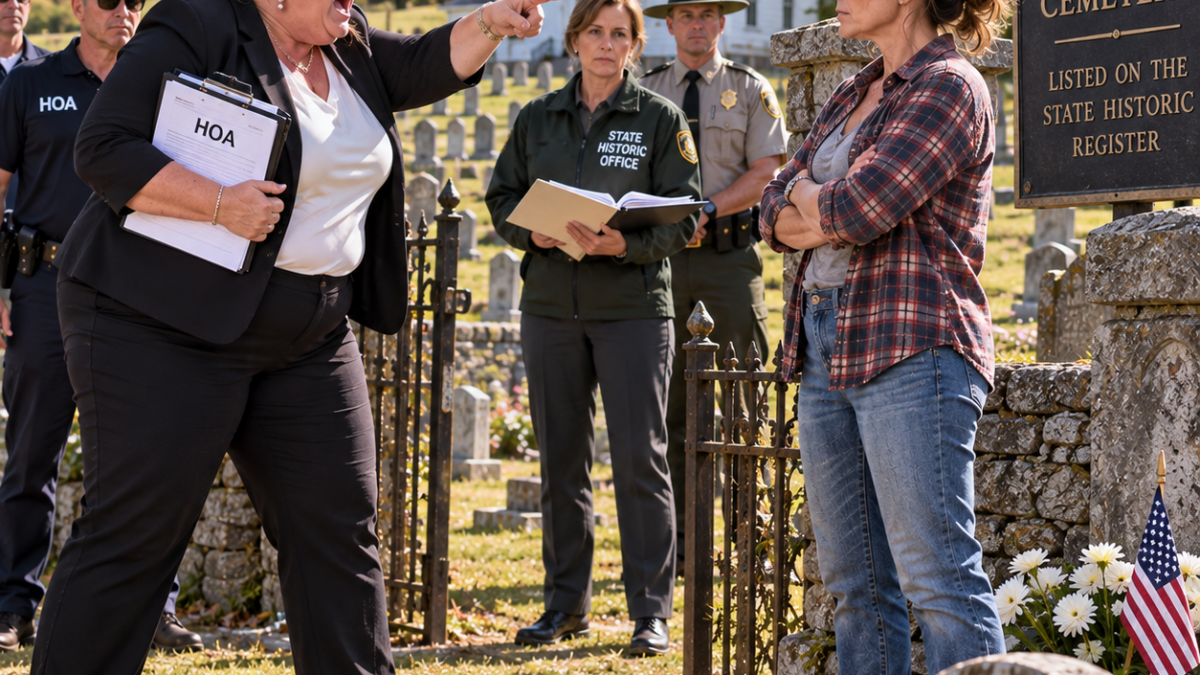
The HOA president stood at my property line and gave me thirty days to dig up five generations of my family because their graves were supposedly hurting neighborhood property values.
She called the cemetery a health hazard, threatened thousands of dollars in fines, and spoke about my ancestors as if they were broken lawn furniture waiting for a disposal truck.
What Karen didn’t know was that the oldest document connected to that half-acre of ground contained two words that were about to bring people with far more authority than an HOA clipboard straight to her door.
“Thirty days, Mr. Miller.”
Karen held the violation notice toward me without crossing the old stone wall separating my property from the Estates at Willow Creek.
I didn’t take it immediately.
“Thirty days for what?”
Her expression tightened as though I were deliberately wasting her valuable time.
“To relocate the burial site.”
I looked over my shoulder toward the grove of ancient oaks at the far end of my twenty acres.
“You mean my family cemetery.”
“I mean the unregulated burial ground creating a potential health and safety concern adjacent to our residential community.”
My hands went still on the string trimmer.
There were moments during my twenty years in the Army when fear had made everything around me seem to move faster. This was the opposite. Karen’s words slowed the afternoon until I could hear every cicada in the trees and every distant lawn mower behind the new houses.
“You want me to move thirty graves.”
“Approximately.”
“They’ve been there since the 1790s.”
“That doesn’t make them compliant with modern standards.”
I stared at her.
Karen shifted the clipboard beneath one arm and continued with the confidence of someone who had mistaken repetition for legal authority.
“The board has received concerns about groundwater, sanitation, visual impact, and property values. You’ve already ignored our previous correspondence, so this is now a formal demand.”
“My property isn’t in your HOA.”
“It borders it.”
“That is not the same thing.”
“Your cemetery affects our residents.”
“It existed two hundred years before your residents.”
Her cheeks darkened.
“History doesn’t give you the right to maintain a hazard.”
That word finally did it.
Hazard.
Behind the farmhouse, beneath those oaks, were people whose names I had heard since childhood. My great-great-grandfather. His wife. Their children. Farmers, soldiers, mothers, babies who never reached their first birthdays, and generations of Millers who had worked that land before there was asphalt, golf carts, architectural committees, or a single beige house called Willow Creek.
I had returned there after two decades in uniform because I wanted roots.
Karen was telling me to excavate them.
I stepped closer to the wall.
“Put everything you just said in writing.”
She blinked.
“It already is.”
“Good.”
I took the notice.
“Include exactly what you expect me to remove, which authority you believe allows you to order it, and every dollar you intend to fine me.”
A smile returned to her face.
“Finally being reasonable?”
“No.”
I folded the paper carefully.
“I’m asking you to document yourself.”
The smile disappeared.
She turned toward her golf cart.
“Thirty days, Mr. Miller. After that, enforcement escalates.”
I watched her drive away between houses built on land that had been pasture when I was a boy.
That evening Sarah found me at our dining table surrounded by property records.
The HOA’s previous letters were stacked beside my deed.
Mailbox color.
Vegetable garden.
Stone wall.
Now the cemetery.
Sarah sat opposite me.
“She can’t actually make us move them, can she?”
“No.”
“You sound very certain.”
“I’m certain the HOA doesn’t own us.”
“That isn’t exactly what I asked.”
I looked toward the dark window.
Beyond it, somewhere behind the fields, the cemetery was hidden beneath the trees.
“I need to know exactly what protects that ground.”
The next morning I drove to the county records office.
For six hours I searched old deeds, survey books, plats, handwritten transfers, and faded microfilm until my eyes hurt.
Then I found an 1888 survey.
My finger stopped on a small rectangle drawn inside the Miller homestead.
The handwriting beside it was faint but readable.
MILLER BURYING GROUND.
Below it were two words.
PERPETUAL EASEMENT.
I photographed the page.
Then I called an old JAG attorney I knew from the VFW.
He listened to the whole story and became very quiet.
“John,” he finally said, “stop writing to the HOA.”
“Why?”
“Because this isn’t an HOA fight anymore.”
I looked again at the survey.
“What is it?”
“A historic cemetery case.”
He paused.
“And I know exactly who you call next.”
PART 2
The attorney’s name was Dave Riley, a former Army JAG officer who had spent enough years around soldiers to understand that when I called him instead of simply handling something myself, the problem had already moved beyond irritation. We met the following morning in his office above an old brick storefront downtown, and I brought what Sarah had started calling my “Karen file,” an accordion folder that had grown fat with every certified letter, copied envelope, invented fine, and photograph I had saved since the Estates at Willow Creek HOA first decided my twenty acres were somehow part of its aesthetic universe. Dave spread the documents across his conference table in chronological order, beginning with the absurd mailbox notice and ending with Karen’s demand that I relocate the cemetery. He read the demand twice, then picked up the copy of the 1888 survey and leaned closer to the faint handwriting. “Perpetual family easement,” he said. “That is the phrase I wanted to see.” I asked him what it meant in practical terms, and he explained that the burial ground wasn’t merely an informal patch where relatives had happened to put stones; it had been recorded as a dedicated family cemetery, a right tied to the land itself, surviving transfers, subdivisions, and later development. The HOA’s covenants could not erase it simply because Karen disliked what she saw beyond her residents’ back fences.
Then Dave asked the question that changed everything. “Has she threatened physical relocation in writing?” I pushed the newest letter toward him. He read the final paragraph, where the HOA demanded that I consult a “licensed relocation service” and stated that failure to abate the alleged hazard could result in escalating penalties and association action. Dave’s expression hardened. “She’s not just annoying you anymore. She is documenting an attempt to pressure you into disturbing a burial site.” He stood, walked to a bookshelf, pulled down a state statute compilation, and began flipping pages. “North Carolina takes cemeteries very seriously. You don’t move graves because somebody wants a better view. There are procedures, permissions, notices, court involvement in some circumstances, archaeological concerns depending on age, family rights, and criminal penalties for knowingly disturbing protected burials. Karen thinks she’s holding a neighborhood compliance hearing. She may be walking into state law she doesn’t understand.” I asked whether we should send another cease-and-desist letter. Dave surprised me by closing the book and shaking his head. “No more letters to Karen. You have already told them they lack jurisdiction. You sent the deed. You sent the survey. You warned every board member individually. They answered with more fines. That is enough. We change battlefields.”
He wrote three letters on a legal pad. S-H-P-O. “State Historic Preservation Office,” he said. “Call them.” I knew the name generally but had never dealt with the agency. Dave explained that their work included historic structures, archaeological sites, old landscapes, and burial places with historical significance. The Miller cemetery was older than nearly every building in the surrounding area, contained multiple generations of one of the county’s early families, and had a recorded history extending back before the nineteenth century was halfway complete. More importantly, the HOA’s actions were no longer theoretical. Karen had created a written campaign claiming the site was dangerous, demanding relocation, and imposing monetary pressure intended to force me to disturb it. “You don’t ask the state to fight your HOA battle,” Dave said. “You report a historic burial ground under threat. Give them the documents and let them decide whether they care.” I looked down at Karen’s latest fine, then at the old survey. “And if they care?” Dave smiled without humor. “Then Karen gets introduced to adults.”
The call lasted more than an hour. I expected a receptionist to take my name and send me a form. Instead, after I explained the age of the cemetery and the written threat, I was transferred to Dr. Alister Finch, a senior official in the historic preservation program. His voice was calm and almost academic at first. He asked when the oldest known burial had occurred, whether the cemetery was visible on historic plats, how many marked graves remained, whether I had family records showing additional unmarked burials, and whether the land surrounding it had ever been conveyed separately. I answered as methodically as I could. The known graves numbered just over thirty, though several infant burials mentioned in family Bibles were no longer marked. The oldest legible stone belonged to John Miller, born in the eighteenth century. The cemetery had remained inside the same larger family tract through generations of inheritance until adjacent farmland was sold to developers. The HOA itself had been created only a few years earlier. Then I read Karen’s language aloud: public nuisance, unregulated burial ground, health hazard, relocation required.
Dr. Finch stopped me. “She used the word relocation?”
“Yes, sir.”
“In writing?”
“Yes.”
“And you have supplied the association with proof that this is a recorded family cemetery?”
“Twice.”
He was silent for several seconds. When he spoke again, the professor’s curiosity had disappeared. “Mr. Miller, send me everything. Not a summary. Everything.” He gave me a direct email address and instructed me to include the survey, deed chain, photographs, grave inventory, correspondence, fine notices, certified-mail receipts, and my communication log. He told me not to remove, repair, reset, clean aggressively, or alter any stones until his office had completed a preliminary review, because the site itself could contain information important to formal designation. Then he gave me the same advice Dave had given. “Do not debate this woman anymore. Documentation has already established her position. Let official channels respond.”
That afternoon the dining table disappeared beneath history. Sarah brought down old family albums. We found photographs of the cemetery from the 1940s, when the wrought-iron gate still had every spear point intact. There was an image of my grandfather at age ten standing beside John Miller’s stone. Another showed my great-aunt placing flowers on a row of graves after World War II. Inside a cedar chest we found a family Bible with handwritten births and deaths reaching back generations. One entry recorded the burial of an infant girl in 1813. Another mentioned a son lost to fever in 1829. The cemetery had never been a decorative historical curiosity. It was where people had carried their grief when there was no funeral home, no municipal cemetery, and barely a road connecting the homestead to town.
Sarah became quiet while holding one photograph. It showed my grandmother in a dark dress beside the gate. “She took you out there every Memorial Day,” Sarah said. I nodded. My grandmother had been the person who taught me that graves weren’t about death so much as continuity. She knew which Miller had built the smokehouse, which one had lost two brothers in the Civil War, which woman had delivered babies for half the county, which child died in winter when the creek froze hard enough to walk across. As a boy, I didn’t understand why any of it mattered. After twenty years of moving from one posting to another, I did. The cemetery was proof that somebody had stayed.
We scanned everything. I created folders labeled DEEDS, SURVEYS, CORRESPONDENCE, PHOTOS, GRAVE INVENTORY, FAMILY RECORDS, and HOA CONTACT. The military part of my brain found comfort in order. By midnight the entire package was uploaded to Dr. Finch’s office. I hit send and sat in the quiet kitchen afterward while Sarah poured two glasses of water. “Now what?” she asked. “Now we wait.” She gave me a look. “You hate waiting.” “I’m excellent at waiting.” “You pace when the microwave has thirty seconds left.” I almost smiled. “Strategic waiting is different.” But she was right. It was miserable.
Karen mistook my silence for surrender almost immediately. The daily letters resumed. Five hundred dollars became a thousand, then fifteen hundred. A new two-thousand-dollar violation appeared for the stone boundary wall, which had stood there for roughly two centuries and, according to Karen, constituted an “unapproved perimeter structure inconsistent with Willow Creek community design.” That one actually made Sarah laugh. “Did they approve stone walls in 1820?” she asked. “Apparently we failed to submit the application.” The joke helped, but the pressure was real. Every trip to the mailbox tightened my stomach. None of the fines had legitimate legal force over my land, but Karen’s letters were designed to make paper feel like debt, debt feel like danger, and danger feel like inevitability. She was trying to turn my own property into a place where I expected attack every afternoon at three.
She also began a whisper campaign. I heard pieces of it whenever residents stood outside near the wall. The cemetery was contaminating groundwater. The cemetery attracted animals. The cemetery prevented the subdivision from expanding a walking trail. The old graves supposedly damaged resale value. According to one version, I had refused county inspectors access. No county inspector had ever asked. According to another, bodies had been buried there “recently.” The newest grave was decades old. Facts didn’t matter because Karen’s story was simple: old man, old graves, modern community, problem. She spoke in the language people feared most—safety and property values.
At first, some residents believed her. Friendly waves disappeared. People who used to chat with Sarah while walking dogs suddenly found reasons to look at their phones as they passed. One afternoon a woman I barely knew stood at the wall and stared toward the cemetery with visible discomfort. I wanted to confront her, explain everything, drag out the deed and show her the dates. Dave told me not to. “Karen wants you angry. If you start arguing with residents, she gets to say you’re unstable. Let her talk.”
The first crack appeared when Bill and Mary Henderson knocked on our door after dark.
Bill was a retired accountant with silver hair and the permanently careful posture of a man who had spent forty years checking other people’s numbers. Mary carried her purse with both hands and kept glancing toward the road. Sarah invited them in. For the first five minutes, they seemed embarrassed to explain why they were there. Finally Bill cleared his throat. “Karen says you’ve got some kind of contaminated burial ground back there.” I nodded. “She says a lot of things.” He looked at Mary. Then Mary said, “My grandfather is buried in a churchyard in Georgia. I looked up your property records myself. That cemetery is older than the subdivision by two hundred years.” She hesitated. “What she’s telling people is wrong.”
Bill opened a folder. Inside were HOA violation notices of his own. Two hundred dollars because a garden hose had not been stored in a circular reel. A warning about rose bushes extending too close to a walkway. Another notice because a garbage bin had remained visible until ten the morning after collection instead of being returned behind the gate by nine. Mary’s anger grew as she spoke. “We kept thinking if we just fixed whatever she complained about, she would leave us alone. But there is always something else.”
They weren’t the last.
The Garcias came two days later. Their children were three and five. Karen had warned them that “excessive recreational noise” violated afternoon quiet hours because their kids laughed and shouted while playing in their own backyard. A teacher named Linda brought a folder of fines over a bird feeder that Karen claimed attracted nuisance wildlife. Another retired couple had been forced to repaint shutters because the approved gray used by the builder had allegedly faded into an unapproved gray. Individually, every story sounded absurd. Together, they described a system. Karen’s authority wasn’t built on law. It was built on the assumption that fighting her would cost more emotionally and financially than giving in.
Bill suggested a neighborhood meeting at his house. Twelve residents came the first night. Seventeen the second. I didn’t recruit them into my dispute. I showed them documents. That difference mattered to me. The 1888 survey. My deed. Karen’s letters. The fines. The certified receipts proving the board had been informed. Then I told them about Dr. Finch and the state review.
The room changed.
Until that moment, most of them thought Karen’s crusade was simply another HOA argument, only more offensive because graves were involved. When they realized a state preservation office had opened an inquiry, the fear shifted. One man asked, “Could the board actually get in trouble for this?” I answered carefully. “I’m not a lawyer. Dave says disturbing protected graves could create serious legal exposure. Dr. Finch’s office is reviewing the cemetery now.” Bill looked around at everyone. “Then why is Karen still sending fines?” Nobody had an answer.
A week later, Dr. Finch provided one.
His email was only three paragraphs, but the attached letter carried the State of North Carolina seal and six pages of supporting references. The Miller family cemetery, he wrote, had been preliminarily determined to possess significant historic value. His office had initiated formal review for historic designation. During that process, the cemetery was to be treated as a protected cultural resource. The association was strongly advised to cease all demands, threats, penalties, or actions intended to alter, relocate, damage, or interfere with the burial ground. The letter referenced state statutes concerning burial-site disturbance and warned that knowing interference after notice could result in criminal referral and substantial civil consequences.
I read it twice.
Sarah read it three times.
Then she sat down and cried.
Not because we had won. We hadn’t.
She cried because for the first time since Karen said “relocate your ancestors,” someone outside our family had put official language around what we already knew instinctively.
The ground mattered.
The state saw it too.
Dave called within minutes of receiving my forwarded copy. “This is the moment where a rational board apologizes.” “Karen?” I asked. “Karen is not the board.” “She thinks she is.” Dave sighed. “Then send it registered to everybody. Karen, management company, each director, their counsel if you have it. We want undeniable notice.”
We did.
Every delivery required a signature.
Karen signed hers personally.
For one week, nothing happened.
No golf cart.
No letters.
No fines.
Even the whisper campaign stopped.
The silence felt unnatural.
Bill called it surrender.
Dave called it weather.
“Pressure dropping doesn’t mean the storm is over.”
He was right.
The flyer appeared beneath every Willow Creek door on a Monday.
EMERGENCY HOA MEETING.
Wednesday, 7:00 p.m.
One agenda item.
SPECIAL ASSESSMENT FOR LEGAL AND ABATEMENT ACTION REGARDING ADJOINING NON-COMPLIANT PROPERTY.
Bill called before I had even seen a copy.
“She’s asking us for money.”
“How much?”
“Five hundred per house.”
I did the math.
More than fifty thousand dollars.
“For what exactly?”
“She says specialized counsel and professional relocation.”
There was silence between us.
Then Bill said what both of us were thinking.
“She’s asking us to pay to move your cemetery.”
I called Dave.
He laughed once, without humor.
“Send me the flyer.”
I did.
Five minutes later he called back.
“We’re attending.”
“I’m not a member.”
“You’re the subject of the agenda.”
“She’ll throw me out.”
“She can try.”
Then I called Dr. Finch.
I expected him to recommend that I let lawyers handle it.
Instead, after reading the flyer, he asked for the time and address.
“You’re coming?”
“I believe it would be useful for me to hear how the board characterizes our letter.”
His voice was calm.
Too calm.
“What should I tell them?”
“Nothing.”
That was becoming everyone’s favorite instruction.
The clubhouse meeting was standing-room only.
Normally Karen governed before twenty bored homeowners and a plate of grocery-store cookies. That Wednesday, nearly every chair was occupied. People stood against walls and clustered near the rear doors. Some came because they were angry about the assessment. Some came because they were curious about the cemetery. Others came because Bill and his quiet network had spent two weeks making sure residents understood they were about to vote on something much bigger than landscaping.
Sarah sat beside me in the rear row. Dave took the seat on my other side with a leather briefcase at his feet. Bill and Mary were three rows forward. The Garcias sat across the aisle. Dr. Finch entered alone and quietly took a chair near the back wall. Nobody recognized him except us.
Karen walked to the front wearing a bright red jacket.
She looked pleased.
That was the strange part.
She interpreted the turnout as support.
“Welcome, neighbors.”
She spoke for nearly twenty minutes.
Property values.
Safety.
Community standards.
Modern expectations.
She never said cemetery.
She called it “the adjacent unregulated site.”
She described my land as neglected even though I maintained it better than half the subdivision.
She claimed her board had attempted compromise.
The compromise she had offered was digging up my family.
Then she held up Dr. Finch’s state letter.
I felt Dave shift beside me.
Karen smiled at the crowd.
“Now Mr. Miller has attempted to involve unelected bureaucrats in what should be a local community matter.”
I heard Mary whisper:
“Oh, no.”
Karen continued.
“They believe an obscure historical designation should take precedence over the safety and investments of more than one hundred families.”
Dr. Finch did not move.
Karen crumpled the corner of the state letter between her fingers.
“The Estates at Willow Creek will not be bullied.”
Dave leaned toward me.
“Let her keep going.”
She did.
The state preservation office became the enemy.
I became the unreasonable outsider.
History became an obstacle to progress.
Then Karen reached the assessment.
“Five hundred dollars per household will allow us to retain specialized counsel and contract with licensed professionals for sanitary abatement and relocation.”
Sanitary.
Abatement.
Relocation.
She was deliberately avoiding saying human remains.
But everyone knew.
She called for a motion.
One of the two remaining board members made it.
The other seconded.
Karen looked almost radiant.
“All in favor—”
I stood.
“Before you count that vote.”
Her face changed instantly.
“You are not a member.”
“No.”
“Then sit down.”
Dave stood beside me.
“My client is directly named in the subject matter of tonight’s motion, and homeowners are being asked to fund action against his property. They are entitled to accurate information before voting.”
Karen grabbed the gavel.
“This is an HOA meeting.”
Bill rose from his seat.
“And I am an HOA member. I yield my speaking time to Mr. Miller.”
Mr. Garcia stood.
“So do I.”
Then Linda.
Then another homeowner.
Karen realized she couldn’t silence all of them without destroying the appearance of procedure she depended on.
“You have five minutes.”
I walked toward the front carrying the large mounted 1888 survey.
I placed it on the easel beside Karen’s presentation board.
No shouting.
No accusations.
I pointed to the faded rectangle.
“This document is one hundred thirty-eight years old.”
The room quieted.
“This is the original recorded survey of the Miller homestead.”
I pointed to the handwriting.
“Miller Burying Ground.”
Then the notation.
“Perpetual family easement.”
I turned toward the residents.
“What you are being asked to fund tonight is not removal of an abandoned dump, nuisance structure, contaminated site, or illegal use. It is the relocation of a legally recorded family cemetery containing more than thirty marked graves and additional historic burials.”
Karen interrupted.
“That is your interpretation.”
I opened the binder.
“No.”
Deed.
County records.
State statutes.
Certified letters.
One by one.
“You and every director received these documents.”
I placed the receipts on the table.
“Here are your signatures.”
One board member leaned forward.
I could see fear entering his face.
Then I held up the state letter.
“And this is the letter Mrs. Karen described as bureaucratic intimidation.”
Karen’s voice became sharp.
“They have no authority over our association.”
A voice came from behind us.
“That is not correct.”
Dr. Finch stood.
He removed his glasses and slipped them into his jacket pocket.
Then he walked down the center aisle.
Karen stared at him.
“My name is Dr. Alister Finch.”
He paused.
“I am the senior preservation official who authorized that letter.”
The clubhouse became completely silent.
He stopped beside me.
Karen’s face lost color.
Dr. Finch looked first at the homeowners, not her.
“I want everyone in this room to understand the actual status of this site before any vote occurs.”
He spoke slowly.
The Miller cemetery was historic.
It was documented.
It had existed for generations before the subdivision.
His office’s review was active.
The demand that graves be relocated was not a normal aesthetic enforcement issue.
Then he looked directly at Karen.
“The letter you received was formal notice.”
She swallowed.
“We have health concerns.”
“Provide the health assessment.”
Karen blinked.
“What?”
“The professional assessment establishing that this cemetery presents a public-health hazard.”
“We have resident complaints.”
“That is not a health assessment.”
“The board determined—”
“Your board is not the state health department.”
A murmur moved through the room.
Karen gripped the table.
Dr. Finch continued.
“Have you consulted the county health department?”
Silence.
“An archaeologist?”
Nothing.
“Cemetery authorities?”
Nothing.
“A court?”
Nothing.
“Any agency with jurisdiction over relocation of human remains?”
Karen said quietly:
“No.”
Dr. Finch nodded.
“Then you have no factual basis for repeatedly describing this cemetery as a health hazard.”
Her attorney, who had been sitting near the front, suddenly stood.
“Perhaps we should pause the meeting.”
Karen snapped:
“No.”
That was her fatal mistake.
She had been offered an exit.
Pride closed it.
She pointed at Dr. Finch.
“This neighborhood cannot be held hostage by dead people.”
A gasp moved through the room.
Sarah closed her eyes.
I looked at the photograph of my grandmother I had tucked inside the binder.
Dead people.
That was all Karen saw.
Dr. Finch’s expression changed.
Barely.
But I saw it.
“Mrs. Karen,” he said, “those ‘dead people’ are the reason this place has a history at all.”
She started to speak.
He raised one hand.
“I am not finished.”
Everyone froze.
“You were notified that the site was under historic review. You then called an emergency meeting to raise money for its relocation anyway.”
His gaze moved to the board.
“Any person participating in physical disturbance of those graves after notice should obtain independent legal advice before assuming that HOA authorization protects them.”
The man beside Karen pushed his chair back.
“What does that mean for us?”
Dave answered.
“It means your board vote does not immunize you from state law.”
The director looked at Karen.
“You told us the state letter was advisory.”
“It is!”
Dr. Finch said:
“You may call it whatever you wish. The statutes governing burial-site disturbance remain enforceable.”
Karen’s lawyer stood again.
“Karen, stop talking.”
This time she listened.
Too late.
Bill Henderson rose.
“I want to know how much HOA money has already been spent on this.”
Another resident called:
“Me too.”
Karen’s treasurer looked at the floor.
Bill pressed.
“Legal fees?”
No answer.
“Consultants?”
Nothing.
“Management fees?”
Karen snapped:
“This is not the subject of tonight’s meeting.”
“It is exactly the subject,” Mary said. “You’re asking for another five hundred dollars from us.”
The room began to turn.
Questions came from everywhere.
Why hadn’t the board disclosed the state warning?
Why were residents told the cemetery was contaminated when no health agency had said so?
How much had Karen spent?
Why did the fines continue after the deed was provided?
Why was the HOA targeting land outside its jurisdiction?
Karen banged the gavel.
“Order!”
Nobody cared.
The timid board member stood.
His name was Richard.
He looked at Dr. Finch.
“If I vote against this, am I still involved?”
Karen turned on him.
“Sit down.”
Richard ignored her.
“I want to know.”
Dave answered carefully.
“You should speak to your own lawyer.”
Richard removed his board badge.
“I resign.”
Karen stared.
“You cannot resign in the middle of a meeting.”
“I just did.”
He placed the badge on the table.
The woman on Karen’s other side looked at him.
Then at the crowd.
Then at Karen.
“I resign too.”
Karen’s mouth opened.
Nothing came out.
For the first time, the woman who had spent months acting as though her position made her law stood completely alone.
Bill stepped into the aisle.
“Our bylaws allow a recall motion from the floor when sufficient members are present.”
Karen found her voice.
“This meeting is adjourned.”
Her attorney said:
“That may be wise.”
Bill opened his copy of the bylaws.
“You don’t have quorum anymore.”
Someone laughed.
Karen’s face turned dark red.
Bill continued.
“With membership quorum present, I move for the immediate recall of Karen as president and director for abuse of authority, unauthorized legal action against property outside HOA jurisdiction, concealment of material legal warnings from residents, and conduct exposing the association to liability.”
Mr. Garcia stood.
“Second.”
Mary:
“Second.”
Dozens of voices followed.
Karen screamed:
“You people have no idea what I’ve done for this community!”
Nobody shouted back.
That was more powerful.
Bill called for the vote.
Hands went up across the room.
Almost every hand.
Karen looked around as if the residents had betrayed her personally by using the same procedural machinery she had spent years weaponizing against them.
“All opposed?”
One hand.
Karen’s.
The vote was recorded.
She was removed.
No police arrived.
No handcuffs.
No cinematic explosion.
The most devastating revenge Karen experienced was quieter.
People simply stopped obeying her.
She gathered her purse.
The gavel fell to the floor.
Nobody picked it up.
As she walked toward the doors, she stopped beside me.
“This is what you wanted.”
“No.”
“You wanted to humiliate me.”
“I wanted you to leave my family alone.”
“You made everyone hate me.”
I looked around the clubhouse.
“No, Karen. They started comparing notes.”
She walked out.
The door closed.
Then the room exhaled.
Bill became interim president that night.
His first motion nullified every fine, demand, legal action, and enforcement communication directed at my property.
Unanimous.
His second required all future legal spending above a reasonable threshold to be approved openly and documented in minutes.
Unanimous.
His third ordered an independent review of Karen-era enforcement practices.
That one received applause.
I didn’t join.
I was exhausted.
Sarah slipped her hand into mine.
“Can we go home?”
“Yes.”
Dr. Finch walked out with us.
At the parking lot he stopped.
“You handled yourself well.”
“I wanted to say more.”
“I know.”
“I wanted to tell her who those people were.”
“Your family?”
I nodded.
“She wouldn’t have heard you.”
He looked back at the clubhouse.
“Tonight wasn’t about convincing her.”
“What was it about?”
“Making sure everyone else understood.”
That turned out to be the real victory.
The next week Bill hand-delivered a formal apology from the HOA.
It recognized that my property had never been subject to Willow Creek covenants.
It acknowledged the cemetery as a historic private family burial ground.
It withdrew every fine.
Then Bill said something that surprised me.
“We want to help maintain the wall.”
“No.”
He laughed.
“I expected that.”
“The wall belongs to the property.”
“I know.”
“I appreciate the offer.”
He nodded.
“That’s enough.”
The state inquiry continued.
I didn’t know every detail, and Dave made sure I understood that rumor was not evidence. What I did know was documented. Karen had received notice. She had continued pressing for relocation. She had described the state warning publicly and attempted to raise association funds to defy it. Dr. Finch’s office referred the matter for further review.
Several months later, Karen entered an agreement resolving the state case without the felony trial she had once seemed determined to invite. She paid significant penalties, accepted probationary conditions, and was barred from serving in similar association leadership for the duration of the agreement. Dave told me that was probably the cleanest outcome.
Some neighbors wanted prison.
I didn’t.
That surprised them.
Bill asked me once:
“After everything she did?”
“Yes.”
“You’re more forgiving than I am.”
“It isn’t forgiveness.”
“What is it?”
“I don’t want my ancestors’ cemetery remembered because Karen went to jail.”
He thought about that.
Then nodded.
The HOA’s internal review was uglier in a different way.
Karen had not stolen huge amounts of money.
What she had done was use community resources as extensions of her personal authority.
Legal letters.
Management hours.
Consultations.
Administrative charges.
Enforcement expenses.
Hundreds here.
Thousands there.
A significant portion of it associated with disputes that had little connection to genuine community safety.
My property had consumed more money than anyone realized.
And I wasn’t even in the HOA.
When residents saw the numbers, anger returned.
Arthur, another retired resident, said:
“She spent our money trying to fine a man who didn’t belong to us.”
Bill corrected him.
“He belonged to the neighborhood. He just didn’t belong to the association.”
I liked that distinction.
Over the following months, Willow Creek rewrote its policies.
No enforcement against parcels outside the declaration.
It sounds ridiculous that this needed to be written.
It did.
Written notice before fines.
Clear appeal process.
Independent review of major penalties.
Open legal-spending approvals.
No anonymous board-president decrees.
No invented quiet hours.
No discretionary aesthetic punishments without published standards.
The Garcias stopped receiving letters about their children.
Mary’s garden hose became whatever shape she wanted.
People left trash cans visible for an extra hour and somehow property values survived.
A woman painted her front door dark green.
Nothing collapsed.
The community became less perfect.
It also became more alive.
Then, two months after the recall, another letter arrived.
State letterhead.
I opened it at the kitchen table.
Sarah stood behind me.
The Miller family cemetery had completed historic review.
Permanent state designation approved.
The protective status would be recorded.
Dr. Finch invited us to a small recognition ceremony.
Sarah read the letter over my shoulder.
“Permanent?”
“Yes.”
“So no future HOA…”
“No.”
“No developer?”
“Not without dealing with the legal protections.”
“No Karen number two?”
I smiled.
“She can complain.”
Sarah began crying again.
This time I did too.
The ceremony happened in October.
The kind of North Carolina morning my grandmother loved.
Clear sky.
Cool air.
Oak leaves beginning to turn.
Dr. Finch arrived with two staff members.
Dave came.
Bill and Mary.
The Garcias.
About twenty residents.
I had expected something formal and uncomfortable.
Instead, it felt like family.
A granite post had been installed outside the wrought-iron gate.
Covered with a dark cloth.
Dr. Finch spoke briefly about the Miller homestead and the role early farm families played in the county’s development. He spoke about cemeteries not as collections of stones but as historical records containing migration patterns, family structures, craft traditions, epidemics, military service, and community memory.
Then he removed the cloth.
A bronze plaque caught the morning sun.
MILLER FAMILY CEMETERY
CIRCA 1795
HISTORIC BURYING GROUND
PROTECTED IN PERPETUITY
I touched the edge.
Cold metal.
Permanent words.
My great-great-grandfather never imagined that plaque.
He probably never imagined an HOA either.
I think he would have found the entire story ridiculous.
After the ceremony, Sarah served coffee and cake at the farmhouse.
Residents wandered the cemetery respectfully.
I gave a few of them short histories of the stones.
John Miller.
Eleanor.
Their children.
A son who served in the War of 1812.
A granddaughter who died during a fever outbreak.
Two brothers separated by the Civil War.
A woman who lived to ninety-three and buried three husbands.
History became people again.
That mattered more than the designation.
Emily Garcia, five years old, stood beside one stone and asked her father:
“Are there bones under there?”
Mr. Garcia panicked.
I laughed.
“Yes.”
She considered this.
“Do they know we’re here?”
“I don’t know.”
“Can I say hi?”
“Absolutely.”
She waved at a man dead for nearly two centuries.
“Hi.”
No HOA regulation covered that.
Thank God.
I stayed behind after everyone left.
The oak leaves moved overhead.
The wrought iron gate squeaked when I opened it.
I walked to my great-great-grandfather’s grave.
The granite was rough beneath my hand.
For months, Karen’s voice had invaded that place.
Hazard.
Nuisance.
Relocation.
Property values.
Now, for the first time, those words seemed small.
History had outlasted her.
The land had outlasted developers.
The wall had outlasted boards.
The dead had outlasted every person who once thought their temporary authority was permanent.
I sat on the grass.
“You caused a lot of trouble,” Sarah said behind me.
I looked up.
She carried two coffee cups.
“Me?”
“Your relatives.”
“They were here first.”
“Exactly.”
She sat beside me.
For several minutes, we said nothing.
That became the best part of the entire fight.
Silence without tension.
No fear of the mailbox.
No golf cart stopping at the wall.
No fines.
No certified envelope.
Just wind.
Birds.
Leaves.
The faint sound of children from Willow Creek.
“I thought we moved here to get away from battles,” Sarah said.
“So did I.”
“Did we fail?”
I looked across the stones.
“No.”
“Really?”
“I think peace is different than I thought.”
“How?”
“For a long time I thought peace meant nobody challenged you.”
“And now?”
“It means knowing what you’ll protect when somebody does.”
Sarah leaned against me.
“That sounds annoyingly wise.”
“I practiced.”
Years passed.
Bill remained HOA president for two terms.
Then, true to his promise, he stepped down voluntarily.
“That chair is dangerous,” he told the residents at his final meeting. “Anybody who starts enjoying it too much should be removed immediately.”
People laughed.
Then added a term-limit provision.
Mary loved that.
The HOA newsletters changed.
No president’s portrait.
No victory speeches.
Mostly information.
Road repairs.
Pool schedules.
Budget reports.
Community picnic.
Lost dog.
Volunteer opportunities.
The most controversial issue one year was whether residents should be allowed to install solar-powered walkway lights without architectural approval.
The debate lasted forty minutes.
No one threatened relocation of the dead.
Progress.
The cemetery became part of local school history programs.
Not a tourist attraction.
I refused that.
But Dr. Finch helped arrange occasional supervised visits for students studying county history.
The first group arrived with notebooks.
Middle-schoolers.
Half interested.
Half bored.
Then one boy found the stone of a child who had died at his age.
Something changed.
“How old was he?”
“Twelve.”
“What happened?”
“We don’t know for certain.”
The boy looked at the stone longer.
Dates do that.
They collapse history.
Suddenly 1832 isn’t just an old year.
It is a twelve-year-old boy.
One teacher later told me the cemetery visit had been the first time some students understood that history was ordinary people, not only presidents and wars.
That would have made my grandmother proud.
I eventually restored the wrought-iron gate.
Not replaced.
Restored.
A blacksmith repaired broken sections using traditional methods.
The stone wall got careful maintenance.
Every repair was photographed.
Recorded.
No mystery.
No neglect.
Karen had called the site dangerous because it looked old.
I made sure nobody could ever again confuse age with abandonment.
But I refused to make it look new.
Weathered stones stayed weathered.
Lichen remained where conservators said it was harmless.
We stabilized markers instead of polishing away their character.
The cemetery was not a theme park.
It was a place where time remained visible.
Karen’s house sold.
The buyers were a young family.
I met them over the wall one afternoon.
The husband looked embarrassed.
“We heard there was some history between this house and you.”
“There was history between the previous owner and half the neighborhood.”
He laughed nervously.
“My wife wanted me to ask about the cemetery.”
“Ask.”
“Is it okay if our kids can see it from upstairs?”
I stared at him.
He realized how ridiculous the question sounded.
“I mean—we don’t mind. I just didn’t know if there were rules.”
“There are.”
His face tightened.
“What?”
“Don’t climb the wall. Don’t enter without permission. Don’t disturb graves. Be respectful.”
“That’s it?”
“That’s it.”
He smiled.
“We can manage that.”
His daughter later brought flowers.
Not expensive.
Wildflowers.
She left them near the gate.
Karen once thought a cemetery next to houses lowered value.
The new family considered it beautiful.
That taught me another lesson.
A lot of what people call “standards” are simply preferences spoken loudly.
Karen’s preferences became rules because people stopped asking why.
Once they started asking, the entire structure weakened.
I was never elected to the HOA.
I didn’t want to be.
Bill asked.
Dave encouraged it because he thought it would be funny.
Sarah threatened divorce if I accepted.
She was joking.
Mostly.
I preferred being outside.
Independent.
Neighbor, not subject.
That distinction had started the entire fight.
But I became more connected to Willow Creek than I ever expected.
The Garcias came to Thanksgiving one year when their family couldn’t travel.
Bill helped repair my barn roof.
Mary traded tomato seedlings with Sarah.
Children from the subdivision learned not to fear the cemetery.
We held a neighborhood Memorial Day walk.
Not an HOA event.
Just people.
Veterans.
Families.
History.
We placed small flags at documented veterans’ graves.
The first year, twenty people came.
The fifth year, nearly eighty.
I told everyone:
“No speeches longer than five minutes.”
Dave violated the rule.
Naturally.
When Dr. Finch retired, he visited one last time.
We walked the cemetery together.
He moved slowly now.
Older.
He stopped at the bronze plaque.
“You know, when you first called, I expected another developer conflict.”
“Disappointed?”
“Very.”
He smiled.
“You gave me an HOA president instead.”
“Sorry.”
He looked across the graves.
“She did one useful thing.”
“What?”
“She forced the documentation process.”
I had never considered that.
Dr. Finch continued.
“Historic sites disappear most often because nobody writes anything down. Families know the story until the last person who remembers dies.”
He tapped the plaque.
“Now this one is recorded properly.”
“So I should thank Karen?”
“Absolutely not.”
I laughed.
He did too.
After he left, I thought about what he said.
Karen wanted to erase the cemetery from her view.
Instead, she made it harder to erase than ever.
That irony became the most satisfying revenge.
Not her fine.
Not probation.
Not recall.
Not humiliation.
Permanence.
She entered my life trying to make my ancestors disappear.
She left with their names more protected than they had been before.
My great-great-grandfather’s grave now appears in state records.
The cemetery boundaries are mapped.
The deed references the protection.
Historical documentation exists in multiple archives.
Photographs are preserved digitally.
Future owners know exactly what is there.
Karen’s attack built the fortress she wanted to destroy.
That is the kind of revenge time understands.
Years later, Sarah and I sat on the porch watching fireflies rise over the field.
The Estates at Willow Creek glowed beyond the stone wall.
Not an enemy kingdom anymore.
Just houses.
Families.
Porch lights.
Someone grilling.
Children playing.
The cemetery disappeared into darkness beneath the oaks.
Sarah handed me an envelope.
“No return address.”
I opened it.
Inside was a photograph.
Karen.
Older.
Standing beside a different house somewhere else.
No message.
On the back, somebody had written:
She’s on a garden committee now.
I laughed until I coughed.
Sarah took the photograph.
“Poor flowers.”
We threw it away.
I didn’t need to know what happened to Karen after that.
For months, I had thought justice required her to understand me.
It didn’t.
Justice required boundaries.
Accountability.
Protection.
Her understanding was optional.
Maybe she still believed she had been right.
Maybe she told people the state bullied her.
Maybe she told herself the homeowners betrayed her.
That was her burden.
Mine was different.
Mine was stewardship.
Every spring I walked the cemetery checking for winter damage.
Fallen branches.
Loose stones.
Fence rust.
Erosion.
Nothing dramatic.
That was the work that mattered.
One morning my grandson came with me.
He was nine.
He carried a small brush.
I showed him how to clear leaves from around a stone without scraping it.
He read the name.
“Is this family?”
“Yes.”
“How?”
I explained the relationship.
He frowned.
“That’s confusing.”
“It gets worse.”
He moved to another grave.
“Do I have to remember all these people?”
“No.”
“Then why do we keep the cemetery?”
That question stopped me.
Children often ask the thing adults avoid.
I looked around.
“Because remembering their names isn’t the only point.”
“What is?”
“Knowing we came from somewhere.”
He considered that.
“Like a map?”
I smiled.
“Yes.”
“A people map.”
“Exactly.”
He brushed leaves away.
Then pointed at the bronze plaque.
“Did the mean HOA lady put that there?”
“In a way.”
“How?”
“She tried to make us move the cemetery.”
His eyes widened.
“All of it?”
“Yes.”
“Why?”
“She thought it was ugly.”
He looked around.
The morning sun came through oak branches.
Birds moved between stones.
Wild violets grew near the wall.
“It’s not ugly.”
“I agree.”
“She was dumb.”
“Careful.”
“She was.”
I couldn’t argue too strongly.
He asked what happened.
I told him a shorter version.
The letters.
The state office.
The meeting.
The vote.
The protection.
His favorite part was Dr. Finch walking down the aisle.
Naturally.
Children appreciate entrances.
When I finished, he asked:
“Were you scared?”
“Yes.”
That surprised him.
“You were in the Army.”
“Army people get scared.”
“Really?”
“Frequently.”
“Then why didn’t you just do what she said?”
I looked at the stones.
“Because being scared and being wrong are different things.”
He didn’t understand completely.
Maybe someday.
The HOA fight became family history too.
Not equal to wars, births, deaths, or migrations.
But part of the story.
The year somebody told us our dead were inconvenient.
The year neighbors finally compared letters.
The year paperwork protected people no longer alive to protect themselves.
The year I learned a clipboard can look powerful until someone brings out the deed.
By the tenth anniversary of the historic designation, the cemetery was in better condition than when I inherited the farm.
We held no grand celebration.
Just coffee.
Cake.
Friends.
Bill was slower.
Mary used a cane.
The Garcias’ children were teenagers.
Sarah’s hair had turned more silver.
Mine had given up entirely.
Dave came late.
Still talking too much.
We stood near the plaque.
Bill raised his coffee.
“To the old bones.”
Mary elbowed him.
“What?”
He grinned.
“That’s what she called them.”
I looked toward the graves.
“To the old bones.”
Everyone repeated it.
Not mockery anymore.
Affection.
Defiance.
Memory.
Later, after everyone left, I stayed beside the cemetery wall.
The subdivision was quiet.
An evening breeze moved through the trees.
I thought about that first afternoon when Karen stood exactly where I was standing and gave me thirty days.
Thirty days to relocate two centuries.
Thirty days to erase a place so her neighborhood could look cleaner.
She believed the deadline belonged to me.
It didn’t.
The clock was running on her authority.
Every letter she sent shortened it.
Every fabricated fine.
Every threat.
Every time she ignored the deed.
Every time she refused the law.
Every resident she bullied.
Every dollar she demanded.
By the time Dr. Finch entered that clubhouse, Karen’s power was already dead.
She simply had not noticed.
The cemetery survived.
That mattered.
But something else survived too.
The neighborhood.
Karen’s downfall did not destroy Willow Creek.
That was one of her favorite arguments—that without her, standards would collapse and property values would crater.
Neither happened.
People still mowed lawns.
Still painted houses.
Still paid dues.
Still maintained common areas.
They just stopped treating one another as violations waiting to be issued.
Children laughed during afternoon quiet hours that no longer existed.
Garden hoses coiled however gravity preferred.
Somebody installed a bird feeder.
Mary grew roses.
The Garcias built a bright blue playhouse.
It was visible from the road.
Bill refused to fine them.
Anarchy, apparently, looked pleasant.
I learned that good communities are not the ones with the most rules.
They are the ones where rules remain servants instead of becoming masters.
That was Karen’s mistake.
She thought enforcement created order.
Sometimes enforcement simply creates silence.
Real order comes from people trusting that authority has limits.
That when someone says no, they can ask why.
That when a rule makes no sense, it can be challenged.
That history doesn’t become disposable because it conflicts with somebody’s landscaping plan.
The Miller cemetery is still there.
The same oaks.
The same stones.
The same wrought iron.
A few repairs.
A bronze plaque.
Nothing flashy.
From the upper windows of the nearest Willow Creek homes, residents can see it.
No one complains.
Some say they like the view.
On Memorial Day, people leave flowers.
On autumn evenings, children sometimes stand outside the wall and read the oldest dates.
The graves haven’t lowered property values.
They have become part of the identity of the place.
Realtors even mention the historic cemetery in listings now.
That would have made Karen furious.
It makes me smile.
My favorite moment comes in late October.
Leaves cover the ground.
The air turns cool.
Sunlight cuts low through the trees and touches the oldest headstones.
For a few minutes, the carved letters become clearer.
Names that rain and time have slowly softened suddenly stand out again.
John.
Eleanor.
Thomas.
Margaret.
Samuel.
People who had no idea I would exist.
People whose decisions made my life possible anyway.
I think about my grandmother.
My years away.
The dusty places where I wondered whether I would make it home.
Then I remember that when I finally returned, the first real battle waiting for me was over whether my family had the right to remain buried where they had always been.
Life has a sense of humor.
Karen called them a hazard.
The state called them history.
She called them a burden on the future.
Dr. Finch called them part of its foundation.
She wanted thirty days.
They got protection in perpetuity.
Of all the words written during that fight, those are the ones I like best.
In perpetuity.
Karen’s presidency lasted a few years.
The HOA itself had existed less than a decade when she confronted me.
The stone wall had stood for roughly two hundred years.
The cemetery had stood longer.
Her power felt enormous because it was loud and immediate.
History’s power is different.
Quiet.
Patient.
It waits.
People like Karen mistake quiet for weakness.
I know better now.
The graves never argued.
The wall never threatened.
The old survey sat forgotten in a county archive for generations.
Then one arrogant person pushed too far.
And all that quiet history stood up at once.
A deed.
A survey.
A statute.
A state office.
A dozen neighbors.
A lawyer.
A retired accountant with enough courage to raise his voice.
That was all it took.
Karen lost because she believed nobody would look deeper than her letterhead.
We did.
And beneath all her rules, fines, threats, and speeches, there was nothing strong enough to overcome the truth.
So when people ask me whether fighting the HOA was worth it, I don’t talk about Karen.
I point toward the cemetery.
Sometimes that is enough.
The dead are still home.
Sarah and I are still home.
The neighborhood found its balance.
The historic plaque catches the sunlight by the gate.
And the old stone wall Karen once called a violation still marks the property line exactly where my ancestors placed it.
Nothing could be more satisfying than that.
Karen came to my land believing she had authority over the living and the dead.
She left Willow Creek with authority over neither.
My ancestors never moved an inch.
[END OF FULL STORY]








