HOA Karen Laughed at My Deed and Bulldozed My Pasture—By 7:42 PM, a Judge Ordered Every Machine Off My Land
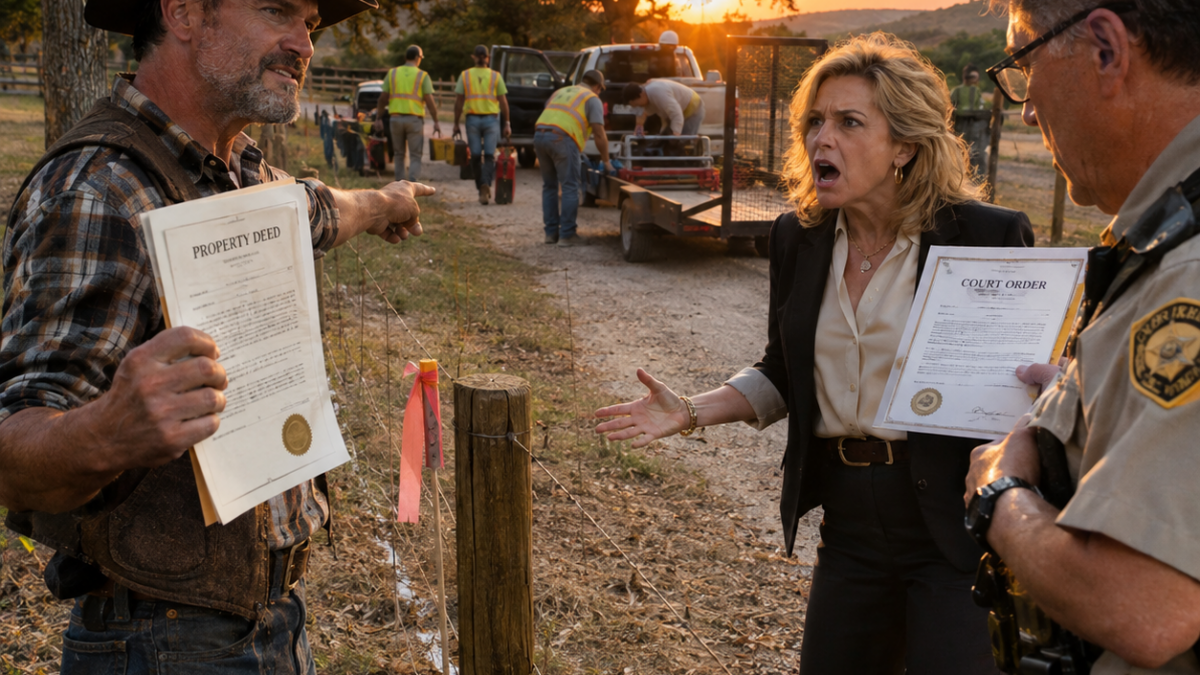
PART 2
Not because I was afraid of Vanessa.
Because there were twelve workers, two excavators, several trucks, and a machine operator sitting behind thick glass waiting for instructions.
Land disputes turn stupid when pride enters them.
I refused to let mine become one of those stories where somebody gets crushed because two adults think standing in front of a bulldozer proves a legal point.
I kept filming.
Truck plates.
Company logos.
Orange stakes.
Excavator positions.
The gap cut through my fence.
My old pasture.
Time stamp.
Wade’s name.
Vanessa’s SUV.
Everything.
Vanessa watched me.
“Call whoever you want.”
I looked at her.
She smiled.
“By tomorrow, this road will already be here.”
That sentence mattered.
I didn’t understand how much yet.
I called the Pine Ridge County Sheriff’s Office.
My voice stayed calm.
“My name is Grant Holloway. There is a construction crew currently excavating a road across land I own. I have not given permission.”
The dispatcher asked whether anyone was threatening me.
“No.”
“Any weapons?”
“No.”
“Any physical confrontation?”
“No.”
“Stay clear of heavy equipment. Deputy is on the way.”
My next call went to Derek Boone.
Licensed surveyor.
Derek had set the modern boundary pins on my property.
He had also known my father.
He answered on the third ring.
“Grant?”
“Someone is building a road across the north pasture.”
A pause.
“Say that again.”
“Sterling Crest. They’re claiming an easement.”
“Which corridor?”
“From behind the clubhouse to County Road 18.”
Longer pause.
Then:
“I’m coming.”
Deputy Marcus Talbott arrived first.
Marcus was the kind of deputy rural counties depend on.
Slow voice.
No wasted motion.
Not interested in becoming anybody’s personal enforcer.
I showed him my deed.
Vanessa showed him a page labeled:
EXHIBIT C2 — PLANNED COMMUNITY ACCESS CORRIDORS
Marcus read both.
I said,
“They’re inside my fence.”
Vanessa said,
“The association has rights through its master development plan.”
Marcus looked at me.
Then her.
“I’m not a surveyor.”
Vanessa smiled.
“And I’m not a judge.”
Her smile weakened.
He turned to me.
“This is likely a civil issue if both sides are claiming documents.”
I hated hearing that.
“So they keep digging?”
“I can’t adjudicate title on the shoulder of a pasture.”
I clenched my jaw.
Marcus continued.
“But I am opening an incident report.”
He wrote down that I was present.
That I claimed ownership.
That I had objected.
That the construction continued after my objection.
Then he looked directly at Vanessa.
“If you keep building while property rights are actively disputed, you do so at your own risk.”
She gave him the kind of smile people use when they believe a warning is technically irrelevant.
“Thank you, Deputy.”
Then she turned.
“Keep moving.”
The excavator kept moving.
Forty minutes later, Derek’s pickup bounced across the field.
He got out carrying his instrument, field notes, and a shovel.
No greeting.
No argument.
He walked straight toward the old drainage ditch.
Then he crouched.
Pulled aside grass.
There it was.
The weathered stone monument.
My father used to point it out when I was a kid.
“Don’t ever let anybody move that.”
He had said it casually.
Back then, I thought he meant cows.
Derek found two iron pins.
Set up his equipment.
Shot the line.
Checked again.
Then walked toward the orange HOA stakes.
He measured.
Twenty-nine feet inside my property at one point.
Thirty-one at another.
Thirty-four near the center.
He looked at Wade.
“Your corridor is inside Holloway land.”
Wade stared at his map.
“You sure?”
Derek gave him the kind of look surveyors reserve for people asking if gravity might be negotiable.
“Yes.”
Vanessa walked over.
Derek held out her exhibit.
“This is not a recorded easement.”
“It’s in the development file.”
“That isn’t the same thing.”
“It shows access.”
“It shows proposed access.”
Vanessa folded her arms.
Derek tilted the photocopy.
Something caught his eye.
He frowned.
“Grant.”
“What?”
“Look.”
The bottom of Vanessa’s copy ended abruptly.
Derek opened his own archived copy of the same old development exhibit.
There was additional text along the lower edge.
Tiny print.
FOR PLANNING PURPOSES ONLY — NOT FOR CONVEYANCE
Vanessa’s copy had been trimmed just above that language.
I looked at her.
She did not look surprised.
That was the moment my thinking changed.
This was not just a confused HOA president reading an old map badly.
Somebody had given contractors a version missing the sentence that said the drawing created no property right.
Derek looked at Wade.
“If I were you, I’d stop.”
Wade looked toward Vanessa.
I said,
“Wade, I’m asking you professionally. Shut it down until this is sorted.”
He hesitated.
For the first time, I saw doubt.
Then Vanessa stepped between us.
She held up a letter.
“Sterling Crest indemnifies the contractor for any property-right dispute connected to this project.”
Wade read it.
Vanessa said,
“You’re being paid to build a road, not interpret deeds.”
I kept filming.
Wade looked at me.
Then at the excavator.
He exhaled.
And signaled the operator forward.
By then, about seventy feet of sod had been stripped.
The pasture that had been green that morning was exposed red clay.
I stood there looking at it.
The anger hurt physically.
That field wasn’t valuable because it was picturesque.
It was valuable because it was ours.
My father ran cattle there.
My mother once planted a row of fruit trees along the fence because she thought the view needed color.
Only two trees survived.
We still called the place “the orchard strip.”
Family language makes land heavier.
Every rut looked personal.
I wanted to walk over and drag those stakes out one by one.
Instead, I called Caroline Prescott.
Real estate attorney.
She had handled land matters for my family for years.
I sent her photographs.
Video.
Deed.
Survey.
Derek’s measurements.
Vanessa’s exhibit.
Deputy incident number.
She called me almost immediately.
Her first sentence:
“Do not touch their equipment.”
“I wasn’t planning to.”
“Good.”
Her second sentence:
“Get me the full county recording history.”
“Derek can help.”
“And Grant?”
“Yes?”
“Stop arguing with Vanessa.”
“That won’t be difficult.”
“I don’t care what she says in the field. I care what she can prove in the courthouse.”
That was the first thing all day that made me feel like I had a direction.
Caroline started searching.
Derek and I went to the county recorder’s office.
We pulled plats.
Deeds.
Development filings.
Subdivision records.
Every recorded instrument touching my parcel.
There was no easement.
Nothing.
No access right.
No thirty-foot corridor.
No Sterling Crest interest.
Then Caroline called.
“I found why they need your pasture.”
“What?”
“This isn’t an emergency road project.”
“That’s what they’re calling it.”
“It’s connected to the clubhouse expansion.”
“What expansion?”
“Sterling Crest filed to convert the clubhouse into a commercial event venue.”
I sat down in the records room.
She continued.
“County fire review requires a second vehicle access route.”
“That’s the road.”
“Yes.”
“How long have they known?”
“Months.”
I looked toward Derek.
He was watching me.
I put Caroline on speaker.
She explained the options Sterling Crest had submitted.
Option one:
Road entirely on HOA property.
Steep hillside.
Retaining wall.
Drainage.
Major grading.
Estimated cost:
$680,000 to $740,000.
Option two:
Straight across my flat pasture.
Contract value:
$318,000.
The difference was more than $360,000.
I understood immediately.
Vanessa hadn’t “corrected” my boundary.
She had found the cheapest road.
Then looked for paperwork that could be made to justify it.
Caroline said,
“There’s more.”
I closed my eyes.
“Of course there is.”
“In 2007, the original Sterling Crest developer approached your father.”
I remembered something.
A conversation at the kitchen table.
My father saying the developer wanted access.
My mother saying she didn’t want more traffic near the farm.
“What did he sign?”
“Nothing.”
I exhaled.
Caroline continued.
“The developer offered to purchase an easement across the western pasture. Your father refused.”
“Recorded?”
“The offer is documented in development correspondence. No easement was created.”
“What about Exhibit C2?”
“Predates the offer.”
That hit me.
The road shown on the old concept plan was not proof that access existed.
It was proof that the developer hoped access would exist if my father agreed.
He didn’t.
The road died.
Almost twenty years later, Vanessa had resurrected the drawing and pretended the hope had become a right.
Derek pulled the official Sterling Crest subdivision plat.
We compared every line.
No road across my land.
He prepared an emergency affidavit.
Boundary monuments.
Coordinates.
Distances.
Encroachment.
Everything.
Caroline drafted a motion for a temporary restraining order.
Meanwhile, Vanessa accelerated.
One of my neighbors texted me.
Another gravel truck just went in.
Then a photograph.
Excavators working faster.
They were trying to create what lawyers call a fait accompli.
Build enough.
Spend enough.
Damage enough.
Then argue that undoing it would be unreasonable.
Vanessa had already told me:
“By tomorrow, this road will already be here.”
Now I understood.
That was the strategy.
Caroline filed.
Then the HOA attorney contacted her.
Nathan Bellamy.
He claimed Sterling Crest had constructive notice rights.
Attached another map.
This one looked far more official.
Parcel numbers.
Page reference.
Stamp.
And in clean lettering over my pasture:
30-FT ACCESS EASEMENT
For one moment, my stomach dropped.
I stared at it.
“What if we missed something?”
Derek leaned over my laptop.
“Wait.”
He enlarged the image.
Studied the lettering.
Then opened the certified county copy.
“Font’s different.”
“What?”
“This label.”
He pointed.
The words “30-FT ACCESS EASEMENT” were not formatted like the original annotations.
On the official county version, the same corridor said:
PROPOSED ACCESS — SUBJECT TO OWNER APPROVAL
On Sterling Crest’s version, the second half was gone.
Again.
Important words disappearing.
Caroline did not accuse anybody of altering a document.
Not yet.
She sent Nathan one question:
Please provide the county instrument number, deed book, and page at which this easement was recorded.
No answer.
Instead, a text arrived from my neighbor.
They’re spreading gravel now.
I stood up.
“I’m going back.”
Caroline looked at me.
“No.”
“They’re putting stone on my pasture.”
“I know.”
“I’m going back.”
“Grant.”
“What?”
“Vanessa wants you angry in a field.”
I didn’t answer.
“I need you calm in front of a judge.”
That stopped me.
My hands were shaking.
I hated that.
I had done nothing wrong.
Yet I was the one who had to walk away while somebody destroyed my land because the legal system needed time.
I gathered the binder.
Deed.
Survey.
Plat.
Incident report.
Derek’s affidavit.
Concept exhibit.
Full version.
Planning file.
Photographs.
Videos.
Then I walked into the Pine Ridge County Courthouse.
Caroline met me on the steps.
Vanessa arrived minutes later with Nathan.
Perfectly composed.
She glanced at the deed under my arm.
Smirked.
“You’re really betting everything on that old piece of paper?”
I looked at her.
Almost answered.
Caroline touched my elbow.
I kept walking.
Judge Rebecca Sloan had a reputation in the county.
Quiet.
Precise.
No patience for theatrical nonsense.
Her afternoon docket was full.
We had one short emergency opening.
Caroline presented the record chronologically.
My deed.
Recorded title.
Survey.
Derek’s affidavit.
County index search showing no easement.
Deputy report showing I objected before continued work.
Video of active excavation.
The judge listened.
Then turned to Nathan.
“Where is the recorded easement?”
Nathan began explaining Sterling Crest’s master declaration.
The judge let him speak.
Then asked again.
“Where is the recorded easement over Mr. Holloway’s parcel?”
Nathan paused.
“The association believed its development documents created access rights.”
Judge Sloan looked at me.
“Mr. Holloway is not a Sterling Crest member?”
“No, Your Honor,” Caroline answered.
“His parcel never joined the subdivision?”
“No.”
She looked at Nathan.
“Then Sterling Crest’s declaration governs Sterling Crest property and those who purchased into it. It does not convey rights across neighboring land.”
Vanessa’s face changed slightly.
First crack.
Caroline asked permission to play the field video.
The courtroom screen showed Vanessa.
My deed in my hand.
Her laugh.
My question about recording.
Then her voice:
“Keep working.”
The excavator moving.
Judge Sloan watched the entire clip.
No expression.
Then she checked the clock.
“How many machines are currently on the Holloway parcel?”
Caroline checked the latest photographs.
“Two excavators, three dump trucks, and approximately twelve workers.”
Judge Sloan turned toward Nathan.
“Will Sterling Crest voluntarily suspend construction until the claimed easement can be adjudicated?”
Nathan leaned toward Vanessa.
I could see he wanted to say yes.
She whispered urgently.
He whispered back.
She shook her head.
Nathan straightened.
“The association cannot agree to a full cessation because the route concerns public safety.”
Caroline stood.
“If this is an immediate public-safety emergency, why was the construction contract signed only two weeks ago?”
Nathan paused.
Caroline placed the county planning application in front of the judge.
“And why is this road a condition attached to a commercial clubhouse expansion?”
Judge Sloan read.
Event venue.
Commercial use.
Second access requirement.
Alternative route.
Estimated costs.
The public-safety shield disappeared in less than thirty seconds.
The road was not being built because Sterling Crest residents would otherwise be trapped during an existing emergency.
Sterling Crest wanted to expand a clubhouse into a profitable event venue.
The county required another access road.
The cheaper road crossed me.
That was the truth.
Judge Sloan picked up the HOA map.
The one labeled 30-FT ACCESS EASEMENT.
“Where did this come from?”
Nathan looked at Vanessa.
“My client’s archive.”
The judge looked at her.
“Ms. Whitmore, is this a recorded easement?”
Vanessa said,
“It’s part of our historical development documents.”
“That was not my question.”
Vanessa hesitated.
“I believe it was recorded.”
Judge Sloan set the paper down.
“Belief is not a recording number.”
Derek appeared by video.
He walked through the boundary.
Stone monument.
Iron pins.
Survey coordinates.
Recorded description.
All three markers consistent.
Then the stakes.
Twenty-nine to thirty-four feet inside my parcel.
Judge Sloan took notes.
I began to think we might actually stop it.
Then Caroline looked at me.
A tiny nod.
She had one more document.
I didn’t know what it was.
She gave it to the clerk.
“Your Honor, this was attached to the association’s county planning materials.”
Email.
Six weeks old.
Former Sterling Crest attorney.
To board recipients.
He advised that the western route crossed Holloway property.
No recorded easement had been found.
Owner consent or purchase would be required before construction.
Recipient list.
Vanessa Whitmore.
The courtroom went silent.
Caroline didn’t accuse her of lying.
She didn’t need to.
Judge Sloan looked directly at Vanessa.
“You received written advice that no recorded easement had been located.”
Nathan stood.
“Your Honor, may we have a moment?”
They conferred.
When Nathan returned, his whole strategy had changed.
No more absolute easement claim.
He asked the court for forty-eight hours to secure the site.
Caroline objected.
“Forty-eight hours is sufficient to finish most of this roadbed, after which Sterling Crest will return arguing removal is too burdensome.”
Judge Sloan looked at the clock.
Then at Nathan.
“Forty-eight hours is unnecessary.”
She turned to her clerk.
“Prepare the order.”
Every word that followed felt unreal.
Stop all excavation.
Stop grading.
Stop placement of material.
No additional workers.
No additional equipment.
No vehicles entering my parcel for project purposes.
No movement or covering of survey monuments.
All personnel and machinery removed.
Nothing left obstructing my use.
Caroline said,
“Your Honor, may we have a fixed compliance time?”
Judge Sloan nodded.
“Clerk, official sunset today?”
A few seconds.
Then:
“7:42 p.m.”
Judge Sloan wrote it into the order.
All personnel, vehicles, machinery, and active operations associated with Sterling Crest to be removed from the Holloway parcel no later than 7:42 p.m.
Vanessa stood.
“That’s impossible.”
Judge Sloan looked at her.
“Why?”
“Two excavators cannot be demobilized safely that fast.”
Caroline said,
“They were mobilized onto the parcel in a matter of hours.”
Vanessa glared at her.
Judge Sloan said,
“If there is a genuine equipment-safety issue, the contractor may coordinate with the sheriff’s office. Logistics will not be used to continue construction.”
She signed.
The clerk stamped it.
I stared at the signature.
That old piece of paper Vanessa had laughed at in the morning had just been backed by another piece of paper she could not ignore.
Outside the courthouse, she came after me.
“You just made the entire community pay for your stubbornness.”
I stopped.
“Then you should have bought the easement.”
That was all.
No shouting.
No insult.
I walked away.
Marcus Talbott was waiting with the certified order.
Assigned to serve it.
We drove back together.
His cruiser ahead of my truck.
When we reached the pasture, machines were still running.
Vanessa had beaten us back.
She was waving crews forward.
Trying to finish another section.
Dump truck raised.
Stone pouring.
Marcus parked.
Walked into the safe zone.
Found Wade.
Served the order.
Wade read it.
His face changed immediately.
He raised his fist.
The excavator operator stopped.
Another machine died.
Then the skid steer.
Then the truck.
One by one, engines shut down.
Silence fell across my pasture.
The first true silence of the day.
I will never forget it.
Vanessa marched toward Marcus.
“We need to secure the construction area overnight.”
Marcus held up the order.
“Not my ruling.”
“This equipment cannot be abandoned unsecured.”
“It cannot remain on the Holloway parcel after 7:42.”
“We have liability.”
“Then remove it.”
“We need to finish grading the stone already placed.”
“That would be an active operation.”
“You’re being unreasonable.”
“I’m reading a court order.”
Wade stepped aside.
Called his office.
Two minutes later, he returned.
“We’re pulling everything.”
Vanessa stared at him.
“You have a contract.”
“We do.”
“You answer to us.”
“We answer to the contract and the law.”
Her expression hardened.
“Our indemnity protects you.”
Wade shook his head.
“It does not protect us from contempt.”
First truck left at 5:58.
Then another.
Workers collected tools.
Survey gear.
Portable signs.
Fuel cans.
Timber mats.
I stood near the stone monument.
Didn’t say a word.
The strangest race I had ever watched had begun.
Not a race with cheering.
A race with sunset.
Vanessa kept trying to slow it.
First she demanded one excavator stay overnight as security.
Wade refused.
Then she ordered already-delivered gravel leveled.
Marcus stopped that.
“Active operation.”
Then she argued the work zone needed temporary drainage before shutdown.
Marcus pointed at the order.
“No new work.”
She called Nathan.
I could hear only her half.
“You need to fix this.”
Pause.
“No, I am not leaving two machines—”
Pause.
“We pay your firm.”
Pause.
Then louder:
“You’re supposed to protect the association.”
I almost felt sorry for Nathan.
Almost.
By 6:50, most workers were gone.
One dump truck remained deeper in the corridor.
Engine running.
I saw Vanessa beside the driver window.
She pointed toward a gravel pile.
I walked closer.
Not too close.
She was telling him to move one last load farther down the route.
I looked at Marcus.
Nothing else.
He walked over.
Spoke quietly.
Driver put the truck in gear.
Rolled out without unloading.
Vanessa watched him leave.
At 7:09, the first excavator crossed the surveyed boundary.
One left.
Sun dropping.
At 7:23, the second excavator hit trouble.
One timber mat sank into soft clay beside the ditch.
Machine stopped.
Vanessa immediately raised her voice.
“There. It cannot be safely removed tonight.”
Wade walked over.
Inspected the track.
“We can move it.”
“No.”
“We lift the mat and route around.”
“That will damage the field.”
I almost laughed at the irony.
Marcus’s body camera was running.
Wade directed his men.
They shifted the mat.
Machine crawled forward.
7:34.
About a hundred feet left.
The sun was touching the ridge.
Then Vanessa did something so reckless even her own crew stared at her.
She walked in front of the excavator.
Hands up.
“Stop!”
The operator stopped.
Wade walked toward her.
“This machine leaves.”
“The association controls this equipment under contract.”
“No.”
She stared at him.
“You hired us.”
Wade’s voice stayed even.
“You do not own our equipment.”
Vanessa’s phone rang.
Nathan.
She answered.
I heard his voice from several feet away.
“Vanessa, get out of their way.”
She stood there three more seconds.
Then moved.
The excavator started again.
7:39.
Tracks crossed Derek’s boundary line.
Wade followed behind.
Last crew member.
7:41.
Marcus walked the corridor.
No workers.
No machines.
No vehicles.
Only torn soil.
Scattered gravel.
Orange stakes.
At 7:42, the sun slipped behind the trees.
Vanessa stood on the Sterling Crest side of the property line.
The same line she had laughed at that morning.
No machine remained on my land.
I looked at one orange stake near my boot.
Bent down.
Started to pull it.
Marcus touched my arm.
“Leave it.”
I looked at him.
“Evidence.”
He was right.
I pushed it back.
That tiny act might have been the hardest part of the entire day.
Because after hours of watching strangers tear into my land, I wanted one small physical gesture that said it was mine again.
But discipline had gotten me that far.
I wasn’t going to throw it away for the satisfaction of pulling one stake.
Wade came toward me carrying a photocopy.
“Mr. Holloway.”
“Yes?”
“You should see this.”
Top:
OWNER AUTHORIZATION
Bottom:
My name.
Signature.
Not my signature.
Not even particularly good.
It resembled the kind of version someone produces after seeing your name printed but not watching you sign.
I stared.
“Where did this come from?”
“HOA packet.”
“You relied on this?”
“Among other documents.”
“I never signed it.”
Wade’s face tightened.
“If we’d known you objected, we wouldn’t have entered.”
I photographed it.
Sent it to Caroline.
That page changed the case again.
Now it wasn’t only:
Does an easement exist?
It was:
Why was a contractor handed a document claiming I consented when I never had?
I did not publicly accuse Vanessa of forging anything.
I didn’t know who created it.
That distinction mattered.
Caroline filed it with the court.
Wade gave a written statement the next morning.
Inside Sterling Crest, board members started panicking.
They had been told land rights were cleared.
They had been told counsel approved the route.
But their former attorney’s email said the opposite.
Elaine Porter, the HOA treasurer, started reading.
Retired accountant.
Patient.
Dangerous to anybody hiding numbers.
She found the board motion Vanessa used to launch the project.
The route was described as:
EXISTING ASSOCIATION ACCESS
No vote to purchase an easement.
No appraisal.
No compensation budget.
No landowner contact.
Nothing.
The entire $318,000 project assumed I would either not notice fast enough or not fight hard enough.
Caroline sent preservation notices.
Emails.
Board minutes.
Maps.
Contracts.
Authorizations.
Invoices.
Metadata.
Nothing deleted.
Nothing altered.
Vanessa started campaigning against me.
Residents received messages about one stubborn landowner blocking community safety.
The usual story.
Selfish farmer.
Community need.
Safety.
Progress.
I refused to knock on doors and defend myself.
Caroline issued one statement for me:
Mr. Holloway does not object to Sterling Crest constructing an access road on Sterling Crest property. He objects to Sterling Crest constructing one on his property without purchasing, leasing, or otherwise holding a lawful easement.
That was it.
No insults.
No accusation.
The effect was stronger than any rant I could have made.
Residents began asking:
Why didn’t the HOA just buy an easement?
Why wasn’t the old attorney’s warning shared?
Why had $318,000 been committed to land the HOA did not own?
Why was the cheaper route being called an existing right when documents showed otherwise?
Then the board found the email that destroyed Vanessa’s last excuse.
Three weeks before construction.
From Vanessa.
To the contractor’s project manager.
Not copied to the full board.
The message said that if Holloway objected, construction should be far enough along that removal would become impractical.
I read it sitting in my truck beside the torn pasture.
Once.
Twice.
Then a third time.
Everything finally made complete sense.
She never believed my deed was worthless.
She believed speed could make it irrelevant.
Build first.
Force reality.
Let the landowner discover a half-finished road.
Then argue that tearing it out cost too much.
That was the entire plan.
At the next hearing, Sterling Crest stopped claiming an unquestionable right.
Nathan told Judge Sloan the association wished to negotiate purchase of an easement.
I declined.
Not forever.
Not as a matter of pride.
But I was not negotiating while an injunction was still necessary to keep them off land they had already entered without permission.
Through Caroline, I said:
“If Sterling Crest wants to discuss a lawful transaction in the future, it can do so after the property is restored and the current dispute is resolved.”
Judge Sloan kept the injunction in place.
Then came the restoration assessment.
Derek.
Land restoration specialist.
Engineer.
About 430 feet of ground had been graded.
Topsoil stripped.
Natural drainage altered.
Fence removed.
Gravel embedded in soil.
The first restoration estimate came in above $86,000.
Not counting legal fees.
Not counting survey work.
Not counting erosion monitoring through a full wet season.
Wade’s company sent its own bill to Sterling Crest.
Mobilization.
Emergency demobilization.
Lost schedule time.
Contract disruption.
Then Sterling Crest’s insurance carrier opened a coverage review.
That frightened the board.
The carrier wanted to know why construction proceeded after Vanessa had received written legal advice stating no easement existed.
Some losses might not be fully covered if they resulted from knowing unauthorized conduct.
Translation:
Homeowners might have to pay.
At a special board meeting, Elaine asked Vanessa a question.
I wasn’t in the room.
Nathan later repeated it during discussions.
Elaine said:
“If we had the right to use his land, why did we need to build fast enough before he objected?”
Vanessa did not answer.
The board stripped her of authority over the project.
Internal investigation opened.
The owner-authorization page was referred for separate review.
Again, there were no handcuffs.
No dramatic police scene.
Her consequences came through systems.
Court.
Contractor.
Insurance carrier.
County.
Board.
The same systems she had assumed she controlled.
Sterling Crest agreed to fund full restoration.
I asked Derek to reset every monument.
Then I asked for something more important.
A new survey.
Clear.
Recorded.
No ambiguity.
No old sketch somebody could wave around in fifteen years.
We filed it with the county.
My boundary became even harder to misunderstand than before.
The county suspended Sterling Crest’s clubhouse expansion permit.
Without a valid second access road, no commercial event venue.
The $318,000 shortcut across my pasture was dead.
If they wanted expansion, they had to build the route on their own land.
The expensive route.
Retaining wall.
Drainage.
Hillside grading.
Nearly $700,000.
One afternoon, Vanessa asked to meet me.
Coffee shop near the courthouse.
I almost said no.
Caroline said,
“You can meet her. Just don’t agree to anything.”
Vanessa looked different.
Still controlled.
But quieter.
She said,
“All of this can go away.”
“What does that mean?”
“Sell us the easement.”
I looked at her.
“Now?”
“Yes.”
“You’re offering to buy the route you said you already owned?”
Her jaw tightened.
“We can resolve the dispute.”
“What’s the price?”
For the first time, something relaxed in her face.
She thought I had surrendered.
She started talking about market value.
I held up one hand.
“I wasn’t asking what you’ll pay me.”
She stopped.
“I was asking what your shortcut has already cost everyone.”
Her expression changed.
I stood.
Left money for my coffee.
Walked out.
By early spring, the scar began disappearing.
Trucks came in.
This time with my permission.
The gravel Vanessa had ordered dumped across the pasture was excavated and removed.
Topsoil returned.
Drainage contours rebuilt.
Seed planted.
Fence replaced.
Derek checked every post.
Exactly on the recorded line.
I placed one small sign near the spot where the excavator first entered.
PRIVATE PROPERTY
RECORDED BOUNDARY
No Vanessa.
No insult.
No joke.
Didn’t need one.
Across the valley, Sterling Crest began work on its new access road.
Their land.
Their hillside.
Their retaining wall.
Their permits.
More expensive.
Longer.
But legal.
The internal investigation eventually concluded Vanessa had exceeded her authority and provided contractors incomplete or misleading information.
The board accepted her resignation as president.
She didn’t attend the meeting.
The question of who created the owner-authorization signature went to separate review.
I never made public accusations beyond what documents could support.
Some people wanted me to.
Neighbors asked:
“Are you going to sue her personally?”
“Are you going to press charges?”
“Are you going after the HOA?”
I let Caroline handle the legal questions.
What I cared about was the field.
People assume revenge feels like watching your opponent fall.
Maybe sometimes.
For me, satisfaction came much later.
April.
Cool afternoon.
Caroline drove to the farm.
Derek came too.
She handed me a certified copy of the final recorded order.
Plain language.
Sterling Crest held no easement across the Holloway parcel.
None.
No implied access.
No master-plan right.
No HOA authority.
Nothing.
I put it in the same folder as my deed.
Derek laughed.
“You should frame these.”
“Why?”
“Hang them above the fireplace.”
I looked across the pasture.
Green again.
Fence straight.
Stone monument visible near the ditch.
“I don’t need to.”
He smiled.
“The line says enough?”
“Exactly.”
That evening, after everyone left, I walked alone toward the old monument.
The same place Vanessa had stood months earlier.
I could still hear her laugh in my head.
“Those documents are old.”
Funny thing about deeds.
They are supposed to be old.
That is part of what makes them matter.
A deed is a record of ownership surviving presidents.
Boards.
Developers.
Plans.
Opinions.
Vanessa treated age like weakness.
The court treated it like history.
I sat on the fence rail.
From there, I could see Sterling Crest’s new road curling along the far hillside.
It was uglier than their original concept.
Longer.
Expensive.
But it sat on their land.
That made it beautiful to me.
My side was quiet.
Cattle grazing again.
Grass covering most of the scar.
For months, people had called what happened a victory.
I suppose it was.
But victories are rarely clean.
The pasture had been damaged.
Money spent.
Neighbors angry.
Residents faced costs created by decisions they didn’t personally make.
Contractors lost time.
My family lost weeks of peace.
There was no way to undo all of that.
Still, something important survived.
The principle.
Sterling Crest could govern Sterling Crest.
It could write rules for homes whose owners voluntarily joined.
It could collect dues.
Approve paint colors.
Maintain roads.
Build amenities.
Whatever its documents lawfully allowed.
But it could not vote itself ownership of my pasture.
That line mattered.
Maybe more because the pressure had been so strong.
I thought about my father.
He had died years earlier.
I remembered the 2007 offer only vaguely before Caroline found it.
Developer wanted access.
Dad said no.
At the time, I thought he was being stubborn.
I was younger.
Developers offered money.
Road seemed harmless.
I remember asking him:
“Why not sell them a strip?”
He had looked toward the west field.
“Because roads don’t stay strips.”
I didn’t understand.
He explained:
“Today it’s access. Tomorrow it’s traffic. Then utilities. Then maintenance. Then somebody tells you they’ve been using it so long it’s basically theirs.”
I laughed at him.
“You’re paranoid.”
He smiled.
“Maybe.”
Years later, Vanessa almost proved him prophetic.
Except there was one difference.
My father had kept the papers.
Deed.
Survey.
Old offer.
Correspondence.
And I had learned enough from him to keep mine.
One Saturday, a Sterling Crest homeowner named Martin came by.
He stood outside my fence.
“Mr. Holloway?”
“Grant.”
“I’m Martin.”
We shook hands.
He looked embarrassed.
“I signed the petition against you.”
I hadn’t known there was one.
“Okay.”
“Vanessa sent it around.”
“What did it say?”
“That you were blocking an emergency route unless the HOA paid you an outrageous amount.”
I smiled slightly.
“No one offered me anything.”
“I know that now.”
He looked at the pasture.
“My wife told me not to sign it.”
“Smart woman.”
He laughed.
“Very.”
Then serious again.
“I’m sorry.”
I nodded.
“Thank you.”
“I thought you were holding the neighborhood hostage.”
“I understand.”
“Do you?”
“Vanessa gave you one version.”
He looked toward the new hillside road.
“That thing is costing us a fortune.”
“I know.”
“Some people still blame you.”
“I know.”
“Does that bother you?”
I thought about it.
“Less than two excavators in my pasture.”
He laughed despite himself.
That conversation helped me.
For a while, I had started thinking of Sterling Crest as Vanessa.
That wasn’t fair.
An HOA is not one person.
A neighborhood isn’t a president.
Some residents believed her.
Some questioned.
Some eventually pushed back.
Elaine did.
Two board members did.
The contractor did.
Nathan ultimately told her to comply.
Even people who had supported her learned.
The danger wasn’t Sterling Crest existing.
It was Sterling Crest forgetting where it ended.
Months later, Wade came by.
His company had been paid through the dispute process.
He wanted to return a piece of paperwork.
The original construction map packet.
“I don’t need it.”
“You might.”
I took it.
He stood awkwardly.
“I should’ve stopped that morning.”
I looked at him.
“You asked questions.”
“Not soon enough.”
“You had an indemnity letter and owner authorization.”
“I also had a surveyor telling me the stakes were wrong.”
Fair.
He continued.
“My company changed policy.”
“What kind?”
“Private-property work now requires direct confirmation from the recorded owner if there’s any easement issue.”
“Good.”
“I wish we’d done it before.”
“So do I.”
He nodded.
“Vanessa told us everything was cleared.”
“I know.”
“We believed her.”
“I know.”
Then he said,
“The worst part?”
“What?”
“When you walked over calm and asked us to stop, I thought you were just trying to renegotiate money.”
That surprised me.
“Why?”
“Because that’s how she framed you.”
“Of course.”
“She said you’d agreed years ago and were exploiting the project deadline.”
I looked across the field.
“That explains why nobody listened.”
“Yeah.”
He extended his hand.
I shook it.
“I’m sorry.”
“Thank you.”
Sometimes apologies matter even when they don’t fix anything.
They move the burden.
For months, I had wondered whether I had somehow failed to communicate clearly enough.
No.
They had been given a story designed to make my objection look dishonest.
That wasn’t my fault to carry.
The following rainy season tested the restoration.
I walked the ditch during the first major storm.
Water flowed where it was supposed to.
No erosion.
No gravel washout.
The repaired slope held.
Derek came out afterward.
“Looks good.”
“It better.”
“Still mad?”
“Yes.”
He laughed.
“Healthy.”
“Mostly.”
We stood beside the stone monument.
He tapped it with his boot.
“You know this little thing did a lot of work.”
“More than me.”
“Definitely more than you.”
I looked at him.
“Thanks.”
“For what?”
“Showing up that morning.”
“That’s my job.”
“So was being right.”
He smiled.
“Usually part of surveying.”
We laughed.
The final cost to Sterling Crest was never just one number.
Restoration.
Emergency contractor removal.
Legal expenses.
Insurance disputes.
New survey work.
The failed $318,000 route.
Then the expensive hillside route.
The event expansion delay.
Residents eventually learned the shortcut cost far more than doing things correctly would have from the beginning.
That was the irony.
Vanessa thought buying an easement would be expensive.
Maybe it would have been.
She never actually tried.
Instead, she gambled that she could turn my land into a free input.
That gamble became more expensive than any honest offer.
I once asked Caroline:
“What if Vanessa had knocked on my door and offered fair money?”
“Would you have sold?”
I thought about it.
“Probably not.”
She smiled.
“So?”
“But I would’ve listened.”
“That’s the difference.”
Exactly.
Permission includes the possibility of no.
People like Vanessa don’t hate negotiations because they cost money.
They hate negotiations because someone else gets a vote.
That was what she could not tolerate.
The new Sterling Crest board eventually wrote me a formal letter.
Acknowledgement of boundary.
No easement.
No association rights across the Holloway parcel.
Future work near the boundary required advance notice.
I read it.
Filed it.
Didn’t frame that either.
My sister laughed when I told her.
“You keep everything in folders.”
“Dad did.”
“He also kept receipts from 1984.”
“He was thorough.”
“He was a hoarder.”
“Organized hoarder.”
We both laughed.
Then she said,
“He would’ve loved the sunset order.”
I smiled.
“Probably.”
“No. He would’ve carried copies around.”
“That sounds like him.”
“Shown everybody at the feed store.”
“Definitely.”
For the first time since the dispute began, remembering him didn’t make me angry.
It made me miss him.
That was when I realized the fight had been about more than acreage.
Land carries memory.
The pasture was not sacred because it was eighteen-point-four acres.
It was sacred because my father had taught me to mend fence there.
My mother had tried to grow fruit trees there.
My sister and I had raced an old pickup across it when we were teenagers and lied about the ruts afterward.
You cannot put that on a plat.
But the plat protects the place where those memories happened.
That matters.
The next spring, Sterling Crest opened its renovated clubhouse.
Commercial events limited until the new road was complete.
Eventually the hillside route passed inspection.
Long retaining wall.
Drainage channels.
Guardrails.
More expensive than Vanessa’s shortcut.
But safe.
Legal.
The first time I saw emergency vehicles test it, I felt no satisfaction about the cost.
Mostly relief.
Their road worked.
My land remained mine.
Both things could exist.
That was always possible.
Conflict had never been inevitable.
Vanessa made it inevitable by treating another person’s ownership as an inconvenience.
One evening, Elaine called me.
She had remained treasurer through the transition.
“We adopted a new land-access policy.”
“Congratulations.”
“You sound thrilled.”
“I’m trying.”
She laughed.
“Any project touching property outside Sterling Crest now requires a title search, written legal opinion, and owner consent before contracting.”
“Seems obvious.”
“It does now.”
“How expensive was the lesson?”
“Please don’t ask.”
I smiled.
She became quiet.
“I wanted to say something.”
“Go ahead.”
“I voted for the project.”
I knew.
“I believed Vanessa when she said the access existed.”
“I know.”
“I signed budget documents.”
“You weren’t shown everything.”
“I should’ve asked.”
“Maybe.”
She sighed.
“I keep thinking about that email from the old attorney.”
“What about it?”
“If the board had seen it, none of this happens.”
“Probably.”
“She kept it from us.”
I didn’t answer.
Elaine said,
“I hate knowing I sat at that table while she made decisions like that.”
“What did you do when you learned?”
“I opened the files.”
“What did you do after?”
“I told the board.”
“What are you doing now?”
“Trying to fix things.”
“Then keep doing that.”
She thanked me.
The call ended.
I stood on the porch afterward, looking toward Sterling Crest lights in the distance.
Trust is strange.
It can fail collectively even when most individuals believe they are acting normally.
One person controls information.
Everyone else assumes somebody checked.
Contractor assumes HOA checked title.
Board assumes president checked counsel.
Residents assume board checked documents.
Attorney assumes client will follow advice.
Then machines arrive.
That was what happened.
The system only corrected because people finally stopped assuming.
Marcus documented.
Derek measured.
Caroline searched.
Judge Sloan asked one question repeatedly:
“Where is the recorded easement?”
That question cut through everything.
Not:
What did Vanessa believe?
What did the HOA want?
How much had they spent?
How useful would the road be?
How many residents supported it?
Where was the legal right?
There wasn’t one.
Sometimes justice is not complicated.
Sometimes it becomes complicated only because somebody powerful refuses to accept a simple answer.
Years later, people still ask me about the 7:42 deadline.
They love that part.
The sunset.
Machines crawling out.
Vanessa standing on the other side of the line.
It sounds cinematic.
Living through it wasn’t.
I spent most of that evening afraid something would go wrong.
Equipment failure.
Operator accident.
Vanessa provoking somebody.
A worker getting hurt.
A contempt dispute.
Rain.
Soft ground.
Anything.
When that final excavator crossed at 7:39, I didn’t feel triumphant.
I felt my lungs work normally again.
At 7:42, I looked at the empty corridor and thought:
It stopped.
That was enough.
The revenge came later, if you want to call it that.
Not because I caused it.
Because Vanessa’s own decisions started charging interest.
Her board learned she had ignored legal advice.
Insurance questioned coverage.
Contractor demanded payment.
County suspended the permit.
Residents questioned her authority.
The cheaper road vanished.
The expensive road still had to be built.
Then she lost the presidency.
She had tried to save more than $360,000 by using land she didn’t own.
Instead, Sterling Crest paid for restoration, delay, legal work, contractor claims, and the legitimate route anyway.
That is what arrogance costs.
Not punishment from an enemy.
The price of refusing reality.
The last time I saw Vanessa was not dramatic.
No courtroom.
No shouting.
A hardware store.
I was buying fence staples.
She was in the next aisle.
We recognized each other.
For a moment, both of us considered pretending we hadn’t.
Then she said,
“Grant.”
“Vanessa.”
She looked older.
Probably I did too.
She glanced at the box in my hand.
“Still repairing fences?”
“Always.”
Silence.
Then:
“Sterling Crest finished the road.”
“I saw.”
“Cost almost twice what we expected.”
I nodded.
She looked at me.
“Does that make you happy?”
“No.”
She seemed genuinely surprised.
“Why not?”
“Why would homeowners spending more money make me happy?”
“You fought us.”
“I fought you building on my land.”
“Same result.”
“No.”
She looked away.
Then said,
“If you’d sold the easement, it would’ve saved everyone money.”
I considered that.
“You’re right.”
Her eyes came back to me.
“Really?”
“Yes.”
Something almost like vindication appeared on her face.
Then I continued.
“But you didn’t ask me to sell it.”
Her expression changed.
“You told me you already owned it.”
She said nothing.
“You laughed at my deed.”
Silence.
“You gave a contractor a document saying I authorized access.”
She looked down.
“I never knew who created that page.”
I held her eyes.
“I didn’t say you did.”
That mattered.
Even then.
Facts.
Not assumptions.
She exhaled.
“Everything got out of control.”
“No.”
She frowned.
“What?”
“You made choices.”
Her jaw tightened.
“You always did enjoy sounding righteous.”
I shook my head.
“No.”
I picked up another box.
“I just learned not to argue with records.”
Then I walked away.
That conversation changed nothing.
But it gave me closure.
Vanessa still thought of the outcome as something that happened to her.
I thought of it as something created by decisions.
Those views were probably never going to meet.
That was fine.
I didn’t need her apology.
My boundary did not depend on her agreement anymore.
It never had.
One afternoon, years after the dispute, my nephew visited.
He was seventeen.
We walked the western fence.
He stopped at the stone monument.
“What’s this?”
I told him.
He knew the story vaguely.
“Is this the one the HOA tried to move?”
“They didn’t move it.”
“Could they?”
“Physically?”
“Yeah.”
“With equipment, sure.”
“So why does it matter?”
I smiled.
“Because moving the rock doesn’t move the legal boundary.”
He thought about that.
“Then what marks the boundary?”
“The recorded description.”
“And the survey?”
“Shows where that description lands.”
“So the stone is just evidence?”
“Exactly.”
He kicked lightly at the grass.
“That’s kind of cool.”
“Very exciting stuff.”
He laughed.
Then asked,
“What would’ve happened if you didn’t come home that day?”
Good question.
The road might have been finished.
That was Vanessa’s plan.
Would I still have won eventually?
Probably.
But restoration would have been harder.
Arguments louder.
Costs higher.
Maybe Sterling Crest would have claimed reliance.
Maybe more residents would have believed removal was wasteful.
Maybe pressure would have mounted for me to sell after the fact.
That was why speed mattered.
Not Vanessa’s speed.
Mine.
Call surveyor.
Call attorney.
Document.
File.
Move before damage became irreversible.
I told my nephew,
“That’s why owning something means paying attention.”
He nodded.
“Like the fence?”
“Like everything.”
We kept walking.
The pasture looked ordinary.
That was the final success.
No scar.
No roadbed.
No orange stakes.
No machines.
Ordinary.
People often underestimate how beautiful ordinary feels after somebody tries to take it.
The new Sterling Crest road is still visible from my property.
Sometimes at night, headlights curve along the hillside.
Emergency access.
Event traffic.
Maintenance trucks.
It works.
It is also a reminder.
Not of Vanessa.
Of boundaries.
Their road over there.
My pasture here.
No conflict.
No confusion.
Just a line everyone finally respects.
On the anniversary of the court order, I didn’t do anything special.
No celebration.
No social-media post.
No champagne.
I repaired a water line.
Moved cattle.
Answered emails.
That evening I walked toward the stone monument.
Sun lowering.
I checked the time out of curiosity.
7:38.
I laughed.
Four minutes.
I stood there.
7:39.
I imagined the excavator tracks crossing the line.
7:41.
Marcus walking the corridor.
7:42.
Sun behind the trees.
Empty pasture.
The memory still gave me chills.
Not because Vanessa lost.
Because the law worked fast enough.
People complain that paperwork is slow.
Often it is.
That day, the recorder’s office.
Surveyor.
Attorney.
Clerk.
Judge.
Deputy.
All those boring institutions lined up and did exactly what they were supposed to do.
They turned my old deed into something a dozen workers and two excavators had to respect.
That mattered to me.
A country where property exists only until somebody wealthier builds on it is not really protecting property at all.
A deed needs enforcement.
So does a boundary.
So does the word no.
That day, mine got enforcement at 7:42 p.m.
Before walking back to the house, I rested my hand on the fence post.
My father set the original post near that spot.
This one was newer.
Restoration crew installed it.
But the line was the same.
I thought about his refusal in 2007.
At the time, no one considered it important enough to remember.
Just one farmer saying no to one developer.
Almost twenty years later, that no still mattered.
It survived him.
It survived the developer.
It survived Vanessa.
It survived a trimmed map.
It survived a fake-looking authorization.
It survived excavators.
That is the power of a boundary written properly and defended when necessary.
I walked toward the house as the light faded.
Across the pasture, cattle moved slowly through the grass.
The ground that had once been raw clay was green.
The drainage worked.
Fence tight.
The little sign remained:
PRIVATE PROPERTY
RECORDED BOUNDARY
Nothing else needed saying.
Vanessa had laughed because my deed was old.
The judge respected it for the same reason.
It had existed before her plan.
Before her presidency.
Before Sterling Crest’s event venue.
Before the $318,000 construction contract.
Before anybody decided my pasture was the cheaper option.
And when all of those temporary things were gone, the deed remained.
So did the land.
That was the ending I wanted.
Not revenge in the form of humiliation.
Not watching homeowners suffer.
Not an enemy destroyed.
A pasture restored.
A boundary recorded.
A road moved to the land where it belonged.
And one final truth nobody in Sterling Crest could pretend not to understand anymore:
An HOA can govern the property inside its community.
It can vote.
Fine.
Budget.
Build.
Argue.
Plan.
But it cannot laugh at a neighbor’s deed, move a line on a map, and make his land become theirs because the shortcut is cheaper.
Vanessa believed she could.
Right up until sunset.
That morning, she stood inside my pasture and laughed at the papers in my hand.
By 7:42 that evening, every worker, every truck, and every excavator she had ordered onto my property was standing on the other side of the line.
Years later, that line is still there.
Straight.
Recorded.
Quiet.
Mine.








