HOA Karen Kept Cutting My Fence for Her Shortcut—So I Built a Steel Fortress Gate She Could Never Pass
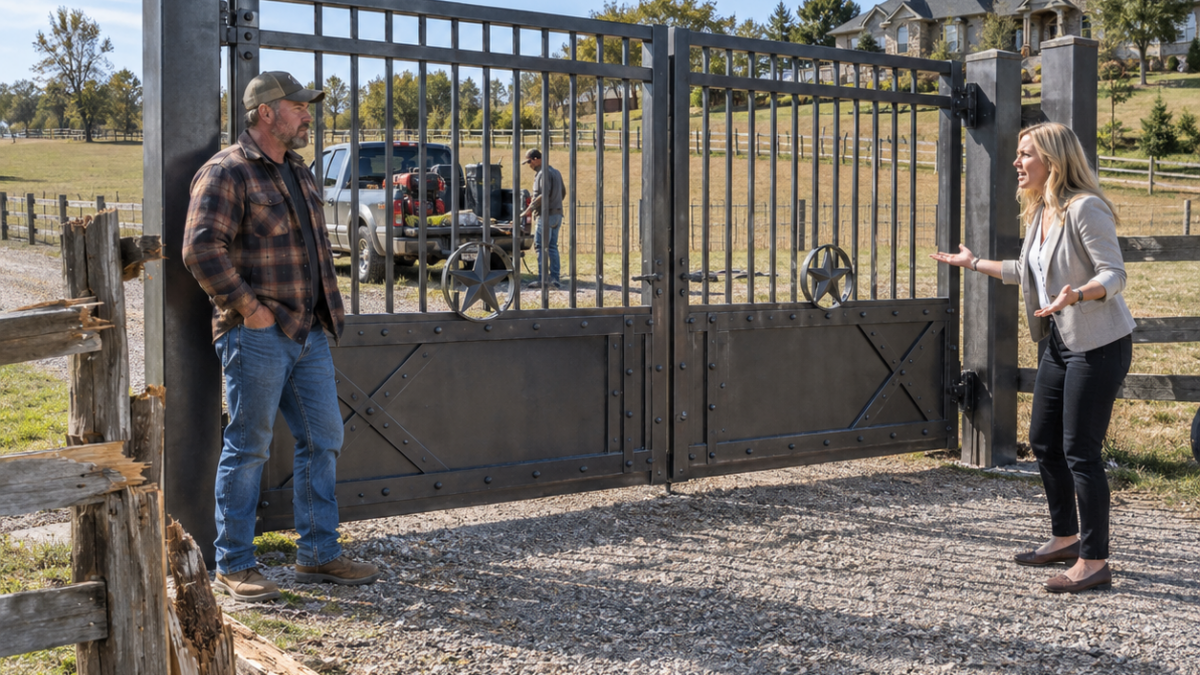
The fourth time she cut my fence, I stopped seeing it as a neighbor dispute and started seeing it as a warning.
Karen stood beside the broken wire with bolt cutters in one hand and the confidence of someone who had never been forced to hear the word no.
What happened after that began with one quiet decision I made at my kitchen table that night.
“This is a community pathway, Sergeant.”
Her voice carried across the wet morning grass like she was reading from a court order instead of inventing a rule.
I stared at the two cleanly severed strands of wire hanging between the posts. My cattle were in the back pasture, thank God, because one open gap could have put a thousand-pound animal on the county road.
Karen didn’t look worried.
She looked irritated that I had shown up.
Behind her sat the white golf cart she used around Oak Creek Estates, parked inches from my property line where my pasture met the development’s clipped lawns and matching fences.
“You cut it again,” I said.
She lifted one shoulder.
“Your barbed wire is ugly, unsafe, and interfering with community access.”
I had spent twenty years in the Army Engineers before retiring as a Sergeant First Class. I understood boundaries. I understood access. And I understood what happened when people decided clearly marked lines applied only when convenient.
“My land is not part of your HOA,” I said. “There is no community access across it.”
Karen patted the thick binder in her golf cart.
“I have the covenants.”
“And I have a deed.”
Her mouth tightened.
This wasn’t our first conversation.
Two months earlier, I had caught her driving over a section of fence she had pushed down to create a shortcut toward the clubhouse. I had been polite then. I explained that the official HOA entrance was half a mile away and that my ranch had never contained a public path.
She claimed the previous owner allowed it.
That was a lie.
After that, I repaired the fence.
A week later, someone cut it.
I repaired it again.
Then it happened a second time.
Then a third.
Now I was looking at the fourth clean cut, and Karen wasn’t even pretending she had nothing to do with it.
“This is criminal damage,” I told her. “And you’re trespassing.”
She scoffed.
“Don’t threaten me, Mr. Callahan. I am the HOA.”
That sentence told me everything.
Not president of the HOA.
Not representative of the HOA.
I am the HOA.
To Karen, the position wasn’t a responsibility. It was ownership.
For five years, my wife Sarah and I had lived peacefully beside that neighborhood. We wanted quiet after my military career. We wanted land, cattle, room for our family, and a life where hard work produced something real.
I had never wanted a feud.
But arrogance becomes dangerous when it threatens your livestock, your property, and your family.
“The next time this happens,” I said, “the sheriff will be involved.”
Karen smiled.
“We’ll see.”
She climbed into the golf cart and drove away through the gap she had made.
I repaired the wire one more time.
But this time, I didn’t stop with pliers.
That afternoon I bought two motion-activated trail cameras and mounted them where they could watch the fence line from different angles. The next morning I drove to the county clerk, obtained a certified copy of my survey, documented every damaged section, and photographed every repair.
Then I sent Karen a certified letter.
No insults.
No threats.
Just dates, statutes, property records, and one unmistakable warning: any future trespass or damage would be reported immediately.
She signed for it.
For two weeks, nothing happened.
Sarah began to think maybe it was over.
Then an envelope arrived from Oak Creek Estates.
Inside was an official violation notice accusing me of failing to maintain my perimeter fence to HOA aesthetic standards.
Karen demanded that I replace the entire quarter-mile stretch with an HOA-approved six-foot privacy fence—at my expense—or face a $100-a-day fine.
I read the letter twice.
Then I laid it beside the certified survey, the photographs, and Karen’s signed receipt.
Sarah stared at the papers.
“She’s fining us for the fence she keeps cutting?”
I looked through the kitchen window toward the property line.
“No,” I said quietly. “She’s trying to teach us that she gets to decide where our boundary is.”
That was the moment I stopped planning another repair.
By sunrise, I knew exactly who I was calling first.
PART 2
At eight o’clock the next morning, I called Tom Sharp.
Tom practiced property and land-use law in the nearest town. He had also been a Marine before becoming an attorney, which meant he had a particular appreciation for two things: clearly written rules and people who tried to twist them.
He answered on the third ring.
“Sharp.”
“Tom, it’s Jack Callahan.”
“Been a while.”
“I’ve got an HOA problem.”
There was a pause.
Then he sighed.
“Those four words have bought me more fishing gear than anything else in my career.”
Despite myself, I smiled.
“I’m serious.”
“So am I. Tell me everything.”
I started at the beginning.
I told him about Karen using my pasture as a shortcut. I told him about the pushed-down wire, the first clean cut, the second, the third, and the fourth. I told him about confronting her. I told him exactly what she had said.
I am the HOA.
Then I explained the certified letter, the county survey, the return receipt with her signature, and the violation notice now demanding that a man who did not live in Oak Creek Estates comply with Oak Creek Estates fencing rules.
Tom stayed silent until I finished.
Then he asked one question.
“Jack, when you bought the ranch, did you ever sign anything placing any portion of your parcel under Oak Creek’s covenants?”
“No.”
“Any easement granting their residents access?”
“No.”
“Any recorded right-of-way?”
“No.”
“Any deed restriction tying your property to their association?”
“No.”
He gave a low chuckle.
“Then Karen’s authority ends exactly where your survey says it ends.”
I leaned back in my chair.
Sarah stood across the kitchen island from me, arms folded, listening.
“So the fines?”
“Worth less than the paper they’re printed on.”
“She’s demanding I replace my fence.”
“She can demand you paint your barn purple and rename your cattle. Doesn’t create jurisdiction.”
Sarah’s shoulders relaxed slightly.
Mine didn’t.
Because the fine wasn’t the thing bothering me.
“What if I replace it anyway?”
Tom went quiet.
“With what?”
“Something stronger.”
“How much stronger?”
“Strong enough that a golf cart and a pair of bolt cutters stop being relevant.”
Another pause.
Then Tom laughed.
Not a polite lawyer laugh.
A genuine one.
“Now you have my attention.”
“I’m not talking about booby traps. Nothing dangerous. Nothing illegal. I want a legitimate agricultural barrier, properly permitted, entirely inside my line.”
“That’s the right answer,” he said immediately. “You stay on your property. You pull every permit the county requires. You document the survey marks before construction. You photograph the work. You keep invoices. You let her throw whatever tantrum she wants on her side.”
“And if she interferes?”
“Call law enforcement.”
“What if she sends more HOA notices?”
“File them.”
“What if she threatens liens?”
“Call me before responding.”
“What if she sues?”
His voice changed.
It lost the humor.
“Then I make her explain to a judge why an HOA is trying to regulate land that has never belonged to the HOA.”
That was the first moment since this mess began that I felt the pressure in my chest ease.
Tom wasn’t telling me to fight harder.
He was telling me to fight cleaner.
There is a difference.
One creates chaos.
The other creates a record.
Before we hung up, he gave me one final instruction.
“Jack, from this point forward, assume every interaction matters. Don’t insult her. Don’t threaten her. Don’t touch her property. Don’t raise your voice. Let her be the unreasonable one every single time.”
“I can do that.”
“I know you can. One more thing.”
“What?”
“If you build this fence, build the fence you actually need. Don’t build something temporary because you’re angry.”
I looked through the window at the distant line where pasture grass met Oak Creek’s carefully maintained lawns.
“That’s exactly what I was thinking.”
My next call went to David Riley.
Nobody called him David.
In the Army, everyone had known him as Sledge.
The nickname had come from his ability to repair machinery that reasonable men would have declared dead. He could weld a cracked bracket in the rain, fabricate a replacement hinge from scrap, and look at a pile of steel the way a carpenter looks at lumber.
After leaving the service, he opened a fabrication shop outside town.
When he answered, grinders screamed in the background.
“Riley Fabrication.”
“Sledge.”
There was a beat.
“Callahan?”
“Still ugly.”
“Still cheap?”
“That depends.”
“On?”
“How much steel you’ve got.”
The grinder stopped.
I could almost hear him grin.
“What are we building?”
I drove to his shop that afternoon.
The place smelled of hot metal, cutting fluid, dust, and coffee that had probably been sitting in the pot since sunrise.
Sledge spread my survey map across a steel workbench and weighed the corners down with sockets.
“So this is the line?”
“Quarter mile.”
“And the problem?”
I pointed at Oak Creek Estates on the plat.
“Their HOA president keeps cutting through.”
“With what?”
“Bolt cutters.”
He stared at me.
“She cutting your fence?”
“Four times.”
“For a shortcut?”
“Three minutes to the clubhouse.”
Sledge slowly removed his safety glasses.
“I need you to say that again because I’m trying to decide whether I heard something stupid or whether I’m having a stroke.”
I told him the whole story.
By the end, he was shaking his head.
Then he grabbed a pencil.
“All right.”
I knew that tone.
It was the sound of an engineer becoming personally invested.
“What do you need?”
“Livestock secure. One controlled access point. County-compliant. No sharp hazards where kids could reach them from the neighborhood side.”
“Visibility?”
“I don’t care.”
“Maintenance?”
“Low.”
“Budget?”
I told him.
He whistled.
“We can do something serious for that.”
He sketched while we talked.
Four-inch steel-pipe posts.
Heavy-gauge steel panels.
Posts sunk six feet and set in concrete.
Eight feet of vertical height.
A legal angled extension along the top that made climbing difficult without using wire that could create additional risk.
And at the center, where an old ranch access lane met the county side, one massive double gate sixteen feet across.
Sledge drew two rectangles and added reinforced cross-members.
“What kind of lock?”
“Something Karen can’t cut.”
“Nothing is uncuttable.”
“I know.”
He tapped his pencil.
“But there are things a middle-aged woman with hardware-store bolt cutters is not getting through at two in the morning.”
I looked at him.
He looked back.
Neither of us said anything.
Finally I asked, “Why two in the morning?”
“Because people who think rules don’t apply to them eventually try something stupid after dark.”
That turned out to be the most accurate thing anybody said during the entire dispute.
I went straight from Sledge’s shop to the county planning office.
I expected questions.
I got them.
Agricultural fencing was permitted differently from residential structures, but because of the height and the steel-panel construction, the county wanted specifications.
I had specifications.
They wanted the survey.
I had the certified survey.
They wanted setbacks confirmed.
I had those too.
The woman behind the counter studied the drawing for several seconds.
Then she looked up at me.
“That is quite a fence.”
“So I’ve been told.”
“Predator issue?”
“Sort of.”
She smiled.
“Two-legged?”
I returned the smile.
“I’m trying to be diplomatic.”
She stamped the application.
Forty-eight hours later, it was approved.
When I got the permit, I made three copies.
One went in my truck.
One went in the house.
One went in a waterproof folder with the survey, photographs, certified letter, and every ridiculous violation notice Karen had sent.
That folder became heavier over the following weeks.
But at that moment, holding the permit in my hand, I felt something I had not felt since Karen first began cutting my wire.
Control.
Not control over her.
That wasn’t possible.
Control over my response.
The following Monday morning, a flatbed truck carrying thousands of pounds of steel turned off the county road and came rumbling toward my ranch.
You could hear it long before you could see it.
Diesel engine.
Air brakes.
Chains rattling against steel.
The truck rolled past my house and continued toward the eastern boundary.
I followed in my pickup.
Sledge and two men from his shop arrived behind us towing a welding rig and an auger.
All three were veterans.
All three knew why they were there.
Not because I needed soldiers.
Because I needed men who understood plans, measurements, and the value of getting something right the first time.
We started by verifying every survey marker.
Sledge measured twice.
Then a third time.
“We stay on your side,” he said.
“Six inches minimum.”
“Exactly.”
There was no reason to give Karen even an inch of legal argument.
The first auger bit into the ground at 8:14 a.m.
The machine growled and twisted.
Dark Texas soil climbed the spiral blades.
By 8:20, curtains were moving in houses across the line.
By 8:30, three residents had wandered into their backyards to watch.
By 8:47, I saw the white golf cart.
It shot around the corner of a house and came flying across the common lawn.
Karen was driving.
She wore a lavender polo shirt, white visor, sunglasses, and an expression that suggested somebody had told her the clubhouse was being demolished.
She hit the brakes ten feet from the survey line.
“What is going on?”
Sledge shut off the auger.
The sudden silence made Karen’s voice sound even louder.
I walked toward her carrying my clipboard.
“Morning.”
“What is this?”
“I’m replacing my fence.”
“With that?”
She pointed at the flatbed like it contained artillery.
“Yes.”
“You cannot put an industrial wall next to Oak Creek Estates.”
“It’s an agricultural fence.”
“It is not approved.”
“It is permitted.”
“By whom?”
“The county.”
“I don’t care what the county says.”
That sentence drew a look from Sledge.
I saw him lower his head to hide a smile.
Karen continued.
“You are adjacent to a managed residential community. Anything visible from Oak Creek must conform to our architectural standards.”
“No.”
“Yes.”
“No, Karen.”
Her cheeks darkened.
She wasn’t used to direct contradiction.
I held out the permit.
“You can read it if you want.”
She didn’t take it.
“I don’t need to read anything.”
“That hasn’t stopped you from mailing me things.”
One of Sledge’s men coughed to disguise a laugh.
Karen’s eyes narrowed.
“You think this is funny?”
“No,” I said. “I think it’s expensive. That’s why I made sure it was legal.”
“I will have this stopped.”
“Call whoever you need to call.”
“You’ll regret that.”
“Karen, I’ve asked you repeatedly not to enter my property or damage my fence. I sent you written notice. I have a certified survey. I have a permit. We are standing on my land. There is nothing left to debate.”
She pulled out her phone.
“Fine.”
She called the sheriff.
Right there.
In front of us.
I didn’t stop her.
Sledge walked back toward the auger.
“Want us to keep working?”
“Absolutely.”
The drilling resumed.
Karen spent the next twenty minutes pacing along her side of the property line while speaking loudly into her phone to someone—I assume another board member—about unauthorized construction, community safety, declining property values, and what she called my “militarized perimeter.”
That one almost impressed me.
When the deputy arrived, he parked near the old access lane and walked toward us with the slow expression of a man who had already been told two completely different stories over the radio.
Karen intercepted him first.
“Officer, thank God. This man is constructing an illegal wall against our subdivision.”
The deputy glanced at me.
I raised my clipboard.
He walked over.
“Mr. Callahan?”
“Yes, sir.”
“Can I see what you’ve got?”
I handed him the permit and survey.
He studied both.
Then he looked at the holes.
Then the stakes.
Then the flatbed.
“Everything inside this line?”
“Yes.”
“You have any agreement with the HOA?”
“No.”
“Member?”
“No.”
“Property subject to their covenants?”
“No.”
He nodded.
Then he walked back to Karen.
I couldn’t hear every word at first.
I didn’t need to.
Her gestures told most of the story.
She pointed at the steel.
Pointed at my pasture.
Pointed at the clubhouse.
Pointed at her binder.
The deputy remained calm.
Finally his voice carried across the gap.
“Ma’am, the county permit is valid.”
Karen answered loudly.
“The HOA has architectural authority.”
“Over HOA property.”
“This directly affects us.”
“That doesn’t make it your property.”
She folded her arms.
“He is obstructing an established community route.”
The deputy looked at me.
“Is there an easement?”
“No, sir.”
I handed him the certified plat.
He examined it.
Then he looked at Karen.
“Do you have an easement?”
She hesitated.
“There is historical use.”
“That wasn’t my question.”
“The previous owner—”
“Do you have a recorded easement?”
Her silence lasted three seconds.
It felt like thirty.
“No.”
The deputy handed the survey back to me.
“Then this isn’t a public access route.”
Karen’s face went rigid.
“He threatened me.”
The deputy turned.
“When?”
“This morning.”
“What did he say?”
“He told me I had no authority here.”
The deputy stared at her.
“That’s not a threat.”
Sledge stopped pretending not to listen.
Karen tried another direction.
“He told me to call the sheriff.”
The deputy actually blinked.
“You called us because he told you to call us?”
“I called because he is violating community standards!”
The deputy took a breath.
Then he said the sentence I think she remembered for a very long time.
“Ma’am, community standards are not criminal law.”
Nobody laughed.
But everybody wanted to.
The deputy continued.
“Mr. Callahan has previously told you not to enter his land, correct?”
Karen’s jaw tightened.
“He sent some ridiculous letter.”
“Certified?”
“Yes.”
“So you received written notice.”
She didn’t answer.
The deputy pointed to the survey stake near her golf cart.
“Stay on that side. If you cross onto his property after being formally warned, we may be dealing with criminal trespass. If you damage his fence, that may be criminal mischief. Do you understand?”
Her face changed.
For the first time since I had met her, Karen looked less angry than shocked.
It was as though the deputy had spoken in a language she had never heard before.
Consequences.
Not HOA consequences.
Real ones.
She climbed into her cart without another word.
Before driving away, she looked at me.
Not the deputy.
Not Sledge.
Me.
There was something in that look I recognized.
Humiliation.
And underneath it, rage.
I had seen people become dangerous for less.
The deputy waited until she was gone.
Then he handed me his card.
“Keep documenting.”
“I intend to.”
“She seems…persistent.”
“That’s one word.”
He looked at the stack of steel.
“Fence should help.”
I nodded.
“That’s the idea.”
He started walking back toward his patrol car, then turned.
“Mr. Callahan?”
“Yes?”
“Maybe point a camera at the gate.”
I looked toward Sledge.
Sledge looked at me.
Neither of us smiled.
But we both remembered that sentence.
For the next four days, the fence rose.
One post at a time.
One panel at a time.
The steel was dark gray, clean, simple, and far less ugly than Karen had predicted. It did not look like a prison wall. It looked like what it was: a heavy agricultural barrier designed to last decades.
The posts disappeared six feet into the ground.
Concrete locked them in place.
Cross-bracing reinforced every section.
At the gate, Sledge doubled the steel around the hinges and installed a recessed lockbox that shielded the chain and hardened lock from easy access.
When the final weld cooled, he stepped back beside me.
“There.”
We stood in the late-afternoon light looking down the line.
The fence stretched across the edge of the pasture with a kind of severe simplicity.
No gaps.
No sagging wire.
No place to push a golf cart through.
No three-minute shortcut.
Sledge rubbed his beard.
“You know what I like about it?”
“What?”
“It doesn’t argue.”
That was exactly right.
For months I had tried explaining.
I had tried requesting.
I had tried repairing.
I had tried warning.
The steel didn’t explain anything.
It simply existed.
A physical no.
That evening Sarah walked the fence with me.
The sun was dropping behind the hills, turning the grass copper.
She touched one of the panels.
“This cost a lot of money.”
“I know.”
“More than the old fence was worth.”
“I know.”
She stopped.
I looked at her.
There was no accusation in her face.
Just weariness.
“Jack, I don’t want this woman consuming our lives.”
“Neither do I.”
“But she is.”
I looked toward Oak Creek.
Children were riding bicycles two streets over. Somebody was grilling. Sprinklers arced over green lawns.
Normal life.
That was all Sarah wanted.
That was all I wanted.
“I thought retirement would be different,” she said softly.
“So did I.”
“You came home from twenty years of service because we were tired of waiting for the next phone call. The next deployment. The next thing we couldn’t control.”
I knew where she was going.
“You think I’m turning this into another mission.”
“I think you know how to fight better than you know how to ignore things.”
That landed harder than I expected.
For a moment, neither of us spoke.
Then I said, “If this were just about Karen irritating me, I’d ignore it.”
Sarah watched me.
“But?”
“But she cut a livestock fence four times. If one of our cattle gets through and a family hits it on the county road, somebody could die. And after I told her that, she did it again.”
Sarah looked at the steel.
I continued.
“She doesn’t believe other people’s boundaries matter. I can’t make her believe they matter. I can only make ours real enough that she has to stop.”
Sarah slipped her hand into mine.
“Then promise me something.”
“What?”
“No revenge.”
I looked at her.
“Meaning?”
“Don’t become obsessed with making her suffer. Protect us. Protect the land. Use the law. But don’t let her turn you into somebody who wakes up every morning thinking about how to hurt her back.”
I squeezed her hand.
“I promise.”
At the time, I thought that promise was about restraint.
Later I understood it was also the reason we won.
Karen wanted an emotional war.
She wanted shouting.
Threats.
Retaliation.
She wanted me angry enough to make a mistake she could use.
Instead, I gave her paperwork.
Cameras.
Permits.
Police reports.
Invoices.
Dates.
The most devastating weapon against someone who invents reality is a record of what actually happened.
For about a week after the fence was completed, nothing came from Oak Creek.
Then the mail started.
The first notice accused me of “unauthorized industrial construction visible from HOA common property.”
I filed it.
The second accused me of “creating a hostile visual environment.”
I filed it.
The third cited my tractor.
Apparently my John Deere was “unapproved agricultural equipment visible from a managed residential corridor.”
The tractor was parked several hundred yards inside my property.
I filed that too.
Then came a noise complaint.
Cattle.
Specifically, “repeated early-morning livestock vocalization.”
I read that one aloud at breakfast.
Sarah stopped buttering her toast.
“They fined the cows?”
“Apparently.”
“How much?”
“One hundred dollars.”
She stared at me.
Then she started laughing.
Not a polite laugh.
The helpless kind.
It was the first time either of us had laughed about Karen in months.
I laughed too.
For nearly a minute we sat at the kitchen table like two idiots, laughing over a formal HOA document accusing cattle of violating community noise expectations.
When we finally stopped, Sarah wiped tears from her eyes.
“You have to save that one.”
“It’s going in the evidence folder.”
“Frame it later.”
“Maybe hang it in the barn.”
That notice did something important.
It changed how I saw Karen’s campaign.
Until then, every envelope had created a physical reaction in me.
Tight shoulders.
Raised pulse.
That old readiness I had spent years learning to turn on and off.
After the cow notice, I stopped feeling threatened by the paperwork.
I started seeing evidence.
Every absurd accusation became another page in the same story.
Tom agreed.
“Do not answer them,” he told me.
“None?”
“Not unless they attempt a lien, file suit, or contact a government agency with a false statement that requires correction.”
“So I just keep them?”
“Every one.”
“What for?”
“Pattern.”
That word became important.
Pattern.
A single letter could be a mistake.
Two could be stubbornness.
Ten became something else.
The notices kept coming.
Improper lawn maintenance.
Failure to maintain community-compatible vegetation.
Agricultural odor.
Excessive exterior lighting from a barn security lamp.
A “visual nuisance” involving stacked hay bales.
Each carried Karen’s signature.
Each claimed authority her association did not possess.
Each went into the folder.
Then she moved beyond paper.
Oak Creek’s monthly newsletter began arriving in my mailbox even though I had never subscribed to it.
Sarah opened the first one.
“Jack.”
I was repairing a cabinet hinge.
“What?”
“You should see this.”
She handed me the newsletter.
The President’s Corner occupied almost a full page.
Karen never named me.
She didn’t have to.
She wrote about “certain adjoining property owners” who refused to respect Oak Creek’s standards.
She warned residents that “hostile perimeter modifications” could threaten property values.
She described outside landowners as people who “benefit from proximity to our beautiful community while refusing to share in its standards.”
I read it twice.
Sarah asked, “Can she print that?”
“She just did.”
“I mean legally.”
“I’ll send it to Tom.”
Tom’s response came five minutes after I emailed him a scan.
Good.
I called him.
“Good?”
“Very.”
“She’s telling an entire neighborhood I’m hostile.”
“She’s documenting motive.”
“For what?”
“For everything she does afterward.”
That changed my perspective again.
Karen thought she was controlling the narrative.
Instead, she was leaving fingerprints all over it.
A few days later, a man named Robert Peterson drove up my ranch road.
I knew who he was only because I had seen him walking near the Oak Creek boundary several times.
Late sixties.
Straight posture.
Silver hair.
The kind of man who still ironed khakis before doing yard work.
He parked near the house and got out carrying a folded newsletter.
“Mr. Callahan?”
“That’s me.”
“Robert Peterson.”
We shook hands.
“Colonel?”
His eyebrows lifted.
“Retired Air Force.”
“Your posture gave you away.”
That earned a smile.
“Karen hates that I still use the title.”
“Then Colonel it is.”
He looked toward the steel fence.
“Mind if we talk?”
We sat on the porch.
Sarah brought iced tea.
Peterson placed the newsletter on the table.
“I owe you an apology.”
“For what?”
“For believing some of this.”
I waited.
He tapped Karen’s column.
“When that fence went up, she told the board you were unstable.”
I felt my jaw tighten.
“She said your military background made you unusually confrontational.”
Sarah’s face changed.
Peterson saw it.
“I didn’t like it either.”
“What exactly did she say?”
“That the structure was designed to intimidate residents and that your refusal to cooperate with the association indicated escalating hostility.”
“Cooperate how?”
“Give her access across your land.”
I leaned back.
“And you believed her?”
“At first, I believed there might be more to the story.”
“That’s fair.”
“Then she spent twenty minutes at the last board meeting talking about you.”
I almost smiled.
“Twenty?”
“I timed it.”
Sarah sat down.
Peterson continued.
“She showed photographs of the fence. She showed copies of violation notices. Then she proposed asking the HOA attorney whether the association could seek an injunction forcing you to modify the structure.”
“What happened?”
“I asked to see the recorded easement she kept mentioning.”
“And?”
“There isn’t one.”
“No.”
“I knew that by then. County records are public.”
I liked him immediately.
Peterson took a sip of tea.
“So I asked her, in front of everyone, whether this entire campaign had anything to do with losing her golf-cart shortcut.”
Sarah covered her mouth.
I said, “What did she say?”
“About six hundred words that meant no.”
I laughed.
Peterson didn’t.
“She’s losing people, Jack.”
“That’s Oak Creek’s problem.”
“It was.”
The way he said it made me look at him more carefully.
“What changed?”
“She started using association money to have the attorney research your property.”
That got my attention.
“Association money?”
“Yes.”
“How much?”
“I don’t know yet.”
“Does the board know?”
“Some do.”
“And they approved it?”
“Karen claims executive discretion.”
Of course she did.
I rubbed my jaw.
Peterson continued.
“I’m not asking you to do anything. I wanted you to know that some of us understand what’s happening now.”
“I appreciate that.”
He looked toward the fence.
“And for what it’s worth, I think it looks fine.”
Sarah smiled.
“Tell Karen.”
“I did.”
That conversation was the first crack I saw in Karen’s power.
Until then, Oak Creek Estates had seemed like one solid block behind her.
It wasn’t.
It was a neighborhood.
That meant it contained people.
People with different opinions.
Different experiences.
Different thresholds for nonsense.
And Karen had spent years assuming silence meant loyalty.
It didn’t.
Sometimes silence just means nobody wants to be the first person to speak.
Peterson had spoken.
Others followed.
Over the next few weeks, residents I barely knew started waving when I drove past.
One man stopped beside my truck at the feed store.
“You Callahan?”
“Yes.”
He glanced around like he was about to confess to something.
“Karen fined me because my son’s basketball hoop was visible from the street.”
I waited.
“She made us take it down.”
“I’m sorry.”
He nodded toward me.
“Glad somebody told her no.”
Then he walked away.
Another resident, an older woman named Margaret Hayes, mailed Sarah a handwritten card.
Thank you for standing your ground.
Nothing more.
No explanation.
We put it on the refrigerator.
I began to understand that my fence had become something larger inside Oak Creek.
Not because I intended it to.
To me, it was steel and concrete.
To some of them, it was proof that Karen’s authority had a limit.
That made her even more dangerous.
Her notices slowed.
Then stopped.
For nearly two months, we heard nothing.
Tom called it progress.
Peterson called it board pressure.
Sarah called it peace.
I called it suspicious.
Sledge had installed the main gate exactly as planned.
I added a high-security lock.
Then, remembering the deputy’s advice, I replaced the old trail-camera setup with a proper security system.
High-definition motion cameras.
Infrared night capability.
Audio.
Overlapping coverage.
One camera faced the gate directly.
Another covered the approach from Oak Creek.
A third watched the fence line.
Sarah found me adjusting the angle one Saturday morning.
“You really think she’ll come back?”
“I think people usually stop when consequences become more expensive than the behavior.”
“And has that happened?”
“Not yet.”
She looked toward Oak Creek.
“Sixty days.”
“Sixty-three.”
“You’re counting?”
“The cameras are.”
She gave me a look.
I climbed down from the ladder.
“I’m not waiting for her.”
“Aren’t you?”
That question stayed with me all day.
Maybe part of me was.
Not because I wanted trouble.
Because unresolved threats create their own kind of tension.
Every quiet morning left a question hanging over the ranch.
Was it over?
Or was Karen simply waiting?
On the sixty-fourth morning, I got my answer.
I woke before sunrise.
Sarah was still asleep.
I made coffee and sat at the small desk in the mudroom where the security monitor was mounted.
Most mornings I reviewed the overnight motion alerts quickly.
Deer.
Raccoons.
Wind moving branches.
Occasionally a stray dog.
That morning there was one alert.
2:17 a.m.
Main gate.
I clicked.
The screen switched to black-and-white infrared footage.
For two seconds, nothing moved.
Then a figure entered from the Oak Creek side.
Dark pants.
Dark hooded sweatshirt.
Heavy build.
The person stopped at the gate and looked around.
My pulse slowed rather than quickened.
That was an old response.
When something serious happened, the world narrowed.
The figure pulled something from beneath the sweatshirt.
Bolt cutters.
Large ones.
Not the little cutters Karen had used on the wire.
Heavy-duty handles.
Long jaws.
The figure stepped closer to the lock.
Then the hood shifted.
Her face appeared.
Karen.
I sat very still.
On the video, she positioned the cutters around the hardened shank and squeezed.
Nothing.
She repositioned.
Put one handle against her hip.
Leaned her full weight into the other.
Nothing.
She tried again.
The lock held.
I should tell you I felt triumphant.
I didn’t.
What I felt was disappointment.
There had been a part of me—small, stubborn, probably naive—that hoped the deputy’s warning had gotten through.
That the board had reined her in.
That two months of silence meant she had finally decided a shortcut wasn’t worth destroying herself over.
Instead, I was watching her commit another crime at 2:17 in the morning.
She tried a fourth time.
Then threw the bolt cutters into the dirt.
Even without color, I could read fury in the movement.
She disappeared from frame.
I leaned closer.
Five seconds.
Ten.
Then she returned.
She was holding a spray-paint can.
I knew what was coming before she shook it.
The microphone picked up the rattle.
Then came the hiss.
She sprayed the gate.
Large letters.
Ugly words.
Accusations.
Insults.
One after another.
She painted until a large section of clean steel was covered.
Then she stepped back.
For several seconds she simply stared at it.
She kicked the gate once.
The steel barely moved.
Then she picked up the bolt cutters and walked away.
I replayed the video.
Once.
Twice.
The third time, Sarah came into the mudroom wearing her robe.
“Jack?”
I paused the screen.
She looked at the frozen image.
Her face went pale.
“Is that her?”
“Yes.”
“When?”
“Two seventeen.”
She stared.
“She came here in the middle of the night?”
“Yes.”
“With bolt cutters?”
“Yes.”
Sarah wrapped her arms around herself.
That was the moment my emotions changed.
Until then, Karen had mostly made me angry.
But seeing fear on my wife’s face did something different.
The ranch was supposed to be where Sarah felt safe.
After years of deployments, separation, and uncertainty, this land had become our promise to each other.
No more waiting for danger to come through a phone call.
No more strangers deciding when I left and when I returned.
No more living around threats we couldn’t control.
Now Karen had walked toward our gate in darkness with tools meant to break through it.
I felt something cold settle inside me.
Sarah looked at me.
“What are you going to do?”
“Exactly what I told her I would do.”
She touched my arm.
“Jack.”
I looked at her.
“Remember what you promised.”
I did.
No revenge.
Protect us.
Use the law.
I nodded.
“I remember.”
I saved the original footage.
Then another copy.
Then a third.
One went to an external hard drive.
One went to secure cloud storage.
One stayed on the system.
I photographed the gate before touching anything.
I photographed the paint.
The lock.
The marks where the cutters had contacted it.
The ground.
Then I called Tom.
It was 6:12 a.m.
He answered sounding half asleep.
“This better involve either jail or breakfast.”
“It may involve both.”
He woke up immediately.
“What happened?”
“I have Karen on video at my gate at two seventeen this morning.”
“Doing what?”
“Trying to cut the lock.”
Silence.
“Anything else?”
“Spray paint.”
Another silence.
Then very calmly:
“Do not clean anything.”
“I haven’t.”
“Do not contact her.”
“I won’t.”
“Do not contact the HOA.”
“Okay.”
“Call the sheriff’s department. Make a report. Give them a copy, not your only copy.”
“I made three.”
“Of course you did.”
“What are you thinking?”
“I’m thinking she just turned months of circumstantial harassment into high-definition evidence.”
By eight-thirty I was sitting inside the sheriff’s department with a thumb drive in my pocket and the evidence folder under my arm.
Detective Aaron Miller met me at a metal desk near the back of the building.
He looked like a man who had spent twenty years watching people make terrible decisions and then invent worse explanations.
He gestured toward the chair.
“What’ve we got?”
I set down the folder.
“Long story.”
“I’m paid by the hour.”
I started from the beginning.
Fence cutting.
Verbal warning.
Second cutting.
Third.
Fourth.
Certified letter.
Survey.
HOA violation notice.
Permit.
Steel fence.
Deputy warning.
Additional harassment.
Newsletter.
Then I reached the previous night.
I put the thumb drive on his desk.
“This is from two seventeen this morning.”
He inserted it into his computer.
The footage played.
Miller’s face remained mostly expressionless until Karen attacked the lock with the bolt cutters.
One eyebrow moved.
When she threw them, his mouth twitched.
Then the spray paint began.
He leaned closer.
At one point, her hood slipped fully back.
Her face was unmistakable.
When the video ended, Miller replayed it.
Then again.
Finally he looked at me.
“Any possibility she has permission to be there?”
“No.”
“Any shared access?”
“No.”
“Recorded easement?”
“No.”
“Prior notice to stay off the property?”
I handed him the certified letter and signed receipt.
He examined both.
“You kept everything.”
“Yes.”
“Photos of prior damage?”
I opened another section.
“Yes.”
“Copies of the HOA notices?”
“Yes.”
He leaned back.
“Mr. Callahan, you’re making my morning very easy.”
“I’m hoping that means something will happen.”
“It means we don’t have to guess who did it.”
He explained the process carefully.
Report.
Evidence submission.
Review by the district attorney.
Potential criminal mischief charges based on the damage and attempted damage.
Possibly additional issues depending on how prosecutors interpreted the entry and prior warning.
I didn’t ask him to maximize anything.
I didn’t ask him to scare her.
I didn’t ask for special treatment.
I simply said, “I want the report made, and I want this stopped.”
Miller nodded.
“That’s what the process is for.”
I left the sheriff’s department feeling lighter than I expected.
Not happy.
Finished.
There is a difference.
I had spent months wondering what Karen would do next.
Now she had done it.
She had finally crossed a line no HOA memo could blur.
I called Tom from my truck.
He listened.
Then he said, “Criminal case belongs to the DA. We stay out of their way.”
“And civil?”
“That belongs to us.”
“For the paint?”
“For everything we can support.”
I gripped the steering wheel.
“I don’t want a circus.”
“Neither do I.”
“I don’t want to ruin somebody because she spray-painted a gate.”
Tom’s voice softened.
“Jack, we’re not talking about one can of paint. We’re talking about repeated damage after notice, attempted access after police warning, a documented harassment campaign, financial costs you incurred because of that behavior, and now intentional vandalism captured on video.”
I said nothing.
He continued.
“You promised Sarah you wouldn’t turn this into revenge, right?”
That surprised me.
“How did you know?”
“I know you.”
I looked through the windshield.
“So what does that mean?”
“It means we ask for restitution, fees, an injunction, and whatever other lawful relief is supported. We don’t invent damages. We don’t humiliate her for sport. We don’t threaten her family. We don’t become her.”
I closed my eyes for a second.
“That works for me.”
“Good. Send me the footage.”
By afternoon, Tom had drafted the civil complaint.
He named Karen personally.
Not the entire neighborhood.
Not every board member.
Karen.
That mattered to me.
I didn’t want hundreds of homeowners paying for one person’s obsession if we could avoid it.
The complaint laid out the sequence with brutal simplicity.
Dates.
Warnings.
Damage.
Costs.
Photographs.
Official records.
Video.
No adjectives were necessary.
Facts were enough.
Two days later, a patrol car drove into Oak Creek Estates.
I wasn’t there.
I learned what happened from Peterson.
He called at 9:34 that morning.
“Jack.”
His voice was low.
“What happened?”
“They arrested her.”
I sat down.
“Where?”
“Her house.”
Peterson paused.
“She answered the door in a robe.”
I didn’t speak.
“They put cuffs on her on the porch.”
“Was she calm?”
“No.”
“What did she do?”
“She kept telling the deputy there had been a misunderstanding.”
I looked toward the gate from my kitchen window.
Peterson continued.
“Then she told him you had provoked her.”
I almost laughed.
“By locking my own gate?”
“That seemed to be the deputy’s reaction.”
“How many people saw?”
“Enough.”
I rubbed my forehead.
“This is going to explode.”
“It already has.”
Within hours, Oak Creek’s neighborhood group was full of rumors.
By afternoon, the HOA board issued an emergency statement.
Karen’s conduct was personal.
The association did not authorize vandalism.
The board was cooperating with law enforcement.
Karen was suspended from her position pending further review.
When Sarah read the statement, she sat quietly at the table.
“This is what she cared about most.”
“The presidency?”
“The authority.”
I nodded.
Sarah folded the paper.
“Do you feel good?”
I thought about it.
“No.”
“Relieved?”
“Yes.”
“So am I.”
That evening we walked to the gate.
The orange paint was still there.
I hadn’t touched it because law enforcement had asked me to preserve the scene until documentation was complete.
In daylight it looked even uglier.
Sarah stared at one of the words Karen had painted.
“She came here alone in the dark to do this.”
“Yes.”
“How angry does a person have to be?”
I didn’t answer immediately.
Then I said, “Angry enough to forget there might be a camera.”
Sarah looked at me.
“Or entitled enough to think consequences are for other people.”
That was closer.
The following day, Tom’s civil lawsuit was served.
Peterson heard about it before I did.
Oak Creek had turned into a rumor mill.
But something unexpected happened alongside the gossip.
People began talking.
Not about me.
About Karen.
A week after her arrest, Peterson invited Sarah and me to his house for what he called “coffee with a few neighbors.”
There were twenty-three people there.
We almost left.
I wasn’t interested in becoming the center of a neighborhood rebellion.
Peterson stopped me near the door.
“This isn’t a celebration.”
“What is it?”
“You’ll see.”
We sat in his living room.
A woman named Margaret spoke first.
She was in her seventies.
Small.
Soft-spoken.
She held a folder on her lap with both hands.
“Karen fined me for my wind chimes.”
Nobody laughed.
Margaret continued.
“My husband gave them to me on our fortieth anniversary. After he died, I kept them on the back porch.”
She looked down.
“Karen said they were a tonal nuisance.”
Sarah’s expression changed.
“How much?”
“Started at fifty dollars.”
Margaret swallowed.
“Then a hundred. Then she said she would send it to collections.”
“What did you do?” I asked.
“I took them down.”
The room went still.
A younger man spoke next.
He and his wife had planted tomatoes, peppers, beans, and herbs in raised beds behind their house.
Karen ordered the garden removed because Oak Creek’s guidelines favored uniform grass.
A disabled resident named Daniel described building a small wooden accessibility ramp after surgery left him dependent on a wheelchair.
Karen called it an unauthorized structural addition.
“She gave me ten days to remove it,” he said.
Sarah stared at him.
“You needed it to get inside your own house.”
“Yes.”
“What happened?”
“My daughter called a lawyer.”
Daniel smiled faintly.
“Karen suddenly discovered a temporary medical exemption.”
Story after story followed.
A family fined because their children left bicycles near the garage.
A widower warned because he painted his front door the wrong shade of blue.
A nurse working night shifts cited because her trash bin remained visible until noon after collection.
A young mother accused of violating landscaping rules after replacing grass with drought-tolerant native plants.
None of these incidents were as dramatic as mine.
That was the point.
Power rarely begins with dramatic abuse.
It begins with small intrusions nobody thinks are worth fighting.
A letter.
A warning.
A fee.
A threat.
People comply because resisting costs time and money.
Then compliance becomes expected.
By the time Karen cut my fence, she had spent years learning that most people eventually backed down.
I was simply the first person she encountered whose property she could not legally regulate and whose personality made surrender unlikely.
Peterson stood after the last person spoke.
“This is not about Jack’s fence anymore.”
I immediately said, “It shouldn’t be about me at all.”
He nodded.
“Exactly.”
He held up a sheet of paper.
“This is a petition requesting a recall vote and a full independent review of the board’s decisions during Karen’s presidency.”
Nobody cheered.
Nobody needed to.
One by one, people signed.
I didn’t.
I wasn’t a member.
That was the irony.
The association Karen had tried to extend across my property line was finally being challenged by the people who actually belonged to it.
Within a week, Peterson told me more than eighty percent of the owners had signed.
The board could no longer ignore them.
Then the newspaper called.
A reporter named Emily Torres left a message.
I ignored it.
She called again.
I ignored that too.
Then Tom called.
“Talk to her.”
“No.”
“Jack.”
“I don’t want my face in the newspaper.”
“You don’t have to give them your life story.”
“I don’t want a circus.”
“I know.”
“Then why talk?”
“Because Karen has spent months telling people what this dispute means. If a reporter is going to write about it anyway, give her verifiable documents.”
That made sense.
So I agreed.
Emily met me at the ranch.
She was younger than I expected and far less dramatic.
No television camera.
No sensational questions.
Just a notebook.
She asked to see the boundary.
I walked her to it.
She stared at the steel fence.
“This is what everybody is calling the fortress?”
“Yes.”
“It looks like a fence.”
“That was the goal.”
She smiled.
“Why did you build it?”
“Because the old one kept getting cut.”
“By Ms. Miller?”
“I have photographs of repeated damage. The video that led to her arrest shows the later incident. I’ll let the criminal case speak for itself beyond that.”
Tom had coached me well.
Facts.
No speculation.
Emily asked, “Do you hate her?”
“No.”
That answer seemed to surprise her.
“You sued her.”
“Yes.”
“And reported her.”
“Yes.”
“But you don’t hate her?”
“No.”
“Why?”
I looked at the fence.
“Hate would require me to keep carrying this after it’s over. I don’t plan to.”
She wrote that down.
Then she asked, “What do you think this is about?”
“Boundaries.”
“Property boundaries?”
“Those too.”
She waited.
I continued.
“A rule is legitimate because it applies where it’s supposed to apply. An HOA can have rules. People who buy inside one agree to certain restrictions. I didn’t. My land was never part of Oak Creek. The problem began when one person decided her title gave her authority beyond the place where that authority ended.”
“That sounds political.”
“It isn’t.”
“What is it?”
“Basic property law.”
She smiled.
“That’s less exciting.”
“Reality usually is.”
The article ran two days later.
The headline focused on the arrest and the dispute.
It described the repeated fence damage.
The certified warning.
The county permit.
The steel barrier.
The security footage.
It also included statements from Oak Creek residents who described Karen’s leadership style as punitive and intimidating.
The article did one thing Karen’s newsletter never had.
It put both sides next to documents.
After that, her story began collapsing quickly.
The emergency board meeting was announced for the following Thursday.
Peterson asked if I would attend.
“I’m not a member.”
“You’re part of what happened.”
“That doesn’t make me part of your governance.”
“Fair.”
Sarah surprised me.
“You should go.”
I looked at her.
“Why?”
“Because she spent months talking about you in rooms you weren’t in.”
“So?”
“So maybe this time you should be in the room.”
I thought about it.
Then called Tom.
“Can I attend?”
“If the board allows guests.”
“They do.”
“Then attend.”
“Speak?”
“Only if invited.”
“What would you say?”
“I don’t know.”
“Good. Keep it short.”
The clubhouse was packed when Sarah and I arrived.
That amused me more than it should have.
The clubhouse.
The destination Karen had once cut through my ranch to reach three minutes faster.
Now she had taken the proper road.
So had I.
Chairs filled the meeting room.
People stood along the walls.
The acting president sat at a folding table with the other board members.
Karen sat near the back beside her attorney.
I barely recognized her.
Not because she had physically changed much.
Because she had lost the setting that had always made her seem larger.
No golf cart.
No binder.
No position at the front.
No audience waiting for instructions.
She was simply another homeowner in a chair.
When she saw me, her eyes hardened.
I looked away.
The acting president opened the meeting.
Procedures were read.
The petition verified.
The recall motion introduced.
Then residents were allowed to speak.
Margaret went first.
She brought the wind chimes.
That broke something in the room.
She held them gently while explaining what they meant.
Her late husband had bought them during a trip to Santa Fe.
They had hung outside their home for twelve years.
After his death, their sound was one of the few ordinary things that still made the house feel occupied.
Then came Karen’s notices.
Margaret had taken them down because she could not afford escalating fines or an attorney.
“I was afraid,” she said.
No accusation.
No shouting.
Just those three words.
I was afraid.
Karen stared at the floor.
Daniel spoke about his wheelchair ramp.
The young couple spoke about their garden.
A father described being threatened with a hearing because his son’s portable basketball hoop remained near the driveway.
Another woman talked about being cited while caring for her dying mother because weeds grew too high along one side of the house.
Then Peterson stood.
He didn’t tell a personal story.
He read numbers.
Legal expenses approved during Karen’s term.
Enforcement notices issued.
Attorney consultations.
Certified letters.
Fines.
Appeals.
Hearings.
The numbers told their own story.
Finally, someone asked whether I wanted to speak.
I stood.
Karen looked directly at me.
The room became quiet.
I had imagined this moment more than once.
In some versions, I humiliated her.
In others, I listed every lie.
Every cut.
Every dollar.
Every sleepless night.
But Sarah’s promise was still in my head.
No revenge.
So I said the only thing that mattered.
“I don’t live in Oak Creek Estates. I never asked to be involved in your association. I asked one thing from the beginning: that my property line be respected. When it wasn’t, I documented what happened and used the law. Whatever you decide about your board tonight is your decision. I hope you choose people who understand that leadership gives you responsibility, not ownership over your neighbors.”
Then I sat down.
That was it.
Karen’s attorney leaned toward her and whispered something.
She shook her head sharply.
When residents finished speaking, the vote began.
Ballots were counted.
The result wasn’t close.
Karen was removed from the board by an overwhelming margin.
There was applause.
I didn’t join it.
Sarah didn’t either.
Not because we disagreed.
Because in that moment Karen looked strangely small.
Not sympathetic.
Not innocent.
Just human.
A person who had mistaken control for respect until she lost both.
On the drive home, Sarah asked, “Are you disappointed?”
“About what?”
“You didn’t get your big speech.”
I smiled.
“I think I’m getting old.”
“No. You’re finally learning when five sentences are better than fifty.”
“That sounds dangerously like criticism.”
“Twenty-eight years of marriage gives me jurisdiction.”
I looked at her.
“Does it extend to agricultural fencing?”
“Absolutely.”
We laughed.
For the first time in months, I drove past Oak Creek without looking toward the fence.
The civil case moved quickly after that.
Karen’s attorney contacted Tom.
Settlement.
That word entered the conversation.
Tom called me into his office.
He sat behind a desk covered in folders.
“Her lawyer wants to resolve it.”
“What are they offering?”
He told me.
It covered the paint damage and part of my legal fees.
I shook my head.
“No.”
Tom raised an eyebrow.
“Why?”
“Because the paint isn’t why we’re here.”
“Correct.”
“The fence?”
“We can argue that a substantial portion of the replacement became necessary because of repeated interference and security concerns.”
“The cameras?”
“Yes.”
“Fees?”
“Yes.”
“Restraining order?”
“That’s a separate legal process, but the criminal case strengthens the request.”
I stared at the paperwork.
“I don’t want punitive money just to punish her.”
Tom leaned back.
“Then don’t ask for it.”
“What do you recommend?”
“Full documented losses. Legal fees. Written acknowledgment that she has no access rights. No contact. No entry. And if her insurer covers eligible portions, we structure it accordingly.”
“Public apology?”
He studied me.
“Do you want one?”
“No.”
“Then why ask?”
I thought about Margaret.
Daniel.
Peterson.
The months of newsletters.
“The residents deserve the truth.”
“That’s different.”
We settled on a written apology to me and acknowledgment of wrongdoing as part of the resolution.
Not a performance.
Not a humiliation ritual.
A record.
Karen’s side rejected it.
Then the district attorney formally moved forward.
Everything changed.
The criminal hearing took place in a small county courtroom.
Sarah sat beside me.
Tom attended even though the criminal matter wasn’t his case.
Karen arrived wearing a gray pantsuit.
Her attorney carried two folders.
She didn’t look at us.
The prosecutor summarized the evidence.
The video.
The prior notice.
The gate.
The damage.
The defense negotiated a plea.
I had been told beforehand what was likely.
Reduced misdemeanor criminal mischief.
Fine.
Community service.
Restitution.
No jail if she complied.
Some people expected me to be angry.
I wasn’t.
Prison had never been my goal.
A boundary was.
When Karen stood before the judge, she looked exhausted.
The judge reviewed the agreement.
Then asked the question.
“How do you plead?”
Karen swallowed.
“Guilty.”
It was barely audible.
The judge asked her to speak up.
Karen closed her eyes for a moment.
“Guilty, Your Honor.”
There it was.
Months of invented authority had finally reached one word she could not redefine.
The judge imposed a fine.
One hundred hours of community service.
Full restitution for the documented damage.
Then came the part that mattered most to Sarah and me.
A permanent restraining order.
Karen was prohibited from approaching our property or contacting our family.
Five hundred feet.
No exceptions for HOA business.
No shortcuts.
No golf cart.
No binder.
No invented easement.
Nothing.
When the judge finished, Karen nodded.
She never looked at me.
Outside the courtroom, Tom touched my shoulder.
“How does it feel?”
I considered the question.
“Quiet.”
“That’s good.”
“Is it?”
“For you? Yeah.”
Sarah took my hand.
“It’s over.”
Not quite.
But almost.
The civil settlement was finalized the next day.
Karen’s side agreed to cover the documented costs permitted under the settlement, including substantial fencing-related expenses, security equipment, repairs, and legal fees.
There was also a formal written apology.
One sentence.
Dry.
Clearly drafted by lawyers.
Karen acknowledged interfering with my property and expressed regret for the damage caused.
I read it once.
Then placed it in the evidence folder.
Sarah watched me.
“That’s it?”
“What should I do?”
“I don’t know. I thought maybe you’d frame it.”
“I’m framing the cow violation.”
She burst out laughing.
And just like that, months of tension finally broke.
The HOA changed too.
Peterson was elected to the new board.
He didn’t want to be president.
That was probably one of the reasons people chose him.
The first thing the board did was commission a review of enforcement practices.
Several policies were rewritten.
Medical accessibility requests were simplified.
Fines required more oversight.
Residents received clearer appeal rights.
Board spending on legal disputes required multiple approvals.
And perhaps most importantly, people stopped treating disagreement like disobedience.
Margaret rehung her wind chimes.
Sarah and I visited one afternoon when Peterson hosted another gathering.
A light breeze moved through the yard.
The chimes rang from Margaret’s porch.
Soft.
Irregular.
Beautiful.
She caught me listening.
“My husband loved that sound.”
“I can see why.”
She smiled.
“Karen hated it.”
“I’m beginning to think Karen hated anything she couldn’t schedule.”
Margaret laughed.
Then her expression softened.
“I should have fought her.”
I shook my head.
“You did what you needed to do.”
“I was scared.”
“I know.”
“She made me feel foolish for caring about those chimes.”
I looked at them.
“She was wrong.”
Margaret nodded.
Then she reached out and squeezed Sarah’s hand.
“Thank you both.”
That stayed with me longer than the court hearing.
Longer than the arrest.
Longer than the recall vote.
Because that was when I understood the full cost of people like Karen.
It isn’t just the fines.
It isn’t the letters.
It isn’t even the damaged property.
It’s the way they make ordinary people question whether they’re allowed to defend something that matters to them.
A garden.
A ramp.
A basketball hoop.
A fence.
A set of wind chimes from a dead husband.
The objects are small.
The principle isn’t.
Months passed.
The orange graffiti disappeared from my gate.
Sledge came out one Saturday with a blasting setup.
He examined the paint.
“Could leave it.”
“Why?”
“Battle scar.”
“I’m not building a museum.”
He smiled.
“Fair enough.”
We stripped the damaged finish.
Repainted the steel.
By sunset, the gate looked new again.
We sat on the tailgate of my truck afterward drinking coffee from a thermos.
Sledge looked along the fence.
“You ever think this thing would cause all that?”
“No.”
“You regret building it?”
I considered the money.
The court dates.
The cameras.
The letters.
The tension at home.
Then I thought about cattle safely behind the barrier.
Sarah sleeping without checking the window.
The restraining order in the filing cabinet.
“No.”
He nodded.
“Me neither.”
“You didn’t pay for it.”
“That’s why I’m especially comfortable with the decision.”
I laughed.
A few weeks later, Peterson stopped by again.
He leaned against my porch rail.
“She’s selling.”
“Karen?”
“Yes.”
I felt surprisingly little.
“When?”
“House went on the market yesterday.”
“Why?”
He shrugged.
“You’d have to ask her.”
“I’m legally prohibited from getting close enough.”
“That may be the healthiest court order ever written.”
I smiled.
Peterson became serious.
“People say she feels humiliated.”
“I’m sure she does.”
“Some think we were too hard on her.”
“What do you think?”
“I think people confuse consequences with cruelty when the person facing consequences used to have power.”
I looked at him.
“That sounds rehearsed.”
“I’ve had board meetings.”
“Worse than combat?”
“Different enemy.”
I shook my head.
He continued.
“For what it’s worth, I don’t think anybody enjoyed what happened.”
“Some probably did.”
“Maybe for a day.”
He looked toward Oak Creek.
“But most people just wanted to stop being afraid of getting a certified letter every time they planted a flower.”
That was the truth of it.
Justice rarely feels the way people imagine it.
There was no triumphant music when Karen’s house sold.
No crowd lined the street.
No final confrontation.
A moving truck came one morning.
Workers carried boxes outside.
I happened to be repairing a water line on the ranch side where I could see a small piece of the street through the trees.
Karen appeared once.
She stood near the driveway holding a box.
Even from a distance, I knew it was her.
For several seconds she looked toward the steel fence.
Toward my land.
Toward the gate she had tried to defeat with bolt cutters and orange paint.
I wondered what she thought.
I never found out.
She got into a car and left.
I never saw her again.
That evening, Sarah and I sat on the porch.
The sky turned purple over the pasture.
Cattle moved slowly near the water trough.
Somewhere across the property line, children were yelling during a game.
Then the wind shifted.
Faintly, impossibly, I could hear Margaret’s wind chimes carrying from Oak Creek.
Sarah heard them too.
“Listen.”
“I hear it.”
She rested her head against my shoulder.
“Was the fortress worth it?”
I looked across the ranch.
The steel line was almost invisible in the fading light.
“You know what’s strange?”
“What?”
“It was never really the steel.”
“No?”
“No.”
“The gate helped.”
“Definitely.”
“The cameras helped.”
“Definitely.”
“But none of that was the real fortress.”
Sarah turned toward me.
“What was?”
“The paper.”
She laughed softly.
“The paper?”
“The deed. The survey. The permit. The certified letter. The police report. Every photograph. Every notice she signed. The court order.”
I paused.
“She kept thinking strength meant being the loudest person in the room.”
“And you?”
“I think strength is being able to prove where the line is.”
Sarah was quiet for a while.
Then she said, “You know you’re still framing the cow violation.”
“I already ordered the frame.”
She laughed again.
A month later, I hung it in the barn office.
Right above the filing cabinet.
Oak Creek Estates Official Violation Notice.
Excessive livestock vocalization.
Sometimes Peterson brings visitors by and points at it.
I tell him I’m still waiting for the cattle to issue a formal apology.
He tells me the new board has chosen not to pursue collection.
The cows remain defiant.
Life went back to normal.
Real normal.
Not the fragile kind where everybody waits for the next escalation.
The kind where days pass and nothing happens.
I fixed equipment.
Rotated pasture.
Helped Sarah repaint the guest room.
We had our kids home for Thanksgiving.
Nobody talked about Karen until my son noticed the steel fence.
“What happened to the barbed wire?”
“Long story.”
Sarah called from the kitchen.
“Your father went to war with a golf cart.”
I looked at her.
“That is an inaccurate operational summary.”
My son laughed.
“Did you win?”
I started to answer.
Then stopped.
That word felt wrong.
Winning implied I had wanted a contest.
I hadn’t.
So I told him the truth.
“We got our peace back.”
That was better.
Because in the end, the most satisfying consequence Karen faced wasn’t the fine.
It wasn’t the community service.
It wasn’t losing the presidency.
It wasn’t the lawsuit.
It wasn’t seeing her own neighbors vote her out.
It wasn’t even the moment she discovered that the gate she had attacked at two in the morning had been watching her the entire time.
It was something quieter.
She lost the power to make everyone else organize their lives around her anger.
She could no longer frighten Margaret into removing the wind chimes her husband had given her.
She could no longer threaten Daniel over the ramp that let him enter his own home.
She could no longer turn association money into ammunition for personal grudges.
She could no longer manufacture rules and assume nobody would ask where her authority ended.
And she could never again cross my property line.
The steel gate remained.
Gray.
Heavy.
Locked.
But after a while, I stopped thinking of it as a fortress.
A fortress exists because you expect an attack.
My gate became something simpler.
A boundary.
One Sunday morning, nearly a year after the first cut wire, I drove the ATV out to check the eastern pasture.
The sun was just clearing the hills.
Dew covered the grass.
For a moment the scene looked almost exactly like the morning Karen had stood beside my broken fence holding bolt cutters.
Same soft light.
Same smell of wet soil.
Same quiet neighborhood beyond the pasture.
But everything else was different.
I stopped at the gate and killed the engine.
No orange paint.
No broken lock.
No notices tied to the fence.
No golf cart idling on the other side.
Only steel.
Grass.
Morning.
And silence.
I walked to the place where the old wire fence had once been cut.
The new panel stood solid beneath my hand.
I remembered every time I had repaired that wire.
The first time, irritated.
The second, angry.
The third, suspicious.
The fourth, finished.
For years in the Army, I had believed that good security meant preparing for the worst thing somebody might do.
Retirement had taught me something different.
Good boundaries weren’t about expecting the worst from everybody.
They were about making sure one person’s refusal to respect you couldn’t control your life.
That difference mattered.
I climbed back onto the ATV.
Before starting the engine, I looked toward Oak Creek one last time.
A man was walking his dog near the common area.
A woman pushed a stroller.
Someone waved.
I waved back.
No enemies.
No armies.
No kingdoms.
Just neighbors.
The way it should have been from the beginning.
I turned the key.
The engine started.
And as I drove away, I didn’t look back at Karen’s old house.
I didn’t think about the arrest.
I didn’t think about court.
I didn’t think about the money.
I thought about Sarah asleep peacefully at home.
About our cattle behind secure fencing.
About Margaret’s wind chimes moving in the Texas breeze.
About a neighborhood learning that leadership is not ownership.
And about one simple truth I wished Karen had understood before she ever picked up those bolt cutters:
You can argue with a person.
You can intimidate a committee.
You can twist a rule until it says almost anything you want.
But eventually, you reach a line that belongs to somebody else.
And when that line is backed by patience, evidence, the law, and a steel gate sunk six feet into Texas ground, there comes a day when you finally have to stop.
Mine was still standing when the sun went down.
And for the first time in a very long time, nothing on the other side of it mattered.
My home was peaceful.
My family was safe.
My boundary was respected.
That was all I had ever asked for.
And in the end, it was more satisfying than revenge could ever have been.








