PART 2: HOA Karen Kept Cutting My Fence for Her Golf-Cart Shortcut—So I Built a Steel Fortress Gate She Couldn’t Break
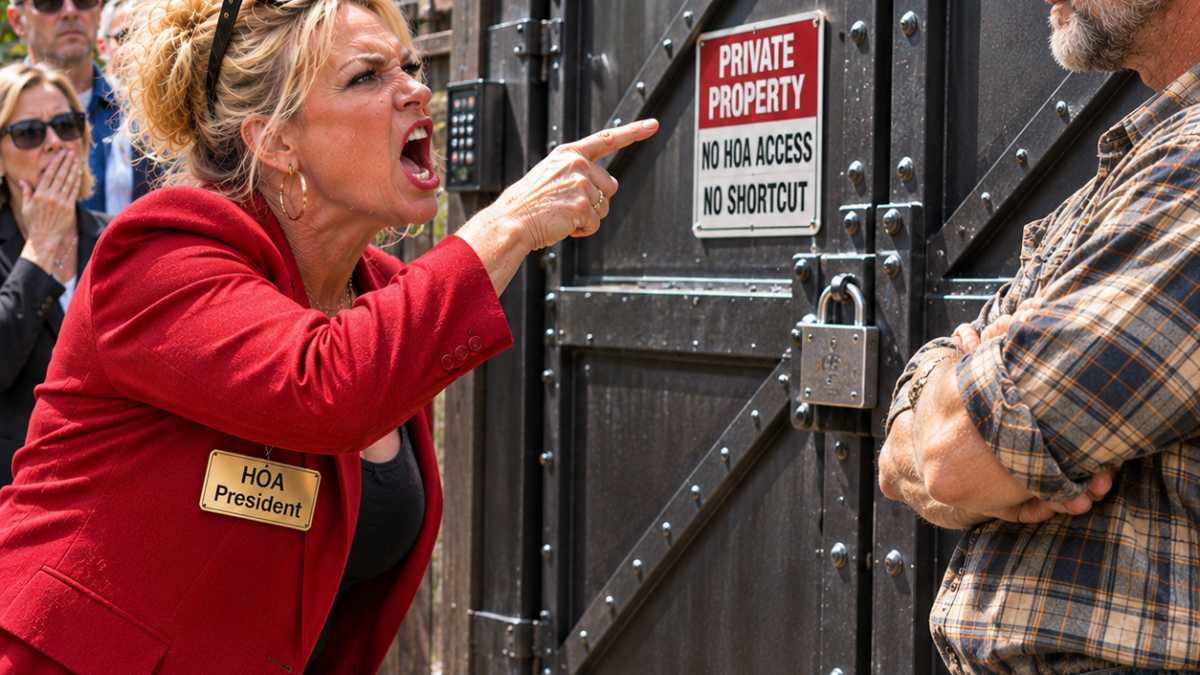
PART 2
## **The Fence Was Never the Real Problem**
Sarah knew me well enough not to ask whether I was serious.
Instead she leaned against the kitchen counter and folded her arms.
“How serious?”
“Steel.”
Her eyebrows lifted.
“That’s not an answer.”
“It’s the beginning of one.”
“Jack.”
I looked again at Karen’s violation notice on the table.
She had created something almost impressive in its contradiction.
On one hand, she claimed my fence was an HOA aesthetic violation.
On the other, she had repeatedly damaged that fence because it inconvenienced her personal route to the clubhouse and pool.
She didn’t want the fence prettier.
She wanted the boundary negotiable.
That was the real problem.
Sarah picked up the letter.
“Can the HOA even fine us?”
“No.”
“You sound very sure.”
“Our ranch isn’t part of Oak Creek Estates.”
“Then why is she sending this?”
“Because paper scares people.”
“Does it scare you?”
“No.”
She gave me a tired smile.
“That’s what worries me.”
## **Tom Sharp**
The next morning I called Tom Sharp.
Tom was a property and land-use attorney in the nearby town.
Former Marine.
Broad shoulders.
Voice like gravel dragged over concrete.
He had represented ranchers, farmers, developers, and more than one person who thought a survey marker was merely a suggestion.
I explained everything.
The fence.
Karen’s shortcut.
The first confrontation.
The cuts.
The certified warning.
The survey.
Then her violation notice.
When I finished, he laughed once.
Not because it was funny.
Because some lawyers react to spectacular overreach the way mechanics react when someone admits they filled a diesel engine with gasoline.
“Jack.”
“Yeah?”
“Are you a member of Oak Creek Estates?”
“No.”
“Do your deed restrictions incorporate their covenants?”
“No.”
“Any easement across your ranch?”
“No.”
“Recorded pedestrian access?”
“No.”
“Golf-cart easement?”
I smiled.
“Definitely no.”
“Then their covenants stop at their property line.”
“That’s what I thought.”
“She can tell her residents what shade of beige makes them spiritually complete. She can’t regulate your ranch.”
“So if I replace the fence?”
“County code.”
“That’s it?”
“And any state requirements applicable to agricultural fencing. But not Karen.”
I leaned back.
“What if the replacement is substantial?”
“How substantial?”
“Very.”
There was a pause.
Then Tom said:
“Now I’m interested.”
## **Sledge Riley**
Dave Riley had welded with my unit years before.
Nobody called him Dave.
His nickname was Sledge.
He could make steel behave.
After leaving the service, he started a fabrication business outside town.
Gates.
Trailer repairs.
Structural work.
Custom agricultural equipment.
I called.
“Sledge.”
“Callahan.”
“I need a fence.”
“You own a fence.”
“I need one Karen-proof.”
Silence.
Then laughter.
“I don’t know who Karen is, but I’m already enjoying this.”
I explained.
When I finished, he whistled.
“She cuts cattle wire so she can drive a golf cart across your pasture?”
“Four times.”
“Does she know cows move?”
“Apparently the concept is still under review.”
“What do you want?”
“A physical boundary that requires no interpretation.”
“Steel?”
“Yes.”
“How much steel?”
“All of it.”
## **Drawing the Line**
We met that afternoon at the boundary.
Sledge walked it slowly.
He looked toward the manicured Oak Creek lawns.
Then toward my pasture.
The contrast was almost comical.
“What are you trying to stop?”
“Golf cart.”
“That doesn’t require eight feet.”
“I know.”
“You expecting elephants?”
“No.”
“Siege engines?”
“Not yet.”
I handed him the concept drawing.
Heavy-gauge steel panels.
Eight feet high.
Four-inch steel pipe posts.
Deep concrete footings.
An angled steel extension along the top, designed within what the county permitted for agricultural perimeter fencing.
No barbed wire on the extension.
No electric wire.
Nothing designed to injure anyone.
Just structure.
One sixteen-foot double gate.
Heavy hinges.
Reinforced locking point.
Enough clearance for ranch equipment.
Sledge stared.
“You are building a fort.”
“I am building a fence.”
“You’re building a fence that will make people wonder what lives behind it.”
“Cows.”
“Dangerous animals.”
“Some have strong opinions.”
He grinned.
“I’ll price it.”
## **The Cost of Peace**
The quote arrived.
Sarah read the number.
Then looked at me.
Then back at the number.
“We could take a vacation.”
“We could.”
“A very nice vacation.”
“Yes.”
“Somewhere without an HOA.”
“Tempting.”
She slid the paper across the table.
“Are you sure?”
I thought about the money.
Then the fence.
Then my cattle.
A loose cow on a county road wasn’t funny.
A teenager entering the pasture wasn’t funny.
Karen cutting a boundary whenever she wanted wasn’t funny.
“I want to stop thinking about that fence.”
Sarah’s expression softened.
“That I understand.”
I signed.
## **County Planning**
I refused to give Karen one technical opening.
So I went to the county planning office myself.
Permit package.
Certified survey.
Fence specifications.
Location.
Gate dimensions.
Setback.
Agricultural use.
The clerk studied the drawing.
Then me.
“Eight feet?”
“Yes.”
“Steel panels?”
“Yes.”
She looked over her glasses.
“Neighbor trouble?”
“Boundary clarity.”
She smiled.
“That’s a diplomatic answer.”
“I’ve been practicing.”
She reviewed everything.
Forty-eight hours later:
Approved.
County stamp.
Permit number.
I made five copies.
One for my file.
One for Tom.
One for Sledge.
One in my truck.
And one I suspected Karen would eventually force me to show a sheriff’s deputy.
## **The Material Arrives**
The flatbed looked like something headed for an industrial project.
Steel panels stacked in long dark rows.
Heavy pipe.
Gate frame.
Hardware.
It turned off the county road onto my ranch, kicking dust into the afternoon air.
Across Oak Creek Estates, curtains moved.
Sledge arrived behind it.
Then two men from his crew.
All veterans.
No ceremony.
They went to work.
The old barbed wire came down section by section.
We preserved whatever was still usable for interior pasture repairs.
Survey stakes remained untouched.
Every new post hole was positioned on my side.
Not on the line.
Inside it.
I deliberately set the steel six inches onto my property so nobody could ever claim even a fraction crossed into HOA land.
The auger started.
Deep mechanical roar.
Soil curled upward.
Six-foot hole.
Then another.
Then another.
Sledge looked at me.
“Six inches inside your line.”
“Yes.”
“You’re giving her six inches.”
“I’d give her a foot if it bought silence.”
“Don’t tell her that. She’ll annex it.”
## **Karen Arrives**
Golf cart.
Of course.
She came fast.
Lavender polo.
Visor.
Expression that suggested someone had constructed an offshore drilling platform in her flower bed.
“What is going on?”
Sledge stopped the auger.
I walked over carrying my clipboard.
“Morning.”
“What are these people doing?”
“Building my fence.”
“You cannot build this.”
“I can.”
“This was not submitted to the Architectural Review Committee.”
“I don’t belong to your HOA.”
“It borders the community.”
“Yes.”
“Therefore it affects community aesthetics.”
I held up the permit.
“County approved.”
She didn’t take it.
“This is a monstrosity.”
“It’s steel.”
“It looks hostile.”
“It isn’t supposed to be friendly. It’s supposed to contain cattle.”
“You’re retaliating.”
That was interesting.
“For what?”
Her mouth tightened.
“You know perfectly well.”
I looked toward the old opening she’d used.
“Your shortcut?”
“It is not my shortcut. Residents have used this path for years.”
“Name one.”
Silence.
“Show me the easement.”
Silence.
“Recorded access agreement?”
Nothing.
I pointed at the stake.
“Your authority ends there.”
## **She Calls the Sheriff**
Karen actually did it.
Pulled out her phone.
Called.
Then stood near the boundary with the satisfaction of somebody waiting for reinforcements.
Sledge leaned toward me.
“You nervous?”
“No.”
“Good.”
He looked at Karen.
“I’m entertained.”
Twenty minutes later, a county unit arrived.
Deputy Miller.
Young.
Polite.
Very obviously wishing he had been dispatched anywhere else.
Karen reached him first.
“This man is constructing an illegal industrial barrier beside a residential community.”
Miller looked at the steel.
Then at me.
“You own this property?”
“Yes.”
“Permit?”
I handed it over.
He read.
Compared parcel information.
Walked to the stakes.
Checked the survey copy.
Then approached Karen.
“Ma’am.”
“Yes?”
“He’s permitted.”
“He is violating our community rules.”
“He isn’t in your community.”
“It impacts our community.”
“That may be something you discuss civilly, but there’s no county violation here.”
Karen pointed toward the crew.
“This fence is dangerous.”
“Have you identified a code violation?”
“Our covenants—”
“Ma’am, I don’t enforce HOA covenants.”
Then Miller added:
“And Mr. Callahan has previously told you not to enter this property?”
Her face changed.
“That’s disputed.”
“No.”
I spoke quietly.
“It isn’t.”
I showed him the certified letter and return receipt.
Miller looked at Karen.
“If you cross onto his land after being formally warned, you may create a trespass issue.”
“I am the HOA president.”
Miller blinked.
“Okay.”
Sledge coughed into his hand.
I knew he was hiding a laugh.
Miller handed my permit back.
“You’re good.”
Then left.
## **The Sound of the Auger**
Karen stood there another thirty seconds.
No words.
Then turned her golf cart around.
Sledge restarted the machine.
The auger bit into the earth.
That sound became one of my favorite memories of the whole story.
Not because it was loud.
Because it was lawful.
Karen had built her power around the assumption that nobody would ever make her hear the word no from an authority she couldn’t control.
That morning, she heard it twice.
Once from me.
Once from the county.
## **Fortress Callahan**
Sledge named it.
I didn’t.
“Fortress Callahan,” he announced on day two.
“Stop calling it that.”
“No.”
Sarah brought lunch to the crew.
He introduced her to “the southern command staff of Fortress Callahan.”
She looked at the wall.
Then me.
Then Sledge.
“It’s ridiculous.”
“Thank you,” I said.
“I wasn’t complimenting you.”
But she smiled.
The posts cured.
Panels went up.
Dark gray steel.
Straight.
Solid.
No gaps large enough for a golf cart.
No sagging wire.
No easy cut.
Then the gate.
Sixteen feet wide.
Two leaves.
Heavy steel frame.
Locking assembly protected by reinforced steel around the connection point.
Nothing exotic.
Nothing designed to hurt.
Just expensive enough and strong enough that a casual pair of bolt cutters had become irrelevant.
When Sledge finished, he stepped back.
“That’s a fence.”
“Yes.”
“No.”
He shook his head.
“That’s a boundary with a retirement plan.”
## **The First Quiet Morning**
For the first time in months, I woke without wondering whether the fence had been cut.
I drove the perimeter.
Cattle secure.
Gate locked.
No golf-cart tracks.
No wire repairs.
I stopped beside the steel.
The wall wasn’t beautiful in the conventional sense.
It was dark.
Industrial.
Almost severe.
But it gave me something beauty hadn’t.
Certainty.
## **Karen’s Paper War**
A rational person would have stopped.
Karen sent another violation notice.
**Unapproved agricultural equipment visible from community property.**
The item:
My tractor.
Stored near my barn.
A quarter mile from Oak Creek.
I filed it.
Then:
**Excessive agricultural noise.**
Cattle mooing.
Filed.
Then:
**Improper lawn maintenance.**
On a hundred-acre Texas ranch.
I laughed so hard Sarah came into the room.
“What?”
I handed her the notice.
She read.
“Lawn?”
“Apparently.”
“What part?”
“The ranch.”
“All of it?”
“I assume.”
She shook her head.
“We’re going to need a bigger mower.”
## **Evidence**
Tom told me not to respond.
“Nothing?”
“Nothing.”
“She’ll claim silence means agreement.”
“No.”
“She sends one every few days.”
“Good.”
“Good?”
“She is creating a pattern.”
He explained.
One unenforceable letter could be confusion.
Ten after legal notice looked different.
Especially when they targeted land outside HOA jurisdiction.
“Let her write.”
So I did.
Folder:
**EVIDENCE**
It grew thick.
## **President’s Corner**
Karen moved into propaganda.
The Oak Creek newsletter suddenly included warnings about “hostile border landowners.”
No names.
Everyone knew.
She described my steel fence as:
“fortress-like.”
Sledge was delighted.
“They used our name.”
“It was your name.”
“History will remember me.”
Karen argued the wall harmed property values.
Created security concerns.
Reflected “unneighborly attitudes.”
At an HOA meeting, according to a resident who later told me, Karen gave a twenty-minute presentation about it.
Then Colonel Peterson stood.
Retired Air Force colonel.
Lived two streets in.
He asked one question.
“Does this campaign have anything to do with the fact that you can no longer drive your golf cart through his ranch?”
Silence.
Karen denied it.
Too strongly.
People began looking at one another.
That’s how cracks start.
Not with rebellion.
With one reasonable question nobody can answer honestly.
## **A Boundary Other People Needed**
I began hearing from Oak Creek residents.
Quietly.
At the feed store.
At the mailbox.
Once at a gas station.
They’d say:
“I don’t agree with that fence, but she shouldn’t be fining land she doesn’t control.”
Or:
“She sent my wife three notices over wind chimes.”
Or:
“Don’t let her bully you.”
Interesting.
Karen had spent months trying to convince them I was dangerous.
Instead, she was teaching them to compare experiences.
## **The Cameras**
I upgraded.
The trail cameras had done their job.
Now I installed high-definition motion cameras along my side of the fence.
Wide coverage.
Gate.
Approach.
Day.
Night.
No hidden traps.
No confrontation system.
Just eyes.
Sarah watched me adjust one.
“You think she’s coming back?”
“I don’t know.”
“You do.”
“I think Karen hates losing.”
“That’s not the same.”
“For her, I think it is.”
Sarah looked toward Oak Creek.
“I want this over.”
“So do I.”
“Do you?”
That question bothered me.
“What does that mean?”
“You’re good at campaigns.”
“I don’t want a campaign.”
“You’re checking footage every morning.”
“Because she cut our fence four times.”
“I know.”
She took my hand.
“Just remember peace is the objective.”
She was right.
## **Sixty-Three Days**
Nothing.
Day one.
Deer.
Day two.
Wind.
Day four.
Coyote.
Day eleven.
Teenagers on bicycles staying safely on the Oak Creek side.
Day twenty-six.
A delivery truck turning around.
Day forty.
Colonel Peterson walking his dog.
Day fifty-seven.
Nothing.
The HOA notices slowed.
Then stopped.
I learned the board had pressured Karen.
Peterson and several residents questioned whether the HOA should be spending time trying to fine a non-member.
Someone apparently mentioned lawyers.
That often improves institutional judgment.
I thought maybe it was over.
## **The Sixty-Fourth Morning**
Coffee.
Computer.
Camera alerts.
One motion event.
2:17 a.m.
I clicked.
Black-and-white infrared.
Gate.
Then a person.
Dark hooded sweatshirt.
Large frame.
Walking from the Oak Creek side.
My stomach tightened before the face was visible.
I already knew.
Karen.
## **Bolt Cutters**
She approached the center of the gate.
Carried long-handled bolt cutters.
Not the small hardware-store pair from before.
Heavy-duty.
She positioned the jaws around the exposed portion of the lock assembly.
Pulled.
Nothing.
Adjusted.
Pulled again.
Nothing.
Her hood slipped.
Camera caught her face clearly.
She put one foot against the gate for leverage.
Pulled a third time.
The lock held.
I found myself leaning toward the monitor as if watching something live.
It had happened hours earlier.
Still, my pulse rose.
Not fear.
Disbelief.
After everything—
the survey,
certified notice,
sheriff,
permit,
board pressure—
she had come back in darkness with bolt cutters.
## **She Throws Them Down**
Third attempt.
Failure.
Karen jerked the cutters away.
Threw them into the dirt.
The microphone caught the impact.
Then she disappeared from frame.
For several seconds, I thought it was over.
She returned holding an aerosol can.
Spray paint.
Orange.
She shook it.
The little mixing ball rattled.
Then she started painting.
Big letters.
Ugly.
Dripping.
Obscenities.
Tyrant.
Pig.
Other things Sarah later told me I wasn’t allowed to repeat in front of the kids.
Karen painted until a large section of the gate looked like a bathroom wall behind a bad bar.
Then she kicked the steel.
The gate did not care.
She gathered her bolt cutters.
Walked away.
The camera watched her disappear.
## **I Watched It Three Times**
Once for shock.
Second for detail.
Third for evidence.
Then I saved the original.
Copied it.
Backed it up.
Exported still images.
Not edited.
Not posted.
Not sent to Oak Creek gossip groups.
Sarah came into the office.
“You’re up early.”
I turned the monitor toward her.
She watched.
Said nothing for almost two minutes.
When the video ended:
“She came at two in the morning?”
“Yes.”
“With bolt cutters?”
“Yes.”
“Then painted that?”
“Yes.”
Sarah sat down.
“Jack.”
“Yeah?”
“Call the police.”
No disagreement this time.
## **I Left the Graffiti**
That was important.
I didn’t sand it.
Didn’t wash it.
Didn’t touch anything around the lock.
I photographed the gate in daylight.
The marks.
The paint.
Ground.
Any tool contact.
Then drove to the sheriff’s department.
Thumb drive in my pocket.
Evidence binder in the truck.
The campaign Sarah had warned me not to enjoy was about to leave my hands.
That was good.
## **Detective Miller**
Seasoned.
Tired eyes.
The kind of detective who had apparently already experienced every possible way adults could behave like unsupervised children.
I introduced myself.
Then built the timeline.
Property survey.
First shortcut.
Repeated fence damage.
Certified warning.
Return receipt.
HOA retaliation.
County permit.
Deputy response.
Harassment notices.
Then:
“Last night.”
I gave him the drive.
He watched.
His eyebrows rose when Karen attacked the lock.
Then the spray paint.
Then her hood fell back.
He paused.
Zoomed.
Looked at me.
“That’s the HOA president?”
“Yes.”
“The same one previously warned?”
“Yes.”
“You have proof she received the warning?”
I slid the certified receipt across.
He stared.
Then smiled without humor.
“Well, Sergeant.”
He tapped the thumb drive.
“People don’t often deliver their own case this neatly.”
## **Criminal Mischief**
Detective Miller explained what would happen.
Report.
Damage estimate.
DA review.
Possible criminal mischief charge based on the documented damage and circumstances.
He wouldn’t promise an outcome.
I respected that.
“Do not contact her.”
“I wasn’t planning to.”
“Do not post this video.”
“I won’t.”
“Keep the original.”
“Already backed up.”
He looked at the binder.
“You did this for a living?”
“Engineers.”
“Same sickness.”
Maybe.
## **Tom’s Reaction**
I called Tom.
He listened.
Then:
“She did what?”
“Bolt cutters.”
“And cameras caught it?”
“Yes.”
“Face?”
“Yes.”
“Audio?”
“Yes.”
“Jack.”
Pause.
“You just won.”
“I didn’t know we were playing.”
“You know what I mean.”
He continued.
“The criminal case is theirs.”
“Agreed.”
“We handle civil exposure.”
“What are you thinking?”
“Personal suit.”
“Against Karen?”
“Yes.”
“Not HOA?”
“Her conduct at two seventeen in the morning wasn’t board business.”
That was fair.
Tom intended to seek documented costs associated with the damage and harassment.
Legal fees where recoverable.
Repair costs.
Other relief supported by the case.
The source story later framed the full fence and camera expenditures as part of the demanded civil settlement.
Tom’s position was simple:
Karen’s repeated acts had forced escalation.
We would document what that escalation cost.
## **Two Days Later**
I was working cattle when my phone buzzed.
Colonel Peterson.
**You hear?**
**Hear what?**
He called immediately.
“They just took her.”
“Who?”
“You know who.”
Peterson gave me the account.
Sheriff vehicle in front of Karen’s beige-and-brick house.
She answered in a robe.
Confusion.
Then warrant.
Then handcuffs.
Neighbors watching from sidewalks.
Dog walkers stopped.
Mailboxes suddenly very interesting.
Peterson’s voice had too much satisfaction in it.
“Colonel.”
“What?”
“Don’t make it entertainment.”
He went quiet.
Then:
“Fair.”
## **Karen Becomes the Defendant**
That mattered.
For months, Karen had assigned roles.
Violation.
Noncompliant owner.
Uncooperative landowner.
Threat to community aesthetics.
Now someone else defined her status.
Defendant.
It didn’t make me happy.
But it did make the world feel balanced again.
## **The HOA Abandons Her**
Emergency board meeting.
Statement.
Karen’s actions at the gate were personal and unauthorized.
Association cooperating with police.
Karen suspended as president pending legal proceedings.
Her allies moved fast.
Some people called that cowardice.
I called it predictable.
Institutions rarely remain loyal to a leader once the leader becomes a documented liability.
## **The Civil Complaint**
Tom filed.
It was thick.
Chronology.
Photos.
Certified letter.
Survey.
Violation notices.
Permit.
Sheriff response.
Security footage.
Graffiti.
Damage estimates.
The entire story Karen had spent months pretending didn’t exist was now organized into numbered paragraphs.
Tom sent me a copy.
Sarah held it.
“This is heavier than the gate.”
“Close.”
The complaint named Karen personally.
The point wasn’t revenge.
It was to make the person who kept choosing escalation financially responsible for the consequences of those choices.
## **Oak Creek Wakes Up**
Once Karen was arrested, residents started talking.
Really talking.
Not whispers.
Colonel Peterson organized an informal gathering at his house.
Sarah and I went.
I expected ten people.
There were more than thirty.
Stories came quickly.
## **Wind Chimes**
An elderly woman named Ruth had wind chimes.
Karen called them a “tonal nuisance.”
Multiple fines.
Ruth removed them.
“I liked hearing them after my husband died.”
The room went quiet.
That detail mattered.
Karen saw noise.
Ruth heard memory.
## **Vegetable Garden**
Young couple.
Backyard garden.
Tomatoes.
Peppers.
Herbs.
Karen said Oak Creek required “continuous ornamental turf.”
They ripped it out.
“What happened to the food?”
“We gave away what we could.”
Mrs. Peterson looked furious.
## **Wheelchair Ramp**
Then a disabled man named Daniel stood.
Wooden access ramp.
Karen called it an unauthorized exterior addition.
Threatened legal action.
He had eventually hired an attorney.
Spent money he couldn’t afford.
The ramp remained.
I looked at him.
“Did the board know?”
“I don’t know.”
That was becoming a common answer.
Karen had built power through fragmentation.
Every resident thought their conflict was private.
Once people compared notes, it became structural.
## **The Petition**
Recall Karen permanently.
Audit HOA spending.
Review enforcement.
Review bylaws.
More than eighty percent of residents signed within a week.
Karen had once crossed my land because she wanted a shortcut.
Now there were no shortcuts left for her.
Every process she had used casually against other people began applying to her carefully and publicly.
## **The Newspaper**
County reporter called.
Tom recommended I speak.
I hesitated.
“I don’t want a circus.”
“Then don’t perform.”
So I talked.
Property rights.
Boundaries.
Livestock safety.
Repeated damage.
Evidence.
I refused to call Karen insane.
Refused to insult her appearance.
Refused to speculate about motives I couldn’t prove.
I said:
“I wanted her to stop crossing my property.”
That was the whole case in one sentence.
The newspaper headline:
# **HOA PRESIDENT CHARGED AFTER VANDALISM DISPUTE WITH VETERAN RANCHER**
Photo:
My gate.
Orange graffiti still visible.
Karen’s booking image.
Not a flattering contrast.
## **Why I Didn’t Clean It**
People asked why the graffiti remained.
Because the case wasn’t finished.
Once evidence collection and documentation were complete and Tom confirmed we could repair it, I had Sledge’s crew sandblast the paint away.
Until then, the orange words stayed.
Every day I drove past them.
I hated them.
Sarah hated them more.
But she never asked me to rush.
We both understood.
Some messes have to stay visible until the right people have seen them.
## **The Recall Meeting**
The Oak Creek clubhouse.
The very building Karen had been taking a shortcut to reach.
That irony wasn’t lost on anyone.
I didn’t have voting rights.
Not an HOA member.
Sarah and I attended as invited guests.
Karen sat in the back with her attorney.
No pink tracksuit.
No clipboard.
No golf cart parked outside.
Gray face.
Tight jaw.
The acting president opened comments.
People stood one by one.
Ruth talked about wind chimes.
Daniel about his ramp.
The gardening couple.
Another resident whose children had been cited for chalk drawings.
Someone whose pickup truck had triggered repeated notices.
Colonel Peterson spoke last.
He said:
“This board exists to serve residents, not to give one resident power over the rest.”
Then the vote.
Near unanimous.
Karen removed permanently.
No longer president.
No committee.
No authority.
## **She Didn’t Look at Me**
Not once.
I was relieved.
I didn’t want another cinematic confrontation.
There had already been enough theater.
## **Settlement Talks**
Karen’s civil attorney contacted Tom.
Settlement.
Early.
No interest in trial.
The video made their position terrible.
Tom called me.
“They want quiet.”
“What does that mean?”
“Confidential settlement.”
“Do we need confidentiality?”
“No.”
“Then no.”
Pause.
“Thought you’d say that.”
I didn’t want revenge publicity.
But I also didn’t want to sign something implying nobody could acknowledge what happened.
Tom’s demand remained:
Full restitution for documented losses.
Legal fees as negotiated.
Repair expenses.
Costs associated with security measures the campaign had forced.
Written apology.
Resolution of all claims.
Otherwise, court.
## **The Criminal Plea**
No giant trial.
No television courtroom speeches.
Reality was more bureaucratic.
Karen negotiated with prosecutors.
She pleaded guilty to a reduced Class B misdemeanor criminal-mischief charge in the story’s resolution.
Small courtroom.
Old paper smell.
Stale coffee.
She wore a gray pantsuit.
When the judge asked for her plea, Karen said:
“Guilty.”
Quietly.
That word did something no HOA meeting ever had.
It ended the argument over whether the vandalism happened.
## **Sentence**
Two-thousand-dollar fine.
One hundred hours community service.
Restitution.
The documented amount owed to me came to just over seven thousand dollars in the source story, covering the relevant gate damage, camera-related costs and repainting expenses presented in the case.
Then the part that mattered most to Sarah and me:
Permanent restraining order.
Karen could not come within five hundred feet of my property or contact my family.
I felt my shoulders loosen.
Not joy.
Relief.
The gate was steel.
Now the boundary had law behind it too.
## **The Civil Settlement**
Next day, resolution.
Her insurer would cover the negotiated fence-related losses and legal expenses under the settlement described in the story.
Written apology.
One sentence.
Lawyer-drafted.
Karen-signed.
No emotion.
No revelation.
No “I understand what I did.”
Just formal surrender.
I read it once.
Filed it in **EVIDENCE**.
Sarah asked:
“That’s it?”
“That’s it.”
“You don’t want to frame it?”
“No.”
“Good.”
“Why?”
“We already have too many decorations.”
## **Sledge Cleans the Gate**
His crew returned.
Sandblasting.
Primer.
Gray finish.
The orange words disappeared.
Underneath, the gate looked almost new.
Sledge stepped back.
“Fortress restored.”
“Fence.”
“Fortress.”
“You’re never letting that go.”
“No.”
He rested a hand on the steel.
“You know what’s funny?”
“What?”
“She helped pay for it.”
I smiled despite myself.
“Don’t say that around Tom.”
“He’ll invoice me.”
Probably.
## **Colonel Peterson Takes Over**
Oak Creek elected a new board.
Peterson became president.
I teased him.
“Congratulations on your promotion.”
He scowled.
“I retired to escape meetings.”
“Poor career planning.”
First priorities:
Review enforcement.
Clarify HOA jurisdiction.
Create a better appeal process.
Stop subjective rules from becoming personal weapons.
Residents actually attended meetings.
Not because they loved HOA governance.
Because they had learned what happened when everybody stayed home and let the loudest person run everything.
## **The Garden Returns**
The vegetable garden came back.
Bigger.
Several neighbors helped.
Ruth rehung her wind chimes.
Daniel’s ramp stayed.
Kids drew sidewalk chalk.
A few residents probably thought Oak Creek looked slightly messier.
Good.
Lived-in places should look lived in.
## **My Ranch Becomes Quiet Again**
Cattle.
Fence checks.
Calves.
Dust.
Rain.
Repair.
Normal.
I stopped checking cameras every morning.
At first, that felt irresponsible.
Then liberating.
Sarah noticed.
“You didn’t open the security app.”
“No.”
“Who are you?”
“Recovering.”
She smiled.
## **The Gate Changed Meaning**
During the fight, the gate meant resistance.
Afterward, I wanted it to mean something else.
Safety.
A line.
Nothing more.
I’d stop while riding the ATV.
Unlock it.
Drive equipment through.
Lock it again.
Routine.
The best thing that can happen to a symbol of conflict is for it to become boring.
## **What Karen Misunderstood About the Fence**
She believed fences were hostile.
Maybe some are.
But mine had existed because of cattle long before Karen arrived.
It didn’t say:
I hate you.
It said:
My animals stay here.
You stay on your road.
We’ll wave across the line.
That’s civilization.
Clear boundaries make good neighbors possible.
Karen interpreted a boundary as an insult because it limited her.
That’s why she kept attacking it.
## **The Old Fence**
I saved one section.
Not as a trophy.
Practical use.
Interior pasture repair.
But every time I saw the old wire, I remembered those clean cuts.
It would have been easy to tell myself Karen forced me to spend money.
True.
But she also forced me to address a fence that was reaching the end of its useful life anyway.
I would have preferred to replace it on my schedule.
Still.
The new boundary was safer.
## **The Cost**
People asked whether building all that steel had been worth it.
Financially?
Complicated.
Emotionally?
Yes.
The ranch was my home.
My cattle were part of my livelihood.
I couldn’t live comfortably while wondering who might cut the perimeter for convenience.
Money buys many things.
Sometimes it buys the ability to stop worrying.
## **What I Could Have Done Differently**
After the first cut, I could have called law enforcement immediately.
Maybe I should have.
I kept hoping reason would work.
Then documentation.
Then warning.
Part of me didn’t want to become the guy calling deputies over fence wire.
Karen relied on exactly that reluctance.
Bullies understand social friction.
They know reasonable people often tolerate several unreasonable acts because escalation feels embarrassing.
That’s how boundaries disappear.
Not all at once.
One concession at a time.
## **The Shortcut Was Never Necessary**
The official Oak Creek route to the clubhouse was maybe three minutes longer by golf cart.
Three minutes.
That detail bothered me for years.
All of this over three minutes.
Cut wire.
Legal letters.
Steel.
Police.
Arrest.
Lawsuit.
Recall.
Restitution.
Restraining order.
Karen could have turned right instead of left and avoided everything.
But the point wasn’t time.
It was entitlement.
She believed inconvenience justified access.
Once someone believes that, three minutes can become a principle.
## **Sarah’s Question**
One evening she asked:
“Would you build the wall again?”
“Yes.”
“No hesitation?”
I thought.
“Maybe not exactly.”
She waited.
“I’d probably do a sturdy legal fence earlier and install cameras sooner.”
“So slightly less fortress?”
“No.”
She laughed.
“Of course not.”
## **The Steel Doesn’t Care**
There’s something comforting about steel.
Karen argued with wire.
Bent it.
Cut it.
Stepped over it.
Steel doesn’t debate.
It doesn’t feel insulted.
It doesn’t understand HOA titles.
It just occupies space according to engineering.
The gate’s greatest strength wasn’t that Karen couldn’t pass it.
The greatest strength was that it removed the need for me to stand there and argue.
## **The Restraining Order**
The five-hundred-foot restriction sounded dramatic.
In practice, it made life simple.
She stayed away.
No golf cart.
No letters directly from her.
No lurking near the fence.
No confrontations.
Silence.
Law can be powerful when its result is simply distance.
## **She Sold**
Eventually, word reached me that Karen and her husband sold their Oak Creek home.
Moved.
I never saw her again.
Peterson told me.
I said:
“Okay.”
He looked disappointed.
“That’s all?”
“What do you want?”
“I don’t know. Closure?”
“I have a gate.”
He laughed.
But that actually was closure.
## **Did I Feel Sorry for Her?**
A little.
Not enough to undo anything.
But humiliation is still human.
She lost a position she’d wrapped around her identity.
Neighbors turned against her.
She got arrested.
Paid money.
Performed community service.
Moved away.
I didn’t enjoy imagining her suffering.
I enjoyed no longer being subject to her choices.
Those are different things.
## **The Difference Between Accountability and Revenge**
Revenge would have been cutting her fence.
Driving across her lawn.
Spray-painting her house.
Using my equipment to make her feel powerless.
I didn’t.
I documented.
Permitted.
Built.
Reported.
Sued.
Then stopped when the problem stopped.
Accountability has an endpoint.
Revenge keeps asking for more.
## **Tom Sharp’s Favorite Part**
Months later, Tom and I had lunch.
He asked:
“Know my favorite document in this case?”
“The video?”
“No.”
“Certified receipt?”
“No.”
“Permit?”
“Close.”
“What?”
“Survey.”
I understood.
Everything started with the line.
He continued:
“People love dramatic evidence. But if we didn’t know where the legal boundary was, everything got harder.”
He was right.
The strongest fortress wasn’t steel.
It was clarity.
## **Deputy Miller**
I saw the first deputy at a county event later.
He recognized me.
“How’s the fence?”
“Still there.”
“HOA president?”
“Not there.”
He laughed.
Then:
“You know, I thought that first call was going to be another dumb neighbor argument.”
“It was a dumb neighbor argument.”
“Got less dumb.”
“Much.”
He looked serious.
“You handled it right.”
“Eventually.”
## **Detective Miller’s Version**
When I later picked up copies of records, Detective Miller said:
“The strange thing is, she had so many chances to stop.”
“Yes.”
“Most cases like this, the defendant makes one impulsive mistake.”
“Karen practiced.”
He shook his head.
“Certified warning would’ve stopped most people.”
“Sheriff didn’t.”
“County permit didn’t.”
“Steel gate didn’t.”
“Camera did.”
“No.”
I thought about it.
“The camera just made denial impossible.”
## **The Night Footage**
I watched it one final time after everything closed.
Not because I enjoyed it.
Because I wanted to understand.
Karen approached confidently.
That was the disturbing part.
Even at 2:17 a.m.
Even in a hood.
Even carrying bolt cutters.
She still moved like someone correcting an injustice done to her.
She didn’t see herself as trespassing.
She saw herself reclaiming authority.
That’s what unchecked entitlement can do.
It converts limits into persecution.
## **Colonel Peterson’s Presidency**
Peterson complained constantly.
Too many emails.
Pool filter issues.
Budget debates.
One resident furious about a tree.
I loved every complaint.
Because they were ordinary.
One afternoon he called.
“I owe Karen an apology.”
“What?”
“I understand why HOA presidents go insane.”
“Don’t say that.”
“Six emails today about dog poop.”
“Resign.”
“I might.”
“That’s why you’re better.”
“What?”
“You know you can leave.”
Karen never did.
Not until she was forced.
## **The Audit**
Residents demanded an audit.
It didn’t reveal some giant secret fortune.
Mostly poor process.
Weak controls.
Spending decisions that deserved better oversight.
The bigger problem had always been governance.
Karen accumulated influence because others stopped participating.
That lesson embarrassed some residents.
It should.
Community authority doesn’t disappear when you ignore it.
It gets picked up by whoever wants it most.
## **The Harassment Notices**
Peterson’s board reviewed old fines.
Some stood.
Real violations existed.
Others were reversed.
Especially those relying on vague standards or clearly selective enforcement.
That mattered.
Fixing Karen’s legacy didn’t mean declaring every rule illegitimate.
It meant separating actual community needs from one person’s preferences.
## **The Fence Was Outside Their Power**
The new board formally acknowledged that Oak Creek covenants did not govern my ranch.
It should not have been necessary.
Still, Tom recommended getting it in writing.
I did.
Filed it.
Different folder.
**PEACE**
Sarah named that one.
## **A Child at the Gate**
One of the Oak Creek kids stopped near the fence while I was working.
Probably ten.
“Mr. Callahan?”
“Yeah?”
“Is this the famous fence?”
I sighed.
“Apparently.”
“My dad says the old president tried to break it.”
“She damaged it.”
“Why?”
“Wanted a shortcut.”
The boy looked toward the community road.
Then back.
“That’s dumb.”
I considered giving him a nuanced lesson about entitlement and governance.
Instead:
“Yes.”
## **Cattle Don’t Care About HOA Drama**
One morning a calf escaped an interior paddock.
Not the perimeter.
A gate latch failed.
I spent two hours chasing him.
As I finally got him back, I thought:
Karen worried about the appearance of agricultural property.
Agricultural property had more immediate concerns.
Cows.
Water.
Weather.
Fence maintenance.
Living systems don’t care about newsletters.
That’s why I loved the ranch.
Reality gave immediate feedback.
Leave a gate open?
Cow leaves.
Cut a fence?
Risk appears.
No committee needed.
## **Sledge Visits**
Months later, Sledge drove by.
Stopped.
Inspected his work like a proud parent.
“Still straight.”
“It should be.”
“Any breaches?”
“Deer don’t carry plasma cutters.”
“Karen?”
“Restraining order.”
He nodded.
“So fortress successful.”
“Fence.”
“Fortress.”
## **Sarah Plants Along Part of It**
She hated the bare steel more than she admitted.
So we planted native shrubs along our interior side in several sections.
Not against the gate.
Not compromising access.
Just softening the long gray line.
Within a few years, green broke up the industrial appearance.
Sarah stood back.
“Better.”
“You just aesthetically harmonized the fortress.”
“Don’t tell anyone.”
## **Irony**
Oak Creek residents liked the landscaping.
Peterson told me several people thought the steel looked “less harsh.”
I said:
“I’ll notify the Architectural Review Committee.”
He laughed.
“You’re terrible.”
Maybe.
## **The Ranch Becomes the Backdrop Again**
Children watched calves.
People waved.
The steel didn’t make neighbors enemies.
Karen had claimed it would.
In reality, once the conflict stopped, the fence became just another boundary.
People adjusted.
That’s what they do.
## **Why I Never Added a Sign**
Sledge wanted one.
**PRIVATE PROPERTY — NO TRESPASSING**
Legal.
Reasonable.
I already had smaller notices where appropriate.
But he wanted a giant custom steel sign.
No.
“Why?”
“The fence already says it.”
He looked offended.
“Missed branding opportunity.”
## **The Apology**
Karen’s written apology was one sentence.
Something like:
She apologized for the property damage and related conduct and acknowledged the settlement.
Lawyer language.
I didn’t expect emotion.
Real apologies require understanding.
Legal apologies require signatures.
I was satisfied with the second.
## **Could I Forgive Her?**
Maybe.
Forgiveness and access are separate.
I can stop hating someone and still keep the gate locked.
That’s another thing boundaries teach.
Compassion doesn’t require removing protection.
## **The Orange Paint**
After sandblasting, one tiny fleck remained in a seam.
I noticed it months later.
Could’ve removed it.
Didn’t.
Not deliberately as some grand memorial.
I simply didn’t care anymore.
That was better than removing it.
When the thing that once made you furious becomes too unimportant to scrape off, healing is happening.
## **The Kids Grow Up**
Our own kids got older.
The ranch remained.
They knew the story.
My daughter once asked:
“Dad, did you really build that whole wall because one lady cut the fence?”
I started explaining context.
She interrupted.
“So yes.”
“Yes.”
She laughed.
“You’re insane.”
“Your inheritance is secure.”
“Great.”
## **The Legal File**
I eventually condensed it.
Kept essentials.
Survey.
Permit.
Certified warning.
Police reports.
Court documents.
Restraining order.
Settlement.
No need to preserve every ridiculous cattle-noise violation.
Sarah wanted to burn them.
Tom said keep copies.
Lawyers.
## **The Boundary Marker**
One day I replaced a faded survey marker nearby.
Professionally.
No drama.
As I worked, I thought about how small the physical marker was compared with everything that had happened around that invisible line.
Ownership is abstract until someone refuses to respect it.
Then the line becomes very real.
## **What Karen Actually Wanted**
I’ve replayed it enough to have a theory.
The shortcut wasn’t only convenience.
Each time she crossed, she proved to herself that my objection didn’t matter.
That feeling was the reward.
If I repaired wire and she cut it, she won.
If I warned her and she crossed again, she won.
The steel removed the game.
That’s why it enraged her.
It was not a fence she could reinterpret.
## **The Gate Said No Without Speaking**
No debate.
No appeals.
No HOA meeting.
No opportunity to exhaust me.
The gate physically represented a legal fact:
You do not have access.
Some people respond well to clear limits.
Others experience them as humiliation.
Karen chose humiliation.
Then criminal vandalism.
## **The Newspaper Follow-Up**
A year later, the reporter called.
“How are things now?”
“Quiet.”
“Fence still up?”
“Yes.”
“Any more conflict?”
“No.”
“Karen?”
“Moved.”
“Do you feel vindicated?”
I looked across the pasture.
“I feel left alone.”
She paused.
“That’s less dramatic.”
“It’s what I wanted.”
## **That Became the Follow-Up Headline**
Something about:
**AFTER HOA BATTLE, RANCHER SAYS HE ONLY WANTED PEACE**
Accurate.
## **The Community Pool**
The ridiculous destination at the center of everything remained open.
I once drove past and saw families swimming.
Golf carts parked properly in the lot.
Nobody crossing my ranch.
The trip from Karen’s old house to the pool by road took maybe four minutes.
I timed it once.
Not proud of that.
## **Four Minutes**
Four minutes.
That’s all.
That number became almost philosophical.
How much destruction can entitlement create to avoid four minutes of inconvenience?
Apparently:
A lot.
## **The Ranch at Sunset**
One evening, Sarah and I rode the ATV along the boundary.
Sun low.
Steel catching orange light.
Oak Creek lawns beyond it.
Our pasture on our side.
She leaned against me.
“You know it’s actually kind of pretty now.”
“The fence?”
“Don’t get excited.”
“I’ll tell Sledge.”
“I take it back.”
## **The Wall of Law**
The source story ends with a phrase I understood deeply by then.
The steel wall was backed by a wall of law.
But I would add something.
Law didn’t work because I was angry.
It worked because I documented.
Survey.
Certified notice.
Permit.
Camera.
Police report.
Damage estimates.
Evidence.
Every step turned memory into proof.
## **Anger Is Not Evidence**
That’s the lesson I’d give anyone dealing with a bully.
Your anger may be justified.
It may even be useful.
But nobody else can measure it.
Evidence can be measured.
Karen expected me to explode.
If I had screamed at her, threatened her, chased the golf cart, or done something reckless, she would have used it.
Instead, I let her keep creating records.
Eventually she created the best record herself.
At 2:17 a.m.
In high definition.
## **The Difference Between a Trap and a Camera**
People joked that I trapped Karen.
I didn’t.
A trap requires manipulating someone into doing something.
I installed cameras on my own property after repeated vandalism.
Karen decided to return.
Karen brought bolt cutters.
Karen attacked the lock.
Karen brought paint.
Karen wrote the words.
The camera simply refused to forget.
That’s why documentation is so powerful.
It doesn’t argue.
## **Colonel Peterson’s Best Rule**
The revised Oak Creek board adopted a simple principle:
No HOA action beyond HOA property or jurisdiction without documented legal authority.
Again—
obvious.
But obvious things often become rules because someone spectacularly ignores them.
## **Wind Chimes Return**
Ruth rehung hers.
I heard them one breezy evening from the road.
Soft.
Not intrusive.
I wondered how someone turned that sound into a violation.
Then remembered Karen could turn a cow into noise pollution.
## **The Wheelchair Ramp**
Daniel’s ramp stayed.
The board apologized.
They also changed accommodation procedures.
His wife later told Sarah:
“We were thinking of moving.”
That sentence came up repeatedly.
Karen believed she protected property values.
Her behavior had nearly driven residents out.
## **Property Values**
Ironically, after governance improved, Oak Creek remained desirable.
The gate didn’t destroy prices.
Cows didn’t destroy prices.
Children’s toys didn’t destroy prices.
Community reputation recovered.
People value stability.
Not sterility.
## **The Ranch Was Never Part of Oak Creek**
This seems obvious in hindsight.
But Karen operated on proximity.
If she could see it, she believed she could regulate it.
That’s a dangerous instinct.
Visibility isn’t jurisdiction.
Convenience isn’t easement.
Authority isn’t ownership.
Those distinctions became the whole story.
## **The Last HOA Letter About Me**
Peterson sent one.
Official letterhead.
I opened it expecting some administrative closure.
It said:
**Oak Creek Estates acknowledges that the Callahan Ranch is not subject to association architectural or landscaping covenants and that the association claims no access right across the property.**
Signed.
Recorded in board minutes.
Tom loved it.
Sarah placed it in **PEACE**.
## **Why I Kept the Gate**
Some people assumed that once Karen left, I’d take down the steel and return to wire.
No.
The gate worked.
The fence protected cattle.
The investment was made.
And the boundary deserved permanence independent of Karen.
Taking it down would have turned it into a monument to her.
Keeping it as ordinary ranch infrastructure made it mine again.
## **The Steel Weathers**
Years pass.
Paint fades.
Dust collects.
Birds sit on sections.
Rain streaks it.
It looks less like a fortress now.
More like something that belongs there.
Time has a way of domesticating symbols.
## **I Stop Calling It the New Fence**
Eventually, it became:
the fence.
That’s when I knew the story was over.
## **The Final Lesson from the Army**
In the Army, a perimeter isn’t there because everybody outside is an enemy.
It’s there so everybody knows where entry occurs.
Good boundaries don’t create conflict.
They prevent ambiguity.
Karen created conflict by insisting the line should disappear whenever it inconvenienced her.
Once the line became undeniable, the conflict could finally end.
## **What Revenge Would Have Cost Me**
Had I retaliated physically, maybe I would’ve felt good for five minutes.
Then lawyers.
Charges.
Escalation.
Sarah angry.
Kids embarrassed.
My credibility weakened.
Instead, patience cost me money and time.
But preserved something more important.
I remained the person I wanted to be after the fight.
That matters.
## **Sarah Reminds Me**
Years later, I made a joke about winning.
Sarah looked at me.
“You remember the objective?”
“Peace.”
“Good.”
She never lets me rewrite myself into an action hero.
Probably healthy.
## **Karen’s Biggest Defeat**
Not the arrest.
Not the fine.
Not community service.
Not restitution.
Not being recalled.
Her biggest defeat was that after she left, Oak Creek kept functioning.
Better, actually.
The community hadn’t needed her control.
It had merely adapted to it.
Once people remembered that, her entire mythology collapsed.
## **My Biggest Victory**
Not the gate.
My biggest victory was waking up one morning and realizing I hadn’t thought about Karen in weeks.
That is freedom.
## **The Gate Today**
Still there.
Sixteen feet across.
Dark steel.
Heavy hinges.
Lock.
Camera.
Pasture beyond.
Sometimes I open it for equipment.
Sometimes cattle crowd near it and make my life difficult.
Sometimes I stand there at sunset.
Not often.
I’m not that sentimental.
But occasionally.
## **What I See**
I see the old wire in my memory.
Hanging after the fourth cut.
Karen with bolt cutters.
Pink tracksuit.
Golf cart.
That dismissive little scoff.
Then I see the county permit.
The auger.
Steel posts.
Deputy Miller.
Sledge laughing.
Sarah bringing lunch.
Camera footage.
Orange paint.
Detective Miller.
Court papers.
Neighbors speaking.
Then silence.
It’s strange how one physical location can hold an entire story.
## **The Ending**
Karen Miller believed my fence was an inconvenience.
That was her first mistake.
Then she believed my property line was negotiable.
That was worse.
Then she believed the HOA title gave her authority beyond Oak Creek Estates.
It didn’t.
Then she believed repeated damage would wear me down.
Instead, it made me document.
She believed the certified warning was a bluff.
It became evidence.
She believed the HOA violation letters would intimidate me.
They became evidence of harassment.
She believed my steel fence was an act of aggression.
The county called it permitted construction.
She believed the sheriff would stop me.
He warned her about trespassing.
She believed the steel gate could be defeated with larger bolt cutters.
It couldn’t.
Then, at 2:17 in the morning, with every reasonable exit already offered to her, Karen made the decision that finished everything.
She walked to my property in the dark.
She brought tools.
She attacked the lock.
She failed.
Then she took a can of orange spray paint and wrote her anger across a gate she had no right to touch.
The camera recorded every second.
That was the moment Karen’s power turned into evidence.
After that, there was very little left to argue about.
Not because I outshouted her.
Not because I frightened her.
Not because I damaged anything she owned.
Because the truth had finally become visible enough that nobody could look away.
The detective saw it.
The prosecutor saw it.
Her lawyer saw it.
The judge saw it.
Oak Creek saw it.
And eventually, Karen had to stand in court and say one word she had spent months refusing to say.
**Guilty.**
She paid a state fine.
Performed community service.
Paid restitution.
Settled the civil case.
Lost her position.
Lost her ability to come near my property.
And eventually left the neighborhood she had once treated like a private kingdom.
The steel gate remained.
For a while, people called it Fortress Callahan.
I hated the nickname.
Then tolerated it.
Now hardly anyone uses it.
It’s just my gate.
That’s exactly how I want it.
Because I didn’t build a fortress to wage war on my neighbors.
I built a boundary because one person kept pretending there wasn’t one.
And after the lawsuits ended, after the orange paint disappeared, after Karen moved away and Oak Creek elected a new board, the strange thing was how quickly ordinary life returned.
Cows grazed.
Kids played.
Ruth’s wind chimes rang again.
Vegetables grew.
Daniel used his wheelchair ramp without being threatened.
Colonel Peterson complained about pool maintenance instead of dictators.
Sarah planted shrubs along sections of the steel.
People waved from the other side.
The fence separated our properties.
It didn’t separate us as people.
That may be the part Karen never understood.
A boundary is not hatred.
“No” is not hostility.
Private property is not an insult.
Sometimes respecting a line is exactly what allows people on opposite sides of it to live peacefully.
Karen kept cutting my fence because she believed her convenience mattered more than my right to say no.
Every time I repaired the wire, she treated my restraint as weakness.
So I finally replaced the wire with something she couldn’t misunderstand.
Steel.
Concrete.
A locked gate.
A county permit.
And, eventually, a court order.
She wanted a shortcut.
Instead, she taught an entire neighborhood why boundaries matter.
Years later, when I ride the fence line in the late Texas sun, I sometimes stop at that gate and look toward Oak Creek Estates.
The community is still there.
Pool still there.
Clubhouse still there.
Golf carts still move along the streets.
Nobody needs my ranch to reach any of it.
They never did.
The route Karen refused to take was always available.
She could have driven around.
Three or four extra minutes.
That was all.
Instead, she spent months trying to prove a line drawn on a county survey did not apply to her.
The line survived.
Her presidency didn’t.
And if there is any revenge in that ending, it isn’t mine.
It’s simply the quiet revenge of a boundary that was respected long after the person who kept crossing it was gone.
**Karen cut my fence because she believed I would keep repairing it forever.**
**She never imagined I’d replace it with a gate strong enough to stop her—and evidence strong enough to end her reign.**








