HOA Karen Had My Shipping Container Towed—Then the Military Showed Up Looking for Their Equipment
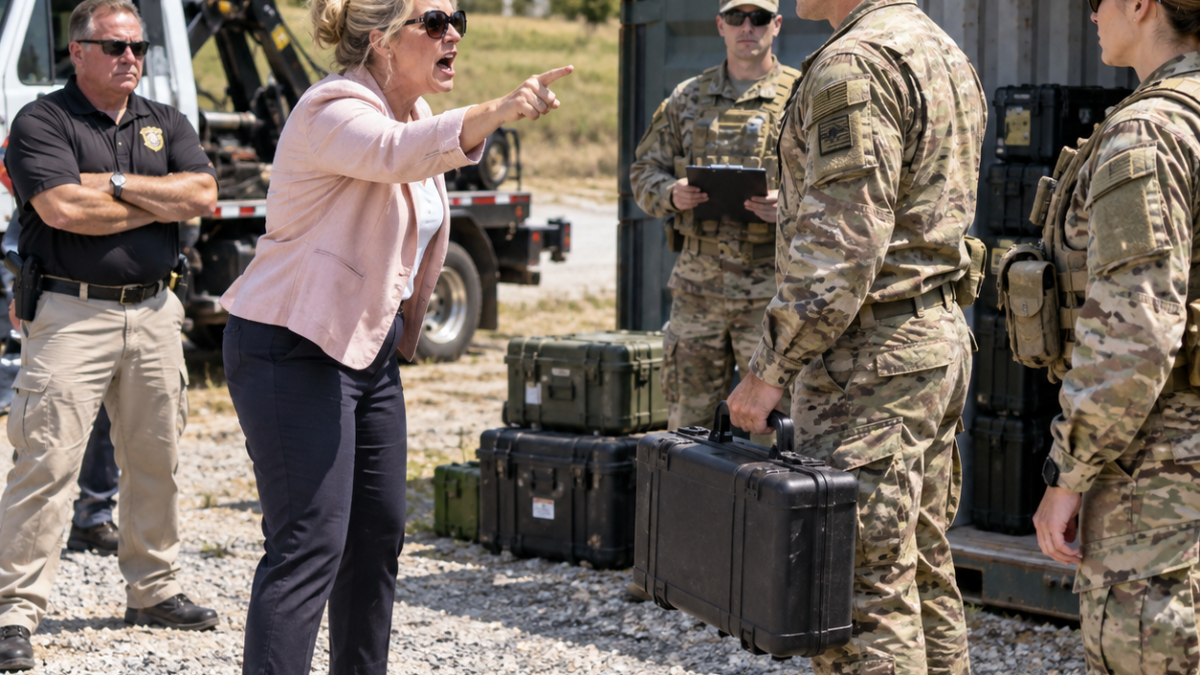
The HOA president had my shipping container chained to a tow truck while I stood ten feet away telling her she was stealing everything I owned.
My forty acres had never belonged to her HOA, but she smiled like my deed, my fence line, and my twenty-five years of military experience meant absolutely nothing.
Then she said one sentence that made me stop arguing—because suddenly I realized letting her finish what she had started might be the biggest mistake of her life.
“My decision is final,” Karen said.
The tow truck idled behind her, yellow lights flashing across the dry Texas pasture.
I looked from Karen to the driver, then to the steel container sitting near my temporary trailer.
That container held almost everything left from my old life.
My father’s tools.
Boxes of photographs my mother had saved for decades.
Uniforms I had worn overseas.
Medals I rarely looked at but could never bring myself to throw away.
Twenty-five years of military records.
Furniture waiting for the small house I planned to build after retirement.
Karen saw none of that.
She saw a metal box.
And because it offended her view from the manicured subdivision next door, she had decided she had the right to remove it.
“You understand that this property is not part of Whispering Pines?” I asked.
She folded her arms over her beige pantsuit.
“We have authority over visual nuisances within fifty feet of our boundary.”
“No, you don’t.”
Her smile tightened.
“It’s called an aesthetic easement.”
I almost laughed.
I had purchased this land specifically because it had no HOA restrictions.
Before closing, I spent weeks reviewing the title, survey, county records, easements, access rights, and restrictions.
I had spent most of my career as an Army logistics officer.
Paperwork was not something I skimmed.
Paperwork was how you made sure three hundred vehicles, thousands of soldiers, and millions of dollars of equipment arrived where they were supposed to arrive.
There was no aesthetic easement.
Karen had invented it.
I pointed toward the survey marker five feet from her shoe.
“That stake is the boundary. You’re standing on my property.”
She glanced down, then back at me.
“I’m protecting our homeowners’ property values.”
“By trespassing?”
“By removing a nuisance.”
I turned toward the tow driver.
His name was Dale, according to the faded lettering on his truck.
“Do not touch that container.”
He hesitated.
Karen snapped her fingers.
“Dale, hook it up.”
That was the moment I pulled out my phone.
“For the record,” I said, making sure the camera caught all three of us, “you are directing the removal of my personal property from land that does not belong to your association. I have told you to stop. I am telling you again.”
Karen barely looked at the phone.
“You’ll receive the removal and storage bill.”
“You’re serious?”
“And additional fines if you continue refusing to comply.”
She paused.
Then came the part that almost impressed me.
“If necessary, the association will pursue a lien against this property.”
A lien.
On land her association did not govern.
I called the sheriff.
Twenty minutes later, a young deputy arrived.
I thought the problem was over.
I showed him the property markers.
I explained the title.
I showed him the container.
Karen handed him a laminated page from her HOA documents and began talking about easements, community standards, and enforcement rights.
The deputy looked from her paperwork to mine.
Then he gave me the sentence nobody wants to hear while someone is actively hauling away his property.
“Sir, this appears to be a civil matter.”
I stared at him.
“She is removing my property.”
“You two disagree about jurisdiction.”
“There is no disagreement about the property line.”
He shifted uncomfortably.
“You may need an attorney.”
Behind him, Karen smiled.
Dale tightened the chains.
The winch groaned.
Twenty feet of steel scraped across the ground, cutting deep tracks through the pasture I had spent years dreaming about.
I stood there recording as my father’s tools, my mother’s photographs, and the physical remains of twenty-five years of my life disappeared down a Texas county road.
Karen walked back toward her subdivision without looking behind her.
She thought the fight was finished.
I walked into my trailer, sat at the small kitchen table, and opened a blank legal pad.
At first I intended to write down the tow company’s name.
Then I remembered something stored behind a locked partition in the very back of that container.
Something that did not belong to me.
Something Karen had just ordered removed without knowing exactly whose property she had taken.
I put down the pen.
And for the first time all afternoon, I smiled.
PART 2
The smile disappeared almost immediately.
Not because I had changed my mind.
Because what I had just remembered was serious.
Very serious.
At the back of the shipping container, behind a reinforced interior panel I had built before moving onto the property, sat a locked hard-shell equipment case.
Inside it was a serialized Army communications unit temporarily entrusted to me by people from my old command.
No active cryptographic key was stored with it.
I was retired, not reckless.
But the radio itself was still controlled government property.
Tracked.
Documented.
Expected back.
I sat at the kitchen table and stared at the gouges outside where the container had been dragged across my land.
An hour earlier, I had been a retired warrant officer having a ridiculous argument with an HOA president.
Now somebody had taken United States government property along with my personal belongings.
That changed the problem.
But twenty-five years in logistics had taught me another rule.
Just because you possess a powerful option does not mean you use it carelessly.
First, I wanted the civilian record clean.
I wanted every warning documented.
Every refusal documented.
Every lie documented.
If Karen had made a mistake, I would give her an opportunity to correct it.
If she refused, nobody would later be able to claim she had not understood what she was doing.
I picked up my phone and called the sheriff’s office again.
This time I requested the incident number.
Then I asked for the responding deputy’s name and badge number to be confirmed.
I wrote both down.
After that, I opened my laptop.
Whispering Pines sat immediately east of my acreage, a development of stucco houses, trimmed shrubs, decorative stone entrances, and streets with names that sounded like expensive candles.
Whisper Trail.
Pine Hollow.
Serenity Court.
The neighborhood looked harmless.
That had been part of the appeal when I bought the ranch beside it.
I wanted neighbors nearby without living under neighborhood rules.
Close enough to borrow a ladder.
Far enough that nobody could tell me what color my mailbox had to be.
At least that had been the idea.
I pulled up the county plat map.
My parcel appeared exactly where it should.
Forty acres.
County land.
Boundary line ending at the old barbed-wire fence.
Whispering Pines ended on the other side.
No fifty-foot extension.
No aesthetic corridor.
No HOA easement.
Nothing.
I downloaded the plat.
Then the deed.
Then the title policy.
Then the recorded survey.
After that I found the publicly filed Whispering Pines covenants.
One hundred twenty pages.
I printed them all.
At midnight, my little trailer looked like a field headquarters.
Paper covered the table, counter, and folding chair.
I read every page.
Rules about roofs.
Rules about fences.
Rules about paint.
Rules about trash cans.
Rules about basketball hoops.
Rules about decorative objects.
Rules governing sheds inside the subdivision.
Nothing granting authority over neighboring property.
Nothing creating a fifty-foot enforcement zone.
Nothing resembling Karen’s alleged aesthetic easement.
At two in the morning, I closed the binder.
The conclusion was simple.
Karen had not misunderstood a complicated rule.
She had invented one.
That distinction mattered.
I slept four hours.
At seven, I was up again.
My first stop was Dale’s Discount Towing and Recovery.
The place sat fifteen miles away behind a chain-link fence beside an old industrial road.
The sign leaned slightly to one side.
A row of damaged cars lined the gravel lot.
My shipping container sat near the back.
Seeing it there made my stomach tighten.
It looked absurdly out of place among wrecked sedans and abandoned pickups.
I parked and entered the office.
A man behind the counter looked up.
Same overalls.
Same heavy face.
Dale.
He recognized me immediately.
“Well,” he said. “Knew you’d come around.”
“I’m here for my container.”
He grabbed a clipboard.
“Non-consensual tow, five hundred.”
“You removed it from private property without authorization.”
He kept reading.
“Administrative handling, three hundred.”
“Illegal tow.”
“Storage, two hundred.”
“It’s been here less than a day.”
“Still counts.”
He tapped the paper.
“Total is one thousand. Cash.”
I stared at him.
“And tomorrow?”
“Another two hundred.”
“Every day.”
“Every day.”
He leaned back.
“Unless the HOA adds anything.”
“The HOA has no authority over my land.”
“Not my problem.”
“You were told that before you removed it.”
“I was hired.”
“You saw the survey markers.”
He shrugged.
“I move what customers tell me to move.”
“That philosophy is going to age badly.”
He smiled.
“You want your box or not?”
For a moment, anger urged me to pay him.
Not because he deserved a dollar.
Because I wanted my father’s tools back.
Because I wanted my mother’s photographs somewhere I could see them.
Because I wanted the radio out of a tow yard controlled by a man who treated other people’s property like poker chips.
But paying him would change the record.
It could be interpreted as accepting the tow and disputing only the fee.
I was not accepting anything.
“I’ll be back.”
“Price goes up at noon tomorrow.”
I walked out.
Through the fence I could see the container.
I stopped near my truck.
There was something strange about seeing your whole life reduced to twenty feet of corrugated steel behind somebody else’s locked gate.
Retirement was supposed to feel like freedom.
I had imagined mornings working on the house.
Evenings watching the sky.
Maybe cattle one day.
Maybe horses.
A workshop.
A porch.
No deployment schedules.
No midnight phone calls because a convoy had broken down eighty miles from nowhere.
No property-book nightmares.
For months, that container had symbolized the transition.
Old life packed away.
New life waiting.
Karen had turned it into evidence.
I drove home.
The next person I visited lived west of me.
Hank Hollis.
I had met him twice since buying the property.
He was seventy-two, lean, sun-darkened, and had hands that looked built from fence wire.
His family had ranched there before Whispering Pines existed.
I found him repairing a gate.
“You look mad,” he said before I even reached him.
“Is it that obvious?”
“Only from half a mile.”
I explained what happened.
When I mentioned Karen’s name, he stopped working.
“That woman.”
“You know her.”
“Everybody within five miles knows her.”
He rested his forearms on the fence.
“She complained about my cattle.”
“For what?”
“Being cattle.”
I waited.
He spat into the dirt.
“Said smells from agricultural activity were affecting residents’ outdoor enjoyment.”
I laughed despite myself.
“That is almost impressive.”
“She filed a nuisance complaint with the county.”
“What happened?”
“County commissioner asked when I bought the ranch.”
“And?”
“Family got the original acreage in 1924.”
He grinned.
“Whispering Pines opened in 2008.”
I nodded.
“That ended it?”
“Eventually.”
Hank’s smile disappeared.
“But she kept trying.”
He told me about dust complaints during plowing.
A complaint against a nearby historic barn.
A fight over a deer feeder on another ranch.
Calls to code enforcement about equipment visible from neighborhood streets.
Nothing had accomplished much because the surrounding properties were legally outside the HOA.
But Karen persisted.
“You’re not the first person she’s tried to bully,” Hank said.
“I may be the first one she physically took property from.”
His eyes hardened.
“What do you need?”
“For now? Information.”
“You got it.”
I showed him the supposed easement language Karen had handed the deputy.
Hank snorted.
“She used that before.”
“When?”
“Road expansion fight. Few years ago.”
“With the county?”
“Yep.”
“What happened?”
“County lawyer told her there was no such easement.”
That caught my attention.
“She already knows it isn’t real?”
“Unless she forgot being laughed out of a meeting.”
That changed things again.
I thanked him and went home.
For the next several hours, I built the timeline.
Purchase of property.
Title confirmation.
Container placement.
Karen’s arrival.
My verbal warning.
Recording.
Sheriff call.
Deputy arrival.
Container removal.
Tow-yard demand.
Every step received a date and time.
Then I called someone who had spent years yelling at me with affection.
First Sergeant Miguel Gutierrez.
Everyone called him Top, even people who had outranked him for twenty years.
He answered on the third ring.
“Tell me retirement hasn’t already made you boring.”
“I have a situation.”
“That sounded boring until you said it like that.”
I explained.
He interrupted once.
“Wait.”
“What?”
“Where’s the radio?”
“In the container.”
Silence.
Then several words I will not repeat.
“Top.”
“Is the crypto loaded?”
“No.”
“Key?”
“In my safe.”
Another pause.
“Okay.”
His voice settled.
“What exactly is in the case?”
I gave him the serial and model information from my custody paperwork.
“You have your hand receipt?”
“Of course.”
“Had to ask.”
“I’m insulted.”
“You’re retired. People get weird.”
Despite everything, I smiled.
Then he became serious.
“Mark, you need to notify the unit.”
“I know.”
“When?”
“Soon.”
“Soon is not a military word.”
“I’m building the civilian record first.”
“Why?”
“Because right now Karen can claim she believed she had authority and the tow company can claim it acted on instructions.”
“She still took federal property.”
“Yes. But I want written notice showing she knowingly refuses to return the container after being told she has no jurisdiction.”
Top was quiet.
Then he said, “You always did enjoy making paperwork hurt.”
“I learned from professionals.”
He sighed.
“All right. But don’t play games with the equipment. If you think anybody is opening that container or tampering with the case, call immediately.”
“I will.”
“I’m serious.”
“So am I.”
He gave me the current contact at the provost marshal’s office and promised to notify Major Evans, an officer I had known during my final years in uniform.
I wrote both numbers down.
Then I did something Karen probably never expected.
I entered Whispering Pines.
Not to confront her.
To listen.
My first conversation happened almost by accident.
A woman in her thirties was watering plants near her garage.
I introduced myself as the owner of the acreage next door.
The moment I mentioned that Karen had ordered a shipping container removed, the woman stopped watering.
“She did what?”
“Had it towed.”
“From your land?”
“Yes.”
“She can’t do that.”
“That’s my understanding.”
The woman looked toward the street.
Then lowered her voice.
“She thinks she can do anything.”
Her name was Rachel Cooper.
She told me about the fines.
Her son’s basketball hoop.
Trash cans visible after collection day.
A three-month argument over trim paint.
Karen measuring lawns.
Karen photographing driveways.
Karen sending violation notices before speaking to residents.
“I used to think HOAs were annoying but useful,” Rachel said. “Now I get nervous when I see the envelope.”
That sentence stayed with me.
An envelope should not frighten somebody inside a house they pay for.
“Has anyone ever challenged her?”
“People try.”
“What happens?”
“She buries them.”
“In what?”
“Meetings. Hearings. Fines. Legal threats.”
Rachel switched off the hose.
“Most people eventually decide their sanity is worth more than being right.”
I had heard versions of that sentence before in other communities.
Different states.
Different institutions.
Same mechanism.
Make resistance exhausting.
People surrender voluntarily.
I gave Rachel my number.
“If enough residents ever decide they want change, you have options.”
She stared at the card.
“Are you going after her?”
“I’m getting my property back.”
“That wasn’t what I asked.”
I looked toward Karen’s street.
“I think the answer depends on what she does next.”
Rachel smiled.
“Then I hope she’s stupid.”
She was.
Over the next day, I spoke to several more homeowners.
Some defended the HOA.
Most were cautious.
Three were openly frustrated.
The most useful was Arthur Bell.
Retired corporate attorney.
Seventy.
Silver hair.
The kind of man who could make you feel cross-examined while asking whether you wanted coffee.
We sat in his study.
I showed him the survey.
The deed.
The recording.
The fabricated easement.
The tow invoice.
He read without speaking.
When he finished, he removed his glasses.
“This is extraordinary.”
“That good or bad?”
“For Karen? Bad.”
He tapped the survey.
“She has no authority here.”
“I know.”
“She knew you disputed authority before the tow.”
“Yes.”
“You warned the driver.”
“Yes.”
“You called law enforcement during the removal.”
“Yes.”
“And afterward they demanded money to release your property.”
“Yes.”
Arthur leaned back.
“At minimum, you have potential claims for trespass and conversion. Depending on evidence regarding the fabricated authority and relationship with the tow company, possibly more.”
“I don’t want five years of litigation.”
“Neither would I.”
“So what would you do?”
He smiled slightly.
“Give them one clean opportunity to fix it.”
That was exactly what I wanted.
Arthur drafted the letter.
It was beautiful.
No insults.
No dramatic threats.
Just facts.
My parcel was not subject to Whispering Pines covenants.
No recorded easement granted authority to the HOA.
The HOA president and towing contractor had been advised of that fact.
They nevertheless removed my property.
The letter demanded immediate return of the container to its original location at association expense.
It required repair or reimbursement for damage to my land.
It demanded cessation of any claim that Whispering Pines possessed enforcement authority over my acreage.
Deadline: seventy-two hours.
Arthur looked at me.
“Anything else?”
“Five thousand dollars for property damage and expenses.”
He raised an eyebrow.
“Do you have five thousand documented?”
“Not yet.”
“Then don’t ask for a number you can’t support.”
I appreciated that.
“Fine. Actual documented damages and legal costs.”
“Better.”
He printed the final version.
We sent copies by certified mail to Karen and every HOA board member.
Not just Karen.
That mattered.
I wanted the board to know.
If they chose to back her after receiving the survey and legal demand, they could not later claim ignorance.
The signatures arrived electronically the following day.
Karen.
Treasurer.
Secretary.
Two additional directors.
All received it.
I started the clock.
Then I waited.
Waiting has a physical feeling when you know somebody’s next decision will determine how hard the consequences become.
I walked the pasture.
The tracks from the tow truck remained visible.
I had not repaired them.
Partly because they were evidence.
Partly because every time I looked at them, I remembered the sound of the container scraping across dirt.
On the second evening, Hank drove over.
“Any word?”
“No.”
“She gonna give it back?”
“I doubt it.”
“Good.”
I laughed.
“You’re supposed to encourage peaceful resolution.”
“I am peaceful.”
He pointed toward the scarred ground.
“But some lessons need tuition.”
On the morning the deadline expired, an envelope appeared.
Whispering Pines HOA.
Heavy paper.
Embossed logo.
Karen liked appearances.
I opened it at the trailer table.
The board had reviewed my demand.
They rejected it.
They reaffirmed Karen’s authority.
They cited the alleged aesthetic easement again.
They claimed my container created a visual nuisance affecting homeowners.
Then came the extraordinary part.
They billed me.
Towing.
Storage.
Administrative penalty.
Noncompliance fine.
Total: $2,500 and increasing.
If unpaid, the letter warned, the HOA would consider “all legal remedies,” including a lien and forced collection against my property.
I read it twice.
Then called Arthur.
“She wrote back?”
“Yes.”
“Did she return the container?”
“No.”
“What did she say about the survey?”
“Nothing meaningful.”
“The recorded plat?”
“Nothing.”
“The easement?”
“Claims it exists.”
“Did the board sign?”
“All of them.”
Arthur was silent.
Then:
“Keep that letter somewhere fireproof.”
“I already put it in a sleeve.”
“You are a deeply predictable man.”
“Thank you.”
“That was not a compliment.”
“It sounded like one.”
I hung up.
The seventy-two hours were over.
Karen had received a formal chance to correct the problem.
She had refused.
More importantly, she had turned the refusal into a written board action.
I opened the folder containing the Army equipment paperwork.
Then I called Top.
“Time.”
“That mean what I think?”
“She refused.”
“In writing?”
“And threatened a lien.”
Top laughed once.
Not because it was funny.
Because the absurdity had exceeded normal language.
“Call the number.”
I did.
The sergeant at the provost marshal’s office answered professionally.
I identified myself.
“Chief Warrant Officer Four Mark Peterson, retired.”
That title sounded strange now.
Like somebody else’s name.
“I need to report unlawful seizure of United States Army property currently being held by a civilian towing company.”
The tone changed instantly.
“What property, sir?”
I gave the equipment description.
Serial number.
Unit.
Custody status.
Last verified location.
Then I described the tow.
The private property.
The HOA.
The demand letter.
The refusal.
“Do you have documentation?”
“Yes.”
“Can you send it?”
“Yes.”
I emailed the deed.
Survey.
Video.
Tow-yard information.
Certified delivery receipts.
Demand letter.
Karen’s response.
My hand receipt.
The sergeant stayed on the phone while receiving everything.
After several minutes, he said, “Sir, remain available.”
“I will.”
“Do not contact the towing company again.”
“Understood.”
“Do not attempt to recover the equipment yourself.”
“Understood.”
“We will coordinate from here.”
I thanked him.
Then I sat down.
The trailer suddenly felt very quiet.
There is a strange moment after you escalate something properly.
For days, you are moving pieces.
Planning.
Collecting.
Writing.
Calling.
Then you hand the problem to an organization bigger than you.
And you wait.
Less than two hours later, my phone rang.
“Mark.”
I recognized the voice immediately.
“Major Evans.”
“What did you do?”
“I retired.”
“That was apparently a mistake.”
I smiled.
He had been a lieutenant when I first met him.
Smart.
Driven.
Occasionally disorganized.
The kind of officer who benefited from having a warrant officer nearby quietly preventing disasters.
“I hear you have a property problem.”
“I had a property problem.”
“You now have an Army property problem.”
“Yes, sir.”
He sighed.
“Crypto?”
“Not present.”
“Thank God.”
“I told Top.”
“He told me. I still wanted to hear it from you.”
“Key is secure at my residence.”
“All right.”
Papers rustled on his end.
“I’ve seen the documents. We’re coming down.”
“We?”
“Me and MPs.”
“You don’t need to—”
“Yes, we do.”
His voice became formal.
“This is serialized communications equipment held at an unauthorized location after a written refusal to return the container containing it. We are going to recover government property and document the circumstances.”
“Understood.”
“Meet us at the Chevron north of the county road.”
I looked at the clock.
“When?”
“Now.”
Twenty-five minutes later, I pulled into the gas station.
Two white military police vehicles were parked near the diesel pumps.
For the first time since retiring, seeing uniforms made something tighten in my chest.
I had not missed waking before dawn.
I had not missed formations.
I had definitely not missed property accountability.
But I missed people.
Shared language.
The way a group trained to solve problems could communicate with three sentences and a glance.
Major Evans stood beside the first vehicle.
He looked older.
So did I.
“Chief.”
“Major.”
We shook hands.
Then he looked at my pickup.
“You still driving that thing?”
“It starts.”
“So do lawnmowers.”
Some relationships survive retirement.
Four MPs stood nearby.
Professional.
Quiet.
Evans introduced them.
Then I handed him the binder.
He flipped through it at the hood of the vehicle.
Survey.
Video transcript.
Sheriff report.
Tow invoice.
Demand.
Karen’s response.
He stopped at the response.
“She actually threatened a lien?”
“Yes.”
“On property outside the HOA?”
“Yes.”
“After receiving the survey?”
“Yes.”
He looked at me.
“Did you provoke this woman?”
“I existed near her.”
One of the MPs tried not to smile.
Evans closed the binder.
“Here’s what happens.”
I listened.
“We go to the HOA president first. We confirm she ordered the removal and identify where the container is being held.”
“I know where.”
“I know you know. I want her statement.”
He pointed at me.
“You stay in your truck unless I call you.”
“Understood.”
“You’re a witness and property custodian. Not part of the enforcement interaction.”
“Understood.”
“No speeches.”
“I wasn’t planning one.”
He stared at me.
“Mark.”
“Fine.”
“Good.”
The convoy entered Whispering Pines just after three.
Two military police SUVs followed by my dusty Ford.
People noticed.
Of course they noticed.
Whispering Pines was the kind of place where a UPS truck parking too long could generate three neighborhood posts.
Uniformed military police changed the afternoon.
A man trimming hedges stopped.
Two kids on bicycles turned around and followed from a distance.
A woman walking a dog lifted her phone.
Rachel Cooper was standing near her mailbox.
She saw my truck.
Then the MPs.
Her mouth fell open.
I gave her the smallest possible nod.
She covered her mouth with one hand.
Karen lived near the center of the subdivision.
Large house.
Immaculate landscaping.
Seasonal wreath.
A small plaque near the walkway identified her as HOA president.
I parked across the street.
Evans and the MPs approached the door.
He rang.
We waited.
Karen opened it wearing a pink tracksuit.
Her face moved from annoyance to confusion.
Then concern.
“Karen Whitmore?” Evans asked.
“Yes.”
“My name is Major Daniel Evans, United States Army. These are military police officers. We need to speak with you regarding government property removed from an adjacent parcel earlier this week.”
Her eyes flicked past him.
She saw my truck.
Everything in her expression changed.
“This is about him?”
Evans did not turn.
“This is about government property.”
“He is harassing me.”
“Ma’am, did you authorize removal of a twenty-foot shipping container from the property located at 1412 County Road 3?”
Karen folded her arms.
“I authorized enforcement action on behalf of the Whispering Pines Homeowners Association.”
“So yes?”
“It was within our jurisdiction.”
Evans glanced at one of the MPs.
The sergeant wrote something.
“Where is the container?”
“At a contracted storage facility.”
“Which facility?”
“Dale’s Discount Towing.”
“Address?”
She hesitated.
“You have no right to interrogate me at my home.”
“I’m asking where United States government property is being held.”
Her face hardened.
“How would I know what was inside some ugly shipping container?”
“You were told to return the container.”
“I was told by him.”
“You received a formal written demand stating the container belonged to a private landowner outside your HOA.”
“That is disputed.”
“Not by the county plat.”
Karen looked toward my truck again.
Neighbors had begun appearing.
Rachel stood two houses away.
Arthur was across the street.
Phones were visible.
Evans stayed calm.
“Ms. Whitmore, inside that container is a serialized United States Army communications system. The Army has verified the serial number and custody record.”
The color drained from her face.
For a moment, she did not speak.
Then:
“I didn’t know.”
“No one said you did.”
Her shoulders lowered slightly.
“But you were notified that the container itself did not belong to you or your association and were formally asked to return it.”
“That’s a civil disagreement.”
“Whether your HOA has some separate dispute with Mr. Peterson is not my concern today.”
Evans’s voice never rose.
“My concern is recovery of Army property.”
Karen gripped the doorframe.
“I have lawyers.”
“Then you should call them.”
That sentence landed harder than any threat.
No drama.
No insult.
Just certainty.
Evans continued.
“We are going to the towing facility now.”
Karen swallowed.
“Why do you need me?”
“You ordered the removal. Your cooperation will help establish the property’s chain of custody.”
“I’m not under arrest.”
“No, ma’am.”
“Then I don’t have to go.”
“You may choose not to cooperate. We will document that choice.”
Karen looked at the MPs.
Then at the neighbors.
Then at me.
Her reputation mattered to her.
Maybe more than anything.
That made this moment unbearable.
She had spent years making other people feel watched.
Now half the street was watching her.
“I’ll meet you there,” she said.
“Please drive directly there.”
She closed the door.
Rachel crossed toward my truck while the MPs returned to theirs.
Her eyes were enormous.
“What did she tow?”
I rolled down the window.
“My belongings.”
“That’s not what I meant.”
I looked toward Karen’s house.
“Apparently something she should have left alone.”
Rachel grinned.
“You are going to kill me with suspense.”
Karen emerged carrying a purse and keys.
She did not look at Rachel.
She did not look at Arthur.
She looked only at me.
The hatred in her eyes was clear.
But beneath it sat something new.
Fear.
The convoy to Dale’s towing yard was almost comical.
Karen’s luxury SUV first.
Two military police vehicles.
Me last.
At a stoplight, Hank’s pickup happened to pull beside mine.
He looked at the line of vehicles.
Then looked at me.
I lowered the window.
He shouted over the road noise.
“That her?”
“Yes.”
“That Army?”
“Yes.”
His grin spread slowly.
“I’ll call you later.”
“You do that.”
The light changed.
We continued.
When we entered Dale’s gravel lot, he was outside smoking.
He recognized Karen’s SUV first.
Then the MPs.
His cigarette dropped from his fingers.
I almost felt sorry for him.
Almost.
Evans got out.
“Are you Dale Mercer?”
“Yes.”
“You towed a shipping container from County Road 3 earlier this week?”
Dale looked at Karen.
She looked away.
“I was contracted.”
“Is the container here?”
“Yes.”
“It contains United States Army property. We need access.”
Dale swallowed.
“There are storage fees.”
Evans stared at him.
Not angry.
Just surprised.
“You can resolve any fee dispute separately with whoever hired you. Government property is being recovered now.”
“I can’t just release—”
An MP sergeant stepped forward.
“Sir, the container was reported unlawfully removed, and the Army asset inside is serialized government equipment. We need you to cooperate.”
Dale’s eyes darted between uniforms.
“Am I in trouble?”
“That depends in part on what happened and how you respond now.”
That was enough.
“The gate’s around back.”
He hurried ahead.
Karen followed more slowly.
I stayed beside Evans.
When we reached the container, relief hit me harder than expected.
No visible damage.
Doors shut.
External lock added by the tow company.
The MPs documented everything before opening it.
Photographs.
Lock.
Container number.
Location.
Then Dale produced the key.
The lock came off.
The doors opened.
The smell inside was familiar.
Cardboard.
Metal.
Old wood.
Dust.
Home, compressed.
Boxes were where I had packed them.
My father’s tool chest sat near the left wall.
A framed photograph had shifted but not fallen.
Evans turned to me.
“Show us the equipment.”
I stepped inside.
Boxes narrowed the walkway.
Near the back, I removed the secured interior panel.
The hard-shell case was there.
Untouched.
I exhaled.
An MP lifted it carefully.
We verified the seals.
Opened it.
Serial matched.
The sergeant read it aloud.
“Asset confirmed.”
Evans nodded.
“Good.”
I did not realize until then how tightly I had been holding my jaw.
The equipment was secure.
Nobody had opened it.
Nobody had sold it.
Nobody had dumped my container somewhere remote.
The worst possibilities vanished at once.
Evans looked at Dale.
“This entire container needs to go back.”
Dale blinked.
“The Army property is out now.”
“And the container was removed during the same incident we are documenting.”
“That isn’t my problem.”
I almost laughed.
He had said those exact words to me.
Evans did not.
“Your company removed it.”
“On her order.”
Dale pointed toward Karen.
She spun around.
“Do not put this on me. You accepted the tow.”
“You told me you had authority!”
“You’re the towing professional!”
“You said the HOA controlled the strip!”
“You should have checked!”
Their partnership lasted approximately thirty seconds under pressure.
Arthur would later tell me that was predictable.
People cooperate enthusiastically while misconduct is profitable.
Responsibility makes everybody an individualist.
Evans raised one hand.
“That dispute can wait.”
He turned to Dale.
“Can you return the container today?”
“I’d need a truck.”
“You own a towing company.”
“My heavy unit is on another job.”
“When is it back?”
Dale looked at his watch.
“Two hours.”
“Then I suggest you contact the driver.”
Dale started dialing.
Karen stood alone near the fence.
Nobody spoke to her.
She looked smaller than she had on my ranch.
Maybe power is partially a matter of scenery.
On her cul-de-sac, surrounded by trimmed lawns and neighbors trained to fear her letters, she had seemed enormous.
At Dale’s junkyard, with crushed cars stacked behind her and federal property being inventoried ten feet away, she was simply a woman who had made a terrible decision.
Evans walked over.
“Ms. Whitmore.”
She looked up.
“This incident will be documented and forwarded through the appropriate channels. I cannot tell you what decisions other authorities will make.”
“I didn’t steal Army equipment.”
“No one is asking me to decide criminal intent.”
“I was enforcing HOA rules.”
“That is an issue for you, your attorneys, and the affected property owner.”
She looked at me.
“This is revenge.”
I said nothing.
Evans did.
“Ma’am, the government requested recovery of government property. That’s what happened.”
Her mouth tightened.
“You all believe him.”
“The serial number believes him.”
One of the MPs looked down quickly, hiding a smile.
Karen said nothing else.
Dale’s heavy truck returned an hour and forty minutes later.
The same driver who had originally towed the container climbed out.
He saw me.
Then the MPs.
“Seriously?”
Dale snapped, “Just move the thing.”
The process reversed.
Chains attached.
Container lifted.
Secured.
Nobody asked me for money.
Nobody gave me a receipt.
The convoy returned to my ranch.
Hank was waiting by the fence.
Of course he was.
He had brought a lawn chair.
I rolled down my window.
“You charging admission?”
“Thought about it.”
The truck backed into the pasture.
The existing grooves showed where the container had originally sat.
As the steel box settled onto my land again, something in me relaxed.
The sound was not dramatic.
A dull metallic thud.
But it felt like a door closing on a bad dream.
Dale’s driver unhooked.
Avoided eye contact.
Left.
Evans supervised one final equipment check.
Then he handed me updated custody paperwork.
“Mark.”
“Yes, sir.”
“Do me a favor.”
“Depends.”
“Stop storing Army equipment at your retirement ranch.”
I smiled.
“Fair.”
“And find quieter neighbors.”
“Working on that.”
He looked toward Whispering Pines.
“I imagine you are.”
We shook hands.
When the military vehicles left, Hank walked over.
He stared at the container.
Then at me.
“What was in it?”
“I could tell you.”
“But?”
“You’d be disappointed.”
“Try me.”
“A radio.”
He stared.
“A radio?”
“Expensive radio.”
“How expensive?”
“Government expensive.”
Hank whistled.
“That woman brought the Army over a radio.”
“No.”
I looked toward the subdivision.
“She brought the Army because she couldn’t stand being told no.”
That distinction mattered.
That night I entered the container alone.
I opened my father’s tool chest.
Everything was there.
Old socket set.
Wood-handled hammer.
A plane he had inherited from his father.
A measuring tape with his initials scratched into the case.
My father had never been sentimental about objects.
He believed tools existed to be used.
But after he died, I discovered grief makes ordinary things sacred.
I sat on a box and held that tape measure for a long time.
Then I opened one of my mother’s photograph boxes.
There she was twenty years younger.
Laughing at a picnic table.
My father beside her.
Me before the Army had carved the softness out of my face.
My younger sister.
People who existed now only in paper and memory.
Karen had called the container an industrial eyesore.
Maybe that was what bothered me most.
She had looked at the outside and assumed nothing inside mattered.
People do that too often.
With houses.
With land.
With people.
If something does not fit their idea of beauty or order, they decide its story has less value.
I closed the box.
The military had recovered its equipment.
My property was home.
The practical emergency was over.
I could have stopped there.
Part of me wanted to.
Build the house.
Fix the ruts.
Ignore Whispering Pines.
Let Karen stew in humiliation.
But the next morning, Arthur called.
“You should see what’s happening over here.”
“What?”
“Community Facebook groups.”
“I don’t use them.”
“I know. You are spiritually eighty-five.”
“I’m seventy—”
“That was not literal.”
“What’s happening?”
“Videos of Karen and the military are everywhere.”
I rubbed my forehead.
“That’s unfortunate.”
“For Karen.”
“For everyone.”
Arthur became quiet.
“Mark, residents are asking questions.”
“About what?”
“Everything.”
He listed them.
Did Karen actually have authority over my land?
Why did the board approve the tow?
Why were residents not told?
Could the HOA be sued?
Would insurance cover it?
Were board members personally exposed?
Had Karen used the fake easement before?
Then Arthur said something more important.
“People are telling their own stories.”
That got my attention.
“Meaning?”
“Fines. Selective enforcement. Threats. Architectural committee decisions. A lot of people have been angry for years.”
I looked through the trailer window toward Whispering Pines.
“What are you suggesting?”
“A special membership meeting.”
“I’m not a member.”
“No. But you’re the reason they finally understand what the board has become.”
“I don’t want to run their HOA.”
“Neither do I.”
“Then what?”
“We give homeowners facts. They decide what to do.”
That I could support.
Arthur began gathering signatures under the special-meeting provision.
He needed a defined percentage of homeowners.
He expected a week.
He had enough in two days.
Karen responded by sending a neighborhood-wide email.
Arthur forwarded it to me.
The subject line read:
MISINFORMATION REGARDING RECENT ENFORCEMENT ACTION
I poured coffee before reading.
Karen wrote that the board had acted “in good faith” to protect property values from a neighboring industrial nuisance.
She claimed the situation involving the military resulted from “information not disclosed to the board.”
She suggested the government property had been improperly stored on my land and implied the board had been victimized by circumstances beyond its knowledge.
No mention of the survey.
No mention of the certified demand.
No mention of the fake easement.
No mention of the fact that the board had received warning and chosen to continue.
Then came this:
“Certain individuals appear determined to exploit an unfortunate misunderstanding for personal retaliation against dedicated volunteers.”
I laughed.
Then I called Arthur.
“She’s doubling down.”
“Of course.”
“Can I reply?”
“You’re not on the distribution list.”
“I meant legally.”
He sighed.
“You were never good at civilian verbs.”
“Can we respond?”
“Yes.”
We did.
Not emotionally.
Arthur drafted a one-page factual statement.
My property was outside the association.
County records showed no aesthetic easement.
The board had received a certified demand containing documentation.
The board had rejected the demand in writing.
The container had contained Army property.
The container had since been returned.
All legal rights were reserved.
No insults.
No speculation.
No revenge language.
Facts.
Rachel circulated it.
Then something unexpected happened.
A board member contacted Arthur privately.
His name was Jerry Latham.
Secretary.
He had signed Karen’s response letter.
He wanted to talk.
We met at Arthur’s house.
Jerry arrived looking like he had not slept.
“I didn’t know,” he said immediately.
Arthur remained expressionless.
“You signed the letter.”
“I know.”
“You voted.”
“I know.”
“So what didn’t you know?”
Jerry rubbed both hands across his face.
“That the easement wasn’t real.”
I leaned forward.
“Did you ask to see it?”
“No.”
“Why not?”
“Karen said it was in the historical documents.”
“And you believed her.”
“She’s been president for nine years.”
“That isn’t a reason.”
“I know.”
His voice broke slightly.
That stopped me.
Jerry was not Karen.
He was not confident.
He was afraid.
Arthur softened.
“Tell us what happened.”
Jerry took a breath.
“The board barely functions independently anymore. Karen brings issues. She tells us what counsel supposedly said. She proposes a vote. Most people vote yes.”
“You have counsel?”
“Technically.”
“When was the last time counsel reviewed one of these enforcement actions?”
Jerry hesitated.
“I don’t know.”
Arthur and I exchanged a look.
Jerry continued.
“She said if we didn’t act against your container, homeowners would accuse us of letting the boundary deteriorate.”
“Did anyone complain?”
“One resident.”
“Who?”
He looked down.
“Karen.”
I almost admired the purity of it.
Karen filed the complaint.
Karen interpreted the authority.
Karen ordered the tow.
Karen led the vote affirming her own action.
The board followed.
“Why are you telling us this?” Arthur asked.
“Because I have a mortgage.”
I stared at him.
He flushed.
“That sounds terrible.”
“It sounds honest,” I said.
He nodded gratefully.
“Our insurance broker called.”
Arthur’s eyes narrowed.
“When?”
“This morning.”
“What did they say?”
“They heard there may be a government investigation and a civil claim.”
The board’s insurance carrier.
Directors and officers coverage.
I had not contacted them.
Yet.
Jerry’s hands trembled.
“If the carrier denies coverage, I can’t afford a lawsuit.”
Arthur leaned back.
“There is a straightforward way to reduce your risk.”
“Resign?”
“Correct the wrongdoing first.”
Jerry looked at me.
“What do you want?”
“My land repaired.”
“Yes.”
“My expenses covered.”
“Yes.”
“Written acknowledgment that the HOA has no authority over my property.”
“Yes.”
“And reform your board so this never happens again.”
Jerry swallowed.
“Karen will never agree.”
“Then the homeowners have a decision.”
After he left, Arthur looked at me.
“You have leverage.”
“I hate that word.”
“It is still true.”
“I don’t want to bankrupt residents who had nothing to do with this.”
“Good.”
He folded his hands.
“That is why we need to separate accountability from destruction.”
We drafted a notice to the HOA’s insurance carrier.
Not a threat for millions.
That had sounded satisfying in the heat of the moment.
Arthur would not allow it.
“Inflated threats make serious people look unserious,” he said.
Instead, we notified the carrier of potential claims arising from trespass, conversion, property damage, towing charges, and board action beyond recorded HOA jurisdiction.
We attached the documents.
We did not demand payment.
We preserved rights.
Three days later, the carrier sent the board a reservation-of-rights letter and notice that coverage questions would be investigated.
That was enough to terrify them.
The special meeting was scheduled for Tuesday.
Karen attempted to cancel it.
Residents ignored her.
She moved it from the clubhouse to a smaller conference room.
Arthur moved it back under the membership provisions.
She challenged signatures.
Arthur verified them.
She claimed non-members could not speak.
Arthur agreed.
Then homeowners voted at the beginning of the meeting to allow me a presentation as an invited guest.
Every move she made tightened the box around her.
Tuesday evening, I stood outside the Whispering Pines clubhouse.
For ten minutes, I considered wearing my old Army service uniform.
The original version of this story in my head wanted that image.
Decorations.
Ribbons.
Brass.
A visible reminder that Karen had misjudged me.
Then I changed my mind.
I wore jeans, boots, and a clean blue shirt.
Hank noticed.
“No uniform?”
“No.”
“Why?”
“Because this isn’t about what I used to be.”
He smiled.
“Fair enough.”
Arthur came up behind us carrying a briefcase.
“It is also generally preferable not to look like we’re staging a coup.”
Hank looked disappointed.
The clubhouse was packed.
People stood along the walls.
Rachel sat near the front.
Jerry sat with the board but looked pale.
Karen occupied the center seat.
Perfect hair.
Dark blazer.
Pearls.
Gavel.
She had dressed for control.
But control is not clothing.
The room had changed.
Nobody lowered their voice when she looked at them.
Nobody avoided eye contact.
Nobody seemed afraid of the next envelope.
Karen struck the gavel.
“This special meeting will come to order.”
Conversations continued.
She hit it harder.
“Order.”
Arthur stood.
“Madam President, point of procedure.”
Her jaw tightened.
“State it.”
“The petition requested discussion of the board’s recent enforcement action against an adjacent property owner and related exposure. The membership has a right to hear the factual record.”
“Mr. Peterson is not a member.”
“That is why the membership will vote on whether to hear from him.”
She stared at him.
“He has threatened this association.”
I remained seated.
Arthur said, “Then presumably members would benefit from understanding the threat.”
A few people laughed.
The vote was overwhelming.
I walked to the front.
Karen did not look at me.
Arthur connected my laptop to the projector.
First slide.
County plat.
My acreage outlined beside Whispering Pines.
“This is my property,” I said.
No dramatic introduction.
No biography.
Just the map.
“Forty acres. Purchased legally. Recorded here in the county. Whispering Pines ends at this line.”
I pointed.
“The old fence.”
Next slide.
Recorded easements.
“There is no recorded aesthetic easement.”
A voice from the back said, “We knew that.”
Karen snapped, “Please remain silent.”
I continued.
“Before the tow occurred, I told Ms. Whitmore that my property was not within HOA jurisdiction.”
Next slide.
Still frame from my phone recording.
Karen beside the container.
Dale with chains.
The survey stake visible.
“I told the towing contractor to stop.”
Next.
Sheriff incident report.
“I called law enforcement during the removal.”
Next.
Photograph of the ruts.
“The container was removed anyway.”
Next.
Dale’s written fee sheet.
“The towing company then demanded payment for return of my property.”
Murmurs.
Next.
My certified demand.
“This association was later given documentation and seventy-two hours to return the container voluntarily.”
Next.
Delivery receipts.
“All directors received the notice.”
The room became quieter.
Then Karen’s written response appeared.
Her signature.
The board members’ names.
The lien threat.
Someone said, “Oh my God.”
Jerry stared at the table.
I looked at the homeowners.
“At this point, the board had the property survey.”
Karen reached for her microphone.
“The board had contrary legal advice.”
Arthur stood.
“Please identify the attorney.”
Karen froze.
“What?”
“The attorney who gave contrary advice.”
“This is not a deposition.”
“No.”
Arthur sat.
“But you raised legal advice as your justification.”
Karen turned red.
I continued.
“Whatever internal advice existed, the board chose not to return the property.”
Then came the military.
I did not use a dramatic image.
No SUVs.
No Karen on her porch.
Instead, I showed the Army property custody document with sensitive details removed.
“This container also held a serialized Army communications asset for which I was temporary custodian.”
The room reacted anyway.
Everybody had seen the videos.
I continued.
“Once the board’s refusal period expired, I notified the Army.”
Karen finally spoke.
“You deliberately withheld that information.”
I looked at her.
“From whom?”
“From the board.”
“The board had no legal right to seize the container whether the contents were Army property, furniture, or empty boxes.”
Applause.
I raised my hand.
“Please.”
The room settled.
“This is important.”
I faced Karen directly.
“You keep acting as if the problem is that you unknowingly took something important.”
She stared at me.
“The problem is that you knowingly took something that was not yours.”
Nobody moved.
That was the heart of it.
Not the Army.
Not the embarrassment.
Not the tow bill.
Entitlement.
Karen finally said, “I acted to protect this community.”
A woman near the front stood.
Rachel.
“From what?”
Karen looked at her.
“That shipping container was visible from our street.”
“So?”
“It affected neighborhood appearance.”
Rachel laughed.
“You risked a lawsuit because you could see a metal box beyond a fence?”
“It was an enforcement matter.”
“It wasn’t our property!”
The room exploded.
Voices.
Years of frustration.
Grass fines.
Paint.
Basketball hoops.
Trash bins.
Fences.
One man shouted that Karen photographed his work trailer.
Another woman described being fined while caring for her dying mother because weeds appeared in a flower bed.
The meeting stopped being about me.
That was when Karen lost.
Not when the Army arrived.
Not when the container came home.
She lost when homeowners realized my experience was merely their experience taken one step further.
Same instinct.
Same method.
Different target.
Arthur regained order.
Then Jerry stood.
Karen turned toward him sharply.
He looked terrified.
But he spoke.
“I need to say something.”
The room quieted.
“I signed the response to Mr. Peterson.”
Karen said, “Jerry—”
“No.”
His voice shook.
“I signed it.”
He looked toward the audience.
“I did not independently verify the easement.”
Karen stood.
“We discussed the documents.”
“You told us it existed.”
“It does.”
“Show it.”
Silence.
“Show it, Karen.”
Her face hardened.
“This is insubordination.”
Jerry almost laughed.
“We’re volunteers.”
That line broke something in the room.
People laughed.
Not cruelly.
With release.
For years Karen had built the board presidency into a throne.
Jerry had reduced it to what it actually was.
A volunteer neighborhood position.
He continued.
“I should have checked. I didn’t. That is my fault.”
He looked at me.
“I’m sorry.”
I nodded.
Then he looked at the residents.
“And I resign effective tonight.”
Karen stared at him like he had shot her.
The treasurer rose next.
“I resign too.”
Karen whispered, “Cowards.”
The treasurer heard.
“No.”
He turned toward her.
“We should have stopped you.”
Linda Moore, another director, began crying.
She resigned from her seat without standing.
Karen remained.
Alone at the center of the table.
Arthur walked to the microphone.
“The membership has the authority under the governing documents to address vacancies and removal. Before proceeding, Mr. Peterson has prepared a proposed civil resolution.”
Karen laughed bitterly.
“Of course he has.”
I took the document.
“This is not revenge.”
“That’s exactly what it is.”
“No.”
I looked around.
“A lawsuit could take years.”
Several residents nodded.
“It could cost this association more than my actual damages. That hurts people who never came onto my land and never ordered a tow.”
Karen said nothing.
“So I am offering a settlement.”
My terms were simple.
Reimburse actual land-repair costs.
Reimburse legal expenses associated with recovering my property and documenting the claim.
Provide written acknowledgment that my land was not under HOA jurisdiction.
Withdraw all fabricated fees and lien threats.
Issue a formal apology.
The total financial demand came to $8,800 based on actual estimates and expenses.
Then came the nonfinancial conditions.
The remaining board would resign.
The architectural review structure would undergo independent review.
The association would conduct a financial audit.
Homeowners would hold a new election.
And policies would be amended so no future board president could authorize enforcement beyond recorded HOA property without legal review.
No million-dollar demand.
No demand for Karen’s house.
No theatrical punishment.
Just repair.
Accountability.
Reform.
Karen stared at the document.
“You don’t even live here.”
“Correct.”
“So you have no right to dictate our governance.”
“I’m not.”
I placed the settlement on the table.
“This is what I require in exchange for resolving my claims without litigation.”
Then I looked at the residents.
“What you do with your board afterward is your decision.”
That distinction mattered to me.
I did not want to become a different version of Karen.
Someone from outside telling them how to live.
The room belonged to the homeowners.
Arthur explained the removal process.
The petition already satisfied the threshold.
A no-confidence motion was made by Rachel.
Seconded by another homeowner.
Karen finally lost composure.
“You people have no idea what I do for this neighborhood!”
Her voice cracked.
“I have given nine years to this place.”
Nobody spoke.
“I have protected your property values.”
A man near the back said, “From basketball hoops?”
Scattered laughter.
Karen slammed her hand down.
“You laugh now. Wait until people paint houses purple and park boats on lawns and this place turns into a trailer park.”
Rachel stood.
“That is what you think of us?”
Karen blinked.
Rachel continued.
“You think the only thing keeping us decent is you threatening us?”
“I maintain standards.”
“No.”
Rachel shook her head.
“You maintain fear.”
That was the sentence that ended the argument.
The vote proceeded.
Karen was removed by an overwhelming majority.
She did not wait for the final count.
She stood.
Gathered her purse.
Looked at me.
“You ruined this community.”
I answered quietly.
“No.”
She waited.
“You forgot it wasn’t yours.”
Karen left.
No door slam.
No dramatic collapse.
Just the sound of her heels crossing the clubhouse floor.
The room remained quiet for several seconds.
Then people exhaled.
Literally.
Like they had all been holding the same breath.
Arthur formed a temporary transition committee.
Rachel agreed to serve.
Jerry, despite resigning, volunteered to turn over records and passwords.
The old treasurer did the same.
The settlement was approved.
The HOA’s attorney, now finally involved properly, reviewed it.
We signed a week later.
Arthur brought the check to my trailer.
“Eight thousand eight hundred dollars.”
I looked at it.
“Feels strange.”
“What does?”
“After everything, this is just numbers on paper.”
“That’s most civil law.”
I laughed.
We stood outside.
The ruts remained.
“What will you do with it?”
“Fix the land.”
A contractor came the following Monday.
He regraded the gouges.
Filled damaged areas.
Reseeded the pasture.
For several days the repaired strip looked like a scar.
Dark earth against dry grass.
Then rain came.
Two weeks later, green shoots appeared.
Hank stood beside me one evening looking at them.
“Land’s forgiving.”
“People?”
“Less.”
I smiled.
“Speaking from experience?”
“I was married forty-three years.”
“Point taken.”
The Whispering Pines audit began quietly.
At first I expected nothing.
Karen had been controlling.
That did not necessarily mean she had stolen money.
The audit eventually showed no giant embezzlement scheme.
No secret mansion.
No offshore account.
Reality was smaller.
And somehow sadder.
HOA money spent on unnecessary enforcement.
Repeated surveys ordered to pursue disputes that went nowhere.
Legal consultations generated by petty conflicts.
Extra patrol services during disputes Karen considered urgent.
Administrative costs resulting from selective enforcement.
Nothing movie-sized.
Just thousands upon thousands of dollars burned over the years because one person could not tolerate losing small arguments.
Death by a thousand paper cuts.
Residents were furious.
But they were also embarrassed.
Several admitted they had known something felt wrong and simply stopped attending meetings.
The new temporary committee posted every significant financial record online.
Meetings moved to evenings so working residents could attend.
Agenda items were published in advance.
Homeowners could speak before votes.
Architectural standards remained.
Whispering Pines did not become lawless.
People still agreed not to leave broken appliances in yards.
They still had landscaping requirements.
They still had rules.
But the rules became rules again.
Not weapons.
Rachel told me the first meeting under the temporary committee lasted nearly three hours because everybody wanted to talk.
“That sounds terrible.”
“It was.”
She smiled.
“It was wonderful.”
The Army side moved more slowly.
I gave a formal statement.
The tow company cooperated.
Karen cooperated after obtaining counsel.
The government property had been recovered undamaged.
No crypto had been compromised.
No operational mission was materially harmed.
Eventually I received notice that federal prosecutors did not pursue criminal charges related to the incident.
I was not shocked.
Actual prosecution is not a revenge machine.
Intent matters.
Evidence matters.
Damage matters.
Cooperation matters.
But the incident was documented.
Warnings were issued.
The Army recovered its property.
That was enough.
Dale’s story ended differently.
The federal incident attracted attention to the tow.
My attorney requested company records.
The county began looking at complaints.
Several prior customers came forward with stories about aggressive non-consensual towing.
I never learned every consequence.
I did learn Dale stopped accepting Whispering Pines enforcement calls.
The last time I saw him was at a gas station.
He recognized me.
I recognized him.
We both pretended not to.
That was fine.
I did not need every opponent destroyed.
That is one of the things retirement was teaching me.
Victory can become another addiction.
You start by defending what matters.
Then, if you are not careful, you keep fighting because fighting feels clear.
Military life gives conflict structure.
Objective.
Resources.
Timeline.
End state.
Civilian life is messier.
Sometimes you have to know when the objective is achieved.
My objective was peace.
So I returned to the reason I had bought forty acres.
I started building my house.
Nothing grand.
One story.
Wide porch.
Metal roof.
Large workshop.
Kitchen windows facing west.
A spare bedroom for my sister when she visited.
The foundation went in first.
Then framing.
Hank appeared constantly.
Never formally invited.
Never empty-handed.
Coffee in the morning.
Beer after five.
Advice all day.
“You’re setting that wall wrong.”
“It’s plumb.”
“It looks wrong.”
“Do you have a level?”
“Don’t need one.”
“How?”
“Experience.”
“That is not a measuring instrument.”
He shrugged.
“You military boys trust tools too much.”
“My career was logistics.”
“Exactly.”
I never understood what that meant.
He still helped.
One afternoon Rachel drove over with her son.
The same boy whose basketball hoop had once generated violation letters.
He stared at the construction site.
“Mr. Peterson?”
“Mark is fine.”
“My mom says you got the Army to arrest Ms. Karen.”
Rachel closed her eyes.
“Oh God.”
I laughed.
“The Army did not arrest Ms. Karen.”
“But they came.”
“They came for equipment.”
“Because she stole it.”
“She ordered my container removed.”
“That’s stealing.”
Rachel said, “Eli.”
“What?”
He looked honestly confused.
I crouched slightly.
“Here’s the important part.”
He waited.
“Adults can be wrong even when they sound confident.”
He nodded solemnly.
“Mom says that about Dad.”
Rachel covered her face.
I nearly fell over laughing.
They had brought me cookies.
Before leaving, Eli asked if I wanted his old basketball hoop.
“Why?”
“We got a bigger one.”
“You’re allowed?”
He grinned.
“New board.”
That evening I drove past Whispering Pines.
A basketball hoop stood in the Cooper driveway.
Then another two streets over.
A boat sat temporarily in one driveway, apparently being cleaned.
Somebody had painted a front door blue.
Nothing had collapsed.
Property values had not vaporized.
Civilization continued.
The most surprising change was how ordinary Karen’s absence felt.
For years, residents told me she had dominated the neighborhood.
Within months, meetings moved on without her.
New people volunteered.
Committees changed.
Kids grew.
Lawns got cut.
Mail arrived.
The community did not need a queen.
It needed neighbors.
Karen’s house went on the market about a month after the special meeting.
I learned from Rachel.
I did not drive over.
I did not want to watch.
Hank did.
Not intentionally, according to him.
“I was going to the feed store.”
“The feed store is west.”
“I took the scenic route.”
“You are a terrible liar.”
He grinned.
“She moved Saturday.”
“How was it?”
“Quiet.”
“Good.”
“No crowd.”
“Good.”
“No applause.”
“Also good.”
He studied me.
“You disappointed?”
“No.”
I meant it.
The fantasy of revenge is loud.
Reality is often quiet.
A moving truck.
Closed garage.
Empty windows.
A woman leaving a neighborhood she once controlled.
I did not need to stand at the gate.
A few days later, an envelope arrived at my trailer.
No return address.
Inside was a handwritten note.
For several seconds I thought it might be from Karen.
It was from Jerry.
Mark,
I owe you an apology beyond what the association signed.
I knew Karen could be excessive. I told myself it was easier to support her than argue every time. When she brought your container issue to the board, I did not ask enough questions because I knew asking questions would create a fight.
That was cowardice.
I have spent weeks thinking about how many other decisions I signed because I wanted meetings to end.
You were right to hold us accountable.
I am sorry.
Jerry
I read the note twice.
Then I put it in the binder.
Not because I needed evidence.
Because I wanted to remember something.
Bad systems are rarely built entirely by villains.
Usually there is one forceful person.
Then several tired people.
Several quiet people.
Several people who disagree privately.
Several who tell themselves the issue is too small.
Several who sign because everybody else signed.
Then, eventually, the system itself begins acting like nobody created it.
I had seen versions of that in government.
In units.
In corporations.
In neighborhoods.
Accountability matters before the crisis.
Not after.
By late summer, the house frame was complete.
The shipping container remained nearby.
I could have moved it farther back.
Could have hidden it.
For a while I considered painting it some neutral color.
Then Hank asked why.
“Looks industrial.”
“So?”
“I’m building a house.”
“And?”
“Maybe I don’t want to stare at a shipping container forever.”
He squinted at it.
“You stared at Army equipment for twenty-five years.”
“That is not an argument.”
“Paint a flag on it.”
“No.”
“A cow.”
“No.”
“Karen.”
I looked at him.
He started laughing before I answered.
Eventually I painted it dark green.
Not for Whispering Pines.
For me.
It blended with the tree line.
Inside, I built shelves.
My father’s tools went on one side.
Military records in waterproof bins.
Photographs in archival boxes.
The container became a workshop until the main shop was finished.
One evening I found my old dress uniform.
I unfolded it.
Ribbons.
Badges.
Nameplate.
A life measured in assignments and ceremonies.
For twenty-five years, the Army had told me where to live.
Fort this.
Camp that.
Overseas.
Stateside.
Temporary duty.
Deployment.
Move again.
Move again.
Move again.
That shipping container had followed the last move.
The final one.
The one I chose.
I hung the uniform carefully.
Then closed the door.
The next day, concrete arrived for the front porch.
I spent the morning with the crew.
Around noon, a car pulled onto my property.
Arthur.
He carried a folder.
“If that is another lawsuit, turn around.”
He smiled.
“Better.”
He handed me a copy of Whispering Pines’ revised governance policy.
“You don’t live there,” he said, “but I thought you might appreciate this.”
I flipped through it.
Board term limits.
Conflict disclosure.
Legal review required before action affecting property beyond HOA boundaries.
Records-access procedures.
Independent appeal panel for disputed fines.
Architectural decisions had to cite actual written standards.
Anonymous complaints could trigger inspection, but not punishment without verification.
And one section that made me laugh.
“HOA jurisdiction shall not be asserted over any non-member parcel absent recorded legal authority.”
I looked at Arthur.
“That seems oddly specific.”
“We call it the Peterson clause.”
“You better not.”
“Too late.”
I shook my head.
“Did Karen’s name appear anywhere?”
“No.”
“Good.”
He nodded.
“That mattered to us.”
The policy was not designed as a monument to revenge.
It was designed to prevent repetition.
That made it meaningful.
Arthur sat on the tailgate.
The house frame cast long shadows.
“You know what residents say about you?”
“I’m afraid to ask.”
“They think you saved Whispering Pines.”
“No.”
“You disagree?”
“Completely.”
“You triggered change.”
“Karen triggered change.”
Arthur smiled.
“Fair.”
“The residents saved it when they showed up.”
He considered that.
“You sound less angry.”
“I am.”
“Retirement.”
“Maybe.”
“No.”
He looked across the pasture.
“Purpose.”
That word stayed with me.
For months after leaving the Army, I had struggled with quiet.
Nobody tells you how strange it is when a career built around responsibility suddenly stops.
One day people call because they need decisions.
The next day your phone barely rings.
One day you possess a title.
Then you possess a coffee maker and forty acres.
Freedom can feel uncomfortably similar to irrelevance if you do not know what you are building next.
Maybe that was why Karen’s intrusion hit me so deeply.
I had spent a career protecting equipment, people, missions, and systems.
Then I finally chose one piece of ground to call mine.
She crossed the boundary.
Literally.
And told me the boundary did not matter.
I had fought harder than necessary because I needed it to matter.
The house became my new mission.
Not in the obsessive way the HOA battle had.
A healthier one.
I learned framing.
Electrical code.
Water systems.
Septic.
Native grasses.
Weather patterns.
Which corner of the property flooded.
Where deer crossed at dusk.
Where the morning sun landed in winter.
Hank taught me that fences required constant attention.
Texas taught me everything required more water than expected.
My sister visited in October.
She walked into the almost-finished house carrying a bottle of wine.
“So this is retirement.”
“Apparently.”
She looked through the living room toward the porch.
“It’s beautiful.”
“Not finished.”
“Nothing you own is ever finished.”
“That sounds insulting.”
“It is.”
She wanted to see the famous container.
I took her inside.
She found Mom’s photographs.
Within minutes we were sitting on folding chairs looking through them.
There was Dad holding a fish that looked smaller every year.
Mom wearing enormous sunglasses.
My sister at sixteen with a haircut she had spent thirty years denying.
She grabbed the photo.
“Destroy this.”
“Government property.”
“You’re not funny.”
I put it safely back.
Then we found a photograph of me at twenty.
Uniform too new.
Face too young.
She became quiet.
“You look like Dad.”
“I do not.”
“You do.”
We sat with that.
Then she asked, “Were you scared?”
“Of what?”
“When the container disappeared.”
I started to give the practical answer.
Government property.
Legal exposure.
Theft.
Then stopped.
“Yes.”
She looked surprised.
“You?”
“I thought Mom’s pictures were gone.”
Her eyes softened.
I continued.
“And Dad’s tools.”
“You could replace tools.”
“No.”
She nodded.
She understood.
People think loss is about market value until the wrong object disappears.
Then you understand memory has no replacement cost.
The final exterior work on the house ended in November.
I moved in before every interior detail was complete.
First night, I slept on a mattress on the floor.
No curtains.
Two lamps.
Coffee maker.
One skillet.
Forty acres outside the windows.
At 5:30 the next morning, I woke without an alarm.
Habit.
I stepped onto the porch.
Cold air.
Pink sky.
Whispering Pines glowed faintly in the distance.
For the first time since purchasing the property, I did not look at it as an adversary.
It was just houses.
Families.
People making breakfast.
Kids looking for backpacks.
Dogs waiting to be walked.
Nobody there threatened my land anymore.
Hank’s truck appeared at seven.
He brought coffee.
“You’re sitting on a porch with no furniture.”
“The chair arrives Friday.”
“You’re retired. Buy two.”
“Why?”
“So I don’t have to stand.”
“You own chairs.”
“Mine are a mile away.”
He handed me coffee.
We stood.
A few minutes later, a pickup from Whispering Pines stopped at the gate.
Rachel and Eli.
Eli jumped out.
He carried something.
A small wooden sign.
“What is that?”
He turned it around.
PRIVATE PROPERTY
NO HOA JURISDICTION
I stared.
Rachel looked embarrassed.
“He made it in shop class.”
Eli grinned.
“You can put it by the fence.”
I took it.
The letters were uneven.
One corner was slightly crooked.
It was perfect.
“You know,” I said, “posting this might upset people.”
He looked toward Whispering Pines.
“Not anymore.”
I mounted it inside the gate.
Not as a threat.
As a joke.
Mostly.
Months passed.
The story became local folklore.
Not because I told it.
Hank did.
Constantly.
At the feed store.
Diner.
Hardware store.
Probably church, though he denied that.
His version grew every time.
By spring, according to Hank, a helicopter had landed at Karen’s house.
It had not.
By summer, he claimed a general personally arrested Dale.
Also false.
Once, while I was buying fencing supplies, a stranger asked:
“Aren’t you the guy whose HOA stole a missile?”
I closed my eyes.
“It was a radio.”
“Oh.”
He sounded disappointed.
“It wasn’t my HOA either.”
“That part I heard.”
I found Hank twenty minutes later.
“You need to stop telling people this story.”
“I didn’t tell him missile.”
“Who did?”
“Stories evolve.”
“This is not evolution.”
“It’s community heritage.”
I threatened to ban him from the porch.
He knew I wouldn’t.
The final chapter arrived almost a year after Karen had towed the container.
Whispering Pines held its annual meeting.
Arthur invited me.
I almost declined.
Then Rachel called.
“Please come.”
“Why?”
“Because you should see this.”
So I went.
Not as plaintiff.
Not as guest of honor.
Just neighbor.
The clubhouse looked different.
Furniture rearranged.
Bulletin board with budgets and meeting dates.
Children’s drawings from a community event.
No presidential plaque.
No throne-like center seat.
Arthur had refused to run for president.
Rachel had.
She won.
The woman who once whispered when discussing the HOA now stood at the front of the room with an agenda and a timer.
“Three minutes per homeowner during open comments,” she said.
Arthur whispered beside me.
“Absolute tyrant.”
I smiled.
The meeting was boring.
Wonderfully boring.
Insurance renewal.
Pool maintenance.
Landscaping bids.
Reserve study.
Streetlight repair.
One disagreement about fence stain.
Nobody shouted.
Nobody threatened liens.
Nobody invoked imaginary easements.
At the end, Rachel made an announcement.
“Our legal expenses this year are down sixty-eight percent.”
Applause.
Arthur leaned over.
“That number would have killed Karen.”
I whispered, “Behave.”
Then Rachel looked toward me.
“And before we adjourn, I want to acknowledge our neighbor, Mark Peterson.”
I immediately regretted attending.
“Rachel.”
She smiled.
“You don’t get a vote.”
People turned.
I stood awkwardly.
She continued.
“Last year, our board crossed a line.”
Literal laughter.
“We tried to enforce rules where we had no authority. That decision exposed deeper problems in how this association operated.”
Her voice softened.
“Mark could have tried to punish every homeowner here.”
I shook my head.
“But he didn’t. He asked to be made whole and asked us to fix the system.”
She looked around.
“We did.”
Applause.
Not thunderous.
Not theatrical.
Warm.
I nodded and sat.
Then an older woman in the second row stood.
“I would like to add something.”
Rachel recognized her.
The woman turned toward me.
“I supported Karen.”
The room shifted.
“I voted for her every year.”
She clasped her hands.
“I thought strict rules protected us.”
Nobody interrupted.
“When the Army vehicles came into this neighborhood, I was angry at you.”
I nodded.
“That’s fair.”
“No.”
She shook her head.
“It wasn’t.”
She looked toward Rachel.
“I confused order with control.”
That sentence could have described the entire story.
The woman sat.
Meeting adjourned.
Outside, homeowners gathered in small groups.
A man invited me to a barbecue.
Somebody asked about my house.
Eli showed me pictures of a school project.
Nobody mentioned Karen until Arthur and I were alone near my truck.
“Do you know where she went?”
“No.”
“Want to?”
I thought for a moment.
“No.”
He nodded.
“Good answer.”
We shook hands.
I drove home.
The sun was low.
My green shipping container sat behind the workshop.
Still visible from parts of Whispering Pines if somebody looked hard enough.
Nobody cared.
Inside were tools.
Pictures.
Uniforms.
Things from another life.
The Army radio was long gone, returned through proper channels immediately after the incident.
No secret federal treasure remained.
Just memories.
I parked beside the house.
Hank was already on my porch.
Of course.
“You know most people ask before coming over.”
“You gonna start an HOA?”
“Get off my property.”
He handed me a beer.
We sat.
Two chairs now.
I had learned.
The sky turned orange.
Whispering Pines appeared in the distance beyond my fence.
Hank nodded toward it.
“Funny.”
“What?”
“All that over a box.”
I looked at the container.
“It wasn’t about the box.”
“What was it?”
I thought about Karen on my property.
The tow chains.
The deputy saying civil matter.
My belongings disappearing down the road.
The radio.
The MPs.
The meeting.
Jerry’s apology.
Rachel’s new board.
The grass growing over the ruts.
The house behind me.
Finally I said:
“Boundaries.”
Hank nodded.
“Fence line?”
“That too.”
He waited.
“Karen thought a boundary only mattered if she respected it.”
Hank took a drink.
“Lot of people think that.”
“She learned otherwise.”
“So did the board.”
“So did I.”
He looked at me.
“What’d you learn?”
I stared out across the pasture.
“That being right doesn’t mean you have to destroy everyone who was wrong.”
Hank grimaced.
“That’s disappointing.”
I laughed.
“You wanted a better lesson?”
“I wanted something about vengeance.”
“You watch too much television.”
“I don’t have cable.”
“That explains a lot.”
We sat until the first stars came out.
The repaired pasture was fully green now.
You could barely see where the container had been dragged.
But I remembered.
Scars do not always disappear because something is forgotten.
Sometimes they disappear because healing finally catches up.
The story started with an HOA president standing on land she did not own and telling me what I was allowed to keep there.
It could have ended with lawsuits.
Years of litigation.
Neighbors paying assessments.
Attorneys getting richer.
Everybody angrier.
Instead, it ended with my property returned.
My land repaired.
A board removed.
A community governing itself differently.
And a house rising where I had once parked a trailer.
There was satisfaction in Karen’s downfall.
I will not pretend otherwise.
Watching arrogance collide with authority outside its control has a certain symmetry.
But the most satisfying moment was not seeing military police on her street.
It was not watching Dale return my container for free.
It was not watching board members resign.
It was not watching Karen lose her position.
It happened months later.
One Saturday morning I was working in my shop when I heard bouncing from across the fence.
Thump.
Thump.
Thump.
I stepped outside.
From where I stood, I could see the top half of a basketball backboard in Whispering Pines.
Then the ball arced above the fence.
Missed.
A kid shouted.
Someone laughed.
Again.
Thump.
Thump.
Thump.
Nobody appeared with a ruler.
Nobody took photographs.
Nobody mailed a violation.
A blue front door stood three houses down.
Somebody’s lawn needed mowing.
A pickup had been parked in a driveway overnight.
The neighborhood survived.
Freedom often looks less dramatic than control.
A little messier.
A little louder.
More human.
I walked back into my workshop.
My father’s old hammer hung above the bench.
My mother’s photographs were stored safely in the house.
My uniform remained in a closet.
The shipping container rested exactly where I wanted it.
No government equipment.
No tow chains.
No Karen.
Just mine.
People sometimes ask whether I would do anything differently.
Yes.
I would have called the Army sooner.
Top never lets me forget that.
But I understand now why I waited.
I wanted proof that Karen had a choice.
She did.
She could have checked the county records.
She could have respected the property markers.
She could have stopped Dale.
She could have listened to the deputy’s uncertainty instead of exploiting it.
She could have returned the container after receiving my demand.
She could have admitted she was wrong.
At every step, there was an exit.
She refused every one.
That is what arrogance does.
It convinces people that backing down is more dangerous than continuing forward.
Sometimes the most expensive step is the one taken after the truth is already obvious.
My military career taught me logistics.
The last year taught me something harder.
Peace also has to be defended.
Not with rage.
Not always with force.
Sometimes with surveys.
Certified letters.
Receipts.
Witnesses.
Patience.
And the willingness to say one simple word when somebody crosses a line they have no right to cross.
No.
A year earlier, Karen heard that word and treated it like an insult.
Now, standing on my porch beneath a Texas sky, I understood it differently.
No was not aggression.
No was the fence.
No was the deed.
No was the line between somebody else’s authority and my freedom.
No was the reason the container was home.
No was the reason Whispering Pines changed.
And no was the reason, after twenty-five years spent going wherever duty sent me, I could finally look across forty acres of land and say something I had waited most of my adult life to say.
I’m home.








