HOA Karen Had My Power Cut Over a Fake Solar Violation—Then She Learned I Sat on the Utility Board
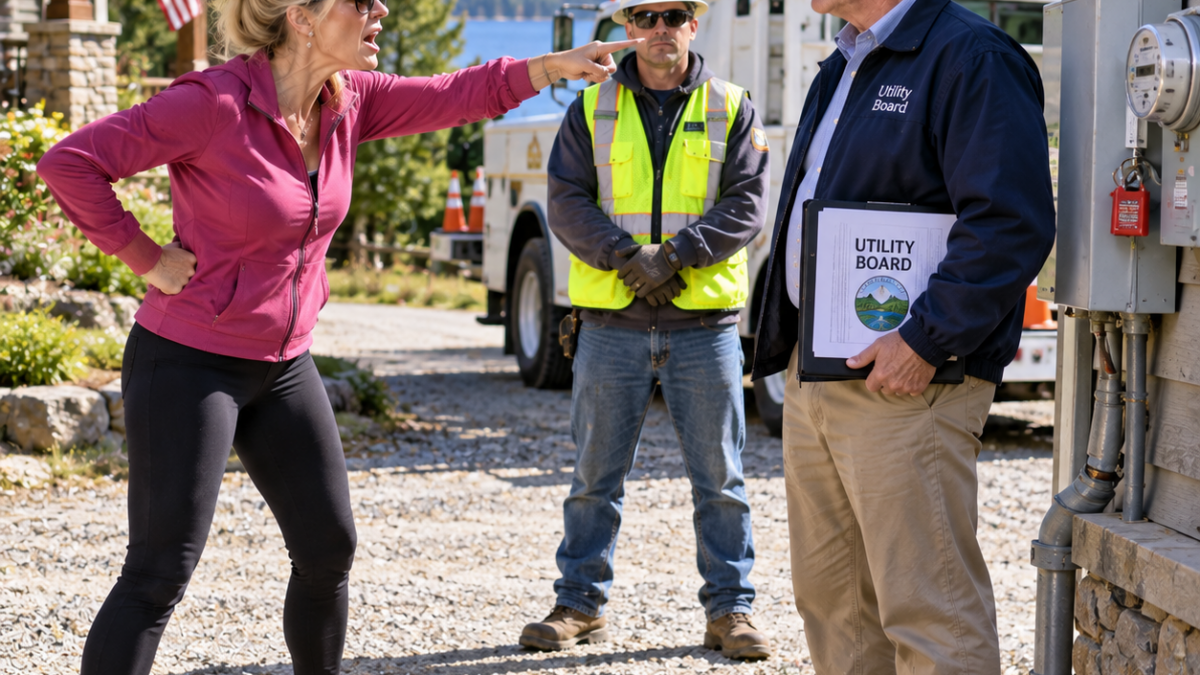
Karen looked me in the eye and promised my house would be dark by sundown because I refused to remove a solar panel the HOA had already approved.
At 6:47 that evening, while every other home on our street glowed with lights and air-conditioning, my refrigerator went silent, the ceiling fans stopped, and my wife whispered, “She actually did it.”
Karen thought cutting my electricity would finally teach me who controlled Eagle’s Landing, but she had no idea what one phone call from my dark living room was about to uncover.
I stood at the front window staring down our cul-de-sac.
Porch lights.
Kitchen windows.
Televisions flickering behind curtains.
Every house had electricity except ours.
Outside, the Florida heat was still pushing ninety degrees, and inside the temperature had already begun climbing.
My wife, Sarah, lit another candle.
“Jack?”
“I know.”
“What do we do?”
I looked toward the electrical panel.
Every breaker was on.
Our account was current.
No storm had passed through.
No transformer had blown.
This was deliberate.
Three hours earlier, Karen Miller had stood on this same lawn with her arms folded over a flowered blouse and told me exactly what she planned to do.
“You’ll be in the dark by sundown, Sergeant.”
She always called me Sergeant as if twenty-two years in the Army were something embarrassing.
Technically, I had retired as a sergeant major.
Correcting Karen would only have encouraged her.
The argument was supposedly about four solar panels mounted along the south side of my roof.
They were professionally installed.
Permitted.
Inspected.
And, most importantly, approved in writing by the HOA Architectural Review Committee.
Karen hated them anyway.
“They disrupt the roofline.”
“They’re barely visible from the street.”
“They are visible.”
“That isn’t the standard.”
“I decide how the standards are interpreted.”
There it was.
Not the HOA.
Not the committee.
Karen.
I had heard versions of that sentence since Sarah and I moved into the Preserve at Eagle’s Landing two years earlier.
Mailbox color.
Flagpole bracket.
Trash-can placement.
The length of a graduation banner.
A child’s plastic tricycle left in a driveway overnight.
Karen could take the smallest rule and stretch it until it became a weapon.
Most people paid the fine because fifty dollars was cheaper than three weeks of arguments.
Karen had mistaken exhaustion for respect.
Then I installed the solar panels.
For the first time, I followed every written requirement and refused to accept one of her invented ones.
That offended her more than breaking a rule ever could.
Now our house was dark.
I opened the note app on my phone.
“6:47 p.m. Total electrical service interruption.”
Sarah watched me type.
“You’re writing this down?”
“Everything.”
I photographed the breaker panel.
Then the dark house.
Then the homes across the street with power.
I recorded the indoor temperature.
Eighty-two degrees.
Rising.
That habit came from the Army.
When something goes wrong, memory becomes emotional.
Records don’t.
Sarah sat beside me.
“Can she even do this?”
“No.”
“You sound very sure.”
“I am.”
“What if the utility thinks she can?”
I looked at her.
“That’s the part we’re about to find out.”
There was one detail Karen had never bothered learning about me.
Eight months earlier, after retirement finally gave me time to care about the place we intended to call home, I had run for an open seat on the board of our member-owned electric cooperative.
Tri-County Rural Electric Cooperative served farms, neighborhoods, small businesses, and thousands of homes across three counties.
Members elected its directors.
I represented the northern district.
I never put a campaign sign in my yard.
Never announced it at HOA meetings.
Never mentioned it to Karen.
My role didn’t make me more entitled to electricity than any other customer.
If anything, it meant I had a greater obligation not to misuse my position.
But it also meant I knew exactly what procedures were supposed to exist before anyone’s essential utility service could be disconnected.
And none of them involved an HOA president with a grudge.
I pulled up the cooperative’s twenty-four-hour operations number.
Sarah reached for my hand.
“What are you going to say?”
“The truth.”
“And then?”
I looked around our dark living room.
The refrigerator was warming.
The air was getting heavier.
Karen had wanted this to feel like punishment.
Instead, she had turned our house into evidence.
I pressed call.
A dispatcher answered on the second ring.
“Tri-County operations. This is Travis.”
“Good evening, Travis. My name is Jack Riley. I’m calling about a service disconnect at 124 Eagle Point Court.”
I heard typing.
Then silence.
A much longer silence.
Finally Travis said:
“Sir… this work order doesn’t make any sense.”
I leaned back in my chair.
“Read it to me.”
And that was when Karen’s real problem began.
PART 2
Travis cleared his throat.
“It says emergency safety disconnect.”
“Based on what?”
“Hold on.”
More typing.
I could hear the keys through the phone.
Sarah sat across from me, one candle burning between us.
Outside, someone’s sprinkler system clicked on.
Water hissed across a lawn.
The normal sound made our dark house feel even stranger.
Travis came back.
“Requested by… Karen Miller.”
I said nothing.
“President of the Preserve at Eagle’s Landing Homeowners Association.”
“I know who she is.”
“She reported an imminent electrical hazard involving unauthorized rooftop equipment.”
“The solar array?”
“It doesn’t specify.”
“It should.”
Another pause.
“There’s also something here about HOA emergency authority.”
“What emergency authority?”
He hesitated.
“Section fourteen-C.”
I almost laughed.
Not because it was funny.
Because our HOA governing documents did not contain a Section 14-C granting anyone power over electric service.
Karen had invented a citation.
“Travis, please check my account balance.”
“Sir—”
“Please.”
Keys.
“Current.”
“How current?”
“You’re on automatic payment. No balance due. Actually, you have a seventeen-dollar credit.”
“Any delinquency notices?”
“No.”
“Any service violation?”
“No.”
“Any utility inspection showing an electrical hazard?”
“No.”
“Any report from a fire department, electrical inspector, building official, or licensed electrician?”
“I don’t see one.”
“Did Tri-County inspect my property before disconnecting me?”
Silence.
“I’m going to have to ask my supervisor.”
“That’s fine.”
I let him breathe.
He sounded young.
Maybe late twenties.
This was not his mistake.
Then I said:
“Before you transfer me, search the director database.”
“The what?”
“Board of directors.”
Another pause.
“My name is Jack Riley.”
Thirty seconds passed.
When Travis returned, his voice was completely different.
“Oh.”
“That’s usually not a good word.”
“Director Riley.”
“Yes.”
“Sir, I’m very sorry.”
“Don’t apologize yet.”
“I didn’t realize—”
“You shouldn’t have to know who I am.”
That mattered.
I sat forward.
“If I were Jack Riley the plumber, Jack Riley the schoolteacher, or Jack Riley the guy who sells fishing bait, the procedure should be the same.”
“Yes, sir.”
“What I need from you is a record.”
“I understand.”
“Note the exact time I called.”
“Yes.”
“Note that the account is paid.”
“Yes.”
“Note that the homeowner disputes any safety hazard.”
“Yes.”
“Note that there was no inspection before disconnect.”
“I’ll verify that with the supervisor.”
“Good.”
“And Travis?”
“Yes, sir?”
“Do not alter the original work order.”
“I won’t.”
“Preserve whatever notes came with Karen’s call.”
“I will.”
“I’m not asking you to hide anything. I’m asking you to preserve everything.”
“Understood.”
I gave him my mobile number and asked for the on-call operations supervisor.
Then I called David Sterling.
David chaired the Tri-County board.
Third-generation cattle rancher.
Sixty-three years old.
Hands like fence posts.
He answered with:
“Jack, why are you calling me after seven?”
“Because somebody disconnected my house.”
“Storm?”
“No.”
“Equipment?”
“No.”
“What then?”
“HOA president.”
Silence.
Then:
“Say that again.”
I explained.
When I finished, David said a word Sarah would not have allowed around our grandchildren.
Then another.
“David.”
“I’m thinking.”
“You think loudly.”
“Some neighborhood dictator talked our people into disconnecting a member over solar panels?”
“That appears to be what happened.”
“Our people actually did it?”
“Yes.”
Long exhale.
“Jack, this is bad.”
“I know.”
“Illegal disconnect bad.”
“I know.”
“Regulator bad.”
“Yes.”
“General counsel calls me from vacation bad.”
“Probably.”
David went silent.
Then his voice changed.
Board chairman now.
Not angry rancher.
“Are you requesting restoration?”
That was an important question.
I considered it carefully.
My wife was healthy.
We had no electrically dependent medical equipment in our house.
The refrigerator contents had already been moved to coolers because Karen had telegraphed her threat.
I owned a portable generator for emergencies.
Keeping the service off briefly would preserve the condition while the cooperative documented what had happened.
But I was not going to turn my family into a prop indefinitely.
“Send an investigator first,” I said. “Then restore as soon as the site condition is documented.”
“Agreed.”
“I’m also disclosing my conflict now.”
David understood immediately.
“You’re a victim and director.”
“Yes.”
“I’ll chair everything. You participate as a complaining member where necessary, but you recuse from personnel discipline, claims decisions, and any board vote involving your own damages.”
“Exactly.”
“We do this clean.”
“Very.”
“That woman already gave us enough trouble. We don’t need to help her.”
David hung up to call the CEO.
Sarah poured melted ice from one cooler into another.
“You handled that very calmly.”
“I’m furious.”
“I know.”
“You know?”
“You’ve reorganized the same three batteries twice.”
I looked down.
She was right.
I put them on the table.
“How long before power comes back?”
“After they document the meter and disconnect.”
“How long?”
“Tonight.”
She looked around.
“I hope so.”
That hit me harder than Karen’s threat.
Sarah had spent twenty-two years moving where the Army told us.
Fort Hood.
Fort Stewart.
Fort Leonard Wood.
Germany.
Virginia.
Back to Texas.
Deployments.
Temporary housing.
Government quarters.
Hotels.
Every time we packed, Sarah made the next place feel permanent before I did.
This house was supposed to be different.
Forever.
Peaceful.
We bought it because the back windows opened toward protected woods.
No base gates.
No PCS orders.
No command sergeant major knocking on the door.
Just home.
Karen had reached into that home and turned off the lights.
I put my arm around Sarah.
“I’m sorry.”
“For what?”
“This.”
“You didn’t cut the power.”
“No.”
“You didn’t invent a violation.”
“No.”
“Then stop apologizing.”
She leaned against me.
“But fix it.”
“I will.”
A Tri-County truck arrived at 8:36.
Two employees.
An operations supervisor named Luis Romero.
And a field technician.
Luis knew me from board meetings.
He looked deeply uncomfortable.
“Jack.”
“Luis.”
“I’m sorry.”
“We’ll deal with apologies later.”
He nodded.
“Show me.”
They photographed the meter.
Service disconnect.
Seals.
Breaker condition.
Solar inverter.
Everything.
Then Luis checked the rooftop system documentation.
“Permitted?”
I handed him the county inspection.
“Licensed installer?”
Paperwork.
“Utility interconnection approval?”
More paperwork.
The solar array had been properly interconnected months earlier.
No hazard.
No irregularity.
Luis shook his head.
“The work order should never have passed.”
“Who approved it?”
He looked at me.
“Local service manager.”
“Name?”
“Frank Henderson.”
I knew Frank.
Not personally.
Twenty years with the cooperative.
Good record.
Three years from retirement.
I felt my anger shift.
Not disappear.
Shift.
“How?”
“We don’t know yet.”
Luis replaced the disconnect seal.
Restored service.
At 9:12, the air conditioner came alive.
The refrigerator hummed.
Lights returned.
Sarah closed her eyes.
I hadn’t realized how tense she was until that second.
Then she smiled.
“Best sound I’ve heard all day.”
I agreed.
The next morning, the Tri-County governance committee met by video.
I joined for the factual presentation, then left before closed-session personnel discussions.
David ran it exactly right.
Bill Henderson, the cooperative CEO—not related to Frank—presented what investigators knew.
Karen had not called the public customer service line.
She had contacted Frank Henderson directly.
Personal cellphone.
How she obtained the number remained unclear.
She claimed she was reporting an immediate electrical fire hazard.
Told him exposed rooftop wiring was arcing.
Said children were at risk.
Claimed the HOA had inspected the installation.
Claimed county code enforcement had already been notified.
And most importantly:
Claimed she possessed written authority under the HOA covenants to request disconnection on behalf of the property owner.
None of it was true.
Frank had made a catastrophic judgment call.
Instead of directing her through emergency dispatch and requiring verification, he created a manual work order.
He labeled it safety-related.
A field crew, believing the hazard had already been verified by management, executed it.
Karen had lied.
Frank had bypassed safeguards.
Both facts could be true at once.
David rubbed his forehead.
“This is how systems fail.”
Bill nodded.
“One person lies. Another trusts. Procedure gets skipped.”
General counsel Arthur Vance appeared in a separate window.
Arthur was not theatrical.
Tall.
Gray suit.
Thin glasses.
Every sentence sounded billable.
He said:
“We need to notify our insurer and regulatory counsel immediately.”
David asked:
“Mandatory self-report?”
“Likely.”
“Civil exposure?”
“Yes.”
“Criminal?”
“Not for us on these facts, but Karen’s representations require review.”
Then Arthur looked at me.
“Jack, I need to ask this plainly. Are you planning to sue the cooperative?”
“Not today.”
“That is not the question.”
“No.”
Sarah was right behind me, listening.
I continued.
“Not if Tri-County fixes the process, covers documented losses, and cooperates completely.”
Arthur nodded.
“That’s reasonable.”
“I reserve whatever rights my attorney tells me I have.”
“Also reasonable.”
David smiled slightly.
“There’s the board member.”
“No. There’s the homeowner.”
That distinction became central.
Tri-County had failed me.
Karen caused the event.
But the utility had allowed her lie to become action.
I refused to help them pretend otherwise simply because I sat on the board.
Good institutions do not protect themselves by denying mistakes.
They protect themselves by correcting them.
The cooperative suspended Frank pending investigation.
Not fired.
Not yet.
Arthur sent a formal preservation and demand letter to Karen and the HOA.
It asked for:
The alleged Section 14-C.
Board minutes authorizing her request.
Any safety inspection of my solar system.
Any electrical report.
Any communication with county officials.
Any board vote.
Any attorney opinion.
Any document showing Karen could act on behalf of homeowners with respect to utility service.
Deadline:
Five p.m. the next day.
A process server delivered it to Karen’s house.
She reportedly asked if he knew who she was.
He reportedly said:
“Yes, ma’am. That’s why I’m here.”
I wish I had witnessed that.
Instead, I spent the morning walking the neighborhood.
Karen’s abuse had been visible for years.
The power shutoff simply made it impossible for me to keep treating it as background noise.
First stop:
Mark and Alyssa Henderson.
No relation to either utility Henderson.
They had two kids.
One five.
One seven.
Mark answered wearing a headset.
“Jack?”
“Working?”
“Technically.”
“I’ll be quick.”
I asked about the Big Wheel fine.
His expression changed.
The toy had been left near the garage overnight.
Fifty-dollar fine.
Threat of another fifty if unpaid.
No hearing.
No grievance committee.
No appeal instructions.
“Why’d you pay?”
“Alyssa said it wasn’t worth fighting.”
Common sentence.
“What if everybody says that?”
Mark stared.
“Then she keeps doing it.”
“Exactly.”
I had printed a simple complaint form.
State law.
HOA procedure.
Formal demand for hearing.
I gave him one.
“Use your own lawyer if you’re worried.”
“I’m not worried.”
He looked down the street toward Karen’s house.
“Not anymore.”
Mrs. Gable came next.
Widow.
Seventy-eight.
Roses extended two inches over the sidewalk.
Fine.
No hearing.
She brought out a folder.
“Dear, I saved everything.”
My kind of woman.
The Patels had a graduation banner.
Fine.
The Millers—different Millers—had a garbage can issue.
Fine.
Another neighbor had a work van parked overnight.
Fine.
Someone had been cited for a wreath.
Someone else for a kayak visible behind a fence.
By lunch I had twelve complaints.
By dinner, nineteen.
I did not promise anyone I could fix them.
I promised we would compare process.
That was enough.
The next morning, a black sedan pulled up.
Arthur Vance got out.
Tri-County’s lawyer.
He carried a leather case.
“You look too pleased.”
“I enjoy facts.”
“So do I.”
“That is why we get along.”
We sat at my kitchen table.
Sarah served coffee.
Arthur spread out a draft letter.
“The regulator has been notified.”
“How bad?”
“Too early.”
“Range?”
“Potentially expensive.”
I looked at him.
“For the cooperative.”
“Yes.”
“Good.”
Arthur raised an eyebrow.
“Good?”
“If there’s no consequence for bypassing procedure, procedure remains optional.”
Sarah smiled into her coffee.
Arthur did too.
“Jack, have you considered law school?”
“I have standards.”
He pretended to be wounded.
Then pointed to the letter.
“We are formally demanding the HOA preserve records.”
“What happens if Karen can’t produce Section 14-C?”
“She apologizes and negotiates if she has competent advice.”
“And if she doesn’t?”
Arthur closed the folder.
“She appears not to.”
He was right.
At 4:45 the following afternoon, Karen sent her response.
Not through a lawyer.
Personally.
On HOA letterhead.
She accused Tri-County of “corporate bullying.”
Claimed her emergency request was lawful.
Then attached:
**AMENDMENT TO BYLAWS — SECTION 14-C**
**EMERGENCY UTILITY INTERVENTION**
It purported to authorize the HOA president to order suspension of utility services for any property deemed an immediate threat to community safety or aesthetics.
Aesthetics.
Even Arthur paused at that.
“You can lose power for aesthetics now.”
“Apparently.”
The document was dated six months earlier.
Signed by Karen.
Brenda Collins, HOA secretary.
George Findlay, director.
Arthur had already requested certified HOA filings from the county.
No amendment.
No Section 14-C.
No record.
Then he called Brenda.
She panicked.
“There was no vote.”
“Are you sure?”
“Yes.”
“Did you sign this?”
“No.”
“Ever authorize Karen to use your signature?”
“No!”
Brenda’s fear turned into anger.
“We spent that meeting arguing about clubhouse trim.”
Arthur asked her to give a sworn statement through her own counsel.
She agreed.
Then he checked George Findlay.
Sold his Eagle’s Landing house seven months earlier.
Moved to Arizona.
The document claimed he signed locally a month after he left.
Arthur called me at 8:30.
“She forged it.”
“You’re certain?”
“We’ll let investigators determine the final criminal characterization, but the document she sent does not match any valid amendment, the secretary denies signing it, and the third director was living in Arizona.”
“Anything else?”
“Yes.”
“What?”
“The font.”
I waited.
“Calibri.”
“So?”
“HOA documents use Times New Roman.”
I laughed.
Arthur sounded offended.
“This is serious.”
“I know.”
“But also exceptionally stupid.”
“There we agree.”
Karen had done something extraordinary.
Her initial abuse might have been defended as a misunderstanding.
An overzealous safety report.
A terrible judgment.
Now, confronted with a demand for authority, she created the authority after the fact.
And mailed it to a lawyer.
The next HOA meeting was three days away.
Arthur requested agenda time.
So did Bill Henderson, the Tri-County CEO.
Karen approved their appearance.
Why?
Because Karen still believed she could win a room.
That had been her weapon for years.
Interrupt.
Frame the issue first.
Speak louder.
Use procedure selectively.
Call disagreement disorder.
Call questions disrespect.
Call fear leadership.
She assumed two utility executives would walk into her clubhouse and negotiate privately.
She had no idea they intended to present findings publicly.
Meanwhile, Frank Henderson—the utility manager who approved the disconnect—gave a full interview.
I did not attend.
Conflict.
Later, after discipline concluded, I read the summary.
Karen had called Frank directly.
Said she knew a county commissioner.
Said exposed solar wiring could ignite the neighborhood.
Said she had photographs.
Said if Tri-County refused to act and a child died, Frank’s name would be in every newspaper.
He panicked.
He skipped verification.
He ordered the disconnect.
When investigators asked whether he had seen evidence of arcing wires, he said:
“No.”
County report?
“No.”
Licensed electrician?
“No.”
Homeowner consent?
“No.”
HOA documentation?
“She said she had it.”
Frank cried during the interview.
That part stayed with me.
He had made a serious mistake.
But Karen had known exactly which fear to use.
Public safety.
Children.
Political influence.
Liability.
People imagine bullies only intimidate weak people.
Wrong.
They intimidate responsible people by exploiting responsibility.
Frank was suspended.
He eventually accepted a demotion and mandatory retraining instead of termination because his record had otherwise been excellent and because he cooperated fully.
Some employees disagreed.
I recused myself from the decision.
Later, Frank came to my house.
I almost didn’t open the door.
Then I did.
He stood on the porch holding nothing.
No lawyer.
No folder.
Just Frank.
“I’m sorry.”
I said nothing.
“I should have called you.”
“Yes.”
“I should have called dispatch.”
“Yes.”
“I should’ve verified.”
“Yes.”
His eyes filled.
“I thought I was preventing a fire.”
“I know.”
“That’s not an excuse.”
“No.”
“I almost lost my job.”
I looked at him.
“My wife sat in a ninety-degree house because you let someone bypass your system.”
He nodded.
“I know.”
“You want me to tell you it’s okay?”
“No.”
“Good.”
I let the silence sit.
Then:
“You made one bad decision.”
Frank looked up.
“Don’t make the next one defending it.”
He nodded.
That was the last personal conversation we had for a long time.
The HOA meeting was packed before six-thirty.
Normally fifteen residents attended.
That night:
More than a hundred.
Mark Henderson.
Mrs. Gable.
The Patels.
Neighbors I had never met.
Even people who usually supported Karen.
Rumor had spread.
Tri-County.
Lawyers.
Forged document.
Power shutoff.
Karen stood behind the board table wearing navy blue and pearls.
No floral blouse.
She wanted institutional seriousness.
Sarah squeezed my hand.
“You nervous?”
“Yes.”
“You?”
“Absolutely.”
“Good.”
“Why?”
“You get annoying when you think you can’t lose.”
Fair.
At seven, Karen banged the gavel.
Landscaping report.
Pool report.
Welcome committee.
She rushed through everything.
Then:
“We have representatives from Tri-County Rural Electric Cooperative who requested time to discuss an unfortunate misunderstanding involving one resident.”
Misunderstanding.
Bill Henderson stood.
Arthur beside him.
Karen gestured impatiently.
“Please be brief.”
Bill walked to the podium.
“My name is William Henderson.”
A few people looked toward Mark.
Bill added:
“No relation to anyone here that I know of.”
Nervous laughter.
Then he became serious.
“I am chief executive officer of Tri-County Rural Electric Cooperative.”
The room changed.
CEO carries weight.
“We are here because this association’s president contacted one of our employees and reported an immediate electrical emergency at 124 Eagle Point Court.”
People turned toward us.
Karen looked forward.
Bill continued.
“Based on information provided during that call, and because our internal verification process failed, service to Jack and Sarah Riley’s home was disconnected.”
He paused.
“That should not have happened.”
Important.
He did not blame Karen first.
He owned Tri-County’s failure.
“We have reported our procedural failure to the appropriate regulator and begun corrective action.”
Then:
“However, our investigation also established that the information used to request that disconnect was materially false.”
Murmurs.
Karen shifted.
“There were no exposed conductors.”
“No documented arcing.”
“No inspection identifying a hazard.”
“No delinquent account.”
“No county electrical emergency.”
“And no lawful HOA authority permitting the association president to order residential utility service terminated.”
Karen stood.
“That is your interpretation.”
Arthur stepped forward.
“Ms. Miller, please allow Mr. Henderson to finish.”
“I will not have outside corporations dictate—”
Bill did not raise his voice.
“Please sit down.”
Something about his tone worked.
Karen sat.
Arthur placed a document on the projector.
Section 14-C appeared on the clubhouse screen.
People leaned forward.
“This document was provided to Tri-County in response to a formal request for the authority Ms. Miller claimed.”
Karen’s face began changing.
Arthur continued.
“We checked county records.”
“No filing.”
“We reviewed HOA records made available to us.”
“No amendment.”
“We interviewed the association secretary.”
Brenda was seated beside Karen.
Her face went pale.
“She states no vote occurred and denies signing this document.”
The room exploded into murmurs.
Karen turned toward Brenda.
“You talked to them?”
Brenda stared at her.
“You put my name on that.”
“Not now.”
“Yes, now.”
Arthur waited.
Then:
“The other purported signatory, George Findlay, sold his home and relocated to Arizona one month before the date he supposedly signed this document.”
Someone in the back said:
“Oh, my God.”
Karen grabbed the microphone.
“This is a clerical drafting error.”
Arthur turned.
“A clerical error did not create an entire bylaw.”
Applause broke out.
Karen banged the gavel.
Arthur raised the actual original governing documents.
“Your association has no Section 14-C granting utility intervention authority.”
He looked around the room.
“The submitted amendment appears to have been created outside proper amendment procedures and includes signatures that at least one named signer has denied authorizing.”
He was careful.
Lawyers are careful when cameras and accusations exist.
“The matter has been referred for appropriate investigation.”
Karen’s mouth opened.
Nothing came out.
Then Bill stepped forward again.
“The regulatory consequences to Tri-County may be substantial.”
The room quieted.
“We will take responsibility for our own failures.”
Then he looked directly at Karen.
“But we will also pursue recovery from any party whose intentional misrepresentations caused those losses.”
That sentence frightened Karen more than any accusation.
Money.
Insurance.
Personal exposure.
You could see the math happening behind her eyes.
A homeowner stood.
“Are we going to have to pay?”
Bill answered:
“I cannot speculate about final amounts tonight.”
Another resident:
“Could the HOA be liable?”
Arthur answered.
“Yes.”
Now panic.
Karen finally found her voice.
“They’re trying to intimidate us!”
Mark Henderson stood.
“My five-year-old got fined over a tricycle!”
The room turned.
Mark held up his violation letter.
“No hearing. No committee. Fifty-dollar fine and a lien threat.”
Mrs. Gable raised hers.
“Same.”
The Patels.
Same.
One after another.
People stood.
Twenty-three residents.
Fines without hearings.
Threats.
No due process.
Karen’s face was red.
“These are separate matters!”
“No,” I said.
First time I had spoken.
The room settled.
I stood beside Sarah.
“This is the same matter.”
Karen glared.
“You would say that.”
“Yes.”
I looked at the homeowners instead.
“Because the power shutoff wasn’t where this started.”
I held up the solar approval.
“It started with people being told that Karen’s interpretation mattered more than written rules.”
Then Mark’s fine.
“People paid because fighting cost more emotionally than fifty dollars.”
Mrs. Gable.
“People stayed quiet because they thought they were alone.”
I looked at Brenda.
“Board members stayed quiet because disagreeing with Karen was unpleasant.”
Brenda lowered her eyes.
“And a utility employee ignored procedure because Karen told him a disaster would be his fault if he questioned her.”
I let that settle.
“This system worked only as long as everyone was more afraid of inconvenience than they were concerned about process.”
Karen shouted:
“I was protecting this community!”
I looked at her.
“From my approved solar panels?”
“They were a hazard.”
“Your own fake amendment says aesthetics.”
The room erupted.
Karen slammed the gavel.
Nobody stopped.
The retired judge who lived on Banyan Court rose.
Judge Harold Benton.
Seventy-two.
Retired circuit judge.
He rarely attended HOA meetings.
When he stood, the room instinctively quieted.
“Madam President.”
Karen looked relieved.
Authority.
Someone she thought might restore order.
Instead Benton said:
“I move pursuant to the removal provision of our bylaws for the immediate removal of Karen Miller from the board for malfeasance and conduct detrimental to the association.”
Silence.
Then Mark:
“Second.”
Another voice:
“Second!”
Then ten.
Karen stood.
“You cannot do this.”
Benton looked at the secretary.
“Is a quorum present?”
Brenda swallowed.
“Yes.”
“Does the removal provision permit a vote at a duly called meeting?”
Brenda looked at Karen.
Then at the bylaws.
“Yes.”
Karen’s voice cracked.
“I won’t allow it.”
Benton almost smiled.
“That is precisely the problem.”
Applause.
The vote happened.
Not by secret ballot.
Show of hands according to the procedure applicable that night.
Hands rose everywhere.
Karen remained seated.
Her two strongest allies looked at each other.
One stood.
Then the other.
They voted against her too.
That was the exact moment her presidency ended.
Not when Tri-County restored our electricity.
Not when Arthur exposed the false amendment.
When her own allies stopped treating fear as loyalty.
Karen looked around.
Everyone she had fined.
Threatened.
Corrected.
Lectured.
Dismissed.
They were standing.
She wasn’t.
For years, she had told residents that community rules existed to protect their property values.
Now the community was protecting itself from her.
The motion passed overwhelmingly.
Karen gathered her purse.
Left the gavel.
I noticed that.
She had treated it like a weapon for years.
Now it sat alone on the table.
She walked toward the door.
Stopped beside me.
“This is what you wanted.”
“No.”
She laughed bitterly.
“You planned this.”
“No.”
“You joined the utility board because of me.”
“No.”
“You collected complaints.”
“After you cut my power.”
“You’re destroying my life over one phone call.”
That sentence made something inside me harden.
“One phone call?”
I kept my voice low.
“You told a utility employee there was an emergency that didn’t exist.”
“I was protecting—”
“You had our power disconnected.”
“You had backup power.”
“You didn’t know that.”
She said nothing.
“You didn’t know whether Sarah had medical equipment.”
Nothing.
“You didn’t know whether we had an elderly parent in the house.”
Her eyes shifted.
“You didn’t care.”
Karen looked away.
“I never intended anyone to get hurt.”
“Intent isn’t magic.”
She left.
The room stayed quiet until the door closed.
Then people exhaled.
Not cheering.
Relief.
Judge Benton nominated an interim board.
He nominated me as interim president.
I immediately said:
“No.”
People laughed.
“I’m serious.”
Mark shouted:
“Why?”
“Because I’m already conflicted in ongoing claims involving this HOA.”
Arthur Vance nodded approvingly.
Good lawyer move.
Good governance move.
I continued.
“I’ll help fix the documents.”
“I’ll testify.”
“I’ll serve on a temporary governance committee if counsel approves.”
“But you do not replace one concentrated authority with another person simply because you like him better.”
Judge Benton smiled.
“That may be the best argument for electing you.”
“Still no.”
Brenda surprised everyone.
“I nominate Mark Henderson.”
Mark nearly choked.
He eventually accepted interim chairmanship until elections could be held.
Benton became parliamentarian.
Mrs. Patel joined the temporary board.
A retired CPA named Lena Brooks became treasurer.
First motion:
Suspend all disputed fines issued without required hearing procedures.
Passed.
Second:
Create an independent review panel.
Passed.
Third:
Authorize separate counsel to investigate Karen’s utility interference and the false amendment.
Passed.
Fourth:
Cooperate with Tri-County and regulators.
Passed.
Fifth:
Reaffirm my solar-panel approval.
Passed.
Sarah whispered:
“Can I use my hair dryer now?”
I laughed.
Bill Henderson overheard.
“Truck restored him hours ago.”
“Good,” Sarah said. “Then your cooperative remains acceptable.”
Bill grinned.
The legal aftermath was slower.
Always is.
Karen’s false document went to investigators.
Brenda gave a sworn statement.
George participated remotely from Arizona.
He nearly shouted when shown his supposed signature.
“I didn’t sign that.”
The electronic file metadata eventually became part of the evidence review.
The document had been created after Tri-County sent its demand.
Not six months earlier.
That removed most plausible misunderstanding.
Karen’s attorney later tried to characterize it as a “proposed amendment mistakenly presented as final.”
Problem:
It contained fabricated approval dates and signatures.
Proposed documents generally do not do that.
The state’s attorney eventually brought charges connected to forgery and fraud.
I stayed away from prosecution decisions.
Not mine.
Tri-County pursued its civil recovery.
The cooperative’s insurer paid certain regulatory and response costs while preserving claims against responsible parties.
The regulator penalized Tri-County for the procedural failure.
Less than the worst-case amount everyone initially feared because the cooperative self-reported, corrected the weakness, restored service quickly after documentation, cooperated, and implemented safeguards.
Still painful.
Rightfully.
The board approved several changes.
No third party could request a residential disconnect.
Safety reports required verification through designated channels.
Emergency disconnects based on outside reports required supervisor confirmation except in obvious field-observed danger.
All manual service-interruption orders generated automatic audit alerts.
No manager could create a novel disconnect category.
And perhaps most importantly:
Employees were trained that urgency does not erase procedure.
I supported every one of those changes.
Then voted on only those where counsel confirmed my participation was appropriate.
Karen’s lawsuit exposure was another story.
Tri-County sought recovery.
The HOA sought indemnity.
My personal attorney pursued damages for food loss, generator expenses, restoration costs, and the wrongful interruption itself.
I did not demand some cartoonishly huge payday.
I wanted documented losses.
Legal fees.
And an acknowledgment.
Sarah agreed.
Mostly.
“What about the candles?”
“What?”
“I hated those candles.”
“You want emotional candle damages?”
“Yes.”
“I’ll tell the lawyer.”
“Good.”
She was joking.
Mostly.
The HOA’s insurer reviewed Karen’s conduct.
Like most such policies, coverage depended on exact policy language, allegations, findings, and exclusions.
The carrier reserved rights.
Once intentional fabrication became part of the case, Karen learned a lesson many board bullies never think about:
Insurance does not necessarily protect every deliberate act simply because you committed it while holding a title.
Her defense costs became a crisis.
She put her house on the market.
Before that happened, she tried one final move.
She sent a community email.
Subject:
**MY SIDE OF THE STORY**
Mark forwarded it to the temporary board attorney before anyone responded.
The lawyer advised letting members read it.
Karen claimed:
She had been “targeted by powerful interests.”
Tri-County retaliated because I sat on the board.
Residents had been manipulated.
The bylaw amendment was misunderstood.
The solar system posed a legitimate concern.
Her actions had always been motivated by community safety.
Then she wrote:
**Ask yourselves why one man who sits on the utility board was able to bring an entire corporation into a private neighborhood disagreement.**
That sentence bothered me.
Because buried beneath the manipulation was a legitimate issue.
Conflict.
Influence.
Power.
The exact things I had accused her of abusing.
So at the next open meeting, I addressed it.
“Karen asked why Tri-County became involved.”
I stood without a microphone.
“Answer: because Tri-County disconnected a member’s electricity improperly.”
I looked around.
“She also suggested that my board position gave me special treatment.”
“Did it create faster executive attention?”
“Yes.”
“Would that concern me if this happened to someone else?”
“Yes.”
I paused.
“That is why Tri-County changed the process.”
People listened.
“The lesson cannot be that residents need to sit on utility boards to protect themselves.”
“It has to be that nobody should be disconnected because a third party makes an unverified claim.”
Judge Benton nodded.
“So my board position matters to this story.”
“But it should not have mattered to whether the service was lawful.”
That honesty changed the tone.
Karen had spent years pretending every action she took was perfect.
I refused to win by pretending our side had been perfect.
Tri-County failed.
We fixed it.
The HOA failed.
We were fixing it.
Governance is not proving you never make mistakes.
It is designing systems that reveal and correct them.
Eagle’s Landing held elections six weeks later.
Mark refused to run for president.
Everyone expected that.
Then his wife Alyssa convinced him.
He won.
Lena became treasurer.
Mrs. Patel joined.
Judge Benton refused office but agreed to chair the grievance committee.
Brenda ran for secretary again.
That surprised people.
She stood at the candidates’ meeting.
“I failed as secretary.”
No excuses.
“I let Karen dominate records, meetings, and decisions because it was easier to keep peace.”
She looked toward me.
“There was no peace.”
Then:
“I would like a chance to do the job correctly.”
She won.
Not overwhelmingly.
But fairly.
Her first monthly minutes were twelve pages.
Mark said:
“Brenda, nobody needs every cough recorded.”
She replied:
“After Karen, yes they do.”
We eventually talked her down to seven.
The covenants were rewritten carefully.
Not to eliminate standards.
Nobody wanted cars on blocks in front yards or abandoned refrigerators beside mailboxes.
But ambiguity was reduced.
Mailbox color?
Removed.
Flag dimensions?
Adjusted to comply with law and common sense.
Toy left in driveway overnight?
Not an HOA crisis.
Fines?
Notice.
Opportunity to cure.
Hearing.
Independent grievance committee.
Written findings.
Appeal.
Liens?
Outside legal review.
Solar panels?
Compliance with state law and clear objective criteria.
No president could invent emergency authority.
Term limits.
Conflict disclosures.
Meeting records online.
Financials online.
Contracts above a threshold competitively bid.
Not glamorous.
Good governance rarely is.
Mrs. Gable’s roses remained two inches over the sidewalk.
Mark personally visited.
“Mrs. Gable?”
“Yes?”
“Technically, these obstruct a little.”
She glared.
“I’m eighty.”
“I know.”
“What do you want?”
“Can I trim three branches?”
She handed him shears.
Problem solved.
No certified letter.
No lien.
Revolutionary.
The solar panels stayed.
They worked beautifully.
Our electric bill dropped.
Karen’s nightmare became my monthly satisfaction.
Sarah would open the statement.
“Twenty-nine dollars.”
“Good sun.”
“She’d hate this.”
“Stop giving her free rent in your head.”
Sarah was right.
That was harder than removing Karen from office.
When you spend months anticipating someone’s next move, your nervous system keeps doing it after the threat is gone.
Golf cart slows outside?
I looked up.
Cream envelope in mailbox?
Heart rate rose.
HOA email?
Immediate irritation.
Sarah noticed.
“Jack.”
“I know.”
“No, you don’t.”
She set my phone face down.
“You won.”
“I know.”
“Then act like you live here.”
That sentence hit.
For years in the Army, hypervigilance had a purpose.
Deployment teaches you to scan.
Retirement requires learning when not to.
Karen had brought that old part of me back.
I didn’t want her to keep it.
So I began saying yes to ordinary things again.
Neighborhood barbecue.
Fishing with Mark.
Helping Mrs. Patel repair a garden bench.
Pool party.
Sarah volunteered for the welcome committee.
I mocked her.
She made me carry folding tables.
Justice.
Frank Henderson—the utility manager—returned to work in a lower supervisory role.
Some people at Tri-County never trusted him again.
Others respected his cooperation.
One year after the incident, he asked if I would meet for coffee.
Public diner.
No lawyers.
I agreed.
He looked older.
“You know Karen’s case is coming up.”
“I heard.”
“They subpoenaed me.”
“Expected.”
He stirred his coffee.
“I’m scared.”
“Of testifying?”
“Yes.”
“Tell the truth.”
“I will.”
He looked at me.
“Do you hate me?”
“No.”
That surprised him.
“Why?”
“Because you admitted what you did.”
“That’s enough?”
“No.”
I smiled slightly.
“Consequences still count.”
He nodded.
“My pension took a hit.”
“I know.”
“My wife almost left.”
I said nothing.
“I thought I was protecting kids from an electrical fire.”
“I know.”
He looked down.
“Karen knew that would work on me.”
Probably.
“How?”
“I was the guy who pushed safety campaigns.”
He laughed bitterly.
“I gave presentations about electrical fires at schools.”
“Bullies study what matters to people.”
He looked up.
“That sounds personal.”
“It is.”
We finished coffee.
Before leaving he said:
“I’m sorry, Sarah had to sit in that dark house.”
That apology mattered more than the first one.
Because now he understood what he was apologizing for.
Karen’s criminal case ended with a negotiated plea.
Forgery-related conduct.
Fraudulent representation.
Terms included probation, restitution, fines, and restrictions determined through the case.
No dramatic twenty-year prison sentence.
Some neighbors were disappointed.
Mrs. Gable said:
“I was hoping for a dungeon.”
Judge Benton replied:
“We don’t have those.”
“Shame.”
But Karen’s punishment was larger than the court order.
She lost office.
Friends.
Status.
Money.
Her house.
Her reputation.
Most importantly for a person like Karen, she lost the assumption that people would obey simply because she spoke with confidence.
The civil cases settled.
Tri-County recovered part of its costs.
My family’s settlement covered our documented losses and legal fees and included a written acknowledgment from the cooperative.
I insisted that the acknowledgment state the service termination violated Tri-County’s procedures and should not have occurred.
Not “regrettable inconvenience.”
Not “communication error.”
Plain language.
They agreed.
Then I did something Karen would never have understood.
I donated a portion of our net settlement to a community emergency assistance fund.
Sarah came up with it.
For residents facing utility hardship.
Not punishment.
Actual hardship.
Medical crisis.
Job loss.
Storm damage.
Mark brought the proposal to the HOA.
The association matched part of it.
Tri-County added funding.
We named it nothing.
No Jack Riley Fund.
No Karen Memorial Darkness Grant.
Just:
**EAGLE’S LANDING EMERGENCY ASSISTANCE PROGRAM**
First recipient was a single mother whose air conditioner failed in July.
Second was an elderly couple after a plumbing disaster.
That felt like justice.
Taking an abuse involving a basic service and turning part of the outcome into a system that kept vulnerable people safe.
One year after the blackout, Sarah and I sat on the porch at 6:47 p.m.
She had remembered the exact time.
Of course she had.
“Ready?”
“For what?”
She checked her phone.
“Three… two… one.”
Nothing happened.
The porch fan kept turning.
The kitchen light remained on.
The refrigerator hummed.
Sarah smiled.
“Anniversary.”
“That is a terrible anniversary.”
“I bought cake.”
“You bought blackout cake?”
“Chocolate.”
“Acceptable.”
We ate outside.
Mark came over.
Then Alyssa.
Then Mrs. Gable carrying lemonade.
Then the Patels.
Within thirty minutes, half the cul-de-sac had appeared.
Nobody planned it.
At least that was what they claimed.
Someone brought candles.
I objected.
Everyone ignored me.
Mrs. Gable lit one.
“For ambiance.”
“Turn it off.”
“You cannot turn off a candle, dear.”
“You know what I mean.”
People laughed.
That sound mattered.
The original blackout had isolated us.
One dark house.
Every other window bright.
A year later, light brought everybody together.
Two months after that, we installed the flagpole.
This part was personal.
Karen’s second violation against us had been the flag mount.
Too large.
Wrong bracket.
Not sufficiently integrated into the architectural style.
I complied back then.
Took it down.
Hated myself for caring enough to be angry.
Under the rewritten guidelines, freestanding flagpoles were permitted if safely installed with reasonable setbacks.
I poured the base myself.
Twenty feet.
Aluminum.
Simple.
Neighbors helped raise it.
Sarah brought lemonade.
Of course.
When the flag caught wind, people applauded.
I almost told them to stop.
Then didn’t.
David Sterling called while we were standing there.
“Jack.”
“David.”
“Final regulatory settlement signed.”
“How bad?”
“Painful.”
“Good.”
“You always say that.”
“Pain teaches.”
“Tell that to accounting.”
I laughed.
He continued.
“We also completed the audit of emergency-disconnect procedures.”
“And?”
“Your incident changed more than Tri-County.”
Apparently several cooperatives in the state had asked for copies of the new controls after hearing what happened.
Third-party hazard reports.
Verification.
Audit trails.
Supervisor approvals.
“People are using our mistake as a case study.”
“Good.”
David paused.
“You’re stepping off the board next year?”
“Yes.”
“Why?”
“Term.”
“You could run again.”
“I won’t.”
“We need people like you.”
“No.”
“Why?”
I looked toward the flag.
Because I had learned something.
“Organizations should not depend on one good person.”
David was quiet.
“They need systems good enough to survive a bad one.”
He laughed softly.
“HOA wisdom?”
“Expensive wisdom.”
I completed my term.
Did not run again.
A younger electrical engineer named Priya Shah won the seat.
Sharp.
Practical.
Asked uncomfortable questions.
Perfect.
At my final Tri-County meeting, they presented a plaque.
I hate plaques.
Sarah loves plaques.
She made me hang it in my office.
It said:
**FOR SERVICE, ACCOUNTABILITY, AND MEMBER ADVOCACY**
I told her it was too grand.
She said:
“You survived Karen. Hang the plaque.”
Years passed.
Mark served two terms as HOA president.
Then stepped away.
His greatest accomplishment was that nobody remembered most of his presidency.
No lawsuits.
No newspaper stories.
No blackouts.
No forged amendments.
Just pool repairs and landscaping budgets.
Leadership achieved.
Brenda remained secretary one term.
Then resigned voluntarily.
She and I became friendly.
One afternoon she came by carrying a storage box.
“I found something.”
Inside were old HOA files.
Karen years.
Not official originals.
Copies Brenda kept.
Violation logs.
Notes.
Draft letters.
One notebook contained Karen’s handwritten comments.
Next to our solar-panel approval:
**Committee approved before I reviewed. Revisit.**
There it was.
Proof the problem had never been the panel.
Karen was angry because somebody else approved something before she could control it.
Brenda shook her head.
“I should have seen it.”
“You probably did.”
“That’s worse.”
“Maybe.”
She sat at our kitchen table.
“Why did I let her do it?”
“Because she made disagreement expensive.”
“Yes.”
“And because most individual decisions looked small.”
Brenda nodded.
“The mailbox.”
“Small.”
“The flag.”
“Small.”
“Tricycle.”
“Small.”
“Roses.”
“Small.”
She looked toward the old notebook.
“Until she shut off your power.”
“That wasn’t small.”
“No.”
Abuse often survives by staying just below the level where people are willing to organize.
Karen crossed that line.
Then forged evidence trying to justify it.
The system finally responded.
The house Karen sold went to a family named the Carters.
Two kids.
Dog.
Quiet people.
Their first week, Mr. Carter came over.
“Are you Jack?”
“Yes.”
“I bought the Karen house.”
I laughed.
“Don’t call it that.”
“That’s what the realtor called it.”
“The realtor should lose a commission.”
He smiled.
“I found something in the garage.”
A cardboard box.
Inside:
Old HOA campaign signs.
**KAREN MILLER — PRESERVING OUR VALUES**
Sarah almost fell over laughing.
“What are you going to do with them?” Mr. Carter asked.
“Bonfire,” Sarah said.
“No,” I said.
“Why?”
“Paint the backs.”
“For what?”
“Yard-sale signs.”
That is exactly what he did.
Six months later:
**GARAGE SALE — SATURDAY**
On the back:
Karen preserving values.
Perfect recycling.
Mrs. Gable died at eighty-six.
I went to her funeral.
Her nephew mentioned roses.
Of course.
Afterward the HOA planted a small rose garden near the clubhouse.
One branch grew over the walkway.
Mark—no longer president—sent me a photograph.
Caption:
**EMERGENCY VIOLATION. CALL KAREN.**
I replied:
**TRIM THE BRANCH.**
He sent:
**Radical governance theory.**
Those jokes were evidence too.
People no longer feared the system enough that humor felt dangerous.
Sarah and I grew older.
The solar panels eventually needed inverter replacement.
When the installer arrived, he looked at our address.
“Wait.”
“What?”
“You’re the blackout house.”
I sighed.
“No.”
“My boss told me this story during training.”
“What story?”
“HOA lady got electricity shut off because she hated solar panels.”
Sarah appeared at the door.
“That’s us.”
I glared.
The technician lit up.
“No way.”
“Yes way,” Sarah said.
“Do not encourage him.”
He spent more time asking questions than replacing the inverter.
The solar system lasted another decade.
Eventually technology improved so much that we replaced the entire array.
The new panels were more efficient.
Even less visible.
We filed the HOA application.
Not because Karen won.
Because objective review was now part of a fair process.
The ARC approved it in four days.
The email said:
**APPROVED — COMPLIANT WITH CURRENT SOLAR GUIDELINES.**
Sarah printed it.
“Why?”
“I want to frame it next to Karen’s fake violation.”
“That’s petty.”
“Yes.”
I married well.
Our grandchildren eventually heard the story.
Children always reduce complex governance failures to villains.
Grandpa versus Mean HOA Lady.
One evening our grandson Caleb asked:
“Did you get her arrested?”
“No.”
“But she got arrested.”
“Investigated and charged.”
“Because of you?”
“Because of what she did.”
He frowned.
“Same thing.”
“No.”
Important distinction.
“People cause their own consequences.”
He thought.
“Did you make the police come?”
“No.”
“Lawyer?”
“Not exactly.”
“Then what did you do?”
“Documented.”
Caleb looked disappointed.
I laughed.
“Paperwork is boring until you need it.”
He pointed toward the solar panels.
“Did she really turn those off?”
“She had our house disconnected.”
“Couldn’t you just use the sun?”
Sarah laughed from the kitchen.
“Your grandfather did not have batteries then.”
Caleb looked at me as if I had lived before fire.
“No batteries?”
“Ancient times.”
He shook his head sadly.
Technology had betrayed my dignity.
The story became local folklore.
I hated that.
Sometimes neighbors introduced me:
“This is Jack. HOA cut his power and found out he ran the electric company.”
“I did not run the electric company.”
“Sits on the board.”
“Sat.”
“Same thing.”
“No.”
That simplification bothered me because it changed the lesson.
It made the story sound satisfying for the wrong reason.
Karen picked the wrong victim.
That is not the point.
There should be no right victim.
She should not have been able to do that to anyone.
My board seat helped expose the failure quickly.
But a good system cannot rely on victims having connections.
That was why I cared more about Tri-County’s reforms than Karen’s plea agreement.
Why I cared more about grievance hearings than her house sale.
Why I cared more about Mark asking Mrs. Gable before trimming roses than watching Karen lose office.
Power behaves better when procedure makes abuse difficult.
That was the part worth carrying forward.
About fifteen years after the blackout, Eagle’s Landing suffered a real outage.
Hurricane.
Lines down.
Transformers damaged.
Trees across roads.
Entire neighborhood dark.
This time every house.
Sarah and I sat on the porch with lanterns.
Rain had stopped.
Generators rumbled.
Mark walked over wearing boots.
“Déjà vu?”
“Not funny.”
“A little funny.”
Tri-County crews worked through the night.
Nobody called an HOA president.
Nobody invented a safety order.
No one household singled out.
At 2:13 a.m., power came back.
Entire street lit simultaneously.
People cheered from porches.
Sarah squeezed my hand.
“This feels different.”
“Because it is.”
Storms do not humiliate you.
Systems fail sometimes.
Equipment breaks.
Wind wins.
What happened with Karen was different because it was punishment disguised as procedure.
Intent mattered.
That hurricane outage gave me unexpected closure.
I realized I no longer tensed when the lights flickered.
Karen had finally left my nervous system.
Not because I defeated her.
Because enough time had passed filled with ordinary trustworthy days.
That is how safety returns.
Not in one victory.
Repetition.
The switch works.
The bill is accurate.
The meeting is fair.
The appeal is heard.
The neighbor knocks instead of reporting you.
Small reliable experiences rebuilding what abuse made uncertain.
Years later, Sarah became ill.
Nothing dramatic initially.
Then more appointments.
Treatments.
Medication that had to stay refrigerated.
One night, while organizing her injections, she looked at the refrigerator.
“Imagine Karen pulling that now.”
My stomach tightened.
Sarah saw it.
“Sorry.”
“No.”
I closed the fridge.
“That is exactly why utility procedure matters.”
She nodded.
Back during the blackout, Karen had not known whether our house contained refrigerated medicine.
Years later, it did.
That fact transformed an old anger into something colder.
Essential services are essential because you cannot know every private dependency behind a meter.
The elderly man with oxygen.
The diabetic child.
The woman with medication.
The newborn in summer heat.
The person working from home.
The freezer full of food bought with a limited paycheck.
Power is not a disciplinary toy.
Sarah recovered after treatment.
Slowly.
We celebrated by replacing the refrigerator.
She chose the most unnecessarily technological model available.
Screen.
Wi-Fi.
Internal camera.
“Why?”
“Because Karen hates electricity.”
“Karen has been gone twenty years.”
“Still.”
Marriage remained petty.
I approved.
When I finally sold the house, I was eighty-one.
Sarah had died two years earlier.
The place was too large.
Stairs weren’t the problem.
Memory was.
Every room had her.
Kitchen.
Porch.
Bedroom.
The candle drawer.
I stayed longer than I should have.
Our daughter convinced me.
The buyers were a couple in their thirties.
Nurse and schoolteacher.
One toddler.
They loved the preserve behind the house.
The solar system.
The flagpole.
At closing, the husband asked:
“Anything we should know about the HOA?”
I looked at him.
The realtor looked nervous.
I smiled.
“Read the bylaws.”
He laughed.
“I’m serious.”
Then I explained.
Not Karen’s whole story.
The current system.
Hearing rights.
Board elections.
Records portal.
Architectural process.
Who to call.
The HOA was no longer something to fear.
It was simply an organization.
That was probably the greatest success.
Before leaving, I walked through the house one last time.
The living room looked strange without furniture.
At 6:47 p.m., sunlight came through the western windows.
I noticed the time because I always did.
Old habit.
The air conditioner hummed.
Refrigerator.
Lights.
Normal.
I walked outside.
The flag moved in a light breeze.
Solar panels dark against the roof.
Mark, now gray-haired and walking with a cane, came across the street.
“You really leaving?”
“Looks that way.”
“Coward.”
“Finally escaping your leadership.”
“I haven’t been president for twenty years.”
“Damage remains.”
He hugged me.
That surprised both of us.
Then he handed me something.
Karen’s original fake Section 14-C.
Framed.
I stared.
“Where did you get this?”
“Brenda kept a copy.”
“Why would I want it?”
“Turn it over.”
On the back was a new plaque.
**THE RULES APPLY TO THE PEOPLE WHO ENFORCE THEM.**
I laughed.
“Who made this?”
“HOA board.”
“You people are sentimental idiots.”
“Yes.”
I took it.
It hangs in my smaller house now.
Not front and center.
Office wall.
Visitors ask about it.
Sometimes I tell the story.
Sometimes I don’t.
Because the ending is not Karen.
The ending is systems.
The electric cooperative changed.
The HOA changed.
People changed.
I changed.
For years I believed discipline meant staying calm while someone else lost control.
The Army taught me that.
Karen taught me something afterward.
Discipline also means refusing the temptation to become what you fought.
When I had influence, I recused myself where I should.
When people wanted me to become HOA president, I declined.
When Tri-County failed, I demanded accountability instead of pretending it was solely Karen’s fault.
When Frank apologized, I let consequences exist without turning him into a permanent enemy.
When Karen faced charges, I stopped needing more punishment once the system had done its work.
That part was harder than building a case.
Revenge is simple.
Restoration requires restraint.
Karen wanted my house dark because I refused to submit.
For a few hours, she succeeded.
That fact cannot be rewritten.
At 6:47 p.m., our lights went out.
My wife sat in candlelight.
Our food began warming.
Our home became the only dark house on the street.
But Karen’s biggest mistake was believing darkness meant power.
Darkness revealed things.
A broken utility procedure.
An HOA board that had stopped questioning its president.
Fake fines.
Missing hearings.
Residents isolated by fear.
A forged amendment.
The danger of letting urgency bypass verification.
Once those things were visible, people could fix them.
Years after I moved away, Mark sent me a photograph from the annual Eagle’s Landing meeting.
Maybe thirty residents.
Folding chairs.
Coffee.
Budget projected on a screen.
Boring.
Caption:
**No forged bylaws tonight. Disappointing turnout.**
I replied:
**Perfect.**
He sent another.
The old gavel.
Apparently someone had found it in storage.
They had mounted it in a glass case beside the clubhouse entrance.
Under it:
**IN CASE OF DICTATORSHIP, BREAK GLASS.**
I laughed so hard I had to sit down.
Sarah would have loved it.
The final time I drove through Eagle’s Landing, I stopped outside our old house.
Not mine anymore.
The new owners had added battery storage to the solar system.
Smart.
A child’s red scooter lay in the driveway.
Years earlier, Karen might have photographed it.
Now nobody cared.
Mrs. Gable’s rose garden still bloomed near the clubhouse.
The flagpole stood.
The preserve looked exactly as peaceful as it had the first day Sarah and I saw the neighborhood.
Only now I knew peace was not something a place gave you automatically.
People built it.
Policies protected it.
Courage repaired it when someone abused it.
I sat in the car for a minute.
Then drove away.
Karen once told me:
“You’ll be in the dark by sundown.”
She was right.
For a few hours.
What she never understood was that turning off someone’s light does not make your authority legitimate.
It only makes everyone ask who touched the switch.
That question ended her presidency.
It exposed her forged rules.
It forced Tri-County to repair a dangerous procedural weakness.
It gave neighbors enough courage to compare stories.
It turned a frightened community into one willing to govern itself.
And it taught me that the most satisfying form of justice is not watching the person who hurt you suffer forever.
It is reaching the day when the system they abused works properly without them.
Karen tried to punish me with darkness.
Instead, she showed us exactly where the failures were hiding.
We fixed them.
Then we turned the lights back on.
And this time, they stayed on.








