HOA Karen Fined My Black SUVs as “Commercial Work Trucks”—Then Learned I Was the Secret Service Agent in Charge
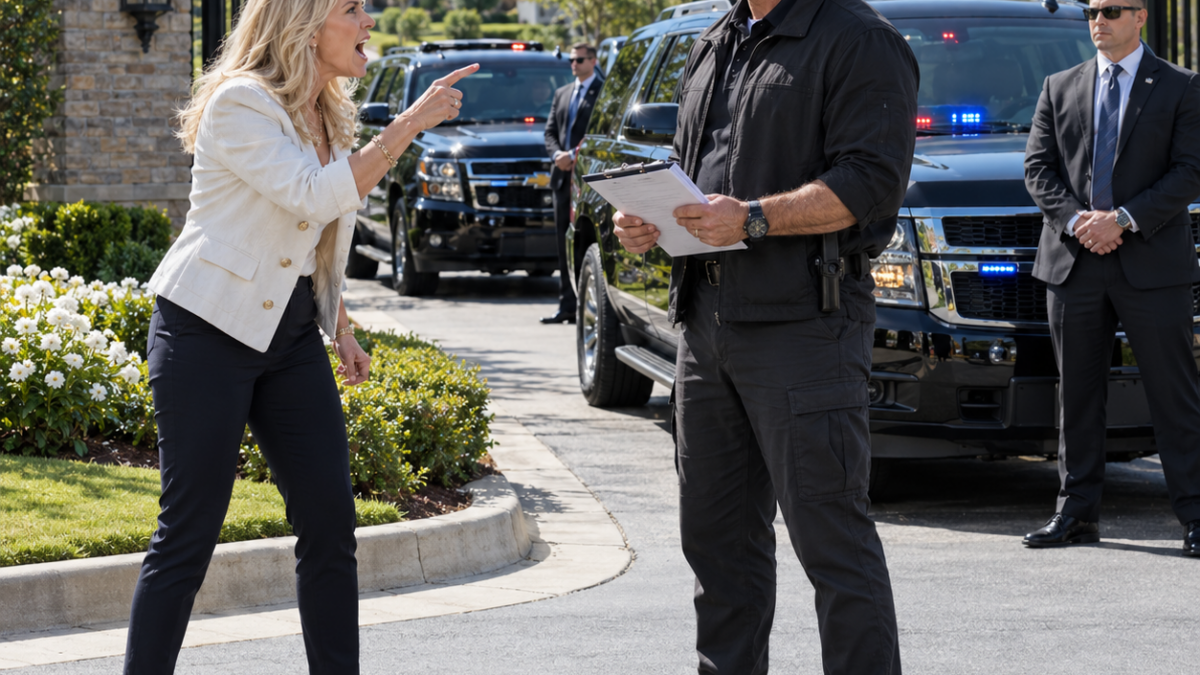
PART 2
The next morning, I stopped thinking of Karen Miller as an irritating neighbor.
I started thinking of her as a system.
That distinction mattered.
You can argue with an irritating person.
Systems have to be understood.
Inputs.
Incentives.
Patterns.
Weak points.
For most of my career, my job had not been standing beside a politician in sunglasses while cameras flashed.
Protective work is overwhelmingly about preparation.
Advance work.
Threat assessment.
Route analysis.
Communications.
Contingencies.
You ask what can go wrong before anything happens.
Then you build enough layers that if one layer fails, another catches it.
I decided to apply the same discipline at home.
Not Secret Service authority.
Secret Service habits.
There was a line there, and I intended to stay on the correct side of it.
I was not going to use federal databases to investigate Karen.
I was not going to assign agents.
I was not going to make her an official government problem because she annoyed me.
Oakmont Estates was a private homeowners association.
I was Jack Renner, homeowner.
That was enough.
Sarah understood immediately.
“What do you need?”
I looked at her.
“You don’t have to get involved.”
She gave me the look wives reserve for husbands who have said something especially stupid.
“Those letters have our address on them too.”
Fair.
Before our oldest child was born, Sarah had worked in accounting.
Not forensic accounting.
But she knew ledgers.
Invoices.
Budgets.
More importantly, she could smell numbers that didn’t belong together.
We started with the bylaws.
Member inspection rights.
Meeting procedures.
Fine schedules.
Appeal rights.
Board compensation.
Vendor bidding.
Records retention.
Then I sent records requests.
Seven years of board minutes.
Budgets.
Vendor contracts.
Invoices.
Violation histories with personal information appropriately redacted.
Meeting minutes relating to my own fines.
Documentation supporting Karen’s claim that the board had reviewed my federal-vehicle explanation.
Separate certified letters.
Separate proof of delivery.
Sarah looked at the pile of envelopes.
“You’re enjoying this.”
“No.”
“You color-coded them.”
“That’s organization.”
“You alphabetized the attachments.”
“That’s civilization.”
She shook her head.
“You terrify me.”
While we waited, I installed two ordinary home-security cameras.
Nothing covert.
One covered the front porch and driveway.
The other covered the garage and side gate.
I had two children.
I should have installed them when we moved in anyway.
Then I started walking the neighborhood in the evenings.
Our dog, Ranger, loved this phase of the operation.
Oakmont was beautiful.
That is worth saying.
Mature trees.
Wide sidewalks.
Homes set back from the street.
People spent money maintaining their properties.
Children rode bicycles between driveways.
From the outside, it looked peaceful.
But something was off.
People did not linger.
They waved, then went inside.
Conversations ended when golf carts approached.
Several houses had identical beige doors even though I remembered seeing more color when we toured the neighborhood months earlier.
The first real conversation happened because George Peterson was trying to drag a forty-pound bag of mulch from the back of his car.
George was seventy-eight.
Widower.
Thin shoulders.
Army veteran, though decades before my time.
I helped him carry the bag into his garage.
“Appreciate it,” he said.
“No problem.”
He looked toward my house.
“Those your black trucks?”
“Temporarily.”
“I heard Karen got you.”
That phrasing interested me.
“Got me?”
He smiled sadly.
“You’ll understand.”
He had already started walking inside.
“George?”
He stopped.
“What happened to you?”
His shoulders changed.
Not much.
Just enough.
He pointed toward his back garden.
“Come see.”
Behind his house were roses.
Dozens of them.
Red.
Yellow.
Pink.
Climbing varieties.
Miniatures.
Old-fashioned bushes that looked like they had been there longer than the subdivision.
In the middle stood an empty rectangle of darker soil.
“What was there?”
George stared at it.
“A bench.”
“HOA make you move it?”
“Tear it down.”
“Why?”
“Unapproved structure.”
He swallowed.
“Martha and I put it there on our fortieth anniversary.”
His wife.
“I’m sorry.”
“She died three years later.”
George rubbed one thumb against the other.
“She used to sit there while I worked.”
I felt heat rise behind my ribs.
Not professional anger.
Human anger.
“How big was the bench?”
“Normal bench.”
“Permanent footing?”
“Two concrete pads.”
“Visible from the street?”
“No.”
“Did you apply after they cited it?”
“Yes.”
“Denied?”
He nodded.
“Karen said approving it afterward would reward noncompliance.”
“So you removed it?”
“They were adding fifty dollars a day.”
He looked embarrassed.
“I thought if I paid and took it down, she’d leave me alone.”
“Did she?”
George looked at me.
That was answer enough.
He showed me the notices.
Roses growing beyond an approved trellis height.
Mulch color.
A hose reel visible from a neighboring second-story window.
Three dandelions near his curb.
Seventy-five dollars.
“Three?”
George pointed.
“Those three.”
I looked at three tiny brown spots where weeds had been removed.
“You kept the photograph?”
“She sent it with the violation.”
Of course she did.
I asked permission to copy his records.
George frowned.
“Why?”
“I’m checking whether the rules are being applied consistently.”
“You’re fighting her?”
“I’m reviewing records.”
“Same thing.”
“Maybe.”
He hesitated.
Then handed me the folder.
“Don’t use my name unless you have to.”
“I won’t.”
His fear followed me home.
That night I told Sarah.
She became quiet.
“I saw the roses.”
“Yes.”
“The bench was for his wife?”
“Yes.”
Sarah closed her eyes.
“Our kids are going to grow up thinking this is normal if nobody stops it.”
That was the moment the dispute stopped being about my SUVs.
The records boxes arrived nearly a month after my requests.
Seven years of paperwork.
No organization.
No index.
No electronic copies.
Just boxes.
Sarah stood on the porch.
“She hates us.”
“She underestimated us.”
We transformed the dining room into an audit station.
The kids thought it was funny for approximately two days.
Then they wanted the table back.
I took minutes and violation files.
Sarah took finances.
The first pattern emerged almost immediately.
Karen’s claim of “equal enforcement without exceptions” was false.
A former board member’s adult son had parked a rusted pickup truck on the street for months.
No fine.
Karen’s closest friend had built an exterior deck before receiving architectural approval.
The board retroactively approved it.
No penalty.
Another resident received six hundred dollars in fines because a plastic children’s playset was the wrong shade of green.
A family two streets over received repeated lawn citations even though photographs showed conditions nearly identical to the board treasurer’s yard.
I did not jump to conclusions about motive.
I made a spreadsheet.
Property.
Violation.
Rule.
Date.
Fine.
Appeal.
Comparable properties.
Board relationship.
Sarah looked over my shoulder.
“You made a matrix.”
“I like matrices.”
“You need hobbies.”
“I had one. Karen fined it.”
She laughed.
Then stopped.
“Jack.”
Her voice had changed.
She slid a budget toward me.
“Landscaping.”
The annual number was huge.
Far larger than I expected for Oakmont’s common entrance, clubhouse beds, several medians, and pool area.
“Vendor?”
“Evergreen Solutions LLC.”
“Get me the contract.”
We found it.
Multi-year renewal.
Price increases each year.
Vague scope language.
Minimal performance metrics.
Sarah searched state business records from her personal laptop.
Five minutes later, she turned the screen.
Evergreen Solutions LLC.
Owner:
Frank Miller.
I looked at her.
“Karen?”
“Cousin.”
“You sure?”
“Same family connection listed in an older community newsletter. ‘Congratulations to my cousin Frank on launching his new landscape company.’”
She pulled up the archived PDF.
A month later, Evergreen received its first Oakmont contract.
“Related-party contracts aren’t automatically illegal.”
“I know.”
“Disclosure?”
“Keep looking.”
We did.
No obvious conflict disclosure in the board minutes before the original award.
No competitive bid package in the boxes.
No board discussion explaining why Evergreen was selected.
That was concerning.
Not proof of theft.
Then Sarah found the stipend.
Five hundred dollars every month.
Payee:
Karen Miller.
Description:
PRESIDENTIAL ADMINISTRATIVE STIPEND
I opened the bylaws.
Article concerning board compensation.
Directors served without salary or compensation, except reimbursement of properly documented expenses unless compensation was specifically approved according to the governing process.
“When did they approve this?”
Sarah had already found it.
Holiday week.
Five years earlier.
Attendance: fourteen households.
Karen introduced a motion granting the president a monthly “administrative allowance” for extraordinary community management services.
Passed four to one by the board.
No membership vote.
No annual disclosure beyond a buried budget line.
“How much total?”
“Thirty thousand over five years.”
I rubbed my forehead.
“Could be improper compensation.”
“Yes.”
“Not automatically embezzlement.”
“I know.”
Sarah looked annoyed.
“You keep saying that.”
“Because words have elements.”
“So does stealing.”
“Sarah.”
She sighed.
“I know. Evidence first.”
We kept going.
Then we found something much more important than the stipend.
Compliance work.
Residents who received landscaping violations were frequently given a “recommended correction vendor.”
Evergreen Solutions.
Sometimes Karen’s violation notice listed Evergreen’s phone number.
Sometimes a follow-up email did.
Sarah began building a second spreadsheet.
Violation date.
Evergreen contact date.
Work performed.
Invoice amount.
Fine closed.
In case after case, the pattern repeated.
Karen found problem.
Resident was frightened.
Evergreen fixed problem.
HOA approved correction.
One family had paid $2,400 to Evergreen to replace shrubs because Karen claimed the original species violated the approved landscape palette.
Another paid $1,100 for lawn remediation after repeated citations.
Then I found George.
Rose trellis.
After his bench issue, Karen had cited the decorative stone edging around Martha’s rose beds.
The notice recommended Evergreen.
George had paid them $680 to replace edging that looked almost identical.
I called him.
“Did Karen recommend Evergreen?”
“She said they knew HOA standards.”
“Did you get other quotes?”
“No.”
“Why?”
“I wanted it over.”
There was that sentence again.
I wanted it over.
Karen’s system did not require overwhelming force.
Just enough pressure to make surrender cheaper than resistance.
I visited George the next day.
He was in his garage polishing an old radio.
I showed him copies.
His violation.
Evergreen recommendation.
Comparable properties with similar garden edging and no citation.
Then Karen’s friend’s unapproved deck.
No penalty.
George read quietly.
Finally he whispered, “I thought it was me.”
“It wasn’t.”
“I thought I was getting old.”
My chest tightened.
“What do you mean?”
“I thought maybe I just didn’t understand anymore.”
He tapped the page.
“They’d send these letters with sections and paragraphs and deadlines.”
His hands started shaking.
“I taught my children to follow rules.”
He looked toward Martha’s empty garden space.
“So when they said I was wrong, I believed them.”
That sentence hit harder than anything Karen had done to me.
I moved the papers aside.
“George, you weren’t stupid.”
“I tore down her bench.”
“You were pressured.”
“I tore it down.”
His voice cracked.
“I should’ve fought.”
“No.”
I waited until he looked at me.
“You survived a system designed to make fighting exhausting.”
He wiped his eyes angrily.
“That sounds like something an agent says.”
“It’s something a neighbor says.”
George agreed to help.
Not publicly yet.
First, he gave us names.
A young family named the Parkers whose children’s playset had generated almost a thousand dollars in fines.
The Alvarez family, who had repeated lawn citations.
Jessica Monroe, a corporate attorney who had lived in Oakmont for a decade and paid every fine because she didn’t have time to fight.
One by one, we met.
Not secret agents.
Not informants.
Neighbors.
Jessica was the turning point.
She reviewed the financial documents at our table.
Evergreen.
Karen’s stipend.
Fine patterns.
Board minutes.
My vehicle citations.
George’s bench.
She removed her glasses.
“Jack, this is serious.”
“I know.”
“No, I mean legally serious.”
“I know.”
“Why haven’t you sued?”
“Because lawsuits are expensive and slow.”
She smiled slightly.
“You are definitely federal law enforcement.”
“What does that mean?”
“You like evidence before drama.”
“Usually.”
She looked toward Sarah.
“Your husband is annoying.”
Sarah said, “Finally, professional confirmation.”
Jessica agreed to help pro bono.
But she corrected several assumptions we had begun making.
The monthly stipend might violate governing documents or fiduciary duties without automatically becoming criminal theft.
A family vendor contract might be self-dealing without automatically being fraudulent.
Selective enforcement could support civil claims, but motive needed proof before anyone called it discrimination.
And my government vehicles?
She looked at the rule.
“The HOA has an argument that these are work vehicles.”
I stared.
Sarah smiled.
“I like her.”
Jessica continued.
“But the bigger problem for them is remedy and context. They’re in your private driveway. They don’t own the vehicles. You’ve shown they’re federally owned and operationally assigned. They can probably regulate visible vehicle categories prospectively within lawful covenant limits, but unilateral towing from your privately owned driveway without a valid legal basis is another question entirely.”
“Exactly.”
“And their hostile-correspondence fine?”
She laughed.
“That one is absurd.”
“So what do we do?”
Jessica stacked the papers.
“First, preservation letter.”
“To Karen?”
“To the whole board.”
“Then?”
“Demand independent review.”
“Then?”
“Recall petition.”
I looked at Sarah.
She nodded.
Jessica continued.
“And we do not threaten federal arrest over an HOA dispute.”
“Agreed.”
“If someone actually attempts to seize government property after notice?”
“Then I call the appropriate federal chain.”
“Good.”
She pointed at me.
“You are not handcuffing Karen on your driveway.”
“I wasn’t planning to.”
Sarah said, “He was thinking about it.”
“I was not.”
She smiled.
Jessica’s demand letter was ten pages.
Much sharper than anything I had written.
It demanded preservation of financial records.
Independent audit.
Suspension of disputed compensation.
Conflict disclosures relating to Evergreen Solutions.
Review of selective enforcement.
Withdrawal of my fines.
And assurance that no board member or vendor would enter my private driveway to seize or disable assigned government vehicles.
It also warned the directors that knowingly continuing improper conduct after notice could create individual exposure depending on the facts.
That frightened them.
As it should have.
The recall petition began quietly.
We needed twenty-five percent of homeowners to force a special meeting.
Sarah and George went door to door.
I stayed mostly behind the scenes.
My federal title complicated everything.
I wanted residents signing because of Karen’s conduct, not because the Secret Service agent at Number 42 asked.
In forty-eight hours, we had thirty-one percent.
Then Karen panicked.
Tuesday morning.
8:22.
I was in my home office on a secure but unclassified planning call related to a visiting foreign minister’s movement.
My phone buzzed.
Security-camera alert.
A tow truck was backing into my driveway.
For half a second, I assumed one of the government vehicles had a mechanical issue.
Then Karen appeared on screen.
Floral blouse.
Clipboard.
Pointing toward the first Suburban.
The tow operator stepped out.
I froze the video long enough to confirm what I was seeing.
Then interrupted my call.
“Sir, I need to step away. I have an attempt to remove an assigned government vehicle from my residence.”
Silence.
Then my supervisor said, “Notify local office duty desk. Do not create an unnecessary confrontation.”
“Understood.”
I ended the call.
Made the notification.
Then walked outside.
The tow operator had already extended his equipment toward the Suburban.
Karen saw me.
Her smile was almost joyful.
“Too late now, Mr. Renner.”
I ignored her.
Walked toward the driver.
“Sir.”
He stopped.
“I’m Jack Renner. This is my property.”
He looked at Karen.
“She called the tow.”
“I understand.”
“This an HOA violation?”
“That’s disputed.”
I held up my credentials where he could see them without turning the sidewalk into a show.
“The vehicle you’re preparing to remove belongs to the United States government and is assigned for official duty.”
His expression changed immediately.
“What?”
“I’m asking you not to attach or move it. I’ve notified the responsible federal office.”
He looked at Karen again.
She shouted, “He says this every time.”
I stayed focused on him.
“You were told the vehicle was privately owned?”
He frowned.
“She said work truck. HOA authorization.”
“Did she tell you it was on my privately owned driveway?”
He looked down.
Then at his truck.
“I’m not touching this.”
Karen marched toward him.
“I hired you.”
“Lady, I am not towing a government truck off somebody’s driveway.”
“You have a contract.”
“I have common sense.”
He began retracting the equipment.
Karen’s face reddened.
“Jack!”
I turned.
“You were warned in writing.”
“This is my community.”
“No.”
I kept my voice low.
“It’s our community.”
She stepped onto my driveway.
I raised a hand.
“Please stay on the sidewalk.”
Her eyes widened.
“You don’t order me around.”
“I’m asking you to leave my property.”
“I have enforcement authority.”
“Not on my driveway without lawful basis.”
Neighbors had begun appearing.
George on his porch.
The Parkers near their mailbox.
Jessica walking down the sidewalk fast.
Karen jabbed a finger toward the SUVs.
“Those are prohibited commercial vehicles.”
“They’re federal fleet vehicles.”
“I don’t care.”
“I know.”
The tow driver climbed into his cab.
Karen slapped the door.
“Don’t leave!”
He rolled down the window.
“I’m leaving.”
“You’ll never work in Oakmont again.”
He looked at me.
Then at her.
“I can live with that.”
The truck pulled away.
No arrest.
No dramatic federal raid.
No agents swarming the cul-de-sac.
Just one tow operator deciding he did not want to become part of a legal dispute involving a government-owned vehicle on private property.
That should have embarrassed Karen enough to stop.
Instead, she made the worst decision of the entire conflict.
She started yelling.
At me.
At the departing tow truck.
At the neighbors.
“You people have no idea what I deal with!”
George stepped off his porch.
Karen saw him.
“You.”
He stopped.
“You’ve been spreading lies.”
George’s shoulders tightened.
Jessica moved closer.
“Karen, stop.”
“This does not concern you.”
“It concerns every homeowner you’ve fined.”
Karen laughed.
“Oh, please.”
I could have exposed everything right there.
Evergreen.
The stipend.
The enforcement pattern.
I almost did.
Then Jessica looked at me.
Small shake of her head.
Not here.
Not like this.
She was right.
A crowd on a sidewalk was not due process.
So I said only one thing.
“Karen, the recall petition is already above the threshold.”
Silence.
Her face changed.
“What petition?”
George straightened.
“The one I signed.”
That hurt her more than my badge ever could.
She stared at him.
“You?”
“Yes.”
“I gave you three extensions on landscaping.”
“You made me tear down Martha’s bench.”
Karen’s mouth opened.
“You violated—”
George’s voice rose.
“It was her bench!”
Everyone stopped.
I had never heard him yell.
“She sat there for fourteen years!”
His hands shook.
“You made me take it apart because it didn’t match your paperwork.”
Karen stepped back.
George’s eyes filled.
“And I let you.”
No one spoke.
Then he said, much quieter:
“I’m not letting you do it to anybody else.”
Karen left.
She walked fast.
No final threat.
No clipboard speech.
Just retreat.
The video from my security camera captured the tow attempt.
I preserved it.
So did the towing company.
Jessica sent a supplemental preservation notice.
The other board members finally broke.
Two resigned within seventy-two hours.
Another hired personal counsel.
The treasurer, Gerald Pike, called Jessica.
He wanted to talk.
With his lawyer present.
That meeting changed the case.
Gerald admitted Karen dominated board decisions.
He claimed he had relied on her representations about Evergreen.
He had signed checks.
He had approved the stipend.
He had not independently reviewed the bylaws.
His lawyer was careful.
Gerald was not confessing to crimes.
He was explaining governance failures.
“Did you know Frank Miller was her cousin?” Jessica asked.
“Yes.”
“Was that disclosed to membership?”
“I assumed.”
“Where?”
Silence.
“Did you review competing bids?”
“Karen said Evergreen was cheapest.”
“Did you see the bids?”
“I don’t remember.”
“Did you approve her stipend?”
“Yes.”
“Did you check whether the board had authority to do that alone?”
“No.”
Gerald looked sick.
“I thought it was five hundred dollars.”
Sarah said quietly, “Every month.”
He closed his eyes.
“I know.”
That was the danger of passive boards.
Nobody thinks one small surrender matters.
Then there are fifty of them.
The special recall meeting happened two weeks later.
Standing room only.
Karen sat at the front with Gerald, the only remaining director who had not resigned before the vote.
He looked like he wanted to evaporate.
Jessica explained the process.
Then residents spoke.
The Parkers.
Their son’s playset.
An Alvarez family member described repeated lawn notices.
Jessica was careful not to characterize the pattern as unlawful discrimination without adjudication.
She didn’t need to.
The photographs and comparison records spoke for themselves.
Then George walked to the microphone.
He carried a framed photograph of Martha.
Young.
Smiling.
Sitting on the old bench in the rose garden.
“My wife designed that garden.”
His voice trembled.
“She had cancer twice.”
The room became completely still.
“The second time, she couldn’t kneel anymore.”
He looked at the photograph.
“So I built her a bench.”
He paused.
“She would sit there and tell me which roses I was pruning wrong.”
A few people laughed softly.
George smiled through tears.
“After she died, that bench was the only place in the yard that still felt like it had her voice in it.”
He looked at Karen.
“You made me tear it down.”
Karen stared at the table.
“You said approving it after the fact would reward disobedience.”
George swallowed.
“I believed you had that kind of power.”
His hands stopped shaking.
“I don’t anymore.”
He stepped away.
No applause at first.
Then one person stood.
Then another.
Eventually almost the entire room.
George looked terrified by the attention.
I helped him back to his seat.
“You okay?”
“No.”
“Good speech.”
“Never doing that again.”
“Deal.”
Jessica presented the financial concerns next.
Not criminal accusations.
Facts.
Evergreen’s family relationship.
Missing bid records.
Contract pricing requiring independent review.
Karen’s compensation despite bylaws describing board service as unpaid absent proper authorization.
Violation-driven referrals.
Selective enforcement data.
Then my federal vehicle matter.
“Mr. Renner’s employment is almost irrelevant,” Jessica said.
That surprised people.
She continued.
“The core issue is that the board imposed escalating fines despite credible documentation, then attempted to arrange removal of vehicles from a homeowner’s private driveway without resolving the underlying authority dispute.”
She looked toward Karen.
“Whether those vehicles belonged to the United States government made the risk larger.”
Then toward the homeowners.
“But you should not have to work for the Secret Service to expect basic procedure from your HOA.”
That was exactly right.
The vote happened by secret ballot.
Oakmont had 112 voting homes.
Ninety-four participated.
Recall Karen Miller:
Ninety-one yes.
Three no.
Gerald Pike was recalled by eighty-seven votes.
He had already said he would not contest the result.
Karen did not speak after the tally.
She gathered her folder.
Then stopped beside George.
For a moment, I thought she might apologize.
Instead she said, “The bench was against the rules.”
George looked at her.
Then smiled sadly.
“That’s why you lost.”
She walked out.
An interim board was elected.
Jessica refused the presidency but agreed to serve as legal-policy adviser temporarily.
A retired CPA named Denise Carter became treasurer.
A young father named Michael Parker joined.
And George Peterson, to his horror, was elected to the board.
He objected.
Loudly.
The room ignored him.
“I’m seventy-eight!”
Someone shouted, “Experience!”
“I hate meetings!”
Someone else shouted, “Qualification!”
He looked at me.
“This is your fault.”
“Absolutely.”
The first interim meeting rescinded my disputed fines after independent counsel reviewed the facts.
They also suspended hundreds of recent penalties pending audit.
Not all were erased.
Some were legitimate.
The boat parked on a lawn for five months?
Still a violation.
The homeowner who ignored three warnings about blocking a fire lane?
Still a violation.
That mattered.
Reform without standards becomes another kind of irresponsibility.
The goal was not to destroy rules.
It was to make them trustworthy.
The new board terminated Evergreen’s automatic renewal.
They opened competitive bidding.
Evergreen was allowed to submit a bid.
They did.
It was almost thirty percent higher than the eventual winning contractor for comparable scope.
Sarah looked at me.
“That answers something.”
“Not everything.”
“No.”
“But something.”
Then came the independent forensic audit.
Karen’s stipend was improper under the association’s governing procedure.
Some Evergreen invoices reflected services actually performed.
Others contained inflated pricing, duplicate charges, and work descriptions auditors could not reconcile with physical records.
Investigators also identified payments unrelated to documented HOA purposes.
The interim board referred the findings to outside counsel.
Outside counsel recommended referral to the county prosecutor and state authorities responsible for nonprofit or association fraud.
That referral did not come from me.
I insisted on it.
The criminal investigation took months.
Karen’s cousin Frank retained counsel.
So did Karen.
Former board members gave statements.
Banks produced records.
Evergreen employees were interviewed.
The investigation eventually established enough evidence for charges involving misappropriation, falsified or unsupported expenses, and improper transfers.
Not every ugly management decision became a crime.
The prosecutor separated the two.
That is how it should work.
Karen and Frank ultimately entered negotiated pleas rather than go through a full trial.
Karen admitted to felony-level financial misconduct involving association money.
She was ordered to pay restitution.
She received a substantial probationary sentence, community-service obligations, and restrictions on serving in fiduciary roles during the applicable period.
Frank’s company lost the Oakmont business and faced separate financial consequences.
Some residents were disappointed Karen did not go to prison for years.
George wasn’t.
“She has to pay the money back?”
“Yes.”
“She can’t run another board?”
“Not under the terms imposed.”
“Good.”
He looked toward his garden.
“I don’t need her in a cell.”
That surprised me.
“Really?”
“I need my bench back.”
So we rebuilt it.
One Saturday morning, thirty neighbors showed up at George’s house.
Michael Parker brought lumber.
Jessica brought coffee.
Sarah brought pastries.
I brought tools.
George tried to supervise.
That lasted twelve minutes.
“You’re cutting that too short.”
“It’s measured.”
“Martha liked wider arms.”
“We’re building a replica, not the USS Constitution.”
He glared.
“Federal agents have no respect for craftsmanship.”
“Secret Service.”
“Same problem.”
We laughed.
Then he became quiet.
The new brass plaque arrived last.
MARTHA PETERSON
1946–2023
THE ROSES WERE ALWAYS YOURS
George touched it with two fingers.
Then sat down on the finished bench.
No one said anything.
The roses were blooming.
Martha’s favorite yellow variety had opened that morning.
George looked at the empty space beside him.
“She would’ve loved all this fuss.”
Sarah wiped her eyes.
I pretended not to see.
George patted the bench.
“Sit.”
I did.
For several minutes, the two of us just looked at roses.
That was the real victory.
Not the recall vote.
Not the tow truck leaving.
Not Karen’s plea.
A widower sitting where grief had once been declared noncompliant.
Oakmont changed after that.
Slowly.
The new board rewrote enforcement procedures.
First notice became educational wherever safety wasn’t involved.
Residents received clear citations to actual rules.
Reasonable cure periods.
Appeals were heard by people who had not issued the original violation when possible.
No “hostile correspondence” fine.
No penalties invented because someone’s tone hurt the president’s feelings.
Vehicle rules were clarified too.
Commercial advertising vehicles could still be restricted.
Large recreational vehicles still had parking limits.
Government fleet vehicles assigned temporarily for official work were addressed specifically after counsel review.
More importantly, no board president could order a vehicle removed from a privately owned driveway merely because she disliked its appearance.
That should never have required clarification.
Sometimes written rules exist because somebody once did something nobody imagined needing to prohibit.
The board also adopted conflict-of-interest requirements.
Related-party vendors had to be disclosed.
The interested director had to recuse from discussion and voting.
Large contracts required competitive bids.
Board compensation required transparent member approval.
Financial reports were posted quarterly.
George became obsessed with quarterly reports.
It was adorable.
He carried them around like baseball statistics.
“Landscaping is fourteen percent under budget.”
“Congratulations.”
“Pool maintenance is high.”
“It’s July.”
“That is no excuse.”
“You’ve become worse than Karen.”
He looked horrified.
“Take that back.”
I did.
Oakmont began feeling like home.
Neighbors stopped avoiding us.
The two black Suburbans remained in the driveway when operational needs required them.
Sometimes one.
Sometimes none.
Eventually newer fleet vehicles replaced them.
No one cared.
The kids started calling them “Dad’s ugly trucks.”
Sarah encouraged this.
“Commercial monstrosities,” she corrected one evening.
Our son asked, “Can we put that on a license plate frame?”
“No.”
“Why?”
“Because they’re government vehicles.”
“Boring.”
“Exactly.”
The story traveled.
First inside Oakmont.
Then outside.
At block parties, someone inevitably told a newcomer:
“Karen tried to tow Secret Service trucks.”
The story grew every year.
In one version, twenty agents jumped out of the bushes.
Never happened.
In another, the President was inside my house.
Absolutely not.
Someone claimed Karen got handcuffed beside the tow truck.
She did not.
Another version had snipers on rooftops.
Ridiculous.
I corrected people when I could.
The truth mattered because the truth was better.
I did not defeat Karen with federal power.
I defeated her attempt to control my driveway by documenting ownership and refusing an unlawful tow.
The community defeated her presidency through its own bylaws.
Auditors exposed money problems.
Prosecutors handled crimes.
Neighbors rebuilt what she had broken.
That story was less cinematic.
It was also more important.
Years later, I was promoted into a broader supervisory role.
More desk.
More responsibility.
More people calling me “sir” when I wished they wouldn’t.
The kids became teenagers.
Sarah returned to accounting part-time.
Oakmont became so normal that our largest annual fight involved pool hours and whether holiday lights could remain up through mid-January.
George argued for February.
“Why?”
“Martha liked lights.”
Nobody had the heart to oppose him.
The rule became January thirty-first.
George called it compromise.
Jessica called it hostage negotiation.
Then George’s health declined.
Heart.
Lungs.
Age.
He stayed stubborn.
At eighty-two, he still pruned roses despite his daughter threatening to confiscate the shears.
One afternoon, Sarah called me at work.
“George is in the hospital.”
I drove straight there.
No black Suburban.
Personal car.
No lights.
No urgency that mattered to anyone except me.
George looked tiny in the bed.
His daughter sat beside him.
He smiled when I entered.
“Agent.”
“Director.”
He laughed, then coughed.
“I never became president.”
“No, but you behaved like one.”
“Insulting.”
We talked for twenty minutes.
Roses.
Kids.
Oakmont.
Then he became serious.
“Bench needs sealing this year.”
“I know.”
“You say that.”
“I’ll do it.”
“Before winter.”
“Yes.”
“Use the good stuff.”
“Yes, George.”
He closed his eyes.
Then opened them again.
“You know what Karen took?”
I waited.
“Not the bench.”
“What?”
“My confidence.”
His voice was thin.
“For a while.”
I sat closer.
“She made me think being old meant I should trust people with louder voices.”
My throat tightened.
“You fixed that.”
“No.”
“You did.”
He looked toward his daughter.
“Neighbors did.”
He was right.
George died three days later.
Oakmont filled the clubhouse for his memorial.
His daughter asked if I would speak.
Public speaking had never bothered me.
That one did.
I stood beside a photograph of George and Martha on the rebuilt bench.
I told the story of the mulch bag.
The three dandelions.
His fear.
His first signature on the recall petition.
Then the night he told Karen no.
I finished with what he had told me in the hospital.
Authority should never make decent people feel smaller inside their own homes.
Afterward, his daughter handed me an envelope.
Inside was the original HOA violation notice for Martha’s bench.
George had saved it.
Across the bottom he had written:
APPROVED BY THE PEOPLE WHO ACTUALLY MATTER.
I framed it.
It hangs in our study.
Beside it is Karen’s original $500 vehicle citation.
Sarah says the décor is weird.
She is correct.
Years passed.
The government eventually reassigned me again.
More travel.
Less driveway time.
Then retirement approached.
People kept asking what I would miss.
The mission.
The agents.
The strange intensity of knowing that ordinary mistakes could become extraordinary consequences.
I would not miss hotel coffee.
Or ties.
Or checking exits automatically every time I entered a restaurant.
On my final week, my office held a ceremony.
Speeches.
Plaque.
Photographs.
One of the younger agents tracked down a model of the exact generation Suburban Karen had tried to tow.
He mounted it on a wooden base.
Small brass plate:
COMMERCIAL MONSTROSITY #1
I laughed harder than anyone expected.
Sarah put it in the study.
Now the room looked even worse.
Retirement gave me too much time.
So I joined Oakmont’s safety committee.
Not the board.
Never the board.
Jessica asked three times.
“No.”
“You coordinated presidential protection.”
“Exactly.”
“You can handle HOA minutes.”
“I would rather coordinate presidential protection.”
Sarah agreed.
The safety committee suited me.
Streetlights.
Emergency contact lists.
AED at the clubhouse.
Pool gate.
Smoke alarm campaign.
Things where rules had an obvious reason.
One afternoon, a new homeowner named Kevin parked a branded plumbing van in his driveway.
The revised covenant restricted certain commercial vehicles overnight.
Kevin received a warning.
He came to my door furious.
“This is Karen all over again.”
“No.”
“They’re telling me what I can park at my own house.”
“Yes.”
“You fought that.”
“I fought an improper application to government fleet vehicles and an attempted tow without appropriate authority.”
He stared.
“That sounds lawyerly.”
“I’ve spent too much time around Jessica.”
He handed me the notice.
The rule was clear.
The van had huge commercial branding.
Kevin had garage space.
He simply didn’t want to use it because tools filled the garage.
“The board is probably right.”
His mouth opened.
“You’re serious?”
“Yes.”
“But your Suburbans—”
“Different facts.”
“So I have to comply?”
“Or use the appeal process and make your argument.”
“That’s not fair.”
I smiled.
“Fair does not mean you always win.”
He hated that answer.
He moved the tools.
Parked the van inside.
Six months later, he joined the architectural committee.
That may have been the moment I knew Oakmont had actually healed.
We had learned how to tell the difference between resisting abuse and resisting every rule.
Karen never understood that distinction.
Everything was obedience or rebellion.
Healthy institutions leave room for disagreement.
Years after her case ended, I saw Karen once.
Grocery store.
Produce section.
Of course.
I almost avoided her.
Then she saw me.
“Jack.”
“Karen.”
She looked older.
So did I.
For several seconds we stood between apples and oranges like two veterans of a war nobody else in the store knew had happened.
She spoke first.
“I heard George died.”
“Yes.”
“I’m sorry.”
I believed her.
“He was a good man.”
She looked down.
“I know.”
That surprised me.
Then she said, “I shouldn’t have made him remove the bench.”
No excuse.
No rule citation.
Just that.
“No.”
“I thought exceptions made authority weak.”
I looked at her.
“What made you change your mind?”
She smiled sadly.
“Losing all of it.”
There was no triumph in hearing that.
I asked, “How are you?”
She seemed surprised.
“Working.”
“Good.”
“My husband and I moved north.”
I nodded.
Then she glanced toward the parking lot.
“Still driving those black trucks?”
“Retired.”
“Really?”
“Really.”
She laughed softly.
“I hated those things.”
“I noticed.”
Silence again.
Then:
“I’m sorry I tried to tow them.”
I almost made a joke.
Didn’t.
“Thank you.”
“I didn’t believe you.”
“I know.”
“I thought you were using your job to scare me.”
“I know.”
She looked at me directly.
“I was the one trying to scare people.”
That was the closest thing to full understanding I ever heard from her.
“Yes.”
She nodded.
Then walked away.
No friendship.
No forgiveness ceremony.
No dramatic handshake.
Just two people continuing their shopping.
Sometimes accountability ends quietly.
Oakmont still has an HOA.
That is another part people find disappointing when they want the story to end with everything burned down.
We never dissolved it.
We didn’t need to.
The community had common property.
A pool.
A clubhouse.
Landscaped entrances.
Stormwater infrastructure.
Insurance obligations.
Someone had to manage those things.
So we made the institution better.
That was harder than destroying it.
And more valuable.
Karen’s mistake was never merely being president of an HOA.
It was believing being president made the association hers.
My mistake, early on, was almost the mirror image.
For one angry moment after that $1,500 letter, I wanted to remind her exactly who I was.
Badge.
Agency.
Authority.
Federal property.
I wanted my title to end the argument.
If I had done that, I might have solved my parking problem.
I would not have helped George.
Or the Parkers.
Or the Alvarez family.
I would not have discovered Evergreen.
I would not have helped change the procedures that allowed Karen to become Karen.
My badge could protect two vehicles.
It could not build a healthy neighborhood.
That required ordinary people deciding the rules belonged to all of them.
Sarah understood that long before I did.
One evening after retirement, we sat on our deck watching our grown children argue about who had to clear dinner dishes.
She looked toward the driveway.
My personal SUV sat there.
Gray.
Boring.
No antennas.
No armor.
No government plates.
“Looks empty,” she said.
“What?”
“The driveway.”
“You miss the Suburbans?”
“No.”
“You sounded nostalgic.”
“I miss making fun of them.”
“You can make fun of my SUV.”
“It lacks presence.”
I laughed.
Then she pointed toward the street.
A black Suburban turned into Oakmont.
We both froze.
The vehicle stopped outside Jessica’s house.
Door opened.
Her son stepped out.
Rental car.
Sarah burst out laughing.
“You reacted.”
“I did not.”
“You absolutely did.”
“Training.”
“Trauma.”
“Professional awareness.”
She kissed my cheek.
“Commercial monstrosity.”
I let her have that one.
The sun went down over Oakmont.
Children who had not even been born during Karen’s presidency rode bicycles past George’s old house.
His daughter had sold it to a young couple.
They kept the roses.
They kept the bench.
The plaque remained.
Martha Peterson.
The roses were always yours.
Once a year, around the anniversary of George’s death, Sarah and I leave a small bunch of flowers there.
No committee approval.
No fine.
No paperwork.
Just neighbors remembering neighbors.
That is the community Karen claimed to protect but never understood.
Not identical shrubs.
Not blank driveways.
Not people frightened into compliance.
Connection.
Trust.
Rules used carefully.
Power limited intentionally.
The willingness to admit when a rule does not fit the facts.
And the courage to tell someone with a title that the title has boundaries.
My title had boundaries too.
Senior Secret Service supervisor.
Agent in charge.
Federal badge.
Government fleet.
Those things sounded enormous on Karen’s sidewalk.
But the most meaningful authority I ever exercised in Oakmont was the same authority George had.
One vote.
One signature.
One voice at a meeting.
That was enough.
Karen saw two black SUVs and assumed they were commercial work vehicles ruining her neighborhood.
She fined me.
She doubled the fines.
She called me arrogant when I documented what they were.
Then she tried to send a tow truck onto my driveway.
Only then did she finally understand that the vehicles belonged to the federal government and that the quiet new homeowner she had chosen to humiliate was the Secret Service supervisor responsible for the protective operation using them.
But that wasn’t what ended her reign.
Her own paperwork did.
The contracts she thought no one would inspect.
The compensation she assumed no one would question.
The violations she believed nobody would compare.
The frightened neighbors she expected never to speak to one another.
And one old man who finally decided Martha’s bench mattered more than being afraid.
The Suburbans eventually disappeared from my driveway.
The federal government replaced them.
Then replaced their replacements.
Then I retired.
Karen moved away.
Board members changed.
Rules changed.
Children grew up.
But George’s bench is still there.
And if you ask me what remains from the entire fight, that is the image I remember.
Not the tow truck.
Not my badge.
Not Karen’s face.
George sitting among Martha’s roses with tears on his cheeks and thirty neighbors standing around him after rebuilding the one thing a petty rule had convinced him he no longer had the right to keep.
I spent most of my career protecting presidents, candidates, foreign leaders, and institutions bigger than any one person.
Oakmont taught me that sometimes protection looks much smaller.
A driveway.
A memorial bench.
A family’s peace.
A neighbor learning he is allowed to ask, “Show me where the rule says that.”
Karen thought the two black SUVs were the problem.
They weren’t.
They were simply the first thing that made me look closely.
And once all of us started looking, her little kingdom couldn’t survive the light.
TITLE: HOA Karen Fined My Black SUVs as “Commercial Work Trucks”—Then Learned I Was the Secret Service Agent in Charge
[FACEBOOK CAPTION — 700–800 WORDS]
Karen pointed at the two black Suburbans in my driveway and promised that if they were still there by morning, she would have both “commercial monstrosities” towed and fine me until I learned to respect her HOA.
She doubled the penalty after I calmly documented that the vehicles were federally owned and temporarily assigned to me for official protective duties, because she decided my explanation proved I thought I was “above the rules.”
What she didn’t know was that the moment she stopped arguing about parking and started reaching for those vehicles, she was about to expose far more than anyone in Oakmont Estates had ever dared to question.
“My name is Karen Miller,” she said, ignoring the hand I had extended. “President of the Oakmont Estates Homeowners Association.”
“I’m Jack Renner. Number forty-two.”
“I know exactly who you are.”
Her finger swung back toward the two Chevrolet Suburbans.
“And those have to go.”
The SUVs were black, clean, and admittedly imposing. One was an armored command vehicle. The other was a support vehicle being staged overnight because my regional office was coordinating security for a visiting foreign delegation the next morning.
They were not mine.
They were not business trucks.
They were United States government vehicles temporarily assigned to my protective operation.
Karen saw something different.
“Section Seven, Paragraph Four prohibits commercial vehicles, work trucks, and oversized vehicles from being parked in residential driveways overnight.”
“They’re not commercial vehicles.”
“They certainly look like work vehicles.”
“They are official government vehicles.”
She crossed her arms.
“Everyone thinks their work is special.”
Fifteen years in the United States Secret Service had taught me to absorb arrogance without matching it.
I had managed protective movements through protests, secured sites where one mistake could become national news, and spent enough time around powerful people to recognize the danger of someone who believed authority and importance were the same thing.
So I stayed calm.
“These vehicles are assigned to me for official duties. They’ll be gone when the detail moves tomorrow.”
“That’s irrelevant.”
“No, ma’am. It isn’t.”
Her eyes narrowed.
Sarah had warned me about her.
My wife and I had bought the Oakmont house less than a month earlier because after years of assignments, hotels, temporary apartments, and unpredictable travel, we wanted our children to have something boring.
A backyard.
A school bus stop.
Neighbors whose biggest emergency was a missing dog.
Sarah had already received a $25 warning because our mailbox flag was supposedly the wrong shade of white.
I had laughed.
I wasn’t laughing now.
Karen pulled a violation slip from a folder.
“Five hundred dollars.”
“For vehicles on my own driveway?”
“For noncompliance.”
“You haven’t even given me time to respond.”
“I just did.”
She pushed the paper toward me.
I took it.
That evening, after the kids were asleep, I sat at our dining table with Oakmont’s covenants open beside my laptop.
I wrote a restrained letter to the full board.
I identified myself as the senior supervisory agent responsible for a regional protective operation.
I explained that the vehicles were federally owned, assigned for official use, and temporarily staged at my residence.
I attached redacted vehicle-assignment documentation showing ownership and identification numbers while removing operational details.
I also made something else clear.
My driveway was part of my private lot.
The HOA had no ownership interest in either vehicle.
There was no court order.
No repossession right.
No emergency.
I requested the fine be withdrawn.
I assumed any reasonable board would end the matter there.
A week later, a thick envelope arrived.
The fine had become $1,500.
Karen added an “administrative penalty” because my letter supposedly contained a hostile threat.
She had photocopied my explanation and written comments in red ink.
Beside “United States government property,” she wrote:
SO WHAT?
Beside the section explaining my federal assignment:
HE THINKS HE’S SPECIAL.
Then came the final page.
A communitywide warning about “new residents who believe professional status exempts them from neighborhood standards.”
Sarah read it twice.
“She’s trying to turn the neighborhood against us.”
I stared through the window at the two black SUVs.
“No.”
“What do you mean?”
“She’s doing something more useful.”
Sarah frowned.
I folded Karen’s letter and placed it in a new evidence folder.
“She’s putting everything in writing.”
[END OF FACEBOOK CAPTION]
[FIRST COMMENT / FULL STORY CONTINUATION]
The next morning, I stopped thinking of Karen Miller as an irritating neighbor.
I started thinking of her as a system.
That distinction mattered.
You can argue with an irritating person.
Systems have to be understood.
Inputs.
Incentives.
Patterns.
Weak points.
For most of my career, my job had not been standing beside a politician in sunglasses while cameras flashed.
Protective work is overwhelmingly about preparation.
Advance work.
Threat assessment.
Route analysis.
Communications.
Contingencies.
You ask what can go wrong before anything happens.
Then you build enough layers that if one layer fails, another catches it.
I decided to apply the same discipline at home.
Not Secret Service authority.
Secret Service habits.
There was a line there, and I intended to stay on the correct side of it.
I was not going to use federal databases to investigate Karen.
I was not going to assign agents.
I was not going to make her an official government problem because she annoyed me.
Oakmont Estates was a private homeowners association.
I was Jack Renner, homeowner.
That was enough.
Sarah understood immediately.
“What do you need?”
I looked at her.
“You don’t have to get involved.”
She gave me the look wives reserve for husbands who have said something especially stupid.
“Those letters have our address on them too.”
Fair.
Before our oldest child was born, Sarah had worked in accounting.
Not forensic accounting.
But she knew ledgers.
Invoices.
Budgets.
More importantly, she could smell numbers that didn’t belong together.
We started with the bylaws.
Member inspection rights.
Meeting procedures.
Fine schedules.
Appeal rights.
Board compensation.
Vendor bidding.
Records retention.
Then I sent records requests.
Seven years of board minutes.
Budgets.
Vendor contracts.
Invoices.
Violation histories with personal information appropriately redacted.
Meeting minutes relating to my own fines.
Documentation supporting Karen’s claim that the board had reviewed my federal-vehicle explanation.
Separate certified letters.
Separate proof of delivery.
Sarah looked at the pile of envelopes.
“You’re enjoying this.”
“No.”
“You color-coded them.”
“That’s organization.”
“You alphabetized the attachments.”
“That’s civilization.”
She shook her head.
“You terrify me.”
While we waited, I installed two ordinary home-security cameras.
Nothing covert.
One covered the front porch and driveway.
The other covered the garage and side gate.
I had two children.
I should have installed them when we moved in anyway.
Then I started walking the neighborhood in the evenings.
Our dog, Ranger, loved this phase of the operation.
Oakmont was beautiful.
That is worth saying.
Mature trees.
Wide sidewalks.
Homes set back from the street.
People spent money maintaining their properties.
Children rode bicycles between driveways.
From the outside, it looked peaceful.
But something was off.
People did not linger.
They waved, then went inside.
Conversations ended when golf carts approached.
Several houses had identical beige doors even though I remembered seeing more color when we toured the neighborhood months earlier.
The first real conversation happened because George Peterson was trying to drag a forty-pound bag of mulch from the back of his car.
George was seventy-eight.
Widower.
Thin shoulders.
Army veteran, though decades before my time.
I helped him carry the bag into his garage.
“Appreciate it,” he said.
“No problem.”
He looked toward my house.
“Those your black trucks?”
“Temporarily.”
“I heard Karen got you.”
That phrasing interested me.
“Got me?”
He smiled sadly.
“You’ll understand.”
He had already started walking inside.
“George?”
He stopped.
“What happened to you?”
His shoulders changed.
Not much.
Just enough.
He pointed toward his back garden.
“Come see.”
Behind his house were roses.
Dozens of them.
Red.
Yellow.
Pink.
Climbing varieties.
Miniatures.
Old-fashioned bushes that looked like they had been there longer than the subdivision.
In the middle stood an empty rectangle of darker soil.
“What was there?”
George stared at it.
“A bench.”
“HOA make you move it?”
“Tear it down.”
“Why?”
“Unapproved structure.”
He swallowed.
“Martha and I put it there on our fortieth anniversary.”
His wife.
“I’m sorry.”
“She died three years later.”
George rubbed one thumb against the other.
“She used to sit there while I worked.”
I felt heat rise behind my ribs.
Not professional anger.
Human anger.
“How big was the bench?”
“Normal bench.”
“Permanent footing?”
“Two concrete pads.”
“Visible from the street?”
“No.”
“Did you apply after they cited it?”
“Yes.”
“Denied?”
He nodded.
“Karen said approving it afterward would reward noncompliance.”
“So you removed it?”
“They were adding fifty dollars a day.”
He looked embarrassed.
“I thought if I paid and took it down, she’d leave me alone.”
“Did she?”
George looked at me.
That was answer enough.
He showed me the notices.
Roses growing beyond an approved trellis height.
Mulch color.
A hose reel visible from a neighboring second-story window.
Three dandelions near his curb.
Seventy-five dollars.
“Three?”
George pointed.
“Those three.”
I looked at three tiny brown spots where weeds had been removed.
“You kept the photograph?”
“She sent it with the violation.”
Of course she did.
I asked permission to copy his records.
George frowned.
“Why?”
“I’m checking whether the rules are being applied consistently.”
“You’re fighting her?”
“I’m reviewing records.”
“Same thing.”
“Maybe.”
He hesitated.
Then handed me the folder.
“Don’t use my name unless you have to.”
“I won’t.”
His fear followed me home.
That night I told Sarah.
She became quiet.
“I saw the roses.”
“Yes.”
“The bench was for his wife?”
“Yes.”
Sarah closed her eyes.
“Our kids are going to grow up thinking this is normal if nobody stops it.”
That was the moment the dispute stopped being about my SUVs.
The records boxes arrived nearly a month after my requests.
Seven years of paperwork.
No organization.
No index.
No electronic copies.
Just boxes.
Sarah stood on the porch.
“She hates us.”
“She underestimated us.”
We transformed the dining room into an audit station.
The kids thought it was funny for approximately two days.
Then they wanted the table back.
I took minutes and violation files.
Sarah took finances.
The first pattern emerged almost immediately.
Karen’s claim of “equal enforcement without exceptions” was false.
A former board member’s adult son had parked a rusted pickup truck on the street for months.
No fine.
Karen’s closest friend had built an exterior deck before receiving architectural approval.
The board retroactively approved it.
No penalty.
Another resident received six hundred dollars in fines because a plastic children’s playset was the wrong shade of green.
A family two streets over received repeated lawn citations even though photographs showed conditions nearly identical to the board treasurer’s yard.
I did not jump to conclusions about motive.
I made a spreadsheet.
Property.
Violation.
Rule.
Date.
Fine.
Appeal.
Comparable properties.
Board relationship.
Sarah looked over my shoulder.
“You made a matrix.”
“I like matrices.”
“You need hobbies.”
“I had one. Karen fined it.”
She laughed.
Then stopped.
“Jack.”
Her voice had changed.
She slid a budget toward me.
“Landscaping.”
The annual number was huge.
Far larger than I expected for Oakmont’s common entrance, clubhouse beds, several medians, and pool area.
“Vendor?”
“Evergreen Solutions LLC.”
“Get me the contract.”
We found it.
Multi-year renewal.
Price increases each year.
Vague scope language.
Minimal performance metrics.
Sarah searched state business records from her personal laptop.
Five minutes later, she turned the screen.
Evergreen Solutions LLC.
Owner:
Frank Miller.
I looked at her.
“Karen?”
“Cousin.”
“You sure?”
“Same family connection listed in an older community newsletter. ‘Congratulations to my cousin Frank on launching his new landscape company.’”
She pulled up the archived PDF.
A month later, Evergreen received its first Oakmont contract.
“Related-party contracts aren’t automatically illegal.”
“I know.”
“Disclosure?”
“Keep looking.”
We did.
No obvious conflict disclosure in the board minutes before the original award.
No competitive bid package in the boxes.
No board discussion explaining why Evergreen was selected.
That was concerning.
Not proof of theft.
Then Sarah found the stipend.
Five hundred dollars every month.
Payee:
Karen Miller.
Description:
PRESIDENTIAL ADMINISTRATIVE STIPEND
I opened the bylaws.
Article concerning board compensation.
Directors served without salary or compensation, except reimbursement of properly documented expenses unless compensation was specifically approved according to the governing process.
“When did they approve this?”
Sarah had already found it.
Holiday week.
Five years earlier.
Attendance: fourteen households.
Karen introduced a motion granting the president a monthly “administrative allowance” for extraordinary community management services.
Passed four to one by the board.
No membership vote.
No annual disclosure beyond a buried budget line.
“How much total?”
“Thirty thousand over five years.”
I rubbed my forehead.
“Could be improper compensation.”
“Yes.”
“Not automatically embezzlement.”
“I know.”
Sarah looked annoyed.
“You keep saying that.”
“Because words have elements.”
“So does stealing.”
“Sarah.”
She sighed.
“I know. Evidence first.”
We kept going.
Then we found something much more important than the stipend.
Compliance work.
Residents who received landscaping violations were frequently given a “recommended correction vendor.”
Evergreen Solutions.
Sometimes Karen’s violation notice listed Evergreen’s phone number.
Sometimes a follow-up email did.
Sarah began building a second spreadsheet.
Violation date.
Evergreen contact date.
Work performed.
Invoice amount.
Fine closed.
In case after case, the pattern repeated.
Karen found problem.
Resident was frightened.
Evergreen fixed problem.
HOA approved correction.
One family had paid $2,400 to Evergreen to replace shrubs because Karen claimed the original species violated the approved landscape palette.
Another paid $1,100 for lawn remediation after repeated citations.
Then I found George.
Rose trellis.
After his bench issue, Karen had cited the decorative stone edging around Martha’s rose beds.
The notice recommended Evergreen.
George had paid them $680 to replace edging that looked almost identical.
I called him.
“Did Karen recommend Evergreen?”
“She said they knew HOA standards.”
“Did you get other quotes?”
“No.”
“Why?”
“I wanted it over.”
There was that sentence again.
I wanted it over.
Karen’s system did not require overwhelming force.
Just enough pressure to make surrender cheaper than resistance.
I visited George the next day.
He was in his garage polishing an old radio.
I showed him copies.
His violation.
Evergreen recommendation.
Comparable properties with similar garden edging and no citation.
Then Karen’s friend’s unapproved deck.
No penalty.
George read quietly.
Finally he whispered, “I thought it was me.”
“It wasn’t.”
“I thought I was getting old.”
My chest tightened.
“What do you mean?”
“I thought maybe I just didn’t understand anymore.”
He tapped the page.
“They’d send these letters with sections and paragraphs and deadlines.”
His hands started shaking.
“I taught my children to follow rules.”
He looked toward Martha’s empty garden space.
“So when they said I was wrong, I believed them.”
That sentence hit harder than anything Karen had done to me.
I moved the papers aside.
“George, you weren’t stupid.”
“I tore down her bench.”
“You were pressured.”
“I tore it down.”
His voice cracked.
“I should’ve fought.”
“No.”
I waited until he looked at me.
“You survived a system designed to make fighting exhausting.”
He wiped his eyes angrily.
“That sounds like something an agent says.”
“It’s something a neighbor says.”
George agreed to help.
Not publicly yet.
First, he gave us names.
A young family named the Parkers whose children’s playset had generated almost a thousand dollars in fines.
The Alvarez family, who had repeated lawn citations.
Jessica Monroe, a corporate attorney who had lived in Oakmont for a decade and paid every fine because she didn’t have time to fight.
One by one, we met.
Not secret agents.
Not informants.
Neighbors.
Jessica was the turning point.
She reviewed the financial documents at our table.
Evergreen.
Karen’s stipend.
Fine patterns.
Board minutes.
My vehicle citations.
George’s bench.
She removed her glasses.
“Jack, this is serious.”
“I know.”
“No, I mean legally serious.”
“I know.”
“Why haven’t you sued?”
“Because lawsuits are expensive and slow.”
She smiled slightly.
“You are definitely federal law enforcement.”
“What does that mean?”
“You like evidence before drama.”
“Usually.”
She looked toward Sarah.
“Your husband is annoying.”
Sarah said, “Finally, professional confirmation.”
Jessica agreed to help pro bono.
But she corrected several assumptions we had begun making.
The monthly stipend might violate governing documents or fiduciary duties without automatically becoming criminal theft.
A family vendor contract might be self-dealing without automatically being fraudulent.
Selective enforcement could support civil claims, but motive needed proof before anyone called it discrimination.
And my government vehicles?
She looked at the rule.
“The HOA has an argument that these are work vehicles.”
I stared.
Sarah smiled.
“I like her.”
Jessica continued.
“But the bigger problem for them is remedy and context. They’re in your private driveway. They don’t own the vehicles. You’ve shown they’re federally owned and operationally assigned. They can probably regulate visible vehicle categories prospectively within lawful covenant limits, but unilateral towing from your privately owned driveway without a valid legal basis is another question entirely.”
“Exactly.”
“And their hostile-correspondence fine?”
She laughed.
“That one is absurd.”
“So what do we do?”
Jessica stacked the papers.
“First, preservation letter.”
“To Karen?”
“To the whole board.”
“Then?”
“Demand independent review.”
“Then?”
“Recall petition.”
I looked at Sarah.
She nodded.
Jessica continued.
“And we do not threaten federal arrest over an HOA dispute.”
“Agreed.”
“If someone actually attempts to seize government property after notice?”
“Then I call the appropriate federal chain.”
“Good.”
She pointed at me.
“You are not handcuffing Karen on your driveway.”
“I wasn’t planning to.”
Sarah said, “He was thinking about it.”
“I was not.”
She smiled.
Jessica’s demand letter was ten pages.
Much sharper than anything I had written.
It demanded preservation of financial records.
Independent audit.
Suspension of disputed compensation.
Conflict disclosures relating to Evergreen Solutions.
Review of selective enforcement.
Withdrawal of my fines.
And assurance that no board member or vendor would enter my private driveway to seize or disable assigned government vehicles.
It also warned the directors that knowingly continuing improper conduct after notice could create individual exposure depending on the facts.
That frightened them.
As it should have.
The recall petition began quietly.
We needed twenty-five percent of homeowners to force a special meeting.
Sarah and George went door to door.
I stayed mostly behind the scenes.
My federal title complicated everything.
I wanted residents signing because of Karen’s conduct, not because the Secret Service agent at Number 42 asked.
In forty-eight hours, we had thirty-one percent.
Then Karen panicked.
Tuesday morning.
8:22.
I was in my home office on a secure but unclassified planning call related to a visiting foreign minister’s movement.
My phone buzzed.
Security-camera alert.
A tow truck was backing into my driveway.
For half a second, I assumed one of the government vehicles had a mechanical issue.
Then Karen appeared on screen.
Floral blouse.
Clipboard.
Pointing toward the first Suburban.
The tow operator stepped out.
I froze the video long enough to confirm what I was seeing.
Then interrupted my call.
“Sir, I need to step away. I have an attempt to remove an assigned government vehicle from my residence.”
Silence.
Then my supervisor said, “Notify local office duty desk. Do not create an unnecessary confrontation.”
“Understood.”
I ended the call.
Made the notification.
Then walked outside.
The tow operator had already extended his equipment toward the Suburban.
Karen saw me.
Her smile was almost joyful.
“Too late now, Mr. Renner.”
I ignored her.
Walked toward the driver.
“Sir.”
He stopped.
“I’m Jack Renner. This is my property.”
He looked at Karen.
“She called the tow.”
“I understand.”
“This an HOA violation?”
“That’s disputed.”
I held up my credentials where he could see them without turning the sidewalk into a show.
“The vehicle you’re preparing to remove belongs to the United States government and is assigned for official duty.”
His expression changed immediately.
“What?”
“I’m asking you not to attach or move it. I’ve notified the responsible federal office.”
He looked at Karen again.
She shouted, “He says this every time.”
I stayed focused on him.
“You were told the vehicle was privately owned?”
He frowned.
“She said work truck. HOA authorization.”
“Did she tell you it was on my privately owned driveway?”
He looked down.
Then at his truck.
“I’m not touching this.”
Karen marched toward him.
“I hired you.”
“Lady, I am not towing a government truck off somebody’s driveway.”
“You have a contract.”
“I have common sense.”
He began retracting the equipment.
Karen’s face reddened.
“Jack!”
I turned.
“You were warned in writing.”
“This is my community.”
“No.”
I kept my voice low.
“It’s our community.”
She stepped onto my driveway.
I raised a hand.
“Please stay on the sidewalk.”
Her eyes widened.
“You don’t order me around.”
“I’m asking you to leave my property.”
“I have enforcement authority.”
“Not on my driveway without lawful basis.”
Neighbors had begun appearing.
George on his porch.
The Parkers near their mailbox.
Jessica walking down the sidewalk fast.
Karen jabbed a finger toward the SUVs.
“Those are prohibited commercial vehicles.”
“They’re federal fleet vehicles.”
“I don’t care.”
“I know.”
The tow driver climbed into his cab.
Karen slapped the door.
“Don’t leave!”
He rolled down the window.
“I’m leaving.”
“You’ll never work in Oakmont again.”
He looked at me.
Then at her.
“I can live with that.”
The truck pulled away.
No arrest.
No dramatic federal raid.
No agents swarming the cul-de-sac.
Just one tow operator deciding he did not want to become part of a legal dispute involving a government-owned vehicle on private property.
That should have embarrassed Karen enough to stop.
Instead, she made the worst decision of the entire conflict.
She started yelling.
At me.
At the departing tow truck.
At the neighbors.
“You people have no idea what I deal with!”
George stepped off his porch.
Karen saw him.
“You.”
He stopped.
“You’ve been spreading lies.”
George’s shoulders tightened.
Jessica moved closer.
“Karen, stop.”
“This does not concern you.”
“It concerns every homeowner you’ve fined.”
Karen laughed.
“Oh, please.”
I could have exposed everything right there.
Evergreen.
The stipend.
The enforcement pattern.
I almost did.
Then Jessica looked at me.
Small shake of her head.
Not here.
Not like this.
She was right.
A crowd on a sidewalk was not due process.
So I said only one thing.
“Karen, the recall petition is already above the threshold.”
Silence.
Her face changed.
“What petition?”
George straightened.
“The one I signed.”
That hurt her more than my badge ever could.
She stared at him.
“You?”
“Yes.”
“I gave you three extensions on landscaping.”
“You made me tear down Martha’s bench.”
Karen’s mouth opened.
“You violated—”
George’s voice rose.
“It was her bench!”
Everyone stopped.
I had never heard him yell.
“She sat there for fourteen years!”
His hands shook.
“You made me take it apart because it didn’t match your paperwork.”
Karen stepped back.
George’s eyes filled.
“And I let you.”
No one spoke.
Then he said, much quieter:
“I’m not letting you do it to anybody else.”
Karen left.
She walked fast.
No final threat.
No clipboard speech.
Just retreat.
The video from my security camera captured the tow attempt.
I preserved it.
So did the towing company.
Jessica sent a supplemental preservation notice.
The other board members finally broke.
Two resigned within seventy-two hours.
Another hired personal counsel.
The treasurer, Gerald Pike, called Jessica.
He wanted to talk.
With his lawyer present.
That meeting changed the case.
Gerald admitted Karen dominated board decisions.
He claimed he had relied on her representations about Evergreen.
He had signed checks.
He had approved the stipend.
He had not independently reviewed the bylaws.
His lawyer was careful.
Gerald was not confessing to crimes.
He was explaining governance failures.
“Did you know Frank Miller was her cousin?” Jessica asked.
“Yes.”
“Was that disclosed to membership?”
“I assumed.”
“Where?”
Silence.
“Did you review competing bids?”
“Karen said Evergreen was cheapest.”
“Did you see the bids?”
“I don’t remember.”
“Did you approve her stipend?”
“Yes.”
“Did you check whether the board had authority to do that alone?”
“No.”
Gerald looked sick.
“I thought it was five hundred dollars.”
Sarah said quietly, “Every month.”
He closed his eyes.
“I know.”
That was the danger of passive boards.
Nobody thinks one small surrender matters.
Then there are fifty of them.
The special recall meeting happened two weeks later.
Standing room only.
Karen sat at the front with Gerald, the only remaining director who had not resigned before the vote.
He looked like he wanted to evaporate.
Jessica explained the process.
Then residents spoke.
The Parkers.
Their son’s playset.
An Alvarez family member described repeated lawn notices.
Jessica was careful not to characterize the pattern as unlawful discrimination without adjudication.
She didn’t need to.
The photographs and comparison records spoke for themselves.
Then George walked to the microphone.
He carried a framed photograph of Martha.
Young.
Smiling.
Sitting on the old bench in the rose garden.
“My wife designed that garden.”
His voice trembled.
“She had cancer twice.”
The room became completely still.
“The second time, she couldn’t kneel anymore.”
He looked at the photograph.
“So I built her a bench.”
He paused.
“She would sit there and tell me which roses I was pruning wrong.”
A few people laughed softly.
George smiled through tears.
“After she died, that bench was the only place in the yard that still felt like it had her voice in it.”
He looked at Karen.
“You made me tear it down.”
Karen stared at the table.
“You said approving it after the fact would reward disobedience.”
George swallowed.
“I believed you had that kind of power.”
His hands stopped shaking.
“I don’t anymore.”
He stepped away.
No applause at first.
Then one person stood.
Then another.
Eventually almost the entire room.
George looked terrified by the attention.
I helped him back to his seat.
“You okay?”
“No.”
“Good speech.”
“Never doing that again.”
“Deal.”
Jessica presented the financial concerns next.
Not criminal accusations.
Facts.
Evergreen’s family relationship.
Missing bid records.
Contract pricing requiring independent review.
Karen’s compensation despite bylaws describing board service as unpaid absent proper authorization.
Violation-driven referrals.
Selective enforcement data.
Then my federal vehicle matter.
“Mr. Renner’s employment is almost irrelevant,” Jessica said.
That surprised people.
She continued.
“The core issue is that the board imposed escalating fines despite credible documentation, then attempted to arrange removal of vehicles from a homeowner’s private driveway without resolving the underlying authority dispute.”
She looked toward Karen.
“Whether those vehicles belonged to the United States government made the risk larger.”
Then toward the homeowners.
“But you should not have to work for the Secret Service to expect basic procedure from your HOA.”
That was exactly right.
The vote happened by secret ballot.
Oakmont had 112 voting homes.
Ninety-four participated.
Recall Karen Miller:
Ninety-one yes.
Three no.
Gerald Pike was recalled by eighty-seven votes.
He had already said he would not contest the result.
Karen did not speak after the tally.
She gathered her folder.
Then stopped beside George.
For a moment, I thought she might apologize.
Instead she said, “The bench was against the rules.”
George looked at her.
Then smiled sadly.
“That’s why you lost.”
She walked out.
An interim board was elected.
Jessica refused the presidency but agreed to serve as legal-policy adviser temporarily.
A retired CPA named Denise Carter became treasurer.
A young father named Michael Parker joined.
And George Peterson, to his horror, was elected to the board.
He objected.
Loudly.
The room ignored him.
“I’m seventy-eight!”
Someone shouted, “Experience!”
“I hate meetings!”
Someone else shouted, “Qualification!”
He looked at me.
“This is your fault.”
“Absolutely.”
The first interim meeting rescinded my disputed fines after independent counsel reviewed the facts.
They also suspended hundreds of recent penalties pending audit.
Not all were erased.
Some were legitimate.
The boat parked on a lawn for five months?
Still a violation.
The homeowner who ignored three warnings about blocking a fire lane?
Still a violation.
That mattered.
Reform without standards becomes another kind of irresponsibility.
The goal was not to destroy rules.
It was to make them trustworthy.
The new board terminated Evergreen’s automatic renewal.
They opened competitive bidding.
Evergreen was allowed to submit a bid.
They did.
It was almost thirty percent higher than the eventual winning contractor for comparable scope.
Sarah looked at me.
“That answers something.”
“Not everything.”
“No.”
“But something.”
Then came the independent forensic audit.
Karen’s stipend was improper under the association’s governing procedure.
Some Evergreen invoices reflected services actually performed.
Others contained inflated pricing, duplicate charges, and work descriptions auditors could not reconcile with physical records.
Investigators also identified payments unrelated to documented HOA purposes.
The interim board referred the findings to outside counsel.
Outside counsel recommended referral to the county prosecutor and state authorities responsible for nonprofit or association fraud.
That referral did not come from me.
I insisted on it.
The criminal investigation took months.
Karen’s cousin Frank retained counsel.
So did Karen.
Former board members gave statements.
Banks produced records.
Evergreen employees were interviewed.
The investigation eventually established enough evidence for charges involving misappropriation, falsified or unsupported expenses, and improper transfers.
Not every ugly management decision became a crime.
The prosecutor separated the two.
That is how it should work.
Karen and Frank ultimately entered negotiated pleas rather than go through a full trial.
Karen admitted to felony-level financial misconduct involving association money.
She was ordered to pay restitution.
She received a substantial probationary sentence, community-service obligations, and restrictions on serving in fiduciary roles during the applicable period.
Frank’s company lost the Oakmont business and faced separate financial consequences.
Some residents were disappointed Karen did not go to prison for years.
George wasn’t.
“She has to pay the money back?”
“Yes.”
“She can’t run another board?”
“Not under the terms imposed.”
“Good.”
He looked toward his garden.
“I don’t need her in a cell.”
That surprised me.
“Really?”
“I need my bench back.”
So we rebuilt it.
One Saturday morning, thirty neighbors showed up at George’s house.
Michael Parker brought lumber.
Jessica brought coffee.
Sarah brought pastries.
I brought tools.
George tried to supervise.
That lasted twelve minutes.
“You’re cutting that too short.”
“It’s measured.”
“Martha liked wider arms.”
“We’re building a replica, not the USS Constitution.”
He glared.
“Federal agents have no respect for craftsmanship.”
“Secret Service.”
“Same problem.”
We laughed.
Then he became quiet.
The new brass plaque arrived last.
MARTHA PETERSON
1946–2023
THE ROSES WERE ALWAYS YOURS
George touched it with two fingers.
Then sat down on the finished bench.
No one said anything.
The roses were blooming.
Martha’s favorite yellow variety had opened that morning.
George looked at the empty space beside him.
“She would’ve loved all this fuss.”
Sarah wiped her eyes.
I pretended not to see.
George patted the bench.
“Sit.”
I did.
For several minutes, the two of us just looked at roses.
That was the real victory.
Not the recall vote.
Not the tow truck leaving.
Not Karen’s plea.
A widower sitting where grief had once been declared noncompliant.
Oakmont changed after that.
Slowly.
The new board rewrote enforcement procedures.
First notice became educational wherever safety wasn’t involved.
Residents received clear citations to actual rules.
Reasonable cure periods.
Appeals were heard by people who had not issued the original violation when possible.
No “hostile correspondence” fine.
No penalties invented because someone’s tone hurt the president’s feelings.
Vehicle rules were clarified too.
Commercial advertising vehicles could still be restricted.
Large recreational vehicles still had parking limits.
Government fleet vehicles assigned temporarily for official work were addressed specifically after counsel review.
More importantly, no board president could order a vehicle removed from a privately owned driveway merely because she disliked its appearance.
That should never have required clarification.
Sometimes written rules exist because somebody once did something nobody imagined needing to prohibit.
The board also adopted conflict-of-interest requirements.
Related-party vendors had to be disclosed.
The interested director had to recuse from discussion and voting.
Large contracts required competitive bids.
Board compensation required transparent member approval.
Financial reports were posted quarterly.
George became obsessed with quarterly reports.
It was adorable.
He carried them around like baseball statistics.
“Landscaping is fourteen percent under budget.”
“Congratulations.”
“Pool maintenance is high.”
“It’s July.”
“That is no excuse.”
“You’ve become worse than Karen.”
He looked horrified.
“Take that back.”
I did.
Oakmont began feeling like home.
Neighbors stopped avoiding us.
The two black Suburbans remained in the driveway when operational needs required them.
Sometimes one.
Sometimes none.
Eventually newer fleet vehicles replaced them.
No one cared.
The kids started calling them “Dad’s ugly trucks.”
Sarah encouraged this.
“Commercial monstrosities,” she corrected one evening.
Our son asked, “Can we put that on a license plate frame?”
“No.”
“Why?”
“Because they’re government vehicles.”
“Boring.”
“Exactly.”
The story traveled.
First inside Oakmont.
Then outside.
At block parties, someone inevitably told a newcomer:
“Karen tried to tow Secret Service trucks.”
The story grew every year.
In one version, twenty agents jumped out of the bushes.
Never happened.
In another, the President was inside my house.
Absolutely not.
Someone claimed Karen got handcuffed beside the tow truck.
She did not.
Another version had snipers on rooftops.
Ridiculous.
I corrected people when I could.
The truth mattered because the truth was better.
I did not defeat Karen with federal power.
I defeated her attempt to control my driveway by documenting ownership and refusing an unlawful tow.
The community defeated her presidency through its own bylaws.
Auditors exposed money problems.
Prosecutors handled crimes.
Neighbors rebuilt what she had broken.
That story was less cinematic.
It was also more important.
Years later, I was promoted into a broader supervisory role.
More desk.
More responsibility.
More people calling me “sir” when I wished they wouldn’t.
The kids became teenagers.
Sarah returned to accounting part-time.
Oakmont became so normal that our largest annual fight involved pool hours and whether holiday lights could remain up through mid-January.
George argued for February.
“Why?”
“Martha liked lights.”
Nobody had the heart to oppose him.
The rule became January thirty-first.
George called it compromise.
Jessica called it hostage negotiation.
Then George’s health declined.
Heart.
Lungs.
Age.
He stayed stubborn.
At eighty-two, he still pruned roses despite his daughter threatening to confiscate the shears.
One afternoon, Sarah called me at work.
“George is in the hospital.”
I drove straight there.
No black Suburban.
Personal car.
No lights.
No urgency that mattered to anyone except me.
George looked tiny in the bed.
His daughter sat beside him.
He smiled when I entered.
“Agent.”
“Director.”
He laughed, then coughed.
“I never became president.”
“No, but you behaved like one.”
“Insulting.”
We talked for twenty minutes.
Roses.
Kids.
Oakmont.
Then he became serious.
“Bench needs sealing this year.”
“I know.”
“You say that.”
“I’ll do it.”
“Before winter.”
“Yes.”
“Use the good stuff.”
“Yes, George.”
He closed his eyes.
Then opened them again.
“You know what Karen took?”
I waited.
“Not the bench.”
“What?”
“My confidence.”
His voice was thin.
“For a while.”
I sat closer.
“She made me think being old meant I should trust people with louder voices.”
My throat tightened.
“You fixed that.”
“No.”
“You did.”
He looked toward his daughter.
“Neighbors did.”
He was right.
George died three days later.
Oakmont filled the clubhouse for his memorial.
His daughter asked if I would speak.
Public speaking had never bothered me.
That one did.
I stood beside a photograph of George and Martha on the rebuilt bench.
I told the story of the mulch bag.
The three dandelions.
His fear.
His first signature on the recall petition.
Then the night he told Karen no.
I finished with what he had told me in the hospital.
Authority should never make decent people feel smaller inside their own homes.
Afterward, his daughter handed me an envelope.
Inside was the original HOA violation notice for Martha’s bench.
George had saved it.
Across the bottom he had written:
APPROVED BY THE PEOPLE WHO ACTUALLY MATTER.
I framed it.
It hangs in our study.
Beside it is Karen’s original $500 vehicle citation.
Sarah says the décor is weird.
She is correct.
Years passed.
The government eventually reassigned me again.
More travel.
Less driveway time.
Then retirement approached.
People kept asking what I would miss.
The mission.
The agents.
The strange intensity of knowing that ordinary mistakes could become extraordinary consequences.
I would not miss hotel coffee.
Or ties.
Or checking exits automatically every time I entered a restaurant.
On my final week, my office held a ceremony.
Speeches.
Plaque.
Photographs.
One of the younger agents tracked down a model of the exact generation Suburban Karen had tried to tow.
He mounted it on a wooden base.
Small brass plate:
COMMERCIAL MONSTROSITY #1
I laughed harder than anyone expected.
Sarah put it in the study.
Now the room looked even worse.
Retirement gave me too much time.
So I joined Oakmont’s safety committee.
Not the board.
Never the board.
Jessica asked three times.
“No.”
“You coordinated presidential protection.”
“Exactly.”
“You can handle HOA minutes.”
“I would rather coordinate presidential protection.”
Sarah agreed.
The safety committee suited me.
Streetlights.
Emergency contact lists.
AED at the clubhouse.
Pool gate.
Smoke alarm campaign.
Things where rules had an obvious reason.
One afternoon, a new homeowner named Kevin parked a branded plumbing van in his driveway.
The revised covenant restricted certain commercial vehicles overnight.
Kevin received a warning.
He came to my door furious.
“This is Karen all over again.”
“No.”
“They’re telling me what I can park at my own house.”
“Yes.”
“You fought that.”
“I fought an improper application to government fleet vehicles and an attempted tow without appropriate authority.”
He stared.
“That sounds lawyerly.”
“I’ve spent too much time around Jessica.”
He handed me the notice.
The rule was clear.
The van had huge commercial branding.
Kevin had garage space.
He simply didn’t want to use it because tools filled the garage.
“The board is probably right.”
His mouth opened.
“You’re serious?”
“Yes.”
“But your Suburbans—”
“Different facts.”
“So I have to comply?”
“Or use the appeal process and make your argument.”
“That’s not fair.”
I smiled.
“Fair does not mean you always win.”
He hated that answer.
He moved the tools.
Parked the van inside.
Six months later, he joined the architectural committee.
That may have been the moment I knew Oakmont had actually healed.
We had learned how to tell the difference between resisting abuse and resisting every rule.
Karen never understood that distinction.
Everything was obedience or rebellion.
Healthy institutions leave room for disagreement.
Years after her case ended, I saw Karen once.
Grocery store.
Produce section.
Of course.
I almost avoided her.
Then she saw me.
“Jack.”
“Karen.”
She looked older.
So did I.
For several seconds we stood between apples and oranges like two veterans of a war nobody else in the store knew had happened.
She spoke first.
“I heard George died.”
“Yes.”
“I’m sorry.”
I believed her.
“He was a good man.”
She looked down.
“I know.”
That surprised me.
Then she said, “I shouldn’t have made him remove the bench.”
No excuse.
No rule citation.
Just that.
“No.”
“I thought exceptions made authority weak.”
I looked at her.
“What made you change your mind?”
She smiled sadly.
“Losing all of it.”
There was no triumph in hearing that.
I asked, “How are you?”
She seemed surprised.
“Working.”
“Good.”
“My husband and I moved north.”
I nodded.
Then she glanced toward the parking lot.
“Still driving those black trucks?”
“Retired.”
“Really?”
“Really.”
She laughed softly.
“I hated those things.”
“I noticed.”
Silence again.
Then:
“I’m sorry I tried to tow them.”
I almost made a joke.
Didn’t.
“Thank you.”
“I didn’t believe you.”
“I know.”
“I thought you were using your job to scare me.”
“I know.”
She looked at me directly.
“I was the one trying to scare people.”
That was the closest thing to full understanding I ever heard from her.
“Yes.”
She nodded.
Then walked away.
No friendship.
No forgiveness ceremony.
No dramatic handshake.
Just two people continuing their shopping.
Sometimes accountability ends quietly.
Oakmont still has an HOA.
That is another part people find disappointing when they want the story to end with everything burned down.
We never dissolved it.
We didn’t need to.
The community had common property.
A pool.
A clubhouse.
Landscaped entrances.
Stormwater infrastructure.
Insurance obligations.
Someone had to manage those things.
So we made the institution better.
That was harder than destroying it.
And more valuable.
Karen’s mistake was never merely being president of an HOA.
It was believing being president made the association hers.
My mistake, early on, was almost the mirror image.
For one angry moment after that $1,500 letter, I wanted to remind her exactly who I was.
Badge.
Agency.
Authority.
Federal property.
I wanted my title to end the argument.
If I had done that, I might have solved my parking problem.
I would not have helped George.
Or the Parkers.
Or the Alvarez family.
I would not have discovered Evergreen.
I would not have helped change the procedures that allowed Karen to become Karen.
My badge could protect two vehicles.
It could not build a healthy neighborhood.
That required ordinary people deciding the rules belonged to all of them.
Sarah understood that long before I did.
One evening after retirement, we sat on our deck watching our grown children argue about who had to clear dinner dishes.
She looked toward the driveway.
My personal SUV sat there.
Gray.
Boring.
No antennas.
No armor.
No government plates.
“Looks empty,” she said.
“What?”
“The driveway.”
“You miss the Suburbans?”
“No.”
“You sounded nostalgic.”
“I miss making fun of them.”
“You can make fun of my SUV.”
“It lacks presence.”
I laughed.
Then she pointed toward the street.
A black Suburban turned into Oakmont.
We both froze.
The vehicle stopped outside Jessica’s house.
Door opened.
Her son stepped out.
Rental car.
Sarah burst out laughing.
“You reacted.”
“I did not.”
“You absolutely did.”
“Training.”
“Trauma.”
“Professional awareness.”
She kissed my cheek.
“Commercial monstrosity.”
I let her have that one.
The sun went down over Oakmont.
Children who had not even been born during Karen’s presidency rode bicycles past George’s old house.
His daughter had sold it to a young couple.
They kept the roses.
They kept the bench.
The plaque remained.
Martha Peterson.
The roses were always yours.
Once a year, around the anniversary of George’s death, Sarah and I leave a small bunch of flowers there.
No committee approval.
No fine.
No paperwork.
Just neighbors remembering neighbors.
That is the community Karen claimed to protect but never understood.
Not identical shrubs.
Not blank driveways.
Not people frightened into compliance.
Connection.
Trust.
Rules used carefully.
Power limited intentionally.
The willingness to admit when a rule does not fit the facts.
And the courage to tell someone with a title that the title has boundaries.
My title had boundaries too.
Senior Secret Service supervisor.
Agent in charge.
Federal badge.
Government fleet.
Those things sounded enormous on Karen’s sidewalk.
But the most meaningful authority I ever exercised in Oakmont was the same authority George had.
One vote.
One signature.
One voice at a meeting.
That was enough.
Karen saw two black SUVs and assumed they were commercial work vehicles ruining her neighborhood.
She fined me.
She doubled the fines.
She called me arrogant when I documented what they were.
Then she tried to send a tow truck onto my driveway.
Only then did she finally understand that the vehicles belonged to the federal government and that the quiet new homeowner she had chosen to humiliate was the Secret Service supervisor responsible for the protective operation using them.
But that wasn’t what ended her reign.
Her own paperwork did.
The contracts she thought no one would inspect.
The compensation she assumed no one would question.
The violations she believed nobody would compare.
The frightened neighbors she expected never to speak to one another.
And one old man who finally decided Martha’s bench mattered more than being afraid.
The Suburbans eventually disappeared from my driveway.
The federal government replaced them.
Then replaced their replacements.
Then I retired.
Karen moved away.
Board members changed.
Rules changed.
Children grew up.
But George’s bench is still there.
And if you ask me what remains from the entire fight, that is the image I remember.
Not the tow truck.
Not my badge.
Not Karen’s face.
George sitting among Martha’s roses with tears on his cheeks and thirty neighbors standing around him after rebuilding the one thing a petty rule had convinced him he no longer had the right to keep.
I spent most of my career protecting presidents, candidates, foreign leaders, and institutions bigger than any one person.
Oakmont taught me that sometimes protection looks much smaller.
A driveway.
A memorial bench.
A family’s peace.
A neighbor learning he is allowed to ask, “Show me where the rule says that.”
Karen thought the two black SUVs were the problem.
They weren’t.
They were simply the first thing that made me look closely.
And once all of us started looking, her little kingdom couldn’t survive the light.
Years after that grocery-store conversation, a certified envelope arrived at my house.
For one ridiculous second, when I saw the heavy paper and formal address, my chest tightened exactly the way it had when Karen’s first fine arrived.
Old reactions survive longer than the danger that created them.
Sarah was in the kitchen making coffee.
She saw me standing by the counter with the envelope.
“What now?”
I turned it over.
No HOA logo.
No lawyer.
The return address belonged to a community-service organization in a town nearly two hours north.
Karen’s town.
Sarah noticed the name too.
“Oh.”
I opened it.
Inside was a letter from Karen.
Not handwritten this time.
Typed.
Three pages.
She explained that part of her court-ordered community service had placed her with an organization that helped elderly residents maintain their homes.
At first, she hated it.
Those were her words.
She resented being told where to go, what hours to work, what she could and could not decide.
I almost laughed at the irony.
Then the letter changed.
She wrote about a widow named Ruth whose husband had died the previous winter.
Ruth’s backyard gate was sagging.
The paint on her porch rail had peeled.
A hedge had grown wild because she could no longer lift the trimmer safely.
Karen’s first instinct had been to see violations.
Again, her words.
She saw what needed correcting.
Then Ruth showed her a bench beneath an old maple tree.
Her husband had built it.
The wood was gray and cracked.
One leg had sunk into the soil.
Karen wrote that she stood there staring at it for so long Ruth asked whether something was wrong.
Karen didn’t tell her about George.
She simply asked whether Ruth wanted help fixing the bench.
They spent an afternoon sanding it.
Another afternoon replacing the bad leg.
Then they stained it.
When the work was finished, Ruth sat down and cried.
Karen wrote:
I finally understood why George looked at me the way he did. I thought I was protecting standards. I was asking a grieving man to destroy a place where his wife still existed for him.
I had to stop reading.
Sarah came beside me.
“What?”
I handed her the page.
She read slowly.
Then rested her hand on my arm.
Karen continued:
I cannot undo that. I cannot undo what I did to you or the others. I know apologies do not restore years. But I wanted you to know that somewhere along the way, I learned what you were all trying to tell me.
At the bottom she had included a photograph.
Karen and Ruth standing beside a restored wooden bench beneath a maple tree.
Karen looked older.
No clipboard.
No perfect hair.
Work gloves.
Dust on her jeans.
Ruth was smiling.
Sarah stared at the photograph.
“Are you going to write back?”
“I don’t know.”
“You don’t have to.”
“I know.”
That night I placed the letter beside George’s framed violation notice.
For three days I left it there.
Then I wrote six sentences.
Karen,
Thank you for telling me about Ruth. George would have understood what that bench meant. I hope the work you’re doing gives other people something different from what Oakmont experienced. None of us can change what already happened, but we can decide what happens next.
Take care.
Jack
Sarah read it.
“That’s generous.”
“No.”
I folded the page.
“It’s finished.”
That was the difference.
Forgiveness, for me, wasn’t pretending nothing happened.
It was deciding I didn’t need the past to keep hurting someone in order to prove that it had hurt me.
A year later, Oakmont marked the tenth anniversary of the recall.
Nobody planned to commemorate it.
George would have hated the idea.
The date simply happened to coincide with the annual fall picnic.
Someone remembered halfway through the afternoon.
Michael Parker raised his soda.
“Ten years since we fired Karen.”
Jessica groaned.
“We did not fire her. The membership recalled the board president pursuant to—”
Everyone booed.
She laughed.
“Fine.”
Then Nicole, who had become board president by then, lifted her cup.
“To George.”
That changed the mood.
People raised glasses.
“To George.”
The young couple living in his old house had brought their daughter.
She was six.
She ran through the rose garden without understanding any of the history beneath her feet.
When she reached the bench, she climbed onto it.
Her mother rushed after her.
“Oh, honey, don’t stand on that.”
I smiled.
George would have told her the same thing.
Probably louder.
The little girl sat instead.
She ran her fingers over Martha’s plaque.
“Who was Martha?”
Her mother looked at me.
I crouched beside the bench.
“She loved roses.”
“That’s it?”
I laughed.
“That’s the important part.”
The child thought about that.
Then pointed at George’s name on a smaller memorial marker his daughter had later added.
“Who was George?”
“He loved Martha.”
She nodded like that explained everything.
Maybe it did.
That evening, after the picnic ended, I stayed behind.
The clubhouse lights clicked off one by one.
My phone buzzed.
Our daughter.
She lived three states away by then and had two children of her own.
“Dad, Mom says you’re still at the picnic.”
“Your mother reports too much.”
“She says you’ll forget your jacket.”
“I’m wearing it.”
Pause.
“She also says you’re being sentimental.”
“Hang up.”
Our daughter laughed.
Then her voice softened.
“You know I remember those black trucks, right?”
“You were little.”
“I remember Karen.”
I stopped.
“What do you remember?”
“She scared Mom.”
That surprised me.
“Your mother wasn’t scared.”
“Yes, she was.”
I thought back.
Sarah never showed much fear.
Maybe our daughter had noticed something I hadn’t.
“She used to look out the window before we went outside,” she said.
My chest tightened.
“I didn’t know that.”
“I did.”
“Why didn’t you ever tell me?”
“I was eight.”
Fair.
Then she said, “After that meeting, she stopped.”
I looked toward our old house down the street.
Porch light glowing.
Sarah probably watching for me.
Our daughter continued.
“I didn’t understand what happened. I just knew the lady in the golf cart stopped coming and Mom stopped checking the window.”
There it was.
The impact we never put into any legal filing.
No dollar value.
No count in an indictment.
My family had been living in a house where Sarah checked the window before letting the children outside.
Because of an HOA president.
I had spent years thinking I had protected my family because the vehicles stayed.
Because the fines disappeared.
Because Karen was recalled.
I hadn’t understood that the real protection arrived when Sarah stopped looking through the curtains.
“You okay, Dad?”
“Yeah.”
“You sound weird.”
“Getting old.”
“Mom says that too.”
“Your mother is disloyal.”
She laughed.
“Go home.”
“I’m going.”
“And don’t forget your jacket.”
“I’m wearing it.”
“You’re impossible.”
“Genetics.”
I hung up.
Then I stood alone outside the clubhouse for another minute.
Oakmont was quiet.
Not frightened quiet.
Normal quiet.
Garage doors closing.
Televisions behind windows.
A dog barking twice before someone called it inside.
Nothing dramatic.
I finally understood why the quiet felt so different from the neighborhood Karen had controlled.
Back then, silence had been caution.
Now it was peace.
Sarah was sitting on the porch when I got home.
“You forgot your travel mug.”
“I had coffee?”
“This morning.”
“Oh.”
She smiled.
“Retirement is going well.”
I sat beside her.
Then told her what our daughter had said.
Sarah became very still.
“You checked the window?”
“For a while.”
“Why didn’t you tell me?”
“You were already furious.”
“I could have—”
“I know.”
She looked at me.
“That was the problem.”
I frowned.
“What?”
“You always wanted to fix the threat.”
“Occupational hazard.”
“I needed you to understand I was tired of living around it.”
I reached for her hand.
“I’m sorry.”
She squeezed mine.
“You fixed the important part eventually.”
“We did.”
“Yes.”
We sat quietly.
Then she said, “You know what I hated most about those Suburbans?”
“The size?”
“No.”
“The gas mileage?”
“Terrible, but no.”
“What?”
“They made Karen think your power was the interesting thing about you.”
I laughed.
“That sounds insulting.”
“It is.”
She leaned against my shoulder.
“You were powerful before the badge came out.”
“How?”
“You stayed calm.”
I considered that.
“I wasn’t calm.”
“You acted like it.”
“Training.”
“Character.”
I didn’t argue.
Marriage teaches you when not to.
Another year passed.
Then another.
My health remained good.
Sarah’s did too.
Oakmont kept changing.
The clubhouse got new flooring.
The pool pump failed twice.
Kevin the plumber became board president for one term despite his commercial-van rebellion.
His first meeting was hilarious.
Jessica stood in the back and asked whether his plumbing business created improper professional traffic.
He threw a pen at her.
Not hard.
Everyone laughed.
He turned out to be a good president.
Not because he loved rules.
Because he remembered being angry at one.
He revised the commercial-vehicle appeal form so homeowners could request practical exceptions for emergencies, temporary assignments, disability-related needs, and unusual work conditions.
A firefighter on extended disaster deployment later used that procedure for his department vehicle.
Approved.
No drama.
That was how reforms are supposed to work.
A problem reveals a gap.
You fix the gap.
Not build a shrine to the conflict.
The only shrine in Oakmont was George’s bench, and even that was just a bench to most people.
I preferred it that way.
Then one spring afternoon, a familiar black Suburban pulled into my driveway.
This one was unquestionably Secret Service.
Current generation.
Different lights.
Different equipment.
An agent stepped out.
Young.
Maybe thirty.
I knew him vaguely from my final years.
“Sir?”
I opened the door.
“Don’t call me sir.”
“Sorry, sir.”
“Hopeless.”
He smiled.
“Director asked me to drop something off.”
He handed me a sealed box.
Inside was my retirement credential display and a photograph from my final protective assignment.
Nothing unusual.
Then I looked outside.
The Suburban remained in the driveway.
I smiled.
The agent noticed.
“What?”
“Nothing.”
Sarah walked up behind me.
She saw the vehicle.
“Oh no.”
The agent looked confused.
Sarah asked, “How long are you staying?”
“Maybe ten minutes.”
She turned to me.
“Should I call the HOA?”
The poor agent had no idea what she meant.
I laughed.
“Get out.”
Sarah went inside still laughing.
The agent stared.
“Was that a joke I’m missing?”
“A very old one.”
He nodded toward the house.
“Nice neighborhood.”
“It is.”
He looked around.
“Quiet.”
“Usually.”
He drove away fifteen minutes later.
No violation.
No photographs.
No tow truck.
I stood on the driveway after he left.
For a second I could see both versions of Oakmont layered over each other.
The present.
Tree shade.
Kids playing basketball.
A dog loose in a yard until its owner called it back.
And the past.
Karen pointing.
Karen shouting.
Karen writing.
The tow truck reversing toward federal property.
George standing on his porch afraid to speak.
Then present again.
One quiet driveway.
Nothing to fear.
I went inside.
The framed violation was still in my study.
$500.
Commercial work vehicles.
I took it off the wall.
Sarah noticed.
“You finally throwing it away?”
“No.”
“Then why?”
I carried it to the clubhouse.
Nicole was there reviewing pool invoices.
She looked up.
“What is that?”
“History.”
“Oh no.”
I put the violation on the table.
“I think this belongs here.”
“Why?”
“Because it stopped being my story years ago.”
She read it.
Then looked at me.
“What do you want us to do with it?”
“Archive it.”
“No display?”
“No.”
“No dramatic plaque?”
“No.”
“You’re losing your touch.”
I smiled.
“It belongs with the records.”
Minutes.
Budgets.
Policies.
Audit reports.
The things that showed not only what Karen did, but how the community changed afterward.
Nicole nodded.
“Okay.”
She opened the archive cabinet.
The citation went inside.
Just paper again.
That felt right.
I kept George’s notice at home.
That one wasn’t governance history.
That was friendship.
When I turned seventy, Oakmont held a barbecue for me.
I specifically asked for no speeches.
They gave speeches.
Jessica talked too long.
Kevin told the tow-truck story inaccurately on purpose.
Michael Parker’s children, now adults, brought a toy green playset and placed it on the cake.
Someone had made two miniature black SUVs out of frosting.
Sarah nearly fell over laughing.
Then Nicole brought out a final gift.
A small wooden bench.
Not full size.
Desk size.
On the little brass plate:
SHOW ME WHERE THE RULE SAYS THAT.
I laughed until my eyes watered.
“George would hate this.”
“No,” Nicole said.
“He would have ordered a bigger one.”
That was true.
After the party, our children stayed late.
Grandchildren ran through the backyard.
One climbed onto my knee.
He pointed toward the little black SUV on the cake.
“Grandpa, was that your spy car?”
Every adult laughed.
“No.”
“Did bad guys chase you?”
“Sometimes.”
“Did Grandma?”
Sarah said, “Constantly.”
He turned serious.
“Who was Karen?”
The laughter stopped.
Our daughter looked at me.
I thought about how to answer a child who knew none of the fear but had inherited all the freedom that came afterward.
“She was a neighbor who forgot that rules have limits.”
He considered that.
“Was she bad?”
Children want clean categories.
I could have given him one.
Instead I said, “She did some bad things.”
“Did she say sorry?”
“Eventually.”
“Did you forgive her?”
The adults went quiet again.
I looked toward George’s old house.
Roses visible beyond the fence.
“I stopped needing to be angry at her.”
The boy frowned.
“That’s not what I asked.”
Sarah laughed softly.
“He has you.”
I smiled.
“Yes.”
I looked at my grandson.
“I forgave enough to move on.”
He accepted that.
Children sometimes understand incomplete answers better than adults do.
Then he returned to the important question.
“Can I eat the spy car?”
“Yes.”
He ate the Secret Service Suburban.
Justice, apparently.
That night, after everyone left, I carried the little bench into my study.
I placed it beside George’s framed notice and Karen’s letter about Ruth’s bench.
Three objects.
Three stages.
The rule used as a weapon.
The neighbor who resisted.
The person who finally understood.
Not perfect redemption.
Not perfect justice.
Something human.
Sarah came to the doorway.
“You keeping all that?”
“Yes.”
“You’re turning into a museum.”
“Historical institution.”
“Dust collector.”
“Go away.”
She smiled.
Then looked at the photographs.
George.
Martha.
Karen and Ruth.
Our children.
My retirement ceremony.
She walked behind me and wrapped her arms around my shoulders.
“Worth it?”
I knew what she meant.
The fight.
The stress.
The lawyers.
The meetings.
The fear.
The attention.
I thought for a moment.
“If the only result had been keeping the trucks?”
“No.”
She nodded.
“If it had only been my fines?”
“No.”
“If it had only been Karen leaving?”
“Probably not.”
She rested her chin on my shoulder.
“So what made it worth it?”
I looked at George’s handwriting.
APPROVED BY THE PEOPLE WHO ACTUALLY MATTER.
“The bench.”
Sarah smiled.
“I knew you’d say that.”
Because that was where every part of the story eventually led.
The SUVs had been the spark.
Karen’s corruption became the fire.
But the bench was what survived after the smoke cleared.
A place where one man remembered his wife.
A place a little girl years later asked who Martha had been.
A piece of wood that once violated a rule and later became proof that rules could be corrected.
I had spent a career around armored vehicles, secure motorcades, weapons, radios, command posts, and some of the most sophisticated protection systems in the world.
Yet the object that taught me the most about protection was a wooden bench in a rose garden.
Protection is not always stopping danger.
Sometimes it is making sure fear does not convince people to surrender what matters to them.
Karen had made George surrender once.
We gave it back.
Years after I am gone, most people in Oakmont will forget my name.
They should.
Neighborhoods aren’t supposed to become monuments to the people who fought old battles.
Children will grow up.
Boards will change.
Rules will be amended again.
Some president will make a mistake.
Some homeowner will become unreasonable.
Some meeting will run three hours because people cannot agree about fence stain.
Life will continue.
But I hope one habit remains.
Ask.
Question.
Read.
Compare.
Document.
And never assume the loudest person in the room is the one who knows what the rules mean.
That is the inheritance I care about.
Not the story about the Secret Service agent Karen tried to fine.
Not the legend of the federal SUVs.
Not the tow truck everyone exaggerates.
Something smaller.
A neighborhood where George Peterson would never again think being old meant he had to trust the person with the louder voice.
A neighborhood where Sarah would never again check the window before letting children play.
A neighborhood where a new homeowner could lose an appeal and still believe the process was fair.
That is harder to build than fear.
It is also harder to destroy.
On warm evenings, I still walk past George’s old house.
The young family keeps the roses.
Not as perfectly as George did.
He would complain.
The bench has weathered.
The brass plaque darkened slightly.
Martha’s name remains clear.
Sometimes I sit there.
No one minds.
I usually stay only a minute.
Long enough to remember a frightened old man saying:
“I thought it was just me.”
Then another memory replaces it.
George standing in the clubhouse.
Hands no longer shaking.
“I don’t anymore.”
That was the whole transformation.
Four words.
I don’t anymore.
Karen’s empire had always depended on one thing.
People believing they were alone.
The moment they stopped believing that, everything else became possible.
The records.
The audit.
The recall.
The prosecution.
The reforms.
The laughter afterward.
Even Karen’s eventual understanding.
People ask sometimes whether I used Secret Service skills to defeat her.
Yes.
But not the dramatic ones.
I didn’t need weapons.
Didn’t need surveillance teams.
Didn’t need armored vehicles.
The useful skills were patience.
Observation.
Documentation.
Knowing when not to escalate.
Knowing when to bring in other people.
Understanding that protecting something is rarely about one heroic moment.
It is layers.
That was true for presidents.
It was true for Oakmont.
And it was true for George’s bench.
Karen thought power meant being the person who could say:
Move the trucks.
Pay the fine.
Remove the bench.
Obey.
What she eventually learned was that durable power works differently.
It asks:
What authority do I actually have?
What harm am I preventing?
Who is affected?
Who can review my decision?
What happens if I am wrong?
Those questions are less impressive than a clipboard.
They save people.
The sun is setting as I write this final part from the same house Sarah and I bought because we wanted something boring.
We got there eventually.
The driveway is empty tonight.
No black Suburbans.
My personal SUV is in the garage.
The mailbox flag is still whatever shade of white Sarah originally chose.
No one has measured it in years.
Somewhere down the street, a basketball bounces.
A lawn mower starts.
A child laughs.
Wind moves through Elaine’s old bamboo chime now hanging from our porch.
And across Oakmont, behind a garden full of roses, a wooden bench remains exactly where George wanted it.
No citation.
No deadline.
No fear.
Just a place to sit beside the memory of someone you loved.
That is how I know we finally won.








