HOA Karen Fined Me for My Diesel Generator—Then the Ice Storm Knocked Out the Neighborhood and She Knocked First
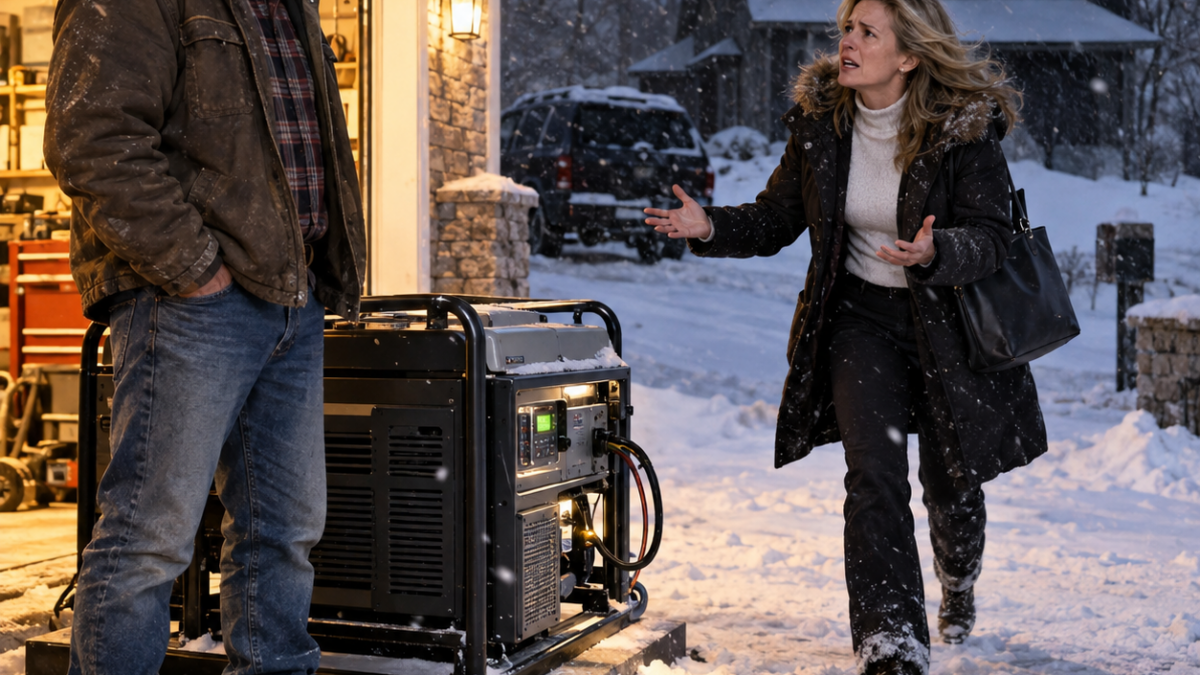
Karen stood on my porch, pointed at the diesel generator I had installed to keep my wife and little girl safe, and told me the HOA would fine me every single day until I ripped the “industrial monstrosity” out of my yard.
Three weeks later, the neighborhood went dark beneath two feet of snow and a coating of ice so thick that transformers exploded like artillery along the road.
By the second night, someone I never expected was standing outside my warm garage, shivering hard enough that she could barely ask me for help.
The first time Karen Miller saw my generator, she looked at it like I had parked a tank beside the roses.
“That rust-bucket monstrosity has to go.”
I stared at her.
Then at the brand-new enclosed diesel unit sitting on a concrete pad behind a lattice privacy screen on the far side of my property.
“Rust bucket?”
“It destroys the uniform appearance of Oak Ridge.”
“It’s barely visible from the street.”
“That is irrelevant.”
She lifted a violation notice.
Five hundred dollars.
Unauthorized permanent structure.
Potential noise nuisance.
Visual incompatibility with neighborhood standards.
Fourteen days to remove it.
After that?
One hundred dollars per day.
“Karen, I had this installed by a licensed contractor.”
“You did not get architectural approval.”
“It’s utility equipment.”
“It’s industrial machinery.”
“It produces fifty-two decibels at the property line.”
Her eyes narrowed.
“You think this is funny?”
“No.”
Twenty years in Army logistics had taught me something useful about people who wanted a reaction.
Never give them the one they came for.
Karen wanted shouting.
I gave her questions.
“What exact rule prohibits a standby generator?”
She glanced at the paper.
“The board has discretion to preserve neighborhood aesthetics.”
“That wasn’t my question.”
Her face flushed.
“I am the president of this association.”
“I know.”
“And if you refuse to comply, the board can place a lien against your home.”
Behind me, the front door opened.
My wife Sarah stepped onto the porch.
Our six-year-old daughter Lily stood behind her, clutching a stuffed rabbit.
Sarah had heard the word lien.
That bothered me more than Karen’s entire performance.
This house was supposed to be our last move.
After twenty years of bases, temporary quarters, deployments, and boxes that never seemed completely unpacked, I had promised Sarah something permanent.
Oak Ridge looked like permanence.
Quiet streets.
Old trees.
Good school.
Neighbors who waved.
For our first two years, that was exactly what we had.
Then the longtime HOA president died.
Karen won a low-turnout election.
Suddenly people received warnings about mailbox colors.
Shrub height.
Holiday lights.
Basketball hoops.
Sidewalk chalk.
I had watched it happen.
I simply hadn’t believed she would come for emergency equipment.
That was my mistake.
I had seen enough failed infrastructure overseas to know how quickly modern life becomes fragile when electricity disappears.
No furnace blower.
No refrigerator.
No lights.
No charged phones.
No normal life.
I had a wife who worked as a nurse and a little girl who still crawled into our bed during thunderstorms.
Preparedness wasn’t paranoia to me.
It was responsibility.
I looked at Karen.
“I’m appealing this.”
“You may certainly waste everyone’s time.”
“I’ll need the applicable covenant provisions in writing.”
“They’re already in your homeowner documents.”
“Then identifying them should be easy.”
Her mouth tightened.
“I suggest you rethink your attitude.”
“I suggest you put everything in writing.”
That ended the conversation.
Three days later, the certified envelope arrived.
By then Karen had upgraded my generator from an eyesore to a threat to community harmony.
Sarah read the letter beside me.
When she reached the words **lien** and **foreclosure remedies**, she stopped.
“Jack.”
“I know.”
“Can they actually do that?”
“Not tomorrow.”
“That’s not an answer.”
I took her hand.
“No. It isn’t.”
That night, after Sarah and Lily went upstairs, I made coffee and opened the Oak Ridge covenants.
One hundred twenty-seven pages.
I read every word.
Then I read them again.
Permanent structures?
Sheds.
Pools.
Gazebos.
Fences.
No generators.
Noise limit?
Sixty decibels at the property line.
My unit was lower.
Visual standards?
Vague.
No objective definition supporting what Karen claimed.
I started a binder.
Photographs.
Contractor invoice.
Permit documents.
Manufacturer specifications.
Sound readings.
Every letter Karen sent.
Every date.
Every threat.
At two in the morning, I wrote one sentence across the inside cover:
**Facts first. Anger later.**
Because Karen thought she had started a fight over a generator.
What she had actually done was force me to document exactly how she was using the HOA.
And long before the snow began falling, I realized I probably wasn’t the only person in Oak Ridge she had been treating this way.
PART 2
Sarah found me at the dining-room table just after sunrise.
The coffee had gone cold.
The table was covered in highlighted pages, photographs, handwritten notes, and a rough timeline of every interaction I had had with Karen.
She stopped in the doorway.
“You slept?”
“Technically.”
“That means no.”
I leaned back.
“I found problems.”
“With the generator?”
“With their case.”
She poured herself coffee.
“Explain it like I’m not someone who voluntarily reads insurance policies.”
I turned the covenant book toward her.
“They call it an unauthorized permanent structure.”
“Okay.”
“The definition mostly covers buildings, pools, walls, sheds, things like that. Utility equipment isn’t clearly included.”
“So we win?”
“No.”
She frowned.
“What?”
“It gives us an argument.”
“That sounded much less satisfying.”
“It’s law-adjacent paperwork. Satisfaction comes later.”
She sat.
I showed her the noise section.
“Sixty decibels at the property line.”
“And yours?”
“Factory data says lower. I’m getting an independent reading.”
“You already measured it.”
“I want something stronger than an app on my phone.”
She studied me.
“You’re enjoying this.”
“No.”
“You’ve got your deployment-planning face.”
“That’s not a thing.”
“It is absolutely a thing.”
She pointed to my new binder.
“What’s that called?”
I looked down.
I had labeled the spine:
**OAK RIDGE / GENERATOR**
Not Karen.
That was deliberate.
This needed to remain about process.
Not personality.
“At least you didn’t write ‘Operation Karen.’”
I looked away.
Sarah’s eyes narrowed.
“You thought about it.”
“Maybe.”
She laughed for the first time since the lien letter arrived.
That mattered.
Fear is part of how intimidation works.
If I could turn the problem into a sequence of solvable tasks, it became smaller.
First task:
Independent noise test.
I hired an acoustics technician from a local environmental firm.
The generator automatically exercised once a week for fifteen minutes.
We measured at the property line.
Then near my closest neighbor.
Then from the sidewalk.
Fifty-two decibels at the boundary.
Forty-eight at the neighbor’s patio.
A garbage truck passing during the test registered louder.
So did one of Oak Ridge’s landscaping crews.
The technician signed the report.
Binder.
Next:
Visibility.
I photographed the generator from every public angle.
The lattice screen and shrubs concealed almost all of it.
From the street, you could barely tell anything was there.
Binder.
Next:
Installation.
Licensed electrical contractor.
Concrete pad.
Automatic transfer switch.
Proper exhaust clearance.
Permit.
Inspection.
Binder.
By the time of the monthly HOA meeting, I had an inch-thick file.
Sarah came with me.
“You don’t have to.”
“I know.”
“Karen likes audiences.”
“So do you.”
“I absolutely do not.”
“You rehearsed your statement in the bathroom mirror.”
“That was preparation.”
“That was theater.”
The clubhouse was beige in every possible direction.
Beige carpet.
Beige walls.
Beige folding chairs.
Even the cookies on the refreshment table looked beige.
Karen sat behind the board table wearing a pale lavender jacket.
Three women occupied the front row.
Karen’s reliable applause section.
The first hour felt like punishment.
Cedar mulch versus pine bark.
Trash bins.
Christmas lights.
A portable basketball hoop.
Karen spoke about standards with the solemnity of someone negotiating nuclear treaties.
Finally:
“Next, appeal of violation seven-three-four, Mr. Jack Callahan.”
She looked at me.
“You have three minutes.”
I walked to the front.
“Good evening.”
No one responded.
“My generator was cited as an unauthorized permanent structure, a noise concern, and an aesthetic violation.”
I held up the covenant book.
“Article Nine, Section Four identifies regulated structures but does not specifically address permanently installed utility equipment.”
Karen rolled her eyes.
I continued.
“The board also cited noise.”
I handed the secretary copies of the acoustics report.
“Your rules allow sixty decibels at the property line. Independent testing measured fifty-two during the generator’s weekly cycle.”
A man in the back leaned forward.
I recognized him as Dave Johnson, a retired electrician.
I continued.
“The visual claim is subjective, but these photographs show the unit is screened from street view.”
Karen cut in.
“Your three minutes are nearly over.”
“I have one question.”
“No cross-examination.”
“Which objective standard did I violate?”
She stared.
“The architectural committee determined the equipment is incompatible with Oak Ridge.”
“Under what measurement?”
“It is an industrial machine.”
“What covenant defines it that way?”
Karen’s face darkened.
“The board has discretion.”
“I understand.”
I looked toward the secretary.
“I’m asking what written standard was applied.”
Silence.
Then Karen snapped:
“The standard is that the architectural committee rejected it.”
“That is a decision, not a standard.”
Several residents looked at one another.
Karen slapped one hand against the table.
“On the grounds that I said so, Mr. Callahan. I am the president of this association, and the appeal is denied.”
There it was.
The room went strange.
Not loud.
Worse.
Uncomfortable.
Even Karen seemed to realize she had said too much.
The women in the front row offered a few weak claps.
Nobody joined them.
I gathered my papers.
“For the minutes, please note that I requested the specific objective standard supporting denial and none was provided.”
Karen pointed at my seat.
“Sit down.”
I did.
Sarah squeezed my hand.
“You lost.”
“Maybe.”
She leaned closer.
“You look happy.”
“Because everyone heard it.”
That meeting changed things.
Not immediately.
No rebellion.
No dramatic walkout.
But people started talking to me.
The first was Maria Alvarez next door.
She caught me dragging recycling bins out two mornings later.
“Jack?”
“Yes?”
She looked toward Karen’s side of the neighborhood before speaking.
“I saw what happened.”
“Hard to miss.”
“That thing she said.”
“Which one?”
“Because I said so.”
I nodded.
Maria looked embarrassed.
“She fined us last month.”
“For what?”
“Sidewalk chalk.”
I thought she was joking.
She wasn’t.
Her two children had covered their driveway with chalk drawings.
Flowers.
Dinosaurs.
A huge crooked rainbow.
Karen cited “graffiti-like markings visible from common roadway.”
Two hundred dollars.
“You paid?”
Maria nodded.
“My husband said it wasn’t worth a fight.”
“Do you still have the notice?”
“Yes.”
“Can I get a copy?”
She hesitated.
“Why?”
“Because if she applies rules based on personal preference, one generator isn’t the whole story.”
That evening Maria emailed it.
I added it to a separate section.
**ENFORCEMENT PATTERN.**
Then Dave Johnson showed up.
He walked into my garage and pointed at the generator through the open side door.
“Perkins?”
“Yes.”
“Automatic transfer?”
“Yes.”
“Load?”
“Whole-house critical circuits. Furnace, refrigeration, lights, outlets, selected kitchen loads.”
He whistled.
“Nice.”
“Karen disagrees.”
“Karen wouldn’t know a neutral wire from dental floss.”
I laughed.
Dave had spent forty years wiring homes, schools, hospitals, and commercial buildings.
Navy Seabee before that.
He had attended the meeting.
“You were right about noise,” he said.
“Report was right.”
“Same thing.”
“No.”
He smiled.
“You’re one of those.”
“One of what?”
“Precise people.”
“Usually safer.”
We talked for an hour.
Karen had fined him for a vegetable garden visible through a gap in his fence.
“Called it agricultural use.”
“You have tomatoes.”
“And zucchini.”
“Dangerous.”
He grinned.
Then stopped.
“I paid it.”
“Why?”
“Same reason everyone does.”
He looked toward the street.
“I have grandchildren. Wife. Life. Nobody wants to spend nights studying HOA law over one hundred bucks.”
“And she knows that.”
“Yes.”
That was the model.
Small penalties.
Big inconvenience.
People paid to purchase peace.
Every payment strengthened the assumption that enforcement must be valid.
Dave began quietly collecting examples.
Bird feeder.
Flagpole.
Work van.
Holiday lights.
Satellite dish.
Decorative bench.
Children’s basketball hoop.
Some violations might have technically fit existing rules.
That mattered.
I didn’t want a binder of complaints.
I wanted patterns.
Selective treatment.
Undefined standards.
Inconsistent hearings.
Procedural shortcuts.
Karen thought she was isolating me.
Instead, she was introducing me to neighbors.
Then the legal envelope arrived.
Process server.
Sarah received it.
When I came home, she was waiting in the kitchen.
No jokes.
No teasing.
“It says lien.”
I read.
Accrued penalties had passed two thousand dollars.
The HOA’s law firm demanded removal within seventy-two hours.
Failure could lead to recording a lien and pursuing remedies available under law and governing documents.
High-powered downtown firm.
Expensive letterhead.
Designed to frighten.
It worked.
Not on me first.
On Sarah.
“We cannot lose this house.”
“We’re not losing the house.”
“You don’t know that.”
She was right.
I hated that she was right.
I sat beside her.
“This is bigger than me reading bylaws.”
“So?”
“I’m calling someone.”
Marcus Thorne answered on the fourth ring.
“Thorne.”
“Jack Callahan.”
Silence.
Then:
“No.”
I laughed.
“What?”
“Every time somebody from Afghanistan calls after eight years, it costs me time or money.”
“I’ll pay.”
“Definitely trouble.”
Marcus and I had overlapped during one deployment.
He was JAG.
I handled logistics.
He was infuriatingly calm under pressure.
Now he handled civil and property litigation.
I explained everything.
He interrupted constantly.
“First notice date?”
I told him.
“Method?”
Certified mail.
“Hearing notice?”
Monthly meeting agenda.
“Written decision after appeal?”
“No.”
“Formal appeal rights stated?”
“No.”
“Did board vote on record?”
Karen announced denial.
“Minutes?”
Not yet available.
“Lien recorded?”
Threat only.
He became quiet.
“Send me everything.”
“Can you help?”
“I haven’t seen documents.”
“Marcus.”
“Yes, Jack. I can help.”
Sarah’s shoulders dropped.
I hadn’t realized how tense she was.
Marcus called the next afternoon.
“These people may have procedure problems.”
“How bad?”
“Potentially significant.”
He explained that enforcement rights came from more than the covenants.
State property-owner association law.
Notice requirements.
Hearing procedures.
Written decisions.
Due process.
Lien prerequisites.
“I’m not promising dismissal,” he said. “But the board appears to have skipped steps.”
“Karen?”
“Board. Keep personality out.”
“Understood.”
“You sound disappointed.”
“Little.”
“Good.”
He reviewed my binder.
Then the neighbor records.
“This is useful.”
“Selective enforcement?”
“Maybe. Needs proof, not stories.”
“Working on it.”
“Do not contact Karen.”
“Gladly.”
“Do not post online.”
“I don’t.”
“Do not threaten.”
“I won’t.”
“Do not run around telling everyone their fines are illegal.”
“I haven’t.”
“Jack?”
“I haven’t.”
He laughed.
“You were always terrifyingly coachable when you wanted something.”
Then the weather changed.
At first, nobody cared.
Possible winter event.
Maybe snow.
Then models converged.
The forecast escalated.
Heavy snow.
Extreme wind.
Freezing rain.
Ice accumulation potentially over an inch.
Long-duration power outages.
Temperatures in single digits.
The local stores emptied within hours.
Bread.
Milk.
Batteries.
Propane.
Portable generators.
Everything.
I watched footage of people fighting over cases of bottled water and thought about Karen’s “industrial monstrosity.”
Sarah stood beside me.
“Feeling smug?”
“No.”
“You’re feeling smug.”
“I’m feeling prepared.”
“Which is military smug.”
Fair.
We went through the checklist.
Diesel.
Oil.
Coolant.
Battery.
Transfer switch.
Furnace load.
Food.
Water.
Flashlights.
First aid.
Lily helped organize canned food by color until Sarah corrected the system.
“Beans are not a color category.”
“They are brown.”
“Technically.”
I stopped intervening.
Dave called.
“You set?”
“Yes.”
“I’ve got kerosene heat.”
“Ventilation?”
“Yes, Dad.”
“Carbon monoxide detector?”
“Jack.”
“Just checking.”
He became serious.
“Mary Henderson worries me.”
Mary was eighty-two.
Widow.
All-electric house except a gas furnace requiring electricity for controls and blower.
“If grid goes down, we check her first.”
“Agreed.”
The storm arrived at noon.
Freezing rain turned trees into glass.
Beautiful for about twenty minutes.
Then branches began breaking.
At six that evening, a transformer exploded down the street.
Blue-green flash.
Thunderous crack.
Lights blinked.
Darkness.
Lily screamed.
Ten seconds later, the transfer switch clicked.
Diesel engine turned.
Coughed.
Settled into a steady low hum.
Lights returned.
Furnace blower started.
Refrigerator resumed.
Lily looked around.
“Daddy fixed it.”
Sarah looked at me.
Her eyes filled.
“Thank God you didn’t remove that thing.”
I smiled.
Outside, Oak Ridge vanished into darkness.
Our generator ran all night.
The next morning, Dave appeared wearing ice cleats.
“My house is forty degrees.”
“Mary?”
“Worse.”
I pulled out two heavy-duty cords.
We couldn’t power every home.
Voltage drop.
Load limits.
Safety.
But Mary’s furnace needed relatively modest electrical power.
We ran a properly rated cord.
Dave handled connection at her end.
The furnace ignited.
Warm air began moving.
Mary grabbed my hands.
“I don’t know how to thank you.”
“Stay warm.”
Then Dave.
Then Maria’s house.
Space heater.
Refrigerator cycling intermittently.
Phone charging.
By afternoon, the generator was approaching the limit I was comfortable with.
So I stopped adding houses.
That was hard.
Preparedness has boundaries.
You can turn one home into a small microgrid, but not recklessly.
At three the next afternoon, someone knocked on the garage door.
I expected Dave.
Instead, Karen stood outside.
For a second I did not recognize her.
Three coats.
Scarf.
Fur-lined hat.
No makeup.
No clipboard.
Her lips were pale.
“Mr. Callahan.”
“Karen.”
She looked past me.
Warm garage.
Lights.
Power strips.
Then toward the generator.
The machine she wanted removed.
“My house is thirty-two degrees.”
I said nothing.
“Our pipes froze.”
Still nothing.
“My husband is at his sister’s.”
She swallowed.
“I stayed because of the dogs.”
“Are the dogs okay?”
“Yes.”
Then finally:
“I need… power.”
The words hurt her.
“Just a heater.”
Pause.
“Maybe charge my phone.”
I could have destroyed her in that moment.
Verbally.
Not physically.
I had weeks of material.
Rust bucket.
Emotional distress.
Eyesore.
Lien.
Foreclosure.
Because I said so.
All available.
Sarah appeared behind me.
She saw Karen.
Then looked at me.
That look mattered.
What kind of man was I going to be when I had leverage?
I opened the door wider.
“Come in.”
Karen blinked.
“Just the garage.”
“Thank you.”
She stepped inside.
I handed her coffee.
Her hands shook around the cup.
Then I explained.
“I can’t run a cord to every house.”
She nodded.
“Mary is eighty-two.”
“Yes.”
“Maria has young children.”
Karen looked down.
“They’re priority.”
“I understand.”
“I’m setting up a warming station here.”
She looked up.
“Anyone can come warm up, charge phones, small medical devices, batteries. We rotate equipment so we don’t overload.”
“What about my heater?”
“You can use the station.”
Her face fell slightly.
“You mean here?”
“Yes.”
“You’re not running one to my house?”
“Not right now.”
She started to protest.
Then stopped.
Because she understood.
For once, rules had a reason unrelated to control.
Limited capacity.
Vulnerable residents first.
Safety.
“You’re welcome to stay.”
She nodded.
“Okay.”
I made a sign.
**WARMING / CHARGING STATION
ALL NEIGHBORS WELCOME
MEDICAL NEEDS / CHILDREN / SENIORS PRIORITY**
Dave spread the word.
Within forty minutes, people started arriving.
Phones.
Battery banks.
CPAP backups.
Small children bundled in blankets.
Maria brought cookies.
Mary sat near the safest heater with tea.
Someone found cards.
Lily organized a drawing table.
And Karen sat in the corner.
Nobody attacked her.
That surprised me.
Some people stared.
Some whispered.
Most were too cold and tired to care.
That might have hurt more.
Power changes dramatically when people discover they can function without your permission.
Around sunset, a news van stopped outside.
Reporter had been covering outage stories.
Saw lights.
Saw people.
Saw the generator.
She asked:
“This your setup?”
“Generator is mine.”
“And you’re powering neighbors?”
“Helping where we safely can.”
“Why?”
I looked confused.
“They’re neighbors.”
Simple answer.
She interviewed Dave.
Then Maria.
Maria said:
“My baby’s room would be freezing without Jack.”
Then she added the sentence that changed everything.
“The HOA president tried to make him remove that generator.”
Reporter’s eyes sharpened.
“She did?”
I closed my eyes.
Here we go.
The camera moved.
Karen was visible in the background.
Reporter approached.
“Ma’am, are you the HOA president?”
Karen froze.
“No comment.”
“Did the association fine Mr. Callahan over this generator?”
“No comment.”
“Are you currently using power generated by the equipment?”
Karen looked at me.
I did nothing.
She whispered:
“Yes.”
Then:
“No comment.”
The story aired at eleven.
**VETERAN’S BACKUP GENERATOR BECOMES OAK RIDGE LIFELINE**
They did not call me a hero in the headline.
Good.
I wasn’t one.
Prepared.
That was all.
The footage showed dark streets.
Broken trees.
Then our lit garage.
Children charging tablets.
Mary warming her hands.
Dave explaining furnace loads.
The reporter accurately mentioned the HOA dispute.
Then footage of Karen declining comment.
Marcus called the moment the segment ended.
“You are unbelievably lucky.”
“This doesn’t feel lucky.”
“Public credibility matters.”
“For court?”
“Indirectly.”
“Marcus.”
“What?”
“I don’t want media turned into revenge.”
“Good. Neither do I.”
He paused.
“But your board now has an obvious problem explaining why equipment they called a nuisance became an emergency resource.”
The blackout lasted six more days.
Six.
The generator became a rhythm.
Fuel.
Load.
Maintenance.
Rest.
We shut unnecessary circuits.
Conserved diesel.
A local service station owner heard about what we were doing and delivered fuel once roads improved.
Refused payment.
I paid him later anyway.
Neighbors contributed food.
Dave managed electrical safety.
Sarah turned our kitchen into soup production.
Lily decorated paper cups.
Maria organized children.
Mary told stories.
At some point, Oak Ridge stopped behaving like a neighborhood under an HOA and started behaving like a neighborhood.
There is a difference.
On day four, Karen approached me while I was checking oil.
“Jack.”
First time she used my first name.
“Yes?”
“I owe you something.”
“You don’t owe me fuel.”
“That’s not what I mean.”
I waited.
She swallowed.
“I was wrong about the generator.”
That sentence looked physically painful.
I tightened the oil cap.
“Okay.”
“I shouldn’t have…”
She stopped.
“Shouldn’t have what?”
“Threatened you.”
“With a lien?”
“Yes.”
“And foreclosure?”
Her face reddened.
“Yes.”
“And called emergency equipment an industrial eyesore?”
“Do we need to do this?”
“No.”
I wiped my hands.
“You brought it up.”
She breathed out.
“I was wrong.”
“Thank you.”
Then she said:
“But you understand why architectural approval matters.”
There she was.
Not gone.
Just humbled.
“Sometimes.”
She seemed surprised.
“I don’t think rules are useless, Karen.”
“You don’t?”
“No.”
“I think rules without objective standards and fair process are dangerous.”
She looked toward the garage.
People she had fined were sharing coffee.
“I suppose you all hate me.”
“No.”
She looked at me sharply.
“That almost sounds worse.”
“It isn’t about you right now.”
And that was true.
The storm had made her smaller because the situation was bigger.
By day seven, utility crews restored power.
Our generator shut itself down after the transfer switch detected stable grid service.
The sudden silence was almost strange.
No diesel hum.
No cords.
No improvised warming station.
Normal electricity.
Normal life.
Except Oak Ridge was no longer normal.
The day after power returned, certified letters went to every homeowner.
Emergency meeting.
Single agenda item:
**Vote of no confidence in President Karen Miller.**
Marcus had filed our formal legal response too.
He challenged the enforcement action on procedural grounds.
He contested the generator classification.
He included the acoustics report.
Permit.
Photographs.
And a carefully organized appendix showing potentially arbitrary enforcement patterns.
Not accusations.
Evidence.
Maria’s sidewalk chalk.
Dave’s garden.
Others.
The petition requesting leadership review had more than sixty signatures.
A majority.
The same clubhouse that once felt like Karen’s courtroom was packed.
Standing room.
This time Karen sat alone at the front table.
Her usual supporters were scattered in the audience.
Vice president chaired.
He looked terrified.
“Discussion?”
Dave stood.
“I’m going to keep this short.”
Everyone laughed because Dave never kept anything short.
He looked at Karen.
“This isn’t about one generator.”
Quiet.
“It’s about years of enforcement based on fear.”
He held up several notices.
“Children’s chalk.”
“Gardens.”
“Work vans.”
“Decorations.”
Then toward me.
“And finally emergency equipment installed legally and professionally.”
He looked around.
“When the real emergency arrived, the person Karen tried to punish helped keep some of the most vulnerable people in this neighborhood warm.”
Someone applauded.
Then more.
Dave raised his hand.
“Don’t clap yet.”
It stopped.
“That’s not the point.”
He waited.
“The point is we built a system where one person’s opinion became stronger than written standards.”
That was better than anything I could have said.
Karen stood.
“I would like to respond.”
The vice president nodded.
She shuffled papers.
“I have always acted in what I believed were the best interests of Oak Ridge.”
Someone muttered:
“Sidewalk chalk?”
Laughter.
Karen’s face tightened.
“I understand mistakes may have been made.”
That was new.
“I understand the generator became useful during an extraordinary emergency.”
Useful.
Dave looked at me.
I shook my head.
Let her speak.
“But standards exist for a reason.”
Murmurs.
Karen raised her voice.
“And without standards, property values—”
Maria stood.
“Karen.”
The room went quiet.
Maria rarely spoke at meetings.
“I paid two hundred dollars because my children drew a rainbow in chalk.”
Karen looked away.
Maria continued.
“I paid because I was afraid.”
That sentence landed harder than anger.
“I should not be afraid of the people elected to represent my neighborhood.”
Silence.
Then Mary Henderson stood.
Eighty-two.
Small.
Still wrapped in a heavy sweater after the storm.
“Mr. Callahan kept my furnace running.”
She looked at Karen.
“You fined me last year because my Christmas wreath stayed on my door three days too long.”
Karen stared.
Mary’s voice was soft.
“I paid because I didn’t want trouble.”
Then:
“I am too old to live afraid of a committee.”
The vote happened.
Nearly unanimous.
Karen lost the presidency.
No shouting.
No cheering at first.
Just hands.
Row after row.
Karen watched them rise.
Her expression changed from anger to disbelief.
Then embarrassment.
Then something close to grief.
Power had been part of her identity.
Now it disappeared in less than two minutes.
When the result was announced, Karen gathered her papers.
She left through the side door.
I did not follow.
That surprised Marcus.
“You didn’t savor it?”
“What would I do?”
“Give one of those movie speeches.”
“No.”
“You disappoint me.”
“I’m sure you’ll recover.”
Dave became interim president.
His first meeting opened differently.
He stood at the same table.
“No speeches.”
Everyone applauded.
He pointed.
“That counts as noise. Stop.”
Laughter.
Then he said:
“We’re reviewing rules.”
Not abolishing everything.
Reviewing.
That mattered.
Rules about traffic safety stayed.
Rules about common-property maintenance stayed.
Noise rules stayed.
Drainage protections stayed.
But vague aesthetic clauses were rewritten.
Children’s chalk?
Gone.
Petty holiday-light restrictions?
Simplified.
Gardens?
Permitted with reasonable setbacks.
Work vehicles?
Clear definitions.
Generators?
A new emergency-preparedness standard.
Safe installation.
Noise limits.
Screening.
Fuel-storage rules.
No arbitrary ban.
Karen’s fines against Maria, Dave, Mary, and several others were reviewed.
Where enforcement lacked proper basis or procedure, refunds followed.
Mine were rescinded.
The threatened lien died.
Marcus sent me his final letter.
**Matter resolved. Generator stays.**
Sarah read it twice.
Then set it on the table.
“Can we finally stop talking about the HOA?”
“For forty-eight hours.”
“Jack.”
“Kidding.”
Lily ran into the room.
“Is the power machine staying?”
“Yes.”
She hugged my leg.
“Good.”
That mattered more than legal language.
A month later, Karen’s house went up for sale.
I saw the moving truck on Saturday morning.
She and her husband loaded boxes.
No crowd.
No celebration.
She looked across the street once.
Saw me checking the generator.
Our eyes met.
For a second, I saw the woman from my porch.
Pink tracksuit.
Violation letter.
Threat.
Then I saw the woman from my garage.
Cold.
Shivering.
Holding coffee in both hands.
People are rarely only one version of themselves.
She looked away first.
The truck left.
I expected satisfaction.
Instead, I felt tired.
Sarah came outside.
“She’s gone.”
“Yes.”
“You okay?”
“Why wouldn’t I be?”
“You spent months fighting her.”
“I spent months protecting us.”
“Different?”
“Yes.”
She slipped her arm through mine.
“Good answer.”
That summer, Oak Ridge held its first block party in years.
No formal dress code.
No clipboard inspection.
Chalk covered half the sidewalks.
Maria’s children drew a giant generator with superhero arms.
They labeled it:
**MR. HUM**
I stared.
“That looks nothing like my generator.”
Maria laughed.
“It has eyes.”
“Exactly.”
Dave grilled burgers.
Mary sat in the shade.
The same people who had whispered complaints in driveways were now talking openly.
The storm had done something Karen never could.
It created a real community.
Not uniformity.
Interdependence.
People started discussing preparedness.
Not paranoia.
Practical things.
Water.
Medication.
Backup heat.
Smoke and carbon-monoxide alarms.
Phone batteries.
Emergency contacts.
Who needed mobility assistance.
Who had medical equipment.
Who lived alone.
The HOA created an emergency committee.
I refused to chair it.
They ignored me.
At the first meeting, I brought a whiteboard.
Sarah saw me leaving.
“Not chairing?”
“No.”
“You have a whiteboard.”
“Consulting.”
She smiled.
“Of course.”
We developed a neighborhood plan.
Not everyone needed a giant diesel generator.
That would be ridiculous.
Some installed smaller standby units.
Others bought safe portable units and proper transfer equipment.
Dave taught a generator-safety class.
He spent half of it explaining carbon-monoxide poisoning.
“No generator in a garage.”
Someone asked:
“What if the garage door is open?”
“No.”
“What about near a window?”
“No.”
“What if—”
“No.”
He became famous for that class.
Mary’s house received a small automatic backup system partly paid for by her children.
Maria bought battery backups and a vented emergency heater.
The clubhouse received a properly permitted standby generator funded through a community vote.
That was my favorite outcome.
Oak Ridge now had an official warming center.
Karen tried to remove one generator.
We ended up with several.
Not as rebellion.
As infrastructure.
The next winter brought another outage.
Nothing like the big storm.
Six hours.
The clubhouse generator started automatically.
Lights came on.
Heat stayed.
Nobody panicked.
Nobody drove to my house.
I sat with Sarah and Lily eating dinner.
Lily looked out the window.
“Are people coming here?”
“No.”
“Why?”
“Clubhouse has power.”
She thought.
“So our generator isn’t special anymore?”
I smiled.
“That’s exactly what I wanted.”
Preparedness that depends on one person isn’t a system.
It’s a vulnerability.
Years passed.
Dave served two terms as HOA president.
Then stepped down voluntarily.
Imagine that.
His final speech lasted twenty-seven minutes despite promising five.
We timed him.
Maria succeeded him.
Her first proposal?
Annual sidewalk-chalk festival.
Unanimous.
Every spring, children filled the main road around the clubhouse with drawings.
Rain washed them away.
No fines.
Mary judged the artwork until she turned eighty-seven.
She always gave everyone a ribbon.
“Competition causes stress,” she said.
Dave accused her of destroying standards.
She threatened him with a fine.
We laughed.
The generator aged.
So did I.
I maintained it obsessively.
Oil.
Filters.
Coolant.
Battery.
Fuel treatment.
Annual professional inspection.
One afternoon, Lily—now twelve—helped me change an air filter.
She pointed to a scratch on the enclosure.
“Is that from the storm?”
“No.”
“Karen?”
“No.”
“Why does everything old in this neighborhood become about Karen?”
Good question.
I stopped.
“You know what?”
“What?”
“You’re right.”
She looked shocked.
“Mom!”
Sarah called from inside.
“Dad admitted I’m right!”
“Document the date!”
I laughed.
That evening I thought about what Lily said.
For several years, we had defined the generator by the fight.
Karen’s generator.
The banned generator.
The storm generator.
But the machine didn’t care about any of that.
It was equipment.
It existed to start when power stopped.
Maybe healing meant letting ordinary things become ordinary again.
So I stopped telling the story every time someone asked about it.
New residents moved into Karen’s old house.
Young couple.
Teacher and physical therapist.
They knocked on my door after closing.
“Hi. We’re the Parkers.”
“Jack.”
The husband looked toward my side yard.
“Is that the famous generator?”
I sighed.
His wife elbowed him.
“Sorry.”
“No. It’s fine.”
“We heard…”
“I’m sure.”
They seemed embarrassed.
I smiled.
“Welcome to Oak Ridge.”
That was all.
Later, their first child was born.
During a summer thunderstorm, their power flickered.
They texted our neighborhood emergency group.
Everything fine.
No drama.
No legacy.
Good.
Marcus visited once.
He was passing through.
We sat on the porch with coffee.
He looked toward the generator.
“Still there.”
“Yes.”
“Karen?”
“Gone.”
“Binder?”
“Attic.”
“You should keep it.”
“I did.”
“For litigation?”
“For memory.”
He nodded.
“Best cases are the ones you never need again.”
I looked at him.
“You never got to spring your dramatic legal trap.”
He smiled.
“Sure I did.”
“The board backed down before court.”
“Exactly.”
He leaned back.
“The best litigation victory is often the hearing that never happens.”
Annoyingly correct.
He became serious.
“Jack, do you know what impressed me?”
“What?”
“You helped her.”
“Karen?”
“Yes.”
“She was cold.”
“Still.”
“What was I supposed to do?”
He shrugged.
“A surprising number of clients could answer that question badly.”
I thought about those ten minutes I left her outside while I made coffee.
Not proud of that.
Not ashamed either.
I had needed a moment.
But I was glad I opened the door.
Because had I refused, the story would have changed.
Maybe not legally.
But inside me.
Revenge is seductive because it feels like balance.
You hurt me.
Now I hurt you.
Simple.
But simple things can be ugly.
The storm taught me something more useful.
Power is most revealing when you finally have it over someone who once had it over you.
Karen used hers to threaten.
Fine.
Humiliate.
Control.
When the roles reversed, I had a choice.
Imitate her.
Or prove there was another way.
I don’t say that because I’m noble.
I was angry.
Part of me wanted her to walk home cold.
But principles only count when breaking them would feel satisfying.
Years later, Mary Henderson died peacefully at ninety.
Her children invited several Oak Ridge neighbors to the memorial.
I sat beside Dave.
Maria spoke.
She told a story about Mary’s first winter after the storm.
How she kept a thermos beside the door in case utility crews needed coffee.
Then Mary’s son mentioned the generator.
“My mother said the sound of Jack Callahan’s diesel engine was the most beautiful thing she had ever heard.”
People laughed.
I looked down.
Afterward, her daughter handed me an envelope.
Inside was a photograph.
Mary standing in my garage during the blackout.
Coffee in hand.
Behind her, Lily sat at a folding table coloring.
Karen was barely visible in the corner.
I stared at that picture for a long time.
Not because of Karen.
Because Mary was smiling.
That had been the real story.
We had warmth.
So we shared it.
Everything else was noise.
When Lily turned sixteen, another major winter storm entered the forecast.
Not as severe.
Still serious.
She watched me check diesel.
“Dad.”
“Yes?”
“You know the neighborhood clubhouse has two generators now.”
“I know.”
“Hospital has backup.”
“I know.”
“Our neighbors have batteries.”
“I know.”
“You still have enough fuel for ten days.”
“Twelve.”
She rolled her eyes.
“You’re impossible.”
“Prepared.”
“Paranoid.”
“Prepared.”
Sarah called from inside:
“He’s prepared!”
“Thank you!”
Lily laughed.
The storm dropped fourteen inches.
Power went out for one night.
Generator started.
Lights returned.
No fear.
I stood by the window.
Across the street, the clubhouse lights glowed.
Other houses had small backup systems.
The dark neighborhood from years earlier no longer existed.
Not because everyone had copied me.
Because everyone learned.
That was the satisfying ending I never expected.
Not Karen losing.
Everyone else becoming harder to endanger.
Eventually the Perkins unit reached the end of its practical service life.
Twenty-three years after installation.
The technician stood beside me.
“We can rebuild.”
“Should we?”
He made a face.
“No.”
I looked at the enclosure.
That machine had been present for birthdays.
Storms.
Outages.
Lily’s childhood.
Karen’s war.
Neighborhood warming station.
Sarah came outside.
“You’re sentimental about machinery.”
“I’m not.”
“You’re touching it.”
I removed my hand.
“No.”
She smiled.
We replaced it with a newer generator.
Cleaner.
Quieter.
More efficient.
Properly approved.
Dave, now long retired from everything except opinions, arrived during installation.
“Did you file architectural paperwork?”
“Yes.”
He looked disappointed.
“No fight?”
“No.”
“Where’s the fun?”
“Progress.”
The HOA approved it in three days.
No drama.
No hearing.
No fines.
The written standards were clear.
Location.
Noise.
Screening.
Safety.
My application met them.
That tiny administrative event may have been the clearest evidence of all that Oak Ridge had changed.
Nobody needed discretion.
Nobody needed personal favors.
Nobody needed fear.
Rule.
Evidence.
Decision.
Done.
I kept one small piece from the old generator.
The metal identification plate.
Sarah found it on my desk.
“You’re going to frame that, aren’t you?”
“Maybe.”
She laughed.
I eventually mounted it inside the garage.
No dramatic inscription.
Just the plate.
Lily came home from college years later and noticed it.
“You finally retired Mr. Hum.”
“Your childhood name, not mine.”
“Sure.”
She stood beside me.
“You know what I remember about that storm?”
“What?”
“Cartoons.”
I stared.
“What?”
“The power went off.”
She smiled.
“Then it came back.”
“I remember Mom making soup.”
“I remember everyone sitting in our garage.”
“I remember drawing pictures with Maria’s kids.”
She shrugged.
“I didn’t understand Karen.”
“Good.”
“I just thought we were having a weird snow party.”
That nearly broke me.
Because for years I remembered danger.
Legal threats.
Cold houses.
Fear.
Karen at the door.
Lily remembered warmth.
That meant we had done our job.
Children should not remember adults’ power struggles if the adults can help it.
They should remember they were safe.
I hugged her.
“What?”
“Nothing.”
“You’re getting emotional.”
“Diesel fumes.”
“The generator is electric now.”
“Go away.”
She laughed.
Oak Ridge is still not perfect.
No real community is.
People argue.
Someone always hates the landscaping contract.
Parking creates fights.
Dogs bark.
Teenagers drive too fast.
Every December somebody questions decoration rules.
But nobody is afraid of the board.
That matters.
Meeting minutes are public.
Hearings are structured.
Rules have objective standards where possible.
Emergency exceptions exist.
And if someone says:
“Because I said so,”
half the room starts laughing.
Karen’s sentence became Oak Ridge’s warning.
Dave eventually had it printed on a coffee mug:
**BECAUSE I SAID SO
IS NOT A GOVERNANCE MODEL**
Maria hated the mug.
Then ordered six.
I still have mine.
Karen never returned.
I heard she and her husband moved closer to family.
Years later, I received a Christmas card.
No return address I recognized.
Inside:
**Jack and Sarah,
I hope your family is well. I have thought many times about that winter. I was wrong about more than the generator. Thank you for opening your door when you had every reason not to.
—Karen**
Sarah read it.
“What do you think?”
I turned the card over.
Nothing else.
“I think she meant it.”
“Going to respond?”
“Yes.”
I sent a short note.
No lecture.
No reopening the case.
Just:
**We’re well. I hope you are too. Take care.**
That was enough.
Justice does not always require permanent hatred.
Consequences happened.
She lost office.
She lost credibility.
The board changed.
The fines disappeared.
The rules improved.
Then life moved forward.
That is the part revenge stories often forget.
Eventually, you have to live after winning.
And living well requires putting the enemy down somewhere outside your head.
One winter evening, long after Lily moved away and started her own family, Sarah and I sat on the porch while light snow fell.
The new generator sat behind the same lattice screen.
Quiet.
Modern.
Almost invisible.
Sarah leaned against me.
“Remember when Karen called it a rust bucket?”
“It was brand new.”
“I know.”
“Still annoys me.”
She laughed.
“You know the funniest part?”
“What?”
“She was right about one thing.”
I looked at her.
“That machine did change the neighborhood.”
I thought about it.
The warming station.
The emergency committee.
The clubhouse backup system.
Dave’s safety classes.
Neighbors learning each other’s medical needs.
Mary staying warm.
Karen standing in my garage.
Children drawing while adults charged phones.
Lily remembering a snow party instead of a crisis.
“Yes.”
I nodded.
“She just didn’t understand how.”
The snow kept falling.
Lights glowed from Oak Ridge homes.
Several had backup systems now.
The clubhouse stood ready.
The emergency contact list was current.
Nobody was waiting for one veteran on Oak Drive to save them.
That made me happier than being right ever could.
My generator had begun as protection for three people.
Sarah.
Lily.
Me.
Karen tried to turn it into a symbol of disobedience.
The storm turned it into something else.
Proof that preparedness becomes community when you share it.
And maybe that was the real reason she lost.
Not because I had the better binder.
Not because Marcus knew the law.
Not because the news exposed her hypocrisy.
She lost because when everything comfortable disappeared—the electricity, the warm houses, the little hierarchy she had built—people discovered what actually mattered.
Warmth.
Safety.
Food.
Medicine.
A charged phone.
A neighbor willing to open his garage.
No covenant can manufacture those things.
No board president can order them into existence.
They come from trust.
And trust has to be earned.
Karen had spent years collecting compliance.
She mistook it for respect.
The storm showed her the difference.
When people were frightened, they didn’t run toward the person with the gavel.
They ran toward each other.
Karen came too.
And we made room.
That is why, after all these years, I don’t remember the moment she lost her presidency as the ending.
I remember a freezing afternoon.
A knock.
A woman who had threatened my home standing outside my garage, too cold to pretend she didn’t need me.
And I remember opening the door.
Because she had spent months telling me what kind of neighbor I was allowed to be.
The storm gave me one chance to decide for myself.
I chose to be the kind who let her in.
The generator kept running.
The garage stayed warm.
The neighborhood changed.
And Oak Ridge finally became the forever home I had promised my family it would be.








