HOA Karen Fined Me $5,000 Over My Guinea Fowl—Then the Neighborhood Learned What Those Birds Were Protecting
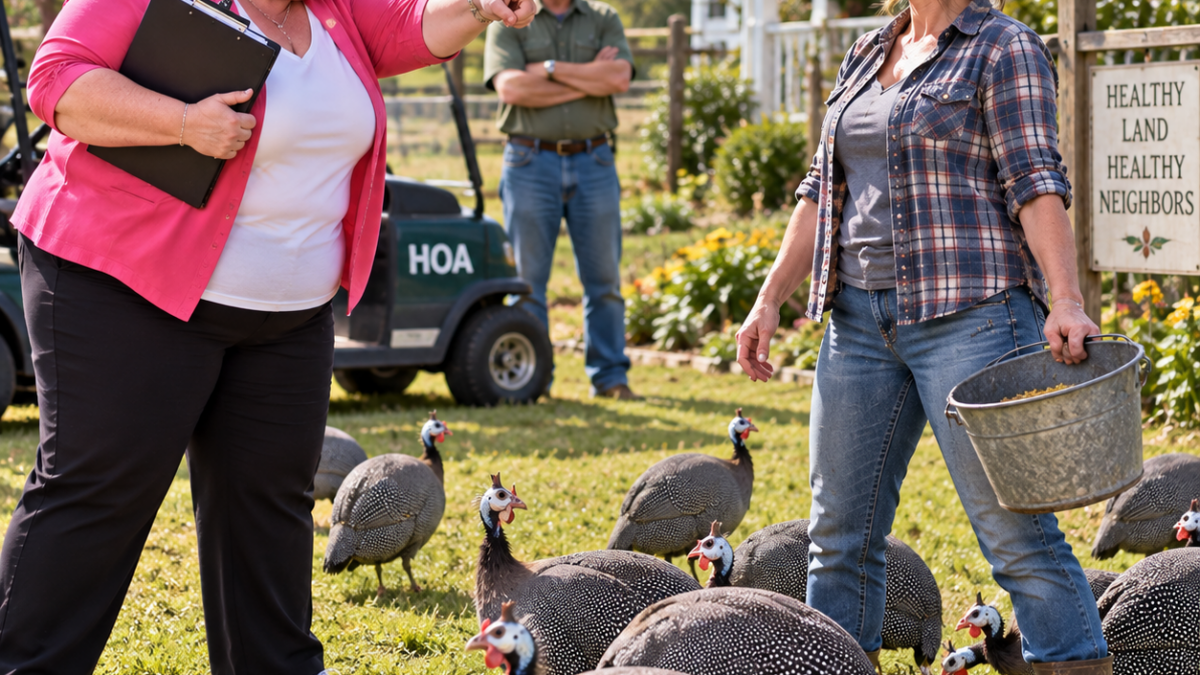
Karen slapped a $5,000 fine against my chest and gave me forty-eight hours to get rid of every guinea fowl on my land—or she promised to have them hauled away herself.
She called them filthy, loud, embarrassing livestock that had no place beside the manicured lawns of Serenity Meadows, and she seemed almost disappointed when I refused to argue with her.
What she didn’t know was that the birds she wanted silenced were connected to a problem already creeping through her neighborhood, and before this was over, one frightened family would force everyone to look at those “nuisance” birds very differently.
“These things are intolerable.”
Karen jabbed one manicured finger through the fence toward my flock.
Twenty helmeted guinea fowl moved through the grass in a loose formation, pecking at the soil, checking beneath weeds, occasionally sprinting several yards for no reason known to God or man.
One bird stopped.
Then another.
All twenty suddenly turned toward Karen.
“Buck-wheat! Buck-wheat! Buck-wheat!”
Karen flinched.
I almost smiled.
“They’re mocking me,” she snapped.
“They’re guinea fowl.”
“They are a public nuisance.”
She lifted her clipboard.
“Covenant 7.4, subsection B. Noise pollution and prohibited livestock.”
I glanced at the letter.
Then back at her.
“You know my property isn’t in Serenity Meadows.”
Her expression hardened.
“It borders Serenity Meadows.”
“That’s not the same thing.”
“The noise crosses the property line.”
“So do birds.”
“You think this is funny?”
“No.”
I folded the notice once.
Then again.
After twenty-five years in the Army, including years as a Sergeant Major, I had learned something important about people who depended on intimidation.
They expected emotion.
Anger made them stronger.
Fear made them confident.
Calm made them nervous.
Karen’s eyes narrowed.
“You have forty-eight hours.”
“For what?”
“To remove the animals.”
“From my land.”
“Yes.”
“Land that isn’t governed by your HOA.”
She sighed dramatically.
“Sergeant Major, I don’t care what kind of backwoods farm operation you think you’re running. These animals affect the quiet enjoyment and property values of our residents.”
I looked past her toward Serenity Meadows.
Identical roofs.
Trimmed hedges.
A perfectly empty gazebo.
Beyond those lawns stood a strip of woods thick with deer, mice, brush, and, increasingly, ticks.
The guinea fowl weren’t decorative.
They had a job.
My first spring on the property, my golden retriever, Gunner, came back from those woods carrying so many ticks that I spent almost two hours removing them.
The veterinarian identified several as blacklegged ticks and warned me that the local population had become unusually heavy.
I considered chemical spraying.
I hated the idea.
The property had bees, butterflies, wild turkeys, rabbits, frogs, and a garden my late wife and I had spent years improving.
I didn’t want to poison everything because of one pest.
So I researched alternatives.
That research eventually led me to guinea fowl.
Strange birds.
Ugly, according to most people.
Loud, according to everyone.
But they spent nearly every daylight hour patrolling the pasture and field edges, eating insects while moving constantly across the property.
Within a season, my own crude tick-drag tests showed a dramatic difference between my pasture and the unmanaged brush just across the boundary.
That was why the flock stayed.
Karen didn’t know any of that.
She didn’t ask.
She saw feathers and heard noise.
That was enough.
“You will receive additional penalties if you ignore this order,” she said. “And if necessary, the association will begin lien proceedings.”
I looked at the $5,000 figure.
“You’re threatening a lien against property that isn’t part of your association?”
Her face flushed.
“Our attorneys have reviewed the matter.”
“Good.”
That answer surprised her.
I slipped the letter into my pocket.
“Then I assume they’ll be happy to put everything in writing.”
Karen stared at me.
“You think your military background makes you intimidating?”
“No.”
I opened the gate leading toward my farmhouse.
“But paperwork usually does.”
She left ten minutes later in her golf cart, furious that I had refused to give her the confrontation she wanted.
I went inside, poured black coffee, opened my property file, and downloaded the Serenity Meadows covenants.
One hundred twenty pages later, I found what I expected.
The HOA’s legal description listed every parcel under its authority.
Mine wasn’t one of them.
Karen’s $5,000 fine had about as much authority over me as a parking ticket written by my dog.
That should have ended the matter.
Instead, ten days later, an envelope arrived from one of the most expensive law firms in the county.
The new demand was no longer $5,000.
It was $12,000.
And that was when I realized Karen wasn’t trying to solve a noise problem anymore.
She was trying to make an example out of me.
PART 2
The letter from Thorne & Blackwood was twelve pages long, printed on heavy cream paper with raised lettering across the top, the sort of stationery designed to make an ordinary person feel financially doomed before reaching the first paragraph. I sat at my dining-room table with Gunner asleep beneath my chair and read the whole thing twice. According to their senior partner, Serenity Meadows had developed some tortured theory that because noise from my property could allegedly affect residents inside the subdivision, their nuisance provisions somehow extended beyond their recorded boundaries. The language was deliberately intimidating—irreparable harm, diminution of property values, injunctive relief, continuing nuisance—but the numbers near the end were much simpler. Karen’s original $5,000 fine had been withdrawn only so it could be replaced with a $10,000 “continuing violation assessment,” plus $2,000 in legal expenses they expected me to reimburse.
Ten business days.
Remove the birds.
Pay twelve thousand dollars.
Or they would seek a court order.
I placed the pages beside my deed and looked through the kitchen window toward the pasture.
The guinea flock had gathered around an old apple tree, scratching through fallen leaves.
Gunner lifted his head.
“You worried?” I asked him.
He yawned.
“Good talk.”
I had already answered Karen once with facts.
She had answered with money and intimidation.
That told me something important.
This was no longer a misunderstanding.
She knew my property was outside the HOA, or at least she had been informed of it, and rather than accept the boundary, she was trying to manufacture leverage until surrender became cheaper than resistance.
I had seen that strategy before.
Different country.
Different stakes.
Same psychology.
Overwhelm the other side.
Make every day uncomfortable.
Convince them resistance will cost more than compliance.
Then offer surrender as relief.
The flaw in that approach is simple.
It only works if the target is alone.
I opened my phone contacts.
There was one person I trusted to tell me whether the legal threat was real or expensive-looking nonsense.
Maria Flores.
Maria and I had served together years earlier. She had been JAG; I had been operations. She could dismantle bad legal reasoning faster than most people could open a laptop.
I had not spoken to her in almost nine years.
She answered with:
“If this is about borrowing money, I’m hanging up.”
“It’s Frank.”
A pause.
“Sergeant Major?”
“Retired.”
“You’ll always be Sergeant Major to me. What did you break?”
“Nothing.”
“What did somebody else break?”
“My peace.”
She laughed.
“That sounds expensive. Send me everything.”
I scanned the HOA fine, my deed, the covenants, my certified letter, the return receipt, and the law firm’s demand.
Maria called forty minutes later.
“Did you make this up?”
“No.”
“She fined land outside the association?”
“Yes.”
“You told them that?”
“In writing.”
“They received it?”
“Certified.”
“And then their lawyer sent this?”
“Yes.”
She was silent.
Then:
“I hate people.”
“Good. Are they right?”
“No.”
That came fast.
“Not even close?”
“Frank, the legal theory in this letter is wearing a tuxedo over clown shoes.”
I smiled.
“That bad?”
“Worse. They’re trying to turn ordinary nuisance law into a private-association enforcement power they do not possess. Could a neighbor theoretically sue over extreme noise under general nuisance law? Sure. But that does not magically make your land subject to HOA fines, liens, or livestock restrictions.”
“So we answer?”
“No.”
That surprised me.
“No?”
“No.”
“Why?”
“Because whoever wrote this thinks a scary letter ends the matter. If we respond immediately, they adjust. They clean up their mistakes. They learn what we know.”
I leaned back.
“You want them comfortable.”
“I want them arrogant.”
That was Maria.
“What do I do?”
“Document. Everything. Every visit. Every threat. Every dollar they spend. Every contact with your property. And find out whether your birds are really as useful as you think they are.”
“They are.”
“That’s not evidence.”
“I’ve done tick drags.”
“With what?”
“White flannel.”
“Procedure?”
“Same route. Same distance.”
“Recorded?”
“Some.”
“Then make it all recorded.”
I heard paper moving on her end.
“One more question. You said Karen called these birds a threat to residents.”
“Yes.”
“Has Serenity Meadows had a tick problem?”
“Yes.”
“How bad?”
“I don’t know.”
“Find out.”
That instruction changed everything.
Until then, I had considered the ticks my problem.
My land.
My dog.
My solution.
Serenity Meadows existed on the other side of the hedge, and I had spent years being grateful for that boundary.
But once I started walking Gunner along the public road beside the neighborhood, I began noticing things.
Warning signs at the trail entrance recommending insect repellent.
Residents spraying their pant legs before walking near the creek.
Dogs wearing tick collars.
Parents calling children away from the wood line.
And then I met Arthur Henderson.
Arthur was in his seventies, retired from corporate management, and spent most afternoons caring for flower beds with the intensity of a surgeon.
He looked up when Gunner and I passed.
“You’re the bird fellow.”
“Guinea fowl.”
“That what they are?”
“Yes.”
“Loud.”
“Very.”
Arthur smiled.
“My wife hates them.”
“That seems statistically normal.”
He laughed.
Then he looked toward the trees behind his property.
“Wish they’d come over here and eat some of these damned ticks.”
I stopped.
“That bad?”
He set down his garden trowel.
“My grandson picked up three last summer. My wife won’t let the kids play near the woods anymore.”
“Has the HOA done anything?”
Arthur gave me a look.
“You haven’t been dealing with Karen long, have you?”
“Long enough.”
“People brought it up last year. She said pest control was an individual homeowner responsibility.”
“What about common areas?”
“Same answer.”
He lowered his voice.
“Then she spent ten grand on banners for the entrance.”
I looked toward the elaborate seasonal signs flanking Serenity Meadows.
“Those?”
“Those.”
That conversation stayed with me.
A few days later, I met the family who changed the entire direction of the fight.
Tom and Sarah Miller—no relation to me—lived three houses from the greenway.
Their property was immaculate.
Mulch perfectly edged.
Shrubs shaped.
Driveway clean.
But the house felt quiet in a way that didn’t match the sunny afternoon.
Tom sat on the porch.
Sarah stood behind the screen door.
When I walked past with Gunner, Tom called out.
“You’re the guy with those birds?”
I stopped.
“I am.”
He hesitated.
“Can I ask you something?”
“Sure.”
“Do they have to be that loud?”
There was no aggression in his voice.
Mostly exhaustion.
I glanced toward Sarah.
Her eyes were red.
“If they’re disturbing you, I’m sorry.”
Tom rubbed both hands over his face.
“It’s not us.”
Sarah opened the door.
“It’s Emily.”
“Your daughter?”
She nodded.
Emily was eight.
I had seen her once riding a purple bicycle.
“She’s sick,” Sarah said.
“How sick?”
Tom looked at his wife.
Then at me.
“Lyme disease.”
I felt the air change.
Sarah sat beside him.
“She started with headaches. Then fever. Joint pain. She couldn’t sleep. Some mornings she couldn’t walk without crying.”
Her voice broke.
“We found a tick on her scalp months before. We removed it and didn’t think much of it. There was no rash when she got sick.”
Tom took her hand.
“The doctors think she picked it up in the yard or near the greenway.”
I looked toward the strip of woods.
Suddenly Karen’s $12,000 threat felt almost ridiculous.
“Can I show you something?”
They invited me inside.
I explained why I had bought the guinea fowl.
Gunner’s first spring.
The ticks.
My refusal to blanket-spray chemicals.
My amateur drag tests.
Tom listened closely.
Sarah frowned.
“You’re saying you bought the birds because of ticks?”
“Yes.”
“We thought…”
She stopped.
“What?”
“Karen said you were keeping exotic livestock because you didn’t care how it affected anybody.”
I almost laughed.
Instead, I said:
“Karen has never asked me why I have them.”
I told them that the noise was real and that I wasn’t pretending otherwise.
Guinea fowl could be obnoxious.
They screamed when a hawk flew overhead.
They screamed when a fox crossed the pasture.
They screamed at delivery trucks.
Sometimes they screamed because another guinea fowl screamed.
But they spent most daylight hours hunting insects.
Tom leaned forward.
“Do you have proof they reduce ticks?”
“I have data from my property. Not university quality.”
“Can I see it?”
The next afternoon, I brought him everything I had.
Photographs.
Tick-drag counts.
Maps.
Notes from the veterinarian.
Research I had collected when deciding whether to keep guineas.
I was careful not to promise miracles.
No animal eliminated all tick risk.
No single intervention could.
But my land consistently showed far fewer ticks during the same periods than the unmanaged area along the Serenity Meadows border.
Sarah stared at the numbers.
“We asked Karen to treat the common area.”
“When?”
“Three months ago.”
“What did she say?”
Tom laughed bitterly.
“To hire our own lawn company.”
I looked around their kitchen.
Emily’s school backpack hung from a chair.
A small pink jacket rested by the back door.
This wasn’t an abstract public-health debate.
A child lived here.
A child who was sick.
“I’m sorry,” I said.
Sarah looked at me.
“For the noise?”
“For what happened to Emily.”
Her face softened.
“Thank you.”
I left without asking them to join my fight.
I didn’t need to.
Sometimes information recruits people better than persuasion.
That week, I turned my tick surveys into something much more disciplined.
I bought proper drag cloths.
Marked fixed transects.
Recorded temperature.
Time.
Weather.
Location.
Distance.
Every Tuesday and Friday, I dragged the same length across my pasture, then repeated the process along the public edge of Serenity Meadows’ common greenway where residents had already complained about ticks.
The difference was disturbing.
My side might produce one.
Sometimes two.
Occasionally none.
The greenway regularly produced dozens.
Twenty.
Thirty.
Forty.
Once, fifty-three.
I photographed every cloth.
Counted each tick.
Bagged specimens.
Logged GPS coordinates.
Built a spreadsheet.
Then a chart.
Maria looked at the first month of data.
“This is exactly what I wanted.”
“It’s not a scientific trial.”
“I know.”
“Then don’t oversell it.”
“I won’t. But it’s strong evidence that the neighborhood has a real problem and your land has a much smaller one.”
Meanwhile Karen kept helping me.
Not intentionally.
My cameras caught her golf cart stopping at my fence.
She stepped onto my property twice to take photographs.
Another afternoon she stood beside a man driving a nuisance-animal truck and pointed toward my pasture.
She never crossed far enough to touch anything.
But the intent was obvious.
I logged everything.
Date.
Time.
Duration.
Video file.
Maria told me I was becoming “the most terrifyingly boring man in Pennsylvania.”
I took it as praise.
Then Sarah Miller created the private group.
Serenity Meadows Parents for a Safer Community.
Her first post wasn’t about Karen.
Or me.
Or birds.
It was about Emily.
She wrote about the headaches.
The appointments.
The nights without sleep.
The fear of not knowing when her daughter would feel normal again.
Then she asked one question.
How many other families had found ticks on their children or pets?
Within twenty-four hours, dozens of responses appeared.
A tick on a six-year-old after playing near the gazebo.
Two on a dog after walking the greenway.
One attached behind a teenager’s knee.
Parents began sharing photographs.
Veterinary bills.
Questions.
Fear.
Then Sarah posted my data.
She introduced me carefully.
“Our neighbor Frank Miller, who lives outside the HOA, has been collecting tick counts on his pasture and along the common greenway. He keeps guinea fowl because they forage for insects, including ticks. Whatever anyone thinks about the noise, I think we should look at the problem these birds were brought in to address.”
The reaction shifted almost overnight.
Karen’s story had been simple.
Loud outsider.
Ugly livestock.
Property values.
My story was more complicated.
A veteran living on land outside the HOA.
A tick problem.
A sick child.
Birds doing a useful job.
A board spending thousands on legal threats while spending nothing on the underlying health concern.
People began asking uncomfortable questions.
Why was HOA money paying lawyers to fight me?
Who approved that spending?
Had residents voted on it?
What had the board done about ticks?
Was there a pest-management plan?
Were the common areas being monitored?
Karen responded the way insecure leaders often do.
She doubled down.
The annual HOA newsletter arrived with a section titled PRESERVING OUR PEACE AND QUALITY OF LIFE.
It did not name me.
It didn’t need to.
The article described “ongoing nuisance livestock activity adjacent to Serenity Meadows” and promised residents that the board would “pursue every available remedy.”
Then it praised the new decorative banners at the entrance.
Sarah Miller posted a photograph of the newsletter beside a picture of Emily’s medication.
The private group exploded.
Arthur Henderson called me.
“Things are moving.”
“I noticed.”
“You coming to the annual meeting?”
“I’m not an HOA member.”
“I’m inviting you.”
“So?”
“The bylaws permit members to bring guests.”
“Karen will throw me out.”
“She can try.”
Maria loved the idea.
“When?”
“Three weeks.”
“Perfect.”
“For what?”
“To finish this.”
The community coalition grew quietly.
Arthur spoke to older homeowners.
Sarah connected parents.
A paralegal named Brenda Carson began requesting records from the HOA.
She was exactly the sort of person Karen should never have irritated.
Brenda had once been fined because her tulips were “excessively bright.”
She still had the notice.
She also had an excellent understanding of document requests.
Board minutes revealed that residents had raised the tick problem at three separate meetings.
Each time, Karen dismissed it.
Personal responsibility.
Private pest control.
No HOA action.
Brenda also found the legal invoices.
Thorne & Blackwood had already billed the association thousands.
More invoices were pending.
The board had never formally approved litigation against me.
Karen had described it in minutes as a “routine nuisance enforcement matter.”
Then came the insurance policy.
Maria read it twice.
She called me.
“You sitting down?”
“Yes.”
“They have a willful-negligence exclusion.”
“In English.”
“If there’s litigation tied to knowingly ignoring a documented hazard or intentional misconduct, coverage could be disputed.”
“Could.”
“Yes. Don’t turn it into certainty. Insurance fights are messy.”
“But Karen thinks insurance protects everything.”
“Probably.”
“What are you thinking?”
“Leverage.”
She drafted a notice of intent to sue.
Not filed.
Not yet.
It named me.
The Miller family.
Several residents willing to join.
Potential claims included harassment, improper use of association resources, selective enforcement, breach of fiduciary duty, and claims tied to the board’s handling of the known tick problem.
Maria was careful about Emily.
We weren’t going to pretend guinea fowl were a guaranteed medical solution.
We didn’t need to.
The stronger argument was simpler.
Residents had documented a serious tick concern.
The board did little.
At the same time, Karen spent large amounts of association money trying to eliminate a neighboring landowner’s insect-foraging flock even though the HOA lacked clear jurisdiction over his property.
That looked terrible without exaggeration.
The annual meeting arrived.
Nearly one hundred residents attended.
Normally twelve did.
Karen interpreted the crowd as validation.
That told me how isolated she had become.
She stood onstage in a royal-blue pantsuit beneath the Serenity Meadows logo.
Her four board members sat behind her.
She smiled.
“Wonderful turnout.”
From the back row, Dave whispered:
“She has no clue.”
I hadn’t spoken to Dave before that night.
He was another veteran.
Marine.
Naturally suspicious of me for being Army.
We got along immediately.
Karen spent twenty minutes praising the board.
New banners.
Fresh landscaping.
Painted recreation areas.
Improved enforcement.
Then she reached the budget.
Legal expenses.
Thirty thousand dollars proposed.
The room reacted.
A sharp collective breath.
Karen raised one hand.
“I know that figure appears significant.”
Appears?
“But maintaining the standards of Serenity Meadows sometimes requires firmness.”
She clicked to another slide.
LEGAL ENFORCEMENT — $30,000.
“We have been forced to address a persistent nuisance originating from an adjacent property.”
Every head in the room knew what she meant.
“Noise pollution.”
Murmurs.
“Unsightly livestock.”
More murmurs.
“And refusal to cooperate with reasonable community expectations.”
Arthur walked to the microphone.
“Karen.”
Her smile tightened.
“Yes, Arthur?”
“Before we approve thirty thousand dollars for legal enforcement, could you explain exactly what nuisance we are paying to fight?”
“This is a sensitive legal matter.”
“We are being asked to fund it.”
Applause.
Small.
But real.
Karen’s jaw tightened.
“It concerns livestock.”
“What livestock?”
She hesitated.
Someone called from the crowd.
“The guinea fowl?”
Another voice:
“The tick birds?”
Karen’s face changed.
That nickname had already escaped the private group.
“The issue is excessive noise.”
Arthur nodded.
“And what has the board allocated for tick control?”
Silence.
Karen blinked.
“That is not relevant to this budget item.”
A chair scraped.
Tom Miller stood.
I knew immediately this was going to hurt.
Not Karen.
Tom.
He walked toward the microphone carrying a photograph.
His hands shook.
“My name is Tom Miller. 118 Meadow View.”
Everyone knew him.
He held up the photo.
Emily in a hospital bed.
Pale.
Small.
Trying to smile.
“My daughter is eight years old.”
The room went completely silent.
“A few months ago, Emily was diagnosed with Lyme disease.”
Sarah sat in the front row crying quietly.
Tom continued.
“She has missed school. She has had headaches so severe she lies in a dark room. Some days her knees hurt enough that walking across our house is difficult.”
Karen looked down.
Tom’s voice broke.
“We believe she was bitten by a tick near our yard or the common greenway.”
He paused.
Several parents were crying now.
“We asked this board for help before we knew how sick she would become.”
He lifted printed minutes.
“According to your own records, the answer was that ticks were an individual homeowner responsibility.”
Karen leaned toward the microphone.
“Mr. Miller, I am very sorry about your daughter, but—”
“No.”
Tom’s voice was not loud.
But it stopped her.
“You don’t get to do that.”
Karen stared.
“You don’t get to say you’re sorry and then ask me to approve thirty thousand dollars so you can get rid of birds that spend all day eating insects while you spent nothing addressing the tick problem we begged you to take seriously.”
The room erupted in angry murmurs.
Karen struck the podium.
“This is emotional manipulation.”
That was the moment she lost the room.
Not later.
Not when the lawyers came out.
Not when the resignations happened.
Right there.
Because a grieving father had spoken about his sick child, and Karen answered by accusing him of manipulation.
Sarah Miller stood.
“You came to our house.”
Karen looked at her.
“You told me the board couldn’t spend community money on pest control.”
“I said—”
“But apparently it can spend thirty thousand dollars fighting Frank.”
“That property is creating a nuisance.”
A voice behind me said:
“Then maybe we should see the evidence.”
That was my cue.
I walked toward the front carrying my laptop and a small projector.
Karen saw me.
Her face transformed.
“You are not a member.”
Arthur answered:
“He is my guest.”
“So am I,” Tom added.
“And mine,” said Sarah.
More voices followed.
Karen looked toward her board.
None knew what to do.
I connected the projector.
First image.
Two white cloths.
My pasture drag.
Almost clean.
Serenity Meadows common-area drag.
Covered in ticks.
Several people gasped.
I spoke.
“I’m Frank Miller.”
Karen folded her arms.
“I live on five acres adjacent to Serenity Meadows. My property is not part of this association.”
I clicked.
County parcel map.
Highlighted boundary.
“Karen fined me five thousand dollars under covenants that do not apply to my land.”
Another click.
The HOA declaration.
Property list.
My parcel absent.
“She received this information by certified mail.”
Click.
Receipt.
“After receiving it, the HOA hired counsel and increased its demand.”
Click.
Law-firm letter.
Twelve thousand dollars.
Residents whispered.
I clicked again.
Tick-density chart.
“My birds are loud.”
I looked around.
“I’m not going to insult your intelligence by pretending otherwise.”
A few people laughed.
“Guinea fowl can sound like a broken alarm system with feathers.”
More laughter.
Even Tom smiled.
“But I did not buy them for entertainment.”
Next slide.
Gunner covered in ticks.
“This is why I bought them.”
Then my survey data.
“I began informal tick monitoring after bringing the flock onto my land. Once this dispute escalated, I standardized the process.”
I described the transects.
Same distance.
Same days.
Similar conditions.
Same collection method.
“I am not claiming this is a university research trial.”
I looked directly at Karen.
“I am claiming that my pasture consistently produces dramatically fewer ticks than your common area.”
Click.
Photographs of bagged counts.
The difference was ugly.
Someone whispered:
“Oh my God.”
Next slide.
Map of resident tick reports gathered voluntarily by parents.
Red points clustered near the creek and greenway.
Next.
HOA board minutes.
Residents asking for action.
Karen dismissing the issue.
Next.
Budget.
Entrance banners: $10,000.
Legal enforcement: rising.
Tick mitigation: $0.
The room became quiet.
No cheering.
No jokes.
Just anger.
I clicked again.
Security footage.
Karen standing several feet inside my boundary taking photographs.
Another.
Karen speaking to a nuisance-animal contractor beside my fence.
Karen stood.
“This is illegal surveillance.”
“No.”
I pointed toward the time stamp.
“Cameras are mounted on my house and record my property boundaries.”
“You’ve been spying on me.”
“You came onto my land.”
“You are twisting everything.”
“I haven’t edited your actions.”
Karen turned toward the crowd.
“He is trying to distract you from his noise violations.”
Arthur called out:
“He isn’t in the HOA.”
She snapped:
“The nuisance affects us.”
Tom answered:
“So do the ticks.”
The room erupted.
Karen started banging the gavel.
“Order!”
That only made people angrier.
I raised one hand.
Surprisingly, the room quieted.
“I didn’t come here to ask anyone to love guinea fowl.”
I looked toward Sarah Miller.
“I certainly didn’t come here to exploit Emily’s illness.”
Sarah nodded.
“I came because your HOA president decided my property rights were optional and your money was available to finance her argument.”
Then I took the bound legal notice from my folder.
Karen saw Maria’s law-firm logo.
Her face changed.
“This is a formal notice of intent to sue.”
The board members behind her started whispering.
Karen’s voice sharpened.
“Is that a threat?”
“No.”
I set the document on the podium.
“It is notice.”
One of the board members, Gary, reached for it.
Karen put her hand over the packet.
“Don’t.”
Gary looked at her.
“Why?”
“Because this is theater.”
I looked at Gary.
“Read the plaintiffs.”
He pulled the packet away.
Karen tried to stop him.
Too late.
Gary read.
My name.
Tom and Sarah Miller.
Arthur Henderson.
Brenda Carson.
Twenty other residents.
His face drained.
“What damages are you claiming?”
“My attorney can explain those.”
Right on cue, the rear door opened.
Maria walked in.
Dark suit.
Leather case.
The temperature in the room changed.
She walked toward the front.
“Good evening.”
Karen stared.
Maria extended her hand.
“Maria Flores. Counsel for Mr. Miller and several Serenity Meadows residents.”
Karen’s attorney was not present.
That mattered.
Maria stood beside me.
“I’ll keep this short. Mr. Miller’s property is not subject to your HOA covenants. Your own declaration confirms that. Yet the association has levied monetary penalties, demanded attorney fees, threatened litigation, and apparently explored seizure of livestock located on property outside its jurisdiction.”
Karen interrupted.
“Our attorneys disagree.”
“Excellent.”
Maria smiled.
“That’s why courts exist.”
Karen went quiet.
Maria continued.
“We also have substantial concerns regarding the board’s fiduciary duties, specifically the expenditure of association funds on unauthorized legal action while multiple resident complaints concerning tick exposure in common areas were repeatedly dismissed.”
Gary looked at Karen.
“Unauthorized?”
Maria handed him a copy of the bylaw.
“Any non-budgeted legal expenditure exceeding five thousand dollars requires majority board approval documented in minutes.”
Gary read it.
Then Brenda Carson called from the audience:
“There is no recorded vote.”
A different board member looked toward Karen.
“You said routine counsel didn’t require a vote.”
Karen’s face flushed.
“It doesn’t.”
Maria answered:
“Your bylaws say otherwise.”
Karen pointed at her.
“You are disrupting a private association meeting.”
“I was invited by multiple members.”
Maria lifted the notice.
“We are prepared to file this action after the statutory notice period.”
A board member asked:
“Would insurance cover it?”
Maria paused carefully.
“That is a question for the association’s insurer. However, the policy documents we have reviewed contain exclusions that may become relevant if conduct is determined to be intentional or willfully negligent.”
May.
Not would.
Maria was precise.
That precision made it worse.
Gary looked sick.
“What does that mean for us personally?”
Karen snapped:
“It means nothing. She’s bluffing.”
Maria turned toward him.
“It means you should obtain independent legal advice before relying on that statement.”
The board members looked at one another.
For the first time, Karen was no longer their source of certainty.
She was their source of risk.
I felt no joy.
Only confirmation.
That was how power collapses.
Not when people suddenly become brave.
When fear changes direction.
Karen had controlled them because they feared crossing her.
Now they feared following her.
She grabbed the microphone.
“This is blackmail.”
Maria’s face remained calm.
“No.”
“You’re threatening financial ruin unless we surrender.”
“We are advising you that litigation can be avoided if the association corrects the conduct.”
Karen laughed sharply.
“And what would your demands be?”
I answered.
“First, all claims, fines, and legal demands against my property are withdrawn.”
She said nothing.
“Second, the board publicly acknowledges that my land is outside HOA jurisdiction.”
Arthur clapped once.
Others joined him.
“Third, legal spending connected to this campaign is audited.”
Gary stared at the floor.
“Fourth, Serenity Meadows establishes an actual tick-management program for the common areas.”
Tom looked toward me.
“And fifth?”
I looked at Karen.
“The guinea fowl stay.”
She rolled her eyes.
“They’re not even in the association.”
“Exactly.”
A few people laughed.
I continued.
“But if the board wants a formal neighbor agreement recognizing their role in the tick-management plan, I’m willing to cooperate.”
Sarah Miller spoke from the front row.
“Do it.”
Someone behind her shouted:
“Protect the birds.”
Another:
“Tick Patrol!”
The room laughed.
Even I did.
Karen didn’t.
Maria added the final condition.
“The current board resigns and an interim election is held in accordance with the bylaws.”
The laughter stopped.
Karen stared.
“No.”
Gary looked at her.
“What?”
“No.”
She straightened.
“I am not resigning because this man brought chickens and charts into our meeting.”
“Guinea fowl,” Arthur corrected.
Karen slammed her palm against the podium.
“I have served this community for eight years.”
Tom stood.
“My daughter is sick.”
“That is not my fault!”
Silence.
Karen seemed to hear herself too late.
Tom’s face collapsed.
Sarah covered her mouth.
Karen tried to recover.
“I mean—obviously I’m sympathetic, but one medical case cannot dictate policy.”
Tom looked at her for several seconds.
Then said:
“It wasn’t one complaint.”
He held up the minutes.
“We asked you.”
Other parents stood.
“So did we.”
“And us.”
“My dog had Lyme last year.”
“My son had a tick behind his ear.”
“We reported the greenway.”
The wave moved through the room.
Karen backed away from the microphone.
Gary lifted his hands.
“I resign.”
Everybody stopped.
Karen turned.
“What?”
He tore a sheet from the meeting packet.
“I’m resigning from the board effective immediately.”
“Gary.”
“I didn’t approve thirty thousand dollars for this.”
“You approved enforcement.”
“Not this.”
He signed the page.
Another board member whispered to him.
Then stood.
“I resign too.”
Karen looked from one to the other.
“You cowards.”
The third member resigned.
Then the fourth.
Within five minutes, Karen stood alone at the front.
Four handwritten resignations lay beside the legal notice.
The crowd said nothing.
No chants.
No insults.
That silence was worse.
Karen looked at Arthur.
At Tom.
At Sarah.
At me.
Then at Maria.
“You think you won.”
I answered quietly.
“This shouldn’t have been a contest.”
Her eyes filled with furious tears.
“You turned them against me.”
“No.”
I shook my head.
“You stopped listening to them.”
Karen looked toward the exit.
Then back at the document.
Finally she picked up a pen.
Her resignation was one sentence.
I resign from the Board of Directors of Serenity Meadows Estates, effective immediately.
Her signature barely resembled the bold flourish on my original $5,000 fine.
She left through the center aisle.
People moved aside.
Nobody applauded.
Nobody needed to.
Arthur became interim president that night.
Brenda Carson took over finances.
Sarah Miller managed communications.
Tom refused a board position.
He had enough at home.
The first vote rescinded every legal action connected to my birds.
The second ordered an independent financial review.
The third committed the board to spending the same thirty thousand dollars Karen had proposed for litigation on a comprehensive tick-management program.
Not blindly.
Professionally.
The association hired an environmental-health consultant.
He inspected drainage.
Vegetation.
Deer paths.
Leaf litter.
Common-area borders.
He recommended an integrated strategy.
Education.
Vegetation management.
Targeted treatment in high-risk areas.
Clear trail maintenance.
Resident awareness.
And, where appropriate, carefully managed guinea-fowl flocks on larger common parcels.
I laughed when Arthur read that part.
“You did this,” he said.
“No.”
I pointed toward Emily’s house.
“She did.”
Emily’s recovery was slow.
There was no miraculous overnight ending.
Some weeks were better.
Others weren’t.
She continued treatment.
Physical therapy.
School when she could manage it.
Rest when she couldn’t.
The first time I saw her outside after the annual meeting, she stood at the end of her driveway wearing a purple jacket.
One of my guinea fowl had wandered near the hedge.
Emily watched it.
The bird watched Emily.
Then screamed directly at her.
“BUCK-WHEAT!”
Emily laughed.
A real laugh.
Sarah came onto the porch.
She froze.
Then covered her face with both hands.
Tom stepped outside behind her.
Emily laughed again.
The guinea screamed again.
“That thing is horrible,” she said.
I smiled from across the road.
“That is the correct opinion.”
The following spring, Serenity Meadows established its first managed flock.
Eight birds.
Arthur wanted ten.
The consultant recommended eight to start.
They lived in a mobile coop near the greenway.
Residents volunteered for feeding and care.
Dave, the Marine, became unexpectedly obsessed with them.
He named the largest bird General Patton.
I objected.
“Patton was Army.”
“Exactly,” Dave said. “The bird screams too much and ignores boundaries.”
We nearly fought.
Maria found that hilarious.
Karen’s financial review produced more embarrassment.
Unauthorized legal bills.
Selective enforcement costs.
Expense reimbursements with weak documentation.
Nothing as dramatic as people initially imagined.
No mansion purchased with HOA dues.
No secret offshore account.
Just entitlement.
A dinner here.
A personal landscape service there.
Legal letters paid from community funds.
Money spent protecting Karen’s authority instead of solving resident problems.
The board recovered a portion through repayment and canceled contracts.
Thorne & Blackwood withdrew their claims against me once Maria responded formally.
Their senior partner sent a letter carefully explaining that the firm had relied upon factual representations supplied by its client.
Maria framed that sentence.
“Lawyer for ‘she lied to us,’” she said.
I kept my original $5,000 fine.
Not because I enjoyed looking at it.
Because I wanted to remember how easily official-looking paper can intimidate people.
Karen moved three months later.
Her house went on the market quietly.
No grand farewell.
No neighborhood email.
No explanation.
One morning a moving truck appeared.
I happened to be repairing fence near the road.
Karen came outside carrying a box.
We saw each other.
For several seconds, neither spoke.
She walked toward the property line.
“You happy?”
“No.”
That answer confused her.
“You got everything you wanted.”
“I wanted you to leave my property alone.”
“You humiliated me.”
“You fined me five thousand dollars for rules that didn’t apply to me.”
“You made me look like some kind of monster.”
“No.”
Her mouth tightened.
“The meeting did.”
I looked toward Emily’s house.
“The meeting showed people what had been happening.”
Karen followed my eyes.
“She would have gotten Lyme whether I was president or not.”
“Maybe.”
“That isn’t on me.”
“I never said it was.”
“You made it sound like I poisoned a child.”
“No.”
I set down the fence pliers.
“What I said was that parents raised a problem. You dismissed it. Then you spent their money fighting me.”
“The birds were disruptive.”
“Yes.”
That surprised her.
I continued.
“They are loud. Sometimes incredibly loud.”
“Then I was right.”
“About the noise.”
She looked almost triumphant.
Then I finished.
“You were wrong about everything else.”
Her face hardened again.
“You always think you’re the smartest person in the room.”
“No.”
“I’ve dealt with men like you.”
“I’m sure.”
“Military men who think discipline means everyone should listen to them.”
I laughed softly.
“What?”
“That’s exactly what everybody said about you.”
She stared at me.
For once, Karen had no answer.
I picked up my pliers.
She looked toward my flock.
“They really eat that many ticks?”
I paused.
That question came two years too late.
But it was still a question.
“Yes.”
She looked toward Serenity Meadows.
The new flock could be heard faintly near the greenway.
“They’re awful.”
“Yes.”
A guinea screamed from my pasture.
Karen almost smiled.
Almost.
“I still hate them.”
“That’s allowed.”
She turned back toward her house.
Before leaving, she said:
“I did care about the neighborhood.”
I believed her.
That was the uncomfortable part.
Most people who abuse power don’t wake up one morning deciding to become villains.
They start by believing they know what is best.
Then they stop asking.
Stop listening.
Stop tolerating disagreement.
Eventually, protecting the community and protecting their authority become the same thing in their minds.
“I know,” I said.
Karen nodded once.
Then walked away.
She moved the next day.
We never spoke again.
Serenity Meadows changed slowly.
The newsletters became useful.
Trail maintenance dates.
Tick-prevention guidance.
Pool schedules.
Budget summaries.
Actual meeting minutes.
No photographs of Karen cutting ribbons.
Residents started attending meetings.
Not a hundred every time.
Usually thirty.
Sometimes twenty.
Enough.
Arthur refused to remain president longer than one year.
“I am too old for emails written in all caps,” he said.
Sarah Miller succeeded him.
She had never imagined serving on an HOA board.
Life changes plans.
Her first meeting lasted forty-eight minutes.
People nearly gave her a standing ovation.
Emily continued improving.
By the following summer, she was riding her bicycle again.
Not every day.
But enough.
One morning I was drinking coffee on my porch when she appeared at the fence with Tom.
“Mr. Frank?”
“Yes?”
“Can I feed them?”
I looked at Tom.
He nodded.
I brought a small scoop of grain.
Emily entered the pasture carefully.
The flock surrounded her.
She froze.
“They look like dinosaurs.”
“That is because they are only pretending to be birds.”
One snatched grain from her hand.
She laughed.
Another screamed beside her ear.
Emily jumped.
Then laughed harder.
Tom stood at the fence wiping his eyes.
I pretended not to notice.
“Do they have names?” Emily asked.
“Not all of them.”
“This one does.”
She pointed toward a particularly aggressive bird.
“What’s his name?”
“Karen.”
Tom choked.
I smiled.
“Kidding.”
Emily looked disappointed.
“Can we name one Tick?”
“That seems disrespectful.”
“To the bird?”
“To the tick.”
She decided on Sergeant.
Naturally, Sergeant immediately escaped through the gate.
I spent twenty minutes chasing him.
Emily laughed the entire time.
That sound meant more to me than every legal victory.
Years later, people still told the story of the Guinea Fowl War.
The details changed depending on who told it.
Dave claimed I marched into the HOA meeting with “military intelligence.”
I brought spreadsheets.
Maria claimed Karen’s lawyer almost fainted.
He wasn’t even there.
Arthur insisted one hundred fifty residents attended.
It was closer to ninety-seven.
Sarah Miller remembered the important parts correctly.
Emily.
The ticks.
The fact that everyone had been so focused on rules that they stopped looking at the actual problem.
The community tick program matured.
Guinea fowl were only one part.
That mattered.
We learned not to replace one oversimplification with another.
The neighborhood improved drainage.
Cleared dense brush from high-traffic borders.
Educated residents about checks after outdoor activity.
Managed deer-attracting vegetation.
Used professional treatments strategically where necessary.
Maintained walking trails.
And yes, several small flocks continued patrolling larger green spaces.
The tick counts fell.
Not to zero.
Nature doesn’t work like that.
But they fell enough that families noticed.
Children returned to the greenway.
Dogs ran beside the creek.
Parents still checked for ticks afterward.
They should.
But fear stopped defining the outdoor space.
The guinea calls became part of the neighborhood.
New residents complained.
Of course they did.
The board sent them a polite information sheet.
It explained the integrated pest-management program.
Outlined why the birds were present.
Provided contact information.
Invited feedback.
No $5,000 fines.
No threats.
No lawyers.
Imagine that.
One evening, years after the fight, Emily came to my farmhouse.
She was fifteen.
Tall.
Healthy-looking.
Still dealing with occasional symptoms but living a normal teenage life.
She carried an envelope.
“What’s this?”
“Open it.”
Inside was a printed essay.
She had written it for school.
Title:
THE NOISY THINGS THAT SAVED OUR SILENCE.
I looked at her.
“That’s dramatic.”
“You’re dramatic.”
“I am famously understated.”
She rolled her eyes.
The essay wasn’t really about birds.
It was about illness.
Community.
Fear.
What happened when adults refused to listen.
One paragraph stopped me.
She wrote:
When I was sick, I thought our neighborhood was dangerous because there were ticks outside. Later I learned a place becomes more dangerous when the people in charge care more about being right than finding out what is true.
I read it twice.
“Your teacher see this?”
“She gave me an A.”
“Smart teacher.”
Emily sat on the porch step.
“Mom says if you hadn’t fought Karen, they would have gotten rid of the birds.”
“Maybe.”
“And nobody would have fixed the tick problem.”
“Somebody eventually would have.”
“How do you know?”
“I don’t.”
She looked across the pasture.
“Were you scared?”
I almost gave her the Sergeant Major answer.
No.
Assess.
Adapt.
Execute.
But she deserved the truth.
“Yes.”
Her eyebrows rose.
“Really?”
“Yes.”
“Of Karen?”
“No.”
“Then what?”
“Losing peace.”
She waited.
“I bought this property because after twenty-five years of people telling me where to go, where to live, what time to wake up, and when I could come home, I wanted one place that belonged to me.”
I looked toward the farmhouse.
“When Karen threatened it, I thought I was going to spend retirement fighting another war.”
Emily nodded.
“But you won.”
“I learned something.”
“What?”
“Winning wasn’t getting rid of Karen.”
“What was it?”
I pointed toward Serenity Meadows.
Children were playing near the greenway.
A guinea flock moved through the grass.
Someone’s dog barked.
Arthur sat on his porch reading.
Sarah Miller pushed a stroller with her sister’s baby.
“People stopped being afraid of each other.”
Emily thought about that.
“That sounds cheesy.”
“It is.”
She smiled.
“But true.”
“Yes.”
The birds screamed.
Emily covered one ear.
“They really are awful.”
“I know.”
We sat there until sunset.
The strangest thing about retirement is that you spend years imagining peace as silence.
No alarms.
No orders.
No engines.
No radios.
Then life teaches you that silence and peace are not the same thing.
Karen wanted silence.
No guinea calls.
No complaints.
No dissent.
No messy conversations.
That kind of silence looked orderly.
But underneath it, ticks multiplied.
Parents worried.
Residents kept grievances private.
Money disappeared into legal bills.
People stopped speaking because speaking had consequences.
My birds were the opposite.
Loud.
Annoying.
Impossible to ignore.
But they made people look.
First at me.
Then at the tick problem.
Then at the board.
Then at one another.
In that sense, those ridiculous birds did more than eat insects.
They interrupted complacency.
One autumn morning I opened the attic looking for Christmas decorations and found the old Karen file.
Dusty cardboard box.
Certified receipts.
Fine notices.
Photographs.
Legal letters.
The original $5,000 demand sat on top.
SERENITY MEADOWS ESTATES HOMEOWNERS ASSOCIATION.
FINAL NOTICE.
I carried it downstairs.
Sarah Miller happened to be visiting with Tom.
Emily was home from college.
Yes.
College.
Environmental science.
Of course.
Tom looked at the paper.
“You kept that?”
“I keep everything.”
Sarah shook her head.
“That nearly ruined our lives.”
“No.”
Tom looked at her.
“She nearly did.”
Emily took the paper.
“Can I have it?”
“Why?”
“For my apartment.”
I stared.
“As decoration?”
“I’m framing it.”
“That is deeply strange.”
She smiled.
“Community history.”
I gave it to her.
A month later she sent me a photograph.
The $5,000 fine hung on her apartment wall beside a picture of Agnes—no, wrong story—beside a picture of my guinea flock.
Underneath she had added a small brass label:
THE MOST EXPENSIVE BIRD COMPLAINT THAT NEVER GOT PAID.
Maria approved.
Arthur wanted copies.
I refused.
Serenity Meadows eventually became known locally for its tick-management program.
County health officials visited.
A university extension agent gave a presentation.
The neighborhood hosted annual outdoor-safety days.
No one pretended guinea fowl were magic.
That would have been foolish.
Instead, the birds became part of a broader system.
That was the lesson Karen missed from the beginning.
Problems rarely have one tidy solution.
Communities are not controlled by forcing everything into one aesthetic.
They are managed by paying attention.
Listening.
Adjusting.
Choosing function over appearances when function matters more.
And accepting that sometimes the thing protecting you is loud.
Years after Karen left, a new resident named Jonathan moved into her old house.
He lasted six days before complaining about the guinea fowl.
He attended an HOA meeting.
Sarah Miller, still occasionally serving as advisor to the board, sat beside me.
Jonathan approached the microphone.
“I don’t mean to be difficult.”
Every difficult statement in HOA history begins that way.
“But those birds wake me up.”
Arthur whispered:
“Here we go.”
Jonathan continued.
“I understand they’re part of some pest-control program, but is that really necessary?”
The board president looked toward me.
I shook my head.
Not my meeting.
He explained the program.
Tick management.
Greenway maintenance.
Flock schedules.
Roosting locations.
Residents had already adjusted feeding patterns to reduce early-morning activity near homes.
Jonathan listened.
Nobody called him selfish.
Nobody threatened him.
Nobody told him to leave.
At the end he said:
“Okay. I still hate the sound.”
The president nodded.
“That’s fair.”
I laughed.
Because that was what healthy governance sounded like.
Not unanimous happiness.
Fair process.
Karen believed harmony meant nobody objected to her.
We learned harmony meant people could object without becoming enemies.
Tom died unexpectedly several years later.
Heart attack.
Too young.
At the funeral, Emily spoke.
She told stories about her father.
His terrible dancing.
His pancakes.
How he cried at every school concert.
Then she mentioned Lyme disease.
Briefly.
She said:
“When I was little and sick, Dad became afraid of everything outside. Then one day a very loud neighbor with very loud birds helped him turn fear into action.”
Everybody looked at me.
I wanted to disappear.
Emily continued.
“My dad taught me that courage isn’t never being scared. It’s deciding fear doesn’t get the final vote.”
That sounded more like Tom than me.
Afterward Sarah hugged me.
“He loved you, you know.”
“I know.”
“He never forgot what you did.”
“We did it together.”
Sarah shook her head.
“No. You started it.”
I looked toward Emily.
“No.”
“Who then?”
“Karen.”
Sarah laughed through tears.
That became our darkest joke.
Karen started it.
And in a strange way, she did.
Without her overreach, I might have stayed on my five acres forever, satisfied with my private solution.
Tom might never have learned why the birds were there.
Parents might have continued suffering separately.
The board might have ignored the tick issue for years.
Karen’s need to control everything forced everyone to examine everything.
That did not excuse her.
Consequences can produce good things without making the original harm good.
That distinction mattered.
The last time I heard Karen’s name was nearly a decade after she moved.
Maria called.
“You’ll appreciate this.”
“That sentence usually means I won’t.”
“Karen joined another community association.”
I closed my eyes.
“As president?”
“No.”
“Good.”
“Garden committee.”
“That seems safer.”
“Apparently they have a strict rule limiting decorative flamingos.”
I laughed for so long Gunner’s successor woke from a nap.
“Do not contact her.”
“I wasn’t going to.”
“You’re thinking about mailing her a guinea feather.”
“I was not.”
“You were.”
Maybe.
I didn’t.
Some wars deserve memorials.
Others deserve to stay over.
Mine ended the night Karen resigned.
Everything after that was rebuilding.
That became more meaningful than revenge.
The $5,000 fine disappeared.
The $12,000 lawyer demand disappeared.
The HOA apologized.
Legal spending was audited.
Tick management became a legitimate budget item.
Parents received information instead of dismissal.
The common areas became safer.
Emily grew up.
The birds stayed.
Karen left.
But the image I remember most isn’t her walking out of the meeting.
It is Emily standing in her driveway months later, laughing while a guinea fowl screamed directly into her face.
That laugh told me what victory actually sounded like.
Not applause.
Not a gavel.
Not a resignation.
A child outside again.
Years later, when people ask whether the guineas are worth the noise, I usually tell them the truth.
Some mornings, no.
At 6:12 a.m., when twenty birds decide a recycling truck is an invading army, I question every life decision that brought me here.
But then I watch them spread across the grass.
Heads down.
Moving constantly.
Checking leaves.
Scratching around the stone wall.
Gunner’s successor trotting safely nearby.
And beyond the hedge, another small flock patrols Serenity Meadows.
You can hear them answering each other.
Buck-wheat.
Buck-wheat.
Buck-wheat.
Once, that sound divided us.
Now it reminds me of what happened when a neighborhood finally chose health over appearances, facts over intimidation, and community over one person’s need for control.
Karen called it noise pollution.
Tom called it protection.
Emily called it annoying.
She was probably the most accurate.
I call it proof.
Proof that something doesn’t have to be beautiful, quiet, or convenient to have value.
Proof that power collapses quickly once frightened people start sharing information.
Proof that rules written for community order become dangerous when somebody uses them to replace judgment.
Proof that the quietest problem can be the one doing the most damage.
Ticks made no noise.
That was the irony.
Karen hated the birds because she could hear them.
She ignored the danger because she couldn’t.
By the time she understood the difference, she had already spent thousands of dollars, alienated her own board, united residents who once feared her, and turned my ridiculous flock into the most popular animals in Serenity Meadows.
I came to those five acres because I wanted peace.
For a while, Karen made me think peace meant defeating her.
I was wrong.
Peace came later.
It came when the letters stopped.
When Tom could bring Emily outside without looking at the grass with terror.
When Arthur’s grandchildren played near the greenway again.
When board meetings became boring.
When residents disagreed and nobody reached for a fine schedule.
When I could sit on my porch with coffee, hear the guinea flock raising hell in the pasture, and know that nobody on the other side of the hedge was plotting to take them away.
That was peace.
Not silence.
Something better.
One morning, not long ago, I stood at the same fence where Karen had once shoved that $5,000 notice into my chest.
The post is older now.
So am I.
The pasture grass was wet with dew.
A flock of guinea fowl moved along the edge of the woods.
Their descendants, technically.
The original birds are long gone.
Serenity Meadows looked peaceful beyond them.
A child rode a bicycle along the path.
A dog chased a ball.
A woman worked in a flower bed.
Then one guinea spotted a hawk.
Its head shot up.
“BUCK-WHEAT!”
Twenty others answered.
The entire pasture exploded with noise.
The child on the bicycle laughed.
The woman gardening looked up, shook her head, and kept working.
I smiled.
Karen once told me Serenity Meadows had standards.
She was right.
It does now.
Better ones.
Standards that value safety.
Evidence.
Fairness.
Transparency.
And neighbors.
The guinea fowl never learned to be quiet.
Thankfully, neither did the people.
Karen shoved the $5,000 violation notice against my chest as if the paper itself carried the authority she lacked. Behind me, twenty guinea fowl moved through the pasture in their usual restless formation, scratching beneath clover, pecking around fence posts, and occasionally freezing in perfect unison before exploding into their unmistakable call.
“Buck-wheat! Buck-wheat! Buck-wheat!”
Karen flinched.
“That,” she snapped, pointing toward them, “is exactly what I’m talking about. Those animals are destroying the peace and quiet of Serenity Meadows.”
I folded the notice carefully and slipped it into my pocket. “My property isn’t part of Serenity Meadows.”
Her face tightened.
“It borders the community.”
“That doesn’t make your covenants apply to it.”
“I have lawyers who disagree.”
That was when I knew this wasn’t going to end with a polite explanation.
I had spent twenty-five years in the Army before retiring to those five acres of Pennsylvania pasture. After a lifetime of orders, schedules, deployments, and sleeping wherever the military decided I should sleep, all I wanted was a quiet farmhouse, a garden, my golden retriever Gunner, and enough land that nobody could tell me what color to paint my shed.
The guinea fowl hadn’t been part of the original plan.
They arrived because of ticks.
During my first spring on the property, Gunner came back from the woods carrying so many deer ticks that I spent almost two hours removing them. The veterinarian warned me that the local blacklegged tick population had increased dramatically and that Lyme disease was becoming a serious concern in our area.
I considered chemical treatment, but spraying five acres repeatedly didn’t sit well with me. The land was full of bees, butterflies, frogs, rabbits, and wild birds. I wanted to control the ticks without turning my property into a chemical battlefield.
That research led me to guinea fowl.
They were strange-looking animals with spotted bodies, blue faces, helmet-shaped heads, and absolutely no concept of indoor voices. They wandered constantly, eating beetles, grasshoppers, insects, and ticks.
I raised twenty keets in my barn.
Within months, they were patrolling the property like a miniature feathered security force.
I began performing simple tick drags with white cloth across my pasture. Before the birds, I could collect dozens. After they had established themselves, the counts dropped dramatically.
So when Karen called them useless livestock, she had no idea what they were actually doing.
But explaining their purpose wasn’t the first battle.
Jurisdiction was.
That evening, I downloaded Serenity Meadows’ governing documents and read every page.
My five-acre parcel was not included.
The HOA had absolutely no authority over my property.
I sent Karen and every board member a certified letter explaining that fact. I attached my deed, the property map, and the relevant section of their own declaration.
For one week, nothing happened.
Then a law firm sent me a twelve-page letter demanding $10,000 for continued violations, another $2,000 in legal costs, and removal of the birds within ten business days.
That was when I called Maria Flores.
Maria had served in the JAG Corps before becoming a private attorney. She was one of the smartest people I had ever known and one of the few people who could become genuinely cheerful when someone handed her an obviously abusive legal threat.
She read the letter and called me.
“Frank, this is nonsense.”
“Good nonsense or expensive nonsense?”
“Both.”
She explained that while neighbors could theoretically pursue an ordinary nuisance complaint if noise became extreme, an HOA couldn’t magically extend its covenants onto land outside its legal boundaries.
“So we answer them?”
“No.”
That surprised me.
Maria continued.
“We let Karen keep talking. Every threat, every trespass, every dollar of HOA money she spends pursuing you—document it.”
I installed cameras covering my own property lines.
Within days, they captured Karen stepping onto my land to photograph the barn. Another recording showed her talking beside my fence with a man driving a nuisance-animal removal truck.
I logged everything.
Date.
Time.
Duration.
Video file.
Then Maria told me to strengthen the other part of my case.
The ticks.
I turned my informal surveys into a disciplined routine. Twice a week, I dragged identical cloths across fixed distances on my pasture and along the publicly accessible edge of Serenity Meadows’ common greenway.
The results shocked even me.
My property usually produced one or two ticks.
Sometimes none.
The Serenity Meadows greenway produced twenty, thirty, sometimes more than fifty.
I photographed every sample and entered the numbers into spreadsheets.
That was when I met Tom and Sarah Miller.
They lived near the greenway with their eight-year-old daughter, Emily.
When Tom first stopped me, I thought he was going to complain about the birds.
He did.
Sort of.
“Are they always that loud?” he asked.
I apologized and explained that guineas were naturally noisy.
Then Sarah stepped onto the porch.
She looked exhausted.
“It’s our daughter,” she said.
Emily had Lyme disease.
Severe headaches.
Joint pain.
Fatigue.
Days when she couldn’t attend school.
They believed the tick had come from their own backyard or the nearby common area.
Suddenly my dispute with Karen didn’t feel like an argument over property rights anymore.
I showed Tom and Sarah my tick counts and explained why I kept the guinea fowl.
Tom stared at the charts.
“You’re telling me those birds are here because they eat ticks?”
“Yes.”
“Karen told us you were just keeping noisy livestock because you didn’t care about the neighborhood.”
“She never asked.”
Sarah’s expression changed.
“We asked the board to do something about the ticks months ago.”
“What happened?”
“She told us pest control was a homeowner responsibility.”
That sentence changed the direction of everything.
Residents had asked Karen about ticks.
A child had become seriously ill.
The board had done nothing.
Yet Karen was prepared to spend thousands of dollars trying to remove animals that were helping control the very pest residents feared.
Sarah started a private online group for Serenity Meadows parents.
She told Emily’s story.
Then she asked how many other families had experienced tick problems.
The answers came quickly.
Children.
Dogs.
Backyards.
Greenways.
The creek.
People who had thought their experience was isolated suddenly realized it wasn’t.
Sarah eventually posted my tick data.
The narrative shifted almost overnight.
I stopped being “the crazy guy with loud birds.”
People began calling the flock the Tick Patrol.
Then the HOA budget records surfaced.
Karen had approved thousands in legal expenses connected to fighting me.
Meanwhile, the budget for tick mitigation in the common areas was zero.
Maria discovered that large legal expenditures required formal board approval.
The meeting minutes showed no such vote.
Then another resident uncovered previous minutes documenting repeated complaints about ticks.
Karen had dismissed them every time.
Maria prepared a formal notice of intent to sue.
We didn’t file it.
We waited for the annual HOA meeting.
Karen loved those meetings.
They were her stage.
That year, nearly one hundred residents attended.
She stood at the front in a blue suit and spent twenty minutes congratulating herself.
New entrance banners.
Landscaping.
Architectural enforcement.
Then she showed the proposed budget.
Thirty thousand dollars for legal enforcement.
She explained that the money was necessary because of a “persistent nuisance” on property bordering Serenity Meadows.
Arthur Henderson, an older resident respected throughout the neighborhood, stood first.
“What nuisance?”
Karen tried to avoid answering.
Someone shouted:
“The guinea fowl?”
Another person added:
“The ones eating the ticks?”
Karen’s smile disappeared.
Then Tom walked to the microphone.
His hands were shaking.
“My daughter is eight years old.”
The room became silent.
He described Emily’s Lyme disease.
The headaches.
The missed school.
The joint pain.
Then he held up copies of the board minutes.
“We asked you to deal with the tick problem before she got this sick.”
Karen tried to interrupt.
Tom kept going.
“You told us it was our responsibility. Now you want us to approve thirty thousand dollars to get rid of birds that eat the ticks.”
Karen called his argument emotional.
That was the moment she lost the room.
I walked forward with my laptop.
The first image I projected was two tick-drag cloths.
Mine was almost empty.
The Serenity Meadows sample was covered.
Then came graphs.
Maps.
Board minutes.
Budget records.
Karen trespassing on my property.
The nuisance-animal contractor beside my fence.
The room grew quieter with every slide.
“This is not a university experiment,” I told them. “I’m not claiming guinea fowl are magic. I’m showing you that my property consistently has far fewer ticks than your common areas, and your board has spent more money fighting me than addressing the problem residents repeatedly reported.”
Karen shouted that I wasn’t an HOA member.
Arthur answered:
“He’s my guest.”
Then Maria entered.
She carried the notice of intent to sue.
Karen’s entire expression changed when Maria introduced herself as my attorney.
Maria explained that the HOA had no jurisdiction over my property, that the legal spending appeared to lack proper authorization, and that residents had documented repeated tick concerns that the board ignored.
One board member asked whether insurance would cover a lawsuit.
Maria answered carefully.
“Coverage may be disputed if conduct is found to be intentional or willfully negligent.”
The board members stopped looking at me.
They started looking at Karen.
Fear had changed direction.
I laid out our settlement terms.
All fines and legal claims against me withdrawn.
Formal recognition that my land was outside HOA jurisdiction.
Independent audit of legal spending.
A professional tick-management program funded with the money Karen wanted to spend fighting me.
And resignation of the board so residents could choose new leadership.
Karen refused.
Then Tom held up the meeting minutes again.
Other parents stood.
One family after another described ticks found on children and pets.
A board member named Gary finally said:
“I resign.”
Karen spun toward him.
Another followed.
Then another.
Within minutes, every director except Karen had resigned.
She stood alone behind the podium.
For the first time since I met her, she looked small.
“You turned everyone against me,” she said.
“No,” I answered. “They started talking to each other.”
Karen stared at the resignation papers.
Then she signed her own.
No applause followed.
She simply walked out.
The new board immediately canceled every action against my property.
Then it hired an environmental-health consultant.
The solution wasn’t just guinea fowl.
The neighborhood cleared high-risk brush, improved trail maintenance, educated families about tick checks, used targeted professional treatments, and eventually introduced carefully managed guinea flocks into larger common areas.
Months later, Emily was improving.
One afternoon, I saw her standing near her driveway watching one of my birds.
The guinea looked at her.
Then screamed:
“BUCK-WHEAT!”
Emily jumped.
Then laughed.
Her mother came outside and froze when she heard that sound.
Not the bird.
Emily.
Laughing.
Tom stood behind her wiping his eyes.
That was the moment I understood what victory actually looked like.
It wasn’t Karen resigning.
It wasn’t the fines disappearing.
It wasn’t the lawyer backing down.
It was a little girl outside again.
Karen eventually sold her house and moved away.
Serenity Meadows became quieter politically, although certainly not acoustically.
The guinea fowl made sure of that.
Years later, new residents still occasionally complain about them.
The board listens.
Explains the tick-management program.
Looks for reasonable ways to reduce unnecessary disturbance.
Nobody threatens anyone with $5,000 fines.
Nobody calls attorneys because a neighbor asks a question.
That may be the biggest change Karen left behind.
She wanted silence.
No noisy birds.
No complaints.
No challenges.
No disagreement.
But silence had hidden the real problem.
Ticks make no noise.
That was the irony she never understood.
The thing she could hear annoyed her.
The thing she couldn’t hear was making people sick.
Now, when I stand on my porch early in the morning, I can hear my flock calling from the pasture and another flock answering from Serenity Meadows.
They are still ugly.
Still loud.
Still ridiculous.
And people still complain sometimes.
But children play near the greenway again.
Parents know what precautions to take.
The board pays attention.
Residents speak up.
And the community no longer mistakes one person’s preference for everyone else’s safety.
I came to those five acres looking for peace and quiet.
I eventually learned they are not the same thing.
Sometimes peace is noisy.
Sometimes safety screams “buck-wheat” before breakfast.
And sometimes the thing everyone wants silenced is the only thing loud enough to make people finally pay attention.
[END OF FULL STORY]








