HOA Karen Fined Me $500 for My “Hideous” Green House—Then City Hall Pulled the Plat Map and Proved She Never Had Authority Over Me
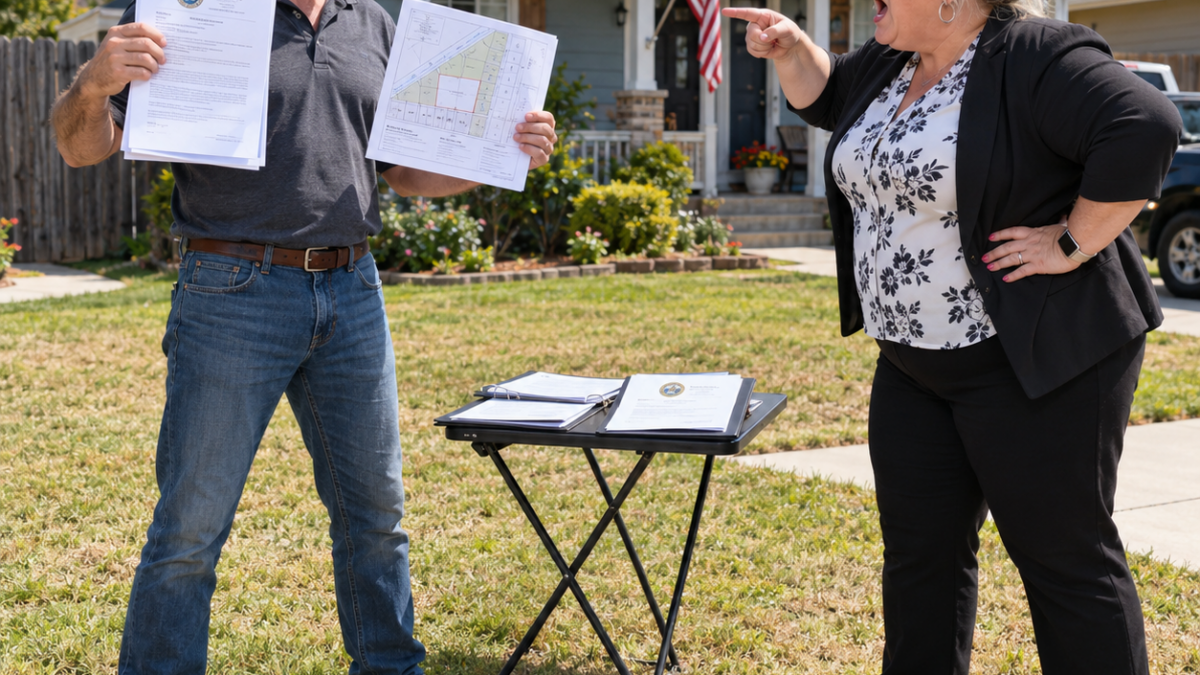
PART 2
I bent over the map.
The words were printed in the tiny, precise lettering surveyors use when they expect their work to outlive everybody in the room.
**EXISTING PARCEL — EXCLUDED FROM COVENANTS.**
For several seconds, I didn’t move.
Linda Mercer looked from the map to me.
“Is that your parcel number?”
I checked the deed I had brought.
Then checked it again.
“Yes.”
“You’re sure?”
“Yes.”
She pulled a chair closer and sat down.
“Then this property was carved out when Cypress Creek was platted.”
I traced the black boundary with my finger.
The subdivision wrapped around my land on three sides.
My farmhouse sat in the middle of the development, but legally it was separate.
Not a Cypress Creek lot.
Not subject to Cypress Creek’s recorded restrictions.
Not part of its declaration.
I felt something move through my chest.
Not excitement.
Not yet.
Anger.
Cold, controlled anger.
“How do I get certified copies?”
Linda looked over her glasses.
“Of the plat?”
“The plat. Original developer filings. Anything showing the exclusion.”
She nodded.
“I’ll print the index.”
Then she hesitated.
“You said you’ve been paying HOA dues?”
“For years.”
“Why?”
“They sent bills.”
“Did you ever sign an agreement?”
“No.”
“Deed amendment?”
“No.”
“Annexation document?”
“No.”
“Voting agreement?”
“No.”
She leaned back.
“I’m not your lawyer.”
“I understand.”
“But I’d take all of this to one.”
“I intend to.”
For three hours, Linda helped me trace the paper history of my property.
My grandfather’s purchase.
My father’s partial sale.
The developer’s subdivision application.
The recorded declaration.
The plat.
The legal descriptions.
Every time Cypress Creek was defined, my two acres were outside it.
There was even a developer’s memorandum explaining that the existing Davidson homestead would remain an independent parcel and would not be burdened by subdivision covenants unless a future owner voluntarily executed an annexation instrument.
No such instrument existed.
I paid for certified copies.
When Linda stamped the last document, I asked one more question.
“Could paying dues make me part of the HOA?”
She shook her head.
“That’s a question for counsel. But payments don’t rewrite a recorded plat.”
Fair answer.
I gathered everything into a manila envelope.
As I walked up the basement stairs toward daylight, my phone buzzed.
Karen.
I almost ignored it.
Then I answered.
“Arthur.”
“Good morning,” she said in that polished voice she used when she wanted intimidation to sound like customer service. “I wanted to confirm you received yesterday’s notice.”
“I did.”
“Have you selected a compliant color?”
“No.”
A pause.
“Then your continuing fine is now six hundred dollars.”
“Good to know.”
“Arthur, sarcasm isn’t helpful.”
“Neither is threatening property you don’t control.”
Her tone cooled.
“I beg your pardon?”
“I’ll be in touch.”
I hung up.
That may have been the first time anyone in Cypress Creek ever ended a conversation with Karen before she was finished.
It felt surprisingly good.
But driving home, I forced myself to slow down.
Twenty years in the Army had taught me something anger never did.
When you discover the other side has made a major mistake, you don’t immediately start shouting.
You verify.
Then verify again.
Then decide what the mistake is worth.
I stopped at the county recorder’s office.
Same result.
My parcel was not listed among the properties bound by the Cypress Creek declaration.
I pulled historical tax maps.
Same result.
I checked recorded amendments.
None included my land.
By four that afternoon, I no longer had a suspicion.
I had documentation.
Karen had been fining a man her HOA had no jurisdiction over.
Worse, Cypress Creek had collected annual dues from me for nearly a decade.
I had paid voluntarily because I assumed the bills were legitimate.
That part bothered me almost more than the paint fine.
Not because of the money.
Because of the confidence.
Year after year, someone mailed a statement to a parcel that wasn’t theirs and expected payment.
And I had paid.
I drove past George Henderson’s house on the way home.
He was in his backyard tying tomatoes to stakes.
George was seventy-seven.
Thin.
Gray-haired.
A retired history teacher who could tell you who won the Battle of Antietam, what year your house was built, and why every modern president misunderstood something about James Madison.
He looked up.
“If this is about my sunflowers, they’re staying.”
I stopped at his gate.
“Good afternoon to you too.”
He wiped his hands on his jeans.
“Karen came yesterday.”
“What for?”
He pointed toward the back fence.
Sunflowers towered over it.
Bright yellow heads leaned toward the afternoon sun.
“Apparently they constitute an excessive vertical landscape feature.”
I stared.
“That’s a phrase?”
“According to Karen.”
“How much?”
He looked embarrassed.
“Three hundred.”
“For flowers?”
“That brings the year to just over two thousand.”
I stopped smiling.
“You paid?”
He wouldn’t look at me.
“Most of it.”
“George.”
“She threatened collection action.”
“She threatened a lien?”
His face tightened.
“She said unpaid assessments could eventually lead to foreclosure.”
There it was.
Fear.
Not annoyance.
Not irritation.
A retired teacher who had spent forty-three years paying for his home was afraid of losing it over sunflowers and garden hoses.
I thought about the certified plat in my truck.
My situation was cleaner than his.
The HOA truly had no authority over my parcel.
George was an HOA member.
But that didn’t mean Karen could invent rules, selectively enforce them, ignore appeal procedures, or use foreclosure threats as a casual conversation tool.
“Can I see your notices?”
He frowned.
“Why?”
“I’m looking into something.”
“About your green house?”
“About more than that.”
He studied me for several seconds.
Then nodded.
“Come inside.”
George kept everything.
Every violation notice.
Every receipt.
Every appeal.
Every certified letter.
The teacher in him had archived his persecution like primary-source material.
Sunflowers.
Compost bin.
Garden hose.
A wheelbarrow visible for three days.
A rain barrel Karen said was “inconsistent with community appearance.”
A small American flag in his vegetable garden that she claimed wasn’t mounted according to the decorative-flag policy.
“What happened when you appealed?”
George laughed.
No humor in it.
“Karen chaired the hearing.”
“She issued the violations?”
“Most.”
“And then chaired the appeal?”
“Yes.”
“Who voted?”
“Karen. Carol Jenkins. Fred Walsh.”
“Always uphold?”
He thought.
“I’ve never won one.”
I photographed the documents.
Then went across the street to the Rodriguez house.
Carlos Rodriguez opened the door with a toddler on one hip.
His wife Maria stood behind him.
I explained enough to get them interested.
When I mentioned Karen’s fines, Maria’s expression changed.
“You want ours?”
“Yes.”
“How much time do you have?”
Their kitchen table became the second archive.
Basketball hoop.
Sidewalk chalk.
A plastic children’s slide deemed an unapproved shade of blue.
A family van parked overnight when Carlos returned late from work.
A Halloween decoration visible one day after the approved removal period.
Then Maria handed me a letter involving the basketball hoop.
The wind had knocked it over while the family was away.
Karen photographed it.
The HOA fined them for improper recreational-equipment storage.
They appealed.
Denied.
“How much?”
“Nine hundred seventy-five dollars after penalties.”
“For a hoop the wind knocked down?”
Carlos nodded.
“We paid.”
“Why?”
He looked toward his children.
“They threatened to suspend pool privileges.”
Maria added, “The kids live at that pool in summer.”
Carlos’s jaw tightened.
“And the letter implied they could pursue collection against the property.”
“What do you do for work?” I asked.
“Paralegal.”
That surprised me.
“You didn’t challenge it?”
“I wanted to.”
“Then?”
He looked embarrassed.
“My firm doesn’t do HOA law. Karen had an attorney send a letter. My wife was pregnant. I didn’t want a lawsuit hanging over us.”
That was Karen’s real system.
Not law.
Cost.
She didn’t need to be right if being wrong was too expensive for anyone to challenge.
I drove home as the sun went down.
Another notice was taped to my front door.
Karen had apparently stopped trusting the mail.
**FAILURE TO COMPLY WITH EXTERIOR COLOR REMEDIATION ORDER**
Fine balance: $800.
Deadline: forty-eight hours.
Then the line she wanted me to notice:
**Failure to comply may result in lien proceedings against the property and suspension of Cypress Creek community privileges.**
I took a photograph before removing it.
Then I placed the notice beside the certified city plat on my dining-room table.
One document said Karen controlled my exterior paint.
The other said she had never controlled anything on my property.
I poured coffee.
Then I started a file.
Date.
Notice.
Amount.
Delivery method.
Claimed authority.
Response.
Supporting public record.
The next morning, I called an attorney.
Not the first one I found online.
Carlos gave me a name through his firm.
Rebecca Albright.
Property litigation.
Community-association disputes.
She had represented both HOAs and homeowners, which I liked.
I didn’t want somebody who thought every association was evil.
I wanted somebody who understood exactly where lawful authority ended.
Her office was twenty minutes away.
She was forty-five.
Dark hair.
Fast eyes.
No patience for dramatic speeches.
I put the certified plat on her desk.
Then the fines.
Then my deed.
Then the developer memorandum.
She read quietly.
After fifteen minutes, she looked up.
“Did you ever sign an annexation agreement?”
“No.”
“Anything at closing when you inherited or refinanced?”
“No.”
“Title commitment?”
I handed it over.
She read.
“No declaration exception listed.”
“Meaning?”
“Meaning I don’t currently see evidence your land is bound to Cypress Creek’s covenants.”
I leaned back.
“That simple?”
“Nothing involving real property is simple until I verify the record myself.”
Good answer.
She tapped the stack of violation notices.
“But if these documents check out, the HOA has a serious problem.”
“The fines?”
“The fines. The lien threats. The dues.”
“I paid for almost ten years.”
“Why?”
“I assumed I belonged.”
“Did you use common amenities?”
“Occasionally.”
“Pool?”
“Once or twice when my niece visited.”
“Trash?”
“City service.”
“Private roads?”
“Public.”
“Gate?”
“There isn’t one.”
Rebecca made notes.
“Voluntary payments complicate refund arguments. They don’t automatically create recorded covenants, but we’ll analyze what services you received and what representations were made.”
I liked her even more.
No easy promises.
Then I showed her George’s notices.
And the Rodriguez file.
She frowned.
“These are different.”
“How?”
“Those properties are in the HOA. Their question isn’t jurisdiction. It’s governance.”
“Can she do what she’s doing?”
“Some associations can impose fines. Some can restrict amenities. Collection remedies depend on state law, the declaration, bylaws, statutory notice, due process, and the type of debt.”
“Foreclosure?”
“Potentially in some circumstances. Not casually. Certainly not because the president feels like scaring a retiree.”
I told her about the appeal hearings.
Karen issuing fines and effectively controlling the review.
The selective enforcement.
Legal threats.
Rebecca closed the folder.
“You have a clean individual issue.”
“My parcel.”
“Yes.”
“The rest?”
“Potential broader claims, but those need much more work.”
“What should I do?”
“For your own property? We send a formal notice immediately.”
“To Karen?”
“To the HOA, the board, its management company, and its counsel.”
She pulled a legal pad closer.
“We demand cessation of enforcement against your parcel. We attach the public records. We demand confirmation no lien will be filed.”
“And the dues?”
“We reserve that issue.”
“What about everyone else?”
Rebecca looked at me.
“Let them decide whether they want counsel.”
“They’re afraid.”
“I understand.”
“No, I mean really afraid.”
She paused.
Then said, “Then give them information, not promises.”
That afternoon she drafted a letter.
No insults.
No accusations of criminal conduct.
No threats of prison.
Just facts.
Parcel number.
Recording references.
Plat notation.
Developer exclusion.
No annexation document found.
No recorded covenant.
Demand for immediate withdrawal of fines.
Demand that Cypress Creek cease representing it possessed enforcement authority over my property.
Demand for confirmation that no lien would be recorded.
Karen received it the next morning.
At 10:17, my phone rang.
“Arthur Davidson?”
I recognized the voice.
“Karen.”
“What have you done?”
“I hired a lawyer.”
“You are trying to intimidate volunteers.”
“No.”
“This ridiculous claim that your property is outside Cypress Creek—”
“Public records say it is.”
“You have paid dues for years.”
“Because you billed me.”
“You participated in the community.”
“I wave at people too. That doesn’t annex my deed.”
She went silent.
Then: “Our counsel will respond.”
“That’s appropriate.”
“You still need to repaint.”
“No.”
“The fines continue until counsel resolves this.”
“Your lawyer may want to rethink that.”
“How dare you—”
“Karen.”
I had never interrupted her before.
She stopped.
“Do not put anything on my property.”
“What?”
“No notices. No contractors. No paint inspectors. No lien documents without going through counsel.”
“This is my community.”
“This is my land.”
I hung up.
Three days passed.
No Escalade.
No notice.
Then Cypress Creek’s attorney responded.
His letter was six pages.
Most of it was fog.
Because my parcel sat geographically within the development and because I had paid dues and accepted “community benefits,” the association claimed there was at minimum an implied contractual relationship.
Rebecca read it twice.
Then looked at me.
“Interesting.”
“Bad interesting?”
“Desperate interesting.”
“So they’re wrong?”
“I said interesting.”
She pointed to the letter.
“They’re not citing a recorded declaration binding the parcel.”
“Because there isn’t one.”
“Likely.”
“Likely?”
“Arthur, you hired me because Karen treats certainty like evidence. Don’t ask me to do the same.”
Fair.
Rebecca ordered a professional title search.
It took a week.
The report came back clean.
No Cypress Creek declaration against my parcel.
No annexation.
No HOA assessment lien rights.
No architectural-control restrictions.
My house was legally outside their covenant regime.
Rebecca smiled when she called.
“Now I’ll say it.”
“Say what?”
“They don’t control your paint.”
I sat on my porch looking at the green siding.
“Good.”
“What do you want to do next?”
“Make sure they never pretend otherwise again.”
“That I can do.”
Then I looked toward George’s house.
His sunflowers rose above the fence.
“And I want to understand what they’ve done to everybody else.”
Rebecca sighed.
“I knew you were going to say that.”
I called a neighborhood meeting.
Not secretly.
No anonymous leaflets.
By then I wanted everything clean.
I knocked on doors.
George called people.
Maria spoke to families at the playground.
Carlos contacted neighbors who had complained to him privately.
Saturday morning, thirty-four homeowners stood in my front yard.
Several carried violation folders.
One woman brought a three-ring binder.
A man named Rick had a grocery bag full of certified letters.
Karen drove past once.
Slowly.
Her face was pale behind the windshield.
I stood on the top porch step.
“My name is Arthur Davidson.”
Someone laughed.
“We know, Arthur.”
I smiled.
“Fair.”
Then I held up the city plat.
“I called this meeting because Karen fined me for painting this house green.”
Several people laughed.
“Turns out she had one problem.”
I taped the plat to a plywood board.
“My property is not in the HOA.”
The laughter stopped.
I pointed to the black boundary.
Then the five words.
**EXISTING PARCEL — EXCLUDED FROM COVENANTS.**
George leaned forward.
Maria covered her mouth.
A man near the driveway said, “Seriously?”
“Certified city record.”
Another asked, “Then why did you pay dues?”
“Because I believed the bills.”
That caused an uncomfortable murmur.
I continued.
“My case is unusual. Most of your properties are legally inside Cypress Creek.”
A few people looked disappointed.
“But Karen having authority doesn’t mean Karen has unlimited authority.”
Carlos stepped forward.
He explained what he had learned from Rebecca.
HOA powers came from governing documents and state law.
Procedures mattered.
Notice mattered.
Appeals mattered.
Board duties mattered.
Selective enforcement mattered.
Accounting mattered.
Then George stood.
He held up his sunflower fine.
“I’ve paid more than two thousand dollars in one year because I was afraid.”
His voice shook.
“I’m tired of being afraid.”
Something changed in the yard.
People began opening folders.
One woman had fines for a wreath.
Another for a work van.
Another for a fence approved years earlier.
A young father had been fined because his children left bicycles in the driveway during dinner.
A nurse who worked nights had received repeated trash-can notices because collection happened while she slept between shifts.
Not every complaint was outrageous.
I said that plainly.
“If you violated a clear rule, this isn’t about pretending rules don’t exist.”
Several people nodded.
“It’s about whether the rules are clear, fairly applied, and lawfully enforced.”
That mattered.
I did not want a mob.
Mobs feel satisfying right until they become another form of Karen.
So we formed a records committee.
George documented violation histories.
Carlos tracked meeting procedures.
A CPA named Nancy Patel volunteered to review financial statements.
Rebecca agreed to represent a group of homeowners if enough joined.
Within two weeks, fifty-eight households signed an engagement agreement.
Then Nancy found something.
Legal expenses.
Under the president before Karen, Cypress Creek had spent between $9,000 and $15,000 annually on legal services.
During Karen’s first year?
$41,000.
Second?
$67,000.
Current year projected?
Nearly $90,000.
“What lawsuits?” I asked.
Nancy pushed the statements toward me.
“That’s the question.”
We demanded invoices.
The board resisted.
Rebecca sent a statutory records request.
Eventually boxes arrived.
The legal bills told the story.
Demand letters against residents.
Collection threats.
Fine enforcement.
Meetings with Karen about individual “problem properties.”
Hours of attorney time spent on matters involving $50, $100, or $200 violations.
In one case, Cypress Creek had spent more than $2,400 in legal fees pursuing a $300 landscaping fine.
George stared at the invoice.
“They spent more chasing me than I paid them.”
“Yes.”
“But why?”
Nancy answered.
“Because it wasn’t financially rational.”
That was the point.
Karen wasn’t running a budget.
She was enforcing obedience.
Then the accounting got worse.
Some fine revenue had been placed into a discretionary “compliance reserve.”
Perfectly legitimate in concept.
Not necessarily legitimate in use.
Nancy found restaurant charges.
Office-supply purchases from retailers that didn’t primarily sell office supplies.
A salon transaction labeled “board hospitality.”
Several online purchases with vague descriptions.
Not enough to accuse anyone of theft yet.
Enough to demand receipts.
Rebecca sent a formal demand.
At the same time, she filed my individual lawsuit.
Simple claims.
Declaratory judgment confirming my property was not subject to Cypress Creek covenants.
Injunction against further HOA enforcement.
Claims relating to wrongful collection demands and dues depending on the evidence and applicable law.
The complaint attached the plat.
The deed.
The exclusion memorandum.
Karen’s “abomination” letter.
Local media discovered it within forty-eight hours.
I hated that.
Rebecca did not.
“Public court filing,” she said.
“I don’t want to become entertainment.”
“Then don’t perform.”
A reporter called.
I refused the first interview.
Then he interviewed Karen.
That changed my mind.
She told him my farmhouse had “benefited from Cypress Creek for years” and that I was trying to “avoid community responsibilities after voluntarily participating.”
Then she said something that made me put down my coffee.
“The house is visually inconsistent with neighborhood standards, and homeowners have a responsibility not to damage shared property values.”
My house.
The one that existed before the neighborhood.
Apparently my grandfather should have anticipated Karen’s palette committee seventy years in advance.
I called the reporter.
“I’ll speak.”
The interview happened on my porch.
I wore jeans.
No flags behind me.
No dramatic binder.
Just the house.
Mossy fern green.
The reporter held the violation notice.
“You were fined five hundred dollars for this color?”
“Yes.”
“Then a hundred dollars a day?”
“That was the demand.”
“You refused?”
“Yes.”
“Why?”
“Because I checked the public record.”
We showed the plat.
The camera zoomed in.
**EXISTING PARCEL — EXCLUDED FROM COVENANTS.**
The reporter looked at me.
“So the HOA does not include your property?”
“According to the recorded documents and title review, no.”
“What did you think when you learned that?”
“I wondered why they had been billing me.”
Then George spoke.
Not because I asked him to.
Because he wanted to.
He stood among his sunflowers and told the reporter about the fines.
His voice shook when he explained the foreclosure threat.
“I taught American history for forty-one years,” he said.
“I told students they should understand the institutions governing them.”
He looked ashamed.
“I didn’t understand the one governing my own street.”
The reporter asked, “Why did you pay?”
George looked at his house.
“Because I was afraid of losing that.”
Maria Rodriguez appeared next.
Her daughter stood beside her holding sidewalk chalk.
That image ended up on television.
Maria explained the basketball-hoop fine.
The pool threat.
The appeal hearing chaired by the same people who issued the violation.
The news segment aired at six.
By seven, Cypress Creek’s private social page exploded.
By eight, Karen disabled comments.
By nine, screenshots of the deleted comments were circulating anyway.
By ten, two board members had called Rebecca separately asking whether they needed individual attorneys.
The first crack appeared.
Carol Jenkins resigned three days later.
Her resignation email said she had “relied heavily on the president and association counsel” and was no longer comfortable serving.
Fred Walsh lasted another week.
Then Nancy found the receipts.
Not all of them.
Enough.
Salon services.
Meals unrelated to meetings.
Home décor.
Retail purchases delivered to Karen’s address.
Total confirmed questionable spending at that point: $11,600.
Then a forensic accountant found more.
Nearly $29,000 in charges that lacked legitimate HOA support or appeared personal.
Some money came from general operating accounts.
Some from the compliance reserve funded partly by fines.
Rebecca sent the records to the association’s insurance carrier and demanded an independent investigation.
The carrier appointed new counsel.
That was the moment Karen lost control of the lawyers.
Until then, she acted like association counsel worked for her.
They didn’t.
They represented the association.
Once the possibility existed that Karen’s personal interests conflicted with Cypress Creek’s, things changed quickly.
The new lawyers advised the remaining board to suspend contested fine collections.
They advised against filing any lien on my property.
They retained an independent auditor.
And they told Karen, in writing, that she could not direct counsel regarding claims against herself.
She called an emergency meeting.
Two hundred people showed up.
The clubhouse could hold ninety.
The meeting moved to the elementary-school cafeteria.
Karen sat at a folding table on a stage.
One remaining director beside her.
Association counsel at the end.
The first agenda item was pool-pump maintenance.
Someone laughed.
Karen glared.
“We will conduct normal business.”
A man near the front stood.
“You fined my mother three hundred dollars for a bird feeder.”
“Sit down.”
“We’re not here for the pool pump.”
“Sir, you are out of order.”
Another resident called, “You’re the one under investigation.”
Applause erupted.
Karen hammered the gavel.
“Order!”
I stayed seated.
Rebecca had told me not to turn a member meeting into courtroom argument.
Good advice.
Then Karen made it personal.
“The entire disruption in this community has been orchestrated by one disgruntled homeowner who refuses to follow standards every other resident respects.”
Her eyes found me.
There it was.
The invitation.
Rebecca, sitting beside me, whispered, “Don’t.”
I nodded.
Karen continued.
“Mr. Davidson has portrayed himself as a victim because he dislikes his obligations.”
Someone shouted, “He isn’t even in the HOA!”
Karen’s face flushed.
“That issue is being litigated.”
Association counsel leaned toward her.
She ignored him.
“He paid dues for almost ten years. He used community services. He cannot simply declare himself independent because he found some obscure note on an old map.”
Rebecca whispered, “Still don’t.”
I stayed seated.
Then Karen said:
“And his hideous paint choice was the final evidence that voluntary compliance had failed.”
The room went silent.
Rebecca closed her eyes.
I looked at her.
“Now?”
She sighed.
“Keep it factual.”
I stood.
Walked toward the microphone.
Karen stared at me.
I didn’t look at the audience.
Only at her.
“You called the color an abomination.”
“It violates standards.”
“My parcel isn’t subject to those standards.”
“According to your interpretation.”
“No.”
I held up the certified title report.
“According to the recorded plat, original subdivision declaration, developer memorandum, and independent title examination.”
She pointed at me.
“You paid dues.”
“Because Cypress Creek billed me.”
“You accepted benefits.”
“Name one that legally annexed my deed.”
She opened her mouth.
Nothing.
I continued.
“This should have ended when my attorney sent you the public record.”
Applause began.
I raised my hand.
It stopped.
I did not want applause.
“This isn’t about winning an argument over green paint.”
I looked toward George.
Then Maria.
“This is about people being afraid to ask whether a fine is lawful because they think the answer will cost them their house.”
Karen shook her head.
“More theatrics.”
George stood.
“No.”
Everyone turned.
He walked slowly toward the second microphone.
His hands trembled.
“No, Karen.”
She stared at him.
“You told me you could foreclose on my home.”
“I told you delinquent HOA debts carry collection remedies.”
“Over sunflowers.”
“You had multiple violations.”
“My wife planted those sunflowers before she died.”
Karen hesitated.
George continued.
“You knew that.”
No answer.
“I paid because I was afraid.”
His voice cracked.
“And you kept coming back.”
The cafeteria became completely silent.
Then Maria stood.
“You threatened our pool access over chalk.”
Another homeowner stood.
“You spent our dues on lawyers to chase a wreath.”
Another.
“You fined me the week after I questioned the budget.”
Another.
“You denied my appeal without putting it on a meeting agenda.”
Another.
“My work van was there because I’m an electrician. I wasn’t running a business out of my driveway.”
Karen kept gripping the gavel.
But nobody feared it anymore.
Authority is strange that way.
Sometimes it disappears before the title does.
Rebecca stepped to the microphone.
She didn’t accuse Karen of a crime.
She explained the current legal posture.
Independent audit underway.
My parcel dispute before the court.
Member rights.
Board fiduciary obligations.
Then Carlos read the recall provisions from the bylaws.
Twenty-five percent of the membership could compel a special removal vote.
He held up a petition.
“We currently have signatures from sixty-eight percent.”
The room erupted.
Karen stood.
“This meeting is adjourned.”
Association counsel spoke for the first time.
“President Miller, you cannot use adjournment to nullify a properly submitted member petition.”
Her head snapped toward him.
“You work for this board.”
“I represent Cypress Creek Homeowners Association.”
“That is what I said.”
“No.”
He remained calm.
“It is not.”
That sentence broke something in her.
The lawyer she thought belonged to her had just explained, in front of everyone, that he didn’t.
Karen swept papers into her folder.
“You’ll regret this.”
She walked off the stage.
No one followed.
The recall meeting was scheduled seventeen days later.
Before it happened, Fred Walsh resigned.
Karen did not.
She sent three neighborhoodwide emails.
The first called the movement a conspiracy.
The second accused me of seeking control of Cypress Creek.
The third claimed removing her would cause property values to collapse.
I answered none of them.
The independent audit did.
Questionable expenses had climbed to just under $31,000.
Some could be explained.
Many could not.
A reserve transfer had been used to pay charges with no association purpose.
The auditor recommended referral to appropriate authorities and recovery efforts.
The remaining board followed that recommendation.
Karen’s attorney announced she denied wrongdoing.
That was her right.
The recall still moved forward.
The school cafeteria filled again.
Independent volunteers counted ballots.
Karen spoke for twenty minutes.
She described herself as a dedicated volunteer.
She pointed out that Cypress Creek had attractive common areas.
True.
She noted that home prices had increased during her presidency.
Also true.
She argued strong standards protected residents.
Reasonable people could believe that.
Then she blamed every controversy on residents unwilling to accept accountability.
That was where she lost the room.
Not because rules were unpopular.
Because after years of fear, people were tired of being told their fear proved they were irresponsible.
The ballots were counted.
Two hundred twenty-one valid votes.
Two hundred fourteen for removal.
Seven against.
Karen sat motionless.
The room did not cheer immediately.
There was a moment of disbelief.
Then relief moved through the crowd like wind through trees.
George started crying.
Maria hugged him.
Carlos closed his eyes.
I looked at the woman who had threatened to lien my grandfather’s house over green paint.
She looked smaller.
Not defeated by me.
Defeated by the people she had stopped listening to.
She placed the gavel on the table.
For the first time since I had known her, she left without saying anything.
The court proceedings continued.
My individual case resolved first.
Cypress Creek formally acknowledged that my parcel was excluded from the association’s declaration.
All fines against me were voided.
The HOA agreed it had no architectural-control authority over my property.
The agreement required the association to stop billing me mandatory dues unless some future voluntary written arrangement was made.
Past dues were complicated because I had knowingly used limited amenities on occasion and because restitution depended on specific legal theories.
Rebecca negotiated a settlement.
I recovered a substantial portion of the money I had paid, plus fees and damages related to the improper enforcement campaign.
More important was the document recorded afterward.
A formal notice confirming that my parcel was not subject to Cypress Creek’s covenants.
Permanent.
Public.
Boring.
Beautiful.
George’s case was different.
He was inside the HOA.
So were the Rodriguezes.
Their claims focused on improper fines, procedures, selective enforcement, board misconduct, and financial misuse.
The insurance carrier and newly elected interim board chose mediation instead of years of litigation.
That decision saved the community enormous legal costs.
After months of negotiation, Cypress Creek established a refund program for fines that could not be supported by valid rules or proper procedure during Karen’s tenure.
George received back most of what he had paid.
The day the check arrived, he walked to my house carrying the envelope.
“I’m buying something reckless.”
“You’re seventy-seven.”
“Exactly.”
“What?”
He smiled.
“Sunflower seeds.”
I laughed.
“They’re already ten feet tall.”
“Different variety.”
“How tall?”
“Twelve.”
“Menace.”
“An aggressively vertical menace.”
He hugged me.
George wasn’t a hugging man.
That was when I understood what the refund really meant.
Not money.
Dignity.
The Rodriguezes received reimbursement for several invalid fines.
Their pool privileges had already been restored.
Carlos later won a seat on the new board.
At his first meeting, his daughter drew a hopscotch grid outside the clubhouse.
Nobody cited her.
The financial investigation was more serious.
The audit records went to the district attorney.
The case took almost a year.
Not every questionable charge became a criminal allegation.
That mattered.
Sloppy accounting is not automatically theft.
Bad judgment is not automatically fraud.
Prosecutors separated what they could prove from what people suspected.
Ultimately Karen was charged with offenses tied to misuse of association funds and false accounting records.
She fought the charges.
Her lawyers argued reimbursements had been informal, documentation poor, and expenditures association-related.
Some were.
Others weren’t.
At trial, Nancy Patel testified about the accounting.
Association vendors testified.
Retail records were introduced.
One salon owner confirmed repeated services billed to Karen personally on dates matching charges coded as “community hospitality.”
An online retailer provided shipping records showing purchases delivered to Karen’s home.
The prosecution did not need my paint dispute to prove those charges.
That was important to me.
I testified only about documents relevant to the financial and enforcement pattern.
Karen’s attorney cross-examined me.
“You dislike my client.”
“I dislike what happened.”
“That wasn’t my question.”
“I don’t know her well enough personally to hate her.”
“She fined you.”
“Yes.”
“She threatened a lien.”
“Yes.”
“You sued.”
“Yes.”
“You organized residents against her.”
“I helped organize a meeting.”
“You appeared on television.”
“Yes.”
“And now you want this jury to believe you have no personal interest in seeing her punished?”
I thought about the question.
“I have an interest in the truth.”
He smiled.
“That sounds rehearsed.”
“It isn’t.”
“You served in the Army.”
“Yes.”
“For twenty years.”
“Yes.”
“You’re accustomed to conflict.”
“I’m accustomed to documentation.”
A few jurors smiled.
Her attorney didn’t.
He changed subjects.
George testified later.
He was nervous.
The prosecutor showed his violation notices.
Sunflowers.
Compost.
Garden hose.
George explained paying them.
Then the prosecutor asked why.
“I was scared.”
“Of what?”
“Losing my home.”
“Did anyone tell you Cypress Creek had actually started foreclosure proceedings?”
“No.”
“Then why did you believe that was possible?”
“Because the president told me unpaid violations could put my house at risk.”
The defense objected to certain wording.
The judge gave instructions.
George continued.
“She sounded official.”
That sentence mattered.
She sounded official.
So had the envelopes.
The letterhead.
The legal language.
The highlighted bylaws.
The clipboard.
Karen had discovered that many people obeyed not because she was right, but because challenging official-looking authority felt dangerous.
That was the deeper damage.
The jury convicted Karen on several financial charges.
Not every count.
Enough.
Sentencing came six weeks later.
I almost stayed home.
Rebecca told me I didn’t need to attend.
George wanted to go.
So I went with him.
Karen stood before the judge without the HOA polo shirts, the clipboard, the Escalade keys, the gavel, or the board members beside her.
Just Karen.
Her attorney asked for leniency.
Clean prior record.
Community service.
Age.
No history of violent conduct.
All legitimate considerations.
Then the judge allowed victim statements.
George stood.
I whispered, “You don’t have to.”
“Yes, I do.”
He walked to the lectern.
He unfolded one sheet of paper.
“My name is George Henderson.”
His voice shook.
“I taught high school history for forty-one years.”
He smiled faintly.
“I spent most of that time telling teenagers that government works best when citizens understand what people in authority are allowed to do.”
He looked toward Karen.
“I forgot my own lesson.”
The courtroom was silent.
“I believed every letter because it had a seal.”
“I believed every threat because it came from a president.”
“I paid money I could not afford because I thought losing an argument meant losing my home.”
He took a breath.
“I’m not angry about the sunflowers anymore.”
Then his voice broke.
“I’m angry that she made me feel small inside a house I worked my whole life to own.”
I looked down.
That hurt more than any fine.
George finished quietly.
“I hope whatever sentence you give reminds people that authority over neighbors is a responsibility, not ownership.”
He returned to his seat.
I squeezed his shoulder.
The judge later sentenced Karen to incarceration followed by supervision and ordered restitution consistent with the proven financial losses.
The exact number of months mattered less to me than the judge’s words.
“You were entrusted with other people’s money and with limited authority over their homes.”
He looked directly at her.
“You repeatedly confused stewardship with entitlement.”
Karen cried.
Maybe for herself.
Maybe from shame.
Maybe both.
I never knew.
As deputies led her away, she looked toward me.
There was anger there.
But there was something else too.
Exhaustion.
For three years she had fought everyone who challenged her.
Now there was nobody left to fight.
I did not nod.
Did not smile.
Did not celebrate.
I just watched her go.
Because by then, the ending I wanted had already happened somewhere else.
Back in Cypress Creek.
The new board had been elected.
Carlos served as vice president.
Nancy Patel became treasurer.
The president was a retired civil engineer named Beth Collins who opened her first meeting by saying:
“If this job ever starts making me feel important, somebody please remove me.”
George laughed so hard he coughed.
The bylaws were reviewed line by line.
Not everything Karen enforced disappeared.
Some rules were sensible.
Parking limits remained.
Common-area protections remained.
Standards against neglected properties remained.
But subjective phrases were tightened.
Appeal procedures changed.
A person involved in issuing a violation could not dominate the review.
Large legal expenditures required board approval.
Financial statements were published quarterly.
Homeowners received clearer records access.
Foreclosure-related collection language required counsel review and formal notices instead of casual threats.
Fines became a compliance tool of last resort.
Not a revenue stream.
Not punishment.
Not personal leverage.
The community changed almost immediately.
Not aesthetically.
Humanly.
People stayed after meetings to talk.
The neighborhood page reopened comments.
Sometimes discussions were annoying.
Arguments about dogs.
Pool hours.
Parking.
Holiday lights.
Normal problems.
No one feared disappearing into Karen’s private blacklist.
George started a gardening club.
His twelve-foot sunflowers became ridiculous.
Beautifully ridiculous.
Children took pictures beside them.
He put a small sign in the garden:
**AGGRESSIVELY TALL SINCE 2026**
Carlos helped build it.
Maria hated it.
Their daughter added a chalk sunflower underneath.
The basketball hoop stayed in the driveway.
When storms came, they laid it down intentionally.
Nobody fined them for the weather.
As for my farmhouse, the green became part of the landscape.
The color softened after the first winter.
Against the trees, it looked exactly the way I had imagined.
One afternoon, a woman walking her dog stopped by.
“We’re new.”
“Welcome.”
She pointed at my house.
“Is this the famous green house?”
“That depends who you ask.”
She laughed.
“Our realtor told us the whole story.”
“That worries me.”
“She said you beat the HOA.”
I shook my head.
“No.”
She looked confused.
“The HOA still exists.”
“So?”
“So I didn’t beat it.”
I pointed toward Carlos’s house.
“People fixed it.”
That distinction mattered.
Karen was not proof that HOAs were inherently corrupt.
Cypress Creek was proof that institutions become dangerous when people stop participating and one personality fills the vacuum.
For years, everyone complained quietly.
Paid quietly.
Feared quietly.
Karen mistook silence for consent.
We helped teach each other the difference.
Months after the criminal case ended, I received a letter.
Not from the HOA.
From Karen.
No return address.
Just my name.
I stared at it for several minutes before opening it.
The handwriting was neat.
Controlled.
Very Karen.
**Arthur,**
**You probably won’t believe this, but I did care about Cypress Creek.**
I almost stopped reading.
Then continued.
**When I became president, I believed the neighborhood had become careless. People ignored rules. Meetings were empty. Volunteers quit. I thought stronger enforcement would improve things.**
That part, I believed.
**Over time, disagreement began to feel like disrespect. I stopped separating the two.**
I sat down.
**I convinced myself that because I was protecting the community, whatever I did in service of that goal was justified.**
That sentence surprised me.
**I still think some residents treated reasonable standards like tyranny simply because they disliked being told no. But I also understand now that I became something worse. I used fear. I took things that weren’t mine. I lied to myself about what I was entitled to do.**
Then:
**Your house was never part of the HOA. I knew that before the lawsuit.**
I stopped.
Read it again.
**I knew that before the lawsuit.**
My hands tightened around the paper.
She continued.
**After your attorney sent the plat, our counsel told me the claim against your parcel was probably indefensible. I kept enforcing because I thought backing down would destroy my authority with everyone else.**
There it was.
The truth I had suspected.
Not a misunderstanding.
Choice.
She knew.
And continued.
**That was wrong.**
**I am sorry for threatening your home.**
No excuse after it.
No “but.”
Just that.
I read the letter twice.
Then walked outside.
George was trimming tomato plants.
I crossed the street.
“Got something.”
He read it.
Slowly.
When he reached the sentence about authority, he looked up.
“She knew?”
“Apparently.”
George handed the letter back.
“You angry?”
“Yes.”
“Going to answer?”
“I don’t know.”
He thought about it.
Then said, “History teacher’s advice?”
“Sure.”
“You don’t owe every chapter a sequel.”
I laughed.
“That’s terrible history-teacher advice.”
“Retirement lowered my standards.”
I folded the letter.
I never replied.
Not out of cruelty.
There was nothing useful left to say.
Karen had consequences.
Cypress Creek had changed.
My house was safe.
Forgiveness did not require correspondence.
Years passed.
George’s health declined.
At eighty-two, he stopped gardening as much.
His knees hurt.
His hands shook.
One April morning, he called me.
“Need a favor.”
“What?”
“Come over.”
I found him sitting beside a tray of sunflower seedlings.
Dozens.
“I can’t plant these.”
“I can.”
“I know.”
We spent the afternoon in his yard.
Carlos came.
Maria.
Their children, older now.
Several gardening-club members.
We planted an entire row along the back fence.
George sat in a lawn chair giving instructions nobody needed.
“Too close.”
“They’re fine.”
“Arthur, you’re crowding them.”
“They’re plants, George.”
“They’re historical artifacts.”
By July, the tallest reached nearly thirteen feet.
George died in August.
Peacefully.
His daughter was with him.
At the memorial, she asked whether I would say something.
I hated speaking at funerals.
I did it anyway.
I told everyone about the first conversation we had beside his tomatoes.
How he greeted me by defending sunflower height before I had even asked a question.
People laughed.
Then I told them about the courtroom.
His fear.
His dignity.
His sentence:
Authority over neighbors is a responsibility, not ownership.
Afterward, his daughter handed me an envelope.
Inside was the little wooden garden sign.
**AGGRESSIVELY TALL SINCE 2026**
“He wanted you to have it.”
I couldn’t speak for a moment.
I put it in my yard.
Not among sunflowers.
Beside my porch.
Karen would have hated it.
That made me smile.
The legal settlement money from my case was more than I expected.
I didn’t need all of it.
My Army retirement was stable.
The farmhouse was paid for.
So Carlos, Rebecca, and I created a small neighborhood legal-information fund.
Not a war chest against the HOA.
A resource.
If residents received a serious enforcement notice they didn’t understand, the fund paid for a short consultation with independent counsel.
Sometimes the answer was:
Yes, the HOA is right.
Fix the fence.
Move the trailer.
Pay the valid assessment.
Other times the answer was:
No, the board skipped required procedure.
Appeal.
Once, a homeowner came to us convinced the HOA was discriminating against him because of a shed.
The attorney reviewed the documents.
The shed was seven feet into a recorded utility easement.
The HOA was correct.
The man was furious.
I told him the same thing Karen never understood.
“Fair rules don’t become unfair just because you lose.”
He moved the shed.
That may have been the best evidence Cypress Creek had actually healed.
We weren’t trying to replace Karen’s tyranny with our own.
We were trying to make the process trustworthy enough that losing didn’t feel like being targeted.
Beth Collins served two terms as president.
Then stepped down.
Voluntarily.
At her last meeting, someone nominated her for a third.
She refused.
“Power needs expiration dates.”
Carlos became president after her.
His first act was not to rewrite anything.
It was to ask homeowners what the board should stop doing.
People gave him a list.
Too many emails.
Too much money on landscaping flowers nobody noticed.
Pool hours needed adjustment.
The clubhouse reservation system was ridiculous.
Normal complaints.
He listened.
Then the board fixed what it could.
One evening I sat on my porch with Carlos.
His kids were teenagers by then.
The daughter who once drew hopscotch now wanted a car.
He looked exhausted.
“HOA president is terrible.”
“I warned you.”
“No, you didn’t.”
“I thought it.”
“Helpful.”
He looked toward my house.
“You ever consider painting it again?”
I stared at him.
He smiled.
“Kidding.”
“I have two acres of sovereign territory.”
“Not sovereign.”
“Independent republic.”
“Still no.”
I laughed.
Then he became serious.
“You know what bothered me most about all this?”
“What?”
“I’m a paralegal.”
“I remember.”
“I work around legal documents all day.”
He looked toward his own house.
“And Karen still scared me.”
“Because it was your home.”
He nodded.
“That was it.”
People think knowledge removes fear.
It doesn’t.
Sometimes the thing at risk matters enough that fear wins anyway.
A house isn’t merely an asset.
It’s where children sleep.
Where spouses fight and make up.
Where your father’s tools stay in a drawer long after he is gone.
Where you mark heights on doorframes.
Where the dog is buried under the maple.
Threaten someone’s home and even ridiculous authority can feel enormous.
Karen understood that instinctively.
She used it.
That was why my green house became important.
Not because green paint matters.
Because one day I stopped accepting the premise that the person threatening my home automatically had the right to do it.
I checked.
Five words on a plat map changed everything.
**Existing parcel — excluded from covenants.**
But the real victory came afterward.
George still belonged to the HOA.
So did Carlos.
Maria.
Nancy.
Beth.
They could not escape the rules by pointing to my map.
They had to fix the system from inside.
And they did.
That was harder.
One Saturday, almost ten years after Karen’s first letter, I decided the house needed another coat of paint.
The mossy fern green had faded.
I went to the hardware store.
The clerk asked whether I wanted the same color.
I looked at the swatches.
For a second, cranberry trim tempted me.
Then I saw another deep green.
Slightly darker.
Almost forest colored.
“What’s that?”
He read the name.
“Heritage Moss.”
I laughed.
“What?”
“Nothing.”
I bought twelve gallons.
Carlos stopped by while I was painting.
He looked at the new shade.
“Did you submit that to architectural review?”
I pointed my brush at him.
“Get off my property.”
He laughed so hard he nearly spilled his coffee.
Maria drove by and shouted, “Fine him!”
A teenager on a bicycle yelled, “Hundred dollars a day!”
I stood on the ladder shaking my head.
That was Cypress Creek now.
People could joke about authority because nobody was terrified of it.
The house looked beautiful when I finished.
Darker.
Older somehow.
More rooted.
That evening, I sat on the porch with a beer.
Same place I had been sitting the day Karen first drove up in her Escalade.
I looked toward the streets that had once felt like enemy territory.
Children played basketball.
Someone walked a dog.
Sunflowers rose behind George’s old house, now owned by a young couple who had promised his daughter they’d keep part of the garden.
The little wooden sign remained beside my porch.
**AGGRESSIVELY TALL SINCE 2026**
I thought about my grandfather.
He built that house before anybody imagined Cypress Creek.
He had no HOA.
No architectural committee.
No property-value newsletter.
He had neighbors.
Some he liked.
Some he didn’t.
When a fence fell, they helped each other put it back up.
When a barn burned, they brought lumber.
When somebody’s husband died, food appeared on the porch.
That wasn’t perfect either.
Nostalgia lies if you let it.
But there was one thing worth remembering.
Community and control are not the same thing.
Karen believed they were.
If every lawn matched, every house complied, every wreath came down on schedule, every sunflower stopped at an approved height, then she believed she had created community.
What she actually created was silence.
The neighborhood became a community only after people started speaking again.
Arguing.
Questioning.
Helping.
Voting.
Admitting mistakes.
Sometimes losing.
Sometimes winning.
Always knowing the process belonged to everybody.
I kept Karen’s original violation notice.
The “abomination” letter.
It sits in a drawer beside the certified plat.
Every once in a while, someone who has heard the story asks to see it.
I show them.
Five hundred dollars.
One hundred dollars a day.
Repaint immediately.
Threat of lien.
Then I put the plat beside it.
Two official-looking pieces of paper.
One claimed authority.
The other proved whether that authority existed.
That difference is the whole story.
People often ask what I would have done if my property really had been inside Cypress Creek.
I tell them the truth.
I would still have challenged Karen if she abused the process.
But I might have lost the paint argument.
And if a lawful rule clearly required approved colors, eventually I would have had to decide whether to comply, seek an amendment, persuade members to change the rule, or accept the consequences.
That is what living under rules means.
You don’t get to invent your own authority.
Neither does the board.
My property happened to have the cleanest possible answer.
They had none.
Years later, Linda Mercer retired from City Hall.
I learned about it because she mailed me a note.
**Mr. Davidson,**
**I still remember the morning we found your parcel notation. In thirty-two years of municipal records, I’ve rarely seen someone become that quiet that quickly.**
**I hope the green house is doing well.**
I sent her a photograph.
Fresh paint.
Wooden sign.
Sunflowers in the background.
On the back I wrote:
**Still excluded. Still green.**
She called me two days later laughing.
By then, the story had lost most of its anger.
That surprised me.
For years I thought justice would feel like Karen being punished.
Then I thought it would feel like the lawsuit settlement.
Then the recorded boundary declaration.
Then the new board.
None of those were wrong.
But the feeling I remember most came one ordinary afternoon when a mail carrier stopped at my box.
She placed three envelopes inside.
Electric bill.
Veterans organization newsletter.
Birthday card from my niece.
No violation notice.
I stood there longer than necessary.
Just looking into an ordinary mailbox.
For years, a cream-colored HOA envelope had been enough to tighten my chest.
That day there was nothing to fear.
That was freedom.
Not defeating Karen.
Not humiliating her.
Not getting money.
Simply reaching into my own mailbox without wondering whether someone had invented a new reason to threaten my home.
The original Cypress Creek sign still stands at the main entrance.
Under the name is a line Karen had installed during her presidency:
**A COMMUNITY OF EXCELLENCE**
The new board considered removing it.
Carlos asked my opinion.
“Leave it.”
He frowned.
“Why?”
“Excellence isn’t the problem.”
“What is?”
“Thinking one person gets to define it.”
So the sign stayed.
Behind it are houses with different gardens now.
Not wildly different.
Cypress Creek still has standards.
But George’s sunflowers became common.
Vegetable beds appeared.
The Rodriguez basketball hoop remains.
A few houses added approved rain barrels.
The world did not end.
Property values did not collapse.
People did not descend into chaos because a child drew chalk on a sidewalk.
And my farmhouse still sits in the middle of it all.
A deep green island surrounded by newer homes.
Legally separate.
Socially connected.
That is exactly how I want it.
My grandfather built the house.
My father preserved it.
I fought to make sure paperwork didn’t erase what they left me.
But the most important thing I learned had nothing to do with deeds.
A home is safest when people know the difference between a rule and a threat.
Between authority and intimidation.
Between community standards and one person’s preferences.
Karen handed me a $500 fine because she believed my green house was ugly.
She threatened another $100 every day.
She threatened a lien.
She told me Cypress Creek had authority because she said it did.
City Hall answered with five words.
**Existing parcel — excluded from covenants.**
Those five words saved my house from her rules.
But the fight that followed did something larger.
It gave George his dignity back.
It gave the Rodriguez family their voice back.
It forced Cypress Creek to open its books.
It exposed money that should never have been spent.
It replaced fear with procedure.
And it reminded all of us that official-looking paper only has the power the law actually gives it.
Karen wanted me to repaint my “hideous” house.
I never did.
Years later, when the siding needed another coat, I painted it green again.
A little darker this time.
And every evening when the sun drops behind the trees, that old farmhouse still settles into the landscape exactly the way I hoped it would.
Like it grew there.
Like it belongs there.
Because it does.








