HOA Karen Fenced Off 100 Acres of My 500-Acre Ranch—Then the Survey Proved She Never Owned a Single Foot
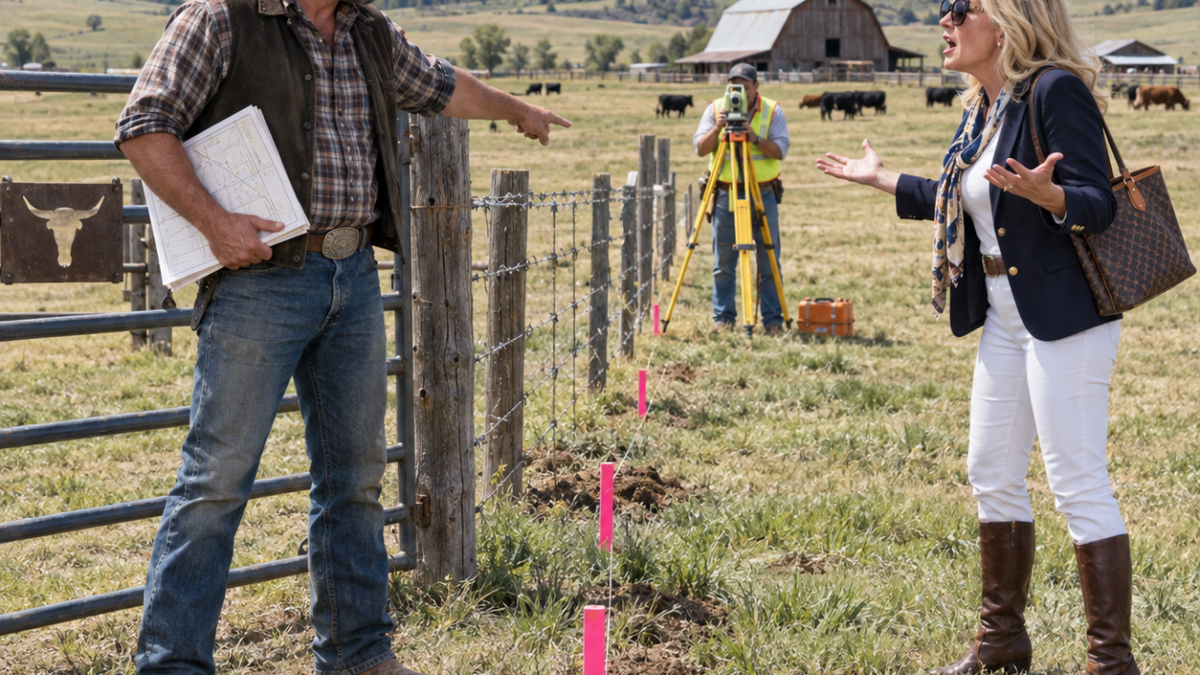
The morning I found a brand-new chain-link fence slicing across the richest hundred acres of my ranch, my Angus herd was packed against the upper pasture while the only year-round creek on the property flowed uselessly behind a gate I had never authorized. Karen Miller, president of the neighboring HOA, stood beside a ridiculous PROTECTED WETLAND PRESERVE sign and calmly informed me that my deed was “only a suggestion” because her board had decided the pasture now belonged under community environmental control. What she didn’t know was that I had spent twenty-two years with the Army Corps of Engineers reading plats, easements, surveys, and bad plans—and the first document I pulled from my closing file told me Karen had just spent thousands of her neighbors’ money fencing off land almost a football field inside my property.
“You’re trespassing.”
Karen smiled.
“No, Major Callahan. I’m preserving.”
Behind her, two contractors were packing a post-hole digger into a trailer.
Fresh concrete surrounded steel posts that ran across my lower pasture.
The fence wasn’t temporary.
Someone had planned this.
Purchased materials.
Hired labor.
Dug holes.
Set posts.
Strung hundreds of yards of chain-link.
And somehow nobody had thought to call the man whose cattle grazed there.
I looked toward the herd.
Forty-eight registered Angus cows and calves stood crowded on the dry upper section, bawling toward the creek.
My daughter Lily’s favorite heifer, Maple, paced beside the old gate.
“That pasture is where my cattle graze.”
Karen glanced at them.
“Livestock access is precisely why intervention became necessary.”
“What intervention?”
“The board designated this a protected green zone.”
“It’s a cattle pasture.”
“It contains riparian habitat.”
“It contains a creek.”
She tapped her clipboard.
“The Architectural and Environmental Committee has authority over undeveloped land adjacent to Willow Creek.”
“My ranch isn’t undeveloped community land.”
“It borders our neighborhood.”
“So does the county road.”
Her smile vanished.
“You signed HOA documents when you purchased.”
“One acre.”
That made her pause.
When Sarah and I bought Heritage Ranch six months earlier, the title work revealed one oddity.
The farmhouse sat on an old one-acre parcel that had once been carved from the ranch and later recombined for ownership purposes, but its recorded covenants still tied that single acre to the Estates at Willow Creek.
I paid four hundred dollars in annual HOA dues for the house parcel.
Annoying.
Manageable.
The other 499 acres?
Not HOA property.
Not HOA common area.
Not subject to Karen’s mailbox-color kingdom.
She knew that.
Or she should have.
Karen pointed toward the creek.
“The board’s green-space amendment gives us authority to protect environmentally sensitive adjacent parcels.”
“Show me the environmental study.”
“The board conducted a review.”
“Show me the wetlands determination.”
“It isn’t necessary for you to understand every technical aspect.”
That almost made me laugh.
Twenty-two years in the Corps of Engineers had given me many flaws.
Difficulty understanding maps was not one of them.
I walked to the fence.
The sign was zip-tied to the mesh.
A clip-art duck floated above green letters.
**WILLOW CREEK PROTECTED WETLAND PRESERVE
NO LIVESTOCK — NO VEHICLES — NO TRESPASSING**
My pasture.
My creek.
And apparently I was now trespassing.
“Who built this?”
Karen folded her arms.
“K&G Rural Solutions.”
“Who authorized them?”
“The board.”
“Permit?”
“They’re an approved HOA contractor.”
“That’s not what I asked.”
Her jaw tightened.
“You should worry less about paperwork and more about complying.”
I looked at the fresh post holes.
Then toward the subdivision beyond the trees.
“How much did this cost?”
“That’s HOA business.”
“Did residents pay for it?”
“You are not entitled to association financial records for matters outside your membership class.”
Interesting answer.
Not no.
I took out my phone.
Photographed the fence.
The sign.
The contractors.
Karen.
She immediately raised the clipboard.
“I do not consent to being recorded.”
“I’m documenting a structure on my ranch.”
“This is a protected preserve now.”
“No.”
I slipped the phone into my pocket.
“This is evidence now.”
For the first time, something changed in her face.
Not fear.
Not yet.
Uncertainty.
I opened the old pasture gate and looked toward my cattle.
Without creek access, I had maybe a day before I needed emergency water tanks.
Without the lower grass, I would start buying hay almost immediately.
Karen had not built an ugly fence.
She had interfered with a working ranch.
With animals.
With water.
With my family’s income.
I turned toward her.
“You have seventy-two hours to remove every post.”
She laughed.
“Or what?”
I looked past her at one hundred acres I had spent my military pension and life savings buying.
“Then we stop discussing whether you crossed the line.”
I pointed toward the pasture.
“And start proving exactly where it is.”
PART 2
Karen left in her golf cart fifteen minutes later.
She didn’t hurry.
That was what irritated me most.
People who know they have done something wrong usually look over their shoulder.
Karen drove away like a woman leaving a successful ribbon-cutting ceremony.
The contractors were less comfortable.
Their foreman, a broad-shouldered man named Rick, remained beside the trailer after Karen disappeared over the rise.
“You own all this?”
“All the way to the county road.”
He looked toward the fence.
“She told us this was HOA conservation land.”
“It isn’t.”
Rick rubbed the back of his neck.
“We got a work order.”
“I’m not blaming you yet.”
“Yet?”
“Who gave you the boundary?”
“Her.”
“Survey?”
“She had a site map.”
“Licensed?”
He hesitated.
“Looked like a subdivision map.”
I nodded.
“Do me a favor.”
“What?”
“Preserve every email, text, drawing, and work order connected to this job.”
His face changed.
“You suing us?”
“I’m telling you not to lose evidence.”
That answer was enough.
He called his crew over.
They left.
I walked the fence alone.
It crossed the lower pasture from east to west, isolating roughly a hundred acres of the best grazing land on Heritage Ranch.
The creek ran through nearly the entire fenced portion before bending south.
Karen had effectively taken the only reliable surface water source available to that herd during summer.
Our wells served the house and barn.
They were not designed to water nearly fifty cattle indefinitely.
I called my surveyor before I called my lawyer.
Tom Hendricks answered with, “If this is about a mailbox, I’m hanging up.”
“Someone fenced off a hundred acres.”
Silence.
“Whose hundred acres?”
“Mine.”
Longer silence.
“Who?”
“Willow Creek HOA.”
Tom began laughing.
Not because it was funny.
Because apparently surveyors respond to absurd property disputes the same way doctors respond to people who swallow batteries.
“She put a fence where?”
“Lower pasture.”
“Near the creek?”
“Across it.”
“That land has been Heritage Ranch since before there was a Willow Creek.”
“I know.”
“Jack, I surveyed the subdivision when half those houses were still soybean fields.”
“I need a fresh certified boundary survey.”
“You already have one from closing.”
“I want current stakes, photographs, measurements, and a report written for someone wearing a robe.”
Tom stopped laughing.
“I’ll be there at seven tomorrow.”
Then I called our veterinarian.
Stress plus limited water access could become an animal-welfare problem quickly.
We moved temporary tanks into the upper pasture using the ranch truck and a stock trailer.
Lily helped connect hoses.
She was fourteen and had inherited Sarah’s ability to ask questions at exactly the moment I didn’t want them.
“Why can’t we just cut the fence?”
“Because we’re documenting it first.”
“But it’s ours.”
“Yes.”
“So we can cut it.”
“Probably.”
She frowned.
“Probably?”
“Ownership and good strategy aren’t always the same thing.”
“That sounds like lawyer language.”
“I haven’t called the lawyer yet.”
“Mom says you become a lawyer whenever you’re angry.”
Sarah, standing beside the water tank, smiled.
“I said he becomes paperwork.”
I tightened a fitting.
“Very supportive family.”
Lily looked toward the cattle.
“Is Maple okay?”
“She will be.”
That was the moment the situation stopped feeling like an abstract boundary dispute.
Maple was a two-year-old heifer Lily had bottle-fed after her mother rejected her.
Technically, she was just another animal in the herd.
To Lily, she was half pet, half agricultural business partner.
Karen’s fence had put the animals in a preventable stress situation.
That mattered.
At dinner, Sarah asked the question I knew was coming.
“How bad financially?”
“If the fence stays?”
“Yes.”
“Hay alone could run several thousand dollars a month depending on conditions.”
Her eyes widened.
“The creek?”
“I can haul and pump water short term.”
“Long term?”
“Not realistic.”
“And if we lose weight on cattle?”
“More.”
Sarah went quiet.
We had put almost everything into the ranch.
My military pension gave us stability.
But the operation itself had to work.
We didn’t have suburban-money margins.
A bad drought year could hurt.
Feed prices mattered.
Veterinary costs mattered.
Losing a hundred acres of productive pasture because Karen Miller liked the phrase environmental preserve was not petty.
It was existential.
“What do we do?” Sarah asked.
“First, prove the line.”
“And after?”
“Prove she knew it.”
That night I pulled every document from closing.
Title commitment.
Recorded deed.
Survey.
Parcel descriptions.
Subdivision plat.
HOA declaration.
The one-acre farmhouse parcel was indeed subject to Willow Creek’s covenants.
The other 499 acres were explicitly excluded.
A twenty-foot utility easement ran between one edge of the subdivision and part of my pasture.
Karen’s fence was not just slightly wrong.
It was grotesquely wrong.
At the deepest point, Tom’s preliminary measurement the next day placed it approximately ninety-eight yards inside my deeded boundary.
Lily watched him drive a pink-flagged stake.
“That far?”
Tom nodded.
“Your dad could build another football field between the property line and that fence.”
“Don’t give him ideas.”
Tom’s crew spent six hours working.
Total station.
GNSS.
Iron monument verification.
Deed calls.
Subdivision plat comparison.
The line never came close to Karen’s preserve.
When they finished, the pasture looked like it had been decorated by someone obsessed with fluorescent pink.
Tom handed me his preliminary notes.
“Zero ambiguity.”
“Good.”
“No boundary conflict.”
“Better.”
“The utility easement actually makes this worse for them.”
“How?”
“They crossed it without coordinating with the utility holder.”
I closed my eyes.
“Of course they did.”
“You want advice?”
“Always.”
“Don’t touch the fence until counsel sees everything.”
“I know.”
“You have the face.”
“Everyone keeps saying that.”
“What face?”
Sarah asked.
Tom pointed at me.
“That one.”
I ignored both of them.
The formal survey came forty-eight hours later.
I attached it to my first demand.
Seventy-two hours.
Remove fence.
Restore disturbed ground.
Provide contractor and insurance information.
Reimburse emergency water and feed expenses.
Withdraw all HOA violations purporting to regulate the 499 non-HOA acres.
Preserve all records.
I sent copies to Karen, every director, the property management company, and K&G Rural Solutions.
Certified mail.
Email.
Return receipts.
Karen signed hers.
Nothing happened.
Instead, a teenager in a golf cart delivered four violation notices to my farmhouse.
One for the John Deere tractor beside the barn.
One for “excessive agricultural dust.”
One for the weathered cypress siding on the barn.
One for keeping chickens.
I stared at the pile.
Sarah came behind me.
“Is that the barn she wants repainted?”
“Yes.”
“The barn built in 1919?”
“Approximately.”
“What color does she want?”
“Approved taupe.”
Sarah took the paper.
“No.”
I looked at her.
“No?”
“No.”
She tore nothing.
Threatened nobody.
Just handed the notice back.
“My grandmother had curtains that color. We are not painting a Texas barn taupe.”
Marriage contains moments when you remember why you chose someone.
That was one.
I kept every notice.
Plastic sleeves.
Dates.
Delivery method.
Relevant covenant section.
Most of them referenced HOA rules that applied only to the one-acre house parcel.
The barn sat outside it.
The tractor sat outside it.
The chicken coop sat outside it.
Karen was expanding authority by repetition.
If she wrote it enough times, maybe people would assume it was true.
Then I found the green-space amendment.
Three years earlier, the board had adopted language allowing the Architectural Control Committee to identify undeveloped adjacent land as “environmentally significant buffer space.”
Broad.
Vague.
Concerning.
But even broad HOA rules generally bind property subject to the declaration—not random neighboring land.
And there was another issue.
The amendment procedures in Willow Creek’s own bylaws required thirty days’ notice and approval by two-thirds of the membership for material covenant changes.
The meeting minutes showed five board members present.
No membership vote.
No notice record.
Karen and four directors had apparently adopted it among themselves.
I called the county clerk.
Then the management company.
Then searched recorded instruments.
No properly recorded amendment binding my ranch appeared.
That was enough for me.
Now I called Jessica Riley.
Jess had been a Marine JAG before moving into private practice.
We had met during a Corps construction dispute years earlier when a subcontractor thought forged change orders were an innovative accounting method.
She answered:
“Jack Callahan.”
“Jessica.”
“You sound angry.”
“Why does everyone say that?”
“Because when you’re happy you talk too much.”
I told her everything.
She was silent for nearly a minute.
“Send me documents.”
“I already did.”
“You emailed before calling?”
“Yes.”
“Retirement has not improved you.”
Within an hour, she called back.
“The good news is this is ridiculous.”
“Bad news?”
“It can still get expensive.”
“Of course.”
“The HOA’s jurisdiction over the one-acre parcel does not magically spread over the ranch because someone wrote ‘adjacent green space’ into an amendment.”
“Agreed.”
“I want the amendment history, full declaration, title policy, survey, contractor records, and all communications.”
“Working on it.”
“And Jack?”
“Yes?”
“Do not describe this as criminal trespass in letters unless facts support the statutory elements.”
“I cited trespass.”
“Civil trespass is enough for now.”
“Fine.”
“You’re disappointed.”
“A little.”
“This is why people hire lawyers.”
Jess prepared the lawsuit.
But she did not file immediately.
First came another demand from counsel.
More formal.
Less emotional.
Ten days to remove the fence and suspend enforcement outside the covered parcel.
Karen’s response came through the HOA’s attorney, Andrew Pearson.
The letter claimed the board had “equitable environmental authority” over property materially affecting Willow Creek’s community character.
Jess called me.
“I haven’t laughed this hard since law school.”
“Is equitable environmental authority a thing?”
“Not in the magical way they’re using it.”
Their compromise was worse.
They offered to give me supervised livestock access to my pasture twice daily if I:
Paid half the fence cost.
Acknowledged the preserve designation.
Withdrew my complaints.
Agreed that future land-use activities within five hundred feet of Willow Creek would be reviewed by the HOA.
Sarah read it over my shoulder.
“They’re offering us permission to feed our cows on our own ranch.”
“Yes.”
“Should I bake them something?”
“No.”
“What about cookies shaped like middle fingers?”
“Still no.”
Lily looked up from homework.
“I can make those.”
“No one is making hostile cookies.”
Jess rejected the offer.
Then we filed.
Declaratory judgment.
Injunction.
Civil trespass.
Property damage.
Interference with ranch operations.
Claims challenging the fines and the invalid amendment.
Actual damages to be proved.
We sought temporary relief to stop further HOA enforcement and prevent additional work while the case proceeded.
Jess did not ask the court to award fantasy punitive damages on day one.
She asked for what could actually be supported.
That difference mattered.
While the lawsuit moved, I started talking to residents.
Not because I wanted a rebellion.
Because Jessica said something I couldn’t forget:
“Karen’s strongest asset isn’t the covenant book. It’s everybody assuming they’re alone.”
The first person I visited was David Moore.
Retired mechanical engineer.
His property bordered the stolen pasture.
He listened, then showed me the five-hundred-dollar special assessment every Willow Creek household had received.
**WETLAND PRESERVATION FUND.**
I stared.
“They charged you for my fence?”
“Apparently.”
“One hundred fifty homes?”
“Roughly.”
“That’s seventy-five thousand dollars.”
“Yes.”
“The fence didn’t cost seventy-five thousand.”
“I assumed they were doing habitat work.”
“Did you vote?”
David laughed.
“We don’t vote anymore.”
That sentence carried weight.
He explained Karen had begun classifying many expenses as emergency environmental or aesthetic actions.
Board approval.
No member vote.
Question her?
Inspections appeared.
Grass height.
Driveway stains.
Basketball hoops.
Trash cans.
“Everyone knows,” David said.
“Knows what?”
“Don’t challenge Karen unless you want a new hobby.”
Then he told me about the Brooks family.
Their son Evan used a wheelchair.
They requested a small access ramp at the front entrance.
The board delayed.
Requested redesigns.
Rejected materials.
Objected to appearance.
The family eventually hired counsel and obtained approval, but only after months of conflict and expense.
They sold their house afterward.
“They said they couldn’t stand living here anymore.”
That bothered me more than the fence.
There are legitimate design questions for accessibility projects.
Drainage.
Setbacks.
Safety.
But when rules become obstacles to basic dignity, something has gone wrong.
I contacted the Brooks family carefully.
They were reluctant.
Then Sarah Brooks called me.
Not my wife Sarah.
Different Sarah.
She said:
“We don’t want to relive it.”
“I understand.”
“But if she’s doing it to others, I’ll tell people what happened.”
That became important later.
More doors.
More stories.
Wind chimes.
Vegetable gardens.
Solar panels.
Basketball hoops.
Political signs.
Holiday displays.
Some residents had legitimate violations.
I didn’t pretend otherwise.
One man complained Karen fined him for leaving a boat trailer blocking half the sidewalk for six months.
I told him:
“She may have been right.”
He didn’t become an ally.
That was fine.
Truth works better when you do not recruit every grievance.
Mr. Abernathy became my most valuable ally.
Eighty-eight years old.
Family had owned much of the area before developers arrived.
His father’s hand-drawn 1952 ranch map showed the original tract.
The lower pasture.
Abernathy Creek.
Not Willow Creek.
He looked offended by the subdivision name.
“Ain’t a willow tree within three miles.”
“Marketing.”
“Lying.”
“Close cousins.”
His map did not replace a modern survey.
But it supported the land’s historical continuity.
More important, Mr. Abernathy knew the community.
Planning commissioners.
Retired county staff.
Former developers.
People who remembered exactly where Heritage Ranch ended.
“You’re not from here,” he said.
“I live here.”
“You know what I mean.”
“I do.”
“Karen’s been telling people you’re some outsider who wants to destroy the neighborhood.”
“I want my cows to drink.”
“She knows.”
He handed me the old map.
“Take this.”
“I’ll copy it.”
“No. Take it.”
“This belongs to your family.”
He stared.
“So does the creek. Doesn’t stop people renaming things.”
I eventually accepted.
The real turning point came from David.
He sent a reasonable email to the HOA.
No accusations.
He asked for:
Environmental study supporting wetland designation.
Fence bids.
Meeting minutes.
Assessment authorization.
Budget accounting.
Karen responded to the entire community.
Her email accused “a small group of malcontents” of spreading misinformation.
Then she added:
**Continued attempts to undermine board authority may constitute conduct detrimental to the association and may be subject to enforcement action.**
That email did more for our side than anything I could have written.
People called.
“Can she fine us for asking questions?”
“Can she punish emails?”
“Where did the seventy-five thousand go?”
One woman said:
“I didn’t care about your cows before. Now I care.”
Fair.
The community meeting took place at the public library, not HOA property.
Fifty-three households attended.
Mr. Abernathy sat beside me.
Sarah and Lily in the front row.
I displayed the survey.
My deed.
The one-acre HOA parcel.
The 499-acre exclusion.
The green-space amendment.
The missing member vote.
Then photographs of the fence ninety-eight yards inside my ranch.
No speeches about war.
No accusations of theft.
Just evidence.
Then residents spoke.
David.
Wind chimes.
Vegetable garden.
Solar panels.
A retired teacher cited because her grandchildren’s chalk drawings remained on her driveway overnight.
Some stories were ridiculous.
Some painful.
Then Sarah Brooks entered from the back.
People recognized her.
She and her husband had moved months earlier.
She had driven almost two hours.
“My son’s name is Evan.”
Her voice shook.
“He uses a wheelchair.”
The room quieted.
“We asked permission for a ramp.”
She explained delays.
Rejections.
Karen suggesting a rear entrance instead because a front ramp would affect “architectural symmetry.”
Sarah Brooks paused.
“You know what that meant?”
Nobody answered.
“It meant my son should enter his own house through the back because seeing his ramp made someone uncomfortable.”
Even Karen’s strongest defenders would have struggled with that.
“I don’t know whether every decision they made violated a law,” she continued. “That’s for lawyers.”
Good.
Realistic.
“But I know how they made us feel.”
She looked around.
“Like our son was the violation.”
Silence.
That changed the room.
By the end, residents were not chanting my name.
Thank God.
They were signing records requests.
Recall petitions.
Audit requests.
That was far more useful.
Jessica filed our motion for preliminary injunctive relief.
The county became interested after regional media reported on the dispute.
Not because reporters magically make government care.
Because public records requests and calls often move a neglected file up the queue.
A county inspector visited.
He checked the fence.
Utility easement.
Permit requirements.
He found several problems.
Part of the fence crossed the utility corridor.
The contractor lacked required local approval for that segment.
A stop-work and correction notice followed.
Karen now had legal pressure from two directions.
Then discovery began.
And discovery is where confident organizations often discover how poorly they document confidence.
The HOA produced records.
Eventually.
Invoices.
Emails.
Bank statements.
Board minutes.
Assessment records.
K&G Rural Solutions appeared repeatedly.
Fence project invoice:
$41,800.
Additional “habitat preparation”:
$12,600.
Administrative environmental consulting:
$9,400.
No biological wetland study.
No hydrologist.
No environmental engineer.
No agency wetlands determination.
Just a landscaping memo prepared by the HOA architectural committee.
The preserved wetland was invented.
Then Jessica searched K&G.
Owner:
Gary Miller.
Karen’s brother-in-law.
Of course.
Still, family relationship alone was not corruption.
The key questions:
Was it disclosed?
Were bids required?
Was pricing reasonable?
Were services delivered?
The procurement policy required multiple bids over $15,000 absent an emergency.
No competing bids appeared.
Minutes showed no conflict disclosure.
Karen signed the contract.
Treasurer Helen Marsh counter-signed payments.
And the seventy-five-thousand-dollar fund?
Not all spent.
About twenty-two thousand remained in a separate reserve account.
So the source’s dramatic “missing money” was more complicated.
Some money remained.
Some expenses were legitimate.
Some appeared inflated.
That distinction mattered.
Jessica told residents:
“Do not accuse people of embezzlement based on incomplete accounting.”
David looked disappointed.
“You think nothing happened?”
“I think something happened.”
Jess tapped the records.
“I also think accuracy matters more than anger.”
The independent forensic accountant we later hired found several related-party payments requiring further explanation.
Not just K&G.
Consulting.
Event expenses.
Landscaping work at HOA common property.
Some vendors connected socially or by family to board members.
Potential conflicts.
Potential overbilling.
Enough for serious civil claims and eventually referral to law enforcement.
Not enough for us to invent crimes.
Karen’s deposition became the moment everything changed.
She arrived in a navy suit.
No floral pantsuit.
No clipboard.
Her lawyer sat beside her.
Jessica remained almost friendly.
That made her more dangerous.
“Mrs. Miller, what study established Mr. Callahan’s pasture as wetland?”
“We observed ecological characteristics.”
“Who is ‘we’?”
“The committee.”
“Names?”
Karen listed three board members.
“Any qualified wetland scientist?”
“No.”
“Engineer?”
“No.”
“Biologist?”
“No.”
“Hydrologist?”
“No.”
“Did you contact the Army Corps?”
Karen looked at me.
I did not react.
“No.”
“Environmental agency?”
“No.”
“Water district?”
“No.”
“So the HOA itself declared the land a protected wetland?”
“We have authority to designate green spaces.”
“Land it owns?”
“Adjacent land affecting the community.”
“Where does the declaration grant you authority over property not subject to it?”
Karen’s lawyer objected.
Jessica moved on.
Then:
“K&G Rural Solutions.”
Karen’s jaw tightened.
“Qualified contractor.”
“Owned by your brother-in-law?”
“Yes.”
“Disclosed in board minutes?”
“I told people.”
“Where?”
“I don’t remember.”
“Any competitive bids?”
“It was urgent.”
“What was the emergency?”
“Environmental degradation.”
Jessica slid a photograph across.
My cows grazing.
Before the fence.
“Describe the degradation.”
“Livestock near the creek.”
“Had any government agency cited Mr. Callahan?”
“No.”
“Any water-quality violation?”
“I don’t know.”
“You had no report?”
“No.”
Jessica let silence work.
Then came the Brooks ramp.
This was not directly part of my property case.
But it related to pattern and board governance issues raised in residents’ claims.
Jessica asked:
“Did you oppose their front ramp?”
“I opposed the first design.”
“Why?”
“It did not harmonize with community architecture.”
“Did you suggest rear access?”
“As an alternative.”
“Why?”
“It would be less visually intrusive.”
That was the moment Karen should have stopped.
Instead she became angry.
“They bought in a community with standards.”
Jessica did nothing.
Karen continued.
“I spent years protecting that neighborhood from people who think every personal preference should override everyone else.”
Her attorney touched her arm.
She shook him off.
“If we allowed every ramp, every vegetable garden, every commercial truck, every ugly solar panel—”
Jessica interrupted softly.
“Every ramp?”
Karen froze.
The room changed.
Her lawyer requested a break.
The video already existed.
That clip never needed dramatic editing.
It showed the problem.
Karen saw individual needs as threats to her vision of uniformity.
The preliminary injunction hearing came first.
Not the final case.
Judge Ellen Emery reviewed the deed, surveys, amendment procedures, and current impacts on ranch operations.
She did not announce that Karen was a disgrace.
Real judges usually do not perform for television.
She asked precise questions.
“Counsel for the association, identify the recorded instrument that subjects the lower pasture to the declaration.”
Their lawyer could not.
“Identify governmental authority recognizing the wetlands designation.”
None.
“Explain the amendment vote.”
He argued board authority.
Judge Emery read the bylaws.
“Two-thirds membership approval appears required.”
He argued interpretation.
She was unconvinced.
The court granted temporary relief.
HOA enforcement against my 499 non-HOA acres was suspended pending final resolution.
The association was prohibited from expanding the fence or interfering further with ranch operations.
And because the fence blocked livestock from a critical water source on land we had shown a strong likelihood of proving was mine, the judge ordered access restored immediately.
Not full fence removal yet.
A gate opening and sufficient removal to allow cattle passage.
The final boundary and damages issues remained.
That order alone felt like oxygen.
We opened a forty-foot section under sheriff standby because tempers were high.
The cattle went through.
Maple first.
Lily stood beside me.
“She remembers.”
“She sees grass.”
“She remembers.”
“Fine.”
The herd moved down.
Cows ran toward the creek.
Calves followed.
Water splashed.
Sarah grabbed my arm.
For weeks, I had been focused on deeds and motions.
Then I watched cattle drink from our own creek again.
My throat tightened.
Sarah whispered:
“That’s why we’re doing this.”
Not Karen.
Not revenge.
This.
Our family’s livelihood.
A dream we had saved decades to afford.
The HOA special meeting occurred ten days later.
Proper petition.
Proper notice.
Independent parliamentarian.
Paper ballots.
No improvised revolution.
Karen defended her record.
She said residents were being manipulated by me.
That outsiders were attacking Willow Creek.
That standards protected investments.
Some residents agreed with parts of that.
That mattered.
She had supporters.
People who remembered her organizing storm debris removal.
Negotiating pool contracts.
Enforcing genuinely useful maintenance standards.
Then David spoke.
“This isn’t about whether neighborhoods need rules.”
He held up the special assessment.
“It’s about whether one president can spend seventy-five thousand dollars and threaten homeowners for asking where it went.”
Helen Marsh, the treasurer, stood.
Everyone turned.
Karen looked terrified.
Helen had said almost nothing publicly.
“I signed payments.”
Her voice trembled.
“I trusted Karen’s representations that procurement requirements had been met.”
Karen interrupted.
“Helen.”
Helen continued.
“I should have verified.”
Silence.
“I did not.”
That was accountability.
The opposite of Karen.
Helen looked toward residents.
“I’m resigning tonight regardless of the vote.”
Then Karen took the microphone.
“You all benefited from everything I did.”
A woman called:
“We didn’t benefit from your brother-in-law’s fence.”
Noise rose.
Karen struck the table.
“You think any of you could run this association?”
David answered:
“That’s why boards have more than one person.”
The recall vote removed Karen.
Sixty-eight percent.
Not 99%.
Not unanimous.
Some residents believed the process had become too personal.
Some genuinely supported her.
But enough wanted change.
The remaining board members either resigned or stayed temporarily under independent management until an election.
David eventually became president.
Reluctantly.
Jessica’s favorite kind.
The civil case continued after Karen’s removal.
The HOA’s new board wanted settlement.
I wanted the entire fence gone.
They agreed.
Insurance covered portions of the property-damage claim.
The HOA reserve paid others.
The board pursued K&G and former decision-makers separately where counsel found grounds.
The fence was removed professionally.
No television skid-steer spectacle.
I considered doing it myself.
Jessica said:
“Absolutely not.”
“Why?”
“Because it’s evidence.”
“The case is settling.”
“Still no.”
“I own a skid steer.”
“That sentence is exactly why I’m saying no.”
So K&G’s insurer funded a bonded contractor.
I watched from horseback with Lily.
The first post came out.
Then another.
Then another.
No cheering crowd.
Just machinery.
Steel.
Concrete.
Dirt.
At the last post, the foreman walked over.
“Want the sign?”
The stupid duck sign.
I stared.
Lily said, “Keep it.”
“For what?”
“Barn.”
“No.”
“Please.”
Sarah sided with her.
Traitors.
The PROTECTED WETLAND PRESERVE sign still hangs in my barn today.
Under it Lily later added a hand-painted sign:
**ACTUAL COW PASTURE.**
I lost that vote.
Once the fence disappeared, the ground remained scarred.
Hundreds of post holes.
Compaction.
Ruts.
The ranch settlement paid for remediation.
We reseeded.
Repaired creek-bank disturbance.
Re-established grazing rotation.
The pasture healed faster than I did.
Financially, we recovered hay costs, temporary water expenses, survey costs, reasonable legal fees under the negotiated settlement, and documented pasture-restoration damages.
No jackpot.
No cartoon punitive award.
Enough to make us whole.
That was better.
Then came the financial investigation.
The new HOA board commissioned an independent audit.
That audit confirmed governance failures.
Undisclosed related-party contracting.
Procurement violations.
Poor financial controls.
Improper classification of some personal or board-officer legal expenses.
Several questionable reimbursements.
But it did not uncover a secret mansion bought with HOA money.
Reality was less cinematic and more tedious.
Karen and Helen had access to the special account.
Records showed payments that investigators believed warranted referral.
Helen cooperated.
Karen fought.
The county District Attorney eventually brought charges related to misapplication of association funds and falsified business records tied to specific transactions, not every rumor residents had spread.
K&G also faced a civil action over pricing and disclosure.
Months later, Karen entered a plea agreement on reduced charges.
Restitution.
Probation.
Community service.
Restrictions on fiduciary management during probation.
No lifetime statewide ban from every HOA board.
No judge owns that magic wand.
But Willow Creek’s bylaws were amended to make anyone convicted of financial crimes involving an association ineligible for board service there.
Karen sold her house before sentencing.
Not seized.
Sold.
Legal fees.
Restitution.
And probably a desire to leave a neighborhood where every grocery-store encounter carried history.
The morning the moving truck arrived, I was replacing a gate near the creek.
Mr. Abernathy sat on the tailgate of my pickup drinking coffee.
“You going to watch?”
“Watch what?”
“Her leave.”
“No.”
“Liar.”
I smiled.
From the pasture ridge, we could see the roof of Karen’s house.
The truck came and went.
Her golf cart was loaded onto a trailer.
That amused me more than it should have.
Mr. Abernathy looked toward the land.
“You hate her?”
I thought about it.
“No.”
“Used to?”
“Probably.”
“That’s expensive.”
“What?”
“Hate.”
He sipped coffee.
“Costs too much time.”
He was right.
People talk about revenge as though satisfaction arrives the moment your opponent loses.
Mine had come much earlier.
Maple drinking from the creek.
Lily laughing when the cows ran downhill.
Sarah sleeping normally after weeks of worrying whether the ranch would survive the dispute.
Those were victories.
Karen’s downfall was consequence.
Different thing.
Willow Creek began changing almost immediately.
Not into chaos.
That’s what Karen had predicted.
The grass did not grow four feet tall overnight.
Property values did not collapse.
People did not paint houses neon purple just because she left.
The new board did something revolutionary.
They asked:
“What rules do we actually need?”
Road maintenance.
Pool operations.
Drainage.
Common-area landscaping.
Reasonable nuisance controls.
Architectural review where legally applicable.
Transparent procedures.
Appeals.
Records access.
Conflicts disclosed.
Competitive bids.
No “conduct unbecoming a resident” nonsense.
The community garden rule came back.
Vegetable beds returned.
Wind chimes reappeared.
Solar-panel policy was revised to comply with current law and practical standards.
And the Brooks family?
They did not move back.
That part mattered.
Some harm cannot be undone by apologizing.
David called them.
The new board sent a written apology.
Offered reimbursement of some association-imposed fees tied to the ramp dispute.
They accepted the apology.
Declined to return.
Sarah Brooks wrote:
**We’re glad the neighborhood changed. We needed to change neighborhoods.**
That sentence stayed with everyone.
Reform does not erase consequences.
Her son Evan eventually visited Willow Creek during a community accessibility project.
The new board installed an accessible entrance at the clubhouse.
No one called it ugly.
Lily graduated high school four years after we bought Heritage Ranch.
She wore boots under her graduation gown.
Of course.
Maple had become one of our best brood cows by then.
At Lily’s graduation party, Mr. Abernathy sat beneath a live oak drinking sweet tea and telling anyone who would listen that the creek had never been named Willow Creek.
“It’s Abernathy Creek.”
David said, “County map says Willow.”
“County’s wrong.”
“Survey?”
“I have one.”
Everyone laughed.
Tom Hendricks was there too.
Surveyors travel in packs when free brisket is involved.
He pointed toward the lower pasture.
“Still got my monuments?”
“Every one.”
“Good.”
Lily said, “Dad checks them.”
“I do not.”
Sarah raised an eyebrow.
“Monthly.”
“Quarterly.”
“Mark your calendars,” Lily said.
I ignored them.
After dinner, Mr. Abernathy walked with me toward the ridge.
He moved slower now.
Ninety-two.
Cane.
Still sharp.
We looked down at the cattle.
“That’s how it’s supposed to look.”
“What?”
“The pasture.”
Cows scattered in green grass.
Creek shining.
No chain-link.
No duck sign.
He sat on a stump.
“My daddy used to run Herefords down there.”
“How many?”
“Too many.”
“Good ranching tradition.”
“He would’ve liked you.”
I smiled.
“You told me that once.”
“I’m old. I repeat myself.”
Then he said:
“You know you don’t own any of this.”
I looked at him.
“That’s an interesting thing to tell someone after a three-year property dispute.”
He laughed.
“Paper says you own it.”
“Correct.”
“Bank says you own it.”
“Yes.”
“Court says you own it.”
“Yes.”
“Still temporary.”
I knew where he was going.
“You’re a caretaker.”
“That’s right.”
He pointed his cane toward the creek.
“My people had it.”
“Then others.”
“Now you.”
“Someday somebody else.”
“Exactly.”
He looked at me.
“The trick isn’t hanging on forever.”
“What is?”
“Leaving it better.”
That became more important than he knew.
Mr. Abernathy died the following winter.
He was ninety-three.
At his funeral, his daughter handed me the 1952 plat map he had loaned me.
“He wanted you to keep it.”
“I should give this to your family.”
“You are.”
I looked at her.
She smiled.
“His words.”
I framed the map.
It hangs in the ranch office now.
Not as legal evidence.
The modern survey is far better for that.
The hand-drawn map is history.
A reminder that land existed before our disputes and will exist after our names disappear from deeds.
The ranch grew.
Carefully.
We expanded the herd.
Improved water distribution so no single creek access point could ever cripple us again.
Installed backup tanks.
Cross-fencing.
Rotational grazing.
I learned something embarrassing from Karen’s attack.
She exposed a vulnerability in my operation.
Not one she had any right to exploit.
But still a vulnerability.
I had relied too heavily on one pasture and one water source.
Good planning means learning even from bad events.
I installed two solar pumps.
One new well.
Additional troughs.
Lily came home from college one summer and stared.
“Are we preparing for another HOA invasion?”
“No.”
“Looks like it.”
“We’re building resilience.”
“You mean revenge infrastructure.”
“That is not a term.”
“It is now.”
She studied agricultural business at Texas A&M.
Then range management.
I pretended not to be proud every time she corrected me.
She saw the ranch differently.
Not as a retirement project.
As a system.
Soil.
Genetics.
Water.
Markets.
Ecology.
People.
She eventually proposed restoring a section of actual wetland habitat near the creek.
I stared at her.
“You’re kidding.”
“No.”
“Did Karen put you up to this?”
“Dad.”
“I will not hang another duck sign.”
“Actual wetlands.”
She showed me maps.
A low area near an oxbow.
Seasonally saturated.
Native sedges.
Important habitat.
She had even talked to conservation specialists.
Legitimate ones.
I looked at Sarah.
Sarah smiled.
“Karma.”
“Don’t say that.”
We enrolled thirty acres in a voluntary conservation program.
Properly.
Our choice.
Agency guidance.
No HOA jurisdiction.
No chain-link stealing cattle water.
We fenced a small sensitive section with livestock crossings designed into the grazing plan.
The irony was impossible to ignore.
At the dedication of the habitat project, Lily brought the old duck sign from the barn.
I nearly disowned her.
She held it up.
“Can we use this?”
“No.”
Everyone laughed.
Instead we installed a modest sign:
**HERITAGE RANCH RIPARIAN RESTORATION AREA
PRIVATE WORKING LAND — CONSERVATION BY OWNER AGREEMENT**
Lily said:
“That is the most Dad sign ever created.”
I considered that a compliment.
Willow Creek residents were invited to one educational day.
Not because they had rights to the pasture.
Because we invited them.
That distinction mattered deeply to me.
Children came.
Families.
David, now HOA president.
Even Sarah Brooks drove down with Evan.
He was twenty by then.
Studying computer science.
Used a power chair.
The new trail we built for the event was compacted and accessible.
Not perfect.
But planned.
Evan stopped beside the creek.
“So this is the famous stolen pasture?”
“Temporarily fenced pasture.”
“My mom says stolen.”
“Your mother enjoys drama.”
Sarah Brooks laughed.
“She’s right here.”
I smiled.
Evan looked at the restoration area.
“Funny.”
“What?”
“Karen called it wetland when it wasn’t.”
“Yes.”
“And now you made part of it wetland.”
“Restored native riparian habitat.”
“Wetland.”
I sighed.
“Yes.”
He smiled.
“Did she win?”
“No.”
“Seems like she got what she wanted.”
“No.”
I pointed toward the grazing herd.
“She wanted control.”
Then toward the restoration area.
“This is stewardship.”
He nodded slowly.
“That’s different.”
Exactly.
Years after the lawsuit, I received a letter from Karen.
I recognized her handwriting from certified receipts.
I almost threw it away.
Sarah said:
“Open it.”
“Why?”
“Because if it’s terrible, we laugh.”
“Strong argument.”
Inside:
Jack,
I saw an article about Lily’s conservation project at Heritage Ranch.
The irony is not lost on me.
I have had years to think about Willow Creek and what I did there.
At the time, I believed I was protecting a community that no one else cared enough to manage.
I confused resistance with irresponsibility.
I also convinced myself that because the board had voted, our decisions were legitimate.
They were not.
The pasture was never ours.
I know that now.
I am sorry for the disruption to your ranch and to your family.
I am also sorry for what happened to the Brooks family.
I do not expect forgiveness.
Karen.
I placed the letter on the kitchen table.
Sarah read it.
“Well?”
I looked toward the ranch.
“She finally said pasture.”
“What?”
“Not preserve.”
Sarah smiled.
“Progress.”
I wrote back:
Karen,
I received your letter.
Thank you for acknowledging what happened.
The ranch is doing well.
Willow Creek is doing well too.
I hope you are well.
Jack.
Nothing more.
Forgiveness doesn’t require friendship.
It doesn’t always require forgetting.
Sometimes it means the other person’s name stops changing your pulse.
That happened slowly.
By my late sixties, Karen Miller had become a story more than an enemy.
By my seventies, she became almost a lesson.
The ranch became the real story.
Lily married a large-animal veterinarian named Caleb Morgan.
Their wedding took place under the live oaks.
Maple’s granddaughter somehow wandered into the background of several photographs.
Sarah said it improved them.
Eventually grandchildren arrived.
Two boys.
One girl.
My granddaughter Emma loved the creek.
At six, she asked:
“Grandpa, where did the bad fence go?”
“Removed.”
“Why?”
“It was on our land.”
“Why did they build it?”
“They thought they could.”
She considered that.
“Were they dumb?”
“Sometimes adults make bad decisions.”
“That means yes.”
I let that go.
At eight, she found the old PROTECTED WETLAND PRESERVE sign in the barn.
“Can I have it?”
“No.”
“Why?”
“Historical artifact.”
“You said it was stupid.”
“It can be both.”
She eventually convinced me to hang it beside Mr. Abernathy’s map.
My office became a museum of battles nobody needed to fight again.
I kept the original HOA fines too.
Tractor.
Dust.
Barn siding.
Chickens.
Every one rescinded.
Lily once asked why.
“Evidence.”
“For what?”
“That paperwork can be wrong.”
She nodded.
“Good lesson.”
I watched Willow Creek change through decades.
New presidents.
New families.
The association became boring.
That is one of the highest compliments I can give local governance.
Budgets came on time.
Meetings lasted ninety minutes.
Disputes happened.
Sometimes people got angry.
But decisions were recorded.
Conflicts disclosed.
People appealed.
No president had unilateral emergency power to invent conservation zones.
The HOA even dissolved its architectural committee and replaced it with a rotating review panel.
David served one term as president.
Then stepped down.
Voluntarily.
When people asked him to continue, he refused.
“Too much authority in one chair for too long is bad.”
Everyone knew where that lesson came from.
The farmhouse remained inside the HOA’s one-acre jurisdiction.
I continued paying dues.
That surprised people.
“Why don’t you sue to get out?”
Because the covenant legally applied.
That was the agreement.
Road maintenance benefited us.
Pool access remained irrelevant.
But contracts matter even when inconvenient.
That was part of the principle too.
I refused to become Karen in reverse.
I could not argue rules mattered when they protected my ranch and then ignore the ones properly attached to my house.
So I kept the trash cans where required.
Submitted roof color when we replaced shingles.
Occasionally attended meetings.
I even served six months on a road-maintenance committee after Sarah volunteered me without permission.
Traitor.
One evening after a meeting, David and I stood near the subdivision entrance.
“You know what’s funny?” he asked.
“What?”
“You’re probably the most rule-following person here.”
“I spent twenty-two years in the Army.”
“I know.”
“Rules are useful.”
“Karen loved rules.”
“No.”
He looked at me.
“She loved enforcement.”
That was the distinction.
Rules create predictable boundaries when they are legitimate.
Enforcement without legitimacy becomes control.
Mr. Abernathy had understood land.
Sarah understood people.
Lily understood systems.
I learned from all three.
Sarah developed arthritis as we aged.
Eventually she stopped helping with cattle.
Then garden work became harder.
We built raised beds near the porch.
I tried to make them waist-high.
She corrected my dimensions.
“You have a degree?”
“No.”
“Then stop revising my design.”
“I have twenty-two years of engineering experience.”
“This is basil.”
Fair.
We spent more evenings sitting.
Less working.
The ranch did not need us every minute anymore.
Lily and Caleb handled operations.
A foreman named Miguel Santos managed day-to-day cattle work.
I transitioned from owner-operator to elderly man giving unsolicited advice from a UTV.
Miguel called me “General.”
I reminded him I retired as a major.
He said:
“General sounds older.”
Disrespectful employee.
Excellent ranch manager.
On our fortieth wedding anniversary, Sarah and I drove to the lower pasture.
No cattle that week.
Rest cycle.
The creek ran clear.
Native grasses moved in wind.
The old fence line was invisible except if you knew where to look.
I stopped the UTV.
“This is where the first post was.”
Sarah nodded.
“You remember?”
“I remember everything.”
“That’s your problem.”
We sat.
Then she said:
“If Karen had won, would we have stayed?”
I thought.
“No.”
“Really?”
“If we’d lost permanent use of this pasture and the HOA gained control over the ranch, I would have sold.”
Sarah looked out.
“That close?”
“Yes.”
She slipped her hand into mine.
“Then I’m glad you fought.”
“You told me not to call it war.”
“I was younger.”
I laughed.
She looked toward the creek.
“You know what I’m most glad about?”
“What?”
“That the fight didn’t become the ranch.”
I understood.
For a few years, Heritage Ranch was known locally as the ranch that beat the HOA.
That faded.
Then it became known for Angus cattle.
Conservation work.
Youth agriculture days.
Good beef.
Lily’s range-management program.
Better things.
Pain should become history eventually.
Not identity.
Sarah died at seventy-eight.
Stroke.
Sudden.
One morning she was drinking coffee and complaining that Miguel planted flowers too close to the porch.
That night she was gone.
There are losses you prepare for.
Others split time into before and after.
For months, the ranch felt enormous.
Five hundred acres used to feel like freedom.
Without Sarah, some days it felt like distance.
Lily moved closer.
Not because I asked.
She knew better than to tell me it was for me.
My grandchildren appeared more often.
Miguel invented reasons for me to inspect fences.
Everyone conspired politely.
One evening, I drove to the creek.
Sat beneath a cottonwood.
I thought about selling.
For the first time.
A developer had offered more money than the ranch had any business being worth.
Growth had reached our road.
Willow Creek itself looked almost urban compared with when we arrived.
Five hundred acres near town was a fortune.
I called Lily.
“Come tomorrow.”
She arrived before breakfast.
I gave her the offer.
She read the number twice.
“Wow.”
“Yes.”
“You thinking about it?”
“Yes.”
She sat across from me.
“You want to sell?”
“I don’t know.”
“That wasn’t my question.”
Military daughters learn interrogation from professionals.
“I’m tired.”
“That’s different.”
“Maybe.”
She looked out the window.
“What did Mr. Abernathy say?”
I stared.
“Don’t.”
“You’re a caretaker for a little while.”
“Do not weaponize dead old men against me.”
She smiled.
Then turned serious.
“You don’t have to keep working it.”
“I know.”
“You don’t even have to live here forever.”
“I know.”
“But you also don’t have to sell because you’re grieving.”
That was Sarah speaking through her.
Annoying.
Accurate.
I rejected the development offer.
Instead, over the next two years, I transferred most operating ownership to Lily through an estate plan.
Conservation easements protected key habitat and agricultural use.
Not all land.
I wanted future flexibility.
But enough.
Heritage Ranch would remain a ranch.
The one-acre HOA parcel?
Still HOA.
Lily complained.
I said:
“Character building.”
She said:
“I’m petitioning annexation release the second you die.”
“Respect your elders.”
“No.”
My granddaughter Emma eventually studied civil engineering.
I blamed genetics.
At twenty-two, she interned with a surveying firm.
One Christmas, she gave me a framed modern survey of Heritage Ranch.
Pink line showing the correct boundary.
Below it:
**DEEDS ARE NOT SUGGESTIONS.**
I laughed until I cried.
“Your grandmother would’ve loved this.”
“I know.”
She pointed at a tiny green area on the map.
Actual restoration wetland.
“And I labeled the real one.”
“Get out.”
She hugged me.
Years later, when my health made ranch life impractical, I moved into a smaller house on a ten-acre corner Lily carved out for me under a life estate.
I could still see cattle.
Still smell rain on pasture.
Still hear coyotes.
Heritage Ranch continued without needing my hands.
That was harder than fighting Karen.
Releasing control always is.
One spring afternoon, Lily drove me to the lower pasture.
I was eighty-three.
Cane.
Oxygen only when walking far, which I denied needing despite medical evidence.
Maple was long gone.
So were several generations after her.
The herd grazing below carried the same bloodline.
We stopped by the creek.
Lily helped me out.
“Careful.”
“I know how to exit a truck.”
“You almost fell yesterday.”
“Tactical descent.”
“Dad.”
I stood on the grass.
No fence.
No scars.
The restoration area farther downstream buzzed with insects.
A great blue heron lifted from the creek.
I pointed.
“Duck sign was wrong species.”
Lily laughed.
“You’re still mad at clip art after thirty years.”
“Standards matter.”
We walked slowly.
At the old fence alignment, I stopped.
“How far inside?”
She knew.
“Ninety-eight yards at the deepest point.”
“Good.”
“You test me every time.”
“Training.”
She looked at me.
“Dad, do you regret any of it?”
“Buying the ranch?”
“Fighting.”
I considered.
“I regret how much I enjoyed beating her.”
Lily looked surprised.
“Really?”
“At first, I wanted land back.”
“That seems reasonable.”
“Then I wanted Karen crushed.”
She said nothing.
“That part wasn’t necessary.”
“But she did wrong things.”
“Yes.”
“She hurt people.”
“Yes.”
“She stole our pasture.”
“She tried.”
“So why regret it?”
“Because wanting accountability is useful.”
I leaned on the cane.
“Wanting suffering changes you.”
Lily looked toward the creek.
“Did it change you?”
“Almost.”
“What stopped it?”
“Your mother.”
She smiled.
Of course.
Sarah had spent our whole marriage saving me from becoming the most exhausting version of myself.
Lily slipped her arm through mine.
“What should I remember?”
“About the ranch?”
“About everything.”
I looked at the pasture.
The answer took time.
“Know your line.”
She frowned.
“Property line?”
“That too.”
I continued.
“Know what belongs to you. Know what doesn’t. Know what you’re responsible for. Know where your authority stops.”
She nodded.
“And when someone crosses yours?”
“Make them step back.”
“Politely?”
“If possible.”
“And if not?”
“Get a surveyor.”
She laughed.
That might have been the last lesson she needed from me.
Mr. Abernathy’s old 1952 map eventually went to the county historical society on long-term loan.
My framed deed stayed in the ranch office.
The duck sign stayed in the barn because my grandchildren refused to let me throw it away.
The actual preservation sign remained near the creek.
The community at Willow Creek continued.
Different people.
Different arguments.
Different board.
Karen became one paragraph in its institutional memory.
New presidents received an orientation packet.
Conflict disclosure.
Records rules.
Procurement thresholds.
Jurisdiction map.
And a page labeled:
**BOARD AUTHORITY DOES NOT EXTEND BEYOND ASSOCIATION PROPERTY OR COVENANT-BURDENED PARCELS.**
David once sent me a copy.
“Subtle.”
“I tried adding your picture.”
“Glad you didn’t.”
“Lily voted against me.”
“Good child.”
In my final years, I spent mornings on the porch.
The ranch stretched beyond what I could see from one chair.
Five hundred acres had once seemed enormous.
Then it became familiar.
Every hill.
Every oak.
Every fence.
Every low spot that held water after spring storms.
Land becomes smaller as memory fills it.
The lower pasture was no longer where Karen built the fence.
It was where Lily’s children learned to ride.
Where Sarah and I celebrated forty years.
Where actual conservation work restored native habitat.
Where Maple raised calves.
Where Mr. Abernathy taught me ownership was temporary.
That was how the story should end.
Not with a bulldozer ripping steel posts from dirt.
Not with Karen leaving in a moving van.
Those were scenes.
The ending was what remained when nobody cared about the conflict anymore.
Healthy cattle.
Clear water.
A daughter running the ranch.
Grandchildren arguing over gates.
Neighbors respecting boundaries.
A community that learned rules should protect people rather than make them afraid.
One evening, Emma brought her little boy to see me.
My great-grandson.
Four years old.
He climbed onto the porch wearing cowboy boots too large for him.
“Grandpa Jack?”
“Great-grandpa.”
“Grandpa Jack.”
I accepted defeat.
He carried something.
The old duck sign.
I stared at Emma.
“You took that out of the barn.”
“He found it.”
The boy held it up.
“What’s this?”
“A mistake.”
He frowned.
“Duck.”
“Yes.”
“Why mistake?”
Emma sat beside me.
I looked at the child.
How do you explain property law to a four-year-old?
I pointed toward the distant pasture.
“Somebody once put a fence where it didn’t belong.”
“Why?”
“They thought they were allowed.”
“Were they?”
“No.”
“What happened?”
“We moved it.”
He accepted that immediately.
Children understand boundaries better than adults sometimes.
“Can I keep duck?”
“No.”
His lip trembled.
Emma whispered:
“Pick your battles.”
Traitor.
“Fine.”
He hugged the sign.
“Mine.”
I laughed.
“Apparently.”
He ran toward the yard.
Emma watched him.
“You know he’ll probably hang it in his bedroom.”
“Family dignity is dead.”
She smiled.
Then looked toward the ranch.
“Mom says we should name the lower pasture.”
“It has a name.”
“What?”
“Lower pasture.”
“Creative.”
“It describes location.”
“She wants to call it Freedom Meadow.”
“Absolutely not.”
“What about Callahan Preserve?”
“No.”
“Karen Memorial Wetland?”
I stared at her.
She laughed so hard she nearly fell from the chair.
“No monuments to Karen.”
“Why?”
“Because she doesn’t own the story.”
Emma quieted.
That answer surprised both of us.
Karen had once occupied enormous space in our lives.
Eventually, she deserved none.
The ranch belonged to the people who cared for it.
The community belonged to residents who rebuilt it.
The lesson belonged to anyone willing to learn.
Karen was merely the person who forced the lesson into view.
At sunset, Emma’s boy returned carrying the duck sign under one arm and a toy tractor under the other.
He climbed onto my lap.
Heavy.
I pretended not to struggle.
“Show me cows.”
I pointed.
Black dots in the distance.
“There.”
“Those ours?”
The question hit me unexpectedly.
Ours.
Not mine.
I thought about Mr. Abernathy.
Temporary caretakers.
“Yes.”
“For how long?”
I smiled.
“As long as we take care of them.”
He seemed satisfied.
The sun dropped lower.
Light stretched over the hundred acres Karen once fenced off.
No metal.
No signs.
No argument.
Just grass.
Creek.
Cattle.
The earth itself had forgotten her.
That was the most complete reclamation I could imagine.
Karen once told me my deed was only a suggestion.
She was wrong about that.
A deed matters.
Surveys matter.
Courts matter.
Boundaries matter.
But Mr. Abernathy had been right too.
Ownership on paper is temporary.
What lasts is stewardship.
What you protect.
What you improve.
What you refuse to let somebody take.
And what you eventually hand to somebody else without needing to control it from beyond the grave.
I rested one hand on my great-grandson’s shoulder.
He pointed toward the creek.
“Can we go there tomorrow?”
“If your grandma takes us.”
“I can drive.”
“You’re four.”
“I have tractor.”
He held up the toy.
Excellent argument.
“We’ll discuss it.”
He leaned against me.
The evening cooled.
Somewhere near the barn, chickens argued.
A calf called for its mother.
Wind moved through the live oaks.
And for the first time in years, when I looked across the lower pasture, I did not remember a fence at all.
I saw only land.
Our land.
For now.
Exactly as it should be.
[END OF STORY]








