HOA Karen Dumped Pool Backwash Onto My Pasture for Two Years—Then a Soil Test Exposed What She’d Done
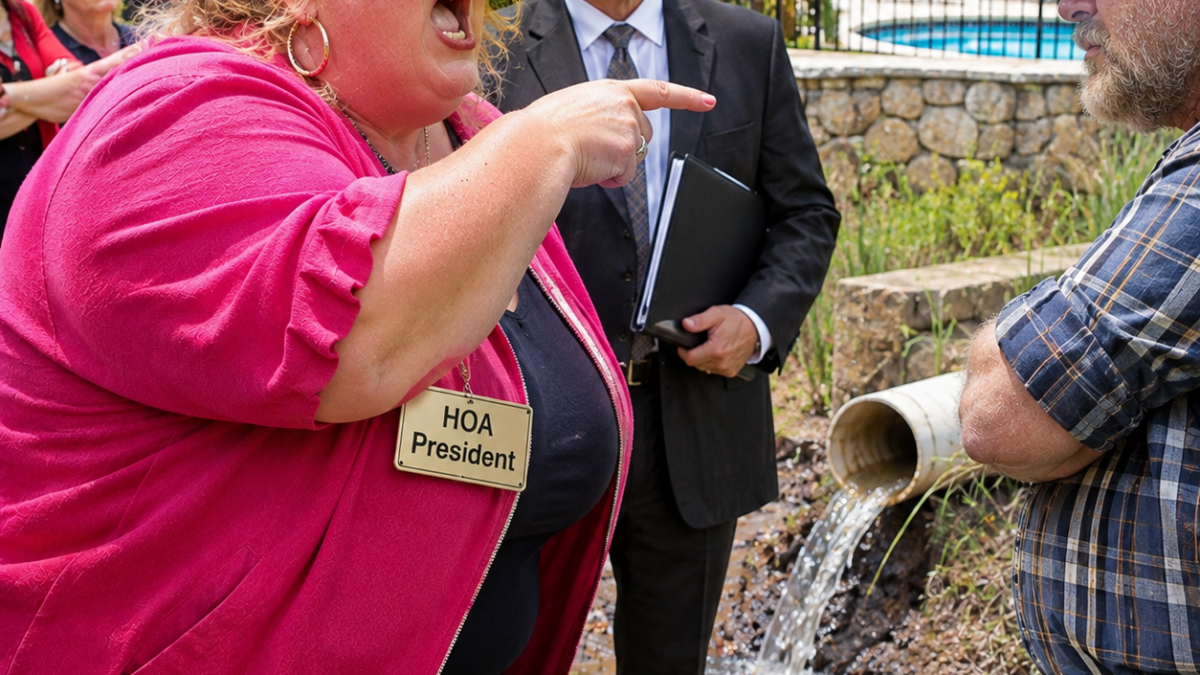
When I found a four-inch black pipe hidden beneath the fence pumping chemically treated pool water onto the five acres I had bought for retirement—and realized the dead, bleached fan of soil beside it had been growing for nearly two years—I knew the woman next door had not made a mistake; she had decided my land was the easiest place to dump a problem she did not want on her own property.
Karen Miller, president of the Eagles Landing HOA, looked at the ruined pasture, smelled the chlorine in the summer air, and still told me, “That’s just a little bit of water, Sergeant—your pathetic patch of weeds will be fine,” as though twenty years of Army pay, a future home for rescue horses, and the ground I had worked to protect were worth less than the convenience of keeping her pool crystal clear.
I walked away without threatening her, because the pipe under that fence had already told me something Karen had not—that this was bigger, older, and more deliberate than one ugly brown patch, and if I wanted the truth I would need to let her keep believing I was the kind of man she could dismiss.
My name is Marcus Thorne, and I had bought those five acres because I was tired of living by somebody else’s timetable.
For twenty years in the Army, logistics had been my life. Convoys, supply schedules, equipment, fuel, deadlines, contingencies—every problem had to be tracked because one overlooked detail could become everybody’s problem. Retirement was supposed to be quieter. I wanted pasture, an old shed, a workshop, and enough room to eventually bring home a couple of rescue horses.
Eagles Landing wrapped around three sides of my property, but my parcel predated the subdivision and was not part of its HOA. That suited me perfectly.
The trouble began with a brown spot near the rear fence.
At first I blamed fungus. Then insects. Then bad drainage. But the spot kept widening in a strange fan shape, green grass fading to yellow and finally to brittle tan. Even after rain, the soil felt crusted. When I knelt close, there was a sterile chemical smell I recognized immediately.
Chlorine.
I started clearing vines along the fence and found the pipe almost by accident.
Four inches wide. Black plastic. Its open end pushed under the lowest wire strand just far enough to cross onto my property.
The soil beneath it was soaked.
I followed the pipe visually through Karen’s hedge line until it disappeared toward the equipment beside her swimming pool.
I took out my phone.
Photographs first.
Then video.
Wide shot of the dead zone. Close-up of the pipe. Fence line. Karen’s house. Pool equipment visible through the shrubs.
That was when her patio door opened.
Karen crossed her lawn with her phone in one hand and irritation already written across her face.
“Can I help you?”
I pointed to the pipe.
“This yours?”
She looked down.
A tiny pause.
Then, “What about it?”
“It’s draining onto my property.”
“It’s water.”
“It smells like pool chemicals.”
She crossed her arms.
“You’re being dramatic.”
“Move the discharge back onto your side.”
Her eyes narrowed.
That was when she called my pasture weeds and told me it would be fine.
I didn’t argue.
I nodded once and went home.
Two trail cameras went up before sunset, each covering the pipe from a different angle. The next morning I collected soil from the damaged area and a healthy section a hundred yards away, labeled both samples, and sent them to the state university agricultural extension lab for comparative testing.
Then I opened a spiral notebook and started a log.
Two days later, one camera captured the first discharge.
At 2:17 p.m., water erupted from the pipe and poured onto my land for thirty-five straight minutes.
Three days later, it happened again.
Then four days after that.
A routine.
Not an accident.
While I waited for the lab report, I checked historical satellite images. The pale scar was faintly visible the year before I bought the place, and clearer the year before that.
I sat staring at the screen.
Karen had not started dumping pool backwash after I moved in.
She had inherited the habit of using that corner of land because nobody had stopped her.
Then the university email arrived.
I opened the attached PDF.
The first page made me sit completely still.
The numbers were bad enough that the technician had added a written note beneath the results—and the moment I read the phrase “consistent with repeated direct application of swimming pool discharge,” I knew I was no longer dealing with dead grass.
I was looking at evidence.
PART 2:
I printed the report before I finished reading it.
Twenty pages slid warm from the printer while I stood beside my desk with both hands pressed against the wood, forcing myself to slow down.
The contaminated sample and the control sample barely looked like they had come from the same property.
The healthy pasture had the kind of numbers you would expect from ordinary grazing land. The damaged area did not.
Its pH had climbed into a range hostile to most of the grasses growing naturally on my acreage. Salinity was extraordinarily high. The chemical analysis showed elevated chlorine compounds and cyanuric acid, the stabilizer commonly used in swimming pools.
Then came the line that mattered most.
The concentrations were consistent with repeated direct exposure to swimming-pool discharge and capable of producing severe plant damage, soil sterilization, and long-term inhibition of vegetation.
The technician’s preliminary recommendation was blunt.
Remove the contaminated topsoil.
Not aerate it.
Not fertilize it.
Not wait for rain.
Physically excavate twelve to eighteen inches of earth in the affected area, possibly deeper in the most concentrated zone, and replace it with clean soil.
I read that recommendation three times.
My pasture wasn’t sick.
Part of it was chemically ruined.
The future grazing area I had spent years planning for horses would have to be dug up and rebuilt.
I thought of Karen standing across the fence.
*A little bit of water.*
I picked up my notebook and wrote the date.
Then:
**University results received. Contamination confirmed.**
That was all.
Anger wants adjectives.
Evidence doesn’t need them.
The next morning, I assembled the first real version of what eventually became the binder.
Photographs.
Trail-camera footage inventory.
Historical satellite images.
Soil-test report.
Property survey.
A printout confirming my parcel was independent of Eagles Landing.
My handwritten discharge log.
Then I wrote Karen one last letter myself.
Two pages.
Professional.
No insults.
No threats.
I explained that a pipe originating from her property was discharging chemically treated water onto mine. I stated that laboratory testing had confirmed severe soil contamination consistent with repeated pool-water discharge.
I attached the summary page.
I included one still image from the trail camera showing water pouring from the pipe.
Then I asked for two things.
Immediate termination of all discharge onto my property.
Contact within ten business days to discuss remediation.
I almost added a paragraph about attorneys.
Then deleted it.
I wanted to know what she would do when offered a reasonable way out.
At the post office, I paid for certified mail and return receipt.
Four days later, the green card came back.
Karen’s signature curved across it in large looping letters.
She had received the warning.
Now there could be no argument about that.
For ten days, I heard nothing.
No call.
No email.
No knock.
But the cameras kept recording.
On day four, another discharge.
Thirty-two minutes.
On day eight, another.
Forty-one.
I sat at my computer watching chemically treated water spread across soil after Karen had personally signed for laboratory proof of what it was doing.
That was the moment my view of her changed.
Until then, part of me had still allowed for laziness.
Maybe the pipe had existed for years and she’d never really thought about where it ended.
Maybe a pool contractor had installed it.
Maybe she hadn’t understood the damage.
The certified letter removed those excuses.
She knew.
And she continued.
On the eleventh day, her answer arrived.
Not from her house.
From Eagles Landing.
Cream-colored envelope.
Embossed eagle.
Official formatting.
I opened it standing by the mailbox.
**NOTICE OF VIOLATION.**
My fence.
I actually looked back toward my property because for a second I wondered whether I had missed some spectacular structural collapse overnight.
Nothing.
Same wire fence.
Same posts.
Functional agricultural boundary.
Karen’s letter called it “unsightly,” “deteriorated,” and “detrimental to the aesthetic harmony of adjacent Eagles Landing properties.”
The demanded remedy?
Replace roughly three hundred yards of agricultural fencing with a six-foot HOA-approved vinyl privacy fence.
At my expense.
Within thirty days.
I read the letter twice.
Then started laughing.
Not because it was funny.
Because sometimes arrogance becomes so pure it circles back into absurdity.
The same fence she was pushing her drainpipe under had suddenly become an emergency aesthetic problem only after I asked her to stop poisoning the land behind it.
I carried the notice inside.
Three-hole punch.
Binder.
Directly behind her signed certified-mail receipt.
Her retaliation had become Exhibit Number One.
Two weeks later, Exhibit Number Two arrived.
The horse shelter.
A simple three-sided run-in structure at the far end of my property that had existed before I bought the land.
Karen declared it a nonconforming outbuilding.
Remove within thirty days.
Potential fine:
One hundred dollars per day.
There was one fairly significant problem with all of this.
I wasn’t in Eagles Landing.
Never had been.
My property predated the development.
I paid no HOA dues.
Had never signed any covenant.
Karen’s association had exactly as much legal authority over my fence and shelter as I had over the color of her kitchen cabinets.
But that didn’t mean the letters were harmless.
Official-looking threats are designed to create doubt.
And I understood what she was doing.
If she could make me spend all my time defending against imaginary HOA violations, maybe I would get tired.
Maybe the pool complaint would disappear.
Instead, I copied every envelope.
Saved every postmark.
Logged every date.
Then wrote to the entire Eagles Landing board through its general mailbox.
My letter was short.
My parcel was not subject to Eagles Landing covenants.
The violation notices were legally inapplicable.
I would retain all correspondence for my records.
Certified again.
I didn’t argue about the fence.
Didn’t argue about the shelter.
I refused to play on terrain Karen had invented.
Then I started wondering who else she had treated that way.
That question led me to Dave.
I had seen him jogging along the perimeter road a few mornings a week.
Late forties.
Military haircut that never quite disappeared.
Air Force veteran plate on his car.
One morning I was tightening a fence wire when he slowed beside me.
“Morning.”
“Morning.”
He introduced himself.
Dave.
I introduced myself.
“Marcus. I own this place.”
“The old Henderson property?”
“That’s it.”
We talked about nothing for a few minutes.
Weather.
Road construction.
His knee bothering him when he ran.
Then I asked:
“You’re on the HOA board, right?”
His expression changed.
Not defensively.
Wearily.
“Treasurer.”
“Karen Miller’s board?”
He groaned.
“Unfortunately.”
That one word opened the door.
I smiled.
“Get many fence complaints?”
He stopped moving.
“What did she send you?”
I told him.
Fence.
Horse shelter.
His eyes closed for a second.
“Of course she did.”
“She has no jurisdiction.”
“I know.”
That caught me.
“You know?”
“Marcus, I sign checks. I don’t rewrite property records.”
“Does Karen know?”
Dave gave me a look.
That told me enough.
Then I said:
“There’s more.”
I explained the pool pipe.
He stared at me.
“She drains onto your land?”
“I have video.”
“For how long?”
“Satellite images suggest at least two years.”
His face hardened.
“Did you tell her?”
“Certified letter. Lab results included.”
“And then she sent the fence violation.”
“Yes.”
Dave rubbed both hands over his face.
“Classic Karen.”
“What does that mean?”
He looked toward Eagles Landing.
Then started talking.
His flagpole had been six inches too tall.
Karen fined him.
A neighbor’s shrubs were measured with a tape measure because several branches allegedly exceeded an approved height.
A family spent months fighting over a basketball hoop because Karen disliked its shade of orange.
Residents usually paid or complied because fighting cost time, money, and peace.
“And the board?”
“Three to one most days.”
“You’re the one?”
“Usually.”
“Why stay?”
He looked at me.
“Because if I leave, there’s nobody in the room telling her no.”
That answer earned my respect.
Then Dave asked a question that changed the case.
“What if you’re not the only one willing to document it?”
That weekend, I went to his house for what was officially a beer.
Two other people happened to stop by.
Eleanor was a retired librarian in her late sixties.
Quiet.
Careful.
The kind of person who apologized before asking a question.
Mike was younger, father of two, permanently tired in the way parents of active children often are.
At first neither wanted to say much.
Then Dave nodded toward me.
“Tell him.”
Eleanor went first.
Karen had forced her to remove a bed of roses because the variety wasn’t on the approved planting list.
“Prize-winning roses,” Dave added.
Eleanor waved him off.
“That doesn’t matter.”
“It matters to you,” I said.
She looked down.
“My husband planted the first three with me before he died.”
That changed the room.
The notices had come every week.
Warnings.
Fines.
Deadlines.
Eventually, frightened that the HOA might place a lien against her home, she dug them up.
“I cried while I did it,” she said.
No one spoke for a moment.
Then Mike told his story.
Children’s toys left in the driveway too long.
Welcome mat color.
Basketball hoop.
“Excessive residential noise” because his kids laughed in the backyard during the afternoon.
That one almost made me think I’d misheard him.
“Laughter?”
He gave a humorless smile.
“Apparently ours exceeds community standards.”
I opened my binder.
At first, I showed only the pipe photographs.
Then the videos.
Then the lab report.
Eleanor leaned closer.
Mike stopped fidgeting.
Then I showed them Karen’s response.
Fence violation.
Horse-shelter notice.
Dave said:
“That’s what she always does.”
Eleanor looked at him.
“No.”
Her voice was still quiet, but something had changed.
“She has never done this.”
“What do you mean?”
“She isn’t just bullying him.”
She touched the lab report.
“She damaged his property. Then she used the HOA to punish him for objecting.”
Dave looked toward me.
I nodded.
“That’s the distinction.”
Eleanor sat back.
“She’s corrupt.”
I didn’t use that word.
Not yet.
I said:
“I need statements.”
Mike frowned.
“For what?”
“Pattern.”
I explained that I wasn’t asking them to join a lawsuit.
I wanted dates.
Copies of notices.
Specific conversations.
What happened.
What they paid.
What they removed.
No exaggeration.
No character judgments.
Facts.
Eleanor hesitated.
“Will she see them?”
“Possibly eventually.”
Fear came back into her face.
Dave leaned toward her.
“She already made you dig up your roses.”
That did it.
Eleanor nodded.
“I’ll sign.”
Mike followed.
By the time I left, I had three allies and a problem too large to handle myself.
Dave gave me a lawyer’s name.
Annette Evans.
Property, contract, and environmental law.
“She’s terrifying,” he said.
“Good terrifying?”
“For you? Yes.”
Her office was modest.
No marble.
No giant city view.
A conference room, shelves of code books, and a coffee machine that looked older than some lieutenants I’d served under.
Annette was in her fifties, sharp-eyed, direct, and unimpressed by drama.
Dave had apparently told her enough to make her curious.
She shook my hand.
“Show me.”
For the next hour, I barely spoke.
Satellite images first.
Healthy pasture.
Then discoloration appearing over time.
Pipe.
Trail-camera video.
Thirty-five-minute discharge.
Another discharge.
Another.
University analysis.
Certified letter.
Return receipt.
Violation notices.
Property records showing I wasn’t part of Eagles Landing.
Witness statements.
Annette read every important page.
When she finished, she closed the binder.
Then she looked at me for a long moment.
“Sergeant.”
I hadn’t asked her to call me that.
Somehow it didn’t bother me.
“This is one of the better-prepared cases I’ve had walk into my office.”
“So I have something?”
She actually laughed.
“Marcus, you have several somethings.”
She started counting.
Trespass.
The pipe and repeated discharge physically invading my land.
Private nuisance.
Substantial interference with the use and enjoyment of my property.
Negligence.
Failure to control discharge in a manner that avoided damage to neighboring land.
Then she tapped the certified-mail receipt.
“And this.”
“What about it?”
“Intent.”
“She knew.”
“Exactly.”
Annette moved to Karen’s violation notices.
“Then after being put on written notice, instead of stopping and addressing the damage, she allegedly used her HOA position to retaliate against you.”
“Allegedly?”
She smiled.
“Get used to that word.”
Then her expression hardened.
“Those notices make this much worse for her.”
I asked the question I had been avoiding.
“What does fixing the land cost?”
“We’ll get a professional estimate.”
The university had suggested excavation.
Annette nodded.
“For that acreage and depth, I wouldn’t be surprised at thirty to forty thousand just in remediation.”
She began making notes.
“Then loss of use.”
“I haven’t put horses on it yet.”
“You intended grazing.”
“I can prove that.”
“How?”
I had correspondence with horse rescues.
Fencing improvements.
Shelter repairs.
Receipts.
She nodded.
“Good.”
Then property-value implications.
Environmental stigma.
Testing.
Professional costs.
Finally she drew a line across the page.
“Punitive damages are where her behavior becomes expensive if we can establish malicious or outrageous conduct.”
“How expensive?”
Annette wrote a number.
Turned the pad.
**$180,000.**
I looked at it.
“That much?”
“We demand it.”
“Do you think we’d get it?”
“The actual damages may land somewhere around sixty or seventy thousand once we total remediation, testing, use, and related losses. The rest gives us room to account for intentional conduct and punitive exposure.”
She capped her pen.
“And more importantly, that number gets everyone’s attention.”
Karen liked paper wars.
Annette knew how to fight one.
Her demand letter arrived at Karen’s house by process server the following Tuesday.
Ten pages.
The most polite demolition job I had ever read.
Dates.
Times.
Chemical levels.
Video evidence.
Property boundaries.
Certified notice.
Retaliatory HOA letters.
Legal theories.
Then:
**Demand: $180,000.**
Thirty days to have counsel contact Annette before formal suit.
The trail camera gave me the first indication Karen had understood.
The discharge stopped.
Completely.
Within days, the black pipe disappeared.
Not redirected.
Gone.
I stared at the empty space beneath the fence.
It was the first practical concession she had made.
She didn’t accompany it with an apology.
Of course not.
Three weeks passed.
Then, on day twenty-five, Annette called.
She sounded amused.
“She answered.”
“Insurance?”
“Better.”
“What?”
“HOA counsel.”
I sat down.
“They responded for her?”
“Yes.”
The letter called my claim frivolous.
Vexatious.
Baseless.
Characterized Karen as a dedicated community volunteer being harassed by a disgruntled neighboring landowner.
Then it threatened to seek attorney fees when my case was dismissed.
My stomach tightened.
Annette, meanwhile, sounded delighted.
“You seem happy.”
“I am.”
“They threatened me.”
“Yes.”
“You’re enjoying that?”
“Marcus, they just formally entangled the HOA in what began as Karen’s personal property problem.”
I went quiet.
She continued.
“They’ve also committed her to a categorical denial despite the video, laboratory work, and certified notice.”
“So?”
“So when we show a judge the denial beside the evidence, credibility becomes an issue.”
I leaned back.
“What now?”
“We let day thirty arrive.”
“And then?”
“We sue.”
While Annette prepared the court filing, Dave prepared something else.
The monthly Eagles Landing meeting.
He had been reading the bylaws like a man studying for an exam that could save his neighborhood.
Two provisions mattered.
First, any member could place a matter on the agenda with forty-eight hours’ written notice.
Dave submitted one.
**Discussion of President’s Fiduciary Conduct and Pending Litigation.**
Eleanor submitted hers.
Review of the rose-garden violation.
Mike submitted his.
Review of fines and enforcement involving children’s recreational equipment.
Karen couldn’t quietly remove any of them without violating the very procedures she loved quoting.
Then Dave found the second clause.
A homeowner could cede allotted speaking time to a nonresident when the subject directly affected association business.
Dave called me that night.
“Want ten minutes?”
“For what?”
“Karen.”
I smiled.
“That’s generous.”
“Don’t waste them.”
We planned carefully.
No speeches.
No revenge language.
No accusation of theft or corruption.
No wild claims about environmental catastrophe.
Evidence only.
I built a presentation.
Simple black background.
White text.
Photographs.
Lab numbers.
Dates.
No dramatic music.
No animations.
Annette reviewed every slide.
On one she made me change “Karen poisoned my property” to “repeated discharges resulted in documented chemical contamination.”
“Why?”
“Because one is rhetoric. The other is evidence.”
I changed it.
Meeting night arrived.
The clubhouse was more crowded than usual.
Apparently secrecy had begun to fail.
People had heard about the demand.
Not all the details.
Enough to be curious.
Karen sat at the center of the long board table.
Same posture.
Same gavel.
Same expression that suggested everybody else was wasting her time.
I stood against the back wall with my laptop bag.
Dave sat near the front.
Eleanor beside him.
Mike on the other side.
Karen moved through ordinary business quickly.
Landscaping.
Trash-can storage.
Seasonal decorations.
Then:
“Eleanor, you requested review of a previous violation.”
Eleanor stood.
Her hands trembled around a sheet of paper.
“Yes.”
Karen sighed.
“The rose issue was resolved last year.”
“No.”
Eleanor swallowed.
“It ended last year. It wasn’t resolved.”
The room quieted.
“I want the board to explain the objective basis for the approved-planting list and refund the fines I paid.”
Karen barely let her finish.
“The board already ruled.”
Dave spoke.
“She requested a formal review.”
Karen’s eyes went to him.
“Dave—”
“Bylaw 7.4.”
He held up a copy.
“Formal review requests require a vote.”
One of Karen’s allies shifted.
The other avoided looking at her.
Karen called the vote.
Three against Eleanor.
Dave alone in favor.
“Motion fails.”
Eleanor sat.
But she wasn’t defeated.
She had made them vote in public.
Mike went next.
Basketball hoop.
Children’s toys.
Noise.
Karen answered with the usual phrase.
“The rules are the rules.”
Mike looked at her.
“My children living in their own home is not a threat to property values.”
“This isn’t a debate.”
She struck the gavel.
Then she reached Dave’s item.
Her face tightened.
“Discussion of presidential conduct.”
Dave stood.
“I cede my ten minutes to Marcus Thorne.”
The room reacted immediately.
Whispers.
Heads turning.
Karen’s chair scraped backward.
“Absolutely not.”
Dave remained standing.
“Bylaw 9.2.”
“He is not a member.”
“The lawsuit your lawyer answered on behalf of the HOA directly affects every member in this room.”
That was when he said the amount.
“One hundred eighty thousand dollars.”
The room exploded in whispers.
Karen banged the gavel.
“Enough.”
Dave held up the bylaw.
“Do you want to follow the rules or not?”
There are moments when power changes hands before anybody votes.
That was one.
Karen had used procedure as a weapon for years.
Now she either had to obey it or admit procedure only mattered when it helped her.
Her mouth tightened.
“Ten minutes.”
I walked forward.
Connected the laptop.
First slide.
Satellite image.
My pasture.
Green everywhere except one pale fan-shaped wound stretching from Karen’s fence.
“My name is Marcus Thorne. I own the five acres adjacent to Mrs. Miller’s property.”
Next slide.
Pipe.
Close-up.
“This four-inch discharge pipe crossed under the fence from her property onto mine.”
Next.
Video.
Water pouring.
Time stamp visible.
“For at least two years, pool backwash was discharged onto my pasture.”
Someone murmured:
“Two years?”
Next slide.
University lab report.
I enlarged the relevant lines.
High salinity.
Elevated pool chemicals.
Severe soil damage.
Recommendation for excavation.
I said:
“I discovered the pipe and asked Mrs. Miller in person to stop.”
Then paused.
“I later sent a certified letter containing these laboratory findings.”
Next slide.
Green return receipt.
Her signature.
“She received it.”
Next.
Trail-camera time stamp after the delivery date.
Water still flowing.
A woman in the second row whispered:
“Oh my God.”
I continued.
“When I asked for the discharge to stop and for the damage to be addressed, I received this.”
Fence violation.
Then horse shelter.
People started turning toward Karen.
“My property is not part of Eagles Landing.”
Next slide.
Parcel map.
“These notices had no jurisdictional basis.”
Then I put up the letter from the HOA lawyer.
Words enlarged:
**FRIVOLOUS.**
**VEXATIOUS.**
**WHOLLY WITHOUT MERIT.**
I looked around the room.
“This response was sent using association counsel.”
Then toward the board.
“That means your dues were used to respond to a property-damage claim created by the president’s private pool discharge.”
Karen shot to her feet.
“That is a lie.”
I didn’t answer.
Instead, I clicked back to the video.
Water poured silently from the pipe.
She pointed toward me.
“He has been spying on my home.”
Annette had prepared me for that.
“The cameras are entirely on my property and directed at the point where the discharge enters my land.”
“You manipulated those tests.”
I clicked to the university report.
“Independent laboratory.”
“That could be anything.”
“Control sample from the same pasture is included.”
Her face reddened.
“This is a personal dispute.”
Dave spoke from the board table.
“You made it HOA business when you used the HOA lawyer and sent enforcement notices against property outside our boundaries.”
Karen wheeled toward him.
“I did what was necessary to protect the community.”
An elderly man stood near the back.
“Did you drain your pool onto his land?”
Silence.
Karen looked around.
Nobody rescued her.
The man asked again.
“Yes or no?”
Karen’s mouth opened.
Nothing came out.
She reached for the gavel.
Dave got there first verbally.
“I move for a vote of no confidence in President Karen Miller on grounds of malfeasance and reckless exposure of the association to financial liability.”
Mike called:
“Second.”
Karen stared at him.
“You can’t.”
Dave opened his bylaws.
“Article 12.”
Her two board allies leaned toward each other.
Whispered.
For years, Karen had survived because they believed standing beside her was safer than standing against her.
That calculation had changed.
The room knew about $180,000 now.
Everyone knew counsel had responded on their behalf.
Everyone had seen the videos.
Karen’s allies had mortgages too.
The vote was called.
Hands rose.
Dozens.
Then more.
When Karen asked for opposition, almost nobody moved.
Her own hand stayed down.
That was about it.
In fifteen minutes, she went from HOA president to ordinary homeowner.
She gathered her papers.
Her fingers shook badly enough that several sheets slipped onto the floor.
For one second Eleanor started to rise as if she might help.
Then stopped.
Karen picked them up herself.
No speech.
No threat.
She walked out.
The door closed.
Nobody applauded.
I was glad.
It wasn’t a sporting event.
Dave became interim president.
His first motion was to hire independent counsel for the association.
Second:
Suspend all disputed fines related to Karen’s targeted enforcement pending review.
Third:
Authorize counsel to contact Annette immediately regarding settlement.
All passed.
I packed my laptop.
Eleanor came toward me.
Her eyes were wet.
“Do you think they’ll let me plant roses again?”
I looked at Dave.
He heard her.
His voice was tired.
“Eleanor, plant the damn roses.”
That got the first laugh of the night.
A week later, Annette filed the lawsuit anyway.
The demand period had expired.
The complaint turned my binder into public record.
Photographs.
Testing.
Dates.
Correspondence.
Retaliatory notices.
Trespass.
Nuisance.
Negligence.
Malicious conduct.
Damages.
Karen was served personally.
The HOA’s new attorney called Annette almost immediately.
Their tone was completely different from the first lawyer’s letter.
They wanted to separate the association’s exposure from Karen’s.
They wanted remediation.
They wanted settlement.
They wanted the nightmare contained.
Karen had another problem.
Insurance.
She submitted a claim to her homeowners carrier.
An adjuster came to both properties.
He photographed the pipe location.
Dead pasture.
Pool equipment.
Fence.
He reviewed my videos and the timeline.
Interviewed Karen.
Then the insurance company sent its answer.
Denial.
Annette obtained a copy during discovery later.
The reasoning was devastatingly simple.
Homeowners insurance covers many accidents.
The evidence suggested this wasn’t an accident.
A semi-permanent discharge pipe had existed for years.
Karen had continued the practice after receiving written notice of contamination.
The policy also contained exclusions concerning certain pollution and contamination claims.
The carrier declined coverage.
When Annette called me, I was repairing the horse shelter Karen had once ordered removed.
“She’s uninsured for it?”
“For the claim as asserted, yes.”
I sat down on an overturned bucket.
“What happens now?”
“She pays counsel herself.”
“And if we win?”
“Potentially herself.”
For a moment I felt satisfaction.
Then I pictured the number again.
$180,000.
Sarah wasn’t part of the source conflict the way the land was, so I had largely kept my private worry to myself, but that evening I sat alone at my kitchen table looking toward Karen’s house.
I had wanted accountability.
Now the possibility of financially crushing another household felt different.
I called Annette.
“Are we overdoing this?”
She didn’t answer immediately.
“What changed?”
“Insurance denial.”
“You feel sorry for her.”
“I didn’t say that.”
“You didn’t need to.”
I rubbed my forehead.
“I want the soil fixed.”
“Yes.”
“I want expenses covered.”
“Yes.”
“I want her to stop.”
“She has.”
“I don’t need to destroy her.”
Annette’s voice softened.
“Marcus, you don’t decide what consequences her choices can bear by pretending the damages are smaller than they are.”
I stayed quiet.
“The remediation is real. Your loss of use is real. The ongoing contamination was real. Her retaliation after written notice is real.”
“I know.”
“Settlement doesn’t have to be vengeance.”
That was what I needed to hear.
“Then make it fair.”
“I’ve been trying to.”
Karen’s lawyer contacted Annette days later.
Gone was the language about frivolous claims.
Gone was the threat to collect fees.
Now:
Could we discuss resolution?
Annette could.
Karen’s lawyer attacked the $180,000 number first.
Too high.
Punitive component excessive.
Property-value damage uncertain.
Annette answered with evidence.
Two years of discharge.
Chemical testing.
Remediation projections.
Post-notice continuation.
Retaliatory HOA conduct.
Insurance denial.
Witnesses.
Trail cameras.
Certified receipt.
The public meeting.
Every time the defense tried to create ambiguity, Annette opened another section of the binder.
Eventually Karen ran out of room.
The final settlement:
**$180,000.**
Full amount demanded.
I read the agreement slowly before signing.
No dramatic trial.
No judge striking a gavel.
No courtroom speech.
Paper.
Negotiation.
Signatures.
That was enough.
Karen and her husband reportedly had to place a substantial second mortgage on their large home to fund the settlement.
I did not celebrate that.
But the irony was impossible to miss.
She had spent years threatening other residents with fines and liens.
Now her own house carried new debt because of damage she had refused to stop.
The HOA settled separately.
Their new board issued me a public written apology.
More importantly, they reviewed Karen-era enforcement.
Eleanor got her fines refunded.
Mike got his refunded.
So did several other residents who came forward with documentation.
The board struck or rewrote many of the most subjective rules.
Approved flowers were no longer treated like a sacred botanical constitution.
Children could leave bikes in driveways for reasonable periods.
Basketball hoops stopped being treated like structural emergencies.
The neighborhood did not collapse.
Property values did not implode.
People simply started living in their houses again.
Annette eventually called me into her office.
A check sat on the table.
Settlement funds had cleared her trust account.
She slid it toward me.
After legal fees and costs, the remaining amount was still substantial.
I looked at it.
She expected some reaction.
I had none.
“You okay?”
“Yes.”
“You don’t look happy.”
“I keep thinking about the dirt.”
She smiled.
“Then fix the dirt.”
That was exactly what I did.
Terravation specialized in environmental soil remediation.
Their project manager came out with GPS equipment and spent half a day mapping the contaminated area.
He studied the university results.
Took additional samples.
Then told me the excavation would have to go deeper in several locations than the original twelve-to-eighteen-inch estimate.
“Near the discharge point, we’re probably approaching two feet.”
I looked at the dead fan of ground.
“How much?”
“Just over fifty thousand, based on what we know now.”
Final invoice:
A little more than **$52,000**.
Karen once called it a pathetic patch of weeds.
Fifty-two thousand dollars to make those weeds capable of growing again.
The equipment arrived on a Monday.
Compact excavator.
Dump trucks.
Workers in protective gear appropriate for the job.
Watching the first bucket tear into my pasture hurt more than I expected.
Even poisoned, it was still my land.
But beneath the brittle top layer, the contaminated soil had to come out.
Bucket by bucket.
Truckload after truckload.
Nearly two feet deep in the worst area.
The wound widened before it could heal.
For three days, dump trucks carried the damaged earth to an approved disposal facility.
Then the direction reversed.
Clean topsoil came in.
Dark.
Rich.
Smelling like earth instead of chlorine.
Organic material.
Grading.
Compaction where appropriate.
Careful drainage shaping.
Then native pasture seed.
Hydroseeding turned the bare restoration area green for a different reason—a slurry of seed, mulch, and starter material sprayed across the soil.
For weeks it looked unnatural.
Then the first real shoots appeared.
I knelt at the edge one morning and touched them.
Thin.
Soft.
Alive.
Dave walked over that evening.
He had become permanent HOA president after the next election.
Never something he’d wanted.
“Grass.”
“Looks like it.”
“Expensive grass.”
“Very.”
He leaned on the fence.
“She’s still in the house.”
“I know.”
Karen rarely came outside anymore.
Her lawn remained manicured, though a service did the work now.
Curtains stayed closed more often.
Neighbors said the second mortgage and public humiliation had changed things inside that house.
I didn’t ask for details.
Dave said:
“People don’t know how to act around her.”
“They don’t have to act any particular way.”
“Some want revenge.”
“She already paid.”
“Some don’t think it’s enough.”
I looked at the new grass.
“This is enough for me.”
Dave considered that.
Then nodded.
The new HOA under him began dismantling the structure Karen had built around herself.
Not every rule.
That would have been stupid.
Communities with common property need reasonable standards.
But vague clauses Karen had interpreted however she wanted were rewritten.
Fine procedures required notice.
Appeals meant real review.
Contracts above modest thresholds required competing bids.
Board conflicts had to be disclosed.
Financial statements became easier for members to access.
Eleanor replanted roses.
Not the same plants.
Those were gone.
But the same varieties where she could find them.
The first season, they were small.
The next, better.
By the third, her garden looked like it had never heard of Karen Miller.
Mike’s children kept their basketball hoop.
The sound of a bouncing ball drifted across Eagles Landing most afternoons.
Nobody died.
No property-value catastrophe occurred.
Dave’s flagpole remained six inches too tall.
He never shortened it.
One evening he came to the fence holding two beers.
I took one.
“You know what the strangest part is?” he asked.
“What?”
“Karen always said she was protecting the neighborhood.”
“Most people justify themselves somehow.”
“We’ve spent less money since she left.”
That interested me.
“How?”
“Legal fees. Enforcement mailings. Dumb contractor decisions. And competitive bidding helped.”
He shook his head.
“We were paying a fortune to control things nobody cared about.”
I looked toward the subdivision.
Kids’ bikes.
Flowers.
A dog barking somewhere.
Normal.
Dave lifted his bottle.
“To lowered standards.”
I tapped mine against it.
“To better ones.”
The criminal side never became part of my own case because my dispute was civil.
There was no dramatic arrest.
No handcuffs.
No squad cars.
That was fine.
People sometimes think justice only counts if somebody goes to jail.
I didn’t.
Karen had caused damage.
She paid for it.
She abused HOA authority.
The homeowners removed that authority.
She retaliated.
Those records helped establish why the conduct was intentional.
Her own choices supplied the consequences.
That was enough.
Six months after reseeding, I made the drive I had been planning since before the first brown spot appeared.
A horse rescue a few counties away.
I’d spoken with them more than once over the years.
Always:
Not yet.
Fence needs work.
Shelter needs repairs.
Pasture isn’t ready.
Then contamination made “not yet” feel endless.
Now I pulled a trailer through their gate.
The manager walked me past several horses.
The first one who chose me was Gus.
Older quarter horse.
Gentle.
The kind of face that looked permanently patient.
He had been surrendered after his owner could no longer care for him.
Nothing dramatic.
Just an animal who needed somewhere to finish his life.
Finn was different.
Thoroughbred.
Scruffy.
Underweight when the rescue got him.
More suspicious.
He watched me for a long time before letting me touch his neck.
I asked:
“Those two?”
The manager smiled.
“Interesting combination.”
“I’m retired. I need problems.”
“You sure?”
“No.”
She laughed.
Paperwork took longer than choosing.
Of course it did.
When I finally backed the trailer toward my pasture gate, Dave came over.
Mike brought his children.
Eleanor stood near the fence holding a bag of carrots she had been explicitly told not to distribute without asking.
Even Karen’s house was visible beyond them.
Curtains closed.
I opened the trailer.
Gus came out first.
Slow.
Head high.
He stopped at the ramp, smelled the air, then stepped onto the grass.
Finn took longer.
Then burst out with enough energy to remind me that “sweet-tempered” and “thoroughbred” can coexist with “dramatic.”
The kids laughed.
The horses moved across the pasture.
I watched them carefully.
Toward the shelter.
Toward the fence.
Then, eventually, toward the restored section.
For a moment I stopped breathing.
Gus reached it first.
The place where nothing had grown.
Where chlorinated backwash had poured for years.
Where the university test had called the soil effectively sterilized.
Where excavators had carved a wound almost two feet deep.
Now the grass there was thick enough to move in the breeze.
Gus lowered his head.
Tore off a mouthful.
Chewed.
Finn joined him.
They had no idea.
That was what made the moment perfect.
To them, it wasn’t contaminated land.
Not evidence.
Not Exhibit A.
Not fifty-two thousand dollars of remediation.
Not the center of a lawsuit.
It was grass.
I leaned against the same wire fence Karen had ordered me to replace.
Eleanor stood a few yards away.
She looked at me.
“You okay?”
I nodded.
Then had to look away for a second.
The Army had taught me how to move enormous quantities of material across impossible distances.
Fuel.
Food.
Equipment.
People.
If something needed to arrive, I knew how to build a system that got it there.
Retirement had taught me something harder.
You cannot schedule healing.
You create conditions for it.
Then wait.
The pasture needed clean soil.
Seed.
Rain.
Time.
Eleanor needed room to replant roses.
Mike’s kids needed permission to be kids in their own yard.
Dave needed other homeowners willing to stand beside him.
I needed two horses grazing where Karen once told me nothing important was growing.
That was the payoff.
Not the settlement check.
Not her second mortgage.
Not seeing her lose the presidency.
Not watching her sit alone in the big house that had once been the headquarters of her tiny kingdom.
Those were consequences.
This was restoration.
Months later, I saw Karen outside for the first time in a while.
I was walking Gus along the fence because he had decided a certain corner post was personally offensive and needed investigation.
Karen stood near her pool equipment.
For a moment we looked at each other through the hedge gap.
No pipe under the fence anymore.
Her system had been modified so wastewater stayed where it was legally supposed to go.
She looked older.
Maybe I did too.
Neither of us spoke.
I expected anger to rise.
It didn’t.
That surprised me.
For nearly a year, Karen had occupied a ridiculous amount of space in my head.
I had imagined arguments while driving.
Replayed her “pathetic weeds” comment while trying to sleep.
Thought about the pipe while eating breakfast.
Memorized dates.
Times.
Chemical levels.
Statutes.
Eventually, I had learned enough about her behavior to defeat it.
But I didn’t want to spend retirement continuing to study Karen Miller.
So I nodded once.
Not friendly.
Not hostile.
Acknowledgment.
Then kept walking.
Gus pulled toward a patch of clover.
That seemed more important.
Eagles Landing continued changing.
Dave served another year as president, then deliberately stepped down.
“Power should make you nervous,” he told me.
“Karen’s didn’t.”
“Exactly.”
Eleanor joined the architectural committee.
The woman once forced to dig out her roses now reviewed landscaping requests.
I teased her about revenge.
She shook her head.
“I approve almost everything.”
“Reckless.”
“If it isn’t invasive, dangerous, or blocking drainage, why should I care?”
That might have been the most sensible architectural policy Eagles Landing ever had.
Mike ended up on the board too.
His first major fight concerned whether the community needed a new playground.
It passed.
The basketball hoop stayed in his driveway anyway.
The old violation notices were formally rescinded.
Refund checks went out.
Small amounts in some cases.
Larger in others.
The checks didn’t erase humiliation.
But they said something official:
The board had been wrong.
That matters.
Karen’s name eventually stopped dominating meetings.
At first, every policy discussion included some version of:
“Under Karen…”
Then less.
Then almost never.
That’s how a community heals too.
Not by talking about a bully forever.
By building procedures that don’t require her name.
My binder moved from the dining table to the workshop.
Then from the workshop desk to a cabinet.
I kept it.
Of course.
Some habits don’t disappear.
But I stopped opening it.
The trail cameras went back to watching deer.
The contaminated-zone log ended.
The black pipe never returned.
Gus gained weight.
Finn gained confidence.
He also discovered that if he stood at precisely the right place near the fence at sunset, Eleanor would appear with a carrot despite every rule I had established about treats.
I confronted her.
“You’re undermining discipline.”
“He’s thin.”
“He is no longer thin.”
“He looks thin to me.”
“Eleanor.”
She handed Finn another carrot.
I had no authority in that jurisdiction.
One spring morning, I walked the pasture after heavy rain.
Years earlier, that kind of morning had revealed the strange crust in the contaminated soil.
Now water soaked normally into the ground.
No bleach smell.
No dead fan.
Grass flattened beneath droplets and stood back up when the sun came out.
Gus grazed near the shelter.
Finn trotted the fence line because a plastic bag had blown onto the county road and was obviously planning an invasion.
I stopped at the old discharge point.
You could still see a subtle difference if you knew where to look.
The restored section was slightly more even because of the grading.
The soil profile beneath it wasn’t the same.
Probably never would be.
Healing doesn’t always mean returning something to exactly what it was.
Sometimes it means making it healthy enough to carry life again.
I thought of Karen’s first words.
*Your pathetic patch of weeds will be fine.*
She had been wrong about almost every part of that sentence.
It wasn’t pathetic.
It wasn’t just weeds.
And it had not been fine.
Making it fine had taken a university laboratory.
An environmental lawyer.
Witnesses.
Trail cameras.
A lawsuit.
$52,000 worth of excavation and replacement soil.
Months of regrowth.
And a settlement of $180,000.
But the irony wasn’t the dollar amount.
The irony was that Karen could have avoided nearly all of it with one ordinary sentence.
*I’m sorry. I’ll move the pipe.*
That was all.
The first day.
Even after years of damage, we could have documented it, hired a remediation company, negotiated cost, and moved forward.
Instead she looked at my land and decided it mattered less because it was mine.
Then when I challenged her, she used the HOA as armor.
Fence.
Shelter.
Lawyer.
Fines.
Authority.
She kept escalating because admitting the original mistake became harder than committing the next one.
That’s how petty disputes become expensive ones.
Not all at once.
One refusal at a time.
One lie protecting another.
One piece of paper written because the previous piece of paper failed.
By the end, Karen was not paying $180,000 because one load of pool water crossed a fence.
She was paying because years of discharge caused real damage, because she continued after documented warning, because remediation was costly, and because her retaliation gave Annette evidence that the conduct was no longer something easily dismissed as an accident.
Karen thought the HOA notices would bury me.
Instead, I punched holes in them and put them in a binder.
Every threat made the chronology clearer.
Every retaliatory letter established motive.
Every discharge after the certified warning strengthened the case.
Every homeowner she had intimidated became someone willing to speak once one person gave them a reason.
She built the evidence herself.
I just kept it organized.
People who hear the story sometimes focus on the money.
**One hundred eighty thousand dollars.**
It is a dramatic number.
I understand why.
But money is a poor ending.
The settlement check sat in my account.
Then large portions went back out.
Lawyer.
Testing.
Remediation.
Restoration.
The meaningful return wasn’t financial.
It was land.
Pasture.
Use.
Peace.
The first summer after Gus and Finn arrived, I sat outside near sunset with a cup of coffee.
Dave walked over.
He was no longer president by then.
Thank God, according to him.
He rested his arms on the top fence rail.
We watched the horses.
Finn had filled out.
Gus moved more slowly but looked content.
After a while Dave nodded toward the restored area.
“Hard to believe.”
“What?”
“All that started there.”
He meant the brown spot.
I nodded.
“Yeah.”
“Do you ever wish you’d just cut the pipe the first day?”
I thought about it.
“Sometimes.”
“Would’ve been easier.”
“Short-term.”
He understood.
If I’d simply cut it, Karen might have installed another.
Denied ownership.
Claimed I damaged her equipment.
The soil still would have been contaminated.
Her HOA retaliation might have continued.
The neighborhood might have stayed afraid.
Instead, the truth became impossible to hide.
Dave said:
“You know people still tell the story at barbecues.”
“I’d rather they didn’t.”
“They call it the hundred-and-eighty-thousand-dollar pool drain.”
“That’s not what happened.”
“I know.”
“Do you correct them?”
“No.”
“Why?”
“Because mine’s funnier.”
I shook my head.
Gus raised his head as if checking whether we had food.
We didn’t.
He went back to grazing.
Across the fence, Eagles Landing looked different from how it had when I first moved in.
Not physically.
The houses were still large.
Lawns still neat.
Mailboxes still matched.
But there were signs of actual people now.
A bicycle tipped against a garage.
A bright welcome mat.
Flowers that hadn’t been selected from one approved list.
A basketball bouncing somewhere behind a house.
Eleanor’s roses were visible from the road.
None of it looked chaotic.
It looked lived in.
That was what Karen never understood.
Order and control are not the same thing.
A healthy community can have standards without turning them into weapons.
A clean pool can exist without sending its waste into someone else’s pasture.
A president can lead without needing every neighbor to be afraid of receiving an envelope.
And a quiet person can refuse to be bullied without becoming a bully in return.
I finished my coffee.
Dave pushed away from the fence.
“Dinner?”
“Not yet.”
“Don’t stay out here all night.”
“You sound like my mother.”
“Somebody has to.”
He walked home.
I stayed.
The sun dropped lower.
Gus and Finn wandered across the pasture until they reached the strip of land that had once been bleached almost white.
The grass there had grown thick.
Tall enough to move around their legs.
Finn lowered his head first.
Gus joined him.
For several minutes, the only sounds were insects, distant children, and horses pulling grass from healthy earth.
I didn’t think about Karen’s house.
Didn’t think about the second mortgage.
Didn’t think about the lawsuit.
Didn’t think about her face at the meeting when all those hands rose against her.
I thought about the first day I knelt beside that dead soil and wondered whether anything would grow there again.
Now two animals I had wanted to rescue before this mess ever began were standing on that exact ground, eating.
That was enough.
I rested my arms against the same wire fence Karen had once ordered me to tear out.
The posts were weathered.
The wire wasn’t pretty.
It never needed to be.
It kept the horses where they belonged.
On the other side, the pipe was gone.
The hedge had grown over the place it used to disappear through.
If you hadn’t lived through it, you would never know there had been a battle there.
Good.
I hadn’t bought five acres to build a monument to a lawsuit.
I had bought them to build a life after the Army.
For a while, Karen made me believe defending that life meant staying permanently at war.
She was wrong about that too.
The best part of winning was finally being able to stop fighting.
Gus moved deeper into the restored grass.
Finn followed.
The evening light turned the pasture gold.
And for the first time since I smelled chlorine along that fence line, my five acres felt exactly like what I had bought them to become.
Home.
[END OF STORY]








