HOA Karen Drained My “Ugly Pond” to Fix the View—She Never Asked Why the Developer Had Been Forbidden to Touch It
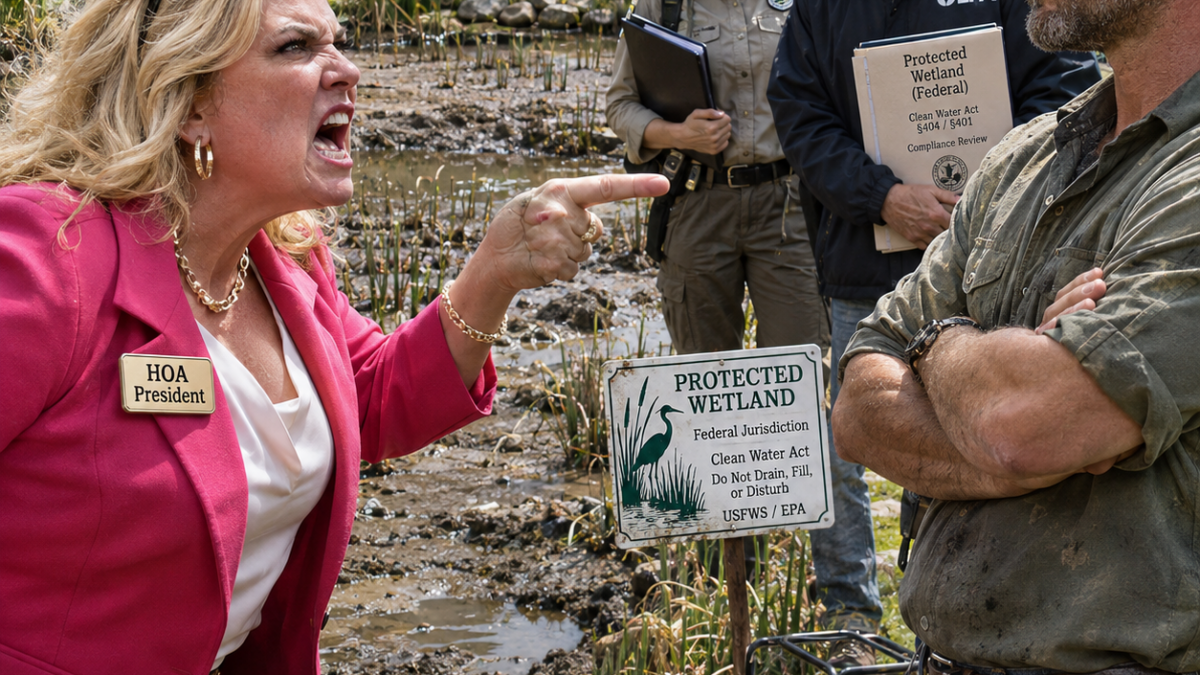
When I came home from my grandson’s birthday and found a ten-inch pump hose stretched across my lawn, the vernal pool I had spent years documenting sucked down to a basin of black mud, and Karen Reynolds standing beside the landscaping crew with the satisfied smile of someone who believed she had finally “fixed the view,” I knew immediately that she had crossed a line far beyond anything an HOA board could invent in a meeting room.
She had ignored my registered letters, mocked the habitat as “Frank’s swamp,” and ordered every last gallon pumped into a roadside storm drain, but what made my hands go cold was not the ruined landscape itself—it was the knowledge that the water, the animals, the buffer zone, and the very depression she had emptied were all protected under certifications she had already received in writing.
I could have told her right then what those documents meant, but as she lifted her chin and proudly announced that she had authorized the work herself, I realized the smartest thing I could do was let her keep talking.
My name is Frank Miller, and after twenty-five years as a civil engineer with the Army Corps of Engineers, I had spent enough time around wetlands, permits, mitigation plans, and environmental regulations to know the difference between a backyard pond and a living system that existed because the law had decided it mattered.
Sarah and I bought our five-acre property at the far end of Eagles Landing after I retired. Most of the neighborhood consisted of carefully landscaped homes, clipped lawns, identical mailboxes, and decorative ponds that looked exactly the way developers wanted water to look. Our land was different.
The pool sat in a natural depression beneath old oaks. It filled with winter rain and spring melt, then gradually dried as summer deepened. That temporary cycle was exactly why it supported life that ordinary ponds often could not. There were no fish to eat the eggs. Fairy shrimp moved through the shallows. Marbled salamanders attached gelatinous egg masses to submerged twigs. On rainy spring nights, spadefoot toads emerged to breed.
Before closing on the property, I had surveyed it myself. Afterward, I submitted hydrological data, species inventories, photographs, and maps to the state environmental department and the U.S. Fish and Wildlife Service. Six months later, the paperwork became official: certified vernal pool 734-B, with a protected buffer zone around it.
For two years, it became the center of our life.
My grandkids learned to find salamander eggs there. Sarah gardened outside the buffer. I kept water-quality records because old habits die hard. At night, the frogs could get so loud that conversation on the porch became almost impossible.
Then Karen moved across the street.
Within six months, she was HOA president.
Her first argument with me concerned a pile of logs and leaves near the pool.
“It’s yard waste,” she said.
“It’s a hibernaculum.”
She stared at me.
“A what?”
“Winter shelter for amphibians.”
“It’s ugly.”
“It’s protected habitat.”
I offered to show her the certification.
She looked at the documents only long enough to become irritated.
After that, the notices started.
Unmaintained water feature.
Mosquito hazard.
Nuisance pond.
Each time, I answered with the same facts and another copy of the relevant paperwork. I even explained that healthy vernal pools support predators such as dragonfly larvae that reduce mosquito populations rather than create the kind of stagnant breeding pit she kept describing.
She never changed her language.
She only became more determined.
A week before the draining, I found human footprints near the culvert that carried overflow toward the road. They were too deep and too regular to belong to an animal.
That night, I installed motion-activated cameras.
I felt foolish doing it.
Then Sunday came.
Sarah and I were two hours away celebrating our grandson’s birthday when our neighbor David called.
“Frank, you need to come home.”
“What happened?”
“There’s a truck on your property.”
My grip tightened around the phone.
“What kind?”
“Landscaping. Big pump. They’re draining the pond.”
Sarah saw my face and stopped wrapping leftovers.
“What?”
I was already reaching for the keys.
By the time we turned onto our street, the pond was almost gone.
And Karen was still there, one hand planted on her hip beside the ruined basin, waiting for me as though she expected me to thank her.
PART 2
I stopped the truck in the middle of the road.
Not in my driveway.
Not neatly along the curb.
Right in the road.
Sarah looked at me.
“Frank.”
“I know.”
“No, you don’t.”
Her hand closed around my forearm before I opened the door.
“You are furious.”
“I know.”
“That woman wants you furious.”
I looked through the windshield.
Karen stood near the drained pool in a bright pink tracksuit, directing two exhausted-looking men who were pulling a heavy hose back toward an unmarked white truck.
The hose had been running from my wetland to the storm drain.
The basin itself looked like something after a drought.
Dark mud.
Exposed roots.
Collapsed vegetation.
Small pale shapes scattered everywhere.
Sarah tightened her grip.
“Do not give her anything she can use against you.”
Twenty-five years in uniform had taught me how to function while angry.
Marriage had taught me that Sarah could usually recognize my anger before I could measure it.
I nodded.
Then got out.
Karen saw me and smiled.
Actually smiled.
“Well, Frank,” she called. “I told you somebody had to take care of it.”
I didn’t answer.
My boots sank into wet soil as I crossed the lawn.
The smell hit me first.
Mud.
Decay.
That stagnant organic smell that rises when a wetland bottom is exposed too quickly.
But underneath that was something worse.
Silence.
For two years, that corner of our property had never truly been silent.
Insects hummed.
Frogs called.
Birds moved through the canopy.
Water shifted through sedges.
Now I heard the landscaping truck idling and nothing else.
Karen followed me.
“You’ll be amazed once we fill this in.”
I stopped at the edge.
“What?”
“We can have soil delivered tomorrow. Good topsoil. Level everything. Sod over it.”
She spread one hand toward the basin.
“It’ll finally look maintained.”
I saw shells in the mud.
Dozens at first.
Then hundreds.
Small aquatic snails.
Tiny bodies.
A desiccating salamander curled beside one of the willow roots.
I crouched.
Sarah came up behind me.
Her breath caught.
“Oh, God.”
I couldn’t answer.
I had photographed marbled salamanders in that exact part of the basin the previous autumn.
My grandson had held my flashlight while I showed him egg masses beneath submerged branches.
He had asked whether the salamanders knew we were watching them.
I told him probably not.
Now I found myself thinking about that ridiculous little question while staring at a dead animal in the mud.
Karen kept talking.
“I know it looks messy now. Landscaping always does at first.”
I stood slowly.
“You hired them?”
“Of course.”
“You ordered this?”
“As HOA president.”
One of the landscapers looked toward us.
Karen must have taken my silence as disbelief because she lifted her voice.
“I authorized it, Frank.”
I turned my phone on and started recording.
She didn’t notice.
Or didn’t care.
“The board approved corrective action after you repeatedly refused to bring the water feature into compliance.”
“Water feature?”
“Yes.”
“That wasn’t a decorative pond.”
“Oh, don’t start.”
“It was certified vernal pool 734-B.”
Karen rolled her eyes.
“Fancy words don’t change what it looked like.”
“You received the certification.”
“I received a stack of government paperwork.”
“You received written notice that this habitat was protected.”
She laughed.
Actually laughed.
“Those slimy things don’t pay HOA dues.”
One of the workers stopped coiling the hose.
The other looked at Karen.
I stared at her.
Then said, very quietly:
“You have no idea what you’ve done.”
Karen crossed her arms.
“I know exactly what I’ve done.”
She gestured toward the basin.
“I corrected a health hazard that you’ve refused to deal with for months.”
Then she said the words that would follow her through everything that came later.
“My name is Karen Reynolds. I am president of the Eagles Landing Homeowners Association, and I authorized this work.”
I looked at my phone screen.
Still recording.
“Thank you.”
Her expression shifted.
“What?”
I didn’t answer.
I stepped away and called the State Department of Environmental Protection’s twenty-four-hour enforcement line.
I gave my name.
Address.
Certification number.
Former professional credentials.
Then the simplest possible description.
“A certified vernal pool has been intentionally dewatered on my private property. The water was pumped into a municipal storm drain. The person who ordered the work is still on scene.”
The dispatcher asked whether the person had admitted responsibility.
“Yes.”
“Are you certain?”
“She just did it again on camera.”
Next call:
Regional U.S. Fish and Wildlife office.
Same facts.
Certified habitat.
Protected species known on site.
Active destruction.
People responsible still present.
When I finished, the landscapers had stopped working entirely.
One approached me.
“Sir?”
“Yes?”
“We were told this was an HOA drainage project.”
“I believe you.”
“We didn’t know anything about protected—”
“I believe you.”
Karen snapped:
“Stop apologizing. You were hired to do a job.”
The worker looked at her.
Then back at me.
“Can we leave?”
I considered the question.
“You can make your own decisions. But state and federal officers are on the way, and they’re going to want your work order, business information, and an accurate account of what you were told.”
His face drained.
The other man said:
“Jesus.”
Karen snorted.
“Oh, for heaven’s sake. Nobody is going to arrest anybody over frogs.”
Sarah stepped between Karen and the basin.
For the first time all afternoon, her voice was colder than mine.
“This was our grandson’s favorite place on this property.”
Karen looked at her as if Sarah had changed topics.
“What does that have to do with anything?”
Sarah stared at her for several seconds.
“Nothing you would understand.”
Then she walked away.
The first government vehicle arrived twenty-seven minutes later.
I know because I checked the timestamp afterward.
Ford F-250.
State markings.
The man who stepped out wore environmental enforcement insignia and the tired expression of somebody expecting paperwork but hoping not to find catastrophe.
He took three steps toward the basin.
Stopped.
Looked at the truck.
Then at the hose entering the storm drain.
“Who reported?”
“I did.”
He approached me.
“Frank Miller?”
“Yes.”
“Officer Thorne. State DEP.”
I handed him the laminated copy of the certification I kept in my vehicle.
He read the number.
His eyes moved toward the exposed basin.
“Certified?”
“Yes.”
“You have species records?”
“Years of them.”
“Current protected species?”
“Marbled salamander. Spadefoot toad. Other documented organisms.”
He nodded once.
“Who ordered the pumping?”
I pointed toward Karen.
“She says she did.”
Karen immediately stepped forward.
“I did, because—”
Officer Thorne raised one hand.
“I’ll speak with you in a moment.”
That alone seemed to shock her.
People normally waited when Karen raised a hand.
Karen was not used to being the one told to wait.
Thorne followed the hose.
He crouched near the storm drain.
“Where does this discharge?”
“Miller’s Creek.”
His head snapped toward me.
“The salmonid stream?”
“Yes.”
He stood.
The two landscaping workers looked increasingly ill.
Officer Thorne walked toward Karen.
“Ma’am, I need to see your permit for the dewatering and discharge.”
Karen blinked.
“My what?”
“Permit.”
“I don’t need one.”
Thorne opened his notebook.
“Why not?”
“Because I’m the HOA president.”
He stared at her.
No smile.
No visible irritation.
Just silence.
Then:
“Are you stating that you personally ordered this company to pump this water?”
“Yes.”
“Into that storm drain?”
Karen looked toward the drain.
“They had to put it somewhere.”
“Were you aware that the storm system discharges to Miller’s Creek?”
“No.”
“Were you aware this site is a certified vernal pool?”
Karen’s confidence wavered.
“Frank claims that.”
“I am asking whether you were informed.”
“He sends everyone paperwork.”
“So yes?”
She crossed her arms.
“He sent letters.”
Thorne wrote.
Karen’s voice rose.
“But it doesn’t matter. This is an HOA.”
Officer Thorne looked up.
“What does that mean?”
“We have bylaws.”
“What do your bylaws say about environmental permitting?”
She stared at him.
For the first time since I’d met her, Karen Reynolds had no immediate answer.
Then two dark green SUVs turned onto our street.
Department of the Interior insignia.
U.S. Fish and Wildlife Service.
A man and woman stepped out.
The man approached me first.
“Mr. Miller?”
“Yes.”
“Special Agent Miller. No relation, I’m guessing.”
“None I know of.”
“This is Agent Sanchez.”
Sanchez was already surveying the site.
Agent Miller walked to the wetland edge.
He didn’t say anything for almost a minute.
Then he crouched.
Picked up a salamander carefully.
“Marbled.”
Sanchez joined him.
“Adult?”
“Breeding age.”
He placed it gently into an evidence container she provided.
Then scanned the exposed basin.
“Total dewatering?”
I nodded.
“Nearly.”
“How long ago?”
“Finished shortly before we arrived.”
“Do you have camera coverage?”
“Yes.”
“Continuous?”
“Motion activated, but wide coverage.”
“Preserve everything.”
“I already have redundant backups.”
He looked at me.
“Corps?”
“Twenty-five years.”
That explained his brief nod.
Then he turned toward Karen.
“Ma’am.”
She straightened.
“Are you the person who hired the contractor?”
“I was acting on behalf of Eagles Landing.”
“That wasn’t my question.”
She glanced toward me.
I could see the moment pride overruled caution.
“Yes.”
“Did you direct them to drain the wetland?”
“It is not a wetland. It’s an ugly swamp.”
Agent Miller’s expression did not change.
“Did you direct them to drain it?”
“Yes.”
“Had Mr. Miller previously informed you that the site had protected status?”
Karen’s jaw tightened.
“He sent documents.”
“What documents?”
“Government forms.”
“Did you read them?”
“I skimmed them.”
“Did you contact any environmental agency before ordering the work?”
“No.”
“Did you obtain a permit?”
“No.”
“Did you obtain a biological assessment?”
“No.”
“Did you obtain authorization from Mr. Miller to enter his property?”
Karen looked offended.
“The HOA has enforcement authority.”
“Do you have written authorization allowing entry for this work?”
“The bylaws—”
Agent Miller stopped her.
“I asked a narrow question.”
She flushed.
“No.”
He wrote.
Then Karen committed the sentence that even her later lawyer could never explain away.
“I’d do it again. It was a health hazard.”
Agent Miller stopped writing.
Looked at her.
Then wrote something else.
“Thank you.”
She blinked.
“For what?”
“For answering clearly.”
He turned to the landscaping crew.
“Gentlemen, I’ll need your identification, business license, work order, invoices, text messages relating to this job, and the name of whoever authorized payment.”
One man said:
“Are we under arrest?”
“Not at this time.”
Karen threw up her hands.
“This is absurd.”
Agent Miller looked back.
“You are free to contact counsel.”
“I will.”
“I recommend it.”
“Are you threatening me?”
“No, ma’am.”
His tone stayed level.
“I am advising you.”
Then he gestured toward the drained basin.
“This is now an active investigation scene. Nobody alters anything without authorization.”
Yellow tape went up before sunset.
That was the moment Eagles Landing realized this wasn’t another fight about landscaping.
Neighbors stood on sidewalks.
Phones appeared.
David, the accountant who had called us, crossed the road.
“Frank.”
“Yeah?”
“I’m sorry.”
“You didn’t do it.”
“I saw the truck arrive.”
“You called.”
“I should’ve gone over there.”
I looked at the wetland.
“No.”
He frowned.
“No?”
“You called me. You gave me the chance to document the scene while they were still here. That mattered.”
He stared at the government vehicles.
“Is Karen in serious trouble?”
I looked at the agents cataloging dead animals.
“Yes.”
That night, Sarah and I barely spoke.
Officers remained outside long after dark.
The house felt strange.
Our porch had always overlooked the pool through trees.
Even when I couldn’t see it, I could hear it.
Now nothing.
Sarah made coffee neither of us drank.
Around eleven she sat across from me at the kitchen table.
“Do you remember Noah finding that salamander?”
Our grandson.
“Yes.”
“He wouldn’t touch it.”
“He thought he’d hurt it.”
She smiled weakly.
“You told him to use two fingers.”
“I remember.”
Then the smile vanished.
“What are we going to tell him?”
I looked toward the dark window.
“The truth.”
“He’s seven.”
“I know.”
She rubbed both hands over her face.
“I hate her.”
That was the first time Sarah said it.
Not “I’m angry.”
Not “What she did was awful.”
“I hate her.”
I reached across the table.
She took my hand.
Neither of us tried to talk the other out of it.
Some emotions need time before they need correction.
The next week felt like living beside an archaeological excavation of a crime.
State biologists.
Federal wildlife specialists.
Water-quality teams.
Soil sampling crews.
Photographers.
GPS units.
Evidence flags.
Investigators took downstream samples from Miller’s Creek to determine what the pumped water and sediment had carried into the stream.
They cataloged dead organisms.
Snails.
Tadpoles.
Salamanders.
Invertebrates.
Vegetation loss.
Egg masses.
I gave them my records.
Two years of photographs.
Hydrological measurements.
Species inventories.
Seasonal observations.
Emails.
HOA violation notices.
And, most importantly, every registered letter I had sent Karen.
Agent Miller sat at my dining table reviewing them.
He held up one signed return receipt.
“She received this?”
“Yes.”
“And this packet contained the certification?”
“Yes.”
“And the statutory warning?”
“Yes.”
“Then she later issued another violation notice?”
“Yes.”
He read it.
“Unmaintained water feature.”
“Correct.”
He put both pages side by side.
Then another.
Then another.
Finally he leaned back.
“Frank, this matters.”
“I figured.”
“No.”
He tapped Karen’s signature.
“She is going to have difficulty claiming she didn’t know.”
“I told her repeatedly.”
“I can see that.”
He gathered the letters.
“Do you have copies?”
“Everything is scanned.”
“Good.”
Then he said something that stayed with me.
“People think environmental cases are about frogs.”
He looked toward the destroyed pool.
“They’re usually about choices.”
The first major government notice didn’t come to me.
It went to the HOA.
EPA notice.
Clean Water Act issues tied to the discharge into the storm system and downstream waterway.
Cease and desist.
Potential penalties.
David called me.
His voice was tight.
“Frank, the letter says fines can be more than fifty thousand dollars per day.”
“Depending on violation and enforcement, yes.”
“Can they charge the HOA?”
“That depends on who authorized what.”
“She told us the board approved it.”
“Did they?”
Silence.
“I don’t know.”
“You’re treasurer.”
“I know.”
“Did you vote?”
“No.”
“Then find out.”
He called back two hours later.
“No vote.”
That changed things.
“What was there?”
“Karen sent an email saying she was taking emergency corrective action under presidential authority.”
“Did the bylaws give her that authority?”
“Only for imminent threats to health or property.”
“Was there any health report?”
“No.”
“Mosquito inspection?”
“No.”
“Environmental consultation?”
“No.”
He breathed out.
“She’s going to drag us all into this.”
That fear spread quickly.
The Department of the Interior notice served personally on Karen was worse.
Protected-species violations.
Habitat destruction.
Potential civil penalties.
Potential criminal exposure.
The neighborhood went from whispering to panicking.
The emergency HOA meeting was held three nights later.
Packed.
Sarah and I sat in the front row.
Karen entered looking pale but armored in anger.
She took the podium.
“This association is under attack.”
Murmurs.
“Federal bureaucrats are attempting to interfere with our lawful responsibility to maintain our community.”
I looked at Sarah.
Sarah stared straight ahead.
Karen continued.
“For years we have tolerated an unsanitary swamp that damages our property values, attracts insects, and creates a visual nuisance.”
Someone called:
“Is it protected?”
Karen ignored them.
“We cannot allow government overreach to intimidate us.”
Then:
“We will fight this together.”
I stood.
Karen pointed.
“You are out of order.”
I stayed standing.
“Whose money?”
“What?”
“You said *we* will fight.”
A hush moved through the clubhouse.
“Are you fighting with your own money, Karen, or ours?”
Her lips tightened.
“This is an association matter.”
“Was there a board vote authorizing the draining?”
The treasurer, David, looked down.
Karen said:
“There was emergency authority.”
“Was there an environmental permit?”
“You know there wasn’t.”
“Was there a health department finding?”
She didn’t answer.
“Mosquito-control report?”
Nothing.
I continued.
“Did you notify the HOA’s insurance carrier before entering protected habitat?”
“This is not a deposition.”
“No.”
I set my laptop on the presentation table.
“But the residents who may be asked to pay your legal bills deserve to know exactly what happened.”
Karen moved toward me.
“You are not using association equipment.”
David stood.
“Yes, he is.”
Karen spun.
“What?”
“As treasurer and board member, I authorize it for the purpose of discussing potential association liability.”
That was the first public defection.
Karen stared at him.
Then at the crowd.
I connected the projector.
First video:
Security camera.
Landscaping truck.
Hoses.
Karen pointing.
Her voice clear enough to understand.
**Get every last drop out. I want it dry enough to fill next week.**
Nobody moved.
Second clip.
Me arriving.
Karen facing me.
**I’m Karen Reynolds, president of the Eagles Landing HOA, and I authorized this work.**
Then:
**I’d do it again.**
I stopped the video.
Karen’s face had gone gray.
I looked at the residents.
“The government isn’t investigating Eagles Landing because frogs offended Karen.”
I kept my voice even.
“They are investigating a documented destruction of protected habitat and an illegal discharge.”
I pointed toward the frozen image of Karen.
“The person on that screen had received written notice of the site’s status before she ordered the work.”
Someone asked:
“Did the board know?”
David answered.
“I didn’t.”
Another board member slowly shook his head.
Neither had he.
Karen shouted:
“They’re lying to protect themselves.”
The room erupted.
Karen tried the gavel.
Wrong meeting for it.
People wanted answers.
Would insurance cover it?
Could residents face a special assessment?
Who hired the landscaper?
Who paid?
Was Karen using HOA money for her own attorney?
David raised both hands.
“I don’t know yet.”
That honesty calmed the room more than Karen’s certainty ever had.
Then I said:
“Your board needs independent counsel.”
Karen snapped:
“We already have counsel.”
“Your counsel represents the association.”
“And me.”
“That’s exactly the problem.”
A retired lawyer near the aisle nodded.
The association eventually retained separate counsel.
Within forty-eight hours, that lawyer gave them blunt advice.
Cooperate.
Preserve records.
Separate association interests from Karen’s personal actions.
Do not destroy documents.
Do not fund personal criminal defense without clear legal authority.
Issue no retaliatory notices to me.
The board suspended Karen’s presidential duties.
She called it betrayal.
I called it survival.
News broke two days later.
Local headline:
**HOA PRESIDENT ORDERED DRAINING OF PROTECTED WETLAND, FEDERAL INVESTIGATION UNDERWAY**
Cameras appeared at the entrance.
Karen stopped answering her door.
Other residents started talking.
At first, stories trickled out.
Then poured.
An elderly couple had been threatened with escalating fines over a small vegetable garden Karen labeled “agricultural use.”
A single mother had been ordered to replace most of her lawn because clover made it “inconsistent.”
A family had been cited for children’s toys.
Another over holiday decorations.
Mailboxes.
Fence stain.
Garden beds.
The pattern wasn’t criminal in the same way the wetland destruction was.
But it explained why residents had stayed silent so long.
Karen had turned inconvenience into fear.
David organized a concerned-homeowners group.
That was how I met Arthur Henderson.
Seventy-something.
Retired litigator.
Sharp enough that five minutes around him made you check whether you’d accidentally contradicted yourself.
He called me.
“Frank Miller?”
“Yes.”
“Arthur Henderson. I reviewed the public filings.”
“Okay.”
“Your neighbor is in trouble.”
“I know.”
“No.”
He chuckled.
“I mean civil trouble.”
He came to our house that afternoon.
I showed him the habitat documentation.
Government notices.
Video.
Karen’s signed letters.
Arthur read for almost two hours.
Then:
“Restoration.”
I nodded.
“My priority.”
“How much?”
“I don’t know yet.”
“You’re an engineer.”
“Quarter million at minimum if we’re rebuilding hydrology, soil structure, plant communities, and monitoring for years.”
Arthur’s eyebrows rose.
“You already have a conceptual plan.”
“Yes.”
“Of course you do.”
Sarah brought tea.
Arthur looked at her.
“Your husband is terrifying.”
“I know.”
He offered to represent us pro bono.
I refused at first.
“Arthur, this could become enormous.”
“I’m retired.”
“That doesn’t make your time free.”
“It makes my time mine.”
He leaned forward.
“Karen spent years making people believe nobody could tell her no. I would enjoy spending some of my retirement correcting that misconception.”
Sarah smiled.
I lost the argument.
Our civil suit named Karen personally and the HOA where legally appropriate.
Arthur explained the strategy carefully to the new board.
“We’re not trying to bankrupt the residents.”
David nodded.
“We appreciate that.”
“We need restoration funding. We need records. We need insurance at the table. And we need legal clarity that Karen acted beyond lawful authority where the evidence supports that.”
The HOA’s insurer reviewed the case.
They agreed to defend association interests.
Karen’s personal coverage?
Denied under the source’s intentional and criminal acts exclusions.
Then the HOA filed its own cross-claim seeking protection and contribution from Karen if the association was forced to pay damages attributable to her conduct.
She was now dealing with state enforcement, federal prosecution, my civil action, and her own HOA’s lawsuit.
And still she refused to surrender.
A local university professor, Dr. Albright, contacted me after seeing the news.
Amphibian ecology.
She had studied vernal-pool systems for years.
She visited the site.
For almost an hour she barely spoke.
Then she crouched near the dried basin.
“This can be restored.”
Sarah asked:
“How long?”
Dr. Albright looked toward the old oaks.
“Years.”
Not months.
Years.
“Will it ever be the same?”
“No.”
Sarah’s face fell.
Albright continued.
“But ecosystems don’t need to be identical to be alive again.”
That sentence became important later.
Her department offered technical support.
Graduate students.
Monitoring.
Species-recovery consultation.
Expert testimony.
For the first time since the draining, I saw a future beyond litigation.
Not a lawsuit.
Water.
Egg masses.
Frogs.
The recall petition circulated that same week.
Required signatures came in one day.
Karen was isolated.
Then she hired a lawyer.
His first significant move was a motion arguing, in essence, that HOA authority over community water features justified Karen’s actions against the environmental claims.
Arthur called me after reading it.
“Frank.”
“Yes?”
“I have practiced law for nearly forty years.”
“That sounds ominous.”
“I have seen bad arguments.”
“And?”
“This one has ambition.”
The motion failed.
Hard.
The court rejected the theory that local private covenants could override applicable federal environmental protections.
Karen treated the defeat as evidence of conspiracy.
The U.S. Attorney’s Office offered a plea arrangement.
According to the source, the proposal would have allowed her to plead to a misdemeanor Clean Water Act charge, pay a substantial $100,000 personal fine, permanently resign from the HOA board, and fund part of the habitat restoration.
It was severe.
But compared with her exposure, survivable.
Karen rejected it.
Arthur stared at me when we learned.
“Why?”
“Pride.”
“No.”
He shook his head.
“Pride knows when it’s losing.”
“What do you call this?”
“Delusion.”
The civil deposition proved him right.
Karen arrived in a dark power suit.
Her attorney looked exhausted before questioning began.
Arthur started gently.
Dates.
HOA role.
Wetland complaints.
Letters.
“Mrs. Reynolds, did Mr. Miller ever provide you written notice claiming the site was a protected vernal pool?”
“I received many communications.”
“That wasn’t my question.”
Karen’s jaw tightened.
“I don’t recall.”
Arthur slid a certified receipt toward her.
“Is that your signature?”
She looked.
“It appears to be.”
“Would you agree this confirms receipt?”
“It confirms receipt of an envelope.”
“What did you believe was inside?”
“I don’t remember.”
Arthur moved on.
“Did you personally hire the landscaping company?”
“I asked for maintenance assistance.”
“Did you instruct them to drain the pool?”
“No.”
I looked at her lawyer.
He went very still.
Arthur didn’t react.
“Did you tell them to remove every last drop?”
“No.”
“Did you direct where the water should go?”
“No.”
“Did you stand on the property while the work occurred?”
“I stopped by.”
“Did you supervise it?”
“No.”
“Did you tell Mr. Miller you had authorized the work?”
“No.”
Her lawyer closed his eyes.
Arthur said:
“Let’s take a short break.”
Five minutes later we returned.
Arthur wheeled a monitor into position.
Inserted a copy of the recording.
First clip.
Karen in pink.
Pointing.
**Get every last drop out.**
He paused.
“Mrs. Reynolds, is that you?”
“The image quality is poor.”
I almost laughed.
It wasn’t.
Arthur said:
“Do you deny that’s you?”
“I can’t authenticate a video I didn’t record.”
He nodded.
“Fair enough.”
Then played the second.
My arrival.
Karen’s face clearly visible.
Her voice.
**I’m Karen Reynolds, president of the Eagles Landing HOA, and I authorized this work.**
Arthur paused on her face.
“Is that your voice?”
Karen stared at the screen.
Her lawyer’s hand moved slowly to his forehead.
“Mrs. Reynolds?”
“I don’t know whether the audio has been manipulated.”
Arthur looked toward the court reporter.
“Let the record reflect that the witness has declined to identify her own voice and image.”
Karen snapped:
“That isn’t what I said.”
Arthur leaned back.
“Then what are you saying?”
She realized the trap.
Too late.
The deposition transcript was devastating.
Her sworn denials conflicted with video, documents, work orders, witnesses, and her own statements on the day of the draining.
Once portions entered the public case file, local media picked them up.
Karen wasn’t just the woman accused of destroying the wetland anymore.
She was the woman denying things everyone could watch her do.
The recall meeting happened the following Tuesday.
People stood outside because the clubhouse couldn’t hold everyone.
Elaine, the interim HOA president, ran the meeting.
Quiet woman.
Efficient.
No theatrics.
One agenda item.
Recall Karen Reynolds.
Karen came.
That surprised me.
She walked to the microphone with her chin high.
Elaine gave her time to speak.
Karen used all of it.
Government conspiracy.
Environmental extremists.
Personal vendetta.
Property values.
Me.
At one point she claimed I had moved into Eagles Landing specifically because I wanted to impose federal environmental control over the neighborhood.
Someone whispered:
“He lived here before her.”
Nobody laughed.
The room had moved past comedy.
Elaine said:
“Thank you, Karen.”
“I’m not finished.”
“Your allotted time has expired.”
“You cannot silence me.”
“You had your turn.”
Elaine looked toward the residents.
“Now they have theirs.”
One by one, people stood.
The elderly man with the vegetable garden.
“I’ve lived here forty years.”
Karen had threatened a lien because his tomatoes allegedly violated landscaping standards.
A single mother.
Voice shaking.
She described thousands of dollars she feared she would have to spend replacing a lawn because Karen hated clover.
Another family.
Holiday decorations.
Another.
Fence.
Another.
Mailboxes.
Karen repeatedly tried to interrupt.
Elaine struck the gavel once.
“Karen.”
She waited.
“You will listen.”
That was perhaps the most complete loss of power Karen had experienced yet.
Not being shouted down.
Being required to sit quietly while people she had controlled described what she had done.
Eventually I stood.
I didn’t bring documents.
No slides.
No law.
I walked to the microphone.
Karen looked at me.
I looked back.
Then turned toward the residents.
“For two years, I kept records of the wetland because I loved knowing what lived there.”
The room quieted.
“In winter, fairy shrimp would appear when the basin filled. In spring, salamander egg masses clung to branches underwater. On rainy nights, the peepers were loud enough that Sarah and I had to raise our voices on the porch.”
Sarah looked down.
“My grandson used to come out with a flashlight.”
My voice tightened.
“He was afraid to touch the salamanders because he thought he’d hurt them.”
I swallowed.
“The day Karen drained the pool, everyone focused on laws, fines, permits, liability.”
I looked at her.
“Those matter.”
Then toward the room again.
“But that isn’t what she took.”
I described the silence.
That first night.
The absence of frogs.
The dead salamander beside the willow root.
The snails in the mud.
The loss of years of life concentrated in one morning because one person wanted a cleaner view.
“You didn’t improve our neighborhood,” I said.
“You scarred it.”
Then sat.
Nobody clapped.
I was grateful.
Some moments shouldn’t be applause lines.
The vote was by paper ballot.
Ten minutes later, Elaine received the count.
She looked once.
Then again.
“187 in favor of recall.”
Pause.
“Two opposed.”
Karen stared straight ahead.
Removed.
Officially.
She stood.
No speech.
No goodbye.
The clubhouse door slammed behind her.
Then people cheered.
I didn’t.
Sarah held my hand.
The public fight with the HOA was over.
The federal case was not.
The trial began the following month.
Karen’s defense eventually chose a bench trial instead of a jury.
Judge Morrison presided.
Silver-haired.
Controlled.
Known for taking environmental statutes seriously.
The prosecution was led by Assistant U.S. Attorney Maria Flores.
Efficient.
Precise.
She didn’t need theatrics.
Agent Miller testified first.
Species loss.
Scene condition.
Recorded admissions.
Work orders.
Evidence chain.
Environmental discharge.
Officer Thorne addressed the storm drain and downstream impact.
Dr. Albright explained vernal-pool ecology.
Why temporary water matters.
Why species depend on fishless seasonal basins.
Why simply digging a hole and adding water does not recreate decades of ecological relationships.
Then I testified.
Two hours.
History.
Certification.
Surveys.
My letters to Karen.
Registered receipts.
Her violation notices.
Security footage.
Under cross-examination, Karen’s lawyer tried to portray me as an environmental zealot.
“You care deeply about amphibians, don’t you, Mr. Miller?”
“Yes.”
“Perhaps more than most people?”
“Probably.”
“More than your neighbors’ property values?”
“That assumes protecting a legal wetland harms their property values.”
“Please answer the question.”
“I did.”
He changed direction.
“You considered this pool more important than the aesthetic concerns of the community?”
“I considered federal and state protections more controlling than Karen’s aesthetic preferences.”
Flores objected to the characterization.
Sustained.
The cross-examination never recovered.
Then Karen testified.
I almost wished she hadn’t.
Not for her sake.
For everyone who had once known her as a neighbor.
She said she had been trying to help.
Said the documents were confusing.
Said nobody adequately explained that the rules applied to her.
Said she believed the pool endangered public health.
Flores stood.
“Mrs. Reynolds, do you have a health-department report supporting that claim?”
“No.”
“Mosquito-control inspection?”
“No.”
“Medical complaint?”
“No.”
“Environmental permit?”
“No.”
“Written authorization from Mr. Miller?”
“No.”
“Did Mr. Miller send you certification documents?”
“I didn’t understand them.”
Flores handed her a letter.
“Please read the highlighted sentence.”
Karen read silently.
“Out loud.”
Karen’s voice weakened.
“Any disturbance, alteration, filling, draining, or contamination of certified vernal pool 734-B or its protected buffer may violate applicable state and federal environmental law.”
Flores waited.
“Was that unclear?”
Karen said nothing.
Flores played the video.
**Get every last drop out.**
Then the confession.
**I’m Karen Reynolds… and I authorized this work.**
Then:
**I’d do it again.**
Flores stopped.
“Mrs. Reynolds, during your civil deposition, you denied authorizing this work.”
Karen shifted.
“I was confused.”
“Were you confused when you said this on camera?”
“No.”
“Were you confused when you testified in the deposition?”
Karen’s face reddened.
“My lawyer was pressuring me.”
Her attorney looked horrified.
Flores asked:
“Were you lying then, or are you lying now?”
Karen tried to answer.
Contradicted herself.
Started again.
Judge Morrison finally said:
“Mrs. Reynolds, listen carefully to the question before responding.”
That quiet warning hurt more than shouting would have.
Closing arguments were short.
Flores called the destruction willful.
Not a mistake.
Not an accident.
Karen had been warned.
Given documentation.
Given opportunities.
She chose personal authority over law and ecological protection.
Judge Morrison delivered the verdict without a long recess.
Guilty on the counts described in the source.
Two felony violations tied to the Endangered Species Act.
One misdemeanor Clean Water Act violation.
Karen gripped the table.
Then sentencing.
The judge called her conduct environmental vandalism.
He imposed a $250,000 personal civil penalty.
A gasp moved through the courtroom.
Then restoration.
The court ordered full funding of the restoration plan submitted with Dr. Albright’s supporting work.
Estimated cost:
$290,000.
Lien against Karen’s property to secure the obligation.
Karen’s knees seemed to weaken.
Her lawyer reached toward her elbow.
Judge Morrison wasn’t finished.
Ninety days in federal custody on the criminal component described in the source.
Karen sat down.
Hands over her face.
I felt no rush.
No triumph.
Only exhaustion.
Sarah leaned toward me.
“Is it over?”
I looked at Karen.
“No.”
Not really.
Because punishment isn’t restoration.
The wetland was still dead.
Karen served the sentence.
Financially, she collapsed.
The federal lien and other obligations left her unable to sell or refinance freely.
Bankruptcy could not simply erase the restoration obligation described in the judgment.
Her immaculate house began to change.
Grass longer.
Shrubs untended.
The visual perfection she had used to judge everyone else slowly disappeared.
People noticed.
They talked.
I asked them not to do it around me.
Karen had enough consequences.
Mocking her lawn added nothing.
Six months later, foreclosure ended her time in Eagles Landing.
The moving van arrived on a gray morning.
I was on the porch.
Karen came out carrying a box.
No floral muumuu.
No clipboard.
No HOA badge.
She looked smaller.
Not physically.
Humanly.
She saw me.
For several seconds we looked at one another across the street.
I had imagined that moment many times.
In the angry months, I’d imagined saying something clever.
*How’s the view now?*
*Still worried about property values?*
Something satisfying.
Something cruel.
Instead I said nothing.
Neither did she.
Karen got into an old sedan driven by someone I didn’t recognize.
The car pulled away.
I watched until it turned the corner.
Sarah came outside.
“You okay?”
“Yes.”
“Do you feel sorry for her?”
I thought.
“Some.”
Sarah nodded.
“So do I.”
That surprised me.
Then she said:
“Doesn’t mean she didn’t earn what happened.”
“No.”
Both things could be true.
Karen was responsible.
And it was still sad to watch a life collapse.
The new HOA board under Elaine rewrote the worst parts of the governing documents.
Vague aesthetic clauses were narrowed.
Board entry onto private land required proper authority.
Environmental features received explicit recognition.
They partnered with a local conservation organization.
They created a community garden.
Ironically, vegetable gardening—something Karen had once punished—became an HOA-sponsored activity.
But the wetland restoration became the center of everything.
Karen’s financial obligations and the proceeds recovered through the legal process funded the work.
The first planning meeting took place at our dining room table.
Dr. Albright.
Two graduate students.
State biologist.
Hydrologist.
Restoration contractor.
Arthur.
Me.
Sarah brought coffee.
Maps covered almost every surface.
The goal wasn’t to build a pretty pond.
That distinction mattered.
We had to recreate the basin’s hydrological behavior.
Seasonal filling.
Slow drawdown.
Impermeable soil layer.
Buffer vegetation.
Microtopography.
Woody debris.
Breeding habitat.
Everything Karen had considered messy.
We began with elevation surveys.
Historical photos.
My old measurements.
The security footage was painful, but even it helped document the pre-destruction contours.
Excavators arrived in spring.
Specialized operators.
No bulldozing blindly.
Every cut guided by plans.
The old basin had been partially disturbed by the draining and attempted preparation for filling.
We recontoured carefully.
Clay-rich material restored the water-holding layer.
Native soil was placed.
Coarse woody debris returned.
Sedges.
Rushes.
Native grasses.
Shrubs.
Logs for cover.
Then volunteers arrived.
University students.
Neighbors.
Scouts.
People I barely knew.
David brought gloves.
Elaine carried trays of native plants.
The single mother Karen had harassed came with her daughter.
The elderly tomato gardener arrived with a shovel and refused to let anyone tell him he was too old to use it.
Arthur showed up in expensive boots he ruined within an hour.
I laughed.
He pointed at me.
“You owe me.”
“For what?”
“These were good boots.”
“You volunteered.”
“I was misled.”
“What did you think wetland restoration involved?”
“Lawyers.”
Sarah nearly dropped a plant laughing.
For weeks, the property became a work site.
It didn’t look healed.
It looked torn open again.
That was difficult.
One afternoon, after everyone left, I stood alone beside the basin.
No water yet.
Freshly placed logs.
Bare soil.
Flags marking plantings.
Sarah joined me.
“What’s wrong?”
“It looks artificial.”
“It is.”
“That isn’t what I wanted.”
She stood beside me.
“Frank.”
I looked at her.
“You told me after Karen drained it that restoration would take years.”
“I know.”
“You meant that when you were talking about everyone else.”
That hurt because it was accurate.
I wanted measurable progress.
Engineering does that to you.
Schedule.
Milestones.
Completion.
Nature doesn’t respect project managers.
We created conditions.
Then waited.
First winter, the basin filled.
Not perfectly.
But enough.
Water sat between young sedges.
Leaves collected.
A few insects returned.
Dr. Albright was cautious.
“Don’t expect too much.”
I nodded as if I understood.
I didn’t.
Every evening I walked out hoping to hear frogs.
Nothing.
The first year was largely sterile.
That was harder than the construction.
At least construction involved action.
Now there was water.
Habitat.
Plants.
And silence.
My grandson came to visit.
He stood beside the restored pool.
“Where are the salamanders?”
“They haven’t come back yet.”
“Why?”
“It takes time.”
“Can we buy some?”
I smiled.
“Not like fish.”
He looked disappointed.
“What if they don’t come back?”
I looked toward Sarah.
She let me answer.
“Then we’ll keep taking care of the place anyway.”
He thought about that.
Then nodded.
Children sometimes understand commitment better than adults.
The second spring brought dragonfly larvae.
Water striders.
Beetles.
Small invertebrates.
Dr. Albright called me one morning.
“You need to come outside.”
“I am outside.”
“No, come to the north edge.”
She was crouched near the water.
She pointed.
Movement.
Tiny.
Almost nothing.
Life.
I stared longer than necessary.
“That’s good?”
She smiled.
“That’s very good.”
That year, more insects arrived.
Birds responded.
The ecological web began rebuilding itself from the bottom.
Still no salamander egg masses.
Still no spadefoot call.
But no longer sterile.
Then came the rainy April night.
Sarah and I were on the porch.
Soft rain.
Not heavy.
The kind of spring rain that seems to darken every tree trunk.
We had been talking about nothing.
Probably groceries.
Maybe the grandkids.
Then Sarah stopped.
“What?”
She raised one finger.
“Listen.”
Rain.
Leaves.
Distant traffic.
Then:
A single peep.
I didn’t move.
Another.
Then another from farther away.
Sarah gripped my arm.
“Frank.”
“I hear it.”
The sound came again.
Tentative.
Small.
Almost ridiculous compared with how loud the old chorus used to be.
I started crying anyway.
Not dignified tears.
Twenty-five years in uniform.
Federal court.
Investigators.
Dead animals.
Lawsuits.
I made it through all of that.
One frog made me cry.
Sarah was crying too.
She laughed through it.
“They’re back.”
“Somebody’s back.”
We stood there getting misted by the rain.
Listening.
That first chorus wasn’t strong.
Maybe a handful.
Didn’t matter.
The pool had a voice again.
The following year, Dr. Albright’s team reintroduced a small population of marbled salamanders as part of the approved restoration plan.
Carefully.
Scientifically.
Monitoring.
No shortcuts.
The next breeding season, a graduate student found egg masses.
He called me at six in the morning.
“Mr. Miller?”
“Yeah?”
“You need to come down here.”
I had heard that sentence once before from David.
That time it meant destruction.
This time the student sounded like he was trying not to shout.
I pulled on boots.
Sarah came behind me in her robe.
“What?”
“Eggs.”
She was outside before I finished the word.
The mass clung to submerged vegetation.
Small.
Gelatinous.
Ordinary-looking unless you knew what you were seeing.
Sarah knelt.
“Are these—”
“Yes.”
She covered her mouth.
The student smiled.
“We’ve got three more on the east side.”
Life doesn’t return with court orders.
It returns one egg at a time.
The biggest surprise came from the spadefoot toads.
Dr. Albright initially assumed we would need a carefully managed reintroduction plan if habitat stabilized.
Then one wet night, a field microphone captured a call.
She called me.
“Frank, don’t get excited.”
“Why would you say that before telling me something exciting?”
“We need confirmation.”
“What?”
“Possible spadefoot.”
We went out.
Waited.
Nothing.
Twenty minutes.
Thirty.
Sarah eventually said:
“I’m going inside.”
Then the call came again.
Dr. Albright froze.
Another.
From farther upslope.
She turned toward me.
“No reintroduction.”
“What?”
“They survived.”
Some had apparently remained underground beyond the immediate destroyed basin, buried deeply enough to survive the draining.
Animals Karen believed she had erased had been waiting beneath the soil.
That night they emerged to breed.
I sat on the wet ground.
Didn’t care about my pants.
Sarah crouched beside me.
The toads called.
One.
Then another.
Then several.
I thought about Karen saying:
*Those slimy things don’t pay HOA dues.*
No.
They didn’t.
They had been living there long before Eagles Landing had dues to pay.
Years passed.
The wetland matured.
Never exactly as before.
Dr. Albright had been right.
Some plant communities came back differently.
The water held slightly longer in certain sections.
One willow didn’t survive.
Another grew.
Species returned at different rates.
But the system became alive again.
Kids from Eagles Landing visited with teachers.
The HOA funded educational signs outside the protected buffer.
Not giant tourist signs.
Simple.
**CERTIFIED VERNAL POOL 734-B
SEASONAL WETLAND HABITAT
PLEASE OBSERVE FROM DESIGNATED PATH**
My grandson, older now, read it one afternoon.
“You put that up?”
“The HOA did.”
“The same HOA that drained it?”
“Different people.”
He considered that.
“So HOAs can learn?”
I laughed.
“Sometimes.”
Elaine overheard.
“Put that on our website.”
“No.”
The community garden flourished.
The tomato gardener became unofficial king of tomatoes.
The woman Karen had fined over clover joined the landscaping committee.
Their first recommendation?
Allow more clover because it supported pollinators.
Sarah thought that was funny enough to tell everybody.
Arthur never became HOA president.
He refused.
“I’m too old to listen to arguments about mailbox colors.”
Elaine stayed for two terms.
Then stepped aside.
That mattered.
Healthy organizations survive leadership transitions.
No one person should become the institution.
David took a board seat later.
His accountant brain made reserve studies almost painfully detailed.
I teased him.
He reminded me who called when the pump truck arrived.
He won every argument with that.
Karen became less important to the story as years went by.
That surprised me.
For a long time she had occupied almost every thought connected to the wetland.
Then eventually I could walk to the pool without seeing the drained basin in my mind first.
I saw water.
Sedges.
Egg masses.
Insects.
My grandson.
Sarah.
The restoration volunteers.
Life crowded out the memory of destruction.
That was healing.
Not forgetting.
Making the loss no longer the largest thing in the landscape.
The legal documents stayed in my office.
The original certification.
The government notices.
Arthur’s civil filings.
Trial transcripts.
Judge Morrison’s order.
Restoration plans.
Monitoring reports.
I kept Karen’s first violation notice too.
**UNMAINTAINED WATER FEATURE.**
Sometimes I looked at those three words.
They captured the entire failure.
She saw water.
I saw habitat.
She saw disorder.
I saw seasonal ecology.
She saw an HOA violation.
The law saw protected wetland.
But even saying it that way eventually felt incomplete.
Because the real issue wasn’t that Karen lacked scientific expertise.
Nobody should expect every HOA president to recognize a vernal pool.
Her failure happened after expertise reached her.
I gave her certification.
She ignored it.
I explained the species.
She mocked them.
I cited protections.
She treated the law as a challenge to her authority.
Ignorance can be fixed.
Arrogance resists repair.
That was why her consequences became so severe.
She had exit after exit.
The first violation notice.
My first response.
The second warning.
The certified documents.
The footprints near the culvert.
The day she hired the contractors.
The moment they arrived.
The moment she saw the animals.
The moment I confronted her.
Officer Thorne asking for a permit.
Agent Miller asking whether she’d been warned.
The plea offer.
Even the deposition.
At every stage, Karen could have admitted error.
She chose another escalation instead.
By the end, the government didn’t have to invent a case against her.
Her own decisions formed the timeline.
Arthur once said:
“The strongest evidence in any lawsuit is often the thing the other side created themselves.”
Karen created almost all of it.
Work order.
HOA notices.
Board emails.
Camera footage.
Statements.
Signed receipts.
Deposition.
The law simply placed those pieces beside one another.
People called what happened revenge.
I never liked that word.
Revenge would have been draining Karen’s pool.
Destroying her landscaping.
Finding some technical violation and making her life miserable because she made mine miserable.
I did none of that.
I preserved the wetland records.
Called the agencies with jurisdiction.
Testified.
Supported the civil suit.
Helped rebuild what she destroyed.
The punishment came from her acts.
The restoration came from ours.
Those are different things.
If I remember one courtroom image, it isn’t Karen crying when the sentence was announced.
It’s Dr. Albright sitting behind the prosecution table with a folder full of species data.
She wasn’t watching Karen.
She was looking at restoration drawings.
Even before the verdict, her attention was already on what came after.
That taught me something.
Punishment faces backward.
Restoration faces forward.
Both mattered.
Only one gave us the frogs back.
One fall afternoon, years after the trial, I found Sarah near the pool with our grandson.
He wasn’t little anymore.
Old enough that “grandson’s birthday” no longer meant cake with cartoon decorations.
He had a field notebook.
I stopped.
“What are you doing?”
He didn’t look up.
“Counts.”
“Counts?”
“Salamander egg masses.”
Sarah smiled at me.
“He asked Dr. Albright how.”
I walked closer.
His handwriting was terrible.
I didn’t mention it.
He pointed.
“Three on this side.”
“Four.”
“What?”
“There’s one under that branch.”
He leaned.
Found it.
“Four.”
He wrote it down.
Then looked at me.
“Is this what you used to do?”
“Yes.”
“Before Karen?”
“Yes.”
He hesitated.
“Do you still hate her?”
I hadn’t expected the question.
Sarah glanced at me.
I could have given him an easy answer.
No.
Everything is forgiven.
People change.
But Karen had never asked my forgiveness.
And I didn’t know enough about her life afterward to claim she changed.
So I answered honestly.
“I don’t spend much time thinking about her anymore.”
“That’s not what I asked.”
He had inherited something from Sarah.
I sighed.
“I hated what she did.”
“Her?”
“For a while.”
“And now?”
I watched a dragonfly skim the surface.
“Now I mostly feel sad that she couldn’t stop herself.”
He looked confused.
“Why?”
“Because she had a lot of chances.”
He nodded slowly.
Then went back to his notebook.
That was enough.
That evening, the pool filled with spring sound even though it wasn’t spring.
Insects.
Birds.
Wind through sedges.
Ordinary life.
The sun dropped behind the oaks.
Sarah stood beside me on the porch.
“Remember when we thought we’d never hear it again?”
“Yes.”
“You were wrong.”
“Technically, you were also worried.”
“I never claimed I wasn’t.”
She leaned into my shoulder.
The water reflected the last orange light.
For years, Karen had been the loudest part of this story.
Her notices.
Her meetings.
Her speeches.
Her denials.
Her courtroom contradictions.
But standing there, I understood the ending had nothing to do with her voice.
The ending was sound returning to the place she had silenced.
A frog calling from shallow water.
Another answering farther back.
Insects over the surface.
Leaves moving in wind.
My grandson laughing when he spotted something I missed.
That was the final verdict I cared about.
Karen Reynolds drained my wetland because she thought beauty meant uniformity, authority meant obedience, and anything wild enough to resist her preferences could simply be removed.
For one terrible morning, she succeeded.
The water disappeared.
The animals died.
The mud cracked.
The chorus stopped.
Then law arrived.
Neighbors spoke.
Documents surfaced.
Her own words came back to her.
The presidency vanished.
The house went.
The money followed.
The courts imposed consequences.
But none of that alone fixed what she had done.
Healing required people who stayed after the cameras left.
Scientists kneeling in mud.
Students planting sedges.
Neighbors carrying logs.
Children setting native plants into wet soil.
Engineers checking elevations.
Volunteers returning month after month when there was nothing dramatic to see.
The first year looked like failure.
The second looked like possibility.
Then came one tentative peep in the rain.
Years later, the salamanders bred again.
The spadefoot toads rose from underground.
And certified vernal pool 734-B became alive enough that a child could stand beside it with a notebook and complain that his grandfather had spotted an egg mass first.
That is why I no longer think of the day Karen lost her house as the ending.
It wasn’t.
The ending came much later.
One rainy April night, Sarah woke me just after midnight.
“Frank.”
I rolled over.
“What?”
“Listen.”
I sat up.
At first I heard rain against the windows.
Then the sound beneath it.
Peepers.
Dozens.
Maybe more.
Loud enough to fill the bedroom.
I smiled in the dark.
Sarah reached for my hand.
We didn’t turn on a light.
Didn’t get dressed.
Didn’t go outside.
We just lay there listening.
Years earlier, I had stood beside a drained basin and thought that sound was gone forever.
Now it was so loud we couldn’t sleep.
I had never been happier to be kept awake.
[END OF STORY]








