PART 2: HOA Karen Cut the Lock on My Family Cabin for an “Inspection”—She Had No Idea the Sheriff’s Tactical Team Was Waiting
PART 2
“What kind of problem?”
“The kind created by people who don’t read the rules they use to threaten everybody else.”
Rita was sixty-eight and had retired after nearly four decades working around courthouse filings, clerks, attorneys, judges, liens, deeds, and enough badly written motions to destroy her faith in higher education.
She also enjoyed catching procedural mistakes more than any person I had ever met.
“What did she do?”
“Your bylaws require fourteen days’ written notice before a special assessment vote.”
“And?”
“Brenda gave six.”
I looked at the assessment letter again.
“So the vote—”
“Was defective.”
“Meaning?”
“Meaning she doesn’t get to invent fifteen thousand dollars in debt because she held an improperly noticed meeting you weren’t even informed about.”
I finally smiled.
“Can we stop the lien?”
“We can challenge the assessment first.”
“Same thing.”
“No.”
Rita’s voice sharpened.
“Learn this now, Nate. People like Brenda survive because angry people skip steps. We are not skipping steps.”
That sentence became the foundation of everything that followed.
Rita helped me draft a certified response.
We challenged the special assessment.
Cited the notice provision.
Requested the inspection records.
Asked for the engineering qualifications.
Invoked every internal review process the bylaws offered.
Nothing dramatic.
No threats.
No Facebook rant.
Just paper.
Brenda responded by scheduling another inspection.
The date was Liam’s sixth birthday.
That was not accidental.
I had posted photos of the cake Jessie ordered and mentioned that I would be in Tacoma for the party.
Glenn offered to stay at the cabin.
“Old man sitting in a chair,” he said. “I’m highly qualified.”
“You’re sixty-two.”
“Ancient.”
“Don’t shoot anybody.”
“I don’t own a gun.”
“Good.”
“Got bear spray.”
“Glenn.”
“Kidding.”
I did something else before leaving.
Cameras.
Four motion-triggered trail cameras hidden around the property.
One beneath the workshop eave.
One inside a hollow near the driveway.
Two covering the rear foundation.
I did not expect anything dramatic.
I wanted proof if Brenda entered without permission.
She arrived with Deputy Krantz.
I knew him.
Not well.
But well enough to recognize him from Brenda’s holiday party.
Her brother-in-law.
Off duty, he drank bourbon with Derek.
On duty, apparently he accompanied Brenda on inspections.
The cameras showed them arriving just after noon.
Glenn met them at the front door.
Brenda announced:
“We received an anonymous report involving illegal firearms.”
Glenn stared at her.
“Nate doesn’t own a gun.”
“We need to verify.”
Deputy Krantz shifted behind her.
Glenn asked:
“You have a warrant?”
“No warrant is necessary for HOA inspection authority.”
Glenn looked at Krantz.
“You agreeing with that?”
Krantz said:
“I’m here to keep things peaceful.”
“Then peacefully leave.”
I watched the footage that evening after Liam’s party.
Brenda walked around the exterior taking photographs through windows.
Krantz looked uncomfortable but did nothing.
Eventually they left.
I thought that was it.
Ninety minutes later, another camera triggered.
Brenda’s nephew.
The engineer who had written the expensive structural report.
He came through the trees carrying a crowbar.
I watched him kneel beside the cabin foundation.
Then start striking mortar.
Not inspecting.
Damaging.
Chip.
Pause.
Photograph.
Chip.
Photograph.
My stomach turned.
I replayed the clip twice.
Then once more because part of me still wanted another explanation.
There wasn’t one.
The man hired to document structural deterioration was manufacturing structural deterioration.
Jessie watched beside me.
Her jaw tightened.
“He’s creating spalling.”
“You sure?”
“Dad, I’m a civil engineer.”
“Right.”
“He’s deliberately damaging the mortar joint exactly where his report claims progressive failure.”
That sentence was worse than anything I could have invented.
I took the footage to the sheriff’s office the next morning.
Not Krantz.
Another deputy.
He watched it.
Took the SD copy.
Then said:
“This may end up partly civil because it’s tied to the HOA dispute.”
I stared at him.
“He’s hitting my building with a crowbar.”
“I understand.”
“Does the crowbar know it’s civil?”
The deputy sighed.
“I’m documenting it, Mr. Harmon.”
I left furious.
Two days later Brenda posted a photograph of Glenn in my doorway.
Caption:
**TRESPASSER THREATENS COMPLIANCE OFFICIAL DURING LAWFUL SAFETY INSPECTION.**
That was when I stopped thinking I could solve this quietly.
I posted the vandalism footage in a private cabin-owner group.
No dramatic commentary.
Just:
**This occurred at my property after an attempted HOA inspection. If anyone has experienced similar conduct, contact me privately.**
Eight people messaged within two hours.
Carmen was first.
Thirty-nine.
Single mother.
Two children.
Cabin inherited from her grandparents.
Brenda had threatened to report her to child services because her kids played too close to the creek.
Old Ed called next.
He was seventy-six.
Brenda had told him a utility company required removal of a massive oak near his cabin.
He complied.
Later he learned there had been no utility request.
Two other owners described fines that appeared whenever they resisted selling.
Another remembered Brenda personally recommending a buyer after telling him his cabin faced “catastrophic assessment exposure.”
Same buyer.
Cascade Retreats.
That name kept appearing.
Then Derek Kowalski walked into my machine shop.
Tuesday afternoon.
I was turning a steel shaft on the lathe.
He waited until I shut the machine down.
“Nate.”
“Derek.”
“Got a minute?”
“I assume that depends on why you’re here.”
He smiled.
Businessman smile.
No warmth.
“Things have gotten unnecessarily tense.”
“Your nephew damaged my foundation with a crowbar.”
“He says he was collecting material samples.”
“He hit it repeatedly.”
“You’re interpreting normal engineering work emotionally.”
I stared at him.
He kept going.
“Brenda can be intense. But she cares about Pinecrest.”
“I’m sure.”
“I think we can solve this.”
He showed me a number on his phone.
180,000.
“For what?”
“Cabin and acreage.”
I laughed.
He looked offended.
“You’re serious?”
“Cash offer.”
“The place is worth at least three hundred.”
“You’ve got liens pending.”
“No valid lien yet.”
“Assessments.”
“Under challenge.”
“Deferred maintenance.”
“According to your nephew.”
His smile disappeared slightly.
“Nate, sometimes you need to recognize when a property is becoming more burden than asset.”
“My wife’s grandfather built it.”
“I understand emotion.”
“No, you don’t.”
He stepped closer.
“I also understand business.”
“So do I.”
“Then understand this. Code enforcement starts looking at your machine shop, permits, environmental compliance, occupational rules—things get complicated.”
There it was.
Threat disguised as advice.
I kept my voice even.
“My shop has passed every inspection.”
“Everybody has something.”
I looked toward the camera above my office door.
Derek did not.
“Offer lasts two weeks.”
“No.”
“You haven’t considered it.”
“I considered it before you finished saying one-eighty.”
His jaw flexed.
“Market conditions can change fast.”
“Then I’ll take my chances.”
He left.
Seven days later, county inspector Malloy appeared.
Coincidence was getting crowded.
He walked through my machine shop flagging items with the enthusiasm of a man reading a grocery list.
Fire extinguisher certification.
I showed the inspection sticker.
Two months old.
He barely looked.
“Not our approved provider.”
“County doesn’t require one specific private company.”
He stopped writing.
I noticed.
Thirty years measuring tolerances teaches you to notice tiny pauses.
I took a photograph of his ID.
Then the extinguisher.
Then the sticker.
“I’ll confirm with your supervisor.”
His eyes narrowed.
“Anything else?”
“Yes.”
I looked directly at him.
“You play poker with Derek Kowalski?”
His pen froze again.
Half a second.
Enough.
“Don’t know him.”
He left.
I opened both bay doors afterward because Derek’s threat suddenly felt less hypothetical.
That night, I drove back to the cabin and installed cameras inside.
Living room.
Hallway.
Kitchen.
Workshop.
Cloud storage.
Local SD backups.
If somebody entered, I wanted the record somewhere they could not reach.
The cabin felt different that night.
That bothered me more than the cameras.
This had always been where I went to escape vigilance.
Now I was drilling mounts into beams because an HOA president had convinced me my dead wife’s favorite place needed surveillance.
I finished near midnight.
Then sat alone at Sarah’s old kitchen table.
Her photograph stood near the window.
Summer, maybe six years before the diagnosis.
Hair tied back.
Mud on one knee.
Holding flowers.
I had taken that picture after she spent the morning planting the wildflower meadow Brenda now called a hazard.
“I’m sorry,” I said.
The empty cabin did not answer.
I wasn’t sure whether I was apologizing for the cameras.
Or for letting the place become another fight.
The next move came from paperwork.
Public records.
I requested exemption information and enforcement records.
Brenda’s cabin had many of the same conditions she claimed made mine unacceptable.
Older outlets.
Foundation settling.
Exterior materials.
Her property was marked exempt under a primary-residence category.
Except tax records showed her primary residence in Bellevue.
Selective enforcement was no longer a suspicion.
It was visible.
Then I pulled sale histories.
Eleven distressed cabins over three years.
Same buyer.
Cascade Retreats Holdings LLC.
Average purchase price far below assessed values.
One couple had sold after receiving nearly twenty thousand dollars in threatened assessments.
Another after a lien notice.
Three were already operating as short-term rentals.
I did not yet know who owned Cascade Retreats.
But I knew what the pattern looked like.
Pressure.
Distress.
Sale.
Flip.
Pressure.
Distress.
Sale.
Then Brenda filed the lien against me.
$15,000 assessment.
$3,200 administrative fees.
$1,800 legal review.
$900 mailing and processing.
$500 document storage.
I called Rita.
“Five hundred dollars to store paper?”
“What, she using a climate-controlled vault?”
“My cabin is now in foreclosure territory over postage and a filing cabinet.”
“Bring everything.”
Rita filed to challenge the lien and assessment.
The hearing date came weeks away.
Too far away for my nerves.
Then she found the HOA financial filings.
Brenda’s compensation or management-related payments had exploded compared with previous leadership.
There were gaps between publicly represented budgets and reported expenses.
We did not know yet where every dollar went.
But we knew enough to ask.
I sent copies to the cabin group.
Twelve families announced they would challenge dues or assessments pending financial clarification.
Brenda responded with seventeen paragraphs online.
Conspiracy.
Disinformation.
Dangerous agitators.
Then her lawyer Vince sent cease-and-desist letters.
Rita read mine.
Finished.
Looked at me.
Then laughed.
“That good?”
“He’s trying to scare you.”
“Working again.”
“He cites a provision that doesn’t do what he says it does.”
“Can we respond?”
“Eventually.”
“When?”
“When silence hurts them more.”
That same week Aisha Muwangi from Cascade Weekly called.
She had been looking into rural HOA disputes.
Someone had sent her records.
She would not tell me who.
I gave her documents.
Not rumors.
Survey.
Assessment notice.
Meeting notice.
Vandalism footage.
Lien.
Financial reports.
Distressed sales.
She asked one question that stayed with me.
“Why do you think Brenda wants your cabin?”
I looked through the machine-shop window.
“For money.”
“Only money?”
“What else?”
“Control?”
I did not answer.
Maybe both.
Brenda’s response to the investigation was not subtle.
She targeted Carmen.
Unpermitted deck extension.
The “deck” was four boards on blocks where Carmen’s kids parked bicycles.
Then child services appeared.
Carmen came to my shop shaking.
“I’m already fighting my ex.”
I brought her into the office.
She sat.
Could barely breathe.
“They asked my daughter if I leave her alone overnight.”
“What?”
“Because somebody reported unsafe conditions.”
“Who?”
“They won’t tell me.”
We both knew.
“My ex is going to use this.”
Tears ran down her face.
“I can’t do this, Nate.”
I remembered Sarah.
Years earlier.
A nightmare client in her accounting job.
She came home furious and said:
“Sometimes defending yourself isn’t enough. Sometimes you have to make the other person explain themselves.”
I had spent months explaining myself.
My cabin.
My paint.
My shop.
My garden.
My friend.
My Bronco.
My inspections.
My assessment.
My lien.
Carmen was crying in my office because Brenda had now forced a mother to explain whether she deserved her own children.
Something in me hardened.
I called Sheriff Roy Blanton.
He had brought department equipment to my shop for repair for years.
Not a close friend.
But a man I trusted.
We met at a diner far from Pinecrest.
I told him everything.
He listened.
When I mentioned Krantz, his expression changed.
“Brenda’s brother-in-law.”
“Yes.”
“We know.”
“You know?”
“Krantz has a pattern of selective activity around Pinecrest.”
“What does that mean?”
“It means I’m looking at it.”
I showed him the cameras.
The nephew.
Derek’s shop threat.
The inspector.
The lien.
The distressed sales.
Roy stirred black coffee he had not put anything into.
“Your cameras are inside now?”
“Yes.”
“If Brenda goes in without legal authority and without permission, call immediately.”
“What if she brings Krantz?”
“Especially then.”
I leaned forward.
“She will.”
“How sure?”
“Enough to install indoor cameras.”
Roy thought.
Then said:
“Don’t create a crime.”
“I won’t.”
“Don’t encourage her to break in.”
I paused.
“Can I post my normal travel plans?”
His eyes narrowed.
“Nate.”
“What?”
“Don’t get clever.”
Too late.
But first, Rita found the document that changed everything.
Her intern Deshawn located the original 1998 HOA charter.
Microfiche.
Old county record.
Paragraph 3.7.
Structures predating the HOA formation were permanently exempt from the special exterior modification requirements and certain assessments Brenda had been applying.
No expiration.
No 2015 sunset.
Nothing.
Then Deshawn compared the original with the version filed in 2019.
Paragraph gone.
Not amended by vote.
Not removed through legitimate recorded amendment.
The filed copy simply lacked it.
The paper reproduction showed signs consistent with physical alteration before recopying.
Rita placed both versions side by side.
“Somebody changed the governing document.”
Jessie stared.
“Can we prove who?”
“Not yet.”
“But Brenda filed it?”
“During her presidency.”
Deshawn leaned forward.
“And every pre-1990 assessment since then depends on the altered version.”
My cabin.
Carmen.
Old Ed.
The others.
Eleven distressed properties.
I thought about Glenn’s warning months earlier.
**She doesn’t want you compliant. She wants you gone.**
Then Deshawn found Cascade Retreats.
Managing member:
Derek Kowalski.
Nobody spoke for several seconds.
Jessie finally said:
“They fined people.”
Rita nodded.
“Appears so.”
“Then Derek’s company bought their cabins.”
“Yes.”
“Cheap.”
“Yes.”
“Then converted them into rentals.”
“Yes.”
Jessie looked at me.
“That’s not HOA enforcement.”
“No.”
Rita closed the folder.
“That’s why we stop using adjectives and start using subpoenas.”
The group grew.
Rita.
Deshawn.
Jessie.
Glenn.
Carmen.
Old Ed.
Sheriff Roy listening carefully from the edge.
Aisha investigating separately.
We did not all agree.
That made me trust the group more.
Glenn wanted public exposure immediately.
Rita wanted procedure.
Jessie wanted engineering analysis.
Carmen wanted Brenda stopped before she lost her children.
Old Ed mostly wanted someone to admit his oak tree had been destroyed because of a lie.
Jessie reviewed the infrastructure assessment.
She found repair costs wildly inflated.
The firm Brenda’s nephew used was not properly situated for the work as represented.
Some assumptions were unsupported.
She rewrote the analysis using actual conditions.
The fifteen-thousand-dollar assessment looked less like engineering every hour.
Rita prepared expanded court filings.
Deshawn traced transactions.
Aisha interviewed affected families.
Jessie notified the HOA insurer of allegations that could affect coverage.
And Roy focused on one thing.
Entry.
“If she breaks in,” he told me, “that gives us something immediate and clean.”
“Compared to forged documents and financial records?”
“Those cases take time.”
“So we wait?”
“We document.”
I hated that word by then.
But it had saved me repeatedly.
The plan was not some Hollywood sting where police hid in a closet hoping Brenda committed a felony.
Roy was clear.
I could make my normal travel schedule public.
If Brenda unlawfully entered, units in the area would respond.
His tactical team already had a training day planned nearby.
That was his decision, not mine.
I posted:
**Headed to Portland for Liam’s soccer tournament. Three days away. Go Wildcats.**
True enough in spirit.
The tournament existed.
Liam was playing.
Jessie was taking him.
I simply was not going.
I parked my F-250 in Glenn’s garage in town.
Then sat at his dining table watching the camera feeds.
I hated myself a little.
Sarah would have understood why.
She would also have told me I was enjoying it too much.
That voice in my head kept me from crossing lines.
Then Derek approached Glenn at the diner.
He offered him cash.
Five thousand dollars.
Forget what he had seen.
Forget the nighttime activity.
Glenn made sure the phone was visible when their conversation turned explicit.
Derek saw the recording indicator too late.
“You’re recording me?”
Glenn smiled.
“Public diner, Derek.”
Derek left so fast he nearly collided with the waitress.
The audio went to Roy.
Then came the internet line.
Cut clean at the property edge.
Whoever did it believed the cameras were dead.
They were not.
Backups remained.
Glenn watched from his RV hidden in the timber.
Around two in the morning, Derek’s truck crept up the road with lights off.
A responding deputy found him near my fence with bolt cutters.
Derek claimed he was checking on a friend’s property.
Could not explain why.
Roy called me the next morning.
“They’re escalating.”
“I know.”
“You can still stop.”
“And do what?”
“Handle the rest through court.”
I thought about Carmen.
The eleven families.
Sarah’s meadow.
The altered charter.
“Would you stop?”
Roy was quiet.
“This isn’t about what I’d do.”
“I know.”
“Do not enter the property. Do not confront anyone. If something happens, we handle it.”
“Understood.”
The day moved slowly.
Too slowly.
At 2:47, my phone vibrated.
Camera.
White Lexus.
Brenda.
Patrol car behind her.
Krantz.
My mouth went dry.
Glenn texted:
**Showtime.**
I wanted to tell him this wasn’t funny.
Then Brenda got out holding a clipboard.
Krantz stepped from his cruiser.
He looked uncomfortable before anything even happened.
Brenda walked to the front porch.
Tried the door.
Locked.
She looked around.
Then went back to the Lexus.
Opened the rear hatch.
Bolt cutters.
I stopped breathing.
She returned.
Krantz said something.
Audio picked it up.
“Brenda, maybe we wait.”
“Section 12.4 authorizes emergency access.”
“What emergency?”
“Safety compliance.”
“That doesn’t sound like an emergency.”
“It is when foreclosure inspection deadlines are involved.”
She placed the jaws of the bolt cutters around my lock.
Krantz did not stop her.
Snap.
The sound came through the speaker sharper than I expected.
Hardened steel dropped onto the porch.
Sarah’s porch.
The lock my father and I installed years earlier.
Brenda pushed the door.
Entered.
Krantz hesitated.
Then followed.
My hands shook.
Not from excitement.
Rage.
She entered the living room like she owned it.
Photographed the walls.
Opened a kitchen drawer.
Moved a chair.
Pulled papers from my desk.
One of Sarah’s framed photographs fell face-down when Brenda shifted a stack.
She did not pick it up.
That was the moment I almost drove there.
Glenn saw me stand.
“Nate.”
“She knocked Sarah’s picture down.”
“Nate.”
“I saw.”
“Sit.”
“She’s in my house.”
“I know.”
I could hear my own breathing.
Glenn grabbed my shoulder.
“Sit down and let Roy do his job.”
I sat.
Brenda moved into the hallway.
Opened the workshop door.
Photographed Dad’s hand tools.
Then she said:
“Unregistered commercial workspace.”
Krantz replied:
“It’s a private workshop.”
“Commercial equipment.”
“It’s woodworking equipment.”
“Document it.”
Krantz lowered his voice.
“We should go.”
Brenda ignored him.
She opened a cabinet.
Then another.
This had stopped resembling inspection minutes earlier.
It was a search.
Glenn texted Roy.
**She’s inside. Lock cut. Krantz with her.**
Roy answered:
**Units moving. Stay away.**
At 3:03, exterior cameras showed black vehicles coming up the access road.
Three SUVs.
Then the armored tactical vehicle.
My stomach dropped.
Even knowing Roy had a team training nearby, seeing it approach my cabin felt unreal.
Brenda heard them.
Living-room camera caught her turning toward the window.
“What is that?”
Krantz looked outside.
His face changed.
“What the hell?”
Brenda said:
“Call them off.”
“Me?”
“You’re law enforcement.”
“I don’t command SWAT.”
A loudspeaker carried through the cabin.
“Occupants of the residence, this is the Sheriff’s Office. Exit with your hands visible.”
Krantz looked at Brenda.
“Do you have a warrant?”
She held up the clipboard.
“HOA authority.”
“Brenda.”
“Section 12.4.”
“That’s not a warrant.”
“We have inspection rights.”
“You cut a lock.”
“You were here.”
Krantz stared at her.
That silence told me more than any confession could have.
He had gone along thinking her authority covered more than it did.
Now uniformed deputies were outside treating the situation as a potentially serious unlawful entry involving one of their own deputies.
“We need to leave,” he said.
“No.”
“Brenda.”
“No. If I walk out, it makes me look guilty.”
Even Glenn muttered:
“Oh, lady.”
The loudspeaker repeated the command.
Krantz raised his hands.
“I’m leaving.”
Brenda grabbed his sleeve.
“You stay.”
He pulled away.
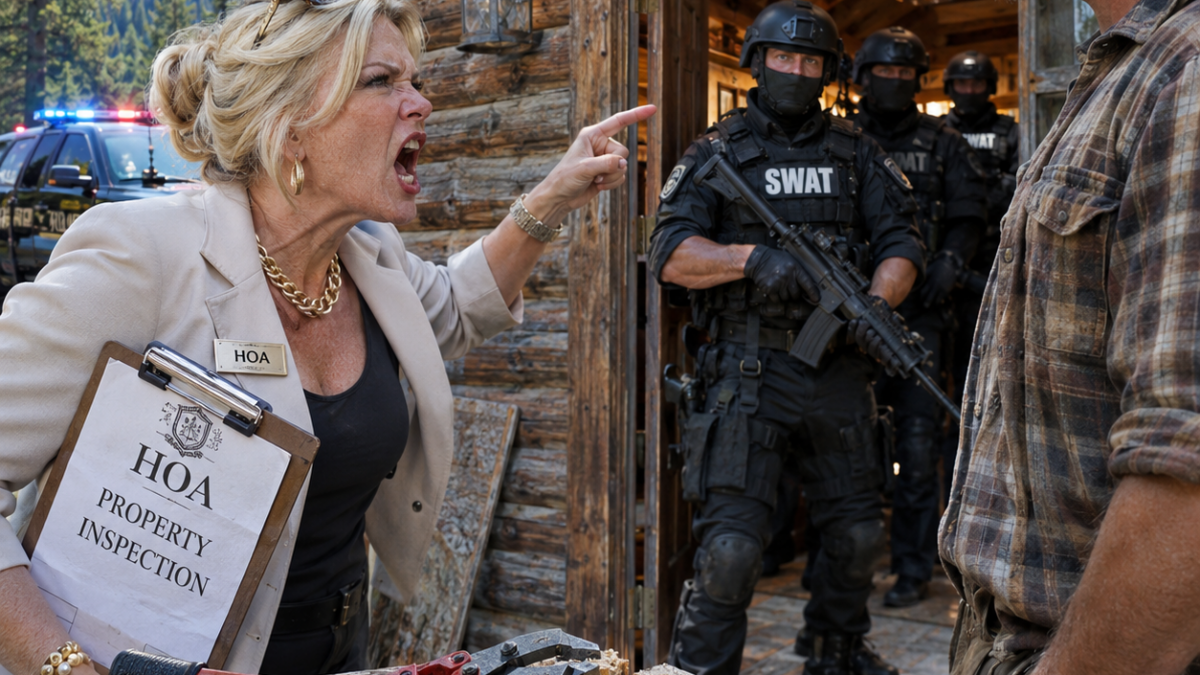
Then the tactical team entered.
Not cinematic.
Fast.
Controlled.
Commands.
Hands visible.
Down.
Krantz complied immediately.
Brenda did not.
She shouted:
“I’m the HOA president!”
That sentence, more than anything, summarized the previous six months.
Men with rifles were ordering her to the floor inside someone else’s locked cabin, and Brenda’s response was to announce a volunteer title as if it outranked property law.
She finally went down.
Cuffed.
Krantz separated.
Roy entered shortly afterward.
He reviewed camera footage.
Saw the lock.
The drawers.
The papers.
The forced entry.
Then called me.
“Nate.”
“Yeah.”
“You can come back.”
“My cabin?”
“Secure.”
“Brenda?”
“In custody.”
“Krantz?”
“Being interviewed.”
I looked at Glenn.
He smiled.
I didn’t.
Not yet.
The drive back took less than fifteen minutes but felt longer than the original two-hour trip from Tacoma.
Deputies still filled the property.
The broken lock lay beside the porch.
I picked it up.
Heavy.
Cut clean.
Roy came over.
“Leave that for evidence.”
I handed it to him.
Then stepped inside.
Sarah’s photograph was still face-down.
I picked it up.
The glass was cracked at one corner.
Roy stood behind me.
“Sorry.”
I ran my thumb along the frame.
“It’s not about the frame.”
“I know.”
I set it upright.
Then looked around the room.
For months I had imagined catching Brenda.
I expected satisfaction.
Instead I felt violated.
That cabin had survived winter storms, wildfires nearby, family deaths, three generations of repairs.
The damage from Brenda was minor compared with all that.
But she had entered because she believed wanting access was enough.
That bothered me in a way money could not fix.
Roy touched my shoulder.
“We’ll process everything.”
“Thank you.”
“Don’t thank me yet.”
“Why?”
“Financial case is about to get uglier.”
Seventy-two hours later, Pinecrest held an emergency meeting.
Ninety residents came.
A normal meeting drew maybe twelve.
Cascade Weekly published that morning.
**HOA PRESIDENT ARRESTED AFTER CABIN ENTRY; FINANCIAL AND DOCUMENT QUESTIONS EXPAND**
Aisha had done it carefully.
Not screaming fraud as proven fact.
Documents.
Questions.
Interviews.
Timeline.
That made it devastating.
Brenda posted bail.
She arrived without the tennis visor.
Hair pulled back.
Hands unsteady.
Vince, her attorney, sat beside her.
Derek sat farther down the table.
He looked terrible.
Brenda read from prepared remarks.
“Recent misunderstandings have been weaponized by a small group of disgruntled owners.”
Somebody laughed.
She continued.
“I acted within my authority as association president.”
A voice shouted:
“You cut his lock!”
“The governing documents provide emergency access.”
I stood.
Rita handed me the packet.
“Now.”
We passed copies through the room.
Original 1998 charter.
2019 version.
Paragraph 3.7 present in one.
Missing in the other.
People flipped pages.
Whispering stopped.
I took the microphone.
“This isn’t only about my cabin.”
I looked at Carmen.
Old Ed.
Faces I knew.
Faces I didn’t.
“My wife loved that place. Her grandfather built it. My father added to it. Brenda tried to turn it into numbers.”
I held up the altered documents.
“But eleven other families lost properties while these rules were being enforced.”
Derek looked down.
I projected Cascade Retreats’ registration.
Managing member:
Derek Kowalski.
The room reacted exactly the way truth reacts when everybody understands it at the same time.
Gasps.
Then silence.
Carmen stood.
Her hands trembled.
“Brenda called CPS on me.”
Brenda shook her head.
“I did not.”
Carmen looked directly at her.
“My kids were interviewed because someone claimed bicycles in our yard proved unsafe living conditions.”
“I don’t control CPS.”
“You reported me.”
“I raised a concern.”
“My seven-year-old asked me if strangers were going to take her away.”
Brenda opened her mouth.
Carmen’s voice broke.
“You don’t get to call that community standards.”
Old Ed stood next.
He brought a photograph.
His oak.
Before.
Huge canopy.
Then after.
Stump.
“Two hundred years.”
He looked toward Brenda.
“You told me the utility company required removal.”
“It was a safety risk.”
“I called them later.”
He held up a letter.
“They never requested it.”
Brenda looked toward Vince.
Vince stopped taking notes.
Glenn played Derek’s diner recording.
Five thousand dollars.
Forget what you saw.
Room silent again.
Derek stood.
“This was taken out of context.”
Glenn said:
“Which part? The money or the forgetting?”
Nervous laughter.
Then Jessie spoke.
Engineer voice.
Calm.
Precise.
She walked through the infrastructure report.
Inflated assumptions.
Unsupported repair estimates.
Licensing issues.
Structural conclusions inconsistent with available conditions.
She did not call Brenda a liar.
She did something worse.
She showed the math.
Then Sheriff Roy entered.
He stood near the back.
Beside him was Investigator Chen from the Attorney General’s Office.
She introduced herself.
“We have opened an inquiry into HOA financial practices, altered governing documents, and related transactions. Anyone who believes they were affected should speak with our office.”
Business cards.
People lined up.
Aisha raised her hand.
Brenda saw her.
Did not call on her.
Aisha asked anyway.
“Ms. Kowalski, did you participate in changing association documents that were later used to place liens against cabins subsequently purchased through a company controlled by your husband?”
Brenda looked at Vince.
Vince whispered something.
Then stood.
“My firm is withdrawing from representation in this matter, subject to applicable court requirements.”
Brenda stared at him.
“What?”
He gathered his papers.
“Vince.”
He would not look at her.
“Sit down.”
He didn’t.
That was the moment Brenda cracked.
Not when SWAT entered the cabin.
Not when she was cuffed.
Not when the newspaper printed her photograph.
When her own lawyer began physically moving away from her.
“You don’t understand!”
The room froze.
Brenda looked around.
“The expenses.”
Derek stood.
“Brenda, stop.”
“No.”
“Stop talking.”
“We were going to lose everything.”
Derek’s face drained.
“Brenda.”
“Your company was collapsing!”
Every camera in the room was pointed toward her now.
“We had debt. The cabins were undervalued. Nobody was maintaining anything. We were improving Pinecrest.”
Carmen whispered:
“By taking houses?”
Brenda shouted:
“We bought them legally!”
“After you fined people into selling,” someone answered.
“No!”
She grabbed the microphone.
“We gave people choices.”
Old Ed said:
“You gave them fear.”
Brenda looked toward me.
“This was supposed to work.”
That sentence hung in the air.
Then Derek walked out.
She stared after him.
I never learned exactly which part she meant.
The modernization.
The enforcement.
The purchases.
The money.
Maybe all of it.
The votes came fast.
Remove Brenda.
Unanimous.
Suspend all disputed liens pending legal review.
Unanimous.
Rescind the special assessment.
Unanimous.
Independent audit.
Unanimous.
Review all property transactions involving board members, relatives, and Cascade Retreats.
Unanimous.
Brenda collected her papers.
Her hands shook so badly half slid onto the floor.
Nobody helped.
I almost did.
That surprised me.
Then I remembered Sarah.
She would have.
Not because Brenda deserved kindness.
Because Sarah hated seeing people humiliated once the fight was already over.
I bent down.
Picked up two sheets.
Handed them to Brenda.
She looked at me.
For a second, all the anger vanished from her face.
She just looked tired.
I said:
“You could have followed the rules.”
She took the papers.
Walked out.
Camera flashes started in the parking lot.
I sat down.
Rita touched my arm.
“You all right?”
“No.”
“Good.”
“What?”
“If you felt wonderful right now, I’d worry about you.”
The court proceedings took months.
Nothing moved as quickly as neighborhood rumors predicted.
My lien was voided.
So were the special assessment actions tied to the defective process and altered provisions after review.
Other owners filed claims.
Investigators followed Cascade Retreats transactions.
The HOA insurer opened its own investigation.
Bank records showed a pattern consistent with what we had feared:
pressure against selected owners,
distressed sales,
purchases through Derek’s company,
renovation,
short-term rental conversion,
profit.
Brenda eventually entered pleas resolving the forced-entry case and fraud-related matters.
Her sentence included probationary supervision, suspended incarceration under the final arrangement, restitution, and community service.
Derek resolved conspiracy and bribery-related allegations through his own plea and substantial financial penalties.
The exact legal labels mattered less to me by then than the result:
they no longer controlled Pinecrest.
Cascade Retreats was dissolved through the resulting litigation and settlements.
Properties still held by the company were sold under court-supervised or negotiated arrangements.
Some proceeds went toward claims and restitution.
Three families eventually returned to cabins they had lost or replaced through settlements.
Not all could.
That hurt.
Money does not recreate years.
Old Ed never got his oak back.
Carmen’s children never forgot the child-services interviews.
My cabin’s broken lock was replaceable.
That tree was not.
Trust was not.
Deputy Krantz faced an internal investigation.
His involvement with Brenda ended his career earlier than he expected.
I did not celebrate that either.
Roy once asked me:
“You feel sorry for him?”
“No.”
“Then what?”
“I think one bad decision became ten.”
Roy nodded.
“Usually does.”
Pinecrest elected Carmen president.
She laughed when people nominated her.
Then cried.
Then won.
Old Ed became treasurer because, in his words:
“If anybody steals a dollar, I’ll haunt them while alive.”
Jessie volunteered to review technical compliance issues.
Not enforcement officer.
She refused the title.
“I’ll review engineering claims,” she said. “I’m not measuring anybody’s curtains.”
The new rules required disclosure of conflicts.
Independent review for major assessments.
Written notice procedures.
Meeting records.
No related-party contract without member review.
Nothing revolutionary.
That was the point.
Governance should be boring.
Brenda had made everything dramatic because drama created confusion.
The new board made things dull enough to trust.
Our settlement with the insurer and responsible parties eventually covered legal fees, property damage, and a share of broader claims.
My portion was more than I expected.
I kept fifteen thousand.
Not for myself.
I created the Pinecrest Heritage Fund.
Sarah would have liked that.
Historic cabins.
Low-income families.
Repairs to structures predating the vacation-rental boom.
Old Ed received the first grant for foundation work.
He tried to refuse.
“Give it to somebody younger.”
“You’re old enough to know better.”
He glared at me.
Then accepted.
The second grant went to a young couple whose great-grandparents had built their place in the forties.
Roof repairs.
Drainage.
Preservation instead of demolition.
Carmen suggested a heritage festival.
I said no.
Then somehow ended up building half the display tables.
Glenn started a website collecting public resources and templates owners could use when navigating HOA disputes.
He called it the HOA Self-Defense Toolkit.
I told him the name sounded dramatic.
He said:
“So did the BearCat in your driveway.”
Fair.
At the first Pinecrest Heritage Days festival, families toured old cabins.
Old-timers told logging stories.
Jessie gave a short talk about timber framing.
Glenn burned brisket and claimed it was “Texas bark.”
Liam chased Carmen’s kids near the creek.
And I sat in Sarah’s wildflower meadow with a piece of cedar across my knees.
Liam stood beside me.
“What are we making?”
“A bench.”
“Why?”
“Because your grandma liked sitting here.”
“I never met her.”
“I know.”
“What was she like?”
That question stopped my hands.
Children ask enormous things casually.
I looked across the flowers.
“She laughed when she got angry.”
“That’s weird.”
“Yes.”
“She liked fish?”
“Catching them.”
“Did she like cabins?”
“This one.”
“Why?”
I smiled.
“Because people left her alone up here.”
Liam considered that.
Then said:
“That Brenda lady didn’t.”
“No.”
“Did Grandma know her?”
“No.”
“Good.”
I laughed.
We worked.
Hand plane.
Chisel.
Sandpaper.
Tools my grandfather used.
Tools my dad used.
Tools I had almost stopped touching because the workshop became evidence in an HOA dispute.
Liam struggled with the plane.
“Against the grain,” I said.
“What?”
“Feel the wood.”
“How?”
“Run your hand.”
He did.
“One way feels smooth.”
“Exactly.”
“So go that way?”
“Usually.”
He pushed the plane.
A cedar shaving curled away.
His eyes widened.
“That’s cool.”
I swallowed.
Sarah would have loved that moment.
The finished bench sat at the edge of the meadow.
Summer sunlight.
Lupine.
Paintbrush.
Columbine.
The same “fire hazard” Brenda once cited.
Hummingbirds moved between flowers.
Jessie joined me after Liam ran toward the creek.
She sat.
“You okay?”
“Why does everybody ask me that?”
“Because you answer badly.”
I looked toward the cabin.
New lock.
Same cedar.
Same creek.
“How long do you think Mom would’ve tolerated Brenda?”
Jessie laughed.
“Eleven minutes.”
“That long?”
“She was patient.”
“True.”
Then Jessie became serious.
“Dad.”
“What?”
“You know you almost lost yourself in this.”
I looked at her.
“You didn’t lose the cabin.”
“No.”
“But for six months, every conversation was Brenda.”
“I know.”
“Every call.”
“I know.”
“You started coming up here because this place helped you remember Mom.”
She touched the bench.
“Then you started coming here to collect evidence.”
That hurt because it was true.
I stared at the workshop.
“What do I do with that?”
“Use it again.”
“For evidence?”
“For furniture.”
So I did.
That fall, I turned off two interior cameras.
Then another.
I kept exterior security.
That was sensible.
But I no longer wanted Sarah’s photograph watched from three angles by cloud servers.
I made a dining table for Jessie.
A toy chest for Liam.
Shelves for Carmen.
Old Ed brought me a slab from one of the oak limbs he had saved after the tree was cut.
“Been drying in my shed.”
I ran my hand over it.
“Beautiful.”
“Make something.”
“What?”
“Something Brenda can’t ruin.”
I thought about that.
Then built a long community table.
Oak top.
Cedar legs.
We put it in the Pinecrest hall.
Every annual meeting now happens around it.
First meeting after installation, Carmen ran her hand along the wood.
“Ed’s tree?”
“Yes.”
He stood across the room pretending not to listen.
“What do we call it?”
“No name.”
Glenn said:
“The Brenda Memorial Table.”
Ed almost threw a coffee cup at him.
We laughed harder than we should have.
Two years passed.
Then three.
Pinecrest changed.
Some cabins remained rentals.
That was fine.
Tourists were not the enemy.
Greed was not automatically evil either.
The problem had been coercion.
Secret profit.
Rules weaponized against people who did not know how to fight back.
The new board allowed reasonable rentals.
Protected quiet hours.
Required fire safety.
Enforced actual rules.
Carmen cited me once.
I found a notice on my cabin door.
**WOODPILE TOO CLOSE TO STRUCTURE — FIRE CODE CONCERN.**
I called her.
“You enjoying this?”
“Immensely.”
“Brenda possessed you?”
“Move your wood.”
I checked.
She was right.
I moved it.
That might have been the healthiest moment Pinecrest ever had.
A rule.
Legitimate.
Applied normally.
Complied with.
No conspiracy.
No lawsuit.
No tactical team.
I sent Carmen a photo afterward.
**Done.**
She replied:
**See? Civilization.**
Old Ed died the following winter.
Quietly.
At home.
His daughter asked if we could hold the memorial in the community hall.
We gathered around the table made from his oak.
People told stories.
Forty-three years in the same cabin.
Fishing.
Snowstorms.
Broken generators.
Neighborhood feuds that sounded laughably small compared with Brenda.
His daughter touched the tabletop.
“He’d like this.”
“He complained about the finish.”
She laughed through tears.
“That means he loved it.”
After everyone left, I stayed behind.
Ran my hand along the oak.
That tree had been destroyed because one person lied about authority.
But part of it remained.
Not as a stump.
As a table people gathered around.
That was different from revenge.
Better.
Glenn’s website kept growing.
Thousands of downloads.
People from other states emailed.
Solar panels.
Fences.
Parking.
Architectural review.
Illegal assessments.
Some cases sounded legitimate.
Some sounded like owners angry because rules applied to them.
Glenn wanted me to answer everybody.
I refused.
“We are not starting a national anti-HOA militia.”
“Coward.”
“We had one case.”
“One excellent case.”
“We got lucky.”
“We documented.”
“We also had Roy.”
“Details.”
Rita became the person everyone called first.
She hated that.
Pretended to.
Deshawn graduated law school.
He sent us a photograph holding his diploma.
Caption:
**Paragraph 3.7 says hello.**
I printed that one.
Put it in the workshop.
Sheriff Roy retired eventually.
At his retirement barbecue, Glenn presented him with toy bolt cutters mounted on a plaque.
Roy stared at them.
“I should arrest you.”
“Retired.”
“Still know people.”
I asked Roy something later, away from everyone.
“Did you know Brenda would break in?”
“No.”
“Expected?”
“Possible.”
“Was the tactical team really training nearby?”
He smiled.
“They were scheduled for exercises.”
“That’s not an answer.”
“It’s the answer you’re getting.”
Fair enough.
“Would you do it the same way again?”
His expression changed.
“Probably not.”
That surprised me.
“Why?”
“Too much risk.”
I nodded.
He continued.
“Worked out clean. But situations with armed personnel, deputies, forced entry—too many things can go wrong.”
I appreciated hearing that.
Stories get cleaner with time.
Memory turns chaos into inevitability.
It was never inevitable.
Brenda could have left when Krantz told her to.
Krantz could have stopped her before the lock was cut.
I could have driven to the cabin angry and created a confrontation.
Somebody could have misunderstood a movement when the tactical team entered.
Nobody did.
We were lucky.
That mattered.
I stopped telling the story like it was a prank where an HOA president walked into SWAT.
It was not funny while it happened.
It was the end of a dangerous escalation.
One that should never have reached that point.
The real victory happened afterward.
Paperwork corrected.
Families compensated where possible.
Rules fixed.
Conflicts disclosed.
Cabins preserved.
People returned.
The tactical team was just the moment Brenda could no longer pretend HOA authority meant whatever she wanted it to mean.
Five years after the break-in, Liam was eleven.
Tall enough to use the hand plane without me hovering over him.
We went to the cabin alone one October weekend.
Jessie had work.
Glenn was guiding fishermen.
Carmen was visiting family.
Pinecrest was quiet.
Liam spent the afternoon in the workshop.
“What are you making?”
“Secret.”
“That usually means ugly.”
“Grandpa.”
“Sorry.”
He worked for an hour.
Then brought me a small cedar box.
Crooked lid.
Sanding inconsistent.
One corner slightly open.
Perfect.
“For what?”
“Grandma.”
I stopped.
He had carved an S into the top.
Not well.
But clearly.
“I thought we could put pictures in it.”
I sat down.
He looked worried.
“You don’t like it?”
“Liam.”
“What?”
“I love it.”
We brought out photographs.
Sarah in the meadow.
Sarah holding a trout.
Sarah with Jessie as a little girl.
Sarah sitting on the porch with Dad.
Sarah beside me, younger than I remembered feeling.
Then Liam found one of the cabin.
Same door.
Old lock visible.
He held it up.
“This was before Brenda?”
“Yes.”
“Does it bother you?”
“What?”
“The door.”
I looked.
New lock now.
Old photograph.
“No.”
“Why?”
I thought about it.
“Doors aren’t memories.”
He nodded like that was obvious.
We placed the photograph in the box.
That evening, snow started.
Early.
Large flakes moving between the firs.
We sat on the porch under blankets.
Creek below us.
Woodstove behind us.
Wildflowers gone for the season.
Liam said:
“Mom says you almost sold this place once.”
I looked at him.
“She told you?”
“She said before the fight you were thinking about it.”
That was true.
After Sarah died, some weekends at the cabin hurt more than they helped.
Every room contained absence.
I had considered selling.
Never told Brenda.
Barely told Jessie.
“Yeah.”
“Why didn’t you?”
“I wasn’t ready.”
“Then Brenda made you want to keep it?”
I laughed softly.
“In a strange way.”
“That’s funny.”
“Not at the time.”
Snow gathered on the railing.
I thought about Derek’s offer.
One hundred eighty thousand.
If Brenda had approached differently—no threats, no forged rules, no harassment—maybe another year, another bad winter, another lonely weekend, and I might have sold voluntarily.
Maybe even to them.
She could not tolerate that possibility.
She needed control.
That was what destroyed her.
Not ambition.
Not money.
Control.
She believed people existed as obstacles between her and whatever outcome she had already decided she deserved.
The cabin taught me the opposite.
Wood tells you what it will tolerate.
Force a cut against the grain, and it tears.
Ignore moisture, it moves.
Rush a joint, it opens.
Good work is partly knowing what you do not control.
Sarah understood that better than I ever did.
The following morning, Liam and I walked to the creek.
Ice along the edges.
Water black between stones.
He cast badly.
Hook landed five feet away.
“Terrible.”
“You taught me.”
“That explains it.”
He tried again.
Better.
We stood without talking.
I looked back through the trees.
Cabin roof.
Smoke.
Cedar walls.
No clipboard.
No citations.
No tactical vehicles.
No cameras inside.
Just a place.
That was all I had wanted.
When we returned, I noticed the old broken lock hanging on a nail in the workshop.
I had kept it.
Evidence had been released years earlier.
I told myself it was history.
Liam picked it up.
“What happened to this?”
“Brenda cut it.”
“This one?”
“Yep.”
He inspected the clean bite marks.
“Why do you keep it?”
I opened my mouth.
No answer came.
Trophy?
Warning?
Proof?
I had photographs.
Court records.
News clippings.
I did not need the metal.
“Good question.”
I took it from him.
Walked outside.
Dropped it into the scrap bin beside the workshop.
Liam looked surprised.
“You’re throwing it away?”
“Yes.”
“Why?”
“Doesn’t work anymore.”
He shrugged.
That answer satisfied an eleven-year-old.
Maybe it should have satisfied me years earlier.
That lock had done its job until somebody destroyed it.
Then we replaced it.
The cabin stayed.
The family stayed.
The memories stayed.
The broken part did not need to become sacred just because someone else broke it.
That afternoon, before driving home, I stood in Sarah’s meadow.
Nothing flowering in October.
Just stems.
Seed heads.
Wet earth.
But I knew what spring would look like.
Lupine first.
Then paintbrush.
Columbine.
Hummingbirds later.
The meadow Brenda called unkempt had outlasted her presidency.
The cabin she tried to force into a distressed sale still belonged to us.
The workshop she called a commercial violation now held a crooked cedar box made by Sarah’s grandson.
And the lock she cut because she thought authority made permission unnecessary was sitting beneath rusty metal in a scrap bin.
I locked the new deadbolt.
Pulled once to check it.
Then stopped.
For years after the break-in, I always pulled twice.
Sometimes three times.
That day, once was enough.
Liam was already in the truck.
“Grandpa!”
“Coming.”
I walked down the steps.
Douglas firs moved slightly in the cold wind.
The creek kept running below the property, exactly as it had before Brenda, before the HOA, before me.
I looked at the cabin one more time.
Not because I was afraid somebody would take it.
Because it was beautiful.
Then I got in the truck and drove home.
[END OF STORY]








