HOA KAREN Cut My Gate and Claimed My Private Road—So I Walked Into Her Meeting and Said, “$500 Per Commercial Vehicle.” The Whole Room Went Silent.
PART 2
The attorney’s name was Davis Hargrove, and within ten minutes of meeting him, I understood why ranchers across Central Texas talked about him like he was a piece of heavy equipment you only rented when something had gone seriously wrong.
He worked out of a modest office above a feed store outside Austin. There was no polished marble lobby, no wall-sized logo, no receptionist offering sparkling water. His office smelled faintly of leather, printer paper, and livestock feed drifting up from downstairs.
He wore a suit jacket over a white shirt, but beneath the desk I could see worn brown boots.
That made me trust him more than a billboard ever could.
I put my grandfather’s easement on his desk.
Then the property deed.
Four years of road-maintenance invoices.
Photographs of broken culverts.
Pictures of deep ruts caused by heavy trucks.
The veterinary report for the calf.
And finally, Camille’s gold-lettered threat telling me to remove my gate.
Davis started with the easement.
He read it once.
Then again.
On the second reading, he stopped halfway down page two.
His finger rested against one paragraph.
“How long has the commercial traffic been happening?”
“About four years.”
“And they haven’t contributed to maintenance?”
“Not one check.”
“How many commercial vehicles?”
“Hard to say before cameras. Hundreds. Maybe thousands of trips.”
“Concrete trucks?”
“Yes.”
“Landscapers?”
“Yes.”
“Contractors?”
“Yes.”
“Delivery services?”
“Constantly.”
He leaned back.
“And the HOA president personally ordered your padlock cut?”
“On Facebook Live.”
He stared at me.
“On video?”
“Yes.”
For the first time, Davis smiled.
It wasn’t a happy smile.
It was the smile of a mechanic who had just opened an engine and found the missing bolt sitting right on top.
“Colton,” he said, “has anybody over there actually read this easement?”
“I’m beginning to think not.”
He turned the document toward me and tapped the paragraph.
The original agreement contained an enforcement clause.
If the holder of the easement materially violated its conditions for more than twelve consecutive months, my family—the landowner—could demand renegotiation.
And if the violations weren’t corrected, we could move toward revocation.
I stared at him.
“Revocation meaning what I think it means?”
“It means exactly what you think it means.”
I looked down at the document.
“If I revoke this…”
“They lose the easement.”
“All ninety-four homes?”
“Assuming they truly have no other legal access, yes.”
I said nothing.
The office suddenly felt smaller.
Camille had come onto my property with a locksmith because she believed a gate inconveniencing wealthy homeowners was somehow more powerful than the deed underneath it.
But the truth was the opposite.
That gate was the smallest part of her problem.
The road itself was mine.
And the only reason those ninety-four families could legally cross it was because my grandfather had allowed them to.
I should have felt victorious.
I didn’t.
I pictured school buses.
Parents driving to work.
Teenagers leaving for college.
Ambulances.
Grocery deliveries.
Ordinary people who might have had no idea what Camille had been doing.
“I’m not shutting ninety-four families out,” I said.
Davis studied me.
“You’d be legally justified.”
“Doesn’t make it right.”
He nodded once.
“What do you want?”
“I want them to honor the agreement.”
“That’s all?”
“I want the commercial traffic controlled. I want the road maintained. I want what they owe. And I want Camille to understand that private property doesn’t become hers because she points at it.”
Davis smiled again.
“That,” he said, “we can work with.”
## **THE GATE SHE THOUGHT SHE OWNED**
Three weeks later, Silverstone Ridge held its monthly HOA meeting.
I had never been inside their clubhouse.
From the outside, it looked more like a boutique hotel than a neighborhood meeting space.
Inside were leather chairs, recessed lighting, stone countertops, and a coffee station with four kinds of milk.
I walked in wearing clean jeans, boots, and a pearl-snap shirt.
About sixty residents were seated.
Camille stood at the podium in a fitted navy blazer, talking about landscaping contracts.
She saw me near the back.
Stopped.
Her expression changed for less than a second.
Then the professional smile returned.
“Can I help you?”
The implication was obvious.
I didn’t belong there.
I was the rancher.
The cow man.
The visual liability.
“I’d like to address the board.”
“You’ll have two minutes.”
“That’ll be enough.”
I walked toward the front carrying a cardboard box.
Whispers followed me.
I recognized two of the board members who had been present when Camille cut my lock.
Neither looked at me.
I placed the box beside the podium.
Then I turned toward the room.
“I’m not here to argue with anybody.”
Camille folded her arms.
“I’m here to agree.”
That got her attention.
“You want access through my gate?”
Nobody moved.
I looked around the room.
“Sure.”
Camille’s lips began forming a smile.
Then I continued.
“Residential access remains exactly what it has always been. Two vehicles per household, under the easement my grandfather signed with your developer in 1991.”
Her smile froze.
“Commercial vehicles are different.”
I reached into the box.
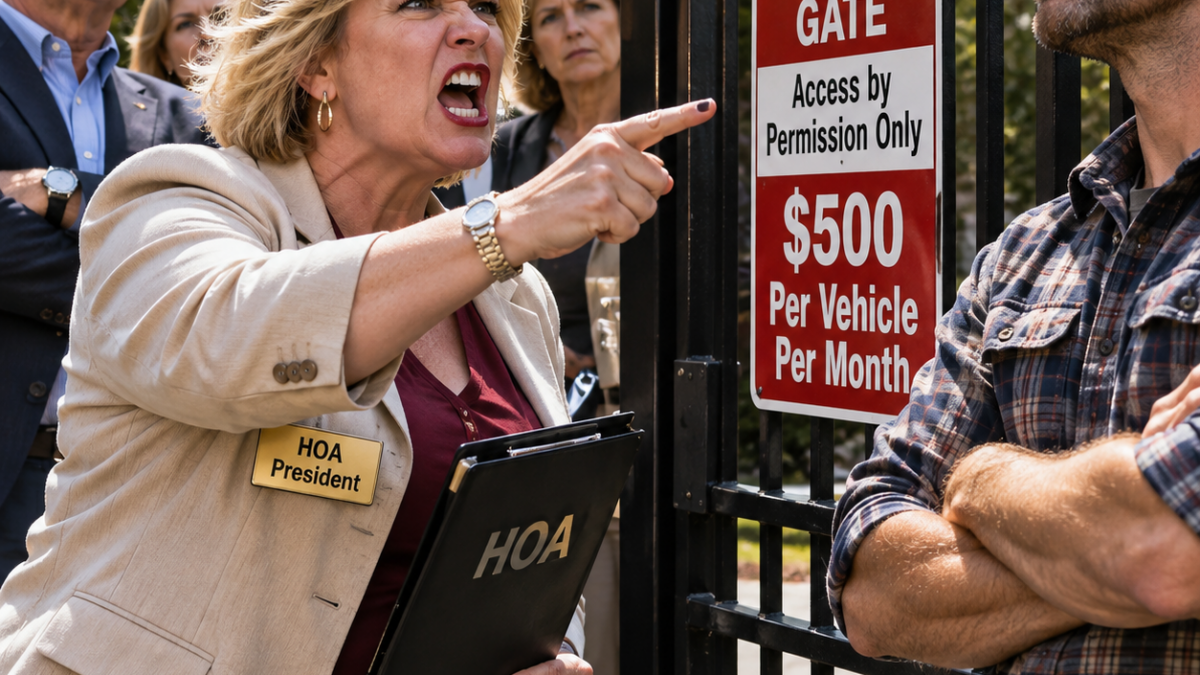
“Starting now, unauthorized commercial access across my property is five hundred dollars per vehicle, per month.”
Silence.
Not polite silence.
Shock.
The kind where people stop shifting in their chairs because their bodies are trying to catch up with what their ears just heard.
I placed a copy of the easement on the table.
“Landscaping companies. Pool contractors. Concrete trucks. Construction crews. Any business repeatedly using my private road outside the terms of the easement.”
Camille gripped the podium.
“That’s outrageous.”
“No, ma’am.”
I pulled out another document.
“I also need forty-two thousand, one hundred sixty dollars in unpaid road maintenance.”
A man in the second row turned toward another resident.
Someone behind me whispered, “What?”
“That represents the HOA’s unpaid share of grading, gravel, drainage, and culvert repair over the last four years.”
Camille finally spoke.
“This is extortion.”
I looked at her.
“No.”
Then I held up the easement.
“This is your contract.”
I started handing out copies.
“I brought sixty.”
The first row took them cautiously.
Then the second.
Paper moved through the room.
“You’ve had this agreement for thirty-three years.”
I looked directly at Camille.
“It was recorded with the county the entire time.”
Her face had turned pale beneath her makeup.
“You just never bothered to read it.”
Nobody said anything.
The expensive coffee machine behind us hissed.
That sound seemed absurdly loud.
I picked up my empty box.
“You have sixty days.”
Camille leaned toward the microphone.
“You cannot threaten this community.”
I stopped.
Turned around.
“I’m not threatening anybody.”
I pointed toward the easement now sitting in the hands of her own residents.
“My grandfather gave this community access. Your board violated the terms. I’m giving you the chance to fix it.”
Then I walked out.
My hands were steady until I reached my truck.
Only after I closed the door did I realize how hard my heart was pounding.
I wasn’t a public speaker.
I wasn’t comfortable in front of sixty strangers.
But there was something strangely calming about telling the truth when you knew the paper on the table could prove every word.
I drove back to the ranch.
Behind me, Camille had sixty copies of a thirty-three-year-old problem sitting in the room.
And now everyone could read it for themselves.
## **CAMILLE DECLARED WAR**
By nine that evening, Camille had called my appearance a “publicity stunt.”
By ten, she had emailed every homeowner.
By midnight, she had called an attorney.
Her email described me as an angry livestock owner attempting to financially punish an established residential community.
She called the five-hundred-dollar commercial access fee extortion.
She called the unpaid maintenance amount fictional.
She called my gate an illegal obstruction.
And apparently she decided that the best response to discovering she had never read the road agreement was to start a legal war over it.
A lawsuit followed.
The HOA’s attorney argued that decades of use had somehow converted my private road into a road the community had broader rights to use.
He asked the court to order my gate removed.
Camille separately complained that the gate created a safety hazard.
Then she started a Facebook campaign.
**FREE OUR ROAD — SILVERSTONE RIDGE RESIDENTS UNITED.**
Someone showed me the page.
The cover photograph featured Camille standing beside my gate at sunset.
White dress.
Perfect hair.
Hand resting on the steel rail.
She looked like she was posing for a charity campaign.
Her caption said ninety-four families were being “held hostage.”
Hostage.
That word bothered me.
Nobody had been locked out.
Residential access continued.
I had never demanded five hundred dollars from families driving to their homes.
I had demanded payment for commercial traffic that was destroying a private road while the HOA ignored its maintenance obligation.
But Camille understood something important about public opinion.
A simple lie travels faster than a complicated truth.
**Rancher demands $500 from families** sounded better on Facebook than:
**HOA violated recorded easement for four years and refused to pay road maintenance.**
She knew that.
So she leaned into it.
She filmed a video.
Apparently more than a thousand people watched it.
A local television reporter contacted her.
Then the reporter called me.
“Mr. Briggs, we’d like your response to allegations that you’re attempting to restrict access to Silverstone Ridge Estates.”
“No comment.”
“Camille Thornbury says families are being held hostage.”
“No one’s residential access has been restricted.”
“Would you appear on camera?”
“No.”
“Why not?”
“Because this isn’t a television argument. It’s a property agreement.”
Then I hung up.
I had cattle to check.
That afternoon I repaired a section of fence damaged by a contractor’s trailer.
The irony wasn’t lost on me.
While Camille was telling television cameras how unfairly her neighborhood was being treated, I was repairing yet another piece of ranch infrastructure damaged by vehicles she had authorized.
I thought about responding publicly.
Davis advised against it.
“She’s building emotion,” he said. “We’re building evidence.”
“I hate letting her lie.”
“I know.”
“People believe her.”
“Some do.”
“How long do we just sit there?”
He looked at me.
“Until the facts matter more than the performance.”
That was one of the hardest lessons of the entire fight.
When someone attacks your reputation publicly, silence feels like surrender.
It isn’t always.
Sometimes silence is just discipline.
## **THE COURTROOM**
Camille arrived at the hearing dressed like she was attending a corporate acquisition.
Charcoal skirt.
Silk blouse.
Perfect hair.
Her attorney had binders.
We had the deed.
The recorded easement.
Maintenance receipts.
Survey records.
Photographs.
Judge Patricia Caldwell reviewed everything.
Camille’s attorney argued that public use over many years had expanded the neighborhood’s rights.
The judge looked at him.
Then at the original easement.
Then back at him.
“So your client has a recorded access agreement?”
“Yes, Your Honor.”
“And the road remained privately owned?”
“Yes.”
“And gated?”
“Yes.”
“And maintained by the landowner?”
“Yes, but—”
“And now you’re arguing that your client’s use became adverse to the person who gave them permission to use it?”
The attorney hesitated.
Camille stared at him.
He tried to recover.
“Your Honor, the volume and duration of use—”
“The volume of violating an agreement does not automatically erase the agreement.”
I looked down.
Davis remained expressionless.
The judge denied the HOA’s attempt to turn decades of permitted use into some broader public entitlement.
Then she denied the request to remove my gate.
Camille’s safety complaint failed too.
County officials reviewed the property.
My ranch was agricultural land outside the municipal rules Camille had cited.
The gate was not an unlawful obstruction.
Her argument collapsed.
One by one.
But the real blow came next.
Davis formally documented the HOA’s easement violations.
By then, our new cameras had collected enough information to show the scale of commercial traffic.
Hundreds of unique commercial vehicles had used the road in a year.
Landscaping companies.
Construction vehicles.
Pool contractors.
Delivery services.
Catering vans.
Utility contractors.
Traffic well beyond what the original easement allowed.
Then came the maintenance total.
$42,160.
And finally, the clause.
Section nine.
Paragraph three.
The part Camille should have read before ordering someone to cut my lock.
Material violations lasting more than twelve months gave me the right to demand renegotiation.
And potentially revoke access if the problem remained unresolved.
Camille’s HOA had been violating the easement for roughly four years.
Davis called me after filing the notice.
“You understand the leverage you have now?”
“Yes.”
“If they refuse to negotiate, we can proceed.”
I looked through my kitchen window toward the road.
For the first time in my life, the road looked different.
My grandfather had built it with machinery he could barely afford.
My father had repaired it year after year.
I had spent thousands maintaining it.
And because my family had always been quiet about those responsibilities, people on the other side of the gate had eventually forgotten there was a family behind them at all.
They saw gravel.
They didn’t see labor.
They saw access.
They didn’t see permission.
They saw inconvenience.
They didn’t see ownership.
I touched the cut padlock still sitting on my kitchen shelf.
“I know exactly what leverage I have.”
## **THE PART OF ME THAT WANTED TO CLOSE IT**
I’m not going to lie and pretend revenge never crossed my mind.
It did.
Especially late at night.
I would picture Camille standing at the gate in her expensive heels telling me to know my place.
I would remember that calf.
That was the part that stayed with me.
Not the lawsuit.
Not Facebook.
Not even the lock.
The calf.
She had been born during a cold spell in February.
Her mother had struggled through labor.
I had spent hours beside them.
When the calf finally came, she was weak.
For two weeks I bottle-fed her.
She eventually started running with the others.
Then a driver using my ranch as a shortcut killed her and never stopped.
That animal didn’t understand easements.
She didn’t understand HOA politics.
She was just where she belonged.
And Camille’s response wasn’t remorse.
It was a letter demanding I remove the gate that could have prevented it.
So yes.
Part of me wanted to file the notice.
Ninety days.
Then close the road.
I imagined Camille explaining to her neighbors that their expensive houses were now sitting behind an access crisis because she couldn’t accept being told no by a rancher.
I imagined property values dropping.
I imagined her phone ringing nonstop.
I imagined her begging.
Then I thought about my grandfather.
Earl Briggs wasn’t a soft man.
But he was fair.
When the developer came in 1991, Granddad could have refused.
Instead, he made a deal.
He allowed people to build lives beyond his pasture.
He didn’t do it because he loved subdivisions.
He did it because he believed ownership came with responsibility.
The road was his.
That meant he had the right to protect it.
But it also meant he had the responsibility not to use it cruelly.
I knew what he would tell me.
**Don’t become the thing you’re fighting.**
So I called Davis.
“I don’t want revocation.”
“Not yet?”
“Not ever, if we can avoid it.”
“What do you want instead?”
“A new agreement.”
## **THE OFFER THAT SAVED THEM**
We built the new terms around fairness.
Residential access remained free.
Two registered household vehicles, exactly as before.
Nobody driving home from work would pay me five hundred dollars.
Nobody taking their child to school would be blocked.
Nobody calling an ambulance would face a gate dispute.
Commercial traffic would be regulated.
Businesses using my private road repeatedly would need permits.
The HOA would coordinate them.
Heavy traffic would be scheduled to reduce congestion and protect livestock movement.
Commercial vehicles using the road outside the original easement would pay five hundred dollars per month for access.
The HOA would pay the $42,160 in maintenance it should have contributed.
Going forward, it would contribute $4,200 annually.
Divided among ninety-four homes, that was less than fifty dollars a year per household.
Forty-five dollars.
People in Silverstone Ridge probably spent more than that on lunch.
The agreement would also contain one sentence Camille hated more than every dollar figure combined:
**Silverstone Ridge Estates acknowledges that the access road is private property belonging exclusively to the Briggs family and is not community-owned infrastructure.**
That sentence mattered.
Because the entire fight had started when Camille forgot the difference between access and ownership.
Davis printed copies.
Ninety-four of them.
I could have mailed them through the HOA office.
I didn’t.
I drove through Silverstone Ridge myself.
It was the first time I had really looked at the subdivision.
Beautiful homes.
Stone facades.
Large windows.
Perfect lawns.
Families grilling.
Children riding bicycles.
A man washing a pickup.
A woman helping a toddler draw with chalk on a driveway.
Ordinary lives.
Not enemies.
That was important.
Camille wanted the story to be rancher versus residents.
It wasn’t.
It was one person abusing a position and convincing people she spoke for everybody.
I placed an envelope at each residence.
One by one.
Ninety-four homes.
Ninety-four copies of the agreement.
Ninety-four copies of the old easement.
A plain-English explanation.
No insults.
No threats.
No photographs of Camille.
Just facts.
By Sunday night, Silverstone Ridge was doing something Camille had never wanted them to do.
They were reading.
## **THE NEIGHBORHOOD TURNS**
The first message I received came from a man named Greg Delacroy.
He introduced himself as a former corporate attorney.
His email was short.
**Mr. Briggs, I reviewed the 1991 easement. Your interpretation appears correct. I apologize that the association allowed this situation to continue.**
The next message came from a woman named Melissa.
**My husband and I had no idea the HOA wasn’t paying maintenance. We were told those costs were covered in our dues.**
Then another.
**Were residents ever asked to approve commercial access?**
Another.
**Why were concrete trucks allowed if the easement prohibited them?**
The questions multiplied.
But they weren’t being sent to me anymore.
They were being sent to Camille.
Residents started comparing information.
Some dug through old HOA meeting minutes.
Some pulled financial statements.
Some remembered Camille personally approving contractors.
Others remembered her telling them the road was community property.
The resident group chat, which Camille had controlled for years, turned against her.
I didn’t see every message, but Greg later showed me several.
**He isn’t charging residents $500. It’s commercial permits. Why did Camille say otherwise?**
**The annual maintenance is only $45 per home? Why are we spending more on lawyers than it would cost to settle?**
**Who authorized the lawsuit?**
**Did the full board vote?**
**Why didn’t anyone tell us about the revocation clause?**
That last one changed everything.
Because once homeowners understood what Camille’s pride was risking, the argument stopped being about me.
It became about their homes.
Ninety-four properties.
Millions of dollars in value.
One access road.
One easement.
One HOA president refusing to admit she had made a mistake.
Camille hired another lawyer after the first one failed.
His name was Paul Whitfield.
He lasted less than a day.
From what Greg later told me, Whitfield reviewed the deed, easement, rulings, violation notices, and proposed agreement.
Then he called Camille.
“You should sign.”
She apparently expected a strategy.
Instead, he told her the agreement was generous.
Residential access stayed free.
The maintenance amount was supported by records.
The annual cost to homeowners was trivial.
And the alternative could be catastrophic.
Camille refused.
Not because the numbers were unfair.
Because signing meant acknowledging that I had been right.
That became her fatal mistake.
She wasn’t fighting for the neighborhood anymore.
She was fighting against embarrassment.
And people can tolerate arrogance for a surprisingly long time.
What they don’t tolerate is losing money because of somebody else’s ego.
By Friday, Greg drafted a petition calling for Camille’s removal as president.
Seventy-one households signed it.
Seventy-one.
Out of ninety-four.
## **THE MORNING SHE CAME ALONE**
Camille returned to my gate early on a Tuesday morning.
No board members.
No locksmith.
No livestream.
No attorney.
Just her.
The intercom buzzed while I was drinking coffee on my porch.
I pressed the button.
“Morning.”
“Mr. Briggs.”
Her voice sounded different.
Still controlled.
But tired.
“What can I do for you?”
“May I speak with you?”
“You are.”
There was a pause.
Then she said something I never expected.
“You turned them against me.”
I looked toward the gate.
From the porch, I could barely make out her white Porsche sitting beyond the steel bars.
“No, ma’am.”
“Seventy-one signatures.”
“I heard.”
“You’re proud of that?”
“No.”
“You destroyed four years of work.”
I set my coffee down.
“Camille, I gave them copies of an easement.”
“You made me look incompetent.”
“I didn’t write the easement.”
“You knew what would happen.”
“I knew people might read it.”
Her breathing came through the intercom.
“I built Silverstone Ridge into what it is.”
“No.”
“What did you say?”
“You didn’t build it.”
Her voice hardened.
“I raised those property values. I improved the landscaping. I negotiated the vendors. I organized—”
“The road existed before the first foundation was poured.”
Silence.
“My grandfather built it in 1969. Your subdivision depends on something my family created and maintained for decades.”
I paused.
“You didn’t build access to Silverstone Ridge. You inherited permission to use it.”
She said nothing.
“And then you treated that permission like ownership.”
“I was protecting my residents.”
“When you allowed hundreds of commercial vehicles?”
Nothing.
“When you ignored maintenance?”
Silence.
“When a calf was killed?”
Still nothing.
“When you brought a locksmith onto my land?”
Her voice dropped.
“You embarrassed me.”
That sentence explained everything.
Not the road.
Not safety.
Not homeowners.
Embarrassment.
“You embarrassed yourself, Camille.”
She exhaled sharply.
Then said, “Open the gate.”
“No.”
“I need to get back home.”
“Your residential plate still has access through the normal resident system once the gate cycle is active. But I’m not opening it manually because you ordered me to.”
“You’re enjoying this.”
“No.”
And I meant it.
“I’m tired of it.”
For the first time, she didn’t have an answer.
I looked toward the white Porsche.
The engine was running.
Morning light was starting to touch the ridge.
A mockingbird called from the oak near the fence.
Camille sat there.
The same woman who had stood in front of that gate months earlier and told me to know my place.
The same woman who had watched a locksmith cut my padlock.
The same woman who had waved at a camera as she drove across my land.
Now she waited outside it.
Alone.
After almost three minutes, she reversed.
Then drove away.
No Facebook post appeared.
No email.
No new lawyer.
For the first time since I had learned her name, Camille Thornbury went quiet.
## **THE VOTE**
The special meeting happened Saturday morning.
Seventy-eight homeowners attended.
More than any HOA gathering in Silverstone Ridge history.
I didn’t attend.
This was their decision.
Not mine.
Greg called me afterward.
“How did it go?”
He laughed without humor.
“Seventy-four to four.”
I leaned against the barn wall.
“For what?”
“To remove her.”
I looked out toward the cattle.
“You serious?”
“Seventy-four votes of no confidence.”
“What happened?”
“She spoke for about five minutes.”
“What did she say?”
“The usual. Four years of service. Property values. Events. Contracts. Landscaping.”
“And?”
“Nobody argued with her.”
“That sounds unusual.”
“They were done arguing.”
I understood.
There’s a point in every long conflict where anger burns itself out.
What remains is exhaustion.
Greg continued.
“After that, they voted on your road agreement.”
I waited.
“Unanimous.”
I closed my eyes.
Not because I felt victorious.
Because something heavy finally came off my chest.
“So we’re done?”
“We’re done.”
That afternoon, the new interim board president drove to my ranch.
His name was David Morada, a retired engineer.
He arrived alone.
No camera.
No entourage.
No attorney.
He parked outside the gate and called.
I walked down.
David held a folder and a check.
“Mr. Briggs.”
“Colton’s fine.”
He nodded.
“Colton, then.”
We shook hands.
He handed me the signed agreement.
Then the check.
$42,160.
“I’m sorry,” he said.
“You personally don’t owe me an apology.”
“I was a homeowner here while it happened.”
“So were ninety-three other people.”
“That doesn’t make it right.”
“No.”
He looked at the road.
“It’s worse than I realized.”
“I’ll fix it.”
“We’ll help pay.”
I smiled.
“That sentence would’ve saved everybody a lot of trouble four years ago.”
He laughed.
“I imagine so.”
Then he looked at the gate.
“I want to be clear about something. The new board understands this is your property.”
I nodded.
“That’s all I ever needed.”
He held out his hand again.
Two men.
A handshake.
A signed piece of paper.
No insults.
No cameras.
No courtrooms.
That was how the whole thing should have ended before it ever started.
## **WHAT I DID WITH THE MONEY**
I didn’t buy a truck.
I didn’t take a vacation.
I didn’t stand beside the road waving the check around.
I used the money for exactly what it was owed for.
The road.
We regraded almost the entire two miles.
Four damaged drainage culverts were replaced.
Low areas were rebuilt.
Fresh limestone gravel was brought in.
We improved runoff control near the pasture.
The second gate system was installed near the subdivision entrance.
Residential plates were entered into the automated system.
Commercial permits were tracked separately.
Speed limits were enforced.
Heavy contractors scheduled access instead of appearing whenever they pleased.
Within weeks, the road was better than it had been in twenty years.
Something else happened too.
Traffic slowed.
People started waving.
Not everybody.
But enough.
One afternoon, a woman stopped near the pasture while I was repairing fence.
“Colton?”
I looked over.
She was maybe fifty, driving a dark SUV.
“Yes?”
“I’m Melissa.”
The woman who had emailed me.
“I just wanted to say I’m sorry about your calf.”
I stopped working.
She continued.
“I didn’t know until the documents came out.”
“Thank you.”
“My daughter rides horses. If somebody drove through our property like that…”
Her voice faded.
I nodded.
“That was the part that bothered me most.”
“I understand.”
She looked toward Silverstone Ridge.
“I think a lot of us forgot this was somebody’s ranch before it was the road to our houses.”
That sentence stayed with me.
Because it was the entire story in one line.
They had forgotten.
Not maliciously.
Most of them simply never thought about it.
The road was something they drove over.
The gate was something they passed through.
The cattle were scenery.
The rancher was “the cow man.”
Until conflict forced them to look more closely.
## **CAMILLE’S HOUSE**
Three months after the vote, Camille listed her home.
Four thousand square feet.
Infinity pool.
Huge windows.
Italian tile.
Perfect view.
She priced it aggressively.
Nothing happened.
For a luxury real-estate broker, silence around a listing is its own form of torture.
No appointments.
No serious offers.
No bidding war.
Weeks passed.
The price dropped.
Then dropped again.
Eventually, a young couple relocating from Houston made an offer well below what Camille wanted.
She took it.
The morning she moved, I happened to be near the road checking drainage after a storm.
A moving truck had received a commercial access permit.
Camille’s Porsche was loaded with boxes.
She approached the gate.
The plate reader recognized her vehicle.
For one last time, the gate opened automatically.
She drove through.
I was standing about fifty yards away.
She saw me.
I know she did.
For half a second, I expected her to stop.
Maybe say something.
Maybe apologize.
Maybe insult me one last time.
She did none of those things.
She kept driving.
The Porsche passed the pasture, crossed the creek, reached the county road, and turned left.
I watched until it disappeared.
Then the gate closed.
That was it.
No dramatic final confrontation.
No shouting.
No revenge speech.
Just a woman leaving a neighborhood she once believed she controlled.
I looked down at the gravel.
My grandfather’s road.
Still there.
## **THE THING PEOPLE MISUNDERSTOOD ABOUT THE $500**
Months later, somebody asked me whether the five-hundred-dollar commercial fee had been revenge.
The question surprised me.
“No.”
“But that’s what made the HOA panic.”
“No. The revocation clause made them panic.”
“Then why five hundred?”
“Because unregulated commercial traffic was destroying the road.”
The fee had a purpose.
Control volume.
Pay for wear.
Create accountability.
Before the new agreement, a contractor could send three heavy trucks through in one day and nobody even called me.
Afterward, businesses thought about whether access was necessary.
Homeowners grouped projects.
Deliveries were scheduled.
Contractors followed speed rules because losing road privileges suddenly mattered.
The road improved.
The cattle settled.
Dust dropped.
Maintenance costs became predictable.
That wasn’t revenge.
It was structure.
Camille had viewed rules as tools for controlling other people.
My grandfather viewed rules differently.
To him, a good agreement protected everybody.
That was what I tried to restore.
## **THE FARMERS MARKET**
The strangest part of everything came the following spring.
David called me.
“We’ve got residents asking about buying beef directly from you.”
I laughed.
“Seriously?”
“Apparently you’re less terrifying now.”
“I was terrifying?”
“According to Camille’s Facebook page, you were basically a rural warlord.”
“That explains the lack of Christmas cards.”
He laughed.
Then he proposed something.
A small Saturday market.
Local ranchers.
Growers.
Eggs.
Vegetables.
Honey.
Smoked meat.
Maybe baked goods.
I had a shaded area near a group of live oaks inside the ranch.
We tried it once.
Twenty families came.
The next Saturday, forty.
Within two months, people from Silverstone Ridge were walking down the very road that had almost torn the neighborhood apart to buy tomatoes and peaches beneath my grandfather’s oak trees.
Kids watched cattle from behind the fence.
Parents asked questions about ranching.
One boy, maybe eight, pointed toward a calf.
“What’s her name?”
“Number 214.”
He looked horrified.
“That’s not a name!”
I laughed.
“What would you call her?”
He studied the calf seriously.
“Pancake.”
“Pancake?”
“She looks like a Pancake.”
For the next six months, every time that family came to the market, the boy asked about Pancake.
Eventually, I started calling the calf Pancake too.
That probably would have made my father question everything he taught me about livestock.
But it made the kid happy.
More importantly, the ranch stopped being scenery to those families.
It became real.
They learned that cattle sometimes crossed the road.
That newborn calves required care.
That gates existed for reasons.
That gravel roads required maintenance.
And I learned things too.
Not everybody behind those million-dollar houses was Camille Thornbury.
Most were ordinary people.
Some were teachers.
Doctors.
Small business owners.
Retirees.
Parents.
People who had trusted the person elected to represent them.
The conflict had made it easy for me to think of Silverstone Ridge as one thing.
It wasn’t.
Communities rarely are.
## **THE CUT PADLOCK**
I kept Camille’s cut padlock.
For a long time it sat on the workbench.
Then one afternoon, David noticed it.
“That the famous lock?”
“Yep.”
He picked it up.
“You should frame this.”
“Why?”
“Because it cost her the presidency.”
I shook my head.
“No.”
“It sort of did.”
“The lock didn’t do anything.”
I took it from him.
“What mattered was what she thought cutting it meant.”
He looked at me.
“She thought the gate belonged to her.”
“No. Worse.”
I put the lock back down.
“She thought I didn’t matter.”
That was the piece I had struggled to explain.
Camille didn’t simply disagree with me.
She had dismissed me before the disagreement even started.
To her, wealth established legitimacy.
A luxury homeowner mattered.
A rancher interfered.
A polished subdivision had rights.
A working pasture had inconveniences.
That attitude was why she never read the easement.
Why would she?
In her mind, the answer was already obvious.
People like her lived beyond the gate.
People like me opened it.
When I refused, she believed the problem was my attitude.
That arrogance cost her everything she had built inside Silverstone Ridge.
Not because I destroyed her.
Because eventually, reality stopped cooperating with the story she told herself.
## **A YEAR LATER**
A year after the fight, I woke before sunrise and walked outside with coffee.
Mist sat low over the valley.
The road was quiet.
No concrete trucks.
No speeding landscaping trailers.
No dust cloud.
A pair of calves stood near the north fence.
The automated gate opened in the distance.
A resident’s pickup rolled through slowly.
The driver waved.
I lifted my coffee.
Then the gate closed.
Simple.
Exactly how it should have been.
I thought about my grandfather.
He had been gone a long time.
But some mornings, standing on that ranch, I could still picture him dragging the road behind the old tractor.
My father too.
Both men had spent countless hours maintaining something that other people eventually took for granted.
For years I thought they had been too generous by not demanding payment.
Maybe they were.
But that wasn’t the only lesson they left me.
My grandfather had negotiated the easement instead of simply saying no.
My father kept the road open.
Neither man believed property rights required cruelty.
They believed ownership meant stewardship.
That became the part of their legacy I was proudest to preserve.
Camille wanted me to choose between surrender and destruction.
Either give her the road or close it and hurt everybody.
I chose neither.
I made the agreement work.
That was the revenge she never understood.
I didn’t have to destroy Silverstone Ridge to prove the road belonged to me.
I only had to make them respect the people who had kept it usable for fifty-five years.
## **THE NEW BOARD**
Under David’s leadership, HOA meetings became boring.
That was probably his greatest achievement.
Budgets.
Landscaping.
Pool repairs.
Insurance.
Real maintenance.
No dramatic Facebook campaigns.
No legal threats over gates.
No president behaving like a monarch.
Financial records became easier for residents to review.
Major decisions went to votes.
Commercial road permits appeared as a normal line item.
The annual road contribution was collected without drama.
Forty-five dollars per household.
Nobody complained.
One resident joked to me at the farmers market:
“That might be the cheapest thing in this neighborhood.”
He wasn’t wrong.
The new board also installed signs near the subdivision end of the road:
**PRIVATE RANCH ROAD — RESIDENT ACCESS BY EASEMENT**
**25 MPH — LIVESTOCK CROSSING**
The first time I saw them, I stopped my truck.
I stared for maybe thirty seconds.
Not because signs mattered that much.
Because words did.
**Private ranch road.**
**Access by easement.**
Those two phrases would have prevented four years of conflict if everybody had understood them from the beginning.
## **THE FINAL LESSON**
People sometimes imagine revenge as destruction.
Take their money.
Ruin their house.
Humiliate them.
Make them suffer.
I understand that instinct.
When somebody stands on land your grandfather worked his whole life to hold onto and tells you to “know your place,” anger comes naturally.
When somebody treats the death of an animal like an inconvenience and then sends you a threat letter, forgiveness doesn’t arrive easily.
When somebody cuts your lock while livestreaming it, you want to give them a moment they’ll never forget.
I got that moment.
But it wasn’t the way I expected.
It wasn’t when Camille lost the lawsuit.
It wasn’t when seventy-four homeowners voted her out.
It wasn’t when her house sat unsold.
It wasn’t when she drove away.
It happened months later at the farmers market.
I was standing beneath the oaks while people from Silverstone Ridge talked with local growers.
A woman was buying peaches.
Two kids were eating breakfast tacos.
Someone was arguing about whether local honey really helped allergies.
The little boy who had named the calf Pancake was leaning against the fence.
Then I noticed something.
The gate was standing open.
Not because someone cut the lock.
Not because somebody demanded access.
I had opened it.
On purpose.
Families walked through.
Nobody rushed.
Nobody acted entitled.
Nobody treated the ranch like public property.
They came because they were invited.
That was the difference Camille never understood.
A gate isn’t always there to keep people out.
Sometimes it exists to remind people that entering means something.
That access can be given without ownership being surrendered.
That generosity works best when it is respected.
I looked toward the road.
My grandfather’s road.
The same gravel stretching toward the county blacktop.
And for the first time since the fight began, I didn’t see Camille.
I didn’t see lawsuits.
I didn’t see that broken padlock.
I saw my grandfather driving the dump truck in 1969.
I saw my father grading washouts after thunderstorms.
I saw myself at twenty years old riding beside him on the tractor.
A road can carry more than vehicles.
Sometimes it carries memory.
## **THE LAST CONVERSATION ABOUT CAMILLE**
One afternoon, David and I were repairing a loose sign near the gate when he asked:
“Do you ever wonder where she is?”
“Who?”
He laughed.
“You know who.”
I tightened the bolt.
“No.”
“Seriously?”
“Seriously.”
He shook his head.
“After all that?”
I stood.
“That’s why.”
He looked confused.
I wiped dust off my hands.
“She already took enough time.”
The answer surprised me as I said it.
For nearly a year Camille had occupied space in my head.
Every speeding truck made me think about her.
Every legal envelope.
Every meeting.
Every camera notification.
Even silence felt like preparation for her next move.
Then one day, she was gone.
Holding onto anger would have meant letting her stay.
I wasn’t interested.
David nodded.
“Fair.”
We finished tightening the sign.
Then a resident approached from Silverstone Ridge in an old Ford.
The gate opened automatically.
He slowed.
“Morning, Colton!”
“Morning.”
“Road looks good.”
“Appreciate it.”
He drove on.
David smiled.
“That still feel weird?”
“What?”
“People thanking you for the road?”
I looked after the truck.
“A little.”
## **HOME**
That evening, a storm rolled over the hills.
Rain hit the metal barn roof.
Water filled the new drainage channels.
I drove the entire two-mile stretch after the worst passed.
Every culvert flowed properly.
No major washouts.
No standing water across the gravel.
At the northern end, I stopped beside the gate.
Rainwater dripped from the steel bars.
I got out.
In my truck toolbox was the old cut padlock.
I don’t know why I still carried it.
Maybe because some objects become stories.
I held it one last time.
The shackle had been sliced cleanly through.
Camille had believed cutting that little piece of metal meant she had defeated me.
But gates aren’t protected by locks alone.
Land isn’t protected by yelling.
Rights aren’t protected by whoever has the more expensive lawyer or louder Facebook page.
Sometimes they’re protected by a thirty-three-year-old piece of paper that somebody had the wisdom to write correctly.
Sometimes they’re protected by patience.
Sometimes by refusing to become cruel when cruelty would feel satisfying.
I tossed the padlock into the toolbox and closed it.
Then I looked down the road.
Fresh gravel.
New culverts.
Quiet pasture.
Cattle grazing where the dust used to drive them away.
Lights glowing from Silverstone Ridge beyond the trees.
Ninety-four families living exactly where they had always lived.
Nobody landlocked.
Nobody held hostage.
Nobody paying five hundred dollars just to drive home.
The commercial vehicles paid for the use they put on my property.
The HOA paid its share.
The road stayed private.
The neighborhood stayed accessible.
The gate stayed standing.
Fair.
That was all I had wanted.
## **THE WORDS THAT ENDED IT**
Years from now, people in Silverstone Ridge probably won’t remember every lawsuit.
They won’t remember the Facebook page.
They may not remember exactly how much unpaid maintenance totaled.
Camille’s name will eventually become one of those neighborhood stories older residents tell new people.
But I suspect they’ll remember the meeting.
The night a cattle rancher walked into their expensive clubhouse carrying a cardboard box.
The night Camille looked at me like I didn’t belong there.
The night I set that old easement on the table.
I had been nervous.
More nervous than I ever admitted.
Sixty people were staring at me.
Camille was waiting for me to lose my temper.
Maybe she expected shouting.
Maybe she expected threats.
Maybe she believed a man who spent his days working cattle wouldn’t know what to do in a room full of lawyers, brokers, executives, and million-dollar homeowners.
Instead, I gave them sixty copies of the truth.
Then I said:
“You want access through my gate?”
I paused.
“Sure.”
Camille almost smiled.
“Five hundred dollars per commercial vehicle per month.”
The room went silent.
And in that silence, something changed.
For four years, Camille had treated quietness as weakness.
My grandfather had been quiet.
My father had been quiet.
I had been quiet.
She assumed nobody objecting loudly meant nobody had the power to object at all.
She learned differently.
The road still runs through my ranch today.
The cattle still cross it.
The gate still opens for every Silverstone Ridge resident whose access is protected by the agreement my grandfather signed.
Commercial drivers check in.
The HOA pays its share.
On Saturday mornings, families sometimes walk through the open gate toward the farmers market.
And when the Texas sun rises over the live oaks and catches the gravel at just the right angle, the whole road turns gold.
On mornings like that, I stand on the porch with black coffee and think about the two men who maintained it before me.
Granddad.
Dad.
Neither of them was rich.
Neither had an HOA title.
Neither owned a luxury home.
But they built something people depended on.
And when my turn came to protect it, I finally understood what they had been teaching me all along.
Owning something doesn’t give you the right to abuse your power over others.
But somebody else needing what you own doesn’t give them the right to take it from you either.
There’s a line between generosity and surrender.
For years, Silverstone Ridge crossed it without even realizing it.
Camille crossed it deliberately.
All I did was put the gate back where that line had always been.
And once everyone understood that, the gate stopped being the problem.
It became the reason we finally learned how to be neighbors.








