HOA KAREN Crushed My Dad’s 1967 Mustang Over My Deeded Parking Spot—Then She Walked Into Court and Saw Me on the Bench
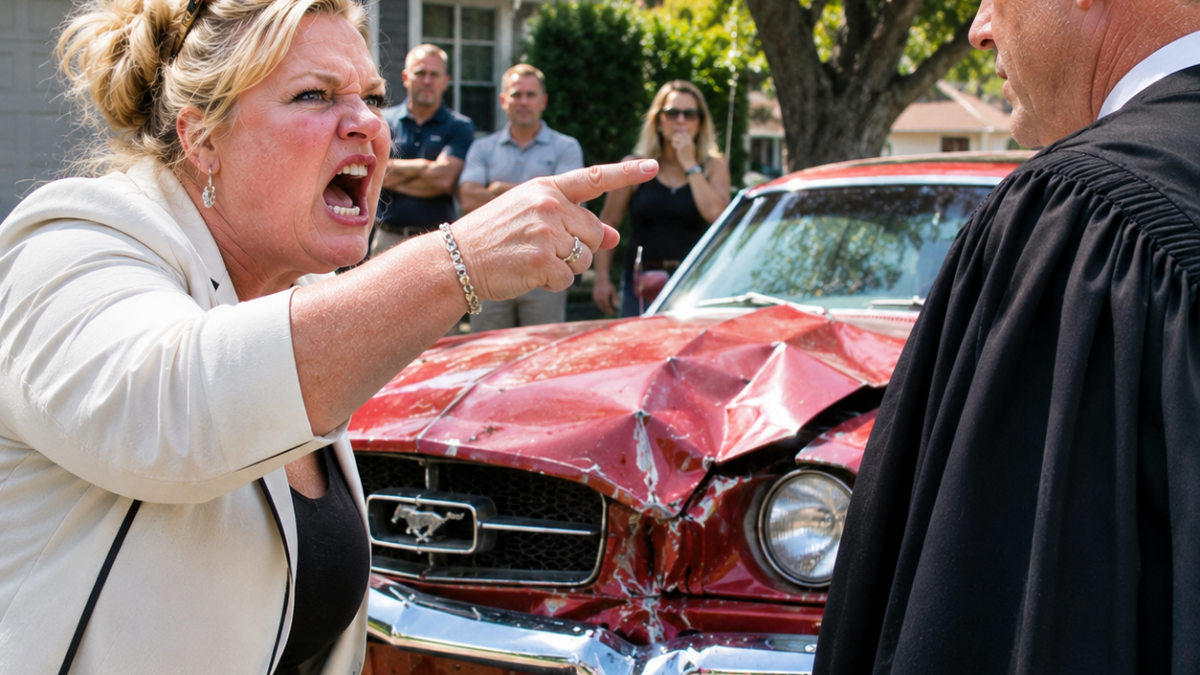
PART 2
Three days after I moved in, Donna left her first note.
I walked out early Tuesday morning with coffee in one hand and my briefcase in the other.
Dew covered the Mustang’s windshield.
The white oak cast a long shadow across the hood.
A small card had been tucked beneath the driver-side wiper.
White cardstock.
Purple ink.
Perfect cursive.
**THIS SPOT IS RESERVED. PLEASE RELOCATE YOUR VEHICLE IMMEDIATELY. — HOA MANAGEMENT**
I recognized the handwriting.
Donna had written my name on the welcome packet in exactly the same looping purple letters.
I read the note.
Folded it once.
Put it in the glove compartment.
Then drove to work.
I did not answer.
Two days later, another note appeared.
Same purple ink.
Different tone.
**FINAL WARNING. MOVE THIS VEHICLE OR FACE CONSEQUENCES.**
That one went beside the first.
By Friday, Donna had upgraded from stationery to official intimidation.
The letter waiting in my mailbox carried the Stonebrook Landing HOA logo.
Her signature filled nearly the entire bottom of the page.
According to the letter, my 1967 Mustang had been classified as a “non-operational project vehicle” under Section 4.7 of the community restrictions.
I was ordered to remove it within fourteen days.
Fine for noncompliance:
Two hundred dollars per day.
I took the letter inside.
Made coffee.
Pulled out the CC&Rs.
And read all of them.
I had made a career out of reading language people assumed nobody would read carefully.
Most bad arguments hide inside definitions.
Section 4.7 was not complicated.
A non-operational vehicle was one that lacked current registration and insurance.
My Mustang had both.
Registration current.
Full-coverage insurance.
State inspection passed three months earlier.
Mechanically, the car was better maintained than half the late-model SUVs in Stonebrook.
The 390 started instantly.
The lights worked.
Brakes worked.
Tires were excellent.
There was nothing to interpret.
So I wrote a response.
Short.
Professional.
No anger.
I enclosed copies of the registration.
Insurance.
Inspection certificate.
Twelve photographs showing the vehicle in operating condition.
Engine bay.
Interior.
Undercarriage.
Tires.
License plates.
I printed Section 4.7.
Highlighted the definition in red.
At the bottom of my response I wrote:
**I trust this resolves the matter.**
Respectfully,
Thomas Callaway.
Certified mail.
Return receipt.
It did not resolve anything.
Monday morning, I found a fluorescent-orange sticker glued to the Mustang’s windshield.
**GUEST PARKING PRIVILEGES REVOKED — LOT 12**
Industrial adhesive.
It took twenty minutes and half a bottle of remover to get it off without damaging the glass.
Across the street, a man watched me from his porch.
Stocky.
Gray hair.
I had seen him twice but never spoken to him.
He finally called over:
“She did the same thing to the Parkers.”
I looked up.
“The sticker?”
“The whole routine.”
He stood.
Carried his iced tea across.
“Ed Brower.”
“Thomas Callaway.”
“Tom?”
“Fine.”
Ed was sixty-two.
Retired master electrician.
Nine years in Stonebrook.
He nodded toward the clubhouse.
“The Parkers had a boat trailer.”
“What was wrong with it?”
“Donna didn’t like looking at it.”
“What happened?”
“Fines. Letters. Threats. Towing notices.”
He took a drink.
“They lasted four months.”
“Where are they now?”
“Chesterfield.”
He pointed down another street.
“Before them, Turners.”
“What did they do?”
“Built a shed Donna didn’t approve of.”
“Permit?”
“Yep.”
“HOA approval?”
“Original board.”
That sounded familiar.
“She fined them anyway?”
“Weekly.”
“And?”
“They tore it down.”
“Problem solved?”
Ed laughed without humor.
“Then she fined them because the bare slab was an eyesore.”
I stared at him.
He continued.
“Ostranders had a basketball hoop.”
“How long?”
“Three months.”
“Then?”
“Gone.”
I looked back at the Mustang.
Ed lowered his voice.
“Donna finds something she doesn’t like about you, then she grinds.”
“How many families?”
“Four that I know.”
“Why doesn’t the board stop her?”
Ed looked toward the clubhouse.
“Because Donna is the board.”
That night, I ordered two security cameras.
One faced Spot 7.
The other covered my driveway.
Hardwired.
Cloud backup.
Thirty-day retention.
I did not install them because I was frightened.
I installed them because courts run on evidence.
Memory changes.
Stories change.
People deny things.
Video doesn’t get embarrassed.
Certified mail doesn’t forget.
Bank statements do not suddenly remember events differently after a lawyer asks questions.
I had spent twenty-six years watching disputes turn on the difference between what someone believed happened and what could actually be proven.
Donna wanted a conflict.
Fine.
I would keep records.
I never told Ed what I did for a living.
I never told Donna.
Nobody asked.
Inside Stonebrook, I was simply the widower in the corner unit.
Flannel shirts.
Old Ford.
Quiet.
Ed asked me one afternoon:
“You know she won’t stop?”
“I’m getting that impression.”
“She outlasts people.”
I smiled.
“Then she hasn’t met someone more patient than she is.”
Two weeks later, Donna called an emergency HOA meeting.
The announcement appeared as a laminated flyer on the clubhouse door.
Three days’ notice.
The bylaws required fifteen.
I photographed the flyer before going inside.
The meeting room smelled like stale coffee and synthetic air freshener.
Donna sat at the head of the table wearing a white blazer with gold buttons.
Laptop open.
Suzanne Drake on one side.
Patty Monroe on the other.
Both had the alert, agreeable expression of people whose primary board qualification was never asking the president an uncomfortable question.
A fourth board member, Glenn Howell, sat farther down.
Ed sat among five homeowners.
I took a chair in the back.
Donna stood.
“Thank you all for coming on short notice.”
I nearly smiled at the phrase.
She clicked her laptop.
An aerial photograph of the parking area appeared.
Spot 7 had been circled in red.
“I am proposing that parking space number seven be reassigned from Lot 12 to Lot 3.”
Lot 3.
Donna’s house.
She continued:
“The reasoning is community harmony and aesthetic continuity.”
She pointed toward the projected image.
“This space sits directly in front of our clubhouse. It is one of the first areas visitors see.”
Then the pause.
Calculated.
“The current vehicle parked there does not reflect the standard we have worked very hard to establish.”
My father’s Mustang.
Forty years of saving, work, restoration, family memory reduced to an aesthetic problem.
Donna looked around.
“All in favor?”
Her hand.
Suzanne.
Patty.
Glenn.
Four.
Ed’s remained down.
“Motion carries four to one.”
She closed the laptop.
Ed stood.
“You can’t do that.”
Donna looked irritated.
“Excuse me?”
“Spot 7 is deeded.”
“Ed—”
“Article Three.”
He had brought a copy.
“Parking assignments are appurtenant to each unit. They’re recorded with the original plat.”
Donna smiled.
“I’ve been running Stonebrook for five years. I understand our parking system.”
“Then you know changing a deeded assignment requires unanimous owner consent and county recorder approval.”
The room went quiet.
Donna’s smile tightened.
“We’ll have counsel review your concern.”
“It isn’t a concern. It’s the document.”
“Thank you, Ed.”
Meeting over.
Eleven minutes.
That night, I checked Article Three myself.
Ed was right.
Exactly.
A board vote could no more transfer Spot 7 to Donna than it could vote my kitchen into her house.
And the meeting was invalid for another reason.
Three days’ notice.
Required:
Fifteen.
I documented both.
Photograph of notice.
Meeting minutes.
CC&R provisions.
Formal written challenge.
Certified mail.
Return receipt.
Donna responded publicly.
She posted a photograph of the Mustang on the Stonebrook Facebook page.
Rain.
Yellow parking-lot lighting.
Low angle.
A photograph carefully chosen to make a valuable classic look tired.
Caption:
**IS THIS THE IMAGE WE WANT REPRESENTING STONEBROOK? RUSTY, LEAKING OIL, TAKING UP PRIME COMMUNITY SPACE? TIME FOR A CHANGE, NEIGHBORS.**
Comments split almost evenly.
One anonymous homeowner wrote:
**That car is worth more than your Range Rover, Donna.**
I never discovered who posted it.
I owe them a drink.
Two days later, a county environmental inspector arrived.
Complaint:
Hazardous petroleum leakage from an abandoned vehicle.
He spent ten minutes underneath the Mustang with a flashlight.
Checked the asphalt.
Drain.
Engine.
Then stood.
“No violation.”
“Thank you.”
He started to leave.
Stopped.
Lowered his voice.
“Sir?”
“Yes?”
“This is the third complaint I’ve handled this year involving that address.”
He gestured toward Donna’s house.
“All unfounded.”
“I’m keeping records.”
“Good.”
Saturday brought the police.
I was washing the Mustang.
Bucket.
Shammy.
Nothing more.
Two cruisers arrived.
An officer stepped out.
“Sir, we received a report of an unlicensed automobile-repair operation.”
I looked at the bucket.
Then him.
“Here?”
“That’s the complaint.”
“I’m washing one car.”
He glanced at his partner.
“I can see that.”
They checked the open garage.
Workbench.
Hand tools.
Turtle Wax.
Nothing resembling a commercial shop.
The officer returned.
“Obviously no issue.”
“I appreciate you checking.”
At his cruiser, he paused.
“Second call this month about your property.”
“Same caller?”
He gave me the look police officers use when they cannot officially answer a question.
Then drove away.
Across the street, Ed raised his iced tea.
Near the clubhouse, Donna sat behind the wheel of the Range Rover.
Watching.
She waited until the police left.
Then drove away.
Two weeks later, she decided government agencies were not producing the result she wanted.
I was at the courthouse during a Tuesday afternoon recess when my phone vibrated.
Motion alert.
Camera one.
Spot 7.
I opened the live feed beneath my desk.
A white flatbed backed toward the Mustang.
Quick Hall Towing.
Two men climbed out.
Then Donna entered the frame.
Cream sneakers.
Oversized sunglasses.
Clipboard.
She pointed toward the car.
Handed the driver paperwork.
He read it.
Shrugged.
Chains went underneath my Mustang.
Four minutes later, my father’s car was on a flatbed.
I watched the truck leave the neighborhood.
Then Donna walked calmly to her Range Rover.
Pulled into Spot 7.
Adjusted her rearview mirror.
Checked her lipstick.
Stepped out.
Took a selfie.
Within an hour, she had posted it online.
**Some things just belong where they belong.**
I finished the court session before dealing with it.
That evening I found the Mustang at county impound.
Release fee:
$385.
Damage:
An eight-inch scratch down the right fender.
Clear coat.
Highland Green.
Down to primer in one section.
Rear quarter panel dented where a chain had slipped.
I stood under those fluorescent lights staring at the scratch.
Dad had painted that panel.
One full weekend.
Primer.
Three coats of Highland Green.
Clear.
Wet sanding.
Buffing.
I remembered him leaning close to inspect the finish.
“No shortcuts where people can see them.”
Then:
“No shortcuts where they can’t either.”
I ran my thumb beside the damage.
Paid the fee.
Drove home.
Parked directly back in Spot 7.
Next morning I called Quick Hall Towing.
“I’m requesting the authorization.”
They faxed it within an hour.
Signed:
**Donna Ashford**
Title:
**HOA Compliance Officer**
Donna did not hold that title.
Authority cited:
Section 4.7.
Again.
Non-operational vehicle.
Again.
A rule that plainly did not apply.
Now she had used it to authorize removal of property she did not own from a deeded parking space she had no authority to control.
Ed saw the damage that evening.
He stared.
“She towed the Parkers’ camper twice.”
I said nothing.
“She keyed Hensley’s truck.”
I looked up.
“Who?”
“Walt Hensley. Vietnam vet. Birch Lane.”
“What happened?”
“Flagpole.”
“What about it?”
“Donna fined him nine hundred dollars.”
“For an American flag?”
“Pole height.”
Ed shook his head.
“He sold six months later.”
I looked at Spot 7.
“How long since anyone really fought her?”
Ed thought.
“You’re the first.”
After that tow, I stopped looking at Donna as one unpleasant HOA president.
Patterns matter.
One incident can be foolishness.
A second can be temperament.
Four families gone?
Bogus fines?
False reports?
Tows?
That was a system.
Systems leave paper.
So I requested the HOA financial records.
Virginia law entitled owners to inspect association books.
I submitted the request in writing.
Certified.
Donna stalled.
First:
Records currently under audit.
Nine days later:
Treasurer on vacation.
Then:
Accounting-system migration.
I sent the statute back to her.
Quoted.
Including enforcement provisions.
Three days later, a large manila envelope appeared in my mailbox.
Five years of financial statements.
Bank records.
Vendor contracts.
No explanation.
I spread everything across my kitchen table after midnight.
Sarah used to hate when I worked there.
She would walk in, find legal pads covering half the table, and say:
“There is a room in this house called an office.”
I would answer:
“The coffee is here.”
She would shake her head.
That night the other chair stayed empty.
I read.
Two hours.
Then found it.
**PRESCOTT PREMIER LANDSCAPING**
Average monthly payments:
Approximately $4,700.
Five-year total:
$282,000.
Stonebrook had thirty-two homes.
Roughly four acres of common landscaping.
Two hundred eighty-two thousand dollars made no sense.
Next morning, I drove to the vendor’s listed address.
Split-level house.
Chain-link fence.
Dead lawn.
No landscaping sign.
No trucks.
No mowers.
No trailers.
No commercial equipment.
Owner:
Lauren Prescott.
Donna’s older sister.
Business incorporated two months before Donna became HOA president.
Invoices listed:
Seasonal treatment.
Irrigation maintenance.
Tree-health assessment.
Grounds services.
The irrigation system had been broken for two years.
Trees at the entrance had clearly not received the work described.
The invoices looked real.
The company did not.
That was when Spot 7 stopped mattering.
Or rather, it became one piece of something larger.
I kept digging.
County property records.
Planning commission minutes.
Nearby development approvals.
Donna’s husband, Craig Ashford, had served on the planning commission for four years.
Three subdivision projects had been approved during that time.
Craig had voted on all three.
Conflict disclosures?
None.
Then one developer caught my attention.
Howard Lennox.
Six weeks after a project approval involving Craig’s vote, Lennox paid Craig a $45,000 “consulting fee.”
Public LLC filing.
Barely disguised.
I leaned back at two in the morning.
Refrigerator humming.
Clock ticking.
Outside, the white oak moved above Spot 7.
Donna was not simply an obnoxious woman fighting over a parking space.
She was presiding over a quarter-million-dollar phantom landscaping scheme while her husband accepted money from people whose projects he voted on.
And Donna had spent years teaching Stonebrook residents what happened to people who asked uncomfortable questions.
Now I was asking.
Quietly.
The next six weeks were almost peaceful.
Donna assumed she had prevailed.
Whenever I was away, she sometimes parked the Range Rover in Spot 7.
A territorial marker.
She smiled whenever we passed.
I let her.
I hired Alan Whitmore.
Retired IRS investigator.
Forensic accountant.
Office in Richmond.
Old files.
Pipe-tobacco smell.
Fourteen hundred dollars.
One week later, he slid a report across his desk.
“Textbook.”
“What exactly?”
“Prescott Premier has no employees.”
He turned a page.
“No meaningful payroll.”
Another.
“No commercial insurance.”
Another.
“No equipment purchases.”
He pointed at the invoices.
“Same format. Same line items. Same rounded totals.”
“Where does the money go?”
He showed me.
HOA account to Prescott Premier.
Money remained three to five days.
Then transferred into Lauren’s personal account.
From there, smaller transfers moved again.
Some aligned with Donna’s spending.
Salon charges.
Luxury retail.
Range Rover lease payments.
Alan leaned back.
“This works because nobody reads HOA books.”
“Until somebody does.”
“Exactly.”
He tapped the folder.
“Wet cardboard.”
“What?”
“The entire thing. Looks like a wall until somebody touches it.”
I paid him.
Took the report.
Next came Craig.
Freedom of Information requests.
Planning minutes.
Disclosure forms.
Development files.
The county responded.
Craig had not simply omitted a relationship once.
On three separate forms, he had actively marked:
**NO CONFLICT**
The Attorney General’s Public Integrity Section received everything.
Alan’s analysis.
Planning records.
Craig’s disclosures.
Vendor records.
Contact information for former Stonebrook families.
The assistant attorney general listened for forty-five minutes.
When I finished, she said:
“We’ll open it.”
That was all I needed.
Then I contacted the people Donna had pushed out.
Parkers.
Turners.
Ostranders.
Walt Hensley.
Walt was seventy-four.
Vietnam veteran.
He still had every notice Donna had sent.
He kept them in a shoebox.
“I almost fought,” he told me.
“Why didn’t you?”
“I was tired.”
I understood.
“She had time. Board. Lawyers. Letters.”
He paused.
“I was alone.”
“You’re not now.”
Silence on the phone.
Then:
“No.”
I kept parking the Mustang in Spot 7.
Every day.
Under the oak.
Washed Saturday mornings.
Waxed once a month.
Not to provoke Donna.
Not entirely.
But I knew resentment produces mistakes.
Every time she walked toward the clubhouse, there it was.
Highland Green.
Shining.
Legal.
Deeded.
Untouched by her board vote.
Ed noticed.
“You’re doing that on purpose.”
“What?”
“The car.”
“It belongs there.”
“You know what I mean.”
I handed him a beer.
“The useful thing about building a case, Ed, is sometimes the defendant keeps adding exhibits.”
He looked at the Mustang.
Then grinned.
“All you have to do is park.”
“Pretty much.”
Somebody eventually told Donna I was looking into records.
Maybe the treasurer.
Maybe someone at the county.
Maybe nothing specific happened and she simply sensed control slipping.
Her smile changed first.
Donna smiled at everybody.
The smile was social currency.
Armor.
Weapon.
Then she stopped smiling at me.
Craig moved next.
I applied for a routine permit to replace my rear fence.
Six-foot cedar.
Code-compliant.
Normal turnaround:
Five to seven business days.
Three weeks passed.
Still pending.
A county clerk finally lowered her voice.
“Your application was flagged.”
“By whom?”
“I can’t say.”
“Planning commission?”
She said nothing.
Enough.
That evening, Craig’s black BMW rolled slowly past my house.
Windows down.
He looked at me.
I waved.
He did not.
Donna went after the Mustang again.
Thursday.
11:47 p.m.
Motion notification.
My security camera captured a woman in a black hoodie and jogging pants walking toward Spot 7.
She was attempting disguise.
Poorly.
Her Chanel sunglasses were perched on top of her head.
Even while committing vandalism, Donna apparently needed designer accessories within reach.
She crouched beside the driver-side front fender.
Pulled out a key.
Dragged it from front to rear.
One slow continuous line.
The camera microphone picked up the faint scraping.
Metallic.
Thin.
Deliberate.
She stood.
Looked at the damage.
Then walked home.
Next morning, I found the groove.
Highland Green to bare metal.
I crouched beside it.
My father had wet-sanded that section himself.
Four-hundred-grit paper.
Reading glasses sliding down his nose.
Knees on an old folded towel Sarah had wanted thrown away.
I took photographs from six angles.
Copied the video to three drives.
Filed a police report.
The officer watched.
Then looked at me.
“You want charges filed?”
“Eventually.”
He frowned.
“Eventually?”
“I’m building something larger.”
He stared for a second.
Then nodded.
“Keep the original.”
“I will.”
Donna followed the keying with something stranger.
Tuesday.
6:30 a.m.
Morning jog.
Lululemon.
AirPods.
Camera catches her stop beside the Mustang.
She removed a plastic bag from her waistband.
Inside:
A dead rat.
She placed it on the hood.
Centered.
Directly above the galloping-horse emblem.
Then she jogged away.
Ponytail swinging.
I put on gloves.
Removed it.
Disinfected everything.
Saved the footage.
Logged date and time.
Added it to the file.
That same week, she began blocking the Mustang.
Three afternoons.
Range Rover parked bumper-to-bumper behind it.
No room for me to reverse.
Each day I walked to Donna’s house.
Rang.
Tuesday:
Silk blouse.
“Oh! Did I block you again?”
Wednesday:
Cashmere wrap.
“I am so sorry, sweetie.”
Thursday:
Linen sundress.
“Must have misjudged the distance.”
Every performance identical.
Every one recorded.
She would glide outside.
Move the Range Rover forward exactly enough for me to leave.
Never enough to admit the blocking had been deliberate.
Thursday night, I sat on the porch.
Ed brought his own chair.
“She’s getting sloppy.”
“Fear does that.”
“She scared?”
“Yes.”
“How can you tell?”
“People who believe they’re safe don’t key cars at midnight.”
Ed laughed.
“I think your cameras need overtime pay.”
“Storage is becoming an issue.”
Inside the kitchen were three manila folders.
**PARKING**
**FINANCES**
**CRAIG**
All thick.
Then came the judicial conference in Charlotte.
Three days.
Wednesday through Friday.
I told Ed.
No one else.
Wednesday evening, Suzanne Drake apparently drove by my house.
Lights off.
Driveway empty.
By Thursday morning, Donna knew I was gone.
At 2:14 p.m., my Spot 7 camera triggered.
Yellow flatbed.
**VALLEY AUTO SALVAGE**
Heavyset driver.
Paperwork.
He looked at the Mustang.
Then at the authorization.
Then back at the Mustang.
Four minutes later, Donna arrived.
White capri pants.
Striped silk blouse.
Oversized Dior sunglasses.
She had dressed for it.
She pointed.
“That one.”
The driver hesitated.
Donna said something else.
Camera audio caught most of it.
“I want it gone. All of it.”
The driver looked at her.
“Crushed, scrapped. I don’t care. Just make sure there’s nothing left to bring back.”
He looked at the Mustang one more time.
A 1967 GT 390 Fastback does not look abandoned.
Even to someone who doesn’t know cars.
It looks intentional.
Loved.
But he had paperwork.
He hooked the chains.
The winch tightened.
The Mustang’s front wheels lifted.
Suspension groaned.
Donna took out her phone.
She filmed.
The car went onto the flatbed.
She narrated.
“Bye-bye, junk car.”
Then:
“Spot seven is mine.”
And laughed.
When the flatbed disappeared, she pulled her Range Rover into Spot 7.
Then posted the video to Stonebrook’s group chat.
**Problem solved. Spot number seven is officially mine again. You’re welcome, Stonebrook.**
Nail-painting emoji.
Sparkles.
Three heart reactions.
I watched the entire thing from a conference room in Charlotte.
My phone under the table.
People around me were discussing judicial administration.
Ethics.
Court efficiency.
I watched my father’s car leave.
I knew what salvage yards do.
I knew I could call.
Leave.
Try to stop it.
But by the time I reached Virginia, I would likely be too late.
I sat still.
The session ended.
I took notes.
Shook hands.
Slept almost none.
Drove home the next morning.
Spot 7 was empty.
Donna had moved her Range Rover.
Under the oak, a dark stain remained where the Mustang had sat.
I drove directly to Valley Auto Salvage.
Route 360.
Feed store.
Baptist church.
Chain-link fence topped with razor wire.
The manager met me.
I gave him the VIN.
His face changed.
“Oh.”
That one syllable told me.
He walked me toward the back.
Past stacked doors.
Engines.
Frames.
Then stopped.
My Mustang was a cube.
Three feet by four, maybe.
Compressed steel.
Highland Green fragments showed along folded edges.
One strip of chrome caught the sun.
The license plate remained bolted to a crushed section.
Bent.
Still readable.
I stood there.
Six summers.
Dad’s hands.
The first roar of that 390.
His five minutes behind the wheel.
Saturday mornings.
Motor oil.
Leather conditioner.
Everything physical that remained of those hours had been folded into itself by a hydraulic press.
A car is metal.
I knew that.
Steel does not contain a soul.
Paint does not contain a father.
Memory is not destroyed because a machine is destroyed.
I knew all those rational things.
They did not help.
I put my hand against the crushed metal.
Cold.
I imagined Dad seeing it.
That thought almost broke me.
Then I did what I had spent my life learning to do when emotion threatened judgment.
I stepped back.
Breathed.
And documented.
Photographs.
Every angle.
VIN section.
License plate.
Green paint.
Chrome.
Manager’s statement.
Authorization form.
Signed:
Donna Ashford.
Again titled:
**HOA Compliance Officer**
Again an authority she did not have.
I asked:
“Did she tell you to crush it?”
The manager looked uncomfortable.
“The order says dispose.”
“Did she speak directly to anyone?”
“Driver.”
“Can I get his statement?”
“I’ll give you his number.”
“Thank you.”
I drove home.
Opened my empty garage.
Dad’s tool rack was still there.
The bay where the Mustang belonged was empty.
I sat at the kitchen table.
Sarah’s chair across from me.
For the first time since moving into Stonebrook, I wished she were there badly enough that I said it aloud.
“I could use you tonight.”
Silence.
Then I picked up the phone.
District Attorney Catherine Wells answered.
“Thomas?”
“I need to report a felony.”
Pause.
“What happened?”
“Donna Ashford destroyed my Mustang.”
“The Mustang?”
“Yes.”
“How?”
“Salvage-yard crusher.”
Silence.
“Do you have proof?”
“The defendant filmed it herself.”
That was when the case moved very quickly.
Catherine had already heard pieces of the Public Integrity investigation.
Now the parking harassment, false documents, vehicle destruction, HOA embezzlement, and Craig’s conflicts began fitting together.
Within ten days, a grand jury returned indictments.
Donna faced six counts.
Felony destruction of property.
Grand larceny.
Fraud related to false authorization.
Embezzlement involving $282,000 in HOA funds.
Conspiracy involving Lauren Prescott and Craig Ashford.
Craig was indicted separately.
Lauren’s case moved on its own track.
Donna’s trial was scheduled for October.
In the weeks before trial, Stonebrook became quieter than I had ever seen it.
Donna stopped walking the neighborhood.
Suzanne and Patty stopped posting.
Craig’s BMW disappeared into the garage.
Ed occasionally sat on my porch.
Neither of us talked much about the Mustang.
One evening, he said:
“I’m sorry.”
“For what?”
“The car.”
“Wasn’t you.”
“We watched her do this to people for years.”
I looked at him.
“You survived.”
“Yeah.”
“That’s what people do.”
He stared toward Spot 7.
Empty.
“I should’ve fought sooner.”
“Maybe.”
He looked at me.
I continued:
“But that doesn’t mean what she did was yours.”
He nodded.
The morning of trial came cold and bright.
Henrico County Courthouse.
Donna arrived dressed for innocence.
Cream blazer.
Red-soled Louis Vuitton heels.
Chanel Boy bag.
Hair professionally blown out.
Makeup perfect.
She walked through security with the posture I had seen in the clubhouse.
Shoulders back.
Chin level.
The expression of a woman accustomed to entering rooms where other people became less confident after she arrived.
Her attorney, Martin Pratt, sat beside her.
Catherine Wells represented the Commonwealth.
The jury pool waited.
Gallery crowded.
Stonebrook residents occupied two rows.
Ed sat near the aisle.
Walt Hensley came.
So did one of the Parkers.
Donna never saw me enter through the judicial corridor.
The bailiff stood.
“All rise.”
Donna rose.
“The Honorable Judge Thomas Callaway presiding.”
I entered.
Black robe.
Gray at the temples.
Glasses in my hand.
Donna looked toward the bench.
And froze.
I saw recognition happen in stages.
First confusion.
Then disbelief.
Then color draining from her face.
Her mouth opened slightly.
The hand holding her Chanel bag stopped moving.
She leaned toward Pratt.
“That’s him.”
Pratt did not look at her.
“I know.”
“That’s the man—”
“I know.”
I sat.
Looked at the file.
Then at counsel.
Then at Donna.
For months, she had looked at me and seen:
Widower.
Flannel.
Old car.
Nobody.
Now she finally understood what I had never considered important enough to tell her.
I was a circuit court judge.
And because I was a circuit court judge, there was one thing I absolutely could not do.
Judge her case.
I addressed the courtroom.
“Before any proceedings begin, I need to address a matter for the record.”
Nobody moved.
“The defendant is a resident of the community in which I own property.”
Donna stared.
“Count One and related evidence involve the destruction of a vehicle belonging to me.”
I paused.
“Under the Virginia Code of Judicial Conduct, I cannot preside over a matter in which my impartiality might reasonably be questioned, particularly where I am the direct victim of charged conduct.”
Donna’s expression shifted again.
Maybe relief.
Maybe confusion.
I continued:
“I am therefore recusing myself.”
Her lawyer exhaled.
Then I looked at Donna.
The source story remembers one sentence I said before transferring the case, and I remember it too because it was the only personal sentence I allowed myself.
“The rule of law does not bend because someone believes a parking space gives them the right to destroy another person’s most treasured possession.”
That was enough.
No lecture.
No revenge from the bench.
No judicial ambush.
I transferred the matter to Judge Patricia Hendricks.
Then stood.
“Court is in recess.”
I left through the side door.
Donna had spent months treating herself as judge, jury, and executioner inside Stonebrook.
I was not going to answer that abuse by misusing my own authority.
Recusal was not weakness.
It was the opposite.
The law only matters if you follow it most carefully when you are angry.
Judge Hendricks was sixty-two.
Former federal prosecutor.
Quiet.
Precise.
The kind of judge who could make a courtroom uncomfortable simply by waiting for someone to finish lying.
Donna’s trial began under her.
Catherine Wells played Donna’s own video.
Sixty-inch courtroom monitor.
Twelve jurors.
Donna pointing toward the Mustang.
Driver attaching chains.
My father’s car lifting.
Donna’s voice:
“Bye-bye, junk car.”
Then:
“Spot seven is mine.”
Then her group-chat post.
**Problem solved.**
Nail-painting emoji.
Sparkle.
Nobody laughed.
The forensic accounting took almost an entire day.
Alan Whitmore explained Prescott Premier Landscaping.
No employees.
No equipment.
No corresponding work.
Identical invoices.
$282,000 in homeowner money.
Transfers to Lauren.
Subsequent transactions aligning with Donna’s personal expenditures.
Salon.
Luxury retail.
Range Rover lease.
Catherine displayed the vendor contracts.
Then bank statements.
Then the landscaping photographs showing work that did not exist.
The prosecution showed Donna’s repeated false use of HOA authority.
The original Section 4.7 notice.
My registration.
Insurance.
Inspection.
The illegal reassignment meeting.
Three days’ notice instead of fifteen.
The tow authorization from Quick Hall.
The second authorization sent to Valley Auto Salvage.
The video of Donna keying the Mustang.
Dead rat.
Range Rover blocking.
Every incident that had once looked petty now formed a timeline.
That is what patterns do in court.
An isolated act can be explained away.
A sequence begins speaking for itself.
Former residents testified.
The Parkers.
Turners.
Walt.
Walt brought his shoebox.
Every violation notice.
Every fine.
He sat straight in the witness chair.
Seventy-four years old.
When Catherine asked why he had moved, he answered:
“I got tired of fighting my own neighborhood.”
That sentence stayed in the room.
Craig’s conflict records entered through the appropriate witnesses.
Planning commission votes.
False disclosure forms.
Howard Lennox’s $45,000 consulting payment.
Donna’s defense tried to separate everything.
Parking dispute over here.
Landscaping company over there.
Craig’s government business somewhere else.
But documents are difficult to separate once money and signatures begin intersecting.
Then Donna took the stand.
I was not in the courtroom.
I read the transcript later.
Catherine’s questions were simple.
“Mrs. Ashford, did you film the Mustang being removed?”
“Yes.”
“Did you instruct that it be scrapped?”
Donna tried to explain.
Judge Hendricks:
“Answer the question.”
“Yes.”
“Did you post the video to Stonebrook’s group?”
“Yes.”
“Did you write, ‘Spot number seven is officially mine again’?”
Pause.
“Yes.”
“Did you include a nail-painting emoji?”
Her lawyer objected to relevance.
Overruled.
“Yes.”
It sounds almost ridiculous written down.
An emoji.
But intent often hides inside the smallest details.
She had not believed she was solving an emergency.
She celebrated.
Catherine asked about Section 4.7.
Donna said she believed the Mustang was non-operational.
Then Catherine produced the registration.
Insurance.
Inspection.
My certified response.
The return receipt bearing Donna’s office signature.
She had received proof.
Before the first tow.
Before the keying.
Before the crusher.
Then the deed.
Spot 7.
Lot 12.
Recorded.
Donna had no ownership interest.
She attempted to say the board had reassigned it.
Meeting notice appeared.
Three days.
Bylaw:
Fifteen.
Article Three:
Deeded parking could not be reassigned by ordinary board vote.
Every escape route ended at a document Donna had either ignored or signed.
The jury deliberated three hours and fourteen minutes.
Guilty.
All counts.
Donna sat motionless when the verdicts were read.
No smile.
No clipboard.
No group chat.
No audience she could control.
At sentencing, Judge Hendricks imposed three years in state prison.
Two suspended.
One year to serve.
Full restitution.
$175,000 for the destroyed Mustang.
Another $47,000 in damages and legal expenses.
Five hundred hours of community service.
And a permanent prohibition against serving on an HOA board anywhere in the Commonwealth of Virginia.
When the bailiff stepped forward with handcuffs, Donna flinched.
According to Ed, it was the first spontaneous reaction he had ever seen from her.
Her mascara had begun tracking beneath her eyes.
The perfect hair was no longer perfect.
The red soles of her shoes clicked across the marble.
Then she disappeared through the courthouse door.
The Richmond paper carried the story on the front page.
The photograph showed Donna leaving in handcuffs.
The headline described the classic-car destruction and parking dispute.
Her Instagram account went dark that afternoon.
It never returned.
Craig Ashford pleaded guilty to three counts related to false disclosures.
He lost the planning-commission seat.
Paid a $70,000 fine.
Put the Stonebrook house on the market.
Sold at a loss.
Then left the county with a U-Haul.
Ed told me nobody waved.
Lauren Prescott was charged separately.
Prescott Premier Landscaping was dissolved.
Asset seizure recovered the $282,000.
Every dollar went back to the Stonebrook HOA fund.
Money that thirty-two families had paid for landscaping that never happened.
Three months later, Stonebrook held new elections.
Ed Brower ran for president.
Unopposed.
He hated that.
“I didn’t ask for this.”
“You put your name on the ballot.”
“People were supposed to have alternatives.”
“Democracy disappoints in surprising ways.”
He won.
His first actions were deliberately boring.
Two-year term limits.
Independent annual CPA audit.
Open meetings.
Published minutes.
A real grievance process.
No president acting as judge, jury, compliance officer, tow dispatcher, parking authority, and personal monarch.
Ed printed the revised bylaws on laminated cards.
One for every household.
He handed me mine on the porch.
“So nobody can say they didn’t know.”
I turned the card over.
“Laminated?”
“I’m an electrician.”
“That explains nothing.”
“Durability.”
Fair.
Suzanne Drake resigned.
Patty Monroe resigned.
No farewell messages.
Glenn Howell stopped attending meetings.
Then something happened that mattered more than Donna losing power.
Families began coming back.
The Parkers purchased a place on Elm Circle.
The Turners rented two streets over.
And Walt Hensley, seventy-four years old, Vietnam veteran, returned to Birch Lane.
The first weekend after he moved in, he installed an American flag.
Same pole.
Same height.
Nobody fined him.
Nobody measured it.
Nobody called it a visual disturbance.
Neighbors came over instead.
Ed brought beer.
They sat on Walt’s porch until sunset.
I walked past that evening.
He called:
“Judge.”
“Walt.”
He pointed at the flag.
“Still standing.”
“It looks dangerous.”
He laughed.
I was glad to hear it.
For the first time since I had moved there, Stonebrook sounded like a place where people lived instead of a place where people were being inspected.
The restitution for my Mustang remained difficult.
One hundred seventy-five thousand dollars was the valuation.
The money arrived.
It did not make sense emotionally.
How do you assign a number to six summers with your father?
You can value a GT 390 Fastback.
Condition.
Originality.
Market.
Restoration quality.
Comparable sales.
But the market does not price the moment your father first turned the key.
There is no line item for his hands on the steering wheel.
No comparable auction result for the smell of leather conditioner in your childhood garage.
The money could replace the model.
It could never replace the car.
For months, I left Spot 7 empty.
Ed never asked why.
Nobody parked there.
That surprised me.
Not because I had posted anything.
Because the neighborhood understood.
The white oak dropped leaves.
Rain darkened the asphalt.
The old oil mark faded slowly.
I still looked toward the spot every time I left my house.
Muscle memory.
Expecting Highland Green.
Then remembering.
One Saturday, a teenager stopped me outside the clubhouse.
Thin kid.
Nineteen.
Dark hair.
Work boots too large for him.
“Judge Callaway?”
“Thomas is fine.”
“My name’s Tyler Simmons.”
“I know. Three doors down.”
He looked toward Spot 7.
“I used to watch your Mustang.”
I waited.
“Every morning.”
“What for?”
“Bus stop.”
He smiled awkwardly.
“I’d leave five minutes early.”
“Why?”
“So I could look at it.”
Something tightened in my chest.
Tyler continued:
“That was the most beautiful thing on this street.”
I looked at the empty space.
“It was my father’s.”
“I know.”
“How?”
“Mr. Brower told me.”
Of course.
Tyler shoved his hands in his pockets.
“He said your dad worked for Ford.”
“Thirty-one years.”
“And taught you engines.”
“Yes.”
Tyler looked at me.
“I want somebody to teach me.”
That sentence changed what I did with the restitution.
My father had spent three decades building cars.
He respected people who worked with their hands.
He used to say:
“College is good if the thing you want requires college. But don’t pay someone forty thousand dollars to tell you a wrench is beneath you.”
He believed trades were not a fallback.
They were knowledge.
So I created the **Callaway Classic Car Restoration Scholarship**.
Named for Henry Callaway.
It covered vocational training in automotive restoration for young people who could not afford trade school.
Not a memorial plaque.
Not something that merely sat there.
Training.
Tools.
Skills.
The kind of thing Dad would have understood.
We held the first award ceremony in the Stonebrook clubhouse.
The same room where Donna had projected Spot 7 onto a screen and explained why my father’s car did not represent the community.
Ed hung a framed photograph beside the entrance.
Dad.
1998.
The day the Mustang first ran.
Hands on wheel.
That quiet smile.
I almost asked Ed to take it down.
Then decided not to.
The first recipient was Tyler Simmons.
Nineteen.
Three doors down.
When I handed him the certificate, he stared at the photograph.
“I used to look at that car every day.”
“I heard.”
“I wanted to know how somebody makes something that old look that alive.”
“Patience.”
He nodded.
“That’s what Mr. Brower said you’d say.”
“Ed talks too much.”
From the back:
“I heard that.”
Everyone laughed.
After the ceremony, Tyler approached me.
“What do I do first?”
“With school?”
“With cars.”
I thought about Dad.
Then answered exactly as he would have.
“Learn to listen before you turn anything.”
Tyler frowned.
“To what?”
“The machine.”
“That sounds weird.”
“It is.”
“Does it work?”
“Usually.”
A few weeks later, I found another Mustang.
Estate sale near Fredericksburg.
1967 Fastback.
Same year.
Same body style.
Not the same car.
I need to say that clearly.
It was never going to be my father’s Mustang.
You cannot replace history by matching a VIN range and paint code.
This car needed work.
Body tired.
Interior worn.
Engine incomplete.
It did not carry Dad’s hands.
Which was exactly why I bought it.
I did not want a replica pretending nothing had happened.
I wanted another project.
Tyler saw it for the first time on a Saturday morning.
We rolled open the garage door.
He stopped.
“Is that—”
“No.”
He looked at me.
“No?”
“Same year.”
He walked closer.
“Fastback.”
“Yes.”
“Are we restoring it?”
“We?”
His face fell.
I smiled.
“Yes.”
His grin was immediate.
We started the way Dad and I had.
Inventory.
Documentation.
Photographs.
Boxes.
Labels.
No rushing.
Tyler asked too many questions.
Perfect.
Saturday mornings became coffee and tools.
Two mugs.
Cold garage.
Radio low.
He learned sockets.
Torque.
Panel alignment.
Primer.
He learned that forcing a frozen bolt usually creates two problems instead of one.
He learned how to hear an engine before taking it apart.
One morning, he stripped a fastener.
He looked devastated.
“I ruined it.”
“No.”
“I stripped it.”
“Yes.”
“So I ruined it.”
“What did you learn?”
“Wrong angle.”
“And?”
“Too much force.”
“Then it wasn’t free.”
“What?”
“You paid for a lesson with a bolt.”
He laughed.
“That’s something your dad said, isn’t it?”
“Almost word for word.”
Sometimes I caught myself watching Tyler’s hands.
Steady.
Patient.
Listening before turning.
Good hands.
Dad would have liked him.
The scholarship covered his vocational program.
He brought what he learned back to the garage.
I brought what Dad had taught me.
Neither was complete alone.
Slowly, the second Mustang took shape.
Not a replacement.
A continuation.
That distinction saved me.
There came a Saturday when Tyler asked:
“Highland Green?”
I froze.
The body was ready for paint.
I had been avoiding the decision.
He noticed.
“We can do something else.”
I looked at the Mustang.
Bare.
Waiting.
Dad’s car had been Highland Green.
That color had become inseparable from memory.
I could choose black.
Blue.
Red.
Anything.
Instead I said:
“Highland Green.”
“You sure?”
“No.”
Tyler nodded.
“Good enough.”
We laid down the paint carefully.
When the first coat settled, my garage changed.
For one second I saw Dad’s Mustang.
Then I looked closer.
Different body marks.
Different history.
Different car.
And that was okay.
The day we first started the rebuilt engine, Tyler sat in the driver’s seat.
I stood beside the open door.
He turned the key.
The engine caught.
Deep V8 rumble filled the garage.
Tyler’s eyes widened.
He laughed.
Then he did something he didn’t know my father had done.
He went quiet.
Hands on the wheel.
Didn’t speak.
I looked away because suddenly I couldn’t see clearly.
Five minutes.
Almost exactly.
Then Tyler said:
“Judge?”
“Yeah?”
“Sounds good.”
I wiped my face.
“Thomas.”
“What?”
“Call me Thomas.”
He smiled.
“Sounds good, Thomas.”
We parked the Mustang in Spot 7.
Under the century-old white oak.
Afternoon sunlight moved through the branches and warmed the Highland Green hood.
People came outside.
Ed.
Walt.
Parkers.
Turners.
No ceremony.
No social media post.
No board vote.
Just neighbors looking.
Tyler stood beside me.
“Feels weird.”
“What?”
“Parking it here.”
“Why?”
“Because of what happened.”
I looked at the spot.
The same asphalt.
The same tree.
The same number.
Donna had wanted that space badly enough to destroy something she could never replace.
Now it held another car.
Built differently.
With another young man’s hands.
That seemed right.
Beside the curb, Ed had installed a small concrete post.
I had not authorized it.
Naturally.
Mounted on top was a brass plaque.
Five words.
**ASSIGNED TO LOT 12 — ALWAYS**
I stared at it.
Ed stood behind me.
“You hate it?”
“Maybe.”
“Too sentimental?”
“Definitely.”
“You’re leaving it.”
“Yes.”
He smiled.
Tyler read the plaque.
Then looked at the car.
“What do you think your dad would say?”
I thought about Henry Callaway.
Thirty-one years on a Ford assembly line.
Twenty years saving.
Six summers restoring.
His reading glasses sliding down while he sanded.
His hands on the steering wheel.
That quiet smile when the 390 first came alive.
Then I looked at Tyler.
Nineteen.
Starting trade school.
Grease already under his nails.
A thousand questions still waiting.
“He’d tell us the panel gap on the passenger side is wrong.”
Tyler stared.
“It is?”
I laughed.
“Now you’re learning.”
We spent the next hour adjusting it.
Because that was the part Donna never understood.
She thought destroying the Mustang would end the argument.
She thought crushing the thing I loved most would prove that power belonged to the person willing to go farthest.
She was wrong.
The first Mustang could never come back.
I never pretended otherwise.
My father’s car was gone.
No conviction fixed that.
No restitution restored six summers.
No replacement carried his fingerprints.
Some losses stay losses.
But what my father taught me was never inside the sheet metal.
It was in patience.
Craft.
Attention.
The refusal to force what should be understood first.
Donna crushed a car.
She could not crush that.
Instead, the money from what she destroyed began teaching young people the same skills Dad taught me.
Tyler was only the first.
And the second Mustang did not erase the first.
It gave the lessons somewhere to go.
Donna had treated Stonebrook like a private courtroom where she could write the rules, prosecute the offense, pronounce guilt, and impose punishment.
In the end, she walked into a real courtroom.
She saw me on the bench.
And I did the one thing she never understood power required.
I stepped aside.
Because authority does not mean getting whatever outcome you want.
It means respecting limits even when those limits deny you the satisfaction of deciding the fate of someone who hurt you.
Judge Hendricks handled the case.
The jury decided the facts.
The sentence came from law.
Not revenge.
My part was simpler.
Document.
Tell the truth.
Then let the system work.
That was something Donna had never learned.
She believed paperwork was a costume for power.
A violation letter.
An HOA title.
A tow authorization.
A board motion.
If the page looked official enough, she assumed the person receiving it would surrender.
But documents have two edges.
Hers were fabricated authority.
Mine were evidence.
Certified-mail receipts.
Deed.
Registration.
Inspection certificate.
Meeting notice.
CC&Rs.
Camera footage.
Bank statements.
Vendor records.
Disclosure forms.
When those two kinds of paperwork finally met inside the same case, confidence stopped mattering.
Facts did.
I still think about my father’s Mustang.
Of course I do.
Sometimes I can hear that first engine start.
Sometimes I remember the impound-lot scratch more clearly than I want.
Sometimes the image of that crushed cube appears without warning.
Grief does that.
The new Mustang helps, but not because it replaces the memory.
It gives memory somewhere useful to go.
Saturday mornings.
Cold garage.
Coffee.
Tyler asking:
“What does this bolt do?”
And me answering the way Dad did.
Not just what.
Why.
That is inheritance.
Not metal.
Not money.
Knowledge passed hand to hand until someone new can carry it.
Spot 7 stayed deeded to Lot 12.
Always had been.
Donna never owned it.
The board never owned it.
Her Range Rover sitting there for three years never changed the deed.
Her four-to-one vote did not change it.
Her tow trucks did not change it.
Crushing the Mustang did not change it.
That may be the cleanest lesson in the whole story.
Taking something does not make it yours.
Using power improperly does not turn abuse into authority.
And destroying the evidence of somebody else’s history does not make your version of history true.
The Highland Green Fastback sits beneath the white oak now.
Not my father’s.
Tyler and mine.
The plaque catches the afternoon sun.
**ASSIGNED TO LOT 12 — ALWAYS.**
Sometimes I stand at my window and look at it.
I think about Dad.
Sarah.
Ed.
Walt’s flag.
Families who came back.
Tyler learning the difference between force and patience.
And the woman who once looked at me in a flannel shirt and decided I was nobody.
Donna was wrong about a lot of things.
She was wrong about the parking spot.
Wrong about the Mustang.
Wrong about the HOA money.
Wrong about the people she bullied.
And she was spectacularly wrong about what kind of man would simply leave because she told him to.
But the most important thing she got wrong was this:
She believed crushing my father’s car would take my father away from me.
It didn’t.
Every Saturday morning, when Tyler reaches for a wrench and waits for me to explain what comes next, I hear Dad all over again.








