HOA Karen Called Wildlife Officers to Arrest Me for Fishing My Own Lake—Then They Shook My Hand and Called Me Captain
PART 2
She stayed on my porch for another few seconds, staring at me as if she expected me to correct myself.
I didn’t.
Finally, Brenda shifted the clipboard against her hip.
“Mr. Mercer, perhaps you don’t understand what I’m suggesting.”
“I understand perfectly.”
“This could increase property values throughout the area.”
“Your property values are not my responsibility.”
“It would benefit everyone.”
“It would benefit Ridgewater.”
“And you.”
“How?”
She blinked.
“Community goodwill.”
I almost smiled.
“I already have neighbors.”
Her jaw tightened.
“The people at Ridgewater are your neighbors.”
“They’re welcome to wave when they drive past.”
“You’re being unnecessarily hostile.”
“I said no.”
“You haven’t even heard the proposal.”
“I heard enough.”
She looked beyond the house toward the glittering water through the trees.
“One elderly man with a fishing rod does not need an entire lake.”
That landed differently.
Not because she called me old.
At sixty, I’d heard worse.
It was the way she said it.
As though ownership had to justify itself to her.
As though Connie’s dock, Grandpa’s mornings, Dad’s work, my entire childhood, and sixty-seven years of recorded property rights could be weighed against the fact that residents on the ridge wanted somewhere picturesque to paddleboard.
I kept my voice calm.
“My grandfather bought this property in 1958. The lake is inside the deed boundary. The springs originate on our land. The shoreline is private. There is no public access.”
Brenda tilted her head.
“That sounds very selfish.”
“No. It sounds very clear.”
She turned.
Walked toward the Range Rover.
Then stopped halfway.
Without looking back, she said:
“This community is growing, Mr. Mercer. You may need to become more flexible.”
I watched her drive away.
Connie would have told me not to let it bother me.
She was good at recognizing people who fed on reaction.
“Don’t give them dessert,” she used to say whenever somebody was trying to irritate me.
So I went inside.
Poured another cup of coffee.
And assumed Brenda would eventually accept the answer.
That was my first mistake.
The next morning, I found a laminated sign zip-tied to my front gate.
Green letters.
White background.
**RIDGEWATER COMMONS LAKE ACCESS TRAIL**
Arrow pointing down my private road.
I stood there staring at it.
Then cut the ties.
Snapped the plastic board in half.
Dropped it into the burn barrel.
I didn’t call Brenda.
Didn’t call an attorney.
Didn’t make a report.
I believed removing the sign sent the message.
Four days later, certified mail arrived.
Two pages.
Ridgewater Commons letterhead.
Gold seal.
The first page cited something called:
**Ridgewater Community Enhancement Bylaw 11.3**
According to Brenda’s letter, this bylaw supposedly required “adjacent property owners” to provide “reasonable recreational access to shared natural water features.”
The second page listed penalties.
Three hundred dollars per day.
Restriction of community services.
Referral to county code enforcement.
I sat at Connie’s kitchen table and read the letter twice.
Then I laughed.
Not because it was funny.
Because the arrogance was so complete it almost became impressive.
I wasn’t a Ridgewater homeowner.
My land wasn’t inside Ridgewater.
I had never joined their HOA.
Never signed covenants.
Never agreed to bylaws.
My property existed for more than sixty years before Ridgewater Commons existed.
I walked to the file cabinet.
Pulled the deed.
Then Grandpa’s 1958 plat survey.
His handwriting was still visible along one margin.
A note beside the creek.
Another beside the barn.
The lake clearly inside the boundary.
I made copies.
Wrote one paragraph.
> My property is not within the jurisdiction of the Ridgewater Commons Homeowners Association. No HOA bylaw, covenant, resolution, or assessment applies to this land. The lake and all access roads are privately owned and recorded. Please direct any further legal correspondence to my attorney.
I sent it certified.
Paper trails work both directions.
A week later, Roy Bledsoe stopped by.
Roy ran cattle south of me.
Quiet man.
Sixty-eight.
Knew every pothole on Blackwater Hollow Road because he’d been driving it since before I was born.
He climbed out of his truck holding his cap.
“You got problems with that HOA woman?”
“That obvious?”
“I was at Ridgewater yesterday delivering beef.”
“And?”
“Saw her open your letter through the clubhouse office window.”
I waited.
“She read it.”
“Good.”
“Then crumpled it.”
“Less good.”
“She threw it at her secretary.”
I sighed.
Roy scratched his jaw.
“She said something.”
“What?”
“Two words.”
I waited.
“Watch me.”
I should have listened more carefully to that warning.
Tuesday morning, Roy called while I was checking fence on the north ridge.
“Dale.”
“What?”
“You better come down.”
“What happened?”
“Crew at your east boundary.”
I drove down in the utility vehicle.
Two workers were attaching metal signs to my fence posts.
Not Ridgewater’s posts.
Mine.
Six professionally printed signs spaced roughly a hundred yards apart.
**NO FISHING**
**PRIVATE HOA WATER**
**VIOLATORS WILL BE PROSECUTED**
**RIDGEWATER COMMONS AUTHORITY**
I stopped behind them.
“Gentlemen.”
Both turned.
One looked about twenty-five.
Ball cap.
Work boots.
Cordless drill in his hand.
“Can I help you?”
I pointed at the sign.
“Who hired you?”
He glanced at his partner.
“Lady from the HOA.”
“Brenda Faulkner?”
“I think that was her name.”
“What did she tell you?”
“That this fence belongs to the development.”
“It doesn’t.”
Silence.
“You’re standing on my property.”
The younger worker looked at his boots as if the ground might suddenly testify against him.
“She paid cash.”
“I’m not blaming you.”
I pointed toward their truck.
“Pack up.”
They did.
No argument.
I removed the signs myself.
Loaded them into the pickup.
Then drove directly to the Ridgewater clubhouse.
Brenda was seated at a long table with four board members.
Folders arranged in front of them.
Coffee.
Bottled water.
Everything looked official.
I walked in carrying one of her signs.
She looked up.
“Mr. Mercer. This is a private HOA board meeting.”
“And this is my private fence.”
I set the sign on the table.
Hard.
One board member jumped slightly.
“You sent people onto my land to bolt fraudulent signs to my property.”
Brenda folded her hands.
“The signs reflect the board’s position.”
“The board has no position on my lake.”
“Our environmental consultant determined Blackwater Lake qualifies under riparian community access provisions.”
“You don’t have an environmental consultant.”
Her eyes narrowed.
“And Tennessee doesn’t have the access rule you’re describing.”
A board member looked toward Brenda.
She ignored him.
“We’ll let the county determine that.”
“Good.”
I leaned toward the table.
“Because if one more person enters my property under your instructions, I start documenting trespass formally.”
Her smile returned.
“Are you threatening the board?”
“I’m explaining consequences.”
I turned toward the door.
Behind me, Brenda said:
“He’s bluffing. He’s just an old fisherman with a temper.”
I stopped.
For a second, part of me wanted to turn around and tell her exactly who the “old fisherman” had been.
Thirty years TWRA.
District captain.
Six counties.
Federal cases.
Poaching investigations.
Conservation awards.
But Connie’s voice came back.
Don’t give them dessert.
So I left.
Within two weeks, Brenda launched the public campaign.
At an HOA meeting, she told residents I was commercially overfishing the lake.
Then she said I was depleting native fish populations.
Then that my fishing was damaging the watershed.
A Ridgewater Facebook group appeared.
Someone sent me screenshots.
Photographs of my dock taken from the ridge with a telephoto lens.
Captions:
**ONE MAN HOARDING NATURE**
Another:
**IS THIS WHAT TENNESSEE STEWARDSHIP LOOKS LIKE?**
The irony would eventually become extraordinary.
At the time, it was only irritating.
Then came the petition.
Forty-seven signatures.
Demanding county investigation of illegal fishing activity on Blackwater Lake.
Brenda personally delivered it to the county commissioner’s office.
Three days later, my phone rang.
“Mr. Mercer?”
“Yes.”
“My name is Jason. County commissioner’s staff.”
“What can I do for you?”
“We received a petition regarding fishing activity on your property.”
I rubbed my forehead.
“I figured.”
“We’re required to log it.”
“Understood.”
“But we reviewed your deed and survey.”
“And?”
“Your lake appears entirely private. We’re not seeing a county access issue.”
“I appreciate you checking.”
He hesitated.
“Sir?”
“Yes?”
“Are you the Dale Mercer who ran the Little Pigeon brook trout program?”
I smiled.
“That’s me.”
There was silence.
“My daughter did a school report on that program.”
“How old?”
“Fourteen.”
“She interested in fisheries?”
“Wildlife biology.”
“Tell her when she’s old enough, she should call the Gatlinburg field office.”
Jason laughed.
“I will.”
After hanging up, I walked to the dock.
The bishops were standing in the shallows.
One beside another.
Connie loved watching them.
She would have found the situation funny.
I could almost hear her:
“Dale, let that woman wear herself out.”
But Brenda didn’t wear out.
The county inspector arrived Thursday.
Martin Greaves.
County truck.
Clipboard.
Reflective vest.
He checked the dock.
Permitted.
Boat ramp.
Permitted.
Tackle shed.
Permitted.
Fish-cleaning station.
Permitted.
He spent nearly two hours walking the shoreline.
Then clicked his pen closed.
“Mr. Mercer, everything is compliant.”
“Good.”
“I have zero findings.”
“Even better.”
He hesitated near his truck.
“The complaint was detailed.”
“How detailed?”
“Three pages.”
He glanced toward the ridge.
“Photographs. Measurements. Descriptions.”
“Brenda has hobbies.”
Martin almost smiled.
“If this keeps happening, there’s a process for identifying repeated unfounded complaints.”
“I know.”
He looked at me more carefully.
“You sound familiar with enforcement.”
“A little.”
I didn’t elaborate.
He drove away.
A week later, county health arrived.
Brenda now claimed my fish-cleaning station was an open-air animal processing operation creating vermin and groundwater contamination.
Patricia Owens inspected it.
Drain.
Waste containers.
Cleaning procedure.
Soil.
Water.
When she finished, she said:
“This might be the cleanest fish station I’ve inspected.”
“I’m flattered.”
“The complaint described it as a biohazard.”
“I’m less flattered.”
Patricia looked at her paperwork.
“She also mentioned contacting TWRA.”
My stomach tightened.
Not because I feared TWRA.
Because I knew exactly what Brenda was doing.
She wasn’t searching for truth.
She was firing agencies at me one after another hoping somebody would eventually misunderstand something badly enough to hurt me.
County.
Health.
Wildlife.
My old agency.
The place where I spent thirty years.
I walked to the lake after Patricia left.
My rod was leaning beside the dock chair.
Connie’s chair was still on the other side.
I had never moved it.
The wood had faded.
One armrest was slightly loose.
I kept meaning to repair it.
Never did.
Some objects become sacred because nobody touches them anymore.
I sat.
Looked across the water.
The trout population in that lake was healthier than most managed water I knew.
I had designed the stocking plan myself.
Brook trout.
Rainbows.
Bass.
Temperature monitoring.
Habitat improvement.
Seasonal harvest limits stricter than state rules.
I knew every inlet.
Every gravel bed.
Every spawning pocket.
Brenda was about to call wildlife officers on one of the cleanest privately managed fisheries in East Tennessee.
Part of me wanted to call Region 4 headquarters first.
Warn them.
Explain.
I didn’t.
That would have been wrong.
She had filed a complaint.
It deserved the same professional response as any other complaint.
I trusted the process because I had spent my career building that process.
Later, Officer Kyle Neely showed me Brenda’s complaint.
Three pages.
Single-spaced.
Twelve photographs.
She accused me of:
Unlicensed commercial fishing.
Illegal gill nets.
Illegal trotlines.
Exceeding daily creel limits.
Dumping fish waste into the watershed.
Introducing invasive species.
She cited Tennessee statutes.
Used phrases like:
“Navigable waterway.”
“Ecological damage.”
“Native species displacement.”
“Shared community water resource.”
And at the bottom:
> I am a long-time advocate for wildlife conservation and welcome any investigation necessary to protect our natural heritage.
I’d read false complaints for thirty years.
Angry neighbors.
Feuding families.
Jealous hunters.
People weaponizing law enforcement.
Brenda’s was better written than most.
That made it more dangerous.
She had spent enough time searching online to sound informed.
Specificity can make a lie look like expertise.
And the complaint worked.
TWRA scheduled an inspection.
Brenda called headquarters three times asking when officers would arrive.
She asked if she could be present.
Asked whether she needed to give a witness statement.
Asked whether arrests would be made on site.
The dispatcher told her officers would respond as appropriate.
Tuesday morning, Brenda parked near the top of my private road by 7:30.
White Range Rover.
Travel mug.
Sun visor.
Watching.
I was already fishing.
Old green TWRA cap.
Faded canvas jacket.
Coffee thermos.
One spinning rod.
Around 8:15, I heard tires.
Two green agency trucks came down the gravel road.
Brenda followed immediately behind them.
Of course she did.
Doors opened.
Boots hit gravel.
Before the officers reached the dock, I heard Brenda.
“That’s him!”
Her voice carried beautifully over water.
“That’s the dock.”
Then:
“You can see where he keeps the nets.”
I looked around.
No nets.
“Well, he probably hid them.”
I smiled.
Classic.
The first officer rounded the trees.
Broad shoulders.
Green uniform.
Quiet face.
Kyle Neely.
I had interviewed Kyle eleven years earlier when he came out of the University of Tennessee wildlife program.
He had been nervous.
Too formal.
Excellent instincts.
I hired him.
Trained him his first eight months.
Wrote his first evaluation.
Recommended him for advanced enforcement training.
Now he was thirty-four.
Experienced.
Confident.
Exactly the officer I hoped he’d become.
He saw me.
Stopped.
His professional expression broke.
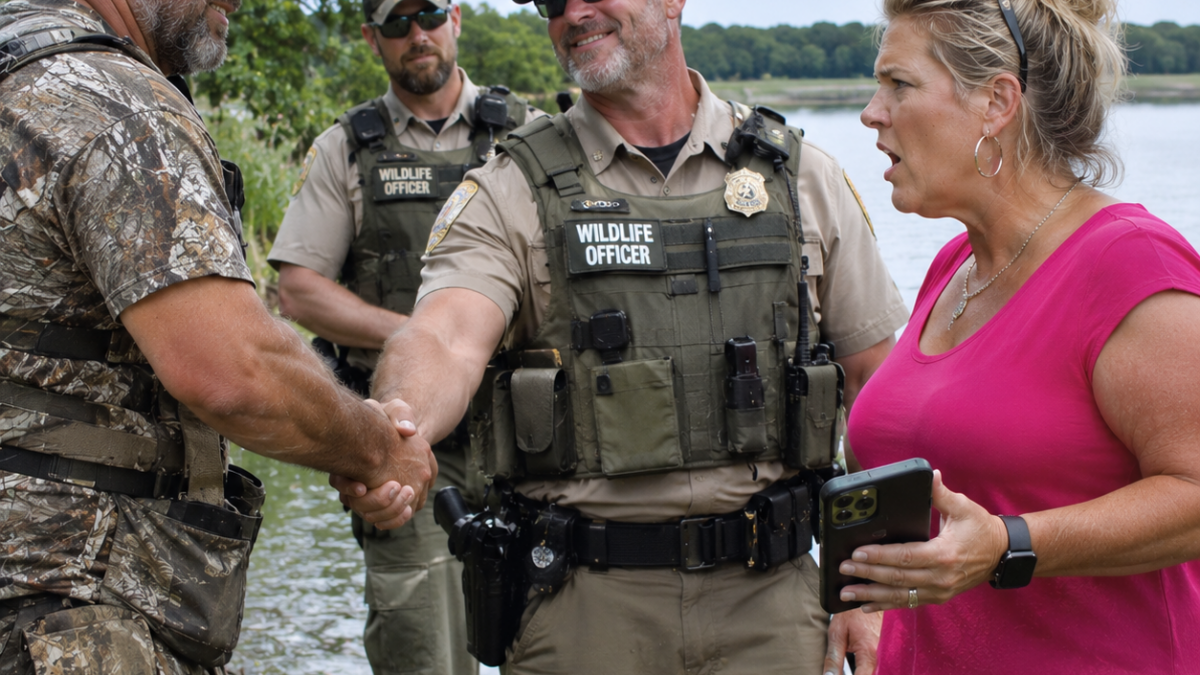
“Captain Mercer.”
I stood.
Kyle walked down the dock.
Extended his hand.
“It’s an honor to see you, sir.”
I shook it.
“Good to see you too, Kyle.”
Behind him came Maria Espinoza.
She saw me.
Her eyes widened.
“Captain?”
“Hey, Maria.”
She laughed.
“I didn’t know this was your place.”
“Now you do.”
“How are you?”
“Retired.”
“That’s not an answer.”
“It’s the only one you’re getting.”
She smiled.
“How’s Cherokee?”
“Busy. We finished the hellbender survey on the Hiwassee.”
“You still using my 2017 protocol?”
“Best one we have.”
Behind them, Brenda stood near the tree line.
Travel mug frozen halfway toward her mouth.
Her smile wasn’t fading.
It was gone.
Completely.
Kyle noticed.
His face changed back to professional.
That made me proud.
Personal familiarity never excuses shortcuts.
“Captain Mercer, we received a formal wildlife complaint regarding activity on this property.”
“I figured.”
“I’m required to inspect.”
“You’d better.”
“Mind if we begin?”
“Kyle, I wrote half the inspection protocol you’re holding.”
He fought a smile.
“Then I guess you know the questions.”
“Ask them anyway.”
He did.
License.
Current.
Lifetime sportsman’s license.
Gear.
Single medium-action spinning rod.
Twelve-pound line.
Legal hook.
Catch.
Three rainbow trout.
Twelve to sixteen inches.
All legal.
He inspected the shoreline.
No gill nets.
No trotlines.
No commercial equipment.
Fish-cleaning station.
Clean.
Creek inlet.
Clean.
Maria photographed everything.
GPS coordinates.
Time stamps.
Evidence procedure.
Exactly as she should.
She knelt beside the inlet and looked into the water.
“Captain, this is cleaner than half the streams we monitor.”
“I know.”
“You stocking it?”
“Personally.”
“What strains?”
I explained.
She nodded.
Brenda was still waiting.
Her arms were crossed now.
But the confident posture was disappearing.
Kyle finished his notes.
Closed the clipboard.
Then walked toward her.
“Mrs. Faulkner?”
“Yes.”
“I’ve completed the field inspection.”
She stepped forward.
“And?”
“There are no violations.”
Her expression froze.
“What?”
“Mr. Mercer is properly licensed. His catch is lawful. His gear is lawful. There are no illegal nets, no commercial equipment, and no evidence of unlawful harvest.”
“But the waterway—”
“Is private.”
Brenda blinked.
Kyle continued.
“The lake lies entirely within Mr. Mercer’s deeded property.”
“I was told it’s navigable.”
“It is not a public navigable waterway for access purposes.”
“But he’s introducing fish—”
“With appropriate management.”
She looked at me.
Then Kyle.
“Do you know him?”
Kyle paused.
“Yes, ma’am.”
“How?”
“Captain Mercer served as district captain for Region 4 for twelve years.”
Silence.
Maria stepped slightly closer.
Kyle continued.
“He supervised wildlife enforcement across six counties.”
Brenda’s mouth opened.
No sound.
“He trained many officers currently serving in this region.”
Then:
“Including me.”
Maria added quietly:
“And me.”
Brenda’s face changed.
Not dramatically.
That’s not how real humiliation works.
First came disbelief.
Then calculation.
Then the awful realization that she had built an entire attack on the assumption that the dirty old fisherman at the dock knew less about wildlife law than she did.
Kyle kept going.
“Captain Mercer also designed and ran the Little Pigeon brook trout restoration program.”
Maria said:
“The one that received the national conservation award.”
Brenda’s eyes moved toward me.
I said nothing.
Kyle looked at his paperwork.
“Mrs. Faulkner, there’s another issue.”
“What issue?”
“You alleged several specific criminal violations.”
“Yes.”
“They are unsupported.”
“I reported what residents observed.”
“Who observed gill nets?”
She hesitated.
“I received information.”
“From whom?”
“I’d have to check.”
“Who observed commercial fishing?”
“I don’t have names with me.”
Kyle’s voice remained calm.
“False wildlife reports can carry penalties.”
Her face hardened.
“Are you threatening me?”
“No, ma’am. I’m informing you.”
He looked directly at her.
“This is also not the first unfounded government complaint connected to your address involving Mr. Mercer.”
Brenda crossed her arms.
“I am protecting my community.”
Kyle nodded once.
“That does not change reporting requirements.”
For several seconds nobody spoke.
Then Brenda turned.
Walked toward her Range Rover.
Gravel flew when she left.
After the dust settled, Kyle sat beside me on the dock.
Maria sat on the other side.
For a moment we were quiet.
One of the bishops stood in the north shallows.
A bass broke the surface.
Kyle said:
“Captain.”
“Yeah?”
“She’s not stopping.”
“I know.”
“We’ve seen her name before.”
I turned.
“What?”
“Complaints involving other people on this road.”
Maria nodded.
“Same pattern. Agencies. Threats. Nothing sticks.”
“How many?”
“Two families we know about.”
Kyle looked at me.
“One already moved.”
I stared across the water.
That changed something.
Until then, I had treated Brenda as my problem.
My lake.
My boundary.
My annoyance.
But predators rely on people believing they are isolated.
I asked:
“How’s the file?”
Kyle smiled slightly.
“You’re building one.”
“Kyle.”
“Of course you’re building one.”
“So?”
“So are we.”
That night, I sat at Connie’s table.
Spread everything across it.
HOA letters.
Fake signs.
Photographs.
County report.
Health report.
TWRA inspection.
Screenshots.
Certified mail receipts.
Names.
Dates.
My file was thick.
But I didn’t want to embarrass Brenda.
I wanted to stop the behavior.
Permanently.
For thirty years, I taught younger officers that a strong case should survive three things:
An angry defense attorney.
A skeptical judge.
And your own worst assumptions.
So I went back to work.
Week one:
Public records.
I filed a Tennessee Open Records request for everything related to Ridgewater Commons.
Development permits.
Plat maps.
Environmental reports.
Stormwater plans.
Certificates of occupancy.
Vendor records available through county filings.
Nine days later, I received 316 pages.
I began at seven in the morning.
Coffee.
Yellow pad.
By midnight, I had found the first major problem.
Ridgewater’s stormwater plan.
The approved engineering documents called for a five-phase system controlling runoff along the eastern slope.
That slope drained toward my creek.
Only phases one and two were completed.
Forty percent.
The rest existed on paper.
Yet sixty-two houses were occupied.
Lawns.
Driveways.
Roofs.
Construction runoff.
Landscaping chemicals.
All above my watershed.
The second problem appeared on page 241.
Green Edge Lawn Solutions.
Ridgewater’s landscaping contractor.
The contract included regular fertilizer and herbicide applications.
One listed product contained atrazine.
A chemical heavily restricted near sensitive water.
I sat back.
Brenda had spent months accusing me of contaminating the watershed.
And her own HOA might be sending landscaping chemicals downhill toward my lake.
Week two:
Cameras.
Six trail cameras.
Gates.
Fence.
Creek inlet.
Likely access points.
Infrared.
Tamper-resistant.
Timestamped.
I had used similar systems in wildlife enforcement for decades.
Week three:
Independent water testing.
Appalachian Environmental Labs.
Twelve sampling points.
Lake.
Creek.
Upstream controls.
Downstream.
Drainage below Ridgewater.
The results arrived twelve days later.
Lake:
Clean.
Upper creek:
Clean.
Below Ridgewater slope:
Atrazine at roughly four times the referenced aquatic-life benchmark.
Elevated phosphate.
Sediment consistent with active erosion.
I read the report twice.
Then placed it beside Brenda’s complaint accusing my fish station of contaminating water.
I wasn’t angry.
Not then.
I was cold.
The kind of cold I used to feel when a poaching suspect lied during an interview while evidence sat between us.
Week four:
Attorney.
James Roth.
Knoxville.
Property and environmental law.
I had worked with Jim during my TWRA years.
He handled complex enforcement referrals and never enjoyed drama unless he could document it.
I called.
“Jim.”
“Dale Mercer. Thought retirement killed you.”
“Almost.”
“What happened?”
“I need a file opened.”
“How bad?”
I told him.
He was silent.
Then:
“You have lab results?”
“Yes.”
“Trail-camera footage?”
“Some.”
“False agency reports?”
“Several.”
“Trespass?”
“Yes.”
“Incomplete stormwater infrastructure?”
“Looks like it.”
Jim sighed.
“Dale, most clients call me with one case.”
“I’m efficient.”
“This sounds like five.”
“I want it airtight.”
“That sounds more like you.”
Brenda responded exactly the way Kyle predicted.
She hired Richard Cahill.
Nashville real-estate lawyer.
His first letter claimed Ridgewater possessed prescriptive rights to the lake based on continuous community use.
I read it at the kitchen counter.
Then called Jim.
“You seeing this?”
“I’m looking at it.”
“Three-year-old subdivision.”
“I know.”
“Claiming twenty-year-type prescriptive rights.”
“I know.”
Silence.
Then Jim started laughing.
“This is going to make his malpractice carrier sweat.”
I smiled.
Brenda didn’t stop.
Next complaint:
Tennessee Department of Environment and Conservation.
She accused me of watershed contamination.
Inspector Alan Buchanan arrived.
I walked him through the property.
Then took him to the creek.
“Alan.”
“Yes?”
“Before you leave, look here.”
The water below Ridgewater’s drainage channel had a faint brown discoloration.
I handed him the lab results.
“Atrazine?”
“Four times the benchmark according to the lab.”
He read.
“Where are your controls?”
“Upstream.”
“Clean?”
“Yes.”
He looked uphill.
Ridgewater’s perfect lawns sat above us.
Alan took his own samples.
Photographed the drainage.
Three weeks later, I received a letter.
No violations on Mercer property.
Ridgewater received a different letter.
TDEC opened an investigation into its stormwater infrastructure and chemical practices.
Brenda called environmental regulators on me.
They followed the water uphill.
Straight to her HOA.
Still, she didn’t stop.
She held a neighborhood meeting.
Wine.
Cheese.
Printed handouts.
Roy’s daughter-in-law attended.
That night, Roy called me.
“She told them you threatened the wildlife officers.”
I closed my eyes.
“With what?”
“A weapon.”
I gripped the phone.
That was different.
Lying about fishing was one thing.
Claiming I threatened armed wildlife officers could ruin a retired law-enforcement officer’s reputation and potentially trigger a dangerous response.
Roy said:
“What are you going to do?”
Connie’s voice came back.
Stay calm.
Be smart.
“Nothing tonight.”
“Dale.”
“I’m documenting it.”
“She keeps talking.”
“Good.”
“Good?”
“The more specific she gets, the easier she is to disprove.”
There was another battle coming.
The road.
Blackwater Hollow Road ran two and a half miles from the county highway.
Single-lane gravel.
County maintained since 1961.
Recorded access easements.
Public right-of-way.
One October morning, I drove toward the highway and stopped dead.
A black steel gate blocked the road.
Electronic keypad.
Concrete footings still wet.
Professional installation.
Sign:
**RIDGEWATER COMMONS PRIVATE COMMUNITY ACCESS**
**AUTHORIZED RESIDENTS ONLY**
For several seconds I simply stared.
Then I laughed once.
Not from humor.
From exhaustion.
Brenda had spent months trying to claim private property was public.
Now she was claiming a public road was private.
Consistency was not her strength.
I called Roy.
“Can you get out?”
“No.”
“Gate?”
“Yep.”
“I’m handling it.”
Then county road supervisor Frank Weaver.
“Frank.”
“Morning, Dale.”
“Someone installed a locked electronic gate across Blackwater Hollow Road.”
Silence.
“What?”
“Concrete’s still wet.”
“That’s county right-of-way.”
“I know.”
“I’ll send a crew.”
“Frank.”
“Yeah?”
“Document before removal.”
Pause.
“You building something?”
“Always.”
By two, county workers arrived.
Photographs.
Measurements.
Electrical installation.
Footings.
Then plasma cutter.
Forty-five minutes later, Brenda’s ten-thousand-dollar gate lay in pieces beside the road.
The county fined Ridgewater five thousand dollars and ordered removal of the footings.
Brenda complained that county workers destroyed HOA infrastructure.
The county responded that the HOA had illegally obstructed public right-of-way.
That should have been the end.
It wasn’t.
The worst escalation came the following week.
I was buying feed when my phone alerted.
Creek-inlet camera.
Live image.
Three men.
Two standing in my creek with shovels.
Third unrolling black corrugated drainage pipe.
I enlarged the screen.
They were cutting a trench from Ridgewater’s runoff channel directly into my creek.
My creek.
My property.
I left the feed store.
Drove home faster than I should have.
By the time I arrived, they were gone.
But the work remained.
Fresh dirt.
Boot prints.
Pipe.
Muddy water.
A new connection directing Ridgewater drainage straight toward the lake.
I photographed everything.
Coordinates.
Time.
Pipe.
Footprints.
Then water samples.
Upstream.
Downstream.
I called Jim.
“They ran a pipe into the creek.”
Silence.
“Who?”
“Three workers. Camera has faces.”
“Company?”
“Checking.”
“License plate?”
“Yes.”
“Dale.”
“What?”
“This may move beyond civil trespass.”
“I know.”
“Do not touch the pipe yet.”
“I know.”
“Do not contact Brenda.”
“I know.”
“You’re very irritating to advise.”
“Thirty years enforcement.”
“I remember.”
That evening, I sat on the dock.
The cove looked cloudy.
Sediment drifting.
One of the bishops landed.
Stood near the muddy inlet.
Then lifted away.
That hurt more than I expected.
Connie had loved those birds.
Loved that water.
Loved the silence.
For the first time since this started, I spoke aloud.
“They hurt our lake, sweetheart.”
Wind moved across the surface.
I looked toward the ridge.
“But they’re done now.”
The County Board of Commissioners meeting came in November.
Standing room only.
Jim and I arrived early.
For the first time in months, I didn’t wear the torn canvas jacket.
Pressed shirt.
Clean boots.
And my retired TWRA identification badge on a lanyard.
Not because it gave me authority.
It didn’t.
I wanted clarity.
For months Brenda had described me as an unstable recluse.
An ignorant fisherman.
A threatening old man.
I was done allowing ambiguity.
Brenda arrived with Richard Cahill.
Charcoal blazer.
Pearl earrings.
Leather portfolio.
She looked confident.
Prepared.
At nine, the chair called the meeting.
First agenda item:
Ridgewater Commons compliance and neighboring-property dispute.
I walked to the podium.
Sixty faces.
Roy second row.
Jason near the back.
Then I noticed Kyle Neely and Maria Espinoza standing against the wall in uniform.
I hadn’t invited them.
Kyle gave a small nod.
I looked at the board.
“My name is Dale Mercer.”
The room quieted.
“I retired from the Tennessee Wildlife Resources Agency after thirty years of service. For twelve of those years, I served as district captain for Region 4.”
Brenda looked toward Kyle and Maria.
I continued.
“My family has owned the property in Blackwater Hollow since 1958.”
I laid out the first document.
“For seven months, Ridgewater Commons HOA President Brenda Faulkner has conducted a campaign of false reporting, trespass, harassment, and unauthorized claims over property she does not own.”
The fake access sign.
Photograph.
The six signs bolted to my fence.
Photographs.
The workers’ statements.
HOA letters.
Invented bylaw.
My deed.
1958 survey.
County inspection.
Zero findings.
Health inspection.
Zero findings.
Then TWRA complaint.
I placed it on the projector.
Unlicensed commercial fishing.
Gill nets.
Trotlines.
Invasive species.
Waste dumping.
Then footage from my dock.
Kyle arriving.
Handshake.
Inspection.
Clean finding.
Kyle standing against the wall gave a small nod.
Nobody laughed.
I moved to the water evidence.
Independent laboratory report.
Sampling map.
Upstream controls.
Clean.
Lake samples.
Clean.
Downstream of Ridgewater.
Atrazine.
Phosphate.
Sediment.
Then the development stormwater plan.
Five phases approved.
Two completed.
I watched several Ridgewater homeowners exchange looks.
Most had apparently never known.
Then Green Edge landscaping contract.
Chemical schedules.
Then TDEC findings.
Then the trail-camera footage.
Three men in my creek.
Shovels.
Drainage pipe.
The license plate enlarged.
Registered to Green Edge Lawn Solutions.
A company paid by Ridgewater.
Brenda whispered to Cahill.
He didn’t answer.
Finally, county-road gate.
Photographs.
County removal documentation.
Fine.
I looked at the commissioners.
“Seven months.”
I held up the folder.
“Multiple complaints.”
Another folder.
“Zero violations on my property.”
Then the lab report.
“And documented environmental problems originating uphill from the community whose president repeatedly accused me of harming the watershed.”
I stepped aside.
Jim took the podium.
He was better at this part.
Trespass.
False reporting.
Harassment.
Environmental violations.
Public-road obstruction.
Unauthorized waterway modification.
Then Jim surprised me.
“Mr. Chair, I have two additional exhibits.”
He handed over affidavits.
Two other Blackwater Hollow families.
Both described Brenda filing false complaints.
Threats.
Agency calls.
Intimidation.
One had moved.
I turned toward Jim.
He whispered:
“Told you I wanted airtight.”
The room went completely silent.
Cahill stood.
“Mr. Chair, we request a recess.”
“Denied.”
Brenda’s confidence finally cracked.
The chair looked at her.
“Ms. Faulkner, would you like to respond?”
She stood slowly.
Opened the portfolio.
Closed it.
Looked toward Ridgewater residents.
Then at Kyle and Maria.
“I was trying to protect the community.”
Her voice was smaller.
The chair replied:
“The evidence presented today suggests you repeatedly acted outside the authority of your HOA.”
Brenda swallowed.
“We had legitimate environmental concerns.”
“Those concerns resulted in investigations of Mr. Mercer.”
“Yes.”
“Which found?”
She said nothing.
“Ms. Faulkner?”
“No violations.”
“And the environmental investigation subsequently found deficiencies within Ridgewater Commons.”
Her lawyer touched her arm.
She stopped talking.
The chair continued.
“This board will refer the evidence regarding false reports, trespass, public-road obstruction, and environmental matters to the appropriate agencies and district attorney.”
Cahill packed his papers.
Not slowly.
He closed his briefcase.
Then left the room without speaking to Brenda.
That was the moment I knew the fight was over.
Not the consequences.
The fight.
The district attorney reviewed the evidence.
Brenda ultimately faced charges tied to false reporting and trespass.
She entered no-contest pleas.
Suspended sentence.
Two hundred hours community service.
Restraining order.
Five hundred feet from my property.
TDEC enforcement followed.
Ridgewater HOA received fines.
Forty-two thousand dollars related to incomplete stormwater phases.
Another eighteen thousand involving restricted chemical application.
They had ninety days to complete the drainage system.
Quarterly testing for two years.
With engineering.
Legal fees.
Gate removal.
Remediation.
The total cost exceeded one hundred eighty thousand dollars.
Homeowners felt it.
Assessment increase:
Four hundred twelve dollars per household.
That part bothered me.
Most Ridgewater residents hadn’t ordered workers into my creek.
They hadn’t written Brenda’s lies.
Many had simply believed the person they elected.
But leadership has a cost when nobody supervises it.
Two days after the county meeting, Ridgewater held an emergency vote.
Brenda removed as president.
Fifty-eight to four.
Her four supporting board members were removed too.
New president:
Susan Adler.
Retired schoolteacher.
She came to my house Saturday morning.
No clipboard.
No embossed letterhead.
No sunglasses.
She looked tired.
“Mr. Mercer.”
“Dale.”
“Dale.”
She took a breath.
“I owe you an apology.”
“You personally?”
“The HOA does. And I was a member.”
I waited.
“What Brenda did was wrong.”
“Yes.”
“The board should have stopped it.”
“Yes.”
“We didn’t.”
“No.”
Susan accepted every answer.
That told me more about her than any speech could.
“We terminated Green Edge.”
“Good.”
“Hired an environmental engineer.”
“Better.”
“We’re completing the stormwater system.”
“Required.”
“And moving to different landscaping products.”
I nodded.
“That’s a start.”
She hesitated.
Then:
“There is one other thing.”
I almost laughed.
“Here we go.”
Susan raised both hands.
“Not a demand.”
“What?”
“Lake access.”
I stared at her.
“A few families asked whether there might ever be a legal, limited way for children to fish.”
“No HOA ownership claim?”
“No.”
“No community-water argument?”
“Absolutely not.”
“No lawyers?”
“Please, no.”
I almost smiled.
Susan continued.
“Just a request.”
I looked toward the lake.
Connie loved children.
We never had our own.
Not because we didn’t want them.
Life made that decision for us.
She taught Sunday school for years.
Every summer, nieces and nephews crowded our dock.
She taught them to bait hooks while I pretended not to laugh at the screaming.
For a moment, I could see her.
Sun hat.
Bare feet.
A child beside her.
“Let me think.”
Susan nodded.
“Fair.”
“Come back next Saturday.”
She did.
I had an answer.
Not an easement.
Not permanent rights.
A revocable recreational license.
Designated weekends.
Summer.
Families.
Children under sixteen accompanied by adults.
Catch and release.
No motorized boats.
No alcohol.
No chemical bait.
And one more condition.
“What?” Susan asked.
“Conservation orientation.”
She smiled.
“You’re going to teach them?”
“Yes.”
“That seems fair.”
“No.”
“What?”
“It seems fun.”
The first session happened in June.
Fourteen kids.
Nine parents.
They gathered around my dock.
Life jackets.
Cheap rods.
Too much sunscreen.
Too much noise.
I stood where Brenda had once expected wildlife officers to arrest me.
And taught children how to read water.
Shade lines.
Temperature.
Gravel beds.
Insects.
How trout face into current.
How bass hold near submerged timber.
Why clean water matters.
Why you wet your hands before touching a fish.
Why you never leave line behind.
Why conservation isn’t keeping people away from nature.
It’s teaching them how to enter without destroying it.
One girl stood out.
Sophie.
Nine years old.
Front tooth missing.
Volunteer cap three sizes too big.
Second cast.
Her rod bent.
“Mr. Mercer!”
“Keep the tip up.”
“It’s pulling!”
“That’s generally what fish do.”
Her father laughed.
Sophie squealed.
Rainbow trout.
Fourteen inches.
Beautiful fish.
Silver flank.
Pink stripe.
She held it carefully.
Then looked at me.
“Can we put him back?”
“That’s the rule.”
“No.”
She shook her head.
“I mean so somebody else can catch him.”
I looked at her.
Then at Connie’s empty chair.
The bishops stood near the sycamore.
“Yes, Sophie.”
She lowered the trout.
It kicked once.
Then disappeared.
Sophie screamed again.
The bishops flew.
Everybody laughed.
For one second, the dock sounded like summers before Connie got sick.
I had to turn away.
Susan noticed.
She said nothing.
Good woman.
That evening, the families went home.
I swept the dock.
Collected one candy wrapper.
Two pieces of fishing line.
A forgotten plastic cup.
Ordinary mess.
I liked it.
My phone rang.
Kyle.
“Captain.”
“Stop calling me that.”
“No.”
“What do you want?”
“Annual TWRA awards dinner next month.”
“I’m retired.”
“I noticed.”
“Then why are you calling?”
“The director wants you there.”
“Why?”
“To present the Conservation Stewardship Award.”
“To who?”
Pause.
“You.”
I sat down.
“Kyle.”
“Yes, sir?”
“I already got the award years ago.”
“Different one.”
“I don’t need another plaque.”
“I told him you’d say that.”
“What did he say?”
“That this one isn’t for your career.”
I looked across the water.
“What’s it for?”
“For what you did after.”
I was quiet.
Kyle said:
“You could have closed that lake forever.”
“I considered it.”
“You could have hated everybody on that ridge.”
“I considered that too.”
“You didn’t.”
I watched Sophie’s release spot.
“No.”
“So come to Nashville.”
“I hate Nashville.”
“Everybody hates Nashville traffic.”
“I’m serious.”
“So am I.”
I laughed.
“Send me the date.”
After we hung up, I stayed on the dock.
Sun lowering.
Lake turning copper.
One bishop stood in the shallows.
The tall one.
Connie used to call him the deacon.
I looked at her chair.
For seven months, Brenda had tried to make me feel small.
An old man.
Dirty clothes.
Cheap fishing rod.
A nobody sitting beside water too valuable for him to deserve.
But that lake had never been about status.
Grandpa understood that.
Dad did.
Connie most of all.
Water doesn’t care what your house costs.
A trout doesn’t care what HOA you belong to.
A heron doesn’t care whether you drive a Range Rover or an old pickup.
The lake only responds to what you put into it.
Respect.
Or poison.
Patience.
Or damage.
For months, Brenda kept choosing damage.
The satisfying part wasn’t that wildlife officers shook my hand.
Although I won’t pretend watching her face when Kyle called me Captain wasn’t memorable.
It wasn’t the fines.
Wasn’t the charges.
Wasn’t her removal.
The satisfying part was Sophie.
A nine-year-old girl holding a rainbow trout.
Choosing to release it so another child might experience the same joy.
That was conservation.
That was community.
Not taking somebody else’s lake.
Not inventing authority.
Not claiming access because you could see something from your back deck.
Community begins with asking.
Then listening when the answer is no.
And being grateful when someday the answer becomes yes.
Darkness settled over Blackwater Hollow.
The ridge houses began lighting up one by one.
For years, I resented those lights.
They represented Brenda.
Noise.
Pressure.
People staring down at something they wanted.
That night, they looked different.
Just homes.
Families.
Neighbors.
Nothing more.
Nothing less.
I leaned back in my chair.
“Connie?”
The lake was almost black now.
“We’re okay, sweetheart.”
One of the bishops shifted in the shallows.
“The lake’s okay.”
Wind moved through the sycamore leaves.
For just a moment, the last strip of sunlight stretched across the water toward the dock.
Then it disappeared.
And the stars came out.
The district attorney didn’t rush the case.
I respected that.
For thirty years, I had watched bad investigations fall apart because somebody wanted an arrest more than they wanted evidence. Good cases moved differently. Slowly. Methodically. Every photograph authenticated. Every agency report verified. Every witness interviewed separately. Every timestamp checked.
Brenda had spent months trying to use government agencies like weapons.
Now those same agencies were reading every page she had created.
That irony wasn’t lost on me.
Jim Roth called me one Tuesday morning.
I was sitting on the dock with coffee.
“Dale.”
“Morning.”
“You sitting down?”
“I’m sixty years old, Jim. I’m usually sitting down.”
He ignored that.
“The district attorney finished reviewing the file.”
I looked across the lake.
One of the bishops stood near the north bank.
“What happens now?”
“Four false-report counts. One criminal trespass count tied to the drainage work.”
I didn’t say anything.
Jim continued.
“Her attorney is negotiating.”
“For what?”
“No-contest pleas.”
“What do you think?”
“I think she finally understands this isn’t an HOA meeting.”
That made me smile.
Two weeks later, the agreement became official.
Brenda pleaded no contest to all five charges.
The judge imposed a suspended sentence.
Two hundred hours of community service.
And, most importantly to me, a permanent restraining order requiring her to remain five hundred feet away from my property and from me.
When Jim called with the final order, I expected to feel something dramatic.
Victory.
Relief.
Vindication.
Instead, I stared at Connie’s empty chair beside me and felt tired.
Deeply tired.
Not physically.
The kind of tired that comes after spending months waiting for the next envelope, the next government truck, the next worker at your fence, the next photograph taken from a ridge by somebody who thinks your home is public property because they can see it.
For seven months, Brenda had occupied space in my mind that she never had any legal right to occupy on my land.
Now, finally, the law had drawn the boundary she refused to respect.
Five hundred feet.
I leaned back.
“Connie,” I said quietly, “I think we can breathe again.”
The water moved against the dock.
No answer.
But the silence felt different.
Lighter.
Brenda’s criminal case wasn’t the only consequence.
TDEC completed its own enforcement action against Ridgewater Commons.
That one hurt the HOA financially.
Forty-two thousand dollars in penalties connected to the incomplete stormwater system.
Another eighteen thousand involving chemical applications near the protected drainage area.
And the subdivision had ninety days to complete the stormwater infrastructure that should have been finished before families ever moved into those houses.
They also had to submit quarterly water testing for two years.
Engineering.
Construction.
Legal fees.
Remediation.
Gate removal.
The total eventually crossed one hundred eighty thousand dollars.
The HOA reserve fund took the hit.
Which meant every homeowner felt it.
Four hundred twelve dollars in additional assessment per household.
I didn’t celebrate that part.
Most of those sixty-two families hadn’t sent workers into my creek.
They hadn’t fabricated wildlife allegations.
They hadn’t put signs on my fence.
Some had believed Brenda.
Some had stayed silent.
Some had probably thought the whole argument had nothing to do with them.
But that’s the uncomfortable thing about an HOA.
People like the collective power when it helps them.
They forget collective power also comes with collective responsibility.
If you give someone authority in your name, eventually you may have to answer for what they do with it.
Two days after the county hearing, Ridgewater called an emergency meeting.
I didn’t attend.
Roy’s daughter-in-law did.
She called him afterward.
Roy called me.
“You sitting down?”
“Why is everybody asking me that lately?”
He laughed.
“They voted her out.”
“Brenda?”
“Fifty-eight to four.”
I let out a slow breath.
“The four?”
“Her board allies.”
“Figures.”
“They removed them too.”
That surprised me.
“All of them?”
“All four.”
Roy sounded almost cheerful.
“They cleaned house, Dale.”
I looked toward the ridge.
For months, those houses had represented pressure.
Now I wondered how many people up there were sitting around kitchen tables asking themselves how they let one woman speak for all of them.
“Who’s president?”
“Susan Adler.”
“Know her?”
“Retired schoolteacher.”
“Good sign.”
“She’s coming to see you.”
I frowned.
“When?”
“Saturday.”
“Why do you know my schedule?”
“Because unlike you, I talk to people.”
Saturday morning arrived cold and clear.
I was splitting kindling beside the shed when an older Subaru stopped near the house.
Not a Range Rover.
That was the first good sign.
A woman stepped out.
Late sixties maybe.
Gray hair cut short.
Jeans.
Walking shoes.
No clipboard.
No portfolio.
No embossed folder.
She looked exhausted.
“Mr. Mercer?”
“Dale.”
“Dale. I’m Susan Adler.”
“I know.”
She looked toward the lake.
Then back at me.
“I wanted to come personally.”
I set the axe against the stump.
“All right.”
She took a breath.
“I’m the new president of Ridgewater.”
“My condolences.”
She surprised me by laughing.
“Thank you. I think.”
That broke some of the tension.
Then she became serious.
“What Brenda did was wrong.”
I said nothing.
“The board failed too.”
I looked at her.
“Most people don’t start apologies that way.”
“I taught middle school for thirty-four years.”
“That explains bravery.”
“It explains knowing when excuses make things worse.”
Fair enough.
Susan continued.
“We should have asked questions.”
“Yes.”
“We should have checked the deed.”
“Yes.”
“We should have stopped the complaints.”
“Yes.”
She nodded every time.
No defense.
No explanation.
No “but.”
That mattered.
“We terminated Green Edge.”
“Good.”
“We hired an environmental engineer.”
“Necessary.”
“The stormwater work starts Monday.”
“Better late than never.”
“We’re switching landscaping products.”
“Good.”
“And the board voted unanimously that no HOA representative is to enter your property without written permission.”
I raised an eyebrow.
“You needed a vote for that?”
Susan actually winced.
“When you say it like that, it sounds ridiculous.”
“It is ridiculous.”
“I know.”
We stood quietly for a moment.
Then she looked toward the lake again.
“There’s one more thing.”
I nearly laughed.
“Of course there is.”
She raised both hands.
“Not a demand.”
“That would be refreshing.”
“Some families asked me to speak with you.”
“About?”
“The lake.”
My expression must have changed.
Susan spoke quickly.
“Not ownership. Not an easement. Not HOA access. Nothing permanent.”
I waited.
“A few families have children who are interested in fishing. Some of them saw the county meeting. Some heard about your conservation work.”
She paused.
“They asked whether there might ever be a way to visit legally.”
I turned toward the water.
My first instinct was no.
Automatic.
Protective.
After seven months, the word had become armor.
No.
No access.
No workers.
No signs.
No complaints.
No gate.
No drainage.
No.
It had kept the lake safe.
But safety and isolation are not always the same thing.
Connie knew that better than I did.
She loved kids.
We never had children of our own.
Life never gave us that chapter.
But nieces, nephews, church kids, neighbors’ children—our dock was rarely quiet during summers when we were younger.
Connie would sit cross-legged at the edge teaching somebody how to hold a worm without screaming.
I would pretend to be annoyed when rods got tangled.
Then spend twenty minutes fixing them.
After she died, the dock became quiet.
At first I needed that quiet.
Then I got used to it.
Maybe too used to it.
Susan said:
“You don’t have to answer today.”
That helped.
“Come back next Saturday.”
She nodded.
“Fair.”
She drove away.
I spent the week thinking.
Not about Brenda.
About Connie.
I remembered one summer afternoon when my nephew had hooked a small bass and panicked so badly he threw the rod into the lake.
Connie laughed until she cried.
I dove in after it.
She laughed harder.
That night she told me:
“You know why kids should fish?”
“So adults have to swim?”
“No.”
She leaned against me.
“Because a child can hold something wild for ten seconds and understand it doesn’t belong to them.”
I hadn’t thought about that sentence in years.
Next Saturday, Susan returned.
I had paperwork ready.
Not because I distrusted her.
Because clarity prevents future arguments.
“No easement,” I said.
“Agreed.”
“No permanent access right.”
“Agreed.”
“Revocable license.”
“Understood.”
“Designated weekends only.”
She nodded.
“Families.”
“Yes.”
“Children under sixteen accompanied by an adult.”
“Yes.”
“Catch and release.”
“Absolutely.”
“No motorized boats.”
“Fine.”
“No alcohol.”
“Fine.”
“No chemical bait.”
Susan smiled.
“You’ve thought about this.”
“Thirty years of enforcement teaches you to imagine what stupid thing somebody will eventually try.”
She laughed.
“Anything else?”
“Yes.”
“What?”
“Everybody attends a conservation orientation.”
Her face brightened.
“You’re teaching it?”
“Apparently.”
“When?”
“June.”
She extended her hand.
This time, when someone from Ridgewater reached toward me, I took it.
The first fishing morning arrived warm and clear.
Fourteen children.
Nine parents.
They came down the trail carrying cheap spinning rods, little tackle boxes, water bottles, sunscreen, and enough excitement to scare every fish into the deepest part of the lake.
I stood at the dock.
For a second, I almost told them to be quiet.
Then I heard Connie in my head.
Let them be kids, Dale.
So I let them make noise.
Susan gathered everyone.
“Okay, guys, this is Mr. Mercer.”
One boy raised his hand.
“Were you really a wildlife captain?”
I looked at him.
“Who told you that?”
“My dad.”
His father looked embarrassed.
“I read the article.”
I sighed.
“Yes.”
The boy’s eyes widened.
“Did you arrest poachers?”
“Yes.”
“Did anyone run?”
“Yes.”
“Did you chase them?”
“Sometimes.”
“Did—”
Susan interrupted.
“Let Mr. Mercer teach.”
I almost told her the kid’s questions were more interesting.
Instead, I began.
“This lake stays healthy because everything in it is connected.”
I showed them the springs.
The limestone creek.
The shallow spawning beds.
The deeper summer water.
I explained why cold water held more oxygen.
Why trout needed clean gravel.
Why fishing line left behind could kill birds.
Why you wet your hands before handling a trout.
Why catch-and-release only works if you don’t spend five minutes taking photographs while the fish suffocates.
One girl listened harder than the rest.
Sophie.
Nine years old.
Gap between her front teeth.
Volunteer cap sliding over one ear.
She raised her hand constantly.
“Why do trout have spots?”
“Camouflage.”
“Why are rainbows pink?”
“Genetics and diet.”
“Why do herons stand still?”
“Because patience catches more fish than noise.”
She looked toward the bishops.
“Do they have names?”
I hesitated.
“My wife called them the bishops.”
“Why?”
“Because they look like they’re supervising everybody.”
Sophie stared at them.
Then nodded solemnly.
“That makes sense.”
We started fishing.
The adults struggled more than the children.
That was predictable.
Twenty minutes in, Sophie’s rod bent.
Her eyes went wide.
“Mr. Mercer!”
“Keep the tip up.”
“It’s pulling!”
“That’s usually a positive sign.”
Her father laughed.
Sophie didn’t.
She was fighting for her life.
Or believed she was.
The trout flashed near the surface.
Rainbow.
Good fish.
She reeled too fast.
“Slow down.”
“It’s getting away!”
“Let it run.”
“But—”
“Trust the rod.”
She did.
That impressed me.
Most adults don’t.
I slipped the net beneath it.
Fourteen inches.
Beautiful.
Pink stripe.
Black spots.
Perfect fins.
I wet my hands and showed Sophie how to support it.
She held the trout.
Her entire face changed.
Wonder does that.
Everything disappears except the thing in front of you.
“Is it okay?”
“Yes.”
“Can I keep it?”
I looked at her.
She immediately remembered.
“Oh. Catch and release.”
“Right.”
She studied the fish.
Then said something I wasn’t ready for.
“Can we put him back so somebody else can catch him?”
Not because it was the rule.
Because she understood the reason.
I looked at Connie’s chair.
Still beside mine.
I had left it there through rain, winter, pollen, and seven months of Brenda’s nonsense.
“Yes, Sophie.”
We walked to the edge.
“Put him in the water facing forward.”
“Like this?”
“Perfect.”
“Do I let go?”
“When he’s ready.”
The trout rested in her hands.
Then one strong kick.
Gone.
Sophie screamed.
Every heron on the north shore took flight.
Parents laughed.
Kids cheered.
And suddenly the dock sounded like it had thirty years earlier.
Children.
Water.
Arguments over bait.
Somebody dropping a tackle box.
A father asking how to untangle line.
For one second, Connie felt close enough that I almost turned toward her chair expecting to see her laughing.
Instead, it was empty.
My throat tightened.
I turned toward the lake.
Susan stepped beside me.
“You okay?”
“Fine.”
She didn’t believe me.
Good teachers rarely do.
But she didn’t push.
After lunch, another child caught a bass.
Then a bluegill.
Nobody caught anything enormous.
That wasn’t the point.
By midafternoon, parents were helping children collect trash without being asked.
Sophie found three inches of old fishing line near the bank.
“Is this dangerous?”
“Yes.”
She wrapped it around her hand.
“Then we should throw it away.”
“Exactly.”
Conservation lesson completed.
Not with a lecture.
With three inches of monofilament.
When everybody finally left, the property became quiet again.
I swept the dock.
One candy wrapper.
Two pieces of line.
Half a cracker.
A plastic cup.
Normal evidence of children having been somewhere.
I didn’t mind.
I sat in my chair.
Looked at Connie’s.
“You would’ve loved her,” I said.
The bishops had returned.
One of them stood near the release spot.
My phone rang.
Kyle.
“Captain.”
“Retired.”
“Still Captain.”
“What do you want?”
“TWRA annual awards dinner next month.”
“No.”
“I haven’t asked yet.”
“Still no.”
He laughed.
“The director wants you there.”
“I’ve been to enough agency dinners.”
“You haven’t been to this one.”
“They’re all the same. Chicken, bad coffee, somebody talks too long.”
“Accurate.”
“Then why would I go?”
“You’re receiving the Conservation Stewardship Award.”
I closed my eyes.
“Kyle.”
“Yes, sir?”
“I already have plaques.”
“I know.”
“I don’t need another.”
“I told the director you’d say that.”
“What did he say?”
“That this one isn’t about your old career.”
I looked across the lake.
“What is it about?”
“What you did after retirement.”
“I argued with an HOA.”
“No.”
Kyle’s voice softened.
“You protected a watershed.”
I said nothing.
“You documented contamination instead of just fighting over property.”
Still nothing.
“You stopped false reporting.”
He continued.
“And after all of that, you opened the lake to children.”
“Limited access.”
“Of course.”
“Revocable.”
“I know.”
“Supervised.”
“Captain.”
“What?”
“You’re proving my point.”
I sighed.
Kyle laughed.
“The director wants you there.”
“I hate Nashville.”
“So does everybody driving into Nashville.”
“That doesn’t help.”
“Maria’s coming.”
“That helps less.”
“She said she’ll drag you there.”
“She might.”
“So?”
I looked at Connie’s chair.
“Send me the date.”
“That a yes?”
“It’s not a no.”
“Close enough.”
He hung up before I could change my mind.
I sat there for a long time afterward.
Awards used to matter to me.
Not because I needed praise.
Because when you’re younger, recognition feels like proof that the sacrifices were worth it.
Missed holidays.
Night calls.
Dangerous stops.
Cold streams.
Court testimony.
Connie eating dinner alone because somebody had spotlighted deer two counties away.
She never complained.
That made it worse.
When the national conservation award came in 2019, she held the plaque and said:
“You know what I like best?”
“What?”
“Your name is smaller than the trout.”
I laughed.
“It should be.”
“That’s why you deserve it.”
Then she kissed me.
Eleven months after her diagnosis, she was gone.
No award had mattered since.
But sitting there after Kyle’s call, I understood this one differently.
It wasn’t for the career.
It wasn’t even for winning.
It was for what came after the fight.
That mattered.
Because anger can protect something.
But anger cannot teach a child to love it.
The following week, Susan sent me a photograph.
Sophie at home.
Drawing.
A rainbow trout in blue and pink crayon.
Three giant herons beside it.
At the bottom she had written:
BLACKWATER LAKE — PLEASE TAKE CARE OF IT
I stared at that picture longer than I should have.
Then I printed it.
Framed it.
Put it beside the old photograph of Connie sitting on the dock in 1998.
Two women who never met.
One fifty-five.
One nine.
Both understanding the lake better than Brenda ever had.
The awards dinner came the next month.
I wore the suit Connie bought me for our thirtieth anniversary.
It still fit if I didn’t breathe too deeply.
Kyle met me at the entrance.
He looked at the suit.
“Captain, you clean up.”
“Careful.”
Maria hugged me before I could stop her.
“You came.”
“Against my better judgment.”
The director gave a speech.
Too long.
Chicken was dry.
Coffee was bad.
I had predicted everything correctly.
Then my name was called.
I walked toward the stage.
The applause felt strange.
Officers I had trained were standing.
Some younger ones I didn’t know.
Kyle.
Maria.
People from fisheries.
Conservation.
I took the plaque.
The director whispered:
“Say something.”
“I thought we agreed no speech.”
“We never agreed.”
I looked at the room.
Then at the plaque.
I had spent most of my life teaching officers how to enforce wildlife law.
But that summer, Sophie reminded me of something more important.
So I spoke.
“Most people think conservation means keeping something away from people.”
The room quieted.
“Sometimes it does.”
I paused.
“But if the next generation never touches clean water, never holds a trout, never watches a heron hunt, then eventually they won’t understand what we’re asking them to protect.”
I looked toward Kyle.
“The law can stop damage.”
Then Maria.
“But law alone can’t create stewardship.”
I thought about Connie.
“That part has to be taught.”
That was enough.
I stepped away.
No long speech.
After dinner, Kyle asked:
“Connie would’ve liked that.”
I looked at him.
“She would’ve said I talked too long.”
He smiled.
“Probably.”
I drove home through the mountains.
It was after midnight when I reached Blackwater Hollow.
I could have gone straight inside.
Instead, I walked to the dock.
Moonlight lay across the water.
Connie’s chair.
My chair.
The lake quiet again.
I set the plaque on the boards between us.
“Another one,” I said.
The lake didn’t care.
Good.
Connie would have approved.
Summer continued.
More kids came.
Not every weekend.
I didn’t want Blackwater becoming a park.
Just enough.
Families learned the rules.
Parents started arriving early to help.
Susan never once asked for expanded access.
That mattered too.
Trust grows when people don’t immediately test its limits.
Some Ridgewater residents apologized.
Some didn’t.
I didn’t need all of them to.
A man once stopped me at the mailbox.
“I signed Brenda’s petition.”
I looked at him.
He swallowed.
“I believed her.”
“All right.”
“I’m sorry.”
I nodded.
He expected more.
Maybe forgiveness should have a speech.
Mine didn’t.
“Don’t do it again.”
“I won’t.”
That was enough.
Brenda disappeared from Ridgewater life.
I heard she sold eventually.
I didn’t look up where she went.
Didn’t care.
For months she had been the loudest person in my world.
Then one day, she was simply absent.
That was the consequence I valued most.
Not seeing her lose.
Not hearing people condemn her.
Peace.
Real peace is remarkably boring.
Coffee.
Fishing.
Repairing the dock.
Watching weather.
Roy complaining about cattle prices.
Kids arriving twice a month with rods.
The bishops standing in the shallows.
Normal things.
One afternoon late that summer, Sophie came back.
She walked straight to the dock carrying her rod.
“Mr. Mercer?”
“Yes?”
“Do you remember the trout?”
“The one you nearly pulled yourself into the lake catching?”
“I did not.”
“You screamed.”
“I was excited.”
“Very loudly.”
She ignored that.
“Do you think he’s still here?”
“Probably.”
“Do you think he remembers me?”
“No.”
She frowned.
“That’s rude.”
“He’s a trout.”
She sat beside me.
Then asked:
“Does the lake remember people?”
That question stopped me.
I looked at Connie’s chair.
“At my age, Sophie, you learn places remember people even if water doesn’t.”
“How?”
“The dock remembers where somebody sat.”
She looked at the empty chair.
“The trees remember what they planted.”
The sycamore moved in the breeze.
“And sometimes people remember for the place.”
She thought about that.
“Was that your wife’s chair?”
“Yes.”
“Was she nice?”
“The nicest.”
“Did she fish?”
“Better than me.”
Sophie smiled.
Then became serious.
“Do you miss her?”
“Every day.”
She nodded as though that answer made perfect sense.
Then she cast.
No pity.
No awkwardness.
Kids are good that way.
We sat quietly.
Ten minutes later, one of the bishops landed across the lake.
Sophie whispered:
“Is that the deacon?”
I laughed.
“How do you know that?”
“Susan told me.”
“News travels.”
We watched him.
For the first time since Connie died, sharing the lake didn’t feel like losing part of her.
It felt like keeping something she loved alive.
That realization took me by surprise.
I had protected Blackwater so fiercely partly because grief had convinced me that change was theft.
If I changed Connie’s dock, I lost her.
If strangers came to the lake, they took something that belonged to us.
If children laughed where she once laughed, maybe the old sound disappeared.
But grief lies that way.
Memory doesn’t shrink when it’s shared carefully.
Sometimes it grows.
That evening, after Sophie left, I repaired the loose armrest on Connie’s chair.
I had avoided it for years.
Two screws.
Ten minutes.
That was all.
When I finished, I sat beside it.
The sunset turned the water copper.
The same color it had been on a hundred evenings when Connie was alive.
One bishop stood near the north shore.
Then another.
Two tall shadows.
Still.
Patient.
I thought about Brenda arriving with her clipboard, convinced the lake was valuable because it could increase property prices.
She never understood.
The lake wasn’t valuable because sixty-two houses could see it.
It wasn’t valuable because someone could paddleboard on it.
It wasn’t valuable because trout lived there or because a conservation organization gave me a plaque.
It was valuable because people cared enough not to destroy it.
Grandpa.
Dad.
Connie.
Me.
Now maybe Sophie.
Maybe fourteen children.
Maybe their parents.
Protection doesn’t always mean closing a gate.
Sometimes it means teaching the right people why the gate matters.
I looked toward Ridgewater.
The houses were glowing in the evening light.
For months, I had seen them as enemies.
But houses aren’t enemies.
People make choices.
Communities can make better ones.
Susan had.
The new board had.
Some residents had.
And perhaps that was the ending Brenda never imagined.
She believed this fight had only two possible outcomes.
Either she took control of the lake.
Or I kept everyone out.
Instead, she lost her authority, the HOA repaired the damage, and the very families she claimed to represent eventually came to my dock by asking permission.
Not demanding.
Asking.
That difference meant everything.
Darkness came slowly.
The last children’s footprints were still visible in the mud beside the trail.
I could hear frogs near the creek.
The lake reflected the first stars.
I placed one hand on Connie’s repaired chair.
“We’re okay, sweetheart.”
The words came easier now.
“The kids are good.”
One of the bishops shifted.
“The trout are good.”
Water moved softly against the dock.
“The lake’s okay.”
I sat there until the sky was completely dark.
For the first time since Connie died, I didn’t feel like I was guarding the past.
I felt like I was handing something forward.
And maybe that was what she had been waiting for me to understand all along.








