HOA Karen Called the Sheriff on My Bonfire—Then the Deputy Stepped Out With Marshmallows
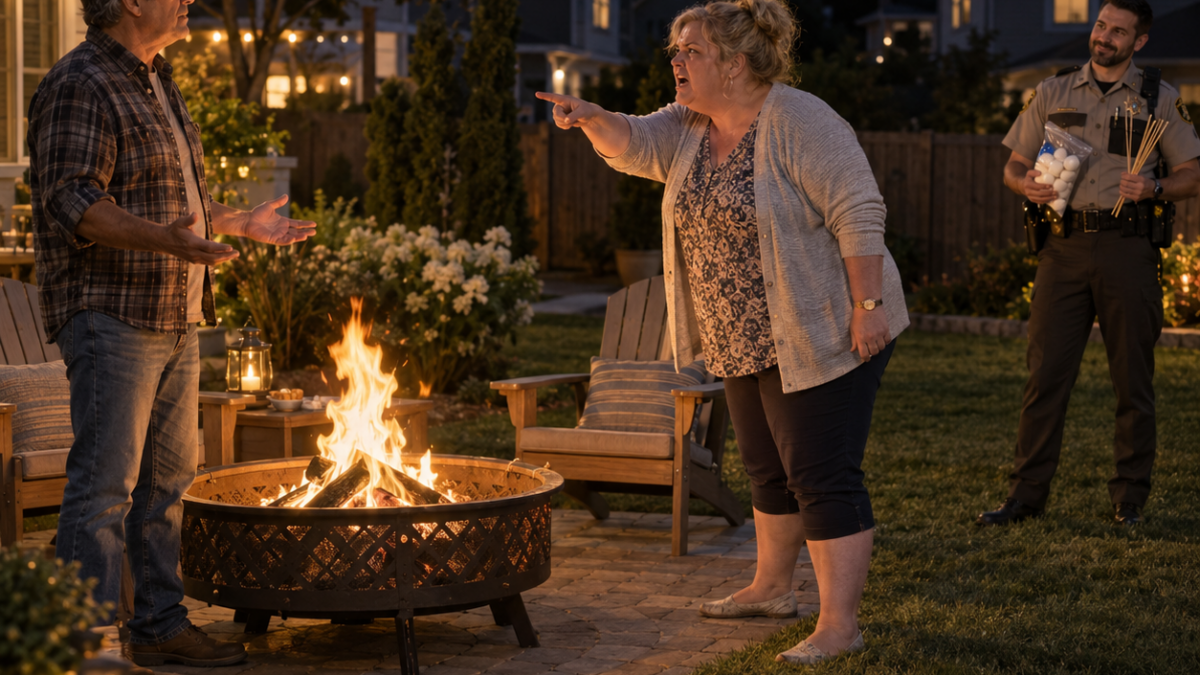
PART 2
Mark didn’t smile after that.
That was the thing Karen misunderstood about him.
He had my sense of humor, sure. He could turn almost anything into a joke when he was home with the kids.
But the moment he was working, he became another person.
Measured.
Careful.
Professional.
He turned toward Karen.
“Mrs. Miller, I need you to understand something.”
She folded her arms.
“I understand plenty.”
“I don’t think you do.”
Her eyes narrowed.
Mark continued.
“Dispatch records show multiple calls from your address regarding recreational fires at this property.”
“They were legitimate complaints.”
“Deputies responded each time.”
“Because he was breaking HOA rules.”
“Deputies don’t enforce your HOA rules.”
“He was creating a public hazard.”
“Each responding deputy documented that the fire was controlled and lawful.”
Karen’s face hardened.
“Then they didn’t investigate properly.”
My grandson Ben leaned toward me.
“Grandpa?”
“Yeah?”
“Is she mad at Dad?”
“A little.”
“Why?”
“Adult stuff.”
He nodded solemnly, then resumed building his s’more.
Karen was still arguing.
“You people don’t understand what it’s like living beside this.”
Mark looked across my acreage.
The nearest HOA house stood roughly a quarter mile away.
Smoke rose vertically through the still air and disappeared above the oak trees.
“What specifically are you experiencing, ma’am?”
“The smell.”
“Of seasoned oak?”
“The smoke.”
“Is smoke entering your residence?”
“It could.”
“Is it?”
She hesitated.
“That’s not the point.”
“It matters if you’re alleging a health or safety emergency.”
She changed tactics.
“The noise.”
Mark glanced toward Lily and Ben.
They had begun whispering because they realized grown-ups were arguing.
“What noise?”
“The parties.”
I looked around.
There were five people at the fire.
Mark.
His wife Sarah.
Two children.
Me.
Sarah lifted her cider cup toward Karen in a small, incredulous salute.
Mark remained calm.
“How many people did you report were attending when you called?”
“I don’t remember.”
“The dispatcher noted that you described a large party with uncontrolled flames.”
“I said it was dangerous.”
“You said approximately twenty people were present.”
Karen’s expression changed.
That detail had come from the call log.
She hadn’t expected him to know it.
Mark continued.
“You also reported flames reaching tree branches.”
“They were high.”
I looked at the fire.
Maybe two feet above the rim.
The closest tree was thirty yards away.
“Mrs. Miller,” Mark said, “I am going to document tonight’s conditions. Another unit is on its way because I’m related to the homeowner and I don’t want there to be any question about impartiality.”
That surprised even me.
“Another unit?”
Mark nodded.
“Sergeant Miller.”
Karen brightened.
For one foolish second, she apparently believed reinforcement was coming for her.
“Good,” she said. “Maybe someone objective will finally deal with this.”
Mark gave me the smallest look.
I’d seen that expression when he was fourteen and realized his mother had caught him sneaking cookies before dinner.
Not fear.
Anticipation.
Ten minutes later another Sheriff’s Department SUV turned onto my driveway.
Sergeant Daniel Miller stepped out.
No relation to Karen.
That coincidence had annoyed her during a previous call because she’d initially assumed sharing a last name meant he’d naturally sympathize with her.
Daniel was fifty-five, built like an old linebacker, with silver at his temples and the permanently unimpressed expression of a man who had spent three decades listening to people lie badly.
He approached Mark first.
“Riley.”
“Sergeant.”
“You involved?”
“My father’s property.”
Daniel sighed.
“Of course it is.”
Mark handed him the incident details.
Daniel read quietly.
Then he walked around the fire pit.
He measured nothing dramatically.
Didn’t need to.
The dimensions had already been documented during previous visits.
He checked the extinguisher gauge.
Looked at the hose.
Looked at the wood.
Then he turned to me.
“Mr. Riley.”
“Sergeant.”
“Same setup as last week?”
“Yes.”
“And the week before?”
“Yes.”
“And before that?”
“Yes.”
He looked at Karen.
She launched immediately.
“I don’t appreciate being mocked.”
Daniel’s face didn’t change.
“No one is mocking you.”
“His son brought marshmallows.”
Daniel glanced at the bag.
“Those are not prohibited under county ordinance.”
I coughed into my fist.
Sarah looked down at her cider.
Karen turned crimson.
“This is exactly what I mean! Nobody takes this seriously.”
Daniel did.
His next words erased every trace of humor.
“Ma’am, the department does take misuse of emergency resources seriously.”
She stopped.
He took a folded document from his breast pocket.
“I reviewed the call history associated with this address before responding tonight.”
“Why?”
“Because this is the seventh call involving the same alleged hazard.”
“It keeps happening.”
“No, ma’am. A legal fire keeps happening.”
Her lips parted.
Daniel went on.
“Seven separate responses. Seven officer assessments. No violation documented.”
“But the HOA—”
“Is not the sheriff’s department.”
Her eyes flicked toward me.
I didn’t smile.
I wanted her to hear every word.
Daniel held the paper at his side.
“Tonight you described an uncontrolled bonfire, approximately twenty people, flames contacting nearby vegetation, and an immediate danger to neighboring homes.”
He pointed toward my fire.
“None of those conditions exist.”
Karen crossed her arms tighter.
“I may have estimated incorrectly.”
“That’s possible once.”
Her face shifted.
“Are you accusing me of lying?”
“I’m telling you your reports have repeatedly failed to match what responding deputies found.”
“Because he cleans everything up before you arrive.”
Daniel looked at the fire.
Then at my security camera mounted under the barn eave.
Then back at her.
“Does he also move twenty people before we arrive?”
She had no answer.
The night seemed quieter.
Even the grandkids had stopped talking.
Daniel stepped closer, still leaving plenty of distance between them.
“This is an official warning. If you continue using the emergency line to report circumstances you know are not occurring, you may be cited under applicable law.”
Karen’s posture changed.
The authority she’d been trying to borrow from the sheriff’s department had just turned around and looked directly at her.
“You can’t threaten me.”
“I’m informing you.”
“I’m president of this homeowners association.”
Daniel nodded once.
“That does not give you authority over emergency dispatch.”
Her voice sharpened.
“I have a responsibility to protect this community.”
“So do I.”
That ended it.
Karen looked at Mark.
“You arranged this.”
Mark spoke for the first time in several minutes.
“No, ma’am.”
“Your father knew you’d be dispatched.”
“I wasn’t supposed to be.”
That was true.
Mark worked a neighboring patrol sector most nights.
The call had bounced to him because of a staffing shift.
The marshmallows had been in his cruiser because Sarah had texted him earlier that afternoon asking whether he could stop by after work.
Karen didn’t believe him.
“You think I’m stupid?”
Mark didn’t answer.
Smart man.
She pointed toward me.
“This man has been harassing the board since he moved here.”
I almost admired the reversal.
“Mrs. Miller,” I said, “I haven’t been to your house once.”
“You send threatening letters.”
“I respond to violation notices.”
“You refuse to pay fines.”
“Because my deed exempts the property from the cited restrictions.”
“You think because you were in the Army you can intimidate everyone.”
That one hurt more than it should have.
Not because it was true.
Because she had discovered something people occasionally used when they couldn’t answer me.
Thirty years in uniform.
Sergeant major.
A voice that still carried.
A habit of standing straight.
Some people heard those things and assumed aggression.
I deliberately lowered my voice.
“I haven’t threatened you.”
“You don’t have to.”
Daniel cut in.
“This conversation is finished.”
Karen looked at him.
“I’m not finished.”
“We are.”
Her phone was still in her hand.
Its camera pointed toward us.
For all I knew, she’d been recording the entire encounter.
Good.
Daniel nodded toward her property.
“Have a safe evening, ma’am.”
For several seconds she didn’t move.
Then she turned.
Her shoes crunched across the gravel shoulder.
The pink bathrobe she had thrown over her clothes fluttered behind her.
Halfway down the road, Lily whispered loudly:
“Can we make s’mores now?”
Everyone heard it.
Karen walked faster.
Daniel finally smiled.
“Kid has timing.”
Lily grinned.
Mark held up the marshmallow bag.
“Sergeant?”
Daniel shook his head.
“I’m working.”
“One marshmallow.”
“I’m working.”
“Plain.”
Daniel looked toward the road where Karen had disappeared.
Then at the fire.
“One.”
Ben handed him a roasting stick.
That was the photograph I wish I had taken.
A Sheriff’s Department sergeant standing beside my supposedly dangerous bonfire, roasting one marshmallow while my six-year-old grandson instructed him not to burn it.
Instead I took something better from that night.
A lesson.
Karen’s power depended on the assumption that everyone she challenged would react emotionally.
Get mad.
Raise their voice.
Say something stupid.
Give her one genuine offense that justified the hundred invented ones.
I had spent most of my adult life learning not to give an adversary what he wanted.
The next morning, I opened what my family had begun calling the Karen Binder.
Three inches thick.
Maybe four.
I added the incident number from the previous night.
Date.
Time.
Responding officers.
Conditions.
I saved the driveway camera footage onto two separate drives.
Then I made coffee and spread the HOA’s financial records across the dining room table.
Because the bonfire had never been the real problem.
That had become clear weeks earlier.
To understand why, you had to understand how I’d ended up surrounded by Oak Creek Preserve in the first place.
My ten acres were older than the neighborhood.
Much older.
Locals called it the Miller Farm long before Karen Miller ever moved into the county.
No relation.
The original Miller family had owned forty acres of pasture and oak woodland.
When developers came through twelve years earlier, old Raymond Miller sold thirty acres but refused to part with the farmhouse and the land around it.
The developer built Oak Creek Preserve around him.
Literally.
Three sides of the old farm now faced matching stone entrance walls, manicured lots, curved sidewalks, and houses painted in seven HOA-approved colors that mostly looked like different moods of beige.
The fourth side opened toward county land and a creek.
When Raymond died, his daughter sold the property.
I bought it less than two years after retiring.
The deed arrangement was unusual.
The subdivision needed access rights across one corner of the property for utilities and road infrastructure.
In exchange, the farm became technically associated with Oak Creek Preserve for certain shared expenses but retained broad exemptions from architectural, landscaping, and land-use restrictions.
The realtor warned me.
“Some HOA people may not like it.”
I asked why.
“Because you get to live inside their boundaries without following most of their aesthetic rules.”
I laughed.
“That sounds like their problem.”
It became mine.
The first time Karen arrived at my porch, she carried a binder thick enough to stop a small-caliber bullet.
“I’m Karen Miller.”
“John Riley.”
“I know.”
Of course she did.
She looked past me toward the farmhouse.
I’d been replacing porch rails.
Lumber lay stacked nearby.
My old pickup was parked beside the barn.
To her, I probably looked like a code violation that had learned to walk.
She handed me the binder.
“Community rules.”
“I have a copy.”
“This is the current edition.”
“Thank you.”
Her eyes moved toward the meadow.
“You’re planning to mow that?”
“Parts of it.”
“All of it?”
“No.”
She blinked.
“We have standards.”
“I have deed exemptions.”
“I know about those.”
Her tone told me she hated them.
“Then we’re both informed.”
She smiled.
“Mr. Riley, the best communities work when everyone cooperates.”
“I agree.”
“That means respecting the expectations of your neighbors.”
“Also agree.”
“Even when a technical loophole says you don’t have to.”
There it was.
My deed wasn’t a legal instrument.
It was a loophole.
I leaned against the porch post.
“Mrs. Miller, I spent thirty years in an organization that took rules very seriously.”
She seemed pleased.
“So you understand.”
“I understand that rules mean what they say. Not what somebody wishes they said.”
Her smile disappeared.
I should have known then.
For the first few months, we mostly ignored each other.
I rebuilt the porch.
Painted the farmhouse.
Repaired fencing.
Cleared dead trees.
Mark helped whenever his schedule allowed.
He’d grown up on Army posts.
Germany.
Georgia.
Texas.
North Carolina.
Wherever orders sent us.
His mother, Elaine, had been the steady center of those moves.
We lost her twelve years before I retired.
Breast cancer.
Forty-nine years old.
Mark had just made deputy.
His first commendation ceremony happened three weeks after her funeral.
He didn’t want to go.
I made him.
“Your mom bought a dress for this.”
He stared at me.
“She’s not going to see it.”
“That’s exactly why you’re going.”
We sat in the front row with an empty chair between us.
Neither of us talked about that chair afterward.
Maybe that’s why family nights mattered so much.
For decades I’d missed dinners.
Birthdays.
School events.
Anniversaries.
Deployments have calendars, but children don’t wait for them.
When I retired, Lily was five.
Ben was three.
I promised myself I’d be the grandfather who was there.
The fire pit became part of that promise.
I built it fifty yards from the farmhouse.
Fieldstone.
Steel insert.
A crescent-shaped bench.
Nothing elaborate.
But the first night we used it, Lily sat on my knee and asked:
“Grandpa, did you have fires in the Army?”
“Sometimes.”
“Did you make s’mores?”
“Not usually.”
“Why?”
“Bad planning.”
She thought about that.
“Your Army needed Grandma.”
I laughed so hard I nearly dropped my hot dog.
That memory mattered.
Karen saw flames.
I saw the hours I’d finally learned not to miss.
The morning after our first bonfire, her first letter arrived.
Concern about smoke.
HOA bylaw 7.14.
Potential nuisance.
I almost threw it away.
Then thirty years of military paperwork whispered into my ear.
Document everything.
So I filed it.
Then I pulled the county outdoor-burning requirements.
Recreational fires permitted.
Contained fire.
Proper distance.
Adult supervision.
No prohibited materials.
No burn ban.
Safety equipment.
I complied with all of it.
I wrote back politely.
Certified mail.
She escalated.
First came the architectural violation.
Unapproved recreational apparatus.
The stone fire pit had suddenly become an “installation” requiring Architectural Review Committee authorization.
Karen chaired the committee.
Fine: $100.
Then nuisance smoke.
Another $100.
Then lawn maintenance.
$50.
The lawn violation was my favorite.
A patch of black-eyed Susans grew beside the driveway.
Native flowers.
Bees loved them.
Karen called them unmanaged vegetation.
I photographed them.
Then I drove to the county extension office.
A horticulture volunteer identified them and gave me a pamphlet recommending native pollinator planting.
I mailed Karen a copy.
A week later, she cited me for “excessive correspondence.”
I still laugh about that one.
There was no fine attached.
Probably because even she couldn’t locate a bylaw for annoying the HOA by answering the HOA.
But something changed around then.
I began hearing stories.
David, whose property touched mine at one corner, had been fined because his trash cans remained visible two hours after collection.
He and his wife both worked.
Collection came at eleven in the morning.
They returned home after five.
Karen expected the cans removed by one.
Mrs. Gable had been fined because of fuchsia petunias.
I’d thought she was joking.
She wasn’t.
She showed me the letter.
**Color inconsistent with approved exterior aesthetic harmony.**
“They’re flowers,” I said.
“I know.”
“Flowers die in winter.”
“I know.”
“You paid this?”
Her eyes lowered.
“I didn’t want trouble.”
Three hundred dollars.
For petunias.
Then she showed me her garage.
On a shelf sat seven garden gnomes.
One held a fishing pole.
One pushed a wheelbarrow.
One had a chipped hat.
“My husband bought these everywhere we traveled,” she said.
“Karen said they were unapproved statuary.”
“Your husband?”
“Walter.”
“How long were you married?”
“Forty-seven years.”
She touched the chipped one.
“He bought this in Vermont.”
I didn’t know what to say.
A person can laugh at a garden gnome.
But you don’t laugh when you realize it’s carrying forty-seven years of somebody’s marriage.
The Rodriguez family had it worse.
Their boys had a basketball hoop.
Perfectly ordinary.
Black pole.
Clear backboard.
Portable base.
Karen first complained that the bouncing ball created excessive noise.
Then the hoop was too close to the sidewalk.
Carlos moved it.
Then it violated sight-line requirements.
He moved it again.
Then the black paint on the pole faded.
Karen demanded an approved repaint.
Carlos requested the approved black.
The Architectural Review Committee told him to submit paint samples.
“For black?” I asked.
“For black.”
“How many shades?”
“I submitted three.”
“What happened?”
“She rejected all three.”
“Why?”
He handed me the letter.
**Insufficient visual compatibility.**
I stared at him.
“That sentence means nothing.”
“I know.”
His younger son, Mateo, stood in the doorway behind him.
“Are we getting the hoop back?”
Carlos looked at me.
Then at his son.
“Maybe.”
That was when my dispute stopped feeling funny.
There is a particular cruelty in making ordinary people afraid of their own homes.
A home should be the place where you exhale.
Karen turned homes into inspection sites.
People watched for her golf cart.
They pulled trash cans early.
Measured grass.
Changed flowers.
Removed toys.
Not because the neighborhood needed it.
Because one person had learned that official-looking letters could make decent people surrender.
I began gathering stories.
Not to gossip.
To establish pattern.
Dates.
Notices.
Fine amounts.
Rule citations.
Outcomes.
People started bringing me copies.
My binder acquired another divider.
**NEIGHBOR TESTIMONIES.**
Then came the sheriff calls.
The first one scared Lily.
That’s the part I never forgave.
She was holding a roasting stick when sirens came up the driveway.
Two deputies walked toward us.
Her face went white.
“Grandpa, are you in trouble?”
“No, sweetheart.”
“Why are police here?”
“We’ll find out.”
She moved behind my chair.
Deputy Harris explained the complaint.
Large uncontrolled bonfire.
I showed him the fire.
He almost looked embarrassed.
“You know the ordinance?”
I recited it.
He nodded.
“You’re fine.”
As they left, Lily whispered:
“Are they taking you?”
“No.”
“Promise?”
“Promise.”
That night after everyone went home, I sat beside the dying fire alone.
I wasn’t angry about being inconvenienced.
I was angry because my granddaughter had looked at me like somebody might take me away.
Karen had turned our family night into fear.
The next Friday, she did it again.
Then again.
By the fourth call, deputies knew my name.
By the fifth, one stepped from his cruiser and said:
“Mr. Riley. Let me guess. Contained fire, hose, extinguisher, no burn ban?”
“That’s the rumor.”
He sighed.
“Mind if I document it?”
“Please.”
By the sixth call, dispatch had begun flagging the history.
Mark heard about it at roll call.
He came to my house angry.
Not son angry.
Deputy angry.
“She’s wasting resources.”
“I know.”
“Last Friday we had three units tied up on a wreck ten miles south. If somebody had actually needed help near here—”
He stopped.
That was the real danger.
Not my fire.
Karen’s obsession.
I poured coffee.
“What do I do?”
“Nothing stupid.”
“Good advice.”
“Seriously, Dad.”
“I’m listening.”
“Keep everything perfect. Don’t give her anything real.”
“I haven’t.”
“Keep it that way.”
He tapped the binder.
“Document every call.”
“I do.”
“Save your camera footage.”
“I do.”
“Don’t yell at responding deputies.”
“I don’t.”
“Don’t yell at her.”
I raised an eyebrow.
“I haven’t.”
“You use the sergeant-major voice.”
“That’s different.”
“It’s terrifying.”
I smiled.
He didn’t.
“She needs to establish her own intent.”
“What does that mean?”
“If she genuinely believes there is danger, repeated calls alone aren’t necessarily enough. But if deputies repeatedly explain the fire is lawful and she keeps making materially false claims, that becomes different.”
“So let her keep talking.”
“Exactly.”
That was hard.
People think restraint is passive.
It isn’t.
Standing silent while someone lies about you takes effort.
Not answering provocation takes effort.
Letting evidence accumulate when you want immediate justice takes more discipline than shouting ever will.
So I waited.
Meanwhile, I began examining the HOA itself.
Karen loved rules.
I decided to read all of them.
Every page.
Covenants.
Articles of incorporation.
Meeting procedures.
Financial disclosures.
Vendor contracts.
Anything residents were entitled to review.
Mr. Rodriguez helped.
Software engineers and retired sergeant majors make a dangerous combination when somebody gives them spreadsheets.
Carlos created folders.
I created timelines.
David brought coffee.
Mrs. Gable brought cookies.
What began as three irritated homeowners around my kitchen table became eight.
Then twelve.
Nobody called it resistance.
George from two streets over called it “the Thursday coffee group.”
That sounded harmless.
Karen would have hated knowing what happened over those cookies.
The landscaping contract caught my attention first.
Eighty-two thousand dollars annually.
Oak Creek wasn’t enormous.
I called two landscaping companies outside the county and described the acreage, entrances, common grass, clubhouse beds, and seasonal services without naming the neighborhood.
Their rough estimates were dramatically lower.
Not proof.
But interesting.
Carlos searched state corporate records.
“Lawn and Order Landscaping.”
I laughed.
“That’s really the name?”
“Yep.”
Owner: Gary Peters.
Carlos kept searching.
Then he turned his laptop toward me.
A public photo from Karen’s social media.
Christmas dinner.
Karen beside a man holding a beer.
Caption:
**Family Christmas with my wonderful brother-in-law Gary.**
Nobody spoke.
David finally said:
“That’s not automatically illegal.”
“No,” I said.
“But was it disclosed?”
We searched board minutes.
No conflict disclosure.
No competitive bids.
Contract renewed repeatedly.
Then we examined legal expenses.
They were enormous.
The firm sending enforcement letters had one attorney who also served informally on the Architectural Review Committee.
Again—not necessarily proof of criminal wrongdoing.
But enough to ask questions.
We agreed on one rule.
No accusations we couldn’t document.
That mattered.
Angry people love the word corruption.
Evidence requires slower language.
Potential conflict.
Undisclosed relationship.
No-bid contract.
Disproportionate cost.
Procedural inconsistency.
We would let everyone else reach their own conclusions.
The annual homeowners meeting was a month away.
Under the bylaws, homeowners could raise motions from the floor.
Board members could be removed by majority vote under certain procedures.
Proxy votes counted.
Karen had survived for years because almost nobody attended.
That was about to change.
Carlos created a private website.
Nothing dramatic.
No insults.
No memes.
Just scanned documents.
Meeting dates.
Proxy instructions.
Copies of disputed violations.
A page titled:
**Questions Homeowners May Want Answered.**
Why was the landscaping contract not competitively bid?
Was the vendor’s relationship to the HOA president disclosed?
What authority supported aesthetic fines inconsistent with written covenants?
Why had emergency services been repeatedly contacted regarding a fire law enforcement had repeatedly determined was lawful?
Were all collected fines properly authorized?
People started reading.
Then they started talking.
Karen noticed.
Her newsletters changed tone.
She wrote about “outside agitators.”
I lived inside the neighborhood.
She warned of residents attempting to “undermine property values through disorder.”
Mrs. Gable had petunias.
Carlos had a basketball hoop.
David owned trash cans.
Apparently civilization was collapsing.
Then Karen made a mistake.
She called a special enforcement hearing for me.
I almost couldn’t believe it.
“What does she want?” Mark asked.
“Removal of the fire pit and payment of fines.”
“Can she do that?”
“Not under my deed.”
“You going?”
“Absolutely.”
The clubhouse was half full.
More than Karen expected.
I brought the deed.
County ordinance.
Photographs.
Letters.
Certified receipts.
She sat at the front with Todd and Brenda.
Todd handled finances.
Brenda rarely spoke except to agree with Karen.
Karen read my alleged violations.
“Unapproved recreational apparatus.”
“Nuisance smoke.”
“Landscape noncompliance.”
“Repeated disregard for community standards.”
Then she looked at me.
“Mr. Riley, would you like to respond?”
“Yes.”
I stood.
I opened the deed.
“My property is expressly exempt from architectural restrictions except those concerning shared infrastructure and enumerated safety conditions.”
Karen sighed theatrically.
“We have discussed your interpretation.”
“It isn’t my interpretation.”
I read the covenant aloud.
Todd stared at his papers.
Brenda stared at Karen.
I moved to the county ordinance.
“The recreational fire complies.”
“We aren’t debating county law.”
“You reported me to county law enforcement.”
A few people laughed.
Karen slammed the gavel.
“Order.”
I placed photographs on the projector.
Distances.
Safety equipment.
Fire-ring dimensions.
Then the native-flower letter.
“My so-called lawn violation concerns black-eyed Susans identified by the county extension service as native pollinator habitat.”
Karen looked furious.
“Your property still affects neighboring values.”
Carlos raised his hand from the audience.
Karen ignored him.
I continued.
“Please identify any documented appraisal showing my property reduced neighboring value.”
“That’s not how standards work.”
“So there isn’t one.”
“This hearing is not an interrogation of the board.”
“No. It’s apparently an interrogation of me.”
That got another laugh.
I hated that.
Not the support.
The temptation.
Humiliation can become addictive when you think you deserve to deliver it.
I forced myself back to facts.
“I am asking that the fines be rescinded.”
Karen shook her head.
“Denied.”
Todd glanced at her.
“We haven’t voted.”
She froze.
That tiny moment told me more than anything else that night.
Karen had stopped distinguishing herself from the board.
Todd cleared his throat.
“We should vote.”
Karen glared at him.
The motion to uphold my fines passed two to one.
Todd voted no.
I noted it.
Everything changes when followers realize the leader can lose.
The next morning, Karen sent the entire neighborhood an email claiming the board had “unanimously affirmed” my violations.
Carlos forwarded it to me.
**She just lied about the vote.**
I added it to the binder.
That afternoon Todd called.
I nearly didn’t answer.
“John?”
“Yes.”
“It’s Todd Green.”
“I know.”
Long silence.
“I need to tell you something.”
“Okay.”
“I’m not comfortable with what’s happening.”
“Then stop voting for it.”
“I didn’t last night.”
“I noticed.”
He exhaled.
“Karen has been making decisions before meetings.”
“What kind?”
“Enforcement. Vendors. Legal.”
“Does the board vote?”
“Sometimes.”
“What does sometimes mean?”
Another silence.
“Sometimes minutes reflect votes we didn’t actually take.”
I sat straighter.
“Do you have evidence?”
“I have emails.”
“Don’t send them to me.”
He sounded surprised.
“Why?”
“Because I’m not your lawyer, and I don’t know your obligations as a director. Preserve them. Talk to independent counsel.”
“You don’t want them?”
“I want this done correctly.”
He was quiet.
Then:
“You’re different than she says.”
“What does she say?”
“That you’re trying to destroy the association.”
I looked out at my pasture.
“I pay my dues every year.”
“I know.”
“Associations aren’t my problem. Abuse is.”
Todd eventually spoke with association counsel.
What happened next remained mostly confidential at the time.
But his resistance inside the board grew.
Brenda became nervous.
Karen became more aggressive.
And then came the seventh bonfire call.
The marshmallow night.
By Sunday, word had spread.
Not because I spread it.
Neighbors had seen the sheriff’s vehicles.
Karen had apparently told people she’d been “ambushed by corrupt deputies.”
That phrase traveled faster than any flyer we could have distributed.
By Monday evening, attendance commitments for the annual meeting had tripled.
Then Mark called.
“Dad.”
“What’s wrong?”
“Nothing. But listen carefully.”
I sat down.
“Sergeant Miller filed the incident as a documented warning concerning repeated inappropriate emergency calls.”
“Good.”
“There may be an administrative path for you to request the call records and body-camera footage.”
“May?”
“I’m not handling it.”
“Because you’re my son.”
“Exactly. I want zero appearance that I influenced anything.”
“Good.”
“Submit the request like any citizen.”
I did.
The department released what law permitted.
Call summaries.
Incident history.
A redacted body-camera clip from Sergeant Miller’s warning.
That clip changed everything.
Not because Mark was my son.
That was funny.
But because it captured Karen making claims directly contradicted by the visible scene.
Twenty-person party.
There were five of us.
Flames in trees.
No flames near trees.
Uncontrolled burn.
Contained fire with extinguisher and hose.
And most damagingly, after Sergeant Miller told her the fire was legal, she insisted she would “keep calling until someone finally shuts him down.”
That sentence became the heart of our presentation.
Annual meeting night arrived cold and gray.
I wore jeans, boots, and a button-down shirt.
Mark offered to attend.
“No.”
“Why?”
“You’re law enforcement.”
“I’m also a homeowner’s son.”
“And Karen will say the department is intimidating her.”
He nodded.
He understood immediately.
Sarah attended instead.
Lily wanted to come.
Absolutely not.
“This is boring adult stuff,” I told her.
“Will Karen yell?”
“Probably.”
“Then it’s not boring.”
Smart kid.
Still no.
The clubhouse parking lot was full.
Cars lined both sides of the street.
People carried folders.
Proxy forms.
Printed bylaws.
For the first time, Karen faced not isolated homeowners but a community that had compared notes.
She sat behind the board table.
Red blazer.
Pearls.
Stack of papers.
Gavel.
Her face changed when I walked in.
Not fear exactly.
Recognition.
She knew.
Carlos greeted me near the back.
“We have one hundred seventeen homeowners represented in person or proxy.”
“How many needed?”
“Ninety-four for majority of total eligible interests if our count is right.”
“Verify twice.”
“We did.”
Mrs. Gable sat in the front row.
Her fuchsia petunias had died for the season, but she’d pinned a small pink silk flower to her sweater.
I sat beside her.
“Nervous?”
She nodded.
“Terrified.”
“You don’t have to speak.”
“I do.”
“You already signed an affidavit.”
“Walter would tell me to speak.”
She touched the flower.
“I’m tired of hiding things in my garage.”
That nearly broke me.
Because suddenly this wasn’t about contracts.
Or bylaws.
Or bonfires.
It was about a widow wanting to put her husband’s ridiculous gnomes back in sunlight.
Karen called the meeting to order.
She rushed.
Minutes.
Treasurer report.
Committee reports.
She barely paused.
Then Carlos raised his hand.
“Question on landscaping.”
“We are not taking questions until homeowner forum.”
“The bylaws permit discussion before adoption of the treasurer’s report.”
Karen’s jaw tightened.
Todd looked down.
Brenda shuffled papers.
Carlos asked:
“Was the landscaping contract competitively bid?”
Karen answered:
“The board selected the best-qualified vendor.”
“Was it bid?”
“We are satisfied with the contractor.”
“That’s not the question.”
“Mr. Rodriguez—”
Todd interrupted.
“No.”
Everyone turned.
He looked pale.
“The contract was not competitively bid.”
You could feel the room change.
Karen stared at him.
“Todd.”
He kept going.
“At least not during the years I’ve served.”
Carlos asked:
“Was the relationship between the vendor and President Miller disclosed?”
Karen stood.
“This line of questioning is inappropriate.”
Todd looked at the audience.
“Gary Peters is Karen’s brother-in-law.”
The room exploded.
Voices.
Questions.
Anger.
Karen hammered the gavel.
“ORDER!”
I stayed seated.
This mattered.
People needed to see the board fracture without me controlling it.
Karen leaned toward Todd.
“You are violating executive-session confidentiality.”
“No,” he said. “I’m answering about a public contract.”
Brenda finally spoke.
“I didn’t know they were related when I first voted on it.”
Karen turned toward her.
“Not you too.”
There are moments when power disappears visibly.
Not gradually.
Not symbolically.
One second Karen was president of a board.
The next she was one angry woman sitting behind a folding table while everyone else stopped pretending she was untouchable.
She tried to move forward.
“Homeowner forum. Three minutes each.”
Hands rose everywhere.
She called on Mrs. Gable reluctantly.
The old woman walked to the microphone.
Her hands shook.
I almost stood to help.
She saw me and shook her head.
She wanted to do it herself.
“My name is Evelyn Gable.”
Her voice was soft.
The room became completely quiet.
“I’ve lived here nineteen years.”
She opened her purse.
Then she removed a photograph.
“My husband Walter died four years ago.”
Karen shifted.
Mrs. Gable continued.
“He liked ugly things.”
People laughed gently.
Mrs. Gable smiled.
“He bought garden gnomes everywhere we traveled. I hated them when he was alive.”
More laughter.
“After he died, I loved them.”
Her voice cracked.
She waited.
“I put them in my garden because every morning when I saw them, I remembered him laughing at me for complaining about them.”
She looked directly at Karen.
“Then I was told they were against community standards.”
Karen opened her mouth.
Mrs. Gable raised one trembling hand.
“Please let me finish.”
Karen stopped.
“I put them in my garage.”
Mrs. Gable breathed carefully.
“And every time I parked my car, there they were. Hidden.”
She wiped her cheek.
“I paid fines over flowers too. Three hundred dollars because my petunias were too bright.”
Someone muttered, “Disgusting.”
Mrs. Gable looked toward us.
“I kept telling myself it wasn’t worth fighting.”
Then she straightened.
“But I finally realized that was how it kept happening.”
The room remained silent.
She stepped away.
No applause at first.
Then Carlos stood.
Then David.
Then almost everyone.
Mrs. Gable looked horrified.
I smiled at her.
She cried.
Karen slammed the gavel.
“Sit down!”
People did.
But something irreversible had happened.
Carlos spoke next.
Basketball hoop.
Paint samples.
Threatened fines.
His son Mateo sat in the audience.
When Carlos finished, Mateo held his father’s hand.
David described trash cans.
Another woman described being fined because a child’s bicycle remained in the driveway overnight.
Another man had been cited because his flagpole was two inches taller than the approved plan.
Each story alone sounded petty.
Together, they sounded pathological.
Then my name was called.
I carried one folder to the lectern.
Not the whole binder.
That would have looked theatrical.
The important pages were enough.
“My name is John Riley.”
Karen stared at me.
“I purchased the old Miller property knowing it had limited association obligations and specific deed exemptions.”
I projected the deed language.
“I pay road and common-area dues.”
Next slide.
Checks.
Receipts.
“Every payment is current.”
Next.
HOA fines.
“I have declined to pay these because each relies on restrictions from which the recorded deed exempts my property.”
Next.
County fire ordinance.
“My recreational fire complies with county safety requirements.”
Next.
Photograph of fire pit.
Distances marked.
Next.
Sheriff incident logs.
“Seven calls were made concerning essentially the same activity.”
Murmuring.
Karen stood.
“Those records do not prove I placed every call.”
I looked at her.
“I haven’t said who placed them.”
She froze.
Carlos looked down to hide a smile.
I continued.
“The records identify the reporting address.”
I displayed the redacted sheet.
Karen sat.
Next slide.
A still image from body camera.
Pink bathrobe.
Fire in distance.
Sergeant Miller facing Karen.
“I submitted a lawful public-records request for portions of the most recent response.”
Karen shot to her feet.
“You have no right to show that!”
Association counsel, seated against the side wall, spoke.
“Mrs. Miller, sit down.”
First time I’d heard anyone order her around.
She looked stunned.
I played only what mattered.
Sergeant Miller explaining repeated lawful findings.
Karen insisting it remained an emergency.
Sergeant warning against misuse of emergency resources.
Then the sentence:
“I’ll keep calling until somebody finally shuts him down.”
The clip ended.
Silence.
I didn’t mention marshmallows.
Didn’t need to.
The funny part had already circulated.
The serious part was intent.
I moved to finances.
Landscaping expenses.
Comparable rough market information was not presented as proof of wrongdoing.
I was careful.
“This cost alone does not prove misconduct.”
Karen looked surprised.
“But the vendor relationship raises a governance question.”
State corporate record.
Gary Peters.
Then the public family photograph.
Karen and Gary.
“This relationship appears nowhere in the meeting minutes we reviewed as a disclosed conflict before contract approval.”
People began talking again.
I raised my hand.
“Please.”
The room settled.
“I’m not asking anyone here to decide whether a crime occurred.”
Important sentence.
“I’m asking for an independent audit.”
I changed the slide.
Legal expenses.
Enforcement costs.
Vendor payments.
“I’m asking professionals with no personal stake to examine the records.”
Karen laughed harshly.
“Now you’re pretending to be reasonable.”
I looked at her.
“I’m trying very hard to be.”
“You have spent months turning these people against me.”
“No.”
“You’ve gone door to door.”
“Yes.”
“You built a website.”
“Carlos did.”
“You collected complaints.”
“Documents.”
“You dragged my family into this.”
“The public business filing identifies the vendor. Your public photograph established the relationship.”
“You invaded my privacy!”
“You posted the photograph publicly.”
Her face reddened.
“You hate me.”
That took me by surprise.
I thought about my answer.
“No.”
The room went quiet.
She almost laughed.
“Don’t lie.”
“I don’t hate you.”
“After everything you claim I’ve done?”
“I think you’ve abused authority.”
Gasps.
“I think you’ve treated neighbors unfairly.”
Her eyes narrowed.
“I think you’ve confused enforcing rules with owning people.”
Nobody moved.
“But hatred would require me to give you more space in my life than I’m willing to give.”
That landed harder than shouting would have.
Karen sat.
I turned toward the homeowners.
“My motion is simple.”
I read it.
Removal of Karen Miller, Todd Green, and Brenda Slate from the board, subject to proper vote under the bylaws.
Independent financial audit.
Immediate suspension of disputed aesthetic fines pending review.
A temporary committee to revise enforcement procedures.
David stood.
“I second.”
Karen grabbed her gavel.
“This meeting is adjourned.”
Association counsel stood.
“No.”
Everyone looked at him.
Karen stared.
“What?”
“The bylaws provide for the pending motion to be considered.”
“I am president.”
“At the moment, yes.”
The room erupted.
Even I couldn’t stop smiling at that.
Karen’s hands shook.
Todd spoke.
“I resign.”
Everything stopped.
He pushed his papers forward.
“Effective immediately.”
Karen stared at him.
“You coward.”
Todd looked at her.
“No. I was a coward before.”
He stood.
“I should have challenged decisions I knew were wrong. I didn’t.”
He looked at the homeowners.
“I’m sorry.”
Then he stepped away from the table.
Brenda began crying.
“I didn’t know about Gary.”
Karen snapped:
“Stop talking.”
Brenda looked at her.
And something inside her changed.
“No.”
One word.
Quiet.
Small.
But powerful.
“No, Karen.”
Karen seemed unable to process it.
Brenda wiped her face.
“I resign too.”
Now Karen sat alone behind the table.
One red blazer.
One gavel.
One stack of papers.
One hundred-plus homeowners watching.
I didn’t feel triumphant.
I felt sad.
This was what power without restraint eventually did.
It made a person believe everyone around them belonged beneath them.
Until the day they stood up.
Carlos verified proxies.
Association counsel observed procedure.
The vote happened.
It wasn’t unanimous.
That mattered.
Nine homeowners voted against removal.
Five abstained.
Everyone else voted yes.
Karen was removed.
No cheering.
At least not immediately.
Just a sound like an entire room releasing breath.
Karen remained seated.
She stared at the table.
Then she gathered papers.
Her gavel slipped.
Hit the floor.
The crack echoed.
Nobody moved to retrieve it.
She bent down herself.
For some reason, that was the moment I remembered most.
Not the vote.
Not the body-camera video.
Not the financial slides.
Karen on her knees beneath the folding table reaching for the symbol of authority she’d used to silence everyone else.
When she stood, Mrs. Gable was waiting near the aisle.
Karen looked at her.
Mrs. Gable spoke softly.
“I hope you never make someone hide something they love again.”
Karen’s face hardened.
Then she walked out.
The audit began two weeks later.
I want to be careful about what happened next because neighborhoods love rumors, and rumors grow faster than weeds.
The independent accountant did find serious problems.
Vendor conflicts.
Weak controls.
Missing documentation.
Invoices that required explanation.
Some expenditures lacked sufficient authorization records.
Certain payments were referred to counsel for further investigation.
But the most important thing wasn’t whether every suspicious dollar became a criminal case.
It was that residents finally knew enough to demand proper governance.
The new board referred questionable transactions to appropriate professionals and authorities rather than holding a public trial in the clubhouse.
That was the difference between justice and revenge.
Justice uses process even when anger wants shortcuts.
Several improper fines were refunded.
Mrs. Gable received a check.
She walked straight from her mailbox to my house.
I was fixing a fence.
“John!”
She waved the envelope.
“Three hundred dollars.”
“Good.”
“I’m buying flowers.”
“Fuchsia?”
She grinned.
“Brightest I can find.”
“And the gnomes?”
Her face became mischievous.
“Already outside.”
I drove past later.
All seven stood in her front garden.
The fisherman.
The wheelbarrow.
The chipped Vermont one.
She had added an eighth.
A tiny ceramic sheriff holding a marshmallow.
I nearly drove into a mailbox laughing.
The Rodriguez hoop returned too.
Carlos repainted it.
Black.
No samples submitted.
The first afternoon his boys played again, I heard the basketball from my pasture.
Thump.
Thump.
Thump.
For months, Karen had described that sound as a nuisance.
To me it sounded like a neighborhood breathing again.
The new board rewrote the enforcement process.
Warnings before fines.
Written citations to actual rules.
Appeals heard by people without direct conflicts.
Documented votes.
Financial conflicts disclosed.
Competitive bids above defined thresholds.
No anonymous “community standards inspections” used as excuses to wander around people’s property.
And every emergency issue went to actual emergency professionals.
Not Karen.
Especially not Karen.
My own fines were erased.
Formally.
Carlos insisted on giving me a letter.
I read it at my kitchen table.
**All disputed assessments associated with the recreational fire pit, native meadow vegetation, and exempt property improvements are rescinded.**
I framed it.
Mark laughed when he saw it.
“You framed an HOA letter?”
“Victory document.”
“Mom would make fun of you.”
“Your mother made fun of all my filing systems.”
“Because you alphabetized the freezer once.”
“That was efficient.”
“You labeled ice.”
“There were two types.”
He stared at me.
“Normal and…?”
“Crushed.”
He rubbed his face.
“I can’t believe you raised me.”
“You turned out fine.”
Friday came.
For the first time in months, I almost didn’t light the fire.
That surprised me.
The conflict had contaminated it.
What began as family ritual had become weekly evidence.
Every log arranged safely.
Every timestamp noted.
Every photograph taken.
I suddenly hated the thought of another night centered on Karen, even though she was gone.
Then Lily called.
“Grandpa?”
“Yeah, bug?”
“Are we having fire night?”
I hesitated.
“Do you want to?”
She sounded shocked.
“Of course.”
That answered it.
At six-thirty, I lit seasoned oak.
No strategy.
No camera pointed deliberately toward the driveway.
No binder on the porch.
Just fire.
Mark arrived with Sarah and the kids.
Then headlights appeared.
I tensed automatically.
Old reflex.
A pickup.
Carlos.
He climbed out with his boys.
“Hope we’re not intruding.”
He held chocolate and graham crackers.
I looked at Mark.
Mark shrugged.
“Your place.”
“Come on.”
Ten minutes later, David and his wife walked up with folding chairs.
Then Carol from two streets over.
Then Todd.
That one surprised everyone.
He stood at the edge of the driveway holding a six-pack of soda.
“I understand if you’d rather I didn’t.”
I looked at him.
“You like marshmallows?”
He smiled nervously.
“Yeah.”
“Then sit.”
He did.
Mrs. Gable arrived last.
She carried apple pie.
And the ceramic sheriff gnome.
“No,” I said immediately.
She hugged it protectively.
“He deserves to attend.”
“He is not sitting beside my fire.”
“He has a marshmallow.”
“So does everyone else.”
“He represents justice.”
“He represents poor taste.”
She marched past me.
“Walter would’ve liked you.”
“That’s what scares me.”
People laughed.
We ate.
Talked.
Children chased each other.
Carlos and Todd had a long conversation near the stone bench.
David told a terrible joke.
Mrs. Gable’s pie disappeared.
Then headlights appeared again.
Nobody moved at first.
An SUV.
Sheriff’s Department.
Lily shouted:
“Dad, you’re already here!”
Mark looked toward the driveway.
“Not mine.”
Sergeant Miller stepped out.
He was off duty.
Jeans.
Jacket.
Paper grocery bag.
I walked toward him.
“Everything okay?”
“Yep.”
He lifted the bag.
“Your granddaughter informed Deputy Riley that I burned my marshmallow last time.”
Lily ran toward him.
“You did!”
Daniel nodded gravely.
“I have come for remedial training.”
Inside the bag were marshmallows.
The giant kind.
The whole group erupted.
For the next hour, the man who had formally warned Karen about abusing emergency services sat beside the fire while an eight-year-old taught him marshmallow technique.
Slow rotation.
Not directly in flame.
Patience.
“Golden brown,” Lily instructed.
Daniel looked at me.
“She’s stricter than the academy.”
“Runs in the family.”
At some point, I leaned back in my chair.
The fire warmed my boots.
Children laughed.
Neighbors passed food.
Nobody talked about bylaws.
Nobody mentioned fines.
Nobody looked toward Karen’s house.
And I realized we’d won something bigger than the board vote.
We had reclaimed ordinary life.
Two weeks later, Karen’s house went on the market.
That caused mixed reactions.
Some people celebrated.
I didn’t.
Mark asked why.
“Because moving is expensive.”
He laughed.
“I’m serious.”
“You feel sorry for her?”
“No.”
“Then what?”
I thought about it.
“I don’t want somebody’s whole life destroyed because they became a terrible HOA president.”
Mark studied me.
“She tried to financially punish you.”
“I know.”
“She frightened Lily.”
“I know.”
“She wasted department resources.”
“I know.”
“She bullied an elderly widow.”
“I know.”
“Then why the sympathy?”
“Because if justice requires me to become cruel, it isn’t justice anymore.”
Mark looked toward the pasture.
“Mom would’ve said that.”
“Your mother would’ve used fewer words.”
He smiled.
“Probably.”
Karen stayed another month while the house was under contract.
We rarely saw her.
No golf cart.
No newsletters.
No clipboard.
Then one morning, I found her standing beside my mailbox.
I stopped twenty feet away.
“Karen.”
She looked older.
Maybe she’d always looked that age and authority had hidden it.
She held an envelope.
“If this is another fine, I’m going to be disappointed.”
No reaction.
“It’s not.”
She handed it to me.
Inside was a copy of one of my first letters.
The polite one.
County ordinance attached.
My explanation of deed exemptions.
“You sent this after my first warning.”
“I remember.”
“You were polite.”
“I try.”
“I thought you were mocking me.”
“I wasn’t.”
She looked across my land.
“I thought if I let you ignore one rule, everybody would.”
“My property wasn’t subject to that rule.”
“I know that now.”
“You knew it then.”
Her jaw tightened.
There she was.
The old Karen.
But only for a second.
Then she sighed.
“I knew what the deed said.”
That admission mattered.
“Then why?”
She looked toward the identical houses behind her.
“Because everything here was getting away from me.”
I waited.
“My husband was traveling all the time. My daughter stopped speaking to me for almost a year. The board was the one place where people listened.”
I said nothing.
Explanation is not absolution.
But it is still information.
She continued.
“Every time somebody challenged a rule, it felt like they were challenging me.”
“They weren’t.”
“I know.”
“Do you?”
She looked at me sharply.
I didn’t soften it.
She nodded.
“I do now.”
She glanced toward the fire pit.
“Your son really had marshmallows?”
“Yes.”
A tiny smile appeared.
“That was humiliating.”
“It wasn’t planned.”
“I still don’t believe that.”
“It wasn’t.”
She studied me.
“Why didn’t you laugh?”
“When?”
“That night.”
“I did later.”
“No. In front of me.”
I thought back.
“Because Sergeant Miller was warning you about emergency calls. That wasn’t funny.”
Her eyes lowered.
“I hated you for that.”
“For not laughing?”
“For looking calm.”
That surprised me.
“I wanted you angry. I wanted you to yell so everyone could see what kind of person you were.”
“And when I didn’t?”
“It made me look worse.”
I almost said something sharp.
Didn’t.
She took a breath.
“I sold the house.”
“I heard.”
“Closing is Friday.”
“Where are you going?”
“My sister’s in Arizona.”
“Gary’s wife?”
Her face changed.
“Yes.”
Awkward.
I nodded.
She turned to leave.
“Karen.”
She stopped.
“Mrs. Gable’s gnomes are back.”
“I saw.”
“One is dressed like a sheriff.”
Karen stared at me.
Then something impossible happened.
She laughed.
Once.
Short.
Real.
“Of course it is.”
Then she walked away.
Friday afternoon, a moving truck arrived.
By sunset, Karen’s house was empty.
Her car pulled away just before seven.
We were lighting the bonfire.
She slowed near my driveway.
For a second I thought she might stop.
She didn’t.
Her window lowered.
I stood.
She looked at the group around the fire.
Carlos.
David.
Mrs. Gable.
Todd.
Daniel.
Mark.
Kids.
Neighbors.
The same fire she’d spent weeks trying to extinguish had become the most social place in Oak Creek.
She looked at me.
I raised one hand.
Not victory.
Just goodbye.
After a second, she raised hers.
Then drove away.
Lily tugged my sleeve.
“Was that Karen?”
“Yep.”
“Is she coming for marshmallows?”
“No.”
“Good.”
“Lily.”
“What?”
“Be nice.”
“She called the cops on you seven times.”
“Still.”
She considered that.
Then selected a marshmallow.
“I would give her one.”
“That’s nice.”
“But not the biggest one.”
Fair enough.
Winter came.
Bonfire season slowed.
The new board continued its work.
The independent audit led to repayment demands on certain questionable expenditures and new controls on contracts. Some matters were handled through lawyers and insurers rather than neighborhood spectacle.
That was fine with me.
I didn’t need Karen arrested in handcuffs to feel justice had happened.
The internet loves endings like that.
Police cars.
Courtrooms.
Public humiliation.
I spent thirty years around real consequences.
They rarely feel as entertaining when you’re standing close to them.
Karen lost the office she’d used for identity.
Lost trust.
Lost influence.
Had to answer difficult financial questions.
Moved from the neighborhood.
That was consequence enough for me.
More importantly, everybody else got something back.
Mrs. Gable got Walter’s gnomes.
Carlos’s sons got basketball.
David got to bring his trash cans in after work without fearing a fine.
Families planted whatever color flowers they liked.
People still maintained their homes.
Property values did not collapse because somebody grew purple petunias.
Civilization somehow survived.
In March, the board asked whether I’d serve.
I said no before Carlos finished the sentence.
“John, hear me out.”
“No.”
“Just one-year term.”
“No.”
“You understand the documents better than anyone.”
“That’s why I know enough not to volunteer.”
Mrs. Gable laughed.
Carlos tried again.
“Architectural committee?”
“No.”
“Safety committee?”
“No.”
“Landscaping?”
“Absolutely not.”
Mrs. Gable leaned toward him.
“He wants unofficial power.”
I looked at her.
“Don’t start.”
In the end, I agreed to one thing.
Community fire-safety night.
Once.
The irony was too good.
The sheriff’s department sent Sergeant Miller.
Mark attended off duty.
We showed people how to safely maintain outdoor fire pits.
Clearance.
Water.
Extinguishers.
Local burn restrictions.
Proper fuel.
Supervision.
Thirty families attended.
At the end, Daniel asked:
“Questions?”
A teenager raised his hand.
“How many marshmallows are legally allowed?”
Everyone turned toward me.
I closed my eyes.
Daniel answered without hesitation.
“Unlimited under county code.”
The place erupted.
Someone printed that phrase on a T-shirt.
I still own one.
By spring, Friday fires resumed.
Not every week.
Some nights I wanted quiet.
Sometimes only Mark and the kids came.
Sometimes half the neighborhood did.
Nobody assumed an invitation.
Nobody made it an official HOA event.
That mattered.
It was still my land.
My fire.
My choice.
But opening the gate felt different now.
One night, almost a year after the first complaint, I sat beside Mark after everyone else left.
The fire had collapsed into orange coals.
Lily and Ben were asleep inside.
Sarah had gone in with them.
Mark held a cup of coffee.
“Remember the first police call?”
“Yep.”
“I wanted to arrest Karen myself.”
“I know.”
“Couldn’t.”
“Good.”
He smiled.
“You always taught me chain of command.”
“And jurisdiction.”
“And paperwork.”
“Especially paperwork.”
He kicked lightly at the dirt.
“You know the marshmallows made the story worse.”
“Worse?”
“At the department.”
I looked at him.
“How?”
“They still tell it.”
“What do they say?”
“‘Guy calls sheriff on legal bonfire. Responding deputy brings s’mores.'”
“Karen was a woman.”
“Details degrade in folklore.”
“Terrible police work.”
He laughed.
Then his expression softened.
“Mom would’ve loved this place.”
I looked toward the farmhouse.
“Yeah.”
“She would’ve loved fire night.”
“She hated smoke.”
“She would’ve sat upwind.”
True.
Elaine could find the practical solution to anything.
I stared into the coals.
“For a while after she died, I thought retirement would be the hard part.”
Mark said nothing.
“I knew how to be a soldier.”
“I know.”
“I didn’t know what I was without that.”
“You’re Dad.”
“That’s one job.”
“Grandpa.”
“Better job.”
“Annoying neighbor.”
“Apparently.”
He smiled.
I continued.
“The fire pit was stupid in a way.”
“No.”
“I built it because I wanted something simple.”
“That’s not stupid.”
“Sit outside. Eat bad food. Listen to kids argue. Nobody saluting. Nobody calling. Nobody needing anything.”
Mark looked at me.
“Then Karen turned it into another mission.”
“Yeah.”
“And you still won.”
I shook my head.
“That isn’t what I’m thinking.”
“What are you thinking?”
“How easy it would’ve been to let her own it.”
He waited.
“To stop lighting the fire because I didn’t want sirens. Or to keep lighting it only because I wanted to make her mad.”
“Either way, she’d control you.”
“Exactly.”
That was the lesson I kept.
Freedom isn’t doing the opposite of what somebody demands.
If your life becomes a reaction to them, they still own part of it.
The real victory was lighting a fire because my grandchildren wanted s’mores.
Nothing more.
Nothing less.
Another year passed.
Oak Creek changed gradually.
Not dramatically.
That was good.
Drama exhausts communities.
Normal life is underrated.
A new family bought Karen’s house.
The Parkers.
Two teachers.
Three children.
A dog that escaped constantly.
The first week, the dog appeared in my meadow chasing a turkey.
I caught him by the collar.
His tag said BUSTER.
A nervous man ran down the road.
“I’m so sorry!”
“Yours?”
“Unfortunately.”
Buster wagged his entire body.
The man introduced himself as Will Parker.
“We just bought the Miller house.”
I almost said:
I’m sorry.
Instead:
“Welcome.”
He looked toward my fire pit.
“I heard about you.”
“Oh, no.”
He laughed.
“The realtor told us there was some HOA drama.”
“Realtors should be banned from storytelling.”
“Apparently you’re the bonfire guy.”
“I’ve been called worse.”
His wife joined us later.
They had no idea who Karen really was beyond vague stories.
I liked that.
Every neighborhood deserves to outlive its worst chapter.
The Parkers came to a fire night a month later.
Their youngest daughter sat beside Lily.
Will brought sausages.
His wife brought homemade cookies.
Buster stole one marshmallow and spent ten minutes trying to chew it out of his fur.
Nobody discussed the previous owner.
That felt like closure.
Then Mrs. Gable arrived carrying the sheriff gnome.
I groaned.
Will looked confused.
“What’s that?”
Mrs. Gable smiled.
“Oh, you haven’t heard the story.”
I stood.
“No.”
Everyone laughed.
She ignored me.
“Once upon a time, your house was occupied by a woman who called the sheriff because John made s’mores.”
“That is not what happened.”
“Close enough.”
Mark arrived halfway through her version.
By the time she reached the part where he produced marshmallows in uniform, the Parkers were crying with laughter.
Lily corrected every detail.
“I caught the bag.”
“Yes, you did.”
“And Dad winked.”
“I don’t remember winking.”
“You did.”
“And Grandpa almost laughed.”
“I maintained discipline.”
“You made a weird face.”
“That’s discipline.”
Even Daniel Miller’s role became exaggerated.
According to neighborhood legend, he had arrived carrying six bags of marshmallows and personally declared bonfires constitutionally protected.
Neither was true.
I stopped correcting people.
Stories belong partly to whoever survives them.
But whenever somebody asked me what actually mattered, I told them this:
The marshmallows were funny.
The paperwork mattered.
Documentation mattered.
Neighbors talking mattered.
Following procedure mattered.
Not letting anger make decisions mattered.
And knowing the difference between a rule and one person’s demand mattered most.
Because bullies thrive in confusion.
They tell you their preference is policy.
Their anger is authority.
Their accusation is evidence.
Their position makes them right.
Sometimes the most powerful response is simply:
Show me where that’s written.
That sentence probably caused Karen more trouble than anything else I ever said.
Two years after she left, I received a Christmas card.
No return address I recognized.
Arizona postmark.
Inside:
A desert sunset.
Printed greeting.
Handwritten beneath it:
**John—Saw this and thought the sky looked like one of your ridiculous fires. Hope the family is well. —Karen**
I read it twice.
Then laughed.
Mark was visiting.
“What’s funny?”
I handed it to him.
He read.
“No way.”
“Way.”
“Are you writing back?”
“Probably.”
“What are you going to say?”
I thought.
Then wrote:
**Karen—Family is well. Fire pit still standing. Marshmallow supply remains dangerously high. Hope Arizona is treating you kindly. —John**
Mark stared at it.
“That’s it?”
“What else?”
“I don’t know. Something profound.”
“I’ve done enough speeches.”
“You’re getting soft.”
“Retired.”
I mailed it.
She sent another card the next year.
No apology.
No friendship.
Just:
**Still no HOA complaints in Arizona. Progress.**
I laughed harder than I expected.
People are complicated.
That doesn’t erase harm.
Karen had done real damage.
Mrs. Gable remembered every humiliating letter.
Carlos remembered explaining to his boys why their basketball hoop disappeared.
I remembered Lily asking whether police were taking her grandfather away.
Forgiveness doesn’t rewrite any of that.
It simply means I stopped requiring anger to carry the memory.
The third autumn after the fight, we held what the neighborhood now called Fire Night.
I still refused to capitalize it.
Not an official event.
Just neighbors.
Forty people came and went over the evening.
Someone brought chili.
Someone else brought cornbread.
Kids carved pumpkins at a folding table.
Daniel attended with his wife.
Todd came too.
He was no longer involved with the board, but people had mostly forgiven him after he cooperated with the audit and publicly acknowledged his mistakes.
Mrs. Gable arrived wearing a bright fuchsia scarf.
“Approved color?” I asked.
“Try fining me.”
Carlos overheard.
“We don’t have a fine for bad scarves.”
She hit him with her purse.
At about eight, Lily sat beside me.
She was eleven now.
Older.
Tall.
More interested in her friends than Grandpa.
That’s how it should be, even when it hurts.
She stared at the fire.
“Do you remember when Dad brought marshmallows?”
“Yes.”
“Karen looked so mad.”
“Yes.”
“Was she a bad person?”
That question caught me off guard.
Children ask the questions adults avoid.
I watched the flames.
“No.”
Lily frowned.
“But she did bad things.”
“Yes.”
“Then why isn’t she bad?”
“Because people are more complicated than one word.”
She thought.
“Was she a bully?”
“She acted like one.”
“What’s the difference?”
I looked at her.
“If I say she was only a bully, I can stop thinking about why she became that way. If I say she acted like one, I remember choices can change.”
Lily was silent.
“Did she change?”
“Maybe.”
“Do you like her now?”
“No.”
She laughed.
“Okay.”
“I don’t have to like everyone.”
“Mom says that.”
“Your mother is wise.”
“Dad says Mom stole that from Grandma.”
“Also true.”
Lily put her head against my shoulder.
For another minute she was eight again.
Chocolate on her face.
Scared by sirens.
Then she sat up and ran toward her friends.
I watched her go.
The fire crackled.
Mark came over.
“What’d she ask?”
“Whether Karen was bad.”
“What’d you say?”
“Complicated answer.”
“Of course.”
“What would you say?”
“Yes.”
I laughed.
“Deputies appreciate concise reports.”
“I raised you poorly.”
“Mom did most of it.”
Fair.
Near the end of the night, after families had gone and chairs sat empty around the fading coals, I carried trash toward the house.
I stopped halfway.
The property was quiet.
The farmhouse windows glowed.
My old barn stood dark.
Beyond the meadow, identical roofs of Oak Creek formed a line beneath the stars.
For the first time since I’d moved there, I didn’t think of the HOA as something surrounding my property.
It was simply where my neighbors lived.
That difference was enormous.
I had bought ten acres because I wanted distance.
Instead, the best thing that happened was learning not all closeness is intrusion.
Sometimes neighbors become family because somebody causes enough trouble to make them finally speak to one another.
The following spring, Carlos completed his last term as HOA president.
He refused reelection.
“Why?” I asked.
“I’ve become the thing I hated.”
“You fine somebody over paint?”
“No.”
“Steal landscaping money?”
“No.”
“Call the sheriff about marshmallows?”
“No.”
“Then you’re fine.”
“I’m tired.”
“Better reason.”
The association elected a younger woman named Denise.
Accountant.
Mother of three.
First thing she did was publish the full annual budget online.
Second thing was create a rule-review committee.
Third thing was eliminate fourteen pages of obsolete restrictions.
Mrs. Gable lobbied unsuccessfully for a constitutional protection for garden gnomes.
I voted against her.
She has never forgiven me.
The neighborhood remained an HOA.
That surprised outsiders who heard the story.
They expected everyone to dissolve it.
But most homeowners wanted shared road maintenance.
Pool upkeep.
Entrance landscaping.
Reserve funds.
Basic standards.
The problem had never been that rules existed.
The problem was that rules became tools for one person’s ego.
Structures don’t protect people by themselves.
Culture does.
Transparency does.
Participation does.
A good rule enforced badly becomes a weapon.
A mediocre rule enforced reasonably can be corrected.
And a community that doesn’t show up eventually gets governed by whoever does.
That’s why annual meetings became crowded.
Not angry.
Crowded.
People asked questions.
Treasurer reports got read.
Contracts received bids.
Board minutes actually described votes.
Democracy at the smallest, least glamorous level imaginable.
No television cameras.
No campaign buses.
Just fifty adults arguing about pool resurfacing and whether entrance shrubs needed replacing.
I loved it.
From a distance.
I still refused every invitation to join.
My preferred public office remained guy by the fire.
Five years after I bought the farm, I replaced part of the stone ring.
Freeze-thaw cycles had loosened several rocks.
Mark helped.
We worked all morning.
At noon, he sat back.
“Remember when Karen called this an unapproved recreational apparatus?”
“Technically accurate description.”
He looked offended.
“You’re defending her wording?”
“No. Admiring bureaucratic creativity.”
He lifted a stone.
“This thing caused all that.”
I shook my head.
“No.”
“What did?”
“People not talking.”
He waited.
“Karen could fine Mrs. Gable because she thought she was alone. Carlos thought he was alone. David thought he was alone. I thought I was fighting my own stupid fight.”
“And then?”
“We compared notes.”
Mark nodded.
“That’s usually when bad systems get nervous.”
“Exactly.”
We finished the repairs.
That Friday, the fire burned perfectly.
Lily brought a friend.
Ben tried to light his marshmallow on fire deliberately.
Sarah yelled at him.
Mark pretended not to see.
I sat in my old chair.
The same one from the night of the seventh sheriff call.
A little faded now.
One arm loose.
I should replace it.
I probably won’t.
Too many memories.
Near nine, a patrol SUV slowed on the road.
Everyone saw it.
The kids went silent.
Then the driver tapped the horn twice and continued.
Mark smiled.
“Deputy Harris.”
“The first responder?”
“Yep.”
I raised my coffee cup toward the disappearing taillights.
No siren.
No complaint.
Just hello.
Later, after everyone left, I poured water over the coals.
Stirred.
More water.
Checked for heat.
Old habits.
Safety isn’t the enemy of freedom.
That’s another thing Karen never understood.
I didn’t resist her because I wanted to be reckless.
I resisted because I was responsible enough to know the difference between real safety and control wearing safety’s uniform.
My fire was contained.
Her fear wasn’t.
My flames went out every Friday.
Her need to control people kept spreading.
Until enough neighbors finally built a firebreak.
I walked toward the house.
Then stopped and looked back.
Steam rose faintly from the wet stones.
Darkness settled over the meadow.
Years earlier, I’d imagined retirement as solitude.
A farmhouse.
Ten acres.
No orders.
No emergencies.
No one knocking.
Instead, I got an HOA war, seven sheriff visits, a binder thick enough to injure somebody, public meetings, audits, proxy ballots, garden gnomes, basketball hoops, and more marshmallows than any grown man should reasonably purchase.
And somehow…
I got exactly what I’d wanted.
Home.
Not the building.
Not the acreage.
The feeling.
A place where my grandchildren ran up the driveway without fear.
Where neighbors knew they could come sit beside the fire.
Where Mrs. Gable’s ugly ceramic men watched over fuchsia flowers.
Where a bouncing basketball sounded normal.
Where no golf cart made people rush to hide whatever made their homes personal.
Where rules existed but dignity mattered more.
Karen believed the bonfire represented defiance.
For a while, I believed that too.
We were both wrong.
Defiance burns hot and fast.
That fire became something else.
The first night, it had been family.
Then conflict turned it into a flag.
Evidence turned it into a battlefield.
Victory turned it into a gathering place.
Time turned it back into what I’d originally wanted.
A hearth.
That’s why the ending people always want isn’t actually the ending I remember.
They want Karen being voted out.
They want the board collapsing.
They want the financial investigation.
They want her moving truck disappearing down the street.
Those things happened.
They mattered.
But the moment I think about most came months later.
Ordinary Friday.
No sheriff.
No HOA meeting.
No argument.
Lily sat beside me with a marshmallow.
She held it too close to the flame.
It caught fire.
She screamed and waved the stick.
I grabbed her wrist.
“Hold still.”
The marshmallow burned like a tiny torch.
Ben laughed until he fell off his chair.
Mark called from across the fire:
“Great safety program, Dad!”
I blew out the marshmallow.
Lily stared at the black lump.
“Ruined.”
I reached for the bag.
“Try again.”
She threaded another one onto the stick.
This time she held it above the coals.
Slow.
Patient.
Golden.
Perfect.
She smiled.
“Look.”
“I see it.”
Then she said something I still remember.
“It’s better when you don’t put it right in the fire.”
I looked across the flames at Mark.
He had heard it too.
Neither of us said anything.
Because sometimes an eight-year-old explains an entire year of your life without knowing it.
Karen had wanted the hottest possible fight.
I almost gave it to her.
Instead, I learned to stay just far enough from the flames.
Document.
Wait.
Let truth heat slowly.
Let neighbors see for themselves.
And when the moment came, the system she tried to weaponize did exactly what a fair system is supposed to do.
It stopped serving one person.
The next morning, I opened the cabinet where I kept the Karen Binder.
I hadn’t touched it in months.
I pulled it out.
Heavy.
Letters.
Fines.
Photographs.
Certified receipts.
Call logs.
Affidavits.
Meeting records.
Financial documents.
Pages and pages documenting a war over something as simple as sitting beside a fire with my family.
I considered throwing it away.
Then I carried it to the barn.
Placed it inside an old Army footlocker.
Not a trophy.
A reminder.
Power hates records.
Bullies hate witnesses.
And ordinary people become much harder to control the moment they realize they’re not alone.
I closed the lid.
That evening, the kids came back.
Friday.
Of course they did.
Ben ran toward the fire pit carrying graham crackers.
Lily carried chocolate.
Mark came last.
He had one jumbo bag tucked under his arm.
I pointed at it.
“We already have marshmallows.”
“I know.”
“Then why another bag?”
He grinned.
“Emergency backup.”
I shook my head.
“Deputies.”
He tossed the bag to Lily.
She caught it.
Exactly like that first night.
For half a second, the years folded together.
Karen at the road.
Red and blue lights.
My granddaughter frightened.
My son in uniform.
That ridiculous bag sailing through the firelight.
Then the memory passed.
No sirens tonight.
No one angry.
Just family.
I leaned back.
Mark handed me coffee.
“Everything okay, Dad?”
I looked around.
At Lily laughing.
At Ben burning another marshmallow.
At neighbors walking up the drive carrying chairs.
At the meadow moving gently under the night breeze.
At a fire that nobody needed permission to fear.
“Yeah,” I said.
“Everything’s fine.”
And it was.
Karen called the sheriff because she wanted my bonfire extinguished.
Instead, she accidentally lit something she couldn’t control.
People started talking.
They started reading.
They started asking questions.
They stopped being afraid.
Her power disappeared.
My family stayed.
My land stayed.
The fire stayed.
And every Friday night, when sparks climb into the dark above those old oak trees, I remember the night she stood at my property line believing a deputy was arriving to put me in my place.
She was right about one thing.
A deputy did arrive.
He just happened to be my son.
And he brought marshmallows.








