HOA Karen Called My Water “Free” and Stole It for Months—Until the Hose She Kept Taking From Destroyed Everything She Loved
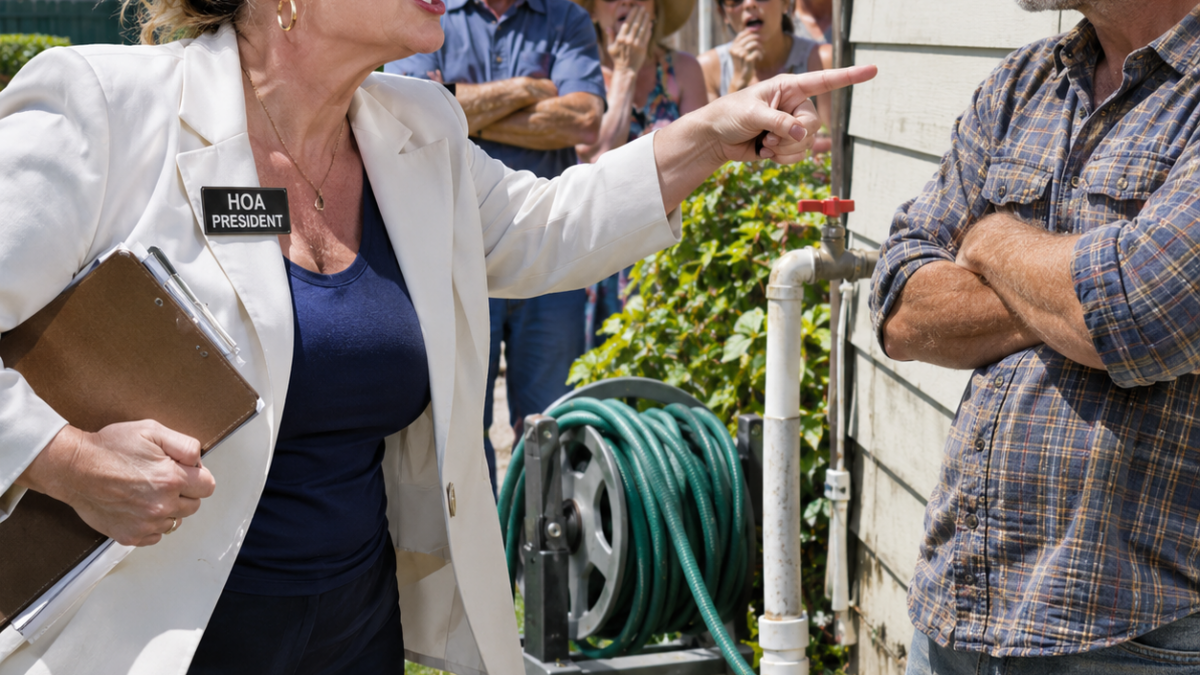
“Get your filthy hands off my water before I have you removed from this neighborhood,” the HOA president snapped while standing eight feet inside my property, one manicured hand wrapped around my outdoor faucet and my water blasting through her hose into the rose garden she bragged about to half the county.
When I reminded her that the faucet was attached to my house, connected to my meter, and responsible for a water bill my family was already struggling to pay, she smiled behind her designer sunglasses and told me I was new, I didn’t understand how things worked in Lake View Pines, and if I touched “her” water supply again, my wife, my nine-year-old son, and I might be packing boxes before Christmas.
What Deborah Lyall didn’t know was that I had spent most of my adult life working with pipes, valves, drains, and everything people preferred not to think about after they disappeared behind a wall—and that eventually, the thing she kept stealing from my property would expose far more than either of us expected.
My name is Marcus Hail.
In the summer of 2022, my wife Sarah and I bought the worst-looking house on one of the nicest streets in Lake View Pines, Georgia.
It sat on a corner lot on Magnolia Court with peeling siding, a cracked driveway, tired landscaping, and a backyard so overgrown that our son Tyler called it “the jungle.”
To us, it was perfect.
Or at least, it was going to be.
The house had solid bones, and because the previous owners had left quickly, we got it for thirty-eight thousand dollars below what similar homes in the neighborhood were selling for.
That discount mattered.
We didn’t have wealthy parents helping us.
There was no inheritance.
No investment account.
No secret pile of cash.
Sarah worked three days a week as a dental hygienist, and I had spent years building my one-man plumbing business, Hail Plumbing, job by job.
I had started in the trade when I was nineteen.
By the time we moved into Magnolia Court, I was a licensed master plumber who could walk into a house, hear a noise behind a wall, and usually tell you what was wrong before I opened my toolbox.
That was the reason we could afford the house at all.
A contractor saw rotten trim and outdated fixtures.
I saw weekends.
A contractor saw twenty thousand dollars in repairs.
I saw lumber, fittings, paint, patience, and my own two hands.
Sarah saw the kitchen she had talked about since our second date.
Tyler saw a yard big enough for a baseball net.
I saw a garage where I could finally organize my tools instead of stacking them around our cramped rental.
For three years, Tyler had lived with us in a tiny apartment where his bed barely fit beside ours.
This house was supposed to be the first place where he could close his own bedroom door.
Our entire savings went into it.
Every dollar.
Every emergency fund.
Every bit of security we had built.
The first week we lived there, we met Deborah Lyall.
She arrived carrying a plate of pastel-colored macarons and wearing expensive athletic clothes that somehow looked more formal than anything I owned.
She was thirty-four, honey-blonde, perfectly styled, and beautiful in a way that looked carefully maintained rather than accidental.
Behind her sat a pearl-white Range Rover.
Across the fence stood the largest house on our block.
That was hers too.
Her husband, Craig, worked in commercial real estate in Atlanta.
Deborah ran the homeowners association.
And I learned very quickly that “ran” was the correct word.
She gave Sarah the macarons, smiled at Tyler, and immediately started explaining neighborhood rules.
Trash cans had to be hidden.
Mailboxes had to match approved styles.
Grass could not exceed a certain height.
Commercial vehicles were “discouraged.”
Her eyes paused on my work van when she said that last part.
Then I noticed the hose.
A green garden hose ran through a gap near our fence and stretched across the side of my yard.
One end disappeared into Deborah’s landscaping.
The other end was screwed onto the outdoor faucet attached to my house.
I stared at it.
“Is that yours?” I asked.
Deborah glanced toward the hose as casually as if I had asked about the weather.
“Oh, yes. That’s for the roses.”
I waited for the rest of the explanation.
There wasn’t one.
The faucet was several feet inside my property line.
It was connected directly to my household plumbing.
Anything flowing through it ran through my meter.
I assumed the previous owners must have had some sort of arrangement with her.
We had just moved in.
Boxes were everywhere.
Sarah was exhausted.
Tyler was excited.
I didn’t want my first interaction with the HOA president to become a property dispute over a garden hose.
So I let it go.
For one week.
Then the water bill arrived.
Three hundred forty-one dollars.
I stood at the kitchen counter staring at the number while Sarah looked over my shoulder.
“That can’t be right,” she whispered.
We had barely finished unpacking.
We weren’t filling a pool.
We weren’t watering a lawn.
Half our fixtures were still being replaced.
I walked outside.
The meter was spinning.
And on the other side of the fence, Deborah Lyall’s famous roses were drinking water my family was paying for.
That was the moment I understood something important.
The hose wasn’t there because of an old misunderstanding.
It was there because nobody had ever successfully told Deborah no.
And I was about to become the next person to try.
PART 2
The sprinkler rotated lazily across Deborah’s flower bed.
Left.
Right.
Left.
Right.
A soft curtain of water glittered in the Georgia sun.
I stood beside my meter with the bill folded in my hand and felt my stomach tighten every time the dial moved.
Three hundred forty-one dollars.
I knew exactly what water cost in our county.
I also knew approximately how much two adults and one child should be using while living in a half-renovated house.
That bill wasn’t ours.
At least not all of it.
I followed the hose to the fence.
Deborah was in her yard trimming roses.
“Deborah?”
She looked up.
“Yes?”
“I think there’s been a misunderstanding.”
She smiled.
“What kind?”
I held up the bill.
“This hose is connected to my water.”
She gave me a little laugh.
Not a nervous laugh.
Not an embarrassed one.
It was the kind of laugh people use when a child has said something cute but incorrect.
“Oh, sweetie.”
That one word told me more about her than the welcome speech had.
“That water is free,” she said.
I looked at her.
“No, it isn’t.”
“Everybody uses those exterior access points.”
“Everybody?”
“Yes.”
“It’s connected to my meter.”
She waved one hand.
“It’s on the HOA side of your house.”
“There is no HOA side of my house.”
Her smile thinned.
I pointed toward the property line.
“The survey puts the boundary over there. My faucet is about eight feet inside it.”
“Marcus, you’re new.”
“That doesn’t change where the property line is.”
Her pruning shears stopped moving.
For the first time, she looked directly at me.
The friendliness disappeared.
“You’re going to find that things work a little differently in Lake View Pines.”
I looked down at the bill.
“I’d like you to stop using my water.”
She lowered her sunglasses.
Behind the tinted lenses, her eyes were colder than her voice.
“Don’t start creating problems over something this small.”
“It’s not small to us.”
“It’s water.”
“It’s three hundred forty-one dollars.”
She shrugged.
“Welcome to homeownership.”
I stared at her.
Then I reached down and turned off my faucet.
The sprinkler died.
Deborah’s expression changed instantly.
“Turn that back on.”
“No.”
“Excuse me?”
“You have your own water.”
“That line has always been used for this garden.”
“Then the previous owners should have stopped it.”
She stepped closer to the fence.
“Marcus.”
“No.”
She stared at me for several seconds.
Then she said, very quietly, “You really don’t want to make an enemy out of the HOA over a hose.”
I almost laughed.
Instead, I said, “I’m not making an enemy out of anybody. I’m asking you to pay for your own water.”
She pushed her sunglasses back up.
“Touch that access point again, and your little family may discover this isn’t the right neighborhood for you.”
Then she turned and walked away.
That evening, I told Sarah everything.
She stood at the kitchen sink with a paintbrush still in one hand from refinishing the cabinet doors.
“She actually threatened us?”
“Pretty much.”
“Over our faucet?”
“Apparently it’s not our faucet anymore.”
Sarah stared at me.
Then she gave me the look she uses when somebody has officially moved from irritating to dangerous.
“What are you going to do?”
“Put a lock on it.”
The next morning, I bought a simple brass hose-bib lock.
Fourteen dollars.
Three minutes to install.
I locked the faucet and put the key in our kitchen drawer.
When I finished, I stepped back and looked at it.
Problem solved.
Or so I thought.
Sixteen hours later, I came home and found the lock lying in the mulch.
Cut clean through.
The hose was connected again.
Deborah’s sprinkler was turning.
My meter was spinning.
For a long moment, I didn’t move.
That little broken lock bothered me more than I expected.
It wasn’t the fourteen dollars.
It was what it represented.
I had placed a physical boundary on my property.
A simple statement.
This belongs to me.
Please don’t use it.
And she had taken bolt cutters to it.
Sarah came outside.
She saw the brass lock lying on the ground.
Then she looked at the hose.
“She cut it.”
Not a question.
I nodded.
Sarah folded her arms.
“Okay.”
That was all she said.
But after eleven years of marriage, I knew that “okay.”
It meant she had stopped giving Deborah the benefit of the doubt.
Two days later, an envelope arrived.
Lake View Pines Homeowners Association.
Official letterhead.
Deborah Lyall, President.
I opened it at the kitchen table.
Sarah read over my shoulder.
The letter informed us that the locking device I had installed on my outdoor faucet violated Section 14.3 of the community covenants.
Exterior fixtures, it said, were required to maintain their original manufacturer appearance and function.
The lock was classified as an unauthorized modification.
Fine: $200.
I read it twice.
Then a third time.
Sarah sat down.
“She cut off your lock.”
“Yes.”
“And now she’s fining you for having the lock.”
“Yes.”
Sarah leaned back.
“That woman is insane.”
“Not insane.”
I put the letter down.
“She knows exactly what she’s doing.”
That was worse.
At the next HOA meeting, I went prepared to be reasonable.
I brought the bill.
Photos.
The survey.
The fine letter.
The clubhouse held maybe twenty people.
Deborah sat behind a long folding table with four other board members.
There was even a microphone in front of her.
A microphone.
For a room smaller than most restaurants.
When public comment opened, I stood.
“My name is Marcus Hail. I live at 412 Magnolia Court. I’d like to address a water-use issue involving the president.”
That got people’s attention.
I explained the faucet.
The hose.
The water bill.
The lock.
The bolt cutters.
The fine.
I had barely reached the part about the property line when Deborah leaned toward her microphone.
“Mr. Hail, the board has already reviewed the exterior modification.”
“I’m not talking about the modification. I’m talking about someone using water I pay for.”
“The water access point you’re referring to has historically served adjacent landscaping.”
“Historically?”
“Yes.”
“Is it connected to the HOA meter?”
She paused.
“No.”
“Is it connected to a common utility line?”
Another pause.
“The board recognizes it as a shared neighborhood resource.”
I almost thought I’d misheard her.
“A shared neighborhood resource?”
“Yes.”
“It’s connected to my house.”
“Mr. Hail—”
“My meter.”
“Your tone is becoming disruptive.”
“My bill.”
Several people shifted in their chairs.
Deborah straightened.
“The fine stands.”
“What about the water?”
“The board considers the matter closed.”
Then she smiled.
That same small smile.
As if she had just demonstrated something.
Power.
Not authority.
Power.
Those are different things.
Authority comes from rules.
Power comes from convincing everyone else that fighting you costs more than surrendering.
After the meeting, an older man approached me in the parking lot.
“Marcus?”
“Yeah?”
“Ray Kendall.”
He shook my hand.
Mid-sixties, maybe.
Retired teacher, he told me.
He lived near the other end of the development.
He glanced back toward the clubhouse.
“Don’t take it personally.”
“Hard not to.”
“She’s done this before.”
My attention sharpened.
“With the water?”
“The family who owned your house before you.”
“The Hendersons?”
He nodded.
“They complained.”
“What happened?”
Ray sighed.
“Suddenly their basketball hoop violated a rule. Their dog barked too much. Their Christmas lights stayed up three days past the deadline. Their garbage can was visible from the street.”
“And they moved.”
“Foresight County.”
I looked at the clubhouse.
Through the window, I could see Deborah laughing with the other board members.
“She ran them out.”
Ray rubbed the back of his neck.
“She has a gift for finding rules when she wants somebody gone.”
That night, Sarah and I sat at the kitchen table after Tyler went to bed.
The $200 fine was beside the $341 water bill.
We were already stretching every dollar.
The downstairs bathroom still needed tile.
My van needed tires.
Tyler needed braces within a year.
We could pay the fine.
We could let Deborah use the water.
We could keep our heads down.
That would be cheaper.
Probably.
Sarah knew what I was thinking.
“No.”
I looked at her.
“No what?”
“We did not spend everything we have to buy this house so some woman next door could scare us out of it.”
“She can make this ugly.”
“She already has.”
Sarah pulled her laptop closer.
“Document everything.”
So I did.
The cut lock.
The hose.
The meter.
Every bill.
Every letter.
Every email.
Every section of the HOA rules.
I installed a trail camera under the eave, facing the side yard.
Within three days, the situation went from insulting to almost unbelievable.
Deborah wasn’t using my water only for her roses.
Every weekday morning, her sprinklers ran for hours.
On Wednesdays, she filled an inflatable kiddie pool for her daughter, Lily, and the children who came to her weekly playgroup.
On Saturdays, she washed her Range Rover.
On Sundays, she pressure-washed her deck.
She had even hidden a splitter near the fence so she could operate more than one line.
I reviewed the footage one night while Sarah sat beside me.
“Look at this.”
Onscreen, Deborah attached a foam sprayer to the hose.
Sarah stared.
“She’s washing her car with our water.”
“Yep.”
“Marcus.”
“I know.”
“No. I mean really look.”
I did.
Deborah wasn’t sneaking.
She wasn’t checking windows.
She wasn’t nervous.
She behaved like the faucet belonged to her.
That was when I understood the heart of the problem.
People who know they’re stealing usually look over their shoulder.
Deborah never did.
I calculated the usage.
Thousands of gallons every month.
Hundreds of dollars.
Over time, well over a thousand dollars of water that my family had paid for.
Sarah stared at the spreadsheet.
“We’ve been putting off Tyler’s bedroom furniture because we’re trying to save money.”
I nodded.
“And she washed a Range Rover with it.”
I closed the laptop.
At the next HOA meeting, I arrived with five printed packets.
Screenshots.
Dates.
Water-use calculations.
Copies of our bills.
I handed one to every board member.
Deborah flipped through the first few pages.
Her face didn’t change.
“Marcus, I appreciate your thoroughness.”
I almost laughed at the word.
“The board handles enforcement matters in closed session.”
“You’re the person in the complaint.”
“We’ll respond within thirty days.”
“Thirty days?”
“That is our procedure.”
Two weeks later, the written response arrived.
The board claimed the faucet fell within the scope of “shared community utilities” under the original development plan.
No further action warranted.
I searched the CC&Rs.
No such designation existed.
The next Monday, I found a violation notice under my windshield wiper.
My work van.
A 2016 Ford Transit with HAIL PLUMBING painted across the side.
It was parked in my own driveway.
Fine: $350.
Commercial vehicle.
Second offense could result in towing.
That van was my livelihood.
Every major tool I owned was inside it.
If they had it towed, I could miss jobs.
If I missed jobs, we missed mortgage payments.
I paid the fine.
Not because Deborah was right.
Because I had a family.
That same week, another letter came.
Our grass along the driveway was “inconsistent with community aesthetic standards.”
Fine: $150.
Georgia in July.
Half the neighborhood had brown grass.
Deborah’s stayed green.
Of course it did.
I was paying to water it.
I contested the lawn citation with photos of six nearby properties that looked the same or worse.
Denied.
No explanation.
The message was clear.
You can fight me.
But I can make fighting expensive.
And then one Tuesday in late August, she crossed a line even I hadn’t expected.
I came home from a job and walked around the side of my house.
A permanent brass splitter had been attached to my faucet.
Not hand-tightened.
Installed.
Secured.
One branch fed Deborah’s hose.
The other fed a drip irrigation line.
I followed the drip line.
There were fresh gardenias planted along the fence.
On my side.
My property.
My soil.
Fresh mulch.
Landscape staples.
Someone had even damaged the siding around the faucet while working.
I stood there in the heat listening to cicadas scream in the trees.
For six months, I had tried to be calm.
Tried to use meetings.
Tried letters.
Evidence.
Locks.
Rules.
Now I was staring at flowers a woman had planted in my yard after physically modifying plumbing attached to my home.
Sarah came around the corner.
Her face fell.
“No.”
“Yep.”
“She planted those?”
“Apparently.”
“On our property?”
“Yep.”
She looked at the damaged siding.
Then at me.
“What do we do?”
I picked up my pipe wrench.
“We remove everything that isn’t ours.”
I took the splitter off.
Rolled the hose.
Lifted the drip line.
Carefully removed the gardenias with their root balls intact.
Nothing destroyed.
Nothing thrown away.
I stacked every item neatly on Deborah’s side of the property line.
Three hours later, two police officers knocked on my door.
Deborah had called them.
She claimed I had destroyed HOA-approved landscaping and removed “community-installed irrigation infrastructure.”
She even produced a board resolution supposedly authorizing the equipment.
I showed the officers my survey.
The older officer studied it.
Then sighed.
“This sounds like a civil issue.”
“She put plumbing on my house.”
“I understand.”
“And flowers in my yard.”
“I understand.”
“So she can do that, but if I remove it, we’re having this conversation?”
The younger officer looked uncomfortable.
Neither cited me.
Neither cited her.
They left.
Twenty minutes later, my phone buzzed.
A text from Deborah.
She had pulled my number from the HOA directory.
**Put everything back the way it was. The board has declared that spigot a community access point. Interfere again and we will place a lien on your property. Final warning.**
Sarah read it.
She didn’t speak.
She opened her laptop.
Created a new folder.
Typed one word.
**DEBORAH.**
The certified letter came the following week.
Resolution 2022-14.
The HOA had officially declared the faucet on the west wall of my private home a “community utility resource.”
Unobstructed access required.
Locks prohibited.
Barriers prohibited.
Fines beginning at $500.
Potential property lien.
I read the letter at my kitchen table.
Then I smiled.
Sarah noticed.
“That’s not your happy smile.”
“No.”
“What did you find?”
“She put it in writing.”
“What?”
“All of it.”
I tapped the letter.
“She just signed her name to a document claiming a private fixture attached to my private water line belongs to the neighborhood.”
“So?”
“So now we stop arguing about what she said.”
I looked toward the window.
“Now we deal with what we can prove.”
I spent that weekend pulling public records.
Building permits.
Development plans.
Utility diagrams.
Plumbing records.
Lake View Pines had been built in 2004.
The original plat showed every main line, service connection, meter, and utility easement.
My faucet was exactly what I had said it was from the beginning.
Private.
No community designation.
No shared access.
No HOA utility.
Nothing.
Deborah’s resolution wasn’t a creative interpretation.
It was fiction.
But then I searched 416 Magnolia Court.
Her house.
That was where the situation changed.
Deborah had an irrigation system installed in 2020.
The permit had been opened.
Never finalized.
Never inspected.
Never approved.
I studied the records.
Then I studied what I could see of the system.
Something bothered me.
The routing.
The connection.
The absence of proper protection between the irrigation system and the drinking-water supply.
I knew enough immediately to understand the risk.
Irrigation lines touch soil.
Fertilizer.
Pesticides.
Bacteria.
Standing water.
If the plumbing is configured improperly, pressure changes can allow contaminated water to move in the wrong direction.
Back toward the drinking supply.
It’s why backflow prevention exists.
And Deborah’s system appeared to have none of the protection I expected to see.
I sat in my truck across the street with copies of the permit records on the passenger seat.
For months, she had called my faucet a community resource.
But her own unapproved plumbing could potentially affect real community water.
I filed complaints.
County water utility.
Building inspection.
Health department.
Not accusations.
Documentation.
Photos.
Permit numbers.
The agencies could decide what was legal.
Not me.
That was one lesson Deborah had accidentally taught me.
You don’t beat power by shouting louder.
You build a record that power can’t erase.
But I was still furious.
That part matters.
Because what I did next came from anger as much as strategy.
I locked my legitimate faucet behind a much stronger protective enclosure.
Then I created a second decoy outlet nearby.
It looked ordinary from the outside.
It wasn’t connected to my drinking water.
It was connected to a foul wastewater source from my own system.
I’m not going to pretend it was a kind decision.
It wasn’t.
It was the decision of a man who had spent months watching another person trespass on his property, steal from his family, threaten his home, manipulate rules, and punish him for objecting.
I set cameras where everything could be documented.
Then I sent certified letters to every board member.
Private water.
Unauthorized access.
Documented theft.
Fourteen days to correct the resolution.
Copies preserved.
Receipts preserved.
Then I waited.
Deborah lasted less than forty-eight hours.
Monday morning.
6:17 a.m.
The camera caught her walking through the gap in the fence.
Matching athletic outfit.
Designer slides.
Sunglasses.
She went directly to my original faucet.
Pulled on the lock.
Again.
Again.
She tried tools.
Nothing.
Then she turned her head.
Three feet away was the second outlet.
She stared at it for a few seconds.
Crouched.
Looked at it.
Stood.
Turned the handle.
Liquid came out.
She touched it.
Then connected her hose.
No knock on my door.
No question.
No request.
Not even confusion about why a new outlet had suddenly appeared.
She saw something she wanted.
She took it.
That was Deborah.
Within days, her routine returned.
Roses in the morning.
Irrigation.
Weekend car washing.
Patio cleaning.
The kiddie pool.
Except the substance flowing through her hose was no longer the clean county water she had forced my family to pay for.
The first visible damage appeared in the roses.
Brown patches.
Then curling leaves.
Then buds dropping before they opened.
Deborah’s garden was famous in Lake View Pines.
She photographed it constantly.
Coral blooms.
White climbing roses.
Deep red bushes framing the patio.
She called herself the Rose Queen online.
Two neighborhood beautification awards.
Now the plants were dying.
The trail camera captured her crouching beside them every evening.
She applied treatments.
Changed fertilizer.
Trimmed dead leaves.
Added salts.
Watered more.
That last part made everything worse.
Sarah watched one clip with me.
“Do you feel bad?”
I didn’t answer immediately.
“About the roses?”
“About any of it.”
I watched Deborah turn another sprinkler head.
“I feel bad that it came to this.”
“That’s not what I asked.”
I looked at my wife.
Sarah wasn’t defending Deborah.
She was checking me.
Making sure the woman next door hadn’t changed something in me that would be harder to repair than siding.
“I don’t know,” I admitted.
Sarah nodded slowly.
“Just remember why we started.”
“Our water.”
“No.”
She touched my arm.
“Our family.”
That stayed with me.
The next Saturday, Deborah washed the Range Rover.
When it dried, ugly discoloration streaked the white finish.
She tried wiping it off.
Then polishing.
Then scrubbing.
Craig came outside.
Even without clear audio, I could see the argument.
Hands pointing toward the car.
Toward the garden.
Toward our house.
The vehicle eventually went to a professional detailer.
The damage was expensive.
But the moment that ended Deborah’s confidence came on Wednesday.
Playgroup day.
Her friend Megan arrived with a toddler.
Lily was already outside.
Someone began filling the inflatable pool.
A few minutes later, Megan stopped.
She leaned closer.
Smelled the water.
Her entire body changed.
She grabbed the children.
Fast.
One under each arm.
Lily screamed.
The other toddler started crying.
Megan dumped the pool, snatched up her diaper bag, and stormed toward the house.
A door slammed.
Minutes later, Deborah came across the yard.
She opened the outlet fully.
Caught some liquid in her hand.
Smelled it.
Recoiled.
For the first time since I had met her, Deborah Lyall looked afraid.
Not offended.
Not angry.
Afraid.
Two days later, a man named Gerald appeared at my door wearing an HOA polo and carrying a clipboard.
“The board has authorized an inspection of your exterior plumbing.”
“Are you a licensed plumber?”
He blinked.
“I’m here on behalf of the board.”
“Are you licensed?”
He clicked his pen.
“That’s not relevant.”
“It’s extremely relevant.”
He glanced toward the side yard.
“I need access.”
“No.”
“Marcus—”
“Gerald, if the board wants a legitimate plumbing inspection, send a properly licensed professional with lawful authority and written notice.”
He left.
Another certified letter arrived.
The HOA now accused my house of contaminating “shared water infrastructure.”
They threatened a lien within fifteen days.
Sarah filed the letter in the Deborah folder.
“You know what’s amazing?” she said.
“What?”
“They still think you’re scared.”
I was.
That was the strange part.
People imagine courage means you stop being afraid.
It doesn’t.
I was terrified they might somehow put a lien on the house.
Terrified I would lose a legal fight we couldn’t afford.
Terrified one mistake would cost Tyler his home.
I just wasn’t willing to let fear make the decision anymore.
Three weeks after my government complaints, a county utility truck arrived at 416 Magnolia Court.
Ray called me.
“Marcus.”
“What?”
“You’re going to want to look outside.”
I stepped toward the window.
An inspector in a safety vest was walking through Deborah’s yard carrying equipment.
Deborah stood on the porch.
Perfect hair.
Full makeup.
Arms crossed.
Ray chuckled.
“She looks like she wants to ask for the county’s manager.”
The county inspector tested her irrigation system.
What he found was worse than even I expected.
The system had never been properly completed under its permit.
Required protective equipment was missing.
Under test conditions, water could move backward from the irrigation system toward the potable supply.
That meant soil contamination, fertilizer residue, bacteria, and other material had a potential pathway toward drinking water.
The county ordered immediate corrective work.
A civil penalty followed.
Deborah argued.
Demanded supervisors.
Claimed the work had been professionally installed.
The records disagreed.
She waited almost until the deadline before hiring a landscaping crew to make the repair.
They installed the wrong equipment.
No proper permit.
The county returned.
Failed it again.
Another penalty.
Then the utility tested water at nearby homes.
That was the part that changed the neighborhood.
Several samples showed evidence consistent with contamination concerns downstream of Deborah’s property.
Nobody became seriously ill.
That mattered.
But thirty-four households received notices telling them there had been a potential water-quality problem associated with a nearby residential cross-connection.
The notice didn’t name Deborah.
It didn’t need to.
Everybody knew where the inspection trucks had been.
Everybody knew whose famous irrigation system had been dug up.
Everybody knew who had spent years boasting about the best garden in Lake View Pines.
Ray told me the rumor crossed the neighborhood in less than four hours.
The same people who once whispered about Deborah now called each other openly.
Parents were furious.
Retirees were frightened.
People wanted records.
Some wanted refunds.
Some wanted the HOA investigated.
Deborah’s carefully maintained image began collapsing.
And still she scheduled a special HOA meeting to punish me.
One agenda item:
**Enforcement action regarding 412 Magnolia Court: plumbing contamination and failure to comply with board directives.**
My house.
My plumbing.
My supposed contamination.
She was going to stand in front of the neighborhood and blame me.
Sarah read the meeting notice twice.
“She’s actually doing it.”
“She doesn’t have another move.”
“She could apologize.”
I looked at her.
We both laughed.
Thursday night, we went to the clubhouse.
Sarah sat beside me carrying the thick folder she had been building for months.
The room was packed.
Sixty-three residents.
I had never seen more than twenty at a meeting.
Ray sat in front.
Megan was there.
Parents from the affected homes.
Older residents.
People who had received warning letters.
People Deborah had fined.
People she had embarrassed.
People who had simply spent three years learning that saying no to her came with a price.
Deborah sat at the front table.
White blazer.
Gold earrings.
Perfect makeup.
Her board members sat beside her.
She tapped the microphone.
“Good evening.”
The room went quiet.
“For several months, the association has investigated reports of degraded water quality believed to originate from an improperly maintained plumbing system at 412 Magnolia Court.”
I felt Sarah’s hand close around mine.
Deborah continued.
“The board has attempted repeatedly to secure cooperation from the homeowner—”
“Madam President.”
My voice carried farther than I expected.
She stopped.
I stood.
“I have a right to respond before enforcement action.”
Deborah stared at me.
One board member started flipping through the bylaws.
Ray called from the front row.
“Section twenty-two, paragraph four.”
Several people laughed quietly.
The board member found it.
Her face changed.
Deborah’s smile tightened.
“Proceed.”
I carried my folder to the front.
My hands were surprisingly steady.
I unfolded the original development plat.
Placed it on the table.
“This is the recorded plat for Lake View Pines.”
Nobody spoke.
“It shows the main lines, service laterals, utility easements, and meters.”
I pointed to my lot.
“Here is 412 Magnolia Court.”
Then the service line.
Then the location of my meter.
“The outdoor faucet the board declared to be a community resource is connected to my private service line.”
I looked directly at Deborah.
“There is no community water access point on this property.”
Murmurs spread through the room.
I laid down Resolution 2022-14.
“This resolution is unsupported by the development plan.”
Next came photographs.
The hose.
The cut lock.
The installed splitter.
The flowers planted on my land.
The siding damage.
Then the camera stills.
Deborah entering my property.
Deborah opening the faucet.
Deborah attaching her hose.
Again.
Again.
Again.
“Months of recordings.”
I placed the water bills on top.
“Thousands of gallons.”
Another sheet.
“More than twelve hundred dollars in excess charges paid by my family.”
Someone behind me said, “Jesus.”
Deborah’s jaw tightened.
She leaned toward the microphone.
“These accusations have already been reviewed by—”
“I’m not finished.”
She froze.
For months, she had interrupted everyone.
Something in the room had changed.
Nobody was allowing it now.
I opened the county report.
The official seal faced the audience.
“This is the utility inspection of 416 Magnolia Court.”
The room went completely still.
“Mrs. Lyall’s property.”
I summarized the findings.
Unapproved irrigation.
Missing required backflow safeguards.
Documented reverse-flow condition during testing.
County violations.
Required correction.
Additional penalties after an improper repair.
Then I reached the sentence that mattered most.
“The documented contamination concern affecting neighborhood water did not originate at 412 Magnolia Court.”
I turned toward Deborah.
“It originated at 416.”
A woman in the third row stood halfway from her chair.
“Her house?”
“Yes.”
“My kids drink that water.”
Deborah lifted both hands.
“The county has not established—”
I slid the report toward her.
“It’s in writing.”
That phrase mattered.
Because those were the rules Deborah herself had chosen.
Put it in writing.
Make it official.
Weaponize paper.
Now the paper belonged to everybody.
A man near the wall shouted, “You blamed him for your plumbing?”
Another voice:
“She sent us violation notices while her system contaminated the line?”
Then another.
“How long did she know?”
Deborah’s face lost color.
Her board members stopped looking at me.
They were looking at her.
I let the room settle.
Then I placed one final set of photographs on the table.
“And there is one more thing.”
Sarah looked down.
She already knew what was coming.
“The outlet Mrs. Lyall has been using for the last several weeks—the one beside my locked private faucet—was not a normal county-water outlet.”
Megan’s eyes widened.
Deborah stopped moving.
I kept my voice level.
“I had secured the actual water supply after repeated unauthorized use. The decoy outlet she chose to use without permission was connected to foul wastewater.”
For a second, nobody reacted.
Then the meaning landed.
The room exploded.
Megan stood.
“The pool?”
I looked at her.
“Yes.”
She covered her mouth.
“Oh my God.”
Craig, who had been standing along the wall, went white.
Someone shouted about the roses.
Someone else yelled about the Range Rover.
A board member whispered, “Deborah…”
Deborah stared at me.
Her expression contained fury, disbelief, humiliation, and something I had never seen from her before.
Powerlessness.
“You did that deliberately,” she said.
I held her gaze.
“I locked my actual water supply.”
“You poisoned my property!”
“You repeatedly entered my property and connected your hose to an outlet you did not own and had no permission to use.”
“You knew I would use it!”
“I knew you had ignored locks, letters, property lines, surveys, meetings, police visits, and written demands to stop.”
Her voice rose.
“My daughter was in that pool!”
At that, the room changed.
Even my anger cooled.
I looked at Lily’s empty seat beside her parents.
“I’m glad Megan pulled the children out before anything worse happened.”
Deborah slammed her palm against the table.
“You could have hurt her!”
“And you could have stopped the first time I asked you not to trespass.”
“Marcus,” Sarah said quietly.
I heard the warning in her voice.
Not because Deborah deserved sympathy.
Because this was bigger now.
I breathed.
Then I looked around the clubhouse.
“I’m not asking anyone here to celebrate what happened.”
The noise softened.
“I’m asking you to understand how we got here.”
I pointed toward the stack of documents.
“I asked politely.”
Water bill.
“I locked my faucet.”
Cut lock.
“I complained to the board.”
Denial letter.
“I brought video.”
Another denial.
“I received fines.”
Van citation.
Lawn citation.
“I showed the property line.”
Resolution 2022-14.
“She invented a rule.”
I placed Deborah’s text message beside it.
“She threatened a lien on the home my family bought with every dollar we had.”
Silence.
“My wife and I spent months wondering whether the next envelope in our mailbox could somehow cost our son his bedroom.”
I looked at Sarah.
Her eyes were wet.
That surprised me.
She had been so steady through everything that I had almost forgotten how frightened she had been too.
“We weren’t fighting over a hose.”
I turned back toward the room.
“We were fighting over whether saying ‘this is mine, please stop taking it’ meant anything in this neighborhood.”
Nobody moved.
“And while the board was accusing my private plumbing of being a public danger, the county documented the actual danger at the president’s own house.”
I closed the folder.
“I have copies of everything.”
“The camera footage.”
“The bills.”
“The resolutions.”
“The retaliatory fines.”
“The property records.”
“The inspection reports.”
“The certified letters.”
“The county complaints.”
“If any court wants them, they’re available.”
Then I stepped away from the table.
“Now you can decide whether this HOA represents you.”
Ray stood.
He wasn’t smiling anymore.
“I move for a vote of no confidence in the president.”
Deborah snapped toward him.
“You can’t do that.”
A man in the rear stood.
Frank Diaz.
Retired attorney.
He had lived in Lake View Pines for nearly a decade.
“Yes,” he said calmly, “we can.”
He opened a copy of the bylaws.
“Emergency removal of an officer requires a two-thirds majority of members present under these circumstances.”
One board member whispered something to Deborah.
She ignored her.
“This meeting was not called for that purpose.”
Frank didn’t raise his voice.
“The bylaws permit an emergency motion when association governance is materially implicated.”
Someone shouted, “Vote!”
Others joined.
“Vote!”
“Vote!”
Deborah struck the table with the gavel.
“Order!”
Nobody cared.
For three years, that gavel had meant something because everybody agreed to be intimidated by it.
That night, it sounded like a piece of wood.
Frank supervised the count.
Sixty-three residents present.
The final vote:
Fifty-eight in favor of removing Deborah.
Three against.
Two abstentions.
Fifty-eight to three.
Deborah Lyall was no longer president of the Lake View Pines HOA.
For several seconds, she remained seated.
The white blazer.
Perfect hair.
Gold jewelry.
Designer watch.
Everything about her still looked exactly as polished as it had when she brought macarons to our house months earlier.
But the room no longer arranged itself around her.
That was the real difference.
Two board members resigned before the meeting ended.
Gerald disappeared without saying goodbye.
Craig walked outside and sat in the Range Rover.
Deborah gathered her papers.
One sheet slipped to the floor.
Nobody picked it up for her.
She bent down.
Took it herself.
Then walked toward the door.
As she passed me, she stopped.
For a moment, I thought she was going to say something.
She didn’t.
She looked at Sarah.
Then me.
Then walked out.
Her heels clicked across the tile.
The door closed.
And just like that, three years of neighborhood dictatorship ended in a beige clubhouse that smelled like stale coffee.
The aftermath was quieter.
That almost made it more satisfying.
There was no dramatic police raid.
No television cameras.
No crowd waiting on Deborah’s lawn.
There were simply consequences.
The county finalized its enforcement against the unapproved irrigation system.
It had to be corrected properly under permit and inspection.
The costs were substantial.
The penalties were real.
Craig paid them.
I filed a small-claims case for the water charges.
My evidence was simple.
Bills.
Camera footage.
Property records.
And, almost unbelievably, Deborah’s own certified HOA resolution insisting she had the right to use my faucet.
The hearing lasted less time than most plumbing estimates.
Deborah’s attorney tried to frame the situation as a misunderstanding over shared utilities.
The judge looked at the development plat.
Then at the meter records.
Then at the footage.
Then at the resolution.
“What shared utility?” he asked.
Her attorney had no good answer.
I was awarded restitution and fees.
Craig handed over the payment after the hearing.
He didn’t look at me.
I almost felt sorry for him.
Almost.
The retaliatory HOA fines were rescinded by the interim board.
The van violation.
The lawn violation.
The faucet modification.
All of it.
The threat of a lien disappeared.
The board issued a written statement acknowledging that the exterior faucet at 412 Magnolia Court was private property.
I framed a copy.
Sarah rolled her eyes when she saw it hanging in the garage.
“You actually framed it?”
“Absolutely.”
“You’re ridiculous.”
“You married me.”
“That was before I knew how petty you could be.”
“You knew.”
She smiled.
“I knew.”
But consequences alone weren’t what changed things for us.
The neighborhood changed too.
Once people stopped being afraid of Deborah, they began talking.
Really talking.
Ray told me about a widow who had been fined because her trash can remained visible for two hours after the deadline while she was at a medical appointment.
Another couple showed me letters over their children’s basketball hoop.
A young family had paid hundreds in landscaping penalties despite following recommendations from the HOA’s own approved vendor.
One resident had been threatened with legal action over a flagpole.
Another had received violation photographs taken through his backyard fence.
For years, people had believed they were isolated.
That was Deborah’s greatest advantage.
Every person thought the problem belonged only to them.
Once everyone compared notes, the pattern became obvious.
The interim board commissioned a review of enforcement records.
Several questionable fines were canceled.
Policies were rewritten.
Board meetings began publishing complete minutes.
Conflicts of interest had to be disclosed.
Residents received notice before new resolutions could be adopted.
No more inventing policy in a closed room and mailing it to somebody afterward.
The microphone disappeared too.
Ray carried it into the storage closet after one meeting.
“Think we need this?” he asked.
I looked around at the twenty-five people in the room.
“Nope.”
He grinned.
“Good.”
He closed the closet.
That felt better than it should have.
Then came the water-safety project.
The contamination scare had frightened people.
Understandably.
Parents wanted their homes checked.
Older residents wanted to know what a backflow device even was.
Some people had irrigation systems installed years earlier and had no idea whether they had been properly maintained.
The new board asked if I would help coordinate inspections.
I agreed.
But I didn’t charge.
At first, Sarah objected.
“Marcus, you have paying customers.”
“I know.”
“We still have half a kitchen.”
“I know.”
“And Tyler’s braces.”
“I know.”
She studied me.
“Then why free?”
I thought about it.
“Because I don’t want the story of this neighborhood to end with what Deborah did.”
Sarah’s face softened.
So one Saturday morning in November, Tyler climbed into my van with my red toolbox between his knees.
He was nine years old.
Too small to lift half the equipment.
Too curious to leave anything alone.
“What are we doing first?”
“Mrs. Patterson’s house.”
“Does she have bad water?”
“Probably not.”
“Then why are we going?”
“To make sure.”
He nodded like that made perfect sense.
We went house to house.
Under decks.
Beside foundations.
Inside garages.
Around irrigation controls.
I checked equipment.
Explained what people had.
Explained what they needed.
Where repairs were simple, I handled them.
Where work needed permits or equipment I didn’t have on the truck, I wrote it down and helped people understand the next step.
Tyler carried wrenches.
Held flashlights.
Lost one screwdriver.
Found it in his own jacket pocket.
At noon, Ray brought sandwiches.
Another neighbor brought lemonade.
At the fifth house, a woman pressed twenty dollars into Tyler’s hand.
He looked at me.
I shook my head.
“We’re not charging.”
She looked offended.
“Then it’s for the boy.”
Tyler looked at the money.
Then at her.
“My dad says we’re doing it free.”
I had never been prouder of him.
She laughed.
“Your dad raised a stubborn one.”
Sarah, who had been organizing the schedule from her car, called over, “He got that from Marcus.”
By late afternoon, we reached Mrs. Patterson’s house.
She was eighty-one.
Tiny woman.
Silver hair.
Lived alone.
Her husband had died years earlier.
She watched Tyler hand me tools while I checked a valve beside her foundation.
When I finished, I stood and brushed the dirt from my knees.
“You’re good.”
She smiled.
“Nothing wrong?”
“Nothing urgent. I’ll put you on the annual test list.”
Tyler closed the toolbox.
Mrs. Patterson bent down and took his face gently between her hands.
“Your daddy did a real good thing for this neighborhood, sweetheart.”
Tyler glanced at me.
She continued.
“You make sure he knows.”
Tyler grinned.
“He already knows.”
Everybody laughed.
But I turned away for a second because my eyes burned.
That kid had watched me angry for months.
He had heard Sarah and me whisper over bills.
He had seen official envelopes on the kitchen table.
He had asked once if we were going to have to move.
I hated that question more than anything Deborah ever said to me.
Now he was watching something different.
Neighbors thanking us.
People trusting us.
A community fixing itself.
That mattered.
By winter, the neighborhood had created a maintenance fund for annual water-safety testing.
Ray volunteered to coordinate appointments.
Within months, homes that needed updated protection had it.
Documentation improved.
Permits were checked.
People who had never spoken before began waving to each other from driveways.
Lake View Pines still had rules.
Of course it did.
We still argued about trash cans.
People still complained about barking dogs.
Someone started a three-week war over mailbox paint.
It was still an HOA.
But nobody owned it anymore.
That was the difference.
Deborah and Craig listed their house in January.
The For Sale sign appeared one cold morning near the driveway.
Tyler noticed it first.
“Dad.”
I looked.
Deborah stood on the porch while a real-estate photographer took pictures.
The rose garden was mostly dead.
Brown canes.
Bare trellises.
Empty patches of soil.
The famous arbor looked skeletal.
For years, those roses had been part of her identity.
Proof, in her mind, that everything she touched became more beautiful.
But the truth was harder.
The garden had survived because someone else was paying for what fed it.
Once entitlement became its foundation, it was only a matter of time before the whole thing collapsed.
They sold at a loss.
Moved to a gated community closer to Atlanta.
Ray checked.
“No HOA position,” he told me.
“You checked?”
“Absolutely.”
“You’re worse than I am.”
“I learned from the best.”
I laughed.
Deborah’s social-media account went quiet.
Her last garden post remained online for a long time.
A close-up photograph of a coral rose glowing in evening light.
The caption talked about how beautiful things become when you pour love into them.
I thought about that sentence more than I should have.
Because she wasn’t completely wrong.
You do see what people pour into things.
Love.
Time.
Money.
Fear.
Control.
Resentment.
Whatever you pour in eventually shows.
For months, Deborah poured entitlement into that neighborhood.
Then retaliation.
Then dishonesty.
Eventually, that showed too.
I wish I could say I felt triumphant every time I thought about what happened.
I didn’t.
Some parts still bothered me.
The kiddie pool bothered me most.
Lily was a child.
She didn’t choose her mother’s behavior.
Years later, if you asked me whether I would handle every detail exactly the same way, I couldn’t honestly say yes.
Anger can make you feel clever when what you really are is hurt.
But I never regretted standing up for my family.
And I never regretted documenting the truth.
Because without those records, Deborah’s version would probably have won.
She was president.
She had the board.
She had the microphone.
She had the confidence.
We had receipts.
Sometimes receipts are enough.
By spring, our house finally began looking like the home Sarah and I had imagined.
The kitchen cabinets were finished.
I replaced the old counters.
Sarah chose a backsplash we argued about for two weeks.
She won.
She usually does.
Tyler’s bedroom got a new desk under the window.
We found a used baseball display shelf online and mounted it above his bed.
The backyard jungle became an actual yard.
I repaired the damaged siding.
Reseeded the bare spots.
Built Sarah a small raised garden.
“No roses,” she said.
“Absolutely not.”
“Maybe tomatoes.”
“Tomatoes I can handle.”
“And basil.”
“Fine.”
“And hydrangeas.”
“That sounds suspiciously like the beginning of a rose garden.”
She kissed my cheek.
“Just build the box, plumber.”
I did.
The legitimate outdoor faucet remained protected.
Not because I expected another Deborah.
Because boundaries deserve hardware sometimes.
I installed a simple cover and a small sign.
**PRIVATE PROPERTY — NO UNAUTHORIZED USE.**
Nothing dramatic.
Nothing threatening.
Just clear.
One evening, Tyler and I pulled into the driveway after baseball practice.
He had grass stains on both knees and was explaining why a pitch clearly should have been called a strike when he stopped beside the side of the house.
He pointed toward the faucet.
“That’s where the bad water came from, right, Dad?”
I looked at him.
Technically, he had the details mixed up.
But I knew what he meant.
“That’s where the whole mess happened.”
He stared at the sign.
“Why did she keep taking it?”
That question was harder than anything a judge or board member had asked me.
I leaned against the van.
“Because she thought nobody would stop her.”
“Why?”
“Because for a long time, nobody did.”
He thought about that.
“What if someone says something is theirs but it isn’t?”
“You check.”
“With a survey?”
I laughed.
“Sometimes.”
“And cameras?”
“Sometimes.”
“And county inspectors?”
“Hopefully not every time.”
He smiled.
Then his face became serious.
“But mostly you tell the truth?”
I looked at my nine-year-old son.
At the house behind him.
At the garage filled with tools.
At Sarah’s new kitchen visible through the window.
At the yard we had nearly lost before it ever felt like ours.
“Yeah,” I said.
“Mostly you tell the truth.”
He nodded.
Then started toward the front door.
Halfway there, he turned around.
“Dad?”
“What?”
“You know Mrs. Patterson said you did a good thing?”
“I remember.”
“I think she was right.”
Then he ran inside before I could answer.
I stood alone in the driveway for a moment.
That was the part nobody at the HOA meeting saw.
The part no court order could measure.
For months, I had worried that fighting Deborah would teach my son the wrong lesson.
That revenge mattered more than restraint.
That winning mattered more than doing what was right.
But maybe the lesson was simpler.
A person can be powerful and still be wrong.
A rule can look official and still be false.
A room full of silent people can make one bully look unstoppable.
And sometimes the first step toward changing everything is simply refusing to let someone convince you that what belongs to you belongs to them.
Water.
Property.
Money.
Peace.
Dignity.
Even your own voice.
Deborah believed the faucet was hers because she had been using it for years.
She believed the HOA was hers because nobody challenged her.
She believed the neighborhood was hers because people had learned to lower their heads when she entered a room.
But possession and entitlement are not the same thing.
Eventually, the bills came due.
Some from the county.
Some from the court.
Some from the neighborhood.
And some from the life she had built around the idea that other people’s boundaries were suggestions.
The roses died.
The Range Rover was repaired.
The house was sold.
The fines against us disappeared.
But those were only the visible consequences.
The real ending came on ordinary Saturdays when neighbors opened their gates instead of closing them.
When Ray brought coffee to meetings.
When Mrs. Patterson waved at Tyler.
When Sarah planted basil in the backyard.
When my work van sat in my own driveway without a violation notice under the wiper.
When the mailbox held grocery coupons instead of certified threats.
When my son stopped asking if we were going to have to move.
That was what I had wanted from the beginning.
Not revenge.
Not humiliation.
Not a room full of people watching Deborah lose.
I wanted my family to feel safe in the home we had sacrificed everything to buy.
It took months of anger, bills, cameras, meetings, threats, records, inspectors, and one decision made when I was angrier than I should have been.
But in the end, the house remained ours.
The neighborhood became better.
And the woman who once stood in my yard with her hand on my faucet telling me the water belonged to everyone finally learned the one rule she had spent years refusing to respect:
If something does not belong to you, calling it “community property” does not make it yours.
And if you keep reaching across someone else’s boundary because you believe they are too weak to stop you, eventually you may discover that the person you dismissed has been documenting every single time you crossed it.
These days, when I turn into Magnolia Court after work, I don’t think first about Deborah.
I see Tyler’s bicycle beside the garage.
Sarah’s hydrangeas along the walkway.
Ray walking his dog.
Mrs. Patterson’s porch light.
My van in the driveway.
My house.
Our home.
And occasionally, when I pass the locked faucet on the side wall, I remember that first afternoon.
Deborah standing in my yard.
My water running through her hose.
Her roses shining in the sun.
Her telling me, with complete confidence, that I would learn how things worked in Lake View Pines.
She was right about one thing.
I did learn.
I learned that bullies depend on silence more than strength.
I learned that paperwork can be a weapon, but it can also be armor.
I learned that people who feel powerless are often only waiting for someone else to stand first.
And most importantly, I learned that protecting your home doesn’t always mean protecting wood, pipes, property lines, or money.
Sometimes it means protecting the people inside it from being taught that peace requires surrender.
That was a lesson I never wanted Tyler to learn.
So we stayed.
We rebuilt.
We planted our own garden.
We paid our own water bill.
And nobody ever touched that faucet again.








