HOA Karen Called My Rain Barrels a Mosquito Hazard—Then the County Inspector Made Her Regret Reporting Me
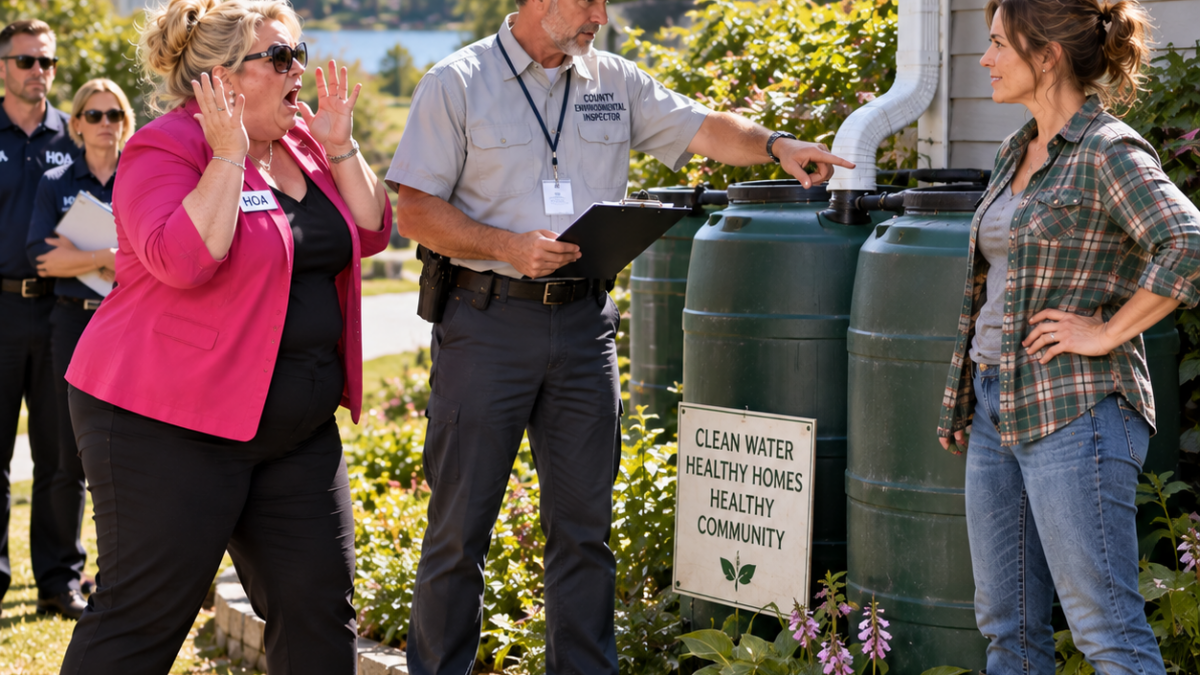
The HOA president stood at the edge of my lawn and called my rain barrels a “public health threat” loud enough for half the neighborhood to hear.
She had already reported me to county mosquito control, and the official truck turning onto our street told me she hadn’t been bluffing.
But when the inspector crouched beside those two blue barrels and began examining what I had built, Karen’s victorious smile slowly disappeared.
I was kneeling beside my tomato bed when she arrived.
“Those toxic swamp barrels have to go,” Karen Smith announced.
I looked up slowly.
She stood on the sidewalk in a bright floral blouse, arms folded tightly across her chest, staring at the two fifty-five-gallon barrels beside my house like I had installed radioactive waste containers.
“They’re rain barrels, Karen.”
“They’re stagnant water.”
“They’re sealed.”
“They’re mosquito breeding tanks.”
I wiped the soil from my hands and stood.
Behind her, curtains were already moving.
That was Oakmont Creek.
Nobody wanted HOA trouble, but everybody wanted to watch somebody else having it.
Karen pointed toward my barrels.
“I’ve filed a formal complaint with county mosquito and vector control. They’re sending an inspector.”
Her voice rose just enough for the neighbors to hear.
“You’re putting this entire community at risk.”
I almost laughed.
Almost.
Instead, twenty years of Army engineering experience reminded me of something important.
When somebody wants you angry, stay calm.
Those barrels weren’t rusty trash cans filled with green water.
I had built the system carefully.
Food-grade polyethylene barrels.
Sealed lids.
Stainless-steel mesh covering every opening.
Screened overflow valves.
Brass spigots.
A French drain underneath to prevent pooling.
The rain traveled from my downspout through a filtered inlet into a closed container and eventually into my vegetable garden.
Mosquitoes couldn’t get inside.
My system was probably cleaner than Karen’s birdbath.
But this wasn’t really about mosquitoes.
Two weeks earlier, the HOA had ordered me to remove the barrels as “unapproved exterior modifications.”
I had answered with photographs, installation details, county water-conservation guidance, and documentation showing exactly how the system worked.
I thought facts would end the discussion.
Karen apparently thought facts were disrespectful.
So she escalated.
My wife Sarah had warned me that morning.
“Mark, maybe we should just take them down.”
She wasn’t weak.
She was tired.
We had bought this house after my final military tour because we wanted ordinary problems.
School schedules.
Mortgage payments.
Tomatoes.
Grass that needed mowing.
After years of living with uncertainty, I wanted my children to grow up somewhere boring.
Oakmont Creek had looked perfect.
Then Karen became HOA president.
Now two plastic barrels beside my house had somehow become a neighborhood crisis.
The county truck stopped at the curb.
Karen immediately straightened.
A man in a khaki uniform stepped out carrying a clipboard and inspection bag.
His name tag read MILLER.
Karen hurried toward him.
“Officer Miller, thank you for responding so quickly. I’m Karen Smith, HOA president.”
She pointed toward my house.
“This is the property I reported.”
Officer Miller looked at me.
“Homeowner?”
“Yes, sir. Mark Davies.”
I shook his hand.
“I’m happy to show you everything.”
Karen followed us across the lawn.
I could practically feel her waiting for him to condemn me.
Officer Miller crouched beside the first barrel.
He inspected the lid.
Then the mesh.
Then the overflow line.
He ran a finger around the seal.
He examined the ground beneath it.
Dry.
He pulled out a flashlight and shined it through the screened inlet.
The water inside was clear.
He moved to the second barrel.
Same inspection.
Same silence.
Karen finally lost patience.
“Well?”
Miller didn’t answer.
He checked the mesh again.
“What gauge?”
“One-sixteenth-inch stainless steel.”
“Overflow?”
“Screened and routed underground into the French drain.”
“Any open access?”
“No.”
He nodded.
Karen stepped closer.
“That doesn’t change the fact that the water is stagnant.”
Miller stood.
She smiled.
It was the smile of someone certain the next sentence would destroy me.
“What kind of fine does the county issue for something like this?”
Officer Miller looked at her.
Then he looked at my barrels.
Then back at her.
For several uncomfortable seconds, nobody spoke.
Even the neighborhood seemed strangely quiet.
Finally, he clicked his pen closed.
“Ma’am,” he said.
Karen lifted her chin.
“Yes?”
Miller’s expression changed.
And the words that came next didn’t sound anything like what she had been expecting.
PART 2
“Ma’am,” Officer Miller said again, “these aren’t a mosquito hazard.”
Karen blinked.
For one second, I honestly thought she hadn’t heard him.
“What?”
He gestured toward the barrels.
“They’re properly screened, sealed, and drained. Mosquitoes need access to standing water to lay eggs. They don’t have access here.”
Karen stared at him.
“But the water sits inside.”
“So does water in a covered municipal tank.”
Her face tightened.
“That’s different.”
“Not in the way you’re suggesting.”
Miller crouched again and tapped the stainless-steel mesh.
“This opening is smaller than what we typically recommend. The overflow is screened. There’s no pooling around the containers. The owner has actually done a very good job.”
I said nothing.
That was important.
When your opponent is doing the work for you, don’t interrupt.
Karen stepped onto my grass.
“Officer, I’m the HOA president. I have residents depending on me to protect this community.”
“I understand.”
“With West Nile and other mosquito-borne illnesses—”
“I understand mosquito control too, ma’am. That’s my job.”
That stopped her.
Miller stood and turned toward the street.
“If you want mosquito concerns addressed, I’d pay attention to uncovered birdbaths, clogged gutters, children’s toys holding rainwater, and low spots in overwatered lawns. Those are typical breeding areas.”
His eyes briefly landed across the street.
Then, almost by accident, they drifted toward Karen’s property.
I followed his gaze.
Her decorative stone birdbath sat beside a flower bed.
Even from where I stood, I could see several inches of old water in it.
George Henderson, my seventy-eight-year-old neighbor, had apparently noticed the same thing.
He was standing at his mailbox.
The corner of his mouth moved.
Karen’s cheeks turned red.
“So you’re saying you’re not going to cite him?”
“I’m saying there’s nothing here for me to cite.”
“But I filed a formal complaint.”
“And I inspected it.”
Miller wrote something on his clipboard.
“The complaint will be closed as unfounded.”
The street became silent.
Not normal suburban silence.
The special kind of silence that happens when twenty people are pretending not to listen to something they absolutely intend to repeat later.
Karen looked at me.
Her eyes had changed.
Before, she had looked smug.
Now she looked betrayed.
Not by me.
By reality.
Miller turned toward me.
“Mr. Davies?”
“Yes?”
“This is one of the cleaner residential rainwater systems I’ve inspected. Keep the screens maintained and make sure they stay sealed.”
“Absolutely.”
He nodded.
“Good work.”
Then he walked back toward his truck.
Karen followed him two steps.
“Officer Miller.”
He turned.
“What about HOA regulations?”
“That isn’t my jurisdiction.”
“But surely your report can state that these barrels are a potential concern.”
“No.”
One word.
Flat.
Final.
Her mouth opened.
Nothing came out.
Miller climbed into his truck and drove away.
George pulled a handful of mail from his box and called across the street.
“Nice barrels, Mark.”
I looked at him.
He gave me the smallest wink imaginable.
Karen saw it.
That somehow made everything worse.
She turned toward me.
“You think this is funny?”
“No.”
“Do you think embarrassing the board is funny?”
“I didn’t call the county.”
Her jaw tightened.
“You deliberately made me look foolish.”
I almost admired the logic.
“You reported a safe system as dangerous. The inspector inspected it.”
“He was rude.”
“He was accurate.”
That did it.
Her face darkened.
“You have no idea what you’ve just started.”
I looked at her for several seconds.
Then I said the sentence that probably bothered her more than anything else I could have said.
“Have a good afternoon, Karen.”
I turned my back and walked inside.
Sarah was waiting behind the front curtain.
The moment the door closed, she laughed.
Not cruelly.
Mostly from relief.
“Oh my God.”
She pressed both hands against her face.
“I thought she was going to explode.”
I smiled.
“Not yet.”
Sarah lowered her hands.
“You don’t think she’s done?”
“No.”
“You won.”
“That wasn’t a contest to her.”
I looked through the window.
Karen was still standing beside the sidewalk.
“She didn’t come here to solve a mosquito problem. She came here to prove she could make me remove those barrels.”
Sarah followed my gaze.
“What happens now?”
I knew the answer.
“She finds another rule.”
Forty-three hours later, she did.
The envelope was waiting in our mailbox when I got home from work.
Cream-colored paper.
Oakmont Creek Homeowners Association letterhead.
FORMAL NOTICE OF VIOLATION.
I carried it inside.
Sarah saw the logo and closed her eyes.
“What now?”
I read aloud.
“Unapproved exterior structure.”
She stared at me.
“Seriously?”
I kept reading.
According to the notice, my rain barrels constituted “semi-permanent exterior installations” requiring prior approval from the Architectural Review Committee.
Initial penalty: one hundred dollars.
Continuing penalty: twenty-five dollars per day until compliance.
Compliance meant removing the barrels.
Sarah sat at the kitchen table.
“So the mosquito complaint failed, and now they’re suddenly architecture?”
“Exactly.”
“Can they do that?”
“I don’t know yet.”
That answer bothered me more than I wanted to admit.
A hundred dollars wasn’t going to hurt us.
Even twenty-five dollars a day wasn’t immediately catastrophic.
But fines weren’t really the weapon.
Fear was.
The real message sat underneath every number.
Keep resisting, and we can make this expensive.
Keep resisting longer, and we can place a lien on the house.
I had seen pressure systems before.
Different setting.
Same principle.
You don’t need to defeat someone if you can make surrender cheaper than resistance.
Sarah watched me place the notice beside my growing folder.
I had labeled it PROJECT HOA.
“You’re getting that look again.”
“What look?”
“The deployment look.”
“I don’t have a deployment look.”
“You absolutely do.”
She reached across the table.
“Mark, I know you’re right. But being right doesn’t mean this can’t hurt us.”
That landed.
Because this wasn’t just my fight anymore.
We had two children asleep upstairs.
A mortgage.
Sarah’s design business.
College savings.
The home we had chosen because we thought it would be peaceful.
I squeezed her hand.
“I’m not going to gamble with the house.”
“Promise?”
“I promise.”
I paused.
“But I’m also not paying a fake fine because somebody got embarrassed.”
Sarah sighed.
Then she gave me a tired smile.
“So what are you doing?”
“Reading.”
The Oakmont Creek bylaws were nearly two inches thick.
Nobody reads HOA covenants for pleasure.
Most people barely read them at closing.
I certainly hadn’t.
That night, I started at page one.
Architectural standards.
Landscaping rules.
Parking restrictions.
Common-area maintenance.
Assessment powers.
Board procedures.
Meeting notices.
Voting requirements.
It was administrative quicksand.
By midnight, I had consumed enough coffee to hear colors.
At one in the morning, Sarah appeared in the doorway wearing her robe.
“Come to bed.”
“Soon.”
“That’s what you said two hours ago.”
“I’m looking for something.”
“What?”
“The rule Karen forgot.”
Sarah leaned against the frame.
“And you know there is one?”
“No.”
I smiled.
“But people who love rules usually make one mistake.”
“What’s that?”
“They assume nobody else will read them.”
At 2:07 a.m., I found Section 9.02.
I read it once.
Then again.
Then I sat back.
Water Conservation and Xeriscaping.
The association encouraged drought-resistant landscaping, drip irrigation, and rainwater collection systems.
That alone made me smile.
Then I read the next paragraph.
Installations whose primary purpose was water conservation were exempt from formal Architectural Review Committee approval as long as they did not alter the primary structure of the dwelling and did not create a nuisance.
I stared at the page.
Then I whispered, “There you are.”
Sarah had gone back to bed.
I almost woke her.
Instead, I photocopied the page.
Highlighted the sentence.
Then I pulled Karen’s violation notice from the folder.
She had cited Section 7.14.
The general requirement for architectural approval.
Section 9.02 was the specific exception.
My barrels were connected to a downspout.
They could be removed in minutes.
No structural alteration.
The county had already determined they were not a health nuisance.
Karen hadn’t just picked the wrong argument.
She had picked an argument contradicted by her own governing document.
I began drafting.
No insults.
No anger.
No sarcasm.
Just facts.
I quoted her notice.
Then Section 7.14.
Then Section 9.02.
I attached Officer Miller’s county inspection outcome.
I requested immediate rescission of the violation and all fines.
And then I added something I knew she would hate.
I requested written confirmation.
Not a phone call.
Not a conversation.
Paper.
I wanted everything documented.
The next morning, I sent it certified mail.
Then I waited.
Five days.
Six.
Seven.
On day eight, another envelope arrived.
Karen rejected my interpretation.
According to her, Section 9.02 applied only to “minor unobtrusive devices.”
My fifty-five-gallon barrels, she wrote, were “industrial drums.”
I laughed when I read that.
Not because it was funny.
Because the bylaws never used the word minor.
She had inserted it herself.
The fine had now reached $275.
At the bottom was the threat.
If I failed to pay and remove the barrels within ten business days, the matter would be referred to legal counsel for possible lien action.
Sarah read it twice.
Her face lost color.
“A lien?”
“That’s what it says.”
“Mark.”
“I know.”
“No, listen to me.”
She placed the paper flat on the counter.
“I know you’re angry. I know she’s wrong. But I need you to promise me we’re not turning this into some pride thing.”
“It isn’t.”
“Because I’ve seen men destroy themselves trying to prove they can’t be pushed.”
That sentence stayed with me.
She was right.
There is a difference between courage and ego.
The result can look identical at the beginning.
I sat down.
“What do you want me to do?”
“I want us protected.”
I nodded.
“That’s fair.”
“So?”
“So now we call a lawyer.”
Ben Carter answered on the third ring.
“Davies?”
“Still alive.”
“That disappoints several people.”
I laughed.
Ben and I had served together years earlier.
He had been a JAG officer then.
He was the kind of lawyer who could read a forty-page contract and remember the dangerous sentence hidden in paragraph thirty-seven.
After leaving the military, he had built a civil litigation practice two counties away.
I had trusted him in situations much more serious than rain barrels.
Which was exactly why I called him.
“What’s going on?” he asked.
“I’m at war with an HOA.”
There was a pause.
Then he started laughing.
“You survived overseas and got taken out by landscaping rules?”
“Not yet.”
“Send me everything.”
I sent the folder electronically that afternoon.
Photos.
Letters.
Bylaws.
County documents.
Certified-mail receipts.
My timeline.
Karen’s latest lien threat.
He called after dinner.
His tone had changed.
“Okay.”
“That bad?”
“For her?”
He laughed.
“Potentially.”
“Ben.”
“I’m serious. She’s sloppy.”
He walked me through it.
Section 9.02 was strong.
The county finding helped eliminate the nuisance argument.
Her shifting justifications created a record suggesting retaliation.
But then he noticed something I hadn’t.
Bylaw 15.04.
If the association initiated enforcement litigation against a homeowner and failed, the association could be responsible for reasonable legal fees.
“That lien threat is her leverage,” Ben said. “But if she pushes this into court and loses, the financial exposure flips.”
“I don’t want court.”
“Good.”
“That doesn’t sound like something lawyers say.”
“Court is expensive. Intelligent leverage is cheaper.”
“What do you suggest?”
“I send the next letter.”
Two days later, the entire board received it.
Not only Karen.
Frank Miller, the HOA treasurer.
Mary Dalton, the secretary.
All three individually addressed.
Ben’s letter was six pages.
Professional.
Cold.
Specific.
He asserted that the rain barrels were protected under Section 9.02.
He stated that Karen’s attempt to redefine the provision without textual support appeared arbitrary.
He challenged the fines as invalid.
He documented the county inspection.
Then he added something else.
Selective enforcement.
Because while I had been fighting my own case, I had started asking questions.
It began with George.
I found him watering petunias beside his front walk.
His yard was beautiful.
His wife had died several years earlier, and gardening had become the thing that kept him moving.
Scattered among his flowers were garden gnomes.
Maybe twelve of them.
Fishing gnomes.
Sleeping gnomes.
A tiny one pushing a wheelbarrow.
Karen hated them.
“George,” I asked, “you ever have trouble with the HOA?”
He stopped watering.
“Which year?”
I smiled.
“With Karen.”
“That narrows it down even less.”
He shut off the hose.
“She fined me for Walter.”
“Who?”
He pointed.
A faded gnome holding a fishing pole sat beneath a rosebush.
“My wife gave him to me on our twenty-fifth anniversary.”
George’s expression softened.
“Walter survived three houses, four grandchildren, a hailstorm, and one Labrador puppy.”
“What was the violation?”
“Unapproved lawn ornament.”
I stared at him.
“You’re kidding.”
“I wish.”
“How much?”
“Started at fifty.”
“Started?”
George looked down.
“Ended at three hundred.”
“You paid?”
“My daughter begged me. Said it wasn’t worth risking trouble with the house.”
The embarrassment in his voice bothered me.
Not because he had surrendered.
Because someone had made a seventy-eight-year-old widower feel ashamed over a garden ornament his dead wife had given him.
“What happened after?”
George’s eyes suddenly brightened.
“I bought eleven more.”
I burst out laughing.
He smiled.
“Your generation didn’t invent resistance, son.”
That conversation changed everything.
George knew Oakmont Creek better than anyone.
He had lived there almost thirty years.
And once he started talking, stories surfaced.
A family had been fined because their basketball hoop remained visible from the street after sunset.
A woman had been ordered to repaint a blue front door despite being unable to locate any official approved-color list.
Another resident was fined because trash bins remained outside three hours after pickup.
A retired nurse received a violation over a porch bench that had sat in the same place for eleven years.
Individually, every story looked petty.
Together, they looked like a pattern.
I created a private online group for residents.
My first post was deliberately neutral.
“Has anyone experienced confusing or inconsistent HOA enforcement? I’m trying to understand the process. Dates and documents are especially helpful.”
Within forty-eight hours, twenty-six people had joined.
Within a week, we had copies of letters.
Photos.
Receipts.
Fine statements.
Meeting notes.
The same pattern appeared repeatedly.
Vague accusation.
Aggressive notice.
Resident objects.
Fine increases.
Threat of legal consequences.
Resident pays.
Karen wins.
Even worse, several neighbors pointed out properties connected to Karen’s friends or relatives that seemed to receive very different treatment.
Ben read through everything.
“This is no longer about two barrels,” he said.
“I know.”
“How far do you want to take it?”
“I want the fines gone.”
“And?”
“I want the process fixed.”
“And?”
I thought about George.
The blue door.
The basketball hoop.
Sarah worrying over our house.
“I want her to stop making people afraid.”
Ben was quiet.
“Then don’t make this personal.”
“It already is to her.”
“That’s exactly why it can’t be personal to you.”
I leaned back.
“Explain.”
“If you go after Karen because you hate Karen, she becomes the victim of a vendetta. If you go after a broken process with evidence, she has to defend the process.”
That became our strategy.
The cease-and-desist letter included a formal request for a review of fines issued over the previous twenty-four months.
It warned that further retaliatory enforcement could expose the association to legal claims.
And it informed every board member that continuing toward a lien after being given notice of the relevant exemption could create substantial financial liability.
Then Ben ended with three demands.
Rescind my fines.
Confirm the rainwater system complied.
Review prior enforcement actions.
“Now,” he told me, “we wait.”
Frank called two days later.
His voice sounded like a man calling from inside a burning building.
“Mr. Davies?”
“Frank.”
“We received your attorney’s letter.”
“I know.”
“It’s… fairly aggressive.”
“Your board threatened a lien on my home.”
“Yes, but—”
“That felt aggressive too.”
Silence.
Frank lowered his voice.
“I wasn’t aware of some of these details.”
“Which details?”
“The county inspection. Section 9.02. The other complaints.”
“You’re the treasurer.”
“I mostly handle budgets.”
“You’re still a board member.”
Another silence.
“I understand.”
“Do you?”
“I do now.”
He sighed.
“There’s a board meeting Tuesday night.”
“Okay.”
“Your case will be on the agenda.”
“I’ll be there.”
“Mr. Davies?”
“Yes?”
“Please don’t turn it into a circus.”
“I won’t.”
I meant it.
“But I won’t be alone.”
Tuesday night, Oakmont Creek’s clubhouse filled faster than I had ever seen it.
Usually HOA meetings attracted six people.
Eight if somebody was angry about landscaping.
That night, fifty-three residents came.
Every chair was occupied.
People stood along the walls.
George sat in the front row wearing his best button-down shirt and holding a folder labeled GNOME INCIDENTS.
I had to look away so I wouldn’t laugh.
Sarah sat beside him.
She squeezed my hand when I passed.
“Calm.”
“I’m calm.”
“You’re walking like you’re about to invade something.”
“I’m going to a podium.”
“Same energy.”
Karen entered at 6:58.
The room changed.
She stopped just inside the door.
For perhaps the first time since becoming president, she saw people she normally dealt with individually sitting together.
She scanned the room.
Then she saw me.
Her expression hardened.
Frank followed her inside, pale.
Mary Dalton came next.
Mary had been a schoolteacher for almost forty years.
She looked less angry than confused.
The meeting began with routine business.
Budget.
Pool maintenance.
Landscaping schedule.
Nobody cared.
Everyone was waiting.
At 7:31, Karen reached my item.
“Next, compliance matter regarding 412 Oak Street.”
She looked directly at me.
“Mr. Davies has refused to remove unapproved exterior structures and currently owes $675 in accumulated fines.”
Murmuring spread through the room.
Karen raised her hand.
“This is not an open debate.”
I stood.
“May I present my response?”
“You may address your violation.”
“That’s what I intend to do.”
I carried my binder to the podium.
It landed with a heavy thump.
The room went silent.
“My name is Mark Davies.”
I looked toward the board.
“This began with two rain barrels.”
Then I turned slightly toward the residents.
“It isn’t about rain barrels anymore.”
Karen’s shoulders tightened.
I continued.
“The original accusation was that my barrels presented a mosquito hazard.”
I held up the county documentation.
“A county inspector examined the system and closed the complaint as unfounded.”
Karen interrupted.
“That has nothing to do with architectural compliance.”
“I agree.”
She looked surprised.
“That’s why I’m moving to the second accusation.”
A few people laughed.
I opened the bylaws.
“After the health complaint failed, I was fined under Section 7.14 for failure to obtain architectural approval.”
I displayed the highlighted page.
“Section 9.02 expressly encourages rainwater collection systems and exempts qualifying water-conservation installations from formal architectural review so long as they don’t modify the primary structure or create a nuisance.”
I looked at Karen.
“My barrels do neither.”
She spoke quickly.
“That section applies to minor installations.”
“Please show us the word minor.”
Her face changed.
“It is clearly implied.”
“Where?”
“This is not a courtroom.”
“No.”
I nodded.
“But you threatened my home with a lien.”
The room became very quiet.
“So I started reading carefully.”
Frank looked down.
Mary leaned toward the document in front of her.
I continued.
“My attorney has put the board on notice that we consider these fines invalid.”
I placed Ben’s letter beside the bylaws.
“He also advised you of the association’s attorney-fee exposure should you initiate legal enforcement and fail.”
Frank’s forehead was shining with sweat.
Karen sat rigidly.
Then I moved to the part she hadn’t expected.
“But there is a bigger issue.”
She immediately spoke.
“No. There isn’t.”
I looked at her.
“There are thirty-seven documented enforcement complaints from residents sitting in this room.”
The clubhouse erupted in murmurs.
Mary’s head snapped toward Karen.
Frank stared at me.
Karen stood.
“These people are not on the agenda.”
“Then put them on the next one.”
“This meeting is about your violation.”
George rose from the front row.
“With respect, Madam President, my three hundred dollars was real enough to be on somebody’s ledger.”
People began turning toward him.
George held up a photograph of Walter the fishing gnome.
“My wife gave me this twenty-five years ago.”
Karen closed her eyes.
“Mr. Henderson—”
“You fined me until my daughter got scared you’d put a lien on my home.”
His voice shook.
Not from fear.
From years of swallowed anger.
“I paid you because I was afraid.”
That sentence changed the room.
Not “I disagreed.”
Not “I was inconvenienced.”
I was afraid.
A woman stood three rows behind him.
“So was I.”
She introduced herself as Sarah Beth Connelly.
She held up a paint receipt.
“I repainted my front door because Karen told me my blue wasn’t approved.”
Karen pointed toward her.
“You were provided with the architectural standards.”
“No, I wasn’t.”
“Yes, you were.”
“Then produce my signed receipt.”
Karen froze.
Another man stood.
Tom Riley.
“My kids stopped playing basketball in the driveway because we kept getting notices.”
Another resident rose.
“My trash bins were outside until four because my wife was in the emergency room.”
Another.
“My mother’s porch bench.”
Another.
“My Christmas wreath.”
Another.
“My fence repair.”
One after another.
No screaming.
No insults.
That was the powerful part.
Documents.
Dates.
Receipts.
People who had felt isolated discovering they had all been told variations of the same thing.
Comply.
Pay.
Stop questioning.
Mary removed her glasses.
She looked at Karen.
“Were all these enforcement matters brought before the board?”
Karen stiffened.
“The president has discretion over routine compliance.”
“That wasn’t my question.”
The entire room went still.
It was the first time I heard Mary challenge her.
Karen’s voice sharpened.
“I handled matters appropriately under my authority.”
Frank spoke next.
“Were these fines reviewed?”
“Frank.”
“Were they?”
She glared at him.
“You signed the financial reports.”
“I signed summaries.”
“That’s your problem.”
Frank leaned back like she had slapped him.
Then I understood something.
Karen had spent years making everyone afraid of conflict.
Even the people beside her.
And fear is powerful right up until the moment people realize everyone else is afraid too.
I returned to the podium.
“We are not asking for revenge.”
That mattered.
“We are asking for accountability.”
I looked around the room.
“We want my fines rescinded.”
Several people nodded.
“We want a moratorium on disputed fines until the enforcement process is reviewed.”
More nodding.
“And we want an independent audit covering assessments, fines, contracts, reimbursements, and board spending during the last two years.”
Karen shot upright.
“No.”
Her chair scraped backward.
“That is absurd.”
George called from the front.
“Why?”
“Because there is no basis for an audit.”
“Then it should be easy.”
A ripple of laughter passed through the room.
Karen pointed at me.
“This is your doing.”
I didn’t respond.
“You organized this mob.”
“They’re homeowners.”
“You manipulated them.”
“I asked them to bring paperwork.”
“This is harassment.”
The irony was so obvious nobody even needed to say it.
Karen’s voice climbed higher.
“I have spent years protecting this neighborhood.”
Sarah Beth held up her repainting receipt.
“From blue doors?”
Someone laughed.
Then someone else.
Karen slapped her hand against the table.
“Enough!”
Silence returned.
She breathed heavily.
“I am the elected president of this association.”
George answered softly.
“That can change.”
Her eyes found him.
He didn’t look away.
Frank cleared his throat.
“As treasurer, I move that lien action against Mr. Davies be suspended immediately pending legal review.”
Karen spun toward him.
“You what?”
Mary spoke.
“I second.”
Karen stared at both of them.
“This is cowardice.”
“No,” Mary said quietly.
“This is oversight.”
Frank continued.
“I also move that an independent accounting firm review fines, contracts, reimbursements, and association expenditures for the preceding twenty-four months.”
“I object.”
“You can vote no.”
“You cannot do this.”
“We are board members.”
“You work with me.”
Frank looked at her.
“No, Karen.”
His voice was still nervous.
But it didn’t shake.
“We work for them.”
He gestured toward the residents.
The vote was two to one.
Karen lost.
For several seconds, she didn’t move.
Then she gathered her purse.
“This meeting is over.”
Frank looked at the agenda.
“We still have three items.”
“I said it’s over.”
“You can leave.”
Her face turned scarlet.
Nobody had ever spoken to her that way.
She walked toward the side door.
Before leaving, she stopped beside me.
“You think you won?”
I met her eyes.
“I think the books are getting audited.”
She flinched.
Tiny.
Almost invisible.
But I saw it.
Then she left.
That should have felt like victory.
Instead, it felt like the moment before a storm.
Because I had expected anger.
I hadn’t expected fear.
Three days later, all fines against me were formally suspended.
A week later, Frank mailed me a letter confirming the suspension pending review.
Two weeks after that, the board voted to rescind them completely.
My rain barrels were officially compliant.
I should have been finished.
Sarah wanted to be finished.
She held the letter while we stood in the kitchen.
“This is what you wanted.”
“It is.”
“The barrels stay.”
“Yes.”
“No lien.”
“No lien.”
She smiled.
“So can we go back to being boring?”
I wanted to say yes.
Then my phone rang.
It was Frank.
“Mark?”
“What happened?”
I could tell immediately something had.
“The auditors found a problem.”
“What kind?”
“A few.”
He sounded sick.
“Can you come to the clubhouse?”
“When?”
“Now.”
Sarah watched my face.
“What?”
“I don’t know.”
She folded her arms.
“That sentence has never led anywhere peaceful.”
I kissed her forehead.
“I’ll call.”
Frank and Mary were waiting in a small conference room with two representatives from the accounting firm.
Stacks of papers covered the table.
Karen was not there.
Frank closed the door.
“This is confidential until the board’s attorney reviews it.”
I nodded.
One of the auditors slid a report toward me.
“We were engaged to review enforcement-related receipts and expenditures.”
He paused.
“That expanded once we identified transactions requiring additional support.”
“What kind of transactions?”
“Administrative reimbursements.”
“How much?”
“Several thousand dollars over the review period.”
I frowned.
“To whom?”
Frank looked miserable.
“Karen.”
The auditor continued.
“Some may ultimately have legitimate explanations. At present, documentation is incomplete.”
I resisted the temptation to jump ahead.
“What else?”
He turned the page.
“Association credit-card expenses that appear personal or inadequately supported.”
“Anything major?”
He exchanged a look with his colleague.
“The landscaping contract.”
Frank rubbed his forehead.
Oakmont Creek had switched landscaping companies three years earlier.
The new contractor cost significantly more.
Most residents disliked the service.
I had never thought much about it.
The auditor placed a copy of the contract in front of me.
Prestige Lawn and Garden.
“Was this competitively bid?” I asked.
“No documentation of competing bids has been produced.”
“Who owns it?”
Nobody answered immediately.
Then Mary said, “Gary Wilson.”
I waited.
She looked directly at me.
“Karen’s cousin.”
I felt something cold settle in my chest.
“Does the contract disclose that relationship?”
“No.”
“Did the board approve it?”
Frank looked toward the floor.
“Karen presented it as the replacement vendor. I signed the budget.”
“Did you know?”
“No.”
“Mary?”
She shook her head.
The anger I felt surprised me.
Not because of the money.
Because of George.
The blue door.
The basketball hoop.
All those people had been treated like threats to community values by someone who may have been hiding a family financial relationship from the community herself.
I pushed the report back.
“What happens now?”
“The HOA attorney is reviewing everything,” Frank said.
“Karen needs an opportunity to respond.”
“Good.”
Frank looked surprised.
“You want her to respond?”
“I want this done correctly.”
That was Ben’s voice in my head.
Don’t make it personal.
Facts.
Process.
Evidence.
The next several days were agonizingly quiet.
Rumors spread anyway.
Nobody knew the numbers.
Nobody knew the details.
But everybody knew something had happened.
Karen stopped walking the neighborhood.
Her blinds stayed closed.
Her car left early and returned late.
Then the letters began.
Not official HOA letters.
Personal emails.
She contacted residents individually.
She said she was being targeted by a “small hostile faction.”
She claimed the audit was politically motivated.
She described the landscaping arrangement as legitimate.
She insisted every reimbursement had been connected to association business.
Some residents believed her.
Or at least wondered if we had gone too far.
That bothered me.
Because the quickest way to become what you hate is to decide your opponent no longer deserves due process.
So I posted one message in the community group.
“No rumors. No personal attacks. No speculation. Let the audit and board counsel finish their work. We wanted a fair process. That includes fairness for everyone.”
George called me afterward.
“You’re nicer than I am.”
“No.”
I stared at my barrels through the kitchen window.
“I’m trying not to become her.”
A special board meeting was scheduled for the following Thursday.
Unlike the previous meeting, this one was limited to board business until the public-comment period.
The HOA attorney attended.
So did Karen.
She walked inside wearing a dark blazer.
No floral blouse.
No dramatic expressions.
She looked tired.
For the first time, she looked human.
That complicated my anger.
It didn’t erase anything.
But it reminded me that people rarely wake up and decide to become villains.
Sometimes they acquire power gradually.
Then they start confusing control with responsibility.
When the meeting began, the attorney summarized the findings carefully.
Certain reimbursements lacked sufficient documentation.
Certain card expenses required repayment or substantiation.
The landscaping contract represented an undisclosed familial relationship and had not followed the association’s preferred competitive procurement procedures.
The contract pricing exceeded comparable bids later obtained by the audit firm.
Karen was given the floor.
She stood.
Her hands were trembling.
Not much.
But I noticed.
“The landscaping company was selected because they were available on short notice.”
Mary asked, “Why didn’t you disclose that the owner was your cousin?”
Karen swallowed.
“I didn’t consider it relevant.”
Frank spoke.
“It was absolutely relevant.”
“He gave us a fair rate.”
The auditor quietly replied, “The available comparisons do not support that conclusion.”
Karen turned toward him.
“You weren’t here three years ago.”
“That’s correct.”
“You don’t know what availability was like.”
“That may be true. We are reporting the documentation available to us.”
She turned toward the residents.
“You people have no idea how much work I did for this neighborhood.”
Nobody spoke.
“I answered calls at night. I handled complaints. I met vendors. I dealt with insurance. I chased people who refused to follow rules while everybody else sat home.”
For a moment, something in her voice sounded honest.
Maybe that was the most uncomfortable part.
She probably had worked hard.
She probably had once believed she was helping.
Then somewhere along the way, enforcement had become identity.
Authority had become validation.
And anyone who questioned her became an enemy.
Her eyes found mine.
“This man decided he didn’t like being told no.”
I stood only because she had addressed me.
“That isn’t what happened.”
“You started all of this over two plastic barrels.”
“No.”
My voice remained quiet.
“You started it over two plastic barrels.”
Her mouth tightened.
“You could have removed them.”
“You could have read Section 9.02.”
People murmured.
She pointed at me.
“You humiliated me.”
That sentence revealed more than she intended.
“I didn’t report you to mosquito control, Karen.”
Silence.
“You reported me.”
Her hand dropped.
“The county disagreed with you.”
I continued.
“You changed the violation.”
“You fought the exemption.”
“You threatened a lien.”
“You made the issue larger every time somebody gave you a chance to stop.”
Her face crumpled for half a second.
Then hardened again.
“So this is revenge.”
“No.”
I looked around the clubhouse.
“Revenge would be me wanting you afraid.”
I looked back at her.
“I want nobody here afraid.”
George lowered his eyes.
Sarah squeezed my arm.
The board entered executive session.
Residents waited outside for almost an hour.
Nobody celebrated.
Not even George.
When the doors reopened, Frank looked exhausted.
He read the motion.
Karen Smith was removed from her officer position as president effective immediately.
A separate membership process would determine her future board status according to the bylaws.
All disputed reimbursements would be referred to association counsel for recovery or substantiation.
The landscaping contract would be terminated according to its cancellation provisions.
Future related-party transactions would require written disclosure and disinterested board approval.
The motion passed.
Karen sat completely still.
Frank looked at her.
“I’m sorry.”
She laughed bitterly.
“No, you aren’t.”
Mary spoke.
“I am.”
Karen turned toward her.
Mary continued.
“I’m sorry I didn’t pay attention sooner.”
That hit harder than anger.
Because Mary wasn’t pretending she had been innocent.
Neither was Frank.
They had allowed Karen’s power to grow because letting one person handle everything had been convenient.
The community had done something similar.
People complained privately.
Paid privately.
Resented privately.
And each private surrender made the next abuse easier.
Karen gathered her papers.
She walked toward the door.
George suddenly stood.
Everyone looked at him.
For one terrifying second, I thought he was about to gloat.
Instead he said, “Karen.”
She stopped.
He held Walter the fishing gnome in his hands.
I had not even noticed he had brought it.
“My wife gave me this.”
Karen’s expression didn’t change.
“I know.”
George nodded.
“That’s why that fine hurt.”
He wasn’t angry.
That made it worse.
“I wasn’t trying to ruin the neighborhood.”
Karen looked down.
“I know.”
It was the softest thing I ever heard her say.
Then she left.
A month later, her house went on the market.
There was no dramatic confrontation.
No police.
No handcuffs.
No screaming across lawns.
She and her husband simply began packing.
The association attorney eventually resolved the disputed financial issues through repayment and contract adjustments without the kind of prolonged lawsuit everyone had feared.
The community recovered money.
More importantly, it recovered control.
The special election took place six weeks later.
George didn’t want to run.
Absolutely refused.
For three days.
Then half the neighborhood signed a nomination petition.
He called me.
“You did this.”
“I signed number fourteen.”
“I am seventy-eight years old.”
“You have experience.”
“I have gnomes.”
“Leadership qualifications vary.”
He laughed.
Then grew quiet.
“My wife would have loved this.”
“You should run.”
“What if I turn into Karen?”
“You won’t.”
“How do you know?”
“Because you’re asking the question.”
George won a board seat.
Mary remained.
Frank stayed as treasurer after publicly admitting that he had been too passive.
That mattered to me.
It would have been easy to turn him into another enemy.
But responsibility isn’t the same as permanent condemnation.
He had failed.
Then he helped repair the failure.
The new board’s first months were almost painfully transparent.
Every contract over a set amount required competing bids.
Related-party relationships had to be disclosed in writing.
Financial statements were posted for homeowners.
Architectural decisions required multiple reviewers.
No more committee of one.
Fine notices changed completely.
The first contact for ordinary violations became a conversation.
A real human conversation.
Not a threat.
No fine could be imposed without written citation to a specific rule.
Residents had a clear appeal process.
And repeated daily fines required full board approval.
The phrase “aesthetic harmony” survived in the covenants, but its use was narrowed.
Sarah Beth painted her front door blue again.
This time she chose an even brighter shade.
Tom Riley’s basketball hoop returned to the driveway.
On the first Saturday after the rule changes, I heard kids bouncing a ball before breakfast.
Nobody complained.
George expanded his gnome army to eighteen.
One morning I walked past his house and discovered a new one.
Tiny blue barrel in its hands.
I stared at him.
“You didn’t.”
George grinned.
“I absolutely did.”
“You had that custom made?”
“My granddaughter found it online.”
He pointed toward the miniature barrel.
“I named him Mark.”
“That feels disrespectful.”
“It’s an honor.”
“Why is he wearing a red hat?”
“You always were difficult.”
We stood there laughing like children.
It was one of the first moments when I realized the neighborhood genuinely felt different.
People lingered in driveways.
Talked while collecting mail.
Borrowed tools.
Watched each other’s houses.
For years, Karen had claimed strict enforcement created community standards.
What it had actually created was suspicion.
People avoided one another because nobody knew who might complain.
Once the fear disappeared, the community she had supposedly been protecting finally started behaving like one.
My rain barrels stayed exactly where they had always been.
Two blue cylinders behind jasmine.
Nothing impressive.
Nothing beautiful.
But every time I looked at them, I remembered the county truck turning onto our street.
I remembered Karen standing there certain that authority would arrive and automatically agree with her.
That was the first crack.
Not because Officer Miller humiliated her.
Because an independent person examined the facts.
That became the pattern for everything that followed.
Read the rule.
Inspect the system.
Check the documents.
Follow the money.
Listen to people.
It sounds simple.
It isn’t.
Anger is easier.
Sarah understood that better than anyone.
One evening after a summer rain, we sat beneath the covered patio.
Water traveled down the gutters.
Through the screened inlet.
Into the first barrel.
A soft hollow sound echoed from inside as the level rose.
Sarah leaned against me.
“You know what I keep thinking about?”
“What?”
“The day she first came over.”
I smiled.
“Which one?”
“The mosquito day.”
“Oh.”
“I really wanted you to take the barrels down.”
“I remember.”
“I thought surrendering would protect our peace.”
I looked across the yard.
“You weren’t wrong.”
She turned toward me.
“I was.”
“No.”
I shook my head.
“You were protecting the family.”
“And you weren’t?”
“I was trying to.”
She smiled.
“Badly sometimes.”
“Fair.”
Rain tapped softly against the patio roof.
She reached for my hand.
“I was scared.”
“I know.”
“Not of her.”
I looked at her.
“Of what this would turn you into.”
That surprised me.
She continued.
“I’ve seen you in fight mode. Once you decide something matters, you stop feeling tired. You stop noticing what it costs.”
I said nothing.
“I thought you were going to spend months angry.”
“Did I?”
“At first.”
She smiled.
“But then George happened.”
“What does that mean?”
“It stopped being about you winning.”
She was right.
At the beginning, I wanted Karen to lose.
That was the truth.
I wanted to see that smug expression disappear.
I wanted the fine rescinded.
I wanted the county inspector to prove her wrong.
I wanted a clean victory.
But somewhere between George telling me about Walter and fifty people standing inside that clubhouse holding violation letters, winning stopped meaning defeating one woman.
Winning meant changing the conditions that had allowed one woman to control everyone.
That distinction saved me.
Because revenge has an appetite.
You can feed it forever.
Justice needs an endpoint.
A corrected record.
A repaired system.
A consequence proportionate to the conduct.
Then you go home.
The garden became my endpoint.
That summer, the tomatoes exploded.
I had more than we could eat.
Sarah made sauce.
The kids carried bags to neighbors.
I gave George so many tomatoes he threatened to issue me a produce violation.
Even Officer Miller came back once.
Not for me.
A resident two streets over had reported mosquitoes around a clogged storm drain.
He drove past while I was outside.
Stopped.
Rolled down his window.
“Barrels still working?”
“Perfectly.”
He looked toward the garden.
“Tomatoes say so.”
I laughed.
“Want some?”
He hesitated.
“County ethics probably prevent tomato bribery.”
“They’re free.”
“In that case…”
I handed him a bag.
Before leaving, he glanced toward the house that had once belonged to Karen.
New owners had moved in.
Young couple.
Baby.
Golden retriever.
No idea what had happened before them.
Miller looked back at me.
“Everything quiet now?”
“Mostly.”
“That’s good.”
He started to drive away.
Then stopped.
“For what it’s worth, I remember that inspection.”
“I figured.”
“She called our office twice afterward.”
I raised an eyebrow.
“What did she want?”
“To complain about me.”
I laughed so hard I had to lean against the mailbox.
“What happened?”
“My supervisor reviewed my report.”
“And?”
Miller smiled.
“Complaint unfounded.”
Then he drove away.
I stood on the curb laughing alone.
George came outside.
“What’s funny?”
“Nothing.”
“Liar.”
I told him.
He laughed louder than I had.
“Should we frame the county report beside Walter?”
“Don’t encourage yourself.”
The following spring, the HOA held its annual meeting.
Attendance remained high.
Not because people were angry anymore.
Because they had learned participation mattered.
The budget passed after discussion.
Three landscaping bids were presented publicly.
The board selected one that wasn’t the cheapest but offered the best service package.
Nobody accused anyone of corruption.
Nobody needed to.
The process was visible.
A resident questioned a proposed pool repair.
Instead of becoming defensive, Frank pulled up the estimate.
They discussed it.
Another resident appealed a fence decision.
Five ARC members reviewed it.
Three approved.
Two opposed.
Decision recorded.
No personal war.
No threats.
No enemy.
Just governance.
Boring, tedious governance.
I loved it.
At the end of the meeting, George tapped the microphone.
“I have one final matter.”
Everyone groaned affectionately.
George held up a sheet of paper.
“I propose Oakmont Creek’s first annual neighborhood garden tour.”
Applause broke out.
He grinned.
“And before anyone asks, garden gnomes are welcome.”
More laughter.
Sarah nudged me.
“You realize this is your fault.”
“What?”
“The revolution.”
“I prefer administrative correction.”
She rolled her eyes.
Outside the clubhouse, the evening air smelled like fresh-cut grass.
Families lingered instead of rushing home.
Children chased each other across the lawn.
George was surrounded by neighbors discussing the garden tour.
Frank was explaining budget numbers to someone without looking terrified.
Mary stood near the door talking with Sarah Beth about her blue door.
I walked home alone.
Not because I was lonely.
Because I wanted the quiet.
When I reached my driveway, I stopped beside the barrels.
The jasmine had grown thick enough to cover most of them.
Karen had once called them an eyesore.
Now you could barely see them.
I ran my fingers across the top screen.
Still tight.
Still clean.
Still doing exactly what they had been designed to do.
Collect rain.
Water vegetables.
Nothing more.
Nothing less.
That was the absurdity of the whole story.
Two barrels hadn’t threatened Oakmont Creek.
They had exposed it.
A healthy system doesn’t collapse when challenged by a homeowner with a copy of the bylaws.
A healthy leader doesn’t retaliate when corrected by an expert.
A healthy community doesn’t require people to suffer alone.
And a rule isn’t automatically fair simply because somebody printed it on expensive letterhead.
I thought about Karen occasionally.
Not with hatred anymore.
She had lost her position.
Lost influence.
Moved away.
Paid a price for decisions she had made.
That was enough.
Anything beyond that would have been about satisfying me rather than repairing harm.
The biggest revenge, if I wanted to call it that, was almost disappointingly gentle.
The neighborhood became happier without her control.
The basketball bounced.
The blue door stayed blue.
Walter the gnome kept fishing beneath George’s roses.
My barrels filled whenever it rained.
Nobody trembled when an HOA envelope arrived because the HOA stopped using envelopes as weapons.
One afternoon, almost a year after the mosquito inspection, I received another cream-colored Oakmont Creek envelope.
For half a second, my stomach tightened from old habit.
Sarah saw me holding it.
“Uh-oh.”
I opened it.
Inside was a single-page notice.
WATER CONSERVATION INITIATIVE.
The new board was encouraging residents to consider drought-resistant plants, drip irrigation, and properly screened rainwater harvesting systems.
I read it twice.
Then I started laughing.
Sarah grabbed the page.
“No way.”
At the bottom was a photograph.
Not my barrels.
But a nearly identical system installed at the clubhouse.
Two fifty-five-gallon food-grade containers.
Screened openings.
Overflow line.
Spigots.
French drain.
Sarah stared at me.
“They copied you.”
“I noticed.”
George had written a note in pen.
“INSPECTOR APPROVED.”
I walked outside carrying the letter.
The evening was warm.
Clouds were gathering in the distance.
I could smell rain.
George was across the street tending roses.
I held up the notice.
“You’re impossible.”
He looked up.
“Community service.”
“The clubhouse has rain barrels now?”
“Three.”
“Three?”
“We’re bigger than you.”
“You’re compensating.”
He pointed his trowel at me.
“Careful. I’m an elected official.”
I smiled.
For a strange moment, I remembered Karen standing almost exactly where George was standing.
Her arms crossed.
Her voice sharp.
Her certainty absolute.
Those toxic swamp barrels have to go.
Now the HOA itself was installing them.
Life has a sense of humor if you wait long enough.
The first drops began falling.
George looked toward the sky.
“There you go.”
I listened as rain struck the roof.
Seconds later, water began traveling through the gutter.
Into the downspout.
Through the stainless-steel mesh.
Into the barrels.
No mosquitoes.
No violation.
No fine.
No threat.
Just rain.
Sarah came outside and stood beside me.
The kids were older now, busy inside arguing about something meaningless.
Dinner was almost ready.
The garden smelled like wet soil.
I reached for Sarah’s hand.
“You happy we kept them?”
She looked at the barrels.
Then at George and his ridiculous gnomes.
Then toward the clubhouse at the end of the street, where neighbors were gathering for garden-tour planning.
“Yes.”
She leaned against my shoulder.
“But not because of the tomatoes.”
I smiled.
“Me neither.”
Because those barrels had taught me something I hadn’t learned during twenty years in uniform.
The hardest ground to defend isn’t always territory.
Sometimes it is the ordinary little piece of life you worked years to build.
A home.
A garden.
A neighbor’s dignity.
The right to ask, “Show me the rule.”
The right to say, “That isn’t fair.”
The right to stand beside somebody who has been too afraid to stand alone.
Karen had believed authority meant people obeying her.
I learned something different.
Real authority survives questions.
Real leadership welcomes oversight.
Real community doesn’t require fear.
And sometimes the strongest answer to a bully isn’t shouting louder.
It is opening a folder.
Producing the documents.
Inviting everyone into the room.
And letting the truth become impossible to ignore.
The storm lasted forty minutes.
By the time it passed, both of my barrels were nearly full.
I opened the spigot beneath the first one and filled my watering can.
The water was cold and clear.
I carried it toward the tomatoes.
Across the street, George lifted Walter the fishing gnome and turned him so he faced my yard.
“Show some respect,” George called. “He’s watching you.”
I shook my head.
“You need another hobby.”
“I’m on the HOA board. This is my hobby.”
Sarah laughed behind me.
I poured the rainwater slowly around the roots of the first tomato plant.
Then the second.
Then the third.
Simple work.
Quiet work.
Exactly the kind of ordinary life I had wanted when we moved to Oakmont Creek.
The difference was that now I understood peace wasn’t something you found by avoiding every conflict.
Sometimes peace was what remained after good people finally decided a bad system had gone far enough.
I finished watering the garden as the last drops slid from the leaves.
The neighborhood was quiet.
Not fearful.
Not tense.
Just quiet.
And for the first time since Karen stepped onto my lawn and declared war on two plastic barrels, the sound felt exactly like home.
The audit changed everything.
Until that point, I had still been telling myself the same thing I had told Sarah from the beginning: this was about two rain barrels, a handful of unfair fines, and an HOA president who couldn’t tolerate being told she was wrong.
Then Frank called me one Thursday afternoon.
His voice sounded nothing like the nervous accountant who had spoken at the clubhouse meeting.
“Mark, can you come over?”
“What happened?”
“There are things in the preliminary audit we need to discuss.”
“We?”
“Mary, the auditors, and me.”
I glanced through the kitchen window toward the two blue barrels tucked behind the jasmine.
“What kind of things?”
There was a pause.
“The kind that make your rain barrels look very small.”
Thirty minutes later, I was sitting at the clubhouse conference table with Frank, Mary, and two representatives from the independent accounting firm.
Stacks of invoices and bank statements covered the table.
Frank looked exhausted.
Mary looked angry.
Not loud angry.
Teacher angry.
The kind where disappointment had hardened into something much worse.
One of the auditors pushed a folder toward me.
“We were originally asked to review enforcement-related financial activity,” he said. “Once we began reconciling the association accounts, several transactions required additional investigation.”
I opened the folder.
There were reimbursements made directly to Karen.
Some were labeled “administrative expenses.”
Others simply said “community management.”
There were no receipts attached to several of them.
“How much?” I asked.
“Enough to require explanation,” the auditor said carefully.
Frank rubbed his face.
“That isn’t even the worst part.”
The auditor turned another page.
The HOA credit card had been used at restaurants, a home décor store, and several other businesses with no obvious connection to community expenses.
Karen might have had explanations.
Maybe some of those expenses were legitimate.
But the records didn’t show it.
Then we reached the landscaping contract.
Prestige Lawn and Garden.
I remembered the company.
They had replaced the old landscaping crew three years earlier.
Residents complained constantly that service had gotten worse while HOA dues had increased.
I had never connected the two.
“How much are we paying them?” I asked.
Frank gave me the number.
I stared at him.
“That much?”
He nodded miserably.
The auditor spoke.
“We compared it with current market bids and the association’s former vendor. Prestige appears to be approximately thirty percent higher, depending on how services are calculated.”
“Was there competitive bidding?”
“We haven’t found evidence of it.”
“Who owns the company?”
Nobody answered.
That was when I knew the answer mattered.
Finally Mary said it.
“Gary Wilson.”
I waited.
She looked straight at me.
“Karen’s cousin.”
I sat back.
For several seconds, the only sound in the room was the air conditioner.
Frank broke the silence.
“She never told us.”
“You approved the contract.”
“She presented it as an urgent replacement. Said the previous contractor was unreliable.”
“Did you ask for bids?”
Frank looked ashamed.
“No.”
Mary shook her head.
“Neither did I.”
For the first time since the fight began, I wasn’t angry at Karen.
I was angry at all of them.
Karen had abused power.
But Frank and Mary had handed it to her.
They had signed documents.
Approved budgets.
Allowed her to control enforcement.
Accepted her explanations because questioning her would have required effort and conflict.
Then I remembered my own mistake.
For two years, I had attended almost no HOA meetings.
I paid my dues.
Mowed my lawn.
Assumed somebody responsible was watching.
Maybe that was how people like Karen became powerful.
Not because everybody supported them.
Because everybody was busy.
The auditor closed the folder.
“We need to be careful here. These findings do not automatically prove theft or fraud.”
I nodded.
“Good.”
Frank looked surprised.
“Good?”
“I want facts.”
I pointed to the documents.
“If Karen has receipts, let her produce them. If there’s a legitimate explanation for the contract, let her give it.”
Mary studied me.
“After everything she did to you, you still want to give her that opportunity?”
“Yes.”
“Why?”
Because Ben’s warning had stayed with me.
If you turn this into hatred, you lose control of it.
“Because if we’re demanding a fair system, it has to be fair when the person being investigated is someone we dislike.”
Mary slowly nodded.
Frank looked down.
The following week was the strangest week Oakmont Creek had seen in years.
Nobody officially announced the preliminary findings.
They didn’t need to.
Rumors moved faster than newsletters.
Karen stopped walking through the neighborhood.
Her blinds stayed closed.
Her car disappeared for long stretches.
Then private emails began arriving.
Residents forwarded several to me.
Karen claimed she was being targeted by a coordinated group of disgruntled homeowners.
She said the audit was retaliation.
She accused me of manipulating George and others because I didn’t want to follow neighborhood rules.
I read every email.
I answered none.
Sarah watched me delete the latest one.
“You’re really not going to respond?”
“No.”
“You’re not even going to defend yourself?”
“The audit doesn’t need me to defend it.”
Sarah leaned against the counter.
“That is a very different Mark Davies from the man who stayed up until two in the morning highlighting bylaws.”
I smiled.
“That guy had more coffee.”
“No.”
She touched my arm.
“That guy wanted to beat Karen.”
I didn’t answer.
She was right.
At the beginning, I wanted to see Karen lose.
I wanted the inspector to embarrass her.
I wanted the fines thrown away.
I wanted to prove she couldn’t push me around.
Somewhere along the way, that had changed.
George had changed it.
So had Sarah Beth with her blue door.
Tom with his kids’ basketball hoop.
Thirty-seven families with folders full of fear.
This wasn’t satisfying anymore because Karen was suffering.
It was satisfying because people were no longer suffering alone.
The emergency HOA meeting was scheduled for Thursday night.
The association’s attorney attended.
So did the auditors.
And Karen.
When she walked into the clubhouse, the room became silent.
She looked different.
Smaller somehow.
Not physically.
Her confidence was gone.
She wore a dark jacket and carried a thick folder under one arm.
For the first time since I had known her, she didn’t look like the HOA president.
She looked like a homeowner being called to explain herself.
Frank opened the meeting.
The attorney summarized the findings.
Undocumented reimbursements.
Credit-card charges requiring justification.
An undisclosed family relationship involving the landscaping contractor.
Lack of competitive bidding.
Pricing above comparable market rates.
Karen listened with her lips pressed tightly together.
Then she was given the floor.
She stood.
“I have spent five years doing work none of you wanted to do.”
Nobody interrupted.
“I answered calls at night. I handled complaints. I dealt with contractors. I enforced rules people constantly ignored.”
She looked around the room.
“You enjoyed having someone else handle everything until suddenly it became convenient to blame me.”
There was some truth in that.
I could see Frank felt it too.
Karen continued.
“Prestige Lawn and Garden was hired because the previous contractor failed us. Gary happens to be related to me, yes, but he was available immediately.”
Mary spoke.
“Why didn’t you disclose the relationship?”
Karen turned toward her.
“Because I didn’t think it mattered.”
“It mattered.”
“You approved the budget.”
“I approved a budget based on incomplete information.”
Karen laughed bitterly.
“Oh, now everybody is innocent.”
Mary’s face tightened.
“No.”
Her voice was quiet.
“I’m not innocent.”
The room went still.
“I should have asked questions. I didn’t.”
She glanced toward the residents.
“I allowed Karen to make decisions because it was easier. I apologize for that.”
Frank nodded.
“So do I.”
Karen stared at both of them.
Then she looked at me.
“This is what you wanted.”
I shook my head.
“Not this.”
“Don’t lie.”
“I wanted you to stop fining me for a legal rainwater system.”
“You wanted to humiliate me.”
“You called the county.”
Her mouth closed.
“You brought the inspector to my lawn. You changed the violation after he disagreed with you. You threatened a lien when I quoted the bylaws.”
Her eyes flashed.
“And you organized everybody against me.”
“I asked people to bring their records.”
“This was revenge.”
That word hung between us.
I thought about it carefully before answering.
“Revenge would mean I want you to feel afraid because you made us afraid.”
I looked toward George.
Then toward the families behind him.
“I don’t.”
Karen said nothing.
“I want nobody in this neighborhood afraid of the HOA.”
Her shoulders dropped slightly.
For a moment, I saw something beneath the anger.
Exhaustion.
Maybe shame.
Maybe fear.
Then George stood.
He was holding Walter.
The old fishing gnome.
I nearly smiled.
Karen looked at him.
“George, please.”
He walked forward.
“My wife gave me this twenty-five years ago.”
“I remember.”
“You fined me three hundred dollars over him.”
“You had multiple unapproved ornaments.”
“That’s true.”
Several people smiled.
George didn’t.
“But I paid because I was scared you could put a lien on the house my wife and I bought together.”
Karen looked down.
“That wasn’t my intention.”
“It was in the letter.”
That landed.
George’s voice softened.
“I don’t hate you, Karen.”
She looked up.
“But I hated how small you made me feel in my own home.”
Nobody laughed now.
Karen blinked several times.
Then she sat down.
The board went into closed session with counsel.
We waited almost an hour.
People whispered.
Nobody celebrated.
When the doors opened again, Frank looked like he had aged five years.
He read the board decision.
Karen was removed as HOA president effective immediately.
The association would seek documentation or repayment for disputed expenses.
The landscaping contract would be terminated according to its cancellation terms.
Any future contract involving a relative of a board member would require written disclosure and approval by disinterested board members.
All enforcement actions from the previous two years would be reviewed.
And new elections would be scheduled.
The decision passed two votes to one.
Karen didn’t react immediately.
She gathered her papers one page at a time.
Then she stood.
As she walked past me, she stopped.
I expected another threat.
Instead, she said quietly, “I really did think I was protecting the neighborhood.”
I believed her.
That surprised me.
“I think you probably did once.”
Her eyes met mine.
“What happened?”
The question sounded genuine.
I answered the only way I knew how.
“You stopped believing anyone who disagreed with you could be right.”
She looked toward the floor.
Then she left.
That was our final conversation.
Karen and her husband listed their house several weeks later.
There was no cheering when the FOR SALE sign appeared.
No party.
No celebration.
The neighborhood had spent enough time divided.
When the moving truck came, I was watering tomatoes.
Karen carried boxes from the house.
At one point, she looked across the street.
Our eyes met.
I lifted my hand.
Not triumphantly.
Just goodbye.
After a moment, she gave the smallest nod.
Then she got into her car.
And drove away.
The new board election happened six weeks later.
George was nominated.
He refused.
Then twelve people nominated him again.
He called me furious.
“You started this.”
“I only signed the petition.”
“You were number fourteen.”
“Then clearly thirteen other people started it.”
“I’m seventy-eight.”
“You have wisdom.”
“I have arthritis.”
“You also have eighteen garden gnomes. That demonstrates commitment.”
He started laughing.
A week later, he agreed to run.
He won easily.
Mary stayed on the board.
Frank remained treasurer.
Some residents wanted him removed.
I didn’t.
Frank had failed by remaining passive.
But once confronted, he accepted responsibility.
That mattered.
Punishing people forever for mistakes doesn’t create accountability.
It creates fear.
The new board’s first changes were simple.
No more architectural committee of one.
Five rotating members would review applications.
No fine could be issued without citing the exact rule violated.
Homeowners would receive a friendly notice before monetary penalties except in urgent situations.
Daily fines required full board approval.
Financial reports would be available to residents.
Large contracts required multiple bids.
Family relationships had to be disclosed.
It wasn’t revolutionary.
That was the point.
Good governance should be boring.
The basketball hoop returned to Tom Riley’s driveway.
Sarah Beth painted her front door blue again.
Brighter blue.
George increased his gnome collection to twenty-one.
Then one morning I saw something beside his roses that stopped me cold.
A tiny gnome holding a miniature blue rain barrel.
I stared at him.
“You did not.”
George grinned.
“His name is Mark.”
“Why?”
“He causes administrative problems.”
Sarah nearly fell over laughing when I told her.
Months passed.
Oakmont Creek slowly became the neighborhood Sarah and I had thought we were buying into.
People talked again.
Children played outside.
Residents attended meetings even when nothing dramatic was happening.
The new board installed rain barrels at the clubhouse as part of a water-conservation program.
When the newsletter arrived announcing them, I showed it to Sarah.
She read the page.
Then looked at me.
“The HOA is recommending rain barrels?”
“Apparently.”
“The same HOA?”
“Under new management.”
She laughed.
“You need to frame this.”
I did.
It went into my workshop beside the letter rescinding my fines.
One evening, almost a year after the county inspector had stood on my lawn, summer rain began tapping against our patio roof.
Sarah and I sat outside.
Water ran through the gutters.
Down the downspout.
Through the stainless-steel mesh.
Into the barrels.
That soft hollow gurgle had become one of my favorite sounds.
Sarah rested her head against my shoulder.
“All this because of tomatoes.”
I smiled.
“All this because Karen hated my barrels.”
“No.”
She squeezed my hand.
“All this because nobody stopped her before.”
I looked across the neighborhood.
George’s porch light glowed.
Walter the fishing gnome sat beneath the roses.
Farther down, I could hear a basketball bouncing in a driveway.
Sarah Beth’s blue door stood out even in the fading evening light.
She was right.
Karen had been the problem.
But silence had been part of the problem too.
My silence.
Frank’s.
Mary’s.
George’s.
Everybody who thought paying the fine was easier.
Everybody who assumed somebody else would eventually say something.
That was the real lesson those two barrels left behind.
You don’t have to turn every disagreement into a war.
You don’t have to scream louder than the person abusing authority.
Sometimes the strongest thing you can do is ask them to show you the rule.
Then read it yourself.
Keep the letter.
Take the photograph.
Save the receipt.
Talk to the neighbor who thinks they are the only one.
And when the time comes, stand together.
Not because revenge feels good.
Because fear should never be the price of living peacefully in your own home.
The rain stopped.
I opened the spigot on the first barrel and filled my watering can.
Clear rainwater rushed out.
I carried it toward the tomato plants.
George called from across the street.
“Careful, Davies!”
I looked up.
He pointed toward the gnome holding the miniature barrel.
“He’s inspecting you.”
I laughed.
“Tell him the complaint is unfounded.”
George raised both hands.
“I’ll notify the board.”
Sarah laughed behind me.
And I stood there with a watering can in my hand, wet grass beneath my shoes, tomatoes growing beside me, and neighbors who no longer looked over their shoulders every time the HOA sent a letter.
That was the ending I hadn’t expected.
Not Karen losing.
Not the audit.
Not the cancelled fines.
Peace.
Real peace.
The kind that doesn’t come from surrendering to someone stronger.
The kind that comes after ordinary people remember they are allowed to ask questions.
I watered the last tomato plant as the clouds broke apart above Oakmont Creek.
The war over my rain barrels was finally finished.
And for the first time, nobody had lost their home, their dignity, or their voice just to keep the neighborhood quiet.








