HOA Karen Called My 1878 Homestead an Eyesore—Then She Learned Destroying It Could Be a Felony
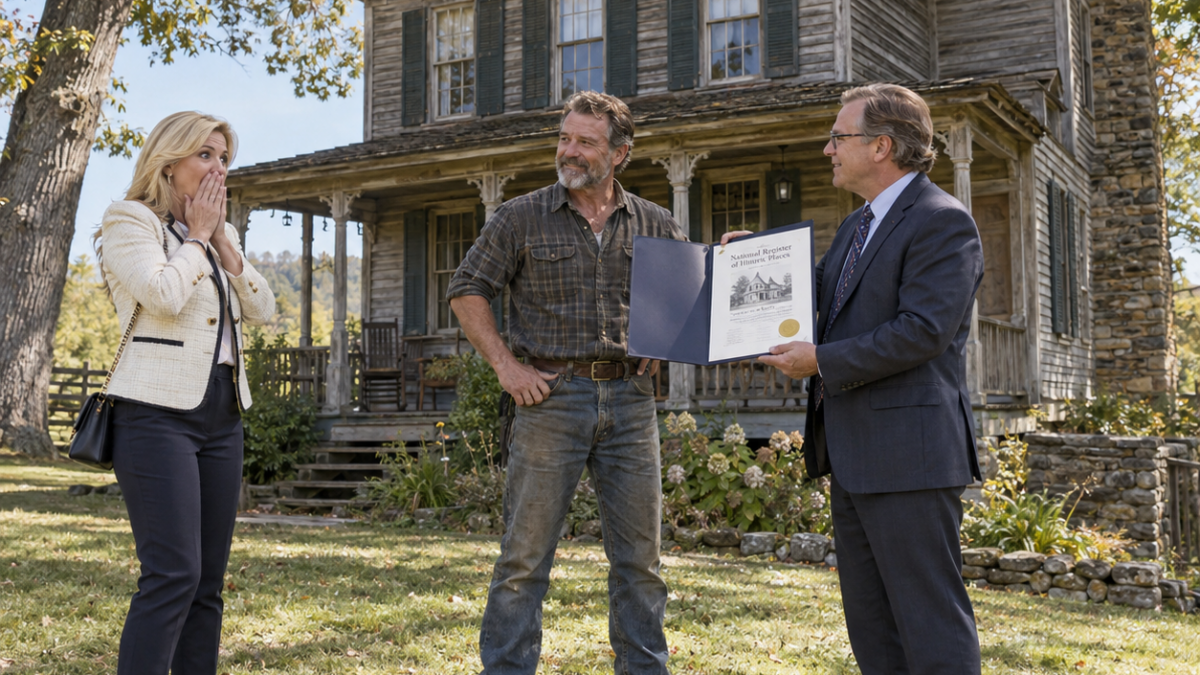
Karen stapled a demolition order to the front door of the house my great-great-grandfather had built with his own hands.
She called the 1878 homestead an ugly, dangerous embarrassment and gave me fourteen days to erase one hundred and fifty years of my family’s history.
What she did not understand was that the old stone house had already survived generations of storms, wars, deaths, debts—and it was about to survive her too.
The orange notice looked obscene against the gray oak door.
FINAL NOTICE OF CONDEMNATION AND ORDER FOR DEMOLITION.
Below it were several paragraphs of HOA citations, daily fines, threats of contractor fees, and enough legal language to frighten anyone who did not know better.
At the bottom was Karen Miller’s looping signature.
President, Oakwood Estates HOA.
I stood there for a long moment without touching it.
The little two-room homestead had been on that ground since 1878.
My great-great-grandfather had come to America from Scotland with stoneworking tools, a young wife, almost no money, and the belief that if he could build something solid enough, his children might have a better beginning than he did.
He cleared those fields by hand.
Every stone he pulled from the soil became part of the walls.
Six children were raised inside them.
One survived influenza there.
Another left through that doorway for France during the First World War.
My grandfather was born in the back room.
My father learned to walk across those uneven floorboards.
And after twenty-four years in the Army Corps of Engineers, I had returned home believing the old place would still be standing long after I was gone.
Karen had apparently decided otherwise.
I slid my pocketknife beneath the first metal staple.
She had not even used thumbtacks.
She had driven heavy staples directly into wood that had survived nearly a century and a half.
That bothered me almost as much as the notice.
Almost.
Oakwood Estates had been built on farmland my father sold during a bad financial period in the late 1990s.
He regretted that sale until the day he died.
What remained—ten acres, my grandfather’s 1950s farmhouse, the creek, several old trees, and the original homestead—stayed with our family.
And most importantly, our parcel had never joined the HOA.
The original development documents said so.
I had confirmed it with the county before moving back.
Karen knew that.
Or at least I had told her enough times that ignorance was no longer an excuse.
Her first visit had been about my mailbox.
Then the grass.
Then the faded trim on the farmhouse.
Then my restored 1986 Ford F-250.
Each time I gave her the same answer.
“My property is exempt from your association.”
Each time she smiled as though facts were merely obstacles waiting for her approval.
But this was different.
This was not another fifty-dollar threat over lawn height.
This was my family’s beginning.
I removed the final staple carefully and slid the notice into its plastic sleeve.
Then I walked back toward the farmhouse.
By the time I reached my grandfather’s old oak desk, the anger had settled into something colder.
Twenty-four years in uniform had taught me that anger is useful only for recognizing that something matters.
After that, you need a plan.
I opened a legal pad.
At the top, I wrote:
PROTECT THE HOMESTEAD.
Then I started listing what I knew.
The parcel was outside HOA jurisdiction.
The structure had documented historical status.
Karen had entered my land without permission.
She had damaged the original door to post her notice.
And now she had placed in writing her intention to destroy the building.
That last part mattered.
I just did not yet know how much.
Before sunset, I made three phone calls.
The first was to the county registrar.
The second was to an old Marine sergeant who lived inside Oakwood Estates and already had his own history with Karen.
The third was to the county historical commission.
When the woman who answered heard my name and the words “Miller Homestead,” she became silent.
Then she asked one question.
“Mr. Miller, exactly what has the HOA threatened to do?”
I looked at the fluorescent demolition notice lying on my desk.
“They say they’re going to tear it down.”
There was another pause.
This one much longer.
When she spoke again, her voice had changed.
“Bring that notice to my office tomorrow morning.”
I sat a little straighter.
“Why?”
“Because if they do what they just threatened in writing…”
She stopped.
And what she said next changed the entire fight.
PART 2
“…they may be moving from harassment into criminal territory.”
The woman on the phone spoke so calmly that, for a second, I thought I had misunderstood her.
“Criminal?”
“Yes.”
“What kind?”
“I don’t want to give you a legal conclusion over the phone without reviewing the file. Bring me the notice. Bring whatever property records you have. And do not alter the building.”
“I wasn’t planning to.”
“Good.”
“What time?”
“Eight-thirty.”
“I’ll be there.”
She paused.
“And Mr. Miller?”
“Yes?”
“If anyone from the HOA shows up before then, document it.”
I looked toward the dark windows beyond my desk.
“That was already the plan.”
I slept badly.
Not because I was afraid Karen might arrive with a bulldozer overnight.
Not yet.
What kept me awake was the thought of my father.
He had spent his final years apologizing for selling most of the farm.
Nobody blamed him.
Agriculture had been brutal in the years when he made the decision.
Debt had accumulated.
Equipment failed.
My mother’s medical bills had come all at once.
Developers arrived offering more money for eighty acres than my father thought he would ever make farming them.
He did what he had to do.
But regret is not always rational.
After Oakwood Estates went up, he would sit on the back porch and stare at rows of new roofs where cornfields had once been.
“I sold your inheritance,” he told me once.
I was home on leave.
“No,” I said. “You saved the part that mattered.”
He looked toward the original stone homestead.
“That old place?”
“That old place.”
He laughed.
“You always were sentimental for an engineer.”
Maybe I was.
But buildings mattered to me.
Not because stone or timber had feelings.
Because people leave themselves inside the things they build.
A notch cut into a doorway.
Initials carved under a windowsill.
A repaired joist that tells you somebody once refused to let a roof fall.
The homestead contained evidence of ordinary people who had survived.
That mattered more to me than any polished monument.
At eight the following morning, I drove to the county courthouse.
The historical commission occupied several rooms in the basement.
The woman behind the counter wore square glasses and had silver hair pulled into a neat bun.
“Major Miller?”
“Retired.”
She extended her hand.
“Dr. Eleanor Albright.”
We shook.
“You spoke with me yesterday.”
“I did.”
“Let’s see the notice.”
I handed it over.
She read every line.
Then she read it again.
Her expression barely moved, but the longer she looked at the paper, the more I could see anger building behind her eyes.
Finally she placed it on the desk.
“They stapled this to the structure?”
“Yes.”
“How many staples?”
“Four.”
“Large?”
“Pneumatic.”
She closed her eyes briefly.
“I’m adding that to the file.”
“You have a file?”
Dr. Albright gave me a look.
“Major, your family’s homestead is one of the best surviving examples of late-nineteenth-century vernacular farm construction in this part of the county.”
That was more enthusiasm than I expected from someone who looked capable of arresting people for misusing semicolons.
She walked to a filing cabinet.
“Miller Homestead.”
She pulled out a thick folder.
Inside were photographs I had never seen.
Some were from the 1980s.
One showed my father standing beside the door, younger than I remembered him.
His hair was dark.
His hands were in his pockets.
My throat tightened.
Dr. Albright noticed.
“That your father?”
“Yes.”
“He helped with the survey.”
“I didn’t know.”
“He was extremely protective of the property.”
“He regretted selling the surrounding acreage.”
“I gathered that.”
She turned several pages.
“Your great-great-grandfather built the structure in 1878 according to the county survey and family records.”
“I’ve always heard 1878.”
“That’s consistent.”
She pulled out an architectural report.
“Original locally quarried fieldstone. Hand-hewn oak lintels. Early lime mortar. Most importantly, the basic structure remains unusually intact.”
She looked at me.
“The peeling paint Karen dislikes?”
“Yes?”
“That’s repairable.”
“The roof?”
“Needs work.”
“She calls it abandoned.”
“Historic preservation and suburban aesthetic preference are not the same discipline.”
I smiled.
“You’ve met her type.”
“More times than I care to count.”
She flipped to another document.
“Oakwood Estates tried to acquire the old gristmill property along the creek several years ago.”
“For what?”
“A recreation facility.”
“What kind?”
“Pickleball.”
I stared at her.
“You’re joking.”
“I wish.”
She adjusted her glasses.
“The commission declined to support demolition.”
“What did Karen say?”
“Something memorable about obsolete structures standing in the way of progress.”
“That sounds like her.”
Dr. Albright removed another sheet.
“This is what you came here for.”
She placed it in front of me.
It was a copy of the state preservation statute applicable to designated landmarks.
Her finger moved to one paragraph.
“Read this.”
I did.
Unauthorized willful demolition, material alteration, or destruction of a designated historic landmark could result in severe penalties.
Depending on the act and intent, criminal referral was possible.
There were also civil penalties.
Restoration obligations.
Fines.
Potential personal exposure for individuals who knowingly authorized illegal work.
I read it again.
“Karen signed the demolition notice.”
“Yes.”
“She says the HOA will hire a contractor.”
“Yes.”
“If they actually do it…”
Dr. Albright finished for me.
“They could create serious legal problems for themselves.”
“How serious?”
“Potentially very.”
I leaned back.
“Does the HOA know the property is protected?”
Dr. Albright became still.
“That question matters.”
“You tell me.”
She stood, walked to her computer, and searched.
Then she printed a page.
“I sent the Oakwood board a preservation notice two months ago.”
“Two months?”
“Yes.”
“Why?”
“They had contacted our office asking whether historic designation prevented what they described as ‘nuisance abatement.’”
My pulse slowed.
That was the same reaction I used to have before an operation.
The moment emotion gives way to clarity.
“What exactly did you tell them?”
“That the homestead was protected and that no demolition or material alteration could proceed without review and authorization.”
“Who received it?”
“The board’s official address.”
“Karen?”
“The acknowledgment came from the president’s HOA email.”
I stared at her.
“So this isn’t ignorance.”
“No.”
She looked at the demolition notice.
“Based on what I’m seeing, no.”
That changed everything.
Karen had been warned.
Then she issued the order anyway.
I picked up the paper.
“What should I do?”
“First, preserve all evidence.”
“I already removed the notice carefully.”
“Good.”
“Second?”
“Send the board a written statement that they have no permission to enter the property.”
“I can do that today.”
“Third, notify us immediately if any contractor or equipment appears.”
“I will.”
“And fourth…”
She looked at me over her glasses.
“Do not become as reckless as they are.”
That almost made me laugh.
“You think I will?”
“I think you’re angry.”
“I am.”
“Angry people like revenge.”
“I’m more interested in keeping the house standing.”
“Good answer.”
She copied the relevant records for me.
Historical designation.
Architectural report.
Correspondence to the HOA.
State statute.
County parcel history.
By the time I left, my folder weighed several pounds.
I drove directly to Gunny Miller’s house.
No relation to Karen.
Thank God.
His real name was James Miller, but everybody who knew him from the Marine Corps called him Gunny.
He had retired as a gunnery sergeant.
Sixty-eight years old.
Back straight enough to use as a framing square.
He lived three streets into Oakwood Estates beneath the largest American flag in the neighborhood.
Karen hated the flagpole.
That was why I liked it.
Gunny opened the garage before I had fully parked.
He held two coffees.
“Report.”
I took one.
“You enjoy this too much.”
“I’ve been retired twelve years. This is the most entertainment I’ve had since the HOA tried to lien my house.”
His garage was absurdly organized.
Every wrench had an outline on the pegboard.
Every container had a label.
His lawn mower looked inspection-ready.
I spread the historical records across his workbench.
Gunny read the statute.
Then looked at me.
“Oh.”
“That’s what I said.”
“No, Major. You said it like an engineer.”
“What does that mean?”
“You probably frowned thoughtfully.”
“What would you do?”
He grinned.
“I would use profanity.”
I pointed at the paper.
“She was warned two months ago.”
His grin vanished.
“Proof?”
I showed him Dr. Albright’s email acknowledgment.
Gunny whistled.
“That woman is either unbelievably arrogant or unbelievably stupid.”
“Could be both.”
“Usually is.”
We looked over the demolition notice.
Fourteen days.
After that, HOA-contracted demolition.
Daily fines.
Contractor costs charged to me.
Administrative fee.
“Twenty thousand dollars,” Gunny said.
“That’s what they’re talking about spending.”
“On a house that isn’t even inside their HOA.”
“Yes.”
He leaned against the bench.
“This is bigger than your homestead.”
“I know.”
“You ready for that?”
“What?”
“To drag everyone else into it.”
I knew what he meant.
Gunny had told me some of his story when we first met.
Karen had nearly put a lien on his home over the flagpole.
He spent three thousand dollars on an attorney proving that her enforcement action was defective and removing the lien threat.
He won.
But the process had exhausted him.
Since then, Karen watched him like an enemy.
“I don’t want a neighborhood uprising,” I said.
“Too late.”
“I want the demolition stopped.”
“And when you stop it?”
“I go home.”
Gunny laughed.
“That’s not how this works.”
“How does it work?”
“You just discovered she was willing to ignore a state preservation notice because she thinks nobody can challenge her.”
He tapped the folder.
“You stop her on your property, she goes back to fining Mrs. Gable over roses.”
“That’s not my fight.”
Gunny’s expression hardened.
“That’s what I used to tell myself.”
Silence.
He continued.
“Until they came after my flagpole.”
I looked toward the open garage door.
Across the street, every lawn was perfect.
Every mailbox matched.
Every garage door had been painted one of four approved neutral colors.
Order can look peaceful from a distance.
Up close, fear sometimes looks exactly the same.
“What do you suggest?” I asked.
“Talk to people.”
“About Karen?”
“About their own experiences.”
“And then?”
“Then we find out whether your homestead is an isolated act of stupidity or the latest part of a pattern.”
I already knew the answer.
But proof mattered.
That evening, Gunny and I walked to Mrs. Gable’s house.
She was eighty-one.
Widowed.
Small enough that the rose shears looked oversized in her hands.
Her front flower bed was immaculate.
Pink roses climbed a trellis near her porch.
“Mrs. Gable,” Gunny called.
She looked up.
“James.”
Then she saw me.
“Oh. Major Miller.”
“Daniel’s fine.”
Nobody called me Daniel.
I was beginning to think I had come home to a neighborhood populated entirely by people who insisted on military rank.
Gunny pointed to the roses.
“Still illegal?”
Mrs. Gable smiled sadly.
“Depends which Tuesday you ask.”
She invited us onto the porch.
I explained what Karen had done to the homestead.
Mrs. Gable’s hand went to her chest.
“She wants to destroy it?”
“Yes.”
“That beautiful stone cottage?”
“You’ve seen it?”
“My husband and I used to walk by before the development was built.”
Her face softened.
“Your father once let us look inside.”
That surprised me.
“You knew him?”
“A little.”
She looked toward my land.
“He was very sad when the farm was sold.”
I said nothing.
Mrs. Gable noticed.
“I’m sorry.”
“It’s all right.”
Gunny changed direction.
“Tell Daniel what she did with the roses.”
Mrs. Gable looked uncomfortable.
“That’s old business.”
“It matters.”
Her fingers tightened around the handle of her shears.
Eventually she told me.
Karen had decided that several rose varieties violated a landscaping guideline requiring a coordinated front-facing color scheme.
Mrs. Gable’s Queen Elizabeth roses were pink.
The approved palette supposedly leaned toward whites, reds, and pale peach.
The first letter demanded removal.
She ignored it.
Then came fines.
Fifty dollars.
One hundred.
Five hundred.
Eventually more than a thousand.
“My husband planted those roses,” she whispered.
“When?”
“Forty-three years ago at our old house. We moved three of them here when we downsized.”
“So you fought.”
“I did.”
“How?”
“At a board meeting.”
Her eyes brightened slightly.
“I cried. I’m embarrassed about that.”
“Why?”
“I don’t like crying in front of people.”
“You were defending something your husband gave you.”
She nodded.
“A few neighbors spoke up. Karen backed down.”
Gunny said, “And then?”
Mrs. Gable gave a humorless laugh.
“Then she discovered my recycling bin.”
“How?”
“Two inches too close to the curb.”
I looked at Gunny.
He shrugged.
“Welcome to Oakwood.”
Mrs. Gable had saved the notices.
She brought them from a drawer.
I asked permission to copy them.
She hesitated.
“Will Karen know?”
“She might.”
Fear immediately returned to her face.
That was the part that bothered me most.
Not the fine.
The fear.
“She cannot legally punish you for giving me documents you own.”
“She’ll find something else.”
Gunny leaned forward.
“She already does.”
Mrs. Gable looked at him.
He continued.
“She wins every time you assume being noticed is more dangerous than being alone.”
That was a hard thing to say to an elderly woman.
It was also true.
She looked at the notices in her lap.
Then handed them to me.
“Make copies.”
We did.
Next came the Martinezes.
Carlos and Elena had two young children and a garage door that was apparently a national emergency.
I found Carlos painting it for the third time.
A can of sandstone beige sat beside him.
The door already looked beige.
“What color was it yesterday?” I asked.
“Light taupe.”
“What color is it now?”
“Sandstone beige.”
I stared.
“They’re different?”
Carlos gave me the hollow expression of a man whose spirit had been defeated by paint samples.
“My wife says one is warmer.”
“Can she tell?”
“No.”
“Can Karen?”
“Apparently she has supernatural beige detection.”
Elena came from the house.
“You’re the homestead guy.”
“That obvious?”
“Everybody’s talking.”
“That’s probably not good.”
“It might be.”
We sat in their garage.
They showed me three violation notices.
Three paint receipts.
A contractor bill.
Two thousand dollars spent repainting a door because Karen claimed the online approved-color list was outdated.
“You used the color listed on the HOA website?” I asked.
“Yes.”
“And she fined you anyway?”
“Yes.”
“Did she update the website first?”
“No.”
“Did you appeal?”
Carlos laughed.
“To who? Karen chairs the appeal committee.”
That sentence went into my notebook.
As we left, Elena stopped me.
“Daniel?”
I turned.
“If you fight her…”
She hesitated.
“Don’t stop halfway.”
I understood.
Half a rebellion is sometimes more dangerous than silence.
By the end of the week, Gunny and I had spoken to twelve families.
Basketball hoop.
Wind chimes.
Patio pavers half an inch too thick.
Trash bins.
Tree species.
Children’s bicycles visible from the street.
A porch light with the wrong color temperature.
One family had been fined because a child left chalk drawings on the driveway overnight.
Every violation was technically tied to some section of the covenants.
That was Karen’s gift.
She could stretch vague phrases until they covered almost anything.
Community harmony.
Visual consistency.
Orderly appearance.
Property-value protection.
All reasonable ideas.
All dangerous when one person gets to define them without restraint.
Then the certified letter arrived.
I was in the kitchen when the mail carrier brought it.
Fourteen-day demolition notice reduced to nine days.
The board had apparently voted to “accelerate abatement.”
If I failed to demolish the homestead myself, Oakwood Estates would hire a contractor.
They would then bill me.
Demolition estimate: $20,000.
Administrative fees: $3,500.
Daily noncompliance penalty: $200.
I read it twice.
Then scanned it.
Subject line to Dr. Albright:
EXHIBIT B.
She replied six minutes later.
Received. Preserve original.
I drafted my response.
No threats.
No felony language.
No mention of the specific penalties she had shown me.
I wanted to give them one clean chance to stop.
The letter stated three things.
My parcel was not subject to Oakwood Estates covenants.
The HOA had no right to enter my property.
Any contractor entering without permission would be treated as a trespasser.
Attached were the deed and original development plat.
I concluded:
You are requested to withdraw all demolition directives, fines, and notices relating to my exempt property and cease further contact except through lawful written correspondence.
Gunny read it.
“Too polite.”
“That’s the point.”
“I would add one sentence.”
“What?”
“Go pound sand.”
“No.”
“Fine. Engineers ruin everything.”
I sent the letter certified mail to all five directors.
Three days later, Karen arrived.
Not at the farmhouse.
At the homestead.
She drove her golf cart directly across my field.
That alone told me she had no respect for the letter.
I was checking mortar along the north wall when I heard the electric motor whining across the grass.
She stopped hard enough to tear two shallow ruts.
Lime-green tracksuit.
Sunglasses.
Large handbag.
She stepped out.
“I received your little letter.”
I stood slowly.
The recorder in my shirt pocket was already running.
“Good.”
“You seem to believe some old map protects you.”
“It’s the recorded development plat.”
“Those exemptions were invalidated.”
I almost admired how smoothly she lied.
“When?”
“Years ago.”
“Board vote?”
“Yes.”
“Recorded amendment?”
“We don’t owe you our internal documents.”
“That’s not how property restrictions work.”
She waved toward the homestead.
“This is why dealing with you is impossible. You hide behind technicalities.”
“Ownership is a technicality?”
“Community obligations extend beyond paperwork.”
“No.”
Her face tightened.
“You don’t get to decide.”
“My deed does.”
“This building is a blight.”
I looked at the stone wall.
“Your opinion.”
“It attracts rodents.”
“Evidence?”
“It could collapse.”
“It was inspected last year.”
“Children could enter.”
“They’d have to trespass across my land.”
“You always have an answer.”
“I usually have documents.”
That did it.
Karen stepped closer.
“The structure is coming down.”
“No.”
“The board approved it.”
“Then the board made a mistake.”
“Nine days.”
I looked at her.
“Karen, this house stood here before Oakwood Estates existed.”
“I don’t care.”
“Before your HOA existed.”
“I don’t care.”
“Before your house existed.”
“Still don’t care.”
“It will still be here when you’re gone.”
Her mouth opened slightly.
Then her voice dropped.
“You really think you can embarrass me?”
“This isn’t about you.”
“Everything you’ve done has been about challenging my authority.”
“What authority?”
She stared.
I continued.
“You are president of an association my land does not belong to.”
“You live inside our community.”
“My property predates your community by more than a century.”
“Your property damages our values.”
“Then you should have considered that before building houses around it.”
That landed.
Her face became mottled red.
“You will regret this.”
I took one step toward her golf cart and pointed toward the road.
“You are on private property after written notice to stay off.”
She stiffened.
“Get off my land.”
“You cannot speak to me like—”
“I just did.”
Her hands trembled.
For a moment I thought she might slap me.
Instead she climbed back into the cart.
“You have nine days.”
Then she drove away.
I let the recorder run until I could no longer hear the motor.
Exhibit C.
That night, the HOA website posted its board-meeting agenda.
Wednesday.
7:00 p.m.
Special item:
EMERGENCY EXPENDITURE FOR DEMOLITION OF ABANDONED STRUCTURE, 112 OLD FARM LANE.
Twenty thousand dollars.
Gunny came over carrying beer and a grin.
“Phase three.”
“I hate that you’re enjoying this.”
“I spent four months getting a lien removed because my flagpole was five feet too tall.”
“You’re entitled to some joy.”
“Damn right.”
We prepared everything physically.
No slides.
No projector.
Poster boards.
Documents.
Photographs.
The first board showed the homestead at sunset.
The caption:
MILLER HOMESTEAD — BUILT 1878.
The second board showed a timeline.
Mailbox complaint.
Grass notice.
Vehicle notice.
Demolition warning.
Certified response.
Karen’s trespass.
The third:
PATTERN OF ENFORCEMENT.
We used anonymous quotations from homeowners.
“They fined me because my child’s tricycle was visible.”
“They made my mother remove her garden.”
“They threatened my home over a flagpole.”
“They told us to repaint a color we selected from their own website.”
For the board members, we made packets.
Property exemption.
Historic designation.
State preservation statute.
Dr. Albright’s prior notice to Oakwood Estates.
Copies of Karen’s demolition directives.
Gunny wanted to include a newspaper article about Karen’s husband’s tire stores receiving environmental penalties.
“No.”
“It’s public.”
“Still irrelevant.”
“Shows a family pattern.”
“It shows his problem. Not hers.”
Gunny grumbled.
“You’re too ethical.”
“You say that like it’s a defect.”
“It slows revenge.”
“This isn’t revenge.”
He looked at me.
“Keep saying that. Might become true.”
That bothered me because he was partly right.
I did want Karen humiliated.
I wanted her standing in front of the people she had frightened while somebody explained that she was not as powerful as she believed.
That desire was human.
It was also dangerous.
My father’s voice returned to me.
Do the work you can defend afterward.
He used to say that about farming.
Fence repair.
Drainage.
Business decisions.
It applied here too.
So we removed anything from the packet that did not directly matter.
Facts only.
Then I called the local newspaper.
Years earlier, after retiring, a reporter had interviewed me for a small story about a veteran returning to restore family land.
His name was Ethan Cole.
I reminded him who I was.
“I remember the stone house,” he said.
“You may want to come to an HOA meeting Wednesday.”
“That sentence usually does not inspire excitement.”
“They’re voting to spend twenty thousand dollars demolishing the house.”
Silence.
“The historic one?”
“Yes.”
“Your property isn’t in the HOA.”
“Correct.”
“Why are they demolishing it?”
“You should probably hear their explanation.”
He came.
By six-thirty Wednesday evening, the clubhouse parking lot was full.
I had never seen so many residents at an HOA meeting.
Gunny looked around.
“She thinks they’re here for her.”
“She may be right.”
“Not the way she thinks.”
Mrs. Gable sat in the front row.
Carlos and Elena sat beside her.
Other residents filled every chair.
Some stood along the wall.
Ethan occupied the back corner with a notebook.
Karen sat at the front table with four directors.
She wore a navy jacket and pearls.
No tracksuit tonight.
This was theater.
She knew it.
The meeting began.
Treasurer report.
Pool maintenance.
Landscaping contract.
Streetlight repair.
I watched Karen during all of it.
She smiled.
Nodded.
Controlled speaking time.
Interrupted residents who wandered off agenda.
She was good at meetings.
That was important.
People like Karen are not always fools.
Sometimes they are effective organizers who gradually discover that efficiency can become power, and power can become identity.
When we reached the special agenda item, she leaned toward the microphone.
“Now we come to an issue many of you have expressed concern about.”
I heard Gunny whisper.
“Here we go.”
Karen continued.
“At the eastern boundary of Oakwood Estates stands an abandoned and severely deteriorated structure.”
She did not call it my homestead.
She called it a structure.
“Despite repeated requests, the owner has refused to maintain or remove this dangerous eyesore.”
I almost stood.
Gunny touched my sleeve.
“Wait.”
Karen displayed photographs.
Clever photographs.
Close-ups of peeling paint.
A cracked porch board.
Moss.
A loose shutter.
No wide shot showing the solid stone walls.
No image showing the distance from any public road.
No context.
“This building threatens property values.”
She clicked to another photo.
“It presents a possible fire hazard.”
Another.
“A vermin risk.”
Another.
“And a serious danger to children who may enter.”
I looked at Carlos.
His eyebrow rose.
Karen continued for ten minutes.
Maybe twelve.
Fear is most effective when it comes dressed as concern.
By the end of her speech, the homestead was not an old family building.
It was a collapsing rat colony ready to ignite and crush children.
“The board,” she concluded, “therefore recommends an emergency allocation not exceeding twenty thousand dollars for immediate professional demolition.”
One director nodded.
Another avoided eye contact with the crowd.
Karen smiled.
“This is not about one resident. It is about all of us.”
That line almost made me laugh.
She opened the floor.
“Questions?”
I stood.
“I have a statement.”
Her smile vanished for half a second.
“This is a question period, Major.”
“The owners whose reserve money you plan to spend deserve the full record.”
Murmurs.
Karen heard them.
She looked around the room.
Control is partly knowing when resistance will look worse than permission.
“Three minutes.”
“I’ll try.”
“Three.”
I walked forward carrying the first poster board.
Gunny followed with packets.
I placed the photograph where everyone could see it.
Gasps.
The sunset image showed the homestead as it actually looked.
Small.
Weathered.
Beautiful.
“This,” I said, “is the abandoned eyesore Karen wants you to spend twenty thousand dollars destroying.”
Karen shifted.
I continued.
“It was built in 1878 by my great-great-grandfather.”
I explained the stone.
The family.
The land sale.
The exempt parcel.
“My property has never been part of Oakwood Estates.”
Karen interrupted.
“That is disputed.”
“No.”
She reached for the microphone.
I held up the recorded plat.
“The county record is not disputed because you dislike it.”
The room murmured louder.
One board member leaned toward Karen.
She whispered something to him.
I changed boards.
“This is the enforcement history.”
I walked through the notices.
Mailbox.
Grass.
Truck.
Then the demolition order.
“None of these HOA covenants legally bind my parcel.”
Karen laughed sharply.
“That is your interpretation.”
“No. It is the county’s.”
I changed boards again.
PATTERN OF ABUSE.
“This part isn’t about my property.”
Mrs. Gable looked at me.
“This is about people who do live inside Oakwood Estates.”
Karen’s face tightened.
I read the statements.
Tricycle.
Roses.
Flagpole.
Garage color.
Wind chimes.
Patio.
At first nobody moved.
Then people began looking at each other.
Fear survives through isolation.
The moment victims realize they share the same story, something changes.
Karen sensed it too.
“These are anonymous, unverified allegations.”
Mrs. Gable stood.
“Mine isn’t.”
Every head turned.
She trembled.
But she stayed standing.
“You fined me one thousand dollars over roses my husband planted.”
Karen looked annoyed.
“We resolved that matter.”
“You found another violation the following week.”
“That is unrelated.”
“No.”
Mrs. Gable’s voice cracked.
“For six years, everything has been related.”
Silence.
Carlos stood next.
“You made us paint our garage three times.”
“You used a noncompliant shade.”
“We used the code from your website.”
“The site was outdated.”
“That was your website.”
Someone laughed.
Not kindly.
Karen slammed the gavel.
“Order.”
Gunny started distributing the packets.
“What are those?” Karen demanded.
“Information,” I said.
“You did not receive permission to distribute materials.”
Gunny looked delighted.
“Put that one in writing.”
The laughter grew.
Karen’s authority was slipping.
I waited until the room quieted.
“Inside those packets is the document Karen should have shown this board before asking you to approve demolition.”
One director immediately opened his.
Then another.
Karen’s eyes moved to the front page.
She knew what it was.
I saw recognition.
That was all I needed.
“The Miller Homestead is a protected historic landmark.”
The room became completely still.
I continued.
“The county historical commission documented its status decades ago.”
Karen interrupted.
“Designation does not eliminate HOA safety authority.”
I turned toward her.
“You were told otherwise.”
Her face froze.
I held up Dr. Albright’s email.
“Two months ago.”
A board member looked sharply at Karen.
“What?”
She ignored him.
I continued.
“The historical commission notified the HOA that demolition or material alteration required preservation review.”
The same director leaned toward her.
“You told us that issue had been cleared.”
“It was.”
“No.”
A woman’s voice came from the back.
Dr. Eleanor Albright stepped forward.
I had not known she was coming.
Gunny looked at me.
I shook my head.
This was not planned.
Dr. Albright carried a leather folder.
“My name is Dr. Eleanor Albright. I represent the county historical commission.”
Karen looked like somebody had opened a trapdoor beneath her chair.
Dr. Albright approached the front.
“The Miller Homestead is protected.”
She placed a document on the table.
“My office informed this association in writing two months ago.”
She placed another sheet.
“We received acknowledgment through the president’s official email account.”
Every director turned toward Karen.
She stared at the papers.
“Historic status does not mean a structure can endanger a community.”
“That is true,” Dr. Albright said.
For a second Karen looked relieved.
Then Dr. Albright continued.
“But there is a lawful process for addressing safety concerns involving protected historic properties. Your board did not use it.”
“We have independent authority.”
“No.”
Karen’s voice sharpened.
“Our attorney—”
“Your private attorney does not override preservation law.”
Dr. Albright opened the statute.
“Willful unauthorized destruction of a protected landmark can lead to significant civil penalties, restoration liability, and possible criminal referral depending on the conduct and intent.”
One director went pale.
“Criminal?”
Dr. Albright looked at him.
“Potentially.”
He turned to Karen.
“You said this was legal.”
Karen raised both hands.
“It is. This is intimidation.”
Dr. Albright did not react.
“I am not threatening you. I am describing the law.”
Another director flipped through the packet.
“What does ‘individual liability’ mean?”
“It means participating decision-makers may not always be able to hide behind the association if they knowingly authorize unlawful conduct.”
The man pushed his chair backward.
“Karen.”
She slammed her palm on the table.
“This is a setup.”
“No,” I said. “It’s your paperwork.”
She looked at me with pure hatred.
I continued.
“You signed the demolition order.”
“I signed it as president.”
“You received the preservation warning as president.”
“That is not—”
“You drove onto my land three days ago and told me the house was coming down.”
Her eyes narrowed.
“You have no proof.”
I reached into my pocket.
The recorder.
Gunny smiled.
I didn’t play it.
I didn’t need to.
“I do.”
That broke the board.
Not Karen.
The others.
One director leaned away from her.
Another began reading every page.
The treasurer put both hands over his face.
The man who had gone pale said, “I’m not voting for this.”
Karen looked at him.
“You already supported it in committee.”
“I didn’t know any of this.”
“You knew enough.”
“No.”
He pointed at Dr. Albright’s email.
“You knew.”
The room erupted.
Residents began standing.
Talking.
Calling out their own experiences.
One woman spoke about being fined because her daughter’s chalk drawings remained overnight.
A man described spending hundreds of dollars removing an approved basketball hoop after Karen reinterpreted the placement rule.
Another family described a threatened lien.
Gunny finally stood.
He did not yell.
He didn’t have to.
“She put a lien threat on my house over this.”
He held up a photograph of his flagpole.
A few people laughed.
Then they realized he was serious.
“Five feet.”
He looked at Karen.
“You tried to jeopardize a veteran’s home because his flagpole was five feet taller than your preference.”
Karen grabbed the gavel.
“This meeting is adjourned.”
Nobody moved.
She hit it.
“Adjourned.”
The director beside her pulled the microphone toward himself.
“No.”
She stared at him.
“This meeting is over.”
“No.”
He took a breath.
“I move that the demolition authorization be withdrawn immediately.”
A second director said, “Second.”
Karen’s expression became desperate.
“You cannot vote after I adjourn.”
“You didn’t complete the adjournment procedure.”
Gunny whispered, “God bless Robert’s Rules.”
The vote happened.
Four board members.
Three voted to withdraw demolition.
One abstained.
Karen voted against.
The motion passed.
Applause hit the room like thunder.
Karen sat perfectly still.
Then Mrs. Gable stood again.
“I move we remove her.”
The room exploded.
Procedurally, it was not that simple.
But emotionally, Karen’s presidency ended right there.
The board hurriedly closed the meeting.
Outside, people gathered in clusters.
Ethan Cole interviewed Dr. Albright.
Residents showed him letters.
Carlos showed him paint receipts.
Gunny practically tried to hand him his entire legal file.
I stood alone near my truck for a minute.
Sarah had not attended.
She hated confrontation and had asked me to call when it was over.
I dialed.
She answered immediately.
“Well?”
“The house is safe.”
I heard her exhale.
“Really?”
“They withdrew the demolition.”
“And Karen?”
“Still breathing.”
“That wasn’t my question.”
I smiled.
“She’s in trouble.”
“How much?”
“I don’t know yet.”
“Did you enjoy it?”
That question caught me.
“A little.”
“Daniel.”
“I know.”
“What did your father always say?”
I looked toward the dark shape of the homestead beyond the clubhouse lights.
“Do the work you can defend afterward.”
“And can you?”
“Yes.”
“Then come home.”
I did.
The newspaper article came out Friday.
HOA DEMOLITION PLAN TARGETED PROTECTED 1878 HOMESTEAD.
Ethan’s story was careful.
He did not call Karen a criminal.
He described the documents.
The preservation notice.
The property exemption.
The residents’ complaints.
The board’s reversal.
Dr. Albright’s warning about potential penalties.
It was devastating because it did not exaggerate.
Karen called it a smear campaign.
The next morning, two board members resigned.
By Monday, the other two announced they would not continue without an independent review.
Oakwood Estates suddenly had almost no functioning leadership.
That should have ended it.
It didn’t.
Gunny came to my house Tuesday afternoon.
He did not joke.
That was how I knew something was wrong.
“What?”
He stepped inside.
“Carlos got a call from his cousin.”
“And?”
“Cousin works for Mason County Excavation.”
I waited.
“Karen called them.”
“For what?”
“Private demolition.”
I felt the world narrow again.
“When?”
“Yesterday.”
“Using HOA authorization?”
“No.”
“Personal?”
“Yes.”
I stood.
“What exactly did she ask for?”
“Backhoe. Operator. Weekend job. Cash.”
“Address?”
“Your place.”
I looked toward the window.
Gunny continued.
“They refused.”
“Good.”
“She may call someone else.”
I picked up the phone.
First Dr. Albright.
Then the sheriff’s department.
Neither could arrest Karen for something she had not yet done.
But both documented the information.
The sheriff advised me to call immediately if equipment entered my land.
Dr. Albright said the same.
Gunny wanted to sit watch.
“That’s ridiculous.”
“So is a private demolition crew.”
“I have cameras.”
“Cameras record ruins after the fact.”
He had a point.
For the next two days we took turns.
Not armed patrols.
Not some vigilante operation.
We simply kept an eye on the property.
My F-250 parked on a rise above the homestead.
Coffee.
Binoculars.
Phones.
Boredom.
Friday passed.
Nothing.
Friday night.
Nothing.
Saturday morning, 6:42 a.m.
I heard diesel.
Not a pickup.
Heavy.
I sat upright inside the truck.
A flatbed turned from the county road onto the dirt access.
Yellow backhoe chained to the bed.
No company markings I recognized.
My stomach hardened.
I called dispatch.
“Equipment is entering now.”
The dispatcher confirmed deputies were being sent.
Next call.
Dr. Albright.
“They’re here.”
“I’m on my way.”
Third.
Gunny.
“Phase four.”
He answered instantly.
“Finally.”
“You sound happy.”
“I’ve been awake since four.”
I drove downhill.
Not toward the homestead.
Across the narrow track.
I parked the F-250 sideways.
The flatbed stopped.
A man climbed from the cab.
Forties.
Greasy shirt.
Cigarette behind one ear.
“What are you doing?”
“This is private property.”
“I got a job.”
“From who?”
“Lady named Karen.”
“Turn around.”
He laughed.
“No.”
“That building is protected by state preservation law.”
His expression changed slightly.
“Lady says she owns the authority.”
“She doesn’t.”
“She’s paying cash.”
“That doesn’t change the law.”
He looked toward the homestead.
“What’s so special about that old shack?”
“My family built it in 1878.”
“Okay.”
“It’s protected.”
“Okay.”
“If you put that backhoe bucket through one wall, you may become part of a criminal investigation.”
That made him stop smiling.
Then an SUV came flying onto the road behind him.
Karen.
Not the golf cart.
Her Lexus.
She braked hard.
Door flew open.
Pink tracksuit.
Of course.
“What are you doing?”
I looked at her.
“Standing on my land.”
“Move that truck.”
“No.”
“You are obstructing lawful work.”
“No.”
“I hired him.”
“I know.”
Her face flashed with surprise.
Then anger.
“This structure has already been condemned.”
“By who?”
“The association.”
“You’re no longer authorized to act for the board.”
“I don’t need them.”
That was the confession.
Not legal.
Not enough by itself.
But revealing.
She stepped toward the backhoe operator.
“Unload it.”
He looked at me.
I said nothing.
Karen shouted.
“I’m paying you.”
The operator rubbed his jaw.
“Ma’am, he says it’s protected.”
“He’s lying.”
“I have the documents in my truck.”
“Don’t listen to him.”
She turned toward me.
“This ends today.”
“No.”
“I am sick of you humiliating me.”
There it was.
Not community safety.
Not rodents.
Not collapsing walls.
Humiliation.
I spoke calmly.
“This was never about humiliating you.”
“Don’t lie.”
“You made this about yourself.”
“You turned everyone against me.”
“You did that.”
Her face twisted.
For the first time, I saw what powerlessness did to her.
Not sadness.
Not reflection.
Rage.
She turned to the operator.
“I’ll double your money.”
He stared.
“Unload it.”
“Ma’am—”
“Double.”
She pointed at my truck.
“Push that truck out of the way if you have to.”
The operator actually took a step backward.
I looked at him.
“You heard that.”
“Yeah.”
“You planning to do it?”
“No.”
Karen spun.
“You coward.”
Then the sheriff’s cruisers arrived.
No sirens.
Lights flashing.
Two vehicles blocked the exit.
Gunny’s pickup appeared behind them.
Dr. Albright arrived last.
Karen stared at all of them.
For several seconds, nobody spoke.
Then Deputy Harris approached.
Salt-and-pepper mustache.
Calm eyes.
He had the expression of a man who hated paperwork but hated stupid decisions more.
“Morning.”
Karen rushed toward him.
“Officer, thank God. This man is obstructing a lawful contractor.”
Harris looked at the flatbed.
Then me.
“Mr. Miller?”
“Yes.”
“Did you invite this equipment onto your property?”
“No.”
“Did you authorize demolition?”
“No.”
He turned to the operator.
“Sir, who hired you?”
The man pointed at Karen.
“She did.”
“How much?”
Karen snapped, “That is none of your business.”
Harris ignored her.
The operator told him.
“Did she show you ownership documents?”
“No.”
“Permit?”
“She had papers.”
“What papers?”
He looked at Karen.
“I don’t know.”
Dr. Albright stepped forward.
“Deputy.”
Harris nodded.
“Doctor.”
She handed him a folder.
“The structure is protected. The HOA was formally notified. The board already withdrew its demolition authorization.”
Karen pointed at her.
“You stay out of this.”
Dr. Albright looked almost amused.
“My office administers historic-preservation review. Staying out of this is not an option.”
Karen’s voice rose.
“I own property here.”
“So does Mr. Miller.”
“I am protecting the neighborhood.”
“No,” I said. “You’re standing on private property after being told not to enter.”
She looked around.
For once, the words did not matter.
Nobody was obeying her.
Not the contractor.
Not the deputy.
Not Dr. Albright.
Not Gunny.
Not me.
Deputy Harris turned to the operator.
“Load your equipment and leave.”
The man nodded immediately.
Karen exploded.
“I paid him!”
“Then discuss your refund with him somewhere else.”
“He has a contract.”
“Not a lawful right to demolish somebody else’s building.”
The man climbed into the flatbed.
The backhoe never touched the ground.
Within minutes, he was backing toward the road.
Karen stood motionless.
Then Deputy Harris faced her.
“Ms. Miller, you need to leave.”
“No.”
“Ma’am.”
“This is my community.”
“This is his property.”
“You cannot remove me.”
“You have been given notice not to enter.”
She stared at him.
He continued.
“If you refuse, I will arrest you for trespass.”
That finally reached her.
Dr. Albright handed Harris another document.
He reviewed it.
Then looked at Karen.
“There is also a temporary protective order related to the preservation complaint.”
Karen’s face went white.
“What?”
“You will be formally served.”
She looked at me.
“You did this.”
I shook my head.
“You kept going.”
For the first time, her anger broke into something that almost looked like fear.
“You’re going to destroy me.”
“No.”
I looked at the homestead.
“I was stopping you from destroying that.”
She had no answer.
Deputy Harris escorted her back to the Lexus.
Gunny stood beside me.
When the vehicle disappeared, he said, “That was anticlimactic.”
“You wanted explosions?”
“A little.”
“You were a Marine.”
“I have standards.”
I laughed.
Then my knees went weak.
Not dramatically.
Just the delayed reaction after adrenaline.
I leaned against the truck.
Gunny saw it.
“You all right?”
“Yeah.”
“You don’t look all right.”
“I almost watched them tear down my family’s house.”
“But they didn’t.”
“No.”
He looked toward the homestead.
“Because you were ready.”
That mattered.
Not revenge.
Preparation.
The investigations moved forward after that.
The state did not throw Karen into prison for years.
Real life rarely produces the punishment people imagine while angry.
But the attempted private demolition changed her legal position.
There was now direct evidence she had continued after the board withdrew authorization and after receiving preservation notice.
The county obtained stronger protective orders.
My attorney filed a civil action covering trespass, harassment, and property damage related to the original door and repeated unauthorized entry.
More residents joined separate claims over improper fines and lien threats.
Oakwood’s insurance carrier became involved.
That terrified the remaining association leadership more effectively than any speech.
Insurers dislike unpredictability.
Karen had become unpredictability in a pink tracksuit.
Six months later, she and her husband sold their house.
I saw the sign first.
FOR SALE.
Then SOLD.
The moving truck arrived on a gray morning.
I did not go watch.
Gunny did.
Of course he did.
He called me.
“You’re missing history.”
“I have enough history.”
“They’re loading that giant gold mirror.”
“What mirror?”
“You’ve never seen it?”
“No.”
“Thing belongs in Versailles.”
“Gunny.”
“What?”
“Go home.”
“I am home. I’m observing from my driveway.”
“Which is somehow worse.”
He laughed.
Then became quiet.
“She’s leaving.”
I looked through my kitchen window toward the roofs beyond the field.
“How do you feel?”
He asked the same question Sarah had.
“Relieved.”
“Not victorious?”
“No.”
“You disappoint me.”
“I can live with that.”
When Karen’s Lexus finally drove away, I happened to be outside.
She did not look toward my property.
At least I don’t think she did.
The car disappeared.
That was the last time I saw her.
Her legal case eventually resolved without the dramatic trial some neighbors wanted.
She entered a plea agreement connected to the unlawful conduct surrounding the attempted demolition and related violations.
She avoided incarceration.
Instead, she received probation, restitution obligations, financial penalties, and hundreds of hours of community service.
When I learned where that community service would happen, I thought Gunny was lying.
He came to my porch laughing so hard he could barely speak.
“What?”
He handed me the paper.
County Historical Commission.
I stared.
“No.”
“Yes.”
“You did this.”
“I wish.”
“Dr. Albright?”
He pointed at the sky as though acknowledging divine intervention.
“Never underestimate librarians, archivists, or angry preservation officers.”
The assignment was not glamorous.
Karen spent weekends cleaning archives.
Cataloging photographs.
Assisting with database entries.
Polishing museum cases.
Handling boxes containing records of buildings older than Oakwood Estates.
I never visited while she was there.
That would have turned consequence into humiliation.
I did not need that.
Dr. Albright later told me Karen completed every assigned hour.
“She complain?”
“At first.”
“And then?”
Dr. Albright thought about it.
“Less.”
“Did she learn anything?”
“That is not a metric we track.”
I smiled.
“Of course not.”
The broader civil case produced refunds for homeowners who had been improperly fined.
Gunny got part of his legal costs back.
Mrs. Gable received reimbursement for several penalties.
The Martinezes recovered money connected to the repeated repainting dispute.
Other families received credits or refunds.
More importantly, Oakwood Estates rewrote its governing process.
The old board disappeared.
New elections were held.
Gunny Miller was nominated for president.
He refused.
Then everybody voted for him anyway.
His first meeting lasted twenty-two minutes.
“New rule,” he announced.
Nobody knew if he was serious.
“If your complaint involves a child’s chalk drawing, a rose, a bird, or the specific tone of beige on a garage door, you must first explain to the board why you have nothing better to do.”
The room laughed.
Then he became serious.
The enforcement structure changed.
No president could unilaterally issue major penalties.
Lien actions required legal review and full-board approval.
Homeowners received clearer appeal rights.
A conflict-of-interest rule was added.
Outside properties were explicitly excluded from enforcement.
The color palette was simplified.
Then mostly abandoned.
Flagpole restrictions were revised.
Gunny’s twenty-five-foot pole stayed.
Mrs. Gable kept her roses.
The Martinezes stopped painting their garage.
But the best thing happened at the homestead.
The old building had survived Karen.
That did not mean it could survive neglect.
She had been wrong about almost everything.
But she had been right about one thing.
The structure needed work.
Not demolition.
Restoration.
One Saturday morning, I went outside and found Gunny already there with a toolbox.
“You have permission to be on my land?”
“No.”
“Then leave.”
“Make me.”
He handed me a pry bar.
“We’re doing the porch.”
Carlos arrived an hour later.
He brought a ladder.
Elena brought sandwiches.
Their kids ran through the grass until I made them stay clear of the work area.
Mrs. Gable appeared with plants.
“What are those?”
“Heirloom varieties.”
“Who told you to buy them?”
“Dr. Albright.”
That explained everything.
She had researched flowers commonly planted on regional farms in the late nineteenth century.
Mrs. Gable knelt near the foundation.
“These aren’t Queen Elizabeth roses.”
“I noticed.”
“She said they wouldn’t be historically accurate.”
“You actually listened to her?”
Mrs. Gable smiled.
“I like her.”
By noon, there were twelve people at the homestead.
Some scraped paint.
Some cleared brush.
Some repaired porch boards under my supervision.
Gunny spent half his time working and half telling people how they were working incorrectly.
“Sergeant,” I finally said, “either hold the board or leave.”
He held the board.
Dr. Albright arrived carrying documentation guidelines.
Of course.
She inspected our work.
“This paint color is wrong.”
Carlos froze.
Everyone stared at her.
Then she smiled.
It took several seconds before we realized she was joking.
Carlos nearly dropped the brush.
“Doctor, that is not funny.”
“For a preservationist, it is extremely funny.”
Even Gunny laughed.
That afternoon, we removed the damaged staples Karen had driven into the front door.
The holes were small.
But visible.
Gunny asked if I wanted to fill them.
I considered it.
“No.”
“Why?”
“Leave them.”
“Battle scars?”
“No.”
I ran my hand over the old wood.
“Evidence that the house survived another idiot.”
Gunny nodded.
“Historical context.”
“Exactly.”
Later, after everyone left, I sat alone on the porch.
The repaired boards smelled new beneath me.
The field stretched toward the development.
Children played somewhere beyond the trees.
A lawn mower ran.
Someone hammered.
Ordinary neighborhood sounds.
I thought about my great-great-grandfather.
I knew very little about what he actually felt.
Family stories turn people into symbols.
Hardworking immigrant.
Stonemason.
Father.
Founder.
But he had been a person.
He probably complained about weather.
Probably lost his temper.
Probably worried about money.
Probably had days when building that house felt like a mistake.
Yet he kept stacking stone.
One piece.
Then another.
Maybe legacy is mostly that.
Not grand decisions.
Just ordinary work repeated long enough that somebody a century later can still see it.
My father joined me in memory.
His voice.
His hands.
The way he looked toward the homestead after selling the surrounding fields.
I sold your inheritance.
No, Dad.
You didn’t.
You kept enough.
I sat there until the sun dropped.
Sarah came looking for me.
She carried two mugs.
“Thought I’d find you here.”
She sat beside me.
For a while we said nothing.
Then she touched one of the repaired porch boards.
“Looks good.”
“Gunny claims credit.”
“He probably did ten percent.”
“Six.”
“Generous.”
I smiled.
Sarah looked toward the stone wall.
“I was scared you’d lose it.”
“So was I.”
“You didn’t tell me that.”
“I’m telling you now.”
“You military men always wait until danger is over before admitting you were scared.”
“Operational security.”
“Emotional incompetence.”
“Harsh.”
“Accurate.”
She leaned against me.
“Do you miss the old farm?”
“I was gone most of my adult life.”
“That wasn’t my question.”
I watched the last sunlight touch the roofs of Oakwood Estates.
“Sometimes.”
“You hate those houses?”
“No.”
That answer surprised even me.
Sarah looked at me.
“I thought you did.”
“I hated what Dad felt when he looked at them.”
“That’s different.”
“Yeah.”
The houses were not guilty.
The families inside them were not guilty.
Oakwood Estates did not destroy our farm.
Circumstances did.
Debt.
Time.
Change.
Karen had simply found a place already carrying old grief and tried to turn that grief into another point of control.
Now people from those houses were restoring the homestead.
That felt like something my father might have appreciated.
The work continued through fall.
We repaired shutters.
Stabilized the porch.
Repointed mortar using an appropriate lime mixture under Dr. Albright’s supervision.
Repaired window frames instead of replacing them.
Documented every change.
One day Ethan Cole returned.
He wanted a follow-up story.
“No Karen?”
I asked.
“Not really.”
“Good.”
“What do you mean?”
“The first article was about the conflict. This one is about the restoration.”
I agreed.
He photographed Gunny on a ladder.
Mrs. Gable planting flowers.
Carlos teaching his son how to sand a board.
The headline ran the following week.
NEIGHBORHOOD RESTORES HOMESTEAD ONCE TARGETED FOR DEMOLITION.
That article meant more to me than the first.
Conflict gets attention.
Repair gives it meaning.
The homestead became a local point of interest.
Not a tourist attraction.
I didn’t want buses.
But the historical commission organized occasional small tours.
Schoolchildren came once.
A boy about ten stood inside the main room looking at the thick walls.
“People lived here?”
“Yes.”
“No electricity?”
“Not originally.”
“No TV?”
“No.”
He looked horrified.
“How did they survive?”
I said, “Chores.”
His teacher laughed.
The boy did not.
Another child asked whether the bullet-shaped dent near the fireplace was from the Civil War.
“No,” I said. “My grandfather threw a horseshoe when he was fourteen.”
The teacher stared at me.
“What?”
“Family story.”
“Why?”
“His brother annoyed him.”
The kids loved that more than any historical fact.
That was the thing about old houses.
Official history gives you dates.
Families give you ridiculous details.
Dr. Albright eventually prepared an updated preservation report.
She showed it to me in the courthouse basement.
New photographs.
Restoration records.
Historical context.
At the end she had included a section on what she called “twenty-first-century preservation conflict.”
“That sounds dramatic.”
“It is academically neutral.”
“It mentions Karen?”
“By role, not insult.”
“Disappointing.”
She looked over her glasses.
“You are spending too much time with Sergeant Miller.”
“Correct.”
I flipped through the report.
One photograph showed the orange demolition notice on the door.
Another showed neighbors restoring the porch.
Side by side.
Threat.
Repair.
I closed the folder.
“Thank you.”
“For what?”
“For caring about the building before I knew anyone else did.”
Dr. Albright softened.
“That is the job.”
“No.”
I looked at her.
“Jobs don’t always make people care.”
She accepted that quietly.
Then said, “Your father cared too.”
“I know.”
“He called this office every year.”
I stared at her.
“What?”
“To confirm the designation remained in good standing.”
“Every year?”
“For almost fifteen years.”
I sat down.
“He never told me.”
“He also donated photographs.”
She retrieved an archival box.
Inside were family pictures.
The homestead in snow.
My grandfather repairing the roof.
My father as a boy.
My mother standing by the door when she was pregnant.
Then one I had never seen.
Me.
Maybe seven years old.
Sitting on the porch step.
Wooden toy truck in my hand.
My father standing behind me.
I held the photograph for a long time.
Dr. Albright waited.
Finally I said, “Can I get a copy?”
“You can have a high-resolution scan.”
“Thank you.”
That image ended up framed on my desk.
Beside the demolition notice.
Not because I wanted to remember Karen.
Because the two pieces of paper told the whole story.
One person saw an ugly building.
Another saw home.
That difference is larger than architecture.
Years passed.
Oakwood changed.
Not perfectly.
No neighborhood is perfect.
People still argued about parking.
Dogs barked.
Teenagers left trash near the pool.
Gunny once presided over a twenty-minute debate about whether inflatable Halloween decorations counted as temporary structures.
He called me afterward.
“I miss combat.”
“No you don’t.”
“No. But I miss clear objectives.”
Mrs. Gable eventually passed away.
She was eighty-six.
At her memorial, her niece gave me a small box.
Inside was a cutting from one of the Queen Elizabeth roses.
“She wanted you to have it.”
I could not speak for a moment.
Sarah squeezed my hand.
We planted it beside the homestead.
Not historically accurate.
I did not care.
When Dr. Albright saw it, she raised an eyebrow.
“Twentieth-century cultivar.”
“File a complaint.”
She smiled.
“I’ll allow a commemorative exception.”
Gunny retired from the HOA board after three years.
His replacement was Elena Martinez.
Karen would have hated that.
Elena reduced meeting frequency.
Created an online records portal.
Required written justification for major fines.
And removed the phrase “aesthetic harmony” from nearly every section of the covenants.
“What did you replace it with?” I asked.
“Nothing.”
I approved.
Carlos never repainted the garage again.
The color eventually faded.
Nobody died.
Property values did not collapse.
Civilization continued.
My homestead stood.
Every spring I inspected the roof.
Every autumn I checked the mortar.
The porch still creaked.
The door still carried four tiny staple scars.
Sometimes visitors asked what caused them.
I told the short version.
“An HOA president once stapled a demolition order there.”
They laughed.
Then saw I wasn’t joking.
One veteran asked, “What’d you do?”
“Paperwork.”
He looked disappointed.
“That’s it?”
“A lot of paperwork.”
“What happened to her?”
“More paperwork.”
That usually satisfied them.
Because that was the truth.
Karen loved bureaucracy when she believed she controlled it.
In the end, procedure defeated her.
The deed.
The plat.
The designation.
The preservation statute.
The certified letters.
The recording.
The meeting minutes.
The sheriff’s report.
The court order.
The civil filings.
None of it was exciting.
Together it was stronger than shouting.
Years after the fight, I found myself standing beside the homestead during a thunderstorm.
Rain hammered the new cedar shingles.
Water ran through the restored gutter into the gravel drainage bed.
Lightning flashed beyond Oakwood Estates.
I put my hand against the fieldstone wall.
Cold.
Solid.
One hundred and fifty years of weather had passed over those stones.
Presidents.
Wars.
Depressions.
Pandemics.
Family deaths.
Family births.
Farm crises.
Developers.
HOAs.
Karen.
The house did not care.
That thought made me laugh.
Sarah called from the farmhouse porch.
“Daniel! Get out of the rain!”
“I’m checking drainage!”
“You’re getting struck by lightning!”
“I was an engineer!”
“That does not make you lightning-proof!”
Marriage has a way of reducing historical reflection to practical orders.
I went home.
That night we sat in the kitchen while the storm passed.
The old photograph of me and Dad rested in its frame on the desk in the next room.
Sarah asked, “Do you ever think about what would have happened if you hadn’t come home when you did?”
“What do you mean?”
“If Karen had done this while your dad was old.”
I understood immediately.
Dad’s final years had been physically difficult.
He was proud.
Tired.
Ashamed about money.
Would he have fought?
Probably.
Would the fight have consumed him?
Maybe.
“I’m glad he never saw it.”
Sarah nodded.
“He would have been furious.”
“Yes.”
“But proud of what happened afterward.”
I looked toward the darkness where the homestead stood beyond the house.
“I hope so.”
“He would.”
“You don’t know that.”
“I knew your father.”
I smiled.
“Fair.”
The anniversary of the confrontation came and went.
I did not mark it.
No revenge party.
No toast.
No social-media post.
The best revenge against a person who tried to make herself central to your life is eventually forgetting to think about her.
Karen became a story.
Then a footnote.
Then mostly a name people used when explaining why certain HOA rules had changed.
“Karen-era enforcement.”
That phrase became shorthand.
Elena once used it during a meeting.
“We don’t do Karen-era compliance anymore.”
Everyone understood.
The funny thing was that Oakwood became more attractive afterward.
Without obsessive uniformity, houses developed personality.
Different flowers.
Different front-door colors.
Children’s play equipment.
Flags.
Gardens.
People maintained their homes because they cared about them, not because they feared fluorescent notices.
Property values did not collapse.
They rose.
Gunny enjoyed pointing that out to anyone who would listen.
“Turns out beige was not load-bearing.”
I heard that joke at least fifty times.
It stopped being funny around number seven.
He disagreed.
One spring, Oakwood organized a community heritage day.
Elena asked whether the homestead could be part of it.
I hesitated.
“Crowds?”
“Limited.”
“Children?”
“Yes.”
“Liability waivers?”
She laughed.
“You really are an engineer.”
“Answer the question.”
“Yes.”
I agreed.
People walked from the clubhouse along a marked path to the old house.
Dr. Albright set up photographs.
Gunny volunteered as a guide despite knowing approximately sixty percent of the actual facts.
I spent most of the day correcting him.
“My great-great-grandfather was not a decorated cavalry officer.”
“Sounds better.”
“He was a stonemason.”
“Less exciting.”
“He built the building you are standing in.”
“Fine.”
Mrs. Gable’s rose bloomed beside the porch that weekend.
Pink.
Completely historically inaccurate.
Perfect.
Near the end of the day, a little girl asked me, “Why didn’t you tear it down when the lady told you?”
Her mother looked embarrassed.
“Sorry.”
“No, it’s okay.”
I crouched.
“Because it wasn’t hers.”
The girl frowned.
“That’s it?”
“Pretty much.”
“What if she was the boss?”
“She wasn’t my boss.”
“What if she thought she was?”
I laughed.
“Then she learned something important.”
The girl seemed satisfied.
So was I.
That simple question contained the entire dispute.
Authority is not created by believing you have it.
Titles do not expand because somebody speaks loudly.
A president of an HOA has power inside the rules that create that office.
Not over every piece of land nearby.
Not over state preservation law.
Not over history.
Not over another person’s home simply because she considers it unattractive.
Karen confused influence with ownership.
She confused compliance with respect.
She confused fear with community.
And for years, enough people were afraid of the cost of challenging her that those mistakes looked like power.
Until they didn’t.
The homestead exposed the limit.
Not because I was braver than everybody else.
I had advantages.
Time.
Experience.
Access to records.
Gunny.
Dr. Albright.
Residents willing to speak.
A reporter who cared about documents.
The point was never that one heroic man defeated a villain.
That version sounds good.
It is also wrong.
Karen lost when people stopped being isolated.
Mrs. Gable standing up in that meeting mattered.
Carlos bringing the paint receipts mattered.
Gunny’s flagpole case mattered.
Dr. Albright preserving the email acknowledgment mattered.
The directors finally reading the law mattered.
Even the backhoe operator deciding that cash was not worth criminal exposure mattered.
A community is not saved by one dramatic moment.
It is saved by enough people choosing not to look away.
That was what the homestead became to me.
Not just a family monument.
A reminder.
Stone by stone.
Person by person.
One Saturday, long after the legal cases were finished, I stood on the porch with Gunny.
We were older.
He complained more.
I moved slower.
The rose beside the foundation was blooming.
Oakwood’s roofs stretched beyond the trees.
Gunny handed me coffee.
“You know what bothers me?”
“Everything.”
“True. But specifically?”
“What?”
“You never named Operation Overlord in the newspaper.”
“I was hoping everyone would forget that.”
“Coward.”
“It was dramatic.”
“It was excellent.”
“It was embarrassing.”
“You spent twenty-four years in the Army and came home to fight a woman in a golf cart. The operation needed a name.”
I laughed.
“What would you call it now?”
Gunny looked at the homestead.
“Operation She Picked the Wrong House.”
“That is terrible.”
“Accurate.”
We sat in silence.
After a while he asked, “Worth it?”
I knew what he meant.
The legal bills before reimbursement.
The lost sleep.
The cameras.
The patrols.
The meeting.
The weeks wondering whether machinery would arrive.
The anger.
The old grief about Dad.
I ran my hand across the porch railing.
“Yes.”
“Even without taking her down?”
I looked at him.
“We didn’t take her down.”
Gunny snorted.
“She moved away after criminal charges and hundreds of community-service hours.”
“She took herself down.”
He thought about that.
“Fine.”
I continued.
“We just stopped moving out of the way.”
That was closer to the truth.
The last chapter came years after Karen left.
Dr. Albright retired.
At her farewell reception in the courthouse, she gave me a thin archival folder.
“Something for the homestead.”
Inside was a copy of the earliest known land record tied to my family’s parcel.
1870s handwriting.
Faded ink.
My great-great-grandfather’s name.
I stared at it.
“We found the original during digitization.”
“Can I keep this?”
“The original stays here. That’s a certified reproduction.”
I touched the paper.
“Thank you.”
Dr. Albright smiled.
“Try not to staple anything to it.”
I laughed.
Then she grew serious.
“You know, when you first came into my office, I thought you wanted revenge.”
“I probably did a little.”
“You hid it well.”
“Military bearing.”
“Engineers are terrible liars.”
“Also true.”
She looked toward the display cases she had managed for decades.
“What I liked about your case was what happened after.”
“The restoration?”
“The people.”
She adjusted her glasses.
“Preservation isn’t about freezing things.”
“No?”
“It’s about continuity.”
She pointed at the archival document.
“Your great-great-grandfather built a home. Your father protected it. You defended it. Your neighbors repaired it. Children now learn from it.”
She smiled.
“That is preservation.”
I carried that sentence home.
That evening, I placed the certified land record on my grandfather’s old desk.
Beside the photograph of Dad.
Beside the orange demolition notice.
Three documents.
Beginning.
Memory.
Threat.
I looked at Karen’s signature.
Years earlier, seeing it had filled me with rage.
Now it felt almost irrelevant.
The paper had lost its power.
That is what happens to threats after they fail.
They become records.
I eventually donated the demolition notice to the historical commission.
Dr. Albright’s successor laughed when I brought it in.
“You sure?”
“Yes.”
“We may display it.”
“Do whatever you want.”
“With context?”
“Please.”
The exhibit appeared the following year.
Not about Karen specifically.
About preservation conflicts.
One case featured a reproduction of the orange notice.
Next to it was the current photograph of the restored homestead.
Visitors could read the history.
1878 construction.
Family ownership.
Suburban development.
Jurisdiction dispute.
Attempted demolition.
Community restoration.
At the bottom was one sentence from the county report:
THE STRUCTURE REMAINS IN ACTIVE PRESERVATION AND COMMUNITY USE.
That was my favorite line.
Not protected.
Not saved.
Active.
Alive.
Because the house had never been important merely because it was old.
It mattered because people still cared what happened there.
Sarah and I still walked down to it some evenings.
We would sit on the porch.
Listen to Oakwood.
Dogs.
Children.
Lawn equipment.
Wind chimes.
Yes, wind chimes.
After Karen left, three different houses installed them.
Gunny claimed it was coordinated psychological warfare.
Nobody admitted anything.
One evening Sarah asked me, “If your dad could see this now, what do you think he’d say?”
I looked at the stone.
Then at the roofs beyond the trees.
“I think he’d apologize again for selling the land.”
Sarah smiled sadly.
“And what would you say?”
“The same thing I said before.”
“What?”
“You kept the part that mattered.”
She rested her head on my shoulder.
For a while, neither of us spoke.
The house cast a long shadow across the grass.
A century and a half had passed since a Scottish stonemason set the first foundation rock.
He could not have known about HOAs.
Historic commissions.
Subdivision plats.
Property-value arguments.
Golf carts.
Backhoes.
Community service.
He only knew he needed walls strong enough to hold a roof.
Maybe that was enough.
Build something honestly.
Maintain it.
Pass it on.
Defend it when necessary.
Let the next generation decide what it means.
Karen had looked at those walls and seen ugliness.
She saw weathered stone.
Old boards.
Peeling paint.
A structure that did not match the homes around it.
She was not wrong about what she saw.
She was wrong about what it meant.
Age is not neglect.
Difference is not disorder.
History is not an eyesore simply because it refuses to match new construction.
And authority does not become legitimate simply because it comes printed on expensive paper.
The homestead outlasted her.
Not because history always wins.
It doesn’t.
Historic buildings disappear every day.
Families lose land.
Documents get ignored.
People get tired.
But this time enough things aligned.
The record existed.
The law mattered.
The neighbors spoke.
The authorities responded.
And Karen, blinded by her need to win, kept pushing long after any reasonable person would have stopped.
In the end, she did not lose because I defeated her.
She lost because every warning became another opportunity for her to choose differently—and every time, she chose escalation.
She could have accepted the parcel exemption.
She didn’t.
She could have withdrawn the demolition notice after the historical commission warned her.
She didn’t.
She could have backed down at the meeting.
She didn’t.
She could have walked away after losing the board.
She didn’t.
She hired a backhoe.
That was Karen’s real downfall.
Not one mistake.
The refusal to stop making the same mistake after reality answered her.
My victory was simpler.
I stopped reacting emotionally long enough to build a record.
And when the moment came, I did not have to shout.
The documents spoke.
The neighbors spoke.
The law spoke.
The homestead itself did not have to say anything.
It had already made its argument by standing there for nearly one hundred and fifty years.
A few summers ago, one of the Martinez children—now a teenager—helped me replace a damaged section of porch railing.
He had been little more than a toddler during the original dispute.
He barely remembered Karen.
“Mom says some HOA lady tried to tear this place down.”
“That happened.”
“Why?”
“She thought it was ugly.”
He stared at the homestead.
“That’s stupid.”
“You can say that.”
“What did you say?”
“A lot more words.”
He laughed.
Then he measured the board.
“Thirty-six and seven-eighths.”
“Check again.”
He rolled his eyes.
“I checked twice.”
“Check three.”
“Why?”
“Because I said so.”
He gave me a look.
“Sounds kind of HOA-ish.”
I stared at him.
He grinned.
I laughed so hard I had to sit down.
Maybe that was the final proof the war was over.
The next generation could joke about it.
No fear.
No anger.
Just a story about a woman who thought an old stone house ruined the neighborhood.
The boy rechecked the measurement.
Thirty-six and seven-eighths.
He was right.
We cut the board.
Installed it.
Stepped back.
The railing looked good.
Another repair.
Another small act keeping the place alive.
That evening, after he left, I locked the homestead and walked toward the farmhouse.
Halfway across the field, I turned.
The setting sun hit the fieldstone.
Warm gold spread across the wall.
The imperfections became shadows.
The old boards looked almost silver.
Beyond it stood Oakwood Estates.
Different roofs.
Different colors now.
A flagpole.
Wind chimes.
A basketball hoop.
Flowers.
Life.
For the first time, I realized the homestead and the development no longer looked like enemies.
They looked like layers.
Old and new.
Family history and new families.
The past had not stopped the neighborhood from changing.
The neighborhood had simply learned it did not need to erase the past to have a future.
That was the ending my father deserved.
Not the farm restored exactly as it had been.
That was impossible.
But something better than regret.
Continuity.
I went home.
Sarah was standing on the porch.
“Dinner.”
“Coming.”
“You’ve been staring at that building again.”
“I like the building.”
“I know.”
She opened the door.
I followed.
Behind us, the 1878 homestead stood exactly where Karen once said it did not belong.
Same field.
Same stone.
Same old oak door.
Four tiny staple scars still visible if you knew where to look.
Nothing dramatic.
Nothing flashy.
Just standing.
And after everything that had happened, standing was enough.
Because Karen had called it ugly.
She had called it abandoned.
She had called it dangerous.
She had ordered it condemned.
She had tried to spend twenty thousand dollars of her neighbors’ money tearing it apart.
And when that failed, she had tried to hire someone privately to finish the job.
She lost her office.
She lost the obedience she had mistaken for respect.
She lost the neighborhood she had tried to control.
Eventually, she left.
The house stayed.
The roses bloomed.
The children grew.
The neighbors stopped being afraid.
And the same walls my great-great-grandfather built from stones he pulled out of the earth kept holding up the roof.
That was the only ending I ever really wanted.
Not revenge.
Not humiliation.
Not watching Karen disappear in disgrace.
Those were consequences.
The victory was simpler.
The home remained.
And a century after my family first crossed its threshold, the door was still opening.








