HOA Karen Bulldozed My Fence on My Own Land—60 Days Later, the Deed to Their Clubhouse Was in My Hands
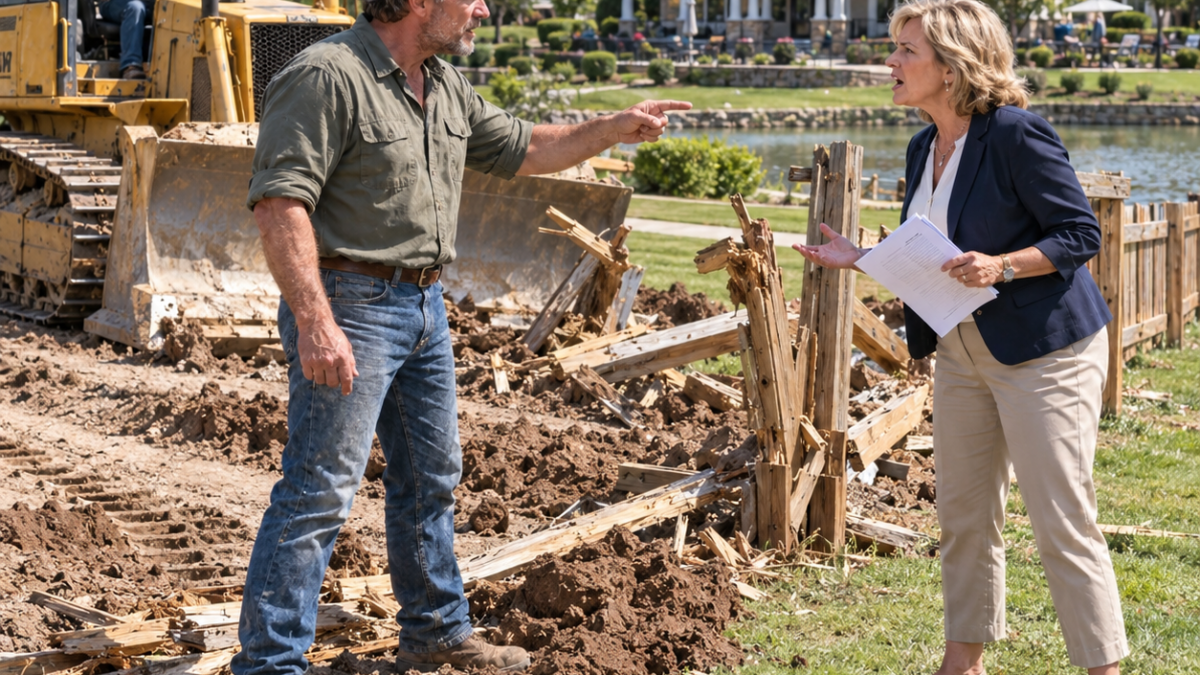
Karen smiled while the bulldozer blade shattered the cedar fence I had spent three weeks building entirely inside my own property line.
She told me the HOA had voted, my survey meant nothing, and I would also be billed for the machine she had brought onto my land without permission.
Sixty days later, I would be sitting across from four terrified board members while they slid the deed to their community clubhouse across a lawyer’s conference table—but that morning, all I had was fifty feet of broken fence and one very clear video.
“That fence is a violation, Mr. Hayes.”
Karen stood beside the yellow bulldozer like a general inspecting artillery.
Her floral dress snapped in the humid Texas breeze while she hugged a clipboard to her chest.
The young operator in the machine looked uncomfortable.
He should have.
My fence was two full feet inside my ten-acre property line.
I knew because I had paid one of the best surveying firms in the county to locate every old iron monument, verify the legal description, and stake the boundary before I dug the first hole.
I held up a copy of that survey.
“Karen, we’ve already discussed this. Prestigious Pines ends at the crepe myrtles. You have no authority here.”
She barely glanced at the page.
“The survey is irrelevant.”
I stared at her.
She pointed toward my fence.
“It affects the visual harmony of our community entrance. The board held an emergency vote. It’s coming down.”
“On my land?”
“Your property borders Prestigious Pines.”
“That isn’t the same thing.”
“To the board, it is.”
That sentence told me everything.
Twenty-five years in the Army Corps of Engineers had taught me to respect lines.
Property lines.
Load limits.
Design tolerances.
Chain of command.
There are places where ambiguity can kill people.
So I had spent most of my adult life making sure measurements meant something.
After my wife Martha died, I bought these ten quiet acres because I was finished with conflict.
The old farmhouse needed almost everything.
Roof.
Wiring.
Foundation repairs.
Plumbing.
I restored it piece by piece because rebuilding something was easier than sitting in our old house listening to silence.
The fence was supposed to be the final project.
Split-rail cedar.
Simple.
Rustic.
Nothing aggressive.
Martha would have planted climbing roses along it.
I had thought about her while setting the last post.
Four days later, Karen taped the first violation notice to it.
I ignored that notice because Prestigious Pines had no jurisdiction over me.
Then came another.
Then Karen arrived in her golf cart and told me my land looked “too rural.”
Now she had brought a bulldozer.
“Karen,” I said, “if that machine crosses the line, you’re trespassing.”
She turned toward the operator.
“Proceed.”
The engine roared.
I pulled out my phone and started recording.
The blade hit the first post.
Cedar exploded.
The second post folded.
Rails snapped and disappeared beneath the steel blade.
The bulldozer crawled fifty feet along my property, leaving splintered wood and deep track marks where grass had been.
I said nothing.
I filmed everything.
When the operator finally stopped, Karen walked toward me with the expression of someone who expected applause.
“There,” she said. “That looks better.”
I lowered the phone.
She flipped a page on her clipboard.
“You’ll receive an invoice for the demolition, plus a one-thousand-dollar noncompliance fine.”
That almost impressed me.
“You destroyed my fence and you’re billing me?”
“You forced the association to act.”
She turned away.
“Karen.”
She stopped.
I kept my voice level.
“You saw the survey.”
She looked over her shoulder.
“Yes.”
“You knowingly sent heavy equipment onto land you knew was mine.”
Her smile thinned.
“You can characterize it however you want.”
“I don’t need to characterize it.”
I lifted my phone.
“It’s recorded.”
For the first time, something flickered behind her eyes.
Then arrogance covered it.
“I have a board and an attorney, Mr. Hayes.”
She looked toward the wreckage.
“You have broken sticks.”
Her golf cart disappeared down the road.
I stood alone beside the ruined fence.
Then I went inside, copied the video onto three separate drives, photographed every damaged post, measured every bulldozer track, pulled out the certified survey, and downloaded five years of Prestigious Pines board records.
At 2:13 the following morning, somewhere between a fifteen-thousand-dollar set of clubhouse chairs and a clause about willful misconduct, I found the first weakness.
By sunrise, I had found the second.
And when I discovered exactly how much of the HOA’s financial survival depended on the clubhouse Karen used as her personal throne room, I finally understood how I was going to make them pay for every foot of cedar they had destroyed.
PART 2
The first weakness was insurance.
The second was Karen.
Those two facts were going to collide harder than the bulldozer had hit my fence.
I had spent most of my military career in engineering and logistics, which means I have an unhealthy respect for documents nobody else wants to read.
Regulations.
Contracts.
Maintenance schedules.
Procurement rules.
Inspection reports.
If you hand most people a four-hundred-page manual, they see punishment.
I see terrain.
Prestigious Pines had made every governing document available online because Karen liked telling residents how “transparent” her administration was.
So I downloaded everything.
The declaration.
The bylaws.
Architectural guidelines.
Insurance summaries.
Reserve studies.
Board-meeting minutes.
Annual budgets.
Special assessments.
Vendor contracts.
Then I started reading.
By three in the morning, my desk looked like a legal department had exploded.
My German shepherd, Rommel, slept beside the chair, occasionally lifting his head whenever I muttered something unprintable.
The first important clause appeared in the directors-and-officers coverage section.
Board members acting within the scope of ordinary duties were generally protected.
That was normal.
Then came the exceptions.
Intentional misconduct.
Knowing violations.
Bad faith.
Acts undertaken after notice that the board lacked authority.
I sat back.
Karen had seen my certified survey.
Not once.
Twice.
I had shown it to her in person the week before.
Then, while I recorded, I warned her again.
She ordered the bulldozer forward anyway.
The second discovery was buried in the meeting minutes.
Prestigious Pines had one major communal asset.
The clubhouse.
Five thousand square feet.
Pool.
Meeting hall.
Fitness room.
Administrative office.
Kitchen.
Outdoor pavilion.
It had been financed years earlier and still carried a substantial mortgage.
The HOA also used it as collateral under a line of credit for capital projects.
The annual budget told me maintenance, insurance, debt service, landscaping, and utilities for that single property consumed close to forty percent of the association’s yearly spending.
The clubhouse wasn’t merely where Karen held meetings.
It was the financial center of Prestigious Pines.
And the board had spent the last several years keeping its reserves dangerously thin.
Why?
Karen liked projects.
The minutes read like a diary of one woman slowly confusing other people’s dues with a personal decorating allowance.
Replacement lounge furniture: $15,400.
New entrance flowers installed twice in one year: $9,800.
Custom monument lighting: $18,200.
Decorative fountain repair upgraded to total replacement: $26,000.
Consulting study on “aesthetic cohesion”: $11,700.
Meanwhile, the roof reserve for the clubhouse had been repeatedly deferred.
The pool deck needed repairs.
Two HVAC units were near the end of their useful life.
If Prestigious Pines faced a sudden uninsured claim, there was no comfortable pile of money waiting.
I printed the relevant pages.
By sunrise, the folder I had once labeled HOA NONSENSE had become three inches thick.
I crossed out the label.
Underneath it, I wrote:
FENCE CASE
I briefly considered something more dramatic.
Twenty-five years around the military cures you of naming every operation like a movie.
Mostly.
At eight that morning, I called a lawyer.
Not because I wanted one.
Because experience teaches you another rule:
Never confuse knowing how systems work with being licensed to practice inside every one of them.
Her name was Rachel Morgan.
She had handled construction disputes, land-use fights, and property litigation in the county for almost twenty years.
Martha had once called Rachel “the only attorney I’ve ever met who sounds more irritated when she’s winning.”
We had known each other socially.
I emailed her the survey, the violation notices, and a link to the demolition video.
She called me eleven minutes later.
“John.”
“Morning.”
“Tell me that video is exactly what it looks like.”
“Depends what it looks like.”
“It looks like an HOA president knowingly ordering a bulldozer onto property her association doesn’t own.”
“That’s accurate.”
“Did you provoke her?”
“I showed her a survey.”
“That’s very aggressive of you.”
“I thought so.”
“Did the bulldozer operator damage anything besides the fence?”
“Grass. Soil compaction. Some shallow drainage grading.”
“Anybody hurt?”
“No.”
“Police report?”
“Not yet.”
“Why?”
“I wanted documentation first.”
There was silence.
Then, “You really were a colonel.”
“So Martha kept reminding me.”
Rachel’s voice softened for half a second.
Then the lawyer returned.
“Do not speak with Karen again unless necessary.”
“Fine.”
“Do not threaten her.”
“I didn’t.”
“Do not send her your analysis of their insurance policy.”
“I wasn’t planning to.”
“You were absolutely planning to.”
I looked at the printed policy language.
“No comment.”
“Good. Come in at ten.”
By noon, we had a plan.
First, file the appropriate reports regarding the trespass and property damage.
Second, preserve evidence.
Third, commission repair estimates.
Fourth, send a formal demand giving the HOA a reasonable opportunity to resolve what should have been a straightforward claim.
Rachel insisted on the word reasonable.
I disliked it.
Karen had not been reasonable.
Rachel noticed my expression.
“You want to win or feel good this afternoon?”
“Both.”
“Pick one.”
“Win.”
“Then we act like adults even if they don’t.”
That sentence became important.
The sheriff’s deputy who came to inspect the damage was named Luis Barrett.
He watched my video twice.
On the second viewing, he paused when I told Karen the fence sat inside my property.
“So she knew.”
“I believe so.”
“You have the survey she saw?”
I handed him a copy.
He walked to the nearest flagged monument, measured from the line to the demolished posts, and shook his head.
“Why would she do this?”
“You’d have to ask her.”
“HOA people.”
“I’m learning.”
He photographed the tracks and took my statement.
I made sure not to exaggerate.
No claims that she had “attacked” me.
No dramatic language.
She had entered property without permission and intentionally caused damage after being warned.
Facts were enough.
The contractor’s estimate to restore the fence came in at $4,650.
A landscaper estimated $2,350 to repair the ruts and soil damage.
The survey had cost $1,475.
Add cleanup, temporary fencing, professional fees, and loss of use, and the direct economic harm was already above ten thousand dollars.
Rachel drafted the demand letter.
It was devastating because it was boring.
Dates.
Measurements.
Photographs.
Survey references.
Video transcript.
Repair estimates.
A request for reimbursement.
A demand that all HOA claims regarding my fence be withdrawn.
A notice to preserve communications relating to me, my property, the demolition decision, and the bulldozer contractor.
She also warned the board that knowingly acting outside association authority could raise insurance-coverage and fiduciary-duty issues.
The amount demanded to resolve everything at that early stage was nowhere near the fantasy number Karen later told residents.
It was $13,800 plus confirmation that the HOA would leave my property alone.
I read the letter.
“That’s it?”
Rachel stared at me.
“What were you expecting?”
“Fire.”
“You hired a lawyer.”
“I’m beginning to understand my mistake.”
“You want fire, buy a grill.”
The letter went out certified.
Rachel copied the HOA’s registered agent and counsel.
Then we waited.
A rational board would have done one of three things.
Report the matter immediately to its insurer.
Consult counsel.
Or settle.
Karen chose option four.
She emailed me personally.
Not Rachel.
Not through counsel.
Directly.
Subject:
YOUR ABSURD DEMAND
The email began:
Mr. Hayes, your attempt to intimidate the Prestigious Pines community with threats of litigation is both laughable and offensive.
It got worse.
She accused me of constructing the fence “in deliberate visual hostility toward community standards.”
She wrote that the board had “inherent authority to remove external nuisances impacting common aesthetic corridors.”
No law citation.
No deed language.
No easement.
Just inherent authority.
Then came the useful part.
The board intentionally authorized removal after reviewing the situation and unanimously determined that your survey did not override our community-interest rights.
Rachel read that sentence twice.
“She admitted the board intentionally authorized it.”
“Yes.”
“And admitted they had the survey first.”
“Yes.”
“This woman is extraordinarily helpful.”
Karen continued.
She rejected the settlement entirely.
Then attached a bill.
Prestigious Pines claimed I owed $1,850 for bulldozer mobilization and “administrative enforcement.”
Rachel put her head down on her desk.
“Are you laughing?”
“No.”
“You’re laughing.”
“I am experiencing professional joy.”
Karen concluded:
Pay the attached invoice, remove the remaining noncompliant fence, and consider this matter closed.
Rachel forwarded the email to the HOA’s attorney.
He called within the hour.
His name was Malcolm Davies.
Rachel put him on speaker.
“Rachel.”
“Malcolm.”
“I assume you received something unfortunate.”
“You mean your client’s confession?”
He sighed.
“She contacted Mr. Hayes without authorization.”
“That appears to be a recurring theme.”
“I’m trying to get control of the situation.”
“Please do.”
“Can your client hold off on filing?”
“For how long?”
“Give me forty-eight hours.”
Rachel looked at me.
I nodded.
“Forty-eight.”
That was the last quiet period in the case.
The next morning, I took Rommel for a walk along the public road bordering Prestigious Pines.
I wasn’t recruiting an army.
Despite what Karen later claimed.
I simply wanted to understand what kind of board I was dealing with.
Rommel did the introductions for me.
A German shepherd who behaves well is more socially effective than a business card.
The first person who stopped was a man washing a black SUV.
Early forties.
Close-cropped hair.
He noticed Rommel, then me.
“You’re the fence guy.”
I smiled.
“That fast?”
“Karen sent an email.”
“Of course she did.”
He shut off the hose.
“David Miller.”
“John Hayes.”
We shook hands.
David glanced toward my property.
“I saw the bulldozer.”
“You did?”
“From the entrance.”
He looked embarrassed.
“I figured you’d given permission.”
“I had not.”
“That tracks.”
“With what?”
He pointed at the rear window of his SUV.
A small 101st Airborne emblem.
“She fined me five hundred dollars for that sticker.”
I thought he was joking.
He wasn’t.
“Why?”
“Unapproved exterior vehicle display.”
“Is that real language?”
“I wish it wasn’t.”
“You serve?”
“Eight years. Two deployments.”
I looked at the emblem again.
“You keeping it?”
His jaw tightened.
“Yes.”
“Good.”
He stared at me.
“You fighting her?”
“I’m dealing with the fence.”
“That wasn’t my question.”
“It’s the answer I can give.”
David nodded slowly.
“Well, if you ever need someone to tell a judge she has a pattern, call me.”
He wrote his number on an old receipt.
I took it.
The second person found me.
Maria Sanchez was sixty-eight, sharp-eyed, and walking a poodle that clearly believed it owned Prestigious Pines.
“You’re Colonel Hayes.”
“Retired.”
“Karen calls you Colonel Hayes like it’s a disease.”
“That sounds efficient.”
Maria smiled.
Then her face changed.
“What she did to your fence was wrong.”
“I appreciate that.”
“She’s been doing smaller versions of that to people for years.”
Maria told me about Eleanor Price.
Eighty-two.
Widowed.
Fixed income.
Karen had fined her because the blue paint around her front door had faded lighter than the approved swatch.
Eleanor repainted it.
Not because she agreed.
Because she was tired.
“She stood there afterward,” Maria said, “holding up the color card to make sure Eleanor got it right.”
I looked across the manicured street.
“Why does everyone put up with this?”
Maria gave me a sad smile.
“Because the first fight costs more energy than surrender.”
That sentence stayed with me.
The third person was George Henderson.
I found his name in the board minutes.
Seventy-six.
Former treasurer.
Current director.
His family had once owned part of the land beneath Prestigious Pines.
I called before showing up.
He invited me in.
George’s house was older than the surrounding subdivision.
Real brick.
Old trees.
Worn porch.
It looked almost embarrassed to be surrounded by architectural conformity.
He poured coffee.
“I know why you’re here.”
“Then save me time.”
He stared into his cup.
“What happened to your fence was wrong.”
“You voted for it.”
“Yes.”
“Why?”
He flinched.
Good.
I wasn’t trying to hurt him.
But guilt is sometimes evidence that conscience still functions.
George said Karen presented the matter as an urgent encroachment affecting the subdivision entrance.
“She told us you were constructing some sort of commercial barrier.”
“A split-rail fence.”
“I know that now.”
“She had my survey?”
“Yes.”
“And you voted anyway?”
George rubbed his forehead.
“She said the survey didn’t account for an aesthetic-control easement.”
“Does one exist?”
“I’ve never seen one.”
“So why vote?”
He looked at me.
“Because she makes every disagreement exhausting.”
That was painfully honest.
George explained Karen’s method.
Emergency language.
Incomplete packets.
Last-minute motions.
Claims that the attorney had approved things when he had only been asked general questions.
The board learned that opposing her meant three-hour arguments, accusatory emails, and being blamed for whatever happened next.
Eventually, they stopped opposing.
“She wore us down,” George said.
“No. She trained you.”
He winced again.
“Yes.”
I leaned forward.
“Does your insurer know what happened?”
His eyes moved away.
“That’s what I thought.”
“Karen told us there was no reason to involve insurance because you had no valid claim.”
“Did the attorney say that?”
“No.”
“Did anyone ask him?”
Silence.
George stood.
Walked to a rolltop desk.
Returned with a folder.
“I kept copies from when I was treasurer.”
I didn’t take it.
“What is it?”
“Budgets. Some emails. Vendor approvals.”
“Why do I need them?”
“You said Karen trained us.”
“Yes.”
“She uses the budget the same way.”
I pushed the folder back.
“If these are confidential board materials, give them to your attorney or the homeowners through whatever process is lawful.”
George looked surprised.
“You don’t want them?”
“I want my fence paid for and your board off my land.”
“That’s all?”
“For now.”
George laughed without humor.
“You really don’t understand Karen yet.”
“I understand bulldozers.”
He held my gaze.
“Then you understand enough.”
I left without his documents.
That choice ended up helping me later.
Karen spent weeks telling people I had orchestrated a conspiracy inside Prestigious Pines.
I hadn’t.
Her own behavior did the organizing for me.
Forty-eight hours after Malcolm Davies asked for time, Rachel’s phone rang.
She listened.
Then said, “You’re kidding.”
She hung up.
“What?”
“The insurer did not know about the demolition.”
“That’s bad?”
“For them.”
Prestigious Pines carried liability coverage and directors-and-officers protection.
But the policy required prompt reporting of potential claims.
Karen had delayed.
Then she rejected our demand without insurer input.
Then she admitted in writing that the board intentionally proceeded despite the survey.
The carrier opened what Rachel called a “coverage investigation.”
I called it the first sound of ice cracking.
The HOA made a settlement offer.
Ten thousand dollars.
No admission.
I declined.
Not because I wanted seventy-five.
Because they demanded a broad release while refusing to provide any written recognition that the HOA lacked authority over my land.
I wanted that fixed permanently.
Rachel countered:
Repair costs.
Survey reimbursement.
Attorney fees to date.
Withdrawal of all violations.
Written acknowledgment of the boundary.
No further enforcement action against my property.
The board stalled.
Karen sent another neighborhood email.
This one described me as “an aggressive adjacent landowner attempting to exploit the community financially.”
David forwarded it to me.
So did Maria.
So did eleven strangers.
Apparently Prestigious Pines had discovered forwarding.
Two days later, Rachel filed suit.
We named the HOA.
We also named Karen in the claims where her individual conduct mattered.
The other directors were initially included regarding the authorization vote, subject to what discovery showed about their roles.
I did not enjoy that.
George called me.
“You sued me.”
“You voted.”
“I know.”
“I told you I wasn’t going to pretend you didn’t.”
He sighed.
“No. You’re right.”
“You should have your own lawyer.”
“I do now.”
That was the moment Karen’s board stopped being a board.
It became five defendants with five different levels of fear.
And fear is terrible glue.
Prestigious Pines’ bank became involved shortly afterward.
Not because I marched into the county recorder and magically placed a lien on the clubhouse.
Real law is not that theatrical.
Rachel sought court-authorized security tied to the property dispute and filed notice of the pending litigation affecting the association’s financial interests.
The HOA’s lender learned of the lawsuit through ordinary reporting requirements and the association’s own mortgage covenants.
Then the insurer’s reservation-of-rights letter arrived.
That combination created exactly the crisis Karen had spent weeks insisting could never happen.
The bank demanded information.
The insurer demanded interviews.
The board demanded answers from Karen.
Residents demanded to know why their community asset had suddenly become part of a serious financial dispute.
Prestigious Pines had roughly two hundred homes.
The clubhouse belonged to them collectively through the association.
Many owners had no idea a bulldozer had ever touched my property.
They knew only that their board president was now warning about “hostile litigation.”
Maria changed that.
She did not ask me first.
I found out when David called.
“You’re famous.”
“I’m going back to bed.”
“It’s noon.”
“Then I’m retiring.”
He sent me a screenshot.
A private resident group had formed.
PRESTIGIOUS PINES RESIDENTS FOR RESPONSIBLE GOVERNANCE
Fifty-three members.
Then eighty.
Then one hundred twelve.
The questions were simple.
Who authorized the demolition?
Why was the fence outside the subdivision?
Why wasn’t insurance notified immediately?
How much had the HOA spent?
What did the survey show?
Was the clubhouse at risk?
Karen tried to control the discussion.
She posted a statement calling rumors “dangerous misinformation.”
Then George replied publicly.
One sentence.
The certified survey showed the fence was on Mr. Hayes’s property before the board voted.
The group exploded.
Karen called him within minutes.
I know because George called me afterward.
“She threatened to remove me from the board.”
“Can she?”
“No.”
“Then why are you upset?”
“I spent five years being afraid of her.”
“And?”
He was quiet.
“I think I’m done.”
Three days later, the remaining directors held an emergency meeting.
Karen wanted the HOA to countersue me for harassment, nuisance, reputational harm, and allegedly interfering with community governance.
Malcolm Davies told them that was a terrible idea.
The board’s accountant, Peter Langford, asked Karen how much personal exposure they faced.
She said none.
Their individual lawyers disagreed.
The boutique owner, Susan Bell, started crying.
She had a business and a home.
She had joined the board because Karen told her it would be “mostly social events and landscaping.”
Now she was reading pleadings accusing her of participating in intentional destruction of property.
George made a motion.
Strip Karen of unilateral authority over the litigation.
Four votes yes.
Karen voted no.
The motion passed.
She stormed out.
George called me afterward.
“It’s happening.”
“What?”
“She lost the board.”
I looked through my study window at the gap where the fence had been.
“Good.”
“You don’t sound happy.”
“I’ll be happy when the hole is gone.”
That was true.
For all the talk about strategy, the part I hated was walking past those splintered posts every day.
I had built that fence after Martha died.
Not because it was expensive.
Because building it had been part of learning how to live alone.
Every post was measured.
Every hole dug.
Every rail fitted by hand.
I had spent years building things for missions, units, bases, governments.
The fence was one of the first things I had built only because I wanted it.
Karen saw cedar.
I saw recovery.
That difference is why property disputes become emotional so quickly.
To an outsider, it is a line.
To the person who lives there, it may be the place where grief finally became bearable.
One evening I sat on the porch with Rommel.
The broken section was visible from my chair.
I heard Martha’s voice in memory.
Not literally.
Just the way marriage leaves another person’s reactions embedded inside your own.
She would have hated Karen.
Then she would have told me not to become Karen while fighting her.
That part irritated me even in memory.
The next major development came from the insurance carrier.
Their adjuster was named Caroline Albright.
She requested an interview.
Rachel attended.
Caroline arrived at ten sharp.
No nonsense.
No small talk.
She watched the bulldozer video once.
Then again.
She paused where I held up the survey.
“Had Ms. Whitmore seen this before the recording?”
“Yes.”
“Proof?”
“Email from the prior week. I sent the PDF after our first conversation.”
Rachel handed it over.
Caroline read.
Then played the video further.
My voice:
“Karen, if that machine crosses the boundary, you’re trespassing.”
Karen:
“The board has already decided.”
Bulldozer moves.
Caroline paused.
“Clear.”
She reviewed Karen’s email rejecting our settlement.
Her eyes stopped at the sentence saying the board had intentionally authorized removal after reviewing the survey.
Caroline looked at Rachel.
“Was this sent before counsel became involved?”
“After our demand, but without HOA counsel’s approval.”
“To Mr. Hayes directly?”
“Yes.”
Caroline closed the folder.
“Who notified the carrier?”
“HOA counsel.”
“When?”
Rachel gave the date.
Caroline wrote it down.
“That was after the demand was rejected.”
“Yes.”
She looked at me.
“Colonel Hayes—”
“John.”
“John, what do you want?”
It was the first time anybody on the other side had asked without assuming the answer was money.
“My land left alone.”
“And financially?”
“I want my actual losses covered. I want legal costs that should never have existed addressed. And I want written recognition that their board has no authority over my property.”
“Punitive damages?”
“I’ll let my lawyer argue what the law allows.”
Rachel smiled faintly.
Caroline nodded.
“What if the HOA cannot afford the final amount?”
“That’s their problem.”
Rachel turned toward me.
I knew immediately she disliked the answer.
Caroline did too.
I corrected myself.
“It’s their legal problem. But I don’t want two hundred families destroyed because five people failed to do their jobs.”
That was closer to the truth.
Caroline packed her papers.
“Thank you.”
After she left, Rachel said, “Better.”
“What?”
“Your second answer.”
“I wasn’t performing.”
“I know. That’s why it mattered.”
The insurer interviewed the board.
George later told me Karen tried to turn it into a speech.
Caroline did not permit speeches.
“Did you see the survey?”
“Yes, but—”
“Did you see it?”
“Yes.”
“Did counsel advise demolition?”
“We believed—”
“That wasn’t my question.”
“No.”
“Did the insurer authorize you to reject the demand?”
“I didn’t need permission to defend the community.”
“Did you notify us before rejecting it?”
“No.”
“Did you instruct the contractor to enter Mr. Hayes’s land?”
Karen reportedly paused.
Then:
“I instructed him to remove the visual violation.”
“Was the visual violation located on Mr. Hayes’s parcel?”
Silence.
“Ms. Whitmore?”
“Yes.”
Caroline’s report changed everything.
The carrier did not simply vanish as Karen feared.
Insurance disputes are more complicated than that.
But it issued a formal reservation of rights and warned that intentional, knowing misconduct might not be indemnified.
In plain English:
If Karen and the board knowingly caused damage outside lawful authority, the insurer might defend portions of the case while refusing to pay some or all of the ultimate liability.
That was enough.
The association’s bank reviewed its mortgage terms.
The board accountant reviewed reserves.
The residents reviewed their dues.
Everyone arrived at the same conclusion.
Karen had risked a community asset over a fence that did not belong to the community.
That was when the petition began.
Prestigious Pines bylaws allowed homeowners representing a specified percentage of membership to call a special meeting on urgent financial matters.
Maria and David gathered signatures.
They needed far fewer than they received.
The special meeting was scheduled for Tuesday at seven.
Malcolm Davies intended to present.
Karen intended to speak.
The board intended to calm everyone.
George called me.
“You should come.”
“I’m not a member.”
“You’re the lawsuit.”
“That sounds like a reason not to.”
“The homeowners are asking to hear from you.”
Rachel disliked the idea.
“Anything you say can become evidence.”
“Then I’ll say facts.”
“That sentence is how clients create exhibits.”
“Do I go?”
She sighed.
“Yes.”
The clubhouse parking lot was full by six-thirty.
I had never been inside.
The building was impressive.
Stone facade.
Tall windows.
Columns.
Landscaped courtyard.
Exactly the sort of place designed to assure buyers that their HOA dues were being transformed into lifestyle.
Inside, more than a hundred residents filled folding chairs.
Karen sat at the front.
No floral dress.
Dark blazer.
Pearls.
Clipboard.
She saw me.
Her lips tightened.
Malcolm started the meeting.
He described the case as a “complex boundary and property-damage dispute.”
That lasted about four minutes.
A man in the back shouted:
“Was the fence on his land?”
Malcolm paused.
“The survey indicates—”
“Yes or no?”
“The available survey places the fence within Mr. Hayes’s parcel.”
Noise filled the room.
Another resident:
“Then why did we bulldoze it?”
Karen grabbed the microphone.
“Because the structure directly impacted our entrance corridor and property values.”
Someone yelled:
“Do we own his land?”
“No,” Karen snapped, “but communities have rights too.”
That answer destroyed whatever Malcolm had been trying to preserve.
David stood.
“My sticker affects your property values too, Karen?”
She ignored him.
Maria rose.
“Eleanor’s faded door?”
Karen banged the table.
“This meeting concerns litigation.”
Maria replied, “It concerns how you govern.”
Applause.
George stood.
He held a copy of the bylaws.
“As a director, I move that Mr. Hayes be permitted ten minutes to describe his claim.”
Karen said, “Absolutely not.”
George looked toward the other directors.
Peter seconded.
Susan voted yes.
The retired sales manager voted yes.
Karen voted no.
Four to one.
For the second time in a week, her own board overruled her.
I walked to the front.
No PowerPoint.
No dramatic soundtrack.
Just photographs.
Rachel had made me promise not to turn a live dispute into theater.
I placed the certified survey on an easel.
“This is the property line.”
Then a photo.
“This is my fence.”
Another.
“This is the bulldozer.”
Then I played twenty-three seconds of video.
Karen’s voice filled the room.
The survey is irrelevant. The board held an emergency vote. It’s coming down.
Then mine.
Karen, if that machine crosses the line, you’re trespassing.
Then hers.
Proceed.
The cedar post cracked through the clubhouse speakers.
The room went completely silent.
I stopped the video.
“That is the case.”
A woman raised her hand.
“How much did you demand?”
“Initially?”
“Yes.”
“Thirteen thousand eight hundred dollars plus a written agreement that the HOA would stop claiming authority over my land.”
People started whispering.
Someone looked at Karen.
“You told us he demanded seventy-five thousand.”
Karen stood.
“He expanded his claims after we rejected extortion.”
Rachel had warned me not to engage.
So I looked at Malcolm instead.
He closed his eyes briefly.
The meeting turned.
David told his story.
Five hundred dollars for a division sticker.
Maria told Eleanor’s.
A man described being fined because his trash can remained visible for two hours after the allowed collection window.
A mother described a warning over a child’s basketball hoop.
Another resident said Karen sent three compliance letters because a garden trellis was “too rustic.”
Every story alone sounded petty.
Together, they formed a system.
People had surrendered because fighting cost more energy than paying.
Karen had built power one exhausted homeowner at a time.
Now the bulldozer had given them a single image for what all of it felt like.
The board president ordering something destroyed because she didn’t like it.
Peter, the accountant, stood.
He held budget sheets.
His face was pale.
“If this claim is not covered, reserves cannot absorb the exposure without affecting the clubhouse roof project.”
Someone shouted, “How much exposure?”
Malcolm said, “We should not speculate.”
Peter answered anyway.
“Potentially substantial.”
“Special assessment?”
“Possible.”
The room erupted.
Karen tried to regain control.
“This panic is exactly what Mr. Hayes wants.”
I was still standing near the wall.
“No.”
Everyone turned.
I hadn’t intended to speak again.
But she had said my name.
“I don’t want your assessment.”
Karen laughed.
“You expect anyone to believe that?”
“I want the people who damaged my property to make it right.”
“You sued the community.”
“The community’s board sent the bulldozer.”
“You are punishing innocent families.”
“No.”
I looked around the room.
“Your board involved innocent families when it used their corporation and their money to do something it had no authority to do.”
That hurt.
Good.
Not because the residents deserved pain.
Because they deserved clarity.
I continued.
“If you want this fixed, fix how decisions get made.”
Then I sat.
By the end of the meeting, Karen had lost the residents too.
Not all.
Some still defended her.
People do not abandon identities quickly, and for years Karen had made “protecting Prestigious Pines” part of hers.
But the fear was gone.
That mattered more.
Three days later, the board formally removed Karen as the person authorized to direct the litigation.
A week after that, they began proceedings to remove her as president.
Karen fought like someone drowning who believed the water was being unfair.
She sent emails.
Accused George of betrayal.
Accused David of organizing a coup.
Accused Maria of spreading defamatory gossip.
Accused me of manipulating veterans and elderly residents.
Then she threatened to sue the other directors.
That ended whatever loyalty remained.
The removal hearing took place in the clubhouse.
I did not attend.
It was not my association.
George called afterward.
“Four to zero.”
“She’s off?”
“President and board.”
“She attend?”
“Sat through the whole thing.”
“What did she say?”
“Nothing.”
That surprised me.
George continued.
“When the vote passed, she picked up her purse and walked out.”
“Good.”
“You really don’t sound happy.”
I looked at the section of temporary fencing I had installed.
“I’m not interested in her chair.”
“What are you interested in?”
“A permanent fix.”
We were now about forty days past the bulldozer.
The case had become expensive.
The HOA’s legal bills were growing.
My own fees were substantial.
Insurance coverage remained disputed.
The bank wanted reassurance that the clubhouse mortgage and reserve obligations would remain current.
The HOA wanted the litigation gone.
Rachel and Malcolm began settlement talks.
The first serious offer was $27,500 plus repair costs.
I declined because it still lacked structural protections.
The second offer included written boundary recognition.
Better.
But the board wanted confidentiality.
I refused.
Not because I wanted publicity.
Because homeowners had a right to understand what their corporation was agreeing to.
Then George came to my farmhouse.
He brought Maria.
David arrived ten minutes later.
Rachel was there too.
George spread a clubhouse financial statement across my dining table.
“They can’t comfortably pay you.”
Rachel said, “They can raise an assessment.”
Maria grimaced.
“Which punishes everyone.”
David leaned back.
“Karen causes it. Everyone else pays. Perfect.”
I looked at the numbers.
The clubhouse still carried debt.
High operating costs.
Deferred roof work.
Pool maintenance.
Insurance.
The HOA could sell it, theoretically, but doing so would trigger member outrage and require compliance with governing documents.
George tapped the statement.
“The building is the problem.”
“It’s also why the bank cares.”
“Yes.”
He turned to me.
“What if the settlement uses the clubhouse?”
Rachel’s expression sharpened.
“Be specific.”
George had been thinking.
Transfer the clubhouse property as part of a court-approved settlement structure.
The association would receive release from the major claims.
My damages would be satisfied through property equity rather than a cash special assessment.
I would temporarily take title subject to the existing loan arrangements and agreed obligations, then immediately place the property into a newly formed community trust once financing and lender consent were finalized.
The trust—not the HOA board—would manage the facility.
Residents would elect trustees.
Clubhouse operations would become transparent.
The HOA would lose both its biggest asset and a huge portion of its annual expense.
Rachel asked questions for twenty minutes.
Liabilities.
Debt assumptions.
Taxes.
Insurance.
Lender consent.
Transfer restrictions.
Member approval.
Trust structure.
This was not, as later social-media versions claimed, me simply “foreclosing” on the HOA and taking the clubhouse.
That makes a better headline.
The truth was more interesting.
They voluntarily considered transferring it because the alternative was paying substantial litigation costs, possible uninsured damages, and an assessment that would make every homeowner furious.
Maria stared at me.
“You’d own the clubhouse?”
“Briefly, if everything is structured that way.”
David grinned.
“You’re taking Karen’s castle.”
Rachel pointed at him.
“Do not call it that in front of anyone involved in law.”
He raised both hands.
“Yes, ma’am.”
I looked at George.
“What happens to the residents?”
“They still use it.”
“Pool?”
“Yes.”
“Events?”
“Yes.”
“Kids?”
“Yes.”
“No private retaliation?”
George shook his head.
“The whole point is separating the building from board politics.”
I looked at Rachel.
“Possible?”
“Yes.”
“Smart?”
She hesitated.
“That depends on whether you’re doing it because it solves the problem or because it feels poetic.”
“Both.”
“Then sleep on it.”
I did.
I thought about Martha.
She would have asked who benefited.
Not who lost.
So I made conditions.
No special assessment connected to my settlement.
No resident loses access to the clubhouse because of the transfer.
The HOA formally acknowledges my boundary and waives every claim regarding my fence.
The board adopts new procedures requiring verified property authority before enforcement affecting adjacent land.
A third-party financial review.
Resident access to major board decisions.
My claims against directors who cooperated and whose conduct did not warrant further pursuit would be released.
Karen’s individual responsibility would be resolved separately to the extent necessary, without using the settlement as a public humiliation ritual.
And the clubhouse, after title passed through me as required by the transaction, would go into a community trust.
Not my private rental property.
Not my trophy.
Theirs.
Just no longer Karen’s throne.
Malcolm took the proposal to the board.
They hated it.
Of course they did.
Giving up a major asset felt like defeat.
Then Peter ran the numbers.
Option one:
Fight.
Continue legal fees.
Risk uninsured damages.
Possible special assessment.
Possible lender complications.
Years of bitterness.
Option two:
Transfer the clubhouse under a negotiated agreement.
Resolve the case.
Avoid the large special assessment.
Move clubhouse expenses into a separately managed trust funded through reasonable user fees, donations, and a reduced resident allocation.
Lower HOA operating costs.
End the dispute.
Recognize the boundary.
The board voted to explore option two.
The lender took longer.
Banks do not care about poetic justice.
They care about debt service.
Rachel, Malcolm, the bank’s attorneys, and trust counsel spent days restructuring the proposal.
I spent most of that time rebuilding a drainage swale and trying not to think about lawyers billing in six-minute increments.
Day fifty-four.
Rachel called.
“Lender consent is possible.”
“Possible or done?”
“Possible.”
“Call me when it’s done.”
“John.”
“What?”
“You’re enjoying this too little.”
“I’m saving it.”
Day fifty-seven.
Member notice went out.
The settlement required community approval because of the asset transfer.
Karen reappeared.
She sent a letter to homeowners calling the proposal a “surrender of community sovereignty to an outside aggressor.”
Maria posted the actual numbers underneath it.
That was effective.
The meeting drew nearly every household.
Malcolm explained the agreement.
Peter explained the finances.
Rachel explained my side.
Then George said something simple.
“We can spend your money defending a decision we should never have made, or we can solve the problem and change how we govern.”
A homeowner asked me to speak.
I stood.
“I am not asking to run Prestigious Pines.”
A laugh moved through the room.
“I don’t live here.”
More laughter.
“I’m not asking you to like my fence.”
David yelled, “I like the fence.”
“Your judgment is questionable.”
He saluted.
I continued.
“I’m asking for the same thing I asked before the bulldozer moved.”
I pointed toward the western windows.
“My land ends where your land begins.”
Silence.
“That line is not an insult.”
I looked around the room.
“It is the reason we can be neighbors.”
The vote passed overwhelmingly.
Not unanimously.
It didn’t need to.
Day sixty arrived on a Thursday.
Rachel’s office occupied the third floor of an old courthouse-square building.
Conference room.
Long walnut table.
Water nobody drank.
Too many documents.
I sat on one side with Rachel.
George attended as HOA representative.
Peter.
Susan.
Another remaining director.
Malcolm.
Trust counsel.
Bank counsel by video.
Nobody looked triumphant.
That felt right.
The deed sat in the center.
Prestigious Pines Community Clubhouse.
Lot 1, Block A.
Approximately half an acre.
Building and improvements.
Subject to the carefully restructured financing terms.
The association president pro tempore signed.
Then the secretary.
Then the settlement documents came to me.
I signed the release.
The boundary acknowledgment.
The trust-transfer commitment.
The financing assumption documents.
The lawsuit dismissal to become effective on completion.
Then Malcolm slid the deed across the table.
“Mr. Hayes.”
I looked at it.
Sixty days earlier, Karen had stood on my property and told me a certified survey was irrelevant.
Now a recorded property instrument was transferring the most important building in her old association to me as part of the settlement of what she had caused.
George whispered, “Don’t smile.”
“I’m not.”
“You are internally.”
“Very much.”
I signed acceptance.
The notary stamped.
The deed would be recorded that afternoon.
For a short period necessary to complete the agreed transaction, the clubhouse legally belonged to me.
The title Karen loved to threaten other people with had changed hands because she had refused to respect mine.
That was the headline.
But not the ending.
The next document transferred my interest into the Prestigious Pines Community Trust once the lender’s final conditions were met.
I signed that too.
Malcolm stared.
“You could have kept more control.”
“I don’t want control.”
He looked almost confused.
Rachel said, “That’s the part your former client never understood.”
We walked outside.
Bright sun.
Texas heat.
George put his hands in his pockets.
“Well, Colonel.”
“Yes?”
“For the next few days, technically, you own our clubhouse.”
“So I’ve been told.”
“Want the keys?”
“No.”
He laughed.
“You have to take them.”
He handed me a heavy key ring.
I stared at it.
Swimming-pool gate.
Mechanical room.
Meeting hall.
Kitchen.
Storage.
Administrative office.
I thought about mailing them to Karen.
Martha would have haunted me.
So I put them in my pocket.
That Saturday, I went to the clubhouse.
Not alone.
George.
Maria.
David.
Rachel refused because she said she had actual hobbies.
Residents filled the room.
The atmosphere felt nothing like the lawsuit meeting.
No panic.
No shouting.
Kids were near the pool windows.
Older residents sat in front.
Eleanor Price was there wearing a bright blue blouse.
Her front door, Maria informed me, was now yellow.
Apparently rebellion had escalated.
I stood at the front.
No podium.
No clipboard.
No gavel.
“This building has been transferred as part of the settlement.”
People nodded.
“For a very short legal interval, the deed passed through me.”
David shouted, “Landlord!”
Everyone laughed.
“David has volunteered to clean the bathrooms.”
He shut up.
More laughter.
I continued.
“Final trust transfer documents are being completed. When that is done, this building belongs to a community trust whose only job is managing this property for you.”
Maria stepped forward.
We explained the structure.
Residents would elect future trustees.
Financial reports would be public to beneficiaries.
Major projects would require defined approval.
No HOA president could use the clubhouse as leverage.
No single person could control access.
Fees would cover reasonable costs.
The HOA itself would reduce dues because it no longer carried full clubhouse operating expenses.
Then George announced the first reforms the HOA board had separately adopted.
No enforcement against property outside recorded HOA boundaries.
Legal review before significant penalties.
Notice and hearing requirements.
Limits on emergency authority.
Transparent board minutes.
Independent review of large contracts.
The room applauded.
Then Eleanor raised her hand.
“What about the architectural committee?”
Maria looked at George.
George looked at me.
I said, “Ask your HOA.”
George smiled.
“The current committee has been dissolved.”
The cheer nearly lifted the roof.
A man shouted, “What about flags?”
George said, “Lawful displays are no longer subject to Karen’s personal taste.”
David stood immediately.
“So my Screaming Eagles sticker stays?”
“You were never taking it off.”
“Correct.”
Maria took the microphone.
“Eleanor.”
“Yes?”
“Your yellow door is beautiful.”
Eleanor started crying.
That almost did me in.
I looked away.
The whole fight had begun because someone decided aesthetics mattered more than dignity.
Now an eighty-two-year-old woman was crying because nobody could force her to repaint a door.
Power looks ridiculous when you shrink it to the size of the harm it caused.
After the meeting, a group of teenagers asked if they could use the basketball court after nine.
The old Karen-era rule said no unscheduled use after eight.
I asked, “Is there a noise ordinance?”
George said, “Ten.”
“Then ask the trust, not me.”
The temporary trustees approved nine-thirty during summer.
Nobody died.
Civilization survived.
The next week, I hired the contractor to rebuild my fence.
I intended to do most of the work myself again.
Then a truck pulled into my driveway Saturday morning.
David climbed out.
Behind him were six Prestigious Pines residents.
One carried post-hole diggers.
Another had coolers.
Maria arrived with food.
George came wearing work gloves that still had store creases in them.
I stared at everyone.
“What is this?”
David grinned.
“You think we’re letting the seventy-year-old colonel do this alone?”
“I’m sixty-two.”
“Sun damage.”
“Go home.”
Nobody did.
We worked all day.
The damaged posts came out.
New cedar went in.
The survey markers remained untouched.
Twenty-four inches inside my property.
Exactly where the old fence had been.
Children carried rails.
People brought water.
Someone played music.
Rommel supervised.
Badly.
Around noon, Eleanor arrived.
She held a small potted climbing rose.
I stopped.
She said, “Maria told me about Martha.”
I looked at Maria.
Maria suddenly found the sky fascinating.
Eleanor held out the plant.
“I thought maybe this could go by the fence.”
For a moment I could not speak.
Martha had loved roses.
She had spent years trying to grow them in places where roses had no business surviving.
I took the pot.
“Thank you.”
Eleanor smiled.
“She sounds like she had good taste.”
“She married me.”
“Then perhaps not.”
The whole group laughed.
I planted that rose myself.
Near the first rebuilt post.
Late afternoon, we set the final rail.
David stepped back.
“Straight.”
“It better be.”
“You measure everything like this?”
“Yes.”
“Explains the divorce rate in engineers.”
“I was married thirty-four years.”
“Then Martha was patient.”
“Yes.”
That was the truth.
A car slowed on the road.
Silver SUV.
Karen.
Everyone noticed.
Nobody said anything.
She stopped for maybe five seconds.
Looked at the rebuilt fence.
Looked at residents working beside me.
Looked at George.
Maria.
David.
Eleanor.
Her former board member.
Her former critics.
Her former “subjects,” as David jokingly called them.
Standing on my property by invitation.
Karen’s face was unreadable through the glass.
Then she drove away.
I never saw her inside Prestigious Pines again.
She listed her house within weeks.
Sold it.
Moved north.
Some residents celebrated.
I didn’t.
By then, Karen had become less interesting than what came after her.
That is one thing people misunderstand about revenge.
They imagine satisfaction lives in the downfall.
Sometimes it does.
Briefly.
But if the person who hurt you remains the center of your life after you win, then they still own something.
I did not want Karen owning another minute.
The community trust finalized.
The deed moved out of my name exactly as planned.
Technically, the period when I personally owned the clubhouse was short.
Long enough for every resident to joke about owing me rent.
Long enough for David to leave a handwritten note on my truck:
DEAR LANDLORD, THE POOL NEEDS MORE UMBRELLAS.
I wrote underneath:
REQUEST DENIED. TENANT TOO ANNOYING.
He framed it.
The trust elected its first permanent board the following year.
I did not run.
Maria did.
So did George.
Three younger residents joined them.
They instituted quarterly financial reports.
The clubhouse roof finally got repaired.
The pool deck was resurfaced.
One room became a free tutoring space twice a week.
Another hosted veteran meetings.
Eleanor started a gardening club.
Her first proposal was climbing roses.
I voted yes even though I technically had no vote.
Prestigious Pines changed.
Not into some utopia.
People still complained.
People fought about parking.
Someone got furious because a neighbor’s dog barked too much.
A resident tried to reserve the clubhouse every Saturday for six straight months and became offended when told no.
Community does not mean everybody suddenly becomes reasonable.
It means disagreement stops being treated as disobedience.
That was the difference.
George once came over for coffee about six months after the settlement.
We sat on my porch.
He looked toward the fence.
“Do you ever wish you’d taken the cash?”
“What cash?”
“If we’d somehow raised it. A big judgment.”
“No.”
“Why?”
“Money would have repaired the fence.”
“And the trust?”
I looked toward the distant clubhouse roof through the trees.
“That repaired something else.”
George nodded.
“I still feel guilty.”
“For voting with her?”
“Yes.”
“You should.”
He looked wounded.
Then I added, “For a while.”
“How long?”
“Long enough to learn from it.”
He was quiet.
“I was a coward.”
“No.”
“Yes, I was.”
“George, cowards don’t usually admit it.”
“That doesn’t erase it.”
“No.”
He looked at me.
“You’re not very comforting.”
“Martha handled comfort.”
He smiled.
“What did you handle?”
“Structural failure.”
“That tracks.”
We drank coffee.
A year later, the rose Eleanor gave me bloomed.
Bright red.
Too red, probably, for Karen’s old architectural standards.
I took a picture and sent it to Maria.
She replied:
VISUAL HARMONY VIOLATION. $500 FINE.
I laughed alone in my kitchen for five minutes.
Martha would have liked that too.
The case technically ended long before the emotions did.
For months, I still felt my shoulders tighten when a golf cart appeared near the boundary.
I still checked survey markers after storms.
I still backed up every property document twice.
Then one morning I realized I had gone a week without thinking about Karen.
Then a month.
The fence became a fence again.
Not evidence.
Not a battlefield.
Just cedar.
Rommel liked sleeping in its shade.
Birds sat on the rails.
The rose climbed slowly.
That was healing.
Not forgetting.
Returning ordinary meaning to things someone had turned into conflict.
Two years later, a young family bought the house nearest my land.
The father walked over before moving in.
He stopped outside the fence.
Did not enter.
“Mr. Hayes?”
“John.”
“I’m Aaron.”
We shook hands across the rail.
“My wife and I bought the Whitaker place.”
“Welcome.”
He looked embarrassed.
“The closing packet had a disclosure about adjacent rural property.”
“Good.”
“And there’s apparently a whole story.”
“There are always stories.”
“My realtor said there was some lawsuit.”
“Your realtor needs hobbies.”
Aaron smiled.
“I just wanted to ask if my kids could say hello to your dog sometime.”
Rommel, who was now older and believed all children existed to throw tennis balls, heard the word kids and stood.
“Sure.”
Aaron nodded toward the fence.
“Gate?”
“Fifty yards down.”
He walked to it.
He did not climb over.
Did not assume.
Did not treat the boundary as hostility.
He asked.
That small thing mattered.
His children became regular visitors.
So did others.
Prestigious Pines residents occasionally walked the public trail near my property.
Some waved.
Some stopped to talk.
I learned names.
The subdivision stopped feeling like an enemy camp.
It became what it had always actually been.
A collection of people.
Karen had turned it into a kingdom because too many people let her.
Without her, it became a neighborhood.
Three years after the bulldozer incident, the trust board invited me to a veterans’ breakfast.
I tried to decline.
David refused.
“You owned the building.”
“For six days.”
“Historic owner.”
“Stop calling me that.”
A small brass plaque had been installed inside the clubhouse.
I worried when I saw it.
If my name was on that wall, I was taking a screwdriver to it.
It wasn’t.
The plaque said:
PRESTIGIOUS PINES COMMUNITY CLUBHOUSE
HELD IN TRUST FOR THE USE AND BENEFIT OF THE COMMUNITY
Underneath:
NO BOARD SERVES ITSELF.
I stared.
Maria stood beside me.
“Too dramatic?”
“Who wrote that?”
“Eleanor.”
“Of course.”
“You like it?”
I nodded.
“Yes.”
The breakfast was loud.
Veterans arguing about football.
Kids stealing pastries.
George attempting to make coffee for forty people and failing.
David wearing a 101st Airborne polo shirt large enough to be visible from orbit.
Nobody fined him.
At one point he came over.
“You know what I still don’t understand?”
“That explains many things.”
“Why Karen cared so much about your fence.”
I thought about it.
Then I looked through the clubhouse windows toward the road leading past my property.
“I don’t think she cared about the fence.”
“What then?”
“Being told no.”
David considered that.
“Yeah.”
People like Karen often call control “standards.”
That does not mean standards are bad.
Good communities need rules.
Good organizations need procedures.
Good neighborhoods need expectations.
But every legitimate rule contains an invisible sentence:
This applies within the authority that created it.
Karen forgot that.
Or decided it was inconvenient.
My fence offended her because she could see it but could not govern it.
The cedar rails marked a limit she did not choose.
Some people experience boundaries as insults.
That is why they cross them.
The older I got, the more I understood something my military career should have taught me earlier.
Strength is not the absence of limits.
Strength is knowing exactly where they are.
Years passed.
Rommel died at fourteen.
That loss hurt more than I expected.
The house became too quiet again.
Not like after Martha.
Nothing will ever be like that.
But quiet enough that I found myself listening for claws on the kitchen floor.
David and Maria came over the day I buried him beneath an oak behind the farmhouse.
George brought a small stone marker.
No speeches.
We drank beer on the porch afterward.
David said, “He was a good soldier.”
“He stole food.”
“Morale acquisition.”
“He ignored orders.”
“Independent command.”
“He once chased a squirrel through my screen door.”
“Rapid deployment.”
I laughed.
Grief shared properly becomes lighter without becoming smaller.
That is what Prestigious Pines gave me eventually.
People.
The thing I had bought ten acres to avoid.
Martha would have found that hilarious.
I had wanted isolation.
Karen forced conflict across the boundary.
The conflict forced me to meet the neighbors.
Somehow the neighbors became friends.
That is not a lesson I would have chosen.
But life rarely asks.
Five years after the settlement, Eleanor died.
Ninety.
Her daughter invited several of us to the funeral.
Afterward, Maria handed me an envelope Eleanor had left.
Inside was a photograph.
The rebuilt fence.
The climbing rose in bloom.
On the back Eleanor had written:
Some fences keep people out. Some teach people where to meet.
I stood beside my truck reading that sentence until the parking lot emptied.
Then I put the photograph in my wallet.
It stayed there until the edges wore soft.
The fence still stands.
Not every original rail.
Cedar ages.
Storms happen.
Wood rots.
I’ve replaced sections.
David helps when his back allows.
Aaron’s kids, now teenagers, helped set posts last spring.
The rose has spread farther than I intended.
I let it.
There is something satisfying about a plant refusing aesthetic restraint.
The clubhouse still belongs to the community trust.
The HOA still exists too.
That surprises people who hear simplified versions of the story.
They assume I destroyed it.
I didn’t.
I did not want to destroy Prestigious Pines.
I wanted its board to stop destroying things that were not theirs.
The HOA now handles roads, drainage coordination, common landscaping, and other legitimate community functions.
It still has rules.
People still receive notices.
But the notices cite actual authority.
There are hearings.
Appeals.
Records.
Limits.
Boring governance.
Boring is underrated.
A well-run HOA meeting should not feel like history.
It should feel like a Tuesday nobody remembers.
George eventually left the board.
Maria left the trust after two terms.
David swore he would never hold any neighborhood office.
Then got elected to the trust board because everyone liked him.
I attended his first meeting just to irritate him.
He sat at the front.
I raised my hand.
“Yes, John?”
“I object to your shirt.”
He looked down.
101st Airborne.
“Violation?”
“Highly jingoistic.”
The room burst out laughing.
David pointed at the door.
“Remove this man.”
I stood.
“I used to own this building.”
“Six days!”
“History remembers owners, not durations.”
Maria nearly fell out of her chair.
Those jokes were possible because the wound had closed.
Karen’s name came up less and less.
Eventually, new residents did not know who she was.
That was probably the healthiest ending.
Tyrants love legacy almost as much as control.
Being forgotten is often more complete than being hated.
I heard about Karen one final time.
George received a Christmas card from her.
She had remarried.
Moved several states away.
The photograph showed her beside a lake.
She looked healthy.
Older.
Normal.
George asked if I wanted to see it.
“No.”
“You’re not curious?”
“No.”
That was when I knew I had fully won.
Not the lawsuit.
Myself.
There had been a period when I wanted her to regret every foot of fence.
Wanted her to feel embarrassed.
Wanted the community to see exactly what she had done.
Some of that was justice.
Some was anger wearing a uniform.
Eventually I stopped needing her pain.
The damage had been repaired.
The boundary had been recognized.
The community changed.
Nothing else was required.
People sometimes ask whether I would do anything differently.
Yes.
I would have called Rachel after the first violation notice.
She likes that answer.
I would also have talked to George sooner.
Maybe the bulldozer could have been prevented.
Maybe not.
Karen was already used to winning by exhaustion.
Perhaps she needed one catastrophic overreach before the people around her would finally stop cooperating.
Systems often tolerate small abuses because each one seems easier to endure than confront.
Then one day someone drives a bulldozer across a line everybody can see.
That was Karen’s mistake.
She made the invisible visible.
Every petty fine.
Every forced repaint.
Every humiliating inspection.
Every board member too tired to argue.
Every homeowner who said, “Fine, I’ll just pay it.”
The bulldozer turned all of that into one image.
Steel blade.
Cedar post.
Crack.
Once people heard that sound, they recognized their own smaller version of it.
That is why the neighborhood changed so quickly.
They were not fighting for my fence.
They were fighting for their own.
A fence is simply a structure marking where one person’s control ends and another person’s begins.
Every healthy relationship has one.
Every functioning institution needs one.
Every government.
Every board.
Every marriage.
Every friendship.
Every neighbor.
The tragedy begins when someone sees a boundary and thinks:
That applies to everyone except me.
Karen thought her emergency vote could erase a survey.
It could not.
She thought four board members saying yes could create authority over land the association did not own.
It could not.
She thought a bulldozer made her decision final.
It did not.
She thought sending me a bill for destroying my own fence would humiliate me into surrender.
It did not.
She thought the clubhouse represented her power.
For six extraordinary days, the deed had my name attached to it instead.
And then I gave it back to the people who had paid for it all along.
That part matters.
When people retell the story, they usually stop at the headline.
HOA bulldozed veteran’s fence. Sixty days later he owned their clubhouse.
Good headline.
Incomplete story.
The better ending happened on a Saturday with sweat running down my back while half a dozen Prestigious Pines residents helped me lift new cedar rails into place.
Nobody was discussing lawsuits.
Nobody cared about bylaws.
Children were playing nearby.
Maria was complaining that David had bought cheap beer.
George was trying to prove he could use a post-hole digger despite clear evidence to the contrary.
Eleanor was kneeling by the first post, packing soil around Martha’s rose.
I stood back.
The new fence followed exactly the same line as the old one.
Twenty-four inches inside my property.
Not one inch surrendered.
That mattered too.
Reconciliation does not require pretending the boundary disappeared.
Good neighbors do not need fewer boundaries.
They need respected ones.
As the sun dropped behind the trees, the fresh cedar turned gold.
I remember looking toward the clubhouse lights in the distance.
Teenagers were playing basketball.
Families were at the pool.
People who once crossed the street rather than complain about Karen were laughing together.
Prestigious Pines had not collapsed.
It had relaxed.
I had not conquered it.
I had joined its people, at least a little.
And the fence Karen destroyed because she thought it separated my ugly rural property from her perfect community became the place where those two worlds finally met.
I put one hand on the top rail.
For three weeks before the demolition, that fence had represented privacy.
Afterward, it represented defiance.
By sunset that Saturday, it represented something else.
Choice.
I could close the gate.
I could open it.
The decision was mine.
That was all I had ever wanted.
Martha used to tell me I could turn any emotional problem into an engineering problem.
She was right.
Given grief, I renovated a farmhouse.
Given loneliness, I built a fence.
Given Karen, I built a case.
But there are some things engineering cannot calculate.
I never predicted that losing fifty feet of cedar would give me David.
Maria.
George.
Eleanor.
A neighborhood full of people who eventually stopped being strangers.
I never predicted I would own a community clubhouse for less than a week and feel more satisfaction signing it away than taking possession.
I never predicted that a rose planted by an eighty-two-year-old woman would become my favorite part of the fence.
Most of all, I never predicted that the sanctuary I built to get away from people would become the place where I found community again.
That is why, when people ask me what Karen lost, I don’t say the presidency.
She lost that.
I don’t say her influence.
She lost that too.
I don’t say the legal fight.
She certainly lost that.
What Karen really lost was the thing she had been trying hardest to protect.
Control.
And what the rest of us gained was better.
Trust.
Years after the bulldozer was gone, after the lawsuit was dismissed, after the clubhouse deed passed through my hands and into the community trust, I stood beside that fence one evening while a thunderstorm gathered west of the county.
The rose vines moved in the wind.
Lights came on across Prestigious Pines one by one.
A basketball bounced near the clubhouse.
Someone’s dog barked.
A child laughed.
Normal sounds.
Martha would have liked them.
I touched the cedar rail.
Still solid.
Still mine.
Then I looked across it at the neighborhood I once thought I needed protection from.
I understood something.
Karen had looked at a fence and seen defiance.
I had looked at it and seen safety.
We were both wrong in one way.
A fence does not decide what relationship exists between the people on either side.
People do.
Karen used a bulldozer to erase the line because she believed power meant never hearing no.
The rest of us rebuilt that same line together because we had finally learned something she never did.
A boundary can separate property without separating people.
And sometimes the strongest community begins with two neighbors standing on opposite sides of a fence, knowing exactly where they belong, and choosing to respect each other anyway.








