HOA Karen Bulldozed My Family’s 1849 Chapel—Then Learned She Had Destroyed a Protected Cemetery
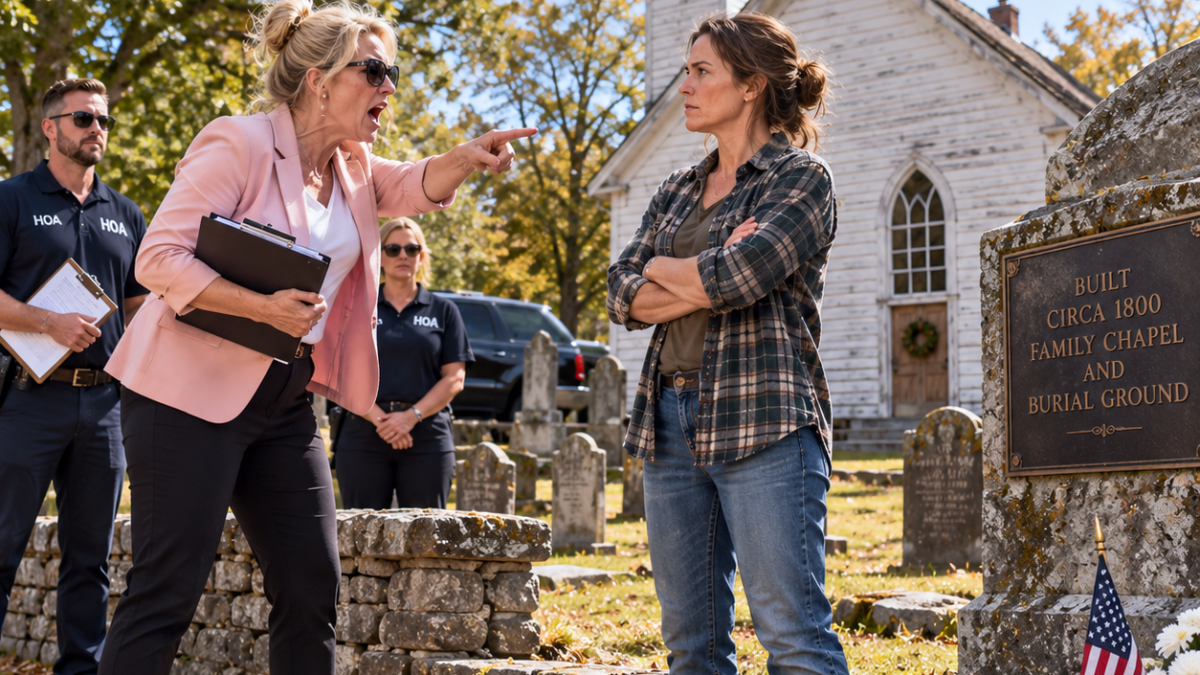
The HOA president stood beside the ruins of my family’s 173-year-old chapel and told me the neighborhood looked better without it.
Behind her, shattered stained glass lay across the same ground where five generations of my family had prayed, married, mourned, and buried their dead.
What Karen Miller didn’t understand was that she hadn’t merely crossed a property line—she had stepped into a kind of trouble no HOA rulebook could protect her from.
“Well,” she said brightly, planting both hands on her hips, “doesn’t this open up the view?”
For several seconds, I couldn’t answer.
Dust floated through the Sunday morning sunlight.
The little bell tower was gone.
The hand-cut limestone walls had been reduced to broken gray chunks scattered through the grass.
One of the old oak beams that had supported the roof since before the Civil War lay splintered in the dirt.
A piece of blue stained glass rested near my boot.
My great-grandfather had installed those windows in 1912 as a wedding gift to my great-grandmother.
Now they glittered across the ground like pieces of ice.
Karen pointed toward the destruction.
“We’re considering a meditation garden,” she continued. “Or perhaps pickleball courts. Residents have been asking for more recreational space.”
I finally looked at her.
“You know people are buried there.”
Her smile faltered for half a second.
Then it returned.
“This was an unsafe structure, Mr. Thorne.”
Behind her, two members of the Oak Ridge Estates HOA board stood silently near a golf cart.
Neither would meet my eyes.
Karen lifted a folder.
“You received the notices.”
“I received your notices.”
“Then you were aware of the deadline.”
“My attorney told you six months ago that the chapel and cemetery are outside HOA enforcement authority.”
Her jaw tightened.
“That was his opinion.”
“No.”
I pointed toward the ruins.
“That was the deed.”
She gave a dismissive little laugh.
“Homeowners always think their situation is special.”
I stared at her.
The Saint Agnes Chapel had stood on that land since 1849.
My ancestor Silas Thorne had quarried the limestone himself and built the original single-room chapel with his own hands.
He named it after his wife, Agnes.
Their son was baptized there.
Their granddaughter was married there.
My parents knelt at its altar on their wedding day.
My grandmother took me there as a boy and taught me the names carved into the stones behind it.
Silas Thorne.
Agnes Thorne.
William Thorne.
Samuel Thorne.
My grandfather.
His father.
His grandfather.
The people who had made my life possible were buried beneath that grass.
And Karen Miller had just driven heavy machinery across them because an old stone chapel spoiled the view from the opposite side of the community lake.
“Where are the headstones?” I asked.
Karen’s eyes shifted.
That was when I knew.
I walked past her.
“Mr. Thorne—”
I ignored her.
The graveyard had been behind the chapel, enclosed by a low iron fence.
Or it had been.
Now the fence was twisted beneath bulldozer tracks.
Fresh earth had been pushed into ridges.
Then I saw the first broken stone.
White marble.
Snapped diagonally.
I knew it before I reached it.
AGNES THORNE.
My great-great-grandmother.
For twenty years, I had served in the Army Corps of Engineers.
I had seen buildings destroyed.
I had stood in places where entire streets had become rubble.
I knew what devastation looked like.
But I had never experienced anything like the sight of my own family’s graves churned beneath steel tracks.
I knelt and picked up half of the headstone.
Behind me, Karen kept talking.
Something about liability.
Safety.
Community improvement.
I barely heard her.
My hand moved over the carved letters.
Then I noticed my phone still recording.
I had turned the camera on when the bulldozer first arrived.
It had captured the contractor telling me Karen had paid double to have the job completed before noon.
It had captured me warning them that this was private property.
It had captured the chapel coming down.
And it had captured Karen standing there directing them.
I slowly rose.
The grief was still there.
So was the rage.
But underneath both, something colder was beginning to take shape.
Karen mistook my silence for defeat.
She smiled again.
“The demolition invoice will be added to your HOA account tomorrow.”
I looked down at the broken headstone in my hands.
Then at her.
“Put everything in writing.”
She blinked.
“What?”
“Every dollar.”
I slipped my phone into my pocket.
“Every order. Every invoice. Every authorization.”
Karen actually laughed.
“With pleasure.”
She climbed into her golf cart and drove away.
I watched her disappear between the identical houses of Oak Ridge Estates.
Then I looked back at what remained of Saint Agnes Chapel.
Karen thought she had finally won.
Standing among the graves of my ancestors, I realized she had just given me exactly what I needed.
PART 2
I stayed in the ruins until the dust settled.
Not figuratively.
Literally.
Fine gray powder hung over the property for nearly an hour after the bulldozer and excavator disappeared down the access road.
I could taste limestone on my tongue.
The air smelled like diesel exhaust, damp soil, and old wood ripped open after more than a century.
I walked slowly through what had once been Saint Agnes Chapel.
There was no roof anymore.
No door.
No altar.
The bell lay half buried beneath a section of collapsed wall.
The bronze was dented along one side.
When I was eight years old, my grandmother had let me pull the rope for the first time.
The sound had been enormous to me then.
Deep.
Warm.
It rolled over the fields long before Oak Ridge Estates existed.
My grandmother had laughed because I covered my ears.
“You’ll get used to it, Jack.”
I never did.
I loved that bell.
Now I put both hands beneath its edge and tried to move it.
It barely shifted.
I stopped.
That was when the first neighbor arrived.
Marcus Hale lived three streets over.
Former Marine.
He had moved into Oak Ridge five years earlier after losing part of his left leg in Afghanistan.
He crossed the torn grass carefully with his cane.
For once, he didn’t make one of his usual jokes about Army versus Marines.
He simply stood beside me.
“Jesus.”
I nodded.
He looked toward the graveyard.
“They went through there too?”
“Yes.”
Marcus took off his baseball cap.
He didn’t say anything for a long time.
Then another car stopped.
Mrs. Gable came next.
Eighty-one years old.
Five feet tall.
Widowed.
Usually dressed as if she expected to be photographed while gardening.
She walked toward the rubble with both hands over her mouth.
“Oh, Jack.”
I had known Mrs. Gable casually for two years.
She had brought Sarah and me a lemon pound cake when we moved into my grandmother’s old farmhouse.
She had once complained that our oak tree dropped leaves into her hydrangeas.
That morning she hugged me so tightly I almost lost my balance.
“I’m so sorry.”
Then she looked toward the broken grave markers.
Her expression changed.
“Did Karen do this?”
“She ordered it.”
Mrs. Gable’s face hardened.
“I knew she was cruel.”
She looked at the ruins.
“I didn’t know she was insane.”
More neighbors came.
The Millers—not related to Karen—arrived with their two children.
A young couple from the end of the cul-de-sac stood near the road.
Someone brought bottled water.
Someone else brought tarps.
Nobody touched anything until I asked them to.
That mattered.
By noon, my land looked less like a demolition site and more like a crime scene being protected by ordinary people who understood something important had happened there.
The sheriff’s deputy who had come earlier had treated it as a civil dispute.
I couldn’t entirely blame him.
Karen had produced official-looking papers.
He was young.
The bulldozer operator insisted he had authorization.
Property disputes involving HOAs were often messy.
But what I saw now wasn’t messy.
It was clear.
A legally protected chapel had been destroyed.
A registered cemetery had been damaged.
Headstones had been broken.
Heavy machinery had crossed graves.
And Karen had stood there supervising it.
I went inside.
Sarah was away visiting her sister that weekend.
I called her.
She answered on the second ring.
“Hey. Everything okay?”
For a moment, I couldn’t speak.
She heard it.
“Jack?”
“They tore down the chapel.”
Silence.
“What?”
“Karen hired a demolition crew.”
“No.”
“They did it this morning.”
“Jack, no.”
Her voice broke.
“The whole thing?”
“Yes.”
“The cemetery?”
I looked through the kitchen window.
My great-great-grandmother’s broken stone was still where I had placed it.
“Yes.”
Sarah started crying.
She had loved the chapel almost as much as I did.
We were married there.
Not legally—the county paperwork had been completed at the courthouse—but our family ceremony had taken place beneath those stained-glass windows.
My grandmother had still been alive.
She sat in the front pew.
The picture over our fireplace showed Sarah and me standing outside Saint Agnes while autumn leaves covered the stone path.
That photograph now depicted something that no longer existed.
“I’m coming home,” Sarah said.
“Drive carefully.”
“What are you going to do?”
I looked at the accordion file on my office shelf.
For two years, I had been saving Karen’s letters.
Her notices.
Her threats.
Every petty fine.
My attorney’s cease-and-desist letter.
The so-called final abatement order.
“I’m going to make sure nobody ever calls this a misunderstanding.”
I hung up and went to work.
The first thing I did was preserve the video.
My phone had captured almost forty-seven minutes.
I transferred it to my desktop.
Then an external drive.
Then cloud storage.
Three copies.
After twenty years in the Corps of Engineers, redundancy wasn’t a personality trait.
It was religion.
Next, I photographed everything.
Wide shots.
Close shots.
Every broken window.
Every track in the soil.
Every damaged grave marker.
Every piece of iron fence.
The contractor’s tire impressions.
The section of curb their machines had cracked.
Then I photographed the chapel as it had looked before.
Not that morning.
From my files.
I had hundreds of pictures.
Roof restoration.
Mortar repair.
Stained glass.
Bell tower.
Interior.
Altar.
Graves.
Those pictures would matter because Karen’s official position was that Saint Agnes had been dilapidated and unsafe.
The photographs showed a different reality.
The structure was old.
It was not abandoned.
I had spent most of the previous autumn repairing it.
I had invoices from craftsmen.
Structural assessments.
Mortar receipts.
Roofing materials.
A licensed preservation mason had inspected the stonework.
A carpenter had reinforced two roof trusses.
The chapel had been more stable the morning Karen destroyed it than it had been in thirty years.
Then I opened the historical file.
My family had owned the land since the 1840s.
Silas Thorne settled there after apprenticing as a stonemason in Richmond.
He married Agnes in 1847.
Their first child died before reaching one year old.
Family records said Silas built the chapel after that loss.
Not because he planned to found a church.
Because Agnes needed somewhere to pray.
The first structure was one room.
Twenty-two feet long.
Fourteen wide.
Local limestone.
Timber roof.
Small wooden cross.
As generations passed, the family enlarged it.
A vestibule.
Three rows of pews.
A bell tower.
Stained glass.
It was never large.
That was part of its beauty.
The chapel belonged to the family, but neighbors had used it too.
Farm weddings.
Funerals.
Christmas services.
During the Depression, food was distributed there.
My grandmother told me that during World War II women from nearby farms gathered inside to sew blankets and pack boxes for soldiers overseas.
In 1998, when developers purchased the neighboring acreage, the chapel became one of the biggest obstacles to approval.
The county required a preservation easement before the development could proceed.
The language was explicit.
The Thorne homestead core—including Saint Agnes Chapel and the associated family burial ground—was protected from alteration, demolition, or development without approval from the county and relevant preservation authorities.
Oak Ridge Estates accepted that condition in its original charter.
Their roads could surround us.
Their homes could rise around us.
But the chapel stayed.
Karen knew that.
My attorney had reminded her in writing.
That was the part I kept returning to.
She knew.
Six months earlier, when her letters became aggressive, I hired David Cole.
David had served with me early in my career before leaving active duty and eventually becoming a property attorney.
He wrote Karen a short letter.
Not threatening.
Not dramatic.
It cited the deed.
The easement.
The HOA charter.
The cemetery designation.
Then one sentence:
The association is directed to cease and desist all enforcement communications concerning Saint Agnes Chapel and the Thorne family burial ground, over which the association has no regulatory authority.
Karen received it.
Signed for it.
Then left me alone for six months.
That proved comprehension.
She understood enough to stop temporarily.
Then, sometime during those six months, she decided she wanted the land more than she feared the consequences.
I called David.
He answered with a cheerful, “What did Queen Karen do now?”
I said nothing.
His tone changed immediately.
“Jack?”
“She demolished Saint Agnes.”
Silence.
“No.”
“Sunday morning.”
“The chapel?”
“Yes.”
“The cemetery?”
“Damaged.”
He swore.
David almost never swore.
“I’m sending you video.”
“Don’t send it by text. Email the full resolution.”
“I already backed it up.”
“Of course you did.”
“There’s more.”
I explained Karen’s false abatement order.
The demolition crew.
The deputy.
Her claim that permits existed.
Her statement about the invoice.
When I finished, David was silent again.
Then he said something I will always remember.
“Jack, stop thinking like this is an HOA dispute.”
“I already have.”
“Good. Because it isn’t one anymore.”
“What is it?”
“At minimum? Destruction of protected property. Cemetery desecration issues. Potential fraud. Potential conspiracy depending on what she told the contractor. Possibly misuse of association funds. And that’s before I see the documents.”
“What should I do?”
“Document everything and touch as little as possible.”
“I’ve already photographed it.”
“Good.”
“I want to start recovering headstones.”
“Not yet.”
That hurt.
“They’re my family.”
“I know. But if state investigators get involved, they need to see the site as it was left.”
I looked through the window.
Mrs. Gable was sitting on a folding chair near the chapel ruins.
She had apparently appointed herself guardian of the crime scene.
“All right.”
“One more thing.”
“What?”
“Do not call Karen.”
I almost laughed.
“That won’t be a problem.”
“Do not confront the board.”
“Fine.”
“Do not threaten anybody.”
“David.”
“I know you.”
“You knew me twenty years ago.”
“You became calmer, not nicer.”
Fair.
“I’m driving down tomorrow,” he said.
After we hung up, I turned to the demolition company.
Bulldog Demolition.
The name was clearly visible on the pickup and equipment in my video.
The owner introduced himself as Frank Gallo.
I searched the state contractor database.
Suspended.
I refreshed the page.
Same result.
Bulldog Demolition LLC.
License status: suspended.
Effective three months earlier.
Reason: failure to maintain required insurance and unresolved safety violations.
I printed it.
Then searched the corporate registry.
Frank Gallo.
Registered address eight miles away.
I knew the name.
It took several minutes before I remembered why.
Community Beautification Committee.
Karen had introduced Frank in an HOA newsletter the previous spring.
There was even a photograph.
Frank standing beside Karen holding a ceremonial shovel during a landscaping project near the pool.
I pulled up the newsletter.
There he was.
That meant Karen hadn’t selected a random demolition contractor.
She had hired someone already connected to the association.
Someone she knew.
I started a new section in the binder.
VENDORS.
Then I looked at HOA finances.
One advantage of paying dues was access to the association portal.
Oak Ridge’s bylaws required financial disclosures to members.
Karen hated that requirement but had never managed to eliminate it.
Budgets.
Bank summaries.
Vendor reports.
Expense categories.
I downloaded three years.
The demolition couldn’t have been cheap.
Two machines.
Sunday work.
Double rate.
Crew.
Disposal.
I searched for Bulldog.
Nothing.
Gallo.
Nothing.
Demolition.
Nothing.
Hazard removal.
One item.
Twenty-five thousand dollars.
Vendor:
Oak Ridge Environmental Services LLC.
I had never heard of them.
Date: two weeks earlier.
Description:
Emergency Hazard Abatement and Community Beautification.
Approved by:
K. Miller.
My pulse changed.
I searched the company.
Formed five weeks earlier.
Registered office:
Karen Miller’s home address.
Registered agent and sole member:
Robert “Bob” Miller.
Karen’s husband.
I stared at the screen.
Then printed everything.
The HOA bylaws required expenditures above $5,000 to receive full board approval unless immediate emergency action was necessary to protect life or property.
Saint Agnes had stood 173 years.
Karen had invented an emergency.
Then authorized twenty-five thousand dollars to a company owned by her husband.
That company appeared to have hired Frank Gallo.
The connections were no longer random.
They formed a line.
Karen.
HOA funds.
Her husband’s company.
Frank.
Bulldozer.
My chapel.
I called David again.
“I found the payment.”
“What payment?”
“Twenty-five grand.”
“To the demolition company?”
“No.”
I explained.
David went very quiet.
“Send me the records.”
“Already doing it.”
“Jack?”
“Yes?”
“Do not post this anywhere.”
“I won’t.”
“Do not accuse Karen publicly of embezzlement.”
“I wasn’t planning to.”
“We need forensic confirmation.”
“Understood.”
“Also, I’m bringing another lawyer tomorrow.”
“Why?”
“Because this just got considerably larger.”
That night, I finally walked back to the cemetery.
Marcus had placed temporary stakes around the damaged areas.
Mrs. Gable had gone home.
The neighborhood was quiet.
I carried a flashlight.
The moon was barely visible.
I found my grandfather’s stone.
Still standing.
Scratched but intact.
His name caught the flashlight beam.
Thomas William Thorne.
1928–2014.
I sat beside it.
When he was alive, my grandfather never talked much.
He had served in Korea, come home, farmed, and raised four children.
He believed conversation should have a practical purpose.
But on the afternoon before I left for basic training, he took me to Saint Agnes.
We sat on the front steps.
“You know why people build things?” he asked.
I gave some answer about shelter.
He shook his head.
“Anybody can build shelter.”
He pointed toward the chapel.
“People build things because they expect somebody to come after them.”
I didn’t understand then.
I did now.
Silas built Saint Agnes because he imagined children he would never meet.
My great-grandfather installed the stained glass because he believed someone would still be there to see sunlight through it after he died.
My grandmother polished the brass plaque because she had inherited something and intended to pass it forward.
And I had failed.
That was how it felt.
Logically, I knew Karen was responsible.
Emotion didn’t care about logic.
I had inherited Saint Agnes.
Now it was gone.
“I’m sorry,” I whispered.
The cemetery didn’t answer.
But sitting there among the graves, something became clear.
I couldn’t rebuild the past exactly as it had been.
Justice would not put the original stone walls back together.
It would not unbreak stained glass.
It would not erase bulldozer tracks from the graves.
So revenge alone could never be enough.
Whatever happened next had to preserve what remained.
The following morning David arrived with a woman named Rebecca Sloan.
Rebecca specialized in historic preservation law and land-use litigation.
She wore hiking boots with a business suit because, she explained, preservation cases tended to involve mud.
She walked the site slowly.
Photographed everything.
Read the easement.
Reviewed the cemetery registration.
Then looked at me.
“This cemetery is recorded?”
“Yes.”
“Exact boundaries?”
“Surveyed.”
“Recorded with the county?”
“Yes.”
“And the HOA has a copy?”
“It’s referenced in their charter.”
She exhaled.
“This is very bad.”
“For me?”
“For them.”
David showed her the twenty-five-thousand-dollar transaction.
Her eyebrows rose.
“Oh.”
“That was my reaction,” I said.
She read it twice.
Then:
“We need preservation authorities involved immediately.”
By noon we had contacted the state historical commission.
I expected voicemail.
Instead, after David explained the situation, we were connected to a senior investigator named Arthur Abernathy.
He asked for three things.
The recorded easement.
The cemetery documentation.
Photographs of the damage.
I sent all three.
Twenty minutes later, he called back.
“When can you meet?”
“Today.”
“Come.”
The capital was almost two hours away.
Marcus insisted on driving with me.
I told him it wasn’t necessary.
He showed up at my house in his Marine dress blues.
“Still unnecessary?” he asked.
I looked at him.
“Completely.”
“Good.”
We drove together.
Mr. Abernathy’s office was in an old government building with narrow hallways and fluorescent lighting.
He was in his sixties.
Silver hair.
Wire-rim glasses.
The exhausted expression of someone whose career involved arriving after history had been damaged.
I gave him the binder.
He asked me to tell the story from the beginning.
So I did.
No adjectives.
No insults.
Dates.
Letters.
Easement.
Cease-and-desist.
Abatement order.
Sunday demolition.
Deputy.
Karen.
Then the video.
He watched without speaking.
When the excavator tore through the bell tower, his jaw tightened.
When the stained-glass window shattered, he leaned closer.
When the bulldozer snapped Agnes Thorne’s headstone, he stopped the video.
“Play that again.”
I did.
He watched.
Then removed his glasses.
“How many graves are registered at the site?”
“Eleven.”
“Any unmarked graves?”
“Family records suggest two infant burials, but they were never formally marked.”
He closed his eyes briefly.
Then picked up the phone.
He made two calls.
One to the Attorney General’s office.
Another to a state cemetery preservation officer.
When he hung up, he looked at me.
“Mr. Thorne, I want to be careful about promising outcomes.”
“I understand.”
“But I can tell you this is being treated very seriously.”
Marcus leaned forward.
“What happens now?”
“Site inspection. Referral to law enforcement. Review of the easement. Review of contractor activity.”
He pointed toward my binder.
“And these financial records should go to investigators as well.”
He looked at me again.
“Do not disturb the graves until our archaeological team documents the site.”
“I’ve been told.”
“I know that’s difficult.”
“It is.”
Mr. Abernathy’s expression softened.
“My family has a cemetery in West Virginia. Four stones. Nothing famous.”
He paused.
“If somebody drove a bulldozer over my grandmother, I’m not sure I would be sitting here as calmly as you are.”
“I’m not calm.”
“No.”
He nodded toward the binder.
“You’re disciplined.”
That distinction mattered.
We drove home.
By the time we reached Oak Ridge, Karen had called an emergency board meeting.
I wasn’t invited.
That was predictable.
Marcus was.
So was Mrs. Gable.
The next morning she knocked on my door.
“She says it was a misunderstanding.”
I almost smiled.
“Of course.”
“She says Frank misinterpreted the work order.”
“He brought a bulldozer.”
“She says you refused all attempts at compromise.”
“What compromise?”
“She wanted you to deed the chapel parcel to the HOA.”
“That wasn’t compromise.”
“I know.”
Mrs. Gable sat at the kitchen table.
Her hands trembled slightly.
“She told everyone you were unstable.”
I looked at her.
“Her word?”
“She said you were ‘troubled from your years in the military.’”
That made something cold move through me.
Marcus had warned me Karen would weaponize my service if she got desperate.
I had hoped he was wrong.
Mrs. Gable continued.
“She said the board acted because residents were afraid the chapel would collapse.”
“Which residents?”
“She wouldn’t say.”
“Of course.”
“She also said the graves weren’t real.”
I stopped.
“What?”
“She called them decorative family memorials.”
For the first time since the demolition, I felt rage threaten to break through my discipline.
Eleven registered graves.
My grandfather’s remains.
My great-grandparents.
The people whose bones were literally in the ground.
Decorative.
Mrs. Gable reached across the table.
“Jack.”
I looked at her.
“Don’t let her drag you into becoming what she says you are.”
That sentence saved me from doing something stupid.
I exhaled.
“You’re right.”
“I usually am.”
I almost laughed.
Then she opened her purse.
“I brought something.”
A notebook.
She placed it on the table.
“I started keeping records two years ago.”
“Of what?”
“Karen.”
Dates.
Fine amounts.
Letters.
Conversations.
Names.
Her prized rose bushes had been removed by an HOA-approved landscaping crew because Karen claimed the variety wasn’t on the approved planting list.
The landscapers had entered Mrs. Gable’s front garden while she was at a medical appointment.
Her late husband had planted those roses.
By the time she returned, they were gone.
“I thought it was just me,” she said.
“It wasn’t.”
“No.”
Over the next three days, more neighbors came.
The Millers brought violation notices about their children’s swing set.
Marcus produced correspondence concerning a disabled-parking request near the pool.
Karen had mocked him during a board meeting.
He had recorded it.
Another resident had been fined because his work van remained in the driveway after his garage door broke.
A widower had been threatened because his late wife’s bird feeder was the wrong style.
Individually, the incidents looked petty.
Together, they formed a culture.
Karen governed through exhaustion.
Each demand was small enough that fighting seemed harder than complying.
Fifty dollars.
One hundred.
Move this.
Remove that.
Repaint.
Trim.
Hide.
People surrendered not because Karen was legally powerful but because resistance cost time.
She turned inconvenience into authority.
The chapel changed that.
A chipped mailbox could be ignored.
A destroyed cemetery could not.
We met at my dining-room table.
Marcus.
Mrs. Gable.
The Millers.
Several others.
David attended.
Rebecca joined by video.
I laid one rule down.
“No rumors.”
Marcus nodded.
“No exaggeration.”
Mrs. Gable nodded.
“No threats.”
Someone groaned.
I continued.
“We use documents. Photographs. Recordings. Things we can prove.”
Mrs. Gable opened her notebook.
“I have two years of things I can prove.”
“Good.”
Marcus leaned back.
“What’s the objective?”
The military language made me smile.
“Accountability.”
“That’s vague.”
“Then here’s something specific. Karen no longer controls the association.”
Everyone became quiet.
Mr. Miller spoke.
“Can we remove her?”
“Yes.”
I had read the bylaws.
Ten percent of members could call a special meeting.
A recall required a majority of votes cast, provided quorum requirements were met.
Karen had survived because no one organized.
We were going to organize.
But David raised his hand.
“Not yet.”
Marcus frowned.
“Why?”
“Because removal from the HOA board is the smallest problem Karen currently has.”
He looked toward me.
“State investigators are moving.”
Rebecca added from the screen.
“And if you hold a recall before they secure records, Karen may destroy or alter documents.”
That changed the room.
Mrs. Gable whispered:
“So we wait?”
“For a little while,” David said.
I hated waiting.
But he was right.
Instead, we focused on public records.
Then Karen made her next mistake.
She sent a community-wide email.
SUBJECT: FALSE RUMORS AND HARASSMENT OF YOUR HOA BOARD.
She described the demolition as a legitimate emergency action.
Claimed Saint Agnes was unsafe.
Claimed the burial ground was “historical in nature but inactive.”
Claimed all expenditures had been properly authorized.
Then she threatened legal action against residents spreading “defamatory misinformation.”
Marcus read it at my kitchen table.
“She’s daring everybody to talk.”
David smiled.
“She’s creating admissions.”
Two days later, Susan Keller called.
Investigative reporter.
Channel 4.
I hadn’t contacted her.
Mrs. Gable had.
“You said no rumors,” she told me.
“You called television news.”
“With documents.”
I stared at her.
She lifted her chin.
“Those are not the same thing.”
She had me there.
Susan arrived that afternoon.
No giant camera crew at first.
Just her and a photographer.
She walked the site.
Asked questions.
Then sat at my dining-room table for nearly three hours reading documents.
She wasn’t interested in HOA gossip.
She was interested in the cemetery.
The easement.
The money.
The shell company.
“Can you prove Oak Ridge Environmental is tied to Karen’s husband?”
I slid the state corporate filing toward her.
“Can you prove HOA money went there?”
Bank report.
“Can you prove Karen personally authorized it?”
Signature page.
“What about the demolition company?”
Suspended-license record.
“What about their connection to Karen?”
HOA newsletter.
Photograph of Frank Gallo beside her.
Susan looked up.
“You built all this yourself?”
“I had help.”
“What do you want to happen?”
That question caught me.
I had prepared for facts.
Not motive.
“I want my family left in peace.”
She waited.
“And?”
“I want the graves restored.”
“And Karen?”
I looked toward the window.
“If she broke the law, I want the law to deal with her.”
Susan studied me.
“You don’t want revenge?”
“Ask me on a worse day.”
She smiled slightly.
“Fair answer.”
The story aired at six.
I almost didn’t watch.
Sarah insisted.
The opening shot showed Saint Agnes before demolition.
Stone walls.
Bell tower.
Autumn leaves.
Then it cut to my video.
The bulldozer blade struck the chapel.
Sarah gripped my hand.
I had watched the footage dozens of times.
She had not.
When the stained glass shattered, she started crying.
The report explained the preservation easement.
The cemetery.
The disputed HOA authority.
Then the twenty-five-thousand-dollar payment.
Susan stood outside the clubhouse as Karen emerged.
“Mrs. Miller?”
Karen stopped.
The camera turned.
“Can you explain why twenty-five thousand dollars in HOA funds was paid to a company registered to your husband shortly before the demolition of the Thorne family chapel?”
Karen froze.
“That is an internal association matter.”
“Was that company used to pay Bulldog Demolition?”
“No comment.”
“Were you aware Bulldog’s contractor license was suspended?”
“That structure was dangerous.”
“County records show it was covered by a preservation easement.”
Karen tried to walk around her.
Susan moved with her.
“Did you obtain county permission to demolish the chapel?”
Karen’s face flushed.
“That man has been harassing this board for years.”
I actually laughed.
Sarah looked at me.
“What?”
“I barely attended meetings.”
On screen Susan asked:
“Was the burial ground registered?”
Karen pushed the microphone away.
“No comment!”
She climbed into her golf cart and drove off.
The report ended with a shot of the broken Agnes Thorne marker.
Then my voice.
Not from an interview.
From my Sunday recording.
“This is a registered cemetery. Stop the machine.”
Black screen.
The effect was devastating.
By eight that night, Oak Ridge’s homeowner page had exploded.
By morning, a statewide outlet picked up the story.
Then another.
I hated some of the headlines.
HOA KAREN BULLDOZES FAMILY CEMETERY FOR PICKLEBALL COURTS.
That wasn’t exactly what happened.
Karen had joked about pickleball after the demolition.
There was no approved project.
But nuance rarely survives headlines.
I refused most interview requests.
I didn’t want to become famous for losing my family chapel.
Karen did the opposite.
Through an attorney, she threatened defamation lawsuits.
David’s response was short.
We welcome formal discovery.
No lawsuit followed.
Then the bank froze certain HOA accounts after receiving legal process from investigators.
Prestige Community Management—the association’s outside management company—suddenly suspended its contract.
One board member resigned.
Then another.
Frank Gallo disappeared from neighborhood events.
A week later, investigators executed warrants related to HOA financial records.
That was when the community stopped being afraid.
A recall petition circulated.
Within twenty-four hours, more than half the neighborhood had signed.
Within three days, over eighty percent.
The special meeting was scheduled for the clubhouse.
Karen tried to challenge it.
The bylaws were clear.
She tried to cancel the reservation.
Residents simply reserved the room under a different member’s name.
She tried to declare the petition invalid.
A retired judge who lived on Juniper Lane reviewed it and said publicly:
“It is valid.”
His name was Harold Henderson.
He agreed to chair the meeting as a neutral parliamentarian.
The night arrived cold and clear.
Sarah and I walked to the clubhouse instead of driving.
People were standing outside because the room had reached capacity.
Marcus waited near the entrance.
Dress shirt.
Cane.
No uniform.
Mrs. Gable wore pearls.
“You look dangerous,” I told her.
“I am.”
Inside, Karen sat at the front table.
Two remaining directors beside her.
Her lawyer next to them.
For the first time in years, she didn’t control the room.
Judge Henderson called the meeting to order.
His voice was quiet.
Everyone listened.
Karen was allowed to speak first.
She stood with a prepared statement.
She talked about service.
Property values.
Safety.
Years of unpaid volunteer work.
Then:
“I deeply regret the unfortunate outcome at the Thorne property.”
Unfortunate outcome.
I saw Marcus’s jaw tighten.
Karen continued.
“The board acted based on information available at the time.”
She blamed the contractor.
“The demolition exceeded the authorized scope.”
She blamed county records.
“The preservation status was unclear.”
She blamed me.
“Mr. Thorne repeatedly refused cooperative solutions.”
Then came the sentence that ended any remaining sympathy in the room.
“I, too, am a victim of this situation.”
Someone behind me whispered:
“Oh, hell no.”
Judge Henderson raised a hand.
Silence returned.
Karen sat.
Then he looked at me.
“Mr. Thorne, would you like to respond?”
I stood.
I had written a speech.
It was folded in my pocket.
I never took it out.
“My family chapel was built in 1849.”
The room quieted.
“My ancestor Silas Thorne cut stone from that property and built it after the death of his infant son.”
I looked at Karen.
“He named it for his wife.”
Then the residents.
“For generations, my family celebrated weddings there. Funerals. Baptisms. Sunday meals. Christmas. Grief. Joy.”
I paused.
“Behind it are eleven registered graves.”
Karen looked down.
“I warned the demolition crew.”
Silence.
“I called law enforcement.”
Silence.
“I warned Mrs. Miller in writing months before the demolition.”
I held up David’s letter.
“Her office received this.”
Then the certified-mail receipt.
“She signed for it.”
Karen’s lawyer whispered to her.
I continued.
“A misunderstanding is sending the wrong trash schedule.”
A few people shifted.
“A misunderstanding is approving the wrong shade of paint.”
I looked directly at Karen.
“Hiring heavy equipment, paying double for Sunday work, ignoring a legal notice, destroying a protected structure, and driving machinery across a registered cemetery is not a misunderstanding.”
No one moved.
Mrs. Gable was crying quietly.
I lowered my voice.
“For two years, a lot of us treated Karen’s behavior as an annoyance.”
I looked toward her.
“That includes me.”
Then back to the room.
“I paid fines I shouldn’t have paid because fighting seemed inconvenient.”
Marcus nodded.
“Mrs. Gable lost roses planted by her husband.”
Mrs. Gable wiped her eyes.
“The Millers were made to feel like their children’s swing set was a threat to civilization.”
A few people laughed softly.
“Marcus was mocked while asking for reasonable access at the pool.”
Karen shifted.
“Every time one of us gave in because resistance was exhausting, the board learned the same lesson.”
I paused.
“That we would surrender.”
I pointed toward the room.
“Look around.”
People did.
“We’re done surrendering.”
Applause started.
Judge Henderson struck the table once.
“Let him finish.”
I looked at the neighbors.
“This community does not belong to Karen Miller.”
Then the board.
“It doesn’t belong to me.”
Then everyone.
“It belongs to all of us.”
I sat.
The applause was louder this time.
Judge Henderson allowed it.
Then the recall motion was introduced.
Before the vote began, the clubhouse doors opened.
Two state troopers entered.
Behind them was a plainclothes investigator I recognized from the Attorney General’s office.
Every head turned.
Karen’s attorney stood.
The investigator walked toward the table.
“Karen Miller?”
She remained seated.
Her face had gone white.
“Yes?”
He showed identification.
“I have a warrant for your arrest.”
The room became absolutely silent.
Karen’s lawyer stood quickly.
“On what charges?”
The investigator kept his voice professional.
“Felony offenses related to destruction and desecration of a protected burial site, conspiracy, and financial crimes associated with association funds.”
Karen stared.
“That’s impossible.”
The trooper stepped forward.
“Ma’am, please stand.”
“No.”
Her lawyer touched her arm.
“Karen.”
She pulled away.
“You don’t understand. I am president of this association.”
Nobody spoke.
The statement sounded absurd the moment it left her mouth.
The investigator said:
“Please stand.”
Karen looked around the room.
People she had fined.
People she had threatened.
People who once lowered their eyes when she passed.
Nobody moved to help her.
Her voice cracked.
“This is because of him.”
She pointed at me.
I didn’t respond.
“This man has been trying to destroy me.”
The investigator said nothing.
Karen continued.
“He manipulated everyone.”
Still nothing.
“I was protecting this community!”
Mrs. Gable stood.
“No, Karen.”
Her voice shook.
“You were protecting yourself.”
Karen stared at her.
The trooper stepped closer.
“Ma’am.”
Karen finally stood.
When the handcuffs closed, there was no cheering.
I’m glad.
At the time, I thought I wanted applause.
I thought I wanted people to celebrate her humiliation.
But watching another human being realize her life had just changed permanently wasn’t joyful.
It was heavy.
Karen started crying.
Not gracefully.
Not quietly.
Her attorney tried to keep her calm.
She kept insisting there had been a mistake.
As the troopers escorted her toward the door, she looked at me.
Our eyes met.
For two years, I had imagined that moment.
I had imagined satisfaction.
Triumph.
Vindication.
Instead, I felt tired.
Deeply tired.
The door closed behind her.
Judge Henderson waited.
Then said:
“We still have association business.”
That broke the tension.
A few people laughed nervously.
The recall vote proceeded anyway.
Karen and the two remaining directors were removed overwhelmingly.
Marcus became interim president.
Mrs. Gable joined the temporary board.
So did a CPA named Rachel Foster.
Their first official motion froze all punitive enforcement until independent review.
The second authorized a forensic audit.
The third directed counsel to cooperate fully with state investigators.
The fourth rescinded every charge against my property.
Including the demolition invoice.
That almost made me laugh.
Karen had actually added $31,480 to my account the day after destroying Saint Agnes.
Demolition cost.
Administrative surcharge.
Emergency compliance fee.
Legal processing.
She wanted me to pay for my own chapel being destroyed.
The balance went to zero with one vote.
The criminal process lasted more than a year.
Much of it was less dramatic than people expect.
Hearings.
Motions.
Document requests.
Negotiations.
Audits.
Interviews.
Frank Gallo eventually cooperated.
His version confirmed much of what the records suggested.
Karen had approached him directly.
She wanted the chapel down before I could obtain an injunction.
Sunday was chosen intentionally.
She believed courts would be closed and I would be unable to stop the work quickly enough.
She offered extra money.
According to Frank, she repeatedly assured him permits existed.
They didn’t.
Oak Ridge Environmental Services acted as the financial middleman.
Bob Miller—the husband—claimed Karen handled everything and he barely understood the company.
Investigators disagreed.
The forensic audit found more problems.
The twenty-five thousand dollars tied to Saint Agnes was not isolated.
HOA money had paid for meals unrelated to legitimate meetings.
Travel.
Personal purchases disguised as community supplies.
Landscape work at Karen’s property.
A portion of a family vacation charged through a “board development conference.”
The amounts weren’t millions.
That almost made the scheme more pathetic.
Years of petty theft.
A few hundred here.
A few thousand there.
Power had convinced Karen nobody would ever examine the receipts.
She was wrong.
The trial received more media attention than I wanted.
I testified.
Rebecca testified about the easement.
Preservation officials testified.
Archaeologists documented cemetery damage.
Financial investigators explained the transactions.
Frank Gallo testified.
Then the prosecution played my video.
I had avoided watching it for months.
There in court, I watched again.
The bulldozer hit the chapel.
The bell fell.
The headstone broke.
Karen stood in the background.
At one point her voice was clearly audible.
“Keep going.”
Sarah gripped my hand.
Karen sat at the defense table.
She never looked at me.
The final judgment included criminal convictions related to the cemetery destruction and financial misconduct.
Her sentence included several years of incarceration, restitution obligations, and financial penalties.
Bob faced consequences of his own.
Frank’s cooperation reduced his sentence, though his company collapsed.
The HOA’s former management arrangement was terminated.
Some residents wanted the harshest punishment imaginable.
I understood.
But somewhere during that year, punishment stopped being what I thought about most.
I thought about Saint Agnes.
What should replace it?
At first, everyone assumed I would rebuild.
The insurance settlement and civil recovery provided money.
Donations also began arriving after the news coverage.
Some envelopes contained five dollars.
Others contained hundreds.
Church groups wrote.
Preservation societies contacted us.
Veterans organizations offered labor.
One contractor offered to rebuild the entire chapel for material cost.
For months, I believed that was what I wanted.
An exact reconstruction.
Same footprint.
Same windows.
Same bell tower.
Then the archaeological team began working.
They carefully mapped the graves.
Recovered fragments.
Located old foundation stones.
Documented where the bulldozer had disturbed soil.
One afternoon, Dr. Elaine Porter, the lead archaeologist, asked me to walk with her.
She showed me a line in the earth.
“This was the original 1849 wall.”
I knelt.
A few stones remained below grade.
Silas’s stones.
Still exactly where his hands had placed them.
“We can build over this,” she said.
“But?”
She knew me well enough by then.
“But rebuilding would change the site again.”
I looked across the open space.
For the first time, I imagined something other than reconstructing Saint Agnes.
“What would you do?”
She shook her head.
“Not my decision.”
“I’m asking.”
Elaine took a long time.
“I’d preserve the footprint.”
I looked at her.
“Low walls. Original stone where possible. Reconstructed grave markers. Maybe a memorial structure that doesn’t pretend the destruction never happened.”
That last phrase stayed with me.
Doesn’t pretend the destruction never happened.
I went home.
Sarah and I talked until nearly midnight.
She surprised me.
“I don’t want a replica.”
“You don’t?”
“No.”
“Why?”
“Because it wouldn’t be the chapel we married in.”
I looked at the photograph over the fireplace.
She continued.
“It would look like it.”
“Yes.”
“But the original mattered because Silas built it. Your great-grandfather touched those windows. Your grandmother sat there.”
Her eyes filled.
“If we build a copy and pretend everything is back to normal, Karen gets erased from the story.”
“I thought that was the goal.”
“No.”
She shook her head.
“The goal is remembering what happened.”
So we created the Saint Agnes Memorial Trust.
My settlement funds became its foundation.
The state provided a preservation grant.
Donations filled the rest.
Historians.
Archaeologists.
Masons.
Landscape designers.
Family members.
Neighbors.
We designed a memorial park.
No pickleball courts.
Mrs. Gable made sure of that.
Low stone walls now trace the exact footprint of the chapel.
Some stones are original.
Others were quarried from the same ridge where Silas took his limestone.
The damaged bell was restored.
It hangs beneath a simple timber shelter near where the tower once stood.
We recovered fragments of stained glass.
Enough to create a memorial panel.
Blue river.
Green hills.
Gold sky.
Not the original window.
But pieces of it.
The graves were carefully restored.
Agnes Thorne’s headstone had broken into three major pieces.
A stone conservator repaired it.
The fracture remains visible.
I asked them not to hide it.
The scar is part of its history now.
The old oak survived everything.
Machines passed within feet of its trunk.
Today it shades the cemetery exactly as it did when my grandmother brought me there.
At the entrance stands a bronze plaque.
It tells the story of Saint Agnes Chapel.
ERECTED 1849 BY SILAS THORNE IN MEMORY, FAITH, AND HOPE.
Below that are the names of those buried there.
Then a final inscription:
THIS MEMORIAL PRESERVES WHAT COULD BE SAVED AND REMEMBERS WHAT COULD NOT. MAY AUTHORITY NEVER BE CONFUSED WITH OWNERSHIP, AND MAY COMMUNITY NEVER BE CONFUSED WITH CONTROL.
Marcus objected to the wording.
“Too polite,” he said.
“What would you write?”
He grinned.
KAREN WAS HERE. KAREN LOST.
Mrs. Gable liked his version.
We ignored both of them.
Opening day came almost two years after the demolition.
Hundreds of people attended.
More than I wanted.
Less than the television station hoped.
My family came from across the country.
Cousins I hadn’t seen in decades.
Children who knew Saint Agnes only through photographs.
A local choir sang.
The preservation commission spoke.
Marcus gave a short speech.
Mrs. Gable gave a long one.
Very long.
Halfway through she abandoned her prepared remarks and started telling stories about my grandmother.
That was better anyway.
Then Judge Henderson invited me forward.
I stood where the chapel doorway had once been.
For a moment, I couldn’t speak.
I could see the building in my mind.
The white flowers Sarah carried when we were married.
Grandmother in the front pew.
The brass plaque beside the door.
Sunlight through blue glass.
Then I looked around.
The chapel was gone.
But people were there.
Lots of them.
Neighbors.
Family.
Children.
Veterans.
Historians.
People who had donated five dollars because they heard a story on television and believed a cemetery deserved respect.
I began.
“When Saint Agnes was destroyed, I thought my family’s history had been destroyed with it.”
The crowd was quiet.
“I was wrong.”
I looked toward the graves.
“History is not only stone.”
Then the restored bell.
“It is not only glass.”
Then my family.
“It is memory.”
Then Oak Ridge residents.
“And responsibility.”
I paused.
“My ancestor Silas built this chapel because he believed something should remain after him.”
I looked at the low stone outline.
“He was right.”
Then I told them what my grandfather had said before I joined the Army.
People build things because they expect somebody to come after them.
My voice nearly failed on the last sentence.
“So this place is for the people who come after us.”
The bell rang once.
Deep.
Warm.
Not exactly the way I remembered.
But close enough.
Sarah squeezed my hand.
Afterward, the neighborhood held a picnic.
No speeches.
No politics.
Kids ran across the grass.
Someone brought too much barbecue.
Mrs. Gable argued with Marcus about potato salad.
Normal life.
That was the best part.
Oak Ridge changed after Karen.
Marcus served one year as board president before declaring the job “less enjoyable than being shot at.”
Mrs. Gable took over temporarily.
Everyone feared her more than Karen.
Not because she was cruel.
Because she actually read the bylaws.
The association eventually adopted a completely new enforcement policy.
Warnings before fines.
Real hearings.
Written standards.
No subjective “eyesore” language.
No contractor entering private property without documented authority.
Spending above a modest threshold required multiple approvals.
Financial records became easier to access.
Conflicts of interest had to be disclosed.
Meetings were recorded.
The rulebook shrank by more than half.
The American flag provision disappeared.
Marcus personally tore that page out of his old copy and framed it.
He gave it to me for Christmas.
Mrs. Gable replanted her roses.
The association reimbursed her.
The Miller children got their swing set back.
Someone painted a front door bright yellow.
Nobody died.
Property values did not collapse.
Civilization survived.
The biggest change was harder to measure.
People started talking.
Before Saint Agnes, neighbors often knew more about each other’s violations than each other’s lives.
Karen encouraged that.
Anonymous complaints.
Photographs.
Reports.
Afterward, anonymous complaints were discouraged except in genuine safety situations.
If you had a problem with your neighbor’s trash bin, you were encouraged to knock on their door first.
It turned out most problems could be solved with conversation.
A revolutionary concept.
One autumn afternoon, I was sitting on a bench at the memorial when a car stopped near the entrance.
A young couple got out.
They were considering buying a house in Oak Ridge.
The realtor had told them about “the chapel situation.”
The husband looked embarrassed.
“Can we ask you something?”
“Sure.”
“Is the HOA still crazy?”
I laughed.
“No.”
His wife glanced at the memorial.
“Did this really happen?”
“Yes.”
“She actually demolished it?”
“Yes.”
“Why?”
I thought about Karen.
For years, people had asked why.
At first, my answer was arrogance.
Then greed.
Then control.
All true.
But incomplete.
“I think she got used to people obeying.”
They waited.
“And eventually she forgot that being obeyed doesn’t mean being right.”
The woman nodded slowly.
They bought the house.
A year later, I saw them at the neighborhood barbecue.
Their toddler was running around the community garden Mrs. Gable had started.
That garden became another strange legacy of the fight.
Karen once wanted a “community improvement project” where the chapel stood.
Instead, the neighborhood built the garden near the clubhouse.
Tomatoes.
Peppers.
Herbs.
Sunflowers.
Mrs. Gable managed it like a military dictatorship.
Marcus found this extremely funny.
“She became Karen.”
Mrs. Gable pointed a trowel at him.
“I will bury you under the zucchini.”
No one doubted her.
Three years after Saint Agnes was destroyed, the last of Karen’s restitution payments arrived.
The new HOA board held a meeting to decide what to do with money recovered from the financial misconduct.
Refund it proportionally?
Reduce dues?
Add to reserves?
Marcus proposed a scholarship.
For local students studying history, preservation, archaeology, or public service.
The vote was unanimous.
They named it the Saint Agnes Community Stewardship Scholarship.
I resisted putting my family name on anything.
Saint Agnes was enough.
The first recipient was a high school student named Maya Lewis.
Her essay was about historic cemeteries disappearing under suburban development.
At the award dinner, she told me she wanted to become an archaeologist.
“Because of your chapel,” she said.
I looked at her.
“You never saw it.”
“No.”
She smiled.
“But I saw what happened when people decided it mattered.”
That sentence stayed with me.
For years, I thought Karen’s demolition was the ending of Saint Agnes.
Maybe it wasn’t.
Maybe it was a transformation none of us would have chosen.
The chapel had once served one family and a few neighboring farms.
Its destruction made hundreds of people learn its story.
The memorial taught children why old places matter.
The scholarship helped students study preservation.
The county strengthened its historic easement enforcement.
Other HOAs reviewed their charters.
The state historical commission created new guidance for private associations bordering protected cemeteries.
Rebecca told me our case was now discussed at preservation-law seminars.
David hated when she called it “the Thorne case.”
I hated it more.
Marcus loved it.
“Finally,” he said, “you’re famous for something other than bad coffee.”
Years passed.
The anger faded first.
The grief took longer.
I still had dreams about Saint Agnes.
In them, the chapel was intact.
Grandmother sat inside.
Sometimes she was old.
Sometimes young.
Sometimes she never spoke.
I would walk toward the door.
Then wake before entering.
For a long time those dreams hurt.
Eventually they became comforting.
I stopped feeling as though I had failed the dead.
That took years.
One evening, Sarah and I sat beneath the old oak.
The sunset turned the restored stained-glass fragments orange and blue.
Children from the neighborhood were riding bicycles along the path.
Sarah leaned against me.
“Do you miss the chapel?”
“Every day.”
“Me too.”
A little boy stopped near the bell.
He asked his father:
“Can I ring it?”
The father looked toward me.
I nodded.
The boy pulled the rope.
The bell sounded over Oak Ridge.
For a second, I was eight years old again.
My grandmother laughing.
My hands over my ears.
You’ll get used to it, Jack.
I smiled.
Sarah looked at me.
“What?”
“Nothing.”
She knew better.
She didn’t ask again.
Eventually Karen became a story rather than a person.
New residents knew the name without knowing her face.
Older residents remembered everything.
Sometimes versions became exaggerated.
One rumor claimed Karen personally drove the bulldozer.
False.
Another said the governor arrived for her arrest.
Definitely false.
Marcus encouraged that one.
A teenager once asked if Karen had built the pickleball courts afterward.
“No.”
“Why not?”
“She was in prison.”
“Oh.”
The teenager considered this.
“So no pickleball?”
“No pickleball.”
He looked disappointed.
History is strange.
The criminal case became a cautionary tale.
But I never wanted Saint Agnes to become a tourist attraction built around hatred of one woman.
So the memorial plaque does not mention Karen Miller.
Not once.
Marcus argued.
I refused.
Her name did not deserve permanent bronze beside Silas and Agnes.
She already occupied too much of the story.
The memorial belonged to the family.
To the community.
To the people who rebuilt dignity out of rubble.
Karen’s punishment belonged to court records.
That was enough.
On the fifth anniversary of the demolition, I arrived at the memorial before sunrise.
No ceremony.
No reporters.
Just me.
I carried a small cleaning cloth.
My grandmother had always polished the original brass plaque.
The original plaque survived the demolition.
Bent.
Scratched.
But intact.
We mounted it inside a protective frame near the entrance.
ERECTED 1849 S. THORNE.
I cleaned it carefully.
When I finished, I sat beside Agnes’s restored grave.
The fracture line still crossed her stone.
I traced it with one finger.
For years, I hated that scar.
That morning I realized I didn’t anymore.
The break proved something.
Damage did not erase identity.
The stone had been broken.
It was still Agnes’s stone.
The chapel had been destroyed.
It was still part of our family.
The community had been damaged.
It healed.
Even I had been damaged.
I healed too.
Not completely.
Maybe people aren’t supposed to heal completely from everything.
Some scars are instructions.
They tell you what to protect.
A truck slowed on the road.
Marcus leaned out the window.
“You having a dramatic moment?”
“Go away.”
“Breakfast?”
“No.”
“Mrs. Gable made biscuits.”
I stood immediately.
He laughed.
“Thought so.”
Mrs. Gable was ninety by then.
Still dangerous.
Still growing roses.
Her garden had become the prettiest in Oak Ridge.
No approved-plant list.
No landscape inspector.
No one measuring petals.
She kept one rose variety near her porch that her husband had originally planted.
A deep red climber.
On the morning she died, several years later, her daughter called me.
“She left instructions.”
I knew before she said it.
Mrs. Gable wanted some of her rose cuttings planted at Saint Agnes.
The board approved it unanimously.
Not that they had authority to approve anything there.
Marcus pointed that out.
We planted the roses anyway.
They grow along the southern edge of the memorial wall.
Every spring, red flowers spill across the stone.
Mrs. Gable would have considered that acceptable.
Marcus passed a few years after her.
His funeral wasn’t at Saint Agnes.
The memorial wasn’t a functioning chapel.
But his family asked to stop there on the way to the veterans cemetery.
The procession pulled in.
His daughter rang the bell once.
I placed my hand on the timber support.
For the first time, it struck me how many new memories the memorial had collected.
Saint Agnes had always been about generations.
The names changed.
The purpose didn’t.
People needed places to remember.
That was what Karen never understood.
She saw a structure.
Old stone.
Unfashionable architecture.
Something blocking a view.
She never understood that places can hold human meaning that has nothing to do with market value.
You cannot measure that with an architectural guideline.
You cannot fine it.
You cannot replace it with recreation space.
You cannot bulldoze it and expect people to forget.
Karen learned that too late.
I sometimes wondered what became of her after prison.
I never searched.
Once, years later, David told me she had moved to another state.
“Want to know where?”
“No.”
“You sure?”
“Yes.”
And I meant it.
For a long time, I had wanted Karen to understand what she did.
Eventually, I stopped needing her understanding.
Justice did not require her enlightenment.
The court had held her accountable.
The community had changed.
The graves were protected.
My family’s story survived.
That was enough.
When I finally retired from maintaining the memorial trust, I handed responsibility to a board that included one of my younger cousins, a local historian, an archaeologist, and—much to my delight—Maya Lewis.
The scholarship recipient.
She had become exactly what she said she would.
An archaeologist.
At my final trust meeting, she handed me a folder.
“No.”
She laughed.
“You haven’t opened it.”
“I have trauma involving folders.”
“Just open it.”
Inside was a preservation plan designed to ensure Saint Agnes remained protected for the next fifty years.
Drainage.
Stone conservation.
Tree care.
Archive management.
Digital records.
The kind of boring document I loved.
I looked at her.
“This is good.”
“I know.”
“You sound like Mrs. Gable.”
“I’ll take that as a compliment.”
“You should.”
That evening Sarah and I walked home through Oak Ridge.
The neighborhood looked different from the place Karen had controlled.
Not physically.
Most houses were the same.
But individuality had returned.
Different flowers.
Children’s toys.
Flags.
Porch furniture.
A basketball hoop.
Someone’s Christmas lights still hanging in February.
I pointed.
“Violation.”
Sarah elbowed me.
We reached our driveway.
The farmhouse lights glowed.
Behind us, the Saint Agnes bell rang.
Once.
Someone visiting the memorial.
Sarah took my hand.
“Remember when we wanted peace?”
“Yes.”
“Did we ever get it?”
I thought about the question.
For years, I assumed peace meant nothing bad happening.
No conflict.
No confrontation.
No letters.
No courtrooms.
But that kind of peace depends on luck.
The peace we had now was different.
It had been built.
Protected.
Paid for.
Not with money alone.
With courage.
Participation.
Boundaries.
People willing to stand beside one another.
“Yes,” I said.
“We got it.”
She looked back toward the memorial.
“Cost a lot.”
“Yes.”
“Worth it?”
I looked at the bell tower shelter.
The roses.
The restored graves.
The low walls tracing a chapel no longer there.
“Yes.”
Absolutely.
The original Saint Agnes Chapel never came back.
That is the one part of this story I refuse to soften.
Some things cannot be repaired.
Some acts cause permanent loss.
Anyone who tells you justice makes everything whole again has probably never lost something irreplaceable.
Justice didn’t bring back the stained glass my great-grandfather installed.
It didn’t restore the exact timber Silas cut.
It didn’t erase the image of a bulldozer blade crossing my great-great-grandmother’s grave.
But justice did something else.
It told the truth.
Karen called the chapel an eyesore.
The law called it protected.
She called the graveyard irrelevant.
The state called it sacred ground entitled to protection.
She called her actions community improvement.
A jury called them crimes.
She called herself the victim.
Her neighbors remembered who had actually been hurt.
That mattered.
Truth does not reverse destruction.
But it prevents destruction from becoming the final word.
Today, when I stand at Saint Agnes, I no longer see Karen first.
That took time.
At first, every stone reminded me of her.
Every repaired grave.
Every missing wall.
Every fracture.
Now I see Silas.
Agnes.
My grandmother.
My grandfather.
Sarah in her wedding dress.
Mrs. Gable’s roses.
Marcus laughing.
Maya explaining archaeology to schoolchildren.
Neighbors sharing food beneath the oak.
The bell ringing over a community that finally learned the difference between order and control.
Karen became smaller as everything she tried to erase became larger.
That may be the most satisfying ending of all.
She wanted the chapel gone because it interrupted her view.
Instead, its story became impossible to ignore.
She wanted absolute control over Oak Ridge.
Instead, residents rewrote the system to make another Karen far less likely.
She wanted me intimidated.
Instead, her attack brought neighbors to my door.
She wanted my family’s history reduced to rubble.
Instead, that history became a preservation trust, a scholarship, a memorial, and a lesson taught to people who never knew the original building.
And the land she once imagined as pickleball courts?
It remains quiet.
No asphalt.
No nets.
No bright painted lines.
Just stone.
Grass.
Roses.
Graves.
An old oak.
And a bell.
Sometimes, just before sunset, the light passes through the recovered stained-glass fragments.
Blue spills across the memorial stones.
Green touches the grass.
Gold catches the repaired line running through Agnes Thorne’s headstone.
When that happens, I can almost see Saint Agnes as it was.
Not completely.
Just enough.
And I think of my grandfather.
People build things because they expect somebody to come after them.
He was right.
Silas built for us.
We preserved what remained for the next generation.
And somewhere in between, one woman with a clipboard learned that authority has limits, history has defenders, and some ground is sacred whether she recognizes it or not.
Karen thought she had erased an eyesore.
Instead, she created a landmark no one in Oak Ridge will ever forget.
Saint Agnes still stands.
Not the way it once did.
But in every way that matters.
[END OF FULL STORY]








