PART 2: HOA Karen Brought a Skid Steer to Tear Down My Stone Wall—Then the City Learned It Was Holding Up 30 Homes
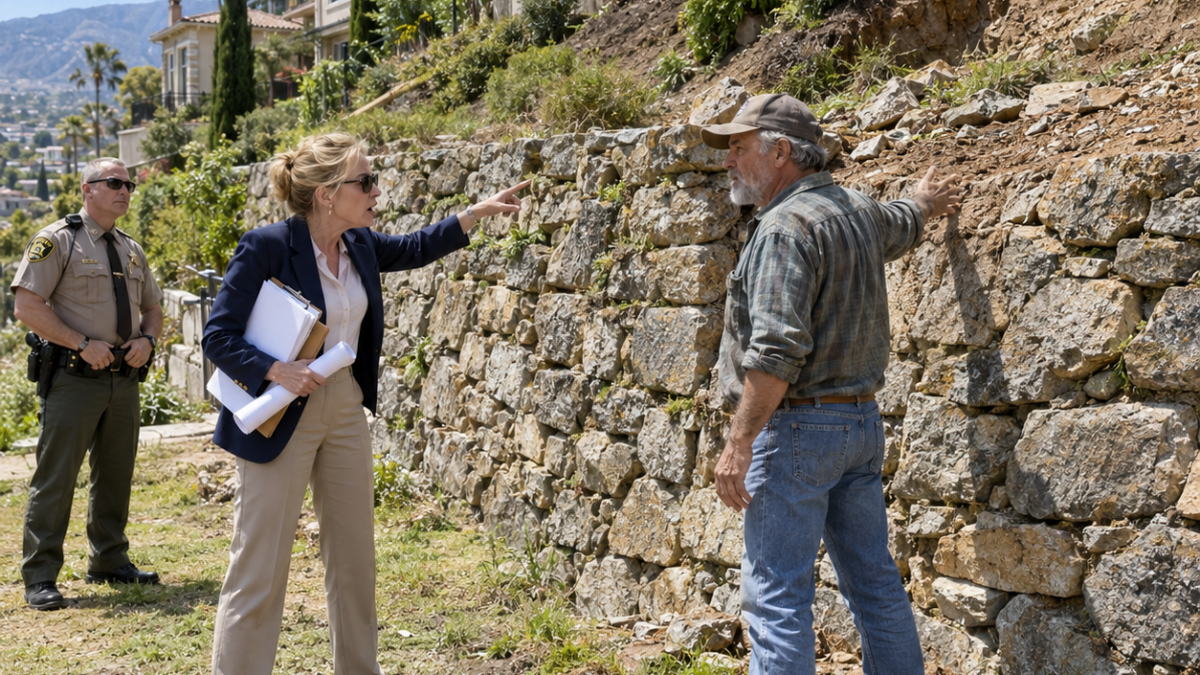
The skid steer was already running when Karen told the operator to tear down my wall.
Its diesel engine growled at the curb while the steel bucket lifted toward a hundred-year-old line of granite and fieldstone that had stood in front of my house longer than Sterling Ridge itself had existed. Karen stood beside the machine in a bright pink tracksuit, smiling like she had finally arranged the public execution she’d been promising me for months.
What she didn’t know was that the wall she called an “illegal eyesore” wasn’t merely holding back the soil in my yard.
It was holding up her entire hillside.
“Proceed,” she ordered.
I set my pruning shears into the garden bucket beside me.
The contractor put one boot on the skid steer’s step.
“Karen,” I said.
She turned.
I had been dealing with her long enough to recognize that expression. It wasn’t anger anymore. Anger had burned out weeks earlier.
This was satisfaction.
She had imagined this moment.
The machine.
The neighbors watching.
Me finally forced to stand there while she proved what happened to homeowners who refused to obey her.
“You’re making a catastrophic mistake,” I said.
She actually laughed.
“You’ve been saying that for a month, Mr. Caldwell.”
Her voice carried across the street.
Curtains were moving in windows.
Carlos Garcia and his wife stood on their porch uphill from me, their faces tense.
Karen pointed at the wall.
“You were given notice. You appealed. The board denied your appeal. You refused to remove the violation. The association is now exercising its right to cure the condition at your expense.”
The contractor looked from her to me.
He had the exhausted expression of a man who had been told this was a simple demolition job and had no interest in becoming part of a suburban civil war.
I looked at the bucket hanging a few feet from the first stones.
Then I looked uphill.
Sterling Ridge had been built on a steep grade. The newer houses climbed the slope behind my property in three broad tiers, each row sitting above the next like stadium seating.
Thirty homes.
Families.
Driveways.
Patios.
Retaining terraces.
Swimming pools.
Gas lines.
Water lines.
And beneath them, layers of clay-heavy fill placed there during development decades earlier.
All of it stopped, at the base of the hill, by the wall Karen was ordering a contractor to destroy.
I wasn’t guessing.
I knew.
I had blueprints.
A geotechnical report.
A structural engineer’s sealed opinion.
And a certified-mail receipt proving Karen had received every page.
Still, she had brought the machine.
That was the moment I finally understood something about her.
This had never been about architecture.
It had never been about property values.
It had never even been about the wall.
It was about whether Karen Henderson could tell another grown adult what to do and still be obeyed.
And she had finally chosen a battlefield where her ego could get somebody killed.
I stepped toward the contractor.
“I need you to read something before you touch that wall.”
Karen’s smile vanished.
“Don’t take anything from him.”
The contractor looked at her.
Then at me.
“Sir, I’ve got a signed work order from the association.”
“I know.”
I held out a thick folder.
“And I’m the property owner. Before you begin, you need to know exactly what that structure is.”
Karen moved between us.
“He is trying to intimidate you.”
“I’m trying to keep him from destroying thirty houses.”
The contractor froze.
Karen’s head snapped toward me.
“What did you just say?”
I looked at her.
“You heard me.”
For the first time that morning, she stopped smiling.
But to understand how we reached that curb with a demolition machine idling beside us, you have to understand why I bought the property in the first place.
I spent twenty years in the Army as a combat engineer.
People hear that title and imagine bridges, explosives, bulldozers, fortifications.
They aren’t wrong.
But engineering in the field teaches you something deeper.
Terrain doesn’t care about your intentions.
Gravity doesn’t care about your authority.
Soil doesn’t care whether you have a clipboard, a title, or a unanimous vote.
You can order a hill not to move all day long.
The hill will still follow physics.
After two decades of deployments, construction, demolition, route clearance, and enough unstable ground to last several lifetimes, I wanted something solid.
My wife, Sarah, wanted peace.
We found both at 121 Sterling Drive.
The house wasn’t remarkable.
A two-story brick-and-siding place built in the late 1950s.
Three bedrooms.
Old oak floors.
A deep front yard.
Mature maples.
But the property sat at the base of the hill, on a lot that existed long before Sterling Ridge subdivision was built around it.
And across the front boundary ran the wall.
Four feet high in most places.
Almost six feet where the grade changed near the east corner.
No mortar.
Just stone.
Granite, fieldstone, shale.
Each piece fitted by hand.
The face leaned slightly back into the earth, a traditional batter that told me the mason knew exactly what he was doing.
The first time I saw it, I crouched beside it for twenty minutes while the real estate agent waited.
Sarah finally came over.
PART 2
“You’ve barely looked inside the house.”
“Look at this.”
She stared at the wall.
“I am.”
“No, really look.”
She gave me the same patient expression she had perfected during my Army years.
“Jack, I’m looking at rocks.”
“It’s dry-stacked.”
“Congratulations.”
“The drainage is built into the whole structure. See how the face pitches?”
“I married an engineer.”
“You knew the risks.”
She laughed.
We bought the house.
For the first year, I spent weekends cleaning ivy from the wall, resetting a few loose stones, clearing drainage paths, and trying not to disturb what had already survived close to a century.
It became therapy.
There is something honest about stone.
You can’t flatter it.
You can’t bully it.
You can’t hold a meeting and reinterpret it.
A stone fits or it doesn’t.
A wall stands or it fails.
The simplicity felt good.
Our neighborhood, unfortunately, was governed by something far less stable.
The Sterling Ridge Homeowners Association.
When we moved in, the HOA was annoying but mostly harmless.
Annual dues.
Pool rules.
Common landscaping.
Standard suburban bureaucracy.
Then Karen Henderson became president.
Karen had lived in Sterling Ridge for twelve years.
She won the election because almost nobody voted.
Her campaign promise was “restoring pride and consistency.”
What that meant became apparent quickly.
Mailbox inspections.
Fence color notices.
Landscape-light restrictions.
Holiday decorating schedules.
Trash can enforcement.
Driveway parking warnings.
Aesthetic review.
The first time she came after me, it was over my mailbox.
The original property had a stone mailbox pillar that matched the wall.
Karen wanted every house to use the same black metal mailbox on the same pressure-treated post.
I received a notice giving me fourteen days to replace mine.
I wrote back politely.
My lot predated the subdivision.
The mailbox appeared on an original survey.
The governing documents contained a grandfather clause.
Matter closed.
Karen disagreed.
Her appeal rejection came by email.
FINAL DECISION REGARDING NON-COMPLIANT MAILBOX STRUCTURE.
Sarah read it over coffee.
“Ancillary structure capable of reasonable replacement,” she said. “That sounds expensive for something that holds junk mail.”
“They’re fining us a hundred dollars.”
“For a mailbox?”
“Yes.”
She took another sip.
“Pay it?”
“No.”
Sarah looked at me.
I wasn’t angry.
That was what worried her.
“You’re doing the engineer thing.”
“What engineer thing?”
“The one where you stop talking and start collecting documents.”
She knew me too well.
That afternoon, I drove to county records.
I pulled the master deed.
Development plats.
Original surveys.
Association declarations.
Recorded amendments.
The grandfather clause was clearer than I expected.
My lot was identified separately.
Existing improvements shown on the referenced survey were expressly exempt unless altered or replaced voluntarily.
The stone mailbox was there.
I sent Karen the documentation.
I copied the board.
I declined to pay the fine.
For almost two weeks, I heard nothing.
Then Karen came after the wall.
She didn’t mail the notice.
She hand-delivered it.
I found it wedged beneath my front door handle.
VIOLATION: UNAPPROVED PERIMETER FENCING MATERIAL.
FIELDSTONE/ROCK NOT PERMITTED.
All perimeter fencing was required to be white vinyl or approved cedar.
Thirty days to remove.
Five-hundred-dollar initial fine.
I stood on the porch reading it while Sarah came up behind me.
“What now?”
I handed her the page.
She stared at it.
Then looked at the wall.
“That’s not a fence.”
“I know.”
“It’s retaining dirt.”
“I know.”
“Does she?”
“She doesn’t care.”
That was when the conflict changed.
Karen wasn’t misreading something obscure.
She was intentionally forcing the wall into a category that suited her argument.
A retaining wall is not decorative perimeter fencing.
Anyone could see that.
But Karen had learned something from the mailbox dispute.
I would not simply pay.
So she needed a bigger weapon.
The wall became that weapon.
Instead of answering immediately, I walked uphill.
Carlos Garcia lived directly above us.
His backyard ended at a steep grassy grade descending toward my property.
He was trimming along the fence when I called his name.
“Morning.”
He shut off the weed trimmer.
“What’s up?”
“The HOA wants me to remove my stone wall.”
His face changed.
“The one down there?”
“Yes.”
“Why?”
“They’re calling it unapproved fencing.”
Carlos laughed.
Then realized I wasn’t joking.
“They can’t be serious.”
“They are.”
He looked downhill.
His house sat maybe seventy feet above mine.
“Would that affect the slope?”
“I don’t know exactly.”
That was true at the time.
“But taking out a retaining structure at the base of a hill is something I’d want an engineer involved in.”
Carlos slowly turned toward his house.
“What would you replace it with?”
“According to Karen? Cedar fence.”
He stared at me.
“Cedar.”
“Apparently it has better aesthetic harmony.”
“Jack.”
“Yes?”
“That wall is holding dirt.”
“I’m aware.”
He rubbed the back of his neck.
“That woman is insane.”
“I didn’t say that.”
“You didn’t have to.”
I had similar conversations with three other uphill neighbors.
I didn’t campaign.
I didn’t attack Karen.
I simply told them exactly what she had demanded.
Then the fines started.
Five hundred.
A thousand.
Two thousand.
Every letter contained stronger language.
Willful noncompliance.
Deliberate disregard.
Continued defiance.
Karen was writing a story where she was the responsible guardian of community standards and I was the dangerous homeowner who believed rules did not apply to him.
The HOA announced a special hearing at the next quarterly meeting.
PROPERTY 121 STERLING DRIVE.
Sarah read the notice at our kitchen table.
“She wants an audience.”
“Yes.”
“You think she already has the votes.”
“Yes.”
“Can you stop it?”
“Maybe.”
That night I called Marcus Grant.
Marcus and I had served together years earlier.
He left the Army, went to law school, and became the sort of civil litigator who enjoyed reading contracts the way normal people enjoyed sports.
We spent two hours on video.
I showed him everything.
Mailbox notice.
Fine.
Grandfather clause.
Wall violation.
Architectural standards.
Surveys.
Marcus leaned back.
“Your HOA president is either dishonest or spectacularly stupid.”
“Those aren’t mutually exclusive.”
He smiled.
“Fair point.”
“What do you think?”
“The wall obviously isn’t fencing. Your grandfather argument is strong. Her enforcement is sloppy.”
“Then why do I feel like that won’t matter at the meeting?”
“Because it won’t.”
I stared at him.
“She controls procedure. She controls the microphone. Her friends control the vote. She’ll declare your documentation irrelevant and call it settled.”
“So what do I do?”
“Create consequences outside the room.”
Marcus drafted a cease-and-desist letter.
It laid out the wall’s pre-existing status.
The grandfather clause.
The lack of authority for forced removal.
The financial exposure the association would face if it damaged my property.
Then he requested the minutes of the architectural committee meeting where the wall supposedly had been reviewed.
He also asked for the names and professional qualifications of the committee members who classified it as fencing.
We sent the letter certified.
It arrived three days before the meeting.
Karen never distributed it.
I found that out publicly.
The clubhouse was packed that night.
Karen sat at the center of the board table with two of her closest allies, Linda Parker and Susan Bell.
She wore navy instead of pink.
Her hair was perfectly sprayed.
She looked like she was presiding over Congress instead of a suburban HOA.
She opened with pool maintenance.
Then landscaping.
Then gate repairs.
Finally, she said, “We now come to a regrettable enforcement matter involving a homeowner who has refused repeated opportunities to comply.”
Every head turned toward me.
Sarah squeezed my hand.
Karen continued for ten minutes.
She called my wall deteriorated.
Unapproved.
Unsafe.
Inconsistent.
She showed a picture of white vinyl fencing.
Then a picture of my stone wall.
The implication was so absurd that several people shifted uncomfortably.
She concluded with the line I knew was coming.
“Mr. Caldwell appears to believe historic age somehow grants him immunity from community standards.”
Then she smiled.
“Mr. Caldwell, you may speak.”
I walked to the podium with one folder.
“My name is Jack Caldwell. I own 121 Sterling Drive.”
Karen rolled her eyes slightly.
“For the record, the structure being discussed tonight is not perimeter fencing.”
I held up the survey.
“It is a retaining wall that predates this association and the Sterling Ridge development itself.”
Karen interrupted.
“That is your interpretation.”
“No. That’s its physical function.”
A few people laughed.
She didn’t.
I continued.
“The governing documents also contain a grandfather clause specifically protecting existing structures shown on the original recorded survey.”
I held up another page.
“My wall is shown here.”
Susan Bell leaned toward Karen.
Karen whispered something.
I looked toward Carlos.
“More importantly, the board is proposing to remove a retaining structure at the bottom of a steep developed slope.”
Carlos sat forward.
“Several houses sit above that slope.”
Now more people were paying attention.
“If the board believes a cedar fence is an appropriate replacement for a load-bearing earth-retention structure, I would strongly suggest obtaining a licensed engineering opinion before taking that position.”
Karen slammed her palm beside the gavel.
“You’re fearmongering.”
“I’m asking for engineering.”
“You are trying to frighten your neighbors.”
“No.”
I looked uphill residents in the room.
“I’m telling them exactly what you’re proposing.”
Then I opened Marcus’s letter.
“Finally, my attorney sent the board a formal notice three days ago.”
Linda looked confused.
Susan turned toward Karen.
Karen’s face tightened.
“I have it here.”
I held it up.
“It requests the meeting minutes in which this wall was reviewed, along with the qualifications of the people who determined it could safely be removed.”
Carlos called out, “Did you get an engineer?”
Karen banged the gavel.
“Homeowners are not recognized from the floor.”
Another voice said, “Did you?”
“No further discussion.”
The room erupted.
Karen tried to move immediately to a vote.
Susan stopped her.
“I think we should table this.”
Karen stared at her.
“We’ve already discussed it.”
“No,” Susan said. “You discussed it.”
That was the first crack in Karen’s control.
The enforcement action was tabled pending legal review.
The fines stopped.
But I knew we had only delayed her.
Humiliation is dangerous to people who confuse authority with identity.
Karen didn’t leave that meeting thinking she had made a mistake.
She left thinking I had embarrassed her.
Marcus called the next morning.
“You bought time.”
“I need more than time.”
“Agreed.”
“I want to know exactly what that wall is doing.”
“Now you’re thinking like an engineer.”
I went back to county records.
Then city planning.
Then old development files.
Sterling Ridge had been developed in phases beginning in the late 1970s.
The original land sloped much more sharply than the finished neighborhood suggested.
Developers had cut into portions of the hill and filled others, producing flattened building pads.
I found grading plans.
Soil reports.
Drainage drawings.
Utility maps.
Retaining details.
The geology was ugly.
Clay.
Weathered shale.
Layers prone to movement when saturated.
I remembered standing in war zones looking at soil that could swallow a truck after rain.
This was different.
But gravity was gravity.
Then, late one Thursday afternoon, I found the drawing.
It was folded inside a set of old phase-one plans.
Blue ink faded almost gray.
MASTER GRADING AND SLOPE STABILIZATION.
I spread it beneath the records-room light.
Lot 1A.
My lot.
121 Sterling Drive.
A line marked the wall.
Then I saw the note.
EXISTING DRY-STACKED STONE RETAINING STRUCTURE TO REMAIN.
PRIMARY BASAL RETENTION FOR PHASE I TERRACING.
DO NOT REMOVE OR ALTER WITHOUT GEOTECHNICAL REVIEW.
CRITICAL TO SLOPE STABILITY, TIERS 1–3.
I read it twice.
Then a third time.
The room seemed to become very quiet.
I traced the uphill lots.
Carlos.
The Millers.
The Pattersons.
The Wongs.
Almost thirty houses.
The developers had not built a new reinforced concrete retaining system along the bottom.
They had relied on the existing wall, likely because its mass and geometry already served the purpose they needed.
They had integrated an old farm wall into the modern subdivision.
The structure Karen wanted replaced with cedar planks was literally part of the engineered slope system.
I photographed the document, requested a certified copy, then called Marcus from the parking lot.
He answered immediately.
“What?”
“I found it.”
“What?”
“The wall.”
A pause.
“What about it?”
“It’s designated.”
“As what?”
“Primary basal retaining structure for phase one.”
Silence.
“How many houses?”
“About thirty.”
Marcus said nothing for several seconds.
Then: “Jack.”
“I know.”
“Do not call Karen.”
“I wasn’t planning to.”
“Do not email the board.”
“I know.”
“Hire an engineer.”
“Already thinking it.”
“And certified mail everything.”
“I know.”
“God, I love you.”
“Sarah still objects.”
I hired Dr. Evelyn Albright.
She had thirty years of structural and geotechnical consulting experience.
She did not smile much.
I liked her immediately.
She walked the wall from end to end.
Measured batter.
Evaluated drainage.
Reviewed stones.
Used ground-penetrating radar in several areas.
Studied the slope.
Then she reviewed the original grading plan.
Her eyebrows lifted.
“Well.”
“That good or bad?”
“Good for your argument.”
“And the neighborhood?”
“That depends on whether your HOA president owns heavy equipment.”
I laughed.
She didn’t.
“I’m serious.”
She pointed toward the hill.
“This slope is old fill over problematic native material. The wall is functioning as a gravity retaining structure at the toe.”
“So the 1978 plan was right.”
“Very.”
“What happens if someone removes it?”
She looked uphill.
“Best case? Significant localized movement requiring emergency stabilization.”
“And worst?”
“Progressive slope failure.”
“How progressive?”
“Multiple lots.”
My stomach tightened.
She continued.
“Jack, nobody should disturb this wall without a designed shoring and replacement plan. Not one section.”
“What if somebody drives a skid steer into it?”
She stared at me.
“Why are you asking that?”
I told her.
Her expression changed.
“They threatened mechanical demolition?”
“Yes.”
“Did you notify them what you found?”
“I will.”
“Do that before anything else.”
Her report arrived four days later.
Stamped.
Signed.
Direct.
Removal presented a high risk of destabilizing the toe of the slope.
Uncontrolled demolition could lead to soil movement and damage to uphill property.
Any alteration required engineered temporary support and a permanent replacement system.
Marcus read it.
“This is over.”
“You don’t know Karen.”
“I know liability.”
Together, we prepared a formal notice.
Each board member received one personally.
So did the HOA’s management company.
So did its lawyer.
Certified mail.
Signature required.
Inside:
The original development plan.
The engineer’s note.
Dr. Albright’s report.
Photographs.
Property survey.
A concise legal notice explaining that the wall formed part of the engineered stability system supporting portions of Sterling Ridge.
The final paragraph was Marcus at his most dangerous because it contained no emotion at all.
The association and its directors were now on actual notice.
Any intentional interference after receipt could expose the HOA—and potentially individual decision-makers—to substantial liability if damage resulted.
No exaggeration.
No threats.
Just notice.
I sent copies to city engineering and my insurer.
Then I installed two cameras.
Sarah watched me mount the second one.
“You really think she’ll still try?”
“I hope not.”
“That isn’t what I asked.”
I tightened the bracket.
“Yes.”
She looked uphill.
“What kind of person reads an engineering report saying thirty homes could be at risk and keeps going?”
“The kind who thinks backing down is worse.”
Two weeks passed.
Nothing.
No emails.
No fines.
No Karen.
I started to think maybe Marcus was right.
Then the bulletin arrived.
REMEDIAL ACTION NOTICE.
Tuesday, October 12.
8:00 a.m.
Heavy equipment would be operating near 121 Sterling Drive for removal of a noncompliant structure.
Sarah read it standing in the kitchen.
Her face went white.
“She’s doing it.”
“Yes.”
“She got the letter.”
“Yes.”
“You have proof?”
I put the signed certified-mail receipt on the table.
“She signed for it herself.”
Sarah sat down.
“Jack, what if something goes wrong?”
“It won’t.”
“You cannot promise me that.”
She was right.
I sat across from her.
“No. I can’t.”
Her hands were cold.
“What are you going to do?”
“Show the contractor the report before he touches anything.”
“And if Karen tells him not to listen?”
“He has a license, insurance, employees, and a business. No legitimate contractor is risking all of that after seeing a stamped engineering warning.”
“You’re sure?”
“I believe it.”
She looked at me.
“That isn’t the same thing.”
“No.”
I reached across the table.
“But I’ve also notified city engineering. If she moves forward, they know what’s happening.”
Sarah closed her eyes.
“This is insane.”
“Yes.”
“All because she wants the wall to look different.”
“No.”
Sarah opened her eyes.
“All because she wants to win.”
Tuesday morning was cold and perfectly clear.
At 7:53, the flatbed arrived.
I watched it through the security-camera feed.
The contractor unloaded a skid steer.
At 8:02, Karen’s white SUV pulled up.
She stepped out wearing that pink tracksuit.
Maybe it was coincidence.
Maybe she liked the color.
But after everything that happened, I can’t see pink without thinking about poor judgment.
I walked outside carrying the folder.
The scene looked staged.
Machine.
Wall.
Neighbors.
Karen.
She smiled.
“Good morning, Mr. Caldwell.”
I ignored her and approached the contractor.
“My name is Jack Caldwell. I own the property.”
He nodded.
“Rick Mason.”
“Before you begin, I need you to review this.”
Karen stepped toward us.
“You don’t.”
Rick looked at her.
“What is it?”
“More nonsense,” she said. “He’s been delaying enforcement for months.”
I handed Rick the report.
“It’s a structural engineering assessment of the wall you’ve been hired to remove.”
That got his attention.
He opened the folder.
Karen kept talking.
“The association owns enforcement rights under the declaration. You are indemnified under your contract.”
Rick held up one hand.
“Ma’am.”
She stopped.
He read.
First page.
Second.
Blueprint.
The longer he read, the more his face changed.
He stepped away from the machine.
Read the engineer’s note again.
Then he looked uphill.
Thirty houses.
He walked to the wall and touched one of the larger stones.
He crouched.
Looked at the grade.
Then he turned.
“You knew about this?”
Karen folded her arms.
“It’s still noncompliant.”
“That’s not what I asked.”
“The HOA’s counsel—”
“Did you know this wall is part of the slope-retention system?”
Karen’s voice sharpened.
“It is a fence.”
Rick’s jaw tightened.
“No, ma’am.”
He held up Dr. Albright’s report.
“It’s a gravity retaining wall at the toe of a developed hillside.”
“It violates our architectural standards.”
“I don’t care if it violates a dress code.”
A neighbor laughed.
Karen went red.
“You have a contract.”
“My contract is for removal of a masonry fence.”
“This is the structure.”
“This isn’t fencing.”
“You agreed to perform the work.”
“Based on what you told me.”
“I am the HOA president.”
Rick stared at her.
Then he looked at me.
“I’m not touching it.”
Karen’s mouth fell open.
“Excuse me?”
“I wouldn’t put a bucket on that wall without engineered shoring if you paid me ten times the contract.”
“You cannot walk away.”
“I absolutely can.”
“Your company will be in breach.”
“You misrepresented the scope.”
“I did no such thing.”
“You called it decorative masonry.”
“It is.”
Rick pointed uphill.
“Decorative masonry doesn’t hold houses up.”
Karen stepped closer.
“Do your job.”
His face hardened.
“My job is not to trigger a landslide.”
That was when the black city sedan arrived.
I recognized Michael Davies from city engineering.
He stepped out with a tablet.
“Morning.”
Karen whirled toward him.
“Who are you?”
“Michael Davies. City engineering.”
He looked at the skid steer.
Then the wall.
Then the folder in Rick’s hands.
“Anybody started work?”
“No,” Rick said.
“Good.”
Karen marched toward Davies.
“This is private HOA enforcement. The city has no jurisdiction.”
Davies gave her the expression engineers reserve for people who say things with great confidence and no understanding.
“I have jurisdiction over slope hazards that may affect multiple residential properties and public infrastructure.”
“There is no hazard.”
He looked at me.
“Mr. Caldwell?”
I handed him the certified plans.
He had already seen digital copies.
He compared the wall to the drawing.
Then addressed Rick.
“You were hired to remove this?”
“Yes.”
Rick pointed at Karen.
“I was told it was nonstructural decorative fencing.”
Davies slowly looked at her.
Karen folded her arms tighter.
“This is harassment.”
“No,” Davies said. “This is a stop-work situation.”
“You can’t stop work that hasn’t started.”
“Then we’re lucky.”
He tapped his tablet.
“I’m issuing a formal stop-work order against any alteration of this wall pending structural review.”
Karen’s face drained.
“The HOA authorized removal.”
Davies looked almost confused.
“That doesn’t override physics.”
Carlos Garcia came down the hill.
His wife Maria followed.
“What happens if the wall comes out?” Carlos asked.
Davies turned toward him.
“Which property?”
“216 Ridgecrest.”
He looked at the map.
“Tier two.”
“Yes.”
Davies chose his words carefully.
“The wall appears to provide basal support for the terraced fill. Removal without temporary stabilization could cause soil movement.”
“My house?”
“Potentially.”
Carlos looked at Karen.
His face changed in a way I will never forget.
Not rage.
Fear.
He had two children.
A seven-year-old boy and a four-year-old girl.
Their swing set stood near the back of the property.
“My kids play back there.”
Karen waved a hand.
“This is being exaggerated to frighten everyone.”
Davies turned sharply.
“Ma’am, the original engineer wrote ‘critical to slope stability.’ The current licensed engineer says removal creates a high risk of slope failure. That is not exaggeration.”
Karen said nothing.
He continued.
“Did you receive Mr. Caldwell’s notice?”
“I receive many communications.”
“Did you receive the engineering report?”
Her silence answered.
I pulled the certified-mail receipt from the folder.
“She signed for it.”
Carlos stared at her.
“You knew?”
“I knew he was making claims.”
“It was an engineer’s report.”
“His engineer.”
Davies’s voice went cold.
“That is not how engineering works.”
Now more neighbors were outside.
Mrs. Miller.
The Pattersons.
Two families from the second tier.
People who had initially come to watch a demolition were realizing they had almost watched the first step of a disaster.
Rick returned to his truck.
Karen stepped in front of him.
“Where are you going?”
“To load my machine.”
“You’re under contract.”
“My lawyer can discuss that with yours.”
“You can’t leave me with this.”
Rick stared at her.
“That’s exactly what I’m doing.”
He loaded the skid steer.
Strapped it down.
Then came over to me.
“You saved my company a nightmare.”
“You did the right thing once you saw the information.”
He nodded.
Then quietly added, “That woman told me you were a retired guy refusing to remove an old decorative fence.”
I looked at Karen.
“Sounds like her.”
Rick drove away.
The silence after that truck disappeared was almost beautiful.
Karen stood on the sidewalk alone.
No demolition crew.
No machine.
No triumphant audience.
Just neighbors coming closer.
Davies photographed the wall.
Carlos confronted her first.
“My house is up there.”
Karen said nothing.
“My children are up there.”
“I would never endanger children.”
“You brought an excavator.”
“A skid steer,” I said automatically.
Carlos looked at me.
“Jack.”
“Sorry.”
He turned back to Karen.
“You knew an engineer warned you.”
Karen finally found her voice.
“The board believed Mr. Caldwell was manipulating the issue to avoid compliance.”
Mrs. Miller walked over.
She was seventy-three and normally spoke so softly you had to lean toward her.
Not that morning.
“You fined my husband because our garden hose was visible.”
Karen looked at her.
“This is not the time.”
“Yes, it is.”
Mrs. Miller’s voice shook.
“You threatened a lien over our trim color.”
Another neighbor stepped forward.
“You fined us for a basketball hoop.”
Someone else:
“You threatened us over wind chimes.”
Another:
“You made my daughter move her graduation banner.”
Years of small humiliations suddenly had a place to go.
Karen looked around.
She had relied on those people being isolated.
Each homeowner had believed their own fight was too small to justify conflict.
Now they were standing together.
Karen pointed at me.
“This is exactly what he wanted. He has been turning you against the board for months.”
“No,” Carlos said.
“You did that.”
Karen looked for help.
Nobody came.
She walked rapidly to her SUV.
Someone shouted, “Resign!”
Then another person did.
Then five.
Karen got into the vehicle and drove away.
That afternoon, my phone barely stopped ringing.
People wanted to know what happened.
What the engineering report said.
Whether their houses were safe.
Whether Karen could return with another contractor.
Davies issued written confirmation of the stop-work order.
The city opened a formal review of the hillside retaining system.
Dr. Albright met with city engineering.
They agreed the wall was currently stable but recommended monitoring and drainage improvements.
Nothing dramatic.
No evacuation.
No imminent collapse.
The danger had been the demolition itself.
That distinction mattered.
I did not want people panicking over a hill that had stood safely for decades.
Carlos and Maria came over that evening.
Maria carried a bottle of wine.
Carlos looked exhausted.
“We owe you.”
“No.”
“Jack, if you hadn’t found that blueprint—”
“The wall was probably strong enough to resist the first bucket strike.”
“Probably?”
I looked at him.
“Don’t ask engineering questions you don’t want answered.”
Maria closed her eyes.
Carlos poured the wine.
“We’re removing Karen.”
“Follow the bylaws.”
He stared at me.
“She almost dropped my backyard into your kitchen and you’re telling me to follow procedure?”
“Yes.”
“Why?”
“Because if you don’t, she becomes the victim.”
That stopped him.
“Do it correctly.”
The petition started the next morning.
Recall Karen.
Recall Linda.
Recall Susan.
At first the organizers wanted only Karen.
Then neighbors began reviewing meeting minutes.
The other two had voted with her.
Approved fines.
Signed enforcement letters.
Supported the demolition.
Within forty-eight hours, more than eighty percent of eligible homeowners had signed.
Marcus was almost cheerful when I called.
“She handed you actual notice plus subsequent intentional conduct.”
“In English?”
“She was warned in writing that removing the wall could destabilize a neighborhood.”
“I know.”
“She proceeded anyway.”
“I know.”
“Jack, lawyers have dreams about fact patterns like this.”
“We need to make sure the wall is protected.”
“We will.”
We filed suit.
The main request was injunctive relief.
A court order preventing the HOA from interfering with the wall.
We also sought reimbursement for engineering costs, attorney fees where recoverable, and damages arising from the harassment and attempted unauthorized entry onto my property.
Marcus named the association.
Then the individual directors involved in the decision.
That changed everything.
The HOA’s insurer became involved immediately.
Insurance companies don’t care who wins neighborhood arguments.
They care about exposure.
Their lawyers requested documents.
I gave them everything.
Mailbox dispute.
Wall notice.
Appeals.
Certified letters.
Delivery receipts.
Engineering report.
Original development plan.
Security video.
The insurer’s lead attorney, Daniel Price, came to Marcus’s office.
Three other lawyers joined by video.
They watched the footage.
Karen standing in pink.
Rick reading the report.
Karen ordering him to continue.
Davies arriving.
Carlos confronting her.
When the video ended, Price sat silently.
Then he asked one question.
“When did Mrs. Henderson receive Dr. Albright’s report?”
I handed him the receipt.
He looked at the date.
Then the demolition bulletin.
Ten days apart.
“She signed personally?”
“Yes.”
He turned to one of the other attorneys.
“She had actual notice.”
The attorney nodded.
Price looked back at me.
“Did any other board members sign?”
“Yes.”
Linda and Susan each received individual copies.
Marcus handed him their receipts.
Price’s mouth tightened.
Insurance coverage becomes complicated when actions move from negligence into intentional or willful misconduct.
Nobody told me the policy position that day.
They didn’t need to.
The board’s protection was suddenly uncertain.
A week later, Sterling Ridge called an emergency membership meeting.
Not at the clubhouse.
At the local high school auditorium.
Almost everyone came.
Sarah and I sat near the front.
Marcus sat beside me.
The insurer sent counsel.
The association’s regular lawyer attended too.
Karen arrived late.
She looked different.
No pink.
Gray suit.
No dramatic entrance.
She sat at the board table with Linda and Susan.
Carlos sat three rows behind us.
The meeting was called to order by an outside attorney appointed to moderate.
He explained the situation clinically.
No insults.
No accusations.
Just risk.
The original development records designated my wall as critical slope-retention infrastructure.
A licensed engineer confirmed its structural function.
The city had issued a stop-work order.
The board received written notice before scheduling demolition.
The HOA faced litigation.
The insurance carrier was reviewing coverage.
The neighborhood sat in absolute silence.
Then came the sentence Karen had probably never imagined hearing.
“The carrier has advised that continued coverage of certain association risks may depend upon immediate corrective governance measures.”
People shifted.
The lawyer continued.
“In practical terms, the current board’s continued service presents significant problems.”
Linda resigned first.
She stood.
Her hands trembled.
“I should have asked more questions.”
No one shouted.
No one booed.
She sat down crying.
Susan resigned next.
She blamed Karen at first.
Then stopped halfway through her statement.
“I signed the notice too,” she said quietly. “That’s on me.”
Then Karen stood.
She unfolded a printed statement.
For a moment I wondered if she might fight.
She didn’t.
“My actions were taken in what I believed to be the best interest of community standards.”
Someone laughed bitterly.
The moderator looked toward the audience.
“Please.”
Karen continued.
“I disagree with many of the allegations made against me. However, in order to protect the association from further division, I hereby resign as president and director effective immediately.”
That was it.
No apology.
No admission.
No gavel.
Karen sat down.
The room remained silent.
I expected cheering.
There was none.
The humiliation was heavier without it.
She had spent years needing everyone to see her authority.
Now two hundred neighbors watched her become irrelevant in less than a minute.
Carlos was elected interim president.
A full election followed.
The new board included people who had once avoided HOA meetings entirely.
Marcus negotiated the lawsuit.
The settlement was better than I expected.
The HOA reimbursed my engineering expenses.
My legal costs were covered.
All fines were canceled.
The association issued a written apology to Sarah and me and mailed a correction notice to every homeowner.
But the most important term concerned the wall.
A consent order permanently recognized it as protected critical retaining infrastructure.
The HOA could not alter it.
No future board could classify it as fencing.
And because the wall provided structural benefit to substantial portions of the common development, the association accepted responsibility for a defined share of professional inspection and necessary structural maintenance.
I read that clause twice.
Sarah leaned over my shoulder.
“So the people who tried to make us pay to demolish it now have to help maintain it?”
“Correct.”
She smiled.
“That feels illegal.”
“It’s called irony.”
The city conducted additional slope review.
Engineers added monitoring points.
Drainage was improved upslope.
The wall itself required only minor repairs.
A few reset stones.
Improved runoff control.
Nothing dramatic.
The old mason had known his business.
Karen sold her house three months later.
Not immediately.
She tried to stay.
But Sterling Ridge had changed.
People no longer feared her.
That may have been worse for her than open hostility.
She would walk to the mailbox and nobody rushed inside.
She would attend a gathering and conversations continued without including her.
The authority she had built around herself simply vanished.
Eventually a FOR SALE sign appeared.
The house sold below her original asking price.
She moved out of state.
I never saw her again.
The new board rewrote the architectural standards.
Carlos invited me to help.
I refused the first time.
Then Sarah reminded me what happened when sensible people avoided HOA work.
So I agreed to sit on an advisory committee.
We removed subjective language.
No more “aesthetically inappropriate” without definition.
No more enforcement based on personal taste.
Historic structures received explicit recognition.
Structural features required engineering review before modification orders could be issued.
Major enforcement actions required full-board votes recorded in public minutes.
Homeowners received real appeal procedures.
The old three-person aesthetic committee disappeared.
Sterling Ridge slowly became boring.
That was an improvement.
People painted doors.
Planted trees.
Put up basketball hoops.
Someone installed wind chimes directly across from Karen’s old house.
I suspected that one was intentional.
A month after the settlement, I received an envelope from the HOA insurer.
Inside was a check for five thousand dollars.
Settlement compensation for harassment and related distress.
I stared at it.
Sarah came into the kitchen.
“What’s that?”
“Five grand.”
“For?”
“Everything.”
She looked at the check.
“You earned it.”
“Doesn’t feel like mine.”
“What are you thinking?”
I endorsed it.
Then wrote:
Sterling Ridge Community Landscape Fund.
Sarah smiled.
“Trees?”
“Trees.”
I mailed it to Carlos.
He called the next day.
“You know you didn’t have to do this.”
“I know.”
“You sure?”
“Yes.”
“What kind of trees?”
“Not my problem.”
“That’s how this whole thing started.”
“Fine. Native species. Good root structure. No planting over utilities.”
Carlos laughed.
“Engineer.”
Several weeks later, the neighborhood threw a cookout.
They called it a wall party.
I hated the name.
Everyone else loved it.
My front yard filled with folding chairs.
Coolers.
Casseroles.
Paper plates.
Children.
The wall that had become the center of a legal battle disappeared beneath people sitting on it, leaning against it, placing drinks on it.
At one point I saw two kids walking along the top like a balance beam.
My combat-engineer instincts nearly stopped my heart.
Sarah caught my arm.
“Leave them.”
“They could fall.”
“They’re four feet up.”
“That’s enough.”
“Jack.”
I forced myself to relax.
Carlos stood at the grill.
“You know what the funniest part is?”
“What?”
“She hated that wall because it looked old.”
I glanced toward the stones.
“Yep.”
“And now it’s probably the most legally protected object in Sterling Ridge.”
“Also true.”
He handed me a burger.
“My homeowners insurance company sent me a letter.”
I stiffened.
“What kind?”
“Nothing bad. They just wanted confirmation of the city review.”
“Sorry.”
“Don’t apologize.”
He looked uphill.
“I keep thinking about that morning.”
“So do I.”
“What if Rick had started before you got outside?”
“He wouldn’t have gotten far.”
“You don’t know that.”
“No.”
Carlos turned toward me.
“My daughter’s bedroom is at the back of the house.”
I knew.
He swallowed.
“I was mad at Karen before. For fines. Rules. Stupid stuff.”
He looked at the wall.
“But when Davies said slope failure…”
His voice trailed off.
I put my hand on his shoulder.
“It didn’t happen.”
“Because you wouldn’t back down.”
“Because the documents existed.”
“You found them.”
“Because Karen pushed too far.”
Carlos shook his head.
“You really hate being thanked.”
“Yes.”
“Why?”
I thought about it.
“Because the wall was mine.”
He waited.
“I would have fought for it anyway.”
Carlos nodded.
“Maybe. But you told us before you knew exactly what it was doing.”
That was true.
I had warned the uphill neighbors before finding the blueprint.
Not because I knew thirty homes were at risk.
Because it was obvious that removing a retaining structure without engineering review was reckless.
“That’s what neighbors are supposed to do,” I said.
Carlos looked toward the crowd.
“Maybe we forgot.”
We had.
Sterling Ridge had become a neighborhood of private houses rather than a community.
Everyone dealt with Karen individually.
Paid individually.
Complained individually.
Feared retaliation individually.
The strongest thing she controlled was not the rules.
It was isolation.
Once people began comparing stories, she lost half her power.
Once they saw the wall almost come down, she lost the rest.
Old Mr. Miller joined me near sunset.
He held a paper plate loaded so heavily with potato salad it was bending in the middle.
“I’ve lived here twenty years.”
“So I’ve heard.”
“I hated the HOA for nineteen.”
I laughed.
“Why’d you stay?”
“My wife likes the kitchen.”
Fair answer.
He looked at the wall.
“I paid every fine.”
“Even the hose?”
“Two hundred dollars.”
“Why?”
“Easier.”
He shrugged.
“Wrong trim shade. Hose. Trash can. Christmas lights one day early.”
He shook his head.
“You know what I always told myself?”
“What?”
“It’s only money.”
The laughter from the yard drifted toward us.
“But it wasn’t.”
“No.”
“It was permission.”
I looked at him.
“Every time we paid something stupid just to make her go away, we taught her she could do it again.”
That was exactly right.
Mr. Miller stared at his potato salad.
“I wish I’d understood that earlier.”
“You understand it now.”
He smiled.
“Carlos says fines need hearings now.”
“They do.”
“Maybe I’ll leave my hose out.”
“Go wild.”
Later, after most people left, Sarah stood beside me.
Sunset turned the upper houses gold.
The wall cast a long shadow across the grass.
“You won,” she said.
I looked at her.
“Did I?”
“Oh, don’t do that.”
“Do what?”
“That philosophical thing where you pretend winning is complicated.”
I laughed.
“Karen resigned. The wall is protected. We got our money back. The new board is sane. She moved away.”
“When you put it like that…”
“You won.”
I put an arm around her.
“We won.”
She leaned her head against my shoulder.
“You scared me.”
“I know.”
“That morning.”
“I know.”
“I thought that machine was going through the wall.”
“So did I for about thirty seconds.”
She lifted her head.
“You told me the contractor would stop.”
“I was projecting confidence.”
“I hate when you do that.”
“I know.”
She looked toward the stones.
“Why did you love this thing so much?”
“The wall?”
“Yes.”
I thought back to the day we bought the house.
Before Karen.
Before notices.
Before engineering reports.
Before court orders.
“I think because somebody built it carefully.”
Sarah waited.
“Whoever made it probably never imagined this neighborhood. Never imagined HOAs, hillside development, lawyers, city engineers.”
I ran my hand across one of the stones.
“He just did the work right.”
“That’s very you.”
“No mortar. No shortcuts. Every stone depending on the one beside it.”
Sarah smiled.
“You’re getting philosophical again.”
“Sorry.”
“Keep going.”
I looked uphill.
“Turns out the neighborhood worked the same way.”
One house alone couldn’t stop much.
One homeowner could be threatened.
One family could be fined.
One retiree could be intimidated.
One couple could decide fighting wasn’t worth the money.
But the moment people started supporting one another, Karen’s whole system failed.
A wall isn’t strong because of one stone.
It’s strong because of how the stones carry weight together.
Months passed.
Then years.
The wall remained.
City engineering inspected it annually at first.
Then less frequently once monitoring showed no movement.
A few drainage improvements reduced water pressure during storms.
The HOA paid its share without argument.
Carlos served two terms as president.
He complained constantly and did a good job.
Mrs. Miller joined the architectural review panel.
The same woman who once trembled when speaking to Karen became notorious for asking contractors, “Do we actually have authority to require this?”
People loved her.
Karen’s old allies either apologized or disappeared from neighborhood politics.
Linda eventually came to my house.
It was almost a year after the demolition attempt.
She stood beside the mailbox looking embarrassed.
“Can we talk?”
I invited her onto the porch.
She held an envelope.
“What’s this?”
“My copy of the original vote.”
I opened it.
Board minutes.
The meeting where Karen pushed to authorize self-help demolition.
Linda’s signature was there.
Susan’s.
Karen’s.
“You already gave this to the lawyers.”
“I know.”
“Then why bring it?”
“Because I wanted to tell you something.”
She sat.
“I knew we didn’t have an engineer.”
I said nothing.
“Karen told us your lawyer was bluffing.”
“Okay.”
“She said the old development note had no legal force.”
“Okay.”
“She said your engineer was being paid to scare us.”
I waited.
Linda looked down.
“I wanted to believe her.”
“Why?”
“Because if she was wrong, then I had been wrong for years.”
That was more honest than I expected.
She continued.
“I signed fines. I voted with her. I defended her.”
Her eyes filled.
“It became easier to believe every homeowner was difficult than admit we were hurting people.”
I handed the envelope back.
“You don’t need me to forgive you.”
“I’d like you to.”
I thought about it.
Then I nodded.
“I do.”
She cried quietly.
Before leaving, she touched the stone mailbox Karen had originally tried to make me remove.
“She really hated this thing.”
“Yes.”
“Why?”
“Because she couldn’t control it.”
Linda laughed through tears.
That answer applied to more than the mailbox.
The Sterling Ridge Community Landscape Fund planted twenty-two trees.
Native maples.
Oaks.
Dogwoods.
I checked the plan before installation.
Carlos accused me of being physically incapable of minding my own business.
He was right.
Three of those trees went into the common green beside the entrance.
A small bronze plaque was installed there.
It didn’t mention me.
I insisted on that.
It read:
STERLING RIDGE COMMUNITY GROVE
PLANTED BY NEIGHBORS FOR NEIGHBORS.
That was enough.
One autumn evening, years after the conflict, I walked the wall alone.
I still did that sometimes.
Checked for movement.
Cleared leaves from drainage paths.
Reset small stones.
Near the east corner, I found one rock slightly displaced.
I crouched.
Sarah came outside.
“You’re fixing it again?”
“Maintenance.”
“It has professional maintenance now.”
“They won’t be here until spring.”
“You realize normal people don’t inspect walls recreationally.”
“Normal people buy vinyl.”
She laughed.
I reset the stone.
Then sat on the top course.
The hill behind us was quiet.
Lights turned on in windows.
Carlos’s children were older now.
His daughter, the little girl whose bedroom had been uphill from the wall, was learning to drive.
The Millers had grandchildren.
New families had moved in.
Some had no idea who Karen was.
That pleased me.
Not every bad chapter deserves to become permanent neighborhood mythology.
But every once in a while, someone new would ask why the HOA paid for inspections of an old stone wall on private property.
Carlos usually told them.
Apparently his version got more dramatic every year.
In one version, Karen arrived with a bulldozer.
In another, police blocked the entire street.
I corrected him twice.
Then gave up.
The facts were dramatic enough.
A woman tried to destroy something she didn’t understand because she believed authority meant she didn’t have to understand it.
That was the whole story.
And maybe that was the part worth remembering.
Not Karen.
Not the lawsuits.
Not the pink tracksuit.
The mistake.
She saw old stone and assumed obsolete.
She saw resistance and assumed arrogance.
She saw a homeowner and assumed weakness.
She saw rules and assumed they belonged to whoever held the gavel.
She never asked what the wall did.
That question would have saved her everything.
Her presidency.
Her reputation.
Her legal expenses.
Her house.
Her standing in a community where she once believed nobody dared challenge her.
Instead, she ordered a machine toward it.
The wall did what it had done for almost a century.
It held.
Not because it shouted.
Not because it threatened.
Because it had been built correctly.
Stone against stone.
Weight distributed.
Pressure absorbed.
Each piece supporting another.
That evening Sarah sat beside me.
She rested her hand on the wall.
“Still solid?”
“Very.”
“Good.”
We watched the lights come on across Sterling Ridge.
Thirty homes rising above us.
Families eating dinner.
Kids doing homework.
Dogs barking behind fences.
Normal life.
Peaceful life.
Everything Karen had almost risked because she couldn’t stand being told no.
I looked down at the same granite stones she once called an illegal eyesore.
The HOA had tried to tear them down.
Instead, the wall outlasted Karen, outlasted her board, outlasted every fine and threat she threw at me—and in the end, the neighborhood finally understood what the old mason had known a century earlier:
You don’t measure the value of a wall by how pretty it looks.
You measure it by what falls apart when you remove it.
I thought that would be the end of it.
I was wrong.
Three weeks after Karen resigned, a certified letter arrived from the city engineering department requesting my presence at a formal hillside safety review.
The notice listed the addresses of twenty-eight homes above mine.
Carlos received one too.
So did the Millers, the Pattersons, and every other homeowner whose property sat on one of the three terraced levels supported by the slope.
Sarah read the letter over my shoulder.
“Should we be worried?”
“No.”
“You said that too fast.”
I set the letter down.
“The city isn’t saying the hill is failing. They’re documenting what exists and determining what maintenance plan should be required.”
“So this is because of Karen?”
“This is because Karen forced everyone to finally look at something nobody had looked at in forty years.”
That was the strangest consequence of the entire fight.
Karen had nearly caused a disaster.
But by trying to destroy the wall, she had also exposed a piece of forgotten infrastructure the neighborhood had depended on for decades without realizing it.
The hearing was held in a municipal conference room.
No dramatic courtroom.
No television cameras.
Just fluorescent lights, folding tables, engineers, homeowners, maps, and enough technical drawings to make most people’s eyes glaze over.
I loved it.
Carlos did not.
He sat beside me studying a cross-section of the hillside.
“Jack.”
“Yeah?”
“What am I looking at?”
“Your house.”
“That blob?”
“Yes.”
“That does not make me feel better.”
I pointed to the shaded layers beneath it.
“That’s compacted fill.”
“And the line at the bottom?”
“My wall.”
He stared.
“So my house is basically sitting on dirt leaning against your rocks.”
“That is a deeply unfair summary of professional geotechnical engineering.”
“But technically?”
“Technically, yes.”
Carlos leaned back.
“I miss when I thought HOA meetings were boring.”
Michael Davies, the city engineer, called the room to order.
Dr. Albright sat beside him.
A geotechnical consultant hired by the city was there too.
The first thing Davies did was calm everyone down.
“There is no evidence of imminent slope failure.”
You could hear thirty people exhale.
“The hillside has remained stable for decades. The purpose of this review is preventive.”
He changed the slide.
An old development plan appeared.
My wall was highlighted at the bottom.
“When Sterling Ridge was built, the developer incorporated an existing retaining structure into the slope-stabilization design.”
Someone raised a hand.
“Was that legal?”
“At the time, yes.”
“Would it be done that way today?”
Davies paused.
“Probably not without substantially more documentation.”
That got nervous laughter.
Dr. Albright stood.
“The important point is that the wall is performing.”
She showed photographs from her inspection.
“The structure has mass, proper batter, effective drainage characteristics, and has experienced minimal displacement for its age.”
Mrs. Miller raised her hand.
“English?”
Dr. Albright smiled.
“It’s a very old wall doing a very good job.”
That got applause.
Then she became serious.
“But it must be treated as a structural system, not landscaping.”
Her eyes moved across the room.
“That means nobody removes stones casually. Nobody excavates near the base. Nobody changes drainage patterns above it without review.”
Carlos looked at me.
“Were you really just pulling ivy off this thing for fun?”
“Yes.”
“You are a strange man.”
The city’s consultant recommended monitoring markers, annual visual inspections, improved drainage at two uphill locations, and a professional structural evaluation every few years.
Nothing catastrophic.
Nothing unaffordable.
But somebody needed to pay.
That was when the new HOA board discovered another gift Karen had left behind.
The association’s reserve fund was lower than expected.
Not empty.
Not stolen.
But poorly managed.
Years of cosmetic projects, unnecessary legal letters, enforcement expenses, and Karen’s obsession with making Sterling Ridge look “uniform” had drained money that should have been available for real infrastructure.
Carlos called me that night.
“You awake?”
“It’s nine-thirty.”
“I have children. Nine-thirty is midnight.”
“What happened?”
“I got the reserve report.”
“And?”
He sighed.
“We have enough money to do what the city wants.”
“That sounds good.”
“Barely.”
“That sounds less good.”
“And guess how much Karen spent on legal enforcement over the last four years.”
“How much?”
“Twenty-seven thousand dollars.”
I sat up.
“On what?”
“Letters. Collection notices. covenant opinions. Lien preparation.”
“Twenty-seven?”
“Yep.”
“How much of that was actual litigation?”
“Almost none.”
I rubbed my forehead.
“So she spent twenty-seven thousand dollars threatening neighbors.”
“That’s one interpretation.”
“What’s yours?”
“She spent twenty-seven thousand dollars threatening neighbors.”
The new board published the numbers.
That decision mattered.
Karen’s board would have buried them in a yearly summary.
Carlos posted the actual report.
Invoices.
Legal expenses.
Reserve balances.
Everything.
The neighborhood reaction was furious.
Not because anyone expected an HOA to operate for free.
Because people could suddenly see what secrecy had cost them.
A woman named Denise called me.
She lived near the top of the hill.
“I paid a four-hundred-dollar fine over my fence.”
“I remember.”
“They spent our dues paying a lawyer to threaten me with a lien.”
“Yes.”
“And now we need that money for the hillside.”
“Yes.”
There was silence.
Then she said something I heard from several people.
“I should have fought harder.”
“No.”
“Why not?”
“Because the system was designed to make fighting expensive.”
“That doesn’t make me feel better.”
“It should.”
“How?”
“You didn’t fail. You were isolated.”
The new board decided not to levy a special assessment.
Instead, they canceled two decorative entrance projects Karen had approved and redirected the funds toward engineering work.
The second entrance monument could wait.
The hill could not.
That was the first time I saw governance become something constructive instead of punitive.
Nobody got a dramatic reward.
Nobody won applause.
They simply made the boring, responsible decision.
And sometimes that is what leadership looks like.
Then Marcus called.
“Karen’s attorney wants to talk settlement.”
“I thought we settled with the HOA.”
“This is separate.”
“For what?”
“She’s worried about personal exposure.”
I leaned against the kitchen counter.
“From the attempted demolition?”
“Yes.”
“She resigned.”
“That doesn’t erase what happened before she resigned.”
“What does she want?”
“A release.”
“In exchange for?”
“Money.”
I laughed.
“She wants to pay me?”
“She wants certainty.”
“How much?”
Marcus told me.
It wasn’t life-changing money.
But it was enough that Sarah and I could have taken a very nice vacation.
Maybe two.
I thought about it.
“What happens if I say no?”
“Potentially more litigation.”
“How long?”
“Months. Maybe years.”
“Cost?”
“Substantial.”
“Stress?”
“You already know.”
I looked through the kitchen window at the wall.
“What would you do?”
“I’m your attorney. I’m not supposed to make emotional decisions for you.”
“Marcus.”
He sighed.
“I’d settle.”
“Why?”
“Because you already won the thing that mattered.”
That stayed with me.
I talked to Sarah.
She listened quietly.
Then she asked, “Do you want to punish her?”
I didn’t answer immediately.
“That’s not a trick question,” she said.
“Part of me does.”
“Because she deserves it?”
“Yes.”
“Or because you’re still angry?”
“Both.”
Sarah nodded.
“Then don’t let anger decide how much more of your life she gets.”
That was the sentence that ended the fight for me.
Not a judge.
Not a settlement.
Not a resignation.
That sentence.
How much more of your life does she get?
We accepted the settlement.
Karen admitted no wrongdoing.
That annoyed me.
Marcus reminded me that settlements rarely come with confessions.
She paid a significant amount toward my unreimbursed costs and signed a permanent agreement not to interfere with my property, contact me directly, or represent herself as having any authority over Sterling Ridge.
The final clause made me laugh.
“What?”
Sarah asked.
I showed her.
She read it.
“Represent herself as having authority?”
“Apparently Marcus wanted to future-proof reality.”
“Smart man.”
I signed.
And for the first time in nearly a year, there was nothing left to fight.
No deadline.
No hearing.
No lawyer waiting for documents.
No certified letter at the door.
I should have felt relief immediately.
Instead, I felt empty.
Conflict becomes routine faster than people realize.
For months, every morning had begun with a problem.
A letter.
An email.
A phone call.
A document.
Evidence.
Strategy.
When it all stopped, I didn’t quite know what to do with the silence.
So I went back to the wall.
I cleaned drainage channels.
Reset stones.
Trimmed plants.
Worked without thinking.
One Saturday, Carlos appeared carrying gloves.
“What are you doing?”
“Maintenance.”
“Need help?”
“No.”
He put the gloves on.
“That wasn’t a question.”
Carlos had never built a stone wall.
Neither had I, technically.
Not from scratch.
But I showed him how to read the existing structure.
Find the bearing surfaces.
Follow the pattern.
Don’t force a stone that doesn’t belong.
He struggled with one piece for five minutes.
“This is impossible.”
“Turn it.”
“I did.”
“Other direction.”
“There are only two directions.”
“There are six surfaces.”
He glared at me.
“I liked you better when Karen was the enemy.”
Eventually the stone settled perfectly into place.
Carlos stared at it.
“That’s satisfying.”
“Now you understand.”
A week later, three more neighbors came.
Then six.
Not to rebuild anything structural.
Dr. Albright would have strangled us.
But we cleared brush, improved the landscaping around the wall, cleaned litter, and restored the small walking path nearby.
Mrs. Miller brought lemonade.
Denise brought sandwiches.
Children drew chalk pictures on the sidewalk.
Nobody fined them.
At one point, I looked around and realized my front yard had become something it had never been before.
A gathering place.
For years, I had called the property my fortress of solitude.
That had been what I wanted after the Army.
Quiet.
Distance.
Control over my own little piece of ground.
But somewhere between Karen’s first mailbox violation and thirty neighbors standing beside the stone wall, the meaning of home had changed.
I no longer wanted a fortress.
I wanted neighbors.
The city completed the hillside stabilization plan in spring.
Drainage channels were improved.
Two catch basins were repaired.
A failing pipe beneath an uphill common area was replaced.
That pipe turned out to be far more dangerous to long-term slope stability than anything happening at my property.
Another consequence Karen never expected.
By trying to remove the wall, she had forced a real engineering review that found a genuine problem elsewhere.
Dr. Albright called me after the pipe repair.
“You know what’s ironic?”
“Karen accidentally improved the neighborhood?”
“That’s exactly what I was going to say.”
“She’d hate that.”
“Probably.”
The new board eventually installed a small interpretive plaque near the common path beside my property.
I objected.
Carlos ignored me.
The plaque explained that the stone retaining wall predated Sterling Ridge and had been incorporated into the subdivision’s original engineering plan.
No mention of Karen.
No mention of me.
Just history.
That was right.
Years from now, nobody needed to know about our ridiculous suburban war.
They only needed to know why the wall mattered.
One afternoon, I saw a little boy reading the plaque with his father.
The boy pointed at the wall.
“That holds up the houses?”
His father nodded.
“All of them?”
“Some of them.”
The boy looked impressed.
“Cool.”
Then he ran off.
I smiled.
Cool.
A hundred-year-old wall.
A forgotten engineering decision.
A retired combat engineer.
An HOA president with a skid steer.
And the entire history reduced to one child saying cool.
Maybe that was healthy.
Karen faded from conversation.
At first people mentioned her constantly.
Then less.
Eventually new families moved in who had never met her.
Someone bought her old house and painted the front door blue.
Bright blue.
Under Karen’s rules, the color would never have been approved.
Carlos sent me a photograph.
NO VIOLATION ISSUED, he wrote.
I replied:
Civilization survives.
He sent back:
BARELY.
Sarah and I celebrated our twenty-fifth anniversary that summer.
Nothing extravagant.
Dinner at home.
Wine outside.
The wall glowed orange in the sunset.
Sarah touched my hand.
“You ever regret buying this place?”
“Never.”
“Not even once?”
“Ask me again when Karen was standing outside with construction equipment.”
She laughed.
“Fair.”
I looked uphill.
Lights were appearing in windows.
Carlos was grilling.
Someone’s dog barked.
Children shouted from a backyard.
A basketball bounced somewhere beyond the trees.
Ordinary sounds.
The best kind.
“You know what I learned?” Sarah asked.
“What?”
“You kept saying facts would win.”
“They helped.”
“But facts didn’t do it alone.”
I looked at her.
“What did?”
“People.”
She was right.
The blueprint mattered.
The engineering report mattered.
The law mattered.
The city mattered.
But none of those things changed Sterling Ridge until neighbors stopped watching from behind curtains.
Carlos walked down the hill.
Mrs. Miller spoke up.
Homeowners signed the recall.
Linda admitted what she had done.
People stopped treating Karen’s authority as inevitable.
Facts created the opening.
People walked through it.
The stone wall was the same.
Each rock mattered.
But no single rock held the hill.
Strength came from connection.
From pressure being shared instead of carried alone.
I had understood that principle as an engineer for most of my adult life.
It took an HOA war to make me understand it as a neighbor.
Years later, one of the monitoring markers on the wall finally showed enough movement to justify a professional repair.
Nothing dangerous.
A small section had settled.
The HOA notified me.
Not with a violation.
With a letter beginning:
Dear Mr. Caldwell,
In accordance with the Sterling Ridge Retaining Infrastructure Agreement…
I laughed so hard Sarah came into the room.
“What happened?”
“They’re being responsible.”
“That bad?”
“Terrifying.”
The association hired a specialty stone contractor.
Dr. Albright, now semi-retired, reviewed the plan.
The contractor carefully dismantled an eight-foot section, corrected drainage behind it, and rebuilt the stones almost exactly as they had been.
I stood there watching.
The foreman held one large granite block.
“Old workmanship is impressive.”
“It is.”
“You know who built it?”
“No.”
“Shame.”
I disagreed.
Whoever built it hadn’t needed his name carved into anything.
The wall was still standing.
That was his signature.
When the repair was finished, I ran my hand over the stones.
Same shape.
Same color.
Same uneven beauty.
A century of weather.
Decades of holding back a hillside.
One absurd attempt at demolition.
Still there.
Carlos walked down that evening.
“Inspection?”
“Obviously.”
“Pass?”
“Pass.”
He leaned against the wall.
“You realize you’re going to die before this thing does.”
“Probably.”
“That bother you?”
I thought about it.
“No.”
“Why?”
“Means somebody built something right.”
We stood there for a while.
No Karen.
No attorneys.
No city officials.
No cameras.
Just two neighbors beside an old wall.
Above us, Sterling Ridge rested quietly on the hill.
And that was finally the part of the story I cared about most.
Karen had wanted the wall gone because it offended her sense of control.
Instead, her attack revealed what the wall truly was.
Not decoration.
Not fencing.
Not an eyesore.
Support.
The kind you don’t notice until somebody tries to take it away.
And maybe communities work the same way.
For years, Sterling Ridge looked like a collection of independent houses.
Then pressure came.
And suddenly everyone discovered what was actually holding the neighborhood together.
Not the HOA president.
Not the bylaws.
Not fines.
People.
Neighbors.
Truth.
Responsibility.
One person willing to say, “Stop.”
Another willing to step outside.
Another willing to ask a question.
Another willing to sign a petition.
Another willing to admit they were wrong.
Stone by stone.
Person by person.
That was how the wall survived.
And that was how Sterling Ridge finally became a community.








