HOA Hit Me With a $55,000 Foreclosure—Then the Survey Showed Their $4.8M Clubhouse Was Sitting on My Ranch
PART 2
The paper lay across my desk beneath the yellow light of the old brass lamp, curling at the corners while I traced that black boundary line again and again, trying to convince myself I wasn’t seeing what I thought I was seeing. The drainage ditch everybody treated as the natural edge between Red Hollow and Pine Haven wasn’t the legal boundary at all. According to the old survey, my ranch extended past the ditch, turned east, and swallowed a large wedge of ground that Pine Haven had landscaped, paved, irrigated, and treated as its own for years. Sitting near the middle of that wedge was the Pine Haven Grand Lodge.
I didn’t celebrate. That may sound strange considering the woman who had just threatened to foreclose on six hundred twelve acres of my ranch might have built her association’s crown jewel on my property, but construction had trained that instinct out of me. First measurements lie. Old maps get copied incorrectly. Pins disappear. Coordinates are transcribed wrong. Men have poured entire foundations six feet off location because somebody trusted a wooden stake placed on a Friday afternoon. So I did not call Glenda. I did not post anything online. I called Hollis Merryweather.
Hollis was the licensed surveyor I had hired before closing to walk the ranch and help me understand several old fence lines. He had nearly thirty years in the field, skin permanently browned by the sun, and the personality of a man who trusted steel monuments more than human beings. When I read him the coordinates from the old survey, there was silence on the phone long enough that I checked whether the call had dropped.
Finally he said, “Read that southeast call again.”
I did.
Another silence.
“Beckett, where are you standing?”
“My office.”
“Where’s your closing survey?”
“In front of me.”
“And Pine Haven’s recorded plat?”
“Here too.”
“Don’t call anybody. I’ll be there in two hours.”
That was when the first real chill went down my back.
While I waited, I pulled every document from my closing file and spread them across the dining table. That was where I noticed something else that bothered me. One of the documents the HOA had referenced in its collection letters carried Jerome Latham’s name. It was called a Supplemental Annexation Agreement and was dated 2018. According to the language, Jerome had supposedly agreed to annex a portion of Red Hollow Ranch into Pine Haven Estates and subject that portion to the HOA’s covenants.
I hadn’t seen it at closing.
That mattered.
My title commitment contained nothing about Pine Haven covenants. Nothing about an annexed strip. Nothing about HOA assessments. Nothing about architectural control. If a valid recorded annexation had actually burdened part of the ranch, my title work should have screamed about it.
I called Kendra Sutherland.
Kendra was a property attorney whose name had come up twice during my purchase. Both times people had described her the same way.
“If the boundary is ugly, call Kendra.”
I told her about the foreclosure notice.
Then the old survey.
Then the annexation document.
“Bring everything,” she said.
“When?”
“Now.”
I left Hollis a message telling him where I was going and drove into town.
Kendra’s office occupied the second floor of an old bank building. She was maybe fifty, sharp-eyed, plainspoken, and incapable of pretending nonsense deserved politeness. She read while I sat across from her for twenty minutes without saying a word. Then she placed the Supplemental Annexation Agreement beside my title commitment.
“This is what they’re relying on.”
“Is it valid?”
“I didn’t say that.”
She pointed at the recording stamp.
The agreement claimed to have been executed in 2018.
It had not been recorded until 2026.
Just weeks after Red Hollow was listed for sale.
I leaned forward.
“That normal?”
“No.”
“How abnormal?”
“Enough that I want the original recording history.”
She pointed to the legal description attached to the agreement.
“And this description doesn’t track the older plat cleanly.”
“So what does that mean?”
“It means either somebody did a poor job drafting it, somebody used the wrong survey, or somebody wanted the description to accomplish something the original records did not.”
I thought about Glenda’s phone call offering to erase fifty-five thousand dollars if I would sign a new boundary agreement and transfer a strip of land for one dollar.
At the time, it had sounded like arrogance.
Now it sounded like urgency.
Kendra looked at me.
“Who owned Red Hollow in 2018?”
“Jerome.”
“Go ask him whether he signed this.”
—
Jerome lived fifteen minutes away in a small brick house with a screened porch and a cattle dog that treated retirement as a personal betrayal. He opened the door wearing suspenders and reading glasses.
“You already broke the ranch?” he asked.
“Not yet.”
“Give it time.”
I showed him the agreement.
He took it to the kitchen table.
Read the first page.
Then the second.
When he reached the signature line, he stopped.
His fingers tightened around the paper.
“That’s my name.”
My stomach sank.
Then he looked up.
“But that is not my signature.”
The room seemed to get quieter.
“You’re sure?”
Jerome gave me a look that could have cut wire.
“Son, I signed cattle notes, grazing leases, bank papers, feed contracts, divorce papers, tax returns, and one marriage license I regretted for twenty-seven years. I know my own signature.”
He pushed the paper back toward me.
“I never signed that.”
I sat down.
“Did anybody ever approach you about this land?”
“Duncan Rutledge.”
The developer.
Jerome remembered it clearly. Back in 2018, Duncan wanted a strip along the southern side of the ranch because Pine Haven was expanding its amenities. They discussed price. Jerome thought Duncan’s offer was insulting. Duncan thought Jerome’s number was unreasonable. They walked away.
“No sale?”
“None.”
“No handshake agreement?”
“I shook his hand when he left. If that’s a land transfer, half the county owns pieces of my ranch.”
“Did he survey?”
“Sent a crew once. I ran them off.”
“Why?”
“Because nobody had bought anything.”
I showed him the clubhouse location on the map.
Jerome stared.
Then slowly removed his glasses.
“That damn building.”
“What?”
“I told Duncan he was too close to my line.”
“You knew?”
“I knew the ditch wasn’t the boundary. Everybody with sense knew. That ditch wandered after heavy rains when I was a boy. Boundaries don’t wander.”
My pulse accelerated.
“Did you ever tell Pine Haven?”
“I told Duncan.”
“What did he say?”
Jerome’s mouth twisted.
“His survey people had it handled.”
They had not.
—
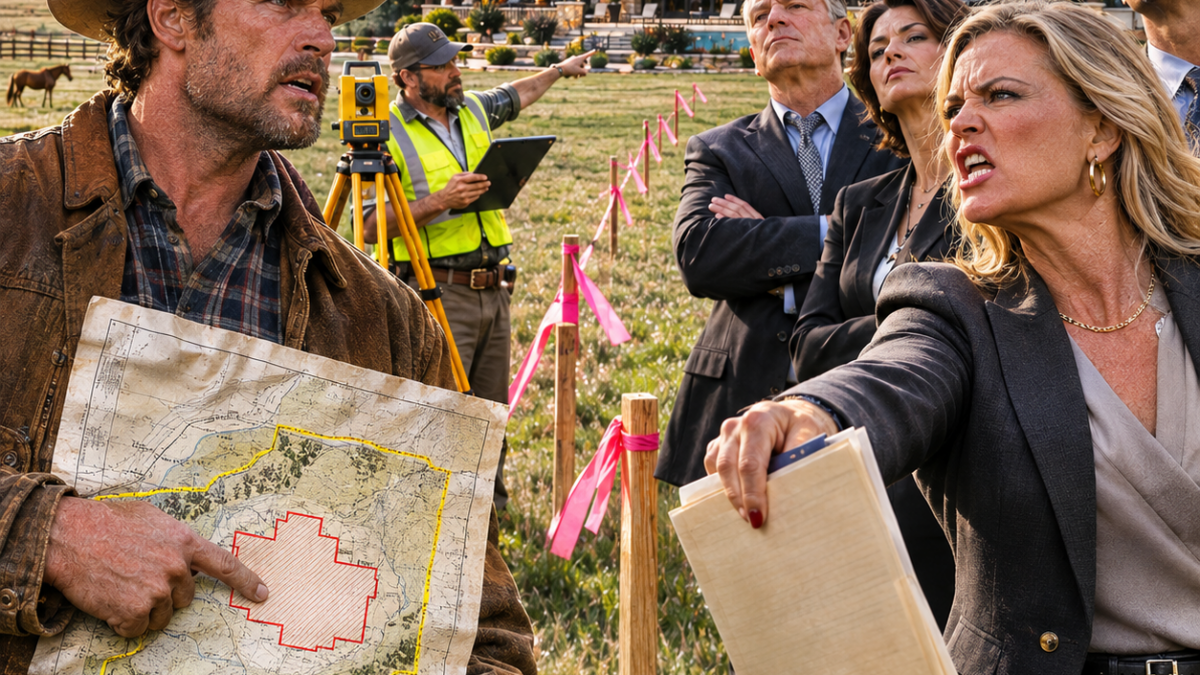
By the time I returned to Red Hollow, Hollis and two technicians were waiting beside the gate. GPS equipment, total station, metal detectors, iron stakes, orange flags. The foreclosure notice was still nailed to the post above them.
Hollis glanced at it.
“Cute.”
“Apparently I’m homeless next week.”
“Let’s see.”
We started at the southeast corner.
The problem with modern property disputes is that people imagine maps are the land. They aren’t. A map is evidence describing the land. Good surveyors look for the physical monuments the records refer to.
Hollis’s technician swept a metal detector near a thicket of mesquite.
Nothing.
Moved three feet.
Nothing.
Then the detector screamed.
They dug carefully and exposed a rusted iron pipe driven into the soil decades earlier.
Hollis cleaned the top.
Checked old field notes.
Measured.
“That’s one.”
Second monument.
Third.
Every one where the old survey said it should be.
Then the equipment began telling a story nobody at Pine Haven wanted to hear.
The legal boundary sat hundreds of feet beyond the decorative fence.
The ditch was just a ditch.
At some point, somebody developing Pine Haven had looked at it, treated it like an obvious dividing line, and built accordingly.
Except real estate law doesn’t care what looks obvious from a truck window.
The survey line crossed manicured grass.
A cart path.
Part of the parking lot.
And then Hollis turned his tablet toward me.
The footprint of the Grand Lodge appeared beneath the legal line.
“All of it?” I asked.
He zoomed.
“Pretty much.”
“How much land?”
“Roughly four-point-six acres, depending on final closure.”
“And the building?”
“Inside your deed.”
I stared at him.
“You sure?”
“No.”
That surprised me.
“Then why are you showing me?”
“Because that’s the preliminary answer. Now we prove ourselves wrong.”
That was why I hired him.
They went back.
Reshot everything.
Checked the original monuments.
Closed the traverse.
Recomputed.
Then did it again.
The line did not move.
Pine Haven Grand Lodge—stone walls, timber beams, banquet hall, terrace, resort pool, parking lot—stood on land legally described inside Red Hollow Ranch.
Glenda’s HOA had tried to foreclose on my ranch.
Their most valuable amenity appeared to be standing on it.
—
Shortly before noon, Hollis began setting stakes along the verified line.
Orange flags crossed the lawn.
Then the parking edge.
Then directly in front of the Grand Lodge’s enormous double doors.
We had placed maybe six stakes when a white SUV came down the clubhouse drive too fast.
Glenda.
She slammed the door hard enough to shake the vehicle.
“What the hell are you doing?”
Hollis continued checking his instrument.
I walked toward her holding the plot.
“You recognize him?”
“No.”
“Licensed surveyor.”
“I don’t care if he’s the governor. This is Pine Haven property.”
“Look.”
I handed her the map.
Her eyes followed the line.
Something strange happened.
She did not look confused.
She looked scared.
Only for a fraction of a second.
But I saw it.
Then anger covered it.
“This is fraudulent.”
“No.”
“You hired somebody to move our boundary.”
“Surveyors don’t move boundaries.”
“This clubhouse cost four-point-eight million dollars.”
“I didn’t build it.”
“We’ve maintained this property for years.”
“Also not my decision.”
“We pay insurance. Taxes. Utilities.”
“Paying the electric bill doesn’t create a deed.”
She grabbed her radio.
Within minutes, security arrived.
Same dark jackets.
Same attitude.
Glenda pointed at the stakes.
“Remove them.”
Hollis finally looked up.
“I wouldn’t do that.”
She ignored him.
One guard—young guy, probably twenty-three—yanked the nearest stake from the ground.
I raised my phone.
“Stop.”
For the first time all day, my voice carried.
The other guards froze.
I began recording.
“Approximately eleven forty-seven a.m., Pine Haven Grand Lodge. Licensed survey marker placed by Hollis Merryweather, registration number—”
I said Hollis’s license number.
Then the guard’s name from his jacket.
Glenda shouted over me.
“You’re trespassing!”
I kept recording.
“Survey marker removed at instruction of HOA president Glenda Pruitt.”
The young guard looked at the stake in his hand like it had become radioactive.
“Ma’am?”
“Pull the rest!”
I looked directly at him.
“Every one you pull becomes another piece of evidence.”
He put the stake down.
Smartest decision anyone working for Glenda made that day.
—
Both sides called the sheriff.
Sheriff Fletcher Gentry arrived twenty minutes later.
Tall.
Gray mustache.
Voice quiet enough that everybody else instinctively lowered theirs.
Glenda intercepted him.
“This man is attempting to seize HOA property.”
The sheriff looked toward me.
“Mr. Larkin?”
“Yes.”
“Documents?”
I gave him the deed.
Hollis provided license and preliminary survey.
Kendra had emailed me certified title records while we waited.
The sheriff read.
Asked Hollis questions.
Walked part of the line.
Then addressed everybody.
“This is a title dispute. I am not deciding ownership in a parking lot.”
Glenda smiled.
Too early.
He continued.
“But nobody is destroying survey markers. Nobody is using private security to remove anybody. Nobody is threatening anybody.”
Her smile disappeared.
“These people are trespassing.”
“That is precisely what a judge may have to determine.”
She pointed at me.
“He owes our association fifty-five thousand dollars.”
The sheriff looked at my ranch across the pasture.
“Does his deed include HOA covenants?”
“Our lawyers—”
“That wasn’t the question.”
Glenda’s jaw clenched.
Then she made a mistake.
In front of the sheriff.
In front of Hollis.
In front of my camera.
“You are going to lose that ranch, Beckett.”
I looked at the clubhouse behind her.
“You came to take my ranch this morning. You may have just put your clubhouse at risk instead.”
Nobody said another word.
—
That evening Hollis delivered the signed, sealed survey.
Four-point-six acres.
Inside Red Hollow.
Grand Lodge entirely within the disputed area.
Kendra studied it.
“You have a serious title claim.”
“Meaning I own the clubhouse?”
“No.”
That answer irritated me.
“The building is on my land.”
“Land ownership and rights concerning a structure somebody else constructed can create separate issues. Compensation, improvements, good faith, bad faith, possession, financing—there are doctrines and facts we have to work through.”
“So I can’t change the locks?”
“Absolutely not.”
“Wasn’t planning to.”
“Good.”
“Can I put cattle in the pool?”
She stared at me.
“That was a joke.”
“Was it?”
“Mostly.”
She pointed at the survey.
“We ask the court to confirm title. We attack the HOA debt. Then we deal with the building lawfully.”
That suited me.
I didn’t want theatrics.
I wanted certainty.
—
At ten fourteen that night, headlights crossed the farmhouse windows.
By the time I reached the porch, the vehicle was gone.
A plain manila envelope sat inside the screen door.
No name.
Inside:
One printed email.
Subject:
**URGENT — PINE HAVEN CLUBHOUSE TITLE DEFECT**
Date:
2024.
Recipient:
Glenda Pruitt.
I read it twice.
Then called Kendra.
She told me to photograph the envelope where I found it and preserve everything.
The next morning, she traced the email through the information shown on the copy.
It had originated with a title examiner connected to the lender that refinanced Pine Haven’s clubhouse loan.
The message was devastatingly clear.
The examiner could not establish Pine Haven’s ownership of the ground beneath the Grand Lodge.
The lender’s collateral might be compromised.
The loan was roughly $2.4 million.
And Glenda had received that warning nearly two years before I bought Red Hollow.
“She knew,” I said.
“Yes.”
“How much?”
“Enough to know there was a title problem.”
Then Kendra found something worse.
A certification in the refinance documents.
Glenda’s signature.
She had assured the lender there was no material title dispute affecting the collateral.
I sat in Kendra’s office staring at the page.
Suddenly the last three weeks rearranged themselves.
The instant fines.
The ridiculous balance.
The foreclosure threat.
The offer to erase everything if I transferred a southern strip for one dollar.
This had never been about road maintenance.
They needed my signature.
I was not a debtor.
I was a loose end.
—
Two days later, the person who left the envelope agreed to meet us.
Opal Fenner.
Pine Haven treasurer for nine years.
Fifty-seven.
Soft-spoken.
Terrified.
She carried a canvas tote bag like it contained explosives.
Maybe, politically, it did.
“I didn’t know at first,” she said.
“Knew what?” I asked.
“That the clubhouse land was never purchased.”
She looked at Kendra.
“Most of the board still doesn’t know.”
Then she told us the history.
In 2018, Duncan Rutledge negotiated with Jerome to buy the strip.
Deal failed.
No transfer.
No deed.
But Duncan built the clubhouse anyway in 2019 using a site plan that treated the drainage ditch as the property line.
Years passed.
Everyone assumed.
Then the lender’s title examiner found the problem in 2024.
Glenda buried it.
“She told me it was clerical,” Opal said.
“Did she tell the board?”
“No.”
“The lender?”
“I don’t know.”
“What changed when the ranch went up for sale?”
Opal looked toward me.
“That scared her.”
“Why?”
“Because a new owner might survey.”
Exactly.
—
Opal had one more story.
She had overheard Glenda and Duncan talking after Red Hollow was listed.
They needed whoever bought it to recognize Pine Haven’s boundary.
Some legal mechanism.
Boundary agreement.
Annexation confirmation.
Anything.
Then the 2018 Supplemental Annexation Agreement suddenly appeared in county records.
Recorded in 2026.
Jerome’s fake signature attached.
Kendra took out the copy.
Opal looked sick.
“I never saw that before this year.”
Then she pulled accounting entries from the tote.
Payments from the HOA to Duncan’s company.
Descriptions:
**Boundary Consulting.**
**Debt Recovery Services.**
**Property Documentation.**
Kendra did not overreact.
“Payments don’t prove fraud.”
Opal nodded.
“But?”
“They give us discovery targets.”
Then Kendra stopped.
She was staring at the notary block on the annexation agreement.
“What?”
She turned the page toward us.
The notary commission number.
Expired before the date the document claimed it had been signed.
The room became silent.
“That’s bad?” I asked.
“That’s potentially very bad.”
“For whom?”
“Several people.”
Opal reached into her bag one final time.
Printed email.
From Glenda to Duncan.
The sentence in the middle was all I needed.
**Get Larkin to sign the boundary settlement before the lender orders another title review. The clubhouse cannot survive that review.**
I read it slowly.
Then again.
The fifty-five-thousand-dollar foreclosure notice suddenly looked very small.
—
“Why are you doing this?” I asked Opal.
She looked down.
“Glenda wants a special assessment.”
“For what?”
“Legal fees. Loan problem. She wants every household to pay.”
“How much?”
“Not decided.”
Her hands trembled.
“They don’t know why. They don’t know she was warned. They don’t know Duncan never bought the land.”
Her voice cracked.
“I can’t sign another financial statement that hides this.”
That was the moment I stopped seeing Pine Haven as Glenda.
One hundred eight households lived there.
Families.
Retirees.
People with mortgages.
People who probably believed their dues had purchased security, amenities, maintenance, and competent leadership.
Glenda had tried to make them my enemy.
They weren’t.
Most of them had been lied to too.
That mattered later.
More than I knew.
—
Kendra filed suit within a week.
Two fronts.
First:
Red Hollow Ranch had never joined Pine Haven.
Therefore the fines, assessments, lien claims, and foreclosure threats were invalid.
Second:
The court needed to determine title to the four-point-six-acre tract beneath the Grand Lodge.
She requested temporary protections preventing Pine Haven from transferring, encumbering, or otherwise manipulating the disputed land while the case proceeded.
At the preliminary hearing, the judge did not decide everything.
But she did one thing Glenda hated.
She stopped the foreclosure.
The association could not enforce the disputed fifty-five-thousand-dollar debt against Red Hollow while the case was pending.
For the first time since I met Glenda, she had been told no by someone whose authority she could not threaten.
—
I could have gloated.
Instead, I wrote a letter to every Pine Haven board member.
Deed.
Survey.
Title documents.
Questions.
No insults.
No threats to shut the clubhouse.
No demands that residents stop using the pool.
I wrote:
**I owe nothing to an association my ranch never joined. The issue Pine Haven must now address is why its most valuable building stands on land contained within Red Hollow Ranch’s recorded title.**
That was all.
Let the facts breathe.
Glenda called an emergency board meeting.
Two directors invited me.
Kendra came with me.
The room was smaller than the Grand Lodge’s public hall, but the tension made it feel crowded.
Glenda sat at the head.
“This meeting concerns internal HOA matters.”
Walter Hensley, retired schoolteacher and director for six years, raised a hand.
“I invited him.”
Glenda glared.
“I did too,” said Carla Whitmore, a younger director.
That was the first visible crack.
Opal placed the lender warning on the table.
Glenda immediately tried to remove it.
Walter put his hand on the page.
“I’d like to read that.”
“You don’t understand the context.”
“Then explain it after I read it.”
Glenda stared at him.
For years, apparently, that stare had been enough.
Not anymore.
—
I unfolded Hollis’s survey across the table.
Big print.
Easy to understand.
The black legal line cut through the Grand Lodge.
“I never asked to join Pine Haven,” I said. “I never asked for your clubhouse. But you built it on land inside my ranch deed.”
One board member shook his head.
“There must be a mistake.”
“Hire your own surveyor.”
Glenda snapped:
“We don’t need another survey.”
I looked at her.
“Why not?”
She said nothing.
Carla noticed.
So did Walter.
I continued.
“Check me. Please. Hire someone I’ve never met.”
That changed the room.
Extortionists usually don’t ask the other side to verify their evidence independently.
Glenda knew that.
So she switched tactics.
“Two hundred fifty thousand.”
I thought I misheard.
“What?”
“The association will pay you two hundred fifty thousand dollars. You sign a settlement, recognize the existing boundary, waive all claims, and this ends tonight.”
Kendra leaned toward me.
I didn’t need advice.
“No.”
Glenda’s eyebrows rose.
“That is substantially more than that acreage is worth as raw ranch land.”
“You nailed a foreclosure notice to my gate this morning.”
“That is unrelated.”
“No. It isn’t.”
“Beckett, be reasonable.”
I almost laughed.
“You tried to take six hundred twelve acres over a debt you manufactured in three weeks, and now you want me to quietly sell you the land under your clubhouse before your lender discovers the problem you’ve known about for two years.”
Half the table went still.
Glenda looked at Opal.
Betrayal registered instantly.
“You had no right—”
Walter interrupted.
“She had every right to tell the board.”
That crack widened.
—
Glenda’s last argument was possession.
Pine Haven had used the land openly.
Maintained it.
Built on it.
Surely years of use meant something.
Kendra answered carefully.
“Claims based on possession have strict elements. They are not magic. A decorative fence doesn’t become a deed because everybody stops checking the plat.”
Glenda’s phone rang.
She stepped out.
Returned five minutes later looking pale.
I learned later that Duncan had called.
The lender had ordered a fresh title review.
Time was running out.
—
Then Glenda made her biggest mistake.
She decided to fight publicly.
Community meeting.
Grand Hall.
Every homeowner invited.
Subject:
**THE ATTEMPTED SEIZURE OF PINE HAVEN GRAND LODGE.**
According to her announcement, I was a speculator who bought Red Hollow knowing about the boundary defect and planned from the beginning to steal an amenity paid for by 108 families.
That accusation made me angry.
Not because it hurt me.
Because it was designed to weaponize innocent residents.
Kendra told me:
“Don’t answer online.”
“I wasn’t planning to.”
“Good.”
“What are we doing?”
“Showing up.”
—
Nearly two hundred people filled the Grand Hall.
Crystal chandeliers.
Timber beams.
Stone fireplace.
Expensive room.
Beautiful room.
My room, perhaps.
That thought still felt absurd.
I sat in the back.
Glenda stood at the podium.
White vest again.
Same one she wore when she nailed the foreclosure notice to my gate.
She held up the 2018 Supplemental Annexation Agreement like scripture.
“Jerome Latham voluntarily committed this land to Pine Haven.”
Murmurs.
“The current ranch owner knew there was a title issue.”
More murmurs.
“He purchased the ranch intending to exploit our community.”
People turned toward me.
I kept my arms folded.
Glenda continued.
“He is demanding our clubhouse.”
I had demanded no such thing.
“He is threatening the financial stability of every family here.”
That part was partially true.
Not because I wanted it.
Because she had hidden a $2.4 million collateral defect.
Then Kendra stood.
No shouting.
No dramatics.
“May I?”
The board had voted to allow her time.
Glenda looked trapped.
Kendra walked to the projector.
First:
Certified county archive record.
No valid deed transferring the 4.6 acres.
Second:
Jerome’s sworn affidavit.
He never signed the annexation agreement.
Never joined Pine Haven.
Never sold the clubhouse land.
Third:
Notary commission record.
Expiration date before the alleged signature date.
The room changed.
Not loudly.
The way air changes before a storm.
People stopped looking at me.
They started looking at Glenda.
—
Then Opal stood.
Her voice shook.
“Why didn’t you tell the board about the 2024 title warning?”
Glenda’s face tightened.
“That was a technical matter.”
Opal unfolded the email.
“You told me to keep it out of the packets.”
“That is not what happened.”
“I have your message.”
Someone in the crowd shouted:
“What warning?”
Opal read the title examiner’s words.
The lender could not confirm ownership of the ground beneath the clubhouse.
The collateral was potentially defective.
People began talking.
“What does that mean for the loan?”
“Are we liable?”
“Why weren’t we told?”
Glenda raised her voice.
“This is exactly why I did not disclose an unverified technical issue. Panic.”
Walter stood from the board table.
“Was it verified?”
She looked at him.
“Walter—”
“Was it?”
Silence.
Carla asked:
“Why did we pay Duncan’s company for boundary consulting?”
Glenda’s eyes moved rapidly around the room.
“Professional services.”
“Did he fix the title?”
“No.”
“Did he buy the land?”
“We believed—”
“Did he?”
“No.”
Another resident shouted:
“Then what did we pay for?”
No answer.
—
I finally stood.
Every face turned.
“I need one thing from Mrs. Pruitt.”
Glenda stared at me.
“Withdraw the claim that I owe Pine Haven fifty-five thousand dollars.”
She gripped the podium.
“You do.”
“Show me the covenant.”
“You bought obligations—”
“Show me.”
“The annexation—”
“Jerome says he never signed it.”
Her palm slammed down.
“That clubhouse belongs to Pine Haven!”
Her voice cracked through the hall.
“I built this community!”
I walked forward until I was close enough that she could hear me without a microphone.
“You may have built the clubhouse.”
Then I pointed toward the floor beneath us.
“But you never bought the ground under it.”
Silence.
Complete.
Glenda turned toward security.
“End the meeting.”
Two guards moved.
Then stopped.
They looked toward the board.
Walter did not nod.
Carla did not nod.
Opal shook her head.
The guards remained where they were.
Power can disappear before a title does.
Everybody in that room watched it happen.
—
Within a week, Pine Haven hired its own surveyor.
I deliberately had no contact with him.
He found the same line.
Four-point-six acres.
Grand Lodge on Red Hollow property.
Not a typo.
Not an inch.
Not a fence dispute.
Real.
The lender received the result.
County investigators received the suspicious annexation papers.
Duncan hired criminal defense counsel.
Stopped answering Glenda.
The civil case moved toward trial.
—
Those weeks were ugly.
Pine Haven residents were frightened.
I received letters.
Some angry.
Some apologetic.
One said:
**My husband and I bought here because the clubhouse was where our daughter got married. Please don’t destroy it because of Glenda.**
I read that one several times.
Another resident stopped me at the feed store.
Older man.
“You taking our clubhouse?”
“I’m trying to clear my title.”
“That’s not an answer.”
“No. It isn’t.”
He looked angry.
Then tired.
“We paid for that thing.”
“I know.”
“Then what happens?”
“I don’t know yet.”
That was honest.
I hated uncertainty almost as much as he did.
—
Jerome visited the ranch before trial.
He stood on the ridge looking toward Pine Haven.
“I should’ve fought harder.”
“For what?”
“Duncan.”
“You told him no.”
“I should’ve checked what he built.”
“You didn’t build it.”
“My land.”
“Was your land.”
He looked at me.
“That supposed to make me feel better?”
“No.”
We stood quietly.
Then he said:
“You’re not going to punish those families, are you?”
I looked toward the Grand Lodge.
“No.”
“How do you know?”
“Because they didn’t nail the notice to my gate.”
Jerome smiled.
“Good.”
That conversation stayed with me.
Winning title was one question.
What kind of man I would be after winning was another.
—
Trial began after weeks of evidentiary hearings.
Courtroom full.
Pine Haven residents on one side.
Ranchers and curious locals on the other.
Glenda in navy.
Kendra beside me.
The HOA argued first.
Jerome supposedly agreed to annex.
Grand Lodge built openly.
Pine Haven maintained it.
Residents relied on it.
The community acted in good faith.
Some of those arguments deserved serious consideration when it came to consequences concerning the building.
None created the missing deed.
Kendra built our case in layers.
My 612-acre title.
Historical chain.
Original patent.
Pine Haven plat.
No ranch inclusion.
Hollis’s survey.
Independent HOA survey.
Same result.
Then supplemental agreement.
Late recording.
Jerome’s disputed signature.
Expired notary commission.
2024 warning.
Glenda’s lender certification.
Emails.
Payments to Duncan.
The pressure campaign against me.
Not rhetoric.
Sequence.
—
Jerome testified.
He wore his best Sunday jacket.
Kendra asked:
“Did you sell the four-point-six-acre tract to Pine Haven?”
“No.”
“Did you sign the 2018 Supplemental Annexation Agreement?”
“No.”
“Did you authorize Duncan Rutledge to build the clubhouse on your land?”
“No.”
“Did you receive purchase money?”
“Not one dollar.”
The HOA lawyer tried.
“Mr. Latham, you discussed selling land to Mr. Rutledge.”
“Yes.”
“And you allowed Pine Haven construction to continue.”
“I didn’t know where every concrete truck was pouring.”
“You never sued.”
“Didn’t know I needed to.”
“Is it possible you signed documents you no longer remember?”
Jerome leaned toward the microphone.
“Counselor, I remember every time somebody tried to pay me too little for land.”
People laughed.
Judge Baird shut that down with one look.
Jerome continued.
“I didn’t sell it.”
—
Hollis testified next.
Maps.
Monuments.
Measurements.
The HOA attorney asked why the ditch had been treated as the boundary for so long.
Hollis answered:
“Convenience.”
“Does that matter?”
“Not against the original monumentation and recorded legal description.”
“But people relied on it.”
“I’m a surveyor. I can tell you where the line is. I can’t make assumptions into deeds.”
That sentence seemed to land.
—
Opal testified.
Hardest part.
She had spent years working beside Glenda.
She described the 2024 warning.
The concealed report.
The payments.
The special-assessment plan.
Then the email.
**The clubhouse cannot survive that review.**
Glenda stared at her the entire time.
Opal never looked back.
When she stepped down, she passed our table.
I whispered:
“Thank you.”
She nodded.
Her hands were shaking.
Courage does not always look fearless.
Sometimes it looks terrified and still tells the truth.
—
Finally Judge Evelyn Baird looked at Pine Haven’s counsel.
She asked one question.
Simple.
“Can you produce a valid recorded deed transferring the disputed 4.6 acres from a prior Red Hollow owner to the association or its predecessor?”
The lawyer looked through papers.
Then toward Glenda.
Then back.
“No, Your Honor.”
That silence was the sound of her entire strategy collapsing.
No speech could repair it.
No security guard.
No fine.
No white vest.
No fifty-five-thousand-dollar notice.
The deed didn’t exist.
—
The judgment confirmed Red Hollow’s title to the 4.6-acre tract.
The HOA’s debt claim against my ranch was dismissed.
The lien had to be removed.
Foreclosure enforcement was barred.
Questions connected to the improvements, compensation claims, transition, and possession of the clubhouse would be resolved according to the judgment and whatever lawful settlement followed.
We won.
Outside the courtroom, I expected relief.
Instead, I felt tired.
Then Glenda caught up.
“You think a piece of paper gives you my clubhouse?”
I turned.
“This entire case started because you thought a piece of paper gave you my ranch.”
Her face twisted.
“I will appeal.”
“Talk to your lawyer.”
“You’ll destroy Pine Haven.”
“No.”
I looked at her.
“You nearly did that yourself.”
Then I walked away.
—
Back at Pine Haven, the board moved before she could.
Emergency meeting.
Court judgment on the table.
Independent survey.
Opal’s financial report.
Lender warning.
For once, every director knew the same facts.
Glenda arrived in her white vest.
She tried to speak.
Walter moved to terminate her authority under the bylaws.
Carla seconded.
The vote passed.
Glenda was ordered to turn over association records, access cards, keys, and financial material.
I attended only because the board requested my presence for settlement discussion afterward.
She looked smaller without control of the agenda.
Then the Grand Lodge doors opened.
Sheriff Fletcher Gentry entered.
Two investigators behind him.
Conversation died.
He walked directly toward Glenda.
“Glenda Pruitt?”
She stood.
“What is this?”
He confirmed her identity.
Then produced a warrant connected to the separate criminal investigation involving suspected forgery and fraudulent property records.
Her face lost color.
“This is Beckett.”
The sheriff’s expression did not change.
“This warrant is not from Mr. Larkin.”
“He did this!”
“No, ma’am.”
He turned her gently.
“Hands behind your back.”
The metal clicked.
I remembered six guards surrounding my ranch gate at sunrise.
I remembered Glenda watching while they nailed the foreclosure notice into my post.
Now she stood beneath the chandeliers of the building she claimed as the symbol of her power, and she no longer had authority to order even one person out of the room.
At the door she twisted toward me.
“You’re going to destroy this community.”
I shook my head.
“I just refused to let you steal my land.”
The cruiser door closed.
That was the last conversation we ever had.
—
People assume that was the satisfying ending.
It wasn’t.
It was satisfying.
I won’t lie.
But it wasn’t the ending.
Because after Glenda disappeared, one hundred eight families were still there.
So was the $2.4 million loan.
So were the legal bills.
So was a building sitting on land Pine Haven did not own.
The new board inherited a disaster.
Walter and Carla came to my farmhouse.
No guards.
No golf carts.
No lawyers initially.
Just two tired neighbors.
They sat at my kitchen table.
Carla said:
“We want to buy the land.”
“Expected that.”
“Independent appraisal.”
“Okay.”
“Fair market price.”
I looked at her.
“No.”
She seemed surprised.
“You haven’t heard the number.”
“Doesn’t matter.”
Walter leaned forward.
“What do you want?”
That was the question.
A month earlier, my answer might have been:
Get off my land.
Now I wasn’t sure.
“I don’t want to sell.”
Carla rubbed her hands together.
“Beckett, people use that clubhouse.”
“I know.”
“Weddings. Meetings. Pool. Events.”
“I know.”
“If you take immediate possession—”
“I’m not.”
They both stopped.
“I’m not throwing families out.”
Walter exhaled.
“Then what?”
“We build a transition.”
—
Kendra nearly smiled when I explained.
“Reasonable.”
“Don’t sound disappointed.”
“I litigate property disputes. Reasonable people are bad for business.”
We negotiated.
Pine Haven received time to move community operations elsewhere.
Safety and insurance obligations defined.
Access scheduled.
Financial issues resolved separately through counsel and lender negotiations.
The association formally surrendered every ownership claim to the four-point-six acres and the Grand Lodge.
Every manufactured fine against me vanished.
Every adverse filing against Red Hollow’s title was cleared.
No mystery boundary agreement.
No dollar sale.
No hidden clause.
Everything written.
Recorded.
Clean.
That mattered to me more than money.
—
One morning, months after Glenda nailed the foreclosure notice to my gate, a sedan came up the ranch drive.
Opal got out.
Walter.
Carla.
They carried nothing except a heavy ring of brass keys.
We sat in my kitchen.
Coffee.
Silence.
Opal placed the keys on the table.
The sound was smaller than I expected.
Metal against wood.
“That’s everything,” she said.
“Pool house?”
“Yes.”
“Maintenance rooms?”
“Yes.”
“Grand Lodge?”
“Yes.”
Carla looked embarrassed.
“I’m sorry.”
“For what?”
“All of it.”
“You didn’t nail the notice.”
“We allowed her too much control.”
Walter nodded.
“We stopped asking questions.”
That was more honest.
I slid the keys toward me.
“No guards this time.”
Opal smiled faintly.
“No.”
“No fifty-five-thousand-dollar invoice?”
Carla laughed.
“We considered one for the coffee.”
That broke the tension.
—
The first time I entered the Grand Lodge alone, I expected triumph.
Instead, the building felt sad.
Empty banquet hall.
Stacked chairs.
Silent kitchen.
Sunlight across polished floors.
I walked onto the terrace overlooking Clear Creek.
Pine Haven houses spread beyond the old ditch.
Somewhere in those homes were people who had birthdays here.
Anniversaries.
Wedding receptions.
Retirement parties.
Pool days.
Glenda had turned the clubhouse into a throne.
For everybody else, it had just been part of their lives.
I didn’t want the building to become a monument to revenge.
That would give her too much permanent influence.
I wanted it to become useful.
—
Investors called.
Event venue.
Private lodge.
Luxury wedding property.
Boutique retreat.
Numbers were tempting.
Really tempting.
Selling could have repaid a significant piece of what I spent buying the ranch.
But every offer made the building feel more disconnected from Red Hollow.
Then Jerome visited.
I showed him through the Grand Lodge for the first time.
He stood in the banquet hall.
“This is what they built?”
“Yeah.”
“Fancy.”
“Very.”
“You selling?”
“Not sure.”
He looked through the windows toward the pasture.
“What does the county need?”
That question changed everything.
“What do you mean?”
“Young ranchers.”
He leaned on his cane.
“Half of them can barely afford equipment. Everybody’s fighting water issues. Grazing costs. Drought. Nobody teaches kids coming back to family land how not to go broke.”
I looked around.
Big hall.
Classrooms waiting to happen.
Commercial kitchen.
Storage.
Meeting spaces.
Pool house.
Parking.
Jerome smiled.
“You spent twenty years building things.”
And suddenly I knew.
—
The banquet hall became a workshop space.
The private dining room became a classroom.
The pool house became an equipment lending library.
The terrace became a place for county extension talks about drought, grass management, cattle markets, conservation, and water rights.
We brought in local ranchers.
Extension agents.
Veterinarians.
Accountants.
Land attorneys.
Surveyors.
Hollis taught a seminar called:
**YOUR FENCE IS NOT YOUR DEED.**
Standing room only.
I made him use that title.
Kendra taught:
**READ BEFORE YOU SIGN.**
Jerome sat in the first row and heckled both of us.
Young ranchers borrowed post drivers, moisture meters, portable scales, fencing tools, and equipment they couldn’t afford yet.
The place got a new name.
**RED HOLLOW RANCH LAND STEWARDSHIP CENTER.**
No marble plaque.
Heavy cedar sign.
Simple.
—
The first community meeting held there after the conversion included Pine Haven residents.
That surprised me.
Carla asked first.
“Can we come?”
“Why wouldn’t you?”
“History.”
I looked around.
“We’re not doing history tonight. We’re talking drought.”
They came.
So did ranchers who had once driven past Pine Haven and complained about rich subdivision people.
They sat together.
Asked questions.
Shared coffee.
One Pine Haven homeowner owned a small acreage outside town and ended up borrowing fencing equipment.
Another volunteered to help organize youth agricultural workshops.
People who had been placed on opposite sides of Glenda’s war discovered they had no reason to stay there.
That was better than winning the building.
—
Jerome attended the dedication.
He moved slowly by then.
I walked him to the terrace.
New cedar sign visible at the entrance.
He stared at it.
“You kept Red Hollow in the name.”
“Of course.”
He nodded.
Then his eyes filled.
I pretended not to notice.
He did the same when mine did.
After a while he said:
“You know what makes me mad?”
“What?”
“I could have sold Duncan four-point-six acres for a fortune.”
I laughed.
“There he is.”
He smiled.
Then became serious.
“I’m glad it’s yours.”
“Ours, in a way.”
“No.”
He shook his head.
“Be careful with that word. People get sloppy with land when nobody knows who’s responsible.”
Fair.
“It’s mine.”
“Good.”
He looked toward the people gathering inside.
“But you’re using it for more than yourself.”
That was the part he approved.
—
I kept the original foreclosure notice.
Of course I did.
I framed it.
Not because I wanted a trophy.
Okay, partly because I wanted a trophy.
Fifty-five thousand dollars in red print.
Nail holes still through the corners.
Below it:
Copy of my 612-acre title.
Beside that:
Hollis’s survey.
The black line through the Grand Lodge footprint.
People visiting the center always stopped.
“What’s that?”
I would tell them.
Sometimes they thought I was joking.
Then Hollis would say:
“He’s leaving out the ridiculous parts.”
“What ridiculous parts?”
“The private security army.”
“I said six guards.”
“You should mention the white vest.”
“That feels personal.”
“It was a memorable vest.”
—
The criminal cases took longer.
Duncan faced his own investigation and civil claims.
Glenda’s case moved separately from my property judgment.
I didn’t follow every hearing.
Kendra sometimes updated me.
Evidence involving the forged property records, lender statements, and recording conduct went through the process it needed to go through.
People asked whether I wanted Glenda in prison.
I always gave the same answer.
“I wanted my title clear.”
“But after what she did?”
“I got my title clear.”
That wasn’t forgiveness.
It was boundary.
I had spent enough of my life letting her occupy mental acreage.
She wasn’t getting another foot.
—
Pine Haven survived.
That surprised some people.
It shouldn’t have.
Communities are larger than bad leaders.
The new board was boring.
That is a compliment.
Budgets.
Maintenance.
Insurance.
Roads.
No manufactured invasions of neighboring ranches.
No six-guard foreclosure ceremonies.
No secret boundary agreements.
Opal eventually stepped down as treasurer after helping rebuild the books.
At her final meeting, residents gave her a standing ovation.
She hated every second.
I attended.
Afterward, she found me.
“I almost didn’t leave that envelope.”
“I know.”
“I sat outside your ranch for twenty minutes.”
“What changed your mind?”
She looked toward the clubhouse—our stewardship center now visible beyond the road.
“Glenda was going to make families pay for something she had hidden.”
“You were scared.”
“Terrified.”
I smiled.
“You did it anyway.”
She nodded.
Courage again.
Terrified and moving forward.
—
One autumn afternoon, I was repairing the eastern fence—the same stretch Glenda once claimed the architectural committee needed to approve—when a car slowed beside the gate.
Carla.
Now Pine Haven vice president.
She rolled down the window.
“Community gathering next month.”
“That sounds dangerous.”
“Barbecue.”
“Worse.”
“You’re invited.”
“Do I need to register my truck?”
She laughed.
“No.”
“Road maintenance fee?”
“No.”
“Architectural approval for my boots?”
“Beckett.”
I grinned.
“Happy to visit.”
She started to drive away.
Then stopped.
“Thank you.”
“For what?”
“For not punishing us for her.”
That stayed with me.
Because I had come close.
Not in action.
In my head.
The morning Glenda nailed that notice to my gate, if someone had handed me a button that erased Pine Haven from the valley, I might have pressed it.
Anger simplifies people.
Turns 108 households into “the HOA.”
Turns board members into enemies.
Turns a clubhouse into a symbol instead of a building where real people made memories.
Justice became more satisfying when I stopped needing innocent people to feel what Glenda had made me feel.
—
That evening, I walked back toward the barn.
The sun was dropping behind the hills.
Cattle moved slowly through the pasture.
Clear Creek reflected copper light.
Far away, the old Grand Lodge glowed warm against the ridge.
Different sign now.
Different purpose.
Same foundation.
I entered the barn.
Near the door hung the foreclosure notice.
I stopped.
Fifty-five thousand dollars.
Seven days.
Surrender the property.
It seemed almost funny now.
Almost.
I remembered those black SUVs.
The guards.
Glenda’s expression.
The humiliation she intended.
She wanted me frightened enough to sign away land I didn’t know I owned.
That was the cruelty beneath everything.
She wasn’t merely mistaken.
She needed me to doubt myself.
My records.
My deed.
My right to ask questions.
Bullies depend on that moment.
The moment you think:
Maybe they know something I don’t.
Sometimes they do.
Which is why you check.
But checking is not surrender.
—
The ranch taught me that.
So did twenty years of construction.
Measure twice.
Verify.
Find the monument.
Read the contract.
Ask where the number came from.
Never let confidence substitute for evidence.
Glenda had confidence.
I had a deed.
In the end, the deed mattered more.
—
A year after the center opened, we held a workshop for young landowners.
Hollis brought survey equipment.
Kendra brought sample deeds.
Jerome sat in the back.
One kid—twenty-three, inherited eighty acres after his father died—asked:
“What’s the biggest mistake people make buying rural land?”
Everybody looked at me.
I thought about giving a clever answer.
Instead:
“They assume everybody already knows where the lines are.”
Hollis nodded.
Kendra added:
“And they assume documents with official-looking stamps are valid just because they exist.”
Jerome raised his hand.
“And they sell too cheap.”
Everyone laughed.
He smiled.
Still Jerome.
—
Afterward, the young man lingered.
“My dad hated paperwork.”
“Most people do.”
“I found boxes.”
“Don’t throw them away.”
He looked toward the framed foreclosure notice.
“That really happened?”
“Every ridiculous minute.”
“What did you feel when you found out the clubhouse was yours?”
I thought carefully.
“Scared.”
He looked surprised.
“Not excited?”
“Later.”
“Why scared?”
“Because suddenly I could hurt people who hadn’t hurt me.”
He absorbed that.
Power is strange.
You spend weeks fighting because someone has too much.
Then you win and discover the danger of your own.
That was the lesson Glenda never learned.
I tried to.
—
The Stewardship Center became busier.
Veterans transitioning into agriculture attended programs.
Young families learned rotational grazing.
We hosted water-rights seminars during drought years.
Equipment library expanded.
Someone donated a portable livestock chute.
Another ranch donated seed drills.
Pine Haven residents volunteered at events.
One taught bookkeeping.
Another organized food for workshops.
The boundary remained legally clear.
Socially, it became easier.
That is what boundaries are supposed to do.
Not create enemies.
Create certainty.
This is mine.
That is yours.
Now we can choose what to share.
—
Sheriff Gentry visited once.
Not officially.
He came for a grazing seminar because his nephew had bought land.
He stood beneath the old chandelier.
“Looks different.”
“Less criminal activity.”
“Usually improves a venue.”
I laughed.
He noticed the foreclosure notice.
“You framed that?”
“Educational material.”
“Sure.”
He looked at the nail holes.
“I remember that morning.”
“So do I.”
“You were calmer than I expected.”
“I was terrified.”
He raised an eyebrow.
“Couldn’t tell.”
“That’s adulthood.”
He laughed.
Then said:
“You did one thing right.”
“Only one?”
“When Glenda’s guard pulled the stake, you recorded.”
“Instead of punching him?”
“Exactly.”
I nodded.
The young guard hadn’t been my enemy either.
He was an employee following a bad instruction until someone gave him a reason to reconsider.
He put the stake down.
Sometimes that is enough to keep a stupid situation from becoming a tragedy.
—
Jerome’s health declined.
One winter, I drove him around Red Hollow in my truck.
Slowly.
Past the barns.
Past Clear Creek.
Past the southern ridge.
He touched the dashboard whenever we hit a rut, complaining about my driving despite having taught me half the ranch roads.
We stopped where you could see the Stewardship Center.
He stared.
“You know what Duncan wanted to pay me for that strip?”
“How much?”
“Not enough.”
“I assumed.”
“Could have used the money then.”
“Regret it?”
He thought.
“No.”
Then:
“Maybe.”
I laughed.
He did too.
Finally he said:
“Land isn’t valuable because you never let go of it.”
“What makes it valuable?”
“What you let it become without forgetting what it is.”
That was one of the last long conversations we had.
Jerome died the following spring.
Peacefully.
His old dog outlived him by nine months.
I planted an oak near the ranch office.
Not a monument.
Just a tree.
But everyone knew.
—
At the next land-stewardship workshop, I left Jerome’s chair empty.
Hollis noticed.
Didn’t say anything.
At the end, a young rancher asked why Red Hollow funded the equipment library.
I looked at Jerome’s chair.
“Because somebody older than me knew you shouldn’t have to own every tool to start building something.”
Close enough.
—
Pine Haven eventually refinanced under clean title arrangements for what remained of its assets.
The clubhouse was no longer among them.
The crisis that once looked capable of destroying the subdivision faded into history.
New residents moved in who had never met Glenda.
One of them stopped by the Stewardship Center and asked:
“Why is this building way out here on ranch property?”
Everyone in the room laughed.
He looked confused.
I said:
“Sit down. This will take a minute.”
—
The story had become funny because time had made it safe.
It wasn’t funny when I had seven days to “surrender” my ranch.
It wasn’t funny when I wondered whether a fraudulent document could poison my title.
It wasn’t funny when Pine Haven residents feared losing a building they had paid for.
It wasn’t funny when Opal was terrified.
Or when Jerome saw his forged signature.
Or when a lender discovered collateral problems worth millions.
Distance turns some fear into comedy.
But I never wanted the lesson to disappear inside the joke.
Authority is not evidence.
A threat is not a court order.
A fence is not a boundary.
A clubhouse is not proof of title.
And a person who appears powerful may be standing on ground they never owned.
Glenda learned all five lessons at once.
—
Years later, I replaced the ranch gate.
The old wooden post with the foreclosure nail holes had started rotting.
I almost threw it away.
Then stopped.
Cut out the section containing the holes.
Mounted it beneath the framed notice.
Kendra visited and stared.
“You’ve built a shrine.”
“Historical archive.”
“You are emotionally incapable of throwing away evidence.”
“That is why we won.”
“Fair.”
She looked through the window toward the Stewardship Center.
“Still refusing offers?”
“Yes.”
“One investor would pay a ridiculous amount.”
“I know.”
“Ever tempted?”
“Every tax season.”
She smiled.
“Then why keep it?”
I thought about Opal.
Jerome.
Young ranchers.
Pine Haven families.
My own anger.
The moment the keys hit my kitchen table.
“Because selling it would make the ending about money.”
“And?”
“It wasn’t.”
—
Glenda thought everything was leverage.
Fines.
Lawyers.
Security.
Foreclosure.
Debt.
Fear.
Even the HOA residents themselves.
She used the community as leverage against me.
When that failed, she used the clubhouse.
When that failed, she used a forged boundary history.
Every relationship became a tool.
That made her powerful for a while.
It also ensured nobody remained loyal once the tools stopped working.
I didn’t want to live that way.
The Stewardship Center became my answer.
A building she had used as a throne became useful because people could enter without owing me obedience.
That mattered.
—
One evening, after everyone left a workshop, I stood alone in the Grand Hall.
The chandelier lights were dim.
Chairs stacked.
Whiteboard covered in notes about grazing rotations.
A kid had forgotten a notebook.
Outside, coyotes called from the ridge.
For a second, I imagined Glenda behind the old podium.
Then Jerome.
Then Opal reading the email.
Then Judge Baird asking for the deed nobody could produce.
So much conflict tied to one building.
I turned off the lights.
Locked the door.
Stepped outside.
The cedar sign caught the porch light.
**RED HOLLOW RANCH LAND STEWARDSHIP CENTER.**
I ran my hand across the letters.
No triumph.
Just gratitude.
—
The next morning I passed my original gate.
Cattle crowded near the fence waiting to be moved.
One black heifer licked the post where Glenda’s security guards had once nailed the foreclosure notice.
I laughed.
“Careful. Association enforcement.”
She ignored me.
Good instincts.
—
Sometimes satisfying endings are loud.
Handcuffs.
Court judgments.
A president removed in disgrace.
We had all of those.
But the ending that satisfied me most came on an ordinary Saturday.
The old clubhouse parking lot was full again.
Not with luxury SUVs arriving for one of Glenda’s board galas.
Pickup trucks.
Stock trailers.
A few dented sedans.
Inside, Hollis was teaching a group of young ranchers how to read survey monuments.
Kendra was answering questions about easements.
A Pine Haven resident was serving coffee.
Jerome’s oak moved in the wind outside.
Nobody mentioned Glenda.
Nobody needed to.
That was when I understood she had finally lost.
Not when the judge ruled.
Not when the sheriff closed the cruiser door.
When the building stopped being about her.
—
The foreclosure notice still hangs in my barn office.
Visitors sometimes read the big red number.
**$55,000.**
Then they look at the survey.
Then at the Stewardship Center through the window.
Their expression is always the same.
“Seriously?”
Seriously.
They tried to foreclose on a ranch that never joined their HOA.
They fabricated enough fees in three weeks to make a working man question whether owning land was worth the trouble.
They showed up with six guards because they believed intimidation could substitute for jurisdiction.
And all the while, their $4.8 million clubhouse was sitting on 4.6 acres they had never legally purchased.
Glenda knew the title was defective.
She knew before I arrived.
She tried to make me surrender before I discovered why.
She almost succeeded in creating fear.
She never succeeded in creating ownership.
—
If I had one moment to relive, it wouldn’t be her arrest.
It wouldn’t even be the judge’s ruling.
It would be the morning Hollis drove the first iron stake into the lawn outside the Grand Lodge.
One solid strike.
Then another.
Metal into earth.
A tiny orange flag fluttering above it.
Glenda had brought paper.
We answered with the ground itself.
The truth had been there the whole time.
Under the landscaping.
Under the parking lot.
Under the clubhouse.
Under years of assumptions.
Waiting for somebody to measure carefully enough to find it.
—
That is what I think about when I stand on the ridge now.
Red Hollow below me.
Six hundred twelve acres still intact.
Cattle moving across grass.
Clear Creek catching the sun.
The old Grand Lodge beyond the ditch, no longer Pine Haven’s monument to status, but a place where people learn how to hold onto land without being destroyed by ignorance.
I bought the ranch because I wanted independence.
Glenda almost convinced me independence meant fighting everybody alone.
She was wrong about that too.
Hollis helped.
Kendra helped.
Jerome told the truth.
Opal risked everything to open that envelope.
Walter and Carla chose residents over Glenda.
Sheriff Gentry kept a tense situation from becoming violent.
Even Pine Haven eventually chose cooperation over war.
That is why the ending matters.
I kept my ranch.
But I didn’t have to lose my neighbors to do it.
—
The day the new cedar sign went up, Carla drove past and stopped at the gate.
She looked toward the center.
“Funny.”
“What?”
“Glenda said you were going to destroy the community.”
I leaned against the fence.
“Maybe communities are harder to destroy than presidents think.”
She smiled.
“Next month’s Pine Haven barbecue?”
“I told you. Happy to visit.”
“No membership bill.”
“Good.”
She started to leave.
I called after her.
“Carla.”
She looked back.
“If you ever nail a foreclosure notice to my gate…”
She laughed.
“Understood.”
Her car disappeared down the road.
Dust settled.
The valley became quiet.
—
I went into the barn.
Stopped at the framed notice.
For years I had measured winning by what I could keep.
My ranch.
My title.
My boundaries.
Now I measured it differently.
A young rancher borrowing a tool instead of going into debt.
A terrified treasurer finding courage.
A neighborhood learning to question its leaders.
A four-point-six-acre mistake becoming something useful instead of something poisoned by resentment.
Jerome’s land staying Red Hollow land.
Those were better measurements.
—
Glenda came to my gate with six guards because she thought power meant making another person surrender.
She left the story in handcuffs because she never learned that power without truth eventually collapses under its own weight.
I never had to tear down her clubhouse.
I never had to humiliate 108 families.
I never had to become the person she told everyone I was.
I only had to hold my line long enough for the truth to catch up.
And when it did, the same building she had used to make herself look untouchable became proof that she had never understood the most basic rule of land.
You can mow it.
Fence it.
Pave it.
Build on it.
Insure it.
Throw parties on it.
Tell everyone it is yours for years.
But sooner or later, somebody may ask the question Glenda should have asked before the first shovel touched Red Hollow.
**Where is the deed?**
She never had one.
I did.
And that made all the difference.
—
On the wall beneath the foreclosure notice, I eventually added one final line on a small brass plate.
Nothing angry.
Nothing about Glenda.
Just six words:
**CHECK THE LINE BEFORE YOU CROSS IT.**
Hollis called it painfully obvious.
Kendra called it legally sound.
Opal cried when she saw it.
I think Jerome would have laughed.
And me?
Every morning when I walk past it and head outside toward six hundred twelve acres that are still mine, I remember the woman who gave me seven days to surrender land she never had the right to touch.
Then I look across the valley at the clubhouse she thought was hers.
The doors open early now.
Young ranchers walk inside carrying notebooks instead of HOA violation letters.
People come there to learn how to protect water, soil, cattle, boundaries, and the farms their families hope to pass down.
The building survived.
Pine Haven survived.
Red Hollow survived.
Even the relationship between the ranch and the subdivision survived.
The only thing that didn’t survive was the lie.
And when everything finally settled, that was more than enough for me.








