HOA Flooded My Late Wife’s Workshop to Force Me Out—They Forgot I Designed Every Drain Beneath Their Golf Course
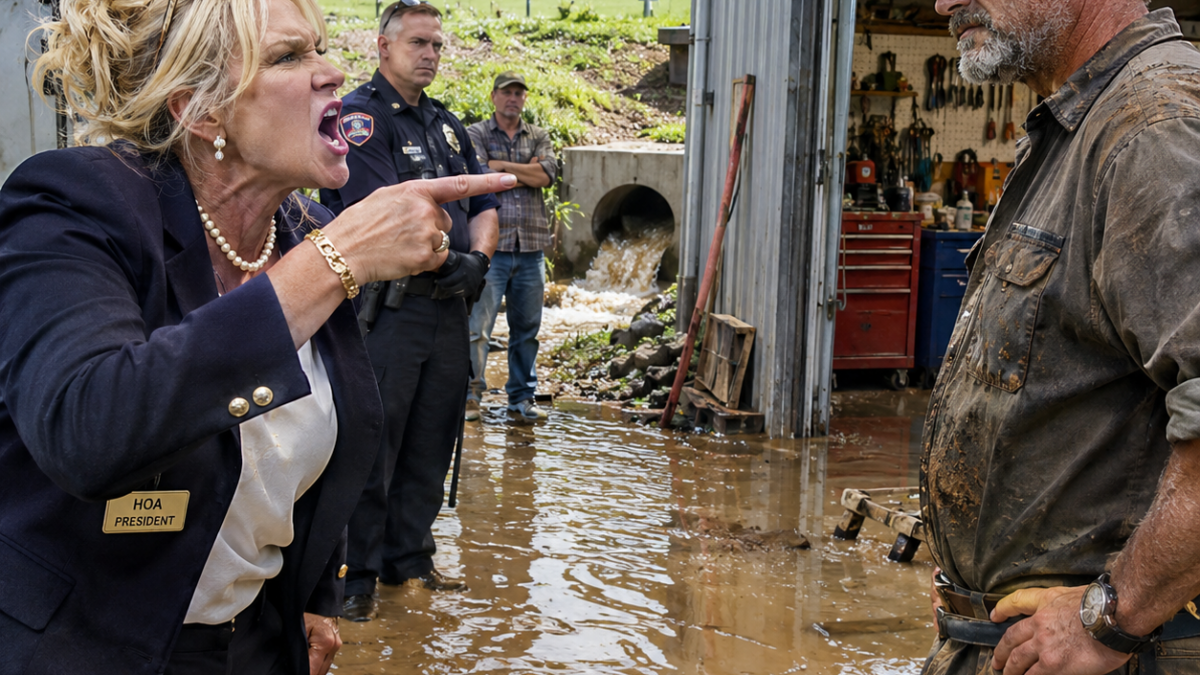
PART 2
Brenda Whitfield was fifty-eight years old and had been president of the Palmetto Ridge HOA since 2017.
She treated that title like it had been issued by the governor.
She controlled the newsletter.
She had opinions about paint.
Trees.
Fences.
Pool furniture.
Mailboxes.
Garden ornaments.
Contractors.
People.
If someone disagreed with her, she didn’t argue so much as begin constructing consequences.
Her husband, Dale, sat on the county planning commission.
That gave Brenda something more dangerous than an overdeveloped sense of authority.
Connections.
People inside Palmetto Ridge understood that.
Most simply learned to avoid her.
I had not been there long enough to learn avoidance.
And I had spent too many years signing engineering documents with my professional stamp to accept the idea that someone’s confidence could substitute for a rule.
The afternoon she first challenged the workshop, I went inside and pulled the governing documents.
I read them cover to cover.
Article 7, Section 2.
Existing accessory structures that had been approved by a prior board could not suddenly be declared non-conforming unless the current board had documented cause and obtained the required supermajority.
My workshop had been approved in 2016.
County permits existed.
Inspection records existed.
The prior board approval existed.
There was nothing ambiguous about it.
I copied the provision.
Highlighted it.
Attached the permit.
Sent everything to Brenda by certified mail.
No accusation.
No sarcasm.
Just:
The structure is compliant.
She never responded.
Two weeks later, I began seeing maintenance carts behind my house.
They lingered around the utility junction.
At first, I assumed ordinary work.
Palmetto Ridge had miles of buried infrastructure.
I knew better than most homeowners how often maintenance crews had legitimate reasons to stop near boxes, valves, and access points.
So I ignored it.
Then one Wednesday evening, I walked into the workshop after dinner.
I hit the wall switch.
Nothing.
No fluorescent buzz.
No ventilation fan.
No battery charger.
Only darkness and the smell of warm dust.
I checked the house breakers.
Normal.
Then went outside to the dedicated disconnect.
The handle was down.
Not tripped.
Pulled.
Fresh scratches around the housing.
I pushed it back to ON.
The workshop lit.
The fan spun.
I went back inside.
Next morning, the disconnect was OFF again.
I called the HOA office.
The receptionist transferred me to Ray Puckett.
Ray supervised maintenance.
Fifties.
Quiet.
The sort of man whose entire posture suggested he wished retirement could arrive before lunch.
“Ray, has anybody been working on the electrical equipment behind Lot 42?”
Pause.
“There was a routine infrastructure inspection.”
“Which infrastructure?”
“I’d need to check.”
“My shop disconnect has been physically pulled twice.”
Another pause.
“Some panels were adjusted for safety.”
“Whose order?”
Silence.
“Ray?”
“Mrs. Whitfield.”
There it was.
“Thank you.”
“Garrett—”
“Yes?”
Nothing.
He hung up.
The power went off four more times over six days.
Always when I wasn’t watching.
The third outage killed the battery charger I had connected to the Shovelhead.
The fifth disrupted the paint-booth environment badly enough that two days of primer blistered.
Temperature changes.
Humidity.
The surface developed bubbles and fractures.
I stood under the workshop lights looking at the ruined coat and felt a kind of tiredness I had not felt since Elena’s treatment.
Not the same grief.
Nothing compared to that.
But the same helpless frustration of watching careful work get damaged by forces outside your control.
The chrome fork tubes had started pitting.
Two custom parts warped from humidity.
The room smelled damp.
I ran my hand over the motorcycle’s fuel tank.
Bare metal still.
No midnight blue yet.
Elena’s voice came back.
“That’s the one.”
I whispered:
“I know.”
Then I did what engineers do when something fails.
I began documenting.
Date.
Time.
Photographs.
Position of disconnect.
Power restoration.
Temperature.
Damage.
Receipts.
I installed a small trail camera pointed toward the junction.
The video did not give me a face.
It did give me a maintenance cart.
After dark.
Repeatedly.
Enough to prove the outages were not random.
I sent a written complaint to the HOA board.
Not Brenda.
Phil Stanton.
Treasurer.
Certified.
Return receipt.
Two days later, Phil called.
“Garrett.”
“Phil.”
“I looked into your complaint.”
“And?”
“Seems to be a load-balancing issue.”
I stared at the phone.
“A load-balancing issue does not physically pull a disconnect.”
“I understand.”
“Then why are you telling me that?”
Pause.
“No one is targeting your property.”
“Phil.”
“Yes?”
“Has anyone produced a work order?”
“I’ll make a note.”
“That’s not what I asked.”
He exhaled.
“I’ll make a note.”
That was the end.
The outages stopped.
Not because the HOA admitted anything.
Because Brenda had accomplished the first part of what she wanted.
She had demonstrated reach.
My property.
My power.
My workshop.
She wanted me to understand she could touch all of it.
But she had made a mistake.
She assumed irritation was the same as fear.
The Saturday after the final outage, I was sanding ruined primer when someone knocked on the open bay door.
A woman stood there holding cookies.
Sheila Brennan.
Two streets over.
She kept looking back toward the road.
“Can we talk?”
“Of course.”
I pulled out a stool.
She didn’t sit.
“I’ve lived here eleven years.”
“I know.”
“You don’t know Brenda.”
“I’m learning.”
“She’s driven people out.”
I stopped sanding.
“Who?”
“Two families I know personally. Probably more.”
“What happened?”
“One had children.”
Sheila swallowed.
“She started with noise complaints about a swing set.”
“A swing set.”
“Yes.”
“What else?”
“Parking. Trash can. Landscaping. Anything she could write.”
“And they left?”
“After fourteen months.”
She looked toward the fairway.
“Another family fought a drainage lien for a year and a half. They sold before it was cleared.”
Something about that word caught me.
“Drainage lien?”
She nodded.
“Brenda said they had altered runoff onto common property.”
“Had they?”
“No.”
“How do you know?”
“The board eventually admitted it.”
“Who was president?”
Sheila looked at me.
“You know.”
I set down my sandpaper.
“She doesn’t stop, Garrett.”
I thought about the power disconnect.
“She will if the documents stop her.”
Sheila looked almost sad.
“That’s what everyone thinks at first.”
She left the cookies.
I did not tell her I had no intention of selling.
Three weeks later, the lawyer letter arrived.
Heavy cream envelope.
Calder, Hayes & Webb.
Mount Pleasant.
Six pages.
Cease and desist.
Demolish the workshop within sixty days.
Three alleged violations.
Non-conforming accessory building.
Hazardous-material storage.
Aesthetic degradation.
I made coffee.
Sat down with the CC&Rs.
Forty minutes later, their entire position had collapsed.
Article 7 protected the building.
Article 12 required an environmental assessment before the HOA could make a hazardous-material enforcement claim.
No assessment existed.
Article 9 limited the aesthetic standard to structures visible from the street.
My workshop sat behind my home, behind a six-foot fence, screened by crepe myrtles.
It could not be seen from Heron Lane.
I drafted four pages.
No insult.
No threat.
Just governing language.
Then I copied the HOA’s insurance carrier.
That mattered.
An association can afford arrogance only as long as its insurer believes the arrogance is covered.
Two weeks passed.
Then a young attorney from the firm called.
“Mr. Townsend?”
“Yes.”
“I reviewed your response.”
“Okay.”
“I also reviewed the documents.”
“Good.”
“I have advised Mrs. Whitfield that the HOA’s position is unsupported and that further action carries significant exposure.”
“What did she say?”
Long pause.
“She said she doesn’t care what the documents say.”
I laughed once.
“I appreciate the honesty.”
He lowered his voice.
“For whatever it’s worth, I wouldn’t assume this is finished.”
“Neither would I.”
The law firm disappeared.
Brenda did not.
She changed tactics.
The rumors began.
Gasoline drums.
Commercial operations.
Illegal chemicals.
Groundwater contamination.
None true.
I stored normal automotive products.
Motor oil.
Brake cleaner.
Paint.
Small acetylene rig.
All in approved containers.
Ventilated steel shelving.
The county fire marshal had inspected the shop six months earlier.
Zero violations.
But truth travels at the speed of paperwork.
Gossip travels across a golf community before breakfast.
Neighbors changed.
People who used to wave stopped.
The Hendersons next door kept their children away from the fence.
Someone slipped a note into my mailbox.
WE DON’T NEED YOUR KIND OF PROJECT IN THIS NEIGHBORHOOD.
I read it twice.
My kind of project.
I folded it carefully.
Added it to the file.
The file was getting thick.
Saturday night, Hank Collier knocked on my door.
Sixty-five.
Retired master plumber.
Hands like industrial clamps.
He held a six-pack of Yuengling.
“You’re the stormwater engineer?”
“Yes.”
“The original?”
“Yes.”
He nodded.
“Brenda’s talking.”
“I’m aware.”
“Calling you a safety hazard.”
“I heard.”
Hank held out the beer.
“Some of us think she’s the hazard.”
Then he walked away.
No speech.
No promise.
Just six bottles and a sentence.
That was the beginning.
Then came the rain.
Thursday night in late June.
Three and a half inches.
Heavy even for the Low Country.
At 5:30 a.m., I made coffee and looked through my kitchen window.
My backyard was underwater.
Not puddles.
Not saturated soil.
A continuous sheet of brown water stretched from the golf-course cart path to the workshop.
The shop door was cracked open six inches.
I had left it that way for ventilation.
My coffee stayed on the counter.
I pulled on boots.
The water reached above my ankles.
Warm.
Brown.
Wrong smell.
Fertilizer.
Cut grass.
Chemical sharpness.
I opened the workshop.
Eight inches of water.
My tool chest stood in it.
Bottom drawers submerged.
Sockets.
Pullers.
Wrenches.
Compressor half underwater.
Welding cart tipped.
And the Shovelhead.
Engine case in brown water.
Lower frame rails submerged.
I stood there.
Couldn’t breathe for a second.
Then I remembered the saddlebags.
Far wall.
Shelf low enough to be vulnerable.
I waded over.
Caramel leather.
Elena found them in a vintage shop in Savannah.
The owner wanted $120.
She saw a repaired stitch.
Haggled him to $85.
When I asked why she wanted old saddlebags instead of new ones, she said:
“Character.”
Then held one up.
“That bag’s been somewhere.”
I lifted it from the water.
Heavy.
Soaked.
Leather dark.
Swollen.
That repaired stitch separating.
Water dripping from the buckle.
Drop.
Drop.
Drop.
I held it against my chest.
Four years since Elena died.
Grief is strange.
It can sit quietly for months.
Then one wet piece of leather tears open a room in you that you thought had healed.
I remembered Savannah.
Her sunglasses.
Her ridiculous triumph over saving thirty-five dollars.
Her saying:
“Don’t you dare restore the bag too much. I like the scar.”
Now the scar was coming apart.
I stood in chemical water holding it.
Something changed.
Not rage.
Rage is hot.
This was cold.
Focused.
Then I heard the Cadillac.
Brenda stopped near my driveway.
Rain boots.
Navy jacket.
Phone raised.
She approached the backyard fence.
Looked at the water.
At me.
At the shop.
“Oh, Garrett.”
Her voice was almost sympathetic.
“What a mess.”
I said nothing.
She tilted her head.
“You know, maybe this is a sign.”
“A sign.”
“That workshop may simply not be suited for this lot.”
I watched her.
“Natural runoff can be unpredictable.”
Natural runoff.
I looked past her.
Not at her face.
At the water.
Flow direction.
Across the cart path.
Toward me.
West.
I knew the original grade.
I knew the design elevation.
I had personally required the rear lots to shed toward eastward collection.
Water should have been moving away from Heron Lane.
Toward the retention system.
Toward the marsh.
It was moving the opposite way.
Uphill through part of the profile.
Not impossible physically if driven through infrastructure.
Impossible naturally under the conditions in front of me.
I looked back at Brenda.
“You’re right.”
She smiled.
“Natural runoff can be unpredictable.”
She began turning away.
“But engineered drainage isn’t.”
She stopped.
Half a second.
“And I would know.”
She kept walking.
Escalade door.
Engine.
Gone.
I did not chase her.
I went inside.
Pulled the original Palmetto Ridge plans from a fireproof cabinet.
Unrolled them across the kitchen table.
My PE stamp.
Eighteen years old.
Main storm trunk.
Sixteen-inch reinforced line.
Retention basin.
Cart path crossing.
Secondary cells.
Tidal marsh outfall.
Arrows.
Elevations.
Calculated flow.
No scenario on those plans sent water toward my lot.
Something had changed.
Monday, I drove to the county records office.
Requested DHEC permit SC-0047832.
Original plan.
As-built.
Permit approval.
Everything.
My signature appeared on every relevant sheet.
I drove home.
Put on boots.
Walked the golf course drainage route.
Behind the fourteenth green, ornamental grass hid a utility access cover.
I pushed vegetation aside.
There it was.
A butterfly gate valve.
Manual actuator.
Stainless flanges.
Newer than everything around it.
Maybe fourteen months.
It was not on my drawings.
I crouched.
Tracked the pipe.
Open position redirected flow from the golf-course retention system into the secondary channel running behind Heron Lane.
My property.
My workshop.
I photographed the actuator.
Flanges.
Pipe labels.
Location.
Measurements.
Then pulled the HOA financials.
Maintenance budget.
Fourteen months earlier:
DRAINAGE IMPROVEMENT — FAIRWAY 14 AREA
$23,400.
Approved:
Brenda Whitfield.
No contractor.
No engineering drawing.
No recorded board vote.
No DHEC permit.
Twenty-three thousand four hundred dollars of association money had purchased a piece of infrastructure capable of turning golf-course runoff toward one residential lot.
Mine.
I stared at that number.
Then asked the question I should have asked earlier.
Why?
Brenda wanted the workshop gone.
But twenty-three thousand dollars was too much money for simple spite.
People spend that kind of money when something larger depends on an outcome.
I filed a Freedom of Information request.
Planning commission communications.
Palmetto Ridge.
Development rights.
Golf-course property.
The county responded in eleven business days.
One hundred sixty-two pages.
Most routine.
Then:
Coastal Ventures LLC.
Emails with Dale Whitfield.
Fourteen over seven months.
Golf-course acquisition.
Boutique resort.
Condominium redevelopment.
Projected transaction:
$11.2 million.
I read every message.
Then found the fourth.
A Coastal Ventures engineer noted:
Primary stormwater discharge easement crosses Lot 42, Heron Lane.
Without control of that easement, redevelopment cannot proceed as planned.
Then the question:
IS CURRENT OWNER OPEN TO SELLING?
Dale’s answer:
BRENDA IS HANDLING IT.
Three words.
I sat alone at the kitchen table.
Looked toward the workshop.
Power outages.
Legal threats.
Rumors.
Flood.
It had never been about aesthetics.
They needed my easement.
My lot was a hydraulic control point for any major reconfiguration of the golf course.
As long as I owned Lot 42 and refused to give up or modify the drainage easement, Coastal Ventures could not push its resort plan through cleanly.
Brenda wasn’t trying to improve Palmetto Ridge.
She was trying to remove an obstacle.
Me.
And Dale was using his position on the county planning commission while communicating privately with the developer who stood to benefit.
I called Hank.
“Beer?”
“Your place or mine?”
“Yours.”
His back porch overlooked marsh grass.
I brought valve photos.
He studied them.
Turned one print sideways.
“That is not maintenance.”
“I know.”
“Retrofit.”
“Yes.”
“Expensive.”
“Twenty-three four.”
He whistled.
“Permit?”
“None.”
“Who installed?”
“Unknown.”
“Where does it go?”
“I have the theoretical route.”
Hank stood.
“Let’s get the actual one.”
Saturday.
6:00 a.m.
Before maintenance crews.
Hank brought an old pipe locator.
We traced the diversion system.
Three hours.
Valve.
Secondary channel.
Back of Heron Lane.
My fence.
Direct pathway.
When he finished, he wiped sweat from his forehead.
“Garrett.”
“Yes.”
“They built a gun.”
I looked at the pipe alignment.
“Not exactly.”
“You know what I mean.”
“Yes.”
“And they pointed it at your shop.”
“Yes.”
Sheila became the second pillar.
She had kept everything.
Eleven years of Brenda.
Violation letters.
Threatening emails.
Minutes.
Expenditure questions.
Notes.
Her file cabinet was more organized than some engineering firms I had worked for.
“I knew someday.”
She said.
“Someday what?”
“Someone would need it.”
I understood.
Then came the press.
Nolan Cross.
Post and Courier.
I called.
“I have unauthorized infrastructure.”
“Okay.”
“Possible misuse of HOA funds.”
“Better.”
“Potential conflict involving a planning commissioner.”
Silence.
“How solid?”
“Original engineering drawings with my professional stamp.”
“Go on.”
“FOIA records.”
“Go on.”
“Potential environmental violations.”
“Proof?”
“Working on it.”
He said:
“Call me when you have the rest.”
I did not repair the valve.
That choice mattered.
I left it.
Same position.
Same access.
But I moved what mattered.
The Shovelhead went to climate-controlled storage in Walterboro.
Every piece.
Frame.
Engine.
Tank.
Saddlebags after careful drying and treatment.
Specialty tools sealed.
Personal items removed.
I left behind things that looked valuable from outside but were expendable.
Old compressor.
Empty rolling chest.
Dead welding cart.
The workshop still looked occupied.
That felt strange.
Like preparing your own home to be attacked.
But if Brenda intended to use the system again, I wanted evidence.
Six water-level sensors.
Behind shop.
Fence.
Swale.
Low point.
Five-minute logging.
Two infrared trail cameras facing the valve.
Cloud-linked storage.
Timestamped.
I checked them nightly.
Nothing.
Then Brenda called an emergency HOA meeting.
Agenda:
Declare Lot 42 workshop a community nuisance.
Authorize removal.
She needed two-thirds.
143 votes.
Notice period?
Twelve days.
CC&Rs required twenty-one.
Nine days short.
At the clubhouse, Sheila found pre-filled proxy ballots.
YES already checked.
Homeowners only had to sign.
She photographed them.
I attended the meeting.
About 130 people.
Brenda at front.
Coral blazer.
Reading glasses.
Phil beside her looking physically ill.
Ray Puckett in back.
She gave ten minutes about standards.
Property values.
Safety.
She never said my name.
Certain residents.
Certain structures.
One woman complained about rodents.
Another said the shop made her uncomfortable while walking her dog.
A man claimed he had heard about hazardous chemicals.
When comments opened, I stood.
One question.
“How many proxy ballots were submitted?”
Brenda looked over her glasses.
“And how many homeowners received the twenty-one days of notice required under Article Ten, Section Four?”
“The notice was adequate.”
“Twelve days.”
“We’ll note the objection.”
“Then any structural enforcement vote tonight is procedurally defective.”
“Noted.”
She turned to Phil.
“Call the vote.”
Eighty-nine to forty-one.
Forty-seven proxy ballots.
They declared my shop a nuisance.
I put on my jacket.
Walked out.
Behind me, Brenda laughed.
Then I heard:
“He’ll be gone by September.”
I stood outside in the humidity.
Let the words settle.
Next morning, I filed the governance challenge.
Notice deficiency.
Proxy forms.
Photographs.
CC&R provision.
Formal state complaint.
Brenda thought she had won.
What she had actually done was create another exhibit.
Then Tropical Storm Delia formed off Georgia.
Four to six inches forecast.
Every weather model lit up.
I watched it.
Not with fear.
Anticipation.
Because I knew what Brenda would see.
An opportunity.
The night before landfall, I sat in my living room.
Laptop open.
Six sensors.
Zero.
Wind through live oaks.
At 11:47 p.m., my phone vibrated.
Camera trigger.
Maintenance cart.
Headlights.
Behind the fourteenth green.
Ray Puckett stepped out.
Opened access cover.
Kneeled.
Turned the actuator.
Full open.
Ninety seconds.
No hesitation.
He did not inspect anything.
He did not test anything.
He opened the valve, checked it once, got back in the cart, and drove away.
His face was clear.
Three-quarter profile.
Timestamp.
Everything.
I saved the file.
Laptop.
Cloud.
USB.
Locked copy in my truck.
Then I went to bed.
For the first time in months, I slept well.
The storm hit before dawn.
Five-point-two inches in eleven hours.
At four, rain hammered the roof.
At five, sensor three rose.
At five-thirteen, sensor two.
At six, the graph became undeniable.
Water moved from golf course toward Lot 42.
By eight:
Fourteen inches behind the workshop.
Approximate flow:
Eight hundred gallons per minute through the diverted channel.
I put on boots.
Walked outside.
The shop flooded.
Again.
Brown water.
Golf-course fertilizer.
Nitrogen.
Phosphorus.
Chemical odor.
I collected water samples.
Three jars.
Time.
Date.
Location.
Chain of custody notes.
The old compressor disappeared halfway underwater.
The empty tool chest sat there.
Movie set.
Nothing irreplaceable.
At 9:15, white Escalade.
Brenda slowed.
Looked.
Smiled.
Small.
Satisfied.
She waved.
I waved back.
She had no idea.
The water peaked at 16.4 inches.
Nineteen hours elevated.
Estimated volume:
Approximately fourteen thousand gallons.
Every minute logged.
Every rise documented.
Every drop tied to the valve action.
The second flood was the one I had been waiting for.
Not because I wanted water in my shop.
Because now intent had a timestamp.
The environmental report was immediate.
Unauthorized contaminated stormwater discharge.
DHEC case number.
Potential penalties significant enough to end most HOA budgets.
I organized everything.
Camera.
Sensors.
Lab samples.
Financial records.
FOIA.
Original plans.
Valve photographs.
Governance challenge.
Then I requested a special HOA meeting.
Subject:
STORMWATER INFRASTRUCTURE AND COMMUNITY GOVERNANCE.
Brenda approved it in less than twenty-four hours.
Of course.
She thought I was negotiating surrender.
Friday.
7:00 p.m.
Large community room.
Projector.
PA.
Two hundred chairs.
By 6:45, 183 people were inside.
Standing room nearly gone.
Hank and Sheila sat second row.
Nolan Cross stood in the back with a cameraman.
Deputy Kyle Everett leaned against the emergency-exit wall.
Brenda sat up front.
White blazer.
Pearls.
Stack of documents.
I suspected workshop-removal paperwork.
She looked satisfied.
I connected my laptop.
The projector came alive.
I stood.
My hands did not shake.
I had given engineering presentations for decades.
City councils.
Developers.
Federal reviewers.
Contractors.
People with millions of dollars riding on the next slide.
This was different.
Not harder.
Personal.
“Thank you for coming.”
The room quieted.
“I want to show you how water moves through Palmetto Ridge.”
Slide one.
Original plan.
My name.
My PE stamp.
Eighteen years earlier.
I explained the design.
Homes shed runoff.
Golf course collects.
Retention basins attenuate.
Main line moves east.
Tidal marsh outfall.
No residential flooding under design event.
Slide two.
Photograph of the butterfly valve.
Beside my original drawing.
“This valve is not in the permitted design.”
Murmurs.
“It was installed without DHEC approval, without engineering review, and without a documented board vote.”
Brenda shifted.
Slide three.
Financial ledger.
DRAINAGE IMPROVEMENT — $23,400.
Authorized by Brenda.
A man in the fifth row said:
“What?”
Slide four.
Trail camera.
Video.
11:47 p.m.
Ray Puckett.
Opening the valve.
People watched in silence.
Ray was not at the meeting.
Sixty seconds.
His face.
Actuator.
Full open.
Timestamp.
I stopped the video.
Slide five.
Sensor graph.
Zero.
Then rise.
Fourteen.
Sixteen-point-four.
Direction arrows.
Flow from golf course.
“Within hours of that valve being opened, runoff began moving toward Lot 42.”
Slide six.
DHEC violation notice.
Case number.
Contaminated stormwater.
Potential civil penalties.
The room changed.
You can feel 183 people realize they may personally be paying for somebody else’s decisions.
Then slide seven.
Emails.
Dale Whitfield.
Coastal Ventures.
Golf course.
$11.2 million.
Boutique resort.
Condominiums.
Drainage easement.
Lot 42.
The room became completely still.
Slide eight.
Three words.
Large on the screen.
BRENDA IS HANDLING IT.
Ten seconds.
I said nothing.
Someone in the room said:
“Oh my God.”
Then everything broke loose.
Voices.
Questions.
Anger.
A woman stood.
“You used our reserves?”
Another:
“Is this why you were trying to tear his workshop down?”
Someone shouted:
“She’s been stealing from us!”
Brenda stood.
Her face had changed from white to deep red.
“This presentation is defamatory.”
I did not answer.
She gathered her purse.
Turned toward the side door.
Deputy Everett was already there.
“Mrs. Whitfield.”
She stopped.
“I need to leave.”
“I’m going to need you to stay.”
“What?”
He stepped forward.
The room went silent again.
I unplugged the laptop.
Sat down.
That was all.
No speech.
No victory line.
No threat.
The evidence had already spoken.
Everett read Brenda her rights.
Felony property damage.
Fraud-related allegations.
Misuse of HOA funds.
Handcuffs clicked.
There is a particular sound metal makes when a room is quiet.
Small.
Mechanical.
Final.
Brenda looked around at the neighbors she had controlled for nine years.
Nobody moved.
Nobody argued with the deputy.
Nobody came forward.
She was escorted through the double doors wearing the same shoes she had probably put on that morning expecting to watch my workshop disappear.
The doors shut.
Five seconds of silence.
Then chaos.
Questions.
Phil Stanton stood.
“I resign.”
That night.
Right there.
Nolan Cross had everything.
Two days later:
HOA PRESIDENT ARRESTED AFTER ENGINEER EXPOSES FLOODING SCHEME.
Front page.
The article included the valve.
The emails.
Dale.
Coastal Ventures.
The workshop.
The storm.
The drainage system.
For the first time, everyone in Palmetto Ridge understood that Lot 42 had never been a nuisance problem.
It was a development obstacle.
Dale resigned from the planning commission three days after the ethics investigation began.
The ethics commission found he had failed to disclose a financial relationship involving Coastal Ventures and had voted on related matters without proper recusal.
Fine:
$15,000.
Further referral followed.
The $11.2 million Coastal Ventures deal died almost immediately.
Their representative stopped taking calls.
No resort.
No condominiums.
No conversion of the fairway into someone’s investment presentation.
The golf course remained community property under the HOA trust.
Brenda eventually pleaded no contest to two felony counts and one misdemeanor.
Probation:
Eighteen months.
Two hundred hours community service.
Full restitution to me.
$112,000.
Permanent prohibition on HOA board service in South Carolina.
People expected me to celebrate that.
I didn’t.
Not because I felt sorry for her.
Because sentences do not restore soaked leather.
Or nights.
Or trust.
The new board mattered more.
Open election.
Real paper ballots.
Twenty-one days of notice.
Independent count.
Sheila Brennan won the presidency:
162 to 19.
When she called me afterward, she sounded almost horrified.
“I didn’t want this.”
“You ran.”
“I thought someone else would win.”
“Excellent campaign strategy.”
“Garrett.”
“You’ll be fine.”
“How do you know?”
“You keep records.”
She laughed.
Her first action:
Independent audit.
Nine years.
Every invoice.
Every vendor.
Every contract.
Result:
$147,000 in unaccounted or questionable expenses.
Pool resurfacing to Brenda’s brother-in-law.
Landscaping work nobody could verify.
Payments with weak documentation.
And:
$23,400 drainage improvement.
The valve.
A weapon paid for by the people whose property it endangered.
Ray Puckett eventually cooperated.
I was not present for every interview.
I didn’t need to be.
His footage existed.
The work orders existed.
Authorization existed.
The important part was that the system stopped depending on whispered explanations.
Everything now had to be documented.
The HOA insurer settled my civil claims for $340,000.
Property.
Personal effects.
Legal expense.
Emotional damages.
It was more than I expected.
For days, the number sat in my account without feeling like money.
Then I knew what I wanted part of it to become.
Palmetto Ridge Stormwater Education Fund.
It sounds painfully boring.
Elena would have laughed.
She used to say engineers could make a sunset sound like a maintenance schedule.
But the fund mattered.
Quarterly homeowner workshops.
Drainage easements.
Stormwater rights.
DHEC permits.
Infrastructure changes.
How to request records.
How to identify unauthorized modifications.
How to understand where water goes before a storm explains it to you.
Hank taught plumbing.
He was terrible at presenting.
No slides.
No structure.
He would hold up a fitting and say:
“This is wrong.”
Then spend twenty minutes explaining why.
Residents loved him.
We created a legal resource hotline for Low Country homeowners dealing with HOA overreach.
Sheila handled governance.
I handled infrastructure.
For the first time since I moved into Palmetto Ridge, expertise was being used to make homeowners less dependent on whoever happened to hold the title of president.
That felt worthwhile.
But none of it mattered to me as much as the workshop.
Six weeks.
We stripped it.
Cleaned.
Dried.
Treated.
New sealed concrete floor.
Drainage channels.
Yes, I added drains to the workshop that had been deliberately flooded.
The irony was not lost on anyone.
Ventilation improved.
Electrical inspected.
Lighting replaced.
I added one east-facing window.
From the workbench, I could see marsh grass beyond the golf course.
The illegal valve was removed.
Properly.
Documented.
Decommissioned.
New maintenance logs.
Every change recorded.
The Shovelhead came back from Walterboro on a flatbed in late October.
I stood in the driveway watching it unload.
For the first time since the flood, I felt nervous.
Not because it was damaged.
It wasn’t.
I had moved it in time.
But because I had spent so many months fighting over the place where I was supposed to finish it that the bike had become tangled in the conflict.
I did not want Brenda in the motorcycle.
I did not want the HOA in it.
I wanted Elena.
That night, I rolled the frame onto the lift.
Closed the bay door.
Turned on the lights.
The workshop smelled new.
Sealant.
Wood.
Metal.
Not yet home.
I opened the box with Elena’s saddlebags.
The leather had survived.
Not perfectly.
One seam had to be repaired.
Color had darkened unevenly.
The old stitched scar she loved was still there.
I sat on the stool holding one bag.
“Character.”
That was what she called it.
I smiled.
“Yeah.”
Then I went back to work.
Transmission.
Rebuild.
Ignition.
Wiring.
Timing.
Brakes.
Controls.
Fuel system.
Every evening, the grief grew quieter again.
Not gone.
Never gone.
Quieter.
I laid the paint last.
Midnight blue.
Exactly as Elena imagined at the swap meet.
Silver pinstripes.
Fine.
Clean.
Not flashy.
I remembered her pointing at that rusty frame.
“That’s the one.”
At the time, I thought she meant the motorcycle.
Years later, I wondered whether Elena had always understood that restoration was not about making an old machine look new.
It was about deciding what deserved another life.
The first Saturday in February, I opened the workshop before sunrise.
Cold for Charleston.
Clear.
I rolled the Shovelhead outside.
The chrome caught morning light.
Midnight-blue tank almost black until the sun touched it.
Then the silver pinstripes appeared.
I stood there.
Hands on the bars.
Elena should have been beside me.
That thought came so fast it hurt.
She should have been wearing her brown leather jacket.
She should have been criticizing something.
The seat.
The mirrors.
My choice of exhaust.
She should have been telling me not to baby the engine.
Instead, I was alone.
Then I heard a truck door.
Hank was standing in his driveway two streets over.
Coffee.
Sheila came onto her porch.
Another neighbor stopped walking his dog.
Then another.
Nobody approached.
Good.
I didn’t need an audience.
I swung my leg over.
Fuel.
Ignition.
One kick.
Nothing.
I smiled.
“Elena.”
Second kick.
The engine caught.
Deep.
Uneven for half a second.
Then settled.
A steady rumble filled the backyard.
The sound hit the house.
Rolled across the fairway.
Carried toward the marsh.
Hank raised his coffee.
Sheila smiled.
Nobody clapped.
That was better.
I let the engine warm.
Then eased onto Heron Lane.
Past the fourteenth fairway.
Past the place where the diversion valve had been.
Now there was only a properly documented section of drainage infrastructure.
No secret actuator.
No hidden line aimed at my workshop.
I rode through Palmetto Ridge.
Past lawns.
Live oaks.
Clubhouse.
Front gate.
Then out onto the road.
The marsh smelled like salt and pluff mud.
Morning air hit my face.
The engine settled beneath me.
I thought of Elena in Macon.
Rusty motorcycle.
Her fingers on the tank.
Midnight blue.
Silver pinstripes.
I had spent years thinking finishing the bike would be something I did for her.
But riding it, I finally understood something.
I had finished it for both of us.
For Elena, because she never got to see what she had already imagined.
For me, because grief had convinced me for too long that finishing something meant leaving her behind.
It didn’t.
The motorcycle carried her forward.
Not literally.
Not in some mystical way.
In choices.
Color.
Leather.
The repaired stitch.
The exact curve of a pinstripe she would have approved.
The workshop did too.
It had been the place where I could remember her without drowning.
Brenda tried to flood it.
For a while, she succeeded.
Eight inches the first time.
More than sixteen the second.
Fourteen thousand gallons of contaminated water.
But water eventually drains.
Evidence remains.
So do foundations when they’re built correctly.
That is something engineers understand.
A structure is only as strong as the load path beneath what people can see.
Brenda built her authority the opposite way.
Everything visible.
Title.
Blazer.
Escalade.
Meetings.
Letters.
Votes.
Connections.
But underneath?
Bad process.
Bad accounting.
Undisclosed interests.
Illegal infrastructure.
Fear.
The first real load test brought it down.
She thought the drainage system was her weapon because she controlled the person who could reach the valve.
She forgot who had designed the system.
She thought the HOA documents were her weapon because most homeowners did not read them.
She forgot I read contracts for a living.
She thought Dale’s planning-commission position would protect the resort deal.
She forgot public records exist.
She thought an emergency vote could destroy my workshop.
She forgot notice requirements.
She thought another storm would finish me.
She forgot cameras.
Sensors.
Data.
She forgot that water leaves evidence.
And more than anything, she forgot that quiet men are not necessarily passive men.
Sometimes they are measuring.
I never needed to flood her house.
Never redirected water back toward the clubhouse.
Never damaged the golf course.
Never touched her Escalade.
Never screamed at her in a meeting.
The most satisfying revenge was letting her own decisions arrive on a projector screen in the correct order.
Slide one.
System.
Slide two.
Valve.
Slide three.
Money.
Slide four.
Ray.
Slide five.
Flood.
Slide six.
Violation.
Slide seven.
Deal.
Slide eight.
“Brenda is handling it.”
There are few things more powerful than a room full of people reaching the same conclusion at the same time.
I didn’t have to tell 183 neighbors she had betrayed them.
Her husband’s email did.
I didn’t have to claim she had flooded me.
The sensors did.
I didn’t have to accuse her of spending HOA money improperly.
The ledger did.
I didn’t have to tell the deputy when to move.
He already had what he needed.
That was the lesson Brenda never learned.
Authority depends on people believing your version of events.
Evidence does not.
Weeks after her arrest, Sheila came to the workshop.
She stood in the doorway.
“Looks good.”
“Better.”
She touched the new window frame.
“You know what Brenda would say?”
“I don’t care.”
She smiled.
“Good answer.”
She looked at the motorcycle.
“That Elena’s?”
“Ours.”
“When will it run?”
“Soon.”
She nodded.
Then said:
“I almost sold my house three years ago.”
I looked at her.
“Because of Brenda?”
“Yes.”
“Why didn’t you?”
“Hank told me not to let an idiot pick my moving date.”
I laughed.
“That sounds like Hank.”
She became serious.
“Two families didn’t get that advice.”
I understood.
“So when people say what happened to Brenda was revenge…”
She stopped.
“What?”
“I think about them.”
“So do I.”
She looked around the shop.
“I’m glad you stayed.”
“So am I.”
After she left, I thought about the first woman who had brought me cookies.
Nervous.
Looking over her shoulder.
Now she was HOA president.
Not because she wanted power.
Because she understood what fear looked like inside a neighborhood.
Those are often the people you want in charge.
People who don’t enjoy being in charge too much.
Phil Stanton moved quietly into the background after resigning.
He apologized once.
Not publicly.
He came by while I was installing shelving.
“Garrett.”
“Phil.”
“I should have pushed harder.”
“Yes.”
He looked surprised.
Maybe he expected forgiveness first.
I continued:
“You should have.”
“I knew the load-balancing explanation was nonsense.”
“I know.”
“I was afraid of Brenda.”
“I know.”
He stared at the floor.
“I told myself keeping my seat on the board meant I could prevent worse things.”
“Did you?”
“No.”
There was the answer.
He exhaled.
“I’m sorry.”
I nodded.
“Thank you.”
That was enough.
He asked:
“Can I help with anything?”
I handed him a shelf bracket.
“Hold this.”
He did.
Not every apology needs a speech.
Ray Puckett’s role was harder for me.
He had opened the valve.
Twice, as far as the evidence showed.
Maybe more actions related to the earlier interference.
I kept remembering his voice on that first phone call.
“Mrs. Whitfield.”
Long pause.
The pause of a man who knew the answer was wrong while giving it.
He had choices.
So did everyone.
Being ordered by an HOA president is not the same thing as being compelled by law.
That mattered.
I did not invent excuses for him.
I also understood fear of employment.
Mortgage.
Health insurance.
Age.
A maintenance supervisor in his fifties may believe jobs are harder to replace than principles.
That does not erase responsibility.
It explains how people like Brenda get their hands on systems.
They rarely do everything themselves.
They find people willing to turn the switch.
Open the valve.
Ignore the invoice.
Sign the proxy.
Stay quiet.
That was why the new board’s reforms mattered more than simply removing one woman.
Every infrastructure modification now required engineering review.
Permit confirmation.
Board vote where necessary.
Documented scope.
Vendor disclosure.
Maintenance logs.
No president signing twenty-three-thousand-dollar drainage work alone.
No secret valves.
No undocumented access.
No “routine inspection” excuse without a work order.
Boring rules.
Wonderful rules.
The Stormwater Education Fund held its first workshop three months after the case settled.
Forty-eight homeowners came.
I expected twelve.
Hank stood beside a table covered with pipe fittings.
PVC.
Copper.
Valves.
Check valves.
He held up a butterfly valve.
“This.”
He said.
“Can ruin your morning.”
People laughed.
He frowned.
“I’m serious.”
They laughed harder.
I covered watershed flow.
DHEC permitting.
Easements.
Maintenance responsibilities.
Sheila covered board records.
Then a woman asked:
“How do I know where drainage crosses my lot?”
I pulled out a sample plat.
“You read this.”
She looked horrified.
“That’s a lot of lines.”
“Yes.”
“Can I call someone?”
“Yes.”
“Who?”
“Preferably an engineer who likes lines.”
Hank said:
“Not this one. He talks too much.”
The room laughed.
For the first time, something connected to Palmetto Ridge infrastructure felt light again.
That mattered.
The golf course itself continued operating.
Same fairways.
Same ponds.
Same retirees arguing about handicaps.
Coastal Ventures disappeared.
No boutique resort.
No condominiums.
No deal.
The fourteenth green looked exactly the same from a distance.
That’s the funny thing about hidden systems.
You can walk over the spot where somebody almost ruined your life and see only grass.
But I knew what was under it.
Now everybody did.
The maintenance map was available to the board.
The permit file was complete.
The modified section had been restored to the original approved configuration.
My drainage easement remained exactly where it had always been.
Protected.
Necessary.
No longer secret to the people who depended on it.
I sometimes walked to the edge of the fairway at sunset.
Not onto the course.
Just near my fence.
The marsh beyond turned copper.
I would think about the version of our retirement Elena and I had imagined.
She would have laughed at Palmetto Ridge.
Not cruelly.
She would have loved the live oaks.
The marsh.
The workshop.
She would have hated Brenda within five minutes.
Elena had a remarkable ability to identify people who mistook confidence for competence.
One time, years before, an architect tried to explain drainage to me during dinner.
Elena listened for ten minutes.
Then asked:
“Does he know what you do?”
I said:
“Yes.”
She said:
“Then this is worse.”
I laughed so hard I nearly spilled my drink.
She would have enjoyed the projector meeting.
Maybe too much.
But I think she would have been more interested in the motorcycle.
I could hear her:
“You took four years?”
“Cancer interrupted the schedule.”
“Excuses.”
“HOA flooded the shop.”
“Excuses.”
“Transmission parts were backordered.”
“That one I accept.”
That was Elena.
No patience for self-pity.
Plenty of room for grief.
She understood the difference.
The saddlebag remained imperfect after restoration.
I could have replaced it.
Didn’t.
The leather was darker where the water soaked deepest.
The repaired seam showed.
I reinforced it.
Did not hide it.
Character.
Her word.
The bike had been somewhere.
So had I.
When I finally rode back through the front gate after that first long morning ride, the security guard waved.
His name was Leon.
He had been there years.
He pointed at the motorcycle.
“That’s the one?”
“That’s the one.”
“Your wife’s?”
“Ours.”
He smiled.
“Sounds good.”
“It does.”
I rode home.
Parked outside the shop.
Killed the engine.
Silence arrived slowly after a Harley.
A ringing in the air.
Metal ticking as it cooled.
I sat another minute.
Then noticed something taped beside the workshop door.
A small envelope.
No name.
Inside was a card.
MIDNIGHT BLUE WAS THE RIGHT CHOICE.
Signed:
Hank, Sheila & a few of us who were rooting for you.
I laughed.
Then cried.
Not dramatically.
Just enough.
The neighborhood had watched the fight.
But the motorcycle reminded me that life after the fight still existed.
That was important.
For months, Brenda had occupied too much space in my mind.
Every noise outside.
Every HOA envelope.
Every maintenance cart.
Every storm cloud.
When you are targeted long enough, vigilance becomes habit.
The person can disappear and the habit remains.
Finishing the Shovelhead gave me something Brenda could never touch.
An ending that had nothing to do with her.
She was not the final chapter.
Elena was.
The bike was.
The road to the marsh was.
That is the ending I wanted.
Not handcuffs.
Not restitution.
Not a front-page headline.
Those things mattered.
They established accountability.
But revenge, if it has any value, should end by returning you to your own life.
Otherwise the person who hurt you still owns the story.
The first flood almost convinced me I had lost Elena’s workshop.
The second one exposed the people trying to take it.
By the time the concrete dried after restoration, I understood the difference between protecting memory and living inside it.
The workshop no longer needed to remain exactly as Elena would have seen it.
I added the window.
Better drainage.
New lights.
The east wall changed.
I had worried that modifying the space would somehow make it less ours.
It didn’t.
If Elena had lived, she would have changed it fifty times.
She moved furniture for entertainment.
She would have loved the window.
That realization freed me.
The Shovelhead did not have to be a shrine.
It could be a motorcycle.
So I rode it.
Often.
Not every day.
Enough.
Sometimes down toward the harbor.
Sometimes north.
Sometimes just through back roads with no destination.
The silver pinstripes flashed whenever sunlight hit the tank.
The saddlebag carried water.
Gloves.
A small photograph of Elena.
Not because I believed she was riding with me.
Because I liked having her somewhere close when I stopped.
There was one place overlooking marshland where I often parked.
Engine off.
Birds.
Wind.
Salt.
I would sit.
No HOA.
No drainage.
No case.
Just quiet.
That was what the workshop had given me before Brenda targeted it.
Quiet.
I found it again.
The Palmetto Ridge case eventually became one of those neighborhood stories people simplify.
“You’re the engineer who caught Brenda flooding the shop.”
Yes.
“She really installed a valve?”
She authorized the expenditure tied to it, and the evidence tied the system to the flooding scheme.
“She really thought nobody would notice?”
Apparently.
“Did you redirect water back to her house?”
No.
People always looked disappointed at that answer.
It would have made a cleaner revenge story.
Flood my workshop?
I flood your mansion.
But that would have been stupid.
Dangerous.
Illegal.
And it would have made me exactly what Brenda wanted the neighborhood to believe I was.
A hazard.
Instead, I did something worse for her.
I measured.
Water depth.
Time.
Flow.
Money.
Votes.
Emails.
And when everything aligned, I put it on a screen.
Engineers are not always exciting people.
That is sometimes useful.
Brenda knew how to fight anger.
She knew how to call it instability.
She knew how to use someone’s raised voice against them.
She had no idea what to do with a timestamp.
That was why the first clue after the flood mattered so much.
Water doesn’t flow uphill.
Not by itself.
The entire case came from one basic physical inconsistency.
I had designed the drainage to move east.
The water moved west.
Once I trusted what I knew, the rest followed.
Valve.
Ledger.
Emails.
Motive.
Cameras.
Storm.
Proof.
That is engineering in its simplest form.
Observe.
Compare reality to expected behavior.
Find the changed variable.
And never ignore a result merely because somebody powerful says it is natural.
Years later, if someone asks what I remember most about Brenda Whitfield, it isn’t her arrest.
It isn’t even the smile she gave me while the workshop flooded.
It is that half-second when I said:
“Engineered drainage isn’t unpredictable.”
She stopped walking.
Half a second.
That was the moment she knew I had noticed.
She just didn’t understand how much I knew.
She mistook noticing for proving.
Those are different.
I spent months bridging the gap.
That is what patience was for.
Sheila once asked me after a workshop:
“When did you know you had her?”
I said:
“Never.”
She laughed.
“No, really.”
“Really.”
“Not the valve?”
“No.”
“Emails?”
“Evidence.”
“Camera?”
“Evidence.”
“Storm data?”
“Evidence.”
“When then?”
“When Everett stood by the door.”
She thought.
“You didn’t know until the arrest?”
“I knew what the case showed.”
“That’s not the same?”
“No.”
Confidence in evidence is not confidence in outcome.
Courts.
Investigators.
Insurers.
Boards.
People.
They can surprise you.
That distinction kept me from becoming careless.
Brenda became careless because she believed every outcome belonged to her before it happened.
That is arrogance.
Engineers should be suspicious of certainty.
Structures fail when people stop checking assumptions.
Organizations too.
The Palmetto Ridge board eventually adopted annual conflict-of-interest declarations.
Sheila insisted.
Every officer.
Every major contractor.
Related businesses disclosed.
Family relationships.
Planning interests.
No secret commissions.
No undisclosed spouse relationships connected to development proposals.
Some residents complained.
“More paperwork.”
I said:
“Yes.”
“Is all this necessary?”
I thought about Dale’s email.
BRENDA IS HANDLING IT.
“Yes.”
Transparency is inconvenient until secrecy costs $147,000.
Then it becomes attractive.
Dale’s downfall was quieter than Brenda’s.
No meeting-room arrest.
No white blazer.
He resigned.
Paid the fine.
Faced referral.
His role in the failed Coastal Ventures transaction became public.
People who had once seen him as an influential county insider started seeing a man who had failed to disclose interests while participating in decisions.
I did not speak to him.
There was nothing to say.
He and Brenda had reduced my workshop to a line item in a development obstacle list.
Lot 42.
Drainage easement.
Current owner open to selling?
Brenda is handling it.
They forgot there was a person attached to Lot 42.
A widower.
An engineer.
A man with plans in a fireproof cabinet.
Elena used to complain when people reduced land to parcels.
“Every lot is somebody’s kitchen.”
She would say.
Or bedroom.
Garden.
Child’s treehouse.
Workshop.
She hated development maps that made lives look empty.
Now I understood why.
On Coastal Ventures’ drawings, my lot was not where I rebuilt Elena’s motorcycle.
It was an easement complication.
You can justify ugly things once people become obstacles on paper.
That’s why I kept telling the new board:
“Every line on these maps touches someone.”
Sometimes the Stormwater Fund workshops brought homeowners from other communities.
They would arrive angry.
HOA conflict.
Drainage.
Retaining wall.
Flooding.
One man once said:
“I want to destroy them.”
I asked:
“Who?”
“The board.”
“What do you actually want?”
“My yard to stop flooding.”
“Good.”
Start there.
That became my approach.
Not:
How do you punish the HOA?
What failed?
What right exists?
What evidence proves it?
What remedy fixes it?
Sometimes people were disappointed.
Revenge feels exciting.
Remediation is usually paperwork.
But remediation lasts.
My workshop stayed.
That was the point.
The Shovelhead ran.
That was the point.
The golf course remained.
Nobody lost 214 homes to a drainage disaster.
That was also the point.
The person who weaponized the system lost the authority to do it again.
Enough.
One afternoon, I found Elena’s original swap-meet receipt while cleaning a drawer.
1972 HARLEY FRAME.
Price nearly illegible.
Her handwriting at bottom:
MIDNIGHT BLUE. SILVER. NO RED.
I laughed.
She hated red motorcycles.
No reason.
Just did.
I taped the receipt inside a cabinet.
Hank saw it later.
“No red?”
“Non-negotiable.”
“Woman had taste.”
“Careful.”
He smiled.
Then looked around.
“You happy here?”
The question surprised me.
I looked out the east window.
Marsh.
Fourteenth fairway.
Workshop.
Bike.
“Yes.”
That answer had taken years.
Not because Palmetto Ridge was bad.
Because happiness after Elena felt disloyal for a long time.
Grief sometimes makes suffering feel like proof of love.
It isn’t.
Elena would have hated that idea.
She loved life too aggressively.
Loved bargains.
Motorcycles.
Bad roadside peaches.
Expensive coffee she claimed she could distinguish from cheap coffee and absolutely could not.
She would not have wanted me preserving pain for her.
Finishing the bike taught me that.
Brenda almost destroyed the place where I learned it.
That is why I fought.
Not because a workshop is worth more than peace.
Because sometimes peace lives in a workshop.
The last official piece of the case arrived months after everything else.
A revised Palmetto Ridge drainage plan.
New engineer of record.
Not me.
Good.
Independent review.
The modified line behind the fourteenth green removed.
Original flow restored.
Maintenance protocol updated.
I received a courtesy copy because of the easement.
I read it.
Cover to cover.
Of course.
Then signed the acknowledgement.
Placed it in the fireproof cabinet.
Beside my original 18-year-old plans.
Two generations of drawings.
One before the conflict.
One after.
The system was safer.
The governance was safer.
Sometimes failure produces better design if people are willing to admit what failed.
I walked outside.
Elena’s motorcycle waited.
I put on my helmet.
The leather saddlebag had its repaired seam.
I ran my thumb across it.
Character.
Then started the engine.
Second kick.
Still.
I liked that.
Some machines should make you participate.
I rode past the fourteenth green.
The place looked ordinary.
Players.
Golf carts.
A maintenance worker checking irrigation.
No secret valve.
No camera needed anymore.
At the front gate, Leon waved.
I turned toward the marsh road.
The Shovelhead settled into a deep rhythm.
Midnight-blue tank.
Silver stripe.
Morning light.
For the first time in years, I wasn’t riding away from anything.
I was simply riding.
And if you want to know whether that felt better than watching Brenda Whitfield leave the community center in handcuffs, the answer is yes.
Not close.
Her arrest was consequence.
This was victory.
I had my workshop.
My work.
My memories.
My motorcycle.
My life.
The floodwater was gone.
And Elena’s colors were moving through the Carolina morning exactly the way she had seen them long before I did.








