HOA Fined Me Every Day to Force Me Off My Own Land—Then My Countersuit Made Their Community Pool Mine
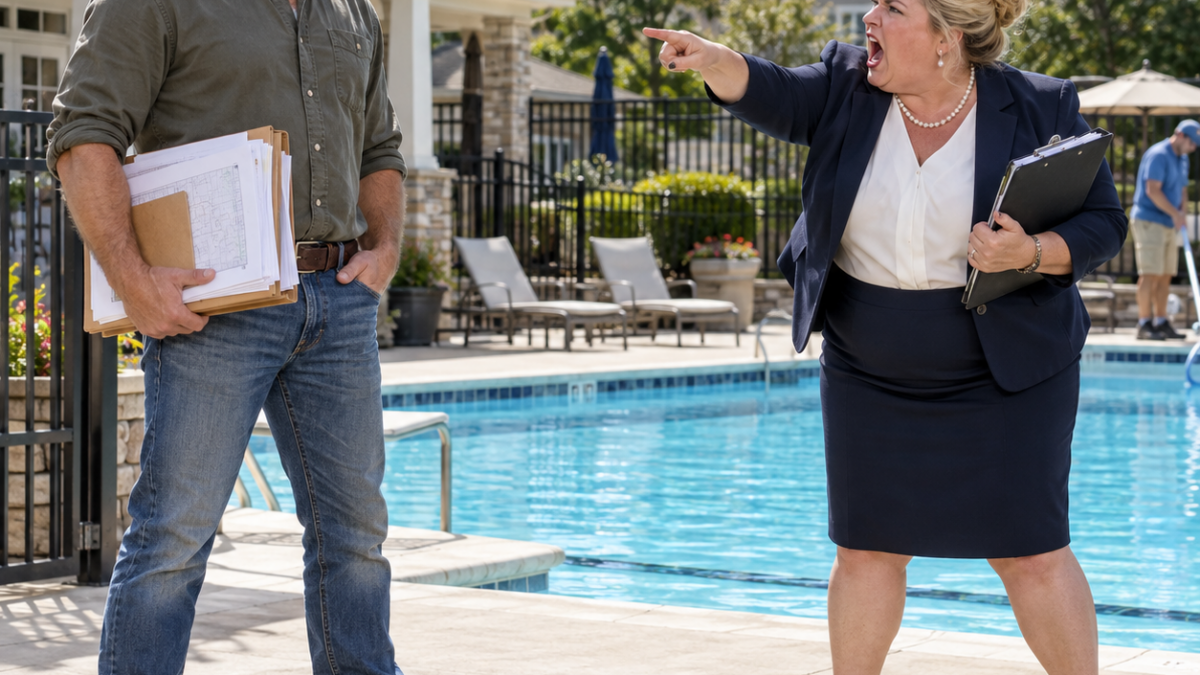
The HOA president stood ten feet from my workshop and told me the fines against my property were now worth more than the building itself.
She gave me forty-eight hours to tear down the place I had built with my own hands, even though my land had never belonged to her association.
What Karen did not know was that every new fine she added was quietly increasing the price she would eventually pay for crossing a boundary she had been warned about from the beginning.
“That pathetic excuse for a workshop violates seventeen separate covenants.”
Karen stood beside the survey stake in a flower-print dress, one hand planted on her hip and the other pointing toward the forty-by-sixty-foot steel building behind me.
“You now owe Oak Creek Estates more than twenty-two thousand dollars.”
I wiped grease from my fingers with an old shop rag.
“Karen.”
“What?”
“You’re standing beside the marker.”
She glanced down.
“That marker?”
“The property line.”
Her mouth tightened.
“Your property directly affects our community.”
“That isn’t what I said.”
Behind her, Oak Creek Estates stretched in neat rows of matching roofs, trimmed lawns, identical mailboxes, and decorative trees spaced with mathematical precision.
My acre and a half looked different.
Native Texas grass.
Old oaks.
Gravel driveway.
My dusty F-250.
And the workshop where I was slowly rebuilding a 1968 Kaiser M715 military truck.
It wasn’t polished.
It wasn’t landscaped.
But it was mine.
More importantly, it wasn’t in Oak Creek Estates.
Before I bought the parcel, I had paid a property attorney to confirm that fact three separate times.
The developer had carved the land out decades earlier.
My deed said it.
The county plat said it.
The HOA’s own founding documents said it.
Karen had seen copies.
She simply did not care.
“You have forty-eight hours,” she repeated. “After that, the board may authorize contractors to remove the structure.”
Something inside me went very still.
I had spent twenty years in the Army Corps of Engineers.
I understood jurisdiction.
I understood contracts.
And I understood what happened when someone became so convinced of their own authority that they stopped checking whether they actually possessed it.
“Are you threatening to send contractors onto my land?”
“I’m informing you of the consequences of noncompliance.”
“I’m not a member of your HOA.”
“We have a responsibility to protect property values.”
“Then protect the property you actually govern.”
Her face reddened.
“This is exactly the kind of hostility the board has documented.”
I almost laughed.
Three years earlier, after my wife Sarah died, I could barely stand being inside our old house.
Every room contained her.
Her coffee mug.
Her side of the closet.
A grocery list in handwriting I recognized from across the room.
Silence became something physical.
So I sold the house.
I used most of my savings and part of Sarah’s life-insurance money to buy this forgotten patch of land beside Oak Creek Estates.
I wanted one thing.
Purpose.
The workshop gave me that.
Every bolt I turned on that old Kaiser quieted my mind.
Every wall I raised gave me somewhere to put the grief.
Karen looked at the building and saw an eyesore.
I saw the first place that had felt like home since I buried my wife.
“I’m giving you one final opportunity,” she said.
“No.”
Her eyes narrowed.
“No?”
“You’re not touching my workshop.”
“You don’t have a choice.”
“That’s where you’re wrong.”
She reached into her binder and pulled out another page.
“Then the daily fines continue.”
“How much?”
“One hundred dollars per day for the structure, plus additional penalties for the vehicle, landscaping, surveillance equipment, and administrative costs.”
“Surveillance equipment?”
“The cameras you installed.”
I looked at the camera mounted above my workshop door.
The same camera that had already recorded Karen stepping across my boundary with a tape measure.
“You’re fining me because my camera recorded you trespassing?”
She stiffened.
“I was conducting an inspection.”
“On property you don’t govern.”
She shoved the notice toward me.
I didn’t take it.
“Mail it.”
“You’re making a serious mistake, Mr. Miller.”
“No, Karen.”
I looked at the survey stake between us.
“You are.”
She turned and marched back toward her golf cart.
I watched her disappear into Oak Creek Estates.
Then I went inside, closed the workshop door, and pulled the growing stack of HOA letters from my filing cabinet.
The latest total was ridiculous.
But the last paragraph was different.
This time, they weren’t merely threatening fines.
They were preparing to put a lien on my land.
I sat down at the workbench where Sarah’s photograph rested beside an old socket set.
And for the first time since this started, I stopped thinking about how to defend myself.
I started thinking about what I could take from them if they forced me to fight.
PART 2
The next morning, I drove downtown before the county records office opened.
I was the first person through the door.
A clerk named Dolores recognized me from my earlier visits.
“You again?”
“Afraid so.”
She took one look at the binder tucked under my arm.
“Property problem?”
“HOA problem.”
She gave me the kind of sympathetic expression people reserve for kidney stones.
“Worse.”
I smiled.
“Probably.”
I had already pulled my own deed and subdivision plat weeks earlier, but this time I wanted everything.
The original master deed for Oak Creek Estates.
The HOA charter.
Recorded covenants.
All amendments.
Maps.
Easements.
Annexations.
Anything showing where their authority began and ended.
For four hours, Dolores helped me pull records.
By noon, the answer was so clear it almost felt insulting.
My parcel was not within Oak Creek Estates.
Not partially.
Not historically.
Not by easement.
Not by amendment.
The original subdivision map drew a thick boundary around the development.
Beside it, my parcel was specifically marked:
NOT A PART OF THIS PLAT.
I stared at the words.
Karen had already received a certified copy of this exact page.
Yet she continued billing me.
That meant something.
At first, I had assumed she was stubborn.
Then arrogant.
Now I began wondering if the goal had never been compliance at all.
I paid for certified copies.
When Dolores handed me the envelope, she said, “Whatever they’re doing, this ought to help.”
“You have no idea.”
I drove home.
Instead of going to the workshop, I went to my kitchen.
For the next six hours, I organized.
Sarah used to laugh at my binders.
“Jack, normal people have drawers.”
“Drawers are where information goes to die.”
“Normal people also don’t label restaurant receipts.”
“You’ll thank me during the audit.”
“We’ve never been audited.”
“Exactly.”
She would have loved this fight.
Not the hostility.
The paperwork.
Sarah had been a school administrator for twenty-three years and could reduce a room full of bureaucratic nonsense to one question.
“Where does it actually say that?”
I heard her voice while I worked.
Where does it actually say that?
Nowhere.
That was the problem for Karen.
There was no document giving Oak Creek authority over me.
So at eight the next morning, I sent another certified response.
Not emotional.
Not insulting.
Three pages.
I stated that I was not an Oak Creek member.
I identified my assessor parcel number.
Quoted the original plat.
Quoted the HOA charter.
Quoted their own governing documents.
Attached certified copies.
Then I wrote:
Any attempt by Oak Creek Estates Homeowners Association, its board, agents, contractors, attorneys, or vendors to record a lien against my property based upon purported HOA fines will constitute knowing interference with title after actual notice that the parcel is outside the association’s jurisdiction.
I signed it.
Certified mail.
Return receipt.
Karen signed for it herself.
For eight days, nothing happened.
I worked on the Kaiser.
The old truck had been sitting in a barn for nearly thirty years before I bought it.
The engine was salvageable.
Body rough.
Electrical system looked like squirrels had attempted engineering.
Perfect.
I was underneath the front axle when the mail arrived.
Another thick envelope.
Oak Creek Estates.
I opened it beside the mailbox.
The first sentence made me laugh.
“Your failure to meaningfully respond to prior enforcement notices…”
I had sent them forty-eight pages.
Apparently forty-eight pages did not qualify as meaningful.
Then came their new legal theory.
Prescriptive aesthetic easement.
I read it twice.
Then a third time.
I had spent enough of my military career dealing with real easements to understand just how absurd the phrase was.
An easement could permit access.
Utilities.
Drainage.
Rights-of-way.
A prescriptive easement could sometimes arise from long, open use.
But Oak Creek was claiming something else.
They claimed that because residents had historically enjoyed attractive views toward my parcel, the HOA had somehow acquired an implied right to regulate the appearance of land it did not own.
It was nonsense wearing a necktie.
The fines had reached $7,500.
Then I reached the final paragraph.
Failure to bring the property into compliance within fifteen days would result in lien proceedings.
I stood beside the mailbox while a hot Texas wind pushed dust across the road.
A lien was different.
Letters could be ignored.
Made-up fines could be challenged.
But a recorded lien attached itself to title.
It could interfere with financing.
Sale.
Insurance.
Ownership.
And eventually, if somebody convinced a court that it was valid, foreclosure.
Karen was no longer waving HOA rules around.
She was trying to put a legal weapon against my land.
That afternoon, I called Dave Martinez.
Dave and I had spent years crossing paths in the Army.
He had eventually gone to law school, moved into civil litigation, and discovered that civilian courtrooms gave him something the military never had.
The freedom to enjoy himself.
He answered with, “Please tell me somebody finally tried to sue you.”
“Close.”
“Jack?”
“Yeah.”
“What happened?”
I explained everything.
He interrupted twice.
Once when I said my land was outside the association.
Once when I mentioned the lien threat.
When I finished, he whistled.
“Send me every document.”
“How bad?”
“For you? Manageable.”
“For them?”
“Potentially educational.”
I scanned the binder.
An hour later, he called.
“Jack.”
“Yes?”
“This is insane.”
“That legal terminology?”
“Highly technical.”
I leaned against the kitchen counter.
“Can they file a lien?”
“Anybody can walk into a recorder’s office with enough confidence and the correct form.”
“Valid lien?”
“That is another matter.”
“What about this aesthetic-easement nonsense?”
“I’m trying to decide whether to laugh professionally.”
“So they’ve got nothing.”
“They’ve got arrogance.”
“Same thing Karen has.”
“No. Arrogance is more expensive.”
There was a pause.
“Listen carefully. Do not pay them. Do not sign anything. Do not verbally agree to anything. Keep every letter.”
“I already do.”
“I know you do, psychopath.”
“Anything else?”
“Install cameras.”
“Already done.”
“Of course.”
He continued.
“And if they trespass, document it.”
“Already have one clip.”
“What happened?”
“She stepped across the property line with a tape measure.”
Silence.
“Send me that.”
I did.
Dave called back laughing.
“Jack, she’s going to make us rich.”
“I don’t want rich.”
“What do you want?”
“Peace.”
His voice became quieter.
“Then we make peace expensive enough that they stop disturbing it.”
That night, I added two more cameras.
One covered the driveway.
One covered the back corner where the old oak trees hid part of the workshop.
I installed motion lights.
No Trespassing signs.
Every sign cited the applicable criminal-trespass statute.
The property looked less welcoming afterward.
I hated that.
But Sarah had taught me something about boundaries.
A boundary that exists only in your head is not a boundary.
Sometimes you have to show people where the line is.
Karen saw the signs the next afternoon.
One of the cameras captured her standing outside the property line, staring at them.
She pointed.
Talked to Gary, one of her board members.
Waved her arms.
Then noticed the camera.
She stared directly into the lens.
I was watching live from inside the workshop.
“Smile,” I muttered.
She did not.
Three mornings later, at 5:42, the motion alert woke me.
I picked up my phone.
Karen.
Tape measure.
Flashlight.
She stepped across the survey marker.
The floodlight snapped on.
She froze.
It was beautiful.
Not because I enjoyed frightening her.
Because for one brief second, the camera captured what happened when someone who believed boundaries were optional suddenly realized the boundary was watching back.
She rushed toward her golf cart.
The rear wheel jumped the curb.
I saved the clip.
TRESPASS_02.
The fines accelerated.
Camera one: $500 daily.
Camera two: another $500.
Security lighting: $200 daily.
Hostile signage: $150.
Workshop: $100.
Vehicle storage.
Improper native landscaping.
Visual nuisance.
Commercial equipment.
The numbers grew so ridiculous that I stopped calculating.
By the time they claimed I owed $15,000, it had become fictional accounting.
But Dave warned me not to dismiss it emotionally.
“Every letter matters.”
“Even when the amount is imaginary?”
“Especially then.”
“Why?”
“Because imaginary money attached to real threats becomes evidence of intent.”
I understood that.
So I filed everything.
Then I began walking.
Not for exercise.
For intelligence.
Oak Creek residents had watched the dispute from a distance.
At first, most treated me like the problem.
The outsider.
The man with the ugly building.
The military trucks.
The native grass.
Karen controlled the newsletter.
She controlled meetings.
She controlled the story.
According to her, I was a hostile noncompliant landowner undermining community values.
I could have fought propaganda with propaganda.
Instead, I talked to people.
The first real conversation happened with Hector Garcia.
He was halfway up a ladder repainting trim on his garage.
I watched the ladder wobble.
“Want me to hold that?”
He looked down.
“You’re the workshop guy.”
“Apparently that’s my legal name now.”
He laughed.
“Aren’t you the one fighting the HOA?”
“I’m the one the HOA is fighting.”
That made him pause.
I steadied the ladder.
We spent an hour fixing trim.
Hector told me about his son’s basketball goal.
Portable hoop.
Birthday present.
The HOA demanded an in-ground system.
Fifty-dollar fines.
Every week.
“My wife wants me to get rid of it.”
“Why don’t you?”
He looked toward the backyard.
His twelve-year-old son was shooting baskets alone.
“Because look at him.”
I understood.
“Karen says rules are rules.”
“Is the rule actually in the covenants?”
He looked at me.
“I assume.”
“Never assume.”
Two days later, Hector brought me the rule book.
Three hundred pages.
We found the recreational-equipment section.
It said equipment must be maintained in good condition.
Nothing about in-ground installation.
Nothing.
Hector stared.
“She made it up?”
“Looks that way.”
His face changed.
That was the moment fear became anger.
After Hector came Mrs. Gable.
Then the Harris family.
Then Captain Dean Mercer from the Air Force.
Then Rebecca Lawson.
Every one of them had a story.
Mrs. Gable had lived there twenty-seven years.
She was being threatened over flowers.
Tulips Karen claimed were not approved.
Her husband had planted the first bulbs before he died.
That detail hit me hard.
She showed me the roses he had also planted for their anniversary.
The HOA wanted several removed.
“Why don’t you fight?” I asked.
She looked embarrassed.
“They mentioned foreclosure.”
“How much do they claim you owe?”
“Twenty-three hundred.”
“For flowers?”
“And legal fees.”
I sat quietly.
The word foreclosure changes elderly people.
It changes anyone.
A home isn’t just an asset when you have spent half a lifetime inside it.
It becomes the container for your dead.
Their voices.
Their routines.
Their fingerprints.
I knew that better than most.
“You’re not alone,” I told her.
Her eyes filled.
“I feel like I am.”
“You aren’t anymore.”
Hector started a group chat.
He named it THE RESISTANCE.
I told him it was dramatic.
He told me that was rich coming from a man who labeled video files like military evidence.
Fair.
Within two weeks, fifteen residents joined.
They started comparing notices.
The pattern became obvious.
Ask a question?
New violation.
Challenge a fine?
Inspection.
Request records?
Administrative fee.
Disagree publicly?
Suddenly your trash can, lawn, driveway, flag, children’s toys, and flower beds became matters of existential community importance.
Karen kept everyone isolated.
Each victim thought they were uniquely difficult.
Once people compared paperwork, the illusion collapsed.
Then came the tow truck.
I was rebuilding the Kaiser’s carburetor when I heard the reverse alarm.
Beep.
Beep.
Beep.
Not from the road.
My driveway.
I stepped outside.
A flatbed tow truck was backing toward the workshop.
The driver climbed down holding a heavy chain.
“What are you doing?”
He glanced at a work order.
“Vehicle removal.”
“Whose?”
He pointed toward my 1952 M37 Power Wagon.
Mine.
“HOA says abandoned vehicle.”
“This isn’t HOA property.”
“Work order says they have authority.”
“Who signed it?”
He showed me.
Karen.
I looked across the line.
There she was.
Sitting in her golf cart.
Watching.
She gave the driver an impatient wave.
Something inside me hardened.
I walked between him and the truck.
“You are currently standing on private property.”
He sighed.
“Look, buddy—”
“No. Listen.”
I kept my voice calm.
“That vehicle belongs to me. It is not abandoned. This property is not inside Oak Creek Estates. I am telling you explicitly that you do not have permission to touch it.”
He looked toward Karen.
She waved again.
“HOA says—”
“The HOA can say the moon owes dues.”
I pulled out my phone.
Hit record.
“For the record, I am ordering A1 Towing to leave my private property. Any attempt to attach equipment to my vehicle after this notice will be reported to law enforcement as attempted unlawful removal of a motor vehicle.”
The driver’s expression changed.
Karen stood up in the golf cart.
“Do your job!”
He looked at her.
Then me.
“I’m not getting arrested over this.”
He threw the chain back onto the flatbed.
Karen marched toward the line.
“You were properly notified!”
I kept recording.
“Karen, are you instructing this company to remove my vehicle from land you know is not within Oak Creek Estates?”
“Your junk is negatively impacting our community.”
“That wasn’t my question.”
“You are being deliberately obstructive.”
“Do you have a court order?”
She hesitated.
“Do you have legal title to this property?”
Silence.
“Do you have a lien authorizing seizure?”
Her face reddened.
The tow driver climbed back into his cab.
He left.
Karen watched him disappear.
Then she looked at me with an expression so furious I almost felt sorry for her.
Almost.
“You’re going to regret this.”
I lowered the phone.
“No, Karen.”
I pointed toward the retreating tow truck.
“You are.”
Dave watched the video three times.
Then he called me.
“She ordered a private towing company onto your property?”
“Yes.”
“After receiving certified proof you’re not in the HOA?”
“Yes.”
“And she’s still threatening a lien?”
“Yes.”
“Good.”
“Good?”
“Legally.”
“That word is doing a lot of work.”
He laughed.
Then he became serious.
“Jack, we’re past nuisance notices.”
“I know.”
“This is becoming a pattern of intentional conduct.”
“What kind of case?”
“At minimum, slander of title if they record the lien knowing it’s false. Abuse of process if they use court machinery for an improper objective. Trespass. Tortious interference. Potential conspiracy claims depending on who participated.”
“And the pattern against homeowners?”
“That may matter.”
“How much?”
“Potentially a lot.”
He explained civil racketeering theories.
State statutes.
Extortion-based claims.
I stopped him.
“Are you telling me we can treat an HOA like organized crime?”
“I am telling you not to use that sentence publicly.”
“So yes.”
“I’m telling you the facts determine the claim.”
“What facts do you need?”
“Pattern.”
“We have it.”
“Documents.”
“We have those.”
“Intent.”
I thought about Karen.
“We’ll get it.”
We did.
At the next HOA meeting, Karen placed “Noncompliant Adjoining Property” on the agenda.
That meant me.
I couldn’t attend because I wasn’t a member.
Hector could.
I gave him an audio recorder.
“Check state law,” he said.
“Dave already did.”
“Legal?”
“One-party consent.”
Hector slid the recorder into his shirt pocket.
At 9:23 that night, the file hit my phone.
I listened from the workshop.
Karen’s voice filled the room.
For twenty minutes she talked about me.
Reclusive.
Hostile.
Degenerate.
Dangerous to property values.
She bragged that the fines exceeded $50,000.
Then she made the mistake.
The one people make when they have listened only to supporters for too long.
“He believes that because his parcel was excluded from the original plat, he can ignore the needs of the community.”
Pause.
“But our attorneys have advised us that Oak Creek has remedies.”
Someone asked what remedies.
Karen answered.
“We will foreclose.”
My hands stopped moving.
She continued.
“When the property is sold to satisfy what he owes, the association can acquire it, demolish the illegal workshop, remove those derelict vehicles, and incorporate the parcel into Oak Creek as a community park.”
There it was.
Not compliance.
Acquisition.
The fines were a mechanism.
The lien was leverage.
The end goal was my land.
She had said it in front of homeowners.
I sent the recording to Dave.
He called within five minutes.
“Jack.”
“Yeah.”
“She just gift-wrapped intent.”
“I figured.”
“I want you to do absolutely nothing.”
“That seems anticlimactic.”
“Let her file the lien.”
“Really?”
“Yes.”
“She already threatened it.”
“Threats are evidence. A recorded lien is action.”
“And if they sue?”
“Even better.”
“You’re enjoying this.”
“I went to law school for a reason.”
The final demand arrived one week later.
$58,250.
Thirty days.
Pay or lien.
I forwarded it.
Dave replied:
LET IT RUN.
Day thirty-one.
I checked the county property system.
There it was.
OAK CREEK ESTATES HOMEOWNERS ASSOCIATION.
LIEN CLAIM.
Against my parcel.
The document claimed I owed association dues, fines, administrative fees, and legal expenses.
Dues.
I had never owed them one dollar in dues because I had never belonged to the association.
I stared at the screen.
Anger came first.
Then grief.
Strange grief.
Sarah’s insurance money had helped buy that land.
I had chosen it because it was supposed to be outside the control that had made our old suburban life feel so suffocating after she died.
I could almost hear her.
“Don’t let anger drive, Jack.”
She used to say that whenever someone irritated me.
“You can put anger in the passenger seat. Just don’t give it the wheel.”
So I printed the lien.
Put it in the binder.
Called Dave.
“It’s recorded.”
“Excellent.”
“Stop saying excellent when people attack my title.”
“Professional habit.”
“What now?”
“Now we wait for them to make the second mistake.”
They did not make us wait long.
Thirteen days later, a process server appeared.
Oak Creek had sued.
They wanted judicial foreclosure.
They claimed the right to force sale of my land to satisfy their bogus lien.
I signed the summons.
Walked into the workshop.
Placed it beside Sarah’s photo.
“You always said I needed a hobby.”
The next morning, Dave filed our response.
One hundred fifty pages.
Not defense.
Counterattack.
Oak Creek HOA.
Karen personally.
Every board member who authorized the lien.
Slander of title.
Wrongful lien.
Abuse of process.
Trespass.
Harassment.
Civil conspiracy.
Attempted unlawful conversion of personal property.
And a civil racketeering claim based on a pattern of extracting money and property through threats and misuse of association authority.
Exhibits filled a separate binder.
My deed.
Master plat.
Certified HOA charter.
Every fine.
Certified letters proving actual notice.
Security footage.
Tow-truck video.
Affidavits from Hector.
Mrs. Gable.
Captain Mercer.
Rebecca.
Five other families.
Then the transcript.
Karen:
“We will foreclose.”
Karen:
“The association can acquire it.”
Karen:
“Demolish the workshop.”
Karen:
“Incorporate the parcel into Oak Creek.”
Dave called after filing.
“How do you feel?”
“Tired.”
“That’s disappointing.”
“What should I feel?”
“Triumphant.”
“Not yet.”
He was quiet.
“Sarah?”
I hadn’t mentioned her much to him.
But he knew.
“Yeah.”
“You bought the land with some of her insurance money, didn’t you?”
“Yes.”
“Then we protect it.”
That was all he said.
Three days later, local investigative reporter Sarah Jenkins called me.
I hadn’t contacted her.
Hector had.
“You have an HOA trying to foreclose on property that isn’t in the HOA?”
“That’s the short version.”
“Can I see documentation?”
“Yes.”
“If it checks out, would you go on camera?”
I hesitated.
I hated attention.
My entire retirement plan involved machines that didn’t talk back.
Then I thought of Mrs. Gable.
Her tulips.
Her husband’s roses.
Hector’s son.
The residents afraid to challenge fines.
“Yes.”
Sarah Jenkins came to my property the next morning.
Unlike Karen, she stopped at the line.
“May I come in?”
That simple question immediately made me like her.
“Yes.”
She spent five hours reviewing records.
Not skimming.
Reviewing.
She called the county.
Verified the plat.
Verified the lien.
Verified the lawsuit.
Interviewed Dave.
Then Hector.
Mrs. Gable.
Captain Mercer.
By the time she left, she looked furious.
Her segment aired three nights later.
It opened with an aerial shot.
Oak Creek Estates.
Perfect lawns.
Blue community pool.
Then my parcel.
Scrub grass.
Workshop.
Military trucks.
Sarah’s voice-over:
“Just beyond Oak Creek Estates sits 1.5 acres the county says is not part of the subdivision. Yet Oak Creek’s HOA claims the owner owes more than fifty-eight thousand dollars in fines and is asking a court to foreclose.”
Then my deed.
Plat.
Not a part of this plat.
Karen’s fines.
Camera footage.
Karen stepping over the survey stake.
Tow truck entering my driveway.
My recorded warning.
Then Hector.
“My son’s basketball goal cost ninety dollars. The HOA has fined us more than that every month because they claim it’s the wrong type.”
Mrs. Gable stood beside her roses.
“My husband planted these.”
Her voice broke.
“They told me to remove them.”
Then the audio recording.
Karen’s voice.
“We will foreclose…”
The television displayed the waveform while she spoke.
“…acquire it…”
“…demolish the illegal workshop…”
“…community park.”
The reporter did not need commentary.
Karen convicted herself.
They tried interviewing her outside a grocery store.
She saw the camera.
“What is this?”
“Mrs. Karen—”
“This is harassment!”
“Can you explain why your HOA filed a lien against property county records show is outside your subdivision?”
“That is a gross mischaracterization.”
“Is this your voice?”
Sarah played the audio from her phone.
Karen reached toward the microphone.
“You people are disgusting.”
Then hurried away.
The seven-minute segment changed everything.
My phone rang until midnight.
Not reporters.
Oak Creek homeowners.
Twenty-three new people joined Hector’s group.
By morning, forty-seven.
People sent violation letters.
Fines.
Threats.
Records.
One family had paid $1,800 because their garage door remained open while caring for a sick parent.
A widow had paid hundreds because her trash bin was visible from the street for ninety minutes.
One father had been fined because his children drew hopscotch in chalk.
Karen had built power through isolation.
The news story destroyed the isolation.
An emergency HOA meeting was announced.
I couldn’t attend.
Hector went.
More than one hundred homeowners packed the clubhouse.
He called me afterward.
“They’re eating each other alive.”
“What happened?”
“Karen tried calling the report fake news.”
“Expected.”
“Captain Mercer stood up with a ruler.”
“A ruler?”
“He measured his flagpole.”
I laughed.
“What else?”
“Rebecca asked Karen to explain how sidewalk chalk damages property value.”
“And?”
“She couldn’t.”
“What about the board?”
“Terrified.”
They had reason.
The HOA insurer had issued something called a reservation-of-rights letter.
Dave explained it.
“They may refuse to cover intentional acts.”
“Meaning?”
“If liability is based on willful misconduct, the board members may personally pay.”
That changed the psychology instantly.
Karen had enjoyed threatening other people’s homes.
Now her board members were staring at their own.
Discovery began.
Dave demanded everything.
Emails.
Texts.
Financials.
Board minutes.
Legal invoices.
Enforcement logs.
Correspondence mentioning my name.
The HOA’s attorneys objected.
The judge ordered production.
Then came depositions.
Karen first.
Dave showed me the video afterward.
She wore black.
Pearls.
Expression of supreme irritation.
Dave began calmly.
“You are president of Oak Creek Estates HOA?”
“Yes.”
“Mr. Miller is a member?”
“He is subject to our community standards.”
“That wasn’t my question.”
Karen looked annoyed.
“His property affects Oak Creek.”
“Is he a member?”
“No.”
“Does his deed contain HOA covenants?”
“Our position is—”
“Yes or no.”
“No.”
“Is his parcel listed within the recorded subdivision plat?”
“It adjoins Oak Creek.”
“Is it within the plat?”
“No.”
“Did you know that before fines were issued?”
Karen shifted.
“I relied on counsel.”
Dave produced my first certified letter.
“You received this?”
“Yes.”
“It includes the county plat?”
“Apparently.”
“You signed the return receipt?”
“Yes.”
“So as of this date, you had documentary notice that Mr. Miller’s land was outside Oak Creek.”
“Our counsel believed—”
“What counsel?”
Karen froze.
Dave had obtained legal invoices.
The HOA attorney had not been consulted until after my third violation letter.
The first fines were Karen’s idea.
The supposed prescriptive aesthetic easement was a phrase from an email between Karen and Gary.
No lawyer had invented it.
They had.
Dave showed her the email.
Karen’s face changed.
Then came the tow truck.
“Did you order A1 Towing onto Mr. Miller’s property?”
“We authorized removal of blighted vehicles.”
“From Oak Creek property?”
“From adjoining property affecting community standards.”
“Did you have a court order?”
“No.”
“Lien?”
“Not at that time.”
“Contract with Mr. Miller?”
“No.”
“Title?”
“No.”
“What legal authority allowed you to remove his vehicle?”
Karen rambled.
Standards.
Aesthetics.
Property values.
Community welfare.
Dave waited.
Then:
“So none.”
She glared.
Then the recording.
Dave played her voice.
“We will foreclose…”
Karen sat perfectly still.
He stopped it.
“Is that your voice?”
“It sounds edited.”
“You deny saying it?”
“I said many things during a contentious meeting.”
“Did you say the association intended to acquire Mr. Miller’s land?”
“I was speaking hypothetically.”
“Did you say the workshop would be demolished?”
“As part of a hypothetical.”
“Did you say the land would become a park?”
“It was conceptual.”
Dave leaned forward.
“Mrs. Carmichael, your HOA levied escalating fines against a non-member, recorded a lien against his title, sued to foreclose, and before filing that lawsuit you publicly described using foreclosure to acquire his land for the association.”
Karen said nothing.
“Is that coincidence?”
Her lawyer objected.
Dave smiled.
“Withdrawn.”
But the question hung there.
The other depositions went worse.
Gary admitted he had never read the master plat.
Gerald, the treasurer, admitted he assumed Karen had authority.
Another board member admitted no formal legal opinion had been obtained before fines began.
One said Karen told them my parcel would be “an easy acquisition once the old guy ran out of money.”
I read that transcript three times.
Old guy.
I was fifty-eight.
Rude.
But useful.
The insurer withdrew coverage for several claims involving intentional misconduct.
Then the board panicked.
Their lawyer called Dave.
Settlement.
They would remove the lien.
Dismiss their case.
Pay some legal fees.
Formal apology.
Dave called me.
“They want out.”
“How badly?”
“Badly.”
“What are they offering?”
He explained.
I listened.
“No.”
“Expected.”
“I don’t want a check.”
“You should want a check.”
“I don’t.”
“What do you want?”
I looked through the workshop door toward Oak Creek.
The most visible feature was the pool complex.
Blue water.
White cabana.
Decorative palms.
Karen loved that pool.
I knew because half the HOA newsletter photos involved her standing beside it.
Opening day.
Summer social.
Fourth of July.
Pool committee.
Senior aquatics.
It was her palace.
“What property does the HOA own outright?”
Dave paused.
“Interesting question.”
“Find out.”
Two days later, he called.
“Common-area tracts.”
“Which?”
“Entrance landscaping. Drainage parcels. Clubhouse. Pool complex.”
“Separate parcel?”
“The pool?”
“Yes.”
“Lot C2. Deeded to the HOA.”
“How much is it worth?”
“Land, structures, pool, parking? Significant.”
“Enough?”
“To settle the case?”
“That depends how angry you are.”
“I’m not angry.”
“That statement concerns me.”
“Offer them a deal.”
“What deal?”
I told him.
Dave was silent.
Then he laughed for almost thirty seconds.
“Jack.”
“Yes?”
“Sarah would either be horrified or deeply impressed.”
“Both.”
“I’ll draft it.”
Settlement conference.
Downtown.
Mahogany table.
Karen on one side.
Three board members.
Their attorney.
Dave and me across from them.
Their lawyer spoke first.
Dismissal.
Lien release.
Apology.
Legal fees.
Monetary settlement.
Dave listened.
Then folded his hands.
“My client rejects your offer.”
Gerald looked sick.
Karen actually smiled.
As if rejection somehow meant she had regained leverage.
Then Dave continued.
“We do have a counterproposal.”
He summarized their position.
Potential civil-racketeering damages.
Wrongful lien.
Title damage.
Intent evidence.
Trespass.
Attempted towing.
Legal costs.
Lack of insurance coverage.
Personal exposure.
Karen interrupted.
“This is intimidation.”
Dave didn’t look at her.
“A trial will be public.”
That silenced everyone.
Then he slid the plat map across the table.
Yellow highlighted parcel.
Gerald adjusted his glasses.
“What is this?”
“Lot C2.”
Karen grabbed it.
Her face changed instantly.
“No.”
Dave leaned back.
“The HOA deeds Lot C2 to Mr. Miller free and clear.”
“No!”
Her fist hit the table.
“Absolutely not.”
Gerald looked confused.
Then saw the parcel description.
“Oh God.”
One board member whispered, “The pool?”
“Yes,” Dave said.
Karen stood.
“This is extortion!”
I finally spoke.
“No.”
She turned toward me.
“This is exactly what you did to me.”
“You’re stealing our pool!”
“I didn’t put a false lien on it.”
“This is insane!”
“You wanted my land.”
“That was enforcement.”
“You told homeowners you planned to foreclose, bulldoze my workshop, and turn my property into a park.”
“You violated community—”
“My property is not in your community.”
Her face twisted.
“You think you can take our pool because of paperwork?”
I looked at her.
That question was so perfect I almost smiled.
“No, Karen.”
I kept my voice quiet.
“I can take it because you used paperwork to try to take my home.”
The room went silent.
Dave continued.
“In exchange, Mr. Miller releases the HOA and individual board members from the civil claims addressed in the settlement, subject to full performance. The lien is expunged. The association dismisses its foreclosure action with prejudice. Title to Lot C2 transfers by warranty deed.”
Gerald whispered to the attorney.
They started calculating.
Trial.
Legal fees.
Potential damages.
Personal assets.
Publicity.
Pool.
Numbers eventually defeat loyalty.
One board member looked at Karen.
“We need to consider it.”
She stared at him.
“You can’t be serious.”
“We could lose our homes.”
“You’re letting him bully us!”
He laughed bitterly.
“You got us here.”
That sentence broke something.
Karen looked around.
Gary would not meet her eyes.
Gerald stared at the map.
The fourth member had both hands over his face.
Her kingdom was evaporating.
They voted.
Three to one.
Karen alone.
Settlement accepted.
The paperwork took twenty-four days.
Longest twenty-four days of my life.
Dave warned me not to celebrate until the deed recorded.
I didn’t.
On day twenty-four, he called.
“Check county records.”
I opened the site.
LOT C2.
Owner:
JACK MILLER.
I stared.
Then sat back in my chair.
I owned their pool.
Not metaphorically.
Not as a judgment lien.
Not temporarily.
The land.
Pool.
Cabana.
Changing rooms.
Parking lot.
All of it.
Sarah’s photograph sat beside my monitor.
I picked it up.
“You’re laughing somewhere.”
The first thing I did was not lock the gates.
That came second.
The first thing I did was walk the property.
Karen had cared obsessively about boundaries when she believed they belonged to her.
So did I.
Survey stakes.
Parcel map.
Utility lines.
Fence.
Everything.
Then I changed the locks.
Sent notice.
Lot C2 was now private property.
Unauthorized access prohibited until reopening arrangements were announced.
Oak Creek residents panicked.
The pool was central to summer.
But most did not blame me.
They blamed Karen.
The old bronze sign said:
OAK CREEK ESTATES
RESIDENTS & AUTHORIZED GUESTS ONLY.
Hector met me there.
“You’re keeping that?”
“No.”
“Can I have it?”
“I’m hanging it in the workshop.”
We unbolted it.
The second screw snapped.
Hector used a pry bar.
The bronze plate came away with a shriek.
We both started laughing.
“What now?” he asked.
“I don’t know.”
“You’re not closing it permanently?”
I looked at the empty pool.
“No.”
“Then what?”
Sarah used to believe every bad space could be fixed by making it welcoming.
Our old backyard had been proof.
She invited neighbors I didn’t like.
Fed soldiers who had nowhere to go on holidays.
Hosted children.
Strangers.
Everybody.
“Something better.”
I hired three retired military friends.
One was a certified lifeguard instructor.
One had managed facilities.
One could fix almost anything except his own marriage.
We repainted the cabana.
Light blue.
Not beige.
Karen would have hated it.
New chairs.
Barbecue grills.
Shade structures.
String lights.
Better safety equipment.
Updated first-aid station.
Clean changing rooms.
Then I created a business.
Miller’s Landing Swim Club.
Public admission.
Affordable.
Veterans and active-duty military free.
Oak Creek residents received discounted annual memberships.
Hector stared when I told him.
“You’re charging the people whose pool you took?”
“I’m charging less than they were paying through HOA dues to maintain it.”
“That is evil.”
“That is accounting.”
“What about Mrs. Gable?”
“Free.”
“Why?”
“She’s seventy-six.”
“That’s discrimination against youth.”
“Go away.”
Opening day arrived in June.
Texas heat.
Ninety-six degrees by noon.
Cars filled the parking area.
Families lined up.
At first, Oak Creek residents approached cautiously.
They had spent years treating the pool like a regulated institution.
Rules everywhere.
No outside food.
No loud toys.
No inflatables over a certain size.
No music.
No splashing near the shallow-end chairs.
No running, obviously.
That one stayed.
I wasn’t stupid.
But most of the rest?
Gone.
Hector’s son performed the first cannonball.
He launched himself so hard that water hit three adults.
For half a second, everyone froze.
Years of Karen conditioning.
Then I laughed.
The adults laughed.
His mother yelled, “Miguel!”
The boy surfaced.
“Sorry!”
“Do it again,” Hector shouted.
His wife smacked Hector’s arm.
Mrs. Gable sat beneath an umbrella drinking lemonade.
Her rose bushes were still at her house.
Untouched.
Captain Mercer brought his family.
Rebecca’s kids drew chalk pictures near the cabana.
I bought them more chalk.
By three, music played.
Classic rock.
People grilled.
Kids screamed.
Adults talked.
Nobody measured anything.
I stood beside the gate watching.
And something surprised me.
I did not feel revenge.
I expected it.
Some satisfaction in owning what Karen considered the crown jewel of Oak Creek.
Instead, I felt relief.
This was what victory looked like.
Not Karen losing.
People relaxing.
Sarah would have understood.
Late afternoon.
The crowd had begun thinning.
A dark luxury sedan slowed outside.
Karen.
She drove past once.
Then circled.
Second time slower.
Window down.
She saw the new sign.
MILLER’S LANDING SWIM CLUB
ALL WELCOME.
She saw Hector at the grill.
Mrs. Gable laughing.
The kids.
Her former board members.
Even Gerald was there.
He had purchased a family membership.
Karen stopped.
For several seconds, we looked at each other.
I was holding a bottle of water.
I raised it slightly.
Not mocking.
Not smiling.
Just acknowledgment.
Her hands tightened on the steering wheel.
She looked toward the pool.
For years, that had been her stage.
Her rules.
Her events.
Her power.
Now children from outside Oak Creek were doing cannonballs in it while her own neighbors ate hamburgers beneath my blue cabana.
Her expression shifted.
Rage first.
Then something else.
Loss.
She accelerated away.
Hector walked over.
“You should’ve charged her admission.”
I shook my head.
“She wouldn’t have come in.”
“Would you let her?”
That question stayed with me.
Would I?
That night, after everyone left, I walked around the pool shutting lights.
The water was still.
Chairs scattered.
Forgotten towel.
Plastic cup.
Normal mess.
I found Sarah’s old photograph in my wallet.
One I carried from our last vacation.
She was standing beside a hotel pool.
Laughing.
Hair wet.
She hated swimming.
But she loved sitting near water.
I sat on one of the lounge chairs.
“You would’ve made me let her in.”
The photograph offered no argument.
“She tried to take our land.”
Still no argument.
I laughed softly.
“Fine.”
The next morning, I changed one policy.
Nobody was permanently banned except for safety violations or criminal trespass.
Karen could buy admission like anyone else.
She never did.
The HOA collapsed politically within months.
Not financially.
The settlement hurt.
Losing the pool humiliated them.
But residents demanded reforms.
Karen resigned before recall petitions reached a vote.
Gary stepped down.
Gerald cooperated with homeowners to rebuild governance.
The new board’s first major decision was to refund improperly issued fines where records justified it.
Hector received money back.
Mrs. Gable’s balance vanished.
Captain Mercer’s flagpole fine was refunded.
Rebecca got a check.
The sidewalk-chalk rule was officially abolished.
Hector framed the repeal.
His wife made him take it out of the living room.
The association hired a new law firm.
A real one.
Their first advice was radical.
“Only enforce restrictions actually written in the governing documents.”
Revolutionary.
My wrongful lien was permanently released.
The county record now showed satisfaction and expungement.
Dave made me order a full title report anyway.
“Clean.”
“Good.”
“You’re paranoid.”
“I’m paid to be paranoid.”
“Technically you were paid with a pool.”
“No. You were paid with a pool. I got fees.”
“Less fun.”
The workshop stayed.
The Kaiser eventually ran.
The first startup happened almost ten months after Karen’s original demolition threat.
Hector was there.
So was Captain Mercer.
Three veteran buddies.
Mrs. Gable refused because she said engines were “boy nonsense.”
Fair.
I turned the key.
Nothing.
Hector laughed.
“Perfect ending.”
“Shut up.”
Second try.
Engine turned.
Coughed.
Third.
The old inline six caught.
Rough.
Loud.
Beautiful.
Exhaust filled the open workshop.
I laughed.
Actually laughed.
Not polite laughter.
Not the small sound I had made in years since Sarah died.
A full, stupid laugh.
Everyone cheered.
I looked at the photograph on my workbench.
For a second, the grief came back.
But different.
Grief had once felt like being buried.
Now it felt like carrying something.
Heavy.
Permanent.
But carryable.
I whispered, “Got it running.”
A year passed.
Miller’s Landing became profitable.
Not wildly.
Enough.
Summer memberships.
Birthday parties.
Swim lessons.
Veterans’ events.
I hired local teenagers as lifeguards.
One of them was Hector’s son when he turned old enough.
He had grown.
The old portable basketball hoop remained in their driveway.
Oak Creek’s new board had proposed clarifying recreational-equipment rules.
Homeowners voted the amendment down.
Hector celebrated like the moon landing.
Mrs. Gable became the unofficial mayor of the swim club.
Her lemonade appeared every Saturday.
Nobody knew the recipe.
She refused to tell us.
“If I die, you’ll have to drink store-bought.”
“Cruel.”
“Life is cruel.”
Her roses bloomed.
So did Sarah’s memory.
I planted a small garden beside the pool.
Not formal.
Native Texas plants.
Roses.
One bench.
No plaque at first.
Then Hector surprised me.
He had a metal plate made.
SARAH’S CORNER
FOR THE WOMAN WHO TAUGHT JACK THAT A HOME SHOULD FEEL WELCOMING.
I stared at it.
“You never met her.”
“No.”
“How do you know she taught me that?”
“Because you didn’t.”
I punched his shoulder.
He laughed.
We installed it.
That garden became my favorite part of the property.
Children ran past it.
People sat there.
Nobody treated it like a shrine.
That mattered.
Sarah hated being fussed over.
Life should move through memory.
Not stop at it.
Karen disappeared from community life.
She kept her house for a while.
Then sold it.
Before leaving, she did one thing I never expected.
She came to my workshop.
Not marched.
Not on a golf cart.
Walked.
I saw her on camera.
Almost told her to leave.
Then remembered the policy.
No permanent bans.
I opened the door.
She stood outside.
Older.
Not physically.
Some people age emotionally all at once when authority leaves them.
“What do you want?”
She looked around.
At the Kaiser.
Tools.
Workbench.
“Is this the building?”
“The illegal one?”
She flinched.
“Yes.”
“Same building.”
“It’s nice.”
I said nothing.
She looked at the M715.
“You fixed that?”
“Yes.”
“Does it run?”
“Yes.”
Another silence.
Then:
“I’m moving.”
“I heard.”
“My husband wants to be closer to our daughter.”
“That sounds good.”
She nodded.
Then looked toward Oak Creek.
“I drove past the pool.”
“I’ve seen you.”
“You made it public.”
“Yes.”
“Why?”
“Why not?”
“It was supposed to be for residents.”
“It wasn’t anymore.”
Her jaw tightened.
Old instincts.
Then relaxed.
“I thought you’d close it.”
“I considered it for about five minutes.”
“That would’ve hurt people who didn’t do anything.”
“Exactly.”
She stared at me.
Then said quietly:
“I did hurt people.”
I waited.
She looked at the ground.
“I thought rules were what held the community together.”
“Rules matter.”
“I know.”
“You used them differently.”
“Yes.”
Another silence.
“I was angry that you wouldn’t cooperate.”
“I wasn’t obligated.”
“I know that now.”
“No. You knew it then.”
She looked up.
That landed.
“You sent me the documents.”
“Yes.”
“I read them.”
I blinked.
That was new.
“You read them?”
“Yes.”
“Then why?”
Her face tightened.
“Because by then everyone was watching.”
“What does that mean?”
“I had told the board we could control the property.”
“And?”
“If I admitted I was wrong…”
“You would look wrong.”
“Yes.”
“So instead you kept going.”
“Yes.”
There it was.
Not misunderstanding.
Not confusion.
Pride.
I appreciated the truth more than any apology.
“I’m sorry.”
She said it simply.
No explanation.
“I’m sorry about the lien. The truck. Everything.”
I thought about Sarah.
Passenger seat.
Don’t let anger drive.
“I accept that.”
Karen looked surprised.
“That doesn’t erase it.”
“I know.”
“And I don’t trust you.”
“I understand.”
“But I accept the apology.”
Her eyes became wet.
She nodded.
Then started walking away.
“Karen.”
She turned.
“The pool is open until eight.”
For the first time since I met her, she laughed.
A small embarrassed sound.
“I don’t own a swimsuit anymore.”
“That sounds like a solvable problem.”
She shook her head.
“Goodbye, Jack.”
“Goodbye.”
She never came.
A month later, her house sold.
The new owners had three children.
They joined Miller’s Landing before their moving boxes were unpacked.
Life continued.
That is the part revenge stories usually forget.
After the showdown.
After court.
After humiliating settlements.
Morning still comes.
Bills still arrive.
Grass grows.
Pumps fail.
Kids get older.
People move.
Grief stays in some form.
So does peace if you work at it.
Two summers after the settlement, the pool pump failed during a heat wave.
Six thousand dollars.
Hector found me staring at the invoice.
“Still glad you took the pool?”
“No.”
He laughed.
“You could give it back.”
“Get off my property.”
“Which one?”
I pointed toward the gate.
“All of it.”
The pump got replaced.
The children returned.
By then, the phrase “Jack owns the HOA pool” had become neighborhood folklore.
New residents thought it was exaggerated.
Then somebody showed them the deed.
One afternoon, a young couple asked me about the story.
“Did you really sue them and take the pool?”
“They sued me first.”
“But you demanded the pool?”
“As settlement.”
“That’s legendary.”
I shook my head.
“It was expensive plumbing.”
They laughed.
Then the wife asked:
“Would you do it again?”
I looked across the water.
Hector’s son was teaching a little girl to float.
Mrs. Gable slept beneath an umbrella.
Captain Mercer was arguing with another veteran about barbecue.
Rebecca’s kids—older now—were decorating the sidewalk with chalk.
Sarah’s roses moved in the wind beside the bench.
“Yes.”
Not because taking the pool felt good.
Because standing my ground had mattered.
The first day Karen threatened my workshop, I thought I was protecting a building.
Then I thought I was protecting land.
Later I thought I was protecting title.
I eventually understood I had been protecting something harder to name.
The right to rebuild your life without someone deciding your peace is inconvenient.
After Sarah died, purpose had come back slowly.
A socket wrench.
Rusty truck.
Concrete slab.
Steel framing.
The workshop.
My acre and a half.
Karen saw those things as ugly.
I saw survival.
She had no way to know that.
But she didn’t need to.
Respect for boundaries shouldn’t depend on understanding why the other person needs them.
That became the lesson I carried forward.
Years passed.
Oak Creek changed.
The HOA still existed.
It collected dues.
Maintained roads.
Managed entrance landscaping.
Enforced legitimate covenants.
Boringly.
Beautifully boring.
Meetings became short.
Karen’s old seventy-page monthly enforcement packet became a simple spreadsheet.
Residents could appeal before fines.
Notices cited actual clauses.
Board members disclosed conflicts.
No president could order towing without attorney review and documented authority.
And one new bylaw had a nickname.
The Miller Provision.
It prohibited enforcement actions against property outside the association without independent verification of jurisdiction.
I hated the name.
Hector loved it.
“Future generations will remember you.”
“Future generations should read their deeds.”
“That isn’t as catchy.”
One July evening, I closed Miller’s Landing after a private veterans’ event.
Only a few people remained.
Old Army friends.
Some young guys recently separated from service.
One man sat apart from everyone.
Maybe thirty.
Staring at the water.
I recognized that look.
Not because every veteran shares the same story.
We don’t.
But sometimes you know what it looks like when a person hasn’t figured out what comes next.
I sat beside him.
“Good burger?”
He nodded.
“Yeah.”
Silence.
Then he asked about the workshop.
Hector had apparently told him.
“You restore military vehicles?”
“Badly.”
He smiled.
“Need help?”
Always.
The next Saturday, he showed up.
Then the next.
His name was Daniel.
He eventually started working part-time with me.
Then another veteran joined.
The workshop became something I had never planned.
Not therapy.
I hated when people called everything therapy.
It was simply a place where people could work with their hands, swear at old machinery, drink terrible coffee, and avoid explaining themselves until they wanted to.
Sarah would have approved.
Miller’s Landing did the same thing for families.
The property Karen once called blight had become useful.
The pool Karen once treated as exclusive had become open.
The fines meant to push me out had pushed me into the neighborhood.
Life is strange that way.
The lawsuit settlement agreement remained locked in a fireproof cabinet.
Sometimes I took it out when somebody doubted the story.
The first page listed the parties.
The final exhibits included Lot C2.
Transfer terms.
Release.
Recorded deed.
What made me smile was not my name beside the pool.
It was the release of lien against my original parcel.
Stamped.
Recorded.
Clean.
Mine.
Every time I saw that page, I remembered standing beside my mailbox under the Texas sun reading Karen’s threat to attach my land.
At the time, I felt violated.
A year later, the lien was gone.
My title was clear.
The workshop still stood.
The trucks remained.
The native grass remained.
And Oak Creek residents drove onto property I legally owned every summer to swim.
I could appreciate irony.
One August afternoon, Mrs. Gable approached me near Sarah’s garden.
She was moving more slowly.
Age had finally started collecting what it was owed.
“Jack.”
“Yes, ma’am?”
“Sit.”
When Mrs. Gable said sit, you sat.
She lowered herself onto the bench.
“I need a favor.”
“What?”
“When I die, don’t let them rip out my roses.”
I looked at her.
“Who is ‘them’?”
“Anyone.”
“You planning something?”
“I’m eighty-one. Statistically, Jack, I am not making long-term investments.”
I smiled.
She continued.
“My daughter may sell the house.”
“Okay.”
“My husband planted those roses.”
“I know.”
“If the new owners don’t want them…”
I understood.
“You want me to move them?”
“If you can.”
“To Sarah’s garden?”
Her eyes brightened.
“If that’s all right.”
“It’s all right.”
She nodded.
“Good.”
Then looked toward the pool.
“You know, I hated you when you first moved here.”
“What?”
“Ugly truck.”
“The Kaiser?”
“Horrible.”
“You have terrible taste.”
“Also your grass.”
“Native prairie.”
“Weeds.”
“Ecologically beneficial weeds.”
“And the workshop.”
“You’re destroying our friendship.”
She smiled.
“Karen was wrong.”
“I’ll record you saying that.”
“Don’t push your luck.”
She lived another three years.
When Mrs. Gable died, Oak Creek filled the church.
Her daughter sold the house.
The new owners wanted a cleaner backyard.
So Hector, Daniel, and I dug up six of her husband’s rose bushes.
We moved them to Miller’s Landing.
Beside Sarah’s garden.
One survived poorly.
Five thrived.
We added a small plaque.
GABLE ROSES
PLANTED WITH LOVE, MOVED WITH PERMISSION, FINED BY NOBODY.
Hector wrote the last line.
I kept it.
By then, Karen’s era felt distant.
People still told the story.
Sometimes inaccurately.
In one version, I had won the pool at trial.
Another claimed a judge personally handed me the keys.
One child told another that I beat Karen in a swimming race and the winner got ownership.
I liked that one best.
The truth was less theatrical.
Documents.
Fear.
Mistakes.
Arrogance.
Evidence.
Settlement.
A group of people deciding they were done being intimidated.
Nothing supernatural.
Power depends heavily on people believing the person wielding it knows what they are doing.
Karen looked powerful because she spoke with certainty.
She had letterhead.
Board votes.
Lawyers.
Fines.
Meetings.
Golf cart.
But authority has boundaries.
The first and most important fact in my entire case was visible on a county map.
NOT A PART OF THIS PLAT.
Everything after that happened because Karen looked at that line and decided it didn’t apply to her.
Years later, while restoring another truck, Daniel asked:
“When did you know you were going to win?”
“I didn’t.”
“Come on.”
“Seriously.”
“Not even after the news report?”
“No.”
“Deposition?”
“More confident.”
“Settlement conference?”
“When they voted.”
He tightened a bolt.
“I would’ve been scared.”
“I was.”
He looked up.
“You didn’t look scared in the footage.”
“Fear and action aren’t opposites.”
That was something the Army taught me.
Courage isn’t calm.
Sometimes calm is simply what discipline looks like when you are terrified.
I had been afraid of losing the land.
Afraid the lien would somehow stick.
Afraid litigation would drain everything Sarah had left me.
Afraid of having another home taken from me—not by death this time, but by people.
I acted anyway.
That mattered more than feeling fearless.
On the tenth anniversary of Sarah’s death, Miller’s Landing hosted a free community day.
I didn’t plan the date intentionally.
Hector noticed.
“You know what today is?”
“Yes.”
“Want to cancel?”
“No.”
The place filled.
Kids.
Families.
Veterans.
Oak Creek residents.
People from outside the development.
Daniel grilled.
Captain Mercer ran the music.
Hector’s son—now in college—worked the lifeguard stand during break.
In the afternoon, I sat beside Sarah’s garden.
Her photograph in my pocket.
I watched a little girl jump into the pool while her father waited in the water.
She surfaced laughing.
Again.
Again.
Again.
I remembered Sarah telling me once that grief was love with nowhere to go.
At the time, I hated the phrase.
Too neat.
Too poetic.
Grief did not feel like love.
It felt like damage.
But sitting there, watching a property born from conflict become full of life, I finally understood part of it.
Love needs somewhere to go.
Mine had gone into the workshop.
The trucks.
The land.
Then the fight.
Then the pool.
Then the garden.
Then people.
Maybe that was why owning the pool never felt like revenge for long.
Revenge is about keeping pain moving toward somebody else.
Restoration is about giving it somewhere better to end.
Near sunset, Hector dropped into the chair beside me.
“Thinking?”
“Unfortunately.”
“Dangerous.”
He handed me water.
We watched the pool.
Then he said, “You know none of this happens if Karen just leaves your workshop alone.”
“I know.”
“She basically built this.”
“Do not put her name on anything.”
“Karen Carmichael Memorial Pool.”
I stared.
He laughed so hard he almost spilled his drink.
“Get out.”
“Your property?”
“All of it.”
At closing, I walked the perimeter alone.
Checked gates.
Lights.
Pump.
Normal routine.
At the entrance, the wooden sign caught the last light.
MILLER’S LANDING
ALL WELCOME.
The old Oak Creek bronze plaque still hung in my workshop.
Residents and Authorized Guests Only.
I kept it above the tool cabinets.
Not as a trophy.
A reminder.
Exclusion had been Karen’s favorite tool.
Member.
Non-member.
Approved.
Unapproved.
Compliant.
Violation.
Authorized.
Unauthorized.
Those categories sometimes matter.
But they are dangerous when people begin mistaking classification for human worth.
My land was outside her HOA.
That legal fact saved me.
But inside Oak Creek, she hurt people who were legally under her authority too.
Rules alone were never the entire problem.
Power without humility was.
I locked the gate.
Walked home across my original acre and a half.
The workshop lights glowed.
The Kaiser sat inside.
M37 beside it.
Native grass moved under the evening wind.
The same land Karen had wanted turned into a park.
Still wild.
Still imperfect.
Still mine.
I stopped at the survey marker.
The little metal stake had rusted.
Almost hidden.
Such a small thing.
That line changed everything.
Karen once stood on the other side of it telling me that her rules were more important than my deed.
Eventually, a lien, lawsuit, countersuit, television investigation, settlement, and property transfer all came down to the same question.
Where does your authority end?
Everyone should know the answer before they try to control someone else.
I went inside.
Sarah’s photograph remained on the workbench.
Older now.
Corners curling.
I could have replaced it.
I didn’t.
I picked it up.
“Still here.”
The workshop.
Land.
Me.
She wasn’t.
That never stopped hurting entirely.
But the pain no longer owned the room.
I returned the photograph.
Turned out the lights.
Outside, music from the pool faded as the last employees left.
I thought about Karen’s original threat.
Daily fines.
Demolition.
Compliance.
She wanted pressure high enough that I would sell.
Leave.
Disappear.
Instead, every fine became an exhibit.
Every threat became evidence.
Every trespass became footage.
Every arrogant statement became intent.
And the lawsuit she filed to take my land eventually transferred her favorite piece of Oak Creek into my name.
That is the funny thing about boundaries.
Some people only learn to respect them after crossing one becomes expensive.
I didn’t destroy Karen.
I didn’t need to.
She destroyed her own authority one decision at a time.
I simply documented it.
Then I defended what was mine.
And when the fight finally ended, I had something I never asked for.
A swimming pool.
A community.
A garden full of two widowed people’s roses.
A workshop full of old machinery and new friends.
And peace.
Not the silence I had run from after Sarah died.
Something better.
The kind of peace filled with engines starting, children splashing, basketballs bouncing, neighbors laughing, and people living without waiting for a clipboard to tell them whether they were allowed.
Karen tried to fine me out of my home.
She threatened my workshop.
She sent a tow truck.
She put a lien on land her HOA never owned.
She sued to foreclose.
And one countersuit later, I owned the crown jewel of the neighborhood she had ruled.
But if you ask me what I really won, I won’t say the pool.
I got my life back.
The pool was just where everybody came to celebrate it.








