HOA Fined Me $5,000 for Compost—Then Health Inspectors Found a Rat Colony in Their Own Garden
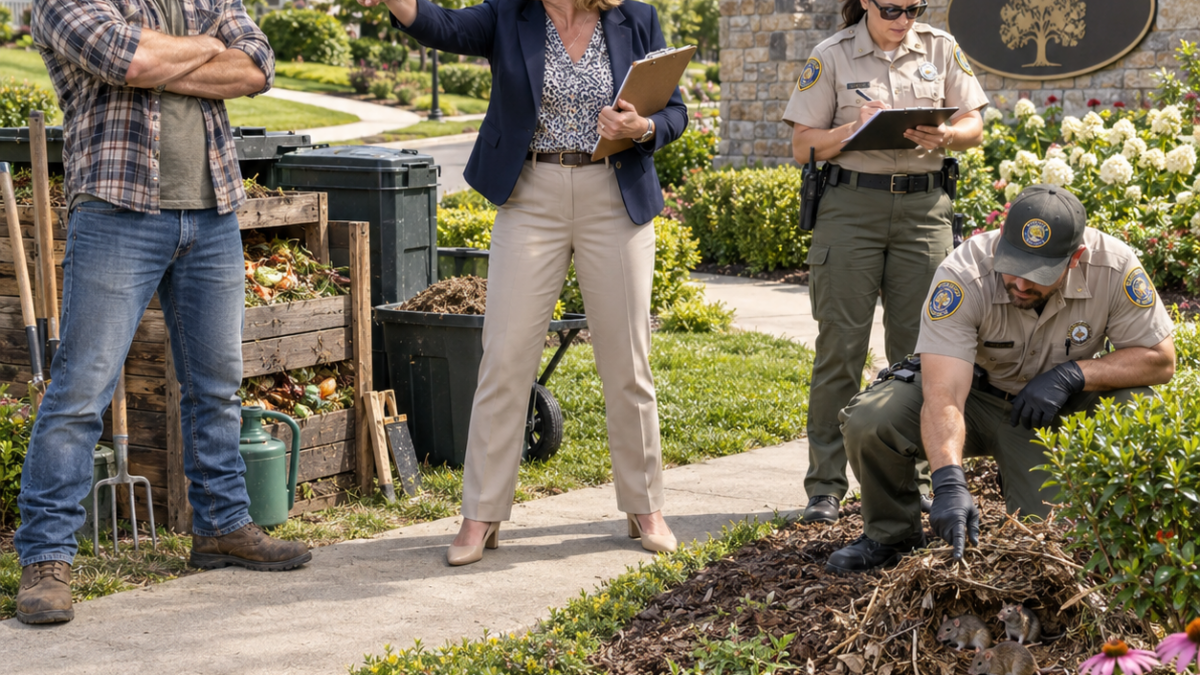
Karen stood at the edge of my yard, pointed at the clean cedar compost system I had maintained for years, and told me I owed the HOA five thousand dollars because my “rotting filth” was attracting disease into the neighborhood.
She threatened another hundred dollars every day, a lien against my home, and public cleanup at my expense if I refused to dismantle it before Friday.
What she didn’t know was that one photograph buried in my old garden files was about to turn her favorite accusation back toward the one place in Whispering Pines she never expected anyone to inspect.
“Five thousand dollars?”
I honestly thought I had heard her wrong.
Karen Whitmore crossed her arms.
“Five thousand to start.”
She glanced toward my compost enclosure like she expected something with claws to crawl out of it.
“And if it remains after Friday, the daily fines begin.”
I looked behind me.
Three cedar bays.
Clean.
Screened.
Covered.
The active pile was a balanced mixture of shredded leaves, grass clippings, vegetable scraps, coffee grounds, and wood chips.
No meat.
No grease.
No dairy.
No standing water.
No odor beyond damp earth.
I had spent twenty years with the Army Corps of Engineers.
Systems were my language.
My compost system was a biological system, and I maintained it more carefully than some people maintained swimming pools.
“What rule am I violating?”
Karen smiled like she had been waiting for that question.
“Bylaw Seven, Section C, Paragraph Four.”
She looked at her clipboard.
“Storage of debris, refuse, rubbish, or unsightly materials.”
“Compost isn’t rubbish.”
“It is in my judgment.”
“The county encourages residential composting.”
“This isn’t the county.”
“It’s still my property.”
“And your property remains subject to Whispering Pines standards.”
She held out the violation notice.
I took it.
Then I noticed the next paragraph.
Lien.
My expression changed.
Karen noticed.
That pleased her.
“You really want to threaten my house over coffee grounds and leaves?”
“You should have considered that before creating a sanitation problem.”
“Sanitation problem?”
“Neighbors have complained.”
“Which neighbors?”
“I’m not required to disclose complainants.”
Convenient.
My next-door neighbors, John and Mary Henderson, had asked me for finished compost the previous spring.
The family behind us had complimented the cedar enclosure.
Nobody had ever mentioned smell.
Nobody had seen rats.
Nobody had complained to me once.
Karen climbed back into her golf cart.
“You have until Friday.”
I held up the notice.
“I’m appealing this.”
Her smile widened.
“You’re welcome to waste everyone’s time.”
Then she drove away.
I stood there long after the golf cart disappeared.
My wife, Sarah, came outside.
“What happened?”
I handed her the paper.
She read silently.
Then stopped at the number.
“Five thousand dollars?”
“That was my reaction.”
“Can they really put a lien on the house?”
“Not without a process.”
“You sound very sure.”
“I’m about to become very sure.”
That afternoon, my workshop stopped being a workshop.
It became a documentation center.
I photographed the compost bays from every angle.
Recorded the distance from neighboring property lines.
Measured the enclosure.
Photographed the lattice screening.
Took temperature readings from the active pile.
One hundred forty degrees.
Exactly where properly managed hot compost should be.
Then I opened the HOA covenants.
Nearly two hundred pages.
Karen had quoted the rule correctly.
What she had not mentioned was the appeals procedure.
Ten days.
Formal hearing.
Full board.
So I wrote an appeal.
Not an emotional complaint.
A technical rebuttal.
I explained the difference between refuse storage and controlled composting.
Attached county composting guidance.
Included photographs.
Temperature measurements.
Maintenance records.
I even included my ingredient log.
Sarah stared at the stack.
“You have an ingredient log?”
“I like consistency.”
“You have spreadsheets for decomposing leaves?”
“Technically, yes.”
She shook her head.
“I married exactly the right lunatic.”
I mailed the appeal certified.
One copy to the board.
One directly to Karen.
Then I waited.
Three days later, the HOA newsletter arrived.
Halfway down the second page was a photograph of my compost enclosure beneath a warning about “open household waste,” vermin, disease, odors, and declining property values.
Karen never used my name.
She didn’t need to.
Worse, the photograph had been taken from inside my property line.
Sarah looked furious.
“She came into our yard.”
I enlarged the image on my computer.
And that was when I noticed something in an older photograph stored beside it.
Far behind my yard, across the community green, stood Karen’s prized HOA garden.
And tucked behind its raised beds were four black compost bins overflowing with rotting food.
I leaned closer.
Then remembered the smell I had noticed the last time I walked past there.
Sarah saw my expression.
“What?”
I zoomed in further.
“Karen wants to make this about sanitation.”
“So?”
I stared at those overflowing bins.
“So I think we should let the professionals decide which compost pile is actually creating the health problem.”
PART 2
The next morning, I walked over to John Henderson’s house with two cups of coffee.
John was sixty-eight, retired from teaching high-school chemistry, and had been fighting the same lawn mower for six years.
He was leaning over the engine when I reached the driveway.
“That machine still winning?”
He straightened.
“Every spring it promises it has changed.”
“Sounds unhealthy.”
“I’m emotionally invested now.”
I handed him coffee.
He looked toward my yard.
“I heard you had company.”
“Karen.”
His expression darkened.
“What now?”
“She says my compost is attracting vermin.”
John stared at me.
“Your compost?”
“Yes.”
“The cedar thing?”
“That’s the one.”
“The thing that smells better than the mulch I buy?”
“Yes.”
He laughed once.
Then realized I wasn’t joking.
“She fined you?”
“Five thousand.”
The laughter stopped.
“What?”
“And a hundred per day after Friday.”
John slowly set his coffee on the workbench.
“For compost?”
“She says neighbors complained.”
His eyebrows rose.
“I hope she didn’t mean us.”
“That’s why I’m here.”
“Marcus, Mary asks you for compost.”
“I know.”
“We’ve never smelled anything.”
“I know.”
“I’ve never seen so much as a mouse over there.”
“I know.”
John wiped his hands.
Then lowered his voice.
“She’s been doing this to people.”
“What do you mean?”
“Mary got a warning last month.”
“For?”
“Our welcome mat.”
I stared.
“What about it?”
“The lettering.”
I waited for the joke.
None came.
“She said the script font looked too casual for the architectural character of Whispering Pines.”
“You’re kidding.”
“I wish.”
“What happened?”
“Mary ordered another one.”
“Why?”
John shrugged.
“We’re retired.”
He looked tired suddenly.
“Fighting over a twenty-dollar mat didn’t seem worth the blood pressure.”
There it was.
Karen’s system.
She didn’t need everyone to agree with her.
She only needed the cost of resistance to feel greater than the cost of surrender.
Fifty dollars.
A hundred.
Two hundred.
Small enough that people paid.
Annoying enough that nobody wanted the meeting.
The emails.
The appeals.
Every surrendered argument made her slightly stronger.
“Do you still have the warning?”
“Probably.”
“Can I get a copy?”
John studied me.
“You building something?”
“Yes.”
He smiled.
“Then absolutely.”
By afternoon, I had John’s notice.
By dinner, Dave Sterling knocked on my door.
Dave lived three streets over.
Retired Air Force.
Tall.
Lean.
Carried himself like someone who still checked corners when entering unfamiliar rooms.
“You Marcus Jensen?”
“Yes.”
“I read Karen’s newsletter.”
I let him inside.
Sarah poured coffee.
Dave declined.
“I don’t want coffee.”
That told me he was serious.
He sat at the kitchen table.
“That story was about you.”
“Yes.”
“Compost?”
“Yes.”
“Five thousand?”
I blinked.
“How do you know the amount?”
“Karen talks.”
Of course she did.
Dave leaned forward.
“She came after me last year.”
“For what?”
“My flag.”
I thought I misheard.
“American flag?”
“Apparently too big.”
“How big?”
“Six-foot flag on holidays.”
“And?”
“She wanted me using a little decorative banner.”
“What did you do?”
“Called a VFW attorney.”
He smiled.
“She disappeared.”
I leaned back.
“That’s useful.”
“It gets better.”
It did.
Dave knew people.
A lot of people.
A mother warned about a therapy swing used by her autistic son.
An elderly couple cited for wind chimes.
A family threatened over a portable basketball hoop.
Another resident fined because his work van remained in his own driveway overnight after an emergency plumbing job.
Some notices may have technically matched rules.
Others were pure interpretation.
But a pattern existed.
Karen targeted inconvenient differences.
Then declared her preferences community standards.
“Can you get copies?”
Dave nodded.
“With permission.”
“Only with permission.”
He smiled.
“You really are an engineer.”
“Evidence needs ownership.”
Over the next several days, my binder grew.
Sarah started calling it The Book of Karen.
I hated the title.
Then labeled the binder exactly that.
The appeal hearing was scheduled for the following Tuesday.
Karen placed it between petunia purchasing and tennis-court resurfacing.
Five minutes allotted.
I spent three nights preparing for those five minutes.
But I kept thinking about the community garden.
Karen’s garden.
Whispering Pines advertised it everywhere.
Newsletter photographs.
Website banner.
Annual garden contest.
Karen posed beside tomatoes as though she personally invented agriculture.
She controlled plot assignments.
Approved crops.
Approved decorative stakes.
Approved even the paint colors on the storage shed.
And in the back corner sat the compost area.
I decided to look.
Not enter.
Look.
The community green had a public walking path around it.
From that path, the garden was visible.
I took my dog Saturday afternoon.
From fifty yards away, the first thing I noticed was smell.
Not compost.
Garbage.
Healthy aerobic compost has an earthy odor.
When material goes anaerobic, especially wet food waste without enough dry carbon, the smell changes.
Sour.
Rotten.
Heavy.
The closer I got, the stronger it became.
The front of Karen’s garden looked beautiful.
Neat rows.
Gazebo.
Decorative stones.
Painted signs.
But behind the raised beds?
Disaster.
Four plastic bins.
Open tops.
Overflowing.
Whole pumpkins.
Lettuce.
Corn husks.
Bread.
Greasy pizza cardboard.
Fruit.
What looked like leftover casserole.
I stopped.
Meat?
That would be worse.
I zoomed with my phone from the public path.
Enough documentation.
No trespassing.
No drama.
Then something moved.
Fast.
Between one bin and the tree line.
Gray-brown.
Low.
Long tail.
I didn’t get a clear photograph.
Could have been a rat.
Could have been something else.
I did not write “rat” in my notes.
I wrote:
**Unidentified rodent-sized animal observed at 3:42 p.m.**
Sarah read it later.
“You’re incapable of simply saying you saw a rat?”
“I didn’t conclusively identify it.”
“You would be terrible at ghost stories.”
“Ghosts have poor documentation.”
She laughed.
I called Dave.
“Walk your dog past the community garden sometime.”
“Why?”
“Look at the compost.”
“Karen’s masterpiece?”
“Yes.”
Two days later he called.
“You were right.”
“About?”
“It’s a garbage pile.”
“Anything else?”
“Rat.”
“You sure?”
“Very.”
“Describe.”
“Brown. Big. Tail. Came from under the second bin.”
“Anyone else?”
“No.”
“Write it down.”
“Already did.”
Good man.
Then another resident contacted me.
Susan Patel.
She had a garden plot.
“I heard you’re asking about the compost.”
“Only if you want to talk.”
She did.
Susan said residents regularly dumped food scraps without supervision.
Some people brought material from home.
There were no clear instructions.
No carbon stockpile.
No lid enforcement.
Sometimes leftovers from clubhouse events were dumped there.
“Cooked food?”
“Yes.”
“Meat?”
“I’ve seen chicken.”
That changed the picture.
“Have you complained?”
“Karen said compost smells.”
“It shouldn’t smell like garbage.”
“She told us nature isn’t always pretty.”
I nearly choked.
Karen had fined me five thousand dollars for a sealed, balanced system while defending open food waste as nature.
But hypocrisy wasn’t enough.
If I attacked too aggressively, I would look exactly like what Karen was already describing.
Angry resident.
Retaliation.
Deflection.
So I waited for the hearing.
Tuesday night arrived.
Thirty residents.
More than normal.
Karen’s newsletter had succeeded at one thing:
Advertising my hearing.
Sarah sat near the back.
Dave beside her.
John and Mary Henderson came.
Several residents I barely knew sat along one wall.
The board consisted of five people.
Karen.
Gary Price.
Linda Moore.
Maria Alvarez, an attorney.
Frank Bennett, retired accountant.
Karen controlled Gary and Linda easily.
Maria and Frank?
Less certain.
Karen approved the minutes.
Then spent seventeen minutes discussing petunias.
I watched Maria’s expression during that debate.
She looked like she would rather litigate a plane crash.
Finally:
“Appeal of violation eighty-eight-twelve.”
Karen looked at me.
“Mr. Jensen.”
I stood.
“You have five minutes.”
“Thank you.”
I placed the binder on the front table.
Thud.
Gary looked at it.
Karen rolled her eyes.
“I’ll be concise.”
Sarah later told me that statement was technically false.
First:
The rule.
I projected the exact language.
“Storage of debris, refuse, rubbish, or other unsightly materials.”
Then:
My compost.
High-resolution photographs.
Cedar enclosure.
Lattice.
Clean surrounding ground.
Next:
County guidance encouraging home composting.
Then:
Temperatures.
A photograph of the thermometer.
One hundred forty degrees.
I explained aerobic decomposition.
Carbon.
Nitrogen.
Moisture.
Air.
Controlled biological activity.
Karen interrupted.
“We don’t need a science class.”
Maria looked at her.
“Let him finish.”
That mattered.
I continued.
“Waste is not being stored indefinitely.”
“It is being processed into soil amendment.”
“I use the finished compost in my vegetable beds.”
I showed before-and-after material.
Coffee grounds and leaves.
Then finished dark humus.
Frank leaned closer.
Karen glanced at the clock.
“Time.”
“I’m finishing.”
“Five minutes.”
Maria spoke.
“The resident is entitled to make the appeal.”
Karen’s jaw tightened.
I moved on.
Public smear.
Newsletter.
Photograph taken from inside my property line.
Karen interrupted.
“That is an allegation.”
“Then explain where the photograph was taken.”
Silence.
The angle showed the backside of the lattice.
Impossible from any public route.
Maria wrote something.
Then I finished:
“I am requesting cancellation of the fine, cessation of daily penalties, and written confirmation that properly contained residential composting does not constitute refuse.”
Karen leaned forward.
“Finished?”
“Yes.”
She smiled.
“Wonderful.”
She turned toward the room.
“Mr. Jensen’s presentation is impressive.”
Condescending applause tone.
“But this board is responsible for more than technical definitions.”
“We must protect sanitation.”
“Vermin.”
“Odor.”
“Public health.”
There it was.
Health.
I almost smiled.
“A health risk?”
I asked.
“Yes.”
Karen pointed toward me.
“Your rotting material creates exactly the kind of condition that attracts rodents.”
I opened the second divider.
**COMMUNITY GARDEN**
Karen saw the label.
Her expression changed.
“Since you’ve raised vermin,” I said, “I think the board should review another composting operation under its direct control.”
I displayed my photograph.
The community bins.
Overflow.
Food waste.
Greasy cardboard.
Rotting produce.
The room stirred.
Karen snapped:
“That is irrelevant.”
“No.”
I stayed calm.
“You’re claiming compost itself is a sanitation threat.”
“I’m demonstrating that method determines risk.”
I placed two images side by side.
Mine.
Theirs.
Closed, balanced cedar system.
Open, unmanaged food waste.
“I’m asking the board to apply the same health standard to common property that it claims to apply to me.”
Frank’s face changed.
He understood instantly.
Liability.
Maria asked:
“Where were these photos taken from?”
“Public walking path.”
“Did you enter the garden?”
“No.”
Good question.
Karen folded her arms.
“Our garden is professionally maintained.”
“Who manages compost?”
“The garden committee.”
“You chair that committee.”
“Yes.”
“Are food scraps allowed?”
“Appropriate organic material.”
“Meat?”
“No.”
Susan Patel spoke from the audience.
“I’ve seen meat.”
Everyone turned.
Karen stared at her.
Susan continued:
“And cooked food.”
Another resident:
“So have I.”
Then Dave stood.
“I’ve seen rats.”
The room changed.
Not dramatically.
But enough.
Karen laughed.
“Rats exist in woods.”
Dave nodded.
“They do.”
“I watched one run from underneath your compost bin.”
“When?”
“Last Thursday.”
Karen’s laugh disappeared.
I addressed the board.
“I’m not asking you to believe Dave.”
Karen looked surprised.
“I’m not asking you to believe me.”
I closed the binder.
“I move that the board contact the county health department and request an independent inspection of the community garden compost area.”
Silence.
That was the key.
Not:
Karen has rats.
Not:
Karen is guilty.
Just:
Inspect it.
If I was wrong, professionals would say so.
If Karen was right, she should welcome it.
Frank spoke first.
“We probably need to.”
Karen turned.
“Absolutely not.”
Maria looked at her.
“Why?”
“Because this is obviously retaliation.”
“The report exists now.”
Maria’s tone hardened.
“A resident has formally alleged vermin activity on common property.”
Dave corrected her.
“I reported an observed rat.”
Maria nodded.
“Even stronger.”
“We have a fiduciary obligation to investigate.”
Karen pointed at me.
“This is what he wanted!”
Maria replied:
“What he wants is irrelevant.”
That sentence killed something in Karen.
Her personal fight no longer mattered.
The board had duties.
Frank seconded the motion.
Vote:
Four to one.
Karen alone against.
Her face went almost purple.
“Fine.”
She spat the word.
“Call them.”
She looked directly at me.
“They won’t find anything.”
I nodded.
“I hope you’re right.”
That angered her more than victory would have.
The health department arrived Thursday.
I did not go.
That was deliberate.
Maria met the inspector.
Frank joined.
County environmental health specialist named Denise Kramer.
Two hours.
Photographs.
Burrows.
Droppings.
Gnaw marks.
Tunnels.
Waste inspection.
Peripheral woodland.
Gazebo foundation.
Drainage area.
Then everything went quiet.
At four-thirty Maria knocked on my door.
Frank beside her.
Sarah let them in.
Nobody wanted coffee.
Bad sign.
Maria sat.
“They found a rat colony.”
I looked at Frank.
“How bad?”
He removed his glasses.
“Bad.”
“Active nests?”
“Multiple.”
“Source?”
“Food availability around the garden bins.”
Sarah stared.
“How long?”
Maria answered.
“The inspector said infestation appears established.”
“Meaning?”
“Not recent.”
There went Karen’s inevitable sabotage theory before she could make it.
Frank opened a folder.
“Garden is closed immediately.”
“Remediation?”
He began listing.
Licensed pest-control contractor.
Removal of all food waste.
Removal of contaminated compost.
Cleaning and disinfection where appropriate.
Destruction of burrows.
Evaluation of compromised wooden structures.
Soil work in heavily affected zones.
Monitoring.
Reinspection.
Then money.
Initial penalty.
Potential accumulating penalties for noncompliance.
Professional cleanup estimates.
Forty thousand.
Maybe fifty.
Possibly more depending on structural damage.
Sarah whispered:
“Oh my God.”
Frank looked physically sick.
“Our reserves are sixty-eight thousand.”
The irony sat in the room.
Karen wanted five thousand from me.
Her garden might cost the HOA ten times that.
Maria looked at me.
“Your violation is rescinded.”
“All penalties?”
“Yes.”
“In writing?”
She almost smiled.
“Already drafted.”
“Thank you.”
Then:
“We’re calling an emergency meeting.”
“For Karen?”
“For the entire problem.”
The yellow closure tape appeared around the garden that evening.
That became the most effective newsletter Whispering Pines ever had.
People saw it.
Asked questions.
Learned.
By Friday morning, everyone knew.
Karen disappeared.
No golf cart.
No clipboard.
No patrol.
Her house curtains stayed shut.
Saturday morning, John Henderson knocked.
He held a six-pack.
“For your health hazard.”
I laughed.
“Keep it.”
“No.”
He put it on the porch.
“Mary says take it.”
That ended negotiation.
Across the neighborhood, stories surfaced.
Residents stopped speaking privately and began comparing experiences.
It turned out Karen’s greatest weapon had been isolation.
Every resident believed their ridiculous violation was uniquely theirs.
One welcome mat.
One flag.
One swing.
One wind chime.
One basketball hoop.
One compost pile.
Once people put them side by side, the pattern became undeniable.
Karen had turned preferences into punishments.
The emergency meeting notice went out Monday.
Karen responded Tuesday with an email from her personal account.
Subject:
**THE TRUTH ABOUT THE ATTACK ON WHISPERING PINES**
Sarah read it aloud until she reached:
“Mr. Jensen may have intentionally introduced rodents—”
She stopped.
“Did she just accuse you of planting rats?”
“Yes.”
“How do you plant rats?”
“Carefully, apparently.”
“This isn’t funny.”
“No.”
It was strategically disastrous, though.
The health inspector had documented extensive burrowing consistent with long-term activity.
Nobody could create that between my hearing and inspection.
Karen’s theory collapsed under its own timeline.
Maria circulated a short official clarification.
No emotion.
**The county inspection identified an established rodent infestation associated with food waste management at the community garden. There is no evidence supporting claims of sabotage.**
Perfect.
Facts don’t need adjectives.
The emergency meeting drew more than one hundred residents.
Standing room.
People lined the back wall.
Karen sat at the board table.
Space separated her from everyone else.
Not officially.
Human instinct.
Maria called the meeting.
Frank presented finances.
Projected remediation:
$48,000 preliminary.
Health penalties and inspection fees:
Additional.
Potential total exposure:
Around $60,000 depending on final scope.
People gasped.
He explained reserve implications.
Road repairs scheduled next year.
Clubhouse roof in three years.
Pool equipment.
Reserve requirements.
Karen’s garden could consume most available cash.
Then Maria explained legal exposure.
Known sanitation issues.
Board response.
Insurance concerns.
Responsibility to mitigate immediately.
Then the floor opened.
Dave stood first.
He told his flag story.
Mary Henderson described her welcome mat.
A mother described Karen’s campaign against her child’s therapy swing.
Another resident described fines over holiday lights.
Another over a work vehicle.
Another over shrubs.
Another over decorative stones.
A man I didn’t know stood up.
“I paid three hundred dollars because my trash can was visible for ninety minutes after collection.”
Someone shouted:
“She watches everyone!”
Karen finally spoke.
“I enforced the rules you all agreed to.”
Maria interrupted.
“Please allow residents to finish.”
Karen looked stunned.
Nobody had interrupted her before.
Then Susan Patel spoke about the garden.
She described asking repeatedly for better compost management.
More brown material.
Covered containers.
Clear rules.
Karen dismissed her.
“She said the smell was normal.”
Susan looked toward me.
“Marcus told us the same thing I had been saying for a year.”
Karen snapped:
“You never submitted a written complaint.”
Susan shot back:
“Because every time someone complained about anything you made their life miserable.”
Applause.
Karen’s authority was gone before anyone voted.
You could feel it.
I was asked to speak.
I carried no massive presentation.
Only two photographs.
My compost.
Community garden.
I held up mine.
“This is what started it.”
Then the other.
“This is what ended it.”
I lowered both.
“I don’t want revenge.”
The room quieted.
“I wanted a rule applied fairly.”
“I wanted evidence before punishment.”
“I wanted someone to explain how leaves and coffee grounds became a five-thousand-dollar threat against my home.”
I looked toward Karen.
“She chose to make this about health.”
“So we asked health professionals.”
“They answered.”
Then I turned back to the residents.
“What happens next should not depend on whether you like me.”
“And it shouldn’t depend on whether you dislike Karen.”
“It should depend on whether you want a board that follows evidence, applies rules consistently, and treats residents like neighbors instead of targets.”
Then I sat.
That was enough.
The motion for no confidence passed overwhelmingly.
Formal removal procedures followed the governing documents.
Karen did not receive a dramatic instant exile based on applause.
Maria insisted on doing it correctly.
Notice.
Vote.
Record.
Certification.
At the final membership vote, not one meaningful bloc supported Karen.
Her presidency ended.
She stood.
Picked up her purse.
For a moment I thought she would scream.
She didn’t.
She looked around the room.
Every person she once intimidated now met her eyes.
Then she walked out.
No applause.
No cheering.
Silence.
That felt more powerful.
Because she had spent years demanding attention.
Her final moment contained none.
Dave Sterling became president in the special election.
Maria remained legal-minded board counsel liaison.
Frank controlled finances.
And, against my better judgment, residents elected me to an open board seat.
Sarah laughed for twenty straight seconds when I told her.
“You fought the HOA.”
“Yes.”
“Now you are the HOA.”
“No.”
“You absolutely are.”
“I am one board member.”
“President Jensen has a nice sound.”
“Never say that.”
She said it constantly afterward.
Our first job was ugly.
The community garden.
Professionals removed the unmanaged food waste.
Pest-control specialists treated the infestation.
The garden remained closed.
Some wooden structures had extensive burrowing underneath.
The gazebo came out.
Several raised beds were removed.
Areas of heavily affected soil were excavated.
Not because every handful was “hazardous waste” in some sensational sense, but because the county’s remediation plan required removal and sanitation of affected material and elimination of burrow networks.
We followed the plan.
Exactly.
No shortcuts.
We paid fines.
Paid contractors.
Paid inspection fees.
It hurt.
That mattered.
Accountability should.
But Dave insisted on complete transparency.
Every invoice posted.
Every contract bid competitively.
Every remediation update shared.
Residents were angry about costs.
Yet they understood them.
Nothing hidden.
That restored trust faster than speeches ever could.
Then we attacked the bylaws.
Two hundred pages.
I nearly enjoyed it.
Sarah said this proved I required psychological evaluation.
We removed subjective language where practical.
“Sole discretion.”
Gone.
“Unsightly” without objective criteria.
Rewritten.
Fines received due-process requirements.
Written notice.
Specific violated provision.
Reasonable cure period.
Appeal.
Board decision.
Records.
No more presidential decree.
Flag restrictions simplified.
Therapy and accessibility equipment received clearer protections.
Work-vehicle rules narrowed.
Holiday-decoration rules reduced to actual safety and reasonable timing.
And composting?
I wrote that section myself.
Residential compost permitted when properly contained and managed.
No meat or grease where prohibited by the system.
No persistent nuisance odor.
No standing water.
Pest prevention.
Reasonable setbacks.
No arbitrary ban simply because someone dislikes the idea.
Frank read my draft.
“You enjoyed this.”
“Immensely.”
“That concerns me.”
The old community garden remained empty for months.
Grass eventually covered part of it.
We converted the worst former garden area into a wildflower meadow.
Native plants.
Pollinators.
No food waste.
No rats.
The transformation surprised me.
Where Karen’s gazebo once stood, black-eyed Susans appeared.
Butterflies.
Bees.
Children stopped beside them.
Nobody planned that symbolism.
Nature has better taste than committees.
Karen listed her house.
No surprise.
Living in Whispering Pines after losing the board became impossible for her.
The moving truck arrived on a Saturday.
I watched briefly from my driveway.
Then returned to turning compost.
That choice mattered.
Months earlier, everything I did had been measured against Karen.
Now?
My life no longer needed her as reference.
The new homeowner was Susan Carter.
Biologist.
Late forties.
Warm smile.
She introduced herself while I was working in the community garden site the following spring.
“I bought the former president’s house.”
I smiled.
“Then you’ve already heard stories.”
“A few.”
“I apologize.”
She laughed.
“I’ve composted twenty years.”
I stopped.
“You’re kidding.”
“No.”
She pointed toward the new bylaw binder.
“When I saw the neighborhood had actual compost guidelines instead of banning it, that helped sell me.”
I stared.
Karen had tried to make compost the reason I lost my home.
Now clear compost rules were helping attract buyers.
There are forms of irony too perfect to improve.
Susan volunteered.
That spring, we rebuilt the community garden.
New location.
Better drainage.
Farther from woodland edge.
Secure storage.
Water access.
And a proper three-bay compost system.
Cedar.
Scaled-up version of mine.
I designed it.
But structures weren’t enough.
Education mattered more.
We held workshops.
Sarah made cookies.
Dave brought folding chairs.
Susan taught microbial biology.
I handled process.
Carbon.
Nitrogen.
Moisture.
Oxygen.
Temperature.
What goes in.
What stays out.
Why healthy compost smells earthy.
Why anaerobic waste smells rotten.
Why meat and greasy cooked food create problems in many simple community systems.
Why rodents are not proof composting is bad.
They are often proof management is bad.
John Henderson sat in the front row.
He raised his hand.
“Does excellent compost guarantee championship tomatoes?”
“No.”
He frowned.
“Then I want my HOA dues back.”
The new garden thrived.
John won the tomato contest the next summer.
He gave me half credit.
I accepted two tomatoes.
They were spectacular.
Years passed.
Whispering Pines became boring.
Best possible outcome.
Meetings dealt with roofs.
Insurance.
Drainage.
Pool maintenance.
Budget reserves.
The occasional fence dispute.
Nobody left crying.
Nobody feared opening their mailbox.
Kids occasionally left bikes out.
Civilization survived.
Dave served two terms.
Then stepped down voluntarily.
Another revolutionary concept.
Frank became president.
Lasted one year.
Hated every minute.
Susan eventually joined the board.
Good boards often contain people who would rather be gardening.
I stayed long enough to finish bylaw reform.
Then I resigned.
Sarah threw me a retirement party from my unpaid government.
The cake said:
**FORMER HOA BUREAUCRAT**
I considered divorce.
Briefly.
My own compost system continued.
Same cedar.
Some boards replaced.
Same method.
Leaves.
Coffee grounds.
Vegetable scraps.
Garden waste.
Time.
Every spring, I spread finished compost into our beds.
Sarah’s roses exploded.
Tomatoes climbed.
Herbs filled the air.
The pile that Karen called “rotting filth” became soil.
That always felt like the clearest metaphor.
Good systems can transform waste.
Bad systems only accumulate it.
Then something unexpected happened.
A letter arrived from a statewide association representing community associations and property managers.
At first I assumed trouble.
Law-firm-style envelope.
Expensive paper.
Sarah handed it to me.
“Your fan club?”
“Probably a lawsuit.”
“Optimistic.”
I opened it.
Invitation.
Annual conference.
Theme:
**Modernizing Community Governance for Sustainable Neighborhoods**
They had heard about Whispering Pines.
Our revised rules.
Composting guidance.
Rainwater collection.
Objective enforcement.
Due process.
Environmental management.
They wanted me to speak.
Keynote.
Expenses covered.
Speaker fee.
Sarah read it.
Then stared at me.
“No.”
“What?”
“You absolutely have to do this.”
“I do not.”
“You spent years complaining about bad HOAs.”
“Yes.”
“Now HOAs want you to tell them how not to be terrible.”
“I see the irony.”
“It’s beautiful.”
I accepted.
Not because I wanted a stage.
Because I remembered Mary Henderson replacing a welcome mat rather than fight.
The mother with the therapy swing.
Dave’s flag.
Residents who quietly paid.
Most HOA conflict is not dramatic enough to become a lawsuit.
That makes good systems even more important.
People should not need a retired combat engineer, three binders, certified mail, county inspectors, and a neighborhood revolt to resolve something as ordinary as compost.
My presentation was simple.
I did not name Karen.
Not once.
She no longer deserved the starring role.
Slide one:
The old rule.
**Unsightly materials determined at sole discretion.**
Slide two:
My cedar compost station.
Slide three:
The old community garden bins.
Slide four:
County closure photograph.
Slide five:
Cleanup costs.
Then:
The new rule.
Specific.
Objective.
Understandable.
Next:
Appeal process.
Then:
Board accountability.
I told the audience:
“If a rule cannot be explained clearly to the person accused of violating it, you should question whether the rule is ready to be enforced.”
People wrote that down.
Then:
“If your first reaction to disagreement is escalating fines instead of clarifying facts, you are probably managing conflict, not solving it.”
More notes.
I finished with the community garden.
Before-and-after.
Rat-infested waste bins.
Then the rebuilt cedar compost system surrounded by vegetables.
“The lesson is not that HOAs are bad.”
“The lesson is that power without standards becomes personal.”
“And personal enforcement eventually becomes expensive.”
Silence.
Then applause.
Afterward, people lined up.
A mother fighting for an accessible ramp.
A homeowner trying to install solar panels.
A board member whose community had vague noise standards causing constant war.
A manager trying to rewrite parking rules.
Different disputes.
Same structural problem.
Ambiguity.
Power.
Fear.
No process.
I spent two hours talking.
On the drive home, I realized Karen had accidentally given me another mission.
Not fighting her.
Preventing replicas.
Years later, the state association adopted model language encouraging clearer environmental rules and defined appeal procedures.
Was that because of me alone?
Of course not.
Policy never changes because of one speech.
But Whispering Pines became part of the evidence.
A small example.
Useful.
That was enough.
The wildflower meadow where Karen’s garden once stood remained beautiful.
Eventually, we added an educational sign.
Not about Karen.
Not rats.
Not scandal.
It explained pollinators and native plants.
The new garden sat on the other side of the green.
Families worked plots.
Children picked strawberries.
Compost bays remained clean.
Every autumn, someone inevitably added too many pumpkins.
Then volunteers shredded dry leaves.
Balanced the pile.
Turned it.
Solved the problem.
No five-thousand-dollar fine required.
One afternoon I found Mary Henderson teaching two children how to add leaves.
She looked at me.
“You did this.”
“No.”
“You started it.”
“Karen started it.”
Mary smiled.
“No.”
“She started a fight.”
“You helped build this.”
Important distinction.
Years later, Karen’s name almost disappeared.
New residents didn’t know her.
They knew the old garden had once had pest problems.
That was about it.
Excellent.
Communities should remember lessons longer than grudges.
Then John Henderson died.
Cancer.
Fast.
Mary stayed in the house.
At his memorial, she put several tomatoes on a table beside his photographs.
Everyone laughed.
Afterward she handed me an envelope.
Inside was a seed packet.
John’s favorite heirloom tomatoes.
A note:
**Marcus—use the good dirt. —John**
I had to sit down.
The next spring, I planted them in soil enriched with compost.
They grew taller than me.
First ripe tomato?
I carried it to Mary.
She cried.
Then we ate it on her porch with salt.
That was what the compost had become.
Not an HOA dispute.
Continuity.
Waste turned into fertility.
Coffee grounds.
Leaves.
Old plants.
All becoming something capable of feeding new growth.
There was more truth in that process than in every rule Karen ever wrote.
When Sarah and I finally decided to move, leaving Whispering Pines was harder than expected.
The house was too large.
Yard too much.
We wanted to be closer to our daughter.
On my last week, I turned the pile one final time.
A younger neighbor named Michael stood watching.
“You’re really leaving?”
“Yes.”
“Who am I supposed to ask when my compost smells?”
“Add browns.”
“What if that doesn’t work?”
“More browns.”
“What if—”
“Turn it.”
He laughed.
“You should write a book.”
“No.”
“Instruction sheet?”
“In the shed.”
Of course there was.
Laminated.
Sarah had mocked it for years.
I handed him the compost fork.
“Take care of it.”
“The pile?”
“The system.”
He nodded seriously.
The buyers were a family with two children.
They loved the vegetable beds.
The husband asked:
“What’s this?”
He pointed at the compost bays.
Before I could answer, his daughter shouted:
“Worm dirt!”
Close enough.
At closing, I gave them a folder.
House documents.
Irrigation.
Garden notes.
Compost guide.
The wife looked through it.
“Apparently your neighborhood encourages compost.”
I smiled.
“It does now.”
We moved.
Smaller house.
Smaller yard.
First project?
Three compost bins.
Sarah caught me measuring.
“You lasted forty-eight hours.”
“I need soil.”
“You need hobbies.”
“This is a hobby.”
“This is a religion.”
Maybe.
One spring morning years later, our granddaughter came over.
She was seven.
She wrinkled her nose at the pile.
“Is that garbage?”
I almost laughed.
“No.”
“It looks like garbage.”
“It used to be.”
“What is it now?”
“Becoming soil.”
“How?”
“Tiny organisms.”
“Bugs?”
“Some.”
“Gross.”
“Very useful gross.”
She stared.
Then asked the perfect question.
“How does it know when it’s soil?”
I looked at Sarah.
Sarah looked at me.
Neither engineer nor gardener had a seven-year-old answer ready.
Finally I said:
“It doesn’t.”
“It just keeps changing.”
She accepted that.
Children often understand processes adults complicate.
She helped add leaves.
Then coffee grounds.
Then more leaves.
A year later, she planted a sunflower in finished compost.
It grew nearly eight feet.
She called me:
“Grandpa! The garbage made a flower!”
There it was.
The entire story.
Karen saw waste.
I saw process.
She saw disorder.
I saw transformation.
She believed control created value.
The compost taught the opposite.
Value often comes from allowing the right process enough time.
Looking back, people expected me to say the best moment was when health inspectors found the rat nests.
It wasn’t.
Not even close.
That discovery mattered.
It proved I had been falsely targeted.
It exposed hypocrisy.
It ended Karen’s power.
But watching someone else fail is a shallow form of satisfaction.
The moments that stayed with me were different.
John’s tomato seeds.
Mary teaching children.
A young family buying Karen’s former house because the new sustainability rules made the neighborhood attractive.
My granddaughter holding a sunflower grown from compost.
The new community garden producing food instead of disease.
The old infested site becoming a meadow full of butterflies.
Those were victories.
Karen had tried to charge me five thousand dollars because she looked at decomposition and saw filth.
Years later, I understood why that bothered me so deeply.
Because decomposition is not destruction.
It is transition.
Leaves fall.
Vegetables rot.
Coffee grounds break down.
The old form disappears.
But the material remains.
Given air.
Moisture.
Balance.
Time.
It becomes something useful again.
Communities can do the same.
Whispering Pines had accumulated years of resentment.
Fear.
Bad rules.
Silent anger.
Karen’s presidency collapsed.
For a while, everything smelled terrible.
Then people did the work.
Turned the pile.
Added balance.
Removed what didn’t belong.
Let time and cooperation do the rest.
Something better grew.
The last time I visited Whispering Pines, I walked through the new community garden.
Children were harvesting beans.
Susan was teaching someone about compost temperature.
Dave, now moving slowly with a cane, sat under the shade structure complaining about tomato varieties.
Mary’s house had new owners.
John’s heirloom tomatoes still grew in one corner.
Then I walked to the wildflower meadow.
Goldenrod.
Black-eyed Susans.
Butterflies.
Bees.
No gazebo.
No plastic bins.
No rats.
No caution tape.
Just life.
Dave joined me.
“You ever miss it?”
“Karen?”
“No.”
He laughed.
“The fight.”
“Absolutely not.”
“You were good at it.”
“That’s different.”
He nodded toward the garden.
“Worth it?”
I watched a child carry a bucket of finished compost toward a raised bed.
“Yes.”
Then Dave said:
“You know the board wants to put up a plaque.”
“No.”
“Too late.”
“What does it say?”
He smiled.
“Not your name.”
“Good.”
At the entrance to the garden, they had mounted a small wooden sign.
**WHISPERING PINES COMMUNITY GARDEN**
Below it:
**GOOD SOIL. CLEAR RULES. STRONG NEIGHBORS.**
I stared.
“That’s terrible.”
Dave laughed.
“You love it.”
“I tolerate it.”
He knew better.
Before leaving, I reached into one compost bay.
Dark.
Crumbly.
Earthy.
Perfect.
I held a handful for a moment.
Then let it fall back.
The pile Karen once called a health hazard had been the beginning.
Not because compost was powerful.
Because truth was.
She fined the wrong thing.
Accused the wrong person.
Demanded an inspection she assumed would humiliate me.
Instead, professionals followed the evidence.
And the evidence led straight past my clean cedar bins and into the garden she controlled.
That is how her reign ended.
Not because I screamed louder.
Not because I threatened her.
Not because I became more ruthless than she was.
I kept records.
Asked questions.
Requested independent inspection.
Then stepped aside.
The rats did the rest.
But that wasn’t the ending.
The ending was the soil.
Black.
Rich.
Alive.
The kind of soil that grows tomatoes, flowers, herbs, and eight-foot sunflowers for little girls who believe garbage can become something beautiful.
She wasn’t wrong about one thing.
There really was something rotting in Whispering Pines.
It just wasn’t behind my lattice fence.
And once the community finally found it, we didn’t merely throw it away.
We rebuilt the entire system so something healthier could grow in its place.
A few years after that, I learned that even a neighborhood that has fixed its rules can still be tested by the people who inherit them.
That test came quietly.
No dramatic fine.
No shouting at my driveway.
No pink golf cart.
Just an email.
Sarah and I had already moved out of Whispering Pines by then, but I stayed in touch with Dave, Susan, and a few of the older neighbors.
The new house was smaller.
One story.
Less yard.
Easier on my knees.
I still had a compost system, of course.
Three cedar bays.
Sarah called them my retirement command center.
Our granddaughter, Lily, called them Grandpa’s dirt factory.
Life had slowed in a good way.
Then one Tuesday morning, Dave called.
“Marcus.”
“You sound irritated.”
“I’m old. I’m always irritated.”
“What happened?”
“New management company.”
That got my attention.
Whispering Pines had hired an outside management firm after Dave left the board.
Nothing unusual.
The neighborhood had grown more complicated.
More insurance requirements.
More accounting.
More maintenance contracts.
Volunteers were burning out.
A professional management company made sense.
At least in theory.
“What about them?”
“They sent violation letters.”
“For what?”
“Compost.”
I thought I had misheard.
“Say that again.”
“Compost bins.”
“How many?”
“Seven households.”
“What violation?”
“Unsanitary storage of organic refuse.”
I laughed.
Not because it was funny.
Because sometimes history has no imagination.
“Have they read the bylaws?”
“That’s what I asked.”
“And?”
“They said their legal department uses a standard enforcement interpretation.”
I closed my eyes.
“Standard interpretation.”
“Exactly.”
“Did you send them the compost section?”
“Yes.”
“They still sent violations?”
“Yes.”
“Who approved this?”
“Board says management initiated routine enforcement.”
That sentence bothered me.
Routine enforcement.
Two words capable of hiding an enormous amount of laziness.
“Who’s president now?”
“Rebecca Sloan.”
“I remember Rebecca.”
“She’s reasonable.”
“Then call her.”
“I did.”
“And?”
“She thinks management made a mistake but wants counsel to review it.”
“That’s sensible.”
“Except residents have fourteen days to cure.”
“Pending legal review?”
“Yes.”
“That isn’t sensible.”
Dave went quiet.
Then:
“I thought you’d say that.”
“You want me to do something.”
“Maybe.”
“I don’t live there anymore.”
“I know.”
“I’m not on the board.”
“I know.”
“I am retired.”
“Very impressive.”
“Dave.”
“One of the violation letters went to Mary Henderson’s niece.”
That changed things.
Mary had died two years earlier.
Her niece, Rachel, bought the house because she loved the neighborhood.
She also inherited John’s old tomato-growing obsession.
Apparently, the compost system I helped her install was now illegal according to someone reading a generic checklist.
“What’s Rachel doing?”
“Panicking.”
“Why?”
“She’s trying to refinance.”
Of course.
Violation letters matter.
Even when stupid.
Lenders.
Resale disclosures.
Account status.
People hear “HOA violation” and imagine liens.
The old Karen playbook.
Different people.
Same pressure.
“What did Rebecca say?”
“Hold off dismantling anything.”
“Good.”
“But management refuses to withdraw letters until counsel gives a written opinion.”
I sighed.
“How many days?”
“Ten left.”
“Send me everything.”
Sarah walked into the kitchen carrying groceries while I was printing the violation letters.
She saw the expression on my face.
“No.”
“What?”
“I know that face.”
“What face?”
“The binder face.”
“I do not have a binder face.”
“You absolutely do.”
She set down the bags.
“What happened?”
“Whispering Pines.”
She closed her eyes.
“Karen?”
“Karen is gone.”
“Good.”
“New management company.”
“That’s worse somehow.”
“They’re citing compost bins.”
Sarah stared at me.
“No.”
“Yes.”
“After everything?”
“Yes.”
She pointed at the printer.
“You are not moving back.”
“I wasn’t planning to.”
“You are not running for anything.”
“No.”
“You are not starting another war.”
I picked up the violation letter.
“I’m reviewing documents.”
“That sentence has ruined entire weekends.”
She knew me well.
The letter cited:
Article VII, Section C — refuse storage and sanitation.
That was interesting.
Because we had replaced the old Article VII years earlier.
The current compost provision appeared under a different section entirely.
I opened the archived bylaws.
There it was.
Clear language.
Home composting permitted if contained, managed to prevent nuisance odor and vermin, and consistent with county health guidance.
The management company had cited language that no longer existed.
Not ambiguous.
Not debatable.
Wrong document.
I called Dave.
“They’re using the old bylaws.”
“I thought so.”
“Version date?”
“Letter doesn’t say.”
“Management portal?”
“Uploads a PDF.”
“Send it.”
He did.
The portal contained the old version.
The Karen version.
Two hundred pages of vague language we had replaced.
Somebody had imported outdated records when the management company took over.
That meant the problem was bigger than compost.
“How long have they been managing Whispering Pines?”
“Eight months.”
My stomach tightened.
“Dave.”
“I know.”
“If they’re using old bylaws—”
“Every violation could be wrong.”
“Not every.”
“Potentially.”
“Yes.”
Parking.
Exterior changes.
Holiday displays.
Storage.
Pets.
Landscaping.
Anything governed by amended language.
We needed the enforcement log.
Not because I had authority to demand it.
Rebecca did.
I called her.
She answered immediately.
“Marcus.”
“You know why I’m calling.”
“Dave.”
“Of course.”
“I think I know the problem.”
“So do I.”
“They uploaded old governing documents.”
“Yes.”
“How many enforcement actions?”
She exhaled.
“We’re checking.”
“Freeze all disputed enforcement.”
“I proposed that.”
“Proposed?”
“Two board members worry that pausing enforcement makes us look negligent.”
I stared at the wall.
“Rebecca.”
“I know.”
“No. Tell them this exactly: enforcing the wrong rules is not diligence.”
Silence.
Then:
“I’m putting you on speaker.”
I heard papers.
A male voice.
“Mr. Jensen, this is Alan Pike, vice president.”
“Morning.”
“We understand the concern, but the association also has an obligation to maintain standards.”
“Which standards?”
“The governing standards.”
“Current or obsolete?”
Silence.
I continued.
“If the letters cite repealed language, your first obligation is accuracy.”
Another voice.
Female.
Treasurer.
“We don’t know yet that the wrong version affected the outcome.”
“Then investigate before continuing.”
Alan responded:
“Residents can appeal.”
That did it.
“No.”
The word came out harder than I intended.
“An appeal process is not a substitute for correct enforcement.”
Nobody spoke.
I lowered my voice.
“If the association sends someone an invalid demand, the resident should not have to spend time and money proving the association wrong.”
Rebecca said quietly:
“That’s what I told them.”
Good.
The board voted that evening.
Temporary enforcement freeze.
All open violations under review.
Management instructed to suspend deadlines.
That should have ended it.
Instead, the management company pushed back.
Their regional director, a man named Blake Mercer, sent a memo.
Professional.
Polished.
Dangerous in the way polished wrongness can be dangerous.
He claimed the company had relied on “governing documents supplied at onboarding” and therefore enforcement remained presumptively valid until the HOA formally demonstrated otherwise.
Presumptively valid.
I read that phrase three times.
Sarah watched from across the table.
“That bad?”
“It’s management language for not our fault.”
“Is it their fault?”
“Maybe not initially.”
“And now?”
“Now they know there’s a problem.”
That’s the line.
Mistakes happen.
What matters is what people do after notice.
Rebecca forwarded the memo to HOA counsel.
Counsel responded within hours.
Freeze enforcement.
Review all letters.
Withdraw any based on obsolete provisions.
Simple.
Management complied reluctantly.
Then the audit began.
Forty-seven violation letters over eight months.
Nineteen relied on language altered or removed from the current bylaws.
Nine fines had already been paid.
Three residents had changed landscaping.
One had removed a small rain barrel.
Two had replaced holiday decorations.
Rachel had almost dismantled her compost system.
That angered me more than I expected.
Not because the amounts were huge.
Because people had complied with rules that didn’t exist.
Again.
History was repeating itself without Karen even being there.
I drove to Whispering Pines for the audit meeting.
Sarah came.
“For supervision.”
“You don’t trust me?”
“Correct.”
The clubhouse looked almost the same.
New carpet.
Better lighting.
Same stackable chairs.
I had not sat in that room for years.
Memory came back instantly.
Karen at the table.
The old binder.
The rat photographs.
The first time residents realized the rules could be challenged.
Now Blake Mercer sat where Karen once had.
Dark suit.
Laptop.
Expensive watch.
Very smooth.
Rebecca opened the meeting.
“This is not disciplinary.”
Good start.
“This is a corrective review.”
Better.
Blake spoke next.
“Our company regrets any confusion caused by document-version inconsistencies.”
Confusion.
I wrote that word down.
Rebecca saw me.
Almost smiled.
Blake continued.
“We acted in good faith based on materials supplied by the association.”
True.
Probably.
“However, we reject the characterization that residents were subject to improper enforcement.”
There it was.
Rebecca leaned forward.
“Nineteen letters cited superseded provisions.”
Blake nodded.
“Procedural discrepancy.”
I almost raised my hand.
Then remembered I wasn’t a board member.
Rebecca noticed.
“Marcus?”
“May I?”
“Yes.”
I looked at Blake.
“If a rule was removed, and you cited it after removal, how is that not improper enforcement?”
“The association’s standards were substantially similar.”
“Were they?”
“In many cases.”
“Compost?”
He paused.
“The newer language provides additional clarification.”
“No.”
I opened the current bylaws.
“The old rule prohibited vague unsightly refuse at board discretion.”
Then the new language.
“The current rule explicitly permits managed residential composting.”
I looked up.
“That is not clarification.”
“It reverses the outcome.”
Blake said nothing.
I continued.
“Rain barrels?”
Another changed provision.
“Holiday displays?”
Changed.
“Therapy equipment?”
Protected differently.
“Appeal deadlines?”
Changed.
Then:
“You were using a different rulebook.”
Blake stiffened.
“With respect, Mr. Jensen, management companies administer the documents they receive.”
“Initially, yes.”
“But after residents raised the issue, your company argued enforcement remained presumptively valid.”
His expression hardened.
“That is a legal interpretation.”
“Counsel disagreed.”
“Our memo preceded counsel’s opinion.”
Fair.
I nodded.
“Then why are we arguing about whether the enforcement was improper?”
That landed.
Frank would have enjoyed it.
The meeting shifted.
Residents spoke.
A woman named Beth had paid $150 for a decorative rain barrel she was told violated outdoor-storage rules.
The current bylaws allowed rain collection if screened.
Hers was screened.
A man named Carlos removed a native pollinator garden because management said grass replacement required architectural approval.
The current sustainability amendment specifically allowed native beds within defined limits.
He spent four hundred dollars converting it back to sod.
An older couple had paid a holiday-light fine.
Their display was permissible under the current schedule.
One by one.
Small harms.
Again.
Blake stopped defending individual letters.
Good.
Rebecca proposed remedies.
Refund invalid fines.
Reimburse reasonable direct costs where residents could document compliance expenses caused by invalid notices.
Correct the management portal.
Send written rescission letters.
Audit account histories.
Review management contract performance.
Blake objected to reimbursement.
“Our contract limits consequential liability.”
HOA counsel answered:
“That may govern disputes between management and association. It does not prevent the HOA from deciding how to make residents whole.”
Exactly.
Whispering Pines would reimburse first.
Then deal with management separately.
That distinction mattered.
Fix people before fighting vendors.
The board approved the remedy unanimously.
Blake’s company ended up crediting management fees as part of the resolution.
Not because anyone threatened war.
Because the contract review revealed onboarding and document-control failures.
The company also changed its internal process.
Every new association had to certify current governing-document versions.
Every enforcement template had to reference version date.
Every amendment required portal update confirmation.
A boring solution.
The best kind.
Rachel kept her compost.
I visited her yard afterward.
Her system looked good.
Two bays.
Wire lids.
Plenty of dry leaves.
No odor.
She held up one of John’s heirloom tomatoes.
“Want one?”
“Always.”
She smiled.
“I almost tore everything out.”
“I know.”
“I was scared the violation would affect the refinance.”
“I know.”
“Then I remembered what Uncle John used to say.”
“What?”
“Marcus will have a document.”
I laughed.
“That’s insulting.”
“It was affectionate.”
She handed me the tomato.
“Thank you.”
I shook my head.
“Rebecca fixed it.”
“You pushed.”
“So did Dave.”
“You always do that.”
“What?”
“Share credit.”
“Accurate credit.”
She smiled.
“Engineer.”
“Exactly.”
The management incident changed Whispering Pines again.
Not as dramatically as Karen.
No rats.
No health department closure.
No sixty-thousand-dollar cleanup.
But maybe the lesson was more important.
A healthy system can still fail when people stop maintaining it.
Rules do not protect anyone merely because they were written correctly once.
Documents age.
Boards change.
Files migrate.
Companies switch.
Institutional memory disappears.
The solution was not permanent vigilance by one stubborn retired engineer.
It was better process.
Rebecca created an annual governance review.
Not exciting.
Every January:
Current bylaws certified.
Amendment index checked.
Management portal audited.
Enforcement templates reviewed.
Appeal procedures tested.
Board training completed.
Conflict disclosures updated.
Records backed up.
Dave called it “checking the smoke detectors.”
Perfect.
Nobody celebrates smoke detectors when nothing burns.
That is exactly why you check them.
Years later, I stopped attending Whispering Pines meetings entirely.
Not because I lost interest.
Because they no longer needed me.
That felt better than being invited.
A system dependent on one experienced person has not become strong.
It has just found a new weak point.
I wanted them to function when Dave moved.
When Rebecca retired.
When Susan left.
When I died.
Especially then.
Our granddaughter Lily eventually went to college.
Not engineering.
Environmental policy.
Sarah blamed me.
I blamed compost.
Lily laughed at both of us.
For one class, she called to interview me about community governance.
“Grandpa.”
“Yes?”
“I need to ask you about the rat story.”
“No.”
“You’ve told it a thousand times.”
“I have not.”
“Mom has.”
Traitor.
“What do you need?”
“Why didn’t you just sue?”
I thought.
“Because I didn’t need to.”
“Would you have?”
“If necessary.”
“But why use the HOA process?”
“Because the process existed.”
“And when Karen controlled it?”
“I created enough evidence that other people inside the system could act.”
“Health department.”
“Yes.”
“Board members.”
“Yes.”
“Residents.”
“Yes.”
“So you trusted the system?”
“No.”
She paused.
“That sounds contradictory.”
“It isn’t.”
I explained.
“You don’t trust systems blindly.”
“You test them.”
“You document when they fail.”
“You use outside oversight when necessary.”
“You repair the system afterward.”
Lily typed.
“Okay.”
Then:
“What was the actual victory?”
“Not the rats.”
“I know.”
“Not Karen losing the election.”
“I know.”
“Not the bylaws.”
She stopped typing.
“Then what?”
I thought of Mary.
John.
Dave.
Susan.
Rachel.
The second-generation management mistake.
The fact that people challenged it early.
“The victory was that years later, when another authority made a bad decision, residents didn’t stay quiet.”
Lily said nothing.
“That’s good.”
“It’s true.”
“So the point wasn’t getting rid of Karen.”
“No.”
“It was getting rid of the belief that people had to obey bad decisions.”
That sentence surprised even me.
Lily typed it.
“Say it again.”
I did.
She used it in her paper.
Years passed.
Sarah’s health declined before mine.
Slowly.
Arthritis first.
Then heart problems.
Nothing dramatic.
Just life collecting its price.
We spent more time on the porch.
Less in the garden.
I still composted.
Smaller amounts.
Kitchen scraps.
Leaves.
Sarah would sit nearby while I turned the pile.
“You know,” she said one autumn afternoon, “you spent more time talking about decomposition than anyone I’ve ever known.”
“Useful process.”
“Morbid hobby.”
“You eat vegetables grown from it.”
“I contain multitudes.”
She smiled.
Then became quiet.
“Do you remember the first night after Karen fined us?”
“Yes.”
“You barely slept.”
“I slept.”
“You reorganized the HOA bylaws at three in the morning.”
“Productive insomnia.”
“I was scared.”
I stopped turning the pile.
“I know.”
“No, I don’t think you did.”
I looked at her.
She continued.
“I wasn’t scared of losing five thousand dollars.”
“I know.”
“I was scared you were going to turn yourself back into the man you were when you came home from deployments.”
That hurt.
Not because she was accusing me.
Because I understood.
After the Army, I had spent years learning not every conflict was a mission.
Karen pulled at that part of me.
The planning.
The dossiers.
The language of battles and enemies.
Sarah saw it before I did.
“Did I?”
I asked.
“No.”
She smiled.
“You came close.”
I sat beside her.
“What stopped me?”
“Compost.”
I laughed.
“I’m serious.”
“How?”
“You couldn’t stay furious while explaining worms to John Henderson.”
That was probably true.
She leaned her head against my shoulder.
“You fought her, but then you built something.”
The garden.
The rules.
The workshops.
The board.
The conference.
“Maybe that’s why it worked.”
I held her hand.
“You should have given the keynote.”
“I would have charged more.”
Also true.
Sarah died three years later.
At home.
Quietly.
Our daughter was there.
Lily too.
No hospital drama.
No final revelation.
Just a long life reaching its natural edge.
Afterward, the house felt impossibly large even though it was small.
Grief makes rooms expand.
I stopped gardening for months.
The compost pile went cold.
That had never happened before.
Leaves accumulated.
Kitchen scraps went into municipal collection.
I couldn’t care.
Then Lily came one Saturday.
She walked to the backyard.
Opened the compost bay.
“Grandpa.”
“What?”
“This is terrible.”
“I know.”
“Dry.”
“I know.”
“No active heat.”
“I know.”
“Too many leaves.”
“Apparently college made you annoying.”
“Genetics.”
She brought a bucket of coffee grounds from the café where she worked.
Then vegetable scraps.
Then water.
She mixed.
I watched.
She was doing it wrong.
I lasted ninety seconds.
“Stop.”
She smiled without looking at me.
“What?”
“You’re compacting it.”
“Show me.”
Trap.
I took the fork.
Turned the pile.
Explained structure.
Air pockets.
Moisture.
Particle size.
By the time I realized what she had done, we had rebuilt the pile.
She stood beside me.
“Grandma said this would work.”
I froze.
“When?”
“Before she died.”
My throat tightened.
“What did she say?”
Lily looked at the compost.
“She said if you disappear into yourself, make you teach something.”
I laughed and cried at the same time.
Very Sarah.
The pile heated within three days.
I checked temperature every morning.
Not because compost mattered.
Because routine did.
Weeks later I spread finished material beneath Sarah’s roses.
The next spring they bloomed heavily.
Too heavily.
Show-offs.
I sat on the porch looking at them.
For the first time since Sarah died, something felt less broken.
Not repaired.
Grief isn’t repairable.
Integrated.
There is a difference.
Whispering Pines heard about Sarah.
Flowers arrived.
Dave sent a letter.
Rebecca called.
Rachel mailed tomatoes, absurdly.
Susan sent native flower seeds.
The current HOA board planted a small dogwood beside the community garden.
I protested.
Nobody listened.
The plaque was simple.
FOR SARAH JENSEN
WHO BELIEVED GOOD COMMUNITIES SHOULD GROW
I would have hated something grander.
That was perfect.
A year after her death, I visited the garden alone.
The dogwood was small.
The wildflower meadow moved in the wind.
The compost bins were clean.
A laminated sign still explained:
Greens.
Browns.
Moisture.
Air.
No meat.
No grease.
Cover food scraps.
Turn regularly.
Someone had added handwritten text at the bottom:
IF IT SMELLS BAD, ASK MARCUS.
I stared.
Then laughed.
Dave appeared behind me.
“You found it.”
“You did that.”
“Prove it.”
“I know your handwriting.”
“Old age claim.”
We sat on a bench.
He was ninety-one.
Still sharp.
Less steady.
“Remember Karen?” he asked.
“Unfortunately.”
“I barely do.”
“That’s good.”
“Her face is fuzzy.”
“Better.”
“But I remember the meeting.”
“Which one?”
“The rat one.”
“Of course.”
Dave looked toward the garden.
“Strange thing.”
“What?”
“She thought power was making everyone afraid of her.”
I nodded.
“And now nobody remembers her clearly.”
He pointed toward Sarah’s tree.
“But people remember Sarah.”
That landed harder than he knew.
Sarah never held office.
Never fined anyone.
Never gave speeches.
Most residents barely knew her.
Yet her name lived beside a garden because kindness has a different kind of staying power.
Karen enforced.
Sarah influenced.
Only one required authority.
A year later Dave died.
Whispering Pines lost another piece of its old generation.
His memorial drew dozens of residents.
Someone brought the old oversized American flag.
They flew it beside the clubhouse.
Six feet.
Exactly the size Karen once tried to ban.
I stood under it with Lily.
She looked up.
“That the famous flag?”
“Yes.”
“It’s not that big.”
“Don’t tell Dave.”
After the service, Rebecca gave me an old folder.
“Found this in the archive.”
Inside:
The original five-thousand-dollar violation notice.
My appeal.
The newsletter.
Health report.
Rescission letter.
Bylaw revision drafts.
Meeting minutes.
I had copies.
But these were the official association versions.
On the rescission letter, someone years earlier had written in pencil:
CASE THAT CHANGED EVERYTHING
I stared at it.
Rebecca said:
“We keep it for board training.”
“You train people using my compost dispute?”
“Absolutely.”
“That’s embarrassing.”
“It works.”
“What do you teach?”
She smiled.
“Three things.”
I waited.
“Verify the rule.”
“Verify the facts.”
“And never threaten a lien before understanding the problem.”
Good curriculum.
I handed the folder back.
“Keep it.”
“We will.”
By then, new residents outnumbered those who remembered Karen.
That was healthy.
The garden story became institutional history rather than gossip.
New board members studied it like any other governance failure.
Not:
Look at this horrible woman.
Instead:
Here is what happens when subjective rules, centralized authority, poor oversight, and fear combine.
That framing mattered.
Individuals matter.
Structures matter more over time.
Lily eventually became a municipal sustainability planner.
She worked with neighborhoods on waste reduction, rainwater, native landscaping, and urban composting.
One day she called me after a meeting.
“You’re going to love this.”
“Unlikely.”
“A neighborhood wants to ban compost.”
“Why?”
“Rats.”
“Are there rats?”
“Yes.”
“From compost?”
“Partly.”
“Proper systems?”
“No.”
“What are they putting in?”
“Meat. Cooked food. Bags of trash.”
I sighed.
“Then the problem isn’t compost.”
“I know.”
“What did you tell them?”
“Exactly that.”
She paused.
“Then I showed them Whispering Pines.”
I smiled.
“You used my case?”
“Anonymized.”
“Good.”
“They’re adopting management standards instead of a ban.”
“Better.”
“Grandma was right.”
“About?”
“You did end up teaching people.”
She was right.
Not intentionally.
Life rarely honors plans.
My original goal was simple.
Keep my compost bins.
Avoid a five-thousand-dollar fine.
Protect my house.
That was it.
Everything afterward was consequence.
Some bad.
Some good.
Some absurd.
The last time I visited Whispering Pines, I was too old to drive.
Lily took me.
The neighborhood entrance looked smaller than I remembered.
Trees taller.
Houses same.
Roads narrower.
Memory enlarges places.
We went to the garden.
Children were there with a science teacher.
They were measuring compost temperature.
One boy called out:
“Hundred thirty-eight!”
Teacher:
“Perfect.”
Another child asked:
“Why does it get hot?”
The teacher explained microbes.
Respiration.
Decomposition.
Energy.
I listened.
Then a girl asked:
“Were there really rats here once?”
The teacher laughed.
“Not in this garden.”
“In the old one?”
“Yes.”
“Like a million?”
“No.”
“Ten thousand?”
“No.”
“Did they attack anyone?”
“No.”
Children dislike boring truth.
The teacher pointed toward the wildflower meadow.
“The old garden wasn’t managed properly.”
“So they got rats?”
“Yes.”
“Then what happened?”
“They fixed the system.”
The girl looked disappointed.
“That’s it?”
“That’s it.”
Perfect.
No hero.
No villain.
No war.
A bad system.
A problem.
A fix.
Lily pushed my wheelchair beside Sarah’s dogwood.
It was tall now.
Healthy.
Branches spreading over the bench.
I touched the bark.
“She’d like this.”
“I know.”
Lily sat beside me.
“Grandpa?”
“Yes?”
“Do you think Karen ever understood what happened?”
“What do you mean?”
“That she lost because she was wrong.”
I thought.
“Maybe.”
“Would that matter?”
“No.”
She looked surprised.
“Why?”
“Because the system changed whether she understood or not.”
“That sounds cold.”
“Maybe.”
I watched the children.
“Personal insight is nice.”
“Accountability doesn’t require it.”
Lily nodded.
Then:
“Did you forgive her?”
I smiled.
“You ask difficult questions.”
“Occupational habit.”
I considered.
“I stopped needing anything from her.”
“Is that forgiveness?”
“Close enough.”
The class began adding dry leaves.
One child dumped too many.
Another corrected him.
“Two buckets of browns for every bucket of greens.”
I laughed.
“What?”
Lily asked.
“That rule survived.”
“Good rules do.”
Maybe that was the final lesson.
Not all rules are oppressive.
Not all authority corrupts.
Not every HOA becomes a nightmare.
Rules can protect.
Authority can serve.
Standards can help.
But only when they remain connected to purpose.
Karen’s mistake was not believing in rules.
I believed in rules too.
Her mistake was believing rules existed to prove she was in charge.
Good rules do the opposite.
They reduce how much personality matters.
They make outcomes predictable.
Fair.
Understandable.
A resident should not need to know whether the president likes them.
A compost bin should not become legal or illegal based on who holds the gavel.
That is what we fixed.
Lily and I stayed until sunset.
The children left.
Garden quieted.
A breeze moved through the wildflowers.
Sarah’s dogwood leaves rustled overhead.
Someone nearby had turned fresh compost.
Earthy smell.
Rich.
Clean.
I closed my eyes.
For a second I was back in our first backyard.
Karen at the property line.
Pink tracksuit.
Clipboard.
Five-thousand-dollar threat.
Me standing beside three cedar bins thinking the world had gone insane.
If I could speak to that younger version of myself, I would tell him something simple.
Do not let the fight become the story.
The fight is temporary.
What you build afterward matters more.
Karen tried to make me afraid of losing my home.
Instead, neighbors learned how to defend theirs.
She tried to define compost as filth.
Instead, the neighborhood learned how to turn waste into soil.
She tried to make residents fear the board.
Instead, the board learned to fear bad process.
She tried to use rules as weapons.
Instead, we rewrote them as guardrails.
And decades later, children who had never heard her name stood in the same neighborhood learning how decomposition creates life.
That was enough.
More than enough.
Lily touched my shoulder.
“Ready?”
“In a minute.”
I looked at the community garden one last time.
Then at the meadow.
Then Sarah’s tree.
The place once associated with rats, yellow tape, fines, and humiliation had become almost unrecognizable.
Good.
Healing should change the landscape.
I reached down and picked up a handful of finished compost from a demonstration bin.
Dark.
Loose.
Crumbly.
The texture of forest floor after rain.
I held it out to Lily.
She smiled.
“You’re taking dirt home?”
“Soil.”
“Grandpa.”
“Important distinction.”
She laughed.
I let it fall back into the bin.
No need to take anything.
The lesson had already traveled.
Into bylaws.
Into board training.
Into residents who questioned bad letters.
Into Lily’s work.
Into children learning how to manage what earlier adults had neglected.
Into a dogwood planted for Sarah.
Into every tomato John’s seeds produced.
Into every resident who understood that a violation notice was not divine law.
Into me.
We left as the garden lights came on.
The sign at the entrance was newer than the old one.
Same words:
GOOD SOIL. CLEAR RULES. STRONG NEIGHBORS.
This time I didn’t call it terrible.
I just smiled.
Because after all those years, the sentence had earned the right to stay.
Karen wanted the neighborhood to look perfect.
We eventually learned something better.
Healthy communities are not perfect.
They are maintained.
Turned.
Aerated.
Corrected.
Rebalanced.
Exactly like compost.
Ignore the pile long enough and something unhealthy takes over.
Manage it with care, and what looked useless becomes the foundation for everything that grows next.
That was what happened to Whispering Pines.
That was what happened to me.
And long after the fines disappeared, the rats were gone, the bylaws changed, and the people who remembered the original fight began leaving one by one, the soil kept getting better.
In the end, that was the only proof I needed that we had done something right.








