HOA Fined Me $500 a Day for Chimney Smoke—They Forgot Their Contractor Dumped the Firewood on My Land
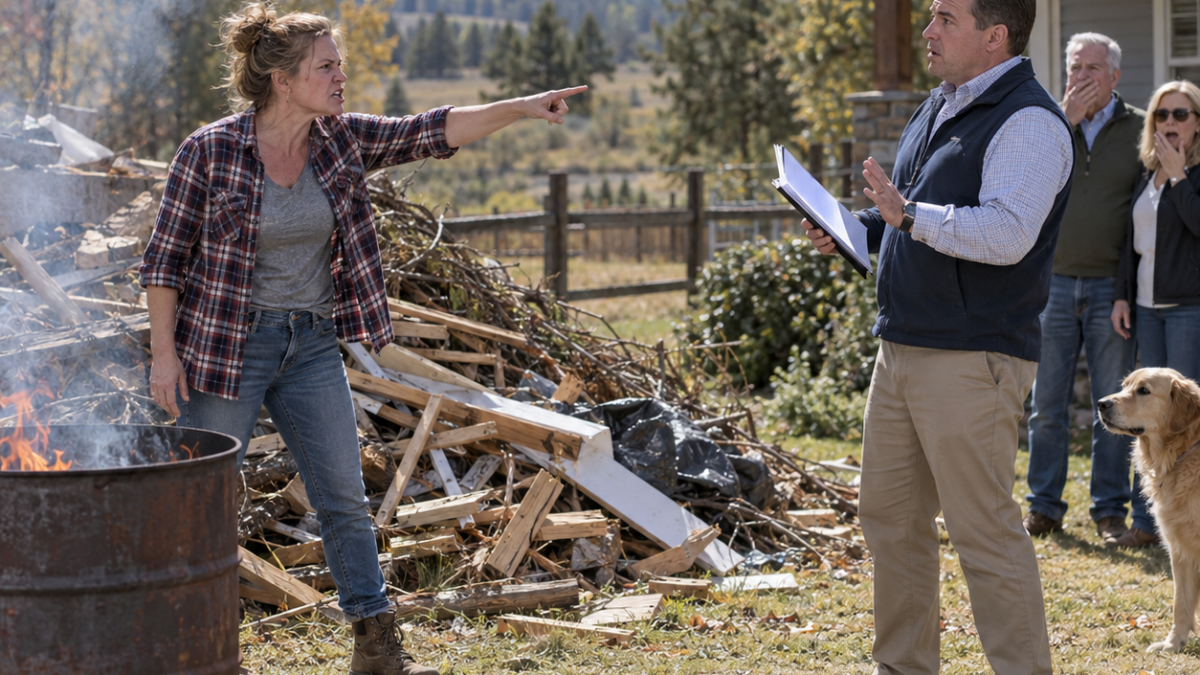
The HOA president stood on my porch in the middle of January and told me the smoke coming from my chimney would cost me five hundred dollars every single day.
She had no idea the oak burning inside my stove had come from the massive pile her own contractor dumped illegally across my property months earlier.
I could have told her right then what I had already discovered about that contractor—but watching her put the threat in writing was going to be far more useful.
“Five hundred dollars a day, Mr. Davies.”
Karen Miller held her clipboard against her chest while a thin ribbon of smoke drifted above my roof into the pale winter sky.
I took another sip of coffee.
“Show me the rule.”
Her expression hardened.
“I don’t have to stand here and debate association policy with you.”
“You’re standing on my property demanding five hundred dollars a day. I’d say we’re already debating.”
Behind me, through the living-room window, I could see my wife Sarah watching.
Our sixteen-year-old son, Leo, stood farther back near the wood stove.
The same stove that had been warming our house all morning.
The same stove that had apparently become Willow Creek Estates’ newest emergency.
Karen pointed toward my chimney.
“That smoke is excessive, offensive, and a nuisance to residents.”
“It’s January.”
“That is irrelevant.”
“My stove is legal.”
“The board determines what constitutes a nuisance.”
“And you’re the board now?”
“I’m the president.”
There it was.
Not an explanation.
A title.
Karen had been using that title like a weapon since the day Sarah and I moved into Willow Creek.
I had spent twenty years with the Army Corps of Engineers before retiring.
I understood procedures.
I understood contracts.
And most importantly, I understood property lines.
That was why I knew exactly where the trouble had begun three months earlier.
Willow Creek owned a wooded greenbelt behind our half-acre lot.
That fall, Karen announced a “beautification project” to remove damaged trees and undergrowth.
I didn’t object.
Dead trees fall.
Brush becomes fuel.
Responsible maintenance made sense.
Then I came home one afternoon and discovered what looked like half a forest piled behind my workshop site.
Oak.
Maple.
Ash.
Branches.
Logs.
Splintered trunks.
Twenty feet long.
Eight feet high.
Tons of wood dumped across my surveyed boundary.
Heavy-equipment tracks ran from the HOA greenbelt straight onto my lawn.
Their contractor hadn’t accidentally dropped a few branches over the line.
He had used my property as a disposal site.
I photographed everything.
Then I contacted the contractor.
No response.
I contacted the HOA management company.
They sent me a polite form letter thanking me for my “feedback.”
Finally, I emailed Karen directly.
She called the pile “temporary staging.”
That almost impressed me.
I had managed construction projects worth millions.
I knew what a staging area was.
It was planned.
Authorized.
Documented.
My backyard was none of those things.
So I sent Karen a certified letter.
Seven days to remove the wood and repair the damage.
If they refused, I would consider the material abandoned and deal with it myself.
Karen signed for the letter.
Seven days passed.
Nothing.
On day eight, I bought a chainsaw.
Sarah watched me unload it.
“You’re serious?”
“Very.”
“What are you going to do?”
I looked toward the mountain of hardwood.
“Clean up their mess.”
That weekend, Leo and I cut, split, and stacked until our shoulders hurt.
For the first time in months, he put his phone down without being asked.
I taught him how to read tension in a log, how to keep his stance balanced, how to respect machinery that didn’t care whether you made a mistake.
By Sunday evening, part of the chaotic pile had become neat rows of firewood.
Then the temperature dropped.
I carried several pieces inside.
Built a fire.
And watched our living room fill with warmth.
Three hours later, Karen emailed me about “noxious emissions.”
Two days after that, she appeared on my porch.
Now she stood there threatening five hundred dollars a day.
I looked over her shoulder toward the remaining pile.
Then back at her.
“Karen, just so we understand each other—you’re fining me for burning the wood your contractor dumped on my property?”
Her face changed.
Only for a second.
But I saw it.
Recognition.
Then fear.
She covered it quickly.
“That has nothing to do with this violation.”
I smiled.
That was when I knew the woodpile was hiding something much bigger than branches.
PART 2
Karen recovered quickly.
People like her usually do.
They spend so much time protecting their authority that embarrassment becomes just another battlefield.
She lifted her clipboard.
“You’ll receive the formal violation notice by mail.”
“Good.”
That answer surprised her.
“Good?”
“I prefer things in writing.”
Her mouth tightened.
“You think this is funny?”
“No.”
I stepped off the porch.
Karen instinctively moved backward.
“Actually, I think fining somebody five hundred dollars a day for using a legal wood stove in January deserves careful documentation.”
“You are creating a nuisance.”
“Then document the nuisance.”
“We have.”
“Air-quality test?”
She blinked.
“Excuse me?”
“Emissions measurement.”
“The smoke is visible.”
“Smoke is usually visible.”
“Complaints have been received.”
“How many?”
“That is confidential.”
“From whom?”
“Confidential.”
“When?”
“Also confidential.”
I nodded.
“So right now you have photographs of smoke coming from a chimney in winter.”
Karen’s cheeks reddened.
“And the authority of the board.”
There it was again.
Authority.
Not evidence.
“I’ll wait for the letter.”
She turned sharply.
“Karen.”
She stopped.
“You’re still standing inside my property line.”
Her shoulders stiffened.
“I am performing official HOA business.”
“That doesn’t grant you permission to enter my lot.”
She looked back at me.
“You really want to play this game?”
“No.”
I held her eyes.
“I want everybody to stay on their own property.”
For the first time, Karen had nothing immediate to say.
She walked back toward the sidewalk.
When I closed the door, Sarah was waiting.
“So?”
“Five hundred a day.”
“I heard that.”
Leo appeared behind her.
“Can they really do that?”
“No idea yet.”
He frowned.
“You said the stove was legal.”
“It is.”
“Then how can they fine us?”
Sarah looked at me.
That was the question.
Not whether Karen could print a number on HOA letterhead.
Anyone with a printer could do that.
The real question was whether the association had authority under our governing documents to classify normal winter chimney smoke from a compliant stove as a nuisance and impose a daily penalty without objective evidence.
I had an opinion.
But opinions cost less than lawyers.
I picked up my phone.
Sarah knew immediately.
“Jack?”
“Jack.”
Leo looked between us.
“Who’s Jack?”
“An old friend.”
Sarah smiled faintly.
“A very expensive old friend.”
Jack Riley had been a Marine JAG officer before leaving active duty and building a property and civil-litigation practice two counties away.
We had met years earlier during a joint infrastructure project.
I liked him because he was the rare lawyer who didn’t confuse complexity with intelligence.
If something could be explained in five words, he used five.
He answered on the fourth ring.
“Davies.”
“Riley.”
“Please tell me you’re calling because you finally bought that fishing boat.”
“My HOA is fining me five hundred dollars a day for chimney smoke.”
Silence.
Then:
“Start over.”
I did.
The greenbelt project.
The tree crew.
The dumped wood.
The emails.
The certified letter.
No removal.
Chainsaw.
Firewood.
Wood stove.
Karen.
Five hundred dollars per day.
When I finished, Jack remained silent for several seconds.
Finally he said, “You still have everything?”
“Photographs.”
“Good.”
“Survey.”
“Better.”
“Emails.”
“Excellent.”
“Certified-mail receipt with Karen’s signature.”
There was a pause.
“Mark.”
“Yes?”
“I’m proud of you.”
“Can she fine me?”
“Send me the covenants.”
“That wasn’t an answer.”
“It was the correct answer.”
I emailed everything that evening.
The official violation arrived two days later.
Thick paper.
HOA logo.
Formal language.
PUBLIC NUISANCE — EXCESSIVE SMOKE.
The board claimed that smoke from my chimney interfered with residents’ quiet enjoyment.
The penalty was listed as five hundred dollars per day beginning January 14.
They had already calculated one thousand dollars due.
Attached were three photographs.
One showed my house under a gray sky.
Another showed my chimney.
The third contained what could generously be described as a thin white plume.
Sarah laid the pages across the kitchen counter.
“They’re serious.”
“So am I.”
She touched the amount.
“A thousand dollars already.”
“It’s paper.”
“Paper turns into bills.”
“I know.”
“Bills turn into liens.”
“I looked at her.”
That fear was real.
Sarah wasn’t frightened of Karen.
She was frightened of systems.
Mortgage systems.
Credit systems.
Property-record systems.
The machinery that can hurt ordinary people even when ordinary people believe they’re right.
I had spent my career inside large systems.
Sarah had spent years watching me navigate them.
She knew how long bureaucracy could take to correct itself.
“Hey.”
She looked at me.
“We’re not ignoring this.”
“I know.”
“Jack is reviewing it.”
“I know.”
“And we have documentation.”
She nodded.
But the worry remained in her eyes.
That night, after Leo went upstairs, Sarah sat beside me near the wood stove.
The fire had burned down to red coals.
“Do you ever wish we’d bought somewhere without an HOA?”
“Every Tuesday.”
“I’m serious.”
“So am I.”
She laughed quietly.
Then grew serious again.
“I don’t want this becoming one of those things that eats our whole life.”
“It won’t.”
“You said that about the porch.”
“The porch took six weekends.”
“And you discussed lumber prices for eighteen months.”
“Entirely different issue.”
She rested her head against my shoulder.
“Promise me something.”
“What?”
“Don’t fight her because you enjoy fighting.”
That hit closer than I wanted.
“I don’t enjoy this.”
“Not yet.”
I looked at the fire.
Sarah knew me.
Maybe too well.
There was a part of me that liked a solvable problem.
A boundary.
A document.
A contradiction.
Give me a machine that failed and I wanted to take it apart until I understood why.
Karen was beginning to feel like a machine built entirely from bad assumptions.
“I promise.”
Sarah squeezed my hand.
The next morning, Jack called.
“Your stove?”
“EPA-certified.”
“Installation permitted?”
“Yes.”
“Inspected?”
“Yes.”
“Chimney cleaned recently?”
“October.”
“Fuel?”
“Seasoned hardwood.”
“Good.”
“And the HOA nuisance clause?”
“Broad.”
“How broad?”
He read it.
No noxious or offensive activity that may become an annoyance or nuisance.
“That’s vague,” I said.
“Very.”
“So they lose?”
“Stop trying to turn litigation into football.”
“I like scores.”
“Law does not.”
“What do we do?”
“First, reject the fine formally.”
“Okay.”
“Second, preserve evidence.”
“Already doing that.”
“Third, I want to know more about the dumping.”
“Why?”
“Because retaliation changes the story.”
He paused.
“If they ignored a trespass complaint and then immediately began punishing you after you demanded remediation, that matters.”
“It matters to me.”
“It may matter to a judge.”
He asked how much wood remained.
“Most of it.”
“Don’t dispose of everything yet.”
“I’m burning it.”
“Slowly.”
“I heat my house.”
“Then photograph the stacks.”
“Why?”
“Because eventually someone will pretend the pile was tiny.”
He was right.
People always remember inconveniences smaller when the invoice arrives.
That afternoon I photographed the remaining mountain beside a measuring tape and several reference points.
Then I photographed the tire ruts.
The buried survey markers.
The damaged grass.
The processed firewood.
My stove certification plate.
Installation permit.
Inspection record.
Chimney-cleaning receipt.
Jack loved evidence the way some people love their grandchildren.
Three days later, his formal response went out.
It rejected the nuisance violation.
Demanded the factual basis for the fine.
Requested copies of complaints and board minutes authorizing the penalty.
Put the association on notice that we considered the action retaliatory.
Then the letter turned to the woodpile.
I had almost forgotten how satisfying that section was.
The HOA had been notified that its contractor entered private property and deposited substantial tree debris without permission.
It had been given an opportunity to remove the material.
It refused.
I had been forced to spend time and money mitigating the condition.
Therefore, we reserved every claim relating to trespass, property damage, cleanup, and associated costs.
Jack also included a preliminary invoice.
Chainsaw supplies.
Splitter rental.
Protective equipment attributable to cleanup.
Labor hours.
Ground repair.
Not every dollar would necessarily be recoverable.
Jack was clear about that.
The point was simpler.
The association wasn’t the only party capable of sending paperwork.
When Karen received the letter, I knew almost immediately.
She drove past our house three times that afternoon.
Slowly.
Golf cart.
Bright red coat.
Clipboard.
On the third pass, I raised my coffee mug.
She did not wave.
The HOA lawyer responded eleven days later.
Their letter was aggressive.
Our claims were “without merit.”
The dumping was characterized as temporary material staging related to authorized maintenance work.
The HOA denied responsibility for any alleged damage.
The nuisance fine remained.
Daily penalties continued.
The balance had already crossed seven thousand dollars.
Jack called me.
“She doubled down.”
“What now?”
“We ask why.”
“I know why.”
“No, you know what you think.”
“She hates me.”
“Not legally useful.”
“She’s retaliating.”
“Potentially useful if proven.”
“So what do you want?”
“Records.”
I smiled.
“I was hoping you’d say that.”
As a homeowner, I had rights to inspect association records subject to the applicable requirements.
Jack drafted the request carefully.
Meeting minutes for two years.
Budgets.
Vendor contracts.
Greenbelt project documentation.
Bid materials.
Invoices.
Approvals.
Payments.
Correspondence related to the contractor.
Documents relating to my violation.
I signed it.
Certified mail.
Again.
Karen responded herself.
The request was “overly broad.”
Vendor contracts were supposedly confidential.
Some records contained proprietary business information.
Access was denied except for selected minutes the board considered relevant.
I forwarded the letter to Jack.
His reply arrived twenty minutes later.
This woman is remarkably cooperative.
I called him.
“Cooperative?”
“She keeps writing down the mistakes.”
He sent a second letter.
Produce the records.
If not, we would seek a court order and request costs where available.
Ten business days.
While Jack fought on paper, something else began happening.
Neighbors started talking to me.
It began with Raj Patel.
Raj lived two doors down.
Software engineer.
Quiet.
Patient.
The kind of man who apologized if his sprinkler crossed six inches onto the sidewalk.
Karen had fined him because his son’s portable basketball hoop did not conform to some interpretation of approved exterior equipment.
The alleged problem?
Color.
The black was apparently not the correct black.
I thought he was joking when he told me.
“She had a sample card,” Raj said.
“A what?”
“Paint samples.”
“She compared your basketball hoop to paint samples?”
“Yes.”
“What happened?”
“I paid the first fine.”
“Why?”
He shrugged.
“My wife said it was easier.”
That sentence bothered me.
Not because I blamed him.
Because Karen depended on it.
Easier.
It was easier to pay fifty dollars.
Easier to move the trash can.
Easier to remove the wind chimes.
Easier to repaint something nobody cared about.
Each individual surrender was small.
Together they became a governing philosophy.
“Did she leave anything in writing?”
Raj laughed.
“A folder.”
“Bring it over.”
That night he arrived with enough paperwork to qualify as a small archive.
Warnings.
Violation letters.
Payment receipts.
Emails.
The hoop.
A planter.
A temporary Diwali decoration.
One complaint about guests parking overnight.
Sarah made coffee while we spread everything across the table.
“Why didn’t you challenge any of this?” I asked.
Raj looked embarrassed.
“I thought it was just us.”
There it was.
The sentence I would hear over and over.
I thought it was just us.
Mrs. Gable thought it was just her.
Eleanor Gable lived alone four houses down.
Seventy-six.
Widowed.
She owned bamboo wind chimes her husband had bought on their final trip to Hawaii before he died.
Karen hated them.
According to Eleanor, one resident had complained about the sound.
Karen converted that complaint into months of notices.
Eleanor had started bringing the chimes inside whenever the breeze picked up.
The first time she told us that, Sarah’s expression changed.
“You bring them inside?”
Eleanor nodded.
“Sometimes.”
“Why?”
“I don’t want trouble.”
“They were your husband’s.”
“Yes.”
“Do you like them?”
A small smile.
“Very much.”
“Then hang them.”
Eleanor looked toward me.
I said, “Sarah outranks me on wind chimes.”
That made her laugh.
It also broke something open.
People began telling stories.
Carlos and Maria Garcia had been fined because their trash bins remained at the curb three hours after pickup.
The rule allowed two.
Their explanation that both were working and could not return home sooner didn’t matter.
Another family received three notices about a child’s plastic slide being visible from the street.
A retired teacher had been threatened over native wildflowers that Karen considered weeds.
Not every notice was outrageous.
Some were legitimate.
A broken fence really did need repair.
One homeowner had ignored mildew spreading across his siding for years.
Another routinely blocked a fire lane.
Rules had a purpose.
That was precisely why Karen’s behavior mattered.
Bad enforcement destroys respect for good rules.
One Saturday evening, Sarah suggested we invite everyone over.
“For what?”
“Dinner.”
“Why?”
“Because if you call it a resistance committee, nobody will come.”
“I wasn’t going to call it that.”
“You were thinking it.”
I had been thinking it.
So we invited Raj and his wife Priya.
Eleanor.
The Garcias.
A few others.
I told them neighborhood watch.
Sarah told them chili.
Both descriptions were technically accurate.
The wood stove burned in the corner.
Yes, with the disputed wood.
It felt appropriate.
For the first hour, people mostly complained.
I let them.
Then Raj said something that changed the entire night.
“The contractor.”
“What about him?”
“The tree company.”
“Tidwell Tree and Stump.”
He nodded.
“I looked them up.”
“Why?”
Raj shrugged.
“I was curious.”
That was engineer language for I lost four hours because a detail annoyed me.
“The registered owner is Daniel Tidwell.”
“Okay.”
Raj turned his phone around.
On the screen was a social-media photograph.
Karen.
Her husband.
Several relatives.
A man tagged Danny Tidwell.
Raj zoomed in.
The caption referred to him as Karen’s brother.
No one spoke.
Sarah was first.
“Her brother?”
Raj nodded.
“The HOA hired her brother?”
“So it appears.”
“For forty thousand dollars?”
I turned.
“What?”
Raj looked at me.
“You didn’t know the amount?”
“No.”
“I heard it at the budget presentation.”
“Forty thousand?”
“For the greenbelt project.”
I felt my stomach tighten.
That did not prove corruption.
Family businesses can legally win contracts.
But conflicts need disclosure and proper procedures.
Depending on the bylaws and state law, competitive bidding might be required or at least expected for a project that large.
“What does the board record say?” I asked.
Raj smiled without humor.
“That’s why she doesn’t want to give you the records.”
Sarah folded her arms.
“You think there were no bids.”
“I think we should find out.”
That phrase became our rule.
Not accusation.
Not rumor.
Find out.
Jack loved it.
When I told him, he went silent.
Then:
“Do not post anything online.”
“I wasn’t going to.”
“Do not accuse her of theft.”
“I wasn’t going to.”
“Do not say fraud.”
“Jack.”
“I know you.”
“Apparently not very well.”
“Find the documents.”
A thick envelope arrived from the HOA attorney six days later.
Records.
Not all of them.
Enough.
The greenbelt contract was there.
One page.
Tidwell Tree and Stump.
Forty thousand dollars.
Scope of work.
Tree removal.
Brush clearing.
Debris disposal.
That last phrase made me stop.
Debris disposal.
I read it again.
They had been paid to dispose of the material.
Instead, a significant amount had been dumped on my property.
Sarah read over my shoulder.
“They were paid to remove it.”
“Yes.”
“And dumped it on us.”
“Yes.”
She sat down.
“So Karen’s brother got paid to clean the greenbelt.”
“Yes.”
“Then saved money by dumping the waste in our yard.”
“Potentially.”
“And Karen called it temporary staging.”
“Yes.”
“Then when you told her to remove it…”
“She ignored me.”
“And when we started burning it…”
“She fined us.”
I nodded.
Sarah looked toward the stove.
“This may be the dumbest corruption scandal in American history.”
“Let’s not call it corruption yet.”
She stared.
“You’ve been spending too much time with Jack.”
The meeting minutes were even more interesting.
The board had approved the project.
But we found no record of multiple bids.
No competitive proposals.
No written conflict disclosure from Karen.
No recusal.
Karen participated in the vote.
Then came the payment record.
A check.
Signed by Karen.
Forty thousand dollars.
I called Jack.
“You have it?”
“Yes.”
“Send scans.”
I did.
He reviewed them.
“This is much better.”
“For us?”
“For truth.”
“Jack.”
“Yes, for us.”
“Can we sue?”
“You can always sue.”
“Can we win?”
“Wrong question.”
I sighed.
“What’s the right question?”
“What outcome do you want?”
That stopped me.
I had been so focused on proving Karen wrong that I hadn’t thought clearly about the end.
“I want the fines gone.”
“Good.”
“My property repaired.”
“Good.”
“The HOA to stop harassing us.”
“Good.”
“And I want answers about the contract.”
“That last one belongs to the membership more than to you individually.”
He was right.
The forty thousand dollars came from all of us.
The conflict wasn’t just mine.
Jack proposed a final settlement offer on my personal dispute.
Rescind every smoke-related fine.
Withdraw the violation.
Acknowledge that the contractor had placed debris on my property without authorization.
Pay five thousand dollars toward cleanup, lawn restoration, equipment, and legal costs.
In exchange, I would release my individual claims arising from that dumping incident.
But the release would not prevent other homeowners or the association itself from investigating the Tidwell contract.
We gave them ten days.
Sarah read the final letter.
“You really think she’ll accept?”
“No.”
“Then why send it?”
“So nobody can say we didn’t offer a reasonable exit.”
She nodded.
“Jack’s idea?”
“Mine.”
“You’re lying.”
“Mostly Jack’s.”
The daily fines continued.
Ten thousand.
Twelve thousand.
Fifteen.
Eventually the number became meaningless.
Karen’s paper empire said I owed more than some people paid for used cars because my chimney produced smoke from wood her contractor left on my land.
Leo turned it into a joke.
He stood near the stove one evening with a calculator.
“Dad.”
“What?”
“According to Karen, tonight’s fire costs about five hundred dollars.”
“Efficient.”
“We should roast marshmallows.”
“Those cost extra.”
Sarah threw a pillow at both of us.
Humor helped.
But underneath it, I felt pressure.
I knew the association could escalate.
Collections.
Attorney fees.
Lien threats.
Even when such actions were challengeable, defending property costs time and money.
I slept poorly.
I checked email too often.
Every vehicle slowing near our driveway annoyed me.
Then one night Leo came downstairs while I was organizing documents.
“You okay?”
“Fine.”
“You always say fine when you’re not.”
“Your mother teaching you that?”
“No.”
He sat opposite me.
The dining table was covered in folders.
“You regret cutting the wood?”
“No.”
“What if you had just left it?”
I considered that.
“Then Karen would still have a mountain of wood on our property.”
“Yeah.”
“But maybe no smoke fine.”
“Probably.”
Leo tapped the table.
“Do you ever think we should’ve just paid?”
That question hurt.
Not because he was wrong to ask.
Because my son was learning the same lesson Raj had learned.
Sometimes systems make surrender cheaper than being right.
“I think about it.”
He looked surprised.
“Really?”
“Sure.”
“So why don’t we?”
“Because there has to be a line.”
“What line?”
I looked toward the back window.
Beyond it, in darkness, I could barely see the remaining woodpile.
“The point where making peace with something wrong causes more damage than fighting it.”
He thought about that.
“How do you know where that point is?”
“You usually don’t.”
“That’s not helpful.”
“Welcome to adulthood.”
He rolled his eyes.
Then smiled.
I leaned back.
“But there’s another reason.”
“What?”
“If we pay a fine that exists only because somebody got angry at us for complaining about their mistake, we teach them something.”
“That they can do it again?”
“Exactly.”
Leo nodded.
Then stood.
“Okay.”
“Okay what?”
“I’m going to bed.”
“That conversation was emotionally expensive.”
He shrugged.
“I’m sixteen.”
The HOA rejected our settlement on day ten.
One paragraph.
All fines valid.
All claims denied.
And then the threat:
The board had authorized legal steps toward placing a lien for unpaid assessments and fines.
Sarah read the letter.
Her face went pale.
There it was.
The word she had feared.
Lien.
I called Jack immediately.
He already had a copy.
“Can they?”
“They can try to record what they claim is authorized.”
“What happens if they do?”
“We challenge it.”
Sarah was listening.
“How long?”
Jack paused.
“That depends.”
She closed her eyes.
I hated that answer.
Not because he was wrong.
Because uncertainty is expensive emotionally.
Jack continued.
“This is the moment where people panic. Don’t.”
“What do we do?”
“Go public.”
“With what?”
“The truth.”
The annual HOA meeting was four weeks away.
Ordinarily fifteen homeowners attended.
Karen read the budget.
Someone complained about landscaping.
Someone else asked why dues increased.
Meeting adjourned.
This year would be different.
Our group grew.
Raj became the organizer.
Maria Garcia was good with people.
Eleanor surprised everyone by volunteering to knock on doors.
“You don’t have to,” Sarah told her.
“I know.”
Karen had spent months teaching Eleanor to feel small.
Now Eleanor seemed determined to prove the lesson hadn’t stuck.
We created an information packet.
Jack reviewed every sentence.
No insults.
No claims we couldn’t support.
Timeline of the dumping.
Photographs.
Property survey.
Certified notice.
HOA response.
Smoke violation.
Fine history.
Settlement offer.
Rejection.
Then the Tidwell contract.
Company registration.
Family relationship.
Meeting minutes.
No recorded competing bids in the produced records.
The forty-thousand-dollar check.
We did not write “Karen stole money.”
We wrote:
The membership should investigate whether proper conflict-of-interest, bidding, disclosure, and fiduciary procedures were followed.
Less dramatic.
Far more dangerous.
Facts don’t need adjectives when they are bad enough.
The final page contained a recall petition structured under the governing documents.
We were not sure a spontaneous vote at the annual meeting would legally remove the board immediately under every procedural requirement.
So Jack made sure we had the correct process ready.
If enough members signed, we would force a special recall meeting if necessary.
No shortcuts.
That mattered.
The entire case against Karen was that she treated procedure like a personal convenience.
We would not defeat her by doing the same thing.
The week before the annual meeting, something remarkable happened.
People started coming to our house.
Not for strategy.
To bring records.
Old fines.
Letters.
Emails.
Receipts.
One man had been fined because his garage door remained open while he worked inside.
A mother had received a warning because chalk drawings remained on her driveway overnight.
Another resident showed us an approval Karen had personally expedited for a friend’s pergola, while a nearly identical request from another homeowner sat unanswered for months.
Again, not every story proved misconduct.
But the pattern created questions.
Questions are kryptonite to people who rule through certainty.
The night of the meeting, eighty-three homeowners packed the clubhouse.
Sarah sat beside me.
Leo stayed home.
I had asked if he wanted to come.
He said no.
“Why?”
“Adults yelling about contracts sounds terrible.”
Smart kid.
Karen looked delighted by the turnout.
That almost made me feel sorry for her.
She believed the crowd had come because community engagement was improving under her leadership.
She opened with a speech.
Property values.
Standards.
Beautification.
Fiscal responsibility.
That phrase nearly made Raj choke.
I nudged him.
“Behave.”
He whispered, “Forty thousand.”
“I know.”
Karen continued through committee updates.
Landscaping report.
Treasurer report.
Architectural approvals.
Then:
“Any new business?”
I stood.
The scrape of my chair against the floor sounded louder than expected.
Karen saw me.
Her face changed.
“Mr. Davies.”
“Karen.”
“If this concerns your outstanding compliance matter, your attorney has been advised that private enforcement disputes will not be litigated in an open membership meeting.”
“It doesn’t.”
That surprised her.
“This concerns association governance.”
Murmurs began.
I held up one packet.
Raj and Maria began passing copies through the rows.
Karen noticed.
“What are those?”
“Documents.”
“I did not authorize distribution.”
Several people laughed.
I walked toward the front.
The first image appeared on the projector.
My backyard.
The woodpile.
Twenty feet of logs and branches.
The laughter stopped.
“This photograph was taken October 18.”
I pointed.
“This is my private property.”
Next slide.
Property survey.
Next.
Tire tracks.
Next.
My certified letter.
“I notified the HOA that its contractor had entered my land and dumped project debris.”
Next slide.
Karen’s email describing it as temporary staging.
Someone muttered, “You’re kidding.”
Next.
The contract.
TIDWELL TREE AND STUMP.
FORTY THOUSAND DOLLARS.
The room changed.
Karen stood.
“What is the purpose of this?”
I turned toward the residents.
“The purpose is to ask whether you knew the company paid forty thousand dollars from association funds is owned by President Miller’s brother.”
Noise exploded.
People turned toward one another.
Someone said, “Her brother?”
Another:
“What?”
Karen hit the gavel.
“Order!”
I waited.
She shouted, “There is nothing illegal about hiring a qualified contractor!”
“I didn’t say there was.”
That slowed her.
I continued.
“I’m asking whether the relationship was disclosed.”
Karen opened her mouth.
Raj spoke from his seat.
“Where is it in the minutes?”
Karen glared at him.
“Mr. Patel, you are out of order.”
I displayed the produced minutes.
“We reviewed the records provided by association counsel. We did not find documentation showing competitive bids or a recorded conflict disclosure.”
“That doesn’t mean they don’t exist.”
“Then produce them.”
Applause.
Karen’s face darkened.
“This is a coordinated personal attack.”
“No.”
I clicked.
The forty-thousand-dollar payment.
“This is a financial question.”
Click.
The debris-disposal clause.
“This is a performance question.”
Click.
The photographs of the wood on my property.
“This is where part of the material went.”
Then the certified letter.
“This is when the association was told.”
Then the chimney violation.
“This is what happened after I demanded cleanup.”
The room went silent.
I let the timeline sit there.
Karen pointed at the screen.
“His chimney smoke has absolutely nothing to do with the contractor agreement.”
“Maybe not.”
That answer bothered her more than an accusation would have.
“But everyone here can look at the dates.”
I displayed them.
October 18 — debris discovered.
October 20 — management notified.
October 22 — Karen notified.
October 23 — temporary staging response.
October 24 — formal certified removal demand.
October 31 — deadline expires.
November through January — wood processed.
January 14 — smoke complaint.
January 15 — nuisance fine begins.
January 17 — Karen visits property.
Daily fines thereafter.
No one spoke.
“You decide whether those events are related.”
Karen slammed the gavel.
“This is outrageous.”
I nodded.
“I agree.”
Then Raj stood.
“My turn.”
He held up his folder.
Karen pointed at him.
“No.”
Raj’s voice remained calm.
“My family paid two hundred dollars because my son’s basketball hoop was allegedly the wrong shade of black.”
Several people laughed.
“It isn’t funny.”
They stopped.
“My son thought he had caused trouble for our family.”
Raj looked toward Karen.
“You came to my house with color samples.”
Karen responded, “The community has established aesthetic standards.”
“Show me the standard specifying the shade.”
“The architectural committee has discretion.”
“That isn’t what I asked.”
Then Eleanor stood.
She looked terrified.
Sarah reached across the aisle and squeezed her hand.
Eleanor walked forward carrying something.
Her wind chimes.
She placed them on the table.
Tiny bamboo tubes clicked softly together.
Karen stared.
“My husband bought these for me in Maui.”
Her voice shook.
“He died three years ago.”
The room went completely still.
“I received warning after warning because somebody complained.”
Karen shifted.
“We offered reasonable alternatives.”
“You told me to remove them.”
“Because they caused distress.”
“To whom?”
“Complaints are confidential.”
Eleanor looked at the chimes.
“I started taking them inside every time the wind blew.”
Her voice broke.
“I was afraid of the next letter.”
Sarah wiped her eyes.
Eleanor looked up.
“I am seventy-six years old.”
Then directly at Karen:
“I should not be afraid of my mailbox.”
Nobody applauded.
It was too painful for applause.
Eleanor returned to her seat.
Then Maria stood.
Then another homeowner.
Then another.
Trash bins.
Planters.
Flags.
Decorations.
Cars.
Grass.
Some stories minor.
Some infuriating.
Together they revealed something more important than my firewood.
Karen’s power had depended on private fear.
Nobody knew how many other people were frightened.
Now the room knew.
Karen stood.
“This meeting is adjourned.”
“No.”
The voice came from the back.
Mr. Henderson.
Retired accountant.
Former board member years before Karen’s time.
He walked toward the front carrying a copy of the bylaws.
Karen stared.
“This meeting is adjourned.”
Henderson shook his head.
“There is a pending motion request.”
“There is no motion.”
“There is now.”
He looked toward the residents.
“I move that the membership direct the board to schedule a properly noticed special meeting for recall consideration under the removal provisions of our governing documents.”
Maria stood.
“Second.”
Karen hit the gavel.
“Out of order.”
Henderson opened the bylaws.
“Section four.”
He read the relevant language.
Karen looked toward the association attorney seated near the wall.
The attorney had been silent all evening.
Now Karen demanded, “Is he correct?”
The lawyer adjusted his glasses.
“The membership can petition for a special meeting pursuant to the bylaws.”
Karen stared at him as though he had betrayed her.
“What percentage?”
He told her.
Raj stood.
“We already have it.”
That was our next reveal.
Forty-one signed petitions.
More than required.
Maria carried them forward.
The association attorney examined the first pages.
Then nodded.
“The petition appears sufficient for notice purposes, subject to verification.”
Karen’s face drained.
For the first time since I had known her, she looked uncertain.
Not angry.
Not offended.
Uncertain.
Power had always answered her questions before.
Now procedure was answering instead.
The special meeting was scheduled eighteen days later.
Those eighteen days were ugly.
Karen sent a community-wide email accusing a minority faction of attempting to destabilize Willow Creek.
Then another defending the Tidwell contract.
According to her, Daniel’s company had provided the lowest practical price based on project urgency.
If that was true, no competing written bids were produced.
She claimed the dumping on my property was an isolated contractor mistake.
That was progress.
For months, she had called it temporary staging.
Now it was a mistake.
Jack noticed too.
“Save that email.”
“Already did.”
The board finally suspended my daily fines pending review.
Not canceled.
Suspended.
The balance on paper had exceeded twenty thousand dollars.
I printed the account statement.
Leo whistled.
“You owe twenty grand for smoke.”
“Allegedly.”
“We should sell the stove.”
“Never.”
“You love this stove way too much.”
“It represents principle.”
“It represents fire.”
“Go do homework.”
Meanwhile, pressure increased on the other board members.
Most had followed Karen passively.
That didn’t excuse their votes.
But I began to see the difference between leadership and complicity.
Karen drove.
They rode.
Now the vehicle was approaching a cliff and passengers were discovering seat belts.
One board member, Susan, called me.
I almost didn’t answer.
“Mark?”
“Yes.”
“I want to explain.”
“I’m listening.”
“I didn’t know Daniel was Karen’s brother when we approved the project.”
I said nothing.
“She referred to Tidwell as a contractor she trusted.”
“Did you ask for bids?”
“No.”
“Why?”
“She said timing was critical because of storm-damaged trees.”
“Was there an emergency report?”
“I don’t remember one.”
“Did you read the contract?”
A pause.
“Yes.”
“Then you saw debris disposal.”
“Yes.”
“And when I complained about dumping?”
“She told us the material was temporarily stored.”
“Did you verify?”
“No.”
“Did you visit my property?”
“No.”
“Before voting on my smoke fine?”
Silence.
“You voted for it?”
“Yes.”
“Did you inspect my stove?”
“No.”
“Request an emissions report?”
“No.”
“Read my response?”
“She summarized it.”
I closed my eyes.
There it was.
Governance by summary.
“Why are you calling?”
Susan began crying.
That I didn’t expect.
“Because Karen says you’re trying to sue all of us personally.”
“I’m trying to stop the fines and recover my costs.”
“Jack’s letters mention board liability.”
“They reserve rights.”
“My husband is terrified.”
I exhaled.
“Susan, I don’t want your house.”
“I know.”
“Then why did you vote to threaten mine?”
Silence.
When she finally spoke, her voice was barely audible.
“I trusted Karen.”
“That isn’t the same as doing your job.”
“I know.”
We ended the call civilly.
Sarah was standing in the doorway.
“You feel bad for her.”
“A little.”
“She voted for the fines.”
“I know.”
“You can feel bad and still hold someone accountable.”
“That sounds suspiciously healthy.”
“I read.”
The recall meeting drew nearly the entire neighborhood.
This time Karen did not look pleased by attendance.
She sat rigid at the front.
Jack attended.
That changed the atmosphere.
He wasn’t there to speak unless necessary.
His presence was enough.
The meeting opened under the procedures laid out in the bylaws.
Petition verified.
Quorum confirmed.
Owners checked against membership rolls.
Proxies reviewed.
Karen objected to three.
The attorney ruled two valid, one invalid.
Everything slow.
Everything procedural.
It was almost boring.
That was exactly what we wanted.
No mob.
No dramatic coup.
Just homeowners using the rules.
Before the vote, both sides received time to speak.
Karen went first.
She defended her record.
Road maintenance improved under her leadership.
Reserve contributions increased.
Landscaping became more consistent.
Delinquency collections improved.
Some of that was true.
It mattered that we admitted it.
Bad leaders can do useful things.
That does not erase abuse.
Karen described herself as strict because standards protect property values.
Then she addressed the Tidwell contract.
“My brother’s company was selected because it was available and qualified.”
A voice called out:
“Why no bids?”
The moderator raised his hand.
“No interruptions.”
Karen continued.
“The relationship was known to multiple people.”
Susan spoke from the board table.
“I didn’t know.”
Everything stopped.
Karen turned slowly.
Susan’s face was pale.
“I’m sorry, Karen. I didn’t.”
Another board member, Mike, looked down.
“I didn’t either.”
Karen stared at them.
“You both knew his last name.”
“Tidwell is not your married name.”
Karen’s mouth opened.
Then closed.
That moment did more damage than my entire presentation.
Not because it proved criminal conduct.
It proved Karen’s core defense—everyone knew—was disputed by her own board.
She finished quickly.
Then it was my turn.
I stood.
Jack whispered, “Facts.”
I nodded.
I walked to the microphone.
“My name is Mark Davies.”
Everyone knew.
But formality felt important.
“My dispute with this board began because an HOA contractor placed a large quantity of tree debris across my surveyed property line.”
The photographs appeared.
“I asked for removal.”
Certified letter.
“The association did not remove it.”
Timeline.
“I processed part of the material because it obstructed my property.”
Photos of split stacks.
“I later burned some of that wood in a legally installed, inspected, high-efficiency stove.”
Stove records.
“The board then classified ordinary chimney smoke as a nuisance and began assessing five hundred dollars per day.”
Fine notice.
“Those fines exceeded twenty thousand dollars before suspension.”
Murmurs.
“We offered a settlement.”
Settlement letter.
“Rescind the fines. Address the damage. Resolve my individual dispute.”
Rejection.
“The board rejected it and authorized lien-related collection steps.”
I paused.
“That brought us here.”
Then the contractor records.
“While investigating the original dumping, homeowners discovered that the contractor was owned by President Miller’s brother.”
Registration.
“The contract was forty thousand dollars.”
Contract.
“In the records produced to us, we found no documented competitive bid process and no recorded conflict disclosure.”
Minutes.
“We also found that the contractor’s scope included debris disposal.”
I turned toward Karen.
“Yet a significant part of that debris ended up on my property.”
Karen spoke.
“That was the contractor’s action, not mine.”
I nodded.
“That may be.”
She looked surprised.
“I’m not claiming you personally drove the truck.”
A few nervous laughs.
“But when I notified you…”
I displayed her email.
“You defended the placement.”
She stared at the screen.
“When I demanded removal…”
Certified receipt.
“The association took no effective action.”
“When I began cleaning it myself…”
Photos.
“The board fined the smoke.”
I stepped away from the projector.
“Those are facts.”
Then I looked at the residents.
“The recall question is yours.”
Karen seemed almost disappointed that I didn’t call her corrupt.
I continued.
“I don’t think Willow Creek needs no rules.”
That mattered.
“We need rules.”
Someone murmured agreement.
“We need dues.”
Another nod.
“We need maintenance.”
“Yes,” someone said.
“We even need people willing to send violation notices when there is a real violation.”
Karen folded her arms.
“But authority without consistent procedure becomes personal.”
I looked at Raj.
“At the Patels.”
Eleanor.
“The Garcias.”
Then back at Karen.
“Rules should be boring.”
That got a laugh.
“I mean that.”
I smiled.
“A rule should produce roughly the same result whether the board likes you or not.”
Applause began.
I raised my hand.
It quieted.
“If leadership becomes about who can be punished, who gets exceptions, who knows whom, or who is too afraid to challenge a letter, the association stops serving the neighborhood.”
I looked toward the woodpile photograph.
“My family was fined for burning wood that reached my property because the association’s own contractor failed to dispose of it properly.”
Then the twenty-thousand-dollar balance.
“If that outcome makes sense to you, vote to keep this board.”
The room was silent.
“If it doesn’t, vote for change.”
I sat down.
No dramatic music.
No shouting.
Paper ballots.
One by one.
Fold.
Drop.
Count.
Observers from both sides watched.
Karen whispered repeatedly to her husband.
Susan stared straight ahead.
Raj squeezed Priya’s hand.
Eleanor’s wind chimes were not there this time.
She had hung them outside her house before coming.
The first vote concerned Karen.
Seventy-eight percent favored removal.
The number appeared on the screen.
For several seconds, Karen didn’t move.
Then:
“This is ridiculous.”
Nobody answered.
She looked toward the board attorney.
He spoke quietly.
“The result satisfies the removal threshold.”
“I know what it satisfies.”
Her voice cracked.
She stood.
“You people have no idea what I have done for this community.”
Eleanor answered from the third row.
“We know.”
Karen turned toward her.
Eleanor did not look away.
That was my favorite moment of the entire fight.
Not Karen losing.
Eleanor no longer being afraid.
The votes concerning other directors followed.
Susan resigned before hers.
Mike too.
One member survived the recall because homeowners believed he had challenged Karen privately and had a record of independent votes.
That seemed fair.
Accountability did not have to become revenge.
An interim board was appointed under the governing documents.
Mr. Henderson agreed to serve as temporary president.
Raj became treasurer.
Maria became secretary.
Two other members joined.
Eleanor refused a board seat.
“I’m retired.”
“So is Henderson,” Sarah told her.
“I’m smarter.”
Her first act as a free citizen was apparently sarcasm.
The interim board met publicly forty-eight hours later.
Their first vote rescinded my smoke fines.
Not suspended.
Rescinded.
Zero balance.
Sarah sat beside me when the motion passed.
She exhaled so deeply I realized she had been holding tension for months.
I took her hand.
“You okay?”
“Ask me when the lien threat is gone.”
The board’s attorney confirmed no lien would be pursued.
Sarah closed her eyes.
“Now I’m okay.”
Then the board reviewed other disputed fines.
Not automatically.
Case by case.
Mrs. Gable’s wind-chime fines were erased.
Raj’s basketball-hoop penalties were reversed.
The Garcias’ trash-bin fine was refunded.
Legitimate violations remained.
That was important.
The point was never that homeowners should do whatever they wanted.
The point was fairness.
Then came the Tidwell contract.
The board voted to freeze further payments connected to the project and retain an independent accountant and outside counsel.
They also commissioned a review of procurement procedures.
For the next two months, the neighborhood learned more about HOA finances than anyone had ever wanted to know.
The audit did not produce a Hollywood vault full of stolen cash.
Reality was messier.
There were sloppy controls.
Poor documentation.
Questionable reimbursements.
Vendor relationships that should have been disclosed more transparently.
Several projects with weak or nonexistent competitive pricing.
And the Tidwell contract.
Forty thousand dollars.
The accountant compared scope, market pricing, disposal costs, and work performed.
The conclusion was uncomfortable.
The HOA had paid a premium.
The contract had not been competitively procured under procedures that should have applied.
The family relationship created an obvious conflict that had not been properly documented.
And the debris dumping reduced the contractor’s disposal burden while shifting damage onto me.
Outside counsel sent demand letters.
To Karen.
To Daniel Tidwell.
To the contractor’s insurer.
To the management company.
Negotiations began.
I was not involved in most of them.
For once, I was happy not to be.
My own settlement came first.
The HOA reimbursed documented cleanup and property-restoration costs.
It paid a portion of my legal expenses.
The board issued a written acknowledgment that the tree debris had been placed on my land without authorization and that the smoke fines should not have been imposed on the record available.
They did not write a dramatic apology.
I didn’t need one.
They wrote the important sentence.
The balance is zero.
Jack sent me the signed document.
Subject:
YOUR MOST EXPENSIVE FREE FIREWOOD.
I called him.
“You’re very proud of that subject line.”
“I worked on it for eleven seconds.”
“Invoice me.”
“Already did.”
The larger contract dispute took longer.
Karen hired her own lawyer.
Daniel hired another.
Insurance companies entered.
Everyone suddenly remembered different conversations.
Karen insisted the contractor had been recommended independently.
Daniel argued his crew believed my property was part of the greenbelt staging zone.
The management company claimed board direction controlled vendor decisions.
The old board members disagreed over who knew what.
That is what accountability often looks like.
Not confession.
Finger-pointing.
Eventually, the HOA reached settlements that recovered a substantial amount connected to the project, audit costs, and related expenses.
Karen contributed under a negotiated resolution.
Daniel’s company contributed through its settlement and insurance arrangements.
I never cared about the exact division.
The HOA posted the final numbers for members.
Transparency became policy.
Large contracts required multiple bids unless a documented emergency made bidding impractical.
Board members had to disclose family or business relationships with vendors.
Conflicted directors had to step out of discussion and voting where appropriate.
Records requests received written responses.
Fine schedules were standardized.
Hearings became real hearings.
Not Karen explaining why Karen was right.
Raj spent three months rebuilding the budget.
He looked ten years older by spring.
I saw him at the mailbox.
“How’s public service?”
“Terrible.”
“Good.”
“Why good?”
“You’re supposed to dislike holding power.”
“That makes no sense.”
“It makes perfect sense.”
He pointed at me.
“You caused this.”
“You looked up the contractor.”
“I regret everything.”
His son’s basketball hoop stood behind him.
Black.
Apparently the correct shade now.
Eleanor hung her wind chimes permanently.
One afternoon I walked past while a breeze moved through them.
Soft bamboo notes.
Nothing maddening.
Nothing offensive.
Just sound.
She opened her front door.
“Do you hear that?”
“I do.”
“Disturbing the peace?”
“Severely.”
She smiled.
“Good.”
The greatest change happened inside our house.
The woodpile became a family project.
At first, Leo helped because splitting logs felt like operating heavy machinery without technically violating anything his mother had forbidden.
Then he started enjoying it.
Every Saturday morning we worked for a few hours.
I handled the saw.
He ran the splitter under supervision.
Later, as his technique improved, he began splitting by hand.
Sarah took photographs.
“Why?” I asked.
“Because in six months he’ll think he did all the work.”
Leo shouted from the stack.
“I did!”
Sarah raised the phone.
“Evidence says otherwise.”
By spring, the original mountain was mostly gone.
The lawn beneath it was destroyed.
Compacted soil.
Ruts.
Dead grass.
The settlement funded proper repair.
But I told the landscaper to leave one small section unfinished.
Sarah thought I had lost my mind.
“Why?”
“I have an idea.”
That Saturday, I brought Leo outside.
I handed him a shovel.
He stared.
“What?”
“We’re planting.”
“Planting what?”
“Trees.”
He laughed.
“Seriously?”
“Very.”
“The whole problem started with trees.”
“Exactly.”
Sarah brought out two young red maples and an oak.
We planted them where the dump pile had been deepest.
Leo hated digging.
Then became competitive about hole quality.
“This one is straighter.”
“It’s a hole.”
“Still.”
Sarah planted wildflowers around the edges.
By evening, the scar where tons of dumped wood had sat looked different.
Not healed.
Beginning to heal.
That mattered.
A fight can become an identity if you let it.
Every time I looked at that back corner, I could have remembered Karen.
The notices.
The fines.
The lawyers.
Instead, I wanted to see trees.
A year passed.
Karen’s house went up for sale in early spring.
The sign appeared on a Tuesday.
Sarah noticed first.
“You seen it?”
“Yes.”
“What do you think?”
“About what?”
“She’s leaving.”
I kept stacking wood.
Sarah waited.
Eventually I said, “Probably better for everybody.”
“No victory dance?”
“My knees hurt.”
“That’s not why.”
I set down the log.
“No.”
She smiled slightly.
“You changed.”
“Careful.”
“I mean it.”
“From what?”
“The man who bought a chainsaw partly because he knew it would annoy her.”
“That was never established.”
“You started at seven thirty Saturday morning.”
“Legal work hours.”
“Mark.”
“Fine.”
I looked toward Karen’s street.
“I wanted her angry.”
“And now?”
“I want her gone enough that we can all stop talking about her.”
Sarah nodded.
“That sounds healthier.”
The moving truck arrived three weeks later.
I was outside splitting wood.
Karen drove past.
Slowly.
For a moment I thought she would continue.
Then her brake lights came on.
She reversed.
Stopped near my driveway.
I set down the maul.
She lowered the passenger window.
“You got what you wanted.”
The sentence sounded familiar.
People who lose power often imagine everyone else wanted the loss itself.
“I got the fines removed.”
“You destroyed my reputation.”
“I showed documents.”
“You turned everyone against me.”
“People voted.”
“You think that makes it right?”
“I think that makes it their decision.”
Karen looked toward the stacked firewood.
“You’re still burning that garbage.”
“It’s oak.”
“You know what I mean.”
“Yes.”
She gripped the steering wheel.
“My brother nearly lost his business.”
“I didn’t hire him.”
“You know that project wasn’t some conspiracy.”
“I never said it was.”
“You made it look like one.”
“No.”
I walked closer, stopping at the edge of my driveway.
“I showed people the contract.”
“You implied things.”
“I asked why the conflict wasn’t disclosed.”
“It was known.”
“Not to your own board.”
Her eyes flashed.
“They betrayed me.”
“Maybe.”
“You don’t believe that.”
“I think they stopped protecting you.”
“That’s betrayal.”
“Depends on whether they were supposed to protect you or the association.”
Silence.
Karen looked older.
Like anger had been supporting her posture and was finally getting tired.
“You know what bothers me most?”
“What?”
“If you had just called Danny, he probably would have moved the wood.”
I almost laughed.
“I called his company.”
“He’s terrible with phones.”
“His voicemail was full.”
“You could have tried again.”
“I contacted management.”
“They’re useless.”
“I contacted you.”
“You came in hostile.”
“I emailed photographs.”
“You threatened us with cleanup costs.”
“I gave you seven days.”
“You always thought you were smarter than everyone.”
That accusation landed differently than she expected.
Maybe because there was a little truth hiding inside it.
I had been smug sometimes.
I enjoyed the paperwork.
I enjoyed being prepared.
I enjoyed watching Karen realize her threats weren’t working.
Sarah had warned me.
Don’t fight because you enjoy fighting.
“I thought I was right.”
Karen laughed bitterly.
“Same thing.”
“No.”
I shook my head.
“That’s exactly the difference.”
She stared.
“You thought being president made you right.”
Her jaw tightened.
“I thought being right made me responsible for proving it.”
Neither of us spoke.
The engine idled.
Finally she looked toward the new trees at the back of my property.
“What are those?”
“Maples and an oak.”
“Where the pile was?”
“Yes.”
She nodded.
Then, quietly:
“I never told him to dump it there.”
I believed her.
“I know.”
That surprised her.
“You do?”
“I never accused you of ordering the dumping.”
“But you blamed me.”
“You defended it after you knew.”
Her eyes moved away.
That was the point she could never escape.
People don’t always cause the original mistake.
What defines them is what they do after the mistake reaches their desk.
She could have called her brother.
Sent a crew.
Apologized.
Fixed the grass.
Maybe the entire story would have ended with an annoyed homeowner and a repaired lawn.
Instead she called trespass “staging.”
Then turned my complaint into a contest of authority.
Then the smoke became a weapon.
Then the fine.
Then the lien threat.
One bad decision became ten because admitting the first one felt impossible.
Karen rolled the window up halfway.
“Goodbye, Mark.”
“Goodbye, Karen.”
She drove away.
I never saw her again.
The family that bought her house had three children.
The youngest immediately covered the driveway in sidewalk chalk.
Rainbows.
Dinosaurs.
A crooked spaceship.
Under Karen, somebody might have called it visual clutter.
Now nobody cared.
The oldest put a soccer goal in the backyard.
The middle child rode a scooter through every cul-de-sac until sunset.
Willow Creek survived.
Property values survived.
Civilization endured.
The HOA did not disappear.
That surprised some people.
There had been homeowners who wanted to dissolve the association entirely after Karen.
Jack warned that wasn’t simple.
Common areas still needed insurance.
Greenbelt maintenance still cost money.
Stormwater systems still needed inspection.
Roadside landscaping still needed care.
The issue had never been whether collective rules were inherently evil.
The issue was accountability.
Mr. Henderson served one year as interim president.
Then refused reelection.
“I’ve done my sentence.”
Raj was nominated.
He nearly moved.
Eventually a woman named Denise Walker became president.
Retired school principal.
She had the unnerving ability to end arguments by simply looking disappointed.
At her first meeting, somebody asked about a neighbor’s shed.
“Is it unsafe?”
“No.”
“Is it over the property line?”
“No.”
“Does it violate a clearly written standard?”
“Well, maybe the color…”
“What color is prohibited?”
Nobody knew.
Denise closed the folder.
“Next item.”
I liked her immediately.
The new board also changed enforcement.
First notice.
Explanation.
Opportunity to cure.
Hearing if disputed.
Written basis for decisions.
Appeal procedure.
No invented daily penalties without clear authority.
No surprise escalation.
No personal visits from presidents carrying clipboards unless necessary.
Most violations disappeared before hearings because communication solved them.
Imagine that.
People sometimes asked whether our smoke fight caused the reforms.
I said no.
Karen caused them.
The rest of us merely stopped pretending her approach was normal.
Two winters after the original wood dump, I was sitting on the porch again.
Same chair.
Same coffee.
Same wood stove heating the house.
A thin white line rose from the chimney.
No fines.
No photographs.
No Karen.
The pile had become several orderly stacks beneath a roofed wood rack.
There was still enough for another winter.
Maybe two.
The oak took longer to season, but once ready it burned beautifully.
Long.
Hot.
Steady.
Leo came outside wearing his college sweatshirt.
He would leave for school the following fall.
That fact bothered me more than I admitted.
He sat beside me.
“You know you’re going to run out eventually.”
“Of what?”
“The Karen wood.”
“We do not call it that.”
“You absolutely call it that.”
“I call it salvaged hardwood.”
“Mom calls it revenge fuel.”
I laughed.
“That sounds like her.”
Leo looked toward the stacks.
“What happens when it’s gone?”
“I buy wood.”
“That’s boring.”
“Or cut deadfall if appropriate.”
“Also boring.”
“What answer are you looking for?”
He shrugged.
“I don’t know.”
Then:
“You’re going to miss it.”
“The wood?”
“The story.”
I looked at him.
“Why would I miss months of legal threats?”
“Because everybody knows you because of it.”
“That’s terrible.”
“No.”
He leaned back.
“You were kind of a neighborhood legend.”
“I want that phrase banned.”
“Mr. Patel literally calls you Smokey.”
“Raj has been warned.”
Leo laughed.
Then he became quiet.
“I liked working with you.”
That hit me unexpectedly.
“The splitting?”
“Yeah.”
“You complained constantly.”
“That’s different.”
I smiled.
“I liked it too.”
He looked toward the three trees we had planted.
The maples had grown.
The oak was slower.
Strong, but deliberate.
“You think that oak will get huge?”
“Eventually.”
“When?”
“After I’m dead.”
“That’s cheerful.”
“That’s trees.”
He smiled.
Then said, “I’ll take care of it.”
I didn’t answer immediately.
There are moments when your children tell you they have quietly understood something larger than the conversation.
“I’d appreciate that.”
He nodded.
We sat there watching smoke rise into the winter sky.
For months that smoke had represented conflict.
Proof that Karen could fine me.
Proof that I could refuse.
Proof that the HOA could threaten.
Proof that Jack could write letters.
Eventually it stopped representing anything.
It was simply smoke.
That felt like winning.
A few weeks later, Eleanor invited us for coffee.
Her wind chimes moved gently above the porch.
Raj came too.
Maria brought muffins.
Denise stopped by after the board meeting.
At some point, conversation turned to the old days.
Karen.
The contract.
The fines.
Eleanor shook her head.
“I still can’t believe I used to take those down.”
She pointed at the chimes.
Sarah smiled.
“I can.”
Eleanor looked offended.
“Why?”
“Because fear becomes routine.”
The porch went quiet.
That was exactly it.
Fear rarely arrives as terror.
It arrives as inconvenience.
One letter.
One fine.
One threat.
One decision that feels easier not to challenge.
Then another.
Soon you stop asking whether the authority is reasonable.
You ask only how to avoid its attention.
Karen didn’t create that culture alone.
We helped by accepting it.
Not intentionally.
Quietly.
Each of us assumed our problem was private.
Raj’s basketball hoop.
Eleanor’s wind chimes.
Maria’s trash cans.
My woodpile.
Once we compared stories, the pattern lost its power.
Denise sipped coffee.
“You know what I tell new board members?”
“What?” Raj asked.
“If you’re excited about the authority, you probably shouldn’t have it.”
Raj laughed.
“That explains why nobody wants to serve.”
“Perfect screening mechanism.”
A third winter came.
The original wood was nearly gone.
One Saturday, Leo and I burned the last large split oak from the first weekend.
I knew it because I had marked several early pieces with blue chalk while teaching him how to stack.
He found it near the bottom.
“This is one of the originals.”
I looked.
Blue mark.
Faded but visible.
“Looks like it.”
“Should we save it?”
“For what?”
“Souvenir.”
“It’s firewood.”
“That never stopped you from keeping the certified-mail receipt.”
“Paper is evidence.”
“This is evidence.”
“Of what?”
“Spite.”
I laughed.
“Put it in.”
He opened the stove.
The log settled onto the coals.
Flames caught along one edge.
We closed the door.
For several minutes we watched through the glass.
The last original piece of Karen’s contractor’s dumped wood became heat.
No ceremony.
No speech.
Leo finally said, “That’s it.”
“Yep.”
“Feels anticlimactic.”
“Most endings are.”
The room warmed.
Sarah walked in.
“What are you two staring at?”
“The final log.”
She understood immediately.
“No way.”
“Way.”
She sat with us.
Three people watching a piece of oak burn.
Ridiculous.
Perfect.
Sarah took my hand.
“Do you remember what you said when you bought the chainsaw?”
“No.”
“I do.”
“That’s dangerous.”
“You said, ‘Let her see me.’”
I remembered.
I had wanted Karen to hear the saw.
I wanted every crack from the splitter to announce that I was not surrendering.
“That sounds immature.”
“It was a little immature.”
“A little?”
She smiled.
“But effective.”
The oak collapsed inward.
Sparks rose.
Then settled.
“I’m glad it happened,” Leo said.
Sarah and I both turned.
“You’re glad?”
“Not the fines.”
“Good recovery.”
“I mean all of it.”
He struggled to explain.
“Before that, everyone here just lived next to each other.”
That was true.
“You knew names.”
He continued.
“But not people.”
Also true.
“Then everybody started coming over.”
Sarah smiled.
“And we got Mrs. Gable.”
Eleanor had essentially adopted Leo.
“And Mr. Patel taught me coding.”
Raj had.
“And Carlos lets me borrow his pressure washer.”
I frowned.
“He does?”
“Sometimes.”
“We need a separate conversation.”
Leo rolled his eyes.
“My point is…”
He looked through the stove glass.
“The HOA messed up, but the neighborhood got better.”
Neither Sarah nor I spoke.
Our son had summarized months of conflict better than any lawyer.
The fire died down.
That spring, Willow Creek held a neighborhood cleanup day.
Not mandatory.
No fines.
No violation threats.
Volunteers.
We cleared litter from the greenbelt.
Removed invasive vines.
Marked unhealthy trees for inspection.
And because history has a sense of humor, the board needed an arborist.
Denise asked me to sit on the vendor committee.
“No.”
“Mark.”
“No.”
“You understand the project.”
“Exactly why I’m staying away.”
Raj joined her.
“We need three bids.”
“Congratulations.”
“We need someone to inspect scope.”
“I recommend an engineer.”
Denise stared.
I sighed.
“Fine.”
The three contractors arrived on different days.
Licensed.
Insured.
Professional equipment.
Written disposal plans.
No relatives of board members.
At the bid meeting, Denise looked at me.
“Anything else?”
“Yes.”
Everyone waited.
“Where is the debris going?”
Raj burst out laughing.
Denise tried not to.
The selected company chipped small material onsite for approved mulch and hauled logs to a permitted processing yard.
Nothing crossed my property line.
The project cost less than half the Tidwell contract.
When the final truck left, Raj stood beside me.
“Look.”
“What?”
“No mountain.”
“I’m emotional.”
“You should write a review.”
“Five stars. Did not illegally dump twenty tons of hardwood.”
“Concise.”
The greenbelt looked healthier afterward.
Sunlight reached younger trees.
Storm-damaged limbs were gone.
Native understory had room to return.
It was what Karen’s original project was supposedly meant to achieve.
That was another lesson.
A bad process can hide a good objective.
The solution isn’t to stop maintaining the woods.
It’s to maintain them honestly.
That autumn, Sarah and I sat on the porch at sunset.
The three trees behind our property had grown taller.
The oak was still the smallest.
Strong trunk.
Slow crown.
Wood smoke drifted faintly from another house.
Not ours.
Someone else had installed a legal stove.
I smiled.
Sarah noticed.
“What?”
“Nothing.”
“You’re looking at that smoke.”
“I am.”
“Going to complain?”
“Five hundred a day.”
She laughed.
Then rested her head on my shoulder.
From Eleanor’s porch came the soft sound of bamboo chimes.
From Raj’s driveway came the bounce of a basketball.
From somewhere farther down, children shouted.
Ordinary sounds.
The kind people sometimes try to regulate until a neighborhood becomes more orderly than alive.
I looked toward the place where the woodpile had once towered.
Nothing remained except the trees.
No ruts.
No torn grass.
No debris.
The land had forgotten faster than we had.
Maybe that was good.
I still kept the file.
KAREN.
Sarah found it one day while reorganizing my office.
“You’re keeping this forever?”
“Historical record.”
“It weighs twelve pounds.”
“Important history.”
She opened it.
Certified-mail receipts.
Violation notices.
Fine statements.
Letters.
Contract.
Meeting packet.
Recall documents.
Settlement.
She flipped to the original photograph of the woodpile.
“Wow.”
“What?”
“I forgot how big it was.”
“That’s why we document.”
She smiled.
Then she found the photograph of Leo using the splitter.
He looked younger.
Shorter.
Focused.
Sarah’s expression softened.
“This is my favorite.”
“Not technically evidence.”
“It is to me.”
“Of what?”
“That something good came out of the mess.”
She removed it from the plastic sleeve.
“Hey.”
“I’m framing it.”
“That disrupts the chain of custody.”
“The case is over, Mark.”
I knew.
Sometimes your body learns peace more slowly than the calendar.
Sarah framed the photograph.
It sits in the living room now.
Not the fine notice.
Not Karen.
Not the forty-thousand-dollar contract.
Leo.
Work gloves too large.
Safety glasses.
Hands on a split piece of oak.
Me behind him.
Both of us tired and smiling.
People who hear the story usually focus on the irony.
HOA contractor dumps wood.
Homeowner burns wood.
HOA fines smoke.
Contractor turns out to be president’s brother.
President loses board seat.
It is satisfying.
I understand why.
But when I think about that winter, I remember smaller things.
Sarah quietly asking whether a lien could threaten our house.
Leo asking whether being right was worth the cost.
Eleanor admitting she was afraid of her mailbox.
Raj saying he thought his family was the only one being singled out.
Susan crying because she finally realized blindly following a leader did not erase her responsibility.
Those moments mattered more than the gavel.
Power looks dramatic from a distance.
Up close, it often works through ordinary fear.
That is why ordinary courage defeats it.
A certified letter.
A neighbor sharing a folder.
An old widow refusing to take down wind chimes.
A homeowner asking to see the contract.
A board member finally saying, “I didn’t know.”
A room full of people voting.
Nothing heroic alone.
Together, enough.
Five years have passed now.
Leo is in college.
Engineering.
Of course.
He claims I influenced him.
I deny responsibility.
Sarah’s garden has expanded far beyond the area we originally planned.
The porch still stands.
My stove still works.
The oak we planted where the woodpile sat is nearly twice my height.
One afternoon Leo came home during winter break.
He walked to the back corner before even bringing his bag upstairs.
I followed.
He put one hand on the oak.
“Doing okay.”
“Trees generally do when you stop dumping equipment debris on them.”
“You still tell that joke?”
“I’m developing new material.”
He looked toward the greenbelt.
“Do you think Karen ever thinks about this place?”
“I hope not.”
“Really?”
“Yeah.”
“Why?”
“Because I don’t want to spend my life thinking about her.”
He nodded.
Then smiled.
“Mom said you’d say something like that.”
“Your mother has become insufferably wise.”
“She said that too.”
We walked back toward the house.
Smoke rose from the chimney.
Legal smoke.
Ordinary smoke.
Warm-house smoke.
No one photographed it.
No one measured it.
No one sent a violation.
Inside, Sarah had soup on the stove.
Eleanor was coming for dinner.
Raj and Priya would arrive later.
Maria had promised dessert.
Five years earlier, none of those people would have been sitting around our table.
We lived on the same streets.
That wasn’t the same as being neighbors.
Karen gave us something she never intended.
A reason to talk.
A reason to compare what was happening.
A reason to stop assuming somebody else would fix it.
I would never thank her for the woodpile.
But I can acknowledge what grew from it.
After dinner, we moved into the living room.
The stove crackled.
Eleanor sat nearest the heat.
“You know,” she said, “this all started because Mark is stubborn.”
Raj nodded.
“Absolutely.”
I looked around.
“This is my house.”
Sarah raised her glass.
“To stubbornness.”
Everyone joined.
I protested.
Nobody cared.
The fire burned low.
Outside, winter wind moved through the maple branches.
Somewhere down the street, Eleanor’s wind chimes rang.
For a moment I remembered Karen standing on my porch.
Clipboard.
Five hundred dollars a day.
Her absolute certainty that a title gave her the final word.
If I could go back, I wouldn’t scream at her.
I wouldn’t threaten her.
I wouldn’t even tell her what was coming.
I would do exactly what I did.
Ask for the fine in writing.
Ask for the rule.
Document the facts.
Then let arrogance meet paperwork.
Because the lesson was never that rules do not matter.
Rules matter enormously.
So do contracts.
Property lines.
Votes.
Budgets.
Procedures.
They matter precisely because authority is dangerous when separated from them.
Karen tried to use rules as weapons.
In the end, those same rules gave homeowners the means to remove her.
Her brother’s company dumped wood where it didn’t belong.
I turned that wood into heat.
Karen turned the heat into a fine.
We turned the fine into questions.
The questions led to records.
The records led to neighbors.
The neighbors led to accountability.
That was the real chain reaction.
Not smoke.
Truth.
The last time I stood beside the oak that grew where the dumping pile had been, Sarah joined me.
Late October.
Leaves turning.
Cool air.
She looked up.
“It’s getting big.”
“Still young.”
“So are we.”
I laughed.
“Speak for yourself.”
She touched the trunk.
“You know what I like about this tree?”
“What?”
“It doesn’t know anything about Karen.”
I smiled.
“No.”
“It doesn’t know about the fines.”
“No.”
“The lawyers.”
“No.”
“The meeting.”
“No.”
“It just grows.”
I looked up through red leaves toward the sky.
“That might be the smartest thing on the property.”
Sarah slipped her hand into mine.
We walked back toward the house.
A thin plume of smoke curled from the chimney.
Nobody cared.
Inside was warmth.
Outside were trees.
Across the neighborhood, a basketball bounced against pavement.
Bamboo chimes moved in the breeze.
And the community we almost lost beneath paperwork and fear finally sounded like people living instead of people trying not to get fined.
Karen once told me the smoke from my chimney was a public nuisance.
She was wrong.
The smoke was never the problem.
The real problem was what happens when someone with a little authority becomes convinced that nobody is allowed to question them.
And the solution was never one angry homeowner with a chainsaw.
It was people deciding that being neighbors meant something more than living behind matching mailboxes.
The wood eventually burned away.
The fines disappeared.
Karen left.
The contractor dispute ended.
Even the tire marks vanished.
But what replaced them lasted.
A stronger neighborhood.
A fairer board.
A son who remembers working beside his father.
Three trees growing where somebody once treated my land like a dump.
And every winter, when I light the stove and watch the first thread of smoke rise into the cold air, I remember exactly what that fire taught me.
You can dump your mess on somebody else.
You can ignore them when they ask you to clean it up.
You can threaten them when they solve the problem themselves.
You can even put a frightening number on official letterhead and hope fear does the rest.
But arrogance has one weakness.
It assumes nobody will compare notes.
Karen fined me for burning the wood her contractor dumped on my property.
She expected the smoke to make me surrender.
Instead, it became the signal that finally brought the whole neighborhood together.
And the warmth from that fire lasted far longer than she ever imagined.








