HOA Fined Me $1,800 for My Porch Railings—Then Their Own Rulebook Proved I Built Them Exactly Right
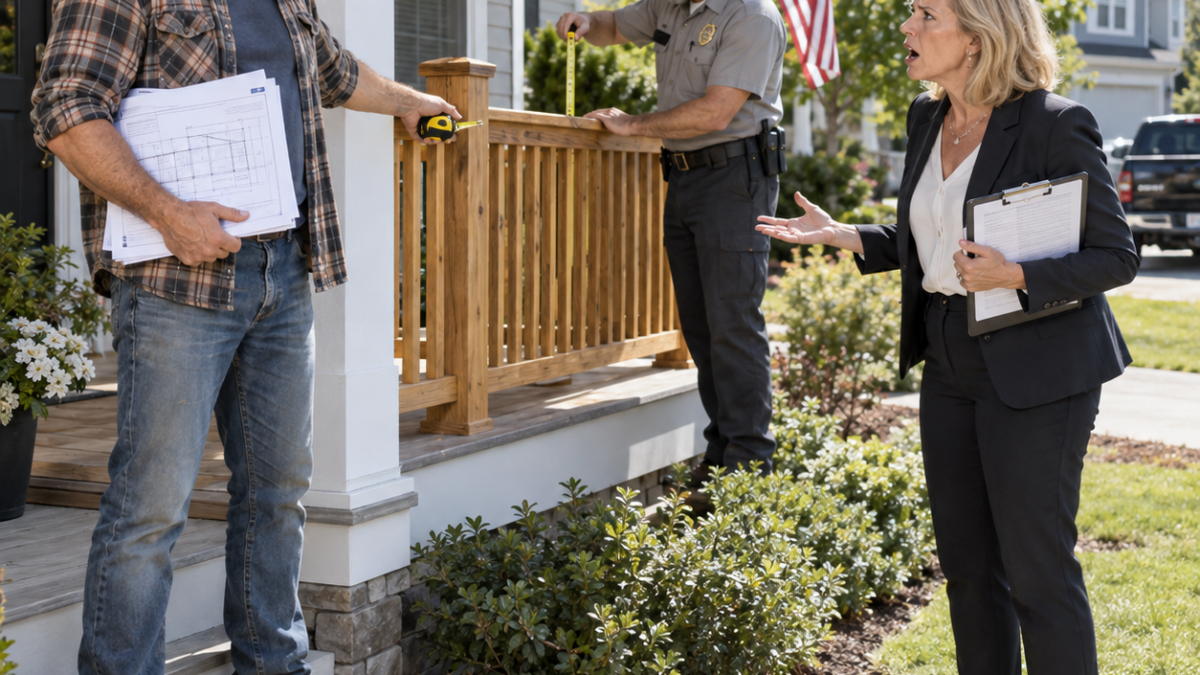
The HOA president stood on the porch I had rebuilt with my own hands, slapped an $1,800 fine against my chest, and told me my new railings violated standards I had spent three weekends following down to the quarter inch.
When I calmly told her I had measured every board, screw, baluster, and rail height against the association’s own written specifications, she smiled and said the rules were only “guidelines” whenever her committee decided they should mean something else.
I had faced officers, contractors, and problems far more dangerous than a suburban HOA president with a clipboard, but the look on her face told me this fight was never really going to be about wood.
“That’ll be eighteen hundred dollars, Mr. Davies.”
Karen Miller tapped the violation notice with one manicured finger.
“And if you don’t resolve it within thirty days, additional penalties can be assessed.”
I looked from the paper to the railing beneath her hand.
Pressure-treated pine.
Thirty-eight inches from porch floor to top rail.
Balusters spaced three and three-quarter inches apart.
Galvanized exterior screws.
Every measurement was deliberate because that was how I built things.
After twenty-seven years in the Army Corps of Engineers, retiring as a sergeant major had not magically taught me how to eyeball a project and hope for the best.
My wife, Sarah, sometimes joked that I could turn replacing a shelf into an engineering exercise.
She wasn’t wrong.
Six months earlier, we had moved into Oak Creek Estates because I wanted something I had spent most of my adult life missing: permanence.
A garage for my tools.
A quiet yard.
A decent school district for our fifteen-year-old daughter, Lily.
A place Sarah could finally unpack a box without wondering when she would have to pack it again.
Then Lily leaned against the original porch railing one afternoon and nearly went backward with it.
The wood was rotten around two posts, the fasteners were rusted, and an entire section moved when I put weight on it.
Sarah looked at me.
“That goes.”
“Yes, ma’am.”
Before buying lumber, I downloaded Oak Creek’s covenants.
All one hundred fifty pages.
Article Four, Section Three, Subsection B covered porch and deck railings.
It was unusually specific.
Pressure-treated pine, cedar, or approved composite.
Vertical balusters no more than four inches apart.
Top rail between thirty-six and forty-two inches high.
I followed it exactly.
Now Karen was telling me I had violated Article Seven for “unapproved materials and design.”
I opened the envelope.
Fine: $1,500.
Administrative processing fee: $300.
Total: $1,800.
“For what material?” I asked.
She crossed her arms.
“The Architectural Review Committee found the structure inconsistent with the premium appearance of Oak Creek.”
“Which part?”
“The overall design.”
“That isn’t an answer.”
Her mouth tightened.
“The committee does not have to debate its architectural judgment on a homeowner’s front porch.”
“Then give me the section I violated.”
“I just did.”
“No, you gave me a conclusion.”
For the first time, her smile slipped.
Karen liked residents frustrated.
She did not like them precise.
I folded the notice and put it back into the envelope.
“Thank you for bringing this to my attention.”
She blinked.
That clearly wasn’t the reaction she wanted.
“You have thirty days.”
“I heard you.”
She descended the steps and walked toward the sidewalk with the satisfied posture of someone who believed she had just won.
I went inside.
Sarah was standing in the kitchen.
“How bad?”
“Eighteen hundred.”
Her eyes widened.
“For the railing?”
“Apparently.”
I pulled my covenant binder from the bookshelf and opened directly to the marked section.
Sarah read it.
Then looked through the front window.
“But you did exactly that.”
“I know.”
“So what does she want?”
That was the question.
Not what rule had I broken.
What did Karen want?
I spent the rest of the evening documenting everything.
Photographs of the lumber stamp.
A tape measure showing the thirty-eight-inch rail height.
Another proving the baluster spacing.
Close-ups of the galvanized fasteners.
Receipts.
The product label from the lumber yard.
Then I built a side-by-side report comparing every requirement with my finished railing.
The next morning, I emailed it to the HOA and formally requested that the fine be withdrawn.
Three days passed.
Nothing.
I sent a follow-up.
Nothing.
Then, on the fourth morning, I found Karen walking past my house and stepped onto the sidewalk holding the printed report.
“I’ve been trying to get this to the board.”
She didn’t take it.
“The committee has already ruled.”
“The railing matches your covenant exactly.”
Karen gave me a patient smile that irritated me more than shouting would have.
“Mr. Davies, the covenant is a guideline.”
I stared at her.
She continued.
“The Architectural Review Committee has final interpretive authority when maintaining aesthetic harmony.”
And with that one sentence, Karen Miller finally told me what kind of fight I was actually in.
PART 2
I kept the binder extended between us for another second.
Then I pulled it back.
“So the written requirements don’t control?”
Karen sighed as though explaining arithmetic to a stubborn child.
“You’re trying to reduce architectural review to numbers and measurements.”
“It is numbers and measurements when the covenant gives numbers and measurements.”
“You’re being deliberately difficult.”
“No. I’m being literal.”
“That’s exactly the problem.”
I almost smiled.
For a woman whose entire authority supposedly came from enforcing written rules, Karen had just admitted she considered those rules optional when they interfered with her preferences.
I shifted the binder under my arm.
“Thank you.”
Her forehead wrinkled.
“For what?”
“Clarifying the board’s position.”
“I didn’t clarify anything.”
“You did.”
I turned toward my house.
“Mr. Davies.”
I stopped.
“If you’re planning to make this confrontational, I strongly suggest you reconsider. People who work with the association usually find things much easier.”
I looked back at her.
“And people who don’t?”
Her lips pressed into a thin line.
“There are procedures.”
“I’m sure there are.”
Then I walked away.
I could feel her staring at my back.
Inside, Sarah was pouring coffee.
“How’d that go?”
“She said the covenant is a guideline.”
Sarah stopped pouring.
“She said that?”
“Almost word for word.”
“What does that even mean?”
“It means she thinks her committee outranks the document that created the committee.”
Sarah handed me the mug.
“Can she do that?”
“No.”
“You sound pretty sure.”
“I’m pretty sure gravity still works too.”
She gave me the look spouses reserve for moments when sarcasm is technically accurate but not especially helpful.
“Eli.”
“I’ll verify.”
That afternoon, I did something I should have done much earlier.
I started talking to neighbors.
Not campaigning.
Not accusing anybody of corruption.
Just asking questions.
Bill Hemlock lived next door.
He was sixty-eight, retired from a regional paper company, and had the kind of yard that looked maintained without looking terrified.
Rows of hostas.
Tomatoes behind the garage.
Three raised flower beds.
He was spreading mulch when I walked over.
“Bill.”
He leaned on the rake.
“Eli.”
“You ever have trouble with the architectural committee?”
His expression answered before his mouth did.
“What’d she get you for?”
“My railing.”
He laughed once.
Not because it was funny.
“Of course she did.”
“What happened with you?”
He kicked at the mulch.
“This.”
I looked down.
“What about it?”
“Too red.”
I thought I had misheard him.
“Your mulch is too red?”
“Apparently.”
“It’s brown.”
“Tell her.”
He walked to his garage and returned holding a folded notice.
Two hundred dollars.
Violation: unapproved landscaping color inconsistent with natural earth-tone standard.
I read it twice.
“What standard?”
“Exactly.”
“You appeal?”
“At first.”
“What happened?”
“Got told the landscaping committee has discretion.”
“Who’s on that committee?”
He looked at me.
“Karen.”
“Anybody else?”
“Depends who you ask.”
That was my first real clue that my railing was part of something bigger.
A few houses farther down lived Daniel and Maria Garcia with their two children.
I had waved to them plenty of times but never had a real conversation.
When I mentioned the HOA, Maria laughed without humor.
“Our swing set.”
“What about it?”
“Five hundred dollars.”
Daniel pointed into the backyard.
A brightly colored swing set sat near the far fence, where the ground dipped and stayed damp after rain.
“It used to be over there.”
He pointed toward a flatter patch closer to the house.
“Karen said it was visible from the street.”
“Is that prohibited?”
“No.”
Maria disappeared inside and came back with their notice.
I read the cited covenant provision.
It concerned sheds and permanent accessory structures.
Not children’s play equipment.
“You challenged this?”
“For three weeks,” Daniel said. “Then the fines started increasing.”
Maria folded her arms.
“Our attorney would’ve cost more than moving the thing.”
“So we moved it,” Daniel said. “Now that corner floods every spring.”
Their daughter, maybe seven, was sitting on one of the swings pushing herself gently with her shoes.
The ground beneath her was soft enough to leave grooves.
I felt something settle inside me.
I knew this pattern.
Not from HOAs.
From organizations.
Rules become dangerous when the person enforcing them learns most people will pay for peace.
Two hundred dollars is cheaper than hiring counsel.
Five hundred dollars is cheaper than losing sleep.
Eighteen hundred dollars might still be cheaper than months of conflict.
Karen understood the arithmetic.
She just didn’t understand me.
Not because I was tougher.
Not because I had been in the Army.
Because after twenty-seven years in engineering units, I had developed an unhealthy tolerance for documentation.
Give me a badly administered system, contradictory directives, three binders of policy, and a person insisting the paperwork didn’t matter, and I became strangely comfortable.
The next letter arrived eleven days later.
Sarah found it first.
She placed it on the kitchen counter without opening it.
“Certified.”
I signed the card.
Inside was an updated demand.
The original $1,800 remained.
A $100 delinquency penalty had been added.
Then came the sentence that made Sarah sit down.
**Failure to remit payment may result in collection action including the recording of a lien against the property.**
“A lien?” she said.
“They’re threatening one.”
“Can they?”
“HOAs can have collection powers.”
“That’s not what I asked.”
I looked at her.
She was genuinely frightened.
Sarah had spent years carrying the parts of our family life I had missed.
Parent-teacher conferences.
Broken appliances.
Fevers.
Deployments.
Moves.
My absences had required her to become good at handling uncertainty.
But this house was supposed to be different.
We had bought it outright enough in our minds that even the mortgage felt temporary.
It was our fixed point.
Now a neighborhood committee was threatening the title because of a railing built exactly to specification.
“Maybe we should pay it,” she said.
I leaned against the counter.
“You think we should?”
“I think I don’t want to lie awake wondering whether some stupid neighborhood fight is going to affect our house.”
I understood that.
That was the problem.
Karen’s power came from making compliance less painful than resistance.
Sarah rubbed her forehead.
“Paint it if that’s what she wants.”
“She hasn’t asked me to paint it.”
“Then replace the wood.”
“She hasn’t told me what wood she wants.”
“Then ask her.”
“I did.”
Sarah looked at me.
I softened my voice.
“I know what you’re saying.”
“Do you?”
“Yes.”
“Because sometimes your idea of solving a problem is preparing for a siege.”
That stung because it was true.
“You’ve been home six months, Eli. Six months. Lily finally likes her school. I finally know where the Christmas decorations are. I don’t want this place turning into another battle map.”
I sat across from her.
For a few seconds, neither of us spoke.
Then I reached for her hand.
“I don’t either.”
“Then what are we doing?”
“We’re making sure the people who run this place follow the same rules they expect us to follow.”
Sarah looked toward the window.
The railing was visible through the front glass.
“You know what scares me?”
“What?”
“That you’re right.”
I squeezed her fingers.
That night I called Marcus Thorne.
Marcus and I had met in basic training before our careers split.
I stayed in uniform.
He eventually used the GI Bill for law school and built a practice focused on real estate and property disputes.
He answered on the third ring.
“Elias Davies.”
“Marcus.”
“You finally ready to admit Texas barbecue is superior?”
“I’m hanging up.”
“Good hearing from you too.”
“I need legal advice.”
The humor disappeared.
“What happened?”
I walked him through everything.
The railing specifications.
The fine.
Karen calling the covenant a guideline.
The unanswered appeals.
The lien threat.
Marcus stayed quiet until I finished.
Then he said, “You built it exactly as described?”
“I can prove every dimension.”
“Prior approval requirement?”
“That’s one point I want you to check. The general architectural article requires approval for modifications, but the railing provision specifically lists allowed materials and dimensions. I notified them after replacing an unsafe existing railing.”
“Did the notice cite lack of application?”
“No. It says materials and design.”
“Interesting.”
He was typing.
“What state are you in again?”
I told him.
“Send me the whole covenant. Fine notices too.”
“Tonight.”
“And Eli?”
“Yeah?”
“Do not pay anything yet.”
Sarah raised an eyebrow from across the room.
Marcus continued.
“Do not threaten her. Do not send a five-page Sergeant Major special telling everyone what prison they belong in. You document. I’ll handle the legal tone.”
“I never threatened prison.”
“You once wrote a four-page memorandum because a supply sergeant stored extension cords incorrectly.”
“That was a fire hazard.”
“I rest my case.”
For the first time in days, I laughed.
Marcus called back the next evening.
“You’ve got leverage.”
“How much?”
“Enough to make the next move theirs.”
He explained it carefully.
The covenants were not merely inspiration.
They were contractual governing documents.
The board could have discretion where the documents granted discretion.
It could not transform an express standard into whatever Karen personally preferred without process.
If new architectural standards had been properly adopted, there should be records.
Minutes.
Notices.
Rules.
Votes.
Some trail proving they existed.
“If the committee says knotty pine is suddenly forbidden,” Marcus said, “then we ask where that standard came from.”
“And if there is no standard?”
“Then we ask why they fined you.”
“What about the lien threat?”
“That’s why we respond formally.”
The letter went out two days later.
Certified mail.
Return receipt.
It demanded withdrawal of the railing fine.
It cited the exact covenant provisions.
It disputed the claimed violation.
It requested all Architectural Review Committee minutes concerning my property.
Then Marcus added something I hadn’t thought of.
Records for the previous twenty-four months concerning architectural fines and the handling of those fines.
“Why two years?”
“Because bad process leaves patterns.”
The board received it on Thursday.
Karen signed the receipt herself.
For eight days, silence.
Then an email appeared.
**The Board of Directors will hear your appeal regarding Violation 734 on Tuesday at 7:00 p.m.**
Sarah read it over my shoulder.
“You going?”
“Yes.”
“You want me there?”
I thought about that.
“No.”
She looked offended.
“Why not?”
“Because I need you outside this one.”
“Eli.”
“If they decide to perform, I don’t want them turning you into part of the performance.”
Sarah crossed her arms.
“You know I survived three deployments without you.”
“I know.”
“And raised your daughter.”
“Our daughter.”
“Debatable during middle school.”
I smiled.
She didn’t.
“Don’t protect me by excluding me.”
Fair.
“Come if you want.”
“I don’t.”
That caught me off guard.
“I just wanted you to stop deciding for me.”
Then she kissed my cheek.
“Go win your little railing trial.”
The clubhouse meeting room smelled like stale coffee and floor cleaner.
Karen sat in the middle of a folding table with Brenda Lowry and Janice Gable on either side.
I recognized them from neighborhood events.
Arthur Penright, the treasurer, sat at the end with a stack of folders.
He looked like a man who had accidentally attended the wrong funeral.
Karen glanced at the projector case in my hand.
“What is that?”
“A projector.”
“I can see that.”
“Then we’re off to a strong start.”
Brenda covered a smile with her hand.
Karen noticed.
Her expression hardened.
“Mr. Davies, you have five minutes.”
“Plenty.”
I set the projector on a small table.
The first image filled the wall.
My railing.
Then the covenant language.
I walked them through it.
Pressure-treated pine.
Compliant.
Thirty-eight-inch height.
Compliant.
Three-and-three-quarter-inch baluster spacing.
Compliant.
Exterior galvanized hardware.
Beyond minimum.
I showed purchase receipts.
Product identification.
Measurements.
Nothing dramatic.
That was intentional.
Karen wanted personality.
I gave her geometry.
After three minutes, I turned off the projector.
“The violation states that my materials and design fail to comply with Oak Creek requirements. The evidence shows they comply exactly. I am requesting that the board withdraw the fine.”
Arthur looked at the documents.
Janice whispered to Brenda.
Karen leaned back.
“Your presentation is very thorough.”
“Thank you.”
“Unfortunately, it misses the issue.”
“What issue?”
“The grade and visual quality of the lumber.”
I stared at her.
“The notice doesn’t mention lumber grade.”
“The committee considers the visible knots inconsistent with the premium appearance of Oak Creek.”
I slowly turned toward the wall where the covenant language had just been projected.
“Where is that requirement?”
“The committee has interpretive authority.”
“Where?”
“The bylaws.”
“Then identify the provision.”
Her voice sharpened.
“You are not cross-examining me.”
“No. I’m asking what rule cost me eighteen hundred dollars.”
“We are not required to reduce every aesthetic determination to a checklist.”
“This one already has a checklist.”
I tapped the printed covenant.
“Material. Spacing. Height.”
Karen leaned forward.
“And architecture requires judgment.”
“So you added an unwritten grade requirement?”
“We interpreted existing standards.”
“When?”
“What?”
“When did the Architectural Review Committee meet and adopt that interpretation?”
Her eyes changed.
Small thing.
Most people would have missed it.
Arthur didn’t.
His gaze dropped instantly to the papers in front of him.
“I’d like the meeting minutes,” I said.
Karen recovered.
“Those records are internal.”
“Marcus Thorne disagrees.”
“Who?”
“My attorney.”
The room became very quiet.
Brenda looked at Karen.
Janice stopped taking notes.
Arthur finally looked at me.
Karen’s voice cooled.
“Is that supposed to intimidate this board?”
“No.”
I gathered my papers.
“It’s supposed to tell you the next letter won’t be coming from me.”
“The appeal is denied.”
“Then put that in writing too.”
I packed the projector.
When I reached the door, I heard a chair scrape behind me.
Arthur followed me into the hallway.
“Mr. Davies.”
I turned.
He glanced back toward the meeting room.
“You should be careful.”
“Why?”
“Karen doesn’t respond well to challenges.”
“I’ve noticed.”
“No, I mean—”
He stopped.
“What?”
He looked toward the closed clubhouse door.
Then back at me.
“I shouldn’t have said anything.”
“Arthur.”
He stepped closer.
“There are things you don’t understand.”
“Then help me understand them.”
His face tightened.
He shook his head.
“I can’t.”
He walked back into the room.
I stood alone in the hallway.
For the first time, the railing felt like the least interesting part of the problem.
The next morning, Karen’s written denial arrived electronically.
Same language.
Aesthetic inconsistency.
Committee discretion.
Final determination.
No minutes.
No supporting standard.
Marcus read it.
“She doubled down.”
“Yes.”
“Good.”
“You say that a lot.”
“Bad decisions are excellent evidence.”
We sent another formal records request.
Then I did something Marcus did not love.
I created a one-page flyer.
No accusations.
No words like fraud.
No insults.
Just facts.
**Are you satisfied with our HOA?**
It described my railing dispute.
Mentioned that several homeowners had raised questions about fines.
Provided an email address for anyone who wanted to share documentation.
I showed it to Marcus before distributing it.
He called.
“This is annoyingly responsible.”
“Thank you.”
“I was hoping you’d write something defamatory so I could yell at you.”
“Next time.”
Bill and Daniel helped me distribute the flyers.
We did not put them in mailboxes.
We slipped them under doors or welcome mats.
Then we waited.
The first day, nothing.
The second morning, an email arrived from a woman named Claire Morrison.
She attached a violation notice.
One hundred fifty dollars for a garden hose caddy that was allegedly the wrong shade of beige.
I searched the covenant.
No such standard.
By noon, another message.
A family had been ordered to remove a small decorative welcome flag.
That evening, three more.
Improper Christmas-light color.
Window-box flowers too bright.
Trash bin visible seven minutes beyond the approved retrieval window.
By the end of the week, the inbox had become a flood.
Sarah sat beside me at the dining room table while I built a spreadsheet.
Name.
Address.
Violation.
Fine.
Date.
Covenant section cited.
Actual covenant language.
Her skepticism vanished slowly.
She opened one attachment.
“Blue Christmas lights?”
“Apparently dangerous to civilization.”
“Eli.”
“Sorry.”
She opened another.
“Petunias?”
“Too vibrant.”
“That isn’t a thing.”
“I know.”
Then came the satellite dish case.
One thousand dollars.
The homeowner had repeatedly challenged the HOA, citing federal protections for certain reception devices.
The committee kept fining him anyway.
Sarah pushed back from the table.
“How many people?”
“Thirty-six households so far.”
“How much?”
I summed the reported fines.
Then stared at the number.
“Over fifty thousand.”
Sarah leaned closer.
“That can’t be right.”
“I’ll recalculate.”
I did.
$52,750 documented.
Not all paid.
Some reduced.
Some disputed.
But assessed.
Sarah looked at the annual HOA budget on the table.
“Fine revenue says three thousand.”
I looked at her.
She looked at me.
Neither of us said the word.
We did not know enough.
Maybe fines were booked elsewhere.
Maybe many had been canceled.
Maybe reporting practices were terrible.
There were innocent explanations.
But suddenly Arthur’s warning at the clubhouse sounded different.
I called Marcus.
He listened.
“Do not accuse anyone of stealing.”
“I wasn’t going to.”
“Yes, you were.”
“I was going to ask where the money went.”
“Ask. Don’t answer.”
“What do we request?”
“Actual financial records.”
Another certified letter went out.
This one requested access to association financial records under applicable state law and the governing documents.
Bank statements.
Fine ledgers.
Check registers.
Records showing deposits and disposition of fines.
We copied every homeowner who had given permission.
Karen now knew I was not standing alone.
Her answer came from an attorney.
The letter accused me of harassing volunteers.
It called the alliance disruptive.
It claimed detailed financial records were confidential.
Attached were redacted account statements so heavily blacked out they looked like documents from a spy movie.
Marcus called me.
“She didn’t give us records.”
“She gave us modern art.”
“Keep it.”
“What next?”
“We use the formal remedies available. And we stay boring.”
“Boring?”
“Boring wins.”
Karen apparently had a different strategy.
At 6:41 on a Thursday morning, I woke to the beeping of a truck backing up.
I walked to the bedroom window.
A tow truck was angled across my driveway.
Its lift was positioned behind my 1998 Ford F-150.
Karen stood on the sidewalk.
For one second, I genuinely wondered whether I was still asleep.
Then the tow operator crouched behind my truck.
I was downstairs before he had the chain in place.
“Stop.”
The man looked up.
Karen turned toward me.
She smiled.
“Good morning, Mr. Davies.”
“What is this?”
“Enforcement.”
The tow operator stood.
“HOA says commercial vehicle.”
I looked at my truck.
Metallic blue.
No company logo.
No ladder rack.
No commercial plate.
Nothing.
“My truck is personally registered.”
Karen lifted her clipboard.
“Article Nine prohibits commercial vehicles from remaining in residential driveways overnight.”
“It isn’t commercial.”
“The committee determined otherwise.”
“Based on what?”
“It has the appearance of a work vehicle.”
I stared at her.
“You’re towing my truck because it looks like work?”
“It is inconsistent with residential character.”
The driver looked from Karen to me.
“Ma’am, you got authorization paperwork?”
“She has the HOA request.”
I stepped between the driver and the truck.
“Do not touch my vehicle.”
He raised both hands.
“Hey, man, I’m just doing the call.”
“Then verify the call is lawful.”
Karen stepped closer.
“He is obstructing an association enforcement action.”
I pulled out my phone.
Karen’s expression shifted.
“What are you doing?”
“Calling the sheriff.”
“For what?”
“An attempted unauthorized removal of my vehicle.”
“Oh, please.”
I dialed.
The dispatcher answered.
I gave my address.
Explained the situation.
Used no dramatic language.
Private vehicle.
Private driveway.
No repossession.
No police order.
HOA representative directing a tow.
The driver began unhooking before the deputy arrived.
Karen snapped at him.
“What are you doing?”
“I don’t tow disputed private vehicles when the owner is standing here calling cops.”
“You were hired.”
“Then hire somebody else.”
He stood beside his truck.
Five minutes later, a county patrol vehicle pulled up.
Deputy Aaron Cole stepped out.
Mid-thirties.
Calm face.
Hands away from his weapon.
“What’s going on?”
Karen immediately approached him.
“Officer, thank goodness. This homeowner is obstructing lawful covenant enforcement.”
Cole looked at me.
“Sir?”
I handed him my registration.
“My truck is personally registered. The HOA is trying to tow it as a commercial vehicle because Mrs. Miller believes it looks commercial.”
Cole read the registration.
Then looked at the F-150.
“Business markings?”
“No.”
“Commercial registration?”
“No.”
“Used as part of a business?”
“No.”
He turned to Karen.
“Ma’am, why are you classifying this as commercial?”
“It is obviously a work truck.”
Cole looked at it again.
“It’s an F-150.”
“It’s large.”
“So are a lot of pickups.”
Karen’s cheeks colored.
“Our covenants—”
“Your covenants are a civil matter. They don’t automatically authorize seizure of a vehicle from private property.”
“He is in violation.”
“Then use whatever lawful civil process your association has.”
Her voice rose.
“We have towing authority.”
“Maybe in some circumstances. I’m telling you I’m not seeing a basis to take this vehicle right now.”
The tow operator nodded vigorously.
“Works for me.”
Karen turned on him.
“I hired you.”
“And I’m leaving.”
He climbed into the cab.
The truck rolled away.
Karen stood on the sidewalk while neighbors emerged from houses.
Doors opened.
Curtains moved.
A dog walker stopped across the street.
Cole handed me my registration.
“Keep documentation of what happened.”
“I will.”
Then he looked at Karen.
“Ma’am, do not escalate this physically. If there’s a dispute over HOA authority, resolve it through counsel or court.”
Karen’s face was rigid.
“This community has rules.”
“So does the rest of the county.”
He returned to his cruiser.
When he drove away, Karen and I stood facing each other.
“You called the police on me.”
“You tried to take my truck.”
“I tried to enforce the covenant.”
“You invented a definition.”
“You are poisoning this community.”
“No.”
I looked toward the houses.
“You’re finally making people compare notes.”
Something flickered in her expression.
Fear.
Not of me.
Of the neighbors watching.
She turned and walked away.
The failed tow changed everything.
Before that morning, some residents still believed the railing dispute was personality conflict.
Maybe Karen and I simply disliked each other.
Maybe I was too stubborn.
Maybe she was too strict.
A tow truck in a man’s driveway at dawn was harder to explain away.
By lunch, the alliance email had twelve new messages.
By evening, nineteen.
People began signing statements.
Not rumors.
Documents.
Dates.
Fine notices.
Payment records.
Emails.
We reviewed the bylaws.
Twenty-five percent of homeowners could demand a special membership meeting.
Oak Creek had two hundred homes.
We needed fifty signatures.
Within three days, we had seventy-eight.
By the next weekend, one hundred twelve.
The petition cited four categories.
Arbitrary enforcement.
Failure to provide records.
Potential financial mismanagement requiring independent review.
Loss of confidence in Karen, Brenda, and Janice.
I personally delivered the petition to the association’s registered agent.
The meeting was scheduled for twenty-six days later.
Karen spent those twenty-six days fighting for survival.
She sent newsletters accusing “a small group of disgruntled residents” of destabilizing the neighborhood.
She claimed our allegations were false.
She said property values could suffer if board authority was undermined.
She even organized what she called a Community Standards Forum.
Eleven people attended.
Three were board members.
One was Arthur.
Bill went out of curiosity.
He came back laughing.
“She spent forty minutes talking about civilization.”
“Civilization?”
“Apparently it collapses when mulch gets too red.”
Sarah laughed so hard she had to sit down.
But underneath the absurdity, pressure was building.
Arthur stopped answering messages.
Then, one night, he came to my house.
Alone.
I opened the door.
“Arthur?”
“Can we talk?”
Sarah was in the living room.
He looked uncomfortable.
“Privately?”
We went into the garage.
He stood beside my workbench staring at the tools.
“I’ve been treasurer three years.”
“I know.”
“I should’ve resigned.”
I waited.
He rubbed his hands together.
“Karen handles the fines.”
“What does that mean?”
“She collects them.”
“Where are they deposited?”
He looked at the garage door.
“Arthur.”
“There’s another account.”
My body went still.
“What account?”
“She calls it the community enhancement fund.”
“Is it in the HOA’s name?”
“I think so.”
“You think?”
“She opened it.”
“As president?”
“I signed paperwork.”
“Why?”
“She said it was easier to keep discretionary money separate from operating expenses.”
“Did the board approve it?”
“Not formally.”
“Do you receive statements?”
“No.”
“Who does?”
“Karen.”
“Who can spend from it?”
He swallowed.
“I don’t know.”
I stared at him.
“You’re the treasurer.”
“I know.”
“How much money goes through it?”
“I don’t know.”
“Arthur.”
“I don’t know.”
His voice cracked.
I lowered mine.
“Why are you telling me now?”
“Because tonight she asked me to sign something.”
“What?”
“A statement saying all fine revenue has always been accounted for through the main financial reports.”
“Is that true?”
“No.”
There it was.
Not proof of theft.
Not yet.
But proof the financial picture was not what residents had been told.
“Do you have documents?”
Arthur reached inside his jacket.
He handed me a photocopy of an old bank authorization form.
The heading carried the association’s name.
Secondary deposit account.
Two authorized signers.
Karen Miller.
Arthur Penright.
I looked at him.
“You signed this.”
“Yes.”
“Did you ever use it?”
“No.”
“Did you ever review it?”
“No.”
“Then why sign?”
He looked ashamed.
“Because she told me it was routine.”
I wanted to be furious with him.
Instead, I saw what Karen had built.
Not a conspiracy of brilliant criminals.
A structure made of habit.
Deference.
People avoiding conflict.
One person making decisions while others nodded.
“Will you say this at the special meeting?”
His face went pale.
“I don’t know.”
“Then why come here?”
“Because I needed someone else to know.”
I copied the document.
Then I handed it back.
“Marcus needs to see this.”
Arthur flinched.
“Is this criminal?”
“I don’t know.”
That was the truth.
“And until somebody qualified examines the records, neither do you.”
He nodded.
As he reached the garage door, I called his name.
He turned.
“If Karen asks whether you spoke to me, what are you going to say?”
He looked miserable.
“I’m tired of lying.”
Then he left.
The night before the special meeting, Sarah found me sitting alone at the dining room table.
The railing fine was beside the petition.
Arthur’s account authorization was underneath it.
She sat across from me.
“You nervous?”
“Yes.”
That surprised her.
“You never say yes.”
“You asked a direct question.”
“What are you nervous about?”
“Being wrong.”
She frowned.
“You’re not wrong about the railing.”
“No.”
“Or the fines.”
“No.”
“Or the account.”
“We don’t know what the account means yet.”
Sarah leaned back.
“You’ve spent a month telling everybody not to jump to conclusions.”
“Because conclusions are where people get reckless.”
“And?”
“And tomorrow two hundred homeowners may decide whether to remove three people because I started asking questions.”
“You didn’t invent the answers.”
“I know.”
She reached across the table.
“You also didn’t make Karen send a tow truck.”
“No.”
“You didn’t make her refuse records.”
“No.”
“You didn’t make Arthur sign that account form.”
“No.”
“Then stop carrying responsibility for choices other adults made.”
I looked at her.
“You rehearse that?”
“Twenty-seven years married to you.”
“Twenty-six.”
“Feels longer.”
I smiled.
She squeezed my hand.
“Come home tomorrow night, Eli.”
“I live here.”
“You know what I mean.”
I did.
She did not want the Sergeant Major returning from a mission.
She wanted her husband.
The clubhouse could not hold the crowd.
People stood along the walls.
The hallway filled.
Some residents brought folding chairs from home.
Karen sat at the front table with Brenda and Janice.
Arthur sat at the end.
His face looked gray.
Marcus stood near the back wall.
Not as my mouthpiece.
As counsel observing.
The petition designated me to present the reasons for the meeting.
Karen struck the gavel.
“I intend to begin with a statement.”
Groans rolled through the room.
She raised her voice.
“For years this board has worked tirelessly to protect Oak Creek from declining standards and falling property values.”
Someone shouted, “And blue Christmas lights.”
Laughter erupted.
Karen hit the gavel.
“This behavior proves exactly why strong governance is required.”
I waited.
Let her talk.
Marcus had told me the same thing three times.
**Never interrupt somebody who is volunteering evidence about their temperament.**
Karen continued for nine minutes.
She accused the alliance of spreading misinformation.
She described me as an outsider who had lived there only six months.
That line hurt her.
People muttered.
She finally surrendered the floor.
I walked to the projector.
The first slide showed my railing.
“This is where I started.”
A few people laughed softly.
I showed the rule.
Then the measurements.
Pressure-treated pine.
Thirty-eight inches.
Three-and-three-quarter-inch spacing.
I displayed Karen’s violation.
Then the appeal denial.
Then the written assertion of architectural discretion.
No theatrics.
Just comparison.
Next came Bill’s mulch.
Two hundred dollars.
No supporting rule.
Then the Garcia swing set.
Five hundred.
No supporting rule.
Garden hose caddy.
Welcome flag.
Christmas lights.
Petunias.
Satellite dish.
One by one.
Each time, I displayed the claimed violation beside the actual covenant language.
Karen interrupted on the sixth example.
“You’re cherry-picking.”
I looked at her.
“Then the records you refused to produce can correct me.”
The room reacted.
She gripped the gavel.
I clicked to the spreadsheet.
“Based solely on documentation voluntarily provided by homeowners, we identified $52,750 in fines assessed over roughly two years.”
The number filled the wall.
Whispers spread.
Then I displayed the annual budget.
Fine revenue: $3,000.
A man in the second row stood.
“Where’s the rest?”
Karen struck the gavel.
“This presentation is intentionally deceptive.”
I faced her.
“Then explain the accounting.”
“We are not going to discuss confidential banking information in a public forum.”
“Association finances are not your personal banking information.”
“They are controlled records.”
Marcus shifted slightly against the wall.
Karen noticed him.
Her confidence wavered.
I looked toward Arthur.
This was the moment I had worried about.
He had never promised to speak.
I could present the account authorization without his testimony.
But a photocopied form would raise questions.
I did not want to drag him into something he had not chosen.
“Mr. Penright,” I said, “as treasurer, can you explain how fine revenue is recorded?”
Arthur stared at the table.
Karen turned toward him.
“Arthur, you are not required to participate in this harassment.”
He closed his eyes.
For several seconds, nothing happened.
Then his chair scraped backward.
He stood.
“I can’t explain it.”
Karen exhaled audibly.
“There. Enough.”
Arthur lifted his head.
“No.”
Her face changed.
He looked toward the crowd.
“I can’t explain it because I don’t have the records.”
Silence.
Karen leaned forward.
“Sit down.”
Arthur’s hands trembled.
“I signed paperwork for a second account.”
A woman near the back whispered, “What?”
Arthur continued.
“Karen called it the community enhancement fund.”
“Arthur.”
This time her voice was low.
Dangerous.
He looked at her.
Something in his posture straightened.
“You collected the checks.”
“I said sit down.”
“You said you would handle deposits.”
“Stop talking.”
“You told me the account didn’t need normal reporting because it was discretionary.”
Chaos erupted.
People shouted.
Karen slammed the gavel again and again.
Brenda turned toward Janice.
Janice looked sick.
I did not move.
This was no longer my presentation.
It was their board collapsing in real time.
Karen stood.
“He’s confused.”
Arthur laughed once.
A broken sound.
“I’m the treasurer and you kept me confused on purpose.”
“That’s a lie.”
“I have the authorization form.”
So did I.
I projected it.
Association name.
Secondary account.
Karen Miller.
Arthur Penright.
The room exploded.
“Where’s the money?”
“Show us the statements.”
“How much is in there?”
“Is that our fine money?”
Karen pointed at me.
“This is defamation.”
Marcus finally stepped forward.
He did not raise his voice.
“Mrs. Miller, nobody here should make unsupported accusations about criminal conduct.”
Karen looked almost relieved.
Then he continued.
“But the existence of an undisclosed secondary association account, combined with unresolved discrepancies and restricted records, is more than sufficient reason for members to authorize an independent forensic audit.”
Her relief vanished.
Marcus faced the residents.
“I strongly recommend that any vote tonight focus on governance, access to records, preservation of financial information, and independent review. Let qualified investigators determine whether any criminal conduct occurred.”
That mattered.
He gave the room a lawful direction for its anger.
The recall vote proceeded.
Ballots were counted in front of observers from both sides.
Karen lost overwhelmingly.
So did Brenda.
So did Janice.
When the result was announced, Karen stood without a word.
She picked up the gavel.
For a moment, I thought she might slam it.
Instead, she let it drop onto the table.
It bounced once.
Then rolled onto the floor.
She walked toward the exit.
At the doorway, she turned.
“This community will regret this.”
Nobody answered.
The door closed behind her.
The room stayed quiet for perhaps two seconds.
Then sound returned all at once.
Voices.
Questions.
Relief.
Bill raised his hand.
“I nominate Eli Davies as interim president.”
I stared at him.
“No.”
Laughter.
He grinned.
“Seconded.”
“Bill.”
Maria Garcia stood.
“I second it.”
The laughter turned into applause.
I raised both hands.
“Stop.”
It took time.
“I will serve only through the audit and transition.”
“Deal,” someone shouted.
“No crown.”
More laughter.
“No private account.”
That one produced cheers.
I looked toward Sarah, who had come after all.
She stood against the rear wall.
Arms folded.
Smiling.
The interim board consisted of me, Bill, and Maria.
My first motion was simple.
Suspend collection of disputed architectural fines issued under Karen’s committee pending review.
Second.
Preserve all financial and electronic records.
Third.
Change access controls to the HOA office and banking systems through proper documented procedures.
Fourth.
Hire an independent accountant.
The $1,800 notice remained folded in my pocket.
Bill nodded toward it.
“Do it.”
“Do what?”
“Come on.”
The room joined him.
I pulled out the notice.
For weeks, I had imagined tearing it up.
Funny thing was, now that I finally could, it didn’t feel as important.
I unfolded it.
Smoothed it against the table.
Then tore it once.
Down the middle.
The room erupted.
I tore it again.
And again.
Sarah laughed.
Pieces fell onto the table where Karen’s gavel had been.
It was satisfying.
But it wasn’t justice yet.
Justice was in the locked filing cabinets.
The bank.
The records.
The unanswered question.
Where had the money gone?
Karen began emailing before breakfast the next day.
She declared the vote invalid.
Claimed procedural defects.
Demanded reinstatement.
Threatened defamation suits.
Demanded immediate access to “her” office.
Marcus gave us one approved sentence.
**Your correspondence has been received and forwarded to legal counsel.**
We sent it so many times that Maria saved it as a keyboard shortcut.
Karen hated it.
Her replies grew longer.
Ours remained one sentence.
Meanwhile, we hired Rebecca Albright.
She was a forensic accountant in her early fifties with silver-framed glasses and the unnerving ability to look at a bank statement as though it had personally disappointed her.
We met in the HOA office.
Three filing cabinets.
One old desktop computer.
Stacks of receipts.
Two years of newsletters.
Arthur handed over everything he had.
Rebecca surveyed the room.
“Anybody delete anything?”
“Not since access changed,” I said.
“Before that?”
Arthur stared at the floor.
“I don’t know.”
Rebecca looked at him.
“You’re Arthur?”
“Yes.”
“Treasurer?”
“Yes.”
“You’re going to have an unpleasant week.”
He nodded.
“I deserve one.”
She did not disagree.
Over the next several days, the picture developed.
The secondary account existed.
Fine payments had indeed been deposited there.
So had a few miscellaneous community-event revenues.
The account was associated with the HOA.
But reporting was poor.
Board approval was inconsistent.
Supporting documentation was a mess.
Then Rebecca found the debit-card transactions.
Dinner.
Dinner.
Dinner.
Department store.
Spa.
Restaurant.
County tax office.
She called me at 8:10 on a Tuesday morning.
“Elias, I need the board here.”
“How soon?”
“Now.”
Bill arrived first.
Maria came fifteen minutes later.
Arthur sat with us.
Rebecca placed copies across the table.
“Before anybody says the word embezzlement, I’m telling you what the documents show.”
Good.
Marcus would have loved her.
She pointed.
“Association account.”
Then another.
“Debit card linked to account.”
Then receipts.
“Expenses labeled community or board related.”
She pushed over a department-store receipt.
“Date matches a personal event identified elsewhere in the records.”
Another.
“Spa expenses described as board stress management.”
Bill stared at her.
“Board what?”
“Stress management.”
Maria covered her mouth.
Rebecca continued.
“And this.”
The county tax receipt.
Payee matched Karen Miller’s property account.
Association money.
Personal property tax.
Nobody spoke.
Arthur looked physically ill.
“How much?”
I asked.
“Questionable and unsupported expenditures exceed seventy thousand dollars when we include payments, transfers, stipends, and expenses requiring further review.”
Arthur gripped the arms of his chair.
“I signed the account.”
Rebecca looked at him.
“That is a fact.”
“Am I going to jail?”
“I’m an accountant, not your attorney.”
He looked at me.
I didn’t rescue him.
He had made choices too.
So had Brenda.
So had Janice.
Rebecca found payments to both women described as committee stipends.
The bylaws explicitly made board and committee service unpaid.
Some expenditures might have explanations.
Some might not.
We were past neighborhood politics now.
We turned the records over to law enforcement.
Detective Samuel Miller from the county financial-crimes unit met with us.
When he introduced himself, Bill couldn’t help it.
“Any relation?”
Detective Miller looked confused.
“To Karen.”
“No.”
“Good.”
“Why?”
“You’ll understand.”
For almost two hours, we walked him through the records.
He did not react much.
That was reassuring.
When residents were angry, every receipt felt like a smoking gun.
Detective Miller treated every receipt like a question.
He asked who had authority.
Who signed.
Who benefited.
What records existed.
What statements were made.
Which documents were originals.
Which were copies.
Whether the account was officially associated with the organization.
Whether personal expenses had reimbursements.
Whether board approval existed.
At the end, he closed the binder.
“We’ll review it.”
Bill leaned forward.
“That’s it?”
“That’s the beginning.”
“How long?”
“As long as it takes.”
It was not satisfying.
It was realistic.
We went home.
For three weeks, nothing dramatic happened.
That period tested me more than the confrontation.
Oak Creek wanted instant justice.
People asked what police were doing.
What the district attorney was doing.
Whether Karen had been charged.
Whether money would come back.
I had one answer.
“I don’t know.”
Meanwhile, interim board work was painfully ordinary.
Pool maintenance.
Insurance renewal.
A broken sprinkler head.
Three dead shrubs near the entrance.
Someone kept leaving dog waste near the walking trail.
After a month of revolution, I found myself comparing landscaping bids.
Sarah walked into the dining room one night and saw me surrounded by proposals.
She started laughing.
“What?”
“You overthrew a dictatorship so you could price mulch.”
“Natural earth-tone mulch.”
She laughed harder.
I pointed at her.
“Careful.”
“Fine me.”
“Too soon.”
Lily wandered through.
“Are you HOA president now?”
“Interim.”
“That sounds worse.”
“It is.”
“Can I paint my room black?”
“That’s inside the house.”
“So yes?”
“Ask your mother.”
Sarah immediately stopped laughing.
“Coward.”
The normal moments mattered.
They reminded me why this had started.
Not revenge.
Home.
A month after the recall, Detective Miller called.
“We’re moving forward.”
“With what?”
“I can’t discuss charging decisions yet.”
“Then why call?”
“We need you to preserve access to records exactly as you’ve been doing. Do not contact former board members about the financial investigation.”
“We haven’t.”
“Good.”
Two days later, subpoenas went out.
Bank records.
Merchant records.
Documents.
That was when Karen’s tone changed.
The long threatening emails stopped.
Her attorney contacted ours.
Then Brenda hired separate counsel.
So did Janice.
Arthur already had representation.
The old alliance was breaking apart because self-preservation is stronger than loyalty when documents start arriving.
Brenda spoke first.
Through counsel, she acknowledged receiving stipends.
She claimed Karen told her they were permitted administrative reimbursements.
Janice said essentially the same thing.
Arthur produced emails showing he had questioned the secondary account once, then accepted Karen’s explanation.
None of that made them innocent.
But it made something clear.
Karen had maintained control by separating information.
Brenda knew one piece.
Janice another.
Arthur another.
Homeowners saw almost nothing.
The structure depended on nobody comparing notes.
Which, again, was exactly what had destroyed it.
The morning police came to Karen’s house, I was in my garage replacing a belt on the drill press.
Bill called.
“You outside?”
“In the garage.”
“Come out.”
I stepped into the driveway.
Two police cruisers were parked four houses down.
Detective Miller stood at Karen’s door with another officer.
Neighbors watched from porches.
I did not move closer.
Neither did Bill.
For several minutes, we could see movement behind the front window.
Karen appeared at the door.
She was speaking fast.
Gesturing.
Then she disappeared inside.
When she came back out, her hands were behind her.
Cuffed.
The neighborhood went silent.
Not cinematic silent.
Real silent.
No cheering at first.
No shouting.
Just the uncomfortable sight of someone we all knew being placed in a patrol car.
Karen looked across the street.
Then she saw me.
Her face held anger.
Disbelief.
Something that looked like fear.
For one second, I remembered her standing on my porch with the $1,800 notice.
So certain.
So pleased with herself.
I expected to feel triumph.
I didn’t.
I felt tired.
The cruiser pulled away.
Somewhere behind me, someone clapped twice.
Another person joined.
Then a few more.
It never became a celebration.
It sounded more like release.
Bill stood beside me.
“You okay?”
“Yeah.”
“Thought you’d smile.”
“So did I.”
“You feel sorry for her?”
I thought about that.
“Not enough to want her back.”
He laughed.
Then his expression turned serious.
“Same.”
The criminal case took months.
That frustrated residents.
It also gave Oak Creek time to become something else.
Permanent elections were scheduled.
I did not run for president.
Despite several nominations.
Despite Bill claiming I owed the community because I had “started the revolution.”
“No.”
“Why?”
“I want to build things.”
“You built an opposition movement.”
“I mean things with screws.”
Maria Garcia became president.
Bill joined as vice president.
A retired CPA named Helen Brooks became treasurer.
That was unanimous.
Nobody wanted another casual approach to money.
The new board established dual-signature thresholds.
Monthly bank reconciliations.
Quarterly owner-accessible financial summaries.
Competitive bids for significant contracts.
Written conflict disclosures.
Committee minutes.
Appeal procedures.
And one rule I insisted upon.
If the association cited a homeowner for violating a covenant, the notice had to quote the exact provision.
Not “aesthetic harmony.”
Not “premium character.”
Not “committee discretion.”
The actual words.
If no words supported the violation, there was no violation.
The old fines were reviewed individually.
Some had legitimate bases.
Most of the bizarre architectural penalties did not.
Refund checks went out as money was recovered and the association stabilized its finances.
Bill received his mulch money.
He framed the check before cashing it.
Maria and Daniel got their $500 back.
Their swing set moved to the dry part of the yard.
When I helped Daniel carry it, his daughter stood nearby directing us.
“More left.”
“We’ve moved it left three times.”
“More.”
Daniel whispered, “She’s basically Karen.”
His wife smacked his shoulder.
“Don’t ever say that again.”
The satellite-dish homeowner got his fines reversed.
The petunia woman planted even redder flowers the following spring.
For a few months, Oak Creek overcorrected.
People acted as though any rule was tyranny.
A camper stayed parked in the street for six weeks.
Someone stacked broken appliances beside a garage.
One resident painted his front door fluorescent orange and dared the board to stop him.
Maria called me.
“You created monsters.”
“I created nothing.”
“You’re coming to the meeting.”
“No.”
“Yes.”
At the meeting, I watched democracy discover why rules existed.
The camper owner wanted freedom.
His neighbor wanted to see around it while backing out.
The appliance pile owner wanted time.
Everyone else wanted rats not to move in.
The orange-door homeowner claimed artistic expression.
Bill quietly said, “It does look terrible.”
The room laughed.
Then people negotiated.
Reasonable deadlines.
Clear standards.
Actual votes.
Nobody was fined before being heard.
Nobody’s vehicle was towed at dawn.
It was messier than Karen’s system.
Also healthier.
Around that time, the county prosecutor announced charges tied to misappropriation of association funds.
Karen’s attorney disputed the characterization of some expenses.
There were arguments over intent.
Authorizations.
Reimbursements.
Recordkeeping.
Brenda and Janice cooperated.
Arthur cooperated extensively.
The final outcome was less theatrical than some neighbors wanted.
Karen accepted a plea agreement.
Marcus called me when it became public.
“You sitting down?”
“In the garage.”
“Of course.”
“What happened?”
“Plea.”
“What terms?”
He explained.
Probation.
Restitution.
Financial conditions.
And a prohibition tied to serving in fiduciary positions such as HOA board leadership for the period specified by the court.
The exact consequences reflected the charges and agreement rather than the neighborhood fantasies about twenty-year prison sentences.
“That’s it?” I said.
Marcus paused.
“You disappointed?”
“I don’t know.”
“You wanted prison?”
“No.”
“Then what?”
I looked around the garage.
The original railing plans were still rolled on a shelf.
“I guess after all that, I expected the ending to feel bigger.”
Marcus laughed softly.
“That’s because you spent too much time in uniform. You like ceremonies.”
“I hate ceremonies.”
“You love structure.”
“Different.”
“Justice is usually paperwork, Eli.”
I smiled.
“You’ve been waiting to say that.”
“Months.”
The restitution mattered.
So did the money recovered from the secondary account.
The association refunded unjustified fines as funds became available.
Karen sold her house.
Brenda moved several months later.
Janice stayed longer but eventually relocated too.
Arthur stayed.
That surprised people.
He resigned permanently from any financial role.
For a while, neighbors treated him with suspicion.
Some still do.
But he showed up.
Meeting after meeting.
He apologized publicly.
He answered questions.
Once, Bill asked why he had signed financial paperwork without reviewing anything.
Arthur stood in front of seventy homeowners and said, “Because it was easier to obey someone confident than admit I hadn’t done my job.”
Nobody applauded.
Nobody should have.
But something changed after that.
He had finally said the truth without blaming Karen for every choice he made.
Sarah and I changed too.
The fight exposed something uncomfortable between us.
A few weeks after everything settled, we were sitting on the porch.
She ran her fingers over the top rail.
“You know what bothered me most?”
“Karen?”
“No.”
I turned.
“You.”
“That seems unfair.”
“Let me finish.”
I nodded.
“When that first lien letter arrived, you went into command mode.”
“I was trying to protect us.”
“I know.”
“But?”
“You stopped being scared because being in charge feels better than being scared.”
I opened my mouth.
Then closed it.
She continued.
“I needed you to admit it scared you too.”
“I told you later.”
“Much later.”
She was right.
In the Army, displaying uncertainty could spread uncertainty.
At home, hiding it could create distance.
“I was scared.”
Sarah looked at me.
“I know.”
“No, I mean really scared.”
I stared toward the street.
“When I saw the word lien, I thought about every year we moved. Every apartment. Every temporary house. Every time you made a place feel permanent when I knew we’d leave it. And I thought I’d finally given you one place nobody could take away.”
Sarah’s eyes softened.
“Eli.”
“Then some woman with a clipboard made me feel like I hadn’t.”
She took my hand.
“You didn’t have to win the whole neighborhood for me.”
“I know.”
“Just next time tell me you’re afraid before you form a coalition.”
“Reasonable.”
She smiled.
“Also, if there is a next time, I get veto power over secret email addresses.”
“Technically anonymous.”
“Eli.”
“Understood.”
Lily came through the front door.
“You guys being emotional?”
“No,” I said.
“Yes,” Sarah said.
“Gross.”
She walked away.
The railing weathered naturally over the following year.
The fresh yellow-brown pine softened toward silver-gray.
The knots Karen had found so offensive became less noticeable.
The structure stayed solid.
No wobble.
No rot.
No movement.
Exactly what I had built it to do.
One Saturday morning, I found Bill standing in my driveway staring at it.
“What?”
“You ever think about staining it?”
“Don’t start.”
He laughed.
“Just asking.”
“You’re still using red mulch.”
“Damn right.”
The neighborhood changed in small ways.
Kids left bicycles on porches.
Not indefinitely.
Just normally.
Swing sets were visible.
Nobody died.
People used colored holiday lights.
Civilization survived.
The newsletters became boring.
I came to treasure them.
**Pool filter replacement: $1,240.**
**Entrance lighting repair: $318.**
**Tree trimming: three bids received.**
No speeches.
No declarations about harmony.
No personal warnings disguised as community standards.
Just administration.
Maria once called me after a meeting.
“You know what success looks like?”
“What?”
“Nobody came.”
I laughed.
“That’s your goal now?”
“Absolutely. A boring HOA is a healthy HOA.”
She wasn’t wrong.
About a year after the special meeting, another moving truck appeared outside Karen’s former house.
A young couple moved in with two children.
I watched them carry boxes until the husband wandered over.
He was maybe thirty-five.
University sweatshirt.
Work gloves.
Friendly face.
“Hey.”
“Morning.”
“I’m Dave.”
“Elias Davies.”
We shook hands.
“Your railing looks great.”
I looked down at it.
“It has a history.”
He ran a hand over the top rail.
“Ours is rough. Previous owner let it go. I was thinking of rebuilding.”
“Smart.”
“HOA tough on that stuff?”
I couldn’t help smiling.
“Not anymore.”
He looked uncertain.
“Good?”
“Very.”
I stood.
“Before you buy anything, let me grab you the covenant.”
“You keep one handy?”
“You have no idea.”
I went inside.
The binder was still on the bookshelf.
Tabs.
Highlights.
Notes.
The original violation page had been replaced by a photocopy because I had destroyed the first one at the recall meeting.
Sarah saw me take down the binder.
“What now?”
“New neighbor needs railing specs.”
She stared at me.
“Do not recruit him into anything.”
“I’m giving him construction information.”
“Eli.”
“No coalitions.”
“Promise?”
“I promise.”
I carried the binder outside.
Dave and I sat on the porch.
I showed him Article Four, Section Three, Subsection B.
Pressure-treated pine.
Cedar.
Approved composite.
Baluster spacing.
Rail height.
Same words.
Still there.
He traced the paragraph.
“Pretty straightforward.”
“You’d think.”
He laughed.
“Anything else I should know?”
I looked down the street.
Bill was arguing with his sprinkler.
Maria’s kids were using the swing set.
Someone had red flowers in a window box.
A pickup sat in another driveway.
No tow truck.
No clipboard.
No one patrolling for infractions.
“Take pictures before you start,” I said.
“Why?”
“Good habit.”
He nodded seriously.
“And save receipts.”
“Okay.”
“And if you want help, I have tools.”
“You a contractor?”
“No.”
“What’d you do?”
“Army Corps of Engineers.”
His eyebrows rose.
“That explains this thing.”
He tapped the railing.
“Built like a bunker.”
“That’s the idea.”
He stood and handed back the binder.
“Appreciate it.”
“No problem.”
He started toward his house.
Then stopped.
“Hey, was there really trouble with your railing?”
I looked at the weathered pine under my hand.
“Once.”
“What happened?”
I thought about Karen.
The fine.
Sarah’s fear.
Arthur trembling at the meeting.
The tow truck.
The spreadsheet.
The second bank account.
Police cruisers.
Refund checks.
The first truly boring HOA newsletter.
“People forgot the rules applied to them too.”
Dave waited for more.
I didn’t give him any.
He smiled.
“Guess they remembered.”
“Eventually.”
That evening, Sarah brought two glasses of iced tea onto the porch.
She handed me one and sat beside me.
Sunlight fell through the oak branches in long strips across the lawn.
Down the street, Dave was measuring his own deteriorated railing.
He held the tape measure while his wife wrote numbers on a notepad.
Sarah followed my gaze.
“You going over there?”
“Not unless he asks.”
“Growth.”
“I resent that.”
She leaned back.
For several minutes, we sat without talking.
That was the quiet I had wanted when we moved to Oak Creek.
Not fearful quiet.
Not the silence people keep when they don’t want to attract attention.
Ordinary quiet.
A lawn mower somewhere behind us.
Children shouting two streets over.
A basketball hitting pavement.
Someone’s dog barking twice.
Then stopping.
Sarah touched the railing.
“Still solid.”
“Of course.”
“Thirty-eight inches?”
“Exactly.”
“Three-and-three-quarter-inch baluster spacing?”
“Exactly.”
“Pressure-treated pine?”
I looked at her.
“Are you mocking me?”
“A little.”
She smiled and rested her head against my shoulder.
Across the street, Dave lifted one rotten section from his porch.
His daughter stood nearby holding a box of screws.
He looked over.
“Elias!”
I raised a hand.
“Yeah?”
“You busy?”
Sarah started laughing before I answered.
I set down my tea.
“Apparently.”
I walked across the street carrying my tape measure.
Behind me stood the railing Karen once claimed was worth an $1,800 punishment.
It had become gray with age, smooth where our hands rested, and strong enough that Sarah could lean against it without thinking twice.
That was all I had ever wanted it to be.
Not a weapon.
Not evidence.
Not the beginning of a neighborhood rebellion.
Just part of my home.
And after everything it took to get there, that ordinary purpose felt like the best ending I could have asked for.
[END OF STORY]








