HOA Fined Me $10,000 Over My Propane Tank—Then Their Own Gated Entrance Became the Problem
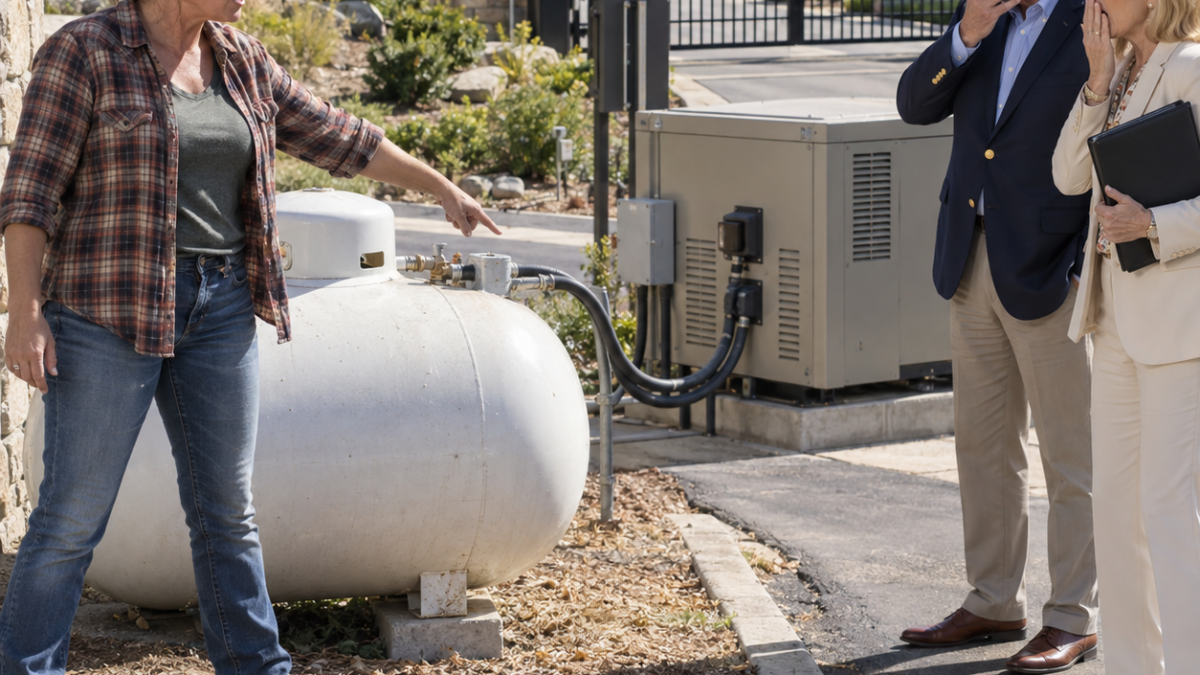
The HOA president stood in front of my eight-year-old son and threatened to fine our family $10,000 unless I removed a propane tank that had been sitting legally beside our house for three years.
She thought the beige steel cylinder was proof that I believed the neighborhood rules didn’t apply to me, and she seemed almost excited about teaching me an expensive lesson.
What she didn’t know was that one old county document connected that tank to something much bigger than my backyard—and I decided not to tell her until she had nowhere left to hide.
“Seven days, Mr. Miller.”
Karen Johnson hugged her clipboard against her chest as if it were a badge.
“After that, the fines begin.”
My son Leo had stopped swinging his T-ball bat.
A few seconds earlier, he’d been laughing every time he knocked the plastic ball across our front lawn.
Now he was staring at Karen.
Then at me.
Then at the propane tank partially hidden behind the lattice fence and arborvitae.
“Dad,” he whispered, “are we in trouble?”
That question changed something in me.
I had spent fifteen years in the Army.
I had dealt with situations where panic could get people hurt, so I learned a long time ago that the loudest person in the room usually wasn’t the one controlling it.
Karen wanted an argument.
She wanted me angry.
She wanted me frightened enough to obey before I started asking questions.
Instead, I knelt beside Leo.
“No, buddy,” I said. “We’re okay.”
Karen gave a short laugh.
“You may want to reconsider telling him that.”
I stood.
She tapped her clipboard.
“The tank is unauthorized, unattractive, and potentially dangerous. The board has determined that it violates community standards.”
“That so?”
“Yes.”
“And you’ve reviewed the approval documents?”
For half a second, something shifted in her face.
Then the confidence returned.
“The board does not need your permission to enforce the bylaws.”
“That wasn’t my question.”
Her mouth tightened.
Behind the curtains of the house across the street, I saw movement.
People were watching.
Karen liked audiences.
“Seven days,” she repeated. “Remove it, or the association will take further action.”
“What kind of action?”
“Daily fines. Removal costs. Legal fees. Possibly a special assessment approaching ten thousand dollars.”
Leo’s fingers tightened around his little bat.
That was the moment this stopped being neighborhood nonsense.
My wife Sarah and I had poured our savings into this house.
We’d chosen Sterling Creek because it backed up to a nature preserve and because, after years of moving wherever the Army told us to move, I wanted one quiet place where my family could finally put down roots.
Karen had just threatened that peace in front of my child.
Still, I didn’t raise my voice.
“I’ve received your position,” I said. “I’ll review the bylaws and respond in writing.”
She blinked.
That wasn’t the reaction she wanted.
“You have seven days.”
“I heard you.”
Karen climbed onto the golf cart she used to patrol Sterling Creek and drove away like she had just won something.
Leo waited until she disappeared around the corner.
“Is she going to take our house?”
My chest tightened.
“No.”
“Promise?”
I looked him in the eyes.
“I promise I’m going to handle it the right way.”
Inside, Sarah had heard enough from the kitchen window to be worried.
“Jack, what was that?”
I told her.
When I reached the $10,000 part, her face changed.
“She can’t just do that.”
“She thinks she can.”
“What are we going to do?”
I walked into my office and opened the bottom drawer of my filing cabinet.
I pulled out one folder labeled HOUSE CONSTRUCTION.
Then another labeled HOA.
Then the county plat map.
Then the easement agreement signed years earlier by the original developer.
Sarah watched me spread the documents across my desk.
“What is all that?”
“Insurance.”
“Against Karen?”
“Against anybody who doesn’t bother reading before threatening us.”
I found the document I wanted.
The paper was several years old, but the county recording stamp was perfectly clear.
I ran my finger down the first page until I reached the paragraph that mattered.
Sarah leaned over my shoulder.
She read it once.
Then again.
Her eyes widened.
“Oh my God.”
I closed the folder.
“Exactly.”
She stared at me.
“Are you going to show Karen?”
“Eventually.”
“Why not now?”
Because Karen had already made one mistake.
I wanted to know how many more she was willing to make when she believed nobody could stop her.
Three days later, the certified letter arrived.
And when I opened it, I realized Karen wasn’t backing down.
She was escalating.
PART 2
The envelope was thick, cream-colored, and unnecessarily formal.
STERLING CREEK HOMEOWNERS ASSOCIATION was printed across the top.
Sarah stood beside me at the kitchen island while I opened it.
Leo was in the living room building a fort out of couch cushions, blissfully unaware that three adults with too much authority and too little curiosity had decided a propane tank was worth turning our life upside down over.
I unfolded the letter.
The opening sentence was exactly what I expected.
FORMAL NOTICE OF VIOLATION.
The board cited a provision restricting unapproved fuel-storage tanks and exterior structures.
According to Karen, our 500-gallon propane tank had never received proper approval.
We had seven days from the original notice to “cure” the violation.
After that, the HOA would assess $100 per day.
If the matter remained unresolved, additional legal action and a special assessment could follow.
The signatures at the bottom belonged to Karen and the two other directors, Gerald Frink and Brenda Wallace.
Sarah read over my shoulder.
“They all signed it?”
“Looks that way.”
“So they actually voted on this?”
“That’s the first question.”
She folded her arms.
“And the second?”
“Whether they bothered checking what they were voting on.”
I took the letter to my office.
Before doing anything else, I photographed the envelope, the certified-mail label, every page of the notice, and the signatures.
Then I scanned the entire thing.
I created a folder on my computer.
I almost called it KAREN.
Instead, because I needed some humor somewhere in the situation, I named it OPERATION PROPANE JUSTICE.
Inside, I created four folders.
CORRESPONDENCE.
FINES.
GOVERNING DOCUMENTS.
TIMELINE.
Sarah appeared in the doorway.
“You’re enjoying the folder names too much.”
“I need a hobby.”
“You have a hobby.”
“Apparently my new hobby is administrative warfare.”
She almost smiled.
Almost.
Then her expression turned serious.
“Jack, I don’t want this becoming your whole life.”
“It won’t.”
“You say that the same way you used to tell me deployments would go fast.”
That stopped me.
Sarah rarely mentioned those years when she was angry.
She didn’t weaponize the past.
If she brought it up, she was scared.
I pushed the keyboard away.
“Come here.”
She sat beside me.
“I know what this house means to you,” she said.
“To us.”
“To Leo, too. That’s why I’m worried.”
I took her hand.
“Karen wants us to believe she can manufacture a debt, slap it on our account, and scare us into doing whatever she says.”
“Can she?”
“Not if we handle this correctly.”
I opened the old folder again.
Inside was the document Sarah had read earlier.
It had been signed before Karen even moved into Sterling Creek.
Years earlier, while our house was still being planned, I had walked the property with the developer, Richard Sterling.
Everyone called him Mr. Sterling.
He was rough around the edges, practical, and more interested in whether drainage worked than whether everybody’s mailbox was the same shade of black.
We had been standing near the northern property line when he pointed downhill toward the subdivision entrance.
The entrance was one of Sterling Creek’s selling points: stone columns, wrought-iron fencing, cameras, an electronic gate, and a small landscaped island that made the place look more expensive than it was.
“What happens during a power outage?” I’d asked.
Mr. Sterling had pointed toward a utility enclosure beside the gate.
“Backup generator.”
“What does it run on?”
“Propane.”
Then he pointed toward my lot.
“Best place for the tank is up here.”
My property sat slightly higher than the rest of the development.
Dry ground.
Easy access for the propane company.
A straightforward downhill line toward the gate.
The arrangement had been formalized through an easement filed with the county.
The HOA would pay for fuel and maintenance.
I would allow the tank and service access on a specific corner of my property.
Everyone benefited.
The tank didn’t heat my home.
It didn’t fuel my grill.
It existed primarily because Sterling Creek’s entrance needed backup power.
That was what Karen had failed to discover before threatening me.
Sarah tapped the document.
“So why not copy this and send it to them?”
“Because I want them to answer some questions first.”
“What questions?”
I opened a blank email.
“Whether they followed their own procedures.”
I addressed the message to all three board members.
I kept it polite.
Painfully polite.
Dear Board Members,
I am in receipt of the violation notice concerning the propane tank located on Lot 42. To allow me to understand the basis of the alleged violation and respond appropriately, please provide the following records…
I requested the minutes of the meeting where my property had been discussed.
Any architectural-review decision regarding the tank.
The version of the governing documents in effect when our home was constructed.
Any record supporting the determination that the tank lacked approval.
I didn’t accuse them.
I didn’t mention the easement.
I didn’t threaten litigation.
I simply asked them to show their work.
Before sending the email, I blind-copied myself.
Sarah watched from the doorway.
“You really aren’t going to tell them.”
“Not yet.”
“Why?”
I turned around.
“Because if this is an honest mistake, they’ll check their records, discover the agreement, apologize, and this ends.”
“And if it isn’t?”
“Then their response will tell us that, too.”
Two days later, we got our answer.
Karen replied from her personal email account.
No documents were attached.
No meeting minutes.
No architectural-review records.
No original approvals.
Just three short paragraphs.
The board’s determination was final.
Internal working materials would not be provided.
The seven-day deadline remained in effect.
Fines would begin as scheduled.
I read the email twice.
Then I saved it.
Sarah looked over my shoulder.
“That seems… bad.”
“For them?”
“For everybody.”
“Mostly them.”
The next morning, at 7:12, an automated email arrived.
HOA VIOLATION FINE — $100.
I printed it.
Day two arrived the next morning.
Another hundred.
Day three.
Another hundred.
By the end of the first week, I had seven invoices.
By the end of the second, fourteen.
Karen apparently believed that numbers growing larger would make me panic.
What they actually did was create a cleaner evidence trail.
Every morning, I downloaded the invoice and added it to the folder.
FINE 001.
FINE 002.
FINE 003.
Sarah started calling the emails “Karen’s daily donation to our legal file.”
It was the first sign she was beginning to believe I had this under control.
Then Karen made the mistake that widened the fight beyond our yard.
I was outside one Saturday morning when I saw Carlos Garcia standing in his driveway staring at a piece of paper taped to his garage door.
Carlos lived four houses down.
He had a wife, Elena, and a twelve-year-old son named Mateo who spent most afternoons shooting baskets in the driveway.
I walked over.
“Everything okay?”
Carlos held up the notice.
“What do you think?”
The HOA had fined him because Mateo’s portable basketball hoop had been left visible overnight.
“What rule?”
Carlos laughed without humor.
“Apparently ‘aesthetic harmony.’”
He read the phrase from the notice.
I shook my head.
“They want you to roll that thing into the garage every night?”
“That’s what it says.”
“How much?”
“Fifty dollars.”
He looked toward his house.
“It’s not even the money. Mateo thinks he did something wrong.”
That bothered me more than I expected.
Maybe because I had seen the same look on Leo’s face when Karen threatened us.
Carlos lowered his voice.
“You’re fighting her, right?”
“I’m disputing a violation.”
“That means yes.”
Before I could answer, he said, “Good.”
A few days later I found Mr. Henderson tending roses.
His name was Walter, but almost everyone called him Mr. Henderson.
He was seventy-eight, quiet, and recently widowed.
His wife had planted most of the rose bushes surrounding his porch.
Mixed among them were four small ceramic garden gnomes.
They weren’t my taste.
But they clearly meant something to him.
Karen had decided they were illegal.
“She says they’re nonconforming decorative objects,” he told me.
“How long have they been there?”
“Twelve years.”
“Did anyone complain before?”
“Not until Karen became president.”
He picked up one of the gnomes and wiped soil from its red hat.
“Margaret bought this one on our twentieth anniversary.”
His voice weakened slightly.
“She thought it looked like me.”
I looked at the ridiculous little ceramic beard.
“She had a point.”
That made him laugh.
Then his eyes turned wet.
“I’m not removing it.”
“You shouldn’t have to.”
The more people I spoke with, the clearer the pattern became.
River rocks.
A child’s slide.
A mailbox color.
A basketball hoop.
Garden decorations.
A porch chair supposedly positioned too close to the walkway.
Individually, the complaints sounded petty.
Together, they looked deliberate.
Karen wasn’t maintaining standards.
She was cultivating fear.
People had stopped asking whether a rule made sense.
They were asking how quickly they had to obey before the next fine arrived.
Then Diane Parker approached me at the mailbox.
Diane had been the HOA treasurer before Karen’s faction took control.
She waited until no one else was near us.
“Jack, can I ask you something?”
“Sure.”
“Have you requested the financial records?”
I looked at her.
“Why?”
She glanced toward Karen’s street.
“When I was treasurer, anything above five hundred dollars required two signatures.”
“And now?”
“Karen pushed through a change.”
“How much authority?”
“Up to five thousand with one signature.”
My attention sharpened.
Diane continued.
“There’s a consulting company being paid for ‘community beautification planning.’”
“How much?”
“Enough that I noticed.”
“Who owns it?”
She hesitated.
“Her brother-in-law.”
That afternoon I went home and drafted a second records request.
This one was not friendly in the conversational sense.
It was formal.
I cited the applicable records-access provisions and requested meeting minutes, contracts, financial statements, budgets, vendor records, and other association documents homeowners were entitled to inspect.
I sent it by certified mail.
Ten business days passed.
On the eleventh, I received a letter from an attorney.
His letter accused me of making an unreasonable and burdensome request.
He offered access to a narrow selection of records at his office for one hour.
I would have to pay $250 for someone to supervise me.
Sarah read the letter.
“They’re charging you to look at records?”
“That’s what they’re trying.”
“So now what?”
“Now I call Marcus.”
She smiled.
“Poor Karen.”
Marcus Thorne and I had served together years earlier.
He had been a military lawyer before opening a private practice focused largely on property, contract, and association disputes.
Marcus didn’t yell.
He didn’t posture.
He was the kind of man who could destroy a bad argument while sounding like he was helping you understand it.
He answered on the third ring.
“Jack Miller.”
“Marcus.”
“This better involve either barbecue or somebody doing something spectacularly stupid.”
“Second one.”
“Excellent.”
I emailed him the folder.
He went quiet while reviewing it.
Eventually he said, “Tell me you have more.”
“I do.”
“How much more?”
“There’s an easement.”
Silence.
“What easement?”
“The propane tank.”
Another silence.
“Jack.”
“Yes?”
“What exactly does this tank serve?”
I told him.
Marcus laughed once.
Not because it was funny.
Because it was unbelievable.
“Oh, this is magnificent.”
“That your legal opinion?”
“No. My legal opinion has longer words.”
I explained the developer agreement.
The county filing.
The gate generator.
The HOA’s obligation to fund fuel and maintenance.
Marcus asked me to send copies.
When he finished reviewing them, his tone changed.
“Do not show Karen yet.”
Sarah, sitting across the room, mouthed, See?
I nodded.
Marcus continued.
“They’ve built their case around the assumption that this is your private tank. Let them establish that position clearly.”
“They already have.”
“I want more.”
“What more?”
“A hearing.”
“You want them to keep fining me?”
“For now.”
Sarah’s eyebrows rose.
I switched the phone to speaker.
Marcus explained.
If the board corrected the mistake immediately, the matter ended.
But if they doubled down publicly after I challenged their process and gave them every opportunity to investigate, they would expose something larger than a simple clerical error.
They would demonstrate reckless governance.
Possibly selective enforcement.
Potential misuse of association funds.
And if Diane’s information was accurate, maybe something worse.
“But first,” Marcus said, “take them up on the document review.”
“The ridiculous $250 one?”
“Especially that one.”
“Why?”
“Because I want a receipt.”
I understood immediately.
Good faith.
A clean record.
Proof that I had followed their process even when they made that process unnecessarily difficult.
A week later, I sat in a small conference room at the HOA attorney’s office with a thin binder and a paralegal who looked deeply offended that I had arrived on time.
“You have sixty minutes.”
“I probably won’t need them.”
She slid the binder toward me.
The meeting minutes were inside.
I found the relevant date.
NEW BUSINESS — COMPLIANCE REVIEW.
Lot 42.
My address.
My propane tank.
According to the minutes, Karen identified the tank as an unauthorized installation.
Brenda moved to issue the violation.
Gerald seconded.
Vote: three to zero.
No architectural-review investigation was mentioned.
No approval-history search.
No county-record search.
No easement review.
No question about why the HOA had apparently been paying propane invoices connected to that exact tank.
I photographed every relevant page.
Then I photographed the signature page.
Then I stood.
The paralegal looked at the clock.
“You have forty-three minutes remaining.”
“I’m finished.”
At reception I requested a receipt for the $250 fee.
Back in my truck, I sent everything to Marcus.
His reply came moments later.
Perfect.
Then he called.
“They documented it.”
“I saw.”
“They relied entirely on Karen’s characterization.”
“Looks that way.”
“Any discussion of permits?”
“No.”
“Utility records?”
“No.”
“Historical approvals?”
“No.”
“The easement?”
“No.”
“Beautiful.”
“You’re enjoying this too much.”
“I enjoy documentation.”
“So what now?”
“Now we wait for Karen to escalate.”
She didn’t disappoint us.
At the thirty-day mark, my HOA account showed nearly $3,000 in daily penalties, accompanied by notice that a much larger assessment could soon be added.
At the same time, Karen intensified enforcement against everyone else.
Carlos received another notice about Mateo’s basketball hoop.
Mr. Henderson received a $500 fine for refusing to remove the gnomes.
The letter threatened that the HOA might send a landscaping contractor onto his property to “remediate” the violation at his expense.
When he showed me the letter, his hands trembled.
That was the night I stopped thinking of this as my problem.
I called Carlos.
“Can you get everyone who’s been fined together?”
“How many?”
“As many as you trust.”
“For what?”
“A meeting.”
“Where?”
“My house. Thursday. Seven thirty.”
Twelve people showed up.
I had expected six.
They crowded into our living room while Sarah put coffee on the dining table.
For nearly an hour, I barely spoke.
I listened.
One family had been fined because their child’s plastic play structure was visible from the road.
Another because they replaced dead shrubs with a different species.
One homeowner had been warned about a work van parked in his driveway even though the documents allowed ordinary passenger vehicles.
Mr. Henderson quietly described Margaret’s gnomes.
Nobody laughed.
When everyone finished, I carried my binder to the dining-room table.
“Karen’s biggest advantage is that everyone thinks they’re fighting her alone.”
The room became quiet.
“You’re not.”
I opened the binder.
I showed them my violation notices.
The daily invoices.
My requests for records.
The board’s refusal.
The attorney’s letter.
The meeting minutes.
Then Diane explained the questionable consulting payments.
Carlos leaned forward.
“Can we sue them?”
“We may not need to.”
He looked confused.
I pulled out the bylaws.
“There’s a provision allowing homeowners to petition for a special meeting.”
“How many signatures?”
“Ten percent of the membership.”
Diane looked around the room.
“We have that here.”
“Exactly.”
Mr. Henderson straightened in his chair.
“What do we ask for?”
“A formal review of recent enforcement actions.”
Carlos smiled slowly.
“In public?”
“In front of everybody.”
The room changed.
Fear became energy.
Not wild anger.
Something better.
Purpose.
We drafted the petition.
Everyone signed.
Mr. Henderson surprised all of us by volunteering to gather additional signatures.
“I know which doors to knock on,” he said.
Carlos looked at him.
“You sure?”
Mr. Henderson picked up his copy of Karen’s letter.
“She threatened to send strangers onto my property to take something my wife gave me.”
His voice was quiet.
“I’m sure.”
Within forty-eight hours, we had more signatures than we needed.
Marcus reviewed the petition and approved.
Then he gave me another instruction.
“Submit your own hearing request separately.”
“Why?”
“Because the petition is the community’s case.”
“And mine?”
“Yours is the trap.”
So I wrote another letter.
I disputed the fines.
I identified the board’s procedural failures.
I documented the records-access dispute.
I asked them to identify the evidence supporting their claim that the tank lacked approval.
Still, I did not mention the easement.
Still, I did not mention the gate.
Still, I did not mention the generator.
I requested a formal hearing.
The board responded a week later.
A special association meeting would be held at the clubhouse.
OPEN FORUM FOR MEMBER GRIEVANCES AND REVIEW OF RECENT COMPLIANCE ACTIONS.
Karen had combined everything into one event.
When Marcus saw the notice, he called.
“She thinks this is her stage.”
“What do we do?”
“Let her have it.”
The night before the meeting, I barely slept.
Not because I feared Karen.
Because I understood what would happen if this went the way Marcus expected.
People would be embarrassed.
Accusations would become public.
The board could collapse.
Money might be missing.
Neighbors who had lived peacefully beside one another for years would have to confront the fact that they had allowed three people to turn their community association into a private enforcement machine.
And somewhere underneath all that was my family.
At two in the morning, I walked downstairs.
Leo’s backpack was hanging beside the kitchen.
Sarah found me standing there.
“You okay?”
“Yeah.”
“You’re lying.”
I smiled.
“Little bit.”
She leaned against the counter.
“You know what Leo told me today?”
“What?”
“He said his dad fixes problems with folders.”
I laughed quietly.
“That’s humiliating.”
“He meant it as a compliment.”
Sarah stepped closer.
“Jack, whatever happens tomorrow, don’t let Karen turn you into her.”
I looked at her.
She continued.
“You’re not doing this to humiliate somebody. You’re doing it so people can live here without being scared.”
“I know.”
“Remember that when she gets angry.”
That sentence stayed with me.
The next afternoon, I made one phone call before leaving for the clubhouse.
A week earlier, I had contacted the local fire marshal’s office.
I had asked a simple question.
If the fuel supply to Sterling Creek’s emergency gate generator were intentionally removed, what would happen?
The answer had gotten the office’s attention.
I provided the documents.
The emergency-access plan.
The easement.
The generator specifications.
The fire marshal agreed to attend the meeting.
Not to take sides in an HOA dispute.
To clarify the public-safety implications if necessary.
At 6:45 that evening, Sarah and I walked into the Sterling Creek clubhouse.
More than fifty residents were already there.
Karen sat at the front between Gerald and Brenda.
She wore a bright red blazer.
A binder sat in front of her.
So did a small wooden gavel.
When I saw the gavel, I almost felt sorry for her.
She really believed this was a courtroom.
Marcus sat beside me in the second row.
No suit.
No briefcase.
Just dark slacks and a polo shirt.
Karen didn’t recognize him.
Perfect.
At seven sharp, she struck the gavel.
“Good evening.”
Conversation died.
“The board has generously agreed to provide members an opportunity to discuss certain concerns.”
Carlos glanced at me.
Generously.
Karen continued.
“Each resident will receive three minutes. The board will listen and make a determination. Decisions tonight will be final.”
There it was.
Her first mistake of the evening.
She had already decided she was there to rule.
Not listen.
Carlos was called first.
He stood before the board.
“My son has a portable basketball hoop.”
Karen looked bored.
Carlos continued.
“I’ve been fined because it remained in the driveway overnight. I’ve read the governing documents. I cannot find a provision requiring homeowners to move portable basketball equipment indoors each evening.”
Karen responded immediately.
“The board has authority to maintain aesthetic harmony.”
“Where does it specifically say the hoop has to be moved nightly?”
“The board has interpreted the standard.”
“So there is no specific rule.”
Karen’s expression hardened.
“The fine stands.”
Carlos nodded.
“Thank you.”
Then he sat down.
No shouting.
No argument.
Exactly as Marcus had instructed.
Mr. Henderson was next.
Watching him walk toward the board hurt more than I expected.
He carried one gnome.
The small one with the red hat.
He placed it gently on the table.
A few people smiled.
Karen did not.
Mr. Henderson clasped his hands behind his back.
“My wife bought this for me.”
Karen sighed.
“Mr. Henderson—”
“Please let me finish.”
Something in his voice stopped her.
“Margaret died seventeen months ago.”
The room went completely still.
“She loved those roses outside our house. Every spring she would put these little fellows among them because she thought gardens should make people smile.”
He looked down at the gnome.
“I know this is just ceramic.”
His voice caught.
“But when I water those roses in the morning and see them, I remember her laughing.”
Several people lowered their eyes.
Mr. Henderson looked at Karen.
“I have been fined five hundred dollars for keeping them.”
Karen’s posture didn’t soften.
“The community rules prohibit nonconforming lawn ornaments.”
“Who decides what is nonconforming?”
“The board.”
“Is there a written standard?”
“The board’s interpretation is sufficient.”
Mr. Henderson nodded slowly.
“So three people can decide that something I’ve had for twelve years suddenly violates a rule.”
“We must maintain standards.”
“Even when nobody complained?”
“We are not required to wait for complaints.”
Mr. Henderson picked up the gnome.
“I see.”
He turned toward his seat.
Karen struck the gavel.
“The fine stands.”
A murmur passed through the clubhouse.
For the next forty minutes, the pattern repeated.
Resident.
Complaint.
Question.
Dismissal.
Fine upheld.
Resident.
Complaint.
Question.
Dismissal.
Fine upheld.
Karen became more confident with every case.
She began interrupting people.
Then correcting them.
Then reminding everyone that board service was “thankless work.”
Gerald said almost nothing.
Brenda nodded whenever Karen spoke.
I watched.
Marcus occasionally made notes.
Finally Karen scanned the room.
“Are there any remaining grievances?”
Her eyes found me.
A smile appeared.
“Ah.”
She glanced toward the audience.
“Mr. Miller.”
I stood.
Karen leaned toward the microphone.
“Our propane gentleman.”
A few people shifted uncomfortably.
“The floor is yours. Three minutes.”
I walked forward with my binder.
I set it on the table.
Then I looked at Karen.
“Three minutes won’t be sufficient.”
“The rule applies to everyone.”
“This is a requested enforcement hearing involving thousands of dollars in fines and a threatened special assessment. I will take the time necessary to present the evidence.”
She stared at me.
Maybe she considered fighting.
Then she glanced around the packed clubhouse.
“Proceed.”
I opened the first tab.
“I’m not going to begin with the propane tank.”
Her smile faded slightly.
“I’m going to begin with how the board handled the allegation.”
I held up my first letter.
“I asked for the meeting record supporting the violation. I asked for the architectural-review decision. I asked for the historical governing documents and any approval records connected to the installation.”
I placed the letter on the table.
“The board provided none of them.”
I held up Karen’s response.
“Instead, I was told that internal documents would not be provided.”
Then the attorney’s letter.
“When I made a formal records request, the association’s attorney restricted my access and required a $250 supervised appointment.”
Karen interrupted.
“We acted on legal advice.”
“That does not change what happened.”
I opened the next tab.
“I attended.”
I placed the receipt on the table.
“I paid.”
Then I displayed the photographed meeting minutes.
“And I found the board’s discussion of my property.”
Gerald leaned forward.
Brenda looked at Karen.
I read aloud.
Karen had identified the tank as unauthorized.
Brenda had moved to issue the violation.
Gerald had seconded.
Three to zero.
“Where,” I asked, “is the architectural review?”
Silence.
“Where is the permit review?”
No answer.
“Where is the examination of historical approval records?”
Karen folded her arms.
“The tank clearly violates current standards.”
“That wasn’t my question.”
“You are deliberately complicating a straightforward enforcement issue.”
“I’m asking what investigation occurred before you began charging my family one hundred dollars per day.”
“We are not required to conduct a criminal investigation to identify an obvious violation.”
I nodded.
“Thank you.”
Her brow furrowed.
She had realized too late that she had just given me exactly what I wanted.
I looked toward Gerald.
“Did you independently review the tank’s history before voting?”
Gerald shifted.
“I relied on the information presented.”
“By Karen?”
“By the president, yes.”
I looked toward Brenda.
“Did you review the installation documents?”
“No.”
“County records?”
“No.”
“Previous approvals?”
She hesitated.
“No.”
Karen slapped her palm against the table.
“This is irrelevant.”
“It is the entire point.”
“No. The point is that you have an unauthorized propane tank.”
Her voice rose.
“You were ordered to remove it.”
“I disputed the order.”
“And you ignored the deadline.”
“I exercised my right to challenge it.”
“You have accumulated nearly three thousand dollars in penalties.”
“Based on a violation you cannot prove.”
“We have already proven it.”
“How?”
“Because the tank exists.”
The room murmured.
Karen’s face reddened.
She looked around.
Then at me.
“The association is done entertaining these tactics.”
I stayed silent.
She continued.
“The tank is prohibited.”
I waited.
“The violation is valid.”
I waited.
“The fines are valid.”
I glanced at Marcus.
He gave the smallest possible nod.
Karen picked up the gavel.
“And if you do not remove that tank, the board will proceed with every remedy available under the governing documents.”
She brought the gavel down.
“Final decision.”
Nobody moved.
I closed the binder.
Karen leaned back.
For perhaps three seconds, she believed she had won.
Then I said, “There is one additional document.”
Her shoulders sagged slightly.
“What now?”
I opened the final tab.
I removed a certified copy of the county plat.
Placed it on the table.
Then another document.
The easement.
Karen stared at them.
“This is the recorded plat for Sterling Creek.”
“I know what a plat is.”
“Good.”
I pointed toward Lot 42.
“My property.”
Then to the marked corner.
“And this is a recorded utility easement.”
Gerald reached for his glasses.
Brenda leaned closer.
I slid the easement agreement across the table.
“It was executed by the original developer and the association while the development was still under developer control.”
Karen began reading.
Her eyes slowed.
Then stopped.
“What is this?”
“The approval you said did not exist.”
She read more.
“That tank has a perpetual recorded easement.”
She looked up.
“I have never seen this.”
“I know.”
“How was I supposed to know about something nobody gave me?”
I stared at her.
“You were president of the association threatening a homeowner with more than ten thousand dollars in penalties.”
The room was silent.
“You were supposed to look.”
Carlos whispered, “Exactly.”
Karen snapped toward him.
“No comments from the audience.”
I placed another page in front of her.
“But approval is only the first problem.”
Her eyes moved toward the document.
I pointed to the paragraph.
“The easement specifies why the tank was installed.”
Gerald began reading ahead.
His face changed before Karen’s did.
“Karen.”
She ignored him.
I read the language aloud in plain terms.
The propane tank on my property was the designated fuel source for Sterling Creek’s emergency entrance-gate generator.
The room reacted all at once.
Confusion.
Whispers.
Then silence.
Carlos stood halfway from his chair.
“Hold on.”
Karen struck the gavel.
“Sit down.”
Carlos ignored her.
“That tank runs our gate?”
“Yes.”
“In a blackout?”
“Yes.”
He turned toward Karen.
“You’ve been trying to remove the fuel supply to the emergency gate?”
Karen looked at me.
“That cannot be correct.”
“It is.”
“No.”
I opened another folder.
“Here are the installation records.”
Then another.
“Fuel-service records.”
Another.
“The original development emergency-access documentation.”
Karen turned to Gerald.
“Did you know about this?”
He shook his head.
“No.”
Brenda whispered, “Neither did I.”
Karen looked back at me.
“You should have told us.”
For the first time that evening, my anger rose.
Not enough to make me shout.
Enough to make every word precise.
“I asked you to review the documents.”
“That’s not the same thing.”
“I asked you for the original approval records.”
“You concealed this.”
“No.”
I stepped closer to the table.
“You refused to investigate.”
Her face hardened.
“You could have ended this on day one.”
“So could you.”
Silence.
“You came onto my lawn and threatened my family before checking the records.”
Karen opened her mouth.
I continued.
“You sent certified violation notices before checking the records.”
She tried again.
“You assessed thousands of dollars in fines before checking the records.”
Gerald stared at the table.
“You hired a lawyer with association money to fight my request for records instead of checking the records.”
The room began murmuring again.
“And tonight, after I showed you the procedural failures and gave you another opportunity to reconsider, you publicly declared the violation valid.”
I tapped the easement.
“All without checking the records.”
Karen said nothing.
Then a man in the back row stood.
He wore an official fire department uniform.
Karen stared at him.
I turned.
“Fire Marshal Thompson, would you explain why this matters?”
He walked forward.
Unlike Karen, he didn’t need a gavel to make the room quiet.
“My office reviewed the documentation Mr. Miller provided.”
Karen’s expression changed.
The marshal continued.
“Sterling Creek’s gated entrance was approved with emergency-access provisions that include backup power.”
He pointed toward the easement.
“The generator system depends upon a dedicated fuel supply.”
Karen spoke quickly.
“But the gate can be opened manually.”
“In some circumstances.”
“So there isn’t a safety problem.”
“There is absolutely a safety concern if a required backup system is intentionally disabled or its fuel source removed.”
The marshal looked around the room.
“Emergency access is not something we recommend experimenting with during a blackout, fire, medical emergency, or severe-weather event.”
Several residents exchanged worried looks.
He continued.
“If an association removes or disables a required emergency-access component, the responsible party may face enforcement action until the deficiency is corrected.”
Karen’s red blazer suddenly looked too bright beneath the fluorescent lights.
She stared at the easement.
Then at me.
Then at the marshal.
“So you’re saying we can’t make him remove it?”
The marshal’s answer was simple.
“I’m saying you should not disable an approved emergency-access system.”
Carlos laughed once from the audience.
It wasn’t humor.
It was disbelief.
“So if Jack had listened to you,” he said, “you could have left the whole neighborhood with a gate that might not work in a blackout?”
“Sit down, Mr. Garcia.”
“No.”
That word changed the room.
Carlos stood fully.
For months, people had obeyed Karen almost reflexively.
But he didn’t sit.
“You fined my kid over a basketball hoop.”
“Mr. Garcia—”
“You threatened Walter over his wife’s garden gnomes.”
“I will have you removed.”
“You tried to remove the fuel source to our emergency gate because you couldn’t be bothered to read your own records.”
Applause broke out.
Karen slammed the gavel.
“Order!”
The applause grew.
“ORDER!”
It no longer worked.
Diane stood next.
“I have a question.”
Karen pointed the gavel at her.
“You are out of order.”
“I’m the former treasurer.”
“I know who you are.”
“Good. Then you remember the financial controls that existed before your board changed them.”
The applause faded.
Karen became very still.
Diane continued.
“How much association money has been spent pursuing Jack?”
“That is confidential.”
“No, it isn’t.”
“How much?”
“Our attorney’s invoices are privileged.”
“The amount paid is not.”
Karen looked toward Gerald.
Gerald avoided her eyes.
Diane stepped into the aisle.
“And while we are discussing association money, perhaps we should also discuss the consulting payments to Green Horizon Community Solutions.”
Brenda turned toward Karen.
“What?”
Diane continued.
“The company receiving association funds for beautification consulting.”
Gerald looked confused.
“What about it?”
“It is registered to an address associated with Karen’s brother-in-law.”
The sound in the room changed.
Until then, people had been angry about petty enforcement.
Now they were listening for something more serious.
Karen stood.
“That is defamatory.”
Diane didn’t move.
“Then open the books.”
“You do not understand the contract.”
“Then explain it.”
“I don’t have to explain financial details in an open grievance meeting.”
“You’re president of a homeowners association.”
Diane’s voice remained controlled.
“You absolutely have to explain where homeowners’ money goes.”
Karen looked toward the crowd.
“This meeting is over.”
She grabbed the gavel.
Marcus stood.
“No.”
Karen stared at him.
“And who are you?”
“My name is Marcus Thorne.”
He stepped into the aisle.
“I represent Jack Miller.”
If Karen’s face had lost color before, it disappeared now.
Marcus continued.
“You may want to remain seated.”
“You cannot order me—”
“I didn’t.”
His voice remained polite.
“I’m suggesting you listen before making another decision.”
Karen slowly sat.
Marcus walked forward.
He didn’t grandstand.
He didn’t threaten a dramatic lawsuit.
That wasn’t his style.
He simply identified the problems one by one.
The disputed fines.
The incomplete investigation.
The records-access fight.
The association money spent defending those decisions.
The recorded easement.
The public-safety implications.
And the newly raised questions about vendor payments.
Gerald turned toward Karen.
“You told us Jack installed that tank himself.”
Karen glared at him.
“I told you it was on his property.”
“No.”
Gerald shook his head.
“You told us it was his private installation.”
“It is on his property.”
“That is not the same thing.”
Brenda spoke next.
“You never told us the HOA paid for propane.”
Karen snapped toward her.
“I didn’t know.”
Brenda’s mouth fell open.
“You didn’t know?”
“How would I know?”
“You’re the president.”
Those three words landed harder than anything I had said all night.
Karen looked around the clubhouse.
Everywhere she turned, she found people staring back.
Not afraid anymore.
Disappointed.
Angry.
Embarrassed that they had ever allowed this to continue.
Then Karen looked at me.
And whatever restraint she had left disappeared.
“You set me up.”
I didn’t answer.
“You knew.”
“Yes.”
“You knew from the beginning!”
“Yes.”
“And you let me keep fining you?”
“I kept asking you to investigate.”
“You could have shown me that document on your lawn.”
“I could have.”
“Then why didn’t you?”
Sarah’s words came back to me.
Don’t become her.
So I answered without anger.
“Because I needed to know whether this was a mistake or a pattern.”
Karen stared at me.
I continued.
“If you had checked after my first letter, this would have ended privately.”
Her lips parted.
“If you had checked after my records request, it would have ended.”
I gestured toward the residents.
“If you had listened to Carlos, Walter, Diane, or any of these people instead of treating every question like rebellion, maybe we wouldn’t be here.”
“You humiliated me.”
“No.”
My voice softened.
“You did that yourself.”
The room was silent.
Karen’s eyes filled with fury.
“I am still president of this association.”
Mr. Henderson stood.
The little ceramic gnome was still in his hands.
“No,” he said.
Everyone looked toward him.
Karen laughed sharply.
“Excuse me?”
Mr. Henderson walked slowly into the aisle.
For months I had seen him as the gentle widower tending roses.
That night he stood straighter.
“I said no.”
“You do not have the authority to remove me.”
“Perhaps not by myself.”
He turned toward the residents.
“But I think we need to discuss whether this board still has the confidence of the community.”
Carlos immediately stood.
“I agree.”
Diane followed.
“So do I.”
Then another homeowner.
And another.
Karen stared.
“This isn’t on the agenda.”
Diane answered, “Neither was threatening emergency access.”
People began talking at once.
Marcus raised one hand.
“Everyone.”
The room quieted.
He looked toward the bylaws binder.
“Follow your procedures.”
That sentence mattered.
The entire reason we were there was because Karen had treated procedure as an inconvenience.
We weren’t going to repeat the mistake.
Diane retrieved the governing documents.
Residents reviewed the provisions for board removal, resignation, and a special membership vote.
There would need to be notices.
There would need to be signatures.
There would need to be another meeting.
Karen realized this and smiled.
“There.”
She sat back.
“You cannot remove me tonight.”
Mr. Henderson nodded.
“You’re right.”
Her smile widened.
“Finally.”
“So we’ll do it correctly.”
The smile disappeared.
He looked toward everyone.
“We’ve spent months being told the rules matter.”
Then he looked directly at Karen.
“Now they do.”
The petition started before people even left the clubhouse.
By midnight, we had enough signatures to require a special membership meeting.
By the following afternoon, we had almost twice that number.
Something extraordinary happened during those two days.
People who had barely spoken beyond polite driveway greetings began talking.
Families compared violation notices.
Older residents brought out letters they had been afraid to challenge.
A young mother named Rachel showed us a warning she had received after leaving a stroller on her porch for three hours.
Another resident had been fined because his replacement roof shingles were allegedly one shade too dark even though the manufacturer had discontinued the originally approved color.
Some complaints were legitimate.
Most weren’t.
And that distinction mattered.
Nobody wanted Sterling Creek to become a place where residents ignored real maintenance obligations.
We didn’t want abandoned vehicles.
Dangerous structures.
Trash piled in yards.
Blocked sidewalks.
We wanted reasonable standards administered reasonably.
The problem had never been the existence of rules.
The problem was that Karen had discovered how intoxicating rules could become when nobody questioned the person interpreting them.
The special meeting was scheduled for ten days later.
During those ten days, Karen fought back.
First came an email to the entire neighborhood.
She accused a “small group of disgruntled residents” of undermining community stability.
She claimed the board had been targeted for enforcing reasonable standards.
She described the propane dispute as “an unfortunate misunderstanding caused by incomplete historical information.”
Carlos forwarded the email to me with one sentence.
Incomplete historical information = she never looked.
Then anonymous flyers appeared near the mailboxes.
They warned that replacing the board could lower property values.
Another message suggested our group wanted to “abolish all community standards.”
That one annoyed Diane enough that she printed a one-page response.
WE DO NOT OPPOSE RULES.
WE OPPOSE SECRETIVE FINANCES, SELECTIVE ENFORCEMENT, AND PENALTIES WITHOUT FAIR REVIEW.
No insults.
No accusations beyond what we could document.
No personal attacks.
Marcus insisted on that.
“Facts,” he told us. “Always facts.”
Karen expected a street fight.
We gave her paperwork.
Meanwhile, Diane kept examining the financial information she still possessed from her time as treasurer.
The numbers involving Green Horizon Community Solutions bothered her.
Over the previous year, more than $20,000 had been paid to the company.
The invoices used vague descriptions.
Neighborhood visual-impact consulting.
Landscape-compliance analysis.
Community enhancement planning.
Yet no one could identify a report.
No survey.
No design packet.
No project.
Nothing.
Gerald called me two nights before the vote.
I almost didn’t answer.
When I did, he sounded exhausted.
“Jack.”
“Gerald.”
“I need to talk.”
“I’m listening.”
“I made mistakes.”
I said nothing.
He continued.
“I trusted Karen.”
“That was your decision.”
“I know.”
“You signed the notices.”
“I know.”
“You voted for the fines.”
“I know.”
His voice cracked.
“I know.”
That softened me slightly.
“What do you want, Gerald?”
“I’m resigning.”
“When?”
“At the meeting.”
“Why tell me?”
“Because I want you to know I never meant to put your family through this.”
I thought about Leo holding the baseball bat.
Sarah worrying about our house.
Daily fines arriving each morning.
“You didn’t ask enough questions.”
“No.”
“That doesn’t make you evil.”
“I appreciate that.”
“But it did make you responsible.”
Silence.
“I understand.”
After we hung up, I sat in my office for a long time.
Revenge sounds satisfying when you imagine it from a distance.
Up close, it mostly looks like tired people realizing too late that their decisions had consequences.
The special meeting filled the clubhouse beyond capacity.
Karen arrived with the HOA attorney.
The same attorney whose office had charged me $250.
Marcus leaned toward me.
“Good.”
“Why?”
“Because now somebody beside Karen may explain reality to her.”
Gerald resigned before the formal proceedings began.
He read a short statement.
He acknowledged that he had relied too heavily on information provided by the president and failed to independently examine important matters before voting.
He apologized to the community.
People listened quietly.
A few nodded.
No one cheered.
Brenda resigned next.
Her statement was shorter.
Then Karen walked to the microphone.
“I will not resign.”
Nobody appeared surprised.
The membership vote proceeded.
The association’s bylaws required a particular threshold.
Diane had checked it repeatedly.
So had Marcus.
Ballots were distributed.
Names were verified.
Votes were counted in front of observers from both sides.
Karen sat with her arms crossed.
I sat beside Sarah.
Leo was at Carlos’s house playing video games with Mateo.
For once, I was grateful he wasn’t there.
The final tally was announced.
Karen had been removed.
No shouting followed.
No movie-style celebration.
Just a long exhale across the room.
Months of tension releasing at once.
Karen remained seated.
The association attorney whispered something to her.
She shook her head.
He whispered again.
Finally she stood.
Before leaving, she walked toward me.
People watched.
I wished they wouldn’t.
She stopped several feet away.
“You got what you wanted.”
“No.”
She gave a bitter laugh.
“Don’t pretend.”
“I wanted you to leave my family alone.”
“You wanted me destroyed.”
“No.”
Her eyes searched my face.
“You enjoyed watching that first meeting.”
I remembered the gavel flying emotionally through her voice even though, in reality, the most powerful moment had been quieter: the instant people stopped obeying her automatically.
“I enjoyed watching people stop being afraid.”
“That’s the same thing.”
“It isn’t.”
Karen shook her head.
“You think you’re better than me.”
“No.”
“Everyone does now.”
I looked at her.
“You were given authority.”
She stiffened.
“So?”
“You started treating it like ownership.”
For the first time since this began, Karen had no response.
She walked away.
The next month was uncomfortable.
Nobody transformed Sterling Creek overnight.
A neighborhood doesn’t heal because one difficult president leaves.
There were contracts to review.
Accounts to reconcile.
Policies to suspend.
Fines to examine.
An interim board was appointed according to the association’s procedures until elections could be completed.
Mr. Henderson agreed to serve.
Everyone wanted him as president.
He resisted.
“I’m seventy-eight.”
“That’s not a disqualification,” Carlos told him.
“I don’t like meetings.”
“Perfect qualification.”
Eventually Walter agreed on one condition.
“If I start acting like Karen, somebody better tell me.”
Carlos raised his hand.
“I volunteer.”
Diane returned as treasurer.
Carlos joined the board.
Their first major action was to review the prior enforcement penalties.
Not every fine was erased automatically.
That mattered to me.
A few involved genuine violations.
Unsafe parking.
Long-neglected maintenance.
Things that affected neighbors.
Those remained subject to proper review.
But fines created through vague interpretations, unsupported penalties, or defective procedures were suspended and examined.
Mine disappeared quickly.
So did Carlos’s basketball-hoop fines.
Mr. Henderson’s gnome penalty vanished.
When Diane entered the reversal into the accounting system, she called Walter.
“You owe us zero dollars for being sentimental.”
Walter laughed so loudly that Carlos heard him from across the room.
The propane tank issue took even less time.
The new board formally acknowledged the recorded easement.
They added the agreement to the permanent property records.
They created a maintenance calendar for the generator.
They verified the propane supplier.
They documented responsibility for refilling the tank.
And because nobody wanted a repeat of what had happened, they had a small plaque mounted inside the utility enclosure at the gate.
EMERGENCY GENERATOR — PROPANE SUPPLY SUBJECT TO RECORDED EASEMENT.
Not on my property.
Not visible to residents.
Just where future board members and service technicians could find it.
Common sense, preserved in writing.
The financial audit took longer.
Diane brought in an independent accountant.
Marcus advised the association but refused payment for the first phase.
“Consider it entertainment,” he said.
Sarah laughed when I told her.
The audit confirmed that Green Horizon Community Solutions had received more than $20,000.
The payments were real.
The services were difficult to verify.
The company was indeed associated with Karen’s brother-in-law.
The new board sent a formal demand seeking documentation supporting the invoices.
Reports.
Work product.
Consulting notes.
Contracts.
Deliverables.
Anything.
The response was thin.
After negotiations and the threat of formal legal action, the company agreed to repay the disputed amount rather than fight the matter.
I never learned what Karen said to her brother-in-law.
I didn’t need to.
The money returned to the association.
The old attorney was replaced.
Financial controls were reinstated.
Two signatures for larger payments.
Competitive quotes for significant contracts.
Conflict disclosures.
Quarterly financial summaries homeowners could actually read.
The rules committee was restructured.
That became the most important reform of all.
Instead of three people deciding what “aesthetic harmony” meant, residents created written standards with objective language wherever possible.
If a rule couldn’t be explained clearly, people questioned whether it belonged there.
If a restriction didn’t address safety, property maintenance, access, or a legitimate community concern, it faced serious scrutiny.
The phrase Carlos repeated at almost every meeting became a neighborhood joke.
“Does this solve an actual problem?”
If the answer was no, the rule rarely survived.
Mateo’s basketball hoop stayed in the driveway.
Mr. Henderson’s gnomes remained among the roses.
The Garcias kept their river stones.
Nobody’s property value collapsed.
Nobody’s lawn descended into chaos.
Sterling Creek still looked like Sterling Creek.
It just stopped feeling like people were being watched.
The biggest change happened inside our own house.
One evening, maybe three weeks after Karen’s removal, I found Leo outside beside the propane tank.
He was staring at it.
“What are you doing?”
He pointed.
“That’s the tank?”
“What tank?”
“The one from the meetings.”
I smiled.
“Yes.”
He looked disappointed.
“That’s it?”
“What were you expecting?”
“I don’t know.”
He walked around it.
“It’s kind of boring.”
“Most important things are.”
“Mom said it helps the gate.”
“It fuels a generator that helps keep the gate working if the power goes out.”
Leo touched the lattice fence.
“So Karen wanted to take away something that helped everybody?”
“She didn’t know what it did.”
“Why not?”
“Because she didn’t ask.”
He considered that.
Then he looked at me.
“Why didn’t you just tell her?”
Kids ask the questions adults spend thousands of dollars avoiding.
I sat on the edge of the patio.
He sat beside me.
“I did try to get her to look at the records.”
“But why didn’t you say, ‘Karen, it powers the gate’?”
I smiled.
“You sound like your mother.”
“Is that bad?”
“Terrifying.”
He laughed.
Then waited.
I thought about my answer.
“Sometimes when somebody is making a mistake, you tell them and they listen.”
“Okay.”
“Sometimes they don’t listen because they’re too busy trying to win.”
“Karen.”
“Yes.”
“So you let her lose?”
I shook my head.
“I gave her chances to stop.”
“How many?”
“A lot.”
He looked toward the tank.
“Do you hate her?”
That question surprised me.
“No.”
“Even after everything?”
“No.”
“Why?”
I stared across the yard.
“Because hating somebody gives them space in your life after they’re already gone.”
He didn’t completely understand.
I could tell.
But maybe someday he would.
Several months later, a FOR SALE sign appeared outside Karen’s house.
Nobody celebrated.
At least not openly.
She sold quickly.
The moving truck came on a Tuesday morning.
I happened to be driving home when I saw Karen standing beside her car while movers carried boxes.
For a second, our eyes met.
I considered driving past.
Instead, I stopped near the curb.
She looked suspicious.
“What?”
“Nothing.”
“Then why did you stop?”
I shrugged.
“I guess I wanted to say goodbye.”
She stared at me.
“That’s very gracious.”
It didn’t sound like a compliment.
“You don’t have to believe me.”
She looked toward her house.
“When I became president, people liked me.”
I didn’t respond.
“They asked me to fix things.”
“I’m sure they did.”
“They complained about lawns. Cars. Decorations. Everything.”
“I believe that.”
“So I fixed things.”
“At first.”
Her jaw tightened.
“You still think I was some dictator.”
“I think you stopped being able to distinguish between responsibility and control.”
She looked at me.
Then, surprisingly, she nodded.
Barely.
“I suppose you’re perfect.”
“Not remotely.”
For the first time, she almost smiled.
Then the expression disappeared.
“The worst part is that you could have told me about that stupid tank.”
There it was again.
I exhaled.
“The worst part is that you would have believed me only after I proved you had to.”
Karen looked toward the moving truck.
Maybe that landed.
Maybe it didn’t.
“I hope you like the new neighborhood,” I said.
She opened her car door.
“I hope your gate breaks.”
I laughed.
She glanced back.
Then she laughed too.
Just once.
A tired, reluctant sound.
“Goodbye, Jack.”
“Goodbye, Karen.”
That was the last time I saw her.
A year after the original confrontation, Sterling Creek held its annual summer barbecue.
Under the old board, community events had felt mandatory.
Perfect tablecloths.
Approved decorations.
Committee sign-up sheets.
That summer, Carlos dragged two grills into my backyard.
Someone brought folding tables.
Kids ran through sprinklers.
Walter arrived carrying potato salad and one of his garden gnomes.
I pointed at it.
“Why did you bring that?”
“Security.”
“Against what?”
“Nonconforming hamburgers.”
Carlos overheard him and nearly dropped a tray of buns laughing.
Sarah walked toward me with two drinks.
“Look at this.”
“At what?”
She gestured around the yard.
“Everybody.”
Neighbors who had spent years avoiding one another were talking.
Diane sat beneath an umbrella explaining the new budget to a homeowner who had voluntarily asked about it.
Mateo was shooting baskets across the street.
Leo chased another kid through the sprinkler.
Mr. Henderson’s gnome sat on the edge of the flower bed like a ridiculous ceramic monument to civil liberty.
Sarah handed me a drink.
“You know what’s funny?”
“What?”
“All you wanted when we moved here was to be left alone.”
“I remember.”
“And somehow you ended up hosting half the neighborhood.”
“I consider it a tactical failure.”
She laughed.
Then she leaned against me.
“You did good.”
“We did.”
“I was terrified.”
“I know.”
“When those fines started arriving, I pictured liens, lawyers, losing the house—everything.”
“I know.”
She looked toward Leo.
“He was scared too.”
That hurt.
“I know.”
“But he learned something.”
“What?”
“That his dad doesn’t solve problems by screaming louder.”
I glanced toward her.
“He told you that?”
“Not exactly.”
“What did he say?”
Sarah smiled.
“He said, ‘Dad wins arguments with folders.’”
I groaned.
“That kid is never getting another birthday.”
“Too late.”
The sun dropped lower behind the nature preserve.
Somewhere near the front of the subdivision, the gate opened.
Then closed.
I could hear the distant electric motor.
Ordinary sound.
Ordinary evening.
Nothing dramatic.
That was what peace actually sounded like.
Not victory music.
Not applause.
Just people living without worrying that a clipboard would appear on their lawn tomorrow morning.
Walter came over carrying a plate.
“Jack.”
“Yeah?”
“I’ve been meaning to ask you something.”
“That sounds dangerous.”
“The board election is next month.”
“No.”
“You don’t know what I was going to say.”
“Yes, I do.”
Carlos shouted from the grill.
“He wants you on the board!”
“No.”
Several people laughed.
Walter looked offended.
“You’d be excellent.”
“That is exactly why I’m refusing.”
“You understand the documents.”
“I also understand how much time board members spend arguing about drainage.”
“Civic duty.”
“I did fifteen years of duty.”
Walter smiled.
“Fine.”
He turned away.
Then looked over his shoulder.
“We’re appointing you to the emergency-preparedness committee.”
I stared at him.
Carlos raised a spatula.
“I second it!”
“You cannot appoint people during a barbecue.”
Diane looked up from her chair.
“Actually, the committee charter says—”
“No.”
Everyone laughed.
I did too.
Then the lights went out.
Just like that.
The music stopped.
The patio lights died.
The refrigerator inside went silent.
Children squealed.
For a second, everybody froze.
A summer storm had been building beyond the preserve, and somewhere nearby lightning had apparently taken out the local power.
Carlos looked toward me.
“You have got to be kidding.”
Sarah started laughing.
From down the hill came the faint mechanical rumble of a generator starting.
A few seconds later, we heard the entrance gate cycle.
Open.
Close.
Operating exactly as designed.
Nobody said anything at first.
Then Walter lifted his drink toward the beige propane tank behind my lattice fence.
“To the ugliest thing in Sterling Creek.”
Carlos raised his bottle.
“To unauthorized community infrastructure.”
Diane added, “Recorded community infrastructure.”
Sarah laughed.
I lifted my own drink.
“Leave the tank alone.”
That earned the loudest cheer of the evening.
The power returned twenty minutes later.
But for those twenty minutes, the barbecue continued.
People brought out flashlights.
Someone lit battery lanterns.
The kids thought the blackout was an adventure.
The gate kept working.
Our neighborhood remained accessible.
The supposedly dangerous eyesore Karen had wanted removed simply sat in the darkness doing exactly what it had been installed to do.
Nothing more.
Nothing less.
I stood near the fence for a moment after everyone left that night.
Sarah had taken Leo inside.
The yard was scattered with paper plates and damp towels.
Across the street, Mateo’s basketball hoop stood exactly where Karen once insisted it could not remain overnight.
Farther down, Walter’s garden gnomes were barely visible beneath his porch light.
The gate opened as a late guest drove out.
Then closed behind them.
I rested one hand on the wooden lattice surrounding the propane tank.
A year earlier, I had believed the battle was about protecting my property.
Then I thought it was about protecting my family.
Eventually I understood it had become something larger.
A community is not protected simply because it has gates.
It is not protected because its lawns match.
It is not protected because somebody carries a clipboard and knows how to quote rules.
A community becomes safe when ordinary people believe they are allowed to ask questions.
When authority expects accountability.
When neighbors stop watching one another from behind curtains and start standing beside one another when something is wrong.
Karen had believed power meant never having to reconsider a decision.
Mr. Henderson taught us something different.
Real leadership could sound like an old widower quietly asking why a ceramic gnome needed to hurt anyone.
Diane taught us that transparency mattered more than appearances.
Carlos taught us that sometimes the first word people need to recover is simply no.
Sarah reminded me that winning mattered less than the way I chose to win.
And Leo gave me the lesson I carried longest.
Sometimes the biggest mistake is not being wrong.
Everybody gets things wrong.
The real danger begins when pride makes you refuse to look again.
I switched off the patio light.
Before going inside, I glanced one last time toward the propane tank.
It was beige.
Ordinary.
Mostly hidden.
Exactly as it had been before Karen noticed it.
Only now everybody in Sterling Creek understood what it really represented.
Not revenge.
Not humiliation.
Not even victory.
Responsibility.
The responsibility to know what you are destroying before you order someone to destroy it.
The responsibility to understand the authority you’ve been given before you use it against somebody else.
And the responsibility to speak when staying quiet would let fear become normal.
I closed the back door behind me.
Down the hill, the gated entrance opened for another car.
The generator was ready if the power failed.
The tank had fuel.
Our homes were accessible.
Our association accounts were transparent.
Walter’s gnomes were safe.
Mateo’s basketball hoop was still standing.
And for the first time since Karen had marched onto my lawn with her clipboard and threatened my family, Sterling Creek finally felt like the quiet place Sarah and I had believed we were buying years earlier.
Sometimes peace comes from avoiding a fight.
Sometimes it comes from having the right documents.
And sometimes, when somebody mistakes a little authority for absolute power, peace only returns after an entire neighborhood remembers that a board serves the people who live there—not the other way around.








