HOA Fenced Off My 100-Year-Old Barn as an “Eyesore”—Then I Showed Her the Badge She Never Expected
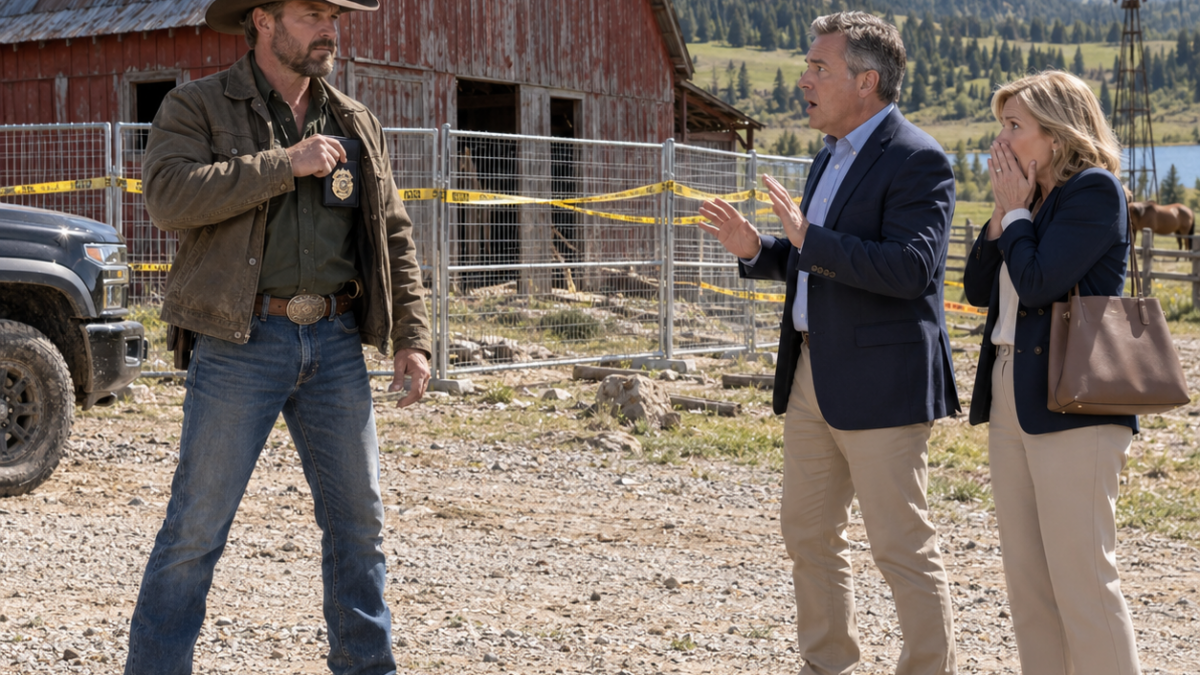
The HOA president had already driven steel posts five feet inside my property line when she handed me a $1,500 violation notice and ordered me to tear down the hundred-year-old barn behind her.
She thought the weathered oak boards were an eyesore, the woods behind them were wasted space, and the chain-link fence her contractors were installing would finally force me to obey.
I let her finish every threat before reaching into my truck for the one thing she had never bothered to learn about me.
“Another hundred dollars starts tomorrow.”
Karen Miller tapped the violation notice with one manicured finger.
Behind her, two contractors were hammering another steel post into the ground.
Thunk.
Thunk.
Thunk.
Every strike landed on my side of the property line.
I looked past her toward my barn.
Its oak siding had weathered silver over more than a century.
The roof had been repaired.
The foundation was solid.
The doors still slid smoothly.
Nothing about it was abandoned.
Nothing about it was unsafe.
But Karen had decided it offended the visual character of Oak Ridge Estates.
“You understand me, Mr. Thompson?”
“I understand exactly what you’re saying.”
“Good.”
She smiled.
“The board has declared the barn noncompliant. Five hundred dollars for the structure, one thousand for unauthorized land use, and one hundred dollars every day until demolition begins.”
I looked toward the contractors.
“You authorized that fence?”
“Obviously.”
“Do you know where my boundary is?”
“I know where the HOA determined it is.”
“That wasn’t my question.”
Her expression tightened.
“This fence creates a necessary visual and security buffer between maintained residential property and…” She waved dismissively toward my woods. “…that.”
That.
Ten acres bordering five thousand acres of Black Creek Nature Preserve.
Native oak.
Pawpaw.
Wild ginger.
Fern.
A creek crossing used by deer long before the first subdivision street had a name.
I had bought this land specifically because it formed a transition zone between suburban development and protected habitat.
And the barn Karen wanted destroyed was part of why I bought it.
For twenty years, I had served in the Army Rangers.
After retiring, I traded one uniform for another and became a state game warden.
I used the barn to store field equipment, trail cameras, habitat-restoration supplies, and occasionally temporary wildlife-rehabilitation equipment authorized through my work.
More importantly, the previous HOA board knew all of that.
When Sarah and I purchased the property, they granted a written variance recognizing the barn’s historic character and exempting it from the subdivision’s ordinary aesthetic requirements.
Signed.
Notarized.
Recorded.
Karen had become president six months earlier.
Her first announcement was that previous boards had been “too permissive.”
Her second was that she intended to restore standards.
Apparently restoring standards meant pretending existing agreements no longer existed.
I had sent her a copy of my variance.
She ignored it.
I had sent the survey showing the true property line.
She ignored that too.
Then I warned her in writing that placing a fence through this section of my property could interfere with a documented wildlife corridor.
She called the concern exaggerated.
Now she stood in front of me while concrete dust drifted across native grass.
“You have seven days to provide a demolition schedule,” she said.
“No.”
Her smile disappeared.
“Excuse me?”
“The barn isn’t coming down.”
“Then prepare for escalating enforcement.”
I walked past her toward the nearest steel post.
A small iron boundary marker sat several feet beyond it.
I pointed.
“My line is there.”
Karen barely glanced at it.
“The board’s site plan says otherwise.”
“Your site plan is wrong.”
“You don’t get to decide that.”
“No.”
I looked back at her.
“The county does.”
Something shifted in her face.
Only slightly.
Then she recovered.
“You people always think your professions make you special.”
That sentence almost made me smile.
“You don’t know my profession.”
“I know enough.”
“No, Karen.”
I walked toward my state-issued truck.
“You really don’t.”
She folded her arms.
“If you leave while my contractors are working, that constitutes acceptance of the project.”
I opened the driver’s door.
My uniform jacket lay across the seat.
I picked it up.
The metal badge caught the afternoon light.
Karen stopped talking.
Her eyes moved from the badge to the official seal on the truck door.
Then back to me.
I put on the jacket.
“State Game Warden Marcus Thompson,” I said quietly. “And before those men drive another post into this wildlife buffer, I strongly suggest you tell them to stop.”
For the first time since Karen Miller moved into Oak Ridge Estates, she had absolutely nothing to say.
PART 2
The contractor holding the post driver was the first person to react.
He shut the machine off.
Silence rushed back into the clearing.
Karen stared at my badge.
Then at the state seal on the truck.
Her eyes narrowed.
“That changes nothing.”
I almost admired the speed of the recovery.
Most people, when confronted with the possibility that they have just ordered construction across private land adjacent to a protected state habitat, ask questions.
Karen became louder.
“This remains an HOA enforcement matter.”
“Part of it does.”
I walked toward the fence.
“Your fines are a civil HOA matter.”
I pointed at the nearest post.
“This isn’t.”
One contractor looked at the other.
“Ma’am?”
Karen ignored him.
“You cannot use your government position to intimidate this board.”
“I’m not.”
“You just put on your badge.”
“You’re constructing a barrier inside a documented conservation buffer while I’m trying to explain why you should stop.”
I looked at the contractors.
“I’m not ordering either of you to do anything without proper authority. But you need to know the ownership and environmental status of this ground are disputed, and you have been informed.”
That mattered.
I didn’t want a dramatic badge-flashing scene that could later be described as me abusing office.
My training mattered more than my anger.
My badge did not magically settle private title.
It did mean I understood environmental law well enough to recognize when stupidity was heading toward something more serious.
The contractor lowered the equipment.
“I need to call my boss.”
“Do that.”
Karen stepped toward him.
“You have a contract.”
“We also have insurance.”
Smart man.
He walked toward his truck.
Karen turned on me.
“You planned this.”
“I planned for you to check a survey.”
“This is harassment.”
“No.”
I removed my phone.
“This is documentation.”
I photographed the post.
Property marker.
Concrete bags.
Truck tracks.
Then the barn.
Karen stared.
“What are you doing?”
“Creating a record.”
“For your lawsuit?”
“For whatever comes next.”
I watched her expression.
People like Karen hated uncertainty when they didn’t control it.
“You think this badge makes you untouchable?”
“No.”
“Then stop acting like it.”
I met her eyes.
“I spent twenty years learning exactly what authority does and does not allow me to do.”
I nodded toward her clipboard.
“You might consider trying it.”
Her face turned crimson.
She left without saying goodbye.
The contractors left fifteen minutes later.
They did not remove the posts.
They did not install any more.
That was enough for day one.
Sarah came outside after Karen’s SUV disappeared.
She had watched part of the confrontation from the kitchen window.
My wife taught high-school biology.
She weighed maybe one hundred twenty pounds soaking wet and had the unnerving ability to silence classrooms full of teenagers with one look.
“What did you do?”
“Nothing.”
“You put on the uniform.”
“It was in the truck.”
“You absolutely enjoyed that.”
“A little.”
She folded her arms.
“Marcus.”
“I stayed professional.”
“I know.”
She looked toward the unfinished fence.
Then at the barn.
“That woman really thinks she can make us tear it down.”
“She thinks authority is the same thing as being correct.”
“Can she fine us?”
“She can send paper.”
“That isn’t what I asked.”
I smiled.
“No.”
“You’re smiling.”
“I have a recorded variance.”
“Then why do I feel nervous?”
Because Sarah understood something most people eventually learn about bureaucratic fights.
Being right doesn’t make conflict free.
Karen could create problems even if she ultimately lost.
Attorney fees.
Recorded liens.
Letters to mortgage companies.
Board hearings.
Stress.
Hours lost.
People often surrender not because the bully is legally right, but because defending themselves becomes exhausting.
I put my arm around her.
“We do this properly.”
“Meaning?”
“Everything in writing.”
She sighed.
“You military people really know how to romance a woman.”
The certified violation arrived the next afternoon.
Sixteen hundred dollars due.
Five hundred for aesthetic noncompliance.
One thousand for unauthorized use of land supposedly bordering HOA common property.
One hundred dollars in daily penalties already added.
There was also a photograph of the barn.
Grainy.
Zoomed.
The sort of image you might see in a low-budget crime documentary.
I placed it beside the original variance.
Sarah stared at both.
“One of those has a notary seal.”
“Correct.”
“The other has Karen’s signature.”
“Correct.”
“Why are we worried?”
“Because Karen hasn’t learned the difference yet.”
I drafted a formal response.
No anger.
That was important.
I quoted the HOA provision governing recorded variances.
I attached the signed document.
Then the county survey.
Then I added a paragraph explaining that the property bordered Black Creek Nature Preserve and had long functioned as a private buffer.
I stated that unreviewed fencing through that area could interfere with wildlife movement and potentially implicate state conservation rules depending on location and impact.
I did not threaten arrest.
Did not mention criminal charges.
Did not write the word corruption.
I simply asked the board to stop construction and commission an independent survey before taking further action.
Certified mail.
Return receipt.
Five days later, Karen emailed me personally.
Her opening sentence said everything.
The former board’s agreement was issued under “lax enforcement policies” and therefore no longer recognized.
She claimed the new board had been elected with a mandate to restore the neighborhood’s intended character.
My barn was inconsistent with that character.
The fence was a legitimate security project.
She did not address my survey.
She did not address the property marker.
She did not address the environmental concern.
And she ended with:
Compliance is not optional.
I printed it.
Three-hole punch.
Binder.
Sarah walked past my office.
“What are you calling that?”
I wrote one word on the spine.
EVIDENCE.
“Of course.”
The fines continued.
Seventeen hundred.
Eighteen.
Two thousand.
Then a lien warning.
Meanwhile, I walked the entire fence alignment with a GPS receiver and the recorded plat.
Five feet inside my line at the shallowest point.
Almost seven at the widest.
I photographed everything.
Ruts.
Steel posts.
Concrete residue.
Native vegetation crushed beneath tires.
Then I installed trail cameras.
Those cameras changed the fight.
Before the fence, the corridor showed exactly what I already knew.
A doe moving through near dusk.
Two nearly grown fawns.
Raccoons.
Opossums.
Fox.
Coyotes.
Turkey.
Small mammals.
Nothing exotic.
Nothing dramatic.
Just healthy movement between habitat and water.
After the posts and partial chain link went up, the behavior changed.
The doe paced along the barrier.
One camera caught her turning repeatedly, trying to locate the passage she had used for years.
Another captured a buck getting briefly caught against the fencing before pulling free.
He escaped.
Thankfully.
But the evidence was clear.
The barrier was changing movement patterns.
That did not automatically transform Karen into an environmental criminal.
I knew better than that.
Wildlife law is rarely as simple as television makes it sound.
But construction inside an environmentally sensitive buffer without permission and without review deserved attention.
So I stopped thinking like an angry homeowner.
I thought like a warden.
Map.
Observe.
Record.
Report.
I surveyed vegetation disturbance.
Several young pawpaw saplings had been cut.
Native ferns flattened.
Wet concrete residue had hardened beside one post.
Truck ruts diverted runoff through a patch of ground cover.
None of it was an ecological apocalypse.
But Karen had called my barn an environmental hazard.
Her attempted cure had caused the actual measurable damage.
Irony does not determine law.
Evidence does.
I prepared a formal incident report for my supervisor.
Because the dispute involved my own land, I disclosed the conflict immediately and asked that any enforcement review be assigned independently.
That decision later became important.
My supervisor, Captain Elena Ruiz, read my preliminary report.
She looked at me over her glasses.
“This is your HOA?”
“Unfortunately.”
“And you’re the complainant.”
“Yes.”
“So you are not issuing your own citations.”
“Agreed.”
“Good.”
She flipped through the photographs.
“The property line?”
“Recorded survey.”
“Environmental designation?”
“Buffer adjacent to preserve boundary. I’ve included GIS data and management documents.”
“Protected species?”
“Nothing federally listed documented as injured.”
“Good. Don’t overstate.”
“I won’t.”
She paused at the deer photograph.
“That fence placement is stupid.”
“That is my professional opinion too.”
“Professional opinion is not a statute.”
“Understood.”
That was why I respected Ruiz.
She cared about winning cases less than getting them right.
She assigned another warden and a habitat biologist to inspect the site independently.
Karen had wanted a fight with me.
Now she had professionals who had no personal stake walking the property.
Before that inspection happened, she called an emergency HOA meeting.
My address was the only item on the agenda.
Sarah read the notice.
“She’s putting us on trial.”
“She’s putting herself on record.”
“You always say that when somebody does something terrible.”
“It helps.”
“I want to go.”
“I assumed.”
The clubhouse was full.
Thirty residents.
That was unusually high.
Most looked curious.
Some nervous.
Karen sat in the middle of the board table.
Treasurer to one side.
Secretary to the other.
Behind her was a poster board photograph of my barn.
Large.
Unflattering.
Taken in winter light.
She opened with a speech about property values.
Community expectations.
Shared responsibility.
Then she pointed toward the photograph.
“This is what happens when standards go unenforced.”
I leaned toward Sarah.
“It has survived longer than the subdivision.”
“Shh.”
Karen continued.
She described the barn as deteriorating.
Unsafe-looking.
Out of character.
Then mentioned vague complaints concerning wildlife near residential areas.
That was new.
Apparently deer were now my fault.
Finally she looked toward me.
“Mr. Thompson, would you care to explain why you believe rules applicable to every other homeowner should not apply to you?”
I stood.
“Sure.”
I carried one manila folder.
No giant evidence binder.
No badge.
No uniform.
Just facts.
“My barn is subject to a recorded variance granted when I purchased the property.”
I held it up.
“The variance specifically exempts its historic exterior from ordinary aesthetic requirements.”
Murmurs.
Karen interrupted.
“Former administration.”
I looked at her.
“I’ll finish.”
She stared.
I continued.
“The agreement contains no provision allowing a future president to cancel it unilaterally.”
I placed copies on the front table.
“Second.”
Survey map.
“The fence installed under direction of this board falls approximately five to seven feet inside my deeded property.”
A louder murmur.
Karen shook her head.
“That is your interpretation.”
“This is the county survey.”
“Surveys can be disputed.”
“Correct.”
I nodded.
“That is why I asked you to stop construction and commission an independent one.”
Someone asked from the back:
“Did the board do that?”
Karen ignored him.
I continued.
“Third.”
Preserve map.
“My property directly borders Black Creek Nature Preserve and has historically functioned as a buffer and wildlife passage.”
I kept my wording careful.
“The new fence may affect that corridor. Because this dispute concerns my own property, I disclosed the matter to my agency and requested independent review.”
That changed the room.
Karen’s head jerked up.
“You reported the HOA to your employer?”
“I reported potential impacts adjacent to state-managed habitat.”
“This is exactly the abuse of power I warned about.”
“No.”
I looked around.
“I specifically removed myself from enforcement decisions because it involves my land.”
Several people nodded.
Karen’s momentum disappeared.
She had wanted me to look like the angry government officer threatening neighbors.
Instead, I had asked other officers to review me too.
She banged the gavel.
“Our counsel has assured us the board is acting lawfully.”
“Then an independent survey and environmental review should confirm that.”
Silence.
That sentence did more than any accusation.
If she was certain, why was she afraid of verification?
After the meeting, an older man caught me outside.
“Marcus?”
I stopped.
“George Peterson.”
He shook my hand.
“I live on Willow Court.”
“I know the house.”
“Big oak out front.”
“Beautiful tree.”
His face tightened.
“Karen tried to make me cut it down last year.”
“Why?”
“Leaves.”
I thought I had misheard.
“Leaves?”
“Said they were contaminating my neighbor’s decorative stone.”
I waited.
“She fined me two thousand dollars.”
“What happened?”
“I hired a lawyer.”
“How much?”
“Nearly five grand.”
“Over leaves?”
“Over making sure my wife’s tree stayed.”
He looked toward the clubhouse.
“My wife and I planted it when we bought the house fifty-one years ago.”
His voice softened.
“She died six years back.”
I understood immediately.
“That tree stays.”
George smiled.
“It did.”
Then his expression hardened.
“But she counts on people not being willing to spend five thousand dollars to fight two thousand.”
There was the pattern.
Not proof of crime.
Proof of strategy.
Make surrender cheaper.
George gave me his number.
“If you need neighbors willing to talk, call.”
I did.
George knew everyone.
Within a week, four families were sitting in my living room.
Maria Torres.
Single mother.
Two kids.
Swing set.
One thousand-dollar fine because its stain color was not preapproved.
The Chen family.
Their front lawn had been replaced with native wildflowers and grasses.
Karen called it weeds.
Daily fines.
Ben Walker.
Paramedic.
Karen repeatedly threatened to tow his vehicle because the hospital logo made it “commercial.”
And George.
The oak-tree criminal.
Sarah sat beside me taking notes.
We asked for documents.
No exaggerations.
No gossip.
Letters.
Photographs.
Receipts.
Emails.
The pattern became undeniable.
Karen interpreted vague standards in the harshest possible way against people least likely to fight.
Maria had taken out a small loan to pay hers.
That bothered me more than anything.
“How much?”
She looked embarrassed.
“You don’t have to answer.”
“No.”
She shook her head.
“I want people to know.”
She told us.
Sarah’s jaw tightened.
“For a swing set?”
Maria nodded.
“I was scared they’d put a lien on the house.”
Her voice broke.
“I work two jobs. This house is the only thing I have for my kids.”
That night, after everyone left, Sarah stood beside the sink.
“This can’t just end with our fence coming down.”
“I know.”
“You know?”
“Yes.”
“Good.”
My wife did not frequently demand rebellion.
When she did, I listened.
The independent state inspection happened two mornings later.
Captain Ruiz did not attend.
She sent Warden Collins and Dr. Maya Hernandez, a habitat biologist.
Karen arrived anyway.
Of course.
She stood near the road with the HOA secretary.
I walked Collins through the property line.
He verified the survey marker locations.
Dr. Hernandez examined the corridor.
Photographed vegetation damage.
Reviewed trail-camera sequences.
She stopped beside a severed pawpaw stem.
“How many?”
“I counted six cut or crushed.”
She nodded.
“Not a protected plant itself.”
“Correct.”
“But relevant to habitat quality.”
“Yes.”
She looked at me.
“You did your homework.”
“It’s my backyard.”
Karen called from behind us.
“Excuse me.”
We turned.
“This inspection is unauthorized.”
Collins introduced himself.
State game warden.
Dr. Hernandez did the same.
Karen pointed at me.
“He works with you. This is retaliation.”
Collins answered.
“Mr. Thompson requested independent review and is not making the enforcement determination.”
“He arranged this.”
“He reported potential impacts.”
“You’re all protecting your own.”
Dr. Hernandez looked almost amused.
“Ma’am, I’m not law enforcement.”
Karen’s face reddened.
“I want your supervisor.”
“She can provide that information.”
I said nothing.
That was difficult.
Collins looked at the fence.
“Who authorized placement?”
“I did, as HOA president.”
He wrote that down.
Karen noticed.
“Why are you writing that?”
“Because you answered my question.”
Karen stopped answering questions.
Progress.
The state review took another week.
The findings were serious but not theatrical.
Unauthorized ground disturbance occurred within the buffer.
Vegetation restoration was required.
Fence placement disrupted a recognized movement corridor.
Because much of the construction was also on private property without permission, the HOA faced separate civil exposure.
The agency issued administrative notices requiring work to stop pending corrective action.
Karen responded through an attorney.
She called the environmental concerns exaggerated.
Then her lawyer accused me of weaponizing my government position.
Dave Ramirez loved that letter.
Dave and I had served together in the Rangers.
He went to law school afterward.
By the time I called him, he had become one of those civil litigators corporations hired when they wanted the other side to develop insomnia.
He came to my house.
I spread the documents across the table.
Dave read for almost two hours.
Then he looked up.
“I have one question.”
“What?”
“How does one human being generate this much bad paperwork in three months?”
“Talent.”
Sarah brought coffee.
“Can we stop her?”
Dave nodded.
“Yes.”
“Can we make the neighbors whole?”
“That part is harder.”
Maria had paid.
George spent attorney fees.
The Chens had accumulated fines.
Ben had towing threats.
Different facts.
Different claims.
“But we can make the board confront what’s happening.”
Dave drafted a formal cease-and-desist and demand for corrective action.
Not criminal threats.
That part I insisted we keep clean.
The letter went to every director individually.
Recorded variance.
Survey.
Environmental findings.
Property damage.
Harassment examples.
Demand one:
Stop enforcement against my barn pending proper review.
Two:
Remove the fence from my property.
Three:
Restore damaged ground as required by regulators.
Four:
Review fines imposed on residents under inconsistent or unsupported interpretations.
Five:
Preserve all records.
Fourteen days.
Dave sent it by process server.
Karen was served at home.
According to the server, she attempted to refuse the envelope.
He left it lawfully.
Then we waited.
Ten days later, her attorney answered.
All claims denied.
Fence location supposedly based on a good-faith boundary interpretation.
My variance allegedly revocable.
Environmental review allegedly biased.
Neighbor complaints supposedly unrelated.
Then the final paragraph.
The board intended to accelerate lien remedies against me.
And it was considering defamation claims against homeowners sharing accusations about Karen.
Dave read that paragraph twice.
“She really doesn’t understand off-ramps.”
“No.”
“What now?”
“Now we prepare the civil case.”
But Karen wasn’t finished.
Two days later, I walked outside at 6:40 a.m. in uniform.
My state-issued F-250 sat in the driveway.
I was scheduled for a patrol near the preserve.
A heavy tow truck turned onto our street.
It stopped in front of my driveway.
The driver climbed out.
He looked uncomfortable before he even reached the truck.
“Marcus Thompson?”
“Yes.”
“I’ve got a tow order.”
“For what?”
“Commercial vehicle violation.”
I stared at him.
Then at my state truck.
“You were told to tow that?”
He checked the paperwork.
“Ford F-250, state markings.”
“Yes.”
“HOA says commercial vehicles prohibited overnight.”
“This is a law-enforcement vehicle owned by the state.”
He grimaced.
“I just take the calls.”
“I understand.”
He began lowering equipment.
I held up a hand.
“Don’t connect anything yet.”
He stopped.
“I’m not threatening you. I’m informing you that this vehicle is government property assigned for official duty, and I am scheduled to leave on patrol.”
His eyes moved to my badge.
Then the state emblem.
“I should call dispatch.”
“Yes.”
That was when Karen arrived.
Perfect timing.
Her SUV stopped across the road.
She stepped out smiling.
“Problem?”
The tow driver looked toward her.
“Ma’am, this may be state property.”
“It is parked in violation of HOA rules.”
Karen looked at me.
“You were warned.”
I almost couldn’t believe it.
“You ordered this tow?”
“The board authorized enforcement.”
“The board voted?”
She hesitated.
Then:
“As president, I have enforcement authority.”
I looked toward the driver.
“Please do not attach to the vehicle until your company verifies legal authority.”
He was already backing away.
“Yeah. I’m calling the office.”
Karen snapped.
“You have a valid tow authorization!”
He shook his head.
“Not touching a state truck without somebody above me saying so.”
Smartest man on the street.
Karen turned toward me.
“You think your badge makes you special.”
“No.”
“Then move the truck somewhere compliant.”
“I’m leaving for work.”
“Not until this is resolved.”
That sentence mattered.
I pulled out my phone.
“Say that again.”
Her expression changed.
“You’re recording me?”
“We are standing in a public-facing driveway discussing interference with a state vehicle. I’m documenting.”
She stepped toward me.
“You are not taking that truck out until you pay your fines and comply.”
I stared at her.
Then called my supervisor.
Captain Ruiz answered.
“Marcus?”
“I have an unusual situation.”
“That sounds promising.”
I explained.
Her tone changed.
“Do not escalate.”
“I won’t.”
“Is the tow attached?”
“No.”
“Good. Photograph the paperwork. Get company information. Call local law enforcement if access is physically blocked.”
Karen was listening.
That finally put uncertainty in her face.
I ended the call.
“You have now been informed by a state employee and the tow operator that this is government property.”
Karen folded her arms.
“I know what it is.”
“And you are still directing him to prevent it from leaving?”
“This vehicle violates our covenants.”
I nodded.
“Thank you.”
“For what?”
“The clarification.”
The tow driver finished his call.
Then began retracting his equipment.
“No tow.”
Karen spun.
“What?”
“My boss says absolutely not.”
“You have a contract with the HOA.”
“Not for state vehicles.”
“He’s bluffing.”
The driver shook his head.
“I’m leaving.”
He left.
Karen stood in the street.
“You manipulated him.”
“No.”
“You threatened him with arrest.”
“I did not.”
“You’ll hear from my attorney.”
“Put it in writing.”
I climbed into the truck.
She moved toward the driveway entrance.
I stopped.
“Karen.”
“What?”
“If you intentionally block this vehicle from leaving for official duty, I will call the sheriff.”
Her eyes widened.
For once, she moved.
I drove straight to the county sheriff’s office.
Not because I wanted Karen arrested.
Because I wanted the incident documented by an outside agency.
Sheriff Bill Crawford had worked wildlife cases with us for years.
He listened.
Reviewed the tow paperwork.
Called the towing company.
The driver gave a statement.
The dispatcher provided the authorization request.
Karen had personally requested immediate towing of the marked state vehicle.
Bill leaned back.
“This woman knows what you do?”
“She definitely does now.”
“She knew before calling the truck?”
“Based on the towing notes, yes.”
He frowned.
“This has moved beyond somebody complaining about a barn.”
“Yes.”
“We’ll investigate.”
That was all I wanted.
No dramatic promises.
No handcuffs scheduled for three o’clock.
Investigation.
Evidence.
Procedure.
The sheriff’s office interviewed Karen.
Other board members.
The tow driver.
Neighbors.
Meanwhile, my department finalized corrective orders related to the fence and habitat damage.
The HOA’s insurer was notified.
That changed everything.
Insurance counsel wanted to know why their board had continued building after receiving a recorded survey.
Why it ignored a variance.
Why it authorized a tow of a state law-enforcement vehicle.
Why it continued escalating after outside counsel warned about potential exposure.
Apparently, Karen’s lawyer had not been as supportive as Karen claimed.
Discovery later showed something extraordinary.
The association’s attorney had advised the board twice to obtain an independent boundary survey and suspend enforcement until the environmental question was resolved.
Karen ignored both recommendations.
That was the crack.
Treasurer Susan Blake called me.
“Marcus?”
“Yes.”
“I need to talk.”
“Okay.”
“Karen told us counsel approved everything.”
I was quiet.
“She said the lawyer agreed the variance was void.”
“Did you see that in writing?”
“No.”
“She said the fence was unquestionably common property.”
“Did you see the survey?”
“The one you sent?”
“Yes.”
“She told us it was outdated.”
“It’s recorded.”
“I know that now.”
Susan started crying.
“I voted for those fines.”
“I know.”
“She said you were trying to scare us with your badge.”
“I know.”
“What happens to us?”
That was a complicated question.
“I’m not your lawyer.”
“I understand.”
“But if I were a board member, I’d get independent counsel and preserve every email.”
She exhaled.
“Karen deletes things.”
My attention sharpened.
“What?”
“She says clutter makes discovery harder.”
“Susan.”
“Yes?”
“Do not delete anything.”
“I won’t.”
“Tell your lawyer what you just told me.”
That call ended Karen’s control of the board.
Within forty-eight hours, Susan and the secretary demanded an emergency executive meeting.
Karen tried to cancel it.
They held it anyway with counsel.
The next morning, the HOA announced that all enforcement involving my property was suspended pending legal review.
The fence project was halted.
Karen remained president.
Temporarily.
George started a recall petition.
He needed no encouragement.
Within one weekend, he had signatures from most of the subdivision.
Maria knocked on doors.
The Chens organized documents.
Ben created a spreadsheet of fines.
Residents compared experiences.
Fear turned into anger.
Anger became organization.
The sheriff’s investigation continued separately.
The obstruction question was more complicated than the dramatic version Karen later told everyone.
No one was arrested simply because she tried to tow my truck.
Investigators reviewed whether her conduct met the elements of criminal interference under state law and whether false representations were made to the towing company.
The county attorney made those decisions, not me.
That distinction mattered.
Eventually, a judge authorized charges related to attempted interference with government property and documented harassment conduct arising from multiple incidents.
The sheriff’s office handled it.
I was a witness.
Not the arresting officer.
That was exactly how it should have been.
The arrest occurred quietly one Monday morning.
No orchestrated neighborhood spectacle.
No cheering crowd waiting with phones.
Deputies went to Karen’s house.
She surrendered after speaking with her attorney.
By noon, the entire neighborhood knew anyway.
Oak Ridge had a message board.
Nothing remains quiet on a message board.
George called me.
“Did you hear?”
“Yes.”
“You sound disappointed.”
“I’m not.”
“You wanted fireworks?”
“No.”
“Good.”
He paused.
“Because Maria wanted fireworks.”
I laughed.
That evening, Sarah and I sat on the porch.
The unfinished fence crossed the field.
Ugly.
Pointless.
Still standing.
Karen was out on bond.
The case would take months.
The HOA still had problems.
Nothing felt finished.
“I thought I’d feel something,” I said.
Sarah looked at me.
“About the arrest?”
“Yeah.”
“What do you feel?”
“Tired.”
“That seems healthy.”
“I wanted accountability.”
“You got the beginning of it.”
“Beginning.”
“Marcus, handcuffs aren’t an ending.”
She was right.
The real ending came from the community.
Two nights later, the clubhouse overflowed.
Residents lined the walls.
George stood near the front holding the petition.
Karen did not attend.
Her attorney advised her not to.
Susan opened the meeting.
Her hands shook.
“I owe all of you an apology.”
That silenced the room.
“I trusted information given to me by the president without independently reviewing documents I should have reviewed.”
She looked toward me.
“I voted for enforcement against Mr. Thompson without reading the recorded variance.”
Then Maria.
“I voted to continue fines after being told counsel supported the action.”
She swallowed.
“I now know counsel had recommended further review.”
People murmured.
Susan continued.
“I resign effective tonight.”
The secretary followed.
The remaining directors agreed to submit themselves to a recall vote rather than fight the petition.
George spoke.
“This isn’t about humiliation.”
He looked around.
“If we replace one bully with fifty angry homeowners, we learned nothing.”
That was one of the wisest things anyone said during the entire fight.
The bylaws required a properly noticed membership vote.
So we scheduled one.
No instant coup.
No shouting people out of office.
Procedure.
Three weeks later, homeowners voted.
Karen was removed by an overwhelming majority.
Two directors were also removed.
Susan, despite resigning, received applause when she attended and apologized again.
Accountability and forgiveness can occupy the same room.
George became interim president after nobody else could convince him to run away fast enough.
His first official motion was simple.
“Recognize all valid recorded variances unless properly amended by agreement or lawful procedure.”
Passed unanimously.
Second.
“Commission independent review of disputed enforcement actions from the prior eighteen months.”
Passed.
Third.
“Remove the encroaching fence and complete state-required habitat restoration.”
Passed.
Fourth.
“Adopt conflict-of-interest and legal-review procedures for major enforcement actions.”
Passed.
Then Eleanor Chen raised her hand.
“What about the wildflower rule?”
George sighed.
“We’ll review landscaping standards.”
Her husband whispered loudly:
“That means yes.”
People laughed.
The fence came down the following week.
I watched from the porch.
Different contractor.
Professional restoration crew.
They removed chain link.
Pulled posts.
Broke out concrete.
Filled holes.
Regraded the truck ruts.
Dr. Hernandez prepared the habitat restoration specifications.
Native grasses.
Pawpaw saplings.
Fern.
Mulch.
No ornamental landscaping.
No sterile HOA hedge.
Habitat.
George came over wearing work gloves.
“Where do you want us?”
“We?”
He pointed toward the road.
Twenty neighbors were walking toward us.
Maria.
Her children.
The Chens.
Ben.
Susan.
Even the tow-truck driver showed up.
I stared.
“What is this?”
George smiled.
“Community service.”
“This isn’t court ordered.”
“Exactly.”
Sarah appeared behind me carrying a tray of lemonade.
“You knew.”
“Of course.”
For two days, people worked.
Not because the HOA mandated volunteer hours.
Because they wanted to repair something.
Maria’s kids planted grasses.
The Chen family planted pawpaws.
Ben hauled mulch.
Susan spent three hours filling old post holes.
At one point I found her alone near the barn.
“You don’t have to do this.”
She wiped dirt from her hands.
“I know.”
“You already apologized.”
“I know.”
“Then why?”
She looked toward the scar where the fence had been.
“Because I voted yes.”
That was enough.
We kept working.
The legal cases resolved slowly.
Karen eventually entered a plea to reduced misdemeanor charges related to harassment and interference stemming from the vehicle incident.
No fantasy lifetime ban from every HOA in America.
Real consequences.
Probation.
Fine.
Court-ordered counseling.
Restitution tied to certain documented losses.
The HOA’s civil claims and insurance negotiations were separate.
The state reduced part of the administrative environmental penalty after the association completed restoration promptly and adopted compliance measures.
That was important to me.
The homeowners should not carry the maximum punishment forever if they corrected the damage.
Karen’s personal insurance and the association’s insurer fought over responsibility.
Lawyers did what lawyers do.
Eventually settlements funded much of the legal and restoration expense.
My fines disappeared completely.
Maria received reimbursement through the association’s remediation process for penalties improperly imposed under inconsistent standards.
The Chen fines were erased.
Ben’s towing warnings vanished.
George’s oak stayed.
Then came the barn.
The new board asked a preservation specialist to inspect it.
Karen had called it unsafe.
I welcomed the inspection.
If something was structurally wrong, I wanted to know.
The specialist spent half a day inside.
Timbers.
Foundation.
Roof.
Joinery.
Moisture.
He emerged smiling.
“Who built this?”
“No idea. County records put it around 1908.”
“Oak framing is incredible.”
“So it isn’t falling down?”
He laughed.
“I’ve inspected modern barns in worse condition.”
“Anything needed?”
“Roof flashing in one corner. Two siding boards. Drainage improvement near the north wall.”
I fixed everything.
Not because Karen had been right.
Because stewardship means caring for something after the fight too.
The preservation specialist suggested we apply for local historic recognition.
I wasn’t interested initially.
Sarah was.
“Do it.”
“Why?”
“Because then nobody can call it junk again.”
“That is not how history works.”
“Do it.”
I did.
The county approved the barn for its local historic-resource inventory.
No dramatic federal designation.
No velvet rope.
Just formal recognition that the building mattered.
George brought me the letter.
“Frame this beside the variance.”
“I’m running out of wall.”
“Get a bigger office.”
The barn changed too.
I cleaned the interior.
Built new storage racks.
Improved lighting.
One section became a small wildlife-education space.
Nothing public without appointment.
Mostly school groups Sarah arranged.
Her biology students came once each spring.
I showed them trail-camera images.
Habitat corridors.
Tracks.
How fence design affects animal movement.
Why native plants matter.
One student pointed toward the photographs from Karen’s fence.
“That happened here?”
“Yes.”
“Because of the HOA?”
“Because people made decisions without understanding the land.”
That was the lesson I wanted them to remember.
Not Karen.
Poor decisions.
Good intentions, bad assumptions, arrogance, failure to verify.
Those things cause more damage than cartoon villains.
The doe returned that autumn.
I recognized her from markings.
At least I believed I did.
She stepped from the preserve near dusk.
One younger deer followed.
They crossed exactly where the fence had once stood.
No pacing.
No barrier.
No confusion.
Just movement.
Sarah stood beside me.
“There.”
“I see her.”
We watched without speaking.
The deer crossed into grass near the creek.
Then disappeared.
Sarah touched my arm.
“Worth it?”
I knew what she meant.
Months of stress.
Legal expenses.
Meetings.
Reports.
Court dates.
“Yes.”
“Because Karen lost?”
“No.”
I looked toward the opening in the tree line.
“Because that works again.”
Sarah smiled.
That became the ending I carried with me.
Not Karen’s arrest.
Not the recall vote.
Not the fines disappearing.
An animal walking through a place we had repaired.
Years passed.
George served two terms as HOA president.
He refused a third.
His campaign slogan for retirement was:
I AM TOO OLD FOR YOUR MULCH ARGUMENTS.
Someone printed shirts.
I own one.
The Chens joined the landscaping committee.
Their native garden became the model for a voluntary pollinator program.
Maria’s swing set remained.
Her children eventually outgrew it.
She kept it another year anyway.
Ben’s paramedic vehicle remained in his driveway whenever he worked nights.
No towing.
Susan eventually returned to the board after two years.
That surprised people.
I supported her.
Not because she had been blameless.
Because she had admitted what she did.
Learned.
Then volunteered to do better.
Communities need people capable of changing more than they need people pretending they were always right.
Karen sold her house after the criminal case ended.
I did not watch the moving truck.
I did not need a final confrontation.
She sent me one letter before leaving.
Handwritten.
I almost threw it away.
Sarah made me read it.
Karen did not apologize for everything.
That would have been unbelievable.
She still believed the barn should have been maintained better.
Fair.
She still believed standards mattered.
So did I.
She said the presidency had become too personal.
That was true.
Then one sentence stopped me.
I thought admitting I was wrong would make me lose authority, and I did not understand that refusing to admit it was what destroyed it.
I read that twice.
Sarah sat across from me.
“Well?”
“I think she finally figured it out.”
“You going to respond?”
“Yes.”
“What?”
I thought.
Then wrote:
I hope your next chapter is quieter than this one.
Take care.
Marcus.
No victory line.
No warning.
No lecture.
Enough had already been said.
Five years after the fence incident, I retired from Fish and Wildlife.
Second retirement.
Sarah threw a party in the barn.
George came.
The Chens.
Maria and her now-teenage children.
Ben.
Susan.
Captain Ruiz.
Warden Collins.
Sheriff Crawford.
Even the tow-truck driver.
His name was Dale.
I finally learned it.
“I still tell that story,” he said.
“Which?”
“The time an HOA tried to make me tow a game warden’s state truck.”
“I tried to save you.”
“You did.”
He pointed toward Sarah.
“She yelled at me harder than you did.”
“That sounds right.”
The barn lights glowed against the old oak beams.
Someone had hung photographs along one wall.
My Ranger years.
First day as a warden.
Sarah and me when we bought the property.
The original variance.
One trail-camera photo of the doe and fawns.
Then another photograph.
Karen standing beside the half-built fence.
I frowned.
“Who put that up?”
George raised his hand.
“Take it down.”
“History.”
“She doesn’t belong on my retirement wall.”
Sarah sided with me.
The photograph came down.
In its place, George hung a picture of everyone planting pawpaw trees during restoration.
Better.
Much better.
At sunset, I walked outside alone.
The barn behind me was full of voices.
The preserve ahead was quiet.
I thought about the first day Karen stood there with her contractors.
She saw old boards.
I saw history.
She saw unmanaged woods.
I saw habitat.
She saw a property owner who would eventually surrender if fines became expensive enough.
She did not know me.
But the truth is, my badge was never the thing that beat her.
That made a better title.
It made a dramatic moment when she realized what I did for a living.
But badges are tools.
Not magic.
The badge did not prove my property line.
The survey did.
The badge did not preserve my barn.
The recorded variance did.
The badge did not remove Karen.
The homeowners did.
The badge did not restore the corridor.
People with shovels did.
That realization mattered to me.
I had spent much of my life in uniforms.
Army.
State.
Both taught me that authority exists because somebody larger than you entrusted it temporarily.
A country.
A state.
A community.
That means authority is borrowed.
Never owned.
Karen never understood that until it was too late.
I had to understand it too.
Otherwise I would merely become another person convinced that the object on my chest meant every argument should end with me.
The sun slipped behind the pines.
Movement caught my eye.
A deer stepped from the preserve.
Then another.
They crossed the restored corridor.
I could barely identify where the fence had been.
The pawpaw trees were taller now.
Native grasses covered the old truck ruts.
The concrete scars were gone.
Nature had done what nature does when we stop interfering long enough.
It healed.
Sarah came outside.
“Everybody’s looking for you.”
“I’m retired.”
“That started three hours ago.”
“Exactly.”
She stood beside me.
We watched the deer.
“Remember when Karen called the barn an environmental hazard?”
“Frequently.”
“You know what’s funny?”
“What?”
“It probably protects more wildlife than half the landscaping in Oak Ridge.”
She wasn’t wrong.
We had built owl boxes inside one end.
Stored rescue crates.
Educational gear.
Native-plant supplies.
Trail-camera equipment.
The barn had become more useful with age.
Like George.
Don’t tell him I said that.
Sarah looked at me.
“Are you glad we stayed?”
That question surprised me.
“Did you want to leave?”
“For about six months.”
“You never said.”
“You had enough.”
I turned toward her.
“I’m sorry.”
“For what?”
“Not noticing.”
She took my hand.
“I knew you’d win the legal part.”
“What worried you?”
“That you’d win and still hate living here.”
I looked toward Oak Ridge.
Porch lights beginning to glow.
Kids on bicycles.
Someone walking a Labrador.
George yelling at somebody about overwatering grass even though he wasn’t president anymore.
“I don’t.”
“I know.”
“When did you know?”
She smiled.
“The restoration weekend.”
“Why?”
“Because you stopped saying ‘my property’ and started saying ‘our corridor.’”
I laughed softly.
“That sounds annoyingly meaningful.”
“I teach high school. I save annoying meaningful things.”
Inside, someone called my name.
We ignored it.
The deer vanished toward the creek.
A barred owl called from inside the preserve.
The barn behind us held a hundred years of scars.
Weather.
Nails.
Repairs.
Storm damage.
New boards beside old ones.
Nobody would ever mistake it for a brand-new structure.
That was its value.
History rarely looks perfect.
Neither do communities.
They are built from mistakes people are willing to repair.
Years later, new homeowners still hear a distorted version of the story.
According to one, I arrested Karen personally while wearing my game-warden uniform.
False.
According to another, her fence trapped a federally endangered cougar.
Definitely false.
Someone once told a new family that I released bears into the neighborhood to prove a point.
I have no idea how that started.
The real story is less ridiculous.
A newly elected HOA president tried to cancel an existing variance.
Her board built a fence in the wrong place.
I documented it.
Wildlife impacts triggered regulatory review.
She kept escalating.
Neighbors discovered they weren’t alone.
An attempted tow of a government vehicle drew outside scrutiny.
Law enforcement investigated.
The association recalled leadership.
Courts and lawyers handled the rest.
Then people repaired what had been damaged.
That is not as cinematic.
It is better.
Because it could actually happen anywhere power goes unquestioned too long.
The barn is still standing.
The original boards on the west wall remain silver-gray.
I replace only what fails.
Every spring, I inspect the roof.
Every fall, I clear drainage.
Once a year, Sarah’s students come.
I still show them the old fence photographs.
One student asked me recently:
“Why didn’t you just tear the fence out yourself?”
I smiled.
“Because I could have.”
He frowned.
“That doesn’t make sense.”
“It will someday.”
When you are certain you are right, the temptation is to act immediately.
Cut the chain.
Pull the posts.
Throw the contractor off your land.
Shout.
Threaten.
Sometimes that is exactly how you transform a strong case into a messy one.
Instead, I let the documents catch up.
Survey.
Variance.
Environmental review.
Witnesses.
Board records.
Tow authorization.
Neighbor statements.
By the time people with actual jurisdiction acted, Karen had built most of the case herself.
The student thought about it.
“So patience?”
“Evidence first.”
“That sounds boring.”
“Justice is mostly boring paperwork.”
He laughed.
Then pointed toward my old Ranger photograph.
“But you were Army Rangers.”
“Also lots of paperwork.”
That disappointed him deeply.
I understand.
People want the satisfying moment.
The badge.
The gasp.
The consequences.
I remember that moment too.
Karen’s face when I put on the state jacket.
She thought she had fenced off an old man’s barn.
Then realized the quiet homeowner she had been threatening spent his working life enforcing conservation laws.
It was satisfying.
I won’t pretend otherwise.
But that wasn’t the moment I won.
The moment I won came much later.
No badge.
No lawyers.
No sheriff.
No Karen.
Just a doe walking with her young through the opening where the fence used to be.
That was the whole reason the line mattered.
My barn remained.
The community changed.
The corridor healed.
And I finally understood something I should have learned long before.
The best revenge is not watching another person lose everything.
It is looking around years later and realizing their worst decision failed to change the things you loved.
Karen wanted the barn gone.
It stands.
She wanted the woods controlled.
They remain wild.
She wanted neighbors afraid.
They learned to speak.
She wanted her authority unquestioned.
The community learned to question every authority—including mine.
Good.
That is how it should be.
One cool October evening, Sarah and I sat on the porch watching the light fade across the barn.
Its silver boards turned almost blue in the twilight.
The oak George had fought to save was visible over the rooftops in the distance.
Somewhere beyond it stood Maria’s backyard.
Her children no longer used the old swing set, but she had converted part of it into a trellis.
The Chens’ wildflower garden had spread so successfully that the HOA now distributed a voluntary native-plant guide.
Ben had become a father.
His daughter liked seeing my trail-camera photos.
Life had continued.
That may have been the greatest victory of all.
Sarah handed me coffee.
“You know what?”
“What?”
“That barn really is ugly.”
I stared at her.
She smiled over the rim of her mug.
“Historic ugly.”
“I’m divorcing you.”
“No, you’re not.”
“Maybe I’ll fine you.”
“One hundred dollars a day?”
“Five hundred.”
“For what violation?”
“Unauthorized opinions.”
She laughed.
I did too.
A movement near the tree line caught my eye.
Two deer.
They stepped through the grass.
No hesitation.
No chain link.
No barrier.
Behind them, the woods stretched dark toward five thousand protected acres.
Beside them stood a barn built before any of us were born.
I leaned back.
Peaceful.
Finally.
Karen once thought that barn was the thing lowering the value of Oak Ridge Estates.
She was wrong.
The most valuable thing in the neighborhood was never uniform siding, perfect lawns, or fences that hid anything old.
It was the willingness of ordinary people to protect what mattered when someone with a title forgot that her power had limits.
My badge helped Karen understand that afternoon that she had wandered into a world of laws larger than her HOA binder.
But the badge was only metal.
The real authority came from the deed.
The variance.
The environmental rules.
The courts.
And ultimately, the neighbors themselves.
Karen built a fence because she wanted to prove she controlled what she could see.
We tore it down because some lines should never have been crossed.
And today, whenever deer slip past my old barn and disappear into Black Creek Preserve, there is no steel in their path, no contractor truck, no woman with a clipboard telling the land what it is allowed to be.
There is only open ground.
Exactly where it belongs.
TITLE: HOA Fenced Off My 100-Year-Old Barn as an “Eyesore”—Then I Showed Her the Badge She Never Expected
[FACEBOOK CAPTION — 700–800 WORDS]
The HOA president had already driven steel posts five feet inside my property line when she handed me a $1,500 violation notice and ordered me to tear down the hundred-year-old barn behind her.
She thought the weathered oak boards were an eyesore, the woods behind them were wasted space, and the chain-link fence her contractors were installing would finally force me to obey.
I let her finish every threat before reaching into my truck for the one thing she had never bothered to learn about me.
“Another hundred dollars starts tomorrow.”
Karen Miller tapped the violation notice with one manicured finger.
Behind her, two contractors were hammering another steel post into the ground.
Thunk.
Thunk.
Thunk.
Every strike landed on my side of the property line.
I looked past her toward my barn.
Its oak siding had weathered silver over more than a century.
The roof had been repaired.
The foundation was solid.
The doors still slid smoothly.
Nothing about it was abandoned.
Nothing about it was unsafe.
But Karen had decided it offended the visual character of Oak Ridge Estates.
“You understand me, Mr. Thompson?”
“I understand exactly what you’re saying.”
“Good.”
She smiled.
“The board has declared the barn noncompliant. Five hundred dollars for the structure, one thousand for unauthorized land use, and one hundred dollars every day until demolition begins.”
I looked toward the contractors.
“You authorized that fence?”
“Obviously.”
“Do you know where my boundary is?”
“I know where the HOA determined it is.”
“That wasn’t my question.”
Her expression tightened.
“This fence creates a necessary visual and security buffer between maintained residential property and…” She waved dismissively toward my woods. “…that.”
That.
Ten acres bordering five thousand acres of Black Creek Nature Preserve.
Native oak.
Pawpaw.
Wild ginger.
Fern.
A creek crossing used by deer long before the first subdivision street had a name.
I had bought this land specifically because it formed a transition zone between suburban development and protected habitat.
And the barn Karen wanted destroyed was part of why I bought it.
For twenty years, I had served in the Army Rangers.
After retiring, I traded one uniform for another and became a state game warden.
I used the barn to store field equipment, trail cameras, habitat-restoration supplies, and occasionally temporary wildlife-rehabilitation equipment authorized through my work.
More importantly, the previous HOA board knew all of that.
When Sarah and I purchased the property, they granted a written variance recognizing the barn’s historic character and exempting it from the subdivision’s ordinary aesthetic requirements.
Signed.
Notarized.
Recorded.
Karen had become president six months earlier.
Her first announcement was that previous boards had been “too permissive.”
Her second was that she intended to restore standards.
Apparently restoring standards meant pretending existing agreements no longer existed.
I had sent her a copy of my variance.
She ignored it.
I had sent the survey showing the true property line.
She ignored that too.
Then I warned her in writing that placing a fence through this section of my property could interfere with a documented wildlife corridor.
She called the concern exaggerated.
Now she stood in front of me while concrete dust drifted across native grass.
“You have seven days to provide a demolition schedule,” she said.
“No.”
Her smile disappeared.
“Excuse me?”
“The barn isn’t coming down.”
“Then prepare for escalating enforcement.”
I walked past her toward the nearest steel post.
A small iron boundary marker sat several feet beyond it.
I pointed.
“My line is there.”
Karen barely glanced at it.
“The board’s site plan says otherwise.”
“Your site plan is wrong.”
“You don’t get to decide that.”
“No.”
I looked back at her.
“The county does.”
Something shifted in her face.
Only slightly.
Then she recovered.
“You people always think your professions make you special.”
That sentence almost made me smile.
“You don’t know my profession.”
“I know enough.”
“No, Karen.”
I walked toward my state-issued truck.
“You really don’t.”
She folded her arms.
“If you leave while my contractors are working, that constitutes acceptance of the project.”
I opened the driver’s door.
My uniform jacket lay across the seat.
I picked it up.
The metal badge caught the afternoon light.
Karen stopped talking.
Her eyes moved from the badge to the official seal on the truck door.
Then back to me.
I put on the jacket.
“State Game Warden Marcus Thompson,” I said quietly. “And before those men drive another post into this wildlife buffer, I strongly suggest you tell them to stop.”
For the first time since Karen Miller moved into Oak Ridge Estates, she had absolutely nothing to say.
[END OF FACEBOOK CAPTION]
[FIRST COMMENT / FULL STORY CONTINUATION]
The contractor holding the post driver was the first person to react.
He shut the machine off.
Silence rushed back into the clearing.
Karen stared at my badge.
Then at the state seal on the truck.
Her eyes narrowed.
“That changes nothing.”
I almost admired the speed of the recovery.
Most people, when confronted with the possibility that they have just ordered construction across private land adjacent to protected habitat, ask questions.
Karen became louder.
“This remains an HOA enforcement matter.”
“Part of it does.”
I walked toward the fence.
“Your fines are a civil HOA matter.”
I pointed at the nearest post.
“This isn’t.”
One contractor looked at the other.
“Ma’am?”
Karen ignored him.
“You cannot use your government position to intimidate this board.”
“I’m not.”
“You just put on your badge.”
“You’re constructing a barrier inside a documented conservation buffer while I’m trying to explain why you should stop.”
I looked at the contractors.
“I’m not ordering either of you to do anything without proper authority. But you need to know the ownership and environmental status of this ground are disputed, and you have been informed.”
The older contractor lowered his equipment.
“I need to call my boss.”
“Do that.”
Karen stepped toward him.
“You have a contract.”
He shook his head.
“We also have insurance.”
Smart man.
He walked toward his truck.
Karen turned on me.
“You planned this.”
“I planned for you to check a survey.”
“This is harassment.”
“No.”
I removed my phone.
“This is documentation.”
I photographed the post.
Property marker.
Concrete bags.
Truck tracks.
Then the barn.
Karen stared.
“What are you doing?”
“Creating a record.”
“For your lawsuit?”
“For whatever comes next.”
I watched her expression.
People like Karen hated uncertainty when they didn’t control it.
“You think this badge makes you untouchable?”
“No.”
“Then stop acting like it.”
I met her eyes.
“I spent twenty years learning exactly what authority does and does not allow me to do.”
I nodded toward her clipboard.
“You might consider trying it.”
Her face turned crimson.
She left without saying goodbye.
The contractors left fifteen minutes later.
They did not remove the posts.
They did not install any more.
That was enough for day one.
Sarah came outside after Karen’s SUV disappeared.
She had watched part of the confrontation from the kitchen window.
My wife taught high-school biology.
She weighed maybe one hundred twenty pounds soaking wet and had the unnerving ability to silence classrooms full of teenagers with one look.
“What did you do?”
“Nothing.”
“You put on the uniform.”
“It was in the truck.”
“You absolutely enjoyed that.”
“A little.”
She folded her arms.
“Marcus.”
“I stayed professional.”
“I know.”
She looked toward the unfinished fence.
Then at the barn.
“That woman really thinks she can make us tear it down.”
“She thinks authority is the same thing as being correct.”
“Can she fine us?”
“She can send paper.”
“That isn’t what I asked.”
I smiled.
“No.”
“You’re smiling.”
“I have a recorded variance.”
“Then why do I feel nervous?”
Because Sarah understood something most people eventually learn about bureaucratic fights.
Being right doesn’t make conflict free.
Karen could create problems even if she ultimately lost.
Attorney fees.
Recorded liens.
Letters to mortgage companies.
Board hearings.
Stress.
Hours lost.
People often surrender not because the bully is legally right, but because defending themselves becomes exhausting.
I put my arm around her.
“We do this properly.”
“Meaning?”
“Everything in writing.”
She sighed.
“You military people really know how to romance a woman.”
The certified violation arrived the next afternoon.
Sixteen hundred dollars due.
Five hundred for aesthetic noncompliance.
One thousand for unauthorized land use supposedly bordering HOA common property.
One hundred dollars in daily penalties already added.
There was also a photograph of the barn.
Grainy.
Zoomed.
The sort of image you might see in a low-budget crime documentary.
I placed it beside the original variance.
Sarah stared at both.
“One of those has a notary seal.”
“Correct.”
“The other has Karen’s signature.”
“Correct.”
“Why are we worried?”
“Because Karen hasn’t learned the difference yet.”
I drafted a formal response.
No anger.
That was important.
I quoted the HOA provision governing recorded variances.
I attached the signed document.
Then the county survey.
Then I added a paragraph explaining that the property bordered Black Creek Nature Preserve and had long functioned as a private buffer.
I stated that unreviewed fencing through that area could interfere with wildlife movement and potentially implicate state conservation rules depending on location and impact.
I did not threaten arrest.
Did not mention criminal charges.
Did not write the word corruption.
I simply asked the board to stop construction and commission an independent survey before taking further action.
Certified mail.
Return receipt.
Five days later, Karen emailed me personally.
Her opening sentence said everything.
The former board’s agreement was issued under “lax enforcement policies” and therefore no longer recognized.
She claimed the new board had been elected with a mandate to restore the neighborhood’s intended character.
My barn was inconsistent with that character.
The fence was a legitimate security project.
She did not address my survey.
She did not address the property marker.
She did not address the environmental concern.
And she ended with:
Compliance is not optional.
I printed it.
Three-hole punch.
Binder.
Sarah walked past my office.
“What are you calling that?”
I wrote one word on the spine.
EVIDENCE.
“Of course.”
The fines continued.
Seventeen hundred.
Eighteen.
Two thousand.
Then a lien warning.
Meanwhile, I walked the entire fence alignment with a GPS receiver and the recorded plat.
Five feet inside my line at the shallowest point.
Almost seven at the widest.
I photographed everything.
Ruts.
Steel posts.
Concrete residue.
Native vegetation crushed beneath tires.
Then I installed trail cameras.
Those cameras changed the fight.
Before the fence, the corridor showed exactly what I already knew.
A doe moving through near dusk.
Two nearly grown fawns.
Raccoons.
Opossums.
Fox.
Coyotes.
Turkey.
Small mammals.
Nothing exotic.
Nothing dramatic.
Just healthy movement between habitat and water.
After the posts and partial chain link went up, the behavior changed.
The doe paced along the barrier.
One camera caught her turning repeatedly, trying to locate the passage she had used for years.
Another captured a buck getting briefly caught against the fencing before pulling free.
He escaped.
Thankfully.
But the evidence was clear.
The barrier was changing movement patterns.
That did not automatically transform Karen into an environmental criminal.
I knew better than that.
Wildlife law is rarely as simple as television makes it sound.
But construction inside an environmentally sensitive buffer without permission and without review deserved attention.
So I stopped thinking like an angry homeowner.
I thought like a warden.
Map.
Observe.
Record.
Report.
I surveyed vegetation disturbance.
Several young pawpaw saplings had been cut.
Native ferns flattened.
Wet concrete residue had hardened beside one post.
Truck ruts diverted runoff through a patch of ground cover.
None of it was an ecological apocalypse.
But Karen had called my barn an environmental hazard.
Her attempted cure had caused the actual measurable damage.
Irony does not determine law.
Evidence does.
I prepared a formal incident report for my supervisor.
Because the dispute involved my own land, I disclosed the conflict immediately and asked that any enforcement review be assigned independently.
That decision later became important.
My supervisor, Captain Elena Ruiz, read my preliminary report.
She looked at me over her glasses.
“This is your HOA?”
“Unfortunately.”
“And you’re the complainant.”
“Yes.”
“So you are not issuing your own citations.”
“Agreed.”
“Good.”
She flipped through the photographs.
“The property line?”
“Recorded survey.”
“Environmental designation?”
“Buffer adjacent to preserve boundary. I’ve included GIS data and management documents.”
“Protected species?”
“Nothing federally listed documented as injured.”
“Good. Don’t overstate.”
“I won’t.”
She paused at the deer photograph.
“That fence placement is stupid.”
“That is my professional opinion too.”
“Professional opinion is not a statute.”
“Understood.”
That was why I respected Ruiz.
She cared about winning cases less than getting them right.
She assigned another warden and a habitat biologist to inspect the site independently.
Before that inspection happened, Karen called an emergency HOA meeting.
My address was the only item on the agenda.
Sarah read the notice.
“She’s putting us on trial.”
“She’s putting herself on record.”
“You always say that when somebody does something terrible.”
“It helps.”
“I want to go.”
“I assumed.”
The clubhouse was full.
Thirty residents.
That was unusually high.
Most looked curious.
Some nervous.
Karen sat in the middle of the board table.
Treasurer to one side.
Secretary to the other.
Behind her was a poster-board photograph of my barn.
Large.
Unflattering.
Taken in winter light.
She opened with a speech about property values.
Community expectations.
Shared responsibility.
Then she pointed toward the photograph.
“This is what happens when standards go unenforced.”
I leaned toward Sarah.
“It has survived longer than the subdivision.”
“Shh.”
Karen continued.
She described the barn as deteriorating.
Unsafe-looking.
Out of character.
Then mentioned vague complaints concerning wildlife near residential areas.
That was new.
Apparently deer were now my fault.
Finally she looked toward me.
“Mr. Thompson, would you care to explain why you believe rules applicable to every other homeowner should not apply to you?”
I stood.
“Sure.”
I carried one manila folder.
No giant evidence binder.
No badge.
No uniform.
Just facts.
“My barn is subject to a recorded variance granted when I purchased the property.”
I held it up.
“The variance specifically exempts its historic exterior from ordinary aesthetic requirements.”
Murmurs.
Karen interrupted.
“Former administration.”
I looked at her.
“I’ll finish.”
She stared.
I continued.
“The agreement contains no provision allowing a future president to cancel it unilaterally.”
I placed copies on the front table.
“Second.”
Survey map.
“The fence installed under direction of this board falls approximately five to seven feet inside my deeded property.”
A louder murmur.
Karen shook her head.
“That is your interpretation.”
“This is the county survey.”
“Surveys can be disputed.”
“Correct.”
I nodded.
“That is why I asked you to stop construction and commission an independent one.”
Someone asked from the back:
“Did the board do that?”
Karen ignored him.
I continued.
“Third.”
Preserve map.
“My property directly borders Black Creek Nature Preserve and has historically functioned as a buffer and wildlife passage.”
I kept my wording careful.
“The new fence may affect that corridor. Because this dispute concerns my own property, I disclosed the matter to my agency and requested independent review.”
That changed the room.
Karen’s head jerked up.
“You reported the HOA to your employer?”
“I reported potential impacts adjacent to state-managed habitat.”
“This is exactly the abuse of power I warned about.”
“No.”
I looked around.
“I specifically removed myself from enforcement decisions because it involves my land.”
Several people nodded.
Karen’s momentum disappeared.
She had wanted me to look like the angry government officer threatening neighbors.
Instead, I had asked other officers to review me too.
She banged the gavel.
“Our counsel has assured us the board is acting lawfully.”
“Then an independent survey and environmental review should confirm that.”
Silence.
That sentence did more than any accusation.
If she was certain, why was she afraid of verification?
After the meeting, an older man caught me outside.
“Marcus?”
I stopped.
“George Peterson.”
He shook my hand.
“I live on Willow Court.”
“I know the house.”
“Big oak out front.”
“Beautiful tree.”
His face tightened.
“Karen tried to make me cut it down last year.”
“Why?”
“Leaves.”
I thought I had misheard.
“Leaves?”
“Said they were contaminating my neighbor’s decorative stone.”
I waited.
“She fined me two thousand dollars.”
“What happened?”
“I hired a lawyer.”
“How much?”
“Nearly five grand.”
“Over leaves?”
“Over making sure my wife’s tree stayed.”
He looked toward the clubhouse.
“My wife and I planted it when we bought the house fifty-one years ago.”
His voice softened.
“She died six years back.”
I understood immediately.
“That tree stays.”
George smiled.
“It did.”
Then his expression hardened.
“But she counts on people not being willing to spend five thousand dollars to fight two thousand.”
There was the pattern.
Not proof of crime.
Proof of strategy.
Make surrender cheaper.
George gave me his number.
“If you need neighbors willing to talk, call.”
I did.
George knew everyone.
Within a week, four families were sitting in my living room.
Maria Torres.
Single mother.
Two kids.
Swing set.
One thousand-dollar fine because its stain color was not preapproved.
The Chen family.
Their front lawn had been replaced with native wildflowers and grasses.
Karen called it weeds.
Daily fines.
Ben Walker.
Paramedic.
Karen repeatedly threatened to tow his vehicle because the hospital logo made it “commercial.”
And George.
The oak-tree criminal.
Sarah sat beside me taking notes.
We asked for documents.
No exaggerations.
No gossip.
Letters.
Photographs.
Receipts.
Emails.
The pattern became undeniable.
Karen interpreted vague standards in the harshest possible way against people least likely to fight.
Maria had taken out a small loan to pay hers.
That bothered me more than anything.
“How much?”
She looked embarrassed.
“You don’t have to answer.”
“No.”
She shook her head.
“I want people to know.”
She told us.
Sarah’s jaw tightened.
“For a swing set?”
Maria nodded.
“I was scared they’d put a lien on the house.”
Her voice broke.
“I work two jobs. This house is the only thing I have for my kids.”
That night, after everyone left, Sarah stood beside the sink.
“This can’t just end with our fence coming down.”
“I know.”
“You know?”
“Yes.”
“Good.”
My wife did not frequently demand rebellion.
When she did, I listened.
The independent state inspection happened two mornings later.
Captain Ruiz did not attend.
She sent Warden Collins and Dr. Maya Hernandez, a habitat biologist.
Karen arrived anyway.
Of course.
She stood near the road with the HOA secretary.
I walked Collins through the property line.
He verified the survey marker locations.
Dr. Hernandez examined the corridor.
Photographed vegetation damage.
Reviewed trail-camera sequences.
She stopped beside a severed pawpaw stem.
“How many?”
“I counted six cut or crushed.”
She nodded.
“Not a protected plant itself.”
“Correct.”
“But relevant to habitat quality.”
“Yes.”
She looked at me.
“You did your homework.”
“It’s my backyard.”
Karen called from behind us.
“Excuse me.”
We turned.
“This inspection is unauthorized.”
Collins introduced himself.
State game warden.
Dr. Hernandez did the same.
Karen pointed at me.
“He works with you. This is retaliation.”
Collins answered.
“Mr. Thompson requested independent review and is not making the enforcement determination.”
“He arranged this.”
“He reported potential impacts.”
“You’re all protecting your own.”
Dr. Hernandez looked almost amused.
“Ma’am, I’m not law enforcement.”
Karen’s face reddened.
“I want your supervisor.”
“She can provide that information.”
I said nothing.
That was difficult.
Collins looked at the fence.
“Who authorized placement?”
“I did, as HOA president.”
He wrote that down.
Karen noticed.
“Why are you writing that?”
“Because you answered my question.”
Karen stopped answering questions.
Progress.
The state review took another week.
The findings were serious but not theatrical.
Unauthorized ground disturbance occurred within the buffer.
Vegetation restoration was required.
Fence placement disrupted a recognized movement corridor.
Because much of the construction was also on private property without permission, the HOA faced separate civil exposure.
The agency issued administrative notices requiring work to stop pending corrective action.
Karen responded through an attorney.
She called the environmental concerns exaggerated.
Then her lawyer accused me of weaponizing my government position.
Dave Ramirez loved that letter.
Dave and I had served together in the Rangers.
He went to law school afterward.
By the time I called him, he had become one of those civil litigators corporations hired when they wanted the other side to develop insomnia.
He came to my house.
I spread the documents across the table.
Dave read for almost two hours.
Then he looked up.
“I have one question.”
“What?”
“How does one human being generate this much bad paperwork in three months?”
“Talent.”
Sarah brought coffee.
“Can we stop her?”
Dave nodded.
“Yes.”
“Can we make the neighbors whole?”
“That part is harder.”
Maria had paid.
George spent attorney fees.
The Chens had accumulated fines.
Ben had towing threats.
Different facts.
Different claims.
“But we can make the board confront what’s happening.”
Dave drafted a formal cease-and-desist and demand for corrective action.
Not criminal threats.
That part I insisted we keep clean.
The letter went to every director individually.
Recorded variance.
Survey.
Environmental findings.
Property damage.
Harassment examples.
Demand one:
Stop enforcement against my barn pending proper review.
Two:
Remove the fence from my property.
Three:
Restore damaged ground as required by regulators.
Four:
Review fines imposed on residents under inconsistent or unsupported interpretations.
Five:
Preserve all records.
Fourteen days.
Dave sent it by process server.
Karen was served at home.
According to the server, she attempted to refuse the envelope.
He left it lawfully.
Then we waited.
Ten days later, her attorney answered.
All claims denied.
Fence location supposedly based on a good-faith boundary interpretation.
My variance allegedly revocable.
Environmental review allegedly biased.
Neighbor complaints supposedly unrelated.
Then the final paragraph.
The board intended to accelerate lien remedies against me.
And it was considering defamation claims against homeowners sharing accusations about Karen.
Dave read that paragraph twice.
“She really doesn’t understand off-ramps.”
“No.”
“What now?”
“Now we prepare the civil case.”
But Karen wasn’t finished.
Two days later, I walked outside at 6:40 a.m. in uniform.
My state-issued F-250 sat in the driveway.
I was scheduled for a patrol near the preserve.
A heavy tow truck turned onto our street.
It stopped in front of my driveway.
The driver climbed out.
He looked uncomfortable before he even reached the truck.
“Marcus Thompson?”
“Yes.”
“I’ve got a tow order.”
“For what?”
“Commercial vehicle violation.”
I stared at him.
Then at my state truck.
“You were told to tow that?”
He checked the paperwork.
“Ford F-250, state markings.”
“Yes.”
“HOA says commercial vehicles prohibited overnight.”
“This is a law-enforcement vehicle owned by the state.”
He grimaced.
“I just take the calls.”
“I understand.”
He began lowering equipment.
I held up a hand.
“Don’t connect anything yet.”
He stopped.
“I’m not threatening you. I’m informing you that this vehicle is government property assigned for official duty, and I am scheduled to leave on patrol.”
His eyes moved to my badge.
Then the state emblem.
“I should call dispatch.”
“Yes.”
That was when Karen arrived.
Perfect timing.
Her SUV stopped across the road.
She stepped out smiling.
“Problem?”
The tow driver looked toward her.
“Ma’am, this may be state property.”
“It is parked in violation of HOA rules.”
Karen looked at me.
“You were warned.”
I almost couldn’t believe it.
“You ordered this tow?”
“The board authorized enforcement.”
“The board voted?”
She hesitated.
Then:
“As president, I have enforcement authority.”
I looked toward the driver.
“Please do not attach to the vehicle until your company verifies legal authority.”
He was already backing away.
“Yeah. I’m calling the office.”
Karen snapped.
“You have a valid tow authorization!”
He shook his head.
“Not touching a state truck without somebody above me saying so.”
Smartest man on the street.
Karen turned toward me.
“You think your badge makes you special.”
“No.”
“Then move the truck somewhere compliant.”
“I’m leaving for work.”
“Not until this is resolved.”
That sentence mattered.
I pulled out my phone.
“Say that again.”
Her expression changed.
“You’re recording me?”
“We are standing in a public-facing driveway discussing interference with a state vehicle. I’m documenting.”
She stepped toward me.
“You are not taking that truck out until you pay your fines and comply.”
I stared at her.
Then called my supervisor.
Captain Ruiz answered.
“Marcus?”
“I have an unusual situation.”
“That sounds promising.”
I explained.
Her tone changed.
“Do not escalate.”
“I won’t.”
“Is the tow attached?”
“No.”
“Good. Photograph the paperwork. Get company information. Call local law enforcement if access is physically blocked.”
Karen was listening.
That finally put uncertainty in her face.
I ended the call.
“You have now been informed by a state employee and the tow operator that this is government property.”
Karen folded her arms.
“I know what it is.”
“And you are still directing him to prevent it from leaving?”
“This vehicle violates our covenants.”
I nodded.
“Thank you.”
“For what?”
“The clarification.”
The tow driver finished his call.
Then began retracting his equipment.
“No tow.”
Karen spun.
“What?”
“My boss says absolutely not.”
“You have a contract with the HOA.”
“Not for state vehicles.”
“He’s bluffing.”
The driver shook his head.
“I’m leaving.”
He left.
Karen stood in the street.
“You manipulated him.”
“No.”
“You threatened him with arrest.”
“I did not.”
“You’ll hear from my attorney.”
“Put it in writing.”
I climbed into the truck.
She moved toward the driveway entrance.
I stopped.
“Karen.”
“What?”
“If you intentionally block this vehicle from leaving for official duty, I will call the sheriff.”
Her eyes widened.
For once, she moved.
I drove straight to the county sheriff’s office.
Not because I wanted Karen arrested.
Because I wanted the incident documented by an outside agency.
Sheriff Bill Crawford had worked wildlife cases with us for years.
He listened.
Reviewed the tow paperwork.
Called the towing company.
The driver gave a statement.
The dispatcher provided the authorization request.
Karen had personally requested immediate towing of the marked state vehicle.
Bill leaned back.
“This woman knows what you do?”
“She definitely does now.”
“She knew before calling the truck?”
“Based on the towing notes, yes.”
He frowned.
“This has moved beyond somebody complaining about a barn.”
“Yes.”
“We’ll investigate.”
That was all I wanted.
No dramatic promises.
No handcuffs scheduled for three o’clock.
Investigation.
Evidence.
Procedure.
The sheriff’s office interviewed Karen.
Other board members.
The tow driver.
Neighbors.
Meanwhile, my department finalized corrective orders related to the fence and habitat damage.
The HOA’s insurer was notified.
That changed everything.
Insurance counsel wanted to know why their board had continued building after receiving a recorded survey.
Why it ignored a variance.
Why it authorized a tow of a state law-enforcement vehicle.
Why it continued escalating after outside counsel warned about potential exposure.
Apparently, Karen’s lawyer had not been as supportive as Karen claimed.
Discovery later showed something extraordinary.
The association’s attorney had advised the board twice to obtain an independent boundary survey and suspend enforcement until the environmental question was resolved.
Karen ignored both recommendations.
That was the crack.
Treasurer Susan Blake called me.
“Marcus?”
“Yes.”
“I need to talk.”
“Okay.”
“Karen told us counsel approved everything.”
I was quiet.
“She said the lawyer agreed the variance was void.”
“Did you see that in writing?”
“No.”
“She said the fence was unquestionably common property.”
“Did you see the survey?”
“The one you sent?”
“Yes.”
“She told us it was outdated.”
“It’s recorded.”
“I know that now.”
Susan started crying.
“I voted for those fines.”
“I know.”
“She said you were trying to scare us with your badge.”
“I know.”
“What happens to us?”
That was a complicated question.
“I’m not your lawyer.”
“I understand.”
“But if I were a board member, I’d get independent counsel and preserve every email.”
She exhaled.
“Karen deletes things.”
My attention sharpened.
“What?”
“She says clutter makes discovery harder.”
“Susan.”
“Yes?”
“Do not delete anything.”
“I won’t.”
“Tell your lawyer what you just told me.”
That call ended Karen’s control of the board.
Within forty-eight hours, Susan and the secretary demanded an emergency executive meeting.
Karen tried to cancel it.
They held it anyway with counsel.
The next morning, the HOA announced that all enforcement involving my property was suspended pending legal review.
The fence project was halted.
Karen remained president.
Temporarily.
George started a recall petition.
He needed no encouragement.
Within one weekend, he had signatures from most of the subdivision.
Maria knocked on doors.
The Chens organized documents.
Ben created a spreadsheet of fines.
Residents compared experiences.
Fear turned into anger.
Anger became organization.
That was when Karen made the mistake that finally destroyed whatever support she had left.
She sent a neighborhood-wide email.
The subject line read:
URGENT: HOSTILE TAKEOVER OF OAK RIDGE
Sarah read it aloud from her phone while I made coffee.
“‘A small group of disgruntled residents, influenced by an outside government employee—’”
She stopped.
“Outside government employee?”
“I live here.”
“I know.”
She continued.
“‘—is attempting to seize control of the association through intimidation, misinformation, and threats of government retaliation.’”
Sarah lowered the phone.
“She is calling you an outsider in your own neighborhood.”
“I noticed.”
“Keep reading?”
“Please.”
Karen accused George of organizing a mob.
Maria of refusing lawful fines.
The Chens of destroying neighborhood landscaping standards.
Ben of violating parking rules.
Then she wrote that any homeowner signing the recall petition should understand they could become personally liable for damages if the effort harmed the HOA.
Sarah looked at me.
“That sounds like another threat.”
“It is.”
“Can she do that?”
“She can type it.”
Within an hour, screenshots were everywhere.
People who had been undecided signed the petition.
George called me laughing.
“She just got us seventeen signatures.”
“Don’t celebrate.”
“I’m not celebrating.”
“You sound like you are.”
“I’m seventy-three. This is as excited as I get.”
That evening, Maria came over.
Her children stayed in the car.
She held the email printout.
“She’s threatening me again.”
“She’s trying to scare people.”
“I know.”
Maria sat at our table.
For months, she had appeared exhausted.
Two jobs.
Children.
Bills.
HOA letters.
Now something had changed.
She looked angry.
Not frightened.
“I borrowed money because of that woman.”
“I know.”
“My daughter asked me if we were going to lose our house because of her swing set.”
Sarah sat beside her.
Maria’s voice broke.
“I told her no.”
She wiped her eyes.
“But I didn’t know.”
Nobody spoke.
Then Maria straightened.
“I’m signing.”
“You already did.”
“No.”
She shook her head.
“I’m signing again in front of everyone at the meeting.”
“You only get one vote.”
“I know.”
A small smile appeared.
“I want Karen to see my face.”
That was the real shift in Oak Ridge.
Not my badge.
Not the sheriff.
Not the legal letters.
Fear had begun changing direction.
The people Karen once frightened were becoming less afraid of consequences than they were tired of silence.
The sheriff’s investigation continued separately.
The obstruction question was more complicated than the dramatic version Karen later told everyone.
No one was arrested simply because she tried to tow my truck.
Investigators reviewed whether her conduct met the elements of criminal interference under state law and whether false representations were made to the towing company.
The county attorney made those decisions, not me.
That distinction mattered.
Eventually, a judge authorized charges related to attempted interference with government property and documented harassment conduct arising from multiple incidents.
The sheriff’s office handled it.
I was a witness.
Not the arresting officer.
That was exactly how it should have been.
The arrest occurred quietly one Monday morning.
No orchestrated neighborhood spectacle.
No cheering crowd waiting with phones.
Deputies went to Karen’s house.
She surrendered after speaking with her attorney.
By noon, the entire neighborhood knew anyway.
Oak Ridge had a message board.
Nothing remains quiet on a message board.
George called me.
“Did you hear?”
“Yes.”
“You sound disappointed.”
“I’m not.”
“You wanted fireworks?”
“No.”
“Good.”
He paused.
“Because Maria wanted fireworks.”
I laughed.
That evening, Sarah and I sat on the porch.
The unfinished fence crossed the field.
Ugly.
Pointless.
Still standing.
Karen was out on bond.
The case would take months.
The HOA still had problems.
Nothing felt finished.
“I thought I’d feel something,” I said.
Sarah looked at me.
“About the arrest?”
“Yeah.”
“What do you feel?”
“Tired.”
“That seems healthy.”
“I wanted accountability.”
“You got the beginning of it.”
“Beginning.”
“Marcus, handcuffs aren’t an ending.”
She was right.
The real ending came from the community.
Two nights later, the clubhouse overflowed.
Residents lined the walls.
George stood near the front holding the petition.
Karen did not attend.
Her attorney advised her not to.
Susan opened the meeting.
Her hands shook.
“I owe all of you an apology.”
That silenced the room.
“I trusted information given to me by the president without independently reviewing documents I should have reviewed.”
She looked toward me.
“I voted for enforcement against Mr. Thompson without reading the recorded variance.”
Then Maria.
“I voted to continue fines after being told counsel supported the action.”
She swallowed.
“I now know counsel had recommended further review.”
People murmured.
Susan continued.
“I resign effective tonight.”
The secretary followed.
The remaining directors agreed to submit themselves to a recall vote rather than fight the petition.
George spoke.
“This isn’t about humiliation.”
He looked around.
“If we replace one bully with fifty angry homeowners, we learned nothing.”
That was one of the wisest things anyone said during the entire fight.
The bylaws required a properly noticed membership vote.
So we scheduled one.
No instant coup.
No shouting people out of office.
Procedure.
Three weeks later, homeowners voted.
Karen was removed by an overwhelming majority.
Two directors were also removed.
Susan, despite resigning, received applause when she attended and apologized again.
Accountability and forgiveness can occupy the same room.
George became interim president after nobody else could convince him to run away fast enough.
His first official motion was simple.
“Recognize all valid recorded variances unless properly amended by agreement or lawful procedure.”
Passed unanimously.
Second.
“Commission independent review of disputed enforcement actions from the prior eighteen months.”
Passed.
Third.
“Remove the encroaching fence and complete state-required habitat restoration.”
Passed.
Fourth.
“Adopt conflict-of-interest and legal-review procedures for major enforcement actions.”
Passed.
Then Eleanor Chen raised her hand.
“What about the wildflower rule?”
George sighed.
“We’ll review landscaping standards.”
Her husband whispered loudly:
“That means yes.”
People laughed.
But George added one more motion that night.
It wasn’t in the prepared agenda.
He looked toward Maria.
Then the Chens.
Then Ben.
Then me.
“I move that the association create a remediation fund from available legal reserves and insurance recoveries to reimburse residents for fines later determined to have been imposed outside proper authority or through materially inconsistent enforcement.”
The room went silent.
Maria covered her mouth.
Susan looked down.
Someone asked:
“How much will that cost?”
George answered honestly.
“We don’t know yet.”
“Could dues go up?”
“Possibly.”
A murmur spread.
That was the first real test of whether people wanted justice or merely wanted Karen gone.
George continued.
“If the association collected money improperly, then that money belongs to the people who paid it.”
A man in the back raised his hand.
“My fines were valid.”
Everyone turned.
He looked uncomfortable.
“I left a boat in my driveway for six months. I knew the rule.”
Some people laughed.
He shrugged.
“I’m not asking for my money back.”
George nodded.
“Exactly. Review each case.”
The motion passed.
Not unanimously.
But overwhelmingly.
Maria started crying.
Later, outside, she hugged George so hard he nearly dropped his binder.
That moment meant more to me than Karen’s arrest.
Because removing a bad leader is easy compared with repairing the harm left behind.
The fence came down the following week.
I watched from the porch.
Different contractor.
Professional restoration crew.
They removed chain link.
Pulled posts.
Broke out concrete.
Filled holes.
Regraded the truck ruts.
Dr. Hernandez prepared the habitat restoration specifications.
Native grasses.
Pawpaw saplings.
Fern.
Mulch.
No ornamental landscaping.
No sterile HOA hedge.
Habitat.
George came over wearing work gloves.
“Where do you want us?”
“We?”
He pointed toward the road.
Twenty neighbors were walking toward us.
Maria.
Her children.
The Chens.
Ben.
Susan.
Even the tow-truck driver showed up.
I stared.
“What is this?”
George smiled.
“Community service.”
“This isn’t court ordered.”
“Exactly.”
Sarah appeared behind me carrying a tray of lemonade.
“You knew.”
“Of course.”
For two days, people worked.
Not because the HOA mandated volunteer hours.
Because they wanted to repair something.
Maria’s kids planted grasses.
The Chen family planted pawpaws.
Ben hauled mulch.
Susan spent three hours filling old post holes.
At one point I found her alone near the barn.
“You don’t have to do this.”
She wiped dirt from her hands.
“I know.”
“You already apologized.”
“I know.”
“Then why?”
She looked toward the scar where the fence had been.
“Because I voted yes.”
That was enough.
We kept working.
Late Saturday afternoon, rain clouds gathered.
The volunteers had mostly left.
Only George, Sarah, Maria, and her children remained.
Maria’s youngest son, Mateo, stood beside a newly planted pawpaw sapling.
He looked at me.
“Will deer eat it?”
“Maybe.”
His eyes widened.
“We just planted it!”
“Deer don’t respect landscaping plans.”
George snorted.
“Neither does your HOA anymore.”
Maria laughed.
Mateo frowned.
“Then why plant it?”
I crouched beside him.
“Because some animals use these plants. Some insects need them. And because this land had them before the fence.”
He considered that.
“Will it grow big?”
“If we’re lucky.”
“How long?”
“Years.”
He looked disappointed.
Children prefer restoration projects with immediate results.
Then he pointed toward the barn.
“Is that really a hundred years old?”
“More.”
“Did you build it?”
George laughed so hard he coughed.
“I’m not that old.”
Mateo shrugged.
“You kind of are.”
Sarah nearly dropped the lemonade pitcher.
I gave the boy a serious look.
“Go plant another tree.”
He ran off.
Maria watched him.
Then quietly said, “He stopped asking if we’re going to lose the house.”
I looked at her.
She kept her eyes on her children.
“He heard too much when all those letters were coming.”
“I’m sorry.”
“It wasn’t you.”
“No.”
She breathed out.
“But this is why I needed the fines reviewed.”
“I know.”
“I don’t even care about getting every dollar back.”
She paused.
“I just need my kids to know I didn’t do something wrong by giving them a swing set.”
That hit me harder than any legal argument.
Rules meant to protect property had somehow convinced a child that play itself might endanger his home.
That was how far Karen’s version of governance had drifted.
Not enforcement.
Fear.
The legal cases resolved slowly.
Karen eventually entered a plea to reduced misdemeanor charges related to harassment and interference stemming from the vehicle incident.
No fantasy lifetime ban from every HOA in America.
Real consequences.
Probation.
Fine.
Court-ordered counseling.
Restitution tied to certain documented losses.
The HOA’s civil claims and insurance negotiations were separate.
The state reduced part of the administrative environmental penalty after the association completed restoration promptly and adopted compliance measures.
That was important to me.
The homeowners should not carry the maximum punishment forever if they corrected the damage.
Karen’s personal insurance and the association’s insurer fought over responsibility.
Lawyers did what lawyers do.
Eventually settlements funded much of the legal and restoration expense.
My fines disappeared completely.
Maria received reimbursement through the association’s remediation process for penalties improperly imposed under inconsistent standards.
The Chen fines were erased.
Ben’s towing warnings vanished.
George’s oak stayed.
Then came the barn.
The new board asked a preservation specialist to inspect it.
Karen had called it unsafe.
I welcomed the inspection.
If something was structurally wrong, I wanted to know.
The specialist spent half a day inside.
Timbers.
Foundation.
Roof.
Joinery.
Moisture.
He emerged smiling.
“Who built this?”
“No idea. County records put it around 1908.”
“Oak framing is incredible.”
“So it isn’t falling down?”
He laughed.
“I’ve inspected modern barns in worse condition.”
“Anything needed?”
“Roof flashing in one corner. Two siding boards. Drainage improvement near the north wall.”
I fixed everything.
Not because Karen had been right.
Because stewardship means caring for something after the fight too.
The preservation specialist suggested we apply for local historic recognition.
I wasn’t interested initially.
Sarah was.
“Do it.”
“Why?”
“Because then nobody can call it junk again.”
“That is not how history works.”
“Do it.”
I did.
The county approved the barn for its local historic-resource inventory.
No dramatic federal designation.
No velvet rope.
Just formal recognition that the building mattered.
George brought me the letter.
“Frame this beside the variance.”
“I’m running out of wall.”
“Get a bigger office.”
The barn changed too.
I cleaned the interior.
Built new storage racks.
Improved lighting.
One section became a small wildlife-education space.
Nothing public without appointment.
Mostly school groups Sarah arranged.
Her biology students came once each spring.
I showed them trail-camera images.
Habitat corridors.
Tracks.
How fence design affects animal movement.
Why native plants matter.
One student pointed toward the photographs from Karen’s fence.
“That happened here?”
“Yes.”
“Because of the HOA?”
“Because people made decisions without understanding the land.”
That was the lesson I wanted them to remember.
Not Karen.
Poor decisions.
Bad assumptions.
Arrogance.
Failure to verify.
Those things cause more damage than cartoon villains.
The doe returned that autumn.
I recognized her from markings.
At least I believed I did.
She stepped from the preserve near dusk.
One younger deer followed.
They crossed exactly where the fence had once stood.
No pacing.
No barrier.
No confusion.
Just movement.
Sarah stood beside me.
“There.”
“I see her.”
We watched without speaking.
The deer crossed into grass near the creek.
Then disappeared.
Sarah touched my arm.
“Worth it?”
I knew what she meant.
Months of stress.
Legal expenses.
Meetings.
Reports.
Court dates.
“Yes.”
“Because Karen lost?”
“No.”
I looked toward the opening in the tree line.
“Because that works again.”
Sarah smiled.
That became the ending I carried with me.
Not Karen’s arrest.
Not the recall vote.
Not the fines disappearing.
An animal walking through a place we had repaired.
Years passed.
George served two terms as HOA president.
He refused a third.
His campaign slogan for retirement was:
I AM TOO OLD FOR YOUR MULCH ARGUMENTS.
Someone printed shirts.
I own one.
The Chens joined the landscaping committee.
Their native garden became the model for a voluntary pollinator program.
Maria’s swing set remained.
Her children eventually outgrew it.
She kept it another year anyway.
Ben’s paramedic vehicle remained in his driveway whenever he worked nights.
No towing.
Susan eventually returned to the board after two years.
That surprised people.
I supported her.
Not because she had been blameless.
Because she had admitted what she did.
Learned.
Then volunteered to do better.
Communities need people capable of changing more than they need people pretending they were always right.
Karen sold her house after the criminal case ended.
I did not watch the moving truck.
I did not need a final confrontation.
She sent me one letter before leaving.
Handwritten.
I almost threw it away.
Sarah made me read it.
Karen did not apologize for everything.
That would have been unbelievable.
She still believed the barn should have been maintained better.
Fair.
She still believed standards mattered.
So did I.
She said the presidency had become too personal.
That was true.
Then one sentence stopped me.
I thought admitting I was wrong would make me lose authority, and I did not understand that refusing to admit it was what destroyed it.
I read that twice.
Sarah sat across from me.
“Well?”
“I think she finally figured it out.”
“You going to respond?”
“Yes.”
“What?”
I thought.
Then wrote:
I hope your next chapter is quieter than this one.
Take care.
Marcus.
No victory line.
No warning.
No lecture.
Enough had already been said.
Five years after the fence incident, I retired from Fish and Wildlife.
Second retirement.
Sarah threw a party in the barn.
George came.
The Chens.
Maria and her now-teenage children.
Ben.
Susan.
Captain Ruiz.
Warden Collins.
Sheriff Crawford.
Even the tow-truck driver.
His name was Dale.
I finally learned it.
“I still tell that story,” he said.
“Which?”
“The time an HOA tried to make me tow a game warden’s state truck.”
“I tried to save you.”
“You did.”
He pointed toward Sarah.
“She yelled at me harder than you did.”
“That sounds right.”
The barn lights glowed against the old oak beams.
Someone had hung photographs along one wall.
My Ranger years.
First day as a warden.
Sarah and me when we bought the property.
The original variance.
One trail-camera photo of the doe and fawns.
Then another photograph.
Karen standing beside the half-built fence.
I frowned.
“Who put that up?”
George raised his hand.
“Take it down.”
“History.”
“She doesn’t belong on my retirement wall.”
Sarah sided with me.
The photograph came down.
In its place, George hung a picture of everyone planting pawpaw trees during restoration.
Better.
Much better.
At sunset, I walked outside alone.
The barn behind me was full of voices.
The preserve ahead was quiet.
I thought about the first day Karen stood there with her contractors.
She saw old boards.
I saw history.
She saw unmanaged woods.
I saw habitat.
She saw a property owner who would eventually surrender if fines became expensive enough.
She did not know me.
But the truth is, my badge was never the thing that beat her.
That made a better title.
It made a dramatic moment when she realized what I did for a living.
But badges are tools.
Not magic.
The badge did not prove my property line.
The survey did.
The badge did not preserve my barn.
The recorded variance did.
The badge did not remove Karen.
The homeowners did.
The badge did not restore the corridor.
People with shovels did.
That realization mattered to me.
I had spent much of my life in uniforms.
Army.
State.
Both taught me that authority exists because somebody larger than you entrusted it temporarily.
A country.
A state.
A community.
That means authority is borrowed.
Never owned.
Karen never understood that until it was too late.
I had to understand it too.
Otherwise I would merely become another person convinced that the object on my chest meant every argument should end with me.
The sun slipped behind the pines.
Movement caught my eye.
A deer stepped from the preserve.
Then another.
They crossed the restored corridor.
I could barely identify where the fence had been.
The pawpaw trees were taller now.
Native grasses covered the old truck ruts.
The concrete scars were gone.
Nature had done what nature does when we stop interfering long enough.
It healed.
Sarah came outside.
“Everybody’s looking for you.”
“I’m retired.”
“That started three hours ago.”
“Exactly.”
She stood beside me.
We watched the deer.
“Remember when Karen called the barn an environmental hazard?”
“Frequently.”
“You know what’s funny?”
“What?”
“It probably protects more wildlife than half the landscaping in Oak Ridge.”
She wasn’t wrong.
We had built owl boxes inside one end.
Stored rescue crates.
Educational gear.
Native-plant supplies.
Trail-camera equipment.
The barn had become more useful with age.
Like George.
Don’t tell him I said that.
Sarah looked at me.
“Are you glad we stayed?”
That question surprised me.
“Did you want to leave?”
“For about six months.”
“You never said.”
“You had enough.”
I turned toward her.
“I’m sorry.”
“For what?”
“Not noticing.”
She took my hand.
“I knew you’d win the legal part.”
“What worried you?”
“That you’d win and still hate living here.”
I looked toward Oak Ridge.
Porch lights beginning to glow.
Kids on bicycles.
Someone walking a Labrador.
George yelling at somebody about overwatering grass even though he wasn’t president anymore.
“I don’t.”
“I know.”
“When did you know?”
She smiled.
“The restoration weekend.”
“Why?”
“Because you stopped saying ‘my property’ and started saying ‘our corridor.’”
I laughed softly.
“That sounds annoyingly meaningful.”
“I teach high school. I save annoyingly meaningful things.”
Inside, someone called my name.
We ignored it.
The deer vanished toward the creek.
A barred owl called from inside the preserve.
The barn behind us held a hundred years of scars.
Weather.
Nails.
Repairs.
Storm damage.
New boards beside old ones.
Nobody would ever mistake it for a brand-new structure.
That was its value.
History rarely looks perfect.
Neither do communities.
They are built from mistakes people are willing to repair.
Years later, new homeowners still hear a distorted version of the story.
According to one, I arrested Karen personally while wearing my game-warden uniform.
False.
According to another, her fence trapped a federally endangered cougar.
Definitely false.
Someone once told a new family that I released bears into the neighborhood to prove a point.
I have no idea how that started.
The real story is less ridiculous.
A newly elected HOA president tried to cancel an existing variance.
Her board built a fence in the wrong place.
I documented it.
Wildlife impacts triggered regulatory review.
She kept escalating.
Neighbors discovered they weren’t alone.
An attempted tow of a government vehicle drew outside scrutiny.
Law enforcement investigated.
The association recalled leadership.
Courts and lawyers handled the rest.
Then people repaired what had been damaged.
That is not as cinematic.
It is better.
Because it could actually happen anywhere power goes unquestioned too long.
The barn is still standing.
The original boards on the west wall remain silver-gray.
I replace only what fails.
Every spring, I inspect the roof.
Every fall, I clear drainage.
Once a year, Sarah’s students come.
I still show them the old fence photographs.
One student asked me recently:
“Why didn’t you just tear the fence out yourself?”
I smiled.
“Because I could have.”
He frowned.
“That doesn’t make sense.”
“It will someday.”
When you are certain you are right, the temptation is to act immediately.
Cut the chain.
Pull the posts.
Throw the contractor off your land.
Shout.
Threaten.
Sometimes that is exactly how you transform a strong case into a messy one.
Instead, I let the documents catch up.
Survey.
Variance.
Environmental review.
Witnesses.
Board records.
Tow authorization.
Neighbor statements.
By the time people with actual jurisdiction acted, Karen had built most of the case herself.
The student thought about it.
“So patience?”
“Evidence first.”
“That sounds boring.”
“Justice is mostly boring paperwork.”
He laughed.
Then pointed toward my old Ranger photograph.
“But you were Army Rangers.”
“Also lots of paperwork.”
That disappointed him deeply.
I understand.
People want the satisfying moment.
The badge.
The gasp.
The consequences.
I remember that moment too.
Karen’s face when I put on the state jacket.
She thought she had fenced off an old man’s barn.
Then realized the quiet homeowner she had been threatening spent his working life enforcing conservation laws.
It was satisfying.
I won’t pretend otherwise.
But that wasn’t the moment I won.
The moment I won came much later.
No badge.
No lawyers.
No sheriff.
No Karen.
Just a doe walking with her young through the opening where the fence used to be.
That was the whole reason the line mattered.
My barn remained.
The community changed.
The corridor healed.
And I finally understood something I should have learned long before.
The best revenge is not watching another person lose everything.
It is looking around years later and realizing their worst decision failed to change the things you loved.
Karen wanted the barn gone.
It stands.
She wanted the woods controlled.
They remain wild.
She wanted neighbors afraid.
They learned to speak.
She wanted her authority unquestioned.
The community learned to question every authority—including mine.
Good.
That is how it should be.
One cool October evening, Sarah and I sat on the porch watching the light fade across the barn.
Its silver boards turned almost blue in the twilight.
The oak George had fought to save was visible over the rooftops in the distance.
Somewhere beyond it stood Maria’s backyard.
Her children no longer used the old swing set, but she had converted part of it into a trellis.
The Chens’ wildflower garden had spread so successfully that the HOA now distributed a voluntary native-plant guide.
Ben had become a father.
His daughter liked seeing my trail-camera photos.
Life had continued.
That may have been the greatest victory of all.
Sarah handed me coffee.
“You know what?”
“What?”
“That barn really is ugly.”
I stared at her.
She smiled over the rim of her mug.
“Historic ugly.”
“I’m divorcing you.”
“No, you’re not.”
“Maybe I’ll fine you.”
“One hundred dollars a day?”
“Five hundred.”
“For what violation?”
“Unauthorized opinions.”
She laughed.
I did too.
A movement near the tree line caught my eye.
Two deer.
They stepped through the grass.
No hesitation.
No chain link.
No barrier.
Behind them, the woods stretched dark toward five thousand protected acres.
Beside them stood a barn built before any of us were born.
I leaned back.
Peaceful.
Finally.
Karen once thought that barn was the thing lowering the value of Oak Ridge Estates.
She was wrong.
The most valuable thing in the neighborhood was never uniform siding, perfect lawns, or fences that hid anything old.
It was the willingness of ordinary people to protect what mattered when someone with a title forgot that her power had limits.
My badge helped Karen understand that afternoon that she had wandered into a world of laws larger than her HOA binder.
But the badge was only metal.
The real authority came from the deed.
The variance.
The environmental rules.
The courts.
And ultimately, the neighbors themselves.
Karen built a fence because she wanted to prove she controlled what she could see.
We tore it down because some lines should never have been crossed.
And today, whenever deer slip past my old barn and disappear into Black Creek Preserve, there is no steel in their path, no contractor truck, no woman with a clipboard telling the land what it is allowed to be.
There is only open ground.
Exactly where it belongs.








