HOA Charged 80 Families Just to Drive Home—So I Led Them Through Her Tollbooth With the Deed She Couldn’t Ignore
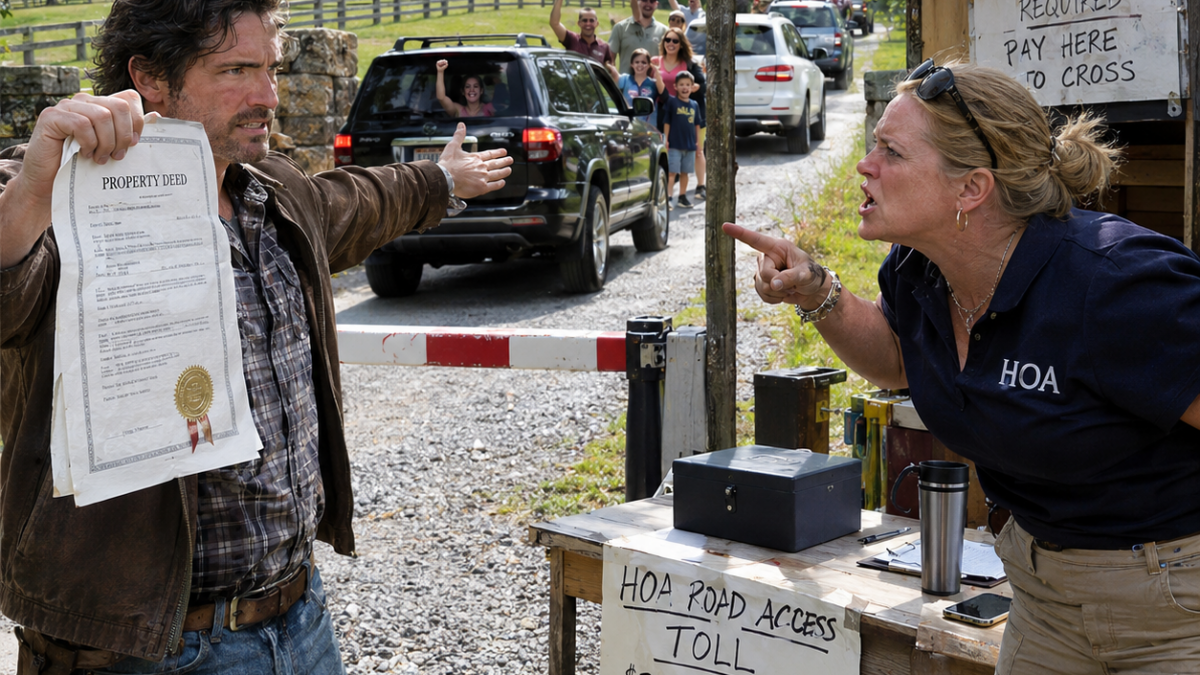
part 2
I didn’t yell at her.
That surprised Darlene.
I could see it.
She wanted anger.
People like her usually did.
If I shouted, threatened somebody, or tried to smash the barrier with my truck, she could turn the story around in five minutes.
Suddenly I wouldn’t be the landowner confronting an unlawful structure.
I’d be the unstable rancher threatening HOA employees.
So I reached back into my truck and took out the small notebook I always carried in my shirt pocket.
“What are your names?” I asked the guards.
The younger man hesitated.
Darlene stepped between us.
“You don’t need their names.”
I looked around her.
“I didn’t ask you.”
Both guards eventually gave me their names.
I wrote them down.
Then I took out my phone.
I photographed the cabin.
The barrier.
The plate camera.
The electrical box.
The rate board.
The concrete anchors drilled into the pavement.
Click.
Click.
Click.
Each picture seemed to irritate Darlene more.
“What exactly do you think you’re doing?” she demanded.
“Documenting my property.”
“This is HOA infrastructure.”
Click.
“I said stop taking pictures.”
Click.
Darlene’s jaw tightened.
“Fine. You’re being assessed a five-hundred-dollar penalty for interfering with HOA operations.”
That finally made me look at her.
“A penalty?”
“Five hundred dollars. Effective immediately.”
“I’m not a member of your HOA.”
“You use the Ridgehaven access corridor.”
“My land has never belonged to Ridgehaven.”
“You can argue that with the board.”
“No,” I said. “You’re going to have to argue ownership with me.”
Her face hardened.
“Payment for today’s access is still required.”
I slipped the phone back into my pocket.
“You’re standing on my land demanding that I pay you to use it.”
She didn’t flinch.
“You can either follow the rules or turn around.”
For one long second, I imagined hooking a chain to that barrier with my truck.
It would have taken me minutes.
Maybe seconds.
But my father had taught me something when I was young.
When somebody wants you angry, don’t give them anger.
Give them evidence.
So I climbed back into my truck.
Darlene smiled as though she had won.
“You’ll pay double tomorrow!” she shouted as I turned around.
I stopped.
I leaned out the window.
“Tomorrow,” I said, “I’m going to find out exactly how much you’ve taken from those eighty families.”
Her smile disappeared.
I drove home by an old internal farm lane.
That night, I didn’t get my quiet evening.
I sat at my kitchen table surrounded by ranch correspondence and my manager’s notes.
The toll booth hadn’t been installed recently.
It had been operating for almost five months.
Five months.
I read that number again.
Then I found several references to complaints from Ridgehaven residents.
By midnight, I knew I needed to talk to someone inside the neighborhood.
The first person I called was Beverly Knox.
Beverly was sixty-one, a retired school administrator with silver hair, a direct voice, and the kind of handshake that made you feel a promise had just been made.
She had known my family for years.
The next morning, I drove the back route into Ridgehaven and sat at her kitchen table.
She poured me coffee.
“You finally saw the booth,” she said.
“I saw it.”
She gave a humorless laugh.
“Then welcome to the club.”
“What exactly has Darlene been charging?”
Beverly disappeared into another room and returned carrying a thick folder.
She dropped it on the table.
“Everything.”
There were invoices.
Access-card fees.
Monthly charges.
Guest charges.
Late fees.
Violation notices.
Threats of suspended privileges.
Warnings that residents who resisted could lose access to the pool, clubhouse, or fitness center.
I flipped slowly through the paperwork.
“All eighty houses?”
“All eighty.”
“For using Old Quarry Road?”
“Yes.”
“How long?”
“Almost five months.”
I leaned back.
“Nobody paid before this?”
“I’ve lived here seventeen years, Wyatt. Not one penny.”
“What changed?”
“Darlene became president.”
The words sat between us.
Beverly looked toward the window.
“At first, she called it a security project. Cameras. Controlled entry. Safer neighborhood. Some people supported the idea.”
“And then?”
“Then the invoices started.”
She pulled out an access card.
“One hundred fifty dollars to activate this.”
“I know.”
“Two hundred twenty-five dollars every month after that.”
“I know that too.”
Beverly studied my face.
“She tried to charge you?”
“She tried.”
For the first time that morning, Beverly smiled.
“I wish I’d been there.”
“Trust me. It wasn’t worth admission.”
Then she became serious again.
“People are scared, Wyatt.”
“Of what?”
“Getting locked out.”
I thought she was exaggerating.
I learned that afternoon that she wasn’t.
I parked near the toll booth to watch.
A pickup approached around three.
The driver was Rodney Pruitt, a warehouse supervisor I vaguely recognized.
He looked exhausted.
Later, I learned he’d just finished a twelve-hour night shift.
His truck stopped at the barrier.
Nothing happened.
The guard leaned toward his window.
Rodney handed over his access card.
The guard scanned it.
Still nothing.
Then I heard him say, “Your account’s disabled.”
Rodney rubbed both hands across his face.
“I paid.”
“Your payment was three days late.”
“I get paid Friday.”
“Then you need the outstanding balance plus a seventy-five-dollar reactivation fee.”
Rodney stared at him.
“I live right there.”
He pointed toward the houses.
“I understand.”
“You understand? I’ve been awake all night.”
The guard looked uncomfortable.
But Darlene was standing beside the booth.
She didn’t look at Rodney.
“No money, no road,” she said.
Rodney’s shoulders dropped.
Something about that made my blood boil more than anything she had said to me.
This wasn’t about community security.
It was about power.
And Darlene enjoyed demonstrating it.
I crossed the shoulder.
“Open the gate.”
Darlene turned.
“You again.”
“Let him through.”
“This doesn’t concern you.”
“It concerns me when you’re blocking a road on my property.”
“If you interfere, I’ll call the police.”
I took out my phone.
“Good idea.”
I called the sheriff’s office myself.
I asked for a deputy to document an obstruction and take an incident report.
Darlene’s expression changed.
Only slightly.
But I saw it.
She had expected me to fear official attention.
I welcomed it.
By the time a deputy arrived, Rodney had paid.
He was too tired to continue fighting.
As the barrier rose, I walked to his window.
“Rodney.”
He looked at me.
“Keep the receipt.”
He gave me a tired half-smile.
“For what?”
“One day,” I said, “it’s going to matter.”
Two evenings later, twelve homeowners were sitting around my kitchen table.
Beverly had brought them.
Some were angry.
Some were embarrassed.
One woman, Gloria Haskins, barely spoke at first.
When I asked everyone to collect their invoices and warning letters, Gloria looked down at her hands.
“If Darlene finds out I’m here,” she said, “she’ll deactivate my card.”
Nobody laughed.
That told me everything.
I set down my coffee.
“Listen to me.”
They looked up.
“There are two separate facts here. First, my family owns Old Quarry Road. Second, your properties appear to have recorded rights to use it.”
Beverly leaned forward.
“Appear?”
“I won’t promise anything until I have the documents certified.”
Gloria swallowed.
“What happens if Darlene comes after us?”
“I’ll file everything involving my land under my name.”
“Why?”
“Because she’s going to come after someone first.”
The room became very quiet.
“I’d rather that someone be me.”
Beverly watched me.
“You really think we can beat her?”
I shook my head.
“This isn’t about beating Darlene.”
“What is it about?”
“Proving she never had the authority she claims.”
That night, Darlene gave us our answer.
Every household received an emergency HOA notice.
She accused me of encouraging residents to interfere with association operations.
Any homeowner participating in action against the toll station could face a thousand-dollar fine.
Then I saw something worse.
My own name was listed as a party supposedly subject to HOA rules.
I read the paragraph three times.
My ranch had never been inside Ridgehaven.
My family had never signed into their association.
Darlene wasn’t merely stretching HOA authority.
She was rewriting reality.
So the next morning, I went into a back closet and pulled out an old cedar chest.
My father had always called it the Mercer family bank vault.
Not because there was money inside.
Because there were deeds.
Surveys.
Recorded agreements.
Tax records.
Maps.
Letters going back decades.
I carried the chest into the kitchen and started sorting.
It took hours.
Then I found what I needed.
A recorded transfer deed from 1994 clearly confirmed the Mercer family’s ownership of the 1.2-mile strip containing Old Quarry Road.
A few years later, when Ridgehaven was developed, an access easement had been recorded.
I sat there reading it again and again.
All eighty lots were granted the permanent right to travel across the road.
Freely.
Permanently.
No HOA ownership.
No toll authority.
No right to build barriers.
No right to sell people access to something they already legally possessed.
I stared at those papers until my coffee went cold.
What Darlene had done suddenly looked even uglier.
She hadn’t created a service.
She had taken a right belonging to eighty families and packaged it as something they had to buy back every month.
I took the entire chest to Laurel Benton.
Laurel was a land attorney in her forties with a reputation for treating deeds like surgical evidence.
She listened to my story without interrupting.
Then she pushed my family papers aside.
“You trust these copies?” she asked.
“They came from my father’s records.”
“That’s not what I asked.”
I understood.
“You want certified copies.”
“I want records Darlene can’t dismiss as something you found in a chest.”
That afternoon, Laurel went to the county recorder’s office.
When she returned, she spread everything across a conference table.
“Good news first,” she said.
“I’ll take it.”
“You own the road.”
I exhaled.
“The full strip?”
“The relevant recorded strip, yes.”
“And the homeowners?”
“They have a valid recorded easement.”
I leaned back.
“So the toll is illegal.”
She raised one finger.
“Careful. I’m telling you what the documents establish. Your ownership is clear. Their travel rights are clear. The HOA’s claimed ownership is not supported by these records.”
“What about the booth?”
“It appears to be an encroachment and obstruction.”
I smiled.
Laurel didn’t.
“Don’t smile yet.”
“Why?”
“Because if Darlene has been collecting money for five months, she’s going to fight.”
Then she showed me something else.
One homeowner had forwarded her an official map distributed by the HOA.
On that map, Old Quarry Road had been colored exactly like Ridgehaven’s internal streets.
The notation showing Mercer ownership was gone.
Laurel placed the county plat beside it.
The difference was obvious.
“Accident?” I asked.
“Maybe.”
“You don’t believe that.”
“I believe what I can prove.”
Then she pointed at me.
“And you’re going to start believing the same thing.”
We built a plan.
Certified deeds.
Certified easement.
Independent survey.
Formal demand for the HOA’s claimed authority.
Sworn homeowner statements.
Emergency court relief if necessary.
I wanted something simpler.
“I could tear the booth down.”
“With what?”
“My tractor.”
Laurel stared at me.
“You want satisfaction for one afternoon, or a victory that survives court?”
I didn’t answer.
She closed the file.
“Then don’t touch the booth.”
That night, I kept searching through my father’s records.
Near midnight, I found a letter dated 2019.
It was from the Ridgehaven board to my family.
I almost tossed it aside.
Then I saw the subject.
OLD QUARRY ROAD ACCESS.
I read it.
The letter acknowledged in plain language that Ridgehaven did not own Old Quarry Road.
It also stated the HOA did not have authority to install barriers across it.
I felt something cold move through my chest.
Then I looked at the signature.
Darlene Whitcomb.
Back then, she had been board secretary.
I called Laurel even though it was late.
She answered on the fourth ring.
“This better be good.”
“I found a letter.”
“What kind?”
“One where Darlene personally confirmed the HOA doesn’t own the road.”
Silence.
Then Laurel said, “Bring it to me tomorrow.”
“She knew.”
“We’ll verify it.”
“She signed it.”
“Wyatt.”
“What?”
“Don’t call her.”
I had already been thinking about it.
“Why?”
“Because right now she doesn’t know you have it.”
Laurel paused.
“Let’s keep it that way.”
Darlene called an emergency HOA meeting that Friday.
Nearly seventy homeowners packed the clubhouse.
I attended as Beverly’s invited guest and sat near the back.
Darlene stood under bright lights beside a projection screen.
Behind her was the altered HOA map.
Old Quarry Road was labeled as an association-controlled route.
She spoke for nearly twenty minutes about security.
Community values.
Property protection.
Disruptive outsiders.
Then she referred to me without using my name.
“A certain neighboring landowner,” she said, “has begun attempting to undermine the security policies approved by your elected board.”
Beverly whispered beside me.
“Neighboring landowner?”
“I’ve been promoted.”
Darlene held up a folder.
“This is Resolution 47B. It provides the board with authority to regulate access.”
I stood.
Every head turned.
Darlene stopped speaking.
“Since when,” I asked, “can an HOA resolution transfer ownership of somebody else’s property?”
Nobody moved.
Darlene’s face tightened.
“This is not an open forum.”
“You just told everyone you control the road.”
“We do.”
“Then show them the deed.”
Murmurs started.
Darlene lifted her chin.
“The association has broad authority over roads serving the community.”
“That’s not what I asked.”
I took one step into the aisle.
“Show these people a deed saying Ridgehaven owns Old Quarry Road.”
She didn’t.
Instead, she said, “Resolution 47B—”
“Is not a deed.”
The room stirred.
A man near the front raised his hand.
Another woman called out, “Why are we paying if the HOA doesn’t own it?”
Someone else asked, “Where is the money going?”
Darlene slammed the folder onto the table.
The microphone screeched.
“I am the president of this HOA!”
The room fell silent again.
“I decide who passes through that gate.”
That sentence changed the entire room.
Even some people who had defended her looked uncomfortable.
I answered quietly.
“You were elected to manage an association.”
I let the silence hold.
“Not seize somebody else’s land.”
Darlene pointed toward the doors.
“Security. Remove him.”
Two guards approached.
I raised my hands.
“No problem.”
I walked out.
Beverly stood immediately.
She followed me.
Then another homeowner stood.
Then another.
By the time I reached the doors, nearly two dozen residents were leaving behind me.
Beverly turned before stepping outside.
She looked directly at Darlene.
“We’re done being afraid of you.”
The retaliation began the next morning.
Fine notices.
Access-card reviews.
License plates recorded outside my ranch.
Threatening letters.
Anyone who had walked out of the meeting suddenly found themselves under special scrutiny.
Then Darlene sent me an envelope.
Inside was something titled:
ROAD ACCESS MANAGEMENT AGREEMENT.
I read the first page.
Then the second.
According to the document, I had granted the HOA authority to operate the toll station.
At the bottom was an electronic signature.
WYATT MERCER.
I stared at it.
My stomach turned.
I called Laurel.
“They sent me a contract.”
“What contract?”
“One where I supposedly gave them control.”
“Did you?”
“No.”
“Did you sign anything remotely similar?”
“No.”
“Have you ever seen it before?”
“No.”
Laurel became quiet.
Then she said, “Send it to me immediately.”
“They forged my signature.”
“Don’t say that publicly yet.”
“It isn’t mine.”
“I understand.”
“This changes things, doesn’t it?”
“Yes.”
Her voice had lost all softness.
“It changes things.”
The following Tuesday, I brought in an independent survey crew.
Three men.
GPS receivers.
Tripods.
Old records.
Orange-tipped stakes.
We started at eight in the morning.
Darlene arrived before the equipment was fully unloaded.
Her white SUV came down the road fast and stopped beside us.
Two guards climbed out behind her.
“What is this?” she demanded.
“A survey.”
“You do not have permission.”
I almost laughed.
“Permission from who?”
“Ridgehaven.”
I stepped between her and the crew.
“You’ve used your map to collect money from eighty families.”
I gestured toward the surveyors.
“Today we’re using the recorded boundaries.”
The crew chief, Glenn Hollister, ignored the argument and started working.
For three hours, they checked coordinates.
Located old monuments.
Measured offsets.
Set stakes.
Word spread.
Homeowners began appearing along the shoulder.
Thirty people.
Then forty.
Then more.
Each new orange stake told the same story.
The road was inside the Mercer strip.
The cabin was inside the Mercer strip.
The barrier arm.
The camera pole.
The concrete foundations.
All of it.
Darlene eventually marched toward Glenn holding her HOA map.
“Our map shows something completely different.”
Glenn looked at it.
Then at me.
I answered.
“A map printed by your association doesn’t change a recorded property line.”
The crowd murmured.
Laurel arrived shortly after.
She opened her portfolio on the hood of my truck.
First document:
The certified deed.
Second:
The recorded easement.
Third:
The independent survey.
Then she pulled out the 2019 letter.
Darlene saw it.
And for the first time since I’d returned home, I watched genuine fear appear in her eyes.
Beverly took the letter.
“May I?”
Laurel nodded.
Beverly faced the homeowners.
She read the part confirming that Ridgehaven did not own Old Quarry Road.
Then the sentence stating that the HOA lacked authority to install a barrier.
Finally, she read the signature.
“Darlene Whitcomb, board secretary.”
Nobody spoke.
Darlene’s face turned pale.
I walked toward the toll booth.
“You knew.”
She looked at me.
“You knew before you ever built this thing.”
“That letter is years old.”
“Ownership didn’t expire.”
“Circumstances changed.”
“Did the deed change?”
She said nothing.
“Did the easement change?”
Nothing.
“Did I sign the road over to you?”
Her eyes flickered.
I knew she was thinking about the fake agreement.
Laurel stepped closer.
I put my hand on the barrier post.
For a second, I wanted to rip it out with my bare hands.
Laurel caught my wrist.
“Don’t.”
I looked at her.
“You’ve proved your point,” she whispered. “Now let the court prove it for you.”
That afternoon, Laurel filed an emergency petition.
We requested an end to the toll collections.
An end to obstruction.
Preservation of payment records.
And removal of the booth under court supervision.
While people were leaving, Darlene lost her temper with one of the guards.
Her voice carried across the road.
“I’ve sunk too much money into this project to stop now!”
I turned.
“What project?”
Darlene froze.
For the first time, she looked like someone who had accidentally said the one sentence she wasn’t supposed to say.
She got into her SUV and drove away.
I watched the dust settle.
And I knew the toll booth wasn’t the whole story.
Two days later, someone knocked on my farmhouse door.
It was Miriam Fowler.
Fifty-three.
Former HOA treasurer.
She was holding a cardboard file box.
“I think you need to see this.”
I invited her inside.
She placed the box on my table.
“I opposed the toll project.”
“What happened?”
“Darlene removed me from the board.”
“Why?”
“Because I kept asking where the money was going.”
Laurel came over that afternoon.
For the next week, we compared Miriam’s records against homeowner receipts.
The numbers were staggering.
Eighty households.
Two hundred twenty-five dollars every month.
Five months.
Ninety thousand dollars.
Activation cards added another twelve thousand.
Guest charges.
Late fees.
Reactivation fees.
Per-trip charges.
Approximately thirty-six thousand four hundred more.
Preliminary total:
One hundred thirty-eight thousand four hundred dollars.
Beverly stared at the figure.
“For driving home.”
Nobody answered.
Then Laurel noticed the name printed on the receipts.
Not Ridgehaven HOA.
Ridgehaven Access Solutions LLC.
Miriam nodded grimly.
“I wondered when you’d see that.”
We checked the public business records.
One owner was Darlene Whitcomb.
The other was Calvin Rusk, a real-estate developer.
I felt sick.
“She wasn’t collecting this for the HOA.”
Miriam shook her head.
“Not according to those records.”
We kept digging.
Around thirty-two thousand four hundred dollars appeared tied to construction, guards, cameras, and equipment.
That left roughly one hundred six thousand dollars without an adequate explanation in the paperwork we had.
Laurel was careful.
“We don’t call it stolen money.”
“Yet,” Beverly said.
Laurel gave her a look.
“We call it money requiring an audit.”
Then we found Calvin’s emails.
He was planning a six-point-eight-million-dollar expansion of Ridgehaven.
Financing depended on demonstrating reliable control over the development’s main access.
Old Quarry Road.
My road.
Suddenly the toll booth made perfect sense.
It wasn’t merely collecting money.
It was manufacturing evidence.
Every card swipe.
Every monthly payment.
Every vehicle stopped.
Every fine issued.
Every locked barrier.
All of it created the appearance that Darlene’s company controlled the road.
In an investment summary, Ridgehaven Access Solutions LLC even described Old Quarry Road as an access route under its exclusive operation.
I read that sentence twice.
Then I laughed once.
Not because it was funny.
Because sometimes anger becomes so heavy that your body doesn’t know what else to do.
“They’re advertising my land to investors.”
Laurel nodded.
“That’s what the document says.”
Darlene must have realized we were closing in.
Because she became more aggressive.
Homeowners supporting our case had their cards deactivated.
One evening, several residents returning from late shifts were trapped outside the barrier.
Beverly called me.
Her voice was shaking.
“She locked them out.”
I grabbed my keys.
When I reached the booth, headlights stretched down the road.
Families were sitting inside cars.
People who lived a few hundred yards away couldn’t get home.
I walked to the guards.
“Open it.”
One looked miserable.
“We were ordered not to.”
“By Darlene?”
He nodded.
“Call her.”
They connected her by video.
Her face appeared on a tablet.
“You again,” she said.
“Open the road.”
“No.”
“These people have recorded rights to cross.”
“You can wave your papers around all night.”
She leaned toward the camera.
“As long as I run this HOA, that gate stays closed.”
I looked directly at her.
“Tomorrow, you’re going to explain that sentence to a judge.”
Then I ended the call.
We documented everything.
Every vehicle.
Every arrival time.
Every witness.
Every guard.
We filed another sheriff’s report.
By sunrise, Laurel had assembled the emergency file.
Certified deed.
Recorded easement.
Independent survey.
Sworn homeowner statements.
Invoices.
Payment records.
Darlene’s 2019 letter.
The fake agreement.
Evidence of the lockout.
Two days later, we were standing in court.
Darlene brought an expensive attorney.
He argued that the booth was about security.
Laurel stood.
“Security does not grant an association the right to occupy property it does not own.”
She placed the survey before the judge.
“Nor does it authorize interference with a recorded easement.”
The judge examined everything.
For several minutes, the courtroom was silent except for paper turning.
Then she issued a temporary order.
The HOA had to stop blocking lawful users.
The disputed toll collection had to stop.
Records had to be preserved.
Residents could not be threatened or obstructed for using their recorded rights.
The court also authorized removal of the physical obstruction within the terms of the order and under proper supervision.
I walked outside with the order in my briefcase.
Beverly hugged Laurel.
Rodney shook my hand.
People were crying.
But I didn’t want eighty families learning what had happened through some legal email.
They had spent five months being stopped one by one.
I wanted them to take back that road together.
That night, I sent a message to every household.
“At 8:00 tomorrow morning, I’ll be standing at the toll booth with the real deed and the court order. If you want to reclaim your right to pass, come stand with me.”
Beverly started making calls.
By midnight, we had a representative from every one of the eighty homes.
At 7:45 the next morning, Laurel sat beside me in my pickup.
The leather briefcase was between us.
Inside it were the certified deed and easement.
The court order rested in Laurel’s portfolio.
As we came down Old Quarry Road, I saw the crowd.
Eighty representatives.
Neighbors.
Parents.
Retirees.
Workers.
People who had paid thousands.
People who had been threatened.
People who had stayed quiet because they were afraid of being locked away from their own homes.
Sheriff Wade Harlan stood near the barrier with three deputies.
And there, directly in front of the booth, stood Darlene.
Her arms were folded.
Her face was rigid.
I drove forward.
The barrier remained down.
Darlene stepped inside the booth.
She picked up the scanner.
Then she thrust it toward my open window.
“Pay.”
I looked at her.
“Excuse me?”
“Pay or turn this truck around.”
Behind me stood eighty families.
Beside her stood the sheriff.
Inside my truck sat the court order.
Yet somehow, she was still trying.
“This is your final warning,” she said. “Nobody passes without paying.”
I shut off my engine.
I climbed out.
The entire road became quiet.
I carried the leather briefcase to the booth.
Set it on the counter.
Opened both latches.
And placed the certified deed in front of her.
Then the easement.
“You’ve collected money from these families for five months.”
Darlene stared at the documents.
“Show everyone the line that gives you the right to do it.”
She grabbed Resolution 47B.
“This gives me authority.”
“That’s an HOA resolution.”
“It governs access.”
“It’s not a deed.”
Her voice rose.
“I am not going to argue legal technicalities with you on the side of the road.”
“Ownership isn’t a technicality.”
She laughed.
It sounded brittle now.
Desperate.
Then she turned toward the guards.
“Block the lane.”
Sheriff Harlan walked forward.
He didn’t hurry.
He took the deed.
Compared it to the certified copy attached to the court order.
Then he faced Darlene.
“The court has reviewed these ownership records.”
She said nothing.
“The temporary order is currently in effect.”
Her mouth tightened.
“You may not continue blocking lawful access.”
Darlene pointed at the booth.
“This is HOA property.”
The sheriff looked again at the legal description.
Then, loudly enough for everyone to hear, he read the final portion confirming the pavement sat inside the Mercer property strip.
Darlene’s face changed.
The confidence vanished.
“You can’t let them through my booth.”
Sheriff Harlan handed the deed back to me.
“Mrs. Whitcomb, you will comply with the court’s order.”
Darlene stepped directly into the lane.
“No.”
Nobody moved.
She pointed toward her guards.
“Keep that barrier down.”
The head guard looked at the sheriff.
Then at Darlene.
The sheriff calmly explained the part of the order prohibiting obstruction.
He warned her that continued interference could have serious consequences.
The guard took one step away from the controls.
“I won’t violate a court order.”
Darlene exploded.
“I PAY YOUR SALARY!”
Her voice echoed down the road.
“I DECIDE WHEN THAT GATE OPENS!”
Something inside me finally broke loose.
Not rage.
Truth.
I looked at her.
“You pay them with money you took from the people standing behind me.”
A wave of angry voices moved through the crowd.
Sheriff Harlan raised one hand.
Everyone quieted.
A technician from the equipment company stepped to the control box.
Under the court’s authorization, he unlocked it.
For one second, nothing happened.
Then the motor hummed.
The red-and-white arm trembled.
It began to rise.
Slowly.
Higher.
Higher.
Until the road was open.
Darlene stared at it.
I walked toward Beverly.
She was crying.
I held the deed against my chest.
Then I faced the crowd.
“For five months, you were charged money to travel a road you already had the right to use.”
Nobody spoke.
“Today that ends.”
I turned toward the open road.
“Everybody follow me.”
Beverly came beside me.
We walked first.
Behind us came seventy-nine representatives.
Nobody scanned a card.
Nobody paid.
Nobody asked permission.
We walked through the toll booth like it wasn’t there.
Because legally, its authority had never existed.
Rodney stopped beneath the rate board.
He looked up at it.
“I’ve paid thousands to get through here.”
A man beside him called, “How much are you paying today?”
Rodney smiled.
“Exactly what I owe.”
He took another step.
“Not one cent.”
Laughter erupted.
Then applause.
It rolled down the road.
Darlene screamed behind us.
“This is trespassing!”
I stopped.
Turned around.
“No, Darlene.”
The crowd quieted.
“Trespassing is building a toll booth on somebody else’s property.”
Her face burned red.
“Blocking people who have a recorded right to pass is something you’ll have to explain somewhere else.”
A newspaper reporter was recording everything.
Darlene finally noticed the camera.
She covered her face.
One by one, all eighty representatives passed.
Then deputies started allowing resident vehicles through.
For the first time in five months, cars rolled along Old Quarry Road without being stopped for payment.
I stood beside the rate board.
Darlene was leaning against the cabin.
“You wanted everybody to remember who controlled this road,” I said.
She wouldn’t look at me.
“I think they got their answer.”
Then Laurel’s phone buzzed.
She read the screen.
Her expression changed.
“What?”
She showed me.
The financial activity surrounding Ridgehaven Access Solutions LLC had attracted formal investigative attention.
The open gate wasn’t the end.
It was the beginning of Darlene’s real problem.
Through lawful requests and later subpoenas, investigators obtained records we had never seen.
The toll booth was only the first part of a larger plan.
Calvin Rusk’s six-point-eight-million-dollar development needed road access acceptable to lenders.
Darlene had represented that their company controlled Old Quarry Road.
The months of toll collection helped make that claim look real.
But it wasn’t real.
I had never sold the road.
The homeowners’ access rights had existed years before the toll booth.
And the agreement supposedly bearing my signature was being treated as an apparent forgery.
One afternoon, Calvin Rusk came to my ranch.
He arrived in a polished silver sedan.
His shoes looked like they had never touched dirt.
He smiled when I opened the door.
“Mr. Mercer.”
“Mr. Rusk.”
“I was hoping we could talk privately.”
I let him sit on the porch.
He didn’t waste time.
“I think this has become unnecessarily adversarial.”
I stared at him.
“You built a development plan around a road you don’t own.”
“We were relying on representations.”
“From Darlene?”
He avoided the question.
“There may have been misunderstandings.”
“Someone forged my signature.”
His smile weakened.
“I can’t speak to that.”
“Then what can you speak to?”
He opened a leather folder.
“I can speak to a solution.”
Inside was a proposed agreement.
And a very large payment.
I looked at the number.
Then at him.
“You want me to sign this now?”
“We would compensate you fairly for formalizing access-control rights.”
I almost admired the nerve.
“You want to buy today what your partner has spent five months pretending she already owned.”
Calvin spread his hands.
“Everyone benefits if we settle quietly.”
I stood.
He looked up.
“Eighty families lost money.”
“We can address reimbursement.”
“They were threatened.”
“We can address that too.”
“They were locked away from their own homes.”
“Mr. Mercer—”
“And somebody put my name on an agreement I never signed.”
His face tightened.
“I’m trying to avoid unnecessary damage.”
I pointed toward his car.
“The damage already happened.”
He closed his folder.
“You’re walking away from a substantial amount of money.”
“No.”
I looked toward Old Quarry Road.
“I’m refusing to sell the truth.”
The financing began collapsing soon after.
The lenders reviewed ownership.
They reviewed access.
They reviewed the documents.
The development could not close under the terms Darlene and Calvin had represented.
Calvin tried distancing himself from her.
He said he hadn’t understood the documents were flawed.
Then investigators found emails discussing my deed.
Not vaguely.
Directly.
Darlene tried another explanation.
Administrative mistake.
Paperwork confusion.
Miscommunication.
Then Laurel produced the 2019 letter.
Darlene’s own signature.
Her own acknowledgement.
Her own words confirming that Ridgehaven didn’t own the road.
There are moments when a lie doesn’t collapse dramatically.
It simply runs out of places to hide.
That letter did exactly that.
The homeowners didn’t wait for every investigation to finish.
They followed their bylaws and called a recall vote.
I did not vote.
I wasn’t a member.
But Beverly called me after the meeting.
“It’s done.”
“What happened?”
“Seventy-four.”
“Seventy-four what?”
“Seventy-four households voted to remove her.”
I sat silently.
“And the other six?”
“Against or abstained.”
Beverly laughed through tears.
“She’s gone, Wyatt.”
Darlene Whitcomb had spent months using the title of HOA president like a weapon.
Now the homeowners had taken it away with their ballots.
The new board included Beverly.
Their first major act was to commission a full independent audit.
Their second was to cooperate with every legitimate investigation.
The toll remained shut down.
The court continued protecting road access.
Residents pursued repayment of the fees they had been charged without legal basis.
Investigators continued examining the questionable agreement, the toll company’s financial activity, and the money collected from residents.
The audit results were devastating.
Large amounts had moved through the toll operation without proper homeowner approval.
Months later, the civil and criminal matters reached their respective conclusions.
The final audit confirmed what the families had already lived through.
The toll charges lacked the lawful basis that had been claimed.
The court ordered restitution tied to the full amount established in the case:
One hundred thirty-eight thousand four hundred dollars.
Recovered money and assets would be used for repayment, with remaining obligations assigned according to the court’s findings.
Darlene was held responsible for the fraud established in the proceedings.
Calvin faced his own consequences in the collapse of the development and the claims that followed it.
At one restitution hearing, the judge gave me an opportunity to speak.
I stood.
Darlene was sitting at the other table.
Months earlier, she had stood beside that toll booth telling exhausted people they couldn’t drive home unless they paid her.
Now she wouldn’t even lift her head.
I looked at the judge.
“I didn’t come here because I wanted more land.”
My voice sounded louder in that courtroom than I expected.
“I already owned my land.”
I glanced toward the homeowners sitting behind Laurel.
“And I didn’t come here because I wanted money.”
Then I looked at Darlene.
“I came here because one person decided that being HOA president gave her the right to sell eighty families their own freedom to drive home.”
Darlene remained still.
“You charged tolls on a road you never owned.”
She looked at the table.
“You locked a gate on people who had the legal right to pass.”
Nothing.
“And when those rights were challenged, an agreement appeared with my name on it that I never signed.”
For a long moment, nobody moved.
Then I sat down.
That was enough.
After all proceedings allowed it, the toll station was removed permanently.
I was there the morning the crews arrived.
The barrier arm came down first.
A worker unbolted the camera.
Another disconnected the scanner.
The rate board was pried away.
The cabin that had caused so much fear was lifted and loaded for removal.
Beverly stood beside me.
We watched the truck carrying it disappear around the bend.
Then she stared at the empty patch of pavement.
“You know something?”
“What?”
“I never thought an empty piece of road could look beautiful.”
I smiled.
“Sometimes the best thing you build is the thing you finally tear down.”
The crews repaired the damaged pavement.
The legitimate survey markers stayed.
Then the new HOA board and I sat down together.
Not as enemies.
Not as competing governments.
As neighbors.
We drafted a written understanding confirming exactly what the recorded documents had always said.
Old Quarry Road remained my property.
All eighty Ridgehaven lots retained their permanent recorded right to travel across it.
Road maintenance would be handled transparently.
Actual documented maintenance expenses could be discussed fairly.
But there would be no toll booth.
No per-trip charge.
No card scanner.
No private company selling residents the right to go home.
And no HOA resolution would ever magically transform somebody else’s property into association property.
A week later, I installed a new sign beside the road.
It wasn’t fancy.
OLD QUARRY ROAD
PRIVATE PROPERTY
RECORDED ACCESS RIGHTS
NO TOLL REQUIRED
Beverly read it twice.
“You should put Darlene’s name underneath.”
I laughed.
“That would ruin a perfectly good sign.”
One evening, Beverly stopped by the ranch.
We sat on the porch looking toward the road.
She asked something I hadn’t expected.
“You spent a lot fighting this.”
“I know.”
“Lawyers. Surveyors. Time away from the ranch.”
“I know.”
“Have you ever thought about asking Ridgehaven residents to reimburse you?”
I looked at the road.
For months, Darlene had turned that pavement into a symbol of control.
Now a family sedan passed by.
No barrier rose.
No machine beeped.
Nobody stopped them.
“I fought to stop someone from selling those families something they already owned.”
Beverly waited.
I shook my head.
“I’m not going to become the next person charging them for the same thing.”
She smiled.
“I figured you’d say that.”
Late autumn came.
The cottonwoods turned yellow.
One afternoon, I received confirmation that the first restitution payments were reaching Ridgehaven families.
I read the notice at my desk.
Attached was the court’s ruling establishing Darlene’s responsibility.
For a while, I simply held the papers.
I thought about Rodney sitting at the barrier after a twelve-hour shift.
Gloria whispering that she was afraid her card would be shut off.
Beverly standing in that clubhouse saying she was done being afraid.
The eighty people walking behind me.
The barrier rising.
Then I placed the papers in my desk drawer.
Closed it.
And went outside.
I climbed into my truck.
Started the engine.
And drove toward Old Quarry Road.
The place where the booth had once stood was almost impossible to recognize now.
No cabin.
No guards.
No rate board.
No camera pointed at my license plate.
No scanner waiting beside an open window.
No woman telling me I had to pay.
I slowed down as I passed the repaired pavement.
For months, Darlene Whitcomb had convinced eighty families that she controlled whether they could drive home.
She had papered their mailboxes with threats.
She had fined them.
Locked them out.
Charged them monthly.
Turned their fear into revenue.
Then, when her authority was challenged, she had tried to bury the truth beneath resolutions, altered maps, and an agreement carrying a signature I had never written.
She believed power came from making people too tired or too frightened to resist.
For a while, she was right.
Rodney paid because he was exhausted.
Gloria stayed quiet because she was afraid.
Dozens of families obeyed because they had jobs, children, mortgages, and lives to live.
Most people don’t wake up wanting to fight an HOA.
They just want to get home.
That was what made the scheme so cruel.
Darlene wasn’t exploiting reckless people.
She was exploiting ordinary people who didn’t have the time, money, or energy for a legal war every evening after work.
But eventually, one person spoke.
Then twelve.
Then twenty.
Then eighty.
And once they stood together, Darlene’s greatest weapon disappeared.
Fear only works when everybody believes they’re standing alone.
I passed the new sign.
A pickup approached from the other direction.
Rodney was driving.
He slowed.
Rolled down his window.
“Hey, Wyatt!”
I stopped beside him.
“How’s the road?”
He grinned.
“Expensive.”
I raised an eyebrow.
He laughed.
“Gas prices.”
I laughed too.
Then he became serious.
“My first refund came.”
“Good.”
“My wife cried.”
I didn’t know what to say.
Rodney looked toward Ridgehaven.
“You know what the weird part is?”
“What?”
“I don’t even think about the gate anymore.”
I looked at the empty road between us.
“That isn’t weird.”
“It isn’t?”
“No.”
I smiled.
“That’s how a road is supposed to feel.”
He nodded.
Then drove away.
I continued toward the ranch.
The sun was low.
Long shadows stretched across the fields.
And for the first time since coming home that summer, Old Quarry Road felt like the road I remembered from childhood.
Just pavement.
Fence posts.
Cottonwoods.
Open sky.
Nothing dramatic.
Nothing threatening.
Nothing demanding payment.
That was the ending I wanted.
Not Darlene humiliated.
Not Calvin’s project collapsing.
Not even the restitution.
Those things mattered.
Accountability mattered.
But the real victory was quieter.
A warehouse worker could come home after a twelve-hour shift without reaching for his wallet.
An older woman could invite friends over without worrying about guest fees.
A family returning after dark didn’t have to wonder whether an HOA president had deactivated their access card.
And eighty households no longer had to ask permission to exercise a right that had been recorded years before most of them ever moved there.
Darlene had tried to make herself the most important person on Old Quarry Road.
In the end, the road didn’t need her at all.
I drove the last mile toward home.
No barrier stopped me.
No scanner beeped.
No guard stepped forward.
Nobody asked for a dollar.
There was only the road stretching through the golden evening toward my ranch.
And I finally understood something my father had probably known all along.
A deed is only paper until somebody is willing to stand behind it.
A right is only words until ordinary people stop being afraid to exercise it.
And sometimes the most satisfying revenge isn’t taking something from the person who tried to hurt you.
It’s giving back what they never had the right to take in the first place.
Darlene spent five months charging eighty families just to drive home.
I didn’t need five months to answer her.
I needed the truth.
A real deed.
A court order.
And eighty neighbors willing to walk through that gate together.
In the end, the families got their road back.
They got their money back.
I got my property back.
And the only person who truly paid a heavy price for Old Quarry Road was the woman who had never owned a single inch of it.
The first restitution checks didn’t arrive with cameras, deputies, or reporters.
There was no crowd standing along Old Quarry Road.
No judge reading an order.
No barrier arm rising against the morning sky.
They arrived quietly, inside ordinary envelopes.
And somehow, that made the moment hit harder.
Beverly was the first person to call me.
I was repairing a section of fence near the north pasture when my phone started vibrating in my coat pocket.
I almost ignored it.
Then I saw her name.
“Wyatt?”
Her voice sounded strange.
Not frightened.
Not angry.
I set the fencing pliers down.
“What happened?”
For several seconds, she couldn’t answer.
Then she laughed.
At least, I thought it was laughter.
Until I realized she was crying.
“My check came.”
I leaned against the fence post.
“The restitution?”
“Yes.”
“How much?”
“Enough.”
Her voice broke.
“Enough that I finally feel like somebody believed us.”
That sentence stayed with me.
Because the money mattered.
Of course it did.
Some families had paid hundreds.
Others had paid thousands after late fees, guest fees, penalties, and card reactivation charges.
Rodney had once told me he’d stopped keeping track because every time he added the numbers together, it made him angry all over again.
But Beverly was right.
The checks represented something larger.
For months, Darlene had treated their complaints like noise.
When residents questioned the toll, she called them disruptive.
When they refused to pay, she called them delinquent.
When they asked for evidence of her authority, she called them uninformed.
She had taken ordinary people and made them feel foolish for asking whether they had the right to drive to their own homes.
Now, piece by piece, the system was admitting those people had been right.
I looked across the pasture toward the distant line of cottonwoods marking Old Quarry Road.
“I’m glad,” I said.
Beverly sniffed.
“You know what I did when I opened the envelope?”
“What?”
“I put it on my kitchen table.”
“And?”
“I stared at it for ten minutes.”
I smiled.
“That sounds like you.”
“No, listen.”
Her voice softened.
“I kept thinking about that first month. When Darlene announced the toll, I told myself it wasn’t worth a fight. Two hundred twenty-five dollars was outrageous, but I could afford it.”
I said nothing.
“Then I watched other people struggle.”
Her voice became quieter.
“Rodney. Gloria. The young couple on Aspen Court with the baby. People working two jobs. Retirees on fixed incomes.”
She inhaled.
“And I still stayed quiet.”
“You eventually stood up.”
“I know.”
“That matters.”
“But I wish I’d done it sooner.”
I understood the feeling.
I had spent nights asking myself whether I should have caught the toll operation sooner.
The booth had been standing on my land for months while I was away.
People had been charged.
Threatened.
Humiliated.
And I hadn’t known.
There are certain kinds of guilt that don’t belong to you, but they show up anyway.
I had learned that responsibility and guilt weren’t always the same thing.
Darlene was responsible for what she had done.
But the rest of us still carried questions about what we might have done differently.
“Beverly,” I said, “Darlene depended on everyone feeling alone.”
She was quiet.
“She made each person think resisting would cost more than paying.”
“I know.”
“You weren’t weak.”
Another silence.
“You were calculating the risk.”
She gave a small laugh.
“Since when did you become a therapist?”
“I didn’t.”
“Good.”
“I’d be terrible at it.”
That finally made her laugh properly.
Before hanging up, she said, “There’s going to be a neighborhood dinner next Saturday.”
“A dinner?”
“Don’t sound terrified.”
“I’m not.”
“You are.”
“I’ve seen what happens when Ridgehaven organizes things.”
She laughed again.
“This one has no toll booth.”
“That’s a good start.”
“And you’re coming.”
That part wasn’t a question.
The following week, more repayment notices arrived.
People started stopping by the ranch.
Some brought copies of their checks.
Others brought pies, bread, jars of preserves, or nothing at all.
Rodney arrived one evening carrying two cups of gas-station coffee.
He handed me one and leaned against the hood of my truck.
“My wife made me promise not to spend the refund on anything stupid.”
“What counts as stupid?”
“My definition or hers?”
“Hers.”
“Anything I want.”
I laughed.
He took a drink.
Then his expression changed.
“We’re putting most of it toward the credit card.”
“You used credit to pay the toll?”
“Couple of months.”
I looked at him.
Rodney shrugged.
“Mortgage. Car payment. Groceries. Kid needed braces. The toll wasn’t the biggest bill we had.”
“That doesn’t make it small.”
“No.”
He stared toward the road.
“You know what made me angriest?”
“What?”
“It wasn’t even the money.”
I had heard that more than once.
“It was standing there after work and having some guard tell me whether I could go home.”
His jaw tightened.
“I kept thinking, I work twelve hours, sometimes fourteen. I do everything I’m supposed to do. I pay my taxes. I pay my mortgage. I take care of my family.”
He shook his head.
“And then I get to the entrance to my own neighborhood and some woman who doesn’t own the pavement gets to decide whether I’ve been obedient enough to pass.”
I remembered that afternoon perfectly.
Rodney’s red eyes.
His slumped shoulders.
The guard holding his disabled access card.
Darlene barely looking at him.
No money, no road.
At the time, it had sounded cruel.
Now, knowing everything behind the scheme, it sounded worse.
“It won’t happen again,” I said.
Rodney looked at me.
“You sure?”
I nodded toward the open road.
“No gate.”
He smiled.
“No gate.”
“And the agreement with the new board doesn’t allow one.”
“No gate,” he repeated.
He seemed to like saying it.
A few days later, the last physical pieces of the toll station were removed.
The cabin had already gone.
The barrier and camera system were gone too.
But several concrete foundations remained beside the road.
The contractor arrived with a small excavator and a crew of three.
I stood nearby as the bucket broke the first footing apart.
Concrete cracked.
Metal reinforcement twisted loose.
For some reason, that sound gave me more satisfaction than watching the barrier rise.
Maybe because the barrier rising had felt temporary.
That morning, we had a court order.
We had law enforcement.
But part of me still wondered how long the fight would continue.
Now there was nothing left to lower.
Nothing left to scan.
Nothing left to lock.
The last chunk of concrete came out of the ground just before noon.
The operator shut down the machine.
For a few seconds, the road was completely silent.
Beverly had come to watch.
So had Rodney.
Gloria stood farther back with her husband.
I walked over to the place where the toll booth window used to be.
There was only dirt.
Beverly folded her arms.
“Well?”
“Well what?”
“Say something.”
“Why?”
“You always say something.”
“I don’t.”
“You absolutely do.”
Rodney grinned.
“She wants a speech.”
“I’m not giving a speech.”
Gloria laughed.
“Come on, Wyatt.”
I looked at the three of them.
Then down at the empty ground.
“All right.”
They waited.
I thought for a moment.
Then I said, “Looks better.”
Beverly stared at me.
“That is your speech?”
“Pretty much.”
Rodney laughed so hard he nearly spilled his coffee.
Beverly shook her head.
“We fought for months and your great closing statement is, ‘Looks better’?”
I pointed at the empty space.
“Am I wrong?”
She tried to stay annoyed.
She couldn’t.
“No,” she admitted. “You’re not.”
That Saturday, I went to the Ridgehaven neighborhood dinner.
Against my better judgment.
They held it in the clubhouse.
The same clubhouse where Darlene had once stood beneath bright lights and declared that she controlled who passed through the gate.
Walking inside felt strange.
The room looked exactly the same.
Same walls.
Same tables.
Same stage.
But the atmosphere was completely different.
People were talking loudly.
Kids ran between chairs.
Somebody had set up a long buffet along one wall.
No security guards stood at the door.
No one was checking names.
No one seemed afraid of being seen speaking to the wrong person.
Beverly spotted me almost immediately.
“You came.”
“You threatened me.”
“I invited you.”
“Very aggressively.”
She grabbed my arm.
“Come on.”
“I can walk.”
“I know. I’m making sure you don’t escape.”
She pulled me into the room.
I probably shook fifty hands in the next twenty minutes.
People thanked me.
I tried to redirect most of it.
“You testified.”
“You kept the receipts.”
“You signed the statements.”
“You voted.”
“You showed up.”
Those things mattered.
I had owned the road.
That gave me the legal foundation to fight.
But I couldn’t have exposed what Darlene had done alone.
Miriam’s records mattered.
Beverly organizing homeowners mattered.
Rodney keeping the receipt I told him to save mattered.
Gloria overcoming her fear mattered.
Every household that showed up that morning mattered.
At one point, an elderly man named Harold Dempsey approached me with two paper plates.
He handed me one.
“You look like somebody who forgot dinner exists.”
I looked at the pile of barbecue on it.
“This could feed three people.”
“I don’t know three people.”
“You know eighty families now.”
“That’s the problem.”
He laughed.
Then his expression turned serious.
“I voted for Darlene.”
I stopped.
“When she first ran.”
He looked embarrassed.
“You don’t owe me an explanation.”
“I know. But I want to give you one.”
We moved away from the crowd.
Harold looked toward the stage.
“She promised order.”
“Order?”
“People complained about speeding. Strangers cutting through. Delivery trucks. Petty theft. Normal neighborhood stuff.”
I nodded.
“She said she’d make Ridgehaven more secure.”
“And you believed her.”
“I did.”
He rubbed his thumb along the edge of the paper plate.
“First cameras. Then rules. Then access cards. Every step sounded small when she announced it.”
That was how things like this often happened.
Nobody announced tyranny on day one.
They announced convenience.
Efficiency.
Security.
Safety.
Only later did the machinery become obvious.
Harold continued.
“By the time I realized something was wrong, I felt stupid for supporting her.”
“You weren’t the only one.”
“No.”
He looked at me.
“But that’s why I kept defending her longer than I should have.”
I understood.
Admitting someone else had fooled you could feel harder than continuing to defend them.
“I think a lot of people do that,” I said.
Harold nodded.
“I won’t again.”
Near the end of the dinner, Beverly climbed onto the stage.
I immediately became suspicious.
She tapped the microphone.
The room quieted.
“I promise this will be shorter than our previous HOA president’s speeches.”
The room erupted in laughter.
Beverly waited.
Then she continued.
“We’ve spent months talking about what happened here.”
Her voice was calm.
“Tonight I want to talk about what happens next.”
She described new transparency rules.
Quarterly financial reports.
Open access to board meeting minutes.
Independent review of major contracts.
Clear voting procedures.
No company owned by a board member would be allowed to receive HOA business without disclosure and independent approval.
And any future proposal involving private property or recorded easements would require actual legal review before anyone touched a shovel.
People applauded each point.
Then Beverly looked toward me.
“And Old Quarry Road will remain exactly what the recorded documents say it is.”
I shifted uncomfortably.
I knew what was coming.
“Private Mercer property with permanent access rights for our eighty lots.”
More applause.
Then she smiled at me.
“Wyatt, come up here.”
I shook my head.
“Yes.”
“No.”
“Everybody, should Wyatt come up?”
The room answered loudly.
Traitors.
I walked onto the stage.
Beverly handed me the microphone.
I stared at it.
Then at eighty families.
“Well,” I said.
Someone shouted, “Better than ‘looks better!’”
The room laughed.
I recognized Rodney’s voice.
I pointed toward him.
“You’re banned from the ranch.”
“Can you legally do that?”
“Unlike Darlene, I own it.”
That got another laugh.
Then the room settled.
I looked around.
I hadn’t prepared anything.
Maybe that helped.
“When this started,” I said, “I thought I was fighting over property.”
I glanced toward the windows.
“Someone had built a structure on my land. That seemed simple.”
People listened quietly.
“Then I learned what was happening to all of you.”
I saw Gloria near the front.
Rodney beside his wife.
Miriam standing near the back.
“And it stopped being about a strip of pavement.”
I paused.
“The thing Darlene understood better than any of us was fear.”
Nobody moved.
“She understood that most people don’t want conflict.”
I looked around the room.
“You have jobs. Kids. Parents to take care of. Bills. Health problems. School schedules. You don’t have time to spend your evenings reading property records or fighting someone who sends official-looking letters.”
Several people nodded.
“So she made resistance expensive.”
I continued.
“If you questioned her, you got a fine. If you refused, your card got disabled. If you complained, you risked losing access to something.”
I rested one hand on the podium.
“She didn’t need every person to believe she was right.”
I looked at Beverly.
“She only needed every person to believe they were alone.”
The room was silent.
“That ended the night people started sitting around my kitchen table.”
Gloria lowered her eyes.
“It ended when Beverly walked out of that meeting.”
Beverly’s face tightened with emotion.
“It ended when Miriam brought over that box.”
Miriam wiped her cheek.
“It ended when Rodney kept his receipt.”
Rodney nodded slowly.
“And it ended for good when eighty families stood behind me at that barrier.”
I took a breath.
“I had the deed.”
I looked across the room.
“But you gave it weight.”
Nobody applauded immediately.
That surprised me.
Instead, there was a strange, emotional silence.
Then someone began clapping.
Slowly.
Others joined.
Within seconds, the whole room was on its feet.
I hated being the center of attention.
But that night, I stood there and let them have the moment.
Because the applause wasn’t really for me.
It was relief.
Months of anger finally having somewhere to go.
Later, outside the clubhouse, Gloria found me alone.
She had been one of the most frightened people at my kitchen table.
Now she looked different.
Not louder.
Just steadier.
“Can I tell you something?”
“Sure.”
“When Darlene sent that thousand-dollar warning, I almost backed out.”
“I know.”
“I wrote you a message saying I didn’t want to be involved anymore.”
“You never sent it.”
“No.”
“Why?”
She looked back toward the clubhouse.
“My daughter saw me writing it.”
“How old is she?”
“Sixteen.”
I waited.
“She asked what I was doing.”
Gloria smiled faintly.
“I told her there was a problem with the HOA and I was deciding whether to stay out of it.”
“What did she say?”
“She asked me whether staying out of it would make the problem disappear.”
I smiled.
“Smart kid.”
“Too smart.”
Her eyes filled.
“I realized I was about to teach her that being afraid was a good enough reason to let somebody do something wrong.”
She shook her head.
“I couldn’t send the message after that.”
I thought about my own father.
About the cedar chest.
About the documents he had saved.
He had never known Darlene would build a toll booth.
But he had understood something.
Memory mattered.
Records mattered.
Protecting what came before mattered.
Sometimes one generation left tools for a fight it would never see.
“You did the right thing,” I said.
Gloria nodded.
“So did you.”
Months passed.
The legal noise gradually faded.
There were still filings.
Accounting updates.
Distributions.
Insurance questions.
Lawyers.
But ordinary life returned.
That was the part nobody reported.
No newspaper wrote an article about Gloria carrying groceries through her front door without thinking about a toll card.
Nobody filmed Rodney coming home at dawn.
There were no cameras when Beverly drove out to visit her sister and returned without stopping at a booth.
Those moments weren’t dramatic.
They were better than dramatic.
They were normal.
By winter, snow covered the shoulders of Old Quarry Road.
I drove the plow down the route after one heavy storm.
For the first time in months, I found myself thinking about my father.
He had maintained that road for years.
He believed land ownership wasn’t just about keeping others out.
It was about stewardship.
If a road crossed your property and neighbors depended on it, you took care of it.
Not because you could exploit them.
Because people depended on you.
That was why the maintenance agreement mattered to me.
The homeowners would contribute to legitimate, documented road maintenance under a transparent arrangement.
No profit scheme.
No per-trip fee.
No threats.
Just shared costs where appropriate.
Beverly joked that the agreement was boring.
I told her boring contracts were usually better than exciting ones.
In early spring, Laurel called me.
“I have something you might want.”
“What?”
“A final certified copy of the order closing the civil portion of the toll dispute.”
“I already have enough paper to start a fire.”
“You’re taking this one.”
“Why?”
“Because I’m your attorney and occasionally you should listen to me.”
“I listened to you about the tractor.”
“And that alone saved you thousands.”
She mailed it anyway.
When the envelope arrived, I put the certified order in the old cedar chest.
Next to my father’s documents.
Next to the 1994 deed.
Next to the 1998 easement.
And next to Darlene’s 2019 letter.
I stared at the stack.
Four pieces of paper.
Four different moments in time.
Together, they told the entire story.
Ownership.
Access.
Knowledge.
Accountability.
I closed the chest.
One afternoon, while driving toward town, I saw a vehicle stopped near the new road sign.
For a moment, my stomach tightened.
Old instincts.
Then I noticed a young couple standing beside it.
They were taking a picture.
I rolled down the window.
“Everything okay?”
The man smiled.
“We’re looking at a house in Ridgehaven.”
His wife pointed at the sign.
“Our agent told us the story.”
I groaned.
“What version?”
“The one where you marched eighty families through an armed checkpoint.”
I stared at them.
“There was no armed checkpoint.”
She laughed.
“I knew it sounded better than real life.”
“It usually does.”
The man nodded toward the road.
“So there’s really no toll?”
“No toll.”
“And the access rights transfer with the lots?”
“You should confirm anything about the property with your own attorney and title documents.”
He smiled.
“You sound like a lawyer.”
“I spent too much time with one.”
They thanked me.
As I drove away, I realized something.
The road’s history had become part of Ridgehaven’s identity.
But not in the way Darlene wanted.
She had wanted the toll booth to symbolize control.
Instead, the absence of the booth symbolized something else.
Limits.
The simple idea that authority had boundaries.
That a title didn’t erase a deed.
That a vote didn’t create ownership.
That people could say no.
Late that summer, almost a year after I first saw the toll station, I drove home at sunset.
The fields were gold again.
Almost exactly as they had been that first day.
I came over the same rise.
For a split second, my mind reconstructed the old scene.
The cabin.
The striped arm.
The camera.
Darlene’s white SUV.
Pay or turn around.
Then the image disappeared.
There was nothing there.
Just the road.
I slowed down.
Rolled my window down.
The evening air smelled like dry grass and warm earth.
A car came from Ridgehaven.
Then another.
Nobody stopped.
Nobody hesitated.
Nobody reached for an access card.
I remembered standing at that booth with the deed in my hand.
Eighty people behind me.
Darlene screaming that she decided when the gate opened.
At the time, I’d thought the greatest moment would be watching that barrier rise.
I was wrong.
The greatest moment was realizing I could barely remember where it had stood.
That was what Darlene never understood.
Real freedom wasn’t dramatic.
It wasn’t eighty people cheering.
It wasn’t a sheriff reading legal language.
It wasn’t a judge issuing an order.
Those things protected freedom.
But freedom itself was ordinary.
It was Rodney driving home tired without thinking about money.
It was Beverly inviting friends over without asking permission.
It was Gloria’s daughter learning that fear didn’t have to make decisions for her mother.
It was an empty piece of asphalt.
It was being able to forget the gate had ever existed.
I drove toward the ranch.
As I passed the sign, I saw someone had placed a small wooden plaque underneath it.
I hadn’t put it there.
I stopped.
Got out.
Walked back.
The plaque was simple.
Hand-painted.
Probably made in somebody’s garage.
It read:
WELCOME HOME.
I stood beside it for a long time.
No mention of me.
No mention of Darlene.
No mention of court cases, toll money, forged documents, or six-point-eight-million-dollar deals.
Just two words.
Welcome home.
I couldn’t have chosen better ones.
I left the plaque exactly where it was.
Then I got back into my truck.
Before pulling away, I looked once more at the open road.
Darlene had spent five months trying to turn that road into proof of her power.
In the end, she lost the presidency.
Her scheme collapsed.
The money was ordered returned.
The development deal built on false control fell apart.
The toll equipment disappeared.
The families reclaimed the access they had possessed all along.
But none of those things felt like revenge anymore.
Not to me.
Revenge suggests you want the other person to hurt as much as you did.
By then, I didn’t care what Darlene felt.
I didn’t need her humiliation.
I didn’t need an apology.
I didn’t need to see her standing beside another courtroom table with her head lowered.
What I wanted was what had been restored.
The families’ money.
Their dignity.
My property.
The truth.
And the quiet.
Especially the quiet.
Because for months, Darlene had filled Old Quarry Road with conflict.
Warnings.
Scanners.
Engines idling at a closed gate.
Arguments.
Threats.
Now there was only wind moving through the cottonwoods.
I started the truck.
The engine rumbled softly.
Then I drove home.
No barrier dropped behind me.
No one recorded my license plate.
No scanner beeped.
No voice called after me demanding payment.
Just the road.
Open.
Golden.
Ordinary.
Exactly the way it should have been all along.
And if there was one thing I carried with me from everything that happened, it was this:
People like Darlene often look powerful because they make everyone else feel small.
They create rules faster than ordinary people can question them.
They use official titles, formal letters, threats, fines, and confident voices until resistance starts to feel impossible.
But confidence isn’t ownership.
A title isn’t truth.
And fear isn’t consent.
Sometimes all it takes to break that kind of power is one person asking the question everyone else has been afraid to ask.
Where is the deed?
Where is the authority?
Where did the money go?
And once those questions begin, lies become expensive to maintain.
Darlene had every opportunity to stop.
She could have removed the booth when I first confronted her.
She could have admitted the road wasn’t hers.
She could have refunded the money.
She could have apologized to the residents.
Instead, every time the truth appeared, she doubled down.
Another threat.
Another fine.
Another document.
Another lie.
Until eventually, she had built something much larger than a toll booth.
She had built the case against herself.
That was the part I found most satisfying.
I didn’t destroy Darlene.
Neither did Beverly.
Neither did Laurel.
Neither did the sheriff.
Darlene did most of that herself.
All we did was stop moving out of her way.
And once we did, there was nowhere left for her lie to go.
The last sunlight disappeared behind the hills as I pulled into the ranch.
I parked beside the house.
Before going inside, I looked back toward Old Quarry Road.
Somewhere beyond the trees were eighty homes.
Eighty families.
Eighty front doors people could now reach without paying a private company for permission.
I thought about the day I first returned.
Darlene had stood beside that barrier and told me she didn’t care who used to own the road.
She was the one controlling it now.
For a while, she probably believed that.
Maybe everyone did.
But ownership had never changed.
The easement had never disappeared.
The truth had never stopped being true.
It had simply been buried beneath enough noise that people stopped trusting what they already knew.
Until we dug it back up.
I turned toward my house.
Then I stopped and smiled.
In the distance, faint through the evening air, I heard a car traveling freely along the road.
No stopping.
No argument.
No toll.
Just somebody going home.
And after everything we’d been through, there was no sound in the world I would rather have heard.








