HOA Called My Silo a Death Trap—Then My Engineer Found Their Retaining Wall Was 6 Months From Collapse
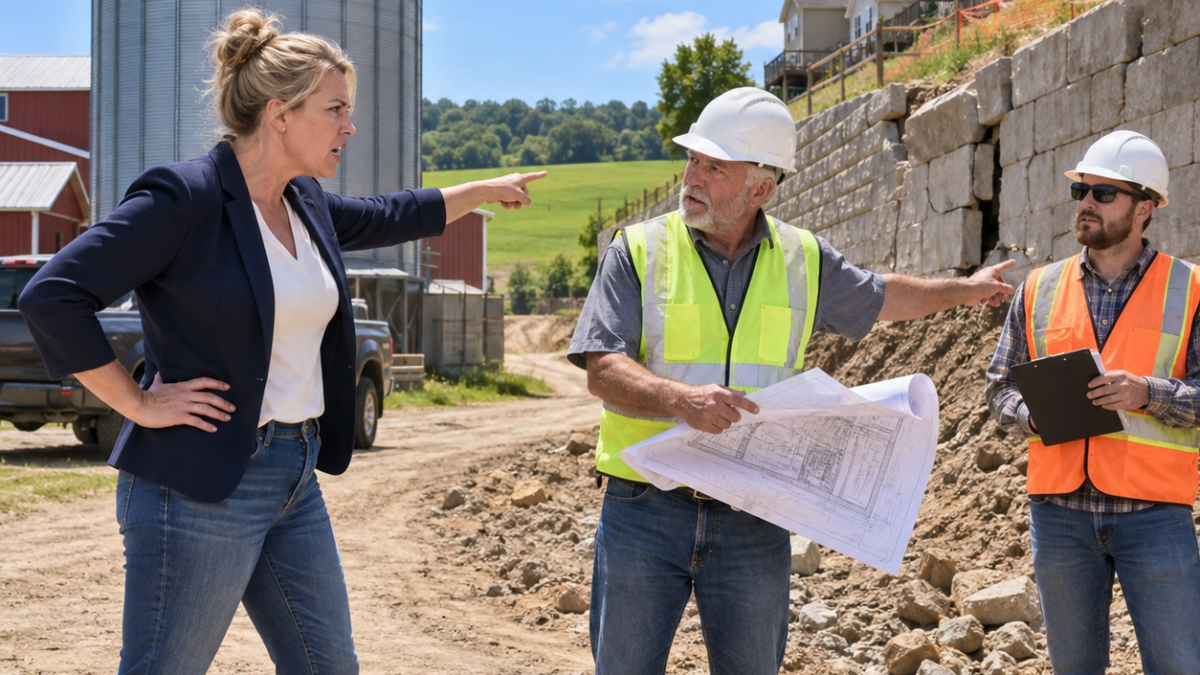
The woman standing in my driveway gave me thirty days to destroy the one thing I had spent years dreaming about rebuilding.
She called my seventy-year-old steel silo a deadly collapse risk, threatened me with $500-a-day fines, and promised the HOA would bury me in legal fees if I refused.
What she didn’t know was that I had spent twenty years learning exactly what happens when someone builds a threat on a foundation that can’t hold it.
My name is Marcus Thorne, and after two decades in the Army, I wanted exactly three things from retirement: ten quiet acres, work I could do with my own hands, and mornings where nobody told me where to be.
The old farmstead outside Willow Creek gave me all three.
The house needed work. The barn leaned enough to make a carpenter nervous. Half the fencing had disappeared into blackberry vines.
But none of that mattered.
The moment I saw the silo, I knew I wanted the property.
It rose sixty feet above the field, a corrugated-steel cylinder built in the early 1950s, weathered silver beneath streaks of rust but still straight against the sky.
Most buyers probably saw obsolete farm equipment.
I saw a home.
I planned to convert it into a three-story circular house with a spiral staircase, windows facing the valley, and a small observation room at the top where I could drink coffee while the sun came over the hills.
For the first time in years, I had a project that wasn’t about destruction.
Then Willow Creek Estates noticed me.
The development sat east of my property on a raised plateau filled with expensive homes, trimmed hedges, identical mailboxes, and lawns so perfect they looked vacuumed.
My land was not part of Willow Creek.
Never had been.
That detail apparently meant nothing to Karen Peterson.
She arrived one Tuesday morning in a white golf cart and stepped onto my gravel driveway holding a clipboard.
I was cleaning old grain residue from the silo when I heard her call.
“Mr. Thorne?”
I climbed down the ladder.
“That’s me.”
She didn’t introduce herself first.
She pointed directly at the silo.
“That structure is a hazard.”
I looked behind me as if another building had appeared overnight.
“My silo?”
“That rusty thing,” she said. “It violates community safety standards and creates an unacceptable risk to neighboring homes.”
I wiped my hands on my jeans.
“This property isn’t in your community.”
Her expression tightened.
“The Willow Creek HOA has authority over hazardous structures affecting the development.”
“According to who?”
She lifted the clipboard.
“Article Seven, Section Four-B of the original county charter.”
That sounded specific.
Specific enough to scare somebody who wouldn’t check.
She handed me a document printed on expensive paper beneath the Willow Creek Estates gold logo.
FINAL NOTICE OF CONDEMNATION AND INTENT TO LIEN.
The letter declared my silo structurally unsound and an imminent collapse hazard.
I had thirty days to demolish it.
If I refused, the HOA would impose a $500 daily penalty, place a lien against my property, and pursue legal action.
I read it twice.
Karen watched me with the calm confidence of someone expecting surrender.
“You really should cooperate,” she said. “These things become expensive.”
I folded the notice.
Then I looked at her.
“Who inspected the silo?”
Her smile flickered.
“We’ve reviewed the matter.”
“That wasn’t my question.”
“Our board has determined—”
“Is your board licensed in structural engineering?”
Her face reddened.
“You don’t get to interrogate me.”
“Actually, you’re standing on my property threatening to condemn my building. I think I get to ask whatever I want.”
She stared at me.
I stepped aside and pointed toward the road.
“Your HOA has no jurisdiction here. Take your golf cart and leave.”
“You have no idea who you’re dealing with,” she snapped. “We will bury you in legal fees.”
I’d heard threats delivered in much worse places by people capable of much worse things.
So I didn’t raise my voice.
I just said, “Leave.”
She finally turned and marched back to the golf cart.
I watched her drive toward Willow Creek until the dust settled.
Then I unfolded the condemnation notice again.
Article Seven, Section Four-B.
Something about it bothered me.
Not because it sounded dangerous.
Because it sounded invented.
That afternoon I made two calls.
The first was to the county records office.
The second was to a man named Dave Jensen, an engineer I’d trusted with my life overseas.
And before that week was over, one of those calls would prove Karen had lied.
The other would uncover something far more dangerous than anything she had accused me of owning.
PART 2
I drove to the county records office the next morning.
There are places where time seems to move differently, and county archives are one of them.
The records department occupied the basement of an old courthouse annex built sometime before air-conditioning became standard. Metal shelves disappeared beneath boxes of deeds, plats, zoning maps, handwritten ledgers, and rolled survey drawings. The room smelled like dust, paper, and the faint dampness of old stone.
A clerk named Evelyn sat behind a desk surrounded by file carts.
I slid Karen’s condemnation notice toward her.
“I need the original county charter.”
Evelyn adjusted her glasses.
“How original?”
“Original original.”
She glanced at the citation.
“Article Seven, Section Four-B?”
“That’s what I’m looking for.”
She raised one eyebrow.
“Interesting.”
That was the first indication something was wrong.
She disappeared into the archive room and returned fifteen minutes later carrying a flat archival box.
Inside was a certified reproduction of the 1922 county charter.
I spent the next two hours reading it.
Then I read it again.
There were six articles.
Not seven.
I asked Evelyn for every amendment adopted since 1922.
She brought another stack.
I read those too.
No Article Seven.
No Section Four-B.
Nothing remotely resembling the authority Karen claimed.
I leaned back in the wooden chair and stared at her letter.
It wasn’t a misunderstanding.
It wasn’t an obscure legal provision interpreted too broadly.
The citation simply did not exist.
Karen had put a fabricated law into an official-looking document, mailed it to me, threatened financial penalties, and demanded that I destroy my property.
I felt something cold settle inside me.
Anger is useful when you control it.
Uncontrolled anger makes you sloppy.
Controlled anger makes you thorough.
“Evelyn,” I said, “can I get certified copies of the charter and every amendment?”
She looked at the HOA letter again.
“You planning something?”
“I think somebody already planned something for me.”
She smiled faintly.
“I’ll make the copies.”
By lunchtime, I had enough paper to make Karen’s supposed legal authority disappear in under thirty seconds.
But I wasn’t ready to confront her.
Not yet.
Back home, I pulled Willow Creek’s covenants and restrictions from the county’s online property system.
Their boundaries were clearly defined.
Lot 1 through Lot 86.
Common park.
Community pool.
Clubhouse.
Private internal roads.
Perimeter landscaping.
My ten acres were outside the subdivision plat.
The HOA had as much authority over my silo as I had over Karen’s living-room curtains.
But another paragraph caught my attention.
The association was responsible for maintaining all common infrastructure, including perimeter fencing, drainage features, and retaining structures.
I read the sentence twice.
Then I printed it.
At the time, I didn’t know why.
Habit, maybe.
Twenty years in the military had taught me to save information before I knew whether I needed it.
Three days later, the second certified letter arrived.
NOTICE OF CONTINUING NONCOMPLIANCE.
Two days after that came another.
NOTICE OF PENDING ENFORCEMENT.
Karen was escalating without receiving a single response from me.
Then Sarah Whitmore called.
I had met Sarah once at the farm supply store. She was a retired schoolteacher in her late sixties who lived in Willow Creek and had apparently watched Karen turn HOA management into a personal empire over the previous few years.
“Marcus,” she said quietly, “I thought you should know what’s happening over here.”
“What happened?”
“She put your silo on the community bulletin board.”
I was silent.
Sarah sent me a photograph.
Someone had enlarged an image of my silo, drawn a red prohibition symbol over it, and placed it beneath the headline:
PROTECT WILLOW CREEK PROPERTY VALUES.
Below that, the notice referred to my property as a “hazardous adjoining site.”
I stared at the picture for a long time.
Sarah must have heard my breathing change.
“She’s telling everyone you’ve refused safety inspections,” she said.
“No one’s requested an inspection.”
“I know.”
“She said I’m refusing one?”
“At yesterday’s board meeting.”
I looked out the kitchen window toward the silo.
The afternoon sun was reflecting from its steel skin.
“Anything else?”
Sarah hesitated.
“She told people that if the silo falls, it could kill children in the neighborhood.”
That did it.
Not because I was afraid of what people thought of me.
I’d spent enough years in uniform to stop needing universal approval.
But Karen was deliberately turning fear into a weapon.
And fear spreads fast when somebody claims children are in danger.
“Thanks for telling me.”
“Marcus?”
“Yeah?”
“Don’t underestimate her.”
“I don’t.”
“She doesn’t like losing.”
I looked at the growing file on my kitchen table.
“Neither do I.”
Dave Jensen arrived four days later.
I heard his truck before I saw it.
A dark Ford F-450 rolled up my driveway carrying enough technical equipment to inspect a bridge, a dam, and probably a spacecraft.
Dave stepped out wearing work boots, faded jeans, and the same crooked grin he’d worn twenty years earlier when we’d both been young enough to believe bad coffee counted as hydration.
He opened his arms.
“Marcus Thorne.”
“Dave Jensen.”
We shook hands, then hugged.
He stepped back and looked toward the silo.
“So that’s the terrifying weapon threatening civilization?”
“Apparently.”
He walked toward it without saying anything else.
Dave had always been like that.
When he encountered a structure, the rest of the world disappeared.
He circled the silo slowly.
Touched the steel.
Studied the seams.
Looked upward.
Then he whistled.
“You didn’t tell me she was this pretty.”
I laughed.
“Karen used different language.”
“Karen doesn’t know steel.”
He knocked against the corrugated wall.
A deep metallic tone answered him.
“These old agricultural structures were overbuilt because nobody had modern simulation software telling them exactly how little material they could get away with. Farmers wanted something that would survive fifty winters, windstorms, grain loads, vibration, and whatever else happened.”
He stepped back.
“If this thing has foundation problems, we’ll find them. If it has dangerous corrosion, we’ll find that too.”
“And if it doesn’t?”
His grin returned.
“Then we’re going to make your HOA president regret learning the phrase structural hazard.”
Dave had brought an assistant named Carlos Mendoza, a young engineer with the kind of quiet concentration that reminded me of Dave twenty years earlier.
They started at the foundation.
The silo sat on a massive concrete ring extending beneath the soil.
Dave ran ground-penetrating radar around the entire base.
I watched the screen even though I understood only half of what I was seeing.
“Anything?”
“No voids.”
He pushed the unit another ten feet.
“No major cracking.”
Another pass.
“No evidence of erosion below grade.”
He looked at me.
“Whoever built this foundation expected Judgment Day.”
“That’s good?”
“That’s extremely good.”
Next came the steel.
Carlos climbed with a harness and began taking ultrasonic measurements every few feet around the circumference and at multiple elevations.
Dave recorded the readings.
“Point four nine.”
Carlos moved.
“Point five zero.”
Another location.
“Point four eight seven.”
Dave shook his head.
“This is ridiculous.”
My stomach tightened.
“Ridiculous bad?”
“Ridiculous good. Seventy years outside and you’ve barely lost measurable thickness.”
They inspected seams, fasteners, roof connections, and support components.
Then they set up a three-dimensional laser scanner on a tripod.
The machine rotated slowly, collecting millions of points.
By late afternoon, Dave had enough data to create a precise digital model.
He stood beside his truck reviewing numbers while Carlos packed equipment.
Finally, he closed the tablet.
“Marcus.”
I waited.
“Your silo is fine.”
“How fine?”
“If you want professional language, I’ll put it in the report.”
“I want Dave language.”
He looked toward Willow Creek.
“If a serious windstorm hit tonight and I had to choose between sheltering inside that silo or inside one of those decorative suburban houses, I’d choose the silo.”
I exhaled.
I hadn’t realized how much tension I was carrying until that moment.
Even when you know someone is lying, part of you wonders whether they might accidentally be right.
Buildings age.
Steel corrodes.
Foundations shift.
Karen had forced a question into my mind that hadn’t existed before she appeared.
Dave erased it.
“Can you certify that?”
“I can certify considerably more than that.”
He slapped the tablet against his palm.
“You’ll get a complete stamped report. Testing methods, measurements, structural calculations, corrosion analysis, foundation scan, the whole package. If anyone wants to call this thing an imminent collapse risk after reading it, they’ll need to bring an engineer willing to destroy his professional reputation.”
“That’s what I needed.”
“We’ll make it bulletproof.”
We opened two beers and leaned against the truck as evening settled across the farm.
For the first time since Karen had entered my driveway, I felt myself relax.
Then Dave stopped talking.
His beer remained halfway to his mouth.
“What?”
He was looking beyond me.
Not at the silo.
At Willow Creek.
The development had been built on land graded roughly fifteen feet above mine.
A retaining wall ran almost five hundred feet along the property line, holding back the elevated yards.
It looked expensive.
Cultured stone.
Decorative pillars.
Ornamental lanterns.
Perfectly landscaped shrubs along the top.
Karen reportedly called it the Great Wall of Willow Creek.
Dave put down his beer.
“How old is that wall?”
“Maybe four years.”
His eyes narrowed.
“Who designed it?”
“No idea.”
He began walking.
I followed him.
Twenty feet from the wall he crouched.
“See those dark lines?”
I looked.
Thin vertical stains ran down sections of stone.
“Water?”
“Exactly.”
He moved closer.
“See any drainage openings?”
I scanned the wall.
“No.”
“Neither do I.”
He walked another thirty feet.
Then another.
His posture changed.
I’d seen that posture before.
Dave had used it overseas while inspecting a bridge after an explosion.
The man I had been drinking beer with disappeared.
The engineer took over.
He placed his hand against the stone and looked upward.
“Marcus, this wall is retaining an enormous amount of fill.”
“I assume that’s what retaining walls do.”
“Yeah. But retaining walls this large don’t survive because they’re pretty. They survive because water pressure is managed behind them.”
He pointed toward another stain.
“This wall is weeping through the face.”
“Meaning?”
“Meaning water is trapped behind it.”
He stepped sideways.
Then stopped.
“Come here.”
I joined him.
“What am I looking at?”
“The alignment.”
I stared.
It looked straight.
Dave retrieved a long level from his truck.
When he pressed it against the wall, a gap appeared.
Half an inch.
Maybe slightly more.
“The face is bowing outward.”
I felt a knot forming in my stomach.
“How bad?”
“I don’t know yet.”
He scanned another section.
“Tomorrow I’m inspecting this.”
“You’re supposed to be writing my report.”
“I am.”
He looked at the wall again.
“But your silo can wait twenty-four hours.”
The next morning, Dave returned before seven.
Carlos came with him.
They spent hours documenting the wall from my side of the boundary.
High-resolution photographs.
Laser measurements.
Thermal imaging.
Elevation readings.
Crack mapping.
Every hour Dave grew quieter.
At one point he stood motionless staring at the thermal camera.
“What do you see?” I asked.
He rotated the screen toward me.
Cold streaks appeared behind the stone facing.
Large irregular blue areas spread near the bottom.
“Water.”
“How much?”
“More than should ever be there.”
He pointed at the image.
“Those are saturated pockets. There should be a drainage system relieving pressure. Perforated pipe. Gravel backfill. Weep outlets. Something.”
“And there isn’t?”
“I can’t prove what exists inside without excavation. But whatever drainage they installed isn’t functioning.”
He walked to the section that had bowed outward.
“Look at the cracking.”
Hairline fractures crossed multiple joints.
“The fill behind this wall gets heavier when saturated. Think about soil turning partly into a fluid load.”
“Like mud pushing against a dam.”
“Exactly.”
“And the wall is losing?”
Dave didn’t answer immediately.
That worried me more than anything.
He took more measurements.
Entered numbers into his notebook.
Called someone at his office and discussed local soil composition.
Checked rainfall history.
Ran calculations.
Then he finally closed the notebook.
“Marcus, we need to talk.”
We sat on the tailgate.
His voice was different now.
Not dramatic.
That made it worse.
“This wall has multiple visible indicators of progressive structural distress. The drainage is either inadequate, clogged, or nonexistent. The face is deforming. We have water migration. We have cracking consistent with lateral soil pressure.”
“How serious?”
“Very.”
“My property?”
“If the wall goes, your silo is far enough back that I wouldn’t expect direct impact.”
“My workshop?”
He looked toward the building.
“Different story.”
The workshop sat much closer.
My driveway crossed the lower portion of the property.
“So I’m going to lose half my front yard?”
“If it fails catastrophically, you’re looking at tons of stone and saturated soil coming downhill.”
I looked at the homes above it.
Several backyards extended almost to the wall.
Swimming pools.
Patios.
Outdoor kitchens.
Children’s play equipment.
“What happens to them?”
Dave followed my eyes.
“That’s what concerns me most.”
He stood and pointed.
“The wall isn’t just protecting your land from their fill. It’s supporting the edge of their plateau.”
The implications hit me.
“If it fails underneath those yards—”
“They go with it.”
“How much warning?”
“Impossible to predict precisely without invasive testing.”
“Best estimate.”
Dave frowned.
“Don’t make decisions based on a casual estimate.”
“I won’t.”
He looked at the wall again.
“If the deformation is progressing at the rate it appears to be, and you get a wet winter followed by sustained spring storms…”
He paused.
“Six months.”
I stared at him.
“Six?”
“Could be eight. Could be longer. Could be less if conditions deteriorate.”
“Is it going to fail?”
“In my professional judgment?”
“Yes.”
He looked directly at me.
“Unless something changes, this wall is failing.”
For several seconds I heard nothing but wind moving through the grass.
Karen had walked onto my property accusing my silo of being a threat.
She had publicly called me irresponsible.
She had told families I was risking their children.
And while she was doing it, a genuine structural hazard sat beneath their own backyards.
“You’ll put that in writing?”
“I’ll prepare a preliminary assessment.”
“Stamped?”
“Yes, but I’m going to make the limitations very clear. I haven’t opened the wall. I haven’t reviewed the design drawings. I haven’t inspected the footing directly.”
“But you’ve seen enough?”
“More than enough to recommend immediate investigation.”
I walked toward the silo and looked back at Willow Creek.
My anger changed in that moment.
Until then, this had been personal.
My land.
My building.
My rights.
Now there were families involved who had no idea what was beneath them.
Some of them probably believed Karen’s lies about me.
That didn’t matter.
A collapsing retaining wall doesn’t ask how somebody voted at an HOA meeting.
It doesn’t care who insulted whom online.
Gravity doesn’t hold grudges.
I called Frank Miller that afternoon.
Frank was a real estate litigator with an office downtown and a reputation for turning property disputes into forensic examinations.
He listened without interrupting while I told him about Karen’s condemnation notice.
When I finished, he said, “Bring everything.”
Two days later, I sat across from his desk.
Karen’s letters occupied one side of the conference table.
The certified county charter sat beside them.
Willow Creek’s governing documents were next.
Then Dave’s report on the silo.
One hundred fifty pages.
Stamped.
Signed.
Indexed.
Frank read the executive summary.
He flipped several pages.
Read the testing methodology.
Studied the conclusions.
A smile appeared.
“This is excellent.”
“Good.”
“No, Marcus. You don’t understand. This is not good. This is devastating.”
He tapped the report.
“They accuse you of an imminent structural hazard with no inspection. You respond with a licensed engineer, instrumented testing, foundation imaging, ultrasonic steel measurements, three-dimensional scanning, and a certified conclusion.”
He leaned back.
“They have nothing.”
I slid the county charter toward him.
“There’s more.”
He read Karen’s citation.
Then the certified charter.
Then he looked at me.
“There is no Article Seven.”
“No.”
He laughed once.
Not because it was funny.
Because it was unbelievable.
“She invented a county law.”
“That’s what it looks like.”
“Did she mail this?”
“Certified mail.”
He looked at the envelope.
“Interesting.”
His expression hardened.
“Very interesting.”
“What does that mean?”
“It means we’re going to preserve every document.”
He began organizing the papers.
“Fraudulent legal threats sent through the mail can create serious problems depending on intent and circumstances. At minimum, this strengthens your harassment case substantially.”
Then I placed Dave’s second report on the table.
Frank looked at the cover.
PRELIMINARY STRUCTURAL ASSESSMENT — WILLOW CREEK PERIMETER RETAINING WALL.
“What is this?”
“The reason Dave stayed an extra day.”
Frank opened it.
He read slowly.
Ten minutes passed.
Then fifteen.
His smile disappeared.
When he reached the photographs of the bowed sections and thermal images, he leaned closer.
Finally, he looked up.
“Is this wall owned by the HOA?”
“Their governing documents say perimeter retaining structures are common infrastructure.”
Frank read that clause.
Then looked back at the engineering report.
“Who commissioned the wall?”
“According to Sarah, Karen pushed the project after becoming president.”
“How much?”
“I don’t know.”
Frank stood and walked to the window.
“Marcus, this changes everything.”
“How?”
“Your silo dispute is irritating. Their wall is potentially catastrophic.”
He turned.
“If this fails and damages homes, injures someone, or destroys your property, every person involved is going to ask one question.”
“What did the HOA know?”
“And when did they know it?”
“Exactly.”
I leaned back.
“What do you recommend?”
“First, you protect yourself. Dave’s assessment should be transmitted to the proper county authority so nobody can later claim you discovered a hazard and concealed it.”
“Agreed.”
“Second, we respond to Karen regarding the silo.”
He began pacing.
“We do not mix these issues immediately.”
“Why?”
“Because right now she believes she owns the battlefield.”
I understood.
“You want her to commit.”
“I want the record to become clear.”
He stopped pacing.
“We send a formal cease-and-desist regarding your property. We attach the engineering report proving the silo is safe. We attach the certified charter proving her cited authority doesn’t exist. We give the HOA an opportunity to withdraw every claim.”
“And if she does?”
“Then your silo dispute ends.”
“You think she will?”
Frank looked at me.
“Do you?”
I thought of Karen standing in my driveway.
The golf cart.
The clipboard.
The promise to bury me.
“No.”
“Neither do I.”
Frank prepared the letter.
It was five pages long and almost painfully polite.
It informed Willow Creek Estates that my property was outside HOA jurisdiction.
It included the actual subdivision boundary.
It documented the nonexistent county citation.
It attached Dave’s structural assessment.
It demanded immediate withdrawal of the condemnation notice, termination of all fines, correction of any records suggesting a lien, and a written public retraction of statements characterizing my silo as unsafe.
Deadline: ten days.
Frank sent it by registered mail.
Then we waited.
The first three days passed.
Nothing.
Day five.
Nothing.
Day eight.
Sarah called.
“She is furious.”
“What happened?”
“She read your lawyer’s letter at a closed board session.”
“How do you know?”
“One of the board members told his wife. His wife told me.”
Small communities have information networks military intelligence officers could only dream of.
“What did Karen say?”
“That your engineer was hired to tell you what you wanted to hear.”
I almost laughed.
“Anything else?”
“She wants a special meeting.”
Frank had predicted it.
“For what?”
“To authorize enforcement.”
“Against property they don’t control?”
“That’s what two board members asked.”
“And?”
“She told them backing down would destroy the association’s credibility.”
There it was.
Not safety.
Credibility.
Not engineering.
Power.
A person who has built authority around never being challenged eventually becomes incapable of distinguishing compromise from humiliation.
Karen couldn’t withdraw because the issue was no longer my silo.
It was her identity.
Day ten passed.
No retraction.
On day eleven, a certified letter arrived.
NOTICE OF SPECIAL COMMUNITY MEETING.
The agenda contained one major item:
WILLOW CREEK SAFETY INITIATIVE — ENFORCEMENT ACTION REGARDING HAZARDOUS ADJOINING STRUCTURE.
I called Frank.
“She did it.”
“I know.”
“How?”
“She sent my office a copy.”
He sounded almost amused.
“You ready?”
“For the meeting?”
“For the part after the meeting.”
Karen spent the following week preparing the neighborhood.
Sarah forwarded me emails.
One described my silo as an “uncontrolled structural threat.”
Another said I had “rejected community safety efforts.”
She shared a news article about an unrelated grain silo collapse hundreds of miles away.
The structure in the article was not remotely comparable to mine.
Different construction.
Different condition.
Different failure mechanism.
It didn’t matter.
Fear rarely stops to study engineering details.
I received anonymous messages.
One said:
TEAR IT DOWN BEFORE SOMEONE DIES.
Another:
WHY DO YOU HATE THIS COMMUNITY?
The strangest part was that I had never met most of these people.
They knew me only through Karen’s version of me.
Sarah apologized for the messages.
“Don’t,” I said.
“They’re scared.”
“Because she made them scared.”
“I know.”
“Then save your anger for the person creating the fear.”
My Army friends heard what was happening.
Mike Alvarez, who owned a plumbing company, called first.
“You going to that meeting?”
“Yes.”
“I’ll be there.”
“You don’t have to.”
“I know.”
Then Nate Brooks, a firefighter.
Then Tom Ellis, a history teacher.
By Friday, I had three men volunteering to sit beside me.
I told them the same thing.
“No arguments. No shouting. No intimidation.”
Mike laughed.
“So basically don’t behave like you used to.”
“Exactly.”
Frank spent Saturday preparing packets.
Each board member would receive Dave’s silo report summary.
The certified charter.
The subdivision map.
Then, behind a colored divider, the retaining-wall assessment.
Frank also created a large satellite image of Willow Creek showing the wall and the houses closest to the failure zone.
“You called the county?” I asked.
“This morning.”
“And?”
“They took Dave’s report seriously.”
“Are they coming?”
Frank shrugged.
“They didn’t make promises.”
I looked at him.
“You know something.”
“I know government offices move much faster when a licensed engineer uses phrases like potential catastrophic failure.”
The meeting was Monday evening.
Willow Creek’s clubhouse looked exactly like I expected.
Beige walls.
Framed photographs of neighborhood landscaping.
A trophy case from community holiday competitions.
The smell of chlorine drifting in from the indoor pool.
Every folding chair was occupied.
People stood along the walls.
I counted more than a hundred residents.
A local television crew had set up near the back.
That surprised me.
Sarah met me at the door.
“Karen invited them.”
“Of course she did.”
“She wants the evening news to show her protecting the neighborhood.”
Frank appeared beside me.
“Then we should make sure they receive accurate information.”
My three Army friends sat in the front row.
We joined them.
Karen sat at a long table with four board members.
She wore a navy blazer and had arranged stacks of documents in front of her.
When she saw me, she stopped talking.
Our eyes met.
She smiled.
Not warmly.
Confidently.
She believed the room belonged to her.
The meeting began at seven.
Karen struck the gavel.
“Thank you all for coming to this emergency session concerning an urgent matter of community safety.”
I almost admired the performance.
Her voice was measured.
Concerned.
Presidential.
She spoke about Willow Creek’s families.
Property values.
Responsibility.
Children playing in backyards.
Then she displayed a photograph of my silo on a projector screen.
“This deteriorating industrial structure,” she said, “stands immediately adjacent to our community.”
Immediately adjacent was doing a lot of work in that sentence.
She continued.
“We attempted repeatedly to resolve this issue privately.”
I heard Mike shift in his chair.
I placed one hand on his arm.
No reaction.
Not yet.
Karen held up the condemnation letter.
“Mr. Thorne has responded with hostility and legal threats rather than cooperation.”
That was almost impressive.
Her HOA had threatened me with a lien on property they didn’t govern, and somehow my lawyer’s request to stop was the threat.
She continued for nearly twenty minutes.
Then she made the mistake Frank had been waiting for.
“We consulted knowledgeable parties regarding this structure,” she said, “and the danger is real.”
Frank looked at me.
He didn’t smile.
He didn’t need to.
The statement had entered the meeting record.
Finally, Karen turned toward me.
“Mr. Thorne has requested an opportunity to speak.”
I hadn’t.
But I stood anyway.
She folded her arms.
“Please keep your remarks brief.”
I carried my folder to the podium.
The room quieted.
I looked at the residents.
Some appeared angry.
Some worried.
Some curious.
A few looked embarrassed already.
“My name is Marcus Thorne.”
My voice sounded louder than I expected through the microphone.
“I own the ten-acre farm directly west of Willow Creek Estates.”
I paused.
“My property is not part of your HOA.”
A few people murmured.
Karen started to interrupt.
Frank raised one finger from his seat.
She stopped.
“I served twenty years in the Army, much of that time working around engineering and infrastructure.”
I glanced toward Dave’s report.
“When your HOA president told me my silo was dangerous, I did what responsible property owners should do.”
I lifted the report.
“I hired an expert.”
I explained Dave’s credentials.
Then the tests.
Ground-penetrating radar.
Ultrasonic steel measurements.
Three-dimensional laser scanning.
Foundation assessment.
Corrosion inspection.
I kept the technical language simple.
“This report is one hundred fifty pages long. It is signed and stamped by a licensed professional engineer.”
I opened to the conclusion.
“The silo is structurally sound. It presents no credible collapse risk under normal or reasonably foreseeable conditions.”
Silence.
I handed copies to the board.
One member immediately began reading.
Karen didn’t touch hers.
She leaned toward her microphone.
“Our own experts disagree.”
Frank stood.
“Could you identify those experts for the record?”
Heads turned.
Karen stared at him.
“And you are?”
“Frank Miller, counsel for Mr. Thorne.”
Her expression changed.
Slightly.
“I’m not going to turn this meeting into a courtroom.”
Frank sat.
I looked at Karen.
“Then just give everyone the name of the engineer.”
She didn’t answer.
The treasurer looked at her.
Another board member leaned toward her and whispered.
I continued.
“Your president also claims this HOA has authority under Article Seven, Section Four-B of the county charter.”
I lifted the certified copy.
“I went to the records office.”
I opened it.
“The county charter has six articles.”
A laugh escaped somewhere in the back.
Then another.
Karen’s face tightened.
“There is no Article Seven.”
The room changed.
You can feel the moment a crowd stops watching a dispute and starts reconsidering who has been telling the truth.
I held up the letter.
“The legal authority used to threaten fines, liens, and demolition does not exist.”
A man near the aisle called out.
“Karen, where did you get that citation?”
She struck the gavel.
“Please maintain order.”
“Answer him,” someone else said.
She struck the gavel again.
I waited until the room quieted.
“My silo is safe.”
I looked around.
“My property is outside your association.”
Then I looked toward the families seated near the front.
“And if that were all I came here to say, I’d sit down now.”
Frank stood and carried the large covered presentation board to me.
Karen watched him.
For the first time that evening, she looked uncertain.
I removed the cover.
The satellite image appeared.
“This is Willow Creek Estates.”
I pointed at the western boundary.
“This is your retaining wall.”
Several residents turned in their seats as though they could see it through the clubhouse windows.
“During the inspection of my silo, my engineer noticed visible defects in that wall.”
Karen laughed sharply.
“Oh, please.”
I turned toward her.
“You may want to read the second section of your packet.”
The board members flipped past the colored divider.
The treasurer’s face changed first.
Then the vice president’s.
One woman covered her mouth.
Karen stared at them.
“What?”
Nobody answered.
I continued.
“The engineer documented outward bowing.”
I displayed a photograph.
“Cracking.”
Another image.
“Water migration.”
Another.
“Evidence of significant trapped moisture.”
Another.
“These are not cosmetic issues.”
A man in the audience stood.
“What does that mean?”
“It means the soil behind the wall is becoming saturated, and the wall does not appear to be relieving the resulting pressure properly.”
“How dangerous?”
That was the question.
I looked at Frank.
Then back at the audience.
“The preliminary professional assessment recommends immediate investigation because the wall shows indicators consistent with progressive structural failure.”
Karen jumped from her chair.
“This is retaliation!”
The microphone amplified her voice throughout the room.
“You couldn’t intimidate us with your lawyer, so now you’re inventing problems with our property.”
I waited.
Frank had told me to remain calm.
He had been right.
Every time Karen shouted, I became more credible simply by not shouting back.
“I didn’t inspect your wall,” I said.
“A licensed engineer did.”
“He works for you!”
“Yes.”
“And you’re paying him!”
“Yes.”
She threw both hands outward.
“There! You see?”
A woman near the back called out.
“Karen, didn’t you just say your HOA consulted experts about his silo?”
Karen froze.
The woman continued.
“Who did you pay?”
More murmurs.
Karen struck the gavel.
I turned back to the satellite image.
“The engineer’s concern isn’t primarily about my property.”
That quieted them.
I pointed to four homes along the edge of the plateau.
“If the wall fails in the section showing the greatest deformation, these properties could lose significant portions of their rear yards.”
A woman gasped.
One man stood so quickly his chair fell backward.
“That’s my house.”
I looked at the map.
“Lot forty-two?”
“Yes.”
His wife grabbed his arm.
“Are you telling me our pool could collapse?”
“I am telling you a licensed structural engineer believes the retaining system requires immediate professional evaluation.”
“What timeline?”
I hated answering that question.
Dave had warned me about false precision.
“The report does not assign an exact failure date.”
Karen spread her hands triumphantly.
“Because it’s nonsense.”
I continued.
“Based on observed deformation, regional soil behavior, and likely seasonal rainfall loading, the engineer advised me privately that six months could become a critical window if wet conditions continue.”
The clubhouse erupted.
People stood.
Questions flew from every direction.
“Six months?”
“Who built that wall?”
“Was it inspected?”
“What did we pay for it?”
“Karen!”
“Where are the permits?”
Karen hammered the gavel until the sound became meaningless.
Then the clubhouse doors opened.
Two men wearing county jackets walked inside.
A third followed carrying a hard equipment case.
The room slowly quieted.
The first man raised identification.
“Ronald Fields. Chief county building inspector.”
Nobody moved.
“We received documentation from a licensed professional engineer indicating a potentially hazardous retaining structure on this property.”
Karen looked toward Frank.
Frank remained expressionless.
Fields continued.
“We’re here to conduct an initial site assessment and determine whether emergency restrictions are necessary.”
The room exploded again.
The news cameraman turned immediately toward Karen.
The reporter moved closer.
“Ms. Peterson, was the retaining wall properly permitted?”
Karen stepped away from the table.
“This meeting is being hijacked.”
Fields looked at her.
“Are you the association president?”
“Yes.”
“We’ll need access to all construction plans, permits, contractor records, engineering documents, and inspection certifications related to the western retaining wall.”
“They’re not here.”
“Where are they?”
“I’d have to check.”
“Who was the engineer of record?”
Karen hesitated.
The treasurer looked at her.
“Karen?”
She turned.
“What?”
“Who was the engineer?”
“I don’t remember.”
The vice president leaned into his microphone.
“You handled the project.”
“Don’t start.”
“You told us it was fully permitted.”
“It was.”
Fields opened a notebook.
“Then the county will have records.”
Karen said nothing.
The room went silent.
That silence destroyed more of her authority than anything I had said.
Fields and his team inspected the wall that same evening.
They started near the section Dave had identified.
Residents followed at a distance until the inspector ordered them back.
Temporary barriers went up before ten o’clock.
Four backyards were declared restricted pending geotechnical evaluation.
The Hendersons were told not to use their pool.
The Clarks had to remove their children from a play area near the edge.
The Miller family voluntarily stayed with relatives for several nights.
I stood on my side of the property watching yellow county tape flutter beneath Willow Creek’s ornamental lanterns.
Sarah came down to the boundary.
She looked exhausted.
“You knew the inspectors were coming.”
“I knew they had the report.”
“Karen thinks you planned to humiliate her.”
“I planned to protect my property.”
Sarah looked toward the wall.
“And this?”
“This isn’t about Karen anymore.”
That was the truth.
The situation had moved beyond revenge.
If Dave was correct, lives and homes were involved.
The county brought in a geotechnical engineering firm two days later.
They drilled test borings behind the wall.
Opened several locations.
Used cameras.
Inspected drainage.
Measured reinforcement.
By noon on the second day, one of the engineers crossed the field to speak with Dave and me.
His name was Dr. Alan Reeves.
He removed his hard hat.
“Your preliminary assessment was conservative.”
Dave’s expression hardened.
“How bad?”
Reeves looked toward the exposed section.
“The footing is undersized.”
Dave nodded.
“Reinforcement?”
“Grossly inadequate.”
“Drainage?”
Reeves gave a humorless laugh.
“What drainage?”
I stared at him.
“There’s none?”
“There are short sections of perforated pipe behind portions of the wall, but they don’t connect to a functioning outlet system. In some places they’re crushed. In others they were installed above the zones where water is accumulating.”
Dave swore under his breath.
Reeves continued.
“The backfill is also wrong. Too much fine soil directly against the structure.”
“What happens now?” I asked.
“The county will issue a formal order.”
“To repair it?”
Reeves shook his head.
“I wouldn’t repair this.”
“Why?”
“Because you’d be trying to reinforce a defective system that was never properly designed in the first place.”
Dave folded his arms.
“So full replacement.”
“Full replacement.”
The county’s written order arrived the following afternoon.
The retaining wall was declared unsafe.
The HOA was required to stabilize the affected area immediately and submit an engineered demolition-and-replacement plan.
Estimated cost: $1.2 million.
Willow Creek had nowhere near that amount in reserves.
Sarah called me the night the figure became public.
“You should see the clubhouse.”
“I’ve seen enough of that clubhouse.”
“People are losing their minds.”
“I imagine.”
“The board called another emergency meeting.”
I hesitated.
“Are you going?”
“No.”
“Marcus.”
“This one belongs to you.”
“What does that mean?”
“It means the residents need to decide what kind of community they want after this. I’m not a member.”
She was quiet.
Then she said, “Fair.”
The second meeting lasted nearly four hours.
Sarah told me about it the next morning.
Karen tried to blame the contractor.
Then the board.
Then “unexpected groundwater.”
Then county regulators.
Finally, the treasurer produced the original project invoices.
That changed everything.
The retaining wall had cost much more than several board members remembered approving.
Frank obtained copies during discovery after filing my civil claim.
One vendor appeared repeatedly.
Cedar Ridge Development Services LLC.
The company had received nearly $600,000.
Frank stared at the paperwork in his office.
“You ever heard of them?”
“No.”
He typed the name into the state corporate database.
A minute later he stopped.
“Well.”
“What?”
“Registered agent is Lawrence Peterson.”
The surname made me sit forward.
“Karen’s husband?”
“No.”
He clicked another record.
“Cousin.”
I stared at the screen.
“What does the company do?”
“According to the filing? General development consulting.”
“Engineering license?”
“None.”
“Contractor license?”
Frank searched.
His eyes narrowed.
“Expired before the wall project.”
That was when the HOA’s problem stopped being a construction failure and became an investigation.
The new temporary board retained a forensic accountant.
Bank records revealed payments routed through Cedar Ridge.
Invoices billed for reinforced concrete that inspectors couldn’t find.
Drainage materials billed in quantities far beyond what had actually been installed.
Engineering consultation fees paid to a consultant who denied working on the project.
At least one document contained what appeared to be a copied professional seal.
Karen’s cousin had received the contract without competitive bidding.
And according to the board minutes, Karen had repeatedly assured directors that every technical requirement had been satisfied.
I didn’t celebrate.
Not then.
The Henderson family was still afraid to use half their property.
The HOA was facing a massive special assessment.
People who had done nothing wrong were about to pay for decisions they didn’t make.
That part bothered me.
One evening I found Sarah standing at the boundary looking at the excavation.
“Residents are furious with you,” she said.
I nodded.
“I expected that.”
“Not all of them.”
“Enough.”
“They’re scared about the assessment.”
“So would I be.”
She turned toward me.
“Ten thousand dollars per house, maybe more.”
I looked at the construction machinery.
“That’s a lot of money.”
“They think if you hadn’t brought the report—”
“The wall wouldn’t be dangerous?”
She sighed.
“No.”
“It would just be dangerous without anybody knowing.”
“I know.”
“Sarah, if that wall had collapsed after the next heavy rain, the assessment would be the smallest problem anybody had.”
“I know.”
Her voice cracked slightly.
I looked at her.
She wiped beneath one eye.
“I’m tired, Marcus.”
The anger in me softened.
She wasn’t Karen.
She was a woman who had spent twenty years in that neighborhood and now watched neighbors turn against each other.
“I didn’t want this,” I said.
“I know.”
“I wanted my silo left alone.”
“I know.”
“And once Dave found the wall, I couldn’t pretend I hadn’t seen it.”
She nodded.
“I know that too.”
We stood quietly.
Then Sarah laughed weakly.
“You say ‘I know’ a lot for a retired teacher.”
“You say it enough when people keep explaining things you already understand.”
That got a real laugh from her.
For the first time since the meeting, something felt normal.
Three weeks later, Willow Creek formally removed Karen as president.
The vote wasn’t close.
The board also terminated every enforcement action against me.
Their attorney sent Frank a letter acknowledging that the HOA had no jurisdiction over my property.
Frank called.
“They want to settle.”
“My case?”
“Yes.”
“What are they offering?”
“Legal fees. Engineering expenses. Written retraction. Formal apology.”
“And Karen?”
“Separate issue.”
“What do you mean?”
“The association’s insurer is taking the position that intentional misconduct may not be covered.”
I leaned back.
“So they’re going after her personally.”
“The HOA is exploring recovery against everyone involved in the wall project.”
“Good.”
Frank paused.
“Marcus.”
“What?”
“Don’t confuse justice with enjoying somebody else’s destruction.”
I almost laughed.
“You telling me that?”
“I bill by the hour. Occasionally I dispense wisdom for free.”
I thought about Karen’s first visit.
The threat in my driveway.
The fake law.
The public notices.
“I don’t need her destroyed.”
“What do you need?”
“My name cleared.”
“That will happen.”
“My silo protected.”
“Done.”
“And the people she scared need to know she lied.”
Frank nodded.
“That too.”
“Then settle.”
We did.
The HOA reimbursed every dollar I had spent defending myself.
Dave’s inspection.
Frank’s legal fees.
County record costs.
Everything.
They issued a written statement acknowledging that the silo had been professionally evaluated and found structurally sound.
They withdrew every accusation.
They removed the photograph from the community bulletin board.
And they published an apology.
I kept a copy.
Not framed.
Not displayed.
Just filed.
Evidence belongs in files.
Dreams belong somewhere else.
Karen’s situation continued to deteriorate.
The district attorney began reviewing the retaining-wall contracts after the county forwarded the irregularities.
Investigators interviewed board members.
Then contractors.
Then vendors.
The postal threats against me became part of a broader inquiry into whether false representations had been intentionally used to pressure me financially.
Frank warned me not to expect dramatic television justice.
“Real investigations are slow,” he said.
“They don’t end with somebody shouting ‘gotcha’ in a courtroom.”
“Good.”
“Good?”
“I’ve had enough shouting.”
Months passed.
Demolition began on the wall.
Watching it come apart was unsettling.
Workers removed the decorative stone first.
Behind it was the reality Dave had suspected.
Inconsistent concrete.
Poor reinforcement.
Improvised drainage.
Sections where the wall looked substantial from the front but had shockingly little structural depth behind the facade.
Dave visited during demolition.
He stood beside me with his hands on his hips.
“Lipstick on a pig.”
“Expensive lipstick.”
“Very.”
He pointed toward exposed soil.
“See that wet zone?”
A dark band ran through the earth.
“All that water was loading the wall.”
“How close was it?”
He considered the question.
“Closer than I’d like.”
“To collapse?”
“Yes.”
“Six months?”
“Could have been.”
I looked at him.
“You really think it would have gone?”
“Marcus, engineering doesn’t care about drama. Structures fail when loads exceed capacity. That wall was progressing toward that point.”
He kicked a clump of soil.
“One long wet season could have done it.”
I imagined the Henderson children playing near their pool.
The workshop buried beneath mud.
Emergency crews in the rain.
Then I looked at my silo.
Still standing.
Karen had called it the dangerous structure.
The irony no longer made me smile.
It made me grateful Dave had looked sideways at the right moment.
The cost of Willow Creek’s replacement wall climbed.
$1.2 million became $1.35 million.
Then $1.48 million after engineers discovered additional soil stabilization was necessary.
The new design was nothing like the old one.
Deep engineered footing.
Reinforced concrete.
Proper geogrid.
Drainage aggregate.
Perforated collection systems.
Inspection ports.
Documented compaction testing.
The kind of infrastructure nobody notices when it’s done correctly.
Sarah won election to the new board.
She hated campaigning.
Which was one reason people trusted her.
Her first act was to create financial transparency rules.
Any major contract required competing bids.
Any structural project required independent professional review.
Any expenditure above $5,000 required broader approval unless it involved a documented emergency.
Board records became accessible online.
No president could sign a major construction contract alone.
One afternoon she walked to my side of the property carrying two coffees.
“I brought a peace offering.”
“I thought cookies were the official Willow Creek currency.”
“We’re reforming.”
I accepted the cup.
“How’s democracy?”
“Exhausting.”
“Better than dictatorship?”
“Ask me after budget season.”
We sat on overturned buckets near the silo.
She looked up.
“When are you starting?”
“The conversion?”
“Yes.”
“Next month.”
Her face brightened.
“Finally.”
That word hit me harder than expected.
Finally.
For almost a year, my dream had been frozen beneath legal letters, engineering reports, meetings, lawyers, investigators, and construction warnings.
I had spent so much time defending the right to build my home that I had stopped building it.
“I already ordered the windows.”
“Good.”
“Spiral staircase arrives in six weeks.”
“Good.”
“Dave reviewed the structural modifications.”
“Of course he did.”
“He threatened to disown me if I cut steel without calling him.”
Sarah smiled.
“You have good friends.”
I looked toward Willow Creek.
“I found a few over there too.”
She understood what I meant.
Not every neighbor had apologized.
Some never did.
But many came over.
The Hendersons brought a pie.
Mr. Clark helped me move lumber one afternoon.
The Miller family’s teenage son asked if he could see inside the silo because he wanted to study architecture.
One Saturday, six Willow Creek residents showed up carrying tools.
Mike, Nate, and Tom arrived an hour later.
By lunchtime, my property looked like a volunteer construction crew had invaded it.
We framed the first floor.
Installed supports.
Marked window openings.
Someone brought barbecue.
Children ran through the field.
Dave stood in the center of the silo directing people like a conductor.
“Do not touch that beam until I tell you.”
Mike rolled his eyes.
“You engineers think everything needs calculations.”
Dave pointed at him.
“Your plumbing company exists because gravity has calculations.”
I laughed so hard I nearly dropped a drill.
That afternoon, standing inside the steel cylinder surrounded by friends and neighbors, I realized something.
Karen’s campaign had tried to turn the silo into a symbol of division.
Outsider versus community.
Old farm versus expensive subdivision.
Ugly versus beautiful.
Dangerous versus safe.
But now the same building was full of people helping one another.
A retired teacher.
A firefighter.
A plumber.
An engineer.
Veterans.
Teenagers.
People who months earlier had been told to fear me.
That felt better than winning in court.
The investigation into Karen concluded the following spring.
Frank called while I was installing kitchen cabinets.
“Turn on the local news tonight.”
“Why?”
“You’ll see.”
I did.
The district attorney announced charges related to financial misconduct in the retaining-wall project.
The investigation alleged that money had been improperly directed through Karen’s cousin’s company and that false documentation had been used during project approvals.
Her cousin was charged too.
The case did not resolve overnight.
There were hearings.
Lawyers.
Negotiations.
Disputed allegations.
Eventually, Karen entered a plea in connection with financial offenses and agreed to restitution as part of the disposition.
Her cousin faced separate consequences.
Civil cases continued.
Willow Creek recovered a portion of the losses through settlements, asset claims, and insurance disputes.
It didn’t erase the damage.
But it reduced the burden on homeowners.
The special assessment remained painful.
Lower than everyone had feared, but painful.
Karen put her house on the market.
For months it didn’t sell.
The retaining-wall scandal had become too well known locally.
Potential buyers asked questions.
Reporters had filmed the house during earlier coverage.
Neighbors avoided her.
Then one morning Sarah called.
“She moved.”
“When?”
“Yesterday.”
I stood in the unfinished second floor of the silo.
“Where?”
“No idea.”
I looked out through the new circular window toward Willow Creek.
Karen’s former house sat quiet.
I expected satisfaction.
Maybe triumph.
Instead I felt something closer to exhaustion.
“She really lost everything,” Sarah said.
“No.”
“What?”
“She lost a position. Money. Reputation. Maybe the house.”
I rested one hand against the steel wall.
“But she still gets to decide what she does next.”
Sarah was quiet.
“You feel sorry for her?”
“No.”
That answer came easily.
“But I don’t need to hate her forever.”
“You’re a better person than I am.”
“I didn’t say I forgive her.”
Sarah laughed.
“That’s more believable.”
The new retaining wall was completed shortly afterward.
It wasn’t as pretty as Karen’s.
At least not immediately.
No fake-stone facade.
No ornate columns.
No theatrical lanterns.
Just reinforced concrete, proper drainage, engineered slopes, and documented safety systems.
Sarah apologized for how industrial it looked.
Dave overheard her.
“Never apologize for visible competence.”
A landscaping crew eventually softened it with shrubs and native plants.
Within a year, the concrete nearly disappeared behind greenery.
The wall became what good infrastructure is supposed to become.
Boring.
Reliable.
Ignored.
My silo became the opposite.
People noticed it.
The first-floor windows wrapped around the living room.
The second floor held my bedroom and a small library.
The third floor became a workshop and office.
A steel spiral staircase climbed around a central column.
At the top, I built the room I’d imagined on the day I first saw the property.
Panoramic glass.
A small table.
Two chairs.
Nothing fancy.
The first morning I carried coffee up there, I sat alone and watched sunrise spread across the valley.
My ten acres looked different from above.
The barn roof had been repaired.
Fences were straight.
The workshop had new siding.
Beyond the property line, Willow Creek’s houses sat quietly behind the new retaining system.
I thought about how close I’d come to losing the silo.
Not because it was unsafe.
Because somebody believed official-looking paper could turn a lie into authority.
I thought about Karen standing in my driveway.
“You have no idea who you’re dealing with.”
She had been right.
Neither of us knew.
She didn’t know I would verify the law.
I didn’t know her wall was failing.
She didn’t know Dave would notice it.
Dave didn’t know his curiosity would protect four families.
Frank didn’t know the dispute would uncover financial misconduct.
Sarah didn’t know she would become HOA president.
None of us knew the ending.
That’s the thing people misunderstand about revenge.
The fantasy version is simple.
Somebody hurts you.
You hurt them worse.
You watch them fall.
You feel satisfied.
Real life is messier.
If I had wanted revenge, I could have ignored the wall.
Imagine that.
I could have known Karen’s prized retaining wall was dangerous and said nothing.
Waited.
Let nature expose her.
When it failed, she would have been ruined.
That would have been revenge.
It also could have destroyed homes.
Maybe killed someone.
Maybe buried my workshop.
Maybe hurt people whose worst crime was believing the wrong person.
That wouldn’t have been justice.
Justice was making the truth impossible to ignore.
Justice was proving my silo was safe.
Justice was stopping the harassment.
Justice was warning people about a genuine danger even when some of them had called me selfish.
Justice was letting investigators follow the money instead of inventing accusations.
Justice was making sure the next wall was built correctly.
And maybe the best part was building my dream anyway.
A year after the first confrontation, Willow Creek held its summer block party.
Sarah invited me.
I almost declined.
Then she added, “Dave is coming.”
“Why?”
“I invited him.”
“You’ve created a monster.”
“You’re both coming.”
I walked over that Saturday afternoon.
The clubhouse doors were open.
Children ran between picnic tables.
A band played near the pool.
Someone had hung string lights across the patio.
I saw Henderson by the grill.
He raised one hand.
“Marcus!”
He handed me a beer.
“Come see something.”
He led me toward his backyard.
The replacement wall disappeared beneath new landscaping.
His pool had been rebuilt.
Near the fence stood a small wooden plaque.
I read it.
ENGINEERING FIRST.
I looked at him.
“Sarah?”
“Nope.”
“Dave?”
“No.”
“Then who?”
“My wife.”
Mrs. Henderson walked out carrying lemonade.
“The old wall had a ridiculous nickname,” she said. “We thought the new one deserved something better.”
I smiled.
“Engineering First is not much of a nickname.”
“That’s why it’s perfect.”
Later, Dave joined me near the edge of the yard.
We looked toward my silo glowing in the late sun.
“You know,” he said, “Karen accidentally gave you the best publicity imaginable.”
“I didn’t need publicity.”
“People drive past just to see it.”
“I noticed.”
“You could rent it.”
“No.”
“Bed-and-breakfast.”
“No.”
“Engineering-themed vacation rental.”
“Dave.”
He laughed.
“All right.”
For a moment neither of us spoke.
Then I said, “Thank you.”
He shrugged.
“You paid my invoice.”
“Not for that.”
He knew.
He looked at the wall.
“Sometimes you inspect one thing and find another.”
“You saved those houses.”
“We found a problem.”
“You found it.”
“And you reported it.”
He nudged my shoulder.
“That’s how this is supposed to work.”
A few months later, the county historical society contacted me.
They wanted to document the silo.
It turned out the structure was one of the last surviving examples of its particular agricultural design in the region.
A historian visited.
Then a photographer.
Then a preservation architect.
Karen had called it a rusty tin can.
The historical society called it a significant surviving element of postwar agricultural infrastructure.
I made Dave repeat that phrase twice.
“Postwar agricultural infrastructure.”
He groaned.
“Please don’t become unbearable.”
“Significant surviving element.”
“I regret helping you.”
They eventually placed the silo on a local heritage inventory.
Not a designation that prevented me from living in it.
Just formal recognition.
Sarah brought a copy of the notice to my door.
“You’re going to enjoy this too much.”
“I have no idea what you mean.”
“You’re smiling.”
“I smile sometimes.”
“Not like that.”
She handed me the paper.
I read it.
Then I looked at the silo.
Somewhere, I thought, Karen would hate this.
That was petty.
I allowed myself exactly ten seconds to enjoy it.
Then I went back to work.
My life became quieter after that.
Which was what I had wanted from the beginning.
I woke early.
Worked on the property.
Helped Mike with jobs when he needed another pair of hands.
Met Dave for fishing twice a year.
Went to Willow Creek cookouts occasionally.
Sarah continued as HOA president for two terms, then refused to run again.
When residents begged her to stay, she told them leadership should never become ownership.
That line made me proud of her.
The board after Sarah remained boring.
Budgets.
Landscaping.
Pool maintenance.
Road repairs.
Exactly what an HOA should be.
One November evening, heavy rain moved through the county.
It began in the afternoon and continued past midnight.
The kind of sustained rainfall Dave had warned about.
I stood inside the top room of the silo listening to water hammer against the glass.
Drainage channels on my land filled.
The field became dark with water.
Lightning illuminated Willow Creek across the property line.
For a moment, I remembered Dave sitting on my tailgate.
Six months.
Maybe eight.
A wet winter.
A stormy spring.
The old wall would have been facing that rain.
Water would have collected behind it.
Pressure rising hour after hour.
The bowed section straining.
Cracks widening.
Maybe nothing would have happened that night.
Maybe it would have survived another year.
Or maybe at three in the morning five hundred feet of wall would have let go.
There is no way to know.
The new drainage outlets, however, were working exactly as designed.
Water flowed through controlled channels.
No buildup.
No deformation.
No emergency.
The next morning, I walked the property.
Branches were down.
Mud covered part of the driveway.
But everything stood.
At the new wall, clear water trickled through the drainage system.
Dave had once told me that the greatest compliment you can give good engineering is that nothing happened.
That morning, nothing happened.
And it was beautiful.
I climbed back to the silo and made coffee.
On the kitchen wall hung three framed photographs.
Not Karen’s apology.
Not the lawsuit settlement.
Not the news article.
The first photograph showed the silo on the day I bought the property.
Rusty.
Empty.
Waiting.
The second showed my Army friends and Willow Creek neighbors standing inside during construction, all of us filthy and laughing.
The third showed the completed home at sunset.
That was the story I wanted to remember.
Not the woman who tried to tear it down.
The people who helped me build it.
Years earlier, I had come home from military service thinking peace meant being left alone.
I was wrong.
Peace isn’t isolation.
It’s knowing the people around you don’t have to be enemies.
It’s having boundaries that are respected.
It’s having neighbors who warn you when something is wrong.
It’s being willing to protect somebody’s home even when they once believed the worst about you.
And it is having enough patience to let facts do what anger usually cannot.
One afternoon, a young couple stopped at my gate.
They had recently bought a Willow Creek home.
The husband pointed toward the silo.
“Are you Marcus?”
“Depends who’s asking.”
He laughed nervously.
“Our realtor told us the story.”
“I’m sorry.”
“No, it’s incredible.”
His wife looked toward the retaining wall.
“She said you discovered the problem.”
“My engineer did.”
“And the silo was never dangerous?”
“No.”
She shook her head.
“That’s crazy.”
I looked up at the steel cylinder.
“People can make almost anything sound dangerous if they repeat it often enough.”
The husband smiled.
“Can we ask you something?”
“Sure.”
“We’re replacing our deck.”
I waited.
“Do you know a good engineer?”
I laughed.
“Yeah.”
I gave them Dave’s number.
That evening I called him.
“Did you just refer somebody to me?”
“You said Karen gave you publicity.”
“She gave you publicity.”
“Now I’m returning the favor.”
He groaned.
“What do they need?”
“Deck.”
“Marcus, I inspect dams.”
“Apparently you inspect decks now.”
“I hate you.”
“No, you don’t.”
He hung up.
Two minutes later, he texted:
SEND ME THEIR NUMBER.
Some friendships survive wars.
Ours survived an HOA.
I still keep Karen’s original condemnation letter in a file cabinet.
Once every few years, I come across it while looking for tax records or property documents.
FINAL NOTICE OF CONDEMNATION AND INTENT TO LIEN.
Thirty days to demolish the silo.
Five hundred dollars per day.
Article Seven, Section Four-B.
I always stop for a moment.
Then I open the drawer below it.
That’s where I keep the certified county charter.
Six articles.
No seventh.
Beside it sits Dave’s silo report.
And beside that, his original preliminary retaining-wall assessment.
Three documents.
A lie.
A fact.
And a warning.
Those pieces of paper changed an entire neighborhood.
Karen believed authority meant having the loudest voice, the official logo, the gavel, and the power to threaten consequences.
I learned something different during twenty years of service.
Real authority has to stand on something stronger.
Law.
Evidence.
Responsibility.
Trust.
The same principles that keep buildings standing.
You can decorate a weak wall.
Cover it in expensive stone.
Add lanterns.
Plant flowers.
Give it a grand name.
But none of that strengthens the foundation.
Eventually, pressure finds the weakness.
Karen spent years building an image of control.
When pressure came, there was nothing behind the facade strong enough to hold.
My silo looked rough.
Weathered.
Old.
But beneath the rust was thick steel.
Beneath the steel was a foundation built properly generations before I arrived.
That difference turned out to matter.
One summer evening, long after the lawsuits ended, Sarah came by with her granddaughter.
The girl was maybe nine.
She stared up at the silo.
“You live in there?”
“I do.”
“Isn’t it scary?”
“Why would it be scary?”
She looked at Sarah.
“Grandma said someone thought it would fall down.”
Sarah closed her eyes.
“I may have oversimplified the story.”
I crouched slightly.
“Somebody said it wasn’t safe.”
“Were they wrong?”
“Yes.”
“How did you know?”
“We checked.”
She considered that.
“With an engineer?”
“With a very annoying engineer.”
Sarah laughed.
The girl looked toward the retaining wall.
“And that wall really was dangerous?”
“Yes.”
“How did you know?”
“Same engineer.”
She thought for a few seconds.
Then she asked the question that summarized the entire year better than any lawyer ever had.
“So the person who said the safe thing was dangerous didn’t know the dangerous thing was dangerous?”
I smiled.
“That’s exactly what happened.”
Her face became serious.
“That’s not very smart.”
Sarah nearly choked laughing.
Children have a gift for stripping adult drama down to its simplest truth.
They stayed for lemonade.
Before they left, the girl asked if she could see the top floor.
We climbed the spiral stairs.
She pressed both hands against the glass and stared across the valley.
“Wow.”
That one word made every hour of construction worth it.
Sarah stood beside me.
“You built something beautiful.”
I looked around.
“I almost didn’t.”
“No.”
She looked through the window toward Willow Creek.
“She almost stopped you.”
I shook my head.
“No.”
Sarah turned.
“What?”
“She delayed me.”
There was a difference.
People can delay you.
Cost you money.
Embarrass you.
Force you to defend yourself.
Make you prove things that should never have been questioned.
But they only stop you permanently if you let the fight become more important than what you were fighting for.
For months, Karen occupied too much space in my life.
Every letter.
Every phone call.
Every legal meeting.
Every conversation.
Eventually I realized the best ending wasn’t her losing.
It was me building.
So I built.
Floor by floor.
Window by window.
Bolt by bolt.
Some evenings I still climb to the top as the sun goes down.
From there, I can see the property line.
The new retaining wall.
Willow Creek’s rooftops.
Sarah’s house.
The Henderson pool.
The field.
My repaired workshop.
And the silo beneath me.
The structure Karen wanted erased became my home.
The wall she was proudest of had to be demolished.
But if you ask me which fact matters most, it isn’t either of those.
It’s that four families still have their houses.
Nobody was buried beneath a landslide.
Nobody woke up to a swimming pool sliding down a fifteen-foot embankment.
Nobody had to stand in the rain while rescue crews searched a mountain of mud.
That is the part of the story I think about when people call what happened “revenge.”
Yes, Karen faced consequences.
She lost her presidency.
She lost her standing in the neighborhood.
Investigators uncovered financial misconduct.
Civil claims followed.
She sold her home and left.
Those consequences were hers.
I didn’t invent them.
I didn’t manufacture them.
I didn’t need to.
All I did was refuse to surrender to a lie.
Then I put facts on the table.
After that, gravity handled the wall.
The law handled the documents.
The homeowners handled the board.
Investigators handled the money.
And I handled my silo.
That’s enough.
Maybe that’s the lesson I carried longest from the whole mess.
When someone comes after something you love, anger will tell you to destroy them.
Don’t.
Build your case instead.
Document everything.
Check every claim.
Find people who know more than you.
Let experts speak where expertise matters.
Protect innocent people even if they aren’t on your side yet.
And never mistake appearance for strength.
Because a rusty structure can be sound.
A beautiful wall can be failing.
An official letter can contain a fake law.
A quiet man can be preparing evidence.
And sometimes the person trying hardest to tear down your dream is standing only a few feet away from the weakness that will eventually expose everything.
My silo is still standing.
On clear mornings, sunlight turns its steel walls gold.
The house inside is warm.
The coffee at the top tastes better than I imagined all those years ago.
And every time I look toward Willow Creek and see water draining safely through the new retaining system, I’m reminded that the greatest victory wasn’t watching Karen’s power collapse.
It was knowing that when the real danger finally came to light, we fixed it before anything else did.








