HOA Bulldozed My Wife’s “Weed” Garden—Then the State Found Out It Was a Protected Native Habitat
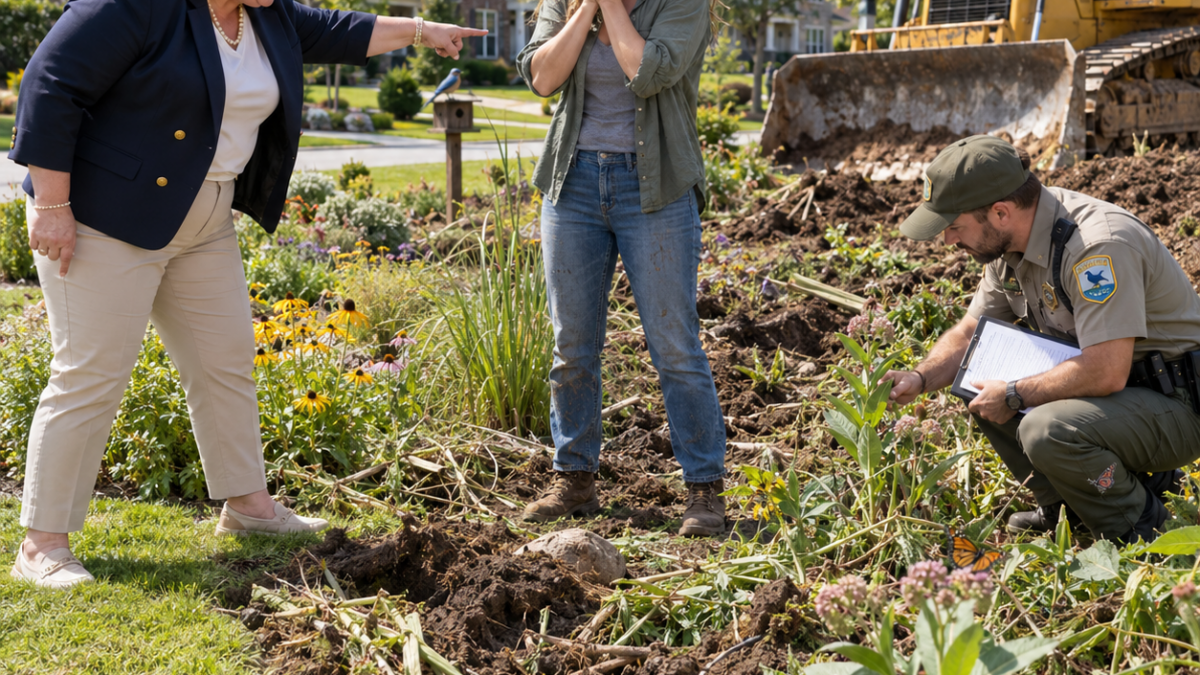
The HOA president called my wife’s garden “a weed patch,” and by the time I got home, bulldozer tracks had replaced two years of milkweed, coneflowers, native grasses, and the serviceberry tree she had planted with her own hands.
Karen stood beside the ruined soil smiling like she had finally taught us who was in charge, while Lena cried inside the house and the last landscaping truck pulled away.
What Karen did not know was that the garden she had ordered destroyed was not merely ours—and the paperwork protecting it was already sitting in a state database with her association’s name about to be attached to it.
“It was an eyesore, Marcus.”
Karen Miller folded her arms across a pink tracksuit and looked over the flattened rectangle beside my driveway.
Dark mulch covered everything.
Yesterday, that same patch had been alive with purple coneflowers, black-eyed Susans, wild lupine, butterfly weed, and twenty-two milkweed plants Lena had raised from tiny plugs.
Now there was nothing but torn roots, shredded stems, tire marks, and the faint sweetness of crushed flowers.
“You authorized this?” I asked.
“The board did.”
“Did you personally order the contractor?”
She gave me the smile I had come to hate during our first year in Northwood Estates.
“The board authorized correction of a covenant violation.”
I took out my phone.
“What are you doing?”
“Documenting.”
Twenty years in the Army Corps of Engineers had taught me what anger could do to a man who let it make decisions for him.
So I did not shout.
I recorded.
“State your name.”
“Marcus, don’t be ridiculous.”
“State your name.”
“Karen Miller.”
“President of the Northwood Estates Homeowners Association?”
“Yes.”
“And you’re confirming the HOA hired this crew to enter my property and remove the garden?”
Her chin lifted.
“We enforced the covenants you agreed to when you bought here.”
I turned the camera toward the destroyed bed.
The landscaping company’s truck was still visible at the end of the street.
Logo.
License plate.
Timestamp.
Everything.
Lena and I had bought this house because we wanted permanence.
For twenty years, my career had meant relocations, temporary addresses, and long stretches when my wife built a life around wherever the Army sent me.
Lena was a botanist, but she had put parts of her career aside again and again because my work kept moving us.
When I retired, I promised her something simple.
Roots.
Real ones.
Northwood gave us a modest house with a wide front yard, and Lena turned a section of ordinary turf into the first place I had ever seen her completely lose track of time.
She researched species native to our county.
She planned blooms from spring through fall.
She planted for bees, swallowtails, monarchs, and birds.
Our state had recently adopted an ecological landscaping law protecting qualifying native gardens from being treated as ordinary “weed violations.”
Lena registered ours as a pollinator habitat.
We had the confirmation.
We had the plant list.
We had photographs.
And when Karen’s first HOA warning arrived two months earlier, I sent all of it to her by certified mail.
The letter cited the statute.
The second response included information from the state agriculture department explaining that protected native plantings could not simply be classified as weeds because an HOA preferred turf grass.
Karen signed for the envelope herself.
Then she went silent.
I assumed silence meant she had read the law.
I was wrong.
Karen gestured toward the barren ground.
“You should be thanking us. Your property finally looks respectable.”
Behind me, the front door opened.
Lena stepped onto the porch.
Her face was pale.
Her eyes were swollen.
Karen glanced at her.
“You can always plant something approved next time.”
Lena made a small sound I will never forget.
Not anger.
Grief.
She went back inside.
I looked at Karen.
“How much did you pay the contractor?”
“That is association business.”
“Did they remove everything?”
“Yes.”
“The milkweed too?”
“All of it.”
I nodded.
Karen smiled again, mistaking my calm for surrender.
“Good. The board will send you the abatement invoice.”
“The invoice?”
“Nine hundred fifty dollars.”
She had destroyed my wife’s protected habitat.
And she intended to bill me for it.
Karen turned toward her car.
I said her name.
She looked back.
“Save every email you sent about today.”
Her expression changed.
“Excuse me?”
“Every text. Every invoice. Every board vote.”
“Are you threatening me?”
“No.”
I looked at the crushed stems beneath the mulch.
“I’m telling you not to lose anything.”
Then I went inside, closed the door, and called the state office that had registered Lena’s habitat.
PART 2
The woman who answered transferred me twice.
The third person asked for the habitat registration number.
I read it from the certificate Lena kept framed in our home office.
There was a pause.
Keyboard clicking.
Then the woman said, “Yes, Mr. Thorne. I have it here. Registered residential pollinator habitat. Active status.”
“My HOA had it bulldozed this morning.”
The clicking stopped.
“Excuse me?”
“They hired a landscaping company, entered my property, removed everything, covered the bed in mulch, and billed me for the work.”
Another pause.
“Did you tell the HOA the site was registered?”
“Twice.”
“In writing?”
“Certified mail.”
“Do you have proof of delivery?”
“Yes.”
“What was planted?”
“Milkweed. Butterfly weed. Coneflower. Wild lupine. Black-eyed Susan. Native grasses. Serviceberry. A few other things my wife would have to give you.”
“How much milkweed?”
“Twenty-two plants, according to her inventory.”
This pause was different.
“Mr. Thorne, I’m going to transfer you to Dr. Anya Sharma. Please do not hang up.”
I almost smiled.
It was the first time all day anyone had spoken as though what happened mattered.
A woman answered thirty seconds later.
“Mr. Thorne?”
“Yes.”
“My name is Dr. Anya Sharma. I direct the state pollinator protection program. Start from the beginning.”
So I did.
I told her about our move.
Lena’s garden.
Karen’s first violation.
My certified response.
The second letter.
The registration certificate.
The state information sheet I had included.
Karen’s signature on the delivery receipt.
Then that morning.
The workers.
The flattened garden.
Karen admitting on video that the HOA had authorized it.
Dr. Sharma did not interrupt until I finished.
Then she asked:
“They removed all of it?”
“Yes.”
“Roots too?”
“As much as they could.”
“Any photographs from before?”
“Hundreds.”
“Plant inventory?”
“My wife kept spreadsheets.”
“Receipts?”
“Probably most of them.”
“Habitat registration photographs?”
“Yes.”
“Good.”
Her voice sharpened.
“Do not disturb the damaged area more than necessary.”
“Why?”
“Because I want our enforcement people to see it.”
That was the first moment the scope of Karen’s mistake truly registered.
I looked toward the front window.
Through the glass, I could see the brown rectangle where color had been.
“Is this actually something the state enforces?”
“Mr. Thorne, the entire point of the law is to prevent exactly this.”
I sat down.
Dr. Sharma continued.
“It does not mean every messy yard becomes legally protected because someone calls it a habitat. There are standards. Registration requirements. Species requirements. Maintenance requirements.”
“We met them.”
“I can see that from your file.”
She paused.
“And your HOA was notified.”
“Twice.”
“That will matter.”
“How much?”
“I’m not going to prejudge an enforcement action before an investigator examines the facts.”
Fair.
“But I will tell you this. If your documentation is accurate, this is not a trivial HOA dispute.”
I heard someone moving papers on her end.
“I want copies of the violation notices, your responses, delivery records, photographs, video, plant inventory, contractor information, and any invoice the HOA sends.”
“I can have it to you tonight.”
“You sound organized.”
“I had a career where being disorganized could kill people.”
Another pause.
“Military?”
“Army Corps of Engineers.”
“Explains it.”
She gave me a secure state email address.
Before hanging up, she added:
“And Mr. Thorne?”
“Yes?”
“Please tell your wife I’m sorry.”
That sentence broke something open inside me.
I had been holding myself together since arriving home.
Anger was easy.
Anger gave me structure.
But sympathy?
That nearly got me.
“Thank you.”
I ended the call.
Lena was sitting on the kitchen floor.
Not because she had fallen.
Because that was where she had ended up after coming inside.
Her back rested against a cabinet.
A mug of tea sat untouched beside her.
I sat next to her.
For a moment neither of us spoke.
Then she said, “There were monarch eggs.”
I knew.
She had shown them to me the night before.
Tiny white dots beneath a milkweed leaf.
Almost impossible to see unless you knew where to look.
“I photographed them yesterday.”
Her voice cracked.
“There were caterpillars too.”
I reached for her hand.
“They shredded everything.”
“I know.”
“I raised some of those plants from seed.”
“I know.”
“You remember the lupine?”
“The one you thought wouldn’t survive winter?”
“It came back.”
She looked at me.
“It came back stronger.”
Then she started crying again.
I pulled her against me.
For twenty years, Lena had been the one who rebuilt.
New city?
She made friends.
New post?
She found work.
Deployment?
She mailed me handwritten notes, coffee, ridiculous socks, pressed leaves from wherever we lived.
When my career moved us, she adapted.
She did it so often people assumed adaptation cost her nothing.
It did.
The garden was the first thing she had built in years that no transfer order could take away.
At least that was what we thought.
“I called the state,” I said.
She wiped her face.
“And?”
“They’re opening a review.”
Her expression barely changed.
“I don’t want money.”
“I know.”
“I want my garden.”
“I know.”
“You can’t replace two years.”
“No.”
“You can’t replace the serviceberry at that size.”
“No.”
“You can’t replace the monarch eggs.”
I squeezed her hand.
“No.”
She looked toward the window.
“So what good is winning?”
That question stayed with me for months.
At the time, I had no answer.
So I gave her the only promise I could.
“We’re not going to let them pretend this was okay.”
That afternoon, I called the sheriff’s department.
A deputy named Collins arrived.
Young.
Polite.
Tired.
He photographed the property.
I showed him my video of Karen.
He watched it twice.
“She admitted ordering it?”
“She said the board authorized correction.”
“Do you know whether the landscaping company believed they had authority?”
“No.”
He nodded.
“That’s important.”
Then came the sentence I expected.
“This may end up being primarily civil.”
“I understand.”
“You have an HOA agreement.”
“I understand.”
“She’ll claim contractual authority.”
“I understand.”
He looked at me.
Most people probably argued at that point.
I did not.
“I still want an incident report.”
His posture changed slightly.
“Absolutely.”
“Case number too.”
He gave it to me.
Before leaving, he looked at the destroyed bed.
“My wife plants milkweed.”
I glanced at him.
“For monarchs?”
“Yeah.”
He shook his head.
“She would kill me if I did this.”
“That makes two of us.”
He almost smiled.
The HOA invoice arrived the next morning.
Karen had not exaggerated.
$950.
WEED ABATEMENT AND RESTORATION OF COMMUNITY STANDARDS.
They had billed me for the destruction.
Sarah—our mail carrier, not my wife—handed me the envelope and said, “You look like you already know what’s inside.”
“I do.”
I signed for it.
Another certified letter.
Karen loved certified mail when she was sending it.
I wondered whether she would still love it by the end.
The monthly HOA meeting was three nights later.
I arrived early.
The clubhouse had fluorescent lights that made everybody look slightly ill.
Karen sat at the front table between Gary Peters, a retired insurance salesman, and Brenda Davis, the board secretary.
Five homeowners sat scattered among rows of folding chairs.
Karen looked up when I entered.
Her mouth tightened.
She continued discussing holiday wreath dimensions.
I sat in the back.
Waited.
When she reached the end of old business, I stood.
“I need to address the board.”
“You may speak during homeowner comment.”
“This concerns an action the board took on my property.”
“You may speak during homeowner comment.”
“When is that?”
“At the conclusion of the agenda.”
I sat down.
Twenty-seven minutes later, Karen finally said, “Homeowner comment.”
I stood.
She checked the clock.
“Three minutes.”
“I’ll try to be efficient.”
I walked to the front carrying a folder.
I placed the first photograph on the table.
The garden four days earlier.
Purple.
Yellow.
Orange.
Green.
Then another.
The destroyed site.
Brown.
Flat.
Dead.
Karen looked away.
I added our habitat registration certificate.
Then the statute.
Then the delivery confirmation bearing Karen’s signature.
Then the sheriff’s report.
Then the $950 invoice.
Gary leaned forward.
“What exactly are you trying to prove?”
“That the board entered my property and destroyed a state-registered native habitat after receiving written notice that state law protected it.”
Karen sighed dramatically.
“Marcus, we have been over this.”
“Not here.”
“You were in violation.”
“According to which rule?”
“Section Four, paragraph B. Properties must be maintained in a neat and orderly condition free from weeds and uncontrolled vegetation.”
“They weren’t weeds.”
“That is your opinion.”
“No.”
I tapped the state document.
“That is the state’s classification.”
Karen pushed it back.
“Our covenants predate that law.”
“State law usually does not ask permission from your covenants.”
Gary shifted.
Brenda suddenly found her notebook fascinating.
Karen’s cheeks reddened.
“We have counsel.”
“Good.”
I placed another page on the table.
“What’s that?” Gary asked.
“A formal request for the minutes and recorded vote authorizing entry onto my property.”
Karen did not touch it.
“The board held an emergency session.”
“When?”
“That is association business.”
“I am a member of the association.”
“We will provide whatever records you’re entitled to receive.”
“Excellent.”
I stepped back.
Karen picked up my invoice.
“You still owe this.”
“No.”
“You do.”
“No.”
“If payment is not received within thirty days, the association may place a lien.”
I stared at her.
“You destroyed protected property, billed me for the destruction, and now you’re threatening my house if I don’t pay you for it.”
“That is an intentionally inflammatory description.”
“It is literally what happened.”
One of the homeowners behind me coughed to hide a laugh.
Karen heard it.
Her face tightened.
I turned toward the small audience.
“Everyone sitting here should understand something.”
Karen snapped, “Address the board.”
“I am.”
I looked at Gary and Brenda.
“If the state determines this was illegal, the association could be fined.”
Gary blinked.
“So?”
“The association is funded by homeowners.”
That got his attention.
“The board’s decision does not magically make liability disappear.”
Karen struck the gavel.
“Your three minutes are up.”
I looked at her.
“One last thing.”
“You’re out of time.”
“I hope the board’s directors-and-officers insurance is current.”
Gary turned toward her.
Karen’s face changed.
Just enough.
I picked up everything except the formal records request.
That stayed on the table.
Then I left.
Outside, I heard footsteps behind me.
“Marcus.”
A man I recognized from three streets over caught up.
George Ellis.
Seventy-six.
Widower.
Japanese maples so perfectly shaped they looked painted.
“You put the fear of God into Gary.”
“That wasn’t my intention.”
“Sure it wasn’t.”
He smiled.
“I used to practice corporate law.”
That got my attention.
“What kind?”
“Contracts. Governance. Shareholder disputes. Expensive arguments between men wearing ties.”
“You retired?”
“Fifteen years ago.”
He nodded toward the clubhouse.
“These people are amateurs.”
“I’m starting to realize that.”
George looked toward my car.
“Bring me your bylaws tomorrow.”
“Why?”
“Because Karen thinks the rule book is a sword.”
He smiled.
“I want to see whether she’s holding it by the blade.”
George came to our house Saturday morning.
Lena made coffee.
Our dining-room table disappeared beneath documents.
George read slowly.
Very slowly.
I learned not to interrupt the little sounds he made.
“Hm.”
Page turn.
“Interesting.”
Page turn.
“Oh, Karen.”
That one I liked.
After two hours, he removed his reading glasses.
“First problem.”
I leaned forward.
“The board’s self-help provision does allow the association to correct certain unresolved exterior violations.”
Karen would love that sentence.
George held up one finger.
“But.”
There it was.
“The procedure requires an initial notice, a defined cure period, a final notice, an opportunity for hearing unless an immediate safety condition exists, and a formal board authorization recorded in the minutes.”
I thought through the letters.
“We got two notices.”
“No final cure notice.”
“No.”
“No hearing?”
“No.”
“Any claim this garden posed immediate danger?”
“Only that it looked bad.”
George smiled.
“Aesthetic emergency. My favorite constitutional crisis.”
Lena almost laughed.
It was the first time since the destruction.
George continued.
“Second problem.”
He tapped the state statute.
“I’m assuming this is current and applicable.”
“The state office confirmed our registration this week.”
“Then the HOA procedure may not matter much if the underlying action is prohibited.”
He leaned back.
“The board cannot use its internal rules to authorize something state law forbids.”
Lena looked at him.
“So they’re responsible?”
“That depends on the facts and how the statute is enforced.”
He held up another page.
“But they may have made it much worse for themselves.”
“How?”
“The so-called emergency vote.”
He pointed to the minutes Karen had finally emailed me that morning.
It was barely a page.
EMERGENCY BOARD ACTION — NATIVE LANDSCAPING VIOLATION.
Three lines said Karen had circulated an email motion to remove the garden.
Gary replied APPROVE.
Brenda replied APPROVE.
No meeting.
No homeowner notice.
No emergency finding.
No factual basis.
No legal review.
Just three people exchanging emails.
George smiled without humor.
“They documented it.”
“What?”
“Their own decision.”
He tapped the paper.
“If I were defending them, I would have preferred no record at all.”
Lena stared at the minutes.
“They voted to destroy my garden in an email?”
“Yes.”
Something changed in her face.
Grief hardened into anger.
“Then I want every plant listed.”
“We already have most.”
“No.”
She stood.
“I want all of them.”
For the next six hours, Lena reconstructed the garden.
Not emotionally.
Scientifically.
Species.
Quantity.
Age.
Source.
Purchase price.
Expected maturity.
Function.
Bloom period.
Whether the plant supported specialist pollinators.
Whether photographs showed its location.
Milkweed: twenty-two.
Butterfly weed: nine.
Purple coneflower: eighteen.
Black-eyed Susan: thirty-one.
Wild bergamot.
Little bluestem.
Golden Alexander.
Asters.
Wild lupine.
Serviceberry.
Native sedges.
By midnight, she had a spreadsheet.
The replacement plant cost alone exceeded $5,800.
“That doesn’t include labor,” she said.
“Or soil.”
“Or irrigation.”
“Or two years.”
She stared at the spreadsheet.
“You can’t put two years in a cell.”
George, who had stayed far longer than planned, said quietly:
“No. But you can put enough facts around the loss that nobody gets to call it weeds again.”
The next week, Dr. Sharma called.
“I’ve reviewed what you sent.”
“And?”
“I’m referring it to enforcement.”
My pulse changed.
“What happens now?”
“An investigator will inspect the property and interview people.”
“Karen too?”
“Likely.”
“Can I tell the HOA?”
“You can do whatever your attorney advises. But from my perspective, you don’t need to warn them.”
I looked at George.
He was sitting across from me, reviewing a draft letter.
“We were already planning to.”
“Planning to what?”
“Send a demand.”
Dr. Sharma laughed softly.
“Then don’t let me interfere with your fun.”
George’s demand letter took two days to write.
My first draft was angry.
He crossed out half of it.
“This sentence says she acted with outrageous contempt.”
“She did.”
“Remove it.”
“Why?”
“Because contempt is an emotion. We have a delivery receipt.”
He crossed out another paragraph.
“This says your wife was devastated.”
“She was.”
“We can establish damages without turning a demand letter into a diary.”
“You have no soul.”
“Forty years of corporate law.”
By Sunday, the letter was brutal precisely because it was boring.
Dates.
Documents.
Rules.
Statutes.
Costs.
No name-calling.
No insults.
We rejected the $950 charge.
Demanded its withdrawal.
Demanded written confirmation that no lien would be filed.
Demanded reimbursement for destroyed plants and documented restoration expenses.
Demanded that the HOA preserve all emails, texts, minutes, invoices, contractor instructions, photographs, legal communications subject to disclosure rules, and insurance correspondence relating to our property.
And we gave them thirty days.
The letter also stated that the registered habitat had been referred to the state enforcement division.
George read the final paragraph aloud.
“Failure to resolve these matters within thirty calendar days will be treated as rejection of this settlement opportunity, and the homeowners reserve all available civil and administrative remedies.”
He looked at me.
“No threats.”
“It feels like a threat.”
“Good legal writing often does.”
We mailed copies to Karen, Gary, Brenda, the HOA management company, and its registered agent.
Certified.
Return receipt.
Karen signed hers.
Again.
For two weeks, silence.
Then came the HOA meeting.
The clubhouse was more crowded.
Word had spread.
Karen stood at the front holding our demand letter.
“I want everyone to understand what your board is dealing with.”
George whispered from beside me, “Never read an opponent’s good letter to a larger audience.”
Karen began.
She mocked the $5,820 valuation.
People chuckled.
Then she read the part about the state-protected milkweed.
“The plant police,” she said.
A few of her supporters laughed.
George wrote something on his legal pad.
I leaned over.
WHAT?
He turned it toward me.
SHE IS DOING OUR WORK.
Karen continued.
She called us litigious.
Entitled.
Hostile to community standards.
Then she made a motion.
“The board formally rejects the demand in its entirety.”
Gary seconded.
Brenda whispered, “Second.”
All three voted yes.
Then Karen looked directly at me.
“And I move that the association proceed with lien remedies if the weed-abatement invoice remains unpaid at the deadline.”
Gary said, “Second.”
Brenda hesitated.
Karen looked at her.
Brenda raised her hand.
Motion carried.
Karen slammed the gavel.
“Northwood Estates will not be intimidated.”
George leaned toward me.
“Don’t say a word.”
I didn’t.
Karen smiled.
She believed silence meant defeat.
It was the same mistake I had made when she went quiet after receiving the state law.
The thirty-day deadline expired on Tuesday.
Wednesday morning began with three actions.
At 8:03, I emailed the HOA’s rejection and meeting minutes to Dr. Sharma.
At 8:30, George accompanied me to the county courthouse, where I filed a civil claim within the appropriate limit available to us for property damage and related losses.
At 9:47, I called a local investigative reporter named Ben Carter.
Ben listened for fifteen minutes.
Then asked:
“Your wife is a botanist?”
“Yes.”
“Registered pollinator habitat?”
“Yes.”
“HOA was warned?”
“Certified mail.”
“They bulldozed it anyway?”
“Yes.”
“And billed you?”
“Nine hundred fifty dollars.”
Silence.
Then:
“Can I see everything?”
“Yes.”
“When?”
“Today.”
He arrived at four.
He wore jeans, a station polo, and the expression of a man who had heard so many absurd stories he no longer trusted any of them until paper appeared.
I liked that.
I showed him paper.
The habitat certificate.
Karen’s signature.
Before photographs.
After photographs.
Video confession.
Plant inventory.
State statute.
HOA minutes.
Invoice.
Demand.
Formal rejection.
Ben’s eyebrows rose higher with each page.
Finally he asked Lena:
“Why did you build the garden?”
She looked toward the bare bed.
“At first?”
“Yes.”
“Because I was tired of moving.”
Ben did not expect that.
Neither did I.
Lena continued.
“Every place we lived, I planted something.”
She smiled sadly.
“Herbs in Germany. Tomatoes in Georgia. Lavender in Colorado.”
She looked at me.
“Then we would get orders.”
Ben lowered his notebook slightly.
“When Marcus retired, I wanted to plant something I could watch grow old.”
That sentence hurt.
I turned toward the window.
Lena pointed toward the empty patch.
“The natives made sense scientifically. Less water. Better habitat. Support for pollinators.”
She swallowed.
“But emotionally?”
Ben waited.
“I wanted something that wasn’t temporary.”
The story stopped being about weeds right there.
A week later, a black state sedan parked in front of our house.
The investigator’s name was Daniel Miller.
No relation to Karen.
He had gray at his temples and the patient expression of someone who spent his career listening to people insist rules did not apply to them.
“Mr. Thorne?”
“Yes.”
“Environmental enforcement.”
He showed identification.
“Dr. Sharma sent me.”
We spent an hour inside.
Then two outside.
Daniel photographed the site.
Measured it.
Compared current conditions to registration photographs.
Reviewed Lena’s species map.
Took copies of receipts.
Examined the HOA notices.
Then he looked toward Karen’s house.
“She lives there?”
“Two streets over.”
“You know if she’s home?”
“I haven’t checked.”
“Good.”
He looked at me.
“I’ll find her.”
He first interviewed neighbors.
Margaret two doors down.
The Johnson family with the basketball hoop.
George.
Then Karen appeared.
Of course she did.
She approached while Daniel was standing beside Margaret’s mailbox.
“Excuse me.”
Daniel turned.
“I’m Karen Miller, HOA president. If you’re conducting association business, you need to speak with me.”
“I was planning to.”
Karen smiled.
Victory, briefly.
Daniel pulled out his identification.
“Environmental Enforcement Division.”
Her smile disappeared.
“I’m investigating the removal of a registered native habitat at the Thorne property.”
Karen’s face changed.
“That was a covenant issue.”
“I’ll need to speak with you about the authorization.”
“It was the board.”
“Good. I’ll need the names of everyone who participated.”
She stiffened.
“Why?”
“Because I’m investigating.”
“I don’t appreciate your tone.”
Daniel looked at her.
“My tone?”
“You’re treating me like I committed a crime.”
“I haven’t characterized your conduct.”
He opened his notebook.
“Did you receive written notice before the removal that the Thorne garden was registered under the state ecological landscaping program?”
Karen glanced toward my house.
“I receive hundreds of documents.”
“That wasn’t my question.”
“I’d need to check.”
“Did you sign for certified correspondence from Mr. Thorne?”
“I sign for many things.”
“Did you review it?”
“I don’t recall.”
I almost laughed.
Daniel did not.
“Who selected the landscaping contractor?”
“The board.”
“Who contacted them?”
“I may have.”
“Who instructed them regarding what to remove?”
“The violation was obvious.”
“Ms. Miller.”
She stopped.
“Who instructed them?”
“I did.”
He wrote it down.
Karen watched the pen.
That tiny movement did more to frighten her than anything I could have said.
The process server found her three days later.
Right beside the entrance sign.
She was supervising landscapers planting identical boxwoods.
The young woman handed her the court papers.
Karen looked down.
Then toward my house.
I happened to be outside.
Our eyes met.
She shouted something I could not hear.
The process server calmly walked away.
I went back inside.
Lena asked, “Was that it?”
“Yes.”
“How did it feel?”
I thought.
“Smaller than I expected.”
“Good.”
“What?”
“You’re getting healthier.”
Then the television story aired.
Ben opened with footage Lena had taken the previous summer.
A monarch landed on milkweed.
Close-up.
Orange wings opening.
Then a cut.
Same location now.
Brown mulch.
Tire tracks.
My voice came next.
“We weren’t asking the HOA to like our garden. We were asking them to obey the same law they expect homeowners to obey.”
Ben included Karen.
That surprised me.
He caught her leaving an emergency board meeting.
“Ms. Miller, were you aware the garden was registered under the state program?”
She stopped.
“This is harassment.”
“Were you aware?”
“It was an unapproved landscape modification.”
“State records show the homeowners sent notice before removal.”
“They agreed to covenants.”
“Do you believe HOA covenants override state law?”
Karen’s eyes widened.
“You’re twisting my words.”
She pushed past him.
Her purse caught briefly on the clubhouse door.
It would have been funny if the larger situation were not so serious.
The segment included Dr. Sharma.
She explained the purpose of native-landscaping protections in general terms.
No comment on the outcome of the active case.
Professional.
Measured.
Then photographs of the garden.
Lena explaining milkweed.
The destroyed area.
Karen refusing to answer.
The contrast was devastating.
The neighborhood Facebook group exploded.
Some people supported us.
Some accused me of humiliating Karen publicly.
One post said:
Marcus should have handled this privately instead of attacking the reputation of the whole neighborhood.
George printed it.
“Why?”
“Evidence of stupidity.”
“Is that admissible?”
“Sadly no.”
Then the official state report arrived.
Twenty-two pages.
The envelope felt heavier than paper should.
Lena and I sat at the kitchen table.
George joined us.
I opened it.
The first findings were factual.
The habitat had been properly registered.
The listed native species qualified.
The HOA received documented notice of the garden’s status before removal.
The association authorized the work.
The contractor removed protected plantings.
The board did not follow required internal procedures.
Then came penalties.
Per-plant penalties for protected milkweed and related regulated species.
A separate sanction connected to willful destruction of a registered habitat.
Another penalty based on the association’s continued refusal to correct its position after written notice.
Total:
$18,500.
Lena stared at the number.
George whistled.
I read it again.
“This comes from the HOA?”
“Unless successfully challenged,” George said.
“That means homeowners.”
“Yes.”
My satisfaction vanished.
I had wanted Karen held accountable.
Instead, reserve funds paid by every homeowner could take the hit.
George saw my expression.
“Marcus.”
“I know.”
“No, listen.”
He tapped the report.
“You did not cause this liability.”
“It still comes from neighbors’ money.”
“The board caused it.”
“Karen caused it.”
“And Gary.”
“And Brenda.”
“Yes.”
I leaned back.
“This doesn’t feel like winning.”
“Accountability rarely feels the way revenge fantasies promise.”
Lena looked at the report.
“What else does it say?”
I turned the page.
That was where everything became bigger.
The investigator had documented broader governance failures.
Improper meeting procedures.
Poor recordkeeping.
Arbitrary enforcement.
Possible conflicts.
The report recommended referral for administrative oversight and financial review.
George read the paragraph twice.
Then smiled.
“What?”
“This is the part Karen should be afraid of.”
“Not eighteen thousand dollars?”
“No.”
He tapped the audit recommendation.
“People who run associations like private kingdoms hate only one thing more than losing power.”
“What?”
“Someone opening the books.”
The HOA called an emergency meeting.
Attendance was enormous.
More than a hundred homeowners packed into a room that usually drew ten.
Karen sat at the front.
Gary beside her.
Brenda looked physically ill.
Karen struck the gavel.
“This meeting will come to order.”
She had prepared a speech.
Of course she had.
“The association is under attack.”
Murmurs.
She continued.
“A disgruntled homeowner has exploited a new and poorly written state law to punish all of you.”
That got attention.
“The fine imposed against this association will ultimately affect every member.”
She pointed toward me.
“This is the consequence of Mr. Thorne’s vendetta.”
People turned.
For one second, the tactic almost worked.
Then Margaret stood.
She was normally quiet.
Maybe sixty.
Silver hair.
Always trimming roses.
“No.”
Karen stopped.
“Excuse me?”
Margaret’s voice trembled.
But she did not sit.
“This happened because you were warned.”
Karen raised the gavel.
“Margaret, please wait to be recognized.”
“You fined me fifty dollars because my garbage can stayed out until seven.”
“This is not relevant.”
“It is relevant to me.”
Applause.
Karen hit the gavel.
A man from the back stood.
“You measured my son’s basketball hoop.”
Another.
“You threatened me over my work trailer.”
Another.
“You photographed my backyard.”
Someone else.
“You fined us for the color of our mailbox.”
The room changed.
Not gradually.
All at once.
Fear became anger when people realized how many others shared it.
Karen shouted, “Order!”
Nobody listened.
George stood.
He did not shout.
That was why everyone heard him.
“Folks.”
The room slowly settled.
“I practiced corporate law for forty years.”
Karen rolled her eyes.
George smiled.
“And yes, that was every bit as boring as it sounds.”
A few people laughed.
Then he held up the state report.
“This is not Marcus’s fine.”
Silence.
“It is the association’s fine.”
He turned toward Karen.
“Because the association acted through its board.”
Then to the room.
“The board had actual written notice of the state protection.”
He raised the certified receipt.
“The board refused an opportunity to correct the matter before enforcement.”
Demand letter.
“The board then voted publicly to reject that opportunity.”
Meeting minutes.
“And the board threatened a lien to collect the cost of destroying the protected habitat.”
Invoice.
Karen’s face turned red.
George continued.
“Now, I reviewed our directors-and-officers policy.”
Gary sat upright.
Karen looked at him.
George raised another sheet.
“It contains exclusions for certain intentional or knowingly unlawful acts.”
Gary’s mouth opened.
Karen turned toward him.
“What?”
George looked around the room.
“I’m not predicting coverage. The insurer will make that determination.”
Good lawyer.
“But every homeowner should understand that a board cannot assume insurance will magically erase the consequences of deliberate misconduct.”
A woman near the aisle asked, “Could Karen have to pay personally?”
George replied carefully.
“Potentially, depending on findings, coverage, governing law, and individual conduct.”
Karen stood.
“This is outrageous.”
George nodded.
“The report uses more formal language.”
Laughter.
Karen slammed the gavel.
“You people have no idea what I’ve done for this neighborhood!”
That sentence hung there.
Then a young father stood.
“We know exactly what you’ve done.”
Karen stared.
His voice strengthened.
“You threatened us with daily fines because our boys’ basketball hoop was two inches above your preferred height.”
Someone applauded.
“You told my wife our yard looked cheap.”
More applause.
“You made my kids think they were doing something wrong by playing outside.”
Karen tried to interrupt.
He kept going.
“And now you cost us eighteen thousand dollars because you couldn’t stand somebody planting flowers you didn’t choose.”
That broke the room open.
“Resign!”
“Remove her!”
“Vote!”
Karen’s face went pale.
George raised his hand.
“One at a time.”
Somehow people listened to him.
He opened the bylaws.
“Article Three, Section Five.”
Karen stared.
“You wouldn’t.”
He looked at her.
“I move that the membership conduct a vote to remove Karen Miller from the Board of Directors for conduct materially detrimental to the association.”
“Second!”
Three voices at once.
Brenda started crying.
Karen shouted, “This is out of order!”
George pointed to the paragraph.
“It is quite literally in order.”
People stood.
Karen turned toward Brenda.
“Do not record that.”
Brenda froze.
“Brenda.”
Karen’s voice hardened.
“You work for this board.”
George spoke gently.
“No. She serves the association.”
That difference mattered.
Brenda looked at the crowd.
Then down at her notebook.
“I recorded the motion.”
Karen stared at her like she had been betrayed by family.
Ballots were distributed.
The count took twelve minutes.
They felt like twelve hours.
Brenda returned to the front.
Her hands shook.
“Votes for removal…”
She swallowed.
“Ninety-eight.”
A roar.
“Votes against…”
Three.
Karen did not react.
Not immediately.
She sat absolutely still.
Then she looked at me.
Her eyes were empty.
I expected satisfaction.
Instead, I remembered Lena sitting on the kitchen floor.
The monarch eggs.
The serviceberry.
The brown mulch.
This vote could not undo any of that.
Gary stood.
“I resign.”
People booed.
He hurried out.
Brenda wiped tears.
“I resign too.”
Karen finally stood.
“You’ll regret this.”
No one answered.
She grabbed her purse.
The gavel.
Then stopped.
Looked at the gavel.
Put it back down.
And walked away.
The new interim board formed that night.
Margaret became president.
She tried to refuse.
George told her that was excellent evidence she was qualified.
A CPA named Denise became treasurer.
A younger homeowner named Luis Ramirez became secretary.
George agreed to serve as unpaid legal adviser for ninety days.
I refused a board seat.
Repeatedly.
“I’m not replacing Karen.”
Margaret said, “Nobody asked you to become Karen.”
“Good.”
“We want you on the landscaping committee.”
“No.”
Lena spoke from behind me.
“I’ll do it.”
Everyone turned.
For weeks, she had avoided the clubhouse.
Now she stood.
Calm.
“I’ll chair the native landscaping working group if the board wants one.”
Margaret smiled.
“It does.”
Lena looked at me.
“What?”
I shook my head.
“Nothing.”
“Good.”
The interim board’s first vote rescinded every action against our property.
Second:
The $950 invoice was canceled.
Third:
Any threatened lien was formally withdrawn.
Fourth:
The association agreed to settle our civil claim by paying documented restoration costs and reasonable associated damages from available lawful sources subject to the necessary process.
Fifth:
Northwood sent every homeowner a written statement acknowledging that the native habitat had been improperly removed.
No flowery apology.
No legal tricks.
Just facts.
Lena read the letter once.
Then placed it in a drawer.
“You’re not framing it?”
“No.”
I smiled.
“That’s probably healthier.”
“I want plants.”
The restoration crew came two weeks later.
Not Karen’s contractor.
A native-habitat nursery recommended by Dr. Sharma.
Their truck arrived filled with life.
Milkweed.
Coneflowers.
Asters.
Little bluestem.
Mountain mint.
Golden Alexander.
Wild bergamot.
Lupine.
And one serviceberry larger than the original.
Lena stood in the driveway in gardening gloves.
For the first time since the destruction, she looked like herself.
Not completely.
But closer.
The foreman unrolled the design.
“Mrs. Thorne, where do you want the serviceberry?”
She stared at the space.
Then pointed.
“Not where the old one was.”
I looked at her.
She saw the question.
“I don’t want to pretend nothing happened.”
The new tree went six feet farther back.
The old location became a small open circle.
At the center, Lena placed one flat stone.
No words.
Just a stone.
“What’s that for?” I asked.
“To remember.”
“The garden?”
“The first one.”
I understood.
Half the neighborhood showed up to help.
Margaret planted coneflowers.
Luis installed low-voltage lighting.
The basketball-hoop father hauled compost.
Mrs. Gable—different neighborhood, different story, as George liked to joke—did not exist here, but George Ellis showed up in an old straw hat with pruning shears he did not need.
“You’re supervising?” I asked.
“I’m counsel.”
“For plants?”
“Someone has to protect them from you.”
“I was an engineer.”
“Exactly.”
Then Karen drove past.
Slowly.
Her car stopped in front of our house.
Conversation faded.
She lowered the window.
The new serviceberry was being lifted from its container.
Lena stood beside it.
Karen stared.
Nobody spoke.
For a moment, I wondered if she had come to apologize.
Then she looked at me.
Cold.
Furious.
Humiliated.
No apology.
I walked toward the curb.
Stopped several feet away.
She said, “Enjoy your victory.”
I shook my head.
“This isn’t victory.”
She laughed once.
“You had me removed.”
“You removed yourself.”
“I was protecting property values.”
“From milkweed?”
“From disorder.”
Behind me, a monarch fluttered across the new plants.
Too early for the garden to support much.
Probably passing through.
Karen saw it.
Her jaw tightened.
“I hope it was worth tearing the community apart.”
I looked around.
Neighbors were carrying plants.
Laughing.
Sharing shovels.
Children watched butterflies.
George argued with a nursery worker about mulch depth.
“Looks pretty together to me.”
Her face hardened.
“You think they love you?”
“No.”
“Wait until they realize what your state fine cost them.”
“That’s why the board is reviewing personal responsibility and insurance.”
Her expression changed.
“You’re coming after me personally.”
“I’m not.”
“Liar.”
“I’m letting the process happen.”
“You started it.”
“No.”
I looked toward the garden.
“You did.”
She rolled up the window.
Drove away.
That was the last direct conversation I ever had with Karen Miller.
But it was not the end.
The state audit began six weeks later.
George predicted it would reveal “something stupid.”
He was right.
Not cinematic embezzlement.
No secret offshore accounts.
Nothing that would make a crime series.
Just years of sloppy, arrogant governance.
Contracts awarded to friends without competitive review.
Late fees inconsistently applied.
Meeting minutes rewritten after the fact.
Legal expenses not properly budgeted.
Landscape vendors chosen because Karen “trusted them.”
Violation revenue had become a line item the board depended on.
That one infuriated me.
They were budgeting fines.
Meaning enforcement was not merely about compliance.
It helped fund operations.
Denise, the new treasurer, stared at the reports.
“This is backwards.”
George nodded.
“If you need residents to break rules to balance your budget, your incentives are diseased.”
The audit also found that Karen had approved reimbursement for expenses that should have required additional signatures.
Most were mundane.
Printing.
Travel to HOA conferences.
Meals.
Office supplies.
But some lacked supporting documentation.
State oversight required corrective action.
Financial controls.
Open records.
Independent annual review.
Competitive bids above a threshold.
Recorded votes.
Conflict disclosures.
For three years, Northwood remained under enhanced reporting requirements.
Karen hated that more than the removal vote.
I know because she sent the interim board a nine-page letter.
Margaret read the first paragraph and handed it to George.
“Lawyer food.”
George read all nine pages.
His conclusion?
“She is still angry.”
The insurance battle was uglier.
The carrier agreed to cover some portions of the association’s defense and civil exposure under reservations.
It rejected other portions.
Karen retained her own counsel.
Gary did too.
Brenda cooperated fully.
She came to our house one afternoon.
I almost didn’t let her in.
Lena did.
Brenda sat at our kitchen table twisting a tissue.
“I’m sorry.”
Lena said nothing.
Brenda continued.
“I should have stopped her.”
“Yes,” I said.
She flinched.
I did not soften it.
“She told us the law didn’t apply.”
“You had the letter.”
“I know.”
“She told you we were registered.”
“I know.”
“You voted yes.”
Tears filled her eyes.
“I was afraid of her.”
That surprised me.
“Karen?”
“She humiliated anyone who disagreed.”
Brenda stared at her hands.
“She would call me stupid in private. She said Gary was spineless. She told everyone she was the only person keeping the board functional.”
Lena finally spoke.
“And that made it okay to destroy our garden?”
“No.”
Brenda looked at her.
“No. Nothing makes that okay.”
Silence.
Then she opened her purse.
She removed a flash drive.
“What is that?”
“Copies of board emails.”
My body went still.
“Why do you have them?”
“Karen told me to clean up old correspondence after the state investigator came.”
George’s voice appeared in my head.
Preserve everything.
“Did you delete anything?”
“Not from the server.”
“Did Karen?”
“I don’t know.”
“Why did you copy them?”
“Because I got scared.”
Lena looked at me.
I did not touch the drive.
“Brenda, call George.”
“What?”
“Call a lawyer before you hand that to anyone.”
“I’m trying to help.”
“I know.”
“Then take it.”
“No.”
I slid it back.
“If this relates to an investigation, I want a clean chain.”
She stared.
“Chain?”
“Talk to George. Then the state.”
She nodded.
That flash drive became important.
Not because it contained a criminal conspiracy.
But because it proved knowledge.
Karen had forwarded our state-law letter to Gary and Brenda weeks before the bulldozing.
Her message said:
Marcus is bluffing. These “habitat” laws are political nonsense and cannot override our architectural authority. If we let one yard go native, we’ll have weeds everywhere.
Gary responded:
Should we ask counsel?
Karen:
No need to waste association money.
Brenda:
What if he is right?
Karen:
He isn’t.
Then another message, two days before the removal:
Contractor confirmed for Thursday. Better to act before he tries another delay tactic.
There it was.
Not misunderstanding.
Not missed mail.
Not confusion.
She knew.
She chose.
The state amended its findings.
The association’s insurer took a harder position regarding Karen’s personal conduct.
George explained everything at an open meeting.
No cheering.
By then, people understood that accountability affected real money.
Karen eventually agreed to contribute personally toward parts of the settlement and costs as part of a negotiated resolution.
I will not pretend I hated that.
There was satisfaction in knowing our neighbors would not shoulder every dollar of her decision.
But the revenge I had imagined on the morning the garden disappeared?
That burning fantasy of watching her lose everything?
It faded.
Because Lena’s question remained.
What good is winning if the garden is gone?
The answer came slowly.
The new garden survived winter.
That spring, the serviceberry bloomed.
White flowers.
Small.
Delicate.
Lena came outside before breakfast and shouted my name.
I thought something was wrong.
I ran.
She stood beneath the tree.
“Look.”
“I’m looking.”
“No. Look.”
A native bee moved among the blossoms.
Then another.
Lena started crying.
Different tears.
I put my arm around her.
“They found it.”
She laughed.
“They found it.”
Weeks later, milkweed pushed through.
Then butterfly weed.
Then coneflower.
By June, the bed looked younger than before.
Of course it did.
Less mature.
More open soil.
But alive.
A monarch arrived in July.
Lena saw it first.
It circled twice.
Landed.
Left.
Returned.
She followed it like a child.
I sat on the porch watching her.
That was the first moment I understood winning.
Not Karen losing.
Lena returning.
The story spread beyond Northwood.
Not because we tried to keep it alive.
Because Ben Carter’s original report kept resurfacing whenever another HOA/native-landscaping dispute appeared in the region.
Dr. Sharma invited Lena to speak at a state workshop.
She refused.
Then agreed.
Then spent three weeks panicking.
Her presentation was titled:
Native Gardens Are Landscapes, Not Neglect.
I sat in the back.
She showed photographs.
The original lawn.
First plantings.
Full bloom.
Destruction.
Restoration.
When the image of the flattened bed appeared, Lena paused.
The room became silent.
“I used to think the worst part was losing the plants.”
She looked toward me.
“It wasn’t.”
She faced the audience.
“The worst part was having someone with authority look at something carefully created, carefully documented, legally protected, scientifically valuable, and emotionally important—and decide none of that mattered because she personally disliked the way it looked.”
People nodded.
“That is what good policy has to prevent.”
Afterward, homeowners surrounded her.
Questions.
Species lists.
How to register.
How to talk to HOAs.
How to create transition borders that reassured skeptical neighbors.
She came home exhausted.
Happy.
“You were amazing.”
“I talked too fast.”
“No.”
“I absolutely talked too fast.”
“Only during the part about sedges.”
“Sedges are exciting.”
“I’m sure they are.”
She threw a pillow at me.
The following year, Northwood created its pollinator corridor.
Not mandatory.
That mattered to Lena.
She hated the idea of replacing one aesthetic dictatorship with another.
Residents could opt in.
The HOA offered a modest grant funded partly from landscape savings after switching contractors.
Twenty-one homes participated the first year.
Thirty-eight the second.
Small native beds appeared along property lines.
Coneflowers.
Coreopsis.
Little bluestem.
Mountain mint.
One family kept a traditional lawn but added three milkweed plants near the mailbox.
Another converted only a narrow strip.
George planted asters beneath his Japanese maples.
“Traitor,” I told him.
“They complement the composition.”
“Sure.”
“I have standards.”
“Karen would be proud.”
He threatened to revise my will.
Kids became obsessed with caterpillars.
Lena created laminated monarch cards.
At the first neighborhood habitat walk, a seven-year-old boy ran across our yard shouting:
“WE GOT AN EGG!”
His mother yelled, “Don’t touch it!”
Lena laughed harder than I had seen her laugh in years.
The state fine hurt the reserve fund.
There was no pretending otherwise.
Some planned clubhouse work was delayed.
A few homeowners blamed me for months.
One man named Robert confronted me near the mailbox.
“You should’ve just replanted.”
I looked at him.
“What?”
“Before getting the state involved. Eighteen thousand dollars. We all paid.”
“I notified Karen before the garden was removed.”
“I know.”
“I offered a settlement before enforcement.”
“I know.”
“The board rejected it.”
“I know.”
“Then what would you have had me do?”
He looked away.
“Take the loss.”
There it was.
The unwritten rule that gives bullies power.
Take the loss.
Because fighting is inconvenient.
Because accountability costs something.
Because the person harmed should absorb damage so everyone else remains comfortable.
“No.”
Robert looked back.
“No?”
“No.”
My voice stayed calm.
“I’m sorry the association lost money.”
He frowned.
“But I’m not sorry I refused to accept what they did.”
“You could afford to fight.”
“That is exactly why I did.”
He did not understand.
So I explained.
“What happens when the next person can’t?”
He stayed quiet.
“What happens when it’s a widow?”
Nothing.
“A young family?”
Nothing.
“Someone without time, money, confidence, or George?”
I nodded toward George’s house.
“Karen counted on the calculation you just made.”
“What calculation?”
“That surrender is cheaper.”
Robert’s face changed.
I walked away.
Three months later, Robert planted native phlox beside his driveway.
He never mentioned our conversation.
Neither did I.
The small-claims case ended by settlement after Karen’s removal.
We received restoration costs.
The HOA retracted its notices.
The invoice disappeared.
No lien.
The state enforcement action remained separate.
Karen fought aspects of it.
She had every right to.
Some issues were reduced after administrative review.
Others stood.
That mattered to me.
I did not want the story becoming mythology where every accusation against Karen automatically became true.
Facts had beaten her.
Facts had to remain the standard even when they helped her.
George agreed.
“Justice that only works when you like the outcome is not justice.”
“Did you practice saying that?”
“Forty years.”
Karen and her husband listed their house the following spring.
The FOR SALE sign appeared on a Tuesday.
No neighborhood celebration.
No balloons.
No jokes on the community page.
Margaret shut down comments before anyone got cruel.
“Why?” someone complained.
“Because we’re not becoming her.”
That became Northwood’s unofficial motto.
Karen moved six weeks later.
I watched the truck leave from our porch.
Lena joined me.
“You happy?”
I thought about it.
“No.”
“Sad?”
“No.”
“Then what?”
“Done.”
She slipped her hand into mine.
“That sounds healthy.”
“George would hate it.”
“He bills by the conflict.”
We never saw Karen again.
Years passed.
The serviceberry grew.
Not quickly enough for my taste.
Trees have no respect for narrative pacing.
The milkweed spread aggressively.
Lena loved that.
I complained once.
“You wanted native habitat.”
“I didn’t realize native habitat would invade my walkway.”
She gasped theatrically.
“Did you just call a native plant invasive?”
“I withdraw the statement.”
“Good.”
Monarch numbers varied.
Some years we saw many.
Some only a few.
Lena taught me not to turn every butterfly into a symbol.
“Ecology is complicated.”
“I know.”
“No, you romanticize.”
“I am not romantic.”
“You named the first monarch Justice.”
“That was one time.”
“You also named the serviceberry Phoenix.”
“That was your idea.”
“It was not.”
Marriage preserves no reliable chain of custody.
The silent stone remained where the original serviceberry had stood.
Visitors sometimes asked about it.
Lena would say:
“That’s where the first garden ended.”
Not died.
Ended.
I liked that.
Because the second garden was not a replacement.
It was a continuation.
Different plants.
Different layout.
Same purpose.
Maybe better.
One autumn afternoon, almost five years after Karen’s bulldozing crew came, I found Lena kneeling beside a milkweed stalk.
Her hair had more gray.
Mine had less hair entirely.
“What?”
She motioned me closer.
A monarch chrysalis hung beneath a support stake.
Green.
Gold flecks.
Small enough to miss.
We crouched together.
“Remember the eggs?” she whispered.
I did.
The ones crushed that morning.
“Yes.”
“I used to think about them every time I came out here.”
“Do you still?”
“Not every time.”
I smiled.
“Progress.”
She leaned against me.
A week later, we watched the butterfly emerge.
Not dramatically.
Nature did not care that we had waited five years for a metaphor.
The wings slowly unfolded.
Wet.
Fragile.
Then firm.
The monarch rested.
Lena and I sat on the porch.
Neither spoke.
Eventually it lifted.
Circled above the garden.
Then disappeared over George’s house.
Lena laughed.
“That’s it?”
“What did you expect?”
“I don’t know. Music?”
“Maybe it’s avoiding HOA jurisdiction.”
She elbowed me.
At the next annual meeting, Margaret announced she was stepping down as president.
“Absolutely not me,” I said before nominations opened.
People laughed.
George had died the previous winter.
Eighty-one.
Peacefully.
His Japanese maples went to his daughter.
Before he died, he made me promise something.
“Never become president.”
“That’s easy.”
“I’m serious.”
“Why?”
“Because you’d be terrible.”
I stared at him.
“After everything?”
“You enjoy being right too much.”
He smiled.
“Good presidents have to survive being wrong.”
He was right about that too.
We named the small community native-plant grant after him.
The George Ellis Habitat Fund.
His daughter cried at the dedication.
I did too, though I blamed pollen.
Northwood’s next president was Denise.
The accountant.
Meetings became boring.
Spectacularly boring.
Budgets balanced.
Minutes posted.
Violations rare.
Appeals transparent.
Once a homeowner complained that another resident’s native grasses looked messy.
Denise called Lena.
“Can you inspect?”
Lena did.
The grasses had collapsed over the sidewalk.
Actual accessibility issue.
The homeowner trimmed them back.
No war.
No certified letters.
No bulldozers.
No state investigators.
Just a conversation.
Lena came home looking delighted.
“What?”
“I solved a landscaping dispute.”
“How?”
“I talked to someone.”
“Radical.”
“Apparently.”
That was when we knew Northwood had changed.
Years earlier, Karen saw every difference as defiance.
Different plants.
Different mailbox.
Different basketball hoop.
Different idea.
Control became her answer to uncertainty.
But healthy communities are full of differences.
That is the point.
A neighborhood should not look like one person’s mind repeated sixty times.
Neither should a habitat.
Lena once explained biodiversity to me this way:
“If everything is the same, one problem can kill everything.”
One pest.
One disease.
One drought.
Diversity is resilience.
I think communities work the same way.
Karen wanted uniformity because uniformity looked orderly.
But underneath it was fragility.
Everyone silent.
Everyone afraid.
Everyone waiting for someone else to be targeted.
The garden exposed that.
One patch of milkweed showed how easily Karen’s system collapsed when one homeowner said:
Show me the authority.
Then:
Show me the law.
Then:
Show me the vote.
Then:
Show me the records.
She had answers only while nobody asked questions.
The day the original garden was destroyed, I told myself I wanted total victory.
I wanted Karen humiliated.
Removed.
Fined.
Personally ruined.
I wanted to make her regret learning how to read a bylaw.
Anger makes satisfying promises.
It does not explain what happens afterward.
Afterward, you still wake up.
Still walk past the empty soil.
Still watch your wife grieve.
Still have to decide what to plant.
The most satisfying part of the story never happened in the clubhouse.
It was not the ninety-eight-to-three vote.
Not the state fine.
Not the audit.
Not the settlement.
Not Karen leaving.
It happened on a warm evening years later.
Lena and I sat on the front porch.
The serviceberry was finally tall enough to cast shade across part of the walkway.
Bees moved through mountain mint.
Goldfinches picked at coneflower seed heads.
A rabbit committed what Lena called “unauthorized pruning.”
Children walked past carrying butterfly nets they had been specifically told not to use on butterflies.
A neighbor stopped.
“Marcus!”
“Yeah?”
He pointed toward his yard.
“Think Lena would help us convert that dead corner by the fence?”
Before I could answer, Lena called from beside me:
“Yes!”
The man laughed.
“I wasn’t asking you.”
“She answers for the plants.”
He walked away.
I looked across Northwood.
Five years earlier, nearly every yard had been turf.
Now native patches appeared everywhere.
Not identical.
Some tiny.
Some elaborate.
Some messy.
Some formal.
Some mixed with traditional landscaping.
That was the best part.
No one was forced.
They chose.
Lena took my hand.
“You remember what Karen said?”
I knew exactly.
“You can always plant something approved next time.”
“Yeah.”
I looked across the street.
“Turns out we did.”
Lena laughed.
“What?”
“Nothing.”
“No, say it.”
“I was going to say the state approved it.”
“That is terrible.”
“Legally accurate.”
“You spend too much time with George.”
“He’s dead.”
“Still influencing you.”
That night, after Lena went inside, I remained on the porch.
Fireflies appeared near the native grasses.
The garden hummed.
I thought about the morning Karen stood in pink beside the destruction.
She believed removing the plants settled the argument.
That was her worldview.
Destroy the thing that doesn’t conform.
Charge the owner.
Threaten a lien.
Move on.
But living systems do not always respond to destruction by disappearing.
Sometimes disturbance releases seeds.
Sometimes sunlight reaches soil that had been shaded.
Sometimes roots remain.
Sometimes people collect what survived and begin again.
Karen bulldozed one garden.
Within five years, Northwood had more native habitat than Lena originally dreamed possible.
That irony would have enraged her.
It comforted me.
The following spring, Dr. Sharma visited Northwood for an anniversary event.
She had never seen the restored garden in person.
Lena walked her through every bed.
Scientists together.
I understood maybe sixty percent.
Dr. Sharma stopped beside the flat stone.
“What’s this?”
“The first serviceberry stood here,” Lena said.
Dr. Sharma’s expression softened.
“You left it empty.”
“Yes.”
“Why?”
Lena looked toward me.
“Because restoration isn’t erasure.”
Dr. Sharma nodded.
“That’s good ecology.”
I smiled.
“Everything becomes ecology around you people.”
“Yes,” both women said simultaneously.
The state presented Northwood with a community habitat recognition.
No one mentioned Karen in the ceremony.
That was intentional.
Her story began the change.
But she did not own the ending.
Children planted milkweed around the clubhouse.
Denise unveiled a sign.
NORTHWOOD NATIVE HABITAT CORRIDOR
ESTABLISHED BY RESIDENTS
FOR POLLINATORS, WILDLIFE, AND FUTURE GENERATIONS
I stood beside Lena.
“You should be up there.”
“No.”
“This exists because of you.”
She shook her head.
“This exists because of everybody.”
“That sounds suspiciously emotionally mature.”
“I’ve been working on it.”
Afterward, a young couple approached us.
They had moved into Karen’s old house.
Their names were Ethan and Priya.
They had no idea about most of the history when they bought.
Priya smiled awkwardly.
“We found something in the garage.”
She handed me a cardboard box.
Inside were old HOA binders.
Karen’s handwriting.
Violation notes.
Photographs.
Printouts.
My stomach tightened.
Lena looked over my shoulder.
Our house.
Our original garden.
Photographs taken from the street.
Some zoomed in.
One image showed Lena kneeling among coneflowers.
Karen had circled the bed in red ink.
Beside it:
NONCOMPLIANT — MUST CORRECT.
I stared at the words.
Five years vanished.
I was back in the destroyed yard.
Karen smiling.
Lena crying.
The smell of crushed flowers.
Priya saw my face.
“I’m sorry. We didn’t know whether to throw it away.”
Denise, now standing nearby, said, “Association archive?”
I thought.
Then shook my head.
“No.”
Lena looked at me.
“What do you want to do?”
I lifted the photograph.
For years, I had documented everything because evidence mattered.
But evidence had already done its job.
The state case was closed.
Civil matter closed.
Audit complete.
Records preserved officially elsewhere.
I looked at the box.
“Shred it.”
Priya blinked.
“All of it?”
“Anything not legally required for the HOA record.”
Denise smiled.
“I like that.”
We spent part of the afternoon feeding Karen’s duplicate surveillance copies into the clubhouse shredder.
Grass-height photographs.
Trash cans.
Basketball hoops.
Mailboxes.
Wreaths.
Gardens.
Stacks of control reduced to strips of paper.
One folder was labeled THORNE.
Lena held it.
“You want to look?”
“No.”
“You sure?”
“Yes.”
She fed it into the machine.
The shredder groaned.
We laughed.
That felt better than the removal vote.
Better than the state fine.
Better than any revenge I had imagined.
Because we did not need Karen’s record of us anymore.
We knew who we were.
That evening, Priya knocked on our door.
She held a plant.
Milkweed.
“I thought this seemed appropriate.”
Lena smiled.
“For your yard?”
“If you’ll help me.”
They planted it in Karen’s old front garden.
One plant.
Then three.
The next year, Priya added coneflowers.
Ethan kept most of the lawn.
Compromise.
One summer morning, I walked past their house.
A monarch floated above the milkweed.
I stopped.
Ethan was bringing out trash.
He followed my gaze.
“First one we’ve seen.”
“Congratulations.”
He smiled.
“Think it knows?”
“Knows what?”
He looked at the house.
“The irony.”
I laughed.
“Monarchs are famously petty.”
He nodded.
“Good.”
I continued walking.
When I reached our house, Lena was kneeling beside the original habitat marker.
The state plaque had faded.
“We need a new one.”
“I’ll order it.”
She stood.
“Marcus?”
“Yeah?”
“Do you still hate her?”
I knew who she meant.
I took longer to answer than expected.
“No.”
Lena studied me.
“Really?”
“I hate what she did.”
“That’s different.”
“Yes.”
“Do you forgive her?”
“I don’t know.”
She nodded.
“Fair.”
I looked across the street.
“At some point she stopped occupying space in my head.”
“When?”
“I didn’t notice.”
Lena smiled.
“That’s probably how it’s supposed to happen.”
Maybe.
People talk about forgiveness as if it is a door you deliberately open.
For me, it was more like realizing one day that the door had stopped mattering.
Karen was gone.
The garden was alive.
Northwood changed.
We had changed.
Her punishment no longer felt like part of our healing.
That was probably the moment I truly won.
Not against her.
Against what she had left in me.
The anger.
The vigilance.
The need to keep proving.
One evening, I opened the drawer where I had stored the original $950 invoice.
WEED ABATEMENT.
I had kept it for years.
Lena walked in.
“What’s that?”
“History.”
“Trash.”
“You’re ruthless.”
“Paper recycling is Tuesday.”
I looked at the invoice.
Then tore it in half.
Not dramatically.
No speech.
Just once.
Then again.
Recycling bin.
Lena nodded.
“Progress.”
We went outside.
The garden was at peak summer bloom.
Coneflowers leaned over the path.
Mountain mint buzzed.
Butterfly weed glowed orange.
The serviceberry had finished fruiting.
Birds got most of it before we did.
Lena claimed that meant the habitat was working.
I claimed birds were thieves.
A monarch landed on milkweed.
Then another.
Two.
I pointed.
“Look.”
“I see.”
We sat on the porch.
After twenty years of moving, this had finally become what we wanted.
Not perfect.
Rooted.
That mattered.
I thought back to the promise I made when I retired.
Roots.
Real ones.
At first, I meant staying in one house.
I was wrong.
Roots are not only about refusing to move.
They are about belonging deeply enough that when someone tears something up, people help you plant again.
They are neighbors showing up with shovels.
A retired lawyer spending Sunday reading bylaws because he cannot tolerate stupidity.
A state botanist answering a stranger’s call and taking the loss seriously.
A quiet woman named Margaret standing in a crowded clubhouse and saying:
No, Karen. This is your fault.
They are a community learning that rules exist to serve people, not the other way around.
They are Lena kneeling beside milkweed five years later because life returned.
Karen called the garden weeds.
She was wrong scientifically.
Wrong legally.
And, in the end, wrong about what destroying it would accomplish.
She believed bulldozing the plants would restore conformity.
Instead, it exposed her.
She believed billing us would force submission.
Instead, it produced an invoice so absurd nobody could ignore what she had done.
She believed the HOA rulebook gave her final authority.
Instead, the state law she mocked brought investigators to her door.
She believed other homeowners would remain silent.
Instead, the financial consequences finally gave them a reason to compare stories.
She believed removing one patch of native plants would make Northwood look more uniform.
Instead, years later, milkweed grew in yards all across the neighborhood—including the house she once lived in.
That is the ending I would choose again.
Not prison.
Not ruin.
Not screaming.
Growth.
Karen’s power lasted until people stopped being afraid of her.
The garden’s impact lasted long after she disappeared.
One morning, many years after the original destruction, Lena found me beside the serviceberry.
It was tall now.
Not ancient.
But substantial.
Shade stretched across the stone marking the first tree.
“What are you doing?”
“Nothing.”
“You’ve been standing there ten minutes.”
“I’m retired.”
“You’ve been retired for years.”
“I’m getting better at it.”
She stood beside me.
A bee moved across the flowers near our feet.
Somewhere down the street, children were laughing.
No landscaper engines.
No gavel.
No certified envelopes.
Just ordinary life.
Lena leaned against my shoulder.
“It’s beautiful.”
I looked at the garden.
At the stone.
At the young trees farther down the corridor.
At Priya’s milkweed across the street.
At the butterfly drifting between yards with absolutely no respect for property lines, HOA sections, architectural committees, or anybody’s approved color palette.
“Yes,” I said.
“It is.”
And this time, nobody had the authority to bulldoze it.








