HOA Bulldozed My “Illegal” Workshop—30 Days Later They Rebuilt It and Paid Me $200,000
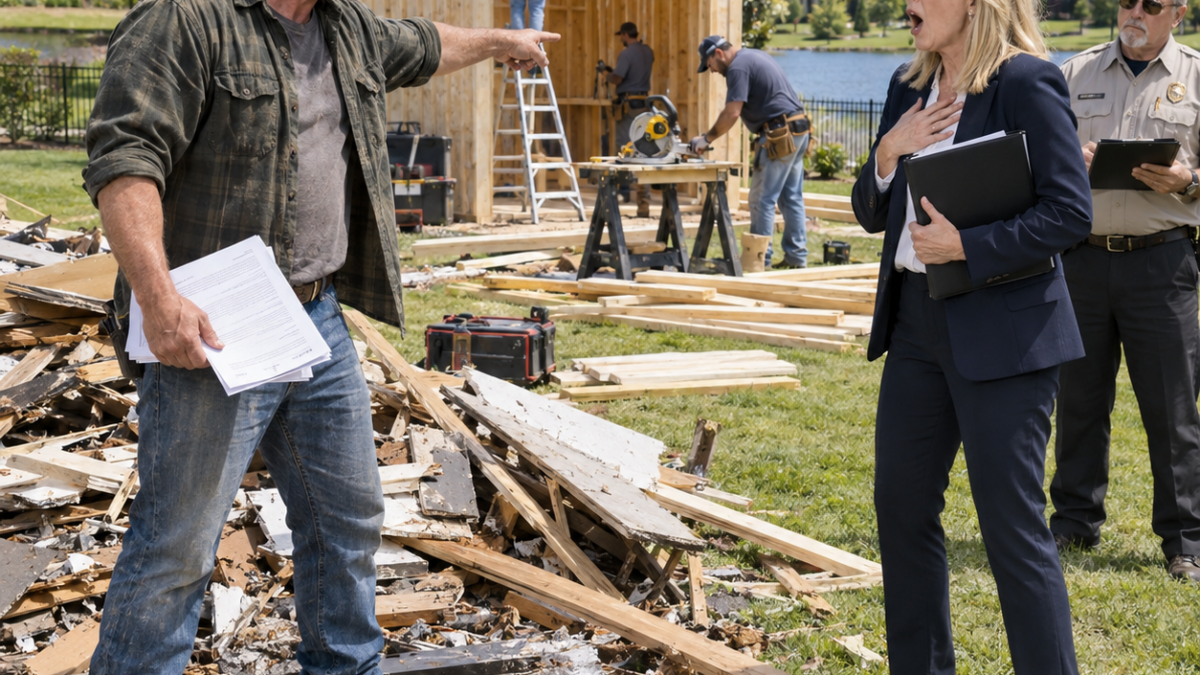
The HOA president called while I was standing in the wreckage of the workshop my late wife and I had planned together, and she actually told me to “have a blessed day.”
Thirty years of tools were buried beneath broken lumber, but the only thing I could see was the shattered cherrywood rocking horse I had been building for my granddaughter from Sarah’s old sketch.
Karen Bishop thought she had finally forced me to surrender, but she had just crossed a line that no fine, no bylaw, and no smug smile could ever erase.
“Your shed was an unauthorized structure,” Karen said through the phone. “The association exercised its right to remedy the violation.”
I stared at the empty rectangle of dirt beneath the oak trees.
My workshop had stood there that morning.
Twenty feet by thirty.
Cedar siding.
Heavy double doors.
Concrete foundation.
Every inch built with my own hands after I retired from the Army Corps of Engineers.
Now it was gone.
“You entered my property?” I asked.
Karen gave a little sigh, as though I were a child struggling with simple instructions.
“You were given repeated warnings, Mr. Garrison.”
“That wasn’t my question.”
“The board has an obligation to enforce community standards.”
“My property isn’t in your HOA.”
Another pause.
Then that sweet voice returned.
“We’ve discussed this.”
“No. I explained it. You ignored it.”
I bent and picked up a splinter of cherrywood.
A curved pencil line still ran across one side.
Sarah’s line.
Before cancer took her, my wife had drawn the rocking horse on a yellow legal pad and written our granddaughter Emily’s name beneath it.
Someday, Jack.
Make her one like your father made for our boys.
I had kept that page for three years before finally starting.
The rocking horse had been almost finished.
Now one of its legs lay ten feet from the place where my workbench had stood.
Karen continued talking.
“You’ll also receive an invoice for demolition expenses and an additional fine for noncompliance.”
I closed my fist around the wood.
“You’re billing me?”
“Yes.”
“For destroying my legally permitted building?”
Her tone sharpened.
“You continue to use that phrase as though repeating it makes it true.”
“It is true.”
“Your refusal to cooperate created this situation.”
That sentence did something to me.
Not an explosion.
The opposite.
Everything inside me became quiet.
Thirty years in uniform had taught me that rage was rarely useful when the other side had already made the mistake you needed.
“What company did you hire?” I asked.
“What?”
“The demolition contractor.”
“That’s association business.”
“You sent people onto my land. I’m asking who they were.”
“I don’t appreciate your tone.”
I almost laughed.
Behind me, my security camera was still mounted beneath the eave of my house.
A tiny green light blinked.
Recording.
Karen didn’t know about the cameras.
She didn’t know the footage had automatically uploaded to the cloud.
She didn’t know I had spent weeks documenting every letter, every fine, every threat.
Most importantly, she didn’t know my attorney had warned her in certified writing that my five-acre property predated Willow Creek Estates, was never annexed into the HOA, and that my workshop had a valid county permit issued before her association even existed.
She had signed for that letter herself.
I still had the receipt.
“Anything else?” Karen asked.
“Yes.”
“What?”
“Don’t destroy any records.”
Silence.
Then she laughed.
It was brief.
Nervous.
“What records?”
“Emails. Text messages. Board minutes. Contractor invoices. Anything concerning me or my property.”
Her voice changed.
“Are you threatening me?”
“No.”
I looked again at the broken cherrywood in my hand.
“I’m preserving evidence.”
She hung up.
I stood alone beneath the oak trees.
The late-afternoon wind moved through the branches where my workshop roof had once caught falling leaves.
Five years earlier, this had been quiet country land.
No HOA.
No covenants.
No Karen Bishop.
Sarah and I had bought it because we wanted freedom after decades of military moves.
Then developers arrived.
Then identical houses.
Then Karen.
And when I refused to let her association absorb my property, she had spent years trying to make me regret it.
She fined my wildflowers.
My vegetable garden.
My pickup.
Even my flag.
I ignored every invoice because legally she had no authority.
Then she targeted the workshop.
And that morning, while I was two hours away at a scheduled VA appointment, she finally did what my attorney had predicted.
She came onto my land.
She brought a demolition crew.
And she tore it down.
I walked into the house and opened the security app.
10:17 a.m.
I pressed play.
A flatbed truck appeared on screen.
Then a golf cart.
Karen stepped out wearing a pink tracksuit and oversized sunglasses.
Two men unloaded crowbars.
One raised a sledgehammer.
And as I watched what happened next, I realized Karen hadn’t merely given me evidence.
She had given me everything I needed to end her reign.
PART 2
I watched the recording from the beginning.
Not because I wanted to.
Because I needed to know exactly what had happened.
At 10:17 that morning, the demolition truck rolled past the front of my house without hesitation.
That mattered.
Nobody accidentally drove half a football field onto private property, around a residence, and directly toward a workshop hidden near a stand of oak trees.
The truck stopped beside the building.
Then Karen’s golf cart appeared.
She climbed out holding the same leather-bound clipboard she carried everywhere.
Even through silent security footage, I could recognize the posture.
Shoulders back.
Chin raised.
The walk of a person who believed the world became official the moment she wrote something down.
She pointed toward the workshop.
One demolition worker looked at her.
Then toward my house.
He said something I couldn’t hear.
Karen pointed again.
The worker shrugged.
Then both men unloaded tools.
The first strike landed on the double doors.
I had built those doors from rough-sawn cedar.
Sarah had chosen the iron handles.
We found them at an antique store during our last anniversary trip before her diagnosis.
I remembered her standing in the aisle, holding one handle against her chest.
“These,” she had said.
“For a workshop we haven’t built?”
“For the workshop you keep talking about.”
“We don’t even own the land yet.”
“We will.”
That had been Sarah.
She could see finished things while I was still studying the blueprint.
The man on the screen swung again.
One hinge tore loose.
Then another.
The doors folded inward.
I stopped the video.
My hand rested on the mouse.
I could have quit.
Marcus already knew they had destroyed the building.
A police report would establish damage.
An insurance appraisal could establish value.
I didn’t need to watch.
But some part of me believed Sarah deserved a witness.
So I pressed play again.
The men entered.
For several minutes, they carried equipment out.
Not carefully.
A drill press hit the ground.
Then a toolbox.
Then boards.
My old table saw came through the doorway on its side.
One man dragged it across the concrete threshold and let it fall into the grass.
I recognized hand planes that had belonged to my father.
A machinist’s square my grandfather carried through three decades of construction work.
My welding hood.
Clamps.
Drawers of hardware.
Every object had a history.
To them, it was debris.
Karen watched with her arms crossed.
Occasionally, she checked her phone.
Once, she walked closer and took a photograph.
A souvenir, I suppose.
Then came the rocking horse.
I stopped breathing.
The two men carried it awkwardly through the ruined doorway.
Its body was carved from solid cherry.
Its legs were fitted but not permanently joined.
The mane still needed shaping.
I had planned to sand it that weekend.
One man dropped the front end.
The wood struck the dirt.
He laughed.
Karen said something.
The man lifted the horse upright.
For a moment, it stood there in the sunlight.
Unfinished.
Beautiful.
Sarah’s drawing made real.
Then the other man swung a sledgehammer.
The first blow cracked the body.
I felt my chair slide backward.
The second separated a leg.
The third destroyed the curved rocker.
I paused the video again.
My reflection stared back from the dark monitor.
Old.
Tired.
Furious.
I whispered, “I’m sorry.”
Nobody answered.
Sarah had been gone three years.
Cancer had taken her slowly enough that we had time to say the important things and quickly enough that none of those things felt sufficient afterward.
The workshop was where I still talked to her.
Not because I believed she was physically there.
Because our life was.
Her gardening gloves hung from a hook.
A coffee mug she had painted crooked blue flowers on held pencils beside my workbench.
Her handwriting was on measurements taped inside cabinet doors.
The rocking horse was the last project she had designed.
Karen didn’t know any of that.
Maybe it wouldn’t have mattered if she did.
That was what hurt.
I saved the footage.
Then I saved it again.
Local hard drive.
Cloud account.
Second cloud account.
USB drive.
Marcus had trained me well.
Or maybe the Army had.
Never trust your only copy of anything you can’t afford to lose.
Then I called the sheriff.
A deputy arrived forty minutes later.
His name was Paul Ramirez.
Young.
Maybe thirty.
He stepped from his cruiser, looked at the bare rectangle under the trees, then at me.
“Mr. Garrison?”
“That’s me.”
“Dispatch said property dispute?”
“Felony property destruction and criminal trespass.”
His eyebrows moved slightly.
“With an HOA?”
“With the HOA president.”
He sighed.
That sigh told me he had already categorized the situation.
Neighborhood drama.
Fence lines.
Mailboxes.
People yelling about grass.
I couldn’t blame him.
“Sir, HOA disputes are usually civil matters.”
“This one isn’t.”
I handed him my phone.
“Watch.”
He watched.
At first his expression stayed neutral.
Then he saw Karen arrive.
Then the tools.
Then the first sledgehammer strike.
His posture changed.
He watched the entire short clip I had prepared.
When it ended, he handed the phone back slowly.
“She authorized that?”
“Directed it.”
“Were you notified?”
“Yes.”
“That they would enter?”
“They threatened to remove it. My attorney sent certified notice that they had no legal authority to enter.”
“Do you have the letter?”
I had a folder waiting.
He read my deed.
County permit.
Survey.
Letter from Marcus.
Certified-mail receipt.
Karen’s signature.
Ramirez looked from the documents to the missing workshop.
“How much was the structure worth?”
“Replacement value, probably thirty-five to forty thousand.”
“And contents?”
I handed him another sheet.
He scanned it.
Table saw.
Band saw.
Drill press.
Welder.
Hand tools.
Antiques.
Specialty lumber.
Partially completed commission pieces.
“Conservatively, over fifty-five thousand total.”
He whistled quietly.
“And the rocking horse?”
“No commercial value that matters.”
He looked at me.
“It matters to you.”
“Yes.”
“What was it?”
I told him.
His expression softened.
“I’m sorry.”
“Thank you.”
He closed the folder.
“Okay. This is not a normal HOA dispute.”
“No.”
“I’ll need a copy of the video.”
“You’ll have it.”
“And contractor information if you have it.”
“Working on that.”
He looked once more at the empty site.
“Did you confront anyone?”
“I wasn’t here.”
“Where were you?”
“VA hospital.”
“You can document that?”
“Yes.”
He nodded.
“That may matter.”
I already knew why.
If Karen had intentionally timed the demolition because she knew I was away, that turned arrogance into planning.
After Ramirez left, I called Marcus.
He answered on the first ring.
“Tell me you backed up the footage.”
“Four copies.”
“Good man.”
“I’m sending it.”
He was silent while the file uploaded.
Then he watched.
I could hear his office in the background.
Keyboard.
Printer.
Traffic through a window.
Finally nothing.
A full minute passed.
“Marcus?”
“I’m here.”
“What do you think?”
His voice had changed.
The amusement he sometimes carried when discussing Karen’s ridiculous fines was gone.
“Jack, we’re done playing defense.”
That sentence settled something inside me.
“What happens next?”
“We build two cases.”
“Civil and criminal?”
“Criminal belongs to the state. We cooperate and stay out of their way.”
“And civil?”
“That belongs to us.”
I sat at the kitchen table.
Sarah’s chair was still across from mine.
I had never moved it.
Marcus continued.
“We sue the association. Karen individually. Every board member who authorized this if the evidence supports it. And the demolition company.”
“For how much?”
“We don’t decide that tonight.”
“I don’t want to get rich from this.”
“I know.”
“I want the workshop back.”
“You’ll get the workshop back.”
“I want those neighbors protected.”
A pause.
“You’ve been talking to them?”
“Not yet.”
“Then tomorrow, start.”
“About what?”
“Ask whether you’re the only one she’s done this to.”
I leaned back.
“I already know the answer.”
“So do I.”
The next morning, I started with Helen Gable.
Mrs. Gable lived four houses inside Willow Creek.
Eighty-two years old.
Widowed.
Five feet tall on a generous day.
She opened the door wearing gardening gloves.
“Colonel Garrison.”
“Just Jack.”
“Nonsense. You earned it.”
I smiled.
“Can I ask you something?”
“If it’s about Karen, come inside before she spots you.”
That answer told me nearly everything.
Her kitchen smelled like cinnamon tea.
Family photographs covered one wall.
Her late husband appeared in half of them.
William Gable.
School principal.
Korean War veteran.
Married fifty-six years.
Mrs. Gable brought a stack of envelopes from a drawer.
“Two thousand, one hundred dollars.”
“For what?”
She pointed toward the front window.
Three ceramic garden gnomes stood among flowers.
I stared.
“The gnomes?”
“My husband collected them.”
I looked closer.
One held a shovel.
One had a watering can.
One sat on a mushroom reading a book.
“Karen says they lower property values.”
“Those?”
“She called them visually disruptive novelty objects.”
I closed my eyes.
“Of course she did.”
Mrs. Gable slid another page toward me.
“Then they put a lien notice on my house.”
My anger sharpened.
“How much equity do you have here?”
“Almost all of it. William and I paid the mortgage off before he died.”
“Did they offer a hearing?”
“I went.”
“And?”
“Karen talked over me.”
Mrs. Gable’s eyes filled.
“I tried to explain that William bought the first gnome in Vermont on our tenth anniversary.”
She touched the edge of the notice.
“She said emotional attachment wasn’t grounds for exemption.”
That sentence stayed with me.
It was familiar.
Not the words.
The cruelty disguised as procedure.
I photographed everything with her permission.
Then I went to the Millers.
Ryan and Michelle Miller had three children and the permanent exhaustion of young parents.
Their violation involved a basketball hoop.
Portable.
Black pole.
Clear backboard.
Nothing unusual.
“Our boys roll it into the garage every night,” Ryan explained.
“Why is it a violation?”
Michelle laughed without humor.
“Karen says it creates a street-like recreational atmosphere.”
I stared at her.
“You live on a street.”
“Apparently not that kind.”
Their fines totaled nearly three thousand.
A lien had been threatened.
They had applied for architectural approval.
Denied.
Appealed.
Ignored.
Ryan lowered his voice.
“We thought about moving.”
“Because of a basketball hoop?”
“Because of everything.”
He showed me additional notices.
Trash cans.
Holiday lights removed twelve hours late.
A chalk drawing on the sidewalk.
Their youngest daughter had drawn a rainbow.
It lasted until rain washed it away.
Karen had fined them fifty dollars.
By the end of that week, I had thirty-two folders.
Not every resident hated the HOA.
That mattered.
Some appreciated basic maintenance rules.
Some liked consistent landscaping.
Some thought Karen had improved the entrances.
I wasn’t interested in manufacturing a rebellion out of personal anger.
I wanted facts.
And the facts were worse than I expected.
Unexplained fees.
Selective enforcement.
Appeals never answered.
Fines applied differently depending on whether Karen liked the homeowner.
Threatened liens.
Neighbors pressured into signing association documents after being told participation was mandatory.
That last part interested Marcus most.
“You have that in writing?”
“Several residents saved the original flyers.”
“Bring them.”
The flyer said:
**WILLOW CREEK COMMUNITY ASSOCIATION ENROLLMENT REQUIRED FOR ALL RESIDENTIAL PROPERTIES WITHIN THE DEVELOPMENT AREA.**
My property wasn’t part of the development.
That was clear.
But several early homeowners claimed Karen had told them the city required association membership.
Marcus stared at the document.
“She formed this?”
“Pushed it through with the developer’s transition committee.”
“Was membership actually mandatory in their deeds?”
“For some newer sections, yes. For the first phase, it’s complicated.”
“Good.”
I laughed.
“Complicated is good?”
“For lawyers.”
He started writing.
“We’re not challenging legitimate covenant authority where it actually exists. We’re challenging misrepresentation, unauthorized fines, abusive lien practices, and potentially fraudulent enrollment where evidence supports it.”
“That sounds less exciting than overthrowing an empire.”
Marcus looked up.
“Real law usually does.”
Then his expression hardened.
“But the demolition case is beautifully simple.”
He turned his laptop toward me.
Freeze-frame.
Karen standing beside the workshop.
Time stamp visible.
Another frame.
One worker swinging a hammer.
Another.
Karen pointing.
Another.
The rocking horse outside.
Another.
The structure collapsing.
“She cannot argue she didn’t know.”
“No.”
“She cannot argue the contractor acted independently.”
“No.”
“She cannot argue the building was abandoned.”
“No.”
“She cannot argue she believed it belonged to the association after your certified notice.”
“No.”
Marcus leaned back.
“She can argue she misunderstood the law.”
“Will that help?”
“Not after discovery.”
“What do you expect to find?”
He smiled without warmth.
“People who enjoy control almost always document how much they enjoy it.”
He was right.
But before discovery came the neighborhood meeting.
Frank Delaney helped organize it.
Frank was a retired Marine gunnery sergeant who lived near the south entrance.
He had been fighting the HOA over a satellite dish.
The dish complied with federal rules.
Karen didn’t care.
When I showed Frank a still image from the demolition video, he stared at it for a long time.
Then he looked at me.
“She did this while you were at the VA?”
“Yes.”
“Did she know?”
“I suspect so.”
His jaw tightened.
“My wife says I need hobbies.”
“Is this going to become one?”
“Absolutely.”
We rented a meeting room at the public library.
Capacity sixty.
I expected fifteen.
Fifty-three came.
People arrived quietly.
Some parked around back.
A few asked whether Karen knew.
That bothered me more than anything.
They were afraid to attend a meeting in a public library.
Frank closed the door.
I stood at the front.
“I’m not here to tell anybody what to think about the HOA.”
Several people looked surprised.
“I’m here because something happened on my property.”
I showed the county permit first.
My deed.
Survey.
Marcus’s certified letter.
Karen’s signed receipt.
Then the final remediation notice.
I wanted everyone to see the sequence.
I didn’t start with the dramatic video.
Facts first.
Then context.
Then evidence.
Finally, I turned off the lights.
The demolition footage appeared on the projector.
Nobody spoke.
They watched Karen arrive.
They watched the workers break through my doors.
They watched the building come apart.
Then the rocking horse appeared.
Mrs. Gable whispered, “Oh, Jack.”
The hammer fell.
Someone gasped.
A woman in the second row covered her mouth.
I stopped the video.
For several seconds, the room remained dark.
Then Frank turned the lights on.
A man near the back stood.
“She can do that to us?”
Marcus had warned me about giving legal advice.
So I answered carefully.
“I can only tell you what happened to me.”
Ryan Miller spoke.
“She threatened us with forced removal of our basketball hoop.”
Another resident said, “She threatened my fence.”
Another.
“My greenhouse.”
Another.
“My wheelchair ramp.”
That stopped everyone.
The speaker was a middle-aged woman named Donna Price.
Her husband had been injured in a motorcycle accident and used a wheelchair.
“What happened?” I asked.
“She said the ramp changed the architectural character of the entrance.”
Frank muttered something under his breath that would have made a drill instructor proud.
Donna continued.
“The county accessibility officer got involved. The HOA backed off.”
“Do you still have the notices?”
“All of them.”
Marcus had told me not to promise people money.
Not to make claims we couldn’t prove.
Not to turn legitimate frustration into a mob.
So I said:
“If you believe you were treated unlawfully, document it. Keep originals. Save emails. Save text messages. Don’t alter anything.”
Mrs. Gable raised her hand.
“What are you going to do?”
I looked around the room.
People weren’t asking because they wanted entertainment.
They wanted to know whether resistance was possible.
“I’m going to court.”
Frank stood beside me.
“So am I.”
Ryan stood.
Then Donna.
Then Mrs. Gable.
By the end of the night, twenty-seven households had agreed to let Marcus review their records.
We didn’t have a rebellion.
We had plaintiffs.
Marcus filed the complaint twelve days after the demolition.
Sixty-one pages.
The primary claims concerning me were straightforward: destruction of property, trespass, conversion of personal property, and damages associated with intentional misconduct.
Additional claims involving other residents depended on individual facts.
Marcus refused to inflate anything.
“That’s how you win ugly cases,” he said. “You keep your side clean.”
The complaint sought fifty-five thousand dollars in direct property damage for me, additional emotional-distress damages, punitive damages where permitted, attorney fees where recoverable, and equitable relief regarding invalid fines and liens.
Karen was served at home.
Frank watched from across the street.
He called me immediately.
“She took it.”
“That’s usually how service works.”
“She read the first page.”
“Frank.”
“Then she yelled at the process server.”
“Go home.”
“I am home.”
“You’re watching from your window?”
“Reconnaissance.”
“You’re retired.”
“Marines don’t retire. We become unsupervised.”
I laughed for the first time in days.
The HOA’s attorney responded quickly.
His name was Clayton Webb.
His first letter called our suit frivolous.
He accused me of attempting to intimidate a volunteer community association.
He threatened sanctions.
Marcus read the letter while eating a sandwich.
“Should I be worried?” I asked.
“No.”
“Why?”
“He hasn’t seen the video.”
“How do you know?”
Marcus wiped mustard from his thumb.
“Because nobody who has seen that video uses the phrase ‘factual misunderstanding.’”
He forwarded a secure link.
The message contained five words.
**Please review before further correspondence.**
Clayton Webb did not reply for nine days.
Then discovery began.
That was when Karen’s empire stopped being an emotional story and became data.
Emails.
Text messages.
Board minutes.
Invoices.
Internal notes.
Archived newsletters.
Marcus subpoenaed everything relevant.
Initially, the HOA produced too little.
Marcus filed a motion to compel.
More documents appeared.
Then more.
Thousands of pages.
I spent evenings in Marcus’s conference room with colored tabs.
Yellow for references to me.
Blue for property issues.
Red for anything concerning demolition.
Green for other homeowners.
At 8:42 on a Thursday night, I found the first email that made Marcus stop eating.
Karen to board members.
Subject line:
**GARRISON COMPLIANCE STRATEGY**
The message read, in part, that I was “the stubborn old soldier” whose resistance was encouraging others.
Another line:
**If he is allowed to ignore us publicly, everyone will believe the board is powerless.**
Marcus circled it.
“Control.”
“What?”
“This was never about the shed.”
“I know.”
“No. Now she told us.”
Another email described a plan to “increase compliance pressure until he either submits or sells.”
Another:
**His property is an embarrassment at the edge of the community and should eventually be brought under association control.**
I stared at that sentence.
“She wanted my land.”
“She wanted authority over it.”
“Same difference.”
“Legally, not quite.”
Then we found the gnome messages.
Karen to Linda Shaw, the HOA secretary:
**Gable cried again about those ugly little gnomes. If she can’t follow simple rules, maybe a lien will finally get her attention.**
Linda replied:
**Do we really need to push an 82-year-old widow over lawn ornaments?**
Karen:
**Rules mean nothing if exceptions are based on sob stories.**
Mrs. Gable cried when we showed her.
Not because Karen insulted the gnomes.
Because Linda had objected.
“All this time,” she whispered, “I thought none of them cared.”
Sometimes cruelty spreads because everyone agrees.
Sometimes it spreads because decent people stay quiet beside the loudest person in the room.
Then came the demolition email.
I remember exactly where I was sitting.
Conference room.
Rain against the windows.
Cold coffee beside me.
Marcus opened the file.
His face became still.
“Jack.”
“What?”
“Read this.”
The email was sent the day before my VA appointment.
Karen to the board.
She referenced Marcus’s certified letter.
Not vaguely.
Directly.
She wrote that she had received “Garrison’s lawyer friend’s bluff.”
Then:
**He will be out of town tomorrow for his VA appointment. It is the ideal window to remove the structure without confrontation. Once it is gone, the issue becomes moot. The community needs to understand that defiance has consequences.**
I read it twice.
Then a third time.
My hands went cold.
“She knew.”
Marcus nodded.
“She planned around the appointment.”
“Yes.”
“How did she know?”
“We’ll find out.”
We did.
A board calendar contained notes from a conversation Karen had apparently had with one of my neighbors after hearing me mention the VA appointment.
Nothing illegal about learning I’d be away.
What mattered was what she did with the information.
Marcus leaned back.
“This email changes settlement posture.”
“Because of malice?”
“Because it makes the jury story devastating.”
I hated hearing Sarah’s workshop described as a jury story.
But he wasn’t wrong.
The video showed conduct.
The email showed intent.
Together they were brutal.
Criminal investigators noticed too.
Detective Ramirez—Deputy Ramirez’s older brother, amusingly—interviewed Karen.
I wasn’t present.
I only knew what eventually appeared in reports.
Karen claimed she had acted in good faith under HOA authority.
Then investigators showed her my certified letter.
She claimed she believed the letter was legally incorrect.
Then they showed her the email describing it as a bluff and discussing my VA appointment.
Her attorney ended the interview.
The demolition contractor had problems of his own.
Roy “Ry” Hanley ran Ry’s Demo and Hauling.
He told investigators Karen had assured him the HOA controlled the property.
He had never requested proof.
He had never checked the permit.
He had never spoken to me.
When asked about the personal property inside the building, he claimed his men believed everything was being discarded.
Then he saw the rocking-horse footage.
According to the report, he looked down for a long time.
His insurance carrier contacted Marcus the following week.
Meanwhile, Frank opened the second front.
Public attention.
He knew Sarah Jenkins, a reporter at Channel Eight.
Not my Sarah.
Hearing the name the first time had punched me unexpectedly in the chest.
Jenkins came to my house with a camera operator.
“I don’t want a cartoon villain story,” I told her.
She seemed surprised.
“You’ve seen the footage?”
“Yes.”
“Then you know what I mean.”
“I do.”
“Karen did something terrible. But I don’t want innocent homeowners turned into villains because they belong to an HOA.”
Sarah Jenkins nodded.
“What do you want viewers to understand?”
I looked toward the empty workshop site.
“That power needs limits.”
She waited.
“And that paperwork doesn’t make something right just because somebody puts a logo on top.”
The story aired at six.
They used only a short portion of the demolition footage.
Enough.
The double doors breaking.
Karen standing nearby.
The rocking horse being carried outside.
They froze the frame before the hammer struck.
I was grateful.
Mrs. Gable agreed to appear.
She held one of William’s garden gnomes in her lap.
“My husband bought this in 1981,” she told the reporter. “Apparently it became dangerous to property values after he died.”
Ryan and Michelle showed their basketball hoop.
Donna showed the wheelchair-ramp notices.
Then the reporter displayed Karen’s email referencing my VA appointment.
That changed everything.
The story spread.
Not because I was a retired colonel.
Not because the shed was expensive.
Because almost everyone understands what it feels like when a person with minor authority begins treating that authority as ownership over other people.
Karen made one decision that stunned even Marcus.
She agreed to an interview.
Frank called me before it aired.
“You need to turn on Channel Eight.”
“Why?”
“She talked.”
“Who?”
“Karen.”
“Oh no.”
“Oh yes.”
Karen sat in her immaculate living room.
Pastel blouse.
Perfect hair.
Expression composed.
Sarah Jenkins asked whether she believed the HOA had authority to demolish my workshop.
Karen said:
“Mr. Garrison was given ample opportunity to comply with community standards.”
Jenkins replied:
“But his deed indicates he was not a member of your association.”
Karen hesitated.
“We dispute his interpretation.”
“His county permit predates the HOA.”
Another hesitation.
“Pre-existing structures can still negatively affect a community.”
“Did you know he would be at a VA medical appointment when the structure was demolished?”
Karen’s eyes flickered.
“My understanding is that his schedule was incidental.”
Jenkins produced the email.
“Your email says it was ‘the ideal window.’”
Karen’s face changed.
Just slightly.
But cameras are merciless.
“I don’t recall the exact wording of every internal communication.”
“You also wrote that the community needed to understand that defiance has consequences.”
“That was taken out of context.”
“What context would change the meaning?”
Karen leaned back.
“You have to understand something. Community governance is difficult. People want the benefits of standards without accepting the inconvenience of following them.”
Jenkins looked at her.
“Was Mr. Garrison legally bound by those standards?”
Karen answered the wrong question.
“He should have been.”
That clip spread everywhere.
Marcus called at 7:15 the next morning.
“Congratulations.”
“For what?”
“Your defendant just gave us another exhibit.”
“I wish she’d stop helping.”
“I don’t.”
The HOA insurance carrier disagreed with him.
They wanted the case gone.
Their lawyers requested mediation.
The conference took place downtown.
Neutral office.
Large table.
Water pitchers.
Boxes of documents.
Karen sat across from me.
The other board members sat farther away.
Linda looked exhausted.
Gerald Pierce, the treasurer, couldn’t meet my eyes.
Karen looked directly at me once.
Then never again.
The insurance lawyer, Martin Henderson—not related to anyone in the sheriff’s department—opened negotiations.
“We’re here to resolve a difficult situation.”
Marcus said nothing.
Henderson continued.
“There are disputed facts and legal questions concerning community governance authority—”
Marcus slid the deed across the table.
Henderson stopped.
Marcus added the county permit.
Then the certified letter.
Then Karen’s signed receipt.
Then the email.
Then he placed a tablet on the table.
The demolition video waited on screen.
Henderson sighed.
“I’m familiar with the evidence.”
Marcus leaned back.
“Good. Then we can save time.”
Their opening offer was twenty thousand dollars.
I actually thought Marcus had misheard.
“For everything?” he asked.
“To compensate Mr. Garrison for the structure and resolve his individual claims.”
Marcus looked at me.
I said nothing.
He turned back.
“My client had more than twenty thousand dollars in tools inside.”
“We dispute valuation.”
Marcus nodded.
“Then let’s try the case.”
Henderson’s expression tightened.
“Counsel, be reasonable.”
“I am.”
He tapped the tablet.
“Your insured’s board president knowingly entered property outside association jurisdiction after written notice from counsel, timed the entry around a veteran’s medical appointment, directed demolition of a permitted structure, destroyed contents with sentimental and monetary value, documented the operation, and then billed the victim for the demolition.”
No one moved.
Marcus continued.
“And we have the email where she describes the purpose as teaching the community that defiance has consequences.”
Karen finally spoke.
“That email was private.”
Marcus looked at her.
“That is not a legal defense.”
Her attorney touched her arm.
She pulled away.
Henderson tried again.
“What does your client want?”
Marcus looked at me.
We had discussed this for days.
Money was part of it.
But money alone would feel empty.
I removed one sheet from my folder and placed it on the table.
Marcus read the terms.
“Two hundred thousand dollars to Mr. Garrison.”
Karen’s head snapped up.
Henderson frowned.
“Excessive.”
Marcus ignored him.
“All reasonable legal fees associated with Mr. Garrison’s claims to be paid separately.”
He continued.
“Every fine, lien, penalty, and collection action challenged by the participating homeowners and determined invalid under the settlement review will be withdrawn and corrected.”
Gerald shifted.
“Next, Mrs. Bishop and the current directors who approved the demolition resign their board positions.”
Karen whispered, “Absolutely not.”
Her attorney murmured something.
Marcus kept reading.
“They will not seek an HOA board position in Willow Creek for the period specified in the agreement.”
Karen’s face turned red.
Then Marcus reached the last page.
“And finally, Willow Creek Estates HOA, through its insurer and at no expense to Mr. Garrison, will retain a licensed, bonded contractor selected from mutually approved bids to reconstruct his workshop on the original footprint to equal or better specifications.”
Henderson rubbed his forehead.
Marcus finished.
“Substantial completion within thirty days after permits and execution of the agreement.”
Silence.
Karen stared at me.
“You want them to rebuild it.”
“Yes.”
“You could take the money and build it yourself.”
“Yes.”
“Then why force the HOA?”
“Because you destroyed it in the HOA’s name.”
Her attorney whispered, “Karen.”
She ignored him.
“You want to humiliate me.”
“No.”
“Yes, you do.”
I looked at her.
For months, I had imagined what I would say when we finally sat across from one another.
Nothing I rehearsed survived the moment.
So I told the truth.
“You destroyed the last project my wife designed.”
Her expression shifted.
Barely.
I continued.
“You destroyed tools my father used.”
Silence.
“You stood there while people smashed something you knew I valued.”
She looked away.
“And afterward, you called me and told me to have a blessed day.”
Linda covered her mouth.
Karen said, “I didn’t know about your wife.”
“You didn’t ask.”
“I thought it was an illegal shed.”
“My attorney told you it wasn’t.”
“I believed he was wrong.”
“You knew there was a dispute.”
She said nothing.
“You could have gone to court.”
Nothing.
“You could have requested an injunction.”
Nothing.
“You could have called the county.”
Nothing.
“You could have done any of the things people do when they actually believe the law is on their side.”
I leaned forward.
“Instead, you waited until I was two hours away and brought men with sledgehammers.”
Her face tightened.
“That tells me you knew exactly what you were doing.”
She stared at the tabletop.
For the first time since I had known Karen Bishop, she had no speech.
No bylaw.
No clipboard.
No righteous explanation.
Just consequences.
The mediation went on for six more hours.
Twenty thousand became fifty.
Fifty became ninety.
We said no.
The insurer argued over emotional-distress valuation.
Marcus showed the rocking-horse footage.
They argued over punitive exposure.
Marcus showed the email.
They argued over the neighbor claims.
Marcus showed the file boxes.
Eventually, Henderson asked to speak privately with his clients.
We left the room.
In the hallway, I stood beside a window overlooking downtown.
Marcus joined me.
“You okay?”
“I don’t know.”
“That’s allowed.”
“I thought this would feel better.”
“Winning?”
“This.”
He nodded.
“Cases aren’t movies, Jack.”
“I know.”
“There’s no music when the villain realizes she lost.”
“She hasn’t realized it.”
Marcus smiled faintly.
“She will.”
I looked outside.
“What if they refuse?”
“Trial.”
“You confident?”
“I never promise juries.”
“That wasn’t my question.”
He glanced at me.
“Yes.”
Thirty minutes later, Henderson opened the conference-room door.
“We have a framework.”
We went back inside.
Karen looked like she had aged ten years.
Henderson spoke.
“The carrier will fund two hundred thousand dollars toward resolution of Mr. Garrison’s personal claims, subject to final release language.”
Marcus nodded.
“Fees separate?”
“Yes.”
“The workshop?”
“Rebuilt.”
“Thirty days?”
“Subject to permitting, but the contractor mobilizes immediately.”
“Neighbor relief?”
“Agreed review and release process for specified fines and liens.”
“Board resignations?”
Henderson looked toward Karen.
“Agreed.”
Karen closed her eyes.
Marcus looked at me.
I thought of Sarah.
The old workshop.
Mrs. Gable.
The Millers.
Donna’s ramp.
The empty dirt beneath the trees.
“Put it in writing,” I said.
Thirty days later, the first thing I smelled when I opened the workshop door was cedar.
Fresh.
Clean.
Alive.
But getting there changed Willow Creek.
The settlement check arrived first.
Two hundred thousand dollars.
I deposited it without ceremony.
People assume a large check produces some cinematic feeling.
It didn’t.
I stared at the bank receipt and thought:
I would give every dollar back for one more afternoon in the old workshop with Sarah sitting on the bench criticizing my measurements.
Money compensates.
It does not restore.
That distinction mattered.
The other settlement terms restored things money couldn’t.
Mrs. Gable’s lien was released.
She called me crying.
“They sent a letter.”
“What does it say?”
“That the fines are withdrawn.”
“Good.”
“And they apologized.”
“Even better.”
“I framed it.”
I laughed.
“Of course you did.”
“The gnomes are reading it right now.”
The Millers’ penalties disappeared.
Their basketball hoop returned to the driveway the same afternoon.
Ryan sent me a photograph of his oldest son taking a jump shot.
Caption:
**Street-like atmosphere restored.**
Donna’s accessibility dispute was formally closed.
Other families had fines reduced, withdrawn, or reviewed under clearer procedures.
Not every complaint disappeared.
Some violations were legitimate.
That mattered too.
Freedom doesn’t mean nobody follows rules.
It means rules are applied lawfully, transparently, and for the purpose they were created—not as weapons in somebody’s private war.
Karen resigned.
So did Gerald.
Linda resigned voluntarily even though her role in the demolition had been less direct.
She came to my house before moving out of the board office.
I almost didn’t recognize her without Karen beside her.
“Can we talk?”
We sat on the porch.
She held an envelope.
“I’m not here to defend myself.”
“Okay.”
“I voted to authorize enforcement.”
“I know.”
“I believed Karen when she said your property had become subject to the association because it was surrounded by the development.”
“That was never true.”
“I know that now.”
She looked toward the rebuilding site.
“I should have checked then.”
“Yes.”
Her eyes filled.
“That’s the part I can’t get past.”
I didn’t rescue her from it.
Some guilt is appropriate.
She handed me the envelope.
Inside was a handwritten apology.
Not legal language.
Not something drafted by counsel.
Hers.
“I’m sorry about your wife’s project.”
I folded the note.
“Thank you.”
She stood.
At the steps, she stopped.
“I kept telling myself I wasn’t like Karen.”
I waited.
“But every time I stayed quiet while she hurt someone, I helped her.”
That was probably the most honest thing anyone from the old board ever said.
Frank won the new board election.
He hated being called president.
“Gunny is fine.”
“HOA documents disagree.”
“The HOA documents can push.”
His wife smacked his arm.
“Behave.”
The new board included an accountant, a nurse, a young father, a retired teacher, and Frank.
Their first meetings lasted forever because everyone was terrified of becoming the next Karen.
Every decision was discussed.
Then discussed again.
Then someone asked whether discussion itself required a vote.
It was inefficient.
It was wonderful.
They rewrote enforcement procedures.
No single person could issue major penalties.
Appeals had deadlines.
Lien actions required legal review.
Architectural rules became objective where possible.
Words like “distasteful” and “inconsistent with community spirit” disappeared.
Frank called me one night.
“We’re stuck on garden ornaments.”
“Ask Mrs. Gable.”
“I did.”
“And?”
“She proposed unrestricted gnome deployment.”
“Reasonable.”
“Jack.”
“Fine. Put height and obstruction limits if you actually need them. Stop trying to legislate taste.”
Long pause.
“That’s annoyingly sensible.”
“You’re welcome.”
The workshop rebuild began almost immediately.
The builder was Daniel Mercer.
Best custom carpenter in the county.
Quiet man.
Precise.
He met me beneath the oaks holding the original plans.
“I can reproduce it exactly.”
I looked at the drawings.
“Not exactly.”
He waited.
“Better.”
A smile appeared.
“I was hoping you’d say that.”
The original foundation had been good.
Daniel reinforced it anyway.
Thicker slab edges.
Improved drainage.
Better anchors.
The walls went up with upgraded framing.
Insulation.
Storm-rated windows.
The old asphalt shingles became standing-seam metal.
The cedar siding remained.
That part mattered.
Karen had hated the cedar because every Willow Creek outbuilding was supposed to match beige houses.
So cedar it would be.
Dark.
Warm.
Unapologetic.
Every morning, trucks arrived.
Saws ran.
Hammers rang.
And because Karen’s house sat two doors beyond the property line, she drove past construction whenever she left Willow Creek.
I never arranged that.
I didn’t need to.
Consequences often have better timing than revenge.
The first week, she ignored the site.
The second, her house went on the market.
The third, I saw her stop at the intersection while a crane lifted roof panels.
She looked toward the workshop.
Our eyes met.
I didn’t smile.
Didn’t wave.
Didn’t gloat.
I turned back to Daniel.
That seemed to bother her more.
Frank, of course, had less restraint.
“You should put up a sign.”
“No.”
“‘Built by Karen Bishop.’”
“No.”
“‘Sponsored by HOA Overreach.’”
“No.”
“‘Defiance Has Consequences.’”
I stared at him.
He grinned.
“That one is good.”
“It is.”
“So?”
“No signs.”
“Colonel, you’re no fun.”
“I’m trying very hard to remain a respectable old man.”
“You failed years ago.”
On day twenty-seven, Daniel called.
“Come out here.”
I walked to the workshop.
The doors were installed.
Iron handles.
Not the originals.
Those were gone.
Daniel had searched antique suppliers until he found a nearly identical pair.
I touched one.
“Where did you find these?”
“Pennsylvania.”
“You didn’t have to.”
“Yes, I did.”
Inside, the layout matched the old workshop.
Windows in the same places.
Workbench beneath the north wall.
Tool cabinets.
Storage racks.
But everything was stronger.
Brighter.
Safer.
On the central workbench sat a wooden box.
“What’s that?”
Daniel nodded.
“Open it.”
Inside were fragments.
Cherrywood.
The pieces I had recovered after the demolition.
I looked at him.
“I asked your lawyer whether I could have them.”
“For what?”
Daniel lifted one broken section.
“I thought maybe you’d want them incorporated into something.”
My throat tightened.
“I do.”
“What?”
I already knew.
“The new horse.”
The workshop passed final inspection on day twenty-nine.
On day thirty, Daniel handed me the key.
“Welcome back.”
I opened the door.
Fresh cedar.
Machine oil.
Paint.
Clean lumber.
For several minutes, I stood alone.
I could hear workers packing trucks outside.
Then silence.
The first object I brought inside was Sarah’s photograph.
I put it on the workbench.
The second was her painted pencil mug.
It had somehow survived because I had carried it into the house before the demolition.
The third was William Gable’s ceramic fishing gnome.
Mrs. Gable delivered it personally.
“This is not a loan,” she said.
“I can’t take William’s.”
“He had eleven.”
“Eleven?”
“You’ve only seen three.”
I laughed.
“Karen never knew?”
“She would have died.”
“Mrs. Gable.”
“Figuratively, Colonel.”
She placed the gnome on the windowsill.
“He can guard the shop.”
“Against what?”
She smiled.
“Pink tracksuits.”
The block party happened that weekend.
Nobody officially called it a victory party.
Frank did.
Sarah Jenkins came without a camera.
Daniel brought his family.
Ramirez stopped by in uniform for fifteen minutes.
Mrs. Gable brought potato salad.
The Millers’ boys rolled the basketball hoop into the street and organized a game.
Someone connected speakers.
Kids ran through sprinklers.
Dogs barked.
Two lawn chairs collapsed.
A tray of hamburgers burned because Frank spent too much time telling a Marine story nobody believed.
It was the opposite of Karen’s idea of perfection.
And it was beautiful.
I stood on my porch and watched.
For five years, Willow Creek had looked immaculate.
Straight edges.
Approved colors.
Matching mailboxes.
Fresh mulch.
Yet underneath that neatness, people had been afraid of one another.
Afraid someone would report them.
Afraid a board member would photograph their yard.
Afraid an envelope would arrive.
That afternoon, nothing matched.
Mrs. Gable’s gnomes appeared beside the curb wearing tiny party hats.
The Miller children drew chalk across half the sidewalk.
Someone’s trash bin remained visible for six straight hours.
Civilization held.
Frank walked over carrying a burger.
“Thinking deep thoughts?”
“No.”
“You’ve got the face.”
“What face?”
“The colonel-standing-on-a-hill face.”
“I never stood dramatically on hills.”
“Every officer stands dramatically on hills.”
I looked at him.
“Go burn more food.”
He took a bite.
“You know she closes next week.”
“Who?”
“You know who.”
Karen.
I had heard.
Cash buyer.
Fast closing.
“Good for her.”
Frank stared at me.
“That’s it?”
“What do you want me to say?”
“I don’t know. Something about karma.”
“I don’t believe in outsourcing accountability to the universe.”
“That may be the most Army Corps thing you’ve ever said.”
“What I believe is documentation.”
He raised his burger.
“To documentation.”
We toasted with food.
A few days later, I saw Karen at the grocery store.
I was selecting apples.
She turned into the aisle.
Stopped.
For a moment, neither of us moved.
Then she started to turn away.
“Karen.”
She froze.
I almost let her go.
But there was one thing I needed to know.
“Why?”
She looked back.
“What?”
“The workshop.”
Her face hardened defensively.
“We’ve already been through this.”
“No.”
I stepped away from the fruit display.
“I know what you did. I know how. I know when.”
She said nothing.
“I’m asking why it mattered so much to you.”
She stared at me for several seconds.
Then something in her expression changed.
Not warmth.
But fatigue.
“You want the truth?”
“Yes.”
“You made me look powerless.”
I hadn’t expected honesty.
“When?”
“When you refused to join.”
“That was my legal right.”
“I know that now.”
“You knew it then.”
She looked away.
“Everybody else signed.”
“Not everyone voluntarily.”
Her jaw tightened.
“I was trying to build something.”
“A neighborhood?”
“A community.”
“You thought those were the same thing as obedience.”
She looked back at me.
“You sat there on five acres doing whatever you wanted. Different siding. Wildflowers. That workshop. Your old truck. Everyone could see it.”
“And?”
“And every time someone questioned a rule, they pointed to you.”
I understood.
I had become proof that life outside Karen’s control was possible.
That was the offense.
Not cedar siding.
Not permits.
Not property values.
Independence.
“You could have left me alone.”
“I should have.”
It was the closest thing to an apology she had ever given.
I waited.
She added, “I didn’t know about Sarah.”
I looked at her.
“You keep saying that.”
“Because I didn’t.”
“That wasn’t the problem.”
“What do you mean?”
“You shouldn’t need to know a man’s wife died before deciding not to destroy his property.”
Karen flinched.
I continued more quietly.
“You didn’t have to know what the rocking horse meant.”
Nothing.
“You only had to know it wasn’t yours.”
Her eyes lowered.
People moved around us with carts.
Normal life.
Somewhere, a child was arguing with his mother about cereal.
Finally Karen said, “I lost everything.”
I thought about that.
Her board position.
Reputation.
Settlement money.
House.
But everything?
No.
She was alive.
Healthy as far as I knew.
Selling an expensive home.
Starting elsewhere.
She still had choices.
“You lost control,” I said. “That isn’t the same thing as everything.”
Her eyes flashed.
For a second, the old Karen returned.
Then it disappeared.
She walked away.
I never spoke to her again.
The next week, the moving truck came.
I happened to be working outside.
Not watching her.
Working.
I was carrying cherrywood into the workshop when I heard a car door.
Karen stood beside her SUV.
Her house behind her was empty.
A SOLD sign crossed the realtor board.
She looked at the workshop.
Completed.
Cedar walls.
Metal roof.
Iron handles.
Exactly where the old one stood.
Better.
Stronger.
Paid for because she had tried to erase it.
For a moment, she simply stared.
Then she got into her car.
Drove past.
Turned at the entrance.
And disappeared.
I carried the cherrywood inside.
The new rocking horse took six weeks.
I could have rushed.
I didn’t.
The original design was Sarah’s.
I used her measurements.
Her notes.
Her little modifications written in the margins.
**Round this more—baby knees.**
**Handles not too high.**
**Jack, do NOT make it weigh 100 pounds just because you can.**
I laughed every time I read that one.
The new body came from a beautiful block of cherry.
For the mane, I laminated thin strips from the salvaged fragments Daniel had saved.
The old wood was darker.
Scarred.
You could see faint damage where the sledgehammer had split it.
I could have hidden those marks.
Instead, I left some visible.
Not ugly.
Not dramatic.
Just honest.
When my granddaughter Emily came to visit, she ran into the workshop.
“Grandpa!”
She was six.
All elbows and energy.
I covered the rocking horse with a canvas sheet.
“What’s that?”
“Nothing.”
“It’s big.”
“Large nothing.”
“Can I see?”
“No.”
“Why?”
“Because your grandfather is a cruel dictator.”
She put her hands on her hips.
“Mom says you say that when you have a surprise.”
My daughter had betrayed operational security.
I sighed.
“Fine.”
I pulled the canvas away.
Emily stopped.
She didn’t scream.
Didn’t jump.
She just stared.
Children sometimes understand important moments more quietly than adults.
The horse gleamed under the workshop lights.
Deep red-brown cherry.
Smooth curves.
Dark mane.
Leather handles.
Emily approached carefully.
“For me?”
“For you.”
She touched the mane.
“Why are these pieces darker?”
I looked toward Sarah’s photograph.
“Those came from the first horse.”
“There was another?”
“Yes.”
“What happened?”
I thought about how to answer.
“Somebody broke it.”
Emily frowned.
“Why?”
“Because sometimes grown-ups make very bad decisions.”
She studied the dark wood.
“So you used the broken pieces?”
“Some of them.”
She smiled.
“That’s better.”
“What is?”
“Now the old horse is inside the new horse.”
I had spent weeks thinking about symbolism.
Resilience.
Legacy.
Justice.
A six-year-old explained it better in eight words.
“Yes,” I said.
“That’s exactly right.”
She climbed on.
The horse rocked smoothly.
Forward.
Back.
Forward.
Back.
Her laughter filled the workshop.
I looked at Sarah’s photograph.
And for the first time since watching that hammer fall, the memory changed.
It didn’t disappear.
It never would.
But destruction was no longer the final image.
Emily was.
That evening, after my daughter drove home with the rocking horse wrapped carefully in blankets, I returned to the workshop alone.
The gnome sat on the windowsill.
The tools were arranged.
The air smelled faintly of sawdust.
I picked up the splinter I had taken from the demolition site on that first afternoon.
The one with Sarah’s pencil line.
I had kept it in my desk drawer.
I turned it over in my fingers.
Karen had believed power meant making other people submit.
She was wrong.
Power without restraint is only force with paperwork.
Real strength is quieter.
Mrs. Gable keeping William’s ridiculous gnomes because love mattered more than somebody’s landscaping opinion.
The Millers letting their sons play basketball in their own driveway.
Donna building a ramp so her husband could enter his own home with dignity.
Linda admitting that silence had made her part of something wrong.
Frank spending his retirement sitting through three-hour HOA meetings because somebody had to keep the rules boring again.
Marcus building a case page by page instead of answering anger with anger.
Daniel picking broken cherrywood from rubble because he understood that some things can be rebuilt without pretending they were never damaged.
And me?
For years after Sarah died, I thought being strong meant protecting what remained exactly as it was.
The workshop.
Her mug.
Her tools.
Her drawings.
Every object frozen in place.
But the new workshop taught me something.
Restoration isn’t the same as going backward.
The original building was gone.
The new one was different.
Better in some ways.
Painful in others.
The rocking horse was gone.
Then another existed.
Not a replacement.
A continuation.
Maybe communities work like that too.
Willow Creek never returned to what it had been before Karen.
It couldn’t.
People knew too much now.
They knew neighbors could be bullied.
They knew boards could overreach.
They knew documents mattered.
They knew silence could become permission.
But they also knew something else.
They could say no.
A year after the demolition, Frank invited me to the annual HOA meeting.
“I’m not a member.”
“Guest speaker.”
“No.”
“Please?”
“No.”
“Mrs. Gable already told everyone you’re coming.”
I closed my eyes.
“That woman is dangerous.”
“She has four gnomes now.”
“Eleven.”
“What?”
“Never mind.”
I went.
The clubhouse was packed.
But the atmosphere was different.
No fear.
No stage.
No president sitting above everyone like a judge.
Frank sat at an ordinary folding table.
Budget reports were printed beside coffee.
Children colored in the back.
The first argument was about pool hours.
It lasted twenty minutes.
Nobody threatened anyone.
The second was landscaping contracts.
Thirty-five minutes.
I nearly fell asleep.
It was glorious.
Then Frank stood.
“One last piece of business.”
He looked at me.
I shook my head.
He ignored me.
“A year ago, most of us were afraid of opening our mailboxes.”
Quiet laughter.
“Tonight, half of you spent forty minutes arguing about whether the pool should close at nine or ten.”
Someone shouted, “Ten!”
Another shouted, “Nine on school nights!”
Frank raised his hand.
“My point exactly.”
More laughter.
He continued.
“We nearly lost something important because we confused order with control.”
His gaze moved through the room.
“We don’t need to agree on everything.”
Mrs. Gable called out, “Especially gnomes.”
“Especially gnomes.”
Frank looked toward me.
“But we do need to remember that no board owns this neighborhood. The people who live here do.”
Applause filled the room.
I didn’t stand.
Didn’t wave.
I just sat beside Mrs. Gable.
She leaned toward me.
“You did this.”
“No.”
“You started it.”
“Karen started it.”
Mrs. Gable considered that.
“Fair.”
Then she whispered, “Did you know the new family in Karen’s house has flamingos?”
I turned.
“Plastic?”
“Pink.”
“How many?”
“Six.”
I started laughing.
Mrs. Gable laughed too.
Frank stopped talking.
“What’s happening back there?”
“Nothing,” I said.
But Mrs. Gable couldn’t resist.
“Flamingos.”
The room erupted.
Frank put his head in his hands.
The meeting dissolved into jokes.
And as ridiculous as it sounds, that moment meant almost as much to me as the settlement.
Because nobody was afraid.
A year earlier, Karen Bishop had demolished my workshop to show Willow Creek that defiance had consequences.
She succeeded.
Just not the way she intended.
Her action showed fifty families exactly what unchecked authority looked like.
It gave frightened neighbors a reason to compare stories.
It gave investigators evidence.
It gave attorneys a pattern.
It gave a reporter a story.
It forced an insurance company to calculate the cost of arrogance.
And ultimately, it forced the association to rebuild what it destroyed.
Thirty days after we signed the settlement, my workshop stood again.
Stronger foundation.
Thicker walls.
Better roof.
New tools.
Same cedar.
Same footprint.
The HOA paid for it.
They paid my legal fees.
They corrected the challenged fines and liens under the settlement process.
The old board resigned.
And I received two hundred thousand dollars in compensation for what had been done.
But the check was never the ending.
The ending was Emily rocking back and forth on the horse her grandmother designed.
The ending was Mrs. Gable’s gnome on my windowsill.
The ending was teenage boys playing basketball without their parents wondering whether a fine was coming.
The ending was an HOA meeting boring enough that people complained about the coffee instead of being afraid of the president.
Karen thought she was demolishing an illegal shed.
What she actually destroyed was the illusion that nobody could stop her.
I still have the first violation notice she ever sent me.
It’s inside a folder with the certified-mail receipt.
Not framed.
Not displayed.
Just kept.
Every once in a while, when someone asks why I documented so much instead of simply yelling back, I show them that file.
Because anger feels powerful in the moment.
Evidence is powerful when the moment is over.
Karen had noise.
I had a deed.
She had fines.
I had permits.
She had a board title.
I had certified mail.
She had two men with sledgehammers.
I had cameras.
She had confidence.
I had patience.
And in the end, patience cost her far more than any shouting match ever could.
Late one evening, almost exactly a year after the demolition, I was working alone.
Rain tapped softly against the metal roof.
The saw was off.
Radio low.
I was building a small cedar planter for my daughter.
Nothing important.
That was what I loved most.
The workshop no longer needed every project to mean something.
It could just be a workshop again.
I looked at the window.
Mrs. Gable’s gnome sat there with his fishing rod.
Behind him, through the glass, I could see the lights of Willow Creek.
Families eating dinner.
Televisions glowing.
Garage doors opening.
Someone walking a dog.
Ordinary life.
Sarah and I had wanted ordinary life for decades.
The Army had moved us from base to base.
New houses.
New schools.
Deployments.
Goodbyes.
Reunions.
She used to say that someday we would buy enough land that no one could tell us where to put the tomatoes.
We almost got that someday together.
Almost.
I touched her photograph.
“You would have hated Karen,” I said.
The workshop stayed quiet.
Then I smiled.
“No. You would’ve invited her inside for coffee and somehow made her apologize in twenty minutes.”
That was more accurate.
Sarah had possessed a kind of strength I never learned in uniform.
She could make someone ashamed of bad behavior without raising her voice.
I wished she had been there.
Not for the lawsuit.
Not for the money.
For the block party.
For Emily.
For the horse.
For the absurd gnome.
I missed her.
That never changed.
But grief had stopped feeling like something Karen could damage.
Because memory doesn’t live in cedar walls.
It doesn’t live in iron handles.
It doesn’t even live in an unfinished rocking horse.
Those things carry memory.
They help.
But memory survives their loss.
I had learned that the hard way.
I switched off the lights.
Before closing the door, I looked around once more.
New workshop.
Old memories.
Fresh sawdust.
A place rebuilt not because destruction had been forgotten, but because it hadn’t won.
Outside, rain darkened the cedar.
I locked the door.
Then walked toward the house.
Behind me stood the structure Karen had been certain she had erased forever.
Thirty days after the settlement, it came back.
Better.
Stronger.
Legal exactly as it had always been.
And every board member who approved its destruction had learned the same expensive lesson:
You can print a rule on official letterhead.
You can stamp it with an HOA logo.
You can call yourself president.
You can send fines, threaten liens, and convince yourself that obedience proves you’re right.
But none of those things give you ownership of another person’s land.
None of them give you permission to destroy what isn’t yours.
And none of them protect you from consequences when the person you tried to bully has the patience to document every single step.
Karen Bishop demolished my workshop because she wanted to teach me that defiance had consequences.
She was right about one thing.
It did.
They just weren’t mine.
:::
:::








