PART 2: HOA Built a $50 Million Christmas Resort on My Forest—Then I Came Home Before Opening Day
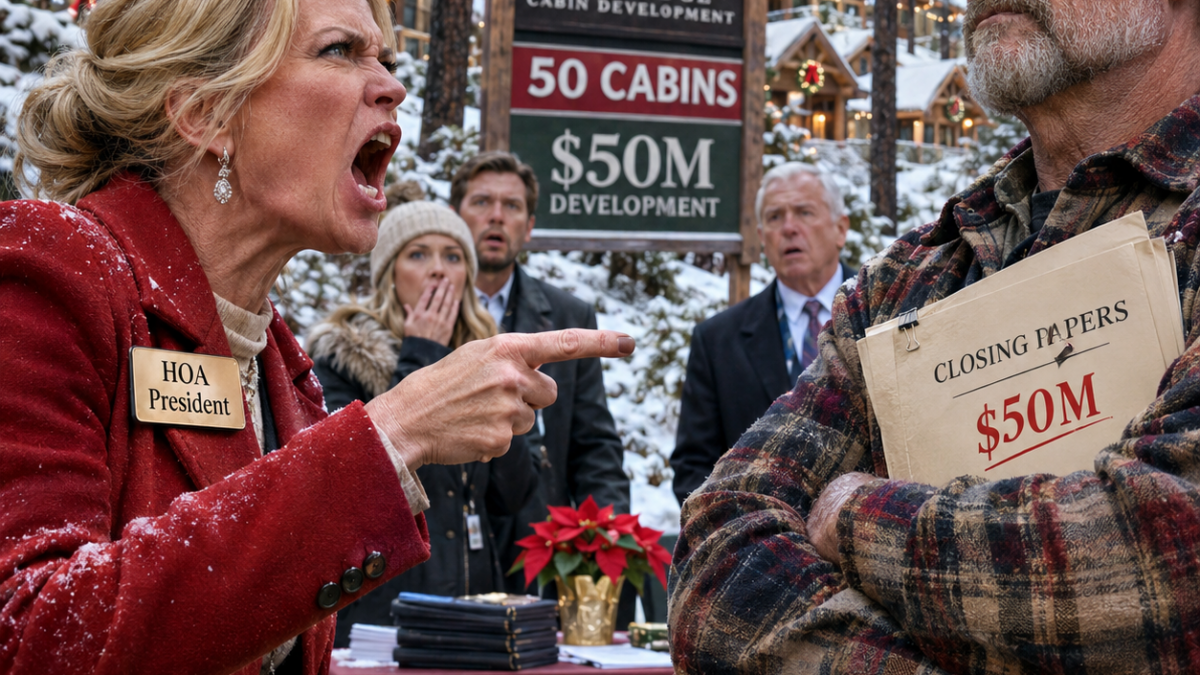
PART 2
I read the paragraph once.
Then again.
Then I leaned closer and read it a third time because I was certain I had misunderstood something.
Every completed sale, long-term rental, membership payment, commercial lease, reservation deposit, or other revenue generated by the project had to pass through a central escrow system administered under the management agreement.
That part made sense.
The next sentence did not.
After verified expenses and contractual distributions, proceeds were ultimately payable according to the legal ownership of the underlying real property and improvements.
I looked at Marlo.
“She thinks Silver Ridge owns the land.”
“Yes.”
“But the county says I own it.”
“Yes.”
“And this agreement says the money eventually follows the owner of record.”
“In simplified terms.”
I tapped the page.
“Meaning me.”
“Potentially.”
“You hate saying anything directly, don’t you?”
“I like keeping my law license.”
I sat back.
For the first time since I had driven into the North Woods, something other than anger moved through me.
Not joy.
Not revenge.
Clarity.
Vivien had treated my land as if it were an empty line on a spreadsheet.
But while she was doing that, she had signed contracts built around the assumption that Silver Ridge actually held title.
The farther she went, the more expensive that assumption became.
Marlo watched my face.
“I know that expression.”
“What expression?”
“The expression clients get immediately before they decide the law is a toy.”
“I’m thinking.”
“That is what worries me.”
I looked back down at the contract.
“How close are they to opening?”
“December twentieth.”
“Twelve days.”
“Yes.”
“How much remains unfinished?”
“Cosmetic work mostly. Furniture. Landscaping. Final inspections. Some interior finish.”
“So if we stop them now?”
“Construction freezes. Guests get canceled. Contractors file claims. The bank panics. Investors turn on the board.”
“And the land?”
“Still yours.”
“But torn up.”
“Yes.”
“Half-built resort?”
“Likely.”
I walked to her window.
Main Street was beginning to disappear under light snow.
Christmas decorations hung from the lamp posts.
Across the road, the diner had fake white snow painted along the bottom of its windows.
I had spent eleven years working on projects where people made mistakes.
Some mistakes were harmless.
Wrong paint.
Wrong fixture.
A truck arriving one day late.
Others became expensive because somebody was too proud to stop.
The most dangerous phrase in construction was always the same.
We’re too far in now.
Vivien had built fifty cabins on exactly that sentence.
“What happens if I don’t stop them?”
Marlo was quiet.
“Legally?”
“Yes.”
“We preserve your objection. Put every interested party on formal notice. Establish that continued construction is not consent. Document the title issue.”
“And then?”
“We let the facts develop.”
“Can they claim I accepted it because I didn’t physically stop them?”
“They can claim anything.”
“Can they win?”
“I can protect you against that argument if we act correctly.”
I turned from the window.
“Then let her finish.”
Marlo removed her glasses.
“You understand what you just said?”
“Yes.”
“Say it again.”
“Let her finish.”
“Why?”
“Because the trees are already gone.”
Her expression softened slightly.
“The foundations are already in.”
“Yes.”
“The road exists.”
“Yes.”
“If I stop it today, I inherit damage and lawsuits.”
“Yes.”
“If I let them finish while formally objecting, whatever they build remains tied to a title problem they created.”
She stared at me.
“You’re an engineer.”
“Yes.”
“That explains a lot.”
“What?”
“You’re looking at this like load transfer.”
“Everything is load transfer.”
“This is not a bridge.”
“It’s still force moving from one place to another.”
She folded her arms.
“And where is the force moving?”
“Back toward the person who made the assumption.”
Marlo stood.
“I am going to say this once.”
I waited.
“If this becomes punishment for punishment’s sake, I’m done.”
“It won’t.”
“If you start enjoying the idea of destroying people who invested honestly, I’m done.”
“I don’t.”
“If you interfere with guest safety, wages, utilities, or anyone’s legitimate interests to increase leverage, I’m done.”
“Understood.”
She looked at me for another second.
“Fine.”
She pulled a yellow pad closer.
“We notify everyone.”
The letters went out the next morning.
To Silver Ridge.
To Vivien personally.
To their counsel.
To the project management company.
The language was simple.
I owned the property.
I had not authorized development.
I disputed any claimed right to build.
I demanded documentary proof of any transfer, lease, easement, license, or recorded use right.
Silver Ridge’s attorney replied two days later.
Six pages.
I read every word.
It discussed county planning approvals.
Public benefit.
Historic community use.
The value created by investment.
Good-faith reliance.
Equity.
Development expectations.
Not one page included a deed.
I called Marlo.
“They didn’t answer.”
“They answered exactly what they wanted to answer.”
“They have nothing.”
“Probably.”
I laughed.
“Still probably.”
“Especially when clients sound confident.”
That afternoon I walked the site.
I did that almost every day from then on.
Not because I wanted to confront workers.
I wanted to understand exactly what had been built.
Construction was my world.
That made it impossible to dismiss what I saw.
The cabins were good.
That irritated me.
Cabin Four had hand-cut stone around the chimney.
Cabin Nine used heavy timber beams joined properly rather than decorative facades hiding cheap framing.
The roofs had enough pitch to shed mountain snow.
Drainage had been designed intelligently.
The main restaurant had a reinforced terrace overlooking the ridge.
The spa sat lower among the trees, steam rising from an outdoor pool like smoke.
The whole place had been designed by someone who understood why people came to mountains at Christmas.
I wanted it to be ugly.
It wasn’t.
Near Cabin Twelve, a man in a hard hat yelled:
“You supposed to be here?”
I turned.
He was around fifty-five, thick neck, gray beard, boots covered in mud.
“Hank Bellamy?”
He looked surprised.
“Who’s asking?”
“Gideon Mercer.”
His face changed.
Not dramatically.
Just enough.
“You’re the landowner.”
“That’s what the deed says.”
Hank removed one glove.
“I run the general contractor.”
“I know.”
“You shutting us down?”
“Not today.”
He studied me.
“That doesn’t sound reassuring.”
“It isn’t meant to be.”
“My crews have been told title’s clean.”
“It isn’t.”
“We have permits.”
“I believe you.”
“County inspections.”
“I believe you.”
“Loan draws.”
“I believe you.”
“Then what exactly is wrong?”
I pointed toward the ground.
“This.”
He looked down.
“Dirt?”
“My dirt.”
Hank exhaled through his nose.
“You have paperwork?”
“Yes.”
“So does Silver Ridge.”
“Ask them for the deed.”
He stared.
I let that sit.
Finally he said:
“I build what the owner contracts.”
“Then you should figure out who the owner is.”
He looked around.
Fifty cabins.
Heavy equipment.
Workers.
Millions of dollars.
“I’ve been doing this thirty-two years.”
“Then you know what happens when title’s bad.”
Hank’s jaw tightened.
“Liens.”
“Among other things.”
He looked toward the main plaza.
“Vivien says everything’s handled.”
“She told me the same.”
“That woman always sounds handled.”
I almost smiled.
Hank put his glove back on.
“I’m going to call counsel.”
“Good.”
That was the first conversation on the site that felt honest.
Nobody shouted.
Nobody threatened.
A man building something asked whether he had the right ground beneath it.
That was all I had wanted from the beginning.
The problem was Vivien had already moved far beyond questions.
Opening day came December twentieth.
Snow began around noon.
By three o’clock, the North Woods no longer looked like my childhood forest.
It looked like a Christmas film somebody had spent fifty million dollars making real.
Lights followed every roofline.
Fresh wreaths hung on cedar doors.
Fires burned behind tall windows.
A massive spruce rose in the central plaza.
Children skated beneath strings of lanterns.
The restaurant doors opened and the smell of roasted chestnuts and mulled cider drifted through the cold.
News vans lined the parking area.
Photographers moved through the crowd.
Two hundred guests and neighbors stood near a small stage.
I stayed at the back.
Plain work jacket.
Brown boots.
Knit cap.
Snow collecting on my shoulders.
Nobody recognized me.
That was useful.
Vivien stepped onto the stage at three.
White wool coat.
Red scarf.
Perfect hair.
Perfect smile.
“This,” she said, “is the largest project Silver Ridge has ever undertaken.”
Applause.
She spoke about courage.
Tourism.
Community.
Economic growth.
The value of seeing possibility where others saw emptiness.
Then she turned toward the cabins.
“For decades, this land sat forgotten.”
My jaw tightened.
“Unused.”
More applause.
“Wasted.”
That word hit harder than I expected.
I looked beyond the stage.
At the edge of the clearing stood one old pine that had survived construction.
My father had carved his initials into it when he was a teenager.
G.M.
Time had swollen the bark around them.
You had to know where to look.
My father never considered the land wasted.
He walked it.
Cut firewood.
Tracked deer.
Cleared storm damage.
Sat beside the creek.
Sometimes land has value because nobody is trying to extract anything from it.
Vivien had never understood that.
Her speech ended to cheers.
An investor named Raymond Ashford leaned toward her near the stage.
The wind carried his voice.
“One thing my partners keep asking. Where’s the landowner in all this?”
Vivien didn’t even look at him.
“We handled every legal issue.”
Raymond nodded.
Satisfied.
That bothered me more than her speech.
One confident sentence.
That was enough.
Handled.
People had invested millions because someone said handled.
Then Vivien saw me.
She recognized my face from county records.
She stepped away from a reporter.
Walked directly toward me.
“Mr. Mercer.”
“Vivien.”
“You still haven’t given up.”
“I haven’t started.”
Her mouth curved.
“You should be grateful.”
“For what?”
She swept her hand toward the cabins.
“In forty years your family never did anything useful with this land.”
I said nothing.
“You left for eleven years.”
Still nothing.
“We created jobs. We created value. We created something people actually want.”
She leaned closer.
“You could never have built this.”
That was probably true.
Not because I lacked skill.
Because I never would have chosen to.
“You’re right.”
Her expression shifted.
For one second she looked genuinely pleased.
I looked across the resort.
“You did good work.”
The smile returned.
“Exactly.”
I reached into my jacket.
Pulled out a white envelope.
Handed it to her.
“What’s this?”
“Notice of ownership and demand for accounting.”
The smile disappeared.
She opened it.
Read the heading.
Read my name.
The deed recording number.
Legal description.
Then she laughed.
Loudly.
A couple nearby glanced over.
“You came to opening day with this?”
“It’s a copy.”
She tore it in half.
Then again.
Four pieces.
She dropped them into the snow.
I looked down.
Then at her.
“The original was recorded this morning.”
She stopped moving.
I walked away.
The HOA called an emergency meeting the following night.
I didn’t attend.
Marlo did.
Vivien spoke for almost an hour.
According to the meeting transcript, I was greedy.
Absent.
Unreasonable.
I had abandoned my family’s land.
Silver Ridge had transformed it.
Now I wanted to seize value created by other people.
The board passed a resolution refusing to recognize my claim.
Only one member, Ruth Callahan, refused to vote yes.
A courier delivered the resolution to the lodge the next morning.
I read it at the kitchen table.
Then folded it beside my coffee.
A resolution could say the moon belonged to Silver Ridge.
That didn’t move the moon.
Marlo arrived around noon carrying a stack of envelopes.
“What are those?”
“Consequences.”
She sent packets to every major party.
Granite Valley Bank.
Evergreen Hospitality Group.
Insurance carrier.
Reservation company.
General contractor.
Key investors.
Each packet included my deed.
Title search.
Recorded ownership notice.
Certified copies of my objection letters.
One cover letter.
Gideon Mercer is the sole legal owner of the property on which the Northwoods project stands.
The first call came from Hank.
“You weren’t kidding.”
“No.”
“Bank counsel called us.”
“I assumed they would.”
“My legal department says stop permanent work until title’s clear.”
“Then stop.”
“My guys need Christmas pay.”
“I know.”
“You know how much that bothers me?”
“Yes.”
“You don’t sound bothered.”
“I am.”
“Then why let it happen?”
“I didn’t build on disputed land.”
Silence.
“I know.”
That was the hardest part of the whole strategy.
Every pressure point touched innocent people too.
Workers.
Suppliers.
Families.
Investors.
Guests.
There was no way to make Vivien feel the consequences without those consequences spreading outward.
So Marlo and I kept drawing lines.
Payroll stayed.
Guest reservations stayed.
Utilities stayed.
Safety systems stayed.
Emergency maintenance stayed.
Anything necessary to keep people safe continued.
Only new permanent construction paused.
Vivien called that night.
I answered on the third ring.
“You’re destroying everything.”
“No.”
“The bank froze the next loan draw.”
“I heard.”
“Hank stopped crews.”
“I heard.”
“Insurance is reviewing the entire policy.”
“I heard.”
“Do you understand what you’re doing?”
“Yes.”
“People put their savings into this.”
“I know.”
“You’re going to ruin them.”
“I’m confirming who owns the ground.”
She inhaled.
“I will sue you.”
“Go ahead.”
“I will bury you in litigation for ten years.”
“Then bring the deed.”
Silence.
Then she hung up.
Two days later Marlo called me to her office.
She had a spreadsheet.
Rentals.
Memberships.
Pre-sales.
Restaurant concessions.
Spa contracts.
Long-term holiday ownership.
Premium cabin interests.
Some buyers had paid hundreds of thousands believing they were purchasing deeded vacation interests.
At the bottom:
PROJECTED CONTRACTED REVENUE: $52,000,000+
I stared.
“She sold all this?”
“Yes.”
“On my land.”
“Yes.”
“Without title.”
“Yes.”
I sat back.
“She built assets on my land.”
Marlo folded her arms.
I almost smiled.
“And she built the cash flow.”
“Careful.”
“What?”
“You’re beginning to enjoy this.”
“No.”
“Yes.”
I looked back at the numbers.
“Maybe five percent.”
“Keep it at five.”
Vivien hired Preston Vance.
People in the state knew his name.
He handled land-use cases rich people thought were impossible.
Within forty-eight hours, he had a strategy.
Public benefit.
Good-faith investment.
Sleeping owner.
Reliance.
Added value.
Equity.
The story became simple enough for television.
Absentee man leaves for eleven years.
Community builds something beautiful.
He comes home at Christmas.
Claims everything.
Vivien held a press conference at town hall.
I watched from the lodge.
Snow fell on the microphones.
“I want the public to understand something,” she said. “Mr. Mercer knew about this project for a very long time.”
False.
“He watched it grow.”
False.
“He allowed families to invest their savings.”
False.
“And only after the cabins were finished and profitable did he suddenly object.”
Very false.
She looked straight into the cameras.
“Now he wants all of it.”
The story spread instantly.
Front page.
Evening news.
Talk radio.
At the diner, people argued about me over pancakes.
Somebody called me a vulture.
Someone else said if I cared about the forest, I should have stayed home.
Outside the hardware store, I found a dead pine branch tied to my truck hood with a black ribbon.
Walt Hensley saw it.
He had mailed me the first photograph of survey flags months earlier.
He stood beside me.
“You going to let that ruin your day?”
“It’s already doing a decent job.”
“Good.”
I looked at him.
“Good?”
“Means you’re still human.”
I untied the ribbon.
Walt picked up the branch.
“You know what your dad would say?”
“That I should’ve come home sooner.”
“He would say that too.”
“And?”
“Don’t argue with people who haven’t read the paperwork.”
That made me laugh.
At Marlo’s office that night, I handed her a black flash drive.
“What?”
“Proof.”
She plugged it in.
Certified letters from eleven months earlier.
Return receipts.
Emails sent from overseas.
Copies of my deed attached.
Walt’s photographs.
Video of bulldozers.
County land records.
Then audio.
Someone inside Silver Ridge had sent me a recording from a board meeting months before.
Vivien’s voice filled the room.
She read my letter.
Then said:
“Nothing to worry about. He’s overseas. We can resolve it after the project advances.”
Marlo stopped the audio.
“You objected.”
“Repeatedly.”
“And she told reporters you did not.”
“Yes.”
“Why didn’t you release this?”
“Because this isn’t a press case.”
She looked at me.
“That may be the smartest thing you’ve said.”
Then she kept searching.
An email.
Vivien to investors.
Six months earlier.
Subject:
TIMELINE UPDATE
Near the bottom:
We only need to finish this project before he has time to react.
Marlo printed it.
Slid it across.
I read the sentence.
“She knew.”
“Yes.”
“She wasn’t confused about ownership.”
“She knew you claimed ownership and were objecting.”
“She thought distance would beat me.”
“Yes.”
I folded the page.
“That’s the sentence I needed.”
Christmas Eve arrived beneath fresh snow.
Every cabin was booked.
Rates had climbed far above original projections.
Families filled the plaza.
Restaurant reservations ran from lunch until midnight.
The skating rink rang with children’s laughter.
To anyone watching, Northwoods Retreat looked like a triumph.
Vivien certainly thought so.
That evening, Silver Ridge held a private celebration in the largest cabin.
Crystal glasses.
Catered food.
String quartet.
Investors.
Board members.
Vivien raised champagne beneath an antler chandelier.
Raymond later told me her toast.
“We took a forgotten forest and turned it into gold.”
While she was saying that, I walked into the management office.
Tessa Wild sat at the front desk.
She looked twenty-eight, maybe thirty.
Brown hair pulled into a loose knot.
Two monitors glowing in front of her.
She recognized me immediately.
“Mr. Mercer.”
“Yes.”
She looked at my folder.
“I was told not to accept legal documents from you.”
“That sounds impractical.”
She almost smiled.
I put the folder down.
Inside:
Deed.
Recorded notice.
Court order Marlo obtained that afternoon.
The order did not shut down the resort.
It preserved revenue in escrow pending ownership verification.
Tessa read it carefully.
“What does this mean operationally?”
“Keep running.”
She looked up.
“Excuse me?”
“Check guests in.”
“Yes.”
“Serve dinner.”
“Yes.”
“Keep housekeeping working.”
“Yes.”
“Sell available nights.”
Her eyebrows rose.
“Yes.”
“Do not interfere with anyone’s vacation.”
She looked at the order.
“And money?”
“Nothing leaves escrow until title is verified.”
“Who receives it after verification?”
“That depends on ownership.”
Tessa looked at me.
Then at the deed.
“Oh.”
“Exactly.”
At nine o’clock, notices reached every connected system.
Escrow.
Reservation platform.
Credit card processor.
Granite Valley Bank.
Evergreen Hospitality.
Payouts stopped.
Reservations did not.
That distinction became the center of everything.
Ten minutes later, Tessa’s phone rang.
Vivien.
“Yes, ma’am.”
Pause.
“No.”
Longer pause.
“I understand.”
Tessa looked uncomfortable.
“No, ma’am. I cannot override a court order.”
Another silence.
“No.”
She hung up.
“What did she ask?”
Tessa hesitated.
“To process manual transfers before the hold hit every account.”
“Did you record that?”
“I wrote a note.”
“Keep it.”
Vivien called Granite Valley Bank.
Douglas Puit answered the after-hours line.
Later, he told me the conversation.
“I run this project,” Vivien said.
Douglas replied:
“Yes, ma’am. But you are not the owner of record.”
Then she called Preston Vance.
She read him the court order.
He stayed silent for so long she asked whether he was still there.
Finally:
“Vivien, I’ve reviewed the escrow agreement. And I’ve now seen the email.”
“What email?”
“You know which email.”
Then:
“You need to meet Gideon Mercer.”
Around ten-thirty, I was sitting alone in Cabin One.
It was the first cabin built.
Closest to my father’s pine.
I kept the overhead lights off.
Only the fireplace burned.
The door opened without a knock.
Vivien stood there.
Snow melting on her white coat.
No red scarf.
No polished smile.
No stage voice.
“How much?”
I looked at her.
“What?”
“How much do you want?”
“I don’t want money.”
She stared like I had answered in another language.
“Everybody wants money.”
“No.”
“You froze millions.”
“The court preserved disputed funds.”
“Because you asked.”
“Yes.”
“How much?”
“I said I don’t want money.”
She stepped farther inside.
“Then what?”
“I want everything you sold.”
Her face tightened.
“You cannot have our contracts.”
“They’re tied to my land.”
“You didn’t pay for the buildings.”
“No.”
“You didn’t finance anything.”
“No.”
“You let us finish.”
“Yes.”
That stopped her.
“You admit it.”
“I don’t deny it.”
“You stood by.”
“After giving written notice.”
“You could have filed an injunction.”
“Yes.”
“Why didn’t you?”
I looked at her.
“Because you already cut down the trees.”
Silence.
“You already poured foundations.”
She said nothing.
“You already built roads.”
Still nothing.
“If I stopped you halfway, I would have inherited a scar.”
Her expression shifted.
“So you let me spend the money.”
“I let you decide whether to keep building after being told you didn’t own the ground.”
“You set a trap.”
“No.”
“You knew what would happen.”
“Not at first.”
“I don’t believe you.”
“You don’t have to.”
I stood.
“I came home expecting trees.”
I looked around Cabin One.
“I found this.”
She followed my eyes.
“This is beautiful.”
“Yes.”
“People love it.”
“Yes.”
“Then why punish us?”
“I’m not punishing the guests.”
“The association.”
“The association knowingly continued.”
Her face hardened.
“We acted in good faith.”
I reached into my coat.
Placed a copy of her email on the table.
We only need to finish this project before he has time to react.
Vivien stared.
Her face lost color.
“That was taken out of context.”
“Then give me the context.”
She said nothing.
“Go back to your party.”
“You’re enjoying this.”
“No.”
“You are.”
I thought about the dead pine branch.
The press conference.
My father’s tree.
The workers.
The families.
“I’m enjoying finally not having to explain ownership to someone who refused to read the deed.”
She left.
Two days after Christmas, the real negotiation began.
Conference room above the management office.
Long walnut table.
Marlo beside me.
Vivien opposite.
Preston Vance.
Two junior attorneys.
Raymond Ashford for investors.
Douglas Puit for Granite Valley Bank.
Evergreen Hospitality counsel.
Nobody drank the coffee.
Marlo opened a blue folder.
“This is not merely a damages demand.”
Copies moved around the table.
“Our client asserts ownership of the underlying land and all improvements legally incorporated into it, subject to whatever equitable rights other parties may establish.”
Preston read without expression.
“Operating control of the fifty cabins.”
Evergreen counsel looked up.
“Assignment or confirmation of guest contracts.”
Raymond loosened his tie.
“Memberships.”
Douglas wrote notes.
“Commercial leases.”
Vivien slapped her palm onto the table.
“No.”
Marlo stopped.
Vivien looked at me.
“The association paid for this.”
“Yes.”
“We built it.”
“Yes.”
“We created every dollar of value.”
“Yes.”
She leaned forward.
“Then you can’t simply take it.”
I pushed my deed across.
“I’m not taking anything.”
“What do you call this?”
“You built on my land.”
Preston stepped in.
“We dispute the simplistic application of fixture law under these facts.”
Marlo nodded.
“That’s why we’re discussing settlement.”
No theatrics.
She walked through the legal landscape.
Unauthorized improvements.
Notice.
Good-faith versus bad-faith construction.
Restitution.
Trespass.
Fixture principles.
Investor rights.
Lender security.
Guest obligations.
Potential litigation.
Then the proposal.
Silver Ridge would recover legitimate invested capital only after full accounting.
The lenders and investors who supplied actual capital would be paid according to verified records.
Guests and membership holders would be protected.
Employees and operations would continue.
But Silver Ridge would not retain profit created through unauthorized use of my property.
Vivien’s eyes narrowed.
“So we recover what we spent.”
“Verified legitimate capital.”
“And maintain some ownership?”
“No.”
Her expression hardened.
“Then this is theft.”
Marlo turned to the financial page.
Construction cost:
Approximately $31 million.
Revenue, memberships, pre-sales, commercial contracts, and projected enforceable value:
More than $52 million.
Damages, destroyed timber, legal expense, remediation:
Approximately $8 million charged under the proposed settlement allocation to the association side.
Capital providers paid first.
Then damages.
Then the residual.
Raymond calculated quickly.
His face changed.
“Oh.”
Vivien looked at him.
“What?”
He did not answer.
She grabbed the page.
Read.
Thirty-one.
Fifty-two.
Eight.
Then the ownership allocation.
Her lips parted.
Nothing left for Silver Ridge.
Not one dollar of profit.
The remaining value flowed to the landowner.
Me.
Then Marlo turned one more page.
Retroactive compensation for unauthorized occupancy of prime resort land.
Eighteen months.
Commercial rate.
Preston closed his eyes.
Douglas Puit nodded once.
Apparently the bank had already calculated something similar.
Vivien looked around the table.
“You’re all agreeing with this?”
Raymond spoke first.
“I’m agreeing I invested based on representations that title was secure.”
“You made money.”
“I expected to.”
“You told me to finish.”
His face hardened.
“I told you to resolve title.”
“You knew the timeline.”
“I did not know Mercer had sent objections.”
“You’re lying.”
Raymond reached into his folder.
Placed one of my certified letters on the table.
Date-stamped.
“I received this only after Christmas.”
Vivien looked at Preston.
He said nothing.
She turned toward me.
“You planned this from the beginning.”
“No.”
“You stayed away.”
“I was overseas.”
“You could have stopped construction months ago.”
“Possibly.”
“But you waited.”
“After Silver Ridge ignored my objections.”
She leaned back.
“What do you want from me?”
“Nothing.”
“That is not true.”
“I want the project separated from you.”
Her eyes narrowed.
“What does that mean?”
“You lose control.”
For the first time, she understood the real shape of the settlement.
This was not about a giant check.
Not about forcing Silver Ridge to buy my land.
Not about shutting the resort.
The resort would survive.
Vivien would not control it.
The association board meeting on January third was called by Ruth Callahan.
Vivien did not set the agenda.
She did not stand at the front.
She sat at the side table.
The clubhouse overflowed.
People who once cheered opening day now held copies of my deed, the escrow agreement, and Vivien’s emails.
Carl Whitaker stood near the rear.
He had put forty thousand dollars of retirement savings into a twenty-year holiday membership.
Ruth read the independent review.
Vivien signed contracts without required board votes.
Pledged association funds.
Represented ownership she did not possess.
Received written objections.
Received legal warnings.
Continued construction anyway.
Carl raised his hand.
Then stood.
“Why didn’t you stop?”
Vivien looked at him.
“Because we believed the project was legally defensible.”
“After Mercer told you he owned it?”
“We had counsel.”
“Did counsel say you owned it?”
She hesitated.
Carl’s voice sharpened.
“Did counsel say you owned it?”
“No.”
The room murmured.
Ruth nodded to the projector.
An email appeared.
From Vivien.
To Raymond Ashford.
If the cabins are finished before Christmas, we will control the story.
Silence.
That line destroyed more than any accusation I could have made.
Because everybody understood it.
The story.
Not title.
Not law.
Not consent.
Story.
Finish first.
Build enough.
Collect enough reservations.
Create enough jobs.
Then ownership would become politically inconvenient.
That had been the strategy.
The back door opened.
I walked in.
The room turned.
Somebody whispered my name.
A few people I recognized from television looked away.
Ruth motioned me forward.
I stood beside her.
“I don’t want to destroy the resort.”
The room became still.
Carl frowned.
“What?”
“The cabins stay.”
A woman near him covered her mouth.
“The staff stays.”
Tessa stood near the wall.
“Legitimate memberships stay.”
Carl slowly sat.
“Reservations stay.”
Someone asked:
“Then what changes?”
“Ownership.”
I let that settle.
“And management.”
I explained my plan.
Northwoods would remain a resort.
Silver Ridge would no longer own or control operations.
Independent audit.
Quarterly financial reporting.
Transparent contracts.
Existing employees retained where possible.
Legitimate investors repaid or bought out.
Guests protected.
Then the part that mattered most to me:
Three hundred acres of untouched forest would go into permanent conservation.
No second phase.
No expansion deeper into the North Woods.
No future board using the resort as an excuse to cut the rest.
Somebody near the back began clapping.
Then stopped when nobody joined.
I appreciated that.
It wasn’t a victory rally.
People had lost trust.
Money.
Pride.
Some were still frightened.
Vivien stood.
Her voice sounded thinner than I had ever heard it.
“What exactly do you want me to do?”
I looked at her.
“Resign.”
She turned to Raymond.
He looked down.
To the board.
Nobody moved.
Ruth held out a pen.
Vivien stared at it.
“This is what you wanted.”
“No.”
“You wanted me humiliated.”
“No.”
“You want me erased.”
“No.”
“What then?”
“I want you unable to make another decision about my property.”
She looked at the pen.
Then signed.
No applause.
No cheering.
She sat down.
That was the end of her authority.
Not the end of consequences.
Closing day came the last Friday in January.
Granite Valley Bank gave us its largest conference room.
Title officers checked every page.
Escrow agents verified wires.
Attorneys sat shoulder to shoulder.
Nobody trusted summaries anymore.
Good.
The documents transferred the cabins and project operations into Mercer Land and Timber.
Guest contracts assigned.
Membership agreements confirmed.
Construction loan paid down.
Investor capital reconciled.
Contractor claims resolved.
Christmas revenue accounted for.
Insurance reissued.
Commercial leases transferred.
I arrived around ten.
Dark suit.
Old leather boots.
Hank stood.
Douglas Puit came around the table.
Raymond offered his hand.
“My partners are glad we found a path.”
I shook it.
“Ask more questions next time.”
He smiled.
“We will.”
Marlo placed the final document in front of me.
“Read.”
“I know.”
“Every line.”
“I know.”
Dad taught me that.
Never sign because everyone else is waiting.
Never trust “standard language.”
Read.
Especially the last page.
I did.
Then signed.
The escrow officer stamped the document.
“Congratulations, Mr. Mercer. The transaction is closed.”
For several seconds, I felt nothing.
Then everything at once.
My grandfather’s forest.
My father.
Eleven years away.
The road.
The first cabin.
The argument with Vivien.
The news.
The branch on my truck.
The emails.
The Christmas escrow freeze.
Now the resort stood under my name.
Not because I had designed it.
Not because I paid for construction.
Because the land had never stopped being mine.
Vivien stood at the far window.
Gray coat.
No red scarf.
She had signed releases twenty minutes earlier.
When the room emptied, she approached.
“Did you plan all of this from the first phone call?”
“No.”
She frowned.
“I need you to be honest.”
“I am.”
“You stayed so calm.”
“Not really.”
“You never raised your voice.”
“That isn’t the same thing.”
“The entire town hated you.”
“For a while.”
“The bank was against you.”
“The bank was against uncertainty.”
“The investors.”
“They were against losing money.”
“The press.”
“I stopped watching.”
She stared.
“How?”
I folded my coat over my arm.
“Because I knew what belonged to me.”
“That’s it?”
“No.”
I looked at the signed documents.
“It’s just the part that didn’t change.”
Vivien turned toward the window.
Snow covered the bank parking lot.
“I thought if we finished, you’d have no choice.”
“I know.”
“I thought you’d take a settlement.”
“I know.”
“I thought nobody would let you destroy fifty million dollars.”
“I know.”
She looked at me.
“And I was right about that.”
I nodded.
“Yes.”
Her face tightened.
“Then why did I lose?”
“Because not destroying the resort didn’t require giving it to you.”
She had nothing to say.
She left.
Marlo called me back to the table.
“One more document.”
The outside investors.
I had offered buyouts.
Full verified value.
Small premium.
Not because I owed them emotionally.
Because I wanted clean ownership.
No future fight over control.
One by one, they accepted.
I signed the final agreement.
The North Woods belonged to one family again.
Except now it contained fifty cabins, a restaurant, spa, skating rink, roads, utilities, and several million dollars’ worth of annual obligations.
I looked at Marlo.
“What have I done?”
She laughed.
“Finally.”
“What?”
“You sound like a normal client.”
My first decision had nothing to do with the cabins.
I put three hundred untouched acres under permanent conservation easement.
Marlo reviewed the draft.
“This is permanent.”
“I know.”
“Future owners can’t casually undo it.”
“Good.”
“It limits development value.”
“Good.”
“It may reduce what somebody would pay for the property someday.”
“Good.”
She removed her glasses.
“You’re serious.”
“My father kept these woods for decades.”
I looked toward the ridge.
“I lost part of them because I stayed away too long.”
“That is not the same as causing what happened.”
“I know.”
“Do you?”
I didn’t answer.
Maybe I blamed myself more than I admitted.
Had I come home sooner, would I have stopped the clearing?
Probably.
Had I returned after Walt’s first photograph instead of trusting letters?
Maybe.
But regret doesn’t regrow mature pine.
Protection was something I could still do.
Three hundred acres.
Deer trails.
Creeks.
Old spruce.
No new cabins.
Recorded.
Permanent.
Done.
Then we changed the resort’s name.
Northwoods Retreat came down.
Silver Ridge logos disappeared.
Tessa gave me a list of alternatives.
Mercer Ridge.
Snow Pine Lodge.
North Star Retreat.
Alder Creek Reserve.
“Those sound like candles.”
She laughed.
“What do you want?”
I thought about the old wooden sign that once hung outside our family lodge.
MERCER PINES
“That.”
She wrote it down.
“Mercer Pines Resort.”
“Christmas Resort.”
“We’re open year-round.”
“Christmas caused this mess. It earns a name.”
The cedar sign went up by the end of February.
MERCER PINES CHRISTMAS RESORT
The first months were harder than the legal fight.
Courts and deeds were simple compared with hospitality.
A broken water heater at Cabin Thirty-One cared nothing about ownership.
Neither did a cook who quit on Saturday night.
Guests expected towels whether I had won a property dispute or not.
Tessa became indispensable.
She had stayed calm when Vivien called demanding manual transfers.
That told me more than a résumé.
I promoted her to general manager.
She stared at me.
“You know I have never run an entire resort.”
“You ran it on Christmas Eve while everyone else panicked.”
“That was one night.”
“Good audition.”
“What if I fail?”
“Tell me early.”
She smiled.
“That’s your management philosophy?”
“Mostly.”
“What if you fail?”
“I hire people who tell me early.”
The staff meeting happened in the restaurant.
About eighty employees.
Housekeeping.
Maintenance.
Kitchen.
Spa.
Front desk.
Grounds.
They looked terrified.
A housekeeper raised her hand.
“Are you closing?”
“No.”
“Selling cabins?”
“No.”
“Layoffs?”
“Not because ownership changed.”
A cook asked:
“Evergreen leaving?”
“Transition contract first.”
Tessa stood beside me.
Someone said:
“You’re the man everybody said was trying to destroy the place.”
“Yes.”
Awkward silence.
I added:
“Apparently I’m bad at it.”
A few laughed.
That helped.
Hank Bellamy handled warranty work for months.
One afternoon we stood outside Cabin Seven examining a drainage issue.
He said:
“You know, when you first told me this was your land, I thought you were crazy.”
“Reasonable.”
“Then I thought Vivien was crazy.”
“Also reasonable.”
“Now I think everybody involved was crazy.”
“That’s construction.”
He laughed.
The resort settled.
Spring hikers.
Summer weddings.
Families.
Autumn leaves.
Winter bookings.
The restaurant built a reputation.
The spa developed a waiting list.
The cabins remained full more often than I expected.
I kept almost all the architecture.
A reporter asked:
“Why keep what Vivien built?”
“Because good work doesn’t become bad work because the wrong person ordered it.”
That quote got printed.
For once I didn’t mind.
Governance changed more than the buildings.
Every major contract accessible to auditors.
Quarterly financial reports.
No private land agreements.
Outside review for title matters.
No undisclosed vendors.
No one person signing multimillion-dollar obligations without board authority.
I had spent my career building systems.
Good systems assume eventually someone will make a mistake.
Bad systems assume the right person will always be in charge.
Silver Ridge had depended on Vivien being trustworthy.
Then never checked.
Ruth Callahan took over the HOA temporarily.
She called me one evening.
“People are embarrassed.”
“About?”
“Voting for her.”
“Why?”
“They think they should have known.”
“Did she show them my deed?”
“No.”
“My letters?”
“No.”
“Outside counsel warnings?”
“No.”
“Then they didn’t know what they weren’t allowed to see.”
Ruth sighed.
“I keep telling them that.”
“Keep doing it.”
She hesitated.
“Do you hate Silver Ridge?”
“No.”
“Really?”
“Yes.”
“After all of this?”
I looked toward the cabins.
“An association didn’t clear my forest.”
“Silver Ridge did.”
“People signed papers.”
“That’s a strange distinction.”
“It matters.”
Organizations become villains when people want to avoid naming decisions.
Vivien made decisions.
Board members failed to ask questions.
Investors accepted assurances.
The bank relied on representations.
Contractors built from approved documents.
Different responsibility.
Different consequences.
I refused to flatten all of it into one enemy.
Vivien’s consequences continued.
The association insurer reviewed whether her actions fell outside coverage.
Several homeowners pursued claims over funds pledged without authorization.
She spent months in depositions.
Her legal bills grew.
By summer, her house on the ridge had a FOR SALE sign.
I drove past once.
Stopped.
I expected satisfaction.
Nothing.
Just exhaustion.
Marlo asked me later:
“Disappointed?”
“About what?”
“Revenge is usually less enjoyable after the paperwork clears.”
“I never called it revenge.”
“No.”
She smiled.
“But everyone else does.”
The best part wasn’t Vivien losing authority.
It was walking the protected forest.
Three hundred acres.
No roads.
No cabins.
I reopened one old trail toward the creek.
Nothing else.
The pine with my father’s initials stood at the edge of the developed clearing.
I put a low split-rail fence around it.
Small brass plaque.
MERCER — 1974
No story.
No explanation.
Guests photographed it.
One afternoon, a boy asked:
“Who’s Mercer?”
“My father.”
“Did he build this?”
“No.”
“Then why does he get a plaque?”
I smiled.
“Because he kept the place long enough for me to decide what should happen next.”
The boy clearly wanted a dragon or a famous explorer.
He ran back to his parents.
I stayed by the tree.
Dad would have hated the road.
Probably the spa too.
He would have liked the stone chimneys.
He respected good masonry.
I wondered what he would think of me letting the resort remain.
For months that question bothered me.
Then I remembered something he once told me while fixing a fence:
“Saving land doesn’t mean pretending nobody ever touches it. It means deciding what happens before somebody else decides for you.”
I had forgotten that until the resort existed.
The first Christmas under Mercer ownership sold out in three days.
Tessa burst into my office.
“All fifty.”
“What?”
“Christmas week.”
“Three days?”
“Three.”
“And New Year?”
“Almost gone.”
I leaned back.
“Raise next year’s rates carefully.”
She grinned.
“Capitalist.”
“Conservation isn’t free.”
“You really enjoy saying that.”
“It keeps accountants calm.”
We dedicated a fixed share of annual profit to the conservation acreage.
Trail restoration.
Forest health.
Fire prevention.
Creek monitoring.
Removing invasive plants.
It wasn’t glamorous.
That was the point.
The untouched forest started paying for its own protection through the resort built from the trees that had already been lost.
I liked the symmetry.
One year after my return, Christmas Eve came again.
Fresh snow.
Mercer Pines glowed beneath the ridge.
Families skated.
Smoke rose from chimneys.
The restaurant was packed.
A gray-haired investor named Leonard Price visited to discuss expanding the spa.
He had heard the story.
Everybody had.
He stood beside me near the entrance.
“Can I ask you something?”
“Probably.”
“Do you regret not stopping them?”
I looked toward the dark forest.
If I had acted the first day, the cabins might have stopped halfway.
I would have kept more trees.
Maybe.
But I would have inherited unfinished structures.
Litigation.
Debt disputes.
A scarred clearing.
“If I had stopped them,” I said, “I would have had a forest.”
Leonard nodded.
I looked toward the cabins.
“Because I let them finish, I have a resort.”
He laughed.
“That’s cold.”
“No.”
I looked at the protected trees.
“It’s complicated.”
That was closer to truth.
Later that evening, I crossed the plaza alone.
Lights came on one by one.
Gold rooflines.
Green wreaths.
White lights on the giant spruce.
From above, Mercer Pines probably looked like a glowing island in a sea of black trees.
I remembered the first drive.
The signs.
The crane.
The anger.
Vivien’s laugh.
Things this large don’t stop because of a phone call.
She had been right.
It took more than a phone call.
It took title records.
Certified letters.
Escrow provisions.
Court orders.
Financial audits.
Investors.
Bank counsel.
Settlement.
Patience.
Mostly patience.
I entered the management office.
Tessa was behind the desk.
Fire going.
Coffee hot.
Phone rang.
She answered.
Listened.
Then covered the receiver.
“Reservation desk.”
“What now?”
“Christmas next year is fully booked.”
“Already?”
“And New Year.”
I walked to the window.
Outside, children crossed the plaza carrying skates.
Beyond the cabins, the conserved forest stood dark and untouched.
Tessa waited.
“Well?”
“Good.”
She laughed.
“That’s all?”
“That’s all.”
But that wasn’t the end.
Not really.
Because once the legal fight ended, the more difficult question began.
What did I actually want to become?
Before Vivien, I was a man who owned forest.
Now I owned a resort because somebody else had decided what my land should be.
If I spent the rest of my life running it only to prove I could, then Vivien would still be making decisions through me.
That thought bothered me.
I started spending mornings in the lodge.
Not the resort office.
The old family lodge.
Same dust scratches on the table.
Same stone fireplace.
Same window where I first watched a crane lift roof trusses over the trees.
I kept one photograph there.
The North Woods before development.
My father and me beside the creek.
I was seventeen.
He looked thirty years younger than I remembered.
One morning Tessa found me there.
“You hiding?”
“Yes.”
“From whom?”
“Everyone.”
“Good. I need a signature.”
She put a contract on the table.
I groaned.
“What?”
“Laundry service renewal.”
“You found me in the forest for laundry?”
“Resorts create towels.”
“Terrible business.”
“You own it.”
“Apparently.”
She sat.
Her eyes found the old photograph.
“That your dad?”
“Yes.”
“You look miserable.”
“I was seventeen.”
“Fair.”
She picked up the photograph.
“He ever see the resort?”
“No.”
“Would he like it?”
I looked toward the window.
“Parts.”
“Which parts?”
“The chimneys.”
She laughed.
“Anything else?”
“The fact that people work here.”
“Not the spa?”
“Absolutely not.”
She put the photograph down.
“Do you like it?”
“What?”
“The resort.”
Nobody had asked me that.
People asked if I regretted it.
If I hated Vivien.
If I felt lucky.
If I planned expansion.
Not whether I liked the place.
“Sometimes.”
Tessa nodded.
“That’s probably enough.”
“Why?”
“Because people who love resorts too much build too many of them.”
That sounded like something Marlo would say.
I signed the laundry contract.
By the second year, Mercer Pines had become part of Alder Creek.
Not the scandal.
The place.
Locals ate at the restaurant.
High-school kids worked seasonal jobs.
The resort sponsored trail maintenance beyond our boundary.
Hank Bellamy came for dinner with his wife and complained that the new maintenance crew had repainted a railing the wrong shade.
“You built it.”
“Exactly. I know what color it should be.”
“You no longer own the paint.”
“That hurts.”
Raymond Ashford visited twice a year.
After I bought out his partners, he could have disappeared.
Instead, we became something like friends.
Not close.
But honest.
One afternoon he said:
“I still think you got lucky.”
“I did.”
“You say that easily.”
“Why wouldn’t I?”
“People tell the story like you planned every step.”
“That would make me a liar.”
“You knew enough to wait.”
“I knew enough after Marlo found the clause.”
He nodded.
“Vivien’s mistake was assuming you’d panic.”
“No.”
“What then?”
“Her mistake was believing I had to react on her schedule.”
Raymond thought about that.
“That sounds planned.”
“It’s not.”
I looked toward the cabins.
“Sometimes waiting is just refusing to let someone else pick the deadline.”
The association eventually dissolved its direct relationship with the resort.
Silver Ridge returned to being what it should have been.
A homeowners association.
Roads.
Common areas.
Snow removal.
Neighborhood issues.
Not a developer.
Not a resort operator.
Not an investment company.
Ruth stepped down after two years.
Before leaving, she came to the lodge.
“I brought something.”
A cardboard box.
Inside were copies of Silver Ridge meeting minutes from before the project.
Vivien’s presentations.
Budgets.
Maps.
My letters.
“Why give me these?”
“Archive.”
“You have records.”
“We do.”
“So why?”
She looked toward the resort.
“Because this started on your land.”
I opened one folder.
My first certified letter.
Stamped received.
Eleven months before opening.
Ruth sighed.
“We should have stopped then.”
“You didn’t see it.”
“That excuse doesn’t feel good anymore.”
“It’s still true.”
“The board should’ve demanded access to correspondence.”
“Yes.”
“We didn’t.”
“No.”
“Why aren’t you angrier?”
“I was.”
“And now?”
“Being angry is repetitive.”
She laughed.
“That sounds like your lawyer.”
“She charges for repetition.”
Ruth stood.
“Take care of the place.”
“I intend to.”
“And if another Vivien shows up?”
“I have better filing systems now.”
That made her laugh harder.
The third Christmas brought something I never expected.
Vivien wrote me.
Not email.
A letter.
Handwritten.
No lawyer.
No threat.
No demand.
I almost threw it away.
Then read it.
She wrote that she had moved two states away.
Worked consulting jobs when she could get them.
She did not ask forgiveness.
She did not blame the board.
She wrote one sentence that stayed with me:
I spent my whole career believing the person who moved fastest controlled the outcome, and I never understood how dangerous that belief was until I built something too large to outrun the truth.
I read that line twice.
Then put the letter in the drawer.
Marlo asked if I would answer.
“No.”
“Why?”
“I don’t know what to say.”
“You could say you received it.”
“That feels cold.”
“You are not obligated to complete someone else’s redemption arc.”
I looked at her.
“Do lawyers practice that sentence?”
“No. It was free.”
I never answered.
Maybe I should have.
Maybe silence was the right answer.
Not every relationship needs closure from both sides.
Sometimes understanding is private.
I kept the letter.
That was enough.
By year four, Mercer Pines was worth more than it had been on closing day.
That created a new problem.
Offers.
Investment firms.
Hospitality groups.
Luxury brands.
One offer was so large I stared at it for ten minutes.
Tessa watched.
“You thinking?”
“Yes.”
“About selling?”
“Yes.”
Her face changed.
“Would you?”
“I don’t know.”
“You always know.”
“No.”
I drove into the conservation acreage that afternoon.
Parked.
Walked to the creek.
Snowmelt ran fast between stones.
I thought about my grandfather buying the land for less than a new car.
My father refusing to sell trees.
Me leaving.
Vivien building.
All that money.
If I sold, the conservation easement protected the three hundred acres.
The resort could change hands without destroying the forest.
That was why I had recorded it.
Still, I could imagine a corporate logo replacing Mercer Pines.
The restaurant becoming a branded concept.
Cabins renovated into something trendier.
A resort that had already survived one ownership lie turning into somebody else’s asset.
I returned to Tessa.
“No.”
“No what?”
“Not selling.”
She exhaled.
“Good.”
“You were worried.”
“Yes.”
“Why?”
“I like my job.”
“Honest.”
“Also I don’t want the spa painted beige.”
“Reasonable.”
We expanded nothing.
That became our strangest competitive advantage.
Other resorts added wings.
More rooms.
More parking.
More attractions.
Mercer Pines stayed fifty cabins.
One restaurant.
One spa.
One rink.
Guests returned because it did not feel bigger every year.
The untouched forest became part of why people came.
We created guided walks.
No motorized tours.
No private villas in the conservation area.
No glass towers.
No “exclusive forest residences.”
I received proposals for all of them.
Rejected all.
One consultant said:
“You’re leaving millions on the table.”
I looked toward the trees.
“Yes.”
He waited for more.
There wasn’t any.
The fifth Christmas after I returned, Leonard Price came back with his wife.
We stood near the entrance again.
Same place where he once asked whether I regretted letting construction finish.
He pointed toward the cedar sign.
“You know, everyone tells the story wrong.”
“How?”
“They say you tricked them into building this for you.”
“That’s not what happened.”
“I know.”
“Then correct them.”
“I do.”
“What do you say?”
He smiled.
“That you warned them. They kept building. Then you stopped arguing and started documenting.”
“That is less exciting.”
“It is.”
“Probably why nobody uses it.”
He laughed.
A family walked past us.
A little girl held a stuffed reindeer.
The resort looked peaceful.
Nothing like the fight that created it.
Leonard asked:
“You ever see Vivien again?”
“No.”
“Would you?”
“I don’t know.”
“Still angry?”
I thought.
“Not the same way.”
“What way?”
“I used to want her to understand what she did.”
“And now?”
“I think she does.”
“How do you know?”
I remembered the letter.
“I just do.”
He nodded.
Then his wife called him toward the restaurant.
I stayed by the entrance.
Snow began falling.
The old pine stood beyond the first cabin.
I walked to it.
Brushed snow from the brass plaque.
MERCER — 1974
Dad’s initials were still visible beneath the bark.
I put my hand on the trunk.
For years I had told myself the resort was a victory because Vivien lost.
That wasn’t true.
The real victory was that the land had stopped being a fight.
The cabins existed.
The forest existed.
Jobs existed.
Guests came.
Investors had been repaid.
The association returned to normal.
The untouched acres were protected.
Even Vivien had moved on.
Nothing needed to be destroyed for ownership to matter.
That was the part I had not understood at forty-one.
I had assumed property rights were about keeping other people out.
Sometimes they are.
But they are also about having the authority to decide what stays.
I chose to keep the cabins.
That mattered more than taking them.
Christmas Eve, six years after my return, I was in the management office when Tessa placed a thick folder on my desk.
I looked at it.
“No.”
“You haven’t opened it.”
“No.”
“It’s the annual report.”
“That is worse.”
She laughed.
“Revenue is up nine percent.”
“Good.”
“Forest fund fully funded.”
“Better.”
“Employee retention highest we’ve had.”
“Good.”
“Guest complaints down.”
“Suspicious.”
“Read it.”
“Tomorrow.”
“It is Christmas Eve.”
“Exactly.”
She pointed toward the window.
“You should go outside.”
“Why?”
“Because you always do.”
She knew me too well.
I put on my brown work jacket.
Same style I wore the first opening day.
Walked outside.
Snow covered the plaza.
Lights burned across all fifty cabins.
The restaurant was full.
The rink crowded.
Smoke rose into the dark.
I walked past Cabin One.
Past the pine.
Toward the edge of the developed clearing.
Then farther.
Into the conservation land.
Within a few hundred yards, the resort sounds faded.
No music.
No laughter.
Only wind.
Snow.
Trees.
I stood beside the creek.
That was the North Woods I remembered.
The forest my father knew.
Not untouched.
Nothing stays untouched forever.
But protected.
Behind me, somewhere through the pines, fifty cabins glowed.
I had spent years thinking those two realities contradicted each other.
They didn’t have to.
My phone vibrated.
Tessa.
I answered.
“What?”
“You disappeared.”
“I’m walking.”
“Reservation desk called.”
“Problem?”
“No.”
“What then?”
“Every cabin is booked next Christmas.”
I laughed.
“That is twelve months away.”
“I’m aware.”
“Tell them good job.”
“You tell them tomorrow.”
“I will.”
I hung up.
Snow settled on my shoulders.
I thought about the first Christmas.
Vivien raising champagne.
The escrow freeze.
The question she asked in Cabin One.
How much?
She never understood why I refused to answer with a number.
Because a number would have made the fight about price.
It wasn’t.
The land had been my family’s before Silver Ridge.
It remained mine during construction.
It remained mine when the press called me greedy.
When the bank froze funds.
When the association voted against me.
When Vivien tore my notice into pieces.
Ownership did not become less true because more people denied it.
That was the thing I held onto.
Not revenge.
Not strategy.
Not cleverness.
Certainty.
I knew what belonged to me.
And once I knew that, I did not need to move faster than Vivien.
I only needed to keep records.
Keep objecting.
Keep reading.
Keep waiting until everyone else was finally forced to look at the same documents.
I walked back toward the resort.
The lights appeared slowly through the trees.
First one cabin.
Then five.
Then the whole crescent.
Gold against white snow.
Above the entrance, the cedar sign caught the glow.
MERCER PINES — ESTABLISHED AT CHRISTMAS
I crossed the plaza.
Children raced past me carrying skates.
Somebody waved from the restaurant window.
I went inside the management office.
Tessa had left coffee on my desk.
The annual report still waited.
I sat.
Opened it.
Page one.
Revenue.
Expenses.
Conservation funding.
Payroll.
Reservations.
No hidden ownership.
No private land deal.
No secret investor agreement.
No document pretending someone else controlled what they did not own.
Everything where it belonged.
I looked through the window one last time.
At the fifty cabins Vivien Cross had built.
On my forest.
With other people’s money.
Thinking speed, confidence, and scale could become ownership if she finished before I reacted.
She had been wrong.
But years later, I no longer thought of the cabins as hers.
They were not trophies from a fight.
They were part of the land now.
Part of my responsibility.
Part of the choice I had finally been allowed to make.
I lifted the coffee.
Still hot.
Outside, every Christmas light came on at once.
And beyond them, where the darkness began, three hundred protected acres of pine and spruce stood silent under the snow.
Exactly where they were supposed to be.
[END OF STORY]








