His Owner Walked Away After a Medical Mistake Took His Back Legs—But Marcel Wasn’t Finished Fighting
PART 2
For a moment, I thought I had misunderstood her.
“What do you mean?”
Rachel’s eyes moved toward the hallway.
Footsteps approached.
She immediately stepped away from me.
Dr. Warren, the clinic director, passed the recovery room carrying a tablet.
He was in his mid-fifties, tall, silver-haired, immaculate even at seven in the morning.
The sort of veterinarian clients trusted immediately because he spoke slowly, never appeared rushed, and had a framed wall full of credentials in his office.
“Morning, Ana.”
“Morning.”
He glanced at Marcel.
“How’s our little fighter?”
I looked at the cat.
“He doesn’t look like he feels much like fighting.”
Dr. Warren gave the sympathetic smile professionals learn after years of delivering bad news.
“He’s had a rough few days.”
Then he continued down the hall.
Rachel waited until he disappeared.
“You can’t show me his chart,” I said quietly.
She looked surprised.
“I know.”
“And I’m not asking you to steal records.”
“I know.”
“What exactly are you telling me?”
Her mouth tightened.
“That something was changed after he got worse.”
Before she could say more, another technician called her name.
Rachel left.
I stayed.
Marcel’s eyes were still fixed on the clinic entrance.
I sat on the floor.
“Don’t look at me like that.”
His ear twitched.
“I’m not the person you’re waiting for.”
Nothing.
“But I’m here.”
I opened a packet of wet food.
He turned his head away.
“Seriously?”
No response.
I put a small amount on my finger and held it near his nose.
After several seconds, he licked once.
Then again.
By the fourth taste, he raised his head.
“That’s better.”
He stared at me as though agreeing would damage his dignity.
I understood cats.
That part, at least, I understood.
I did not yet understand how much Marcel’s life was about to rearrange mine.
I called Denise, the director of the rescue group I volunteered with.
“We have an owner-surrendered cat at Westbrook Veterinary.”
“Age?”
“Four.”
“Behavior?”
“Quiet. Scared.”
“Medical?”
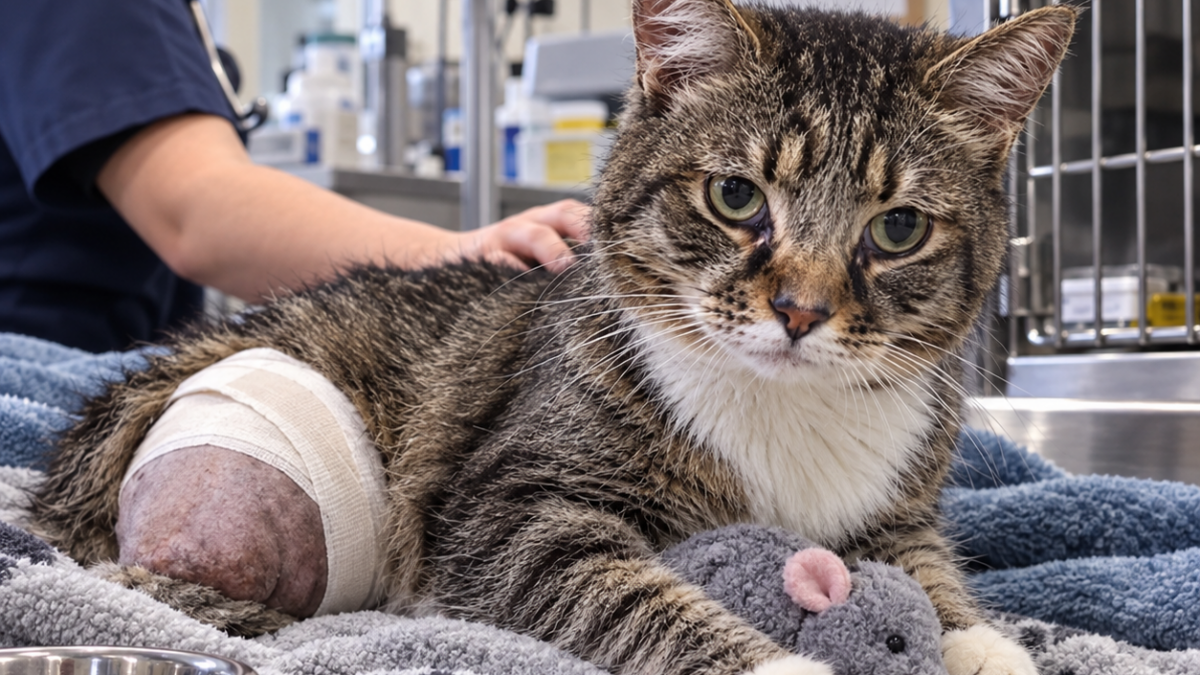
I looked at the postoperative dressings.
“Complicated.”
“That means expensive.”
“Yes.”
“How complicated?”
“Both rear legs amputated yesterday.”
There was a long silence.
“Ana.”
“I know.”
“We already have six medical fosters.”
“I know.”
“Two orthopedic cases.”
“I know.”
“And one cat with neurological problems.”
“I know.”
“So why does your voice sound like you already volunteered?”
“I didn’t.”
“You did emotionally.”
“That isn’t legally binding.”
“With you it usually is.”
I looked at Marcel.
He was licking the last bit of food from my finger.
“The owner surrendered him.”
“Can the clinic keep him for another few days?”
“I don’t want them to.”
Denise became quiet.
“What aren’t you telling me?”
“I’m not sure yet.”
That answer was enough.
“Get copies of everything we are legally entitled to receive,” she said. “Then get him evaluated somewhere independent.”
Our rescue accepted Marcel that afternoon.
The transfer paperwork described him as a four-year-old neutered male domestic shorthair following bilateral hind-limb amputation secondary to traumatic injury and postoperative complications.
That phrase bothered me.
Postoperative complications.
Clean.
Neat.
Almost harmless.
It concealed everything.
Rachel placed Marcel gently into a carrier lined with towels.
The moment the door closed, his breathing changed.
Fast.
Shallow.
His pupils widened.
I crouched beside him.
“Hey.”
He pressed himself into the far corner.
“I know.”
I put my fingers through the bars.
“I’m not leaving you somewhere.”
His nose touched my knuckle.
“I promise.”
That promise would matter later.
At the time, it was simply something you say to a frightened animal when you want to believe kindness is enough.
It rarely is.
Kindness has to survive inconvenience.
Expense.
Fear.
Time.
Mess.
Otherwise it is only a feeling.
Our rescue veterinarian was Dr. Maya Singh.
Her clinic looked nothing like Westbrook.
No polished marble reception desk.
No huge wall-mounted television.
No glass water fountain.
The waiting room had mismatched chairs, a jar of dog biscuits on the counter, and a handwritten sign reminding clients that frightened animals were not badly behaved animals.
Dr. Singh had black hair streaked with gray, rectangular glasses, and the unsettling habit of looking directly at you while you talked.
She examined Marcel carefully.
She did not rush.
She checked his temperature.
Heart.
Lungs.
Hydration.
Abdomen.
Surgical sites.
Pain response.
Then she studied the documents I brought.
“How bad?”
I asked.
“The wounds?”
“Everything.”
She removed her gloves.
“His surgical sites currently look appropriate. Mild swelling. No obvious active infection at the incisions.”
“Can he survive this?”
“Yes.”
The relief hit me so hard I had to sit.
Dr. Singh noticed.
“I said survive. Recovery is a longer question.”
“But he can have a good life?”
“Yes.”
“A wheelchair?”
“Maybe.”
“Maybe?”
“Mobility carts are useful for some cats. Others refuse them completely. Cats are not small dogs.”
Marcel looked at her.
“See?” she said. “He agrees.”
I almost smiled.
She turned to the chart.
“Where are the original hospitalization notes?”
“That’s everything they gave us.”
“This is a discharge summary.”
“There are twenty-seven pages.”
“Mostly billing and standard consent forms.”
She flipped through them again.
“Where is the nursing flow sheet?”
“I don’t know.”
“Medication administration record?”
“No idea.”
“Circulation checks?”
I shook my head.
“Culture report?”
“They said there was an infection.”
“I know what they said.”
She tapped the chart.
“I want to know what organism grew, when the sample was collected, when the result returned, what drugs he received before and after that result, and who examined him when his limbs started deteriorating.”
“You think something was done wrong?”
She looked at me over her glasses.
“No.”
I blinked.
“No?”
“I think there is not enough information here to know.”
That answer disappointed me.
She could tell.
“Ana, sometimes people want certainty because certainty gives them someone to blame.”
“I’m not looking for someone to blame.”
“You’re angry.”
“Yes.”
“Which is not the same thing as evidence.”
I folded my arms.
“Rachel told me the chart changed.”
Dr. Singh’s expression sharpened.
“What exactly did she say?”
“That the chart I’d receive wasn’t the chart she wrote.”
“That is different.”
“From what?”
“From saying medical negligence caused the amputations.”
She sat beside Marcel.
“These injuries may have been too severe from the beginning. Tissue can appear viable and then fail. Infection can develop despite good care. Blood supply can collapse after trauma.”
“So nothing happened?”
“I did not say that either.”
She closed the file.
“Get the complete record.”
The rescue submitted a formal request.
Westbrook sent forty-three pages.
Dr. Singh reviewed them.
She requested more.
They sent twelve.
She requested the surgical anesthesia sheet, nursing notes, laboratory submission times, vascular assessment documentation, and medication logs.
Westbrook replied that all relevant records had already been provided.
Dr. Singh printed the email.
Then wrote across the top:
Relevant according to whom?
I smiled when I saw it.
Meanwhile, Marcel came home with me.
For three days, I told myself.
Maybe five.
My guest bathroom became a recovery room.
I covered the tile with rubber-backed rugs so his front paws would not slip.
I removed anything he could pull down.
I replaced the litter box with a shallow tray.
Food on one side.
Water on the other.
Thick folded blankets in the center.
The first night, Marcel stayed exactly where I placed him.
I sat beside him until almost midnight.
When I stood, his head lifted.
I took one step toward the door.
His eyes followed.
Another step.
He tried to move.
Front paws forward.
Pull.
His body dragged several inches.
Then again.
“Marcel.”
He kept going.
I sat back down.
“You’re emotionally manipulating me.”
He lowered his head.
“Fine.”
I slept on the bathroom floor.
At 2:17 in the morning, I woke because he was moving.
Pull.
Rest.
Pull.
He was trying to cross the room.
“Where are you going?”
He ignored me.
Four feet later, he reached the water bowl.
Drank.
Then turned around.
“You could have meowed.”
He stared at me.
“Right. Independence.”
By the second day, he had learned how to pivot.
By the third, he had claimed the bath mat.
By the fourth, he tried to bite me when I moved it.
That bite made me absurdly happy.
Pain makes animals quiet.
Fear makes them disappear into themselves.
Annoyance meant Marcel was returning.
At first, though, he still watched doors.
Every time footsteps passed my apartment, his head rose.
When a man’s voice sounded in the hallway, Marcel became still.
He would stare toward the entrance for several seconds.
Then lower himself again.
The part of me that wanted a simple story decided he was waiting for Daniel.
His former owner.
Maybe he was.
Maybe he was simply frightened by doors.
Animals do not narrate their own suffering for us.
We fill in the silence.
Sometimes accurately.
Sometimes not.
A week later, Rachel contacted me.
Can we meet?
We chose a coffee shop twenty minutes away from Westbrook.
Public.
Busy.
Neutral.
Rachel arrived wearing jeans and a sweatshirt instead of scrubs.
She looked younger outside the clinic.
And more tired.
“I’m not giving you confidential documents.”
“Good.”
She looked confused.
“I mean it.”
“Why?”
“Because if there’s a real problem, I don’t want your evidence contaminated by a rescue volunteer who already dislikes the situation.”
Rachel almost smiled.
“You’ve been talking to lawyers?”
“No. I watch too much television.”
She wrapped both hands around her coffee.
Then said, “Marcel’s initial injuries were severe.”
“I understand.”
“But there was circulation.”
“How much?”
“His left leg was better than his right.”
“Were the doctors optimistic?”
“Carefully.”
“What happened?”
Rachel looked out the window.
“After his first procedure, the surgeon ordered neurovascular checks every two hours.”
“What kind of checks?”
“Temperature. Color. swelling. Capillary refill. pulses when possible.”
“And?”
“The order was entered incorrectly.”
“How?”
“Six hours.”
I stared at her.
“Why?”
“A technician copied a monitoring protocol from another patient.”
“Did anyone notice?”
“Not immediately.”
“That caused the amputations?”
Rachel shook her head quickly.
“I can’t say that.”
“Then what can you say?”
“At one in the morning, his right paw was colder.”
“And?”
“I documented it.”
“Did you call a veterinarian?”
“Yes.”
“Who?”
She hesitated.
“Dr. Warren.”
“What did he say?”
“That some temperature difference was expected after trauma.”
“Did he examine Marcel?”
“Not then.”
“When?”
“After seven.”
Six hours.
“What happened in between?”
“I checked Marcel repeatedly.”
“Even though the chart said six hours?”
“Yes.”
“What did you see?”
“The right leg worsened.”
“And the left?”
“By four, swelling had increased.”
“Did you call again?”
“Yes.”
“Response?”
“He said he would be in soon.”
Rachel’s voice had begun shaking.
“When he arrived, both limbs looked worse. Marcel had a fever.”
“What did they do?”
“Changed antibiotics. Removed the wraps. Ordered cultures.”
“What went wrong with the culture?”
Her eyes lifted.
“How do you know?”
“I guessed.”
She exhaled.
“The sample missed the morning pickup.”
“For how long?”
“Until the afternoon.”
“That’s hours.”
“Yes.”
“And the result?”
“Resistant bacteria.”
“Would getting the result sooner have saved his legs?”
“I don’t know.”
“Could it have?”
“I don’t know.”
I let the silence sit.
Rachel looked down at the table.
“I keep hearing him.”
“Marcel?”
“When he woke up.”
She wiped her eyes quickly.
“He tried to stand.”
I looked away.
“I saw that after surgery. He tried three times.”
“I know.”
“I told myself at least we saved his life.”
“You did.”
“Did we?”
“He is alive.”
“That isn’t what I mean.”
She lowered her voice.
“My overnight note changed.”
I leaned forward.
“What exactly changed?”
“I wrote that I contacted Dr. Warren at 1:17 because Marcel’s foot was cold and capillary refill was delayed.”
“And later?”
“The final chart says 5:47.”
“Maybe the timestamp was corrected.”
“No.”
“How do you know?”
“I took a picture.”
“Why?”
Rachel hesitated.
“Because something similar happened before.”
She took out her phone.
The photograph showed a computer screen.
Patient: Marcel.
Time: 01:17.
The note was clear.
Right distal limb cooler than left. Increased edema. Cap refill delayed. Attending veterinarian notified by phone.
“Keep the original file.”
“I did.”
“Back it up.”
“I did.”
“Talk to someone independent.”
“Who?”
“A lawyer. The licensing board. Your professional association.”
“I’ll lose my job.”
“Maybe.”
“My husband has been unemployed for eight months.”
I stayed quiet.
“I have two children.”
“I know.”
“I’m not brave like you.”
That irritated me.
“I’m not the one risking anything.”
She looked at me.
“I take home cats.”
I pointed toward her phone.
“You are deciding whether to tell the truth about people you work with. That is different.”
Rachel started crying.
“I should’ve pushed harder.”
“You called.”
“I should’ve driven to Warren’s house.”
“That is not a reasonable standard.”
“I should’ve done something.”
“You did.”
“Not enough.”
I understood the impulse.
After something terrible happens, the mind invents alternate versions.
If I had called again.
If I had noticed sooner.
If I had argued louder.
If I had refused.
If.
If.
If.
Guilt is a machine that runs forever if you keep feeding it.
“Rachel.”
She looked up.
“What happened to Marcel needs facts.”
She nodded.
“Not revenge.”
Her mouth tightened.
“What if the facts are worse than revenge?”
“Then let them be.”
Two days later, Rachel retained an attorney and filed a confidential complaint with the state veterinary licensing board.
She submitted her photograph.
The original file metadata.
Her personal notes.
And names of people who had been present.
I did not know that until weeks later.
By then, Marcel had other priorities.
Like getting onto my couch.
I walked into the living room one afternoon and found him halfway up.
His front claws were buried in the fabric.
His body hung below.
“Marcel.”
He froze.
“How did you even get out here?”
He pulled again.
“You’re going to fall.”
Another pull.
His chest reached the cushion.
“Stop.”
He ignored me.
One more effort.
Then he flopped onto the couch.
Breathing hard.
Triumphant.
I stared at him.
He stared back.
“You realize you have no back legs?”
Marcel began washing his paw.
I called Dr. Singh.
“He climbed my couch.”
“Good.”
“No.”
“Why no?”
“Because he could have fallen.”
“Did he?”
“No.”
“Then he problem-solved.”
“He ruined the upholstery.”
“Also normal cat behavior.”
I hung up on her.
His physical rehabilitation started the following week.
The first sessions were simple.
Supported posture.
Core activation.
Weight shifting through his front limbs.
Gentle range-of-motion exercises at the hips.
Massage around scar tissue.
Marcel hated everything except treats.
Then we introduced a mobility cart.
Two small wheels.
Light aluminum frame.
Padded chest harness.
Support under the pelvis.
When Dr. Singh secured him into it, Marcel froze.
Ten minutes passed.
Nothing.
“He hates it.”
“He doesn’t understand it.”
“Same result.”
She put chicken three feet away.
Marcel’s eyes locked onto the food.
“Manipulation,” I said.
“Motivation.”
He shifted one paw.
The wheels moved.
Marcel startled.
Stopped.
Moved again.
Another inch.
He looked over his shoulder as though furious that the world had begun following him.
By the time he reached the chicken, he had learned to turn.
By the end of twenty minutes, he chased a feather toy.
Not gracefully.
He hit the wall.
Then my ankle.
Then the water bowl.
But he moved.
I cried.
Dr. Singh handed me a tissue without comment.
Marcel rolled over my foot again.
“I’m going to regret this.”
“You already do.”
She was right.
The rescue posted a short video of Marcel in his wheels.
No accusations.
No mention of Westbrook.
Just:
Marcel is learning a new way to move.
The video spread.
Twenty thousand views.
Then fifty.
Then hundreds of thousands.
People called him inspirational.
A warrior.
A miracle.
I disliked all three words.
Marcel had not asked to inspire anybody.
He wanted canned chicken and sunlight.
I worried that people were turning his disability into entertainment.
Denise disagreed.
“Attention pays for therapy.”
“I know.”
“And helps other disabled animals get adopted.”
“I know.”
“So let people be moved.”
“I just don’t want them thinking he exists to teach them gratitude.”
Denise smiled.
“You care too much about wording.”
“I care exactly enough.”
Then Daniel contacted the rescue.
Marcel’s former owner.
Denise called me.
“He saw the video.”
“No.”
“That was not a question.”
“He doesn’t get Marcel back.”
“He isn’t asking.”
I paused.
“What does he want?”
“To see him.”
“No.”
“Ana.”
“He left.”
“Yes.”
“He watched Marcel drag himself after him.”
“Yes.”
“And now because Marcel is cute in a wheelchair, he wants closure?”
“Probably.”
“No.”
Denise waited.
Then said, “Your anger is not automatically Marcel’s interest.”
I hated that sentence.
Mostly because it was true.
“What does Dr. Singh think?”
“That a controlled visit is medically safe.”
I looked at Marcel.
He was asleep in a patch of sun, wheels removed, front paws tucked under his chest.
“Fine.”
We arranged the meeting at the rescue center.
Private room.
No cameras.
Daniel arrived early.
He was not what I expected.
I had imagined someone cold.
Maybe arrogant.
Instead, he looked exhausted.
Thin.
Unshaven.
His hands shook.
When Marcel entered, Daniel stopped breathing for a second.
“Hey, buddy.”
Marcel froze.
His ears moved forward.
Then he pulled himself across the padded floor.
Front paws.
Drag.
Front paws.
Drag.
Daniel dropped to his knees.
“Oh God.”
Marcel reached him.
Sniffed his jeans.
His hand.
Then pushed his forehead against Daniel’s fingers.
Daniel cried instantly.
Not quiet tears.
He folded forward.
“I’m sorry.”
Marcel rubbed his face against him.
I looked away.
I wanted rejection.
I am ashamed to admit that.
I wanted Marcel to understand morality like a human being.
I wanted him to punish Daniel.
Turn away.
Choose me dramatically.
But animals do not exist to complete our emotional scripts.
Marcel remembered him.
Maybe the smell.
Voice.
Hands.
A home.
Four years is a long time.
Daniel stroked his head.
“I’m sorry, Marcy.”
Marcel stayed for several minutes.
Then he turned.
Pulled himself across the floor.
Toward me.
He stopped against my shoe.
Daniel saw.
His expression changed.
“He picked you.”
“No.”
I lifted Marcel.
“I stayed.”
Daniel nodded slowly.
“That’s what I meant.”
Afterward, I asked him the question that had been burning inside me.
“Why?”
Daniel stared at his hands.
“I was afraid.”
“Of a cat?”
“Of everything.”
“That isn’t an answer.”
“My father had a stroke when I was seventeen.”
I waited.
“He couldn’t walk after.”
Daniel swallowed.
“My mother became his caregiver.”
“For how long?”
“Nine years.”
“What does that have to do with Marcel?”
“I watched her disappear.”
His voice broke.
“She stopped sleeping. Stopped seeing friends. Everything became medications, appointments, lifting him, cleaning him, worrying.”
“A disabled cat is not a disabled adult.”
“I know that.”
“Did you then?”
“No.”
He rubbed his face.
“When they told me Marcel lost both legs, I stopped hearing what they were saying.”
“What did you hear?”
“That my life was over.”
I stared at him.
“So you made sure his was.”
Daniel flinched.
“I know how it looks.”
“It looks exactly like what happened.”
“I panicked.”
“And he paid for it.”
“Yes.”
There was no defense in his voice.
That made it harder to hate him.
“I work ten-hour shifts,” he continued. “My daughter lives with my ex-wife. I rent a second-floor apartment. I thought about wound care, diapers, carts, therapy, money…”
“Did anyone explain disabled cats can adapt?”
“They tried.”
“And?”
“I left.”
We sat in silence.
Finally he said:
“I drove home.”
I looked at him.
“I made it halfway.”
“What happened?”
“I pulled into a gas station and cried.”
“Then why didn’t you go back?”
His eyes filled.
“Shame.”
That answer landed differently.
“Every minute I waited made it harder.”
I understood that.
Human beings often turn one bad decision into ten because admitting the first feels unbearable.
“I called the clinic the next morning.”
“They said the rescue had him.”
“I asked if he was alive.”
“I know.”
“You know?”
“Denise told me.”
Daniel nodded.
“I almost asked for him back.”
“Why didn’t you?”
“Because I knew I had already shown what happened when things got hard.”
That was painful.
And honest.
Before he left, Daniel asked if he could help financially.
“Not buy him back,” he said quickly.
“Then what?”
“Therapy. Food. Whatever.”
I almost refused.
Denise answered first.
“Yes.”
Daniel began donating fifty dollars a month.
Sometimes less.
Sometimes more.
He never requested another visit.
That mattered.
Meanwhile, the licensing investigation deepened.
Westbrook’s position remained simple.
Marcel suffered catastrophic trauma.
Severe infection followed.
Amputation saved his life.
All true.
But that was not the entire question anymore.
Investigators subpoenaed audit logs from the clinic’s medical software.
Rachel’s note had been modified.
The timestamp changed from 1:17 a.m. to 5:47.
More troubling, the text changed too.
“Attending veterinarian notified by phone” had become “continue routine monitoring.”
The edit was made after Marcel’s condition had deteriorated enough that amputation was being discussed.
The login belonged to Dr. Warren.
He said he corrected inaccurate documentation after speaking with staff.
Rachel said nobody consulted her.
Then another employee came forward.
Kevin.
Veterinary assistant.
He had screenshots of messages exchanged the night Marcel deteriorated.
Rachel: Foot colder. I called Warren twice.
Kevin: What did he say?
Rachel: Swelling expected.
Later:
Rachel: Left side is changing now too.
Kevin: Is Warren coming?
Rachel: Says soon.
Later:
Rachel: This is bad.
Then:
Kevin: He said stop calling unless vitals crash.
That message changed the tone of the investigation.
Not because it proved the legs could have been saved.
It did not.
But it established something crucial.
Concern existed.
It was communicated.
And later records minimized when it was communicated.
Investigators reviewed other cases.
A dog with postoperative bleeding.
A rabbit with a medication error.
An elderly cat who became severely dehydrated during hospitalization.
Again, bad outcomes happen.
Medicine is messy.
Bodies fail.
Drugs produce unexpected reactions.
But in several files, documentation had been altered after complications.
A pattern began forming.
Rachel eventually resigned.
When she told me, I asked:
“Did they fire you?”
“No.”
“Then why leave?”
“I can’t walk into that building anymore.”
“Where will you work?”
“I don’t know.”
I felt guilty.
She saw it.
“Don’t.”
“I didn’t tell you to file the complaint.”
“You didn’t have to.”
“I don’t want you losing everything because of Marcel.”
Rachel looked at me.
“I almost lost something worse.”
“What?”
“My ability to recognize myself.”
That stayed with me.
Three months later, she began working at another hospital.
Smaller.
Non-corporate.
Lower pay.
She told me she slept better.
Marcel meanwhile became unbearable.
Healthy enough to develop ambition.
He learned how to open the lower kitchen cabinet by hooking one paw beneath the door and throwing his weight sideways.
The first time, I found him sitting among canned food.
“How?”
He looked pleased.
I installed child locks.
He figured out one.
I installed stronger ones.
He started attacking the trash instead.
“Your disability is apparently not limiting your criminal activity.”
He blinked.
Dr. Singh said that was a good sign.
I stopped telling her things.
His cart became faster.
We used it mostly in the hallway and courtyard.
Inside the apartment, Marcel preferred dragging himself.
Front paws forward.
Pull.
Slide.
Repeat.
His shoulders became muscular.
The skin beneath his pelvis required constant monitoring.
Pressure sores were a risk.
We used padding.
Changed surfaces.
Rotated rest positions.
I learned more about anatomy than I ever wanted to know.
Urinary health became another concern.
So did constipation.
Then weight.
Disabled cats gain weight easily.
Marcel believed this recommendation was discriminatory.
Whenever I measured his food, he stared at me like a betrayed employee.
“You are twelve pounds.”
Silence.
“You are supposed to be ten.”
Silence.
“Your front legs carry all of you.”
He knocked the scoop out of my hand.
Negotiations ended there.
Six months after his surgery, Denise called.
“We have applications.”
“For what?”
“Marcel.”
I actually felt sick.
“What applications?”
“Adoption.”
“No.”
“Ana.”
“He’s not ready.”
“Dr. Singh says medically he is.”
“He needs experienced care.”
“Several applicants have disabled-pet experience.”
“He hates strangers.”
“He attended an adoption event last week.”
“He tolerated strangers.”
“Thirty-seven applications.”
“No.”
Denise started laughing.
“What?”
“You.”
“What about me?”
“You sound like every foster parent one week before adopting.”
“I’m evaluating.”
“You are hoarding.”
“I am ensuring quality control.”
“Ana.”
I looked across the room.
Marcel was asleep on my couch.
My couch had a ramp.
My bathroom had a low-entry litter station.
My schedule revolved around physical therapy.
My freezer contained meal portions labeled MARCEL.
I had canceled a weekend trip because his mobility cart needed adjustment.
“Oh.”
Denise laughed harder.
“You just realized?”
“I hate you.”
“Fill out the form.”
“I volunteer for you.”
“Still need the form.”
The adoption agreement arrived that afternoon.
Owner: Ana Carter.
Animal: Marcel.
Special needs: bilateral hind-limb amputee.
I stared at the word owner.
Then crossed it out on my copy and wrote family.
Not legally meaningful.
Emotionally accurate.
Marcel sat on the paperwork.
“Excellent.”
The licensing board released preliminary findings later that year.
The report was careful.
It did not state that proper care would definitely have prevented Marcel’s amputations.
No responsible reviewer could prove that.
His initial trauma had been significant.
But the board found:
Failure to follow ordered monitoring frequency.
Delayed escalation of deteriorating limb perfusion.
Inadequate supervisory response.
Deficiencies in handling laboratory specimens.
Improper retrospective alteration of the medical record.
The final item carried particular weight.
Medicine sometimes produces terrible outcomes even with excellent care.
Changing the story afterward is different.
Dr. Warren’s license was suspended for a period, followed by mandatory supervision, documentation training, and practice monitoring.
Westbrook’s corporate owner placed new audit controls on patient charts.
Late edits required explanations.
Original text remained visible.
Critical nursing alerts triggered direct escalation protocols.
Would any of that give Marcel his legs back?
No.
That was the part I struggled with.
One evening, I sat in Dr. Singh’s office after a follow-up.
“So that’s it?”
“What?”
“Suspension. Courses. Monitoring.”
“That is significant.”
“It doesn’t feel significant.”
“To Marcel?”
“To me.”
She removed her glasses.
“What did you want?”
I knew the answer immediately.
“I wanted him never to touch another animal.”
“That is understandable.”
“And?”
“Not necessarily proportional.”
I stared at her.
“You’re defending him?”
“No.”
“Sounds like it.”
“I’m defending the difference between accountability and annihilation.”
I did not like that phrase.
She continued.
“If a licensing board believes someone can practice safely under conditions, its job is public protection, not satisfying anger.”
“What about what happened?”
“It matters.”
“Not enough.”
“Ana.”
She leaned forward.
“Nothing the board does can make this emotionally equal.”
That silenced me.
“You are looking for a punishment that feels like Marcel gets his legs back.”
My throat tightened.
“There isn’t one.”
I looked through the exam-room window.
Marcel was trying to steal a cotton ball.
Dr. Singh continued.
“So the useful question becomes: what changes because of what happened?”
The rescue’s civil claim eventually settled.
The clinic’s insurer did not admit liability.
The amount was confidential.
Most of the funds went into a special medical account for disabled rescue animals.
We called it the Marcel Mobility Fund.
I opposed the name.
Denise ignored me.
The first recipient was a dachshund named Olive with a spinal injury.
Her owner had died.
She needed a rear-wheel cart and physical therapy.
The fund paid for both.
The second was a kitten born with malformed hind limbs.
The third was an elderly beagle requiring a lifting harness.
Then a rabbit recovering from spinal surgery.
A young tabby with nerve damage.
A dog whose family could afford surgery but not rehabilitation.
Each time, Denise sent me a photograph.
I showed Marcel.
“Look.”
He stared at nothing.
“You helped.”
He licked his paw.
“You’re incredibly humble.”
The fund grew.
Not huge.
Enough.
Sometimes that is what justice looks like.
Not a dramatic courtroom.
A harness mailed to someone who could not afford one.
A wheelchair rolling down a hallway.
A family saying yes to treatment because somebody helped with rehabilitation.
Rachel came to visit Marcel almost a year after the complaint.
She stood in my doorway holding a bag of treats.
“He remembers me?”
“I have no idea.”
Marcel rolled toward her.
She crouched.
He sniffed her.
Then grabbed the drawstring from her hoodie and pulled.
Rachel burst out laughing.
Then crying.
“He looks so good.”
“He is deeply irritating.”
“I’m sorry.”
She stroked his head.
“I’m so sorry, Marcel.”
He chewed the string.
“That’s forgiveness,” I said.
She looked at me hopefully.
“No. He wants your hoodie.”
Rachel laughed.
Later, over coffee, she told me she trained new technicians now.
“On what?”
“Documentation.”
I almost smiled.
“What do you tell them?”
“Write what happened.”
“That’s it?”
“And if someone tells you to change what happened, ask them to make the change under their own login.”
“That sounds specific.”
“It is.”
She looked toward Marcel.
“I used to think good medicine meant getting good outcomes.”
“And now?”
“Good medicine also means telling the truth when the outcome is bad.”
That felt bigger than the investigation.
Daniel continued donating.
At first, I resented every payment.
Then I realized resentment was becoming another way of keeping him present.
Marcel did not need me to hate Daniel forever.
Two years after surrendering him, Daniel sent a letter.
Inside was a photograph.
Marcel as a kitten.
Tiny.
All four legs.
Gray ears too large for his head.
Sleeping across Daniel’s chest.
On the back:
He slept like this every night for months. I thought you should have this. I don’t deserve to ask for anything.
I put the picture in a frame.
When Denise saw it, she asked:
“You’re okay with that?”
“With what?”
“Keeping part of Daniel’s history.”
“It’s Marcel’s history.”
That distinction mattered.
People are tempted to rewrite the past after betrayal.
Make every earlier moment false.
But Daniel had loved Marcel.
He had fed him.
Played with him.
Taken him to veterinary appointments.
Let him sleep on his chest.
Then when Marcel became disabled, fear overwhelmed him and he abandoned him.
The good did not erase the bad.
The bad did not retroactively erase every good day.
Life was messier than that.
So I kept the photograph.
Marcel deserved all of himself.
At six, he became famous locally.
The rescue invited him to events.
He tolerated exactly twenty-five minutes of attention before becoming murderous.
We learned to respect the limit.
Children loved his wheels.
Parents often whispered:
“Poor cat.”
I hated it.
One afternoon, a little boy crouched beside Marcel.
“Does it hurt?”
His mother looked embarrassed.
I answered honestly.
“Not now.”
“Is he sad?”
“Sometimes. Just like everybody.”
The boy watched Marcel race toward a treat.
“He’s fast.”
“Very.”
“Can he climb?”
“Unfortunately.”
The boy smiled.
“He doesn’t know he’s disabled.”
I shook my head.
“He knows his body better than any of us.”
That was another thing people misunderstood.
Marcel knew.
He knew surfaces.
He knew where he had grip.
He knew when his shoulders were tired.
He knew which ramps were too steep.
He knew he could not jump like other cats.
He knew exactly what his body could and could not do.
What he did not know was that humans had decided limitations were tragic.
He simply adapted.
At seven, he learned to get onto my bed using a carpeted ramp.
The first night, I woke with him sleeping on my chest.
“You weigh too much.”
Purring.
“Move.”
Purring.
“I pay rent.”
Nothing.
The next morning, I bought a second pillow.
At eight, Marcel developed mild arthritis in his right shoulder.
That terrified me more than I expected.
His front limbs had carried him for years.
Dr. Singh showed me X-rays.
“Not severe.”
“Can it become severe?”
“Yes.”
“What do we do?”
“Weight control.”
Marcel, in his carrier, objected loudly.
“He heard you.”
“Good.”
“Anything else?”
“Pain management if needed. Adjusted exercise. Strength without overloading.”
“What about the cart?”
“Shorter sessions.”
I looked at him.
For years, progress had meant more.
More distance.
More speed.
More independence.
Now care meant less.
Less strain.
Less expectation.
That was harder for me than it was for Marcel.
One evening, he tried to climb a ramp and slipped.
I moved to help.
He hissed.
“Fine.”
He tried again.
Failed.
I reached again.
Another hiss.
“Marcel.”
Third attempt.
He made it.
At the top, he turned around.
“I hope you feel superior.”
He did.
At nine, Daniel and Marcel met again accidentally.
Dr. Singh’s waiting room.
Daniel was holding a leash attached to a young mixed-breed dog.
I froze.
He froze.
Marcel looked up from his carrier.
Daniel crouched slowly.
“Hey, buddy.”
Marcel sniffed.
Then pulled himself forward.
Daniel touched his head.
“You got old.”
“So did you,” I said.
Daniel laughed.
Fair.
The dog beside him wagged.
“What’s his name?”
“Buddy.”
“Yours?”
“Yes.”
“How long?”
“Two years.”
“You adopted?”
Daniel nodded.
I looked at him.
“Why?”
He understood the real question.
“Because I finally believed fear wasn’t the same thing as incapability.”
That was a good answer.
“Does he have special needs?”
“No.”
Daniel smiled.
“Other than believing every shoe is food.”
Buddy tried to eat Marcel’s cart strap.
“Accurate.”
Daniel scratched Marcel behind the ears.
“I thought about asking to visit.”
“Why didn’t you?”
“Because I realized apologies can become selfish.”
I said nothing.
“If seeing him helped me but disrupted him, then I was still making his life about me.”
That was the first moment I believed Daniel had truly changed.
Not because he regretted leaving.
Regret is easy.
Because he had learned to consider someone else’s needs before his own discomfort.
Marcel rubbed his forehead against Daniel’s hand once.
Then turned back toward me.
Daniel stood.
“Thank you.”
“No.”
He looked confused.
“Don’t thank me for doing what you wish you had.”
“That’s exactly what I’m thanking you for.”
I let him.
They never saw each other again.
At ten, Marcel became slower.
His amber eyes clouded slightly.
His hearing remained perfect whenever I opened a can.
He slept more.
His medical fund had helped forty-one animals by then.
At eleven, the number reached fifty-eight.
Rachel sent money every year on the anniversary of his surgery.
Daniel did too.
Neither coordinated it.
I found that strangely beautiful.
Two people connected to the worst week of Marcel’s life using the date to help other animals.
Dr. Warren’s supervision period eventually ended.
He returned to unrestricted practice.
When I heard, my anger came back instantly.
I called Dr. Singh.
“This is ridiculous.”
“You knew it could happen.”
“I hoped it wouldn’t.”
“Has he had further disciplinary problems?”
“Not that I know.”
“Then perhaps the intervention worked.”
I hated that possibility.
It sounded too forgiving.
“What if he doesn’t deserve another chance?”
Dr. Singh answered quietly.
“Medical regulation is not a moral afterlife.”
“What does that mean?”
“It means the goal is safer practice.”
I leaned against my kitchen counter.
Marcel was asleep nearby.
“What about consequences?”
“He had consequences.”
“Not enough.”
“For you.”
“Yes.”
“That distinction matters.”
I closed my eyes.
She continued.
“You do not need to forgive him.”
“Good.”
“But you may eventually need to stop organizing Marcel’s story around him.”
That landed.
I looked at Marcel.
He had lived years since Westbrook.
Years.
More mornings than the number of hours he spent under Dr. Warren’s care.
More meals.
More naps.
More ridiculous adventures.
More people.
More sunlight.
Dr. Warren had become tiny inside Marcel’s actual life.
I was the one enlarging him.
That night, I took every document related to the board investigation and put them into a storage box.
Not destroyed.
Just removed from my desk.
The next morning, I noticed how much space returned.
That mattered.
At twelve, Marcel’s kidneys started declining.
At first mildly.
Diet change.
More water.
Regular bloodwork.
Then more noticeably.
He lost weight.
For years we had fought to keep him slim.
Now I would have done anything to make him hungry.
He still loved chicken.
Then one week, he did not.
I placed the bowl down.
Marcel sniffed.
Turned away.
My stomach dropped.
“Don’t.”
He moved toward the window.
“Marcel.”
He ignored me.
That evening, he ate half a spoonful.
The next morning, nothing.
Dr. Singh examined him.
Bloodwork.
Urine.
Ultrasound.
Kidney disease.
Advanced.
“How much time?”
“I don’t know.”
“Months?”
“Possibly.”
“Weeks?”
“Possibly.”
I hated that answer.
“What do we do?”
“Comfort.”
There are moments when medical language shifts.
For years, every appointment had been about improving something.
Healing.
Strengthening.
Preventing.
Monitoring.
Now the vocabulary changed.
Comfort.
Quality.
Pain.
Appetite.
Good days.
Bad days.
I hated every word.
Marcel did not.
He did not understand prognosis.
He understood that warm blankets felt good.
That chicken sometimes smelled worth eating.
That my lap remained available.
I began carrying him more.
At first, he objected.
Then less.
Eventually, when I lifted him, his chin settled into the crook of my arm.
That nearly broke me.
One evening, I took out the photograph Daniel had sent.
Kitten Marcel.
Four legs.
Sleeping on a chest.
I placed it beside older Marcel.
“You were ridiculous.”
His ear twitched.
“You had legs.”
Nothing.
“Very overrated.”
His eyes opened.
“I’m lying.”
I cried.
Marcel looked annoyed.
“I know.”
The final morning came quietly.
No emergency.
No dramatic collapse.
He simply would not eat.
Would not drink.
Could not comfortably pull himself across the blanket.
He looked at me.
And I knew.
There is a particular cruelty in knowing the exact moment love requires you to stop demanding more time.
I called Dr. Singh.
She came to my apartment that afternoon.
No clinic.
No carrier.
No bright exam room.
Marcel was on his favorite blanket near the window.
Dr. Singh listened to his heart.
Checked his gums.
Touched his abdomen.
Then sat beside me.
“It’s time.”
I nodded.
Then shook my head.
Then nodded again.
“I promised him.”
“What?”
“The first day.”
She waited.
“I told him I wasn’t dropping him somewhere.”
“You didn’t.”
“I know.”
“You kept it.”
For almost nine years.
I sat on the floor with Marcel in my lap.
His body felt too light.
The body I once struggled to keep at ten pounds.
His front paws rested against my wrist.
I thought about the recovery pen.
The closed clinic door.
Him dragging himself after Daniel.
I had spent years believing that was the saddest image in his story.
It was not anymore.
It was simply the beginning.
“I used to think the worst thing that happened to you was losing your legs.”
Marcel’s eyes were half closed.
“It wasn’t.”
I stroked his forehead.
“The worst thing was someone deciding your changed body was too much.”
My voice broke.
“And I hope the best thing wasn’t the wheelchair.”
Dr. Singh was crying now too.
“I hope it was all the boring stuff.”
I laughed through tears.
“Breakfast. Sun. Destroying my furniture. Making me late for work. Sleeping on my face.”
Marcel breathed slowly.
“You never had to prove you deserved any of it.”
I kissed his head.
“You don’t have to fight because people called you a fighter.”
His paw shifted against my hand.
“You can be tired.”
Dr. Singh gave the first injection.
Marcel relaxed.
His breathing became slower.
I whispered:
“I’m here.”
The same thing I had told him years earlier.
Not the person you’re waiting for.
But I’m here.
This time there was no door closing.
Nobody walked away.
His final breath happened with my hand beneath his chest.
Afterward, I stayed on the floor.
Five minutes.
Ten.
Maybe thirty.
Time stopped behaving normally.
Dr. Singh waited.
Eventually she said:
“He had a good life.”
I nodded.
Then corrected her.
“He had his life.”
She looked at me.
“That was enough.”
One week later, the rescue held a gathering.
I did not want one.
Denise insisted.
“It isn’t a memorial show.”
“Sounds like one.”
“The fund helped seventy-three animals.”
That number stopped me.
“Seventy-three?”
“Yes.”
Wheelchairs.
Rehabilitation.
Surgery aftercare.
Harnesses.
Foster supplies.
Transportation.
Seventy-three lives touched because people learned Marcel’s name.
I went.
Rachel came.
Daniel came.
He stood quietly in the back with Buddy.
Dr. Singh spoke.
She hated speeches almost as much as I did.
So hers was short.
“Marcel’s value did not begin when he learned to use a wheelchair.”
The room became quiet.
“He was valuable when he was injured.”
Rachel lowered her head.
“When he was frightened.”
Daniel closed his eyes.
“When he could not walk.”
I looked at Marcel’s photograph.
“When he adapted.”
A photograph showed him flying down a hallway in his wheels.
People laughed softly.
“And when he became old.”
Dr. Singh paused.
“Care is not something patients must earn by being inspirational.”
That was Marcel.
Not a miracle.
Not a symbol.
Not a lesson.
A cat.
A difficult, funny, stubborn cat whose life remained worth living after his body changed.
The rescue installed a small plaque beside the rehabilitation room.
THE MARCEL MOBILITY FUND
CARE DOES NOT END WHEN A BODY CHANGES.
I kept his first mobility cart.
I tried to donate it.
Could not.
It stayed in my closet.
His final cart was refurbished and fitted to another cat.
That felt right.
Three months after Marcel died, Denise called.
“We have a cat.”
“No.”
“Listen.”
“No.”
“Temporary foster.”
“That phrase is how Marcel happened.”
“This one has four legs.”
“Luxury.”
“She was hit by a car.”
“No.”
“Front-leg fracture.”
“No.”
“Three weeks.”
“No.”
The cat arrived at seven that evening.
Her name was Penny.
Small.
Black.
Four perfectly functional legs.
Terrible personality.
She hid under my bed for twenty-four hours.
Then emerged, climbed Marcel’s old ramp, sat in his favorite window, and knocked his framed kitten photograph onto the floor.
I gasped.
“Absolutely not.”
Penny stared at me.
Then pushed a second frame off the shelf.
I started laughing.
Hard.
The kind that becomes crying.
For months, I had been afraid that letting another animal into the apartment would somehow reduce Marcel.
As if love were a fixed quantity.
As if a new paw print could erase an old one.
Penny taught me otherwise.
She did not replace him.
Nobody could.
She added herself.
That was different.
Years have passed now.
The mobility fund still exists.
Rachel supervises nursing education at a veterinary hospital.
Her first lecture for new technicians includes a section called Documentation Is Patient Care.
Daniel still has Buddy.
Once a year, a donation arrives anonymously on Marcel’s surgery anniversary.
I know it is Daniel because the amount is always fifty dollars and seventeen cents.
I never asked why the seventeen cents.
Some things do not need explanation.
Dr. Warren eventually retired.
Not because of Marcel.
Age.
Health.
Life.
When I heard, I felt almost nothing.
That surprised me.
Years earlier, I would have wanted a dramatic feeling.
Victory.
Vindication.
Instead I looked at Penny sleeping on Marcel’s old blanket and thought:
That part is over.
Perhaps that is the cleanest form of justice.
When the person or institution that harmed you stops being the main character in what came afterward.
People still ask about Marcel.
They remember the video.
The little gray cat racing down the hallway.
The wheels.
Some ask:
“Was he happy?”
I always hesitate.
Happy is too simple.
Was I happy every day?
No.
Neither was Marcel.
He had painful days.
Frustrating days.
Veterinary days.
Days when his cart annoyed him.
Days when he could not reach something.
Days when arthritis hurt.
Days when he hid.
He also had warm windows.
Chicken.
My couch.
People who knew him.
A life where nobody walked out because helping became inconvenient.
So I answer:
“He lived.”
Usually people look confused.
I mean it as the highest compliment.
Marcel lived.
Fully.
Not as a tragedy waiting to inspire someone.
Not as a broken animal.
Not as a lawsuit.
Not as a victim.
He lived.
The medical mistake changed his body.
Daniel’s fear changed his home.
The investigation changed policies.
But Marcel changed the meaning of all of it simply by continuing.
If I could return to that first morning, I know exactly what I would do.
I would walk into that recovery room.
I would see the gray cat lying behind the clear door.
I would notice the untouched food.
The dressings.
The amber eyes fixed on the entrance.
I would crouch.
Marcel would sniff my fingers.
I would not tell him everything would be okay.
That promise would be too large.
I would not tell him he would become famous.
He would not care.
I would not tell him seventy-three animals would benefit from his medical fund.
He would probably ask where breakfast was.
I would say only:
“I know you’re watching that door.”
His ears would move.
“The person who left isn’t coming back today.”
That part would hurt.
Then I would unlatch the recovery pen.
“But this isn’t the end.”
I would place one hand beneath his chest.
Support the body he had.
Not the body everyone wished he still had.
And when he looked toward the closed clinic door one more time, I would turn toward the other one.
The one leading outside.
Toward my car.
Toward ramps and wheelchairs and destroyed furniture.
Toward Rachel telling the truth.
Toward Daniel learning too late what staying means.
Toward seventy-three animals receiving care.
Toward nine years of ordinary mornings.
Toward sunlight on the living-room floor.
Toward old age.
Toward a final day when no one walked away.
I would lift him carefully.
And I would tell him what I eventually spent the rest of his life proving.
“That door closed, Marcel.”
Then I would carry him through the next one.
“You’re coming home.”
A year after Marcel died, I received a photograph in the mail.
There was no note inside the envelope.
Just a picture.
A small orange tabby sat in a blue mobility cart on a grassy lawn, staring directly at the camera with the same offended expression Marcel used whenever somebody expected gratitude from him.
On the back, someone had written:
Milo. Eleven months old. Hit by a delivery truck. Marcel Fund paid for rehabilitation and wheels.
I put the photograph on my refrigerator.
The next month, another arrived.
A black-and-white kitten named Daisy had been born with severely malformed back legs.
Her family had been told she might never move independently.
The fund paid for an orthopedic consultation, rehabilitation, and a custom device.
The photograph showed Daisy chasing a yellow ball across a kitchen floor.
Another picture went on the refrigerator.
Then another.
And another.
Soon I had so many that Penny’s food schedule disappeared beneath them.
Dogs.
Cats.
One rabbit.
An elderly dachshund whose owner was eighty-three and had been using a towel as a support sling because she could not afford a proper harness.
A young pit bull recovering from spinal surgery.
A kitten who lost one back leg and most of the function in the other after being trapped beneath farm equipment.
Different animals.
Different injuries.
Different families.
But the same sentence kept appearing in the letters.
We thought we would have to give up.
That sentence hurt every time.
Because I knew what it really meant.
Not that people did not love their animals.
Often they loved them desperately.
But love does not automatically create money.
It does not reduce veterinary bills.
It does not give an elderly owner the strength to lift a seventy-pound dog.
It does not build ramps.
It does not purchase wheelchairs.
It does not teach wound care.
Sometimes families stood at the same cliff Daniel had stood at years earlier.
The difference was that now somebody could tell them:
Before you walk away, let us show you what might still be possible.
That became the real purpose of Marcel’s fund.
Not keeping every animal alive at any cost.
That would have been irresponsible.
Some injuries were too severe.
Some animals were suffering.
Some families truly could not provide safe long-term care.
But nobody should make the decision from fear before they understood the options.
No one should look at a changed body and assume the life inside it had ended.
The rescue eventually hired a rehabilitation coordinator.
Her name was Jasmine.
She had previously worked as a veterinary technician and specialized in mobility cases.
The first time I met her, she was sitting on the floor fitting a tiny wheelchair to a white terrier named Archie.
Archie kept trying to bite the wheels.
“Promising?” I asked.
Jasmine laughed.
“He hates the machine.”
“So did Marcel.”
“I know.”
“You knew him?”
“No.”
She pointed toward a photograph on the wall.
“But I know that face.”
There he was.
Marcel in his first cart.
Gray chest forward.
Amber eyes furious.
The photograph had been taken during one of his earliest rehabilitation sessions.
I had forgotten how young he looked.
“How many animals has the fund helped now?” I asked.
Jasmine checked a board.
“One hundred and twelve.”
I thought I had heard incorrectly.
“What?”
“One hundred and twelve.”
“When did that happen?”
“While you were avoiding our newsletters.”
“I don’t avoid them.”
“You have unsubscribed twice.”
“That is because Denise writes too much.”
From the reception desk, Denise shouted:
“I heard that.”
Jasmine smiled.
Then she became serious.
“There’s something else.”
“What?”
“We’re starting a caregiver support program.”
“For animals?”
“For people.”
I must have looked confused.
She continued.
“A lot of owners surrender disabled animals because they panic. They don’t understand care routines. Or they’re exhausted. Or they think they have to handle everything alone.”
Daniel.
I thought of him immediately.
“We’re creating short-term support,” Jasmine said. “Training. Home setup advice. Respite fostering when possible.”
“Who suggested that?”
She hesitated.
“Daniel Reeves.”
I stared at her.
“Marcel’s Daniel?”
“Yes.”
I had not seen him in years.
I knew he still donated.
I knew Buddy was alive.
That was about it.
“What exactly did he say?”
Jasmine pulled a printed email from a folder.
“He contacted Denise.”
I read it.
Daniel did not try to excuse himself.
That surprised me.
He wrote:
When Marcel became disabled, everyone gave me medical information, but I only heard a list of things I was afraid I could not do. I wish someone had taken me aside and said, “You do not have to know how to handle the next five years tonight. You only need to understand the next twenty-four hours.”
I stopped reading.
That sentence hit something old inside me.
Below it he wrote:
Leaving Marcel was my responsibility. Nobody made me do it. But if another frightened owner can be helped before fear becomes abandonment, I would like to fund that.
I read the message twice.
“When did he send this?”
“Four months ago.”
“Why didn’t anyone tell me?”
Denise answered from behind me.
“Because the fund is not your private kingdom.”
I turned.
“I know.”
“Do you?”
“No.”
She laughed.
Then softened.
“We wanted you to see what he built before deciding how you felt about it.”
“How do I feel?”
“That’s your problem.”
I hated when Denise spoke like Dr. Singh.
Everyone in my life had become annoyingly emotionally intelligent.
The caregiver program began modestly.
One Saturday workshop each month.
Owners learned how to move animals safely.
How to prevent pressure sores.
How to clean wounds.
How to use slings.
How to adapt litter boxes.
How to recognize when a mobility cart was helping and when it was creating stress.
Most importantly, they were allowed to admit the parts nobody likes to say aloud.
I am tired.
I am afraid.
I don’t know if I can do this.
I resent how much my life has changed.
The first time I attended, I stood in the back.
Daniel was there.
He saw me.
For a second, both of us froze.
Then he walked over.
“Ana.”
“Daniel.”
He had more gray hair.
Buddy was with him, wearing a therapy-dog vest.
“You trained him?”
Daniel smiled.
“He trained me first.”
Buddy leaned against my leg.
“He looks good.”
“He is.”
There was an awkward silence.
Finally, Daniel asked:
“Did you read my proposal?”
“Yes.”
“Are you angry?”
That was such an honest question I almost laughed.
“No.”
He looked surprised.
“I expected to be.”
“So did I.”
We stood beside a table covered with support harnesses.
Daniel ran one hand over a large padded sling.
“I kept thinking about the night I left Marcel.”
I said nothing.
“I remember the technician trying to explain how to support his body.”
His voice lowered.
“She demonstrated with a towel.”
“What did you hear?”
“Nothing.”
He looked ashamed.
“I just saw years of impossible responsibility.”
“And now?”
“Now I know I was trying to live five years in five minutes.”
That phrase stayed with me.
“Would you make the same decision today?”
“No.”
No hesitation.
“What if you couldn’t care for him?”
“I would tell someone that honestly before walking out.”
“That’s different.”
“I know.”
Daniel looked toward Buddy.
“I used to think staying meant doing everything yourself.”
“And now?”
“Sometimes staying means finding the right person before you leave.”
That was probably the closest he would ever come to making peace with what he had done.
I realized something then.
For years, I had thought Daniel’s redemption required Marcel.
That he somehow needed Marcel to forgive him.
But Marcel was dead.
Daniel’s work had to happen without the possibility of receiving anything back.
No reunion.
No final approval.
No cat rubbing against his hand.
That made his actions more meaningful.
He could not repair Marcel’s past.
So he was trying to change someone else’s future.
The first family Daniel personally helped was a single father named Chris.
His dog, Rosie, had lost movement in both back legs after a spinal injury.
Chris had two young children, worked nights, and was already behind on rent.
When surgeons explained the rehabilitation needs, he told the rescue:
“I love her, but I cannot do this.”
Those words triggered something in Daniel.
He asked to speak with him.
I was not present for the conversation.
Later, Chris told me about it.
Daniel did not say:
You’ll regret giving her up.
He did not shame him.
He did not describe himself as a cautionary tale.
He simply asked:
“What part scares you most?”
Chris answered:
“All of it.”
Daniel nodded.
“Pick one.”
The biggest immediate problem was getting Rosie outside safely.
The fund provided a support harness.
A volunteer helped twice daily during the first week.
Jasmine taught Chris how to express Rosie’s bladder safely until she regained better function.
The rescue paid for four rehabilitation sessions.
Then something changed.
Not Rosie’s disability.
Chris’s fear.
Once the future became one day at a time, he could see himself inside it.
Six months later, Rosie was still with him.
She never regained full back-leg function.
She used a cart outside.
At home, she dragged herself across rugs with astonishing speed.
Chris sent Daniel a photograph.
Two children sleeping on the floor.
Rosie between them.
On the back he wrote:
We stayed.
Daniel gave me a copy.
He did not say anything.
He did not need to.
That was the first time I felt genuinely glad he had come back into Marcel’s story.
Not as the man who abandoned him.
As a man who understood exactly how quickly fear can make someone leave.
Rachel’s work changed too.
At her new hospital, she helped build an escalation system for technicians.
Before Marcel, junior staff sometimes hesitated to challenge doctors.
Especially senior doctors.
Nobody wants to be called dramatic.
Nobody wants to annoy the surgeon.
Nobody wants to wake someone at two in the morning.
Rachel created a rule.
If a technician documented a significant deterioration and the first call was dismissed, they could escalate to another veterinarian without permission.
No punishment.
No accusation of insubordination.
The patient came first.
She also insisted that late chart edits preserve the original text.
No silent replacements.
If something changed, the record showed who changed it and why.
One afternoon she invited me to speak with a new group of technicians.
I refused.
“I am not a medical professional.”
“That’s why I want you.”
“What would I say?”
“Tell them what the chart looked like from the other side.”
I agreed reluctantly.
Twenty-two young technicians sat in a classroom.
I showed them no graphic pictures.
No accusations.
I only told them about the first morning.
A cat inside a recovery pen.
Two amputations.
A technician who whispered that the record had changed.
Then I said:
“You may think documentation is paperwork. To families, it becomes the story of what happened when they weren’t there.”
Nobody moved.
“If that story is changed to protect a person, a hospital, or a reputation, the patient loses something twice.”
Rachel stood in the back.
Her eyes filled.
Afterward, one young technician approached me.
“I’m scared of disagreeing with doctors.”
“So was Rachel.”
“What do you do?”
I smiled.
“I’m the wrong person to ask.”
Rachel stepped over.
“No,” she said. “That’s the right question.”
Then she answered:
“You don’t have to accuse anybody. You say what you observed. You document it. You escalate if the patient is deteriorating. Courage in medicine is often boring.”
The student frowned.
“Boring?”
“Phone calls. Timestamps. Rechecking vitals. Asking again.”
I thought about Marcel’s entire case.
She was right.
Truth often survives through boring things.
A timestamp.
A screenshot.
A lab log.
A person refusing to delete a message.
Years passed.
The Marcel Fund reached two hundred animals.
Then two hundred fifty.
By then, I stopped counting.
Other people did it better.
Penny grew into a sleek black tyrant.
She had four legs and used all of them to create problems Marcel could only have dreamed of.
She climbed curtains.
Opened closets.
Learned to push the bedroom door shut from inside and then scream because she had trapped herself.
One night, she climbed onto the shelf where Marcel’s first wheelchair sat.
I found her asleep inside the frame.
“You have absolutely no respect.”
She yawned.
I took a photograph.
For the first time, seeing another cat touching Marcel’s things did not hurt.
That told me more about healing than anything else had.
The apartment no longer felt like a museum.
Marcel’s photograph remained.
His kitten picture remained.
His old collar remained in a drawer.
But the rooms belonged to the living again.
I think that would have pleased him.
Mostly because the living were still opening cans.
On what would have been Marcel’s fifteenth birthday, the rescue held a mobility clinic.
I arrived late.
Cars filled the parking lot.
Inside, I saw wheelchairs everywhere.
Small ones.
Large ones.
Dogs learning turns.
Cats refusing to cooperate.
An elderly beagle being fitted with a harness.
A rabbit sitting indignantly in a padded support device.
Noise.
People.
Life.
Near the rehabilitation room, the small plaque still hung on the wall:
CARE DOES NOT END WHEN A BODY CHANGES.
A little girl stood reading it.
Beside her was a three-legged cat in a carrier.
She looked at me.
“What does it mean?”
I considered giving some complicated explanation.
Instead I said:
“It means different doesn’t mean done.”
She thought about that.
Then nodded.
“I like that.”
“So do I.”
Before leaving, I stopped beside Marcel’s photograph.
For years I had associated his story with everything people failed to do.
A medical team failed to respond quickly enough.
A record failed to tell the truth.
An owner failed to stay.
I had missed the other half.
Rachel spoke.
Daniel learned.
Dr. Singh questioned.
The rescue built.
Families stayed.
Animals moved again.
Systems changed.
Marcel’s life did not erase what happened to him.
It created consequences beyond it.
That mattered more.
I touched the edge of the frame.
“You caused a lot of trouble.”
Someone behind me said:
“Still talking to cats?”
I turned.
Dr. Singh.
Her hair was almost completely gray now.
“I talk to photographs.”
“Much healthier.”
“You’re retiring soon, aren’t you?”
“Do not say that word.”
“You complain about standing.”
“I have always complained about standing.”
We watched a small tabby race past in a cart.
Dr. Singh smiled.
“Do you remember his first one?”
“He hit me with it.”
“He hated the wheels.”
“He hated you.”
“He respected me.”
“He bit you.”
“Respectfully.”
I laughed.
Then she said something quietly.
“You know, Ana, nobody remembers the clinic first anymore.”
“What?”
“When people mention Marcel.”
She pointed toward the room.
“They remember this.”
I looked around.
Families.
Animals.
Volunteers.
Ramps.
Harnesses.
Wheels.
People kneeling on the floor encouraging frightened pets forward.
Dr. Singh continued.
“That is how you know the ending changed.”
I understood.
For a long time, I had thought Marcel’s satisfying ending had to be about punishment.
The clinic answering for its failures.
Dr. Warren facing discipline.
Daniel confronting what he had done.
Those things mattered.
Accountability matters.
But punishment was not the final victory.
The final victory was irrelevance.
The worst people and worst moments in Marcel’s story became smaller every year.
What grew larger was everything created afterward.
That evening, I went home.
Penny met me at the door.
She screamed because dinner was six minutes late.
“I attended a charitable event.”
She screamed again.
“You do not care.”
Correct.
I fed her.
Then sat by the window.
Marcel used to sleep there in the late afternoon.
The wooden ramp had been replaced twice, but I had never removed it.
Penny climbed onto the sill.
She turned three times and lay down.
Sunlight covered her black fur.
For a moment, I could picture Marcel there.
Not as a ghost.
Not sadly.
Just memory doing what memory does.
Layering one life over another.
I thought about the postoperative pen.
The way he stared at the door.
For years, that image had made me angry.
Now I saw something else.
Marcel had been looking backward because he did not yet know there was anywhere else to go.
Someone had left.
His body had changed.
His familiar world had disappeared within days.
Of course he watched the door.
But eventually he turned away from it.
Not in one dramatic moment.
First for food.
Then for a bath mat.
Then my couch.
Then chicken.
Then his wheels.
Then windows.
Then everything else.
That was how healing happened.
Not when the past stopped mattering.
When something ahead began mattering too.
The next morning, an envelope arrived from the rescue.
Another photograph.
This time, a tiny gray kitten in a bright mobility cart.
She had amber eyes.
For one painful second, she looked so much like Marcel that I stopped breathing.
Her name was June.
A spinal injury had left her unable to use her back legs.
The note said:
Her family initially believed euthanasia was the only humane option. The Marcel Fund paid for an independent assessment and caregiver training. June is home.
Below that, someone had handwritten:
She sleeps in their daughter’s bed.
I sat at the kitchen table.
Penny jumped onto the chair beside me.
I showed her the photograph.
“You see her?”
Penny sniffed the paper.
“Marcel helped.”
She tried to bite the corner.
“Thank you for your emotional support.”
I placed June’s photograph beside the others.
Then I realized something.
I had once wanted to save Marcel.
That was how I told the story.
I walked into a clinic.
Saw an abandoned disabled cat.
Took him home.
But years later, the arithmetic no longer worked.
Marcel had changed the lives of hundreds of animals and people.
He changed Rachel.
Daniel.
Me.
The rescue.
Even the clinic systems that came afterward.
At some point, saying I rescued him became embarrassingly incomplete.
I gave Marcel somewhere to go when a door closed.
He spent the next nine years opening doors for everyone else.
That became the ending I preferred.
Not that a cat lost his back legs because something went wrong.
Not that an owner walked away.
Not even that the people responsible faced consequences.
The ending was that the story did not stop where cruelty expected it to stop.
Marcel lived.
Then because he lived, others did too.
Different bodies.
Different homes.
Different endings.
But one lesson remained.
A body can change overnight.
A plan can collapse.
A person can panic.
A professional can make a mistake.
Someone can walk away.
None of those moments should be allowed to decide, by themselves, whether the life left behind is still worth showing up for.
Marcel never asked that philosophical question.
He did not need to.
Every morning he answered it.
He woke up.
Pulled himself toward breakfast.
Found the sun.
Climbed something he had been told was inaccessible.
Got angry.
Played.
Slept.
Trusted.
Ate.
Aged.
Lived.
And because people eventually chose to stay beside him long enough to see that life clearly, other frightened families learned to stay too.
Sometimes, when I pass the rescue, I still walk into the rehabilitation room.
I stand beneath Marcel’s plaque.
I look at whichever animal is learning to move that day.
And in my mind, I return to the beginning.
The clinic.
The postoperative pen.
The little gray cat staring at a door that had already closed.
If I could speak to him again, I would change only one thing about what I told him.
I used to imagine saying:
“You’re coming home.”
Now I would add one more line.
I would lift him carefully, support the body he had, and turn him away from the door he could not stop watching.
Then I would whisper:
“You don’t know it yet, Marcel, but someday somebody else is going to get home because you did.”








