He Was Starving, But Every Scrap He Found Went to the Dog Who Couldn’t Stand—Then We Learned Who Left Them There
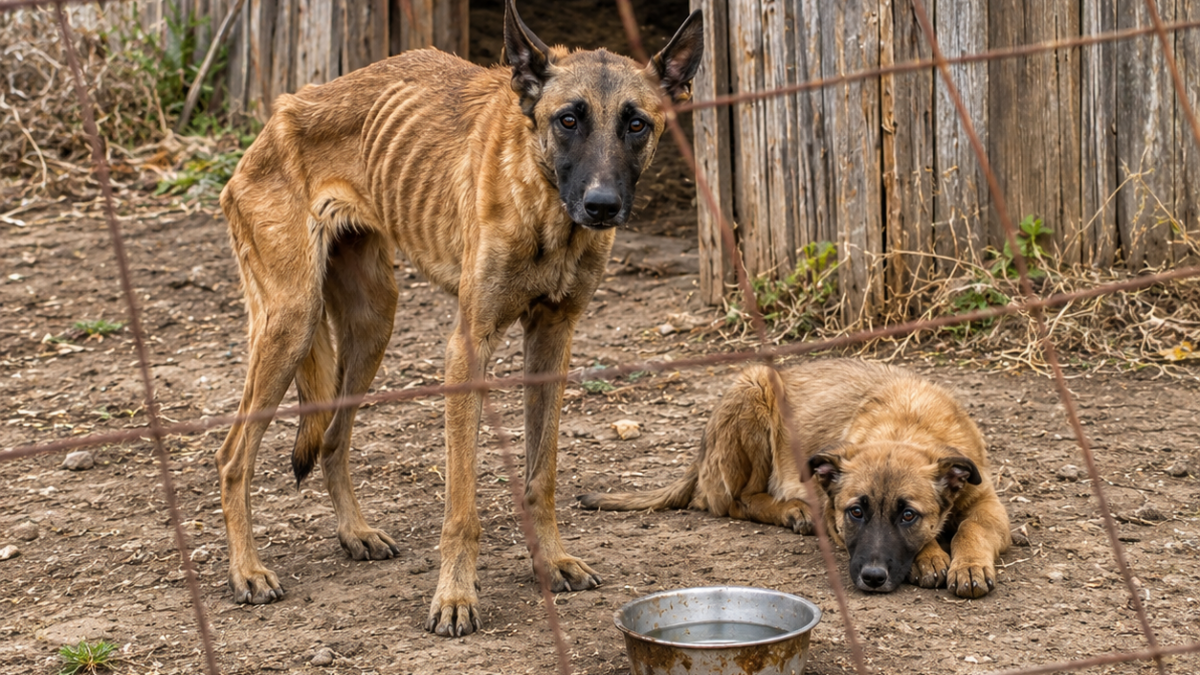
He hadn’t eaten properly in days, but every scrap of food he found was carried back to the dog who could no longer stand.
When I stepped through the broken gate, the starving young dog put his body between me and his dying companion instead of running toward the food in my hand.
And before that gray morning was over, I would discover that the two dogs behind that abandoned farmhouse had been waiting for something far more dangerous than hunger to end.
My name is Ethan Cole.
I was forty-six years old when I found them, and until that morning, I would have described myself as the kind of man who noticed trouble and kept driving.
Not because I was heartless.
Because life had taught me how expensive it could be to get involved.
I lived in western Pennsylvania, in a county where farms had been disappearing for years. Families moved away. Barn roofs collapsed. Fields grew wild. Mailboxes leaned toward empty roads as though even they had grown tired of waiting for someone to come home.
That morning, I was driving back from checking a furnace for an elderly customer.
The sky was low and gray.
A cold drizzle had started.
I was thinking about coffee.
Then I saw movement behind a rusted fence.
At first I thought it was a deer.
I slowed.
Something dark moved again near an old barn.
I pulled onto the shoulder.
The property had been abandoned for at least two years, as far as I knew. The farmhouse windows were boarded. Half the roof over the equipment shed had collapsed. Weeds stood waist-high around an old cattle gate.
Then I saw the first dog.
He was young.
Maybe two years old.
Black and tan, but not quite any breed I could identify. Shepherd in the face. Something leaner through the body.
He was so thin that his hips rose sharply beneath his coat.
Beside him lay another dog.
A Belgian Malinois.
Larger.
Older.
And in much worse condition.
The Malinois wasn’t standing.
He wasn’t even trying.
His ribs showed through his coat, and one rear leg rested at an unnatural angle.
I turned off the truck.
For several seconds, I sat there.
Then I heard myself say, “Damn it.”
I got out.
The younger dog saw me immediately.
He rose.
Slowly.
Painfully.
I expected barking.
Instead, he stepped in front of the Malinois.
His paws spread.
Head lowered.
Eyes locked on me.
He was terrified.
But he wasn’t leaving.
“Easy,” I said.
No reaction.
“I’m not coming for him.”
His eyes followed every movement.
I went back to my truck and found half a turkey sandwich from breakfast.
When I returned, I tore off a piece and pushed it through the fence.
The young dog stared at it.
Then at me.
Then he moved forward.
He grabbed the food.
I expected him to swallow it instantly.
He didn’t.
He turned around.
Walked back to the Malinois.
And dropped the piece beside his mouth.
I stopped breathing for a second.
The older dog lifted his head weakly.
He ate.
The young one watched.
Only after the Malinois swallowed did the younger dog return to me.
I gave him another piece.
He carried that one back too.
“Jesus.”
A car slowed behind my truck.
It stopped.
A woman climbed out.
She looked to be in her early thirties, brown hair pulled into a loose ponytail, phone already in her hand.
“Are they yours?”
“No.”
She saw the dogs.
Her face changed.
“Oh my God.”
“I think the big one is hurt bad.”
“I called Valley Ridge Veterinary Hospital,” she said. “I saw your truck and then the dogs. They’re sending someone if we can get them contained.”
“I’m Ethan.”
“Emily.”
The younger dog moved closer to his companion again.
Emily watched him.
“He’s guarding him.”
“Yeah.”
I looked toward the rusted gate.
The chain had broken years ago.
I pulled it open.
The hinges screamed.
The younger dog backed up.
But he didn’t run.
I stepped inside.
One step.
Then another.
The dog stood over the Malinois.
I crouched.
“Whatever happened here,” I said softly, “I’m not leaving you in it.”
His ears twitched.
Behind me, Emily whispered, “Ethan.”
“What?”
“Look.”
Near the barn doorway lay an old paper plate.
On it were several pieces of dried bread.
And leading from the barn to where the Malinois lay was a trail of small objects.
A chicken bone.
A torn fast-food wrapper.
Part of a hamburger bun.
The young dog had been scavenging.
But he hadn’t been eating what he found.
He had been bringing it back.
To his friend.
I looked at the Malinois again.
Then at the thin dog standing between us.
Something inside me shifted.
I had pulled over thinking I was about to help two abandoned animals.
I didn’t know yet that one of them had already been keeping the other alive.
And I had no idea how much that loyalty was going to cost all of us.
PART 2
The veterinary van arrived twenty-three minutes later.
It felt like two hours.
The younger dog never stopped watching me.
Emily and I stayed inside the fence but kept our distance.
The Malinois barely moved.
Every few minutes, the younger dog lowered his nose to the older one’s face.
Checking.
That was the only word for it.
Checking.
“You think they’re related?” Emily whispered.
“I don’t know.”
“He acts like that’s his father.”
“Maybe.”
The veterinary van rolled onto the shoulder.
A woman in navy scrubs stepped out with a man carrying a stretcher.
“I’m Dr. Sarah Patel,” she said. “Who’s been able to approach them?”
I pointed at myself.
“Sort of.”
“Any aggression?”
“Protection. Not aggression.”
She nodded.
“That’s different.”
She crouched outside the gate.
The young dog’s body stiffened.
Dr. Patel didn’t move closer.
She opened a pouch of wet dog food.
The smell reached us immediately.
The young dog’s nose lifted.
He looked at the food.
Then at the Malinois.
Dr. Patel placed a small amount on the ground.
The young dog approached.
He took one mouthful.
Again, he carried it back.
Dr. Patel stared.
Emily whispered, “He’s been doing that.”
“How long?”
“We don’t know.”
The doctor looked at the older dog.
“Long enough.”
We spent almost forty minutes earning enough trust to move them.
The young dog finally allowed a slip lead around his neck only after Dr. Patel let him watch us position the stretcher beside the Malinois.
The instant we touched the older dog, the younger one panicked.
He lunged forward.
Not biting.
Trying to reach him.
“Easy!” I said.
His body shook against the leash.
“Easy, buddy. We’re helping him.”
The Malinois gave a weak whine.
The younger dog froze.
Then he lay down.
Right beside the stretcher.
Dr. Patel glanced at me.
“He needs to ride with him.”
“Is that safe?”
“For the older dog? I think it might be necessary.”
We loaded them together.
Emily followed in her car.
I stood beside my truck.
Technically, I could have left.
They were with professionals.
My part was done.
I got in the truck.
Started the engine.
Then turned it off.
“Damn it.”
I followed them to the hospital.
—
Valley Ridge Veterinary Hospital sat twenty miles away.
When I arrived, Emily was standing in the waiting room.
“They took both dogs back.”
“How bad?”
She shook her head.
“They don’t know yet.”
We waited.
An hour.
Then another.
I bought terrible coffee from a machine.
Emily didn’t drink hers.
At 11:47, Dr. Patel came out.
“Can you both come with me?”
Neither of us corrected her assumption that we belonged there.
She took us into a consultation room.
“The younger dog is severely underweight and dehydrated, but his bloodwork is better than I expected.”
“And the Malinois?”
Her face tightened.
“He’s in trouble.”
“How much trouble?”
“His right rear leg has an old fracture that never received proper treatment. There appears to be nerve damage.”
Emily covered her mouth.
Dr. Patel continued.
“He’s severely dehydrated. Anemic. He has pressure sores from lying down for an extended period. There’s also evidence of an infection.”
“Can you save him?”
“We’re going to try.”
That answer frightened me more than no would have.
“What happened to his leg?”
“We can’t know for certain.”
“Car?”
“Possible.”
She paused.
“But the fracture pattern isn’t typical.”
“What does that mean?”
“It may have been caused by blunt trauma.”
Emily’s eyes met mine.
Someone might have hurt him.
“How long has he been like that?” I asked.
“Days at minimum. Possibly weeks.”
I looked toward the hallway.
“And the younger dog?”
“He has cuts on his paws. His teeth are worn in strange places.”
“From what?”
“Chewing something hard.”
The fence.
Maybe the gate.
Trying to get out.
Dr. Patel continued.
“There’s another thing.”
“What?”
“Both dogs have microchips.”
I felt immediate relief.
“So you can find the owner.”
“We already have.”
Her tone made the relief disappear.
“Who?”
“The Malinois is registered to a man named Wade Mercer.”
The name was familiar.
I couldn’t place it.
Emily did.
“Mercer K9?”
Dr. Patel nodded.
I looked at her.
“What is Mercer K9?”
Emily turned toward me.
“Dog training company. Security dogs. Protection work.”
Then I remembered.
A billboard on Route 44.
MERCER K9
ELITE PROTECTION. ELITE RESULTS.
“That’s the owner?”
“According to the chip.”
“And the younger one?”
“Chip registered to the same company.”
“What are their names?”
Dr. Patel looked at her chart.
“The Malinois is Ranger.”
That fit him.
“And the younger dog?”
“Scout.”
Scout.
I repeated it silently.
“Has Mercer been contacted?”
“Yes.”
“What did he say?”
Dr. Patel hesitated.
“He claims both dogs were stolen six months ago.”
I laughed.
Not because anything was funny.
“Stolen?”
“That was his statement.”
“From where?”
“His training facility.”
“And they just happened to end up trapped on an abandoned farm?”
“That’s what animal control is going to investigate.”
Emily leaned forward.
“Is he coming here?”
“He asked us to hold the dogs until his employee arrives.”
“No.”
The word came out of me instantly.
Dr. Patel looked at me.
I felt foolish.
They weren’t mine.
I had known them for three hours.
Still, I said it again.
“No.”
Dr. Patel folded her hands.
“Mr. Cole, we cannot release Ranger today regardless. He’s receiving emergency treatment.”
“And Scout?”
“He’ll remain here during the animal control investigation.”
“Good.”
She studied me.
“You’re very invested for someone who found them beside a road.”
I looked through the little window in the door.
“Maybe I don’t like people claiming things after leaving them to die.”
“We don’t know that’s what happened.”
“No.”
I looked back at her.
“But Scout does.”
—
Animal Control Officer Maria Torres arrived that afternoon.
She was small, sharp-eyed, and looked like she’d heard every lie a human being could tell about an animal.
She interviewed me first.
Then Emily.
Then she went to the farm.
Before leaving, she asked one question.
“Did you touch anything besides the gate?”
“No.”
“Did you enter the barn?”
“No.”
“Good.”
“Why?”
“Because if this turns into a cruelty case, that property may matter.”
A cruelty case.
There it was.
Not neglect.
Not bad luck.
A case.
At six that evening, I finally saw Scout again.
A technician brought him into a quiet room.
He had an IV catheter taped to one leg and looked even smaller under the fluorescent lights.
“Ranger is sedated,” she said. “Scout’s been frantic. Dr. Patel thought seeing someone familiar might help.”
Someone familiar.
Me.
I crouched.
“Hey, buddy.”
Scout stopped.
His ears lifted.
Then he walked toward me.
Not fast.
Not dramatically.
He simply pressed his forehead against my chest.
I put one hand behind his neck.
“You did enough.”
His body shook once.
“You hear me?”
I looked down at him.
“You don’t have to keep him alive by yourself anymore.”
Scout closed his eyes.
For the first time since I found him, he slept.
—
The next morning, I went to work.
I lasted ninety minutes.
Then I called my boss.
“I need the day.”
“Everything okay?”
“No.”
“What happened?”
“I found two dogs.”
There was a pause.
“You need a day off because you found dogs?”
“Yes.”
Another pause.
“Okay.”
My boss had known me fourteen years.
He knew when not to ask questions.
I drove back to Valley Ridge.
Emily was already there.
“You too?”
She held up a coffee.
“I tried going to work.”
“What do you do?”
“Middle school counselor.”
“And?”
“I spent twenty minutes thinking about two dogs while a thirteen-year-old explained why he threw a stapler.”
“Did the stapler deserve it?”
“Apparently.”
For the first time since yesterday, we laughed.
Then Dr. Patel appeared.
Our laughter stopped.
“Ranger made it through the night.”
Emily exhaled.
“But?”
“He needs surgery.”
“For the leg?”
“Partly. We need to clean infected tissue, stabilize what we can, and determine whether the limb is salvageable.”
“How much?”
The doctor named a number.
I stared.
Emily stared.
Neither of us had that kind of money.
“What happens if it isn’t paid?”
“We have an emergency rescue fund, but it’s limited.”
I looked at Emily.
She looked at me.
“How much can you put in?” I asked.
She blinked.
“You’re serious?”
“Yes.”
“Ethan—”
“How much?”
“Maybe eight hundred.”
“I can do fifteen hundred.”
“That still isn’t—”
“Then we find the rest.”
Dr. Patel said, “You don’t have to personally finance this.”
“No.”
I looked through the hallway toward wherever Ranger was lying.
“Scout financed it with his ribs.”
Nobody answered.
We found the rest.
The hospital transferred Ranger’s case to a local rescue partner.
Donors contributed.
A police K9 association heard about him and offered help.
By afternoon, the surgery was funded.
Ranger went under at 3:20.
Scout waited in a kennel near recovery.
I sat outside.
Emily went home for clothes.
At 7:06, Dr. Patel came out.
“We saved the leg.”
I closed my eyes.
“But recovery is going to be long.”
“Will he walk?”
“I don’t know.”
That was enough for one day.
—
Officer Torres called the following morning.
“Mr. Cole, are you available?”
“Yes.”
“I need you to come to the property.”
“Why?”
“We found something.”
My stomach tightened.
“What?”
“I’d rather show you.”
I drove there.
Two county vehicles sat outside the farm.
Yellow tape crossed the gate.
Officer Torres met me near the barn.
“Walk carefully.”
I followed.
Inside, the smell hit first.
Old straw.
Rot.
Urine.
The barn looked empty until Torres pointed toward the back.
Kennels.
Six of them.
Heavy steel.
Not farm cages.
Professional dog kennels.
Every one empty.
Scratches covered the doors.
“What is this?”
“We were hoping you could tell us whether you saw these yesterday.”
“No.”
She nodded.
“Come here.”
Near one kennel lay a broken leather collar.
Another held an empty water bowl bolted to the floor.
On the wall above them were numbers written in marker.
R-17.
S-4.
R.
S.
Ranger.
Scout.
I felt cold.
“They were kept here.”
“Looks that way.”
“You said Mercer claimed they were stolen six months ago.”
“He did.”
“Then why are their identification numbers written inside an abandoned barn?”
Torres’s expression did not change.
“That is one of several questions Mr. Mercer will be answering.”
She led me outside.
Near the rear of the barn, an old security camera hung beneath the roofline.
“Does it work?”
“We don’t know yet.”
“What else did you find?”
Torres looked toward the road.
“A locked room.”
Inside that room were veterinary supplies.
Expired antibiotics.
Sedatives.
Training collars.
Several blood-stained towels.
And records.
Dozens of them.
Dog names.
Weights.
Training scores.
Notes.
Ranger’s name appeared on six pages.
Scout’s on three.
Then I saw the last entry beside Ranger.
FAILED DEPLOYMENT EVAL.
REAR INJURY.
NON-PRODUCTIVE.
DISPOSE.
I read the word twice.
“Dispose?”
Officer Torres said nothing.
I turned the page.
Beside Scout’s name:
LOW DRIVE.
BONDED TO R-17.
NO COMMERCIAL VALUE.
No commercial value.
I stared at those words until they blurred.
Scout had been starving.
His paws cut open.
Still, he had carried food to Ranger.
And somewhere, someone had reduced him to a line on a page.
No commercial value.
“What happens now?”
Torres closed the folder.
“Now we prove who wrote it.”
—
Wade Mercer showed up at the veterinary hospital that afternoon.
I knew who he was before anyone introduced him.
Mid-fifties.
Tall.
Gray at the temples.
Expensive boots.
Black jacket with MERCER K9 embroidered across the chest.
He walked through the lobby like he owned the building.
Emily was beside me.
Scout was in a treatment room.
Mercer approached the front desk.
“I’m here for my dogs.”
Dr. Patel stepped out.
“Mr. Mercer.”
“Doctor. I appreciate you taking care of my property.”
Property.
I stood.
Emily touched my arm.
A warning.
Stay calm.
Dr. Patel said, “The dogs are currently under an animal control hold.”
“I’m their registered owner.”
“You’ll need to speak with Officer Torres.”
“I already have.”
“Then you know they cannot be released.”
Mercer’s eyes moved around the lobby.
They stopped on me.
“You the one who found them?”
“Yes.”
He smiled.
“Thanks.”
I didn’t respond.
“Those dogs are expensive.”
“Didn’t look expensive where I found them.”
His smile faded slightly.
“They were stolen.”
“Right.”
“You doubt that?”
“I found them locked behind a fence on a property with their kennel numbers written on the wall.”
Emily squeezed my arm harder.
Mercer stared at me.
Then smiled again.
“You’ve been talking to animal control.”
“I’ve been answering questions.”
“Best thing you can do now is stay out of it.”
There it was.
Quiet.
Polite.
A warning disguised as advice.
I stepped closer.
“The best thing you could’ve done was feed your dogs.”
His jaw tightened.
Dr. Patel said, “Mr. Cole.”
Mercer looked me up and down.
“You know anything about working dogs?”
“I know they need water.”
His smile vanished.
He turned away.
As he walked toward the door, I noticed Scout behind the glass panel of the treatment room.
He had seen Mercer.
Scout wasn’t barking.
He was crouched against the wall.
Trembling.
That told me everything I needed to know.
—
Three days later, Ranger stood for the first time.
Only for three seconds.
Two technicians supported him with a sling.
Scout watched from the doorway.
Ranger pushed upward.
His good rear leg shook.
The injured leg barely touched the mat.
But he stood.
Scout lost his mind.
He barked.
Jumped.
Whined.
His entire body wagged.
Ranger looked toward him.
Then collapsed back onto the blanket.
Scout rushed over and licked his face.
Everyone in the rehabilitation room went quiet.
Dr. Patel wiped beneath one eye.
“Three seconds,” she said.
I smiled.
“Three more than last week.”
Recovery became our calendar.
Day nine: Ranger ate a full meal.
Day twelve: Scout gained four pounds.
Day fourteen: Ranger took two supported steps.
Day eighteen: Scout learned that tennis balls were more fun than scavenging for food.
Day twenty-one: Ranger walked six feet.
Then something happened nobody expected.
When Ranger began rehabilitation exercises, he refused unless Scout was in the room.
If Scout left, Ranger lay down.
If Scout returned, Ranger tried again.
Dr. Patel laughed the first time.
“Well.”
“What?”
“Apparently he has a physical therapist.”
Scout stood beside Ranger, tail wagging.
I looked at the young dog.
“He’s been doing that job longer than any of us.”
—
The criminal investigation widened.
Mercer K9 had once operated on the abandoned property under a lease arrangement.
Mercer claimed he stopped using it eighteen months earlier.
Records said otherwise.
Feed deliveries had been made there until five months before we found the dogs.
Electricity remained active until eight weeks earlier.
Former employees were interviewed.
Most refused to talk.
One didn’t.
His name was Lucas Grant.
He called Officer Torres after seeing a local television story about Ranger and Scout.
Torres asked if I’d meet him.
We sat at a diner outside town.
Lucas looked exhausted before he even began.
“I worked for Mercer six years.”
“What did you do?”
“Training. Kennel management.”
“You knew Ranger?”
His eyes dropped.
“Yeah.”
“And Scout?”
“Yeah.”
“What happened?”
Lucas rubbed both hands over his face.
“Ranger was one of Wade’s best dogs.”
“For security work?”
“Protection. Detection. Private contracts.”
“What changed?”
“He got injured.”
“How?”
Lucas went silent.
“How?”
“Training accident.”
“What kind?”
He looked at me.
“Not an accident.”
I felt my stomach harden.
“Tell me.”
“Wade was demonstrating a pressure exercise for a client.”
I didn’t understand.
Lucas explained.
Handlers sometimes tested a dog’s nerve around noise, unstable surfaces, threats.
Mercer pushed too far.
“Ranger stopped engaging.”
“So?”
“Wade got angry.”
“What did he do?”
Lucas looked toward the window.
“He kicked him.”
I stared.
“Once?”
Lucas didn’t answer.
“Once?”
“No.”
My hands tightened beneath the table.
“That’s how his leg broke?”
“We didn’t know it was broken right away.”
“You didn’t take him to a vet?”
“I told Wade we needed to.”
“And?”
“He said Ranger was finished anyway.”
Finished.
Dispose.
The word flashed through my mind.
“What about Scout?”
“Scout was a rescue somebody brought to the facility.”
“A rescue?”
“He was maybe eight months old. Wade thought he might train.”
“Did he?”
“Scout wasn’t aggressive enough.”
I almost laughed.
Of course he wasn’t.
“He liked Ranger,” Lucas said.
“How much?”
Lucas looked directly at me.
“Wouldn’t leave him.”
My throat tightened.
“When Ranger got hurt, Scout stayed outside his kennel.”
“So Mercer put them together?”
“Eventually.”
“And then?”
Lucas’s face changed.
Shame.
“They got moved to the old farm.”
“Why?”
“Inspection.”
“What inspection?”
“State licensing.”
“How many dogs were there?”
“Nine.”
I froze.
“Nine?”
“When?”
“About two months before you found Ranger.”
“What happened to the others?”
Lucas shook his head.
“I don’t know.”
“Where are they?”
“I don’t know.”
“Lucas.”
“I quit.”
“When?”
“Six weeks before you found them.”
“So you left them there.”
His eyes filled.
“I thought Wade was moving them.”
“You thought?”
“He said he was.”
I leaned back.
Anger flooded me.
“You saw an injured dog locked in a barn and you walked away.”
“Yes.”
“You saw Scout.”
“Yes.”
“And you left.”
“Yes.”
He didn’t defend himself.
That made it harder to hate him.
“I was afraid of Wade,” he whispered.
“You should’ve been more afraid of yourself.”
He nodded.
“I am now.”
He slid a small flash drive across the table.
“What is this?”
“Security footage.”
I stared at him.
“From the farm.”
“I copied it before I quit.”
“Why?”
“In case.”
“In case of what?”
“In case I finally stopped being a coward.”
—
The footage changed the case.
There was no sound.
It didn’t need any.
Mercer’s truck appeared repeatedly.
He had lied about never returning to the property.
Employees unloaded food.
Dogs were moved.
Ranger limped in one video.
Scout followed him.
Then came the footage from eight weeks before we found them.
Five dogs were loaded into a trailer.
Ranger couldn’t walk properly.
Scout refused to leave him.
An employee tried dragging Scout toward the trailer.
Scout fought back.
He ran to Ranger.
Mercer appeared.
He pointed toward the barn.
Scout and Ranger were left behind.
The trailer drove away.
After that, Mercer returned twice.
The final visit lasted less than ten minutes.
He left one bag of food.
Then no one came back.
For thirty-six days.
Thirty-six.
Scout had survived thirty-six days on whatever food remained, rainwater, and scraps he could find beyond a gap under the fence.
Ranger couldn’t get through the gap.
Scout could.
That explained his paws.
His worn teeth.
He had chewed and clawed his way beneath the fence.
Then returned every time.
He could have left.
He didn’t.
He went out.
Found food.
Came back.
Out.
Back.
Again.
Again.
Again.
For more than a month.
Emily sat beside me when Torres showed us the timeline.
She cried silently.
I couldn’t.
I was too angry.
“He could have escaped.”
Torres nodded.
“He chose not to.”
“Because Ranger couldn’t.”
“Yes.”
I looked through the shelter window at Scout sleeping beside Ranger.
No commercial value.
Mercer had written it like an insult.
He had been wrong.
Scout’s value was the one thing money couldn’t measure.
—
The other five dogs were found in three states.
Mercer had sold them through brokers.
Two were recovered because their paperwork had been falsified.
One had serious medical problems.
Another had bite injuries that suggested abuse during training.
The case became public.
Mercer responded exactly the way men like him often do.
He blamed everyone.
Former employees.
Animal control.
The rescue.
The media.
Me.
He gave an interview claiming Ranger’s fracture happened after the dogs were stolen.
Then the security footage surfaced through the investigation.
His story changed.
Now he said an employee abandoned them without his knowledge.
Lucas testified.
His story changed again.
He called Ranger “dangerous.”
That might have worked if Ranger hadn’t become the gentlest dog in the rehabilitation wing.
Children visiting the clinic sat beside him.
He never growled.
He never snapped.
Scout still slept pressed against his side.
One morning, Emily showed me a news article on her phone.
Mercer’s attorney claimed the investigation was a “personal vendetta by animal activists.”
I laughed.
Emily looked at me.
“What?”
“Apparently I’m an activist now.”
“You did pay for a dog’s surgery.”
“I fix heating systems.”
“Very radical.”
For the first time in weeks, we laughed.
Then my phone rang.
Unknown number.
I answered.
“Ethan Cole?”
“Yes.”
Wade Mercer.
I knew the voice.
“You’ve caused enough trouble.”
I stood.
Emily saw my face.
“What do you want?”
“I want you to understand something.”
“I understand plenty.”
“You don’t understand business.”
“No.”
“You don’t understand working dogs.”
“No.”
“You don’t understand what it takes to build what I built.”
I looked through the glass.
Ranger was practicing stepping over low foam bars.
Scout walked beside him.
“I understand what it took.”
Silence.
“Broken legs. Empty bowls. Abandoned kennels.”
“You should watch your mouth.”
“Why?”
“Because accusations have consequences.”
“So does evidence.”
He went quiet.
Then he said, “Walk away.”
“No.”
“You found two dogs. That’s all.”
“No.”
“That’s all you know.”
I watched Ranger stumble.
Scout immediately pressed against his shoulder.
Ranger steadied himself.
“No,” I said. “That’s all you hoped anyone would find.”
I hung up.
—
Mercer didn’t frighten me until three nights later.
I arrived home after dark.
My back door was open.
I knew I had locked it.
I stood in the driveway.
Didn’t enter.
Called police.
Nothing obvious had been stolen.
Laptop still there.
Television.
Tools.
Cash in a kitchen drawer.
The only thing disturbed was a folder on my dining room table.
Copies of everything I had collected about Ranger and Scout.
It had been opened.
Officer Torres arrived.
“Do you have cameras?”
“No.”
“You do now.”
She arranged for patrols.
Emily came over while the officers worked.
“You’re staying somewhere else tonight.”
“I am forty-six.”
“Congratulations.”
“I don’t need—”
“You got involved because two dogs couldn’t protect themselves.”
She pointed toward my house.
“Now stop acting stupid because you’re the one who needs help.”
I stared at her.
“You talk to middle schoolers like this?”
“Worse.”
I stayed at her place.
The next morning, I installed cameras.
No evidence ever proved Mercer entered my house.
But he made another mistake soon after.
One of his former employees, Jenna Morales, received a threatening voicemail.
He told her she should “remember who paid her bills before she starts inventing stories.”
Jenna hadn’t spoken publicly.
Only investigators knew they had interviewed her.
That voicemail helped obtain a search warrant.
Mercer’s office was searched.
Computers seized.
Records recovered.
And buried in deleted files were photographs.
Injured dogs.
Training sessions.
Lists of animals marked for “retirement.”
Financial records showing dogs being sold under false health certifications.
And videos Mercer apparently kept as demonstrations for clients.
One showed Ranger.
Healthy.
Strong.
Obedient.
Mercer stood beside him.
“Ranger’s our best pressure dog,” he said.
Then another video, months later.
Ranger limping.
Mercer could be heard saying:
“He’s done. Don’t waste vet money.”
I walked outside before the video finished.
Emily followed.
I stood beside the clinic wall.
“I want him destroyed.”
I hated how easily the sentence came.
Emily didn’t pretend not to understand.
“Ethan.”
“I mean it.”
“I know.”
“He left them there.”
“I know.”
“Scout could have died.”
“I know.”
“Ranger almost did.”
“I know.”
I turned.
“And he’s worried about his business.”
Emily looked at me for a long moment.
“Then don’t give him what he expects.”
“What?”
“Don’t become something ugly just because he is.”
I looked away.
“What am I supposed to do with this?”
“The anger?”
“Yes.”
She nodded toward the building.
“Give it a job.”
That stayed with me.
So I did.
—
Ranger walked without a sling seventy-three days after surgery.
Five steps.
Then eight.
Then fifteen.
We had planned nothing.
There was no audience.
No cameras.
Just Dr. Patel, two technicians, Emily, me, and Scout.
Ranger stood at one end of the rehabilitation room.
I crouched ten feet away.
“Come on, boy.”
Ranger looked uncertain.
Scout was beside him.
Scout took one step.
Ranger followed.
Another.
Another.
Scout moved slowly.
Matching him.
When Ranger stumbled, Scout stopped.
Ranger recovered.
They kept coming.
At the tenth step, everyone was crying.
At the fifteenth, Ranger reached me.
I put both hands around his face.
“You stubborn old bastard.”
He licked my chin.
Scout pushed between us.
“Yeah, yeah.”
I wrapped one arm around him too.
“You’re the reason he’s standing.”
Dr. Patel smiled.
“I think he knows.”
—
By then, Scout had been legally surrendered to the county through court action.
Ranger’s ownership remained disputed pending the criminal case.
I applied to foster both.
The rescue coordinator laughed when she saw my paperwork.
“What?”
“You’ve been here almost every day for three months.”
“So?”
“You think you’re fostering?”
“Yes.”
She shook her head.
“Sure.”
The first night they came home, Scout explored everything.
Kitchen.
Bedroom.
Bathroom.
Garage.
He discovered his reflection in the oven and barked at himself for four straight minutes.
Ranger walked slowly.
He checked every room.
Then lay beside the back door.
Scout dropped down next to him.
I put two dog beds nearby.
Neither used them.
At midnight, I woke because something touched my hand.
Scout.
He stood beside the couch.
Ranger was behind him.
“What’s wrong?”
Scout walked toward the kitchen.
Looked back.
I followed.
His food bowl still had kibble in it.
He picked up three pieces.
Carried them into the living room.
Dropped them in front of Ranger.
Ranger sniffed them.
I sat on the floor.
“Scout.”
He looked at me.
“You don’t have to do that anymore.”
He picked up another piece.
Took it to Ranger.
I felt my throat tighten.
“No one is taking the food.”
Scout stared at me.
I filled both bowls.
Right to the top.
Then I opened the pantry.
I showed him the bag.
“See?”
He didn’t understand the words.
But I kept talking.
“There’s more.”
I opened another cabinet.
“And more.”
Emily, who was staying to help that first night, stood in the doorway.
“Ethan.”
I wiped my eyes.
“I’m fine.”
“You’re crying into dog food.”
“Dust.”
“At midnight?”
“Very dusty kibble.”
She sat beside me.
Scout carried another mouthful to Ranger.
Emily whispered, “He’ll learn.”
“How long?”
“As long as it takes.”
She was right.
For weeks, Scout carried food.
Then one evening he took a piece.
Paused.
Looked at Ranger.
Ranger was asleep.
Scout chewed.
Swallowed.
He looked almost guilty.
I crouched beside him.
“Good.”
He ate another.
“That’s yours.”
Another.
“Good boy.”
By the end of the month, Scout ate from his own bowl without checking Ranger first.
That felt like a victory.
Small.
But enormous.
—
The trial began eleven months after I found them.
By then, Ranger could walk almost normally, though cold weather made him limp.
Scout had gained twenty-three pounds.
His coat shone.
Mercer looked different too.
Thinner.
Older.
Less certain.
The prosecution laid out the case piece by piece.
The abandoned farm.
The kennel records.
The veterinary findings.
The security footage.
The former employees.
The phone threats.
Financial documents.
Mercer’s attorney argued that employees had acted without authorization.
Then Lucas testified.
Jenna testified.
Dr. Patel testified.
Officer Torres testified.
I testified.
Mercer’s attorney asked me why I had inserted myself into a situation that “did not concern” me.
I looked at him.
“Because two dogs were dying behind a fence.”
“Yet you continued involving yourself long after they received veterinary treatment.”
“Yes.”
“Why?”
“Because the person responsible wanted them back.”
“Objection.”
“Sustained.”
The attorney smiled slightly.
“Mr. Cole, would you say you developed strong emotions about these animals?”
“Yes.”
“Strong enough to dislike my client?”
I looked at Mercer.
“Yes.”
The attorney seemed pleased.
“So your testimony is biased.”
“No.”
“You just admitted—”
“My feelings are biased.”
I leaned slightly toward the microphone.
“The video isn’t.”
The courtroom became quiet.
The attorney moved on.
Emily squeezed my hand when I sat down.
“You’ve been waiting to say that.”
“Eleven months.”
Mercer testified last.
He was polished.
Calm.
He called himself an animal professional.
He explained difficult decisions.
Business realities.
Safety standards.
He said Ranger’s injury made him unsuitable for placement.
The prosecutor asked one question.
“Did unsuitability justify abandoning him without food or medical treatment?”
Mercer replied, “I didn’t abandon him.”
The security video played.
His truck arriving.
His truck leaving.
The final bag of food.
Thirty-six empty days.
Mercer stopped looking at the jury.
Then came the line that destroyed him.
The prosecutor displayed the kennel record.
R-17.
REAR INJURY.
NON-PRODUCTIVE.
DISPOSE.
“Did you write this?”
Mercer hesitated.
“No.”
A handwriting expert had already testified.
The prosecutor waited.
“Mr. Mercer?”
“I don’t recall.”
Then she displayed an email recovered from his computer.
Subject: R-17.
His words:
Don’t spend another dime on that dog. Leave S-4 with him if he won’t load. We’ll clear the property later.
Silence.
I looked at Scout.
He wasn’t in court, of course.
But I could see him anyway.
Standing between me and Ranger.
Starving.
Still refusing to leave.
Mercer’s lawyer asked for a recess.
The judge said no.
—
The verdict came two days later.
Guilty on multiple counts of aggravated animal cruelty.
Guilty of falsifying records.
Guilty of operating violations tied to the other dogs.
Additional fraud charges were handled separately.
His training license was permanently revoked.
He was prohibited from owning or commercially training dogs during a long period of court supervision.
His company collapsed.
Contracts disappeared.
Clients sued.
Former employees came forward.
The building with the giant MERCER K9 sign closed.
People asked me whether that felt like revenge.
At first, I thought it did.
Then I saw Ranger sleeping in the sun beside Scout.
And I understood something.
Mercer losing everything wasn’t the revenge.
That was consequence.
The revenge was that he had written both dogs off as worthless.
And they were about to become the most valuable thing he’d ever thrown away.
—
Three weeks after sentencing, Ranger and Scout became legally adoptable.
The rescue coordinator called me.
“Ethan?”
“Yeah?”
“I need you here tomorrow.”
“Why?”
“Paperwork.”
My heart started pounding.
“What paperwork?”
She sighed.
“You really need me to say it?”
Emily was sitting across from me.
She saw my face.
“What?”
I put the call on speaker.
The coordinator continued.
“Ranger and Scout are free for permanent placement.”
Emily covered her mouth.
I couldn’t speak.
“You still want them?” the coordinator asked.
I finally managed, “That’s a stupid question.”
“Good. Ten a.m.”
The next morning, I signed twenty-three pages.
At least it felt like twenty-three.
When I finished, the coordinator stamped the final document.
“Congratulations.”
I stared at her.
“That’s it?”
“That’s it.”
“They’re mine?”
“Legally.”
I laughed.
She smiled.
“Though between us, you’ve belonged to them for almost a year.”
Fair.
When I brought them outside, Emily waited beside my truck.
Scout ran to her.
Ranger followed more slowly.
I held up the folder.
“Official.”
Emily hugged me.
Then she stepped back.
“So what happens now?”
I looked at the dogs.
Scout was sniffing a bush.
Ranger stood beside him.
“I have an idea.”
—
The abandoned farm went up for county auction six months later.
Most people considered it worthless.
Collapsed structures.
Overgrown fields.
Broken fencing.
Contaminated outbuildings.
I bought it.
Emily thought I had lost my mind.
“You bought the place where they almost died?”
“Yes.”
“Why?”
“Because I don’t want that to be what it is anymore.”
She stared at me.
Then smiled.
“You already have a name.”
I did.
Scout & Ranger Second Chance Farm.
We demolished the old kennels first.
I wanted to do it personally.
The kennel marked R-17 took almost an hour to dismantle.
I used a grinder on the steel bolts.
Sparks flew.
Ranger sat outside with Emily.
Scout wandered around carrying a tennis ball.
When the final panel fell, I stood there breathing hard.
Emily walked over.
“You okay?”
“Yeah.”
I wasn’t.
I touched the scarred steel.
Thirty-six days.
I remembered the first sandwich.
Scout carrying it back.
“What are you going to put here?” she asked.
I looked around.
“Windows.”
She laughed.
“What?”
“This wall.”
I pointed.
“Take it out. Big windows.”
“For what?”
“Recovery room.”
A year later, that was exactly what stood there.
Warm floors.
Sunlight.
Clean beds.
Fresh water.
Dogs recovering from surgery could lie by the windows and look across the fields.
No chains.
No numbered kennels.
No dark barn.
We partnered with Valley Ridge and two rescues.
Our specialty became dogs considered difficult to place.
Injured working dogs.
Older shepherds.
Dogs with behavioral scars.
Animals somebody else had labeled useless.
I kept one thing from the original barn.
The board with the old notes.
R-17.
S-4.
NON-PRODUCTIVE.
NO COMMERCIAL VALUE.
I hung it in the office.
Visitors sometimes asked why.
I told them.
“Because I never want us to forget how dangerous those words are.”
—
Ranger surprised everyone.
During rehabilitation, Dr. Patel noticed how calm he became around anxious people.
Emily had an idea.
Her school ran a counseling program for veterans’ children and kids dealing with trauma.
“What if Ranger trained as a therapy dog?”
I laughed.
“You mean the dangerous dog Mercer said couldn’t be placed?”
“Exactly.”
Ranger passed his evaluation nine months later.
Scout failed his first one.
Not because he was aggressive.
Because he stole the evaluator’s sandwich.
I considered that justice.
Scout eventually found his own job.
When frightened rescue dogs arrived at the farm, we introduced them to him carefully.
Scout had a gift.
He never rushed them.
Never crowded them.
He simply stayed nearby.
Sometimes for hours.
A neglected hound named Daisy refused to leave a transport crate for an entire day.
Scout lay ten feet away.
Then eight.
Then five.
At sunset, Daisy crawled out.
She walked directly to him.
Emily watched from beside me.
“He knows.”
“Knows what?”
“What it feels like when getting closer to someone might be dangerous.”
Scout touched noses with Daisy.
“He also knows what it feels like when someone stays.”
—
Two years after the rescue, Valley Ridge hosted a fundraiser at the farm.
More than three hundred people came.
Dr. Patel spoke.
Officer Torres spoke.
Lucas came too.
That surprised me.
He stood near the back.
Afterward, he approached me.
“Can I see them?”
I looked at Ranger.
Ranger looked at him.
Recognition came slowly.
His ears moved.
Lucas knelt.
“Hey, old man.”
Ranger stood still.
Lucas began crying.
“I should’ve taken you.”
Ranger stepped closer.
Lucas covered his face.
Scout approached next.
Lucas whispered, “I’m sorry.”
I had spent a long time imagining what I’d say if I ever saw him again.
Something cruel.
Something satisfying.
Instead I said, “What are you doing now?”
Lucas wiped his eyes.
“County shelter.”
“Working there?”
“Volunteer.”
“How often?”
“Four days a week.”
I nodded.
“Good.”
He looked surprised.
“That’s it?”
“What do you want me to say?”
“I don’t know.”
I looked toward the barn.
“You failed them.”
His face fell.
“Yes.”
“Then you helped prove what happened.”
“Yes.”
“Both things are true.”
Lucas nodded.
I pointed toward Scout.
“He doesn’t live in yesterday.”
Lucas looked at him.
“Maybe I should learn from him.”
“Probably.”
—
Mercer appealed.
He lost.
A civil judgment required him to pay restitution for veterinary care and costs associated with several recovered dogs.
Part of the money came to our rescue partners.
I refused anything personally.
Then Officer Torres gave me an idea.
We established the R-17 Fund.
Mercer had used that number to reduce Ranger to inventory.
So we turned it into something else.
The fund paid emergency veterinary bills for abandoned working dogs.
The first dog it helped was a retired German shepherd named Atlas.
The second was a Malinois named June.
The tenth was an elderly detection dog with spinal arthritis.
By the third year, the R-17 Fund had helped twenty-nine dogs.
Emily stood beside me at the annual fundraiser.
“You realize what you’ve done?”
“What?”
“You turned his bookkeeping into a rescue program.”
I smiled.
“That bothers him somewhere.”
She laughed.
“There’s the revenge.”
Maybe.
If there was revenge in any of it, that was the kind I could live with.
Mercer wrote:
DISPOSE.
We responded:
SAVE.
He wrote:
NO COMMERCIAL VALUE.
We proved value had nothing to do with money.
—
Ranger turned eleven.
His injured leg finally began failing him again.
We knew it would.
Arthritis set in badly.
Cold mornings hurt.
Scout changed his pace.
Just as he had at the farm.
If Ranger walked slowly, Scout walked slowly.
If Ranger stopped, Scout stopped.
Nothing in their relationship had changed.
One October morning, I watched them cross the field.
Scout ran ahead.
Then realized Ranger wasn’t behind him.
He stopped.
Turned.
Ran back.
Together, they continued.
Emily stood beside me.
“They’re still doing it.”
“What?”
“The same thing.”
I knew exactly what she meant.
Scout had once chosen starvation over leaving Ranger alone.
Now, with forty open acres and enough food to feed an army, he still wouldn’t go too far without him.
—
Ranger’s final winter was gentle.
We kept him comfortable.
Medication.
Warm bedding.
Short walks.
He still visited the school twice a month.
Children loved him.
Especially one boy named Tyler.
Tyler was ten and had lost his father overseas.
For weeks, Tyler refused to speak during counseling.
Then Ranger came in.
Tyler sat beside him.
Said nothing.
Ranger rested his head on the boy’s knee.
Twenty minutes later, Tyler whispered, “My dad had a dog.”
That was his first sentence in therapy.
Months later, Tyler read Ranger an entire story.
The last time Ranger visited, Tyler hugged him.
“You’re old.”
Ranger licked his hand.
Tyler smiled.
“But you’re still good.”
I turned away because I couldn’t let a ten-year-old see me cry.
—
The final day came in March.
Ranger didn’t get up for breakfast.
Scout knew before I did.
He lay beside him.
No food carrying now.
No frantic pacing.
Just presence.
Dr. Patel came to the house that afternoon.
She examined Ranger.
Then looked at me.
I knew.
“I don’t want him hurting,” I said.
“He is.”
I closed my eyes.
Scout rested his chin across Ranger’s paws.
Dr. Patel whispered, “We can give you time.”
We took Ranger outside.
To the field behind the rebuilt barn.
The sun was low.
Scout lay beside him.
Emily sat on Ranger’s other side.
I held his head.
“You remember that first day?”
Ranger breathed slowly.
“I thought you were already gone.”
His eyes moved toward me.
“Scout didn’t.”
Scout pressed closer.
“He knew better.”
I looked at the younger dog.
“He kept you alive long enough for us to find you.”
Emily was crying openly.
I scratched behind Ranger’s ear.
“And then you spent four years teaching everybody else how to survive.”
Ranger’s breathing became shallow.
Scout licked his face once.
Dr. Patel administered the first medication.
Ranger relaxed.
His head grew heavier in my hands.
Scout moved closer until their foreheads touched.
I couldn’t speak for several seconds.
Then I whispered, “You don’t have to stand anymore.”
His eyes closed.
“You did enough.”
A minute later, Ranger was gone.
Scout remained beside him.
For nearly an hour.
Nobody made him move.
When we finally lifted Ranger, Scout stood.
He followed.
Just like always.
But at the doorway, he stopped.
Ranger wasn’t coming inside.
Scout looked at me.
I crouched.
“Come here.”
He didn’t.
He looked toward the field.
Then back at me.
I walked to him.
“I know.”
I put both arms around his neck.
“I know.”
That night, Scout didn’t eat.
The next morning, he carried one piece of kibble to Ranger’s empty bed.
I sat on the floor beside him and cried harder than I had the day Ranger died.
—
We buried Ranger beneath an oak tree overlooking the farm.
On the stone I had only five words engraved:
HE WAS NEVER WITHOUT VALUE.
Below it:
RANGER
THE DOG SCOUT REFUSED TO LEAVE
For weeks, Scout slept beside the grave.
Then slowly, life pulled him forward.
Not away.
Forward.
There is a difference.
Daisy began following him.
A new rescue puppy bothered him constantly.
Children came.
Food bowls filled.
Gates opened.
People laughed.
One evening, Scout stood near Ranger’s tree.
Then a frightened new Malinois arrived.
She refused to leave the transport van.
Scout looked at the grave.
Then at the van.
He walked away from the tree.
Toward the dog who needed him.
That was when I knew he would be okay.
—
Four years after I first saw Scout behind that fence, I returned to the roadside where it all began.
The old farm looked nothing like it had that gray morning.
Fresh fencing.
Painted barns.
Fields trimmed.
Dogs running.
The rusted gate was gone.
We had replaced it with a wide wooden entrance.
Above it hung a sign:
SCOUT & RANGER SECOND CHANCE FARM
Underneath:
NO DOG IS DISPOSABLE.
Emily came up beside me.
She was no longer just the woman who had stopped her car that morning.
Somewhere between veterinary appointments, court hearings, renovation arguments, and midnight feedings, she had become my wife.
She looked toward Scout.
He was older now.
Gray around the muzzle.
Still lean.
Still watchful.
A young shepherd mix ran past him.
Scout followed.
Not because anyone needed saving.
Because he wanted to run.
I smiled.
Emily looked at me.
“What?”
“Nothing.”
“You’re doing that thing.”
“What thing?”
“Thinking without talking.”
“I found him starving behind a fence.”
“I remember.”
“He could barely stand.”
“I remember.”
“And now look at him.”
Scout ran across the grass.
He didn’t look back.
For once, he didn’t need to.
There was food waiting.
Water waiting.
A warm bed waiting.
People waiting.
Nobody was being left behind.
—
A few months later, I received a letter.
No return address.
Inside was a newspaper clipping about the R-17 Fund.
Someone had written one sentence across the bottom.
You ruined my life over two dogs.
No signature was necessary.
Mercer.
I read it once.
Then I walked outside.
Scout was lying beneath Ranger’s oak.
Children were helping Emily brush two rescued shepherds.
A retired Army medic was meeting a dog he hoped to adopt.
Dr. Patel’s truck was pulling into the driveway.
The renovated rehabilitation barn stood where six steel kennels had once been.
I looked at the letter again.
You ruined my life over two dogs.
I almost answered.
Then I realized there was nothing to say.
He still didn’t understand.
I hadn’t ruined his life.
He had.
The dogs had merely survived long enough for everyone else to see who he was.
I tore the letter in half.
Then again.
Then I dropped it in the trash.
That was the last time I ever thought of Wade Mercer as part of our story.
Because he wasn’t.
Scout was.
Ranger was.
Emily was.
Dr. Patel.
Officer Torres.
Lucas.
The children.
The veterans.
The frightened dogs that came through our gates and eventually learned to sleep without listening for footsteps.
Those were the people and animals who mattered.
—
Scout lived to be twelve.
His final years were soft.
That mattered to me.
Soft beds.
Warm winters.
Full bowls.
Slow walks.
He never completely stopped sharing food.
Sometimes I would give him a biscuit.
He would carry it to another dog.
Old habits.
Or maybe old character.
There are differences between scars and virtues.
People confuse them.
Scout had learned hunger.
But nobody taught him loyalty.
That part had always been his.
Near the end of his life, his legs weakened.
Emily found him one summer evening lying beneath Ranger’s oak tree.
I joined them.
Scout lifted his head when he saw me.
“You picked this place?”
His tail moved.
I sat beside him.
Twelve years old.
Gray face.
Cloudy eyes.
Still Scout.
I gave him a small piece of chicken.
He took it.
For a moment, he held it in his mouth.
I knew exactly what he was thinking.
There were three other dogs nearby.
He started to stand.
I put my hand on his shoulder.
“No.”
Scout looked at me.
“That one’s yours.”
He hesitated.
Then lay back down.
He ate it.
I laughed through tears.
“Finally.”
Emily sat beside us.
“What?”
“Took him ten years.”
“For what?”
“To keep the food.”
She leaned against me.
Scout finished the chicken.
Then rested his head on my leg.
The sun dropped behind the old barn.
I looked toward Ranger’s stone.
And suddenly I could see that first morning again.
The broken fence.
The gray sky.
Ranger on the ground.
Scout standing over him.
Starving.
Scared.
Still protecting.
I had thought I was witnessing desperation.
Now I knew I had been witnessing devotion.
There is a difference.
Desperation says:
Save me.
Devotion says:
Save him first.
Scout had chosen the second one every time.
Even when nobody was watching.
Even when there was nothing to gain.
Even when it almost killed him.
That was why, years later, when people asked me which dog had saved which, I never knew how to answer.
Scout kept Ranger alive.
Ranger gave Scout someone worth staying for.
Their story brought Emily into my life.
It brought me into rescue.
It exposed a man who believed animals had value only when they produced money.
It gave abandoned dogs a place to recover.
It gave veterans companions.
It gave frightened children a quiet animal to sit beside.
One starving dog carrying scraps through a broken fence had somehow changed hundreds of lives.
And the man who wrote NO COMMERCIAL VALUE beside his name never understood any of it.
Maybe that was the greatest revenge of all.
Wade Mercer spent his life measuring dogs by what they could earn for him.
Scout never earned a dollar.
He simply refused to abandon his friend.
And that act became worth more than Mercer’s entire business.
When Scout finally died, we buried him beneath the same oak.
Beside Ranger.
His stone reads:
SCOUT
HE COULD HAVE LEFT
HE CHOSE TO STAY
Every spring, wildflowers grow around both graves.
Every summer, rescued dogs sleep in their shade.
And sometimes, when a new dog arrives terrified and starving, I stand at the edge of the field and remember exactly where all of this began.
A gray morning.
An abandoned farm.
A dying Malinois.
And one starving young dog carrying every piece of food he could find back to the friend who couldn’t stand.
I had stopped my truck because I thought nobody else was coming.
I was wrong.
Help came.
Emily came.
Dr. Patel came.
Officer Torres came.
People came from everywhere once they knew the truth.
But Scout had been there first.
For thirty-six days, when nobody else showed up, he stayed.
And in the end, that was the lesson he left me with.
Loyalty isn’t staying because you have nowhere else to go.
It’s having every reason to leave—
and choosing not to.








