He Told His 84-Year-Old Mother Her Dog Was Dead—Then I Found Gaston Waiting in Our Shelter
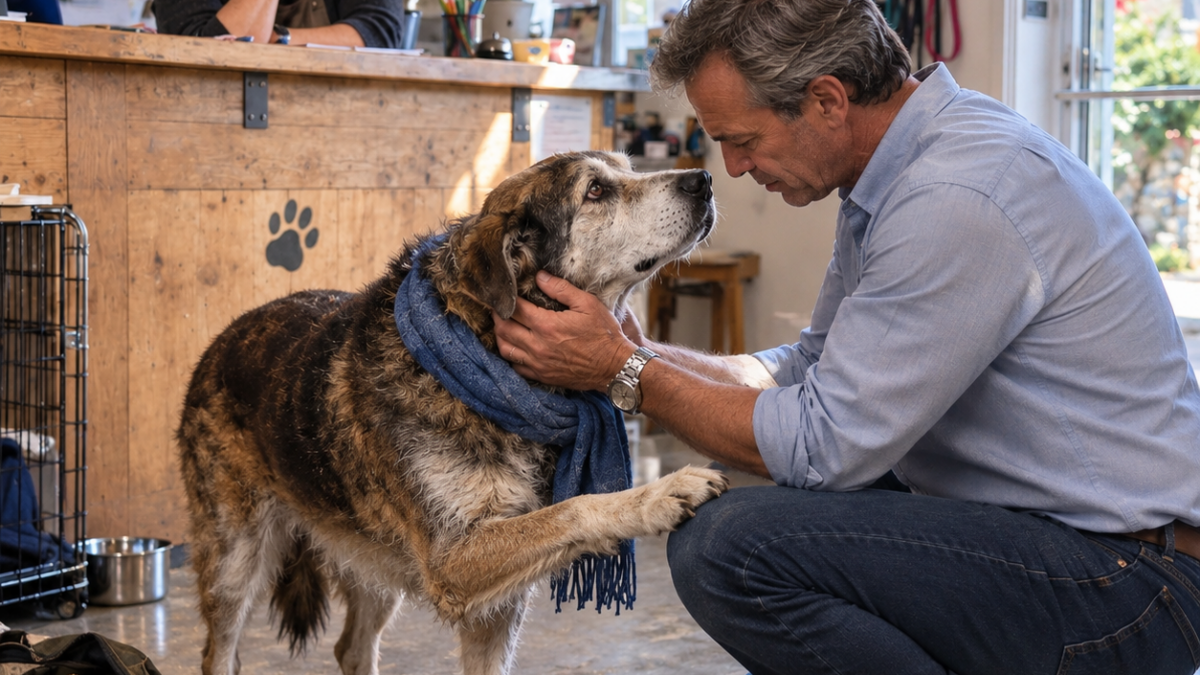
# **He Told His 84-Year-Old Mother Her Dog Was Dead—Then I Found Gaston Waiting in Our Shelter**
The man handed me the leash like he was dropping off a bag he no longer wanted to carry.
Before walking away, he leaned toward the counter and said, “Whatever you do, don’t call my mother. She thinks this is already over.”
I had no idea then that the old blue scarf around that dog’s neck was about to expose a lie cruel enough to tear an entire family apart.
My name is Colette.
I’m seventy-two years old, and I live in a small town outside Saumur, France.
After my husband, Henri, died three years ago, I started volunteering two mornings a week at a local animal shelter.
I clean kennels.
Prepare food.
Wash blankets.
And when my knees cooperate, I walk the older dogs who no longer have enough energy to drag me across the yard.
Animals have always made sense to me.
People are sometimes harder.
That Tuesday morning in September, I was behind the reception counter sorting medication when a man in his early fifties walked through the door with an elderly spaniel.
The man looked polished.
Pressed shirt.
Leather shoes.
Car keys in one hand.
Phone vibrating every few seconds inside his pocket.
The dog looked like the exact opposite.
Twelve years old, maybe older.
White muzzle.
Cloudy brown eyes.
One rear leg stiff enough to give him a limp.
Around his neck was a faded blue scarf tied neatly in a knot.
Our shelter manager, Sandrine, stepped forward.
“Good morning. Do you have an appointment?”
“No.”
The man placed the leash on the counter.
“I need to leave my mother’s dog here.”
Sandrine glanced at the spaniel.
“What happened?”
“My mother went into a nursing home after a fall. I cleared out her house. I work in Angers, I have two children, and I live in an apartment.”
He shrugged.
“What exactly am I supposed to do with him?”
The dog sniffed the tile floor.
He didn’t whine.
He didn’t pull toward the man.
He simply looked tired.
“What’s his name?” I asked.
“Gaston.”
“How old?”
“Twelve. Thirteen. Something like that.”
Something about the answer bothered me.
People who had lived with an animal for twelve years usually knew its age.
The man placed a half-empty bag of food, an old blanket, and a veterinary booklet on the counter.
Sandrine opened the booklet.
“The owner listed here is Lucienne Renaud.”
“My mother.”
“Has she agreed to surrender Gaston?”
His expression hardened.
“Obviously.”
“We still need confirmation.”
“She’s eighty-four years old. She just lost her house. Do you really want to upset her over a dog?”
Sandrine remained calm.
“We can take Gaston temporarily, but ownership has to be clarified.”
The man looked at his watch.
“Do whatever paperwork you need. I can’t keep him.”
Then he turned toward the door.
That was when I noticed something strange.
Gaston didn’t try to follow him.
Not even one step.
The door closed.
The man disappeared.
Gaston stood still for several seconds.
Then he walked toward the bag left on the floor.
He pushed his nose inside.
Pulled out the old blanket.
And buried his face in it.
I crouched beside him.
The fabric smelled faintly of lavender and laundry soap.
One corner had been repaired with pink thread, the stitches large and uneven, as if someone with trembling hands had refused to throw it away simply because it was worn.
I reached into the bag again.
At the bottom was a small plastic box containing two tablets.
Gaston’s name had been written across the lid.
Underneath it was a folded piece of paper.
I opened it.
The handwriting shook across the page.
**If there’s a thunderstorm, please leave a light on. Gaston is afraid of the dark.**
I read it twice.
Then I looked at the old dog lying against the blanket.
Someone knew exactly what frightened him.
Someone remembered his medication.
Someone had repaired the blanket he loved instead of replacing it.
Someone had tied that blue scarf carefully around his neck.
I looked toward the glass doors through which the man had just disappeared.
And for the first time, I wondered whether his mother had agreed to any of this at all.
—
## **— END OF FACEBOOK OPENING / PART 1 —**
—
We placed Gaston in one of our quietest kennels.
The younger dogs were housed farther down the corridor, where barking could rise and fall like a wave every time someone walked past.
Gaston needed peace.
He ate.
That was encouraging.
But he refused the new padded bed we gave him.
Instead, he dragged his old blanket into the far corner, circled twice, and lowered himself onto it with a groan.
When I came back later, his nose was still pressed against the fabric.
I knew what he was doing.
He was finding home in a smell.
I had done something similar after Henri died.
For nearly a year, I kept one of his old sweaters hanging behind our bedroom door.
It was ridiculous.
I knew that.
It smelled less like him every month.
Eventually it smelled mostly like dust and the cedar blocks inside the wardrobe.
But I couldn’t wash it.
Washing it felt like admitting he wasn’t coming back.
That evening, as I watched Gaston sleep on his patched blanket, I thought about the woman who had sewn it.
Lucienne Renaud.
Eighty-four years old.
Recently moved into a nursing home after a fall.
According to her son, she had agreed to give up the dog she had apparently cared for with extraordinary attention.
Maybe she had.
Life forces people into terrible choices.
Age does too.
I knew that better than most.
I had never adopted an animal after Henri died because I was seventy-two.
People liked to tell me, “You should get a dog. It would keep you company.”
Maybe.
But a puppy could live fifteen years.
I might not.
Promises should mean something.
Still, something about Gaston’s situation wouldn’t leave me alone.
The following morning, I took him into the small garden behind the shelter.
He moved slowly.
His bad leg dragged slightly when he was tired, but his nose still worked perfectly.
He investigated every bush.
Every tree.
Every patch of wet grass.
Another dog barked behind the fence.
Gaston lifted his head.
Then, instead of barking back, he came toward me.
I lowered myself onto a bench.
“Come on, old man,” I said. “Neither of us is winning any races.”
He stopped in front of me.
For a moment, he stared at my shoes.
Then he placed his muzzle gently across the toe of my boot.
That tiny gesture nearly broke me.
It had been three years since anyone waited for me when I came home.
No footsteps.
No voice from the kitchen.
No television playing too loudly because Henri refused to admit his hearing was getting worse.
Only silence.
I put one hand on Gaston’s head.
“You belonged to someone,” I whispered.
His ears moved.
“Someone loved you.”
He closed his eyes.
“And I’m going to find out what happened.”
On Friday morning, Sandrine pulled Gaston’s identification record.
The microchip still listed Lucienne Renaud as his legal owner.
Not her son.
Not the shelter.
Lucienne.
The veterinary booklet included an old telephone number.
Sandrine held the paper between two fingers.
“His son specifically told us not to contact her.”
“Which is exactly why I think we should.”
She gave me a long look.
“I agree.”
We tried the son first.
No answer.
Again.
Nothing.
Sandrine left a message.
Then she dialed Lucienne’s number.
No one answered the first time.
Twenty minutes later, she tried again.
A woman picked up.
“Hello?”
“Mrs. Renaud?”
“Yes.”
“My name is Sandrine. I’m calling from an animal shelter near Saumur.”
There was a pause.
“We have a dog here registered in your name.”
Another pause.
“His name is Gaston.”
The silence on the other end became so complete that I could hear the faint electrical hiss of the phone.
“Mrs. Renaud?”
The woman finally spoke.
“You said Gaston?”
“Yes, ma’am.”
“A spaniel?”
“Yes.”
“White around the face?”
“Yes.”
“Blue scarf?”
I looked through the office window toward the kennel corridor.
“Yes.”
I heard Lucienne inhale sharply.
Then she whispered something I couldn’t understand.
Sandrine lowered her voice.
“Mrs. Renaud, are you all right?”
“No.”
Her answer came immediately.
“No, I’m not.”
Sandrine glanced at me.
“Can you tell us what happened?”
Lucienne was quiet again.
Then she said, “My son told me Gaston was dead.”
Neither Sandrine nor I moved.
“He said what?”
“He told me the veterinarian had to put him to sleep on Monday.”
My hand went to my mouth.
Lucienne’s voice broke.
“He said Gaston was suffering. He said there was nothing they could do.”
She began crying.
Not loudly.
That somehow made it worse.
“He promised me he stayed with him.”
Sandrine closed her eyes.
I felt something cold move through my chest.
Lucienne continued.
“I asked him if Gaston was frightened.”
She swallowed.
“He told me no.”
Then came the question I will remember for the rest of my life.
“Are you telling me my dog is alive?”
Sandrine’s voice softened.
“Yes.”
Lucienne made a sound somewhere between a sob and a gasp.
“Oh, thank God.”
She repeated it.
Again.
Again.
“Oh, thank God.”
Then suddenly—
“Where is he?”
“He’s safe.”
“Is he hurt?”
“No.”
“Is he eating?”
“Yes.”
“Does he have his blanket?”
I looked toward Gaston’s kennel.
“Yes.”
“And his tablets?”
“Yes.”
“His blue scarf?”
“Yes.”
Lucienne started sobbing harder.
“That scarf was Henri’s.”
For one irrational second, I thought she meant my Henri.
Of course she didn’t.
Her late husband had apparently had the same name.
She explained that after her husband died six years earlier, she had cut a strip from one of his old blue shirts and made Gaston a scarf.
“He used to sleep beside Henri’s chair.”
I sat down.
Lucienne finally asked the question we had both been dreading.
“Why is he there?”
Sandrine hesitated.
“Your son brought him in.”
Another silence.
This one felt different.
Not grief.
Shock.
“My son?”
“Yes.”
“When?”
“Tuesday morning.”
“But he told me…”
Her voice faded.
Then she said quietly, “He lied to me.”
Sandrine remained silent.
Sometimes silence is kinder than agreement.
Lucienne said, “I want my dog.”
It was not a request.
It was a declaration.
“We understand.”
“Bring him to me.”
“We need to speak with your residence first.”
“I don’t care what they say. He’s mine.”
“I know.”
“He has slept beside my bed for twelve years.”
Her anger suddenly appeared through the tears.
“My son had no right.”
“No,” Sandrine said. “He didn’t.”
That afternoon, we contacted Lucienne’s nursing home.
Maison des Tilleuls sat outside Saumur, surrounded by low stone walls and a garden filled with roses.
The director, Madame Girard, knew Lucienne well.
When Sandrine explained the situation, there was another stunned silence.
“Her son told us the dog had been euthanized,” Madame Girard said.
“So Lucienne repeated the story here?”
“Repeated it? She cried for three days.”
My stomach twisted.
Madame Girard continued.
“She refused lunch the first day. One of our nurses found her awake at two in the morning holding an old photograph of the dog.”
I looked at Gaston through the office glass.
He was sleeping.
His paw twitched occasionally.
Maybe dreaming.
Maybe remembering.
“Does your facility allow pets?” I asked.
There was hesitation.
“Not permanently in standard rooms.”
My heart sank.
“But?”
“We do allow family animals to visit.”
“That’s not enough,” I said before I could stop myself.
Sandrine touched my arm.
Madame Girard surprised me.
“I agree.”
She explained that the facility had recently renovated four ground-floor rooms around a small enclosed courtyard.
They were originally intended for residents who needed more independent living arrangements.
One of those rooms was empty.
“And pets?” Sandrine asked.
“We’ve never officially approved a dog living there.”
“Could you?”
“I would need authorization from our administrator and our medical team.”
“How long?”
“I don’t know.”
I looked at Sandrine.
“Ask.”
Madame Girard heard me.
“I will.”
Lucienne wanted to see Gaston immediately.
That was easier.
The following morning, Sandrine and I drove him there.
I had expected him to be nervous.
Instead, the moment he climbed out of the van, something changed.
His nose lifted.
He sniffed the air.
Then he began pulling.
Not hard.
He was too old for that.
But with purpose.
Inside the building, a nurse met us.
“Lucienne is in the sitting room.”
Gaston’s tail moved.
The nurse’s face changed.
“He knows.”
I didn’t answer.
We walked down the corridor.
At the end, a woman sat beside a large window.
She was small.
Very thin.
Silver hair cut close around her face.
Her right wrist was wrapped in a brace from the fall that had brought her there.
She was staring outside.
Gaston stopped.
His entire body froze.
Lucienne turned.
For one second, neither moved.
Then she whispered:
“Gaston?”
The old dog made a sound.
I had never heard anything like it.
A high, trembling cry from somewhere deep inside him.
Lucienne covered her mouth.
Gaston pulled the leash from my loose fingers.
He ran.
Not well.
Not gracefully.
His bad leg stumbled twice.
But he ran.
Lucienne slid forward in her chair and opened her arms.
Gaston crashed into her knees.
She bent over him.
“Oh, my baby.”
He pushed his head against her chest.
She held his face.
Kissed his forehead.
Touched his ears.
His scarf.
His white muzzle.
As though she had to physically confirm every piece of him.
“You’re alive.”
Gaston licked her chin.
“You’re alive.”
The nurses stopped in the doorway.
One began crying.
Sandrine turned away.
I didn’t.
I watched.
Because there are moments in life so painful and beautiful that looking away feels disrespectful.
Lucienne pressed her forehead against Gaston’s.
“I’m sorry.”
The dog’s tail struck the side of her chair.
“I’m sorry I wasn’t there.”
He licked her again.
“You must have thought I left you.”
My throat closed.
Maybe he had.
She whispered, “I didn’t.”
That sentence destroyed whatever composure I had left.
I sat down on a nearby chair and wiped my eyes.
They stayed like that for nearly twenty minutes.
Eventually Gaston lowered himself beside Lucienne’s feet.
She kept one hand resting on his back.
She refused to let go of the leash.
Not because Gaston might run.
Because she was afraid someone might take him again.
When Madame Girard entered, Lucienne’s expression hardened.
“Is he staying?”
The director sat across from her.
“Lucienne—”
“He is not going back with my son.”
“No one is suggesting that.”
“Then he stays.”
Madame Girard spoke gently.
“We’re trying to arrange something.”
“Trying?”
“Your current room cannot accommodate a dog.”
“My room can accommodate a dog better than I can accommodate another funeral.”
The room went silent.
I almost smiled.
Lucienne might have been eighty-four.
She was not fragile in the way her son apparently believed.
Madame Girard nodded.
“I understand.”
“No, you don’t.”
Lucienne pulled Gaston’s head closer.
“My husband died in 2018. My sister died the year after that. I gave up my house last month. I gave up my garden. My furniture. My kitchen. My bed.”
Her voice shook.
“And then my son looked me in the eyes and told me this dog was dead.”
Nobody spoke.
Lucienne straightened.
“I have given up enough.”
Madame Girard’s eyes softened.
“I’ll do everything I can.”
That should have been the hardest part.
It wasn’t.
The hardest part walked into the building forty minutes later.
Lucienne’s son.
His name was Philippe.
I recognized him immediately.
Pressed shirt again.
Phone again.
But this time he wasn’t calm.
He stormed into the sitting room.
“What the hell is going on?”
Gaston raised his head.
Lucienne’s hand tightened around his leash.
Philippe looked at me.
Then Sandrine.
Then the dog.
His face changed.
“Mom.”
Lucienne stared at him.
He took one step forward.
“Mom, I can explain.”
She said nothing.
“I was going to tell you.”
“When?”
“Once you were settled.”
“You told me he was dead.”
“I didn’t want you worrying.”
“You told me a veterinarian killed him.”
“Put him to sleep.”
The correction was so stupid, so cruel, that I felt my hands curl into fists.
Lucienne stared at her son as if seeing a stranger.
“You said you held him.”
Philippe looked away.
“I was trying to make it easier.”
“For whom?”
“Mom—”
“For whom?”
Her voice cracked through the room.
Gaston stood.
Philippe exhaled sharply.
“I couldn’t keep the dog.”
“You could have told me.”
“And then what?”
“We would have found a solution.”
“There wasn’t a solution!”
“There is always a solution before a lie.”
Philippe rubbed his forehead.
“You’re being emotional.”
That was the moment I stopped merely disliking him.
Lucienne went completely still.
“Emotional?”
“You’ve had a difficult month.”
“I buried my dog in my head because of you.”
“I was protecting you.”
“No.”
Her voice became quiet.
“You were protecting yourself from a conversation you didn’t want to have.”
Philippe looked toward Sandrine.
“I don’t appreciate strangers interfering in family matters.”
Sandrine’s expression didn’t change.
“You surrendered an animal that legally belongs to your mother.”
“I had authority.”
“Do you?”
Philippe hesitated.
That hesitation mattered.
Madame Girard stepped forward.
“What authority are you referring to?”
“I handle Mom’s affairs.”
Lucienne looked at him.
“What do you mean?”
Philippe’s jaw tightened.
“Banking. House paperwork. Everything we already discussed.”
“I gave you permission to pay bills while I was in the hospital.”
“It’s more practical if I manage things.”
Lucienne’s face changed.
Something else had entered the room now.
Fear.
Not for Gaston.
For herself.
“What have you done?”
“Nothing.”
“What have you done with my house?”
Philippe’s eyes flickered.
I saw it.
So did Lucienne.
Her hand went pale around Gaston’s leash.
“Philippe.”
“Mom, calm down.”
“What have you done with my house?”
He stared at the floor.
“We accepted an offer.”
Lucienne stopped breathing.
At least it looked that way.
“What?”
“You can’t live there anymore.”
“You sold my house?”
“It needed to happen.”
“You sold my house?”
“It’s not finalized.”
Lucienne pushed herself upright.
Pain flashed across her face from her injured hip.
Madame Girard moved toward her.
Lucienne raised one hand.
“No.”
Then she looked directly at her son.
“Did I sign something?”
Philippe didn’t answer.
“Did I sign something?”
“You signed authorization forms at the hospital.”
“For paying bills.”
“They covered administrative matters.”
“I asked you a question.”
He stared at her.
Lucienne’s voice dropped.
“Did you sell my home without asking me?”
Philippe said, “I did what had to be done.”
That sentence changed everything.
The dog had brought us to the truth.
But Gaston was no longer the only thing at stake.
Madame Girard immediately called the nursing home social worker.
Sandrine contacted our shelter’s legal advisor regarding Gaston’s ownership.
Lucienne requested that Philippe leave.
He refused at first.
Then a staff member told him that if Lucienne did not want him in her room or visiting area, he had to respect her wishes.
“This is insane,” he said.
Lucienne looked at him.
“No.”
She stroked Gaston’s head.
“This is the first sane conversation I’ve had all week.”
Philippe pointed at me.
“You people put this into her head.”
I almost answered.
Lucienne beat me to it.
“Colette didn’t tell me you lied.”
“You did.”
He stared at his mother.
She continued.
“She didn’t tell me you sold my house.”
“You did.”
He opened his mouth.
Nothing came out.
Lucienne’s voice became colder than I expected from such a small woman.
“You should go.”
“Mom.”
“Go.”
“Please.”
“You told me my dog was dead.”
He flinched.
“Go.”
Philippe left.
Gaston watched the door close.
Then he put his head back on Lucienne’s knee.
That afternoon, the nursing home social worker, a woman named Émilie, sat with Lucienne for nearly two hours.
I was not included in most of that conversation.
Nor should I have been.
But afterward, Lucienne asked me to stay.
“I need a witness who isn’t family.”
Émilie explained carefully.
Philippe had been helping with Lucienne’s affairs since her fall.
He had access to several documents.
There were questions about what exactly she had authorized.
The house sale had not yet closed.
That was the good news.
The bad news was that a preliminary agreement had been signed using documents Philippe claimed gave him authority to act for her.
Lucienne stared at the table.
“I trusted him.”
Émilie said, “Trust and legal authority are not always the same thing.”
“He’s my son.”
“I understand.”
“No.”
Lucienne looked up.
“That’s the problem. I thought being my son meant I didn’t have to understand.”
The next few days became a blur.
Appointments.
Phone calls.
A notary.
A lawyer.
Forms.
Copies.
Signatures.
Philippe’s supposed authority was suspended while everything was reviewed.
The house transaction was halted.
Lucienne changed who could access her accounts.
Her niece, Claire—not the same Claire from Iris’s story, if you’re wondering—came down from Tours to help.
I met her on the third day.
She hugged Lucienne for nearly a minute before turning toward Gaston.
“So you’re the troublemaker.”
Gaston wagged his tail.
Lucienne said, “He saved my house.”
In a strange way, she was right.
If Philippe had simply surrendered Gaston honestly, perhaps no one would have asked questions.
If he had told Lucienne that Gaston needed a new home, she might have fought him.
But she would have fought only for the dog.
Instead, Philippe invented a death.
That lie was so specific, so unnecessary, that it made people look more closely.
And once they looked—
other things stopped making sense.
There had been withdrawals from Lucienne’s account.
Not enormous amounts.
Nothing dramatic enough to scream theft.
But several payments had gone toward repairs on Philippe’s car.
A vacation deposit.
A furniture purchase.
Philippe later claimed Lucienne had agreed to help him.
Lucienne said she had not.
I never learned how every financial question was resolved.
Some things belong inside families and legal offices, not shelter gossip.
What I do know is that Philippe lost control over his mother’s money.
He lost control over the house sale.
And he lost the ability to make decisions on Lucienne’s behalf.
He blamed us.
Of course he did.
A week later he appeared at the shelter again.
I was walking Gaston in the yard.
Lucienne still couldn’t keep him at the nursing home permanently because the facility’s approval process wasn’t finished.
So Gaston stayed with us and visited her every day.
Philippe stood outside the fence.
“Colette.”
I pretended not to hear.
“Colette.”
I turned.
“What?”
“You’ve caused enough trouble.”
Gaston moved closer to my leg.
I looked at Philippe.
“I found a note in a dog’s bag.”
“You called my mother.”
“Your mother owns the dog.”
“You had no right.”
“The shelter had every right to verify a surrender.”
“You don’t know my family.”
“That’s true.”
“You don’t know what I’ve dealt with.”
“That’s also true.”
He stepped closer.
“My mother is impossible.”
Gaston’s ears moved.
I stayed quiet.
Philippe continued.
“She shouldn’t have been living alone. She refused help. She fell twice. She forgot things on the stove. She wouldn’t sell the house.”
Some of his anger suddenly sounded less simple.
Maybe there had been years of exhaustion underneath it.
Caretaking can make people tired.
Fear can make people impatient.
But neither gives you permission to lie about death.
I said, “Those things can all be true.”
He blinked.
“And you can still have been wrong.”
His jaw tightened.
“You think you’re better than me?”
“No.”
“Everyone does.”
“I don’t know you well enough to decide what kind of person you are.”
“You’ve already decided.”
“I decided what you did to Gaston was cruel.”
“It was a dog.”
I stared at him.
There it was.
The sentence that explained everything.
Not because Philippe hated dogs.
I don’t think he did.
But to him, Gaston had become an object in a difficult transition.
One more piece of his mother’s old life to remove.
A chair.
A lamp.
A dog.
I stepped closer to the fence.
“To her, he wasn’t.”
Philippe scoffed.
“Do you know how many times she called me when he got sick? How many vet visits? How many times I had to drive over because she couldn’t lift him into the car?”
“No.”
“Do you know what it’s like having a mother who refuses to admit she’s getting old?”
“Yes.”
That stopped him.
I smiled without humor.
“I’m seventy-two.”
He looked away.
“I’m tired,” he said.
For the first time, I heard something human beneath the defensiveness.
“I believe you.”
He looked back.
“But being tired doesn’t turn a lie into mercy.”
Silence.
“You could have asked for help.”
“I did.”
“From whom?”
“No one listened.”
I thought about that.
Maybe parts of his story were true.
Families rarely collapse because one person wakes up evil one morning.
Usually there are years beneath the break.
Resentment.
Fear.
Old arguments.
Unspoken obligations.
But some lines remain lines.
“You told your mother her dog died.”
Philippe looked toward Gaston.
“I didn’t know what else to say.”
“The truth.”
“She would have made everything harder.”
“Yes.”
His face tightened.
I continued.
“Sometimes loving someone is letting them make things harder because the decision belongs to them.”
He said nothing.
Then he asked, “Is she keeping him?”
“I hope so.”
“She can’t take care of him.”
“Maybe not alone.”
“That’s what nobody understands.”
I surprised myself by answering softly.
“I think everyone understands that now.”
Philippe looked suddenly older.
Not kinder.
Just older.
He walked away without another word.
The nursing home’s decision came four days later.
Gaston could stay.
There were conditions.
The veterinarian had to certify that he was safe around residents.
Lucienne needed help with feeding and walks.
The facility required a written care plan.
If Lucienne’s health declined, someone else had to assume responsibility.
I volunteered before Sandrine could stop me.
“So did I,” Lucienne’s niece Claire said.
Madame Girard smiled.
“That solves two problems.”
“What’s the second?” I asked.
“Lucienne has requested the empty room beside the courtyard.”
Lucienne looked pleased with herself.
“I told you I was getting my dog back.”
The move happened on a Monday.
Almost exactly two weeks after Philippe had told his mother that Gaston was dead.
I packed Gaston’s things.
Food.
Medication.
Veterinary booklet.
His patched blanket.
And the handwritten note.
I considered leaving the note behind.
Then I folded it and placed it carefully inside the bag.
It belonged with Lucienne.
When we reached the nursing home, she was waiting by the entrance.
Her room opened directly onto a small fenced garden.
There was a bed near the window.
A chair.
A little table.
Several framed photographs.
And in one corner—
a dog bed.
New.
Thick.
Expensive.
Lucienne pointed at it.
“He won’t use it.”
I laughed.
“Probably not.”
We brought Gaston inside.
He sniffed the bed.
Then walked directly to his old blanket.
Lucienne shook her head.
“I told them.”
We laid it beside her bed.
Gaston circled.
Lay down.
Then sighed.
Lucienne sat beside him.
“Home,” she whispered.
That word nearly undid me.
Because home was no longer the house Philippe had nearly sold.
Home was no longer a building at all.
It was where his person was.
Over the following weeks, Gaston became something of a celebrity at Maison des Tilleuls.
He was too old to cause much trouble.
He slept most of the day.
But every morning, he followed Lucienne to breakfast.
He learned which residents dropped toast.
He discovered that Madame Besson in room twelve kept biscuits in her cardigan pocket.
During physical therapy, he lay beside Lucienne’s chair.
And when thunderstorms came—
the staff left a light on.
The first storm happened in October.
At 11:30 that night, one of the nurses sent me a photograph.
Lucienne was asleep.
Gaston was curled on his blanket beside the bed.
A small lamp glowed in the corner.
Under the picture, the nurse wrote:
**He’s not afraid tonight.**
I cried.
I didn’t tell anyone.
At seventy-two, you learn that crying is easier if you stop pretending you don’t.
Philippe disappeared from Lucienne’s life for nearly two months.
He called.
She refused to answer.
He wrote.
She returned the letters unopened.
Claire visited every weekend.
I visited twice a week.
Gaston grew stronger.
His arthritis medication was adjusted.
He began walking farther.
Not much.
But enough.
Then, one November morning, Lucienne asked me a strange question.
“Do you believe in revenge?”
I looked up from my coffee.
We were sitting in the nursing home garden.
Gaston slept between us.
“At my age?”
“Yes.”
“I believe revenge is exhausting.”
She smiled.
“That wasn’t my question.”
“All right. Sometimes.”
“What kind?”
“The kind where the person who hurt you has to live long enough to understand what they lost.”
Lucienne looked toward the trees.
“That’s a very French answer.”
“I’m French.”
“You sound like Henri.”
“Mine or yours?”
She laughed.
“Both, probably.”
Then her expression changed.
“Philippe asked to see me.”
I waited.
“What will you do?”
“I don’t know.”
“You don’t owe him forgiveness.”
“I know.”
“And you don’t owe him punishment.”
“I know that too.”
She looked down at Gaston.
“I want him to understand.”
“Understand what?”
“That I’m still alive.”
The sentence struck me.
Lucienne continued.
“After the fall, everyone started speaking around me instead of to me.”
I said nothing.
“The doctor spoke to Philippe. The realtor spoke to Philippe. Nurses spoke to Philippe. He packed my house. He decided what furniture I needed. He decided what happened to Gaston.”
Her hands tightened around her cane.
“I became a problem people were solving.”
I understood.
Not exactly.
But enough.
“So what do you want?”
“I want to make my own decision.”
“Then make it.”
She invited Philippe to visit.
On one condition.
He came alone.
No wife.
No children.
No phone calls.
Just him.
He arrived the following Saturday.
I offered to leave.
Lucienne asked me to stay nearby.
Not inside the room.
Nearby.
I sat in the hallway with a book I never actually read.
Their voices carried through the partly open door.
Philippe spoke first.
“I’m sorry.”
Lucienne said nothing.
“I mean it.”
Still nothing.
“I shouldn’t have lied.”
“No.”
“I panicked.”
“No.”
“I was overwhelmed.”
“Yes.”
A pause.
Then Lucienne said, “That part I believe.”
Philippe’s voice dropped.
“I thought I was doing what needed to be done.”
“You keep saying that.”
“Because it’s true.”
“No. It’s what you told yourself.”
Silence.
“You always make things difficult, Mom.”
“I know.”
“You refused to leave the house.”
“It was my house.”
“You fell.”
“I know.”
“You weren’t safe.”
“I know.”
“You wouldn’t listen.”
“I know.”
I heard Philippe’s chair scrape.
“Then what was I supposed to do?”
Lucienne answered quietly.
“Tell me the truth.”
Nothing.
“Tell me I was old.”
Nothing.
“Tell me I was frightening you.”
Nothing.
“Tell me you were exhausted.”
Nothing.
“Tell me the house was too much.”
Her voice shook.
“But don’t kill my dog in a story because you’re afraid I’ll argue with you.”
I closed my eyes.
Philippe began crying.
I know because I heard him try not to.
That sound is unmistakable.
Lucienne let him.
She did not rush to comfort him.
That mattered.
After several minutes, he said, “I’m sorry.”
This time, she answered.
“I believe you.”
My heart lifted.
Then she added:
“But I don’t trust you.”
Silence.
“And forgiveness is not the same as trust.”
I stared at the page in my book.
That may have been the strongest thing I ever heard Lucienne say.
Philippe whispered, “What do I do?”
“You stop asking me to make your guilt disappear.”
Another silence.
“You come back next month.”
“What?”
“If you still want to see me.”
“I do.”
“Then come back.”
“And Gaston?”
“He lives here.”
“I know.”
“You will apologize to him too.”
I covered my mouth to keep from laughing.
Philippe actually said, “Mom, he’s a dog.”
Lucienne answered:
“And he has better manners than you.”
I failed.
A laugh escaped me.
The room went silent.
Lucienne called, “Colette?”
“Yes?”
“Stop eavesdropping.”
“You left the door open.”
Philippe muttered something.
For the first time since I had met him, Lucienne laughed.
Real laughter.
The legal consequences of Philippe’s actions took longer.
The attempted sale of Lucienne’s house was canceled.
The authorization he had used was formally revoked.
The questionable withdrawals were reviewed.
Eventually, Philippe repaid money Lucienne said she had never intended to give him.
There was no dramatic arrest.
No police dragging him away.
No courtroom where a judge slammed a gavel and declared justice complete.
Real life is usually less theatrical than that.
But he lost something more important.
Control.
Lucienne appointed her niece Claire and a professional adviser to handle financial matters jointly.
No single relative could make decisions alone.
The house remained hers.
And the following spring, she made a decision that shocked everyone.
She sold it.
Herself.
Philippe almost laughed when she told him.
“You fought me for six months and then sold it anyway?”
Lucienne looked at him.
“I wasn’t fighting the sale.”
“What?”
“I was fighting you deciding for me.”
He had no answer.
She sold the house to a young couple with a little girl and a rescue dog.
When they came to sign the final papers, Lucienne asked only one strange question.
“Will the dog be allowed on the couch?”
The woman laughed.
“She already is.”
Lucienne said, “Good.”
Part of the money went toward Lucienne’s long-term care.
Part went into savings.
And a smaller amount went to our shelter to help pay veterinary bills for elderly animals.
She insisted on calling it the Gaston Fund.
I told her that sounded ridiculous.
She told me I was ridiculous.
We compromised by keeping the name.
During the next year, the fund helped seventeen senior dogs.
A fourteen-year-old terrier with heart medication.
A blind Labrador.
Two bonded spaniels whose owner died.
An elderly shepherd with arthritis.
People had overlooked them because they were old.
Gaston, without knowing it, paid for their second chances.
Philippe continued visiting.
Not often at first.
Once a month.
Then twice.
Trust returned slowly.
Very slowly.
Lucienne never gave him access to her accounts again.
She never let him handle legal papers.
When he offered, she simply said:
“No.”
And he learned to accept it.
That was part of his punishment.
He had to sit in a room with a mother who still loved him but no longer handed him authority simply because he was her son.
He had to earn something he once assumed belonged to him automatically.
One afternoon, nearly a year after Gaston arrived at our shelter, I walked into Lucienne’s room and found Philippe kneeling beside the dog.
Gaston was asleep.
Philippe was scratching gently behind his ear.
He looked embarrassed when he saw me.
“I thought he hated me.”
“Dogs aren’t very good at revenge.”
“I noticed.”
I sat down.
“People are.”
He smiled faintly.
“My mother definitely is.”
From the bathroom, Lucienne shouted:
“I heard that.”
Philippe rolled his eyes.
But he was smiling.
Something had changed.
Not healed completely.
Some wounds shouldn’t disappear too easily.
But changed.
The real heartbreak came the following winter.
Gaston was almost fourteen.
His bad leg worsened.
Then his appetite disappeared.
The veterinarian ran tests.
Kidneys.
Heart.
Bloodwork.
Nothing catastrophic.
Everything failing slowly.
Age.
The diagnosis no one wants because there is nothing to fight.
Lucienne listened quietly.
“How long?”
The veterinarian hesitated.
“Weeks. Maybe months.”
Lucienne nodded.
Philippe was beside her.
So was I.
Gaston rested on the floor.
His blue scarf was still around his neck.
Lucienne looked down.
“No hospitals.”
The veterinarian nodded.
“No unnecessary suffering.”
“I agree.”
“He stays with me.”
“Yes.”
“And when it’s time, someone tells me the truth.”
The room went still.
Philippe lowered his head.
Lucienne reached over and took his hand.
It was the first time I had seen her do that since everything happened.
He squeezed back.
“I promise.”
The final weeks were gentle.
Gaston slept more.
Residents visited him.
Staff brought small pieces of chicken.
Madame Besson cried every time she saw him and then pretended she had allergies.
Thunder rolled one night in February.
I happened to be visiting late.
The lights flickered.
Gaston lifted his head.
His breathing quickened.
Lucienne was already in bed.
She reached toward the lamp.
“Leave it on.”
I smiled.
“I know.”
She looked at me.
“Of course you do.”
I switched on the little lamp.
Gaston relaxed.
Lucienne patted the mattress.
He no longer had enough strength to jump.
So Philippe, who happened to be there, lifted him carefully.
Gaston lay beside his mother.
His head rested against her hip.
Philippe stood awkwardly near the bed.
Lucienne looked at him.
“Sit.”
He did.
The storm moved over us.
Rain hit the windows.
Thunder rolled.
The room remained warm.
Bright.
Safe.
I thought about the note from the shelter bag.
**If there’s a thunderstorm, please leave a light on. He’s afraid of the dark.**
I had kept it.
Lucienne knew.
The next morning, Gaston stopped eating completely.
The veterinarian came that afternoon.
No white clinic room.
No metal table.
No strangers.
Just Lucienne’s bedroom.
His blanket.
The lamp.
The blue scarf.
Philippe stood near the window.
Claire sat beside Lucienne.
I stayed near the door.
The veterinarian examined Gaston and looked at Lucienne.
“It’s time.”
She nodded.
Then she asked everyone to leave except Philippe.
I was surprised.
So was he.
“Mom?”
“Stay.”
We stepped into the hallway.
Twenty minutes later, Philippe opened the door.
His face was wet.
I knew.
Lucienne sat on the bed.
Gaston lay beside her.
Still.
Peaceful.
Her hand rested on his back.
I walked toward her.
She looked at me.
“He wasn’t afraid.”
My throat closed.
“No.”
“The light was on.”
“Yes.”
“And Philippe stayed.”
I looked at him.
He started crying again.
Lucienne reached for his hand.
This time, she did comfort him.
“He told me the truth,” she said.
Three years earlier, maybe I would have thought that was a small thing.
It wasn’t.
Truth was the thing that had broken them.
Truth was also the only thing that could begin putting them back together.
We buried Gaston’s ashes beneath a small cherry tree in the nursing home garden.
Residents attended.
Staff attended.
Philippe came with his wife and children.
Lucienne carried the blue scarf.
She did not bury it.
“That stays with me,” she said.
Afterward, she gave me the patched blanket.
“I can’t.”
“Yes, you can.”
“It belongs to you.”
“No.”
She pushed it toward me.
“It belongs to the place that gave him back.”
I took it.
The blanket still had pink stitches in one corner.
I keep it at the shelter.
Not inside a kennel.
In the office.
Folded on a shelf.
Sometimes new volunteers ask why we keep such an ugly old blanket.
I tell them the truth.
Because once, a twelve-year-old dog arrived at our shelter carrying the last pieces of a woman’s old life.
Because someone thought an elderly mother would be easier to manage if she believed that dog was dead.
Because a little handwritten note made us suspicious.
Because we made one phone call.
Because that phone call gave a woman back her dog.
And almost gave her back her life.
Lucienne is eighty-six now.
I’m seventy-four.
My knees are worse.
Her hearing is worse.
We complain about both.
Philippe visits every Sunday.
Not because Lucienne needs him to manage her.
Because she asks whether he wants coffee.
There is a difference.
He never became the villain I expected him to remain.
That surprised me.
He had done something deeply cruel.
Nothing erases that.
But sometimes consequences change people more than humiliation does.
He had to repay money.
He lost authority over his mother’s affairs.
He nearly destroyed their relationship.
And for months, every time he entered Lucienne’s room, he had to walk past the dog he once told her was dead.
Maybe that was revenge enough.
He had to look at Gaston alive.
Happy.
Loved.
And understand exactly what his lie had almost stolen.
Once, after Gaston died, Philippe came to the shelter alone.
He brought several bags of senior dog food.
I looked at them.
“What’s this?”
“A donation.”
“Your mother send you?”
“No.”
He looked embarrassed.
“I did.”
I waited.
Then he said:
“There’s something I never told you.”
“What?”
“The day I brought Gaston here, I almost drove him to another shelter.”
“Why didn’t you?”
“This one was closer.”
I raised an eyebrow.
“That’s not much of a story.”
“No.”
He swallowed.
“I sat in the parking lot for twenty minutes.”
That surprised me.
“With Gaston?”
“Yes.”
“What were you doing?”
“Trying to convince myself to go home.”
I said nothing.
“He kept looking at me.”
Philippe stared at the floor.
“And I knew what I was doing was wrong.”
“Then why did you come inside?”
“Because going back meant telling Mom I couldn’t handle everything.”
There it was.
Not evil.
Pride.
Fear.
Weakness.
Sometimes those things destroy just as much.
Philippe continued.
“I thought if I removed the problem, I could keep everything under control.”
“And did you?”
He gave a short laugh.
“No.”
“Gaston caused quite a lot of trouble.”
“He did.”
We both smiled.
Then Philippe became serious.
“I’m not asking you to forgive me.”
“It isn’t mine to forgive.”
“I know.”
He nodded toward the kennels.
“Do you have any old dogs that need walking?”
I stared at him.
“You?”
“Yes.”
“You own shoes that can get dirty?”
“Probably.”
I laughed.
His first walk was with a thirteen-year-old Beagle named Marcel.
Marcel peed on his shoe.
I considered it divine justice.
Philippe did not.
But he came back the following Sunday.
And the Sunday after that.
He never became one of our regular volunteers.
Life was busy.
His children.
His job.
His mother.
But once or twice a month, he came.
Usually with food.
Sometimes just to walk an elderly dog.
He always chose the old ones.
I never asked why.
I didn’t need to.
Two years after Gaston first arrived, a new dog came into the shelter.
Her name was Lola.
Eleven years old.
Arthritis.
Half deaf.
Her owner had died.
She lay at the back of her kennel and refused to look at anyone.
I stood outside the gate one morning.
Philippe happened to be delivering food.
He stopped beside me.
“What’s her story?”
“Owner died.”
“How long has she been here?”
“Three weeks.”
He looked at Lola.
“She looks sad.”
“She is.”
“Can I walk her?”
I handed him the leash.
Lola didn’t want to move.
Philippe sat down on the concrete.
He waited.
Ten minutes.
Fifteen.
Then Lola slowly stood.
She walked toward him.
I watched from the doorway.
He didn’t pull.
Didn’t call.
Didn’t force her.
He simply waited.
Eventually, Lola placed her nose against his hand.
Philippe looked at me.
Neither of us said anything.
The man who once handed me a leash because he wanted a dog removed from his life was sitting on a dirty shelter floor waiting for another old dog to decide whether she trusted him.
People can surprise you.
Sometimes terribly.
Sometimes beautifully.
Later that afternoon, I visited Lucienne.
She was sitting near the garden with Gaston’s blue scarf folded in her lap.
I told her about Philippe and Lola.
She smiled.
“Good.”
“That’s all?”
“What do you want me to do? Give him a medal?”
I laughed.
“You’re impossible.”
“That’s what he says.”
We sat quietly for a while.
Then Lucienne asked:
“Do you think Gaston knew?”
“Knew what?”
“That Philippe changed.”
I looked toward the cherry tree.
“I don’t know.”
She nodded.
“Henri used to say dogs don’t care who you were yesterday if you’re kind today.”
“That sounds suspiciously wise.”
“He stole most of his wisdom from wine labels.”
I laughed so hard my knees hurt.
Before I left, Lucienne stopped me.
“Colette.”
“Yes?”
“Thank you for calling me.”
I had heard those words from her before.
But this time they felt different.
“You don’t have to thank me.”
“Yes, I do.”
“Sandrine made the call.”
“You pushed her.”
“She already wanted to.”
“You noticed the note.”
“Anyone could have.”
“But you did.”
I looked down.
Lucienne touched my arm.
“People think old women become invisible.”
I looked at her.
“Sometimes old dogs do too.”
She smiled.
“That’s why we make such a good team.”
I drove home that evening to my quiet house.
For years, I had told myself I didn’t need anyone waiting behind the door.
I was too old for another commitment.
Too practical.
Too cautious.
But life enjoys making fools of people who say “never.”
Six months after Gaston died, Lola was still at the shelter.
Philippe walked her when he could.
I walked her when my knees allowed.
She remained overlooked.
Eleven years old.
Gray muzzle.
Arthritis.
Half deaf.
One rainy Tuesday, I stood in front of her kennel holding a leash.
She looked at me.
I thought about Henri.
About Lucienne.
About Gaston.
About promises.
Then I went to Sandrine.
“I need an adoption form.”
She stared at me.
“For whom?”
“Don’t be irritating.”
Her mouth fell open.
“Colette.”
“I’m aware.”
“You said you would never adopt.”
“I say many stupid things.”
“You’re seventy-four.”
“I can count.”
“What if—”
“I know.”
We discussed it properly.
That mattered.
I arranged with my niece that if anything happened to me, Lola would go to her.
The shelter agreed.
My doctor told me walking more would probably improve my knees.
I accused him of conspiring with Sandrine.
Then I signed.
That evening, I brought Lola home.
She stood in my hallway for almost a full minute.
The house smelled different with a dog inside.
Alive.
Warm.
Uncertain.
I removed her leash.
She walked into the living room.
Sniffed Henri’s old chair.
Turned twice.
Lay down beside it.
I cried.
Of course I did.
Later that night, rain began.
Not a real storm.
Just distant thunder.
Lola lifted her head.
Without thinking, I switched on the lamp beside the sofa.
Then I froze.
For a moment, I could see Gaston.
His patched blanket.
His blue scarf.
Lucienne’s trembling handwriting.
**If there’s a thunderstorm, please leave a light on. He’s afraid of the dark.**
I smiled.
“All right,” I whispered to Lola.
“The light stays on.”
She sighed and went back to sleep.
I sat beside her with my tea.
The house was no longer silent.
There was breathing.
A collar moving.
Paws shifting against the rug.
Tiny sounds.
Ordinary sounds.
The kind you don’t understand you miss until they return.
I thought about the morning Philippe first entered our shelter.
He believed he was ending a problem.
Instead, he started something none of us could have predicted.
Gaston returned to Lucienne.
Lucienne regained control of her life.
Philippe lost his authority, faced the damage he had caused, and slowly learned that caring for someone does not mean taking away their right to choose.
Seventeen senior dogs received medical care because of the fund created in Gaston’s name.
And eventually, an old woman who had spent years saying she was too old to promise anything brought home an eleven-year-old dog nobody else wanted.
That is the strange thing about cruelty.
Sometimes it tries to close one door—
and accidentally forces ten others open.
I still think about the lie Philippe told his mother.
He could have said:
“I can’t manage Gaston.”
He could have said:
“I’m overwhelmed.”
He could have said:
“We need help.”
Instead, he chose the cruelest shortcut.
“He’s dead.”
Four words.
That was all it took to break his mother’s heart.
But those four words didn’t become the ending.
Because Gaston was alive.
Because a shelter checked the paperwork.
Because Sandrine made a phone call.
Because Lucienne answered.
And because when she finally held her dog again, she understood something Philippe had forgotten.
Growing old had changed what she could do.
It had not changed what she had the right to decide.
The last photograph I have of Gaston sits on my refrigerator.
Lucienne is sitting in the nursing home garden.
Gaston is lying beside her chair.
His muzzle is almost completely white.
His blue scarf is around his neck.
Philippe is standing behind them.
All three are looking toward the camera.
But my favorite detail is one most people probably wouldn’t notice.
Lucienne’s hand rests lightly on Gaston’s back.
Not gripping him.
Not holding the leash.
Just touching him.
She doesn’t need to hold on tightly anymore.
No one is taking him away.
Sometimes people ask me what happened to the man who abandoned the old dog.
They expect a dramatic answer.
They want me to say he went to jail.
Lost everything.
Was humiliated publicly.
That would make a cleaner story.
But real revenge was quieter.
Philippe watched his mother take back every decision he had stolen from her.
He watched the house sale stop.
He watched his access to her money disappear.
He watched her choose who represented her.
He watched her bring Gaston into her new home despite him insisting there was no solution.
And then, for the rest of that old dog’s life, he watched Gaston sleep safely beside the woman he had claimed no longer needed him.
Philippe had tried to erase the dog from his mother’s life.
Instead, Gaston became the reason she took her life back.
That was the punishment.
And the lesson.
One Tuesday morning not long ago, Philippe came to the shelter while I was there with Lola.
He crouched.
Lola smelled his hand.
Then let him scratch beneath her chin.
“You finally adopted one,” he said.
“Apparently.”
“Your knees?”
“Still terrible.”
He laughed.
Then he asked something I didn’t expect.
“Do you ever wish you hadn’t called my mother?”
I looked at him for a long moment.
“No.”
He nodded.
“Neither do I.”
I believed him.
Before he left, he placed a bag of senior dog food on the counter.
Then he glanced toward Lola.
“You know, Gaston would’ve liked her.”
“Gaston liked everyone.”
“Not me.”
I smiled.
“He forgave you before the rest of us did.”
Philippe looked down.
“Yeah.”
He walked toward the door.
Before stepping outside, he turned.
“Colette?”
“Yes?”
“Thank you.”
I didn’t answer immediately.
Then I said:
“Don’t thank me.”
He frowned.
“Why?”
“Just keep doing better.”
He nodded once.
Then he left.
Lola watched the door close.
For a moment, I expected her to stand.
She didn’t.
She rested her head against my shoe.
Exactly the way Gaston once had.
I bent down and stroked her gray muzzle.
Outside, the sky was darkening.
A storm was coming.
So when I got home that evening, before the first thunder rolled across the Loire Valley, I switched on the lamp beside Henri’s old chair.
Lola curled beneath it.
And I left the light on.
Not because Gaston was still afraid of the dark.
But because some promises deserve to outlive the ones we made them to.
And because an old dog once taught all of us something his owner’s son had forgotten:
Love is not deciding what someone can live without.
Love is staying long enough to learn what they cannot bear to lose.








