PART 2: He Survived a Fighting Ring but Couldn’t Trust Anyone—Then an Old Dog Nobody Wanted Lay Beside Him
PART 2
I did not see what happened in real time.
By then, I was home.
But the security camera saw everything.
The next morning, Léa called me before six.
I knew from the way she said my name that something had happened.
“Marianne.”
I sat up in bed.
“What?”
“You need to see the camera.”
My first thought was disaster.
“Are they hurt?”
“No.”
“Did they fight?”
“No.”
“Then what happened?”
She was silent for two seconds.
“I don’t know how to explain it.”
I was dressed and driving before sunrise.
When I arrived, Léa was waiting in the small office beside the kennel corridor.
She had already loaded the recording.
“Start here.”
11:47 p.m.
Basile stood.
The old dog crossed the kennel slowly.
Nino watched him.
As Basile approached, Nino’s shoulders tightened.
His head lowered.
The trembling increased.
I expected Basile to stop.
He didn’t.
But he also did not walk directly toward Nino.
About three feet away, he turned sideways.
Then he lowered himself to the floor.
Slowly.
Painfully.
His old joints made the movement awkward.
And then he simply lay there.
Not touching Nino.
Not looking directly at him.
Just close enough that they could feel each other’s presence.
For eleven minutes, nothing changed.
Nino remained against the wall.
Basile lay beside him.
At 11:59, Nino moved.
Barely.
His nose stretched forward.
He sniffed the air.
Basile did not react.
Nino leaned another inch.
Then stopped.
At 12:06, he moved again.
This time, he shifted one paw away from the wall.
At 12:14, he took a small step toward Basile.
I looked at Léa.
“How long did you watch this?”
“All of it.”
On the screen, Basile remained perfectly still.
Nino came closer.
One step.
Then another.
At 12:21, his nose touched Basile’s rear leg.
The old Great Dane lifted his head.
Nino froze.
Basile looked at him.
Then lowered his head again.
No warning.
No excitement.
No attempt to sniff Nino.
Nothing.
It was as though he understood that even attention could be too much.
At 12:37, Nino lay down.
Not against the wall.
Beside Basile.
There was still space between them.
Maybe six inches.
But it was the first time in six days that Nino had chosen to lie somewhere other than the farthest corner of his kennel.
I covered my mouth.
Léa whispered, “Keep watching.”
At 1:18, Basile shifted in his sleep.
His back touched Nino’s front paw.
Nino woke instantly.
His body stiffened.
For a moment, I thought he would run.
Instead, he stayed.
Basile kept sleeping.
Slowly, Nino relaxed again.
At 2:03, his head dropped.
At 2:17, he was asleep.
Actually asleep.
Not the shallow, alert resting we had seen since he arrived.
His eyes were fully closed.
His body had loosened.
His head was resting against Basile’s side.
I stared at the screen.
“When was the last time we saw him sleep like that?”
“We haven’t.”
Neither of us spoke.
Then the recording moved into the early morning.
At 4:52, Basile woke.
He stood slowly.
Nino woke immediately and followed him with his eyes.
Basile walked toward the water.
Drank.
Then crossed to his food bowl.
There were still some pieces of kibble left from dinner.
He ate several.
Nino watched.
Basile stopped.
Turned away from his bowl.
And walked back toward his bed.
The bowl was left behind.
Nino stared at it.
For nearly three minutes.
Then he stood.
He approached.
He sniffed.
And he ate.
Not much.
Maybe eight or nine bites.
But he ate while another dog was in the kennel.
He ate with Basile visible.
He ate without trembling.
Léa began crying.
I realized I was too.
“He showed him.”
“What?”
I wiped my face.
“He showed Nino nothing was going to happen.”
We had spent six days trying to convince Nino with food, distance, soft voices, medical care, and patience.
Basile had offered something we could not.
He was another dog.
And he had eaten without being attacked.
He had slept without being attacked.
He had allowed Nino to approach without demanding anything.
For a dog whose entire understanding of other dogs had been built around violence, that mattered in a way our kindness could not yet reach.
We entered the kennel carefully that morning.
Basile was back on his bed.
Nino had returned near the wall, but not pressed tightly against it.
Léa carried breakfast.
The sound of the bowl still made him tense.
She placed it down.
Then backed away.
Basile lifted his head.
Nino looked at him.
Basile stood.
He walked toward his own bowl.
Started eating.
Nino watched.
Then, slowly, he approached his food.
One bite.
Then another.
Léa looked at me.
Neither of us moved.
Nino finished almost a quarter of the meal.
That was more than he had eaten in six days.
Basile finished his breakfast, drank water, and returned to his bed.
For him, apparently, nothing remarkable had happened.
For us, everything had changed.
From that day forward, Basile became part of Nino’s rehabilitation.
We did not force them together.
They always had space.
Nino always had an exit.
But if Basile went outside, Nino watched.
If Basile returned, Nino’s body relaxed.
If Basile ate, Nino often ate.
If a volunteer approached Basile and scratched his neck, Nino watched.
That became our next tool.
Léa would sit beside Basile.
“You like that, don’t you, old man?”
Basile leaned his enormous head against her.
Nino watched from several feet away.
No pressure.
No one reached for him.
The next day, the distance became smaller.
A week later, Nino stood only a few feet away while Léa stroked Basile.
She did not look at him.
Did not call him.
She simply continued petting the old dog.
Nino approached.
One step.
Then another.
He sniffed her sleeve.
Léa froze.
Basile nudged her hand because she had stopped scratching him.
The movement startled Nino.
He jumped backward.
But he did not run to the wall.
That mattered.
Léa resumed petting Basile.
Nino watched.
Then approached again.
His nose touched the back of her hand.
She did nothing.
He sniffed.
Then stepped away.
The next day, he did it again.
On the third day, Léa turned her hand palm-up.
Nino sniffed her fingers.
His body trembled.
But he stayed.
“Hi,” she whispered.
That single word almost frightened him away.
She learned.
Silence was safer.
So she waited.
Nino sniffed again.
Then Basile pushed his giant muzzle between them, demanding attention.
Léa laughed.
“You jealous old thing.”
She scratched him.
Nino watched.
And then something happened so quickly that I almost missed it.
He leaned forward.
Just enough for Léa’s knuckles to brush the fur beneath his chin.
He froze.
Léa froze too.
One second.
Two.
Three.
Then Nino stepped backward.
No panic.
No shaking.
He simply moved away.
That was his first voluntary human touch since arriving.
Basile was lying beside us.
His eyes were half closed.
As if he had known all along.
The weeks that followed were not magical.
Healing never is.
There were setbacks.
A metal gate slammed one afternoon and Nino dropped to the floor, trembling so violently we could see it from the hallway.
Basile was outside at the time.
Nino would not move.
Would not respond to food.
Would not look at us.
We brought Basile back earlier than planned.
The old dog entered.
Nino saw him.
Within minutes, the shaking eased.
Basile walked to his bed.
Nino followed.
That frightened me.
Not because their bond was bad.
Because it was becoming obvious how much Nino depended on him.
“What happens if Basile gets sick?” Léa asked one night.
Neither of us wanted to answer.
Basile was eleven.
For a Great Dane, eleven was very old.
We knew that.
His hips were getting stiffer.
Some mornings he needed several seconds before his back legs fully cooperated.
He had been overlooked for four years partly because everyone could see the truth.
Time was not on his side.
And yet, somehow, the dog nobody wanted had become the one animal Nino trusted enough to teach him how to live again.
I began feeling angry whenever visitors walked past Basile.
More angry than before.
Families came into the shelter.
Children pointed toward younger dogs.
Adults asked which animals were easiest.
Which were healthiest.
Which might live the longest.
Basile would slowly rise when they approached.
Walk to the gate.
Wait.
Sometimes someone would stroke his muzzle.
“Oh, he’s beautiful.”
Then came the question.
“How old?”
“Eleven.”
And there it was.
The hesitation.
The polite smile.
The retreat.
One Saturday afternoon, a couple spent nearly five minutes with him.
The woman loved him.
I could see it.
Basile leaned against the bars while she scratched his cheek.
Then her husband asked his age.
When I told him, his expression changed.
“We just lost a dog last year.”
“I’m sorry.”
“He was fourteen.”
The woman looked at Basile.
Her eyes were already wet.
“I don’t think we can do that again so soon.”
I understood.
I truly did.
But when they walked away and chose a four-year-old Labrador instead, I stood beside Basile’s kennel longer than usual.
He returned to his bed.
Nino followed him.
The young boxer lay down close enough that their shoulders touched.
I whispered, “You deserved somebody too, you know.”
Basile’s tail moved once.
I began posting about him again.
New photographs.
A new description.
Not just:
Eleven-year-old Great Dane seeking retirement home.
I wrote what I actually knew.
Basile has spent four years watching families walk past him. He is old, slow, and may not have many years ahead. He is also the reason a terrified young dog has begun eating, sleeping, and trusting humans again.
People reacted.
They shared his story.
They called.
For a few days, I allowed myself hope.
Then most of the inquiries disappeared once people understood his age and size.
One woman wanted him but lived on the fifth floor without an elevator.
Another family had three young children who might accidentally knock into his painful hips.
A man called from several hours away and seemed perfect until he explained Basile would spend ten hours alone every weekday.
We said no.
Finding any home was not enough.
Basile had waited four years.
We were not going to reward that patience by sending him somewhere unsuitable.
Meanwhile, Nino continued changing.
He gained weight.
His wounds healed.
The fur around his neck began growing back.
The damaged ear remained slightly uneven.
The scars remained.
But his eyes changed most.
At first, they had followed every movement.
Every hand.
Every door.
Now he sometimes slept while volunteers worked nearby.
One afternoon, I heard laughter from the yard.
I went outside.
Léa was standing near the fence.
Basile was walking slowly through the grass.
And Nino was running.
Actually running.
Not fleeing.
Not escaping.
Running in circles around Basile.
Play bow.
Sprint.
Turn.
Another circle.
Basile stopped.
Looked annoyed.
Nino bounced in front of him.
The old Great Dane gave one deep bark.
Nino jumped sideways.
Then came back.
Another bow.
Basile finally lifted one paw and nudged him.
That was enough.
Nino exploded into another circle.
Léa laughed so hard she had tears in her eyes.
I leaned against the fence.
“There you are.”
Nino ran past me.
For a second, his body looked exactly like what it should have been.
Young.
Strong.
Careless.
A two-year-old dog.
Not bait.
Not a victim.
Just a dog.
The people who had used him for violence had tried to teach his body that pain was the only thing another dog could bring.
Basile was teaching him something else.
Safety.
Company.
Play.
Rest.
That felt like revenge to me.
Not violence returned for violence.
Something better.
They had tried to turn Nino into fear.
He was becoming joy.
They had used dogs to hurt him.
A dog was healing him.
There was a kind of justice in that I could not have invented.
Then, about six weeks after we paired them, Basile scared us.
It happened during the afternoon.
Léa was cleaning the outdoor area.
Nino and Basile were resting beneath the shade structure.
Basile stood.
Took two steps.
Then his rear legs gave out.
He collapsed.
Nino jumped up.
Léa dropped everything.
“Marianne!”
I ran.
Basile was conscious.
His breathing was fast.
He tried to stand.
“Don’t.”
I knelt beside him.
“Stay down, old man.”
Nino paced around us.
His body became tense.
He whined.
I had rarely heard him vocalize.
“Léa, call the vet.”
She was already dialing.
We brought a stretcher.
When we tried to move Basile, Nino panicked.
He pushed toward us.
Not aggressively.
Desperately.
“No, Nino.”
He whined.
Basile lifted his head.
Nino pressed his nose against his face.
For a moment, the entire team stopped.
Basile licked him once.
Then lowered his head.
We carried him away.
Nino screamed.
I cannot describe it another way.
Not a bark.
Not a whine.
A raw, high sound that echoed through the corridor.
He threw himself against the kennel gate.
“Nino!”
Léa rushed back.
He was frantic.
The old terror returned in seconds.
Something he trusted was disappearing through a door.
And in Nino’s experience, things taken away did not always come back.
I looked at the stretcher.
Then at him.
“Bring him.”
Léa stared.
“To the clinic?”
“Yes.”
“Marianne—”
“Bring him.”
We put Nino in the rescue van beside Basile’s stretcher.
He remained close.
His nose almost touching the old dog.
The veterinarian examined Basile.
Age.
Arthritis.
Weakness.
Blood tests.
Heart.
The waiting was unbearable.
Nino stayed with me in a quiet room.
He paced.
Every time footsteps approached, his head snapped up.
I sat on the floor.
“He’s coming back.”
Nino looked at me.
I realized what I had said.
For the first time since his rescue, I was making him a promise.
“He’s coming back.”
I did not know if it was true.
That terrified me.
After almost two hours, the veterinarian came in.
“No catastrophic event.”
I exhaled.
“What happened?”
“Pain and weakness in the rear legs, probably combined with exhaustion. We need to adjust his arthritis management and watch him closely.”
“He’s coming home?”
“To the shelter, yes.”
I laughed.
Nino reacted to my voice.
“He’s coming back.”
When Basile was brought out, Nino pulled toward him.
The old dog looked tired.
But his tail moved.
Nino pressed his face against Basile’s neck.
Then something happened I will never forget.
Basile stood unsteadily.
Nino positioned himself beside him.
Not underneath.
Not actually carrying his weight.
But close enough that their bodies touched.
Basile took a step.
Nino matched it.
Another.
Nino stayed beside him.
For weeks, Basile had taught Nino how to follow.
Now Nino slowed himself for Basile.
Back at the shelter, the roles began to change.
Basile needed more rest.
Nino had more energy.
But he did not abandon him.
When Nino went outside, he returned frequently to check on Basile.
If Basile stayed inside, Nino often chose to stay too.
When volunteers brought medication hidden in food, Nino sat nearby until Basile ate.
Léa laughed one morning.
“He’s supervising.”
“He learned from the best.”
That health scare changed my thinking.
Basile did not have forever.
No dog does.
But his time was more obviously limited.
I became determined that he would not spend whatever remained inside a kennel.
Then an email arrived.
The subject line was simple.
About Basile and Nino.
I almost ignored it because we received so many vague adoption inquiries.
The message came from a woman named Claire and her husband, Julien.
They lived about forty minutes away in an old farmhouse.
Their children were grown.
Claire worked partly from home.
Julien was retired.
They had recently lost an elderly mastiff.
That detail made me cautious.
People in grief sometimes adopt too quickly.
But the rest of the message stopped me.
We are not afraid that Basile is eleven. We know what that means. We also understand that Nino may not be able to leave him yet. We are writing because if separating them would hurt Nino, we would like to meet both.
I read the sentence twice.
Then called Léa.
“Come here.”
She read it.
Her eyes widened.
“Both?”
“Apparently.”
“Do you believe them?”
“I believe nothing until I meet them.”
They arrived Saturday morning.
Claire was sixty-two.
Julien sixty-five.
No children living at home.
No other pets.
Their house had one floor available for the dogs, rugs to help old joints, a fenced yard, and enough room for Basile to move without stairs.
They did not rush toward Nino.
That was the first thing I liked.
Claire sat sideways on a bench.
Julien spoke quietly to Basile.
Basile walked toward him.
Julien let the old dog sniff his hand.
“Hello, big man.”
Basile leaned against his leg.
Julien nearly lost his balance.
He laughed.
“Okay. Very big man.”
Nino remained twenty feet away.
Claire ignored him.
Good.
We talked.
Medical history.
Basile’s arthritis.
Potential expenses.
His age.
Nino’s trauma.
His fear.
The possibility he might regress.
The need for slow introductions to everything.
The couple listened.
No romantic expressions.
No “love will fix everything.”
That was another good sign.
Claire asked, “Does Nino have to be adopted with Basile?”
I answered honestly.
“We don’t know.”
She nodded.
“If separating them now would damage him, we won’t ask you to.”
Julien looked toward the dogs.
“What happens when Basile eventually dies?”
The question hurt.
But it was the right question.
“Nino will need support.”
“We can give it.”
“You may have to deal with grief behaviors. Anxiety. Loss of appetite.”
Claire nodded.
“We lost our dog after thirteen years.”
She looked at Basile.
“We know what grief does to humans. I assume dogs deserve the same patience.”
That answer stayed with me.
During their second visit, Nino came five feet closer.
On the third, he sniffed Claire’s shoe.
She did not react.
On the fourth, Julien sat beside Basile while Nino lay several feet away.
After nearly an hour, Nino stood.
Walked toward them.
And lay down beside Basile.
Claire looked at me.
I nodded.
She slowly extended one hand.
Nino watched it.
Then sniffed.
Her fingers touched his cheek.
He flinched.
But stayed.
Claire’s eyes filled.
She did not try again.
Smart woman.
The adoption process took weeks.
We visited their home.
Checked the yard.
Discussed feeding.
Medication.
Emergency transport for a Great Dane.
Where Basile would sleep.
Where Nino could retreat if overwhelmed.
They bought two beds.
Then, after hearing that the dogs often slept together, they exchanged them for one enormous orthopedic bed plus a second smaller one.
“They can choose,” Julien said.
That became one of my favorite sentences.
They can choose.
Nino had lived in a world where choice had been taken from him.
At Les Saules, we had spent weeks giving it back.
Do you want to approach?
Do you want to eat?
Do you want to be touched?
Do you want distance?
Now he was going to a home where the same rule would continue.
The adoption day arrived on a cold morning.
I barely slept the night before.
Léa was worse.
“You’re crying already.”
“I’m not.”
“You are.”
“So are you.”
“That’s different.”
“How?”
“I have mascara on.”
We laughed.
Then Claire and Julien arrived.
Basile wore a new padded harness.
Nino wore a simple blue collar.
For the first time, neither dog looked like an animal belonging to a shelter.
They looked like dogs going somewhere.
Basile climbed into the vehicle first using a ramp Julien had bought.
Nino stopped at the door.
Cars still frightened him.
We waited.
No pulling.
No forcing.
Basile turned around from inside.
Nino looked at him.
One paw onto the ramp.
Then another.
He climbed in.
Claire closed the door.
I stood there with my hands in my pockets because I did not know what else to do with them.
Four years.
Basile had lived behind our gates for four years.
Hundreds of visitors had passed.
Some had loved him for five minutes.
Nobody had taken him home.
Now he was leaving because of the frightened young dog everyone had thought might never recover.
The dog nobody wanted had become indispensable.
And because of Nino, someone finally looked at Basile long enough to see him.
That felt like justice too.
Claire hugged me.
“We’ll send updates.”
“You’d better.”
Julien shook my hand.
Then looked toward Basile.
“We know we may not get years.”
I swallowed.
“I know.”
“But he won’t spend whatever time he has left waiting.”
I looked away.
That sentence nearly broke me.
The car pulled out.
Nino stood at the rear window.
For one horrible second, I felt panic.
What if he thought we were abandoning him?
Then Basile’s enormous head appeared beside him.
Nino looked away from us.
Toward Basile.
The vehicle disappeared down the road.
Léa was openly sobbing now.
I put my arm around her.
“You okay?”
“No.”
“Me neither.”
For the first few days, Claire sent photographs constantly.
Basile sleeping.
Nino hiding beneath a table.
Basile in the yard.
Nino watching from the doorway.
Nino eating.
Basile snoring.
Nino lying three feet from the giant bed.
Then one photograph arrived at 6:12 on the fourth morning.
No message.
Just a picture.
Basile asleep on the orthopedic mattress.
Nino curled against his chest.
Exactly like the security camera footage.
Except there were no concrete walls.
No kennel gate.
No fluorescent light.
Behind them was a living room.
A fireplace.
A window looking out toward trees.
I sat alone in the shelter office and cried.
Their transition was not perfect.
Nino panicked when Julien dropped a metal saucepan.
He refused dinner after a motorcycle backfired outside.
For several days, he would not enter one room because the floor was slippery.
Claire put rugs everywhere.
No punishment.
No pressure.
Basile continued doing what he had always done.
He existed calmly.
Nino watched.
Basile walked through the kitchen.
Nino followed.
Basile slept beside Julien’s chair.
Nino learned that the chair was safe.
Basile greeted Claire when she returned from the store.
Nino watched her leave.
Then watched her return.
Again.
Again.
Again.
Three weeks after adoption, Claire sent a video.
She opened the front door.
Nino was standing behind Basile.
She entered.
Basile wagged.
Nino hesitated.
Then his tail moved.
One wag.
Two.
Then he came forward.
Claire crouched but did not reach.
Nino approached her.
Pressed his head against her shoulder.
I replayed the video five times.
Léa watched over my shoulder.
“He hugged her.”
“Dogs don’t hug.”
“He hugged her.”
I laughed.
“Fine. He hugged her.”
Months passed.
Basile’s arthritis remained manageable.
Nino became stronger.
His coat filled in.
His muscles developed.
The scars remained, but fewer people noticed them first.
That mattered.
When a dog has been badly abused, people often see the wounds before they see the animal.
Nino slowly became more than his history.
He loved running beside the fence.
He stole Julien’s socks.
He learned that cheese existed and became shameless about begging for it.
He slept upside down.
He barked at birds.
He hated rain.
He loved Claire.
And he still loved Basile most.
One spring afternoon, Claire invited us to visit.
Léa and I drove out together.
When we entered the yard, Basile was sleeping under a tree.
Nino was nearby.
I called his name.
“Nino.”
His head rose.
For a second, he stared.
Then recognition happened.
He ran.
Straight toward us.
Léa crouched.
Nino reached her first.
He did not stop three feet away.
Did not tremble.
Did not flatten himself.
He crashed into her.
Léa fell backward into the grass.
I burst out laughing.
She wrapped both arms around him.
“You little monster!”
Nino licked her face.
Then he came to me.
I knelt.
He pressed his forehead against mine.
I closed my eyes.
The last time he had lived under my care, I still approached him carefully.
Now he was asking for touch.
I put my hands around his neck.
No flinch.
No fear.
Just warmth.
Behind him, Basile slowly stood.
I went to him.
“Hello, old man.”
His tail moved.
He looked older.
More gray.
Thinner through the hips.
But peaceful.
I sat beside him.
Nino immediately lay down on his other side.
Claire brought coffee.
Julien sat nearby.
For nearly an hour, we talked.
Normal things.
Food.
Medication.
Basile’s joints.
Nino’s obsession with socks.
Then Julien said something that made us all quiet.
“You know, I think Basile was waiting for him.”
I looked at the old dog.
“What do you mean?”
“Four years in the shelter.”
Julien rubbed Basile’s neck.
“Maybe nobody took him because his job wasn’t finished yet.”
I smiled.
“That sounds sentimental.”
“It is.”
He shrugged.
“I’m retired. I’m allowed.”
Claire laughed.
Nino rested his chin across Basile’s front leg.
Julien continued.
“If someone had adopted Basile two years earlier, maybe Nino wouldn’t have had him when he needed him.”
I looked down.
I knew life did not really arrange itself that neatly.
There was no invisible plan guaranteeing rescue dogs reached the right place at the right time.
Sometimes dogs waited too long.
Sometimes we lost them.
Sometimes unfair things remained unfair.
But sitting beneath that tree, I allowed myself to believe in the coincidence.
The dog nobody chose had become exactly the dog another animal needed.
And by saving Nino, Basile had finally become visible to the people who would choose him too.
A year after Nino first arrived at Les Saules, Claire sent me another video.
This one made me laugh before it made me cry.
Basile was lying on the giant bed.
Nino was standing beside him with a toy.
He dropped the toy on Basile’s head.
Basile ignored him.
Nino picked it up.
Dropped it again.
No reaction.
Third time.
Basile lifted his head slowly and gave Nino the most exhausted expression I had ever seen.
Nino bounced backward.
Basile barked once.
Nino ran around the room.
The camera shook because Claire was laughing.
Then Basile rested his head again.
Nino came back.
And instead of bothering him, he curled beside him.
I saved that video.
It reminded me of the first one.
11:47 p.m.
Basile standing.
Crossing the kennel.
Nino against the wall.
Two dogs the world had already failed in different ways.
One was young and terrified.
One was old and forgotten.
Neither looked like the solution to anything.
Yet they became each other’s answer.
People sometimes asked me whether Nino ever fully recovered.
I never knew how to answer.
What does fully recovered mean?
Did he forget?
No.
Loud metal sounds could still frighten him.
Unfamiliar dogs approaching too quickly could make him freeze.
Some strangers needed to sit quietly for a long time before he came near.
The past remained inside him.
Healing did not delete it.
But the past stopped deciding everything.
That was enough.
He could eat.
Sleep.
Play.
Trust.
Choose.
Love.
Those were victories.
And the people who had once used him as an object in violence no longer controlled his story.
They had tried to teach Nino that another dog meant pain.
Basile taught him companionship.
They had taught him that food could come with danger.
Basile showed him how to eat without fear.
They had taught him that being noticed meant something bad was about to happen.
Basile showed him that another living creature could simply lie beside him and ask for nothing.
That was the revenge.
Not revenge built from cruelty.
Revenge built from contradiction.
Everything they taught him was proven wrong.
Again.
Again.
Again.
And Basile received his own answer to four years of rejection.
For four years, people had looked through the bars and thought:
Too old.
Too large.
Too expensive.
Too little time.
Nino looked at him and saw something different.
Safe.
That one word changed both their lives.
A few months later, Basile turned twelve.
Claire organized what she jokingly called his retirement party.
There was a dog-safe cake.
A ridiculous blue bandana.
Julien insisted on hanging a sign over the living room:
FOUR YEARS LATE, BUT FINALLY HOME.
Léa and I attended.
Basile tolerated the celebration with the dignity of an elderly king forced to participate in nonsense.
Nino tried to steal the cake.
Some things could not be fixed.
I sat on the floor beside Basile.
His breathing was slower now.
His eyes softer.
Nino dropped beside us.
Claire took a picture.
Later, she sent it to me.
In the photograph, my hand rested on Basile’s enormous gray head.
Nino’s body was pressed against his side.
Both dogs were looking toward the camera.
I stared at their faces for a long time.
The first photograph I had of Nino showed him pressed against the rear wall of a kennel.
Eyes wide.
Body folded in on itself.
The first adoption photograph we ever took of Basile showed him standing behind bars four years earlier.
Hopeful.
Waiting.
Now there were no bars.
That contrast told the entire story.
Eventually, Basile’s body slowed further.
There were harder mornings.
His back legs needed more time.
Walks became shorter.
Julien built another ramp.
Claire added more rugs.
Nino adjusted too.
He stopped demanding long play sessions from Basile.
He learned to lie near him instead.
Sometimes Nino went running through the yard alone.
Then returned.
Always returned.
He would touch his nose to Basile’s face.
Basile would lift his head.
Check him.
Then sleep again.
The young dog who had once needed reassurance every minute was now giving it.
That may have been Basile’s greatest achievement.
He had not made Nino dependent forever.
He had made him strong enough to become gentle.
One evening, Claire called me.
Her voice was emotional.
My heart immediately tightened.
“Basile?”
“He’s okay.”
I exhaled.
“Do not start a phone call like that.”
“Sorry.”
“What happened?”
“Nino.”
She told me Basile had been having a difficult arthritis day.
He had struggled to get comfortable.
Julien helped him onto the large bed.
Then they left the room briefly.
When Claire returned, Nino had brought his own blanket.
Not literally folded or carried neatly, of course.
He had dragged it across the floor.
He pulled it beside Basile.
Then lay down.
His body pressed against the old dog.
That was all.
Claire said, “Do you think he knows?”
I thought about the camera footage.
The first night.
Basile crossing the kennel.
Lying beside a terrified dog without asking for anything.
“Yes.”
I said it before I could overthink.
“Yes. I think he knows.”
Maybe not in the human sense.
Maybe Nino did not remember dates or understand arthritis or mortality.
But animals understand vulnerability.
They understand changes in movement.
Breathing.
Smell.
Energy.
And Nino understood Basile.
He had built his new life around reading that dog.
Of course he knew when something was different.
That night, the roles completed their circle.
Once, Basile had walked across a dark kennel toward Nino.
Now Nino walked toward Basile.
And stayed.
When I think back to those first six days, I remember how helpless I felt.
We had rescued Nino physically.
We removed him from the place where he had been hurt.
Treated his wounds.
Offered food.
Warmth.
Safety.
But he did not know what any of that meant.
We wanted desperately to explain.
You’re safe.
Nobody will attack you.
The bowl belongs to you.
You can sleep.
Hands can be kind.
But language failed.
Then Basile spoke to him in a way we never could.
He ate.
Nothing happened.
He slept.
Nothing happened.
He approached.
Nothing happened.
He lay beside Nino.
Nothing happened.
Sometimes safety is learned through the absence of terrible things.
No attack.
No punishment.
No competition.
No pain.
Just another night.
Then another.
Then another.
That was how Basile rebuilt Nino.
Not with one heroic act.
With repetition.
Calm repeated often enough to become believable.
And maybe Nino rebuilt Basile too.
Before Nino, Basile was simply our old dog.
Loved by the staff.
Ignored by adopters.
Waiting.
After Nino, people saw him differently.
Not as an eleven-year-old Great Dane approaching the end.
As a dog with something left to give.
Something enormous.
The shelters of the world are full of animals people dismiss for what they are not.
Not young.
Not perfect.
Not easy.
Not fashionable.
Basile was none of those things.
He was slow.
Expensive to feed.
Hard to fit into a small car.
Old enough that loving him required accepting loss sooner rather than later.
And yet, when Nino needed exactly one thing in the world, it was something only Basile seemed able to offer.
Presence without pressure.
The thing that made him easy to overlook made him perfect.
He did not demand.
He waited.
He had four years of practice.
That thought still hurts.
But it also makes me smile.
The world had taught Basile patience in the cruelest possible way.
Then Basile turned that patience into someone else’s salvation.
Nino had been used to absorb violence.
Basile gave him peace.
Two animals carrying damage from human choices.
And somehow, when placed in the same kennel because we simply had no space left, they began repairing each other.
There was no plan.
No brilliant rehabilitation strategy.
I wish I could pretend otherwise.
The truth is humbler.
We were overcrowded.
We made a cautious decision.
An old dog stood up at 11:47 p.m.
And everything changed.
That is why I still keep the security footage.
Not because it is dramatic.
There is almost no action.
No music.
No speech.
No rescue vehicle.
Just grainy nighttime video.
Basile standing.
Walking.
Lying down.
Nino watching.
Then, slowly, choosing to come closer.
Most people would find it boring.
I think it is one of the most beautiful things I have ever seen.
Because I know what that distance meant.
Three feet.
Two feet.
One foot.
Six inches.
Then contact.
The distance between terror and trust can look very small on a screen.
For Nino, it was enormous.
Years of pain lived inside those few feet.
And Basile never dragged him across them.
He waited until Nino crossed them himself.
That was the lesson I carried from both of them.
Love does not always rescue by pulling.
Sometimes it rescues by staying still.
By making room.
By waiting.
By proving, minute after minute, that you are not going to hurt the frightened thing beside you.
Nino learned that from Basile.
I think all of us did.
When Claire later asked me what she should tell people who wanted to know Nino’s story, I told her not to begin with the fighting ring.
She looked surprised.
“Why?”
“Because that’s what was done to him.”
I pointed toward the yard.
Nino was running after a ball.
Basile was sleeping beneath a tree.
“That isn’t who he is.”
She nodded.
“So where do I start?”
I thought for a moment.
“Tell them he went six days without eating.”
“And then?”
“Tell them an old dog everybody overlooked got up in the middle of the night.”
Claire smiled.
“And saved him?”
I looked at Basile.
“No.”
She seemed confused.
I continued.
“He showed Nino how to save himself.”
That felt more accurate.
Basile did not force Nino to eat.
He showed him eating was safe.
He did not force him to sleep.
He showed him sleeping was safe.
He did not force him to trust people.
He let Nino watch while people touched him gently.
Then Nino decided.
That choice belonged to Nino.
And that mattered.
His previous life had been built around having choices taken away.
At the end of his story, choice became everything.
He chose to approach.
He chose to eat.
He chose to play.
He chose Claire.
He chose Julien.
And every day, he chose Basile.
If there was any revenge worth celebrating, it was that.
The humans who had once treated Nino like an object failed.
They did not decide what he became.
Fear did not decide.
Pain did not decide.
The scars did not decide.
Nino did.
And the dog nobody wanted helped him discover that he still could.
Years from now, people may forget the details.
They may forget the dates.
The name of our shelter.
The exact time on the camera.
But I will never forget 11:47 p.m.
A huge gray dog with a white muzzle slowly pushing himself to his feet.
An injured young boxer watching from the wall.
Basile crossing the kennel.
Nino choosing not to run.
Then an old dog lying down.
That was all.
No miracle anyone could see immediately.
No dramatic rescue.
Just one unwanted animal telling another, without words:
You don’t have to be afraid of me.
Hours later, Nino ate.
Weeks later, he played.
Months later, he went home.
And Basile went with him.
The old dog who had watched families walk away for four years finally left the shelter beside the one dog who had never wanted him to leave.
Sometimes justice does not look like punishment.
Sometimes it looks like two empty beds in a shelter kennel.
A farmhouse forty minutes away.
An old Great Dane asleep beside a fireplace.
A young boxer curled against his chest.
A full food bowl nearby.
A front door that always opens again.
And two dogs who were once used, rejected, frightened, and forgotten finally discovering that home can be something you do not have to earn.
The people who hurt Nino had tried to make him afraid of dogs for the rest of his life.
They failed.
The people who passed Basile for four years had treated his age as though it meant he had nothing left to offer.
They were wrong.
Nino learned to trust because of him.
And Basile finally found a family because somebody saw what Nino had seen from the beginning.
Not an old dog.
Not a burden.
Not a countdown.
Safety.
That is how I choose to remember them.
Not Nino trembling against the wall.
Not Basile standing alone behind the bars while another family walked away.
I remember the night camera.
The old dog crossing the floor.
The young dog lifting his eyes.
And the six inches between them slowly disappearing.
Because sometimes the biggest rescue does not begin when someone opens a cage.
Sometimes it begins at 11:47 at night, when one broken animal realizes the creature walking toward him is not coming to hurt him.
And instead of running away, he finally stays.
For six days, Nino barely ate.
I had spent almost twenty years working in animal rescue, and I had seen dogs refuse food because of illness, pain, medication, grief, anxiety, even simple stubbornness.
But Nino was different.
He looked at food the way some dogs look at a raised hand.
With fear.
He was only about two years old, a young boxer whose body should have been full of restless energy. Instead, every movement seemed calculated around one question.
What is going to hurt me next?
When we first brought him to Les Saules Shelter after authorities dismantled a place where dogs had been used for fighting, Nino did not bark.
He did not growl.
He did not even try to escape.
He folded himself into the farthest corner of the kennel and stared at the wall.
That frightened me more than aggression would have.
Aggression says there is still fight left.
Nino seemed to have learned that fighting back only made things worse.
His body told enough of the story.
Scars crossed his shoulders and chest.
One ear had been badly damaged.
There were older marks around his neck where the fur had never fully grown back.
His paws had healing wounds.
Our veterinarian believed many of his physical injuries would improve.
His bloodwork was not perfect, but nothing suggested he could not recover medically.
That should have comforted me.
It didn’t.
Because medicine could treat wounds.
It could not explain to Nino that the world had changed.
Every morning, Léa brought him breakfast.
She was one of our most patient caregivers, the kind of person who could sit on a concrete floor for forty minutes without asking a frightened dog for anything.
She would enter slowly.
Place the bowl several feet away.
Then move backward.
“Morning, sweetheart.”
Nino’s eyes followed her.
“Breakfast.”
Sometimes he looked toward the food.
Sometimes he did not.
“Nothing bad is going to happen.”
The first day, he touched nothing.
The second, almost nothing.
On the third, we tried warmer food with a stronger smell.
No difference.
The fourth day, Léa stopped staying in the room after putting the bowl down.
She left the kennel.
Then the corridor.
We watched through the camera.
Nino eventually stood.
Walked toward the bowl.
Sniffed it.
Then a metal gate slammed somewhere else in the shelter.
Nino threw himself against the wall.
The food remained untouched.
On the fifth night, he ate several mouthfuls.
We celebrated like fools.
Then he stopped again.
By the sixth morning, I stood beside Léa staring at another nearly full bowl.
“He can’t keep doing this,” she whispered.
“I know.”
“He’s losing more weight.”
“I know.”
“What if we have to tube-feed him?”
The thought had already crossed my mind.
If his physical condition worsened enough, we would do whatever was medically necessary.
But I hated the idea.
Not because feeding support was wrong.
Because Nino had already spent too much of his life having control taken away.
I wanted him to choose to eat.
Choose to move.
Choose to trust.
We just could not figure out how to make the choice feel safe.
A few kennels away lived Basile.
If Nino looked like fear compressed into a young body, Basile looked like patience stretched over eleven years.
He was an enormous gray Great Dane.
His face had gone almost completely silver.
His legs were stiff.
When he stood after sleeping for a long time, he needed a few seconds before his back end fully cooperated.
Basile had been with us for four years.
Four years watching families arrive.
Four years watching them walk away.
People liked him.
That was almost the cruel part.
They would stop.
Smile.
Reach through the bars.
“What a beautiful dog.”
Then they asked.
“How old?”
“Eleven.”
Their expressions changed.
Eleven was old for any dog.
For a Great Dane, it sounded ancient.
People thought about veterinary expenses.
Joint problems.
The difficulty of lifting a dog that large.
And, most of all, the possibility of loving him only to lose him soon.
I understood those fears.
But Basile did not understand any of them.
He only knew that people touched his face, spoke kindly, then left with someone else.
He never barked after them.
Never scratched at the gate.
He simply turned around and went back to his bed.
Our volunteers called him the most patient dog at Les Saules.
That evening, several emergency intakes arrived at once.
We had more dogs than available kennels.
It forced us to consider arrangements we normally avoided.
Basile had always been calm around other dogs.
We had already introduced him to Nino through barriers.
During those meetings, Basile had barely reacted.
He did not stare.
Did not posture.
Did not try to play.
He simply lay down.
Nino had watched him.
That was all.
So that evening, after another carefully supervised meeting, I made the decision.
“We’ll put them together overnight.”
Léa looked at me.
“You sure?”
“No.”
She almost smiled.
“That’s reassuring.”
“We use the large kennel. Two beds. Two bowls. Plenty of room.”
“And cameras.”
“Constantly.”
“If Nino’s stress gets worse?”
“We separate them immediately.”
Basile entered first.
He sniffed his oversized mattress.
Turned once.
Then lowered himself with a groan.
Nino came in afterward.
The second the door closed, he rushed to the far wall.
Basile raised his head.
Looked at him.
Then went back to sleep.
For almost two hours, nothing happened.
Basile slept.
Nino trembled.
At ten, the final volunteers left.
The shelter became quiet.
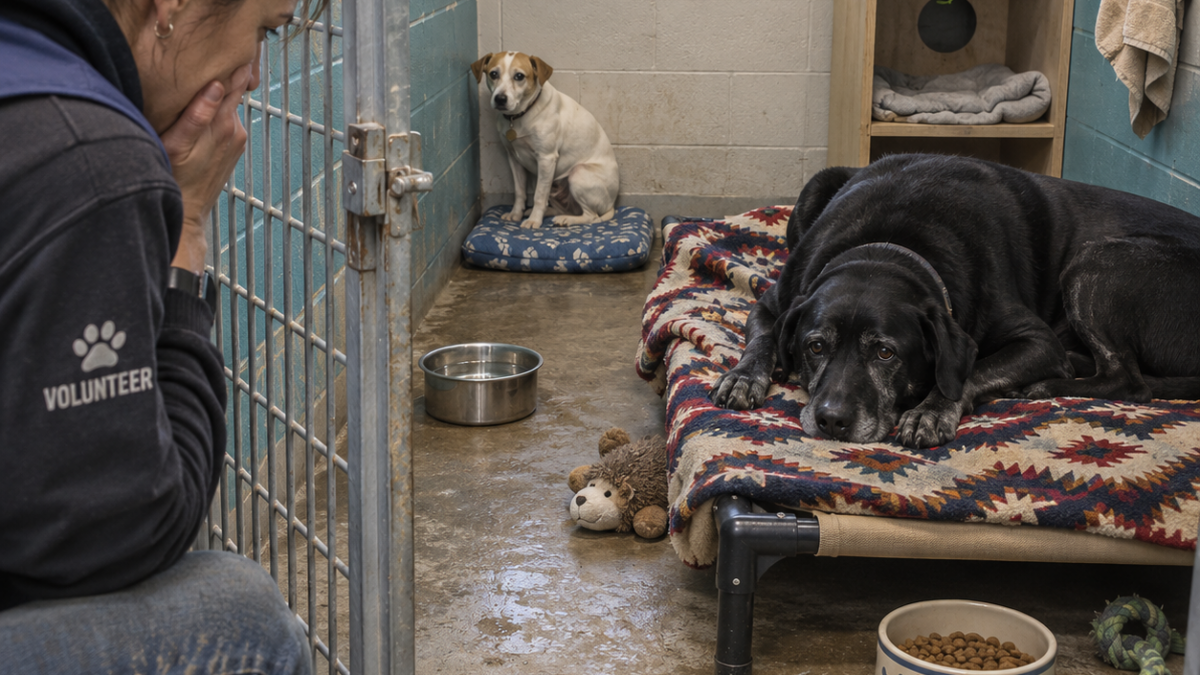
At 11:47 p.m., the camera recorded Basile waking.
The old dog lifted his head.
Then slowly pushed himself upright.
For several seconds, he stood still, finding his balance.
Across the kennel, Nino watched.
Basile stepped off the bed.
One slow step.
Then another.
Toward Nino.
The young dog’s body tightened.
But instead of pressing harder against the wall, he lifted his eyes.
The next morning, Léa called me before sunrise.
“Marianne.”
Something in her voice made me sit upright.
“What happened?”
“You need to come in.”
“Did they fight?”
“No.”
“Is Basile okay?”
“Yes.”
“Nino?”
“Yes.”
“Then tell me.”
“You need to see it.”
I arrived before seven.
Léa was already sitting in front of the computer.
She replayed the security footage.
11:47.
Basile stood.
Walked toward Nino.
I leaned forward.
“What does he do?”
“Watch.”
About three feet from Nino, Basile stopped.
Then he turned sideways.
Slowly lowered himself to the floor.
And lay down.
Not touching Nino.
Not facing him directly.
Not blocking his escape.
Just there.
For eleven minutes, neither dog moved.
Then Nino stretched his nose forward.
Basile did nothing.
Nino moved one paw.
Stopped.
Waited.
Moved again.
At 12:21, Nino’s nose touched Basile’s hind leg.
The old dog lifted his head.
Nino froze.
Basile looked at him.
Then lowered his head back to the floor.
I whispered, “Oh.”
Léa nodded.
“Keep watching.”
At 12:37, Nino lay down.
Not in his corner.
Beside Basile.
Six inches between them.
At 1:18, Basile shifted in his sleep.
His body touched Nino’s paw.
Nino woke immediately.
For one terrible second, he looked ready to flee.
But Basile remained asleep.
Nothing happened.
Slowly, Nino relaxed.
At 2:17, the young dog’s head finally lowered.
His eyes closed.
He slept.
Really slept.
I had never seen his body that loose.
By 4:52, Basile woke again.
He got up.
Drank water.
Walked to his food bowl.
Ate several pieces of kibble.
Nino watched.
Then Basile simply turned away from the food and returned to his bed.
Nino stared at the bowl.
Three minutes.
Then stood.
Walked toward it.
Sniffed.
And ate.
Eight or nine bites.
Maybe ten.
It was not much.
For us, it was everything.
Léa wiped her face.
“He showed him.”
I nodded.
We had tried to convince Nino that food was safe.
Basile did not convince him.
He demonstrated it.
Eat.
Nothing happens.
Sleep.
Nothing happens.
Approach another dog.
Nothing happens.
For an animal whose entire understanding of other dogs had been built around violence, nothing happening might have been the safest thing he had ever experienced.
That morning, we gave them breakfast at the same time.
Basile began eating.
Nino watched.
Then took one step toward his own bowl.
He ate nearly a quarter of it.
We did not celebrate in front of him.
We simply stood outside the kennel trying not to cry.
From then on, Basile became part of Nino’s recovery.
Not as a therapy dog.
Not officially.
Basile did not know he had a job.
That was probably why he was so good at it.
He asked for nothing.
If Nino approached, Basile allowed it.
If Nino stayed away, Basile slept.
If people entered, Basile greeted them calmly.
Nino watched everything.
Léa began sitting near Basile during the afternoons.
She would stroke his neck.
“Who’s a handsome old man?”
Basile leaned his weight against her.
Nino stood several feet away.
Watching.
Days passed.
The distance became smaller.
One afternoon, Nino approached while Léa was scratching Basile under the chin.
He sniffed her sleeve.
She stopped moving.
Basile immediately pushed his nose into her hand.
Léa whispered, “You’re not helping.”
I almost laughed.
Nino startled but stayed.
He sniffed her fingers.
Then backed away.
The next day, he did it again.
On the third day, Léa turned her palm upward.
Nino sniffed.
His nose touched her skin.
His whole body trembled.
But he remained there.
Léa did not reach.
She waited.
Then Nino leaned forward slightly.
Her knuckles brushed beneath his chin.
One second.
Two.
Three.
Nino stepped back.
No panic.
No collapse.
No retreat to the wall.
His first voluntary touch.
I looked at Basile.
The old dog was half asleep.
As if none of this was remarkable.
Progress came slowly after that.
There were setbacks.
A bowl fell in the next room one afternoon.
The metal crash echoed through the shelter.
Nino dropped flat.
The shaking returned instantly.
Basile was outside with another volunteer.
Nino would not respond to us.
Not food.
Not voices.
Nothing.
“Bring Basile,” I said.
Léa ran.
The moment Basile entered the kennel, Nino looked up.
The old dog walked toward his bed.
Nino followed.
Within minutes, the trembling decreased.
That was when our success began to worry me.
Nino was healing.
But he was healing through Basile.
And Basile was eleven.
One night, Léa said what both of us had been avoiding.
“What happens when Basile dies?”
I looked through the glass.
Nino was asleep against the old dog’s side.
“I don’t know.”
That answer frightened me.
Basile’s body was already showing its age.
Stiff hips.
Slower mornings.
Shorter walks.
Sometimes a tremor in one rear leg.
He had waited four years for a home.
Now, after all that waiting, he had become the center of another dog’s recovery.
I started thinking about adoption differently.
Before, Basile’s age made people hesitate.
Now it made me angry when they walked past.
A family visited one Saturday.
The woman loved him immediately.
She spent five minutes rubbing his face through the bars.
Then her husband asked, “How old?”
“Eleven.”
Her hand stopped.
They had recently lost an elderly dog.
I could see fear in her eyes.
“I can’t do that again yet.”
I understood.
But understanding did not make it easier.
They left with a younger Labrador.
Basile returned to his bed.
Nino lay beside him.
I sat outside the kennel.
“You know you’re worth more than five minutes, right?”
Basile’s tail moved once.
I rewrote his adoption profile.
I stopped pretending his age was something to hide.
Basile is eleven years old. He is slow, enormous, and may not have many years ahead. He has also done something none of us could do: he helped a terrified young dog begin eating, sleeping, and trusting again.
The post spread.
People called.
Most were not suitable.
Some wanted him because the story made them emotional, not because they understood what caring for a giant senior dog required.
We rejected several applications.
Basile had already waited too long for us to make the wrong choice now.
Meanwhile, Nino changed.
He gained weight.
His wounds closed.
His coat improved.
The empty look in his eyes began disappearing.
Then one afternoon I heard laughter outside.
I walked into the yard.
Nino was running.
Not escaping.
Running for pleasure.
He sprinted in a circle around Basile.
Stopped.
Dropped into a play bow.
Basile stared at him with exhausted annoyance.
Nino bounced.
Another bow.
Finally, Basile gave one deep bark.
Nino leaped sideways and took off again.
Léa was laughing so hard she had tears on her cheeks.
For a few seconds, Nino looked exactly like what he should have been all along.
A young dog.
Nothing more.
Not bait.
Not evidence.
Not a victim.
A dog.
I whispered, “There you are.”
That felt like revenge to me.
The people who hurt him had tried to teach him that other dogs meant pain.
Basile taught him play.
They had tried to reduce him to fear.
He was running.
They had tried to make violence his entire world.
He had found gentleness instead.
Then Basile collapsed.
It happened six weeks after their first night together.
He stood in the yard.
Took two steps.
His back legs gave way.
“Basile!”
Léa dropped what she was carrying.
I ran toward him.
Nino was already there.
Basile was conscious.
Breathing hard.
He tried to stand.
“Don’t.”
I placed a hand against his shoulder.
“Stay down.”
Nino circled us.
Whining.
The sound surprised me.
He rarely vocalized.
“We need the stretcher.”
Léa called the veterinarian.
When the team lifted Basile, Nino panicked.
He tried to follow.
“No, sweetheart.”
We moved toward the door.
Nino screamed.
That sound stopped me.
It was not barking.
It was grief before grief had even happened.
He threw himself toward the kennel door.
I looked at Basile.
Then Nino.
“Bring him.”
Léa stared.
“To the clinic?”
“Bring him.”
Nino rode beside Basile’s stretcher.
His nose stayed close to the old dog.
At the veterinary clinic, we waited almost two hours.
Nino paced.
Every footstep in the hallway made him jump.
I sat on the floor.
“He’s coming back.”
The words escaped before I thought.
Nino looked at me.
“He’s coming back.”
I had no idea if I could keep that promise.
When the veterinarian finally appeared, I stood too quickly.
“No catastrophic event.”
I exhaled.
“What happened?”
“Arthritis, weakness, probably exhaustion. We’ll adjust pain management. His heart looks stable.”
“He’s okay?”
“For now, yes.”
When they brought Basile back out, Nino rushed forward.
He pressed his face against the Great Dane’s neck.
Basile licked him once.
Then tried to stand.
His legs shook.
Nino moved beside him.
Their shoulders touched.
Basile stepped.
Nino matched him.
For weeks, Basile had slowed down for Nino.
Now Nino slowed himself for Basile.
After that day, something changed between them.
Nino still needed Basile.
But he also began caring for him.
When Basile slept longer, Nino stayed nearby.
When he ate his medication hidden in food, Nino watched until he finished.
When Basile struggled to stand, Nino waited beside him.
Then an email arrived.
It came from Claire and Julien.
They lived forty minutes away in an old farmhouse.
Their children were grown.
Claire worked mostly from home.
Julien was retired.
They had lost an elderly mastiff the year before.
The final paragraph made me stop breathing for a second.
We understand Basile is eleven. We understand Nino may still depend on him. If separating them would hurt either dog, we would like to meet both.
Léa read the message twice.
“Both?”
“That’s what they said.”
We met them carefully.
I expected sentimentality.
Instead, they asked practical questions.
Basile’s arthritis.
Transport.
Medication.
Nino’s triggers.
Food.
Other dogs.
Visitors.
Noise.
What if Basile died sooner than expected?
That question convinced me they understood.
Claire said, “If Nino grieves, then we help him grieve.”
No promises that love would cure everything.
No fantasies.
Patience.
They visited again.
And again.
During the first meeting, Nino stayed twenty feet away.
The second, twelve.
The third, five.
On the fourth visit, he sniffed Claire’s shoe.
She did not reach toward him.
Good.
Later, Julien sat beside Basile.
Nino walked over.
Lay beside the old dog.
Claire extended one hand.
Nino sniffed.
Her fingers brushed his cheek.
He flinched.
But stayed.
Claire’s eyes filled with tears.
She pulled her hand back.
That mattered.
She understood that love sometimes meant stopping before you wanted to.
We inspected their farmhouse.
One level where the dogs could live.
Fenced yard.
Rugs for Basile’s joints.
Room for Nino to retreat.
Two beds.
Then Claire exchanged them for one giant orthopedic mattress and a second bed.
“They can choose,” she said.
Those words mattered more than she knew.
They can choose.
Nino had spent too much of his life without choices.
Now every good thing in his life began with one.
The day they left the shelter, Basile climbed into the vehicle first using a ramp.
Nino stopped at the bottom.
Cars still frightened him.
Nobody pulled.
Nobody pushed.
Basile turned inside the vehicle.
Nino looked at him.
Then put one paw on the ramp.
Another.
He climbed in.
Four years after entering Les Saules, Basile was finally leaving.
Not alone.
He was leaving beside the dog who needed him most.
I cried before the car even moved.
Léa was worse.
Claire promised updates.
She kept that promise.
The first photograph arrived that evening.
Basile asleep on an enormous bed.
Nino under a table across the room.
The second morning, Nino was closer.
The fourth morning, Claire sent a photograph without any message.
Basile was sleeping beside the fireplace.
Nino was curled against his chest.
Same position as the security footage.
But this time there was no concrete wall.
No kennel gate.
No fluorescent light.
There was a living room.
A window.
A home.
Months later, Léa and I visited.
When Nino saw us in the yard, he ran.
Straight toward us.
No stopping.
No trembling.
He crashed into Léa hard enough to knock her into the grass.
She laughed and cried at the same time.
“You little monster!”
Nino licked her face.
Then came to me.
I knelt.
He pressed his forehead against mine.
I put both hands around his neck.
He did not flinch.
Behind him, Basile slowly stood.
He looked older.
Thinner around the hips.
More silver around the face.
But peaceful.
I sat beside him.
Nino immediately lay against his other side.
Julien looked at them.
“You know what I think?”
“What?”
“Basile was waiting for Nino.”
I smiled.
“That’s very sentimental.”
“I’m retired. I’m allowed.”
Claire laughed.
Julien rubbed Basile’s neck.
“If someone had adopted him two years earlier, Nino might never have had him.”
I knew life did not arrange itself that perfectly.
But looking at them, I allowed myself to believe in the coincidence.
The dog everyone overlooked had become exactly the dog Nino needed.
And because of Nino, someone finally looked at Basile long enough to understand what he still had to give.
People sometimes ask me whether Nino fully recovered.
I don’t know what “fully” means.
He still disliked loud metal noises.
Unfamiliar dogs rushing toward him could make his body stiffen.
Some strangers needed time.
But the fear no longer controlled everything.
He ate.
He slept deeply.
He ran.
He played.
He approached people.
He loved.
That was enough.
And Basile?
He finally stopped watching families leave the shelter.
He had a fireplace.
A garden.
Medication when his joints hurt.
People who understood that loving an old dog meant accepting there might be fewer tomorrows.
Nino stayed beside him through all of it.
Once, Basile had walked across a dark kennel at 11:47 p.m. and lain beside a trembling young dog.
Months later, when Basile struggled with a painful arthritis night, Claire found Nino dragging his own blanket across the room toward him.
Nino lay down.
Pressed his body against Basile.
And stayed.
The circle was complete.
Basile had not made Nino dependent forever.
He had made him strong enough to become gentle.
That may have been the greatest thing he gave him.
When I think about Nino now, I do not begin with the place he was rescued from.
I do not begin with fighting.
I do not begin with scars.
Those things were done to him.
They are not who he became.
I begin at 11:47 p.m.
An old Great Dane slowly pushing himself onto stiff legs.
A terrified young boxer pressed against a wall.
Basile crossing the kennel.
Nino watching him.
Then Basile lying down and asking for nothing.
No miracle anyone could recognize immediately.
Just one animal saying something without words.
I am not coming to hurt you.
And Nino, after everything humans and dogs had taught him about fear, making one tiny decision.
Not to run.
That decision became another.
Come closer.
Another.
Sleep.
Another.
Eat.
Another.
Trust.
Another.
Play.
Another.
Go home.
The people who once hurt Nino had tried to teach him that another dog meant violence.
They failed.
Basile proved them wrong simply by existing beside him.
The families who passed Basile for four years believed his age meant he had little left to offer.
They were wrong too.
He had the most important thing Nino needed.
Patience.
Maybe that was the real revenge.
Everything cruel people had taught Nino was slowly contradicted.
Food could be safe.
Sleep could be safe.
Hands could be gentle.
Dogs could be friends.
Doors could lead home.
And the dog nobody wanted turned out to be the one who knew exactly how to teach him.
Sometimes people imagine rescue as the moment a cage opens.
I no longer believe that.
Sometimes rescue begins much later.
In the middle of the night.
On a security camera.
With one old dog walking across a kennel and lying down beside another dog who has forgotten what safety feels like.
Nothing dramatic happens.
No one applauds.
No one even sees it until morning.
But the frightened animal looks up.
And for the first time, he does not run.
That was where Nino’s real rescue began.
Not when we removed him from violence.
When he finally understood he no longer had to expect it.
And Basile?
After four years of being overlooked, he finally went home beside the one dog who had never cared how old he was, how large he was, or how many years he had left.
Nino only knew one thing.
When everyone else in the world had frightened him, Basile stayed.
And sometimes, staying is the greatest rescue of all.








