PART 2: He Dragged Himself Back to the Family Who Abandoned Him—Then Rescuers Learned His Mother Was Still There
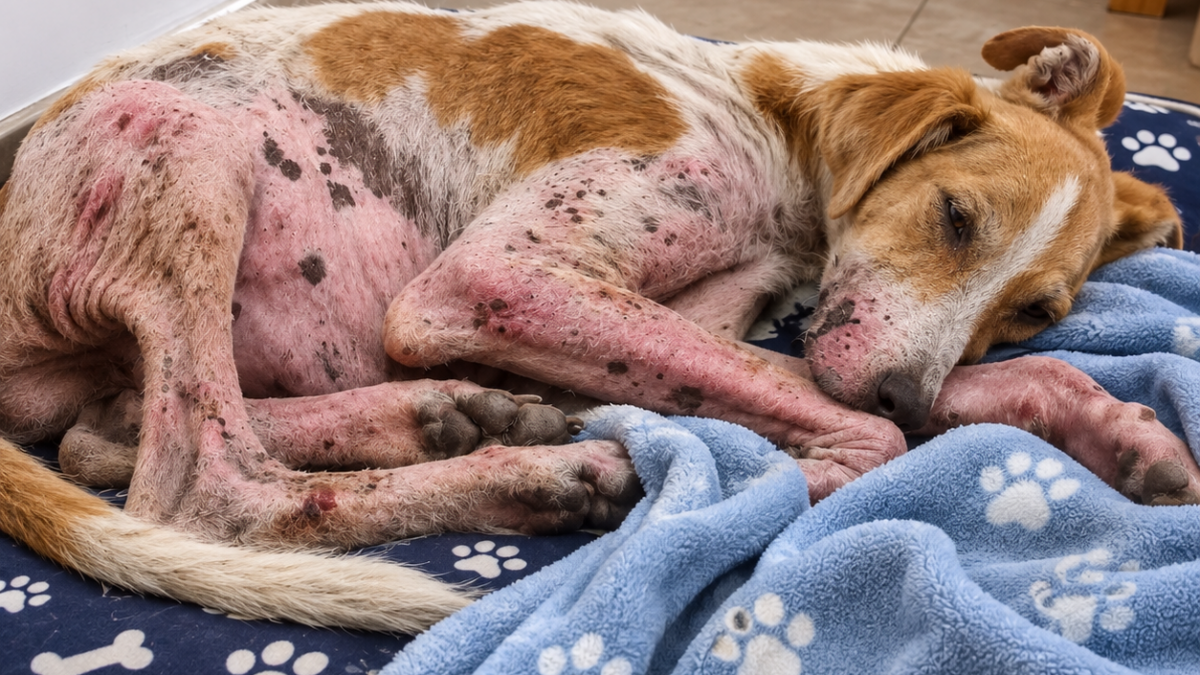
The first time I saw Angelito, he was lying on the sidewalk outside the very house where people had once called him theirs, his eighteen-month-old body reduced to twelve kilograms of bone, parasites, anemia, and pain, with one front leg so badly infected and swollen that every attempt to move sent a visible tremor through him.
He had not wandered there looking for food, and he had not simply collapsed in a random neighborhood; somehow, after everything that had happened to him, this young dog had dragged himself back to the only address he still remembered as home, then waited outside a closed gate while the people behind it chose not to come for him.
What we discovered after I lifted him from that pavement made me realize the terrible condition of his body was only the part of the story we could see, and before this was over, one frightened young dog would force an entire family to answer questions they had spent months hoping nobody would ever ask.
My name is Elena, and by then I had spent enough years in animal rescue to recognize the difference between a stray dog and a dog who was waiting for somebody specific.
Angelito was waiting.
That was what hurt most.
He wasn’t wandering from trash can to trash can. He wasn’t sniffing along the street or moving between houses looking for scraps. He had chosen one gate and collapsed beside it, and every time a sound came from inside the property, his head lifted slightly before dropping back onto the concrete.
The neighbor who called us was named Rosa. She stood a few feet away, arms wrapped around herself, watching Angelito with the exhausted expression of someone who had already spent too many hours wondering whether she should interfere.
“He came back last night,” she told me.
I turned. “Back?”
She nodded toward the house. “He used to live there.”
That sentence changed everything.
“How sure are you?”
“I used to see him in the yard all the time. When he was younger.”
“How long has he been gone?”
“Weeks. Maybe longer. Nobody really knows.”
I crouched several feet from Angelito and spoke softly before touching him.
“Hey, little man.”
His eyes moved toward my voice. His tail did not.
Up close, the damage was worse than it had looked from the road. Every rib stood out sharply beneath his coat. Fleas moved through the thin fur around his shoulders and neck. His gums were almost white. His hip bones looked too large for the rest of him, and his front leg was swollen from the shoulder toward the paw, the skin hot and tight around a wound that had clearly been infected for far longer than a day or two.
When I moved my hand toward him, Angelito flinched.
Then he stopped resisting.
That frightened me more than a growl would have.
A dog in pain usually protects himself.
Angelito looked like he had already learned that protecting himself no longer changed anything.
“Can he stand?” my partner Nina asked.
Rosa shook her head. “He tried this morning.”
“What happened?”
“He fell.”
Behind us, a curtain moved inside the house.
Someone was watching.
I stood slowly.
“Does that family know he’s here?”
Rosa gave a bitter laugh. “They know.”
“They’ve seen him like this?”
“Yes.”
“And nobody came out?”
“They said he isn’t theirs anymore.”
I looked back at Angelito.
His head had lifted again.
Toward the gate.
Still waiting.
Something inside me hardened.
I knelt, slipped one arm beneath his chest and another beneath his hips. When I lifted him, he let out a tiny cry that sounded almost apologetic.
“I’m sorry,” I whispered. “I’ve got you.”
He weighed almost nothing.
His head fell against my shoulder as if even holding it up required too much energy.
I started toward the van.
That was when the front door opened.
A man stepped outside.
“Where are you taking that dog?”
I stopped.
Rosa went silent.
The man pointed at Angelito as though we were carrying away an object someone had left near the curb.
“He belongs around here.”
I stared at him. “Does he belong to you?”
He hesitated.
Just long enough.
“Used to.”
I tightened my hold on Angelito.
“Then you just answered your own question.”
I turned away.
Angelito looked over my arm toward the house one last time.
The door closed before we reached the van.
And at that moment, I believed the worst thing we were going to discover was what had happened to him.
I was wrong.
PART 2
The moment we placed Angelito on the padded floor of the rescue van, he turned his head toward the house again. Even through the glass, even with his body shaking from pain and exhaustion, he seemed to know exactly where he was. That destroyed the small part of me that had still hoped the people inside might come running after us at the last second, call his name, ask whether he would survive, or at least show enough shame to look him in the face.
Nobody came.
Nina shut the rear door.
Angelito continued staring through the window until the house disappeared behind us.
I sat on the floor beside him and placed a folded towel under his injured leg.
“You don’t have to wait there anymore.”
His eyes moved toward me.
There was no trust in them yet.
Only exhaustion.
Then somebody pounded lightly against the driver’s window.
Rosa.
Nina stopped before pulling away.
I lowered the passenger-side glass.
Rosa looked frightened.
“There was another dog.”
My stomach dropped.
“What?”
“His mother.”
I stared at her.
“Where?”
“She used to live there too. In the back.”
“Used to?”
“I don’t know if she’s still there.”
“What does she look like?”
“Brown. Bigger than him. Older.”
“Name?”
Rosa shook her head. “I never knew it.”
“Why didn’t you tell me before?”
“I wasn’t sure she was still there. I haven’t seen her properly in days.”
I looked at the house.
The curtains were closed now.
“Call me the second you see her.”
Rosa nodded.
I gave her my number.
Then we drove.
From that point on, the rescue had two clocks running.
One belonged to Angelito.
The other belonged to a dog we hadn’t found yet.
Twelve Kilograms
The clinic was ready when we arrived.
Dr. Samuel Reed had worked with our rescue for years, and I’d watched him treat animals so badly injured that almost nothing shocked him anymore.
Angelito did.
The moment we lowered him onto the scale, Dr. Reed looked at the number, then checked whether the scale was working correctly.
“Twelve kilograms.”
Nina swallowed. “What should he weigh?”
Dr. Reed ran his hands carefully along Angelito’s frame.
“Depending on build, nineteen. Maybe twenty when properly muscled.”
“So he’s missing almost a third of his body weight.”
“More than that in lean tissue.”
I looked at Angelito.
Eighteen months old.
He should have been in the most ridiculous period of dog life—fast, hungry, clumsy, curious, impossible to tire out.
Instead, he was twelve kilograms and barely able to remain upright.
The examination began.
Temperature.
Heart.
Lungs.
Abdomen.
Eyes.
Mouth.
Skin.
Gums.
Then the leg.
Angelito reacted before Dr. Reed even touched the worst area.
He jerked away.
A quiet cry escaped him.
Dr. Reed stopped instantly.
“Okay. I know.”
He looked at me.
“This is significant.”
“How significant?”
“Deep infection. At minimum soft tissue. We need imaging.”
“Bone?”
“Possible.”
I felt the word before I understood it.
“Amputation?”
“Too early to say.”
“Can he lose the leg?”
“Yes.”
“Can the infection kill him?”
Dr. Reed didn’t answer quickly enough.
“Yes.”
The room became very quiet.
Blood
The bloodwork gave us more reasons to worry.
Severe anemia.
Parasite burden.
Inflammatory markers.
Dehydration.
Protein deficiency.
Evidence of prolonged malnutrition.
Nothing in the results suggested Angelito had simply been missing for a few days and happened to get hurt.
His body told a longer story.
Hunger.
Parasites.
Neglect.
Pain.
Time.
Dr. Reed looked at me over the chart.
“How long was he outside that house?”
“We don’t know.”
“How long was he gone before that?”
“They claim weeks.”
“His condition didn’t happen in one week.”
“I know.”
“Some of this is chronic.”
“I know.”
He studied me.
“You’re angry.”
“No.”
“Elena.”
“Fine. Yes.”
“Stay useful.”
I hated that phrase because he was right.
Anger can make you loud.
Rescue requires precision.
The Meal We Could Not Give Him
Everyone who sees a starving dog wants to do the same thing.
Fill the bowl.
Chicken.
Meat.
Rice.
Everything.
As much as the dog will eat.
It feels compassionate.
Sometimes it is dangerous.
Dr. Reed measured Angelito’s first meal into a portion so small it made me furious.
“That?”
“Yes.”
“He’ll finish that in twenty seconds.”
“Probably ten.”
“Then?”
“We wait.”
“He is starving.”
“I know.”
“He’s twelve kilograms.”
“I know.”
“Give him more.”
Dr. Reed looked at me.
“You know why I can’t.”
I did.
A severely malnourished body can react dangerously when food returns too aggressively. Electrolytes shift. Organs already under stress can fail. The stomach and intestines need time. The heart needs protection.
Knowing didn’t make it easier.
Angelito smelled the food before we set it down.
His whole expression changed.
He tried to rise.
The injured leg collapsed.
I caught him.
“Easy.”
The bowl touched the floor.
Angelito ate as if somebody might take it from him before the next breath.
No chewing.
No looking around.
Just swallowing.
Then licking.
Dr. Reed removed the bowl.
Angelito’s head snapped up.
His eyes searched.
His nose hit my hand.
Then Dr. Reed’s wrist.
Then the floor.
More.
His entire body asked for more.
I sat beside him.
“There will be another meal.”
He didn’t understand.
Maybe he’d heard promises before.
Maybe he hadn’t eaten enough consistent meals to believe anyone.
So we waited.
Thirty seconds.
Another small portion.
Gone.
Again.
The first meal took twenty minutes.
Angelito spent the last five licking an empty stainless-steel bowl.
The Leg
Imaging showed the infection was severe but had not completely destroyed the bone.
That was our first piece of good news.
Small.
Conditional.
Still good.
There was deep inflammation around the paw and lower limb, an abscess near the damaged tissue, and concern that infection might spread farther if treatment failed.
Dr. Reed recommended sedation, aggressive wound cleaning, drainage, antibiotics, and pain control.
“If this responds, he may keep the leg.”
“And if it doesn’t?”
“We reassess.”
“I hate that phrase.”
“So do most people.”
He touched Angelito’s shoulder.
“We don’t decide the ending on Day One.”
That became one of the rules of the rescue.
Don’t decide the ending on Day One.
His First Safe Sleep
The pain medication began working that afternoon.
Angelito’s breathing slowed.
His body stopped trembling so violently.
For the first time since we found him, he stretched out instead of curling around the bad leg.
Nina sat nearby.
“He’s sleeping.”
I nodded.
“Really sleeping.”
Most people underestimate how much pain destroys sleep.
A body cannot heal properly when it is constantly braced for the next wave.
Angelito slept for nearly three hours.
When he woke, the first thing he did was search for food.
The second was look toward the door.
I wondered whether some part of him expected the old family to appear.
They didn’t.
Rosa Calls
At 10:14 that night, my phone rang.
Rosa.
I answered immediately.
“I saw her.”
I stood.
“Where?”
“Backyard.”
“The mother?”
“Yes.”
“Alive?”
“Yes.”
“Condition?”
“Thin.”
“How thin?”
“Not like Angelito. But bad.”
“Can you send me a picture?”
A photo came through.
Dark.
Blurry.
Taken through part of the fence.
Still enough.
A brown female dog stood near a wall.
Ribs visible.
Coat patchy.
Head low.
A plastic bucket beside her.
No food visible.
“Is she tied?”
“I can’t tell.”
“Can she leave the yard?”
“No. Gate is closed.”
“Anyone feeding her?”
“I don’t know.”
I stared at the photo.
Angelito slept behind the clinic door.
His mother stood behind another.
I called Officer Daniel Ruiz.
He answered with:
“You only call after ten when someone has done something stupid.”
“Correct.”
Day Two
Angelito woke in a soft bed.
Fresh water.
Scheduled food.
Medication.
Clean wound.
For the first time, the clinic staff saw a little more of him.
He looked at people instead of through them.
His tail moved once when Nina brought breakfast.
One tiny movement.
I froze.
“Do that again.”
Nina stared at me.
“What?”
“Say something.”
“Good morning, Angelito.”
Tail.
Another movement.
She smiled.
“That’s breakfast.”
“I don’t care.”
Hope doesn’t always arrive with dramatic bloodwork.
Sometimes it’s a tail that remembers how to move.
The Mother Behind the House
The next morning, animal welfare officers visited the property.
I wanted to go.
Daniel told me not to interfere.
I went anyway and stood across the street.
Technically I wasn’t interfering.
The man from the day before opened the gate.
We learned his name was Victor Ramos.
His wife, Maribel, stood several feet behind him.
Daniel introduced himself.
“We’re here regarding the female dog in the backyard.”
Victor frowned.
“What dog?”
I nearly laughed from across the street.
Daniel didn’t.
“The brown female.”
“She isn’t ours.”
“Who owns her?”
“My cousin.”
“Name?”
Victor hesitated.
“Why?”
“Because we’re asking about her welfare.”
“She is fine.”
“May we see her?”
Victor crossed his arms.
“Do you have a warrant?”
That was when my anger stopped being emotional and became focused.
People with nothing to hide do sometimes know their rights.
I understand that.
But Victor had watched a dog nearly die outside his gate, claimed the dog was no longer his, and now refused access to another neglected animal.
We needed evidence, not anger.
Daniel stepped away.
The process began.
Day Three
Angelito underwent another wound cleaning.
He remained weak.
Most of the day, he slept.
That was exactly what we wanted.
Nutrition.
Medication.
Rest.
Repeat.
His anemia remained concerning but stable enough to monitor without immediate transfusion.
His appetite was enormous.
His trust was not.
If somebody approached without food, Angelito watched carefully.
If someone approached with a bowl, his entire body came alive.
That’s what prolonged hunger does.
It makes survival the center of every interaction.
We had to teach him that people could arrive carrying something other than food and still mean something good.
The Family’s First Story
Victor told investigators Angelito had run away three weeks earlier.
Healthy.
Normal weight.
No serious injury.
Maribel gave a different story.
She said they had given Angelito to another family.
“What family?”
She couldn’t remember the surname.
Address?
No.
Phone number?
Lost.
When?
Maybe six weeks earlier.
Victor said three weeks.
Maribel said six.
Both said Angelito had been healthy.
The veterinary report said the neglect and infection were not new.
Rosa had photographs too.
One showed Angelito outside the Ramos property more than a month before rescue.
Already thin.
Another showed him limping.
Truth was beginning to collect witnesses.
The Mother Gets a Name
During a second interview, Maribel finally admitted the female dog was Angelito’s mother.
Her name was Luna.
She had lived on the property for years.
She had produced puppies.
More than one litter.
Angelito had been part of one.
“She belongs to your cousin?” Daniel asked.
Maribel looked toward Victor.
Then down.
“No.”
“Who does she belong to?”
Silence.
Daniel asked again.
“Who?”
Victor answered:
“Us.”
The cousin disappeared from the story.
The Legal Entry
With Angelito’s veterinary condition, witness statements, visible concerns regarding Luna, conflicting ownership claims, and evidence of possible neglect, authorities obtained the legal access necessary to inspect the property more thoroughly.
This time, Victor couldn’t close the gate.
I went with the rescue team because if Luna required removal, we would transport her.
The backyard looked worse from inside.
Broken fencing.
Old bowls.
Stained concrete.
A makeshift shelter with a damaged roof.
No clean bedding.
A bucket with greenish water.
Luna stood near the wall.
She was not as emaciated as Angelito.
But she was thin enough to see ribs.
Her coat was dirty.
Fleas moved around the base of her tail.
Her ears looked inflamed.
Her mammary tissue showed the unmistakable signs of repeated breeding.
Maribel called:
“Luna.”
The dog looked toward her.
Did not approach.
Victor said:
“She eats.”
The bowl was empty.
“When?” Daniel asked.
“This morning.”
“What did you feed?”
“Kibble.”
“How much?”
Victor became angry.
“What is this? An interrogation?”
Daniel looked at the dog.
“Yes.”
The Water
I knelt near Luna.
Spoke softly.
She backed away.
Not aggressive.
Uncertain.
I held out my hand.
She smelled it.
Then turned her head.
Her trust had not collapsed completely.
It had simply become cautious.
I looked at the water bucket.
Mosquito larvae moved near the surface.
“That’s her water?”
Victor said:
“It was clean yesterday.”
I looked at him.
Didn’t say anything.
Sometimes silence is better because anything else would be used against the case.
Luna Leaves
Luna was removed under protective authority and transported for evaluation.
Victor shouted as we carried her out.
“You can’t steal our dog!”
Daniel stopped.
“You said yesterday she belonged to your cousin.”
Victor had no answer.
Maribel began crying.
Luna did not look back.
Angelito had.
That difference stayed with me.
Luna’s Examination
Luna was anemic too.
Moderately underweight.
Severe flea infestation.
Intestinal parasites.
Chronic ear infection.
Dental disease.
Skin irritation.
Evidence of reproductive stress.
No immediate organ crisis.
She would recover.
Dr. Reed looked from Luna’s chart to Angelito’s.
“They were living in the same system.”
That was exactly it.
Angelito was the emergency version.
Luna was what happens when suffering becomes ordinary enough that people stop noticing.
Day Four
Angelito began recognizing caregivers.
Nina entered.
Tail wag.
Maya, the veterinary assistant, entered.
Tail wag.
Dr. Reed entered with a thermometer.
No wag.
We laughed.
Angelito looked confused.
It was the first time the clinic had laughed around him.
His ears lifted.
He watched us.
Then his mouth opened slightly.
Not quite a smile.
Close.
Day Five: The Paw Touches Down
The swelling had begun to decrease.
Not dramatically.
But visibly.
Dr. Reed measured the leg.
“Better.”
I leaned closer.
“How much better?”
“Enough to say better.”
“Your optimism is overwhelming.”
Angelito tried to stand.
He shifted weight onto three legs.
Then, for half a second, the injured paw touched the floor.
Everybody froze.
He lifted it again.
“Did you see?”
“Yes.”
“He used it.”
“For a fraction.”
“He used it.”
Dr. Reed smiled.
Tiny.
I caught him.
“You smiled.”
“Get out.”
Finding Luna
We waited until both dogs were stable before allowing any reunion.
I had no idea what to expect.
Humans love projecting emotion onto dogs.
Mother.
Son.
Recognition.
Reunion.
Dogs are more complicated than our stories.
So we kept expectations low.
Angelito entered the quiet room first.
Luna came through another door.
They stopped.
Both smelled the air.
Angelito’s tail began moving.
Slow.
Luna approached.
Smelled his face.
His shoulder.
Then the injured leg.
Angelito leaned forward.
Luna licked his ear once.
That was all.
Enough to destroy everyone in the room.
Nina cried.
Maya cried.
Daniel looked suspiciously at the ceiling.
I said:
“Are you crying?”
“No.”
“Your face says otherwise.”
“Allergies.”
“Inside a clinic?”
“Severe.”
The Breeding Photos
Rosa found old social-media listings.
Pictures.
Puppies.
Prices.
Luna with several litters.
Angelito as a younger puppy in one photograph.
His body round.
Coat healthy.
Eyes bright.
Caption:
Strong healthy pups available. Serious buyers only.
I stared at it.
At some point, Angelito had been valuable enough to advertise.
Then something changed.
Age?
Injury?
Cost?
Inconvenience?
He became the dog outside the gate.
Luna had been valuable when puppies came from her body.
Then her litters became less profitable.
The pattern wasn’t hard to see.
Day Seven
Angelito began asking for affection.
Not just tolerating it.
Nina sat on the floor.
He approached.
Slowly.
Then pushed his face beneath her arm.
She hugged him gently.
He sighed.
A long, deep release.
His entire body softened.
That’s the thing about rescue people remember forever.
Not the dramatic surgery.
Sometimes the first time an animal realizes touch can mean comfort.
Breakfast Becomes a Promise
Every morning, Angelito waited for food.
At first, frantically.
Before six, awake.
Watching.
Listening.
Any movement near the food area made him stand.
By Day Eight, he had learned the schedule.
He still became excited.
But less desperate.
Meals appeared.
Again.
Again.
Again.
The bowl came back tomorrow.
And the next day.
That’s how food insecurity begins to loosen.
Not because you explain it.
Because you prove abundance through repetition.
Luna’s Appetite
Luna responded differently.
She ate slowly.
Sometimes stopped.
At first, I worried.
Dr. Reed watched.
“Some neglected dogs become frantic. Some become resigned.”
That word hurt.
Resigned.
Angelito had fought hunger.
Luna had learned to expect it.
We sat with her.
Fed smaller meals.
Added more appealing food.
Her appetite grew.
One morning, she finished everything.
Then licked the bowl.
I cried over another empty dish.
Rescue makes your emotional standards strange.
Day Ten
Angelito explored.
That was new.
For the first days, his world had been bed, bowl, treatment.
Now he smelled corners.
Tried to enter storage.
Stole gauze.
Maya caught him with a roll hanging from his mouth.
“Angelito!”
Tail wag.
He ran.
Badly.
Three-legged half-hop.
But ran.
Everyone laughed.
A dog with enough energy to commit crime is improving.
The Infection Fades
Bloodwork showed inflammation dropping.
The wound looked healthier.
Drainage decreased.
Tissue began closing.
Antibiotics were working.
Dr. Reed allowed more controlled weight-bearing.
Angelito put the paw down more often.
One step.
Then another.
The limp remained severe.
But he was using the leg.
The word amputation moved farther away.
Victor Comes Back
He arrived at the clinic without permission.
Angry.
Security stopped him in reception.
I went out because apparently self-control is a limited resource.
“Where are my dogs?”
“Under protective custody.”
“You made them look worse than they were.”
I stared.
“How?”
“Photos. Angles. You rescue people know how to make things dramatic.”
“Angelito weighed twelve kilograms.”
“He was always lean.”
“He was severely anemic.”
“He ran away.”
“Your wife says you gave him away.”
Victor hesitated.
I continued.
“Which story are we using today?”
His face changed.
“You think you’re clever.”
“No.”
“You stole Luna.”
“You denied she was yours.”
“She is ours.”
“Then why didn’t you take her to a veterinarian?”
“We couldn’t afford everything.”
“Then why were you breeding her?”
He stepped closer.
Security moved.
Victor pointed toward me.
“You don’t know what you’re talking about.”
I looked directly at him.
“I know she made you money.”
Silence.
“And I know Angelito stopped being worth the cost when he got sick.”
Victor shouted:
“He wasn’t useful!”
The lobby went still.
Even he realized what he had said.
I didn’t smile.
Didn’t need to.
The rescue line and lobby had security recording.
Daniel appreciated that sentence later.
Useful
That word stayed with me.
Useful.
Useful for what?
Dogs are not equipment.
Angelito did not need to guard a property.
Produce puppies.
Earn money.
Entertain anyone.
His value did not depend on performance.
He was alive.
That should have been enough.
Hearing Victor
Angelito heard his voice from the treatment area.
His body lowered.
Tail stopped.
He backed toward the wall.
I sat several feet away.
“It’s okay.”
He didn’t come.
I waited.
Five minutes.
Ten.
Eventually, he moved toward me.
Rested his head against my leg.
Trust isn’t the absence of memory.
Sometimes trust is choosing one person while another memory still frightens you.
Two Weeks
Angelito’s body began changing quickly now.
The ribs were still visible but softer.
Hip bones less sharp.
Muscle returning.
Coat healthier.
Parasites gone.
Anemia improving.
Energy rising.
Pain falling.
He walked more.
Used all four paws for short stretches.
Then Luna started improving too.
Her coat became shinier.
Ear infection responding.
Weight increasing.
She began greeting Rosa when the neighbor visited.
That mattered.
Rosa had been the person who called.
Without her, both dogs could have disappeared behind the story people told themselves about “someone else’s pets.”
Rosa’s Guilt
One day, Rosa told me:
“I should’ve called sooner.”
“When did you first worry?”
“Months before.”
“Why didn’t you?”
She looked down.
“I thought it wasn’t my business.”
There it was.
The phrase neglect depends on.
Not my business.
“You called when Angelito came back.”
“Yes.”
“You saved him.”
“I waited too long.”
“Then learn from it.”
She looked at me.
“What?”
“Next time you see something wrong, call sooner.”
Months later, she did.
A different dog.
A different neighborhood.
Smaller problem.
Prevented from becoming Angelito.
That’s how guilt becomes useful.
Day Twenty
Twenty days after rescue, Angelito stepped onto the scale.
Nina covered the display with her hand.
“Why?”
“For drama.”
“Move.”
“Wait.”
“Nina.”
She moved.
More than nineteen kilograms.
Over seven kilograms gained.
I stared.
“No.”
“Yes.”
“Check.”
We weighed him again.
Same.
The clinic cheered.
Angelito barked because everyone else was making noise.
Luna barked from the next room.
Dr. Reed entered.
“What happened?”
“Seven kilos.”
He looked at the scale.
Then at Angelito.
“Excellent.”
I pointed.
“You’re happy.”
“Clinically pleased.”
“Same thing.”
Walking on Four
That afternoon, Angelito walked across the treatment room using all four legs.
The limp was visible.
But the paw touched.
Weight transferred.
Again.
Again.
He reached Nina.
She crouched.
He climbed halfway into her lap.
Twenty kilograms of dog pretending to be twelve again.
Dr. Reed watched.
“I don’t think we’re losing that leg.”
I covered my mouth.
Nina screamed.
Angelito barked.
Dr. Reed regretted saying anything.
Before and After
The rescue-day photograph was almost unbearable beside the Day Twenty image.
Day One:
Head low.
Bones.
Leg lifted.
Eyes empty.
Day Twenty:
Standing.
Tail up.
Paw down.
Weight restored.
Looking for food.
People said:
“I can’t believe that’s the same dog.”
I could.
The face was still there.
What changed was everything around it.
The Legal Case
The case moved slowly.
Too slowly for my anger.
Exactly as fast as evidence required.
Victor and Maribel faced allegations tied to neglect, abandonment, lack of veterinary care, and breeding-related violations supported by local law and records.
They claimed Angelito had not been in their custody when his condition became severe.
But their stories changed.
Runaway.
Given away.
Returned.
Not theirs.
Used to be theirs.
The dog himself could not testify.
His body did.
Dr. Reed in Court
“What was the dog’s condition when admitted?”
“Severely underweight, anemic, dehydrated, parasitized, with a serious untreated infection of the front limb.”
“Could the condition develop overnight?”
“No.”
“Could it develop in a few days?”
“Not the overall condition.”
“Would an ordinary person notice the leg?”
“Yes.”
“Would an ordinary person notice the body weight?”
“Yes.”
“Would an ordinary person recognize the dog needed veterinary care?”
“Yes.”
Simple words.
Powerful.
Luna’s Evidence
Luna’s condition mattered too.
Repeated breeding.
Poor body condition.
Parasites.
Untreated ear disease.
Lack of veterinary records.
When the prosecutor displayed the old litter advertisements, Victor became visibly angry.
His lawyer whispered to him.
The prosecutor asked:
“Did you sell puppies from this dog?”
“Yes.”
“How many litters?”
“I don’t know.”
“Three?”
“Maybe.”
“Four?”
“I don’t remember.”
“Did you receive money?”
“Yes.”
“So Luna had financial value to you.”
Victor shifted.
“She was a good dog.”
Then:
“Until her litters got smaller.”
Silence.
His lawyer closed his eyes.
The prosecutor asked:
“And what did you do when her litters got smaller?”
Victor realized too late.
Angelito Wasn’t Useful
Later, the recorded clinic argument was introduced where legally admissible.
Victor’s voice:
He wasn’t useful.
The room became quiet.
Those three words became the case in miniature.
Angelito had been young.
Alive.
Dependent.
But not useful.
Therefore neglected.
That isn’t how care works.
The Outcome
The court imposed the penalties and restrictions available under the proven violations.
Loss of custody.
Restrictions on future breeding and animal ownership for a defined period.
Fines.
Financial responsibility for portions of care where permitted.
Additional compliance conditions.
People wanted more.
They wanted a cinematic ending.
A judge shouting.
Handcuffs.
A business collapsing overnight.
Real law rarely gives you that.
But the part I cared about became permanent.
Victor would never own Angelito again.
Luna would never return to that backyard.
And the breeding operation stopped functioning the way it had before.
That was enough to begin.
Angelito Discovers Crime
With health came personality.
Unfortunately.
Angelito stole towels.
Dragged laundry into hallways.
Found a cardboard box and shredded it.
Stole one of Nina’s shoes.
Carried it around without chewing.
When caught, he wagged.
No remorse.
I looked at him.
“You almost died.”
Tail wag.
“You’re supposed to be grateful.”
More wagging.
Nina laughed.
“He is grateful. He’s expressing it through theft.”
Luna Learns Play
Luna took longer.
She liked beds.
Food.
Quiet.
People at a distance.
One day Angelito dropped a rope toy near her.
She ignored it.
He picked it up.
Pushed it against her paw.
She looked at him.
He pulled.
She grabbed the other end.
Ten seconds later, tug-of-war.
We stopped everything.
The mother who had spent years producing puppies was playing with one of them.
Not nursing.
Not breeding.
Playing.
The Rescue Home
Angelito became the center of the temporary rescue house.
Everyone knew him.
Volunteers looked for him first.
Visitors heard him before entering.
His leg improved enough that we no longer protected him constantly.
He ran short distances.
Turned too fast.
Slid.
Got up.
He discovered squeaky toys.
Loved them.
Destroyed three.
We bought more.
Food Anxiety
The hardest thing to heal wasn’t visible.
Food.
Angelito still ate as if every bowl might be the last.
We slowed him with feeding mats.
Smaller portions.
Consistent schedule.
He checked the kitchen constantly.
One day, a volunteer moved his bowl after he finished.
Angelito panicked.
Searched.
Whined.
We put it back.
Empty.
He lay beside it.
That broke me.
Hunger can continue after starvation ends.
The body recovers faster than the expectation of loss.
Luna’s Different Scar
Luna didn’t panic around food.
She seemed almost indifferent sometimes.
That was its own damage.
Angelito expected food to disappear.
Luna had learned not to expect much in the first place.
Both needed consistency.
Different wounds.
Same cure.
Repeat kindness.
Adoption Discussions
Once Angelito’s medical condition stabilized, we began discussing adoption.
I resisted.
Not rationally.
Emotionally.
Susan, our coordinator, called me.
“He’s ready.”
“No.”
“Elena.”
“Leg.”
“Cleared.”
“Anemia.”
“Improved.”
“Food anxiety.”
“Manageable.”
“He needs follow-up.”
“So do millions of dogs.”
I hated her.
She continued:
“You are attached.”
“No.”
“You call him your little idiot.”
“Professional term.”
“List him.”
Applications
Angelito’s story had spread locally.
Applications arrived quickly.
Some people wanted “the famous rescue dog.”
Rejected.
Some had no plan for veterinary care.
Rejected.
Some asked whether he would always limp.
Fair.
Some asked whether he was house-trained.
Also fair.
One applicant said:
“We want him because our children need to learn gratitude.”
Rejected immediately.
Angelito was not a moral-education prop.
Then the Parker family applied.
Rachel.
Matt.
Two teenage sons.
One older dog named Max.
Fenced yard.
Excellent veterinary references.
Stable finances.
Experience with medical animals.
Their application said:
We don’t need Angelito to be inspirational. We need a dog young enough to annoy Max and a family patient enough to teach him that dinner always comes back tomorrow.
I reread that sentence three times.
Meeting the Parkers
Rachel sat on the floor.
Angelito approached.
Smelled her.
Then Matt.
Then the boys.
One boy had gloves tucked into a jacket pocket.
Angelito stole one.
Perfect.
Max, the older dog, entered.
Angelito went wild.
Play bow.
Tail.
Bouncing.
Max looked at him with the exhausted expression of a retired teacher seeing a new class arrive.
Angelito bounced again.
Max growled once.
Angelito stopped.
Good.
They understood each other.
The Medical Conversation
Dr. Reed met the family.
“The leg may develop arthritis earlier than normal.”
Matt nodded.
“Medication later?”
“Possibly.”
“Future imaging?”
“Maybe.”
“Cost?”
We gave estimates.
No one flinched.
Rachel asked:
“Will exercise help?”
“Controlled exercise.”
“What should we avoid?”
“High-impact activity while he finishes rebuilding strength.”
They took notes.
That’s what I wanted.
Not promises.
Preparation.
Luna’s Future
Luna received fewer applications.
Adult female.
Breeding history.
Slower to trust.
Less “dramatic” after-photo.
That’s rescue reality.
Young charismatic dogs get attention.
Quiet older females wait.
Then Rosa asked:
“Can I apply?”
I stared.
“For Luna?”
“Yes.”
“Why didn’t you say something earlier?”
“I didn’t want you to think I was doing it because I felt guilty.”
“Are you?”
“Partly.”
Honest.
“What else?”
She looked toward Luna.
“I watched her through that fence for years.”
Pause.
“Maybe she deserves to come through mine.”
That sentence decided it.
Rosa’s House
Small.
Clean.
Quiet.
Fenced yard.
No other pets.
Rosa worked close enough to come home midday.
She bought a bed before approval.
Typical.
Luna entered during the home visit.
Smelled everything.
Walked to the living room.
Lay on the rug.
Rosa sat beside her.
No drama.
No grand gesture.
Sometimes home feels correct because nothing dramatic happens.
Angelito’s Adoption Day
The Parker family arrived with a blue harness.
Angelito recognized them.
Tail wag.
No hesitation.
I packed:
Medical records.
Medication.
Food.
Slow feeder.
Toys.
Blanket.
One stolen glove we had washed.
Rachel laughed.
“You kept it?”
“Evidence.”
Angelito stole it again before we left.
Goodbye
I knelt.
Angelito pressed against me.
“You know what?”
He licked my face.
“You came back to the wrong house once.”
Tail wag.
“Don’t do that again.”
He had no idea.
Good.
I gave Rachel the leash.
Angelito walked toward the exit.
Then stopped.
Turned.
Came back.
Leaned into my legs.
My eyes filled.
“Go.”
He did.
He Jumps Into the Car
No ramp.
No lifting.
Angelito jumped into the back seat.
The dog who had once collapsed trying to stand.
Matt laughed.
“Show-off.”
Angelito barked.
Then climbed across both boys.
Home began before the car moved.
Luna Goes Home
Two weeks later, Rosa adopted Luna.
She walked out wearing a simple red harness.
No puppies.
No reproductive purpose.
No yard isolation.
Just Luna.
Rosa sent a photo that night.
Luna on the couch.
Caption:
Apparently the bed was unnecessary.
Perfect.
The Empty Sidewalk
Victor later moved.
The property was sold.
Months afterward, I drove past by accident.
The gate was different.
Fresh paint.
No dogs.
I saw the place where Angelito had collapsed.
Just sidewalk.
People walking.
A bicycle leaning nearby.
Ordinary.
The place had no power anymore.
Good.
Angelito’s First Month
His body filled out with muscle.
Weight stabilized.
The leg became stronger.
Still a slight limp after hard play.
Nothing like before.
Dr. Reed said:
“Do not overfeed him.”
Rachel looked offended.
“After what happened?”
“Especially after what happened.”
Angelito begged beside us.
Dr. Reed pointed.
“He has learned manipulation.”
Correct.
The First Time He Leaves Food
Months after adoption, Rachel texted me.
You need to see this.
Photo.
Three pieces of kibble left in the bowl.
I didn’t understand at first.
Then I did.
Angelito had walked away before finishing.
He believed food would remain.
He believed another meal would come.
I cried over three pieces of kibble.
Breakfast Alarm
Angelito became the family alarm clock.
6:00 a.m.
Awake.
6:02.
Tail against furniture.
6:05.
Staring.
6:10.
Whine.
6:15.
Dramatic sigh.
The boys complained.
Rachel replied:
“Feed the survivor.”
Angelito approved.
Reunion With Luna
We arranged a reunion months later.
Angelito saw Luna.
Tail everywhere.
Luna approached.
They smelled.
Then ran.
Not far.
Luna was older.
Still, they played.
Rosa cried.
Rachel cried.
I cried.
Matt looked toward the sky.
Again.
“Allergies?” I asked.
“Severe.”
Victor Sees Them
One day, Rosa was walking Luna when Victor drove through the old neighborhood.
He slowed.
Saw her.
Healthy coat.
Good weight.
Red harness.
Rosa did not stop.
Neither did Luna.
Later, Victor saw a public rescue update with Angelito.
Day One beside current photo.
Someone told me he commented:
“That can’t be the same dog.”
I smiled when I heard.
In a way, he was right.
It wasn’t.
The dog he remembered was twelve kilograms and waiting outside his gate.
This dog had a family.
The Appeal
Victor later challenged portions of the restrictions.
The attorney argued that both dogs had recovered, suggesting the harm wasn’t permanent.
Dr. Reed was furious.
“Recovery doesn’t erase injury.”
Exactly.
A wound healing does not mean it never existed.
A starving dog gaining weight does not mean starvation was harmless.
The key protections remained.
The breeding operation did not resume in its previous form.
No more Luna producing puppies.
No Angelito returned.
One Year Free
On the first anniversary of rescue, the Parkers invited us.
Angelito had a dog-safe cake.
Max stole part.
Angelito stole Max’s toy in retaliation.
The boys laughed.
Rachel had printed the rescue photograph.
We placed it beside a new one.
Nobody could believe the difference.
I could.
The face was the same.
The world around him was different.
Luna’s Couch Life
Rosa reported Luna had become “lazy.”
Wonderful.
No puppies.
No yard.
No breeding.
Just naps.
Walks.
Food.
Veterinary appointments.
Belly rubs.
The dog once valued because of what her body could produce had become completely useless in economic terms.
And completely priceless to Rosa.
That was justice.
Two Years
Angelito matured.
Slightly.
He still stole gloves.
Still destroyed boxes.
Still loved breakfast.
Still followed Rachel everywhere.
The leg developed occasional stiffness after long play sessions.
Managed with rest.
No amputation.
No chronic infection.
The paw that once hung helplessly beneath him now carried him through the yard every day.
Max
The older dog became Angelito’s teacher.
How to wait at doors.
How to sleep through vacuuming.
How to ignore squirrels sometimes.
How to behave when guests arrived.
Angelito learned half.
Enough.
When Max rested, Angelito eventually rested nearby.
Two dogs.
One old.
One survivor.
Family.
Three Years
Angelito reached a stable adult weight around twenty-one kilograms.
Dr. Reed examined him.
“Perfect.”
I grabbed my phone.
“What?”
“Say it again.”
“No.”
“Perfect?”
“No.”
“You said perfect.”
He walked away.
Luna Grows Gray
Luna’s muzzle silvered.
Rosa started pain medication for early arthritis.
Dentals.
Bloodwork.
Vaccinations.
All the ordinary things.
Every appointment felt like a correction to the years when nobody had bothered.
The Boys Grow Up
One son graduated high school.
Angelito wore a bandana.
Hated it.
The other left for college the next year.
Angelito searched his bedroom.
For days.
Then adjusted.
When the boy returned, Angelito lost his mind.
Jumping.
Barking.
Running circles.
The same dog once unable to cross a sidewalk.
Max Dies
Max eventually died of old age.
Home euthanasia.
Angelito was nearby.
He smelled Max afterward.
Then searched the house for several days.
He slept beside Max’s old bed.
Grief does not belong only to humans.
Slowly, Angelito adjusted.
The Parker house became quieter.
He became the older dog.
Imagine that.
The eighteen-month-old who nearly died before becoming an adult lived long enough to become the senior dog in his family.
The Scar
His front leg always carried a scar.
Small.
Almost invisible beneath fur.
Sometimes new veterinarians asked what happened.
Rachel would say:
“Long story.”
Then shorten it.
“Neglect. Infection. Rescue.”
The scar told the rest.
Luna’s Cancer
Years later, Luna developed a tumor.
Rosa called me crying.
“Am I selfish if I treat it?”
We talked.
Prognosis.
Quality of life.
Cost.
Risk.
No easy answer.
Surgery offered a reasonable chance.
Rosa chose it.
Luna recovered.
Another year.
Then another.
She lived long enough that eventually the story of the neglected breeding dog became the story of an old lady who snored.
Excellent.
The Family’s New Foster
The Parkers fostered a young dog temporarily.
Angelito hated the energy.
The irony was unbearable.
Rachel called:
“He keeps looking at us like we brought home an idiot.”
“You did.”
“He used to be worse.”
“Tell him.”
“He doesn’t care.”
Angelito taught the foster boundaries the same way Max once taught him.
Circle completed.
Five Years
At five years post-rescue, Angelito returned to Dr. Reed for a full evaluation.
The doctor looked at his gray beginning around the muzzle.
“You got old.”
I said:
“So did you.”
Dr. Reed ignored me.
He manipulated the once-infected paw.
Angelito tolerated it.
“Some arthritis.”
“Bad?”
“No.”
“Manageable?”
“Yes.”
Rachel smiled.
That was enough.
The Diet Problem
Angelito gained too much weight once.
Only a little.
Dr. Reed said:
“He needs to lose about a kilogram.”
Rachel stared.
“You understand who this dog is?”
“Yes.”
“He almost starved.”
“And now he is slightly overweight.”
I laughed.
“This is officially the happiest medical problem in his history.”
Angelito disagreed completely.
Diet food was betrayal.
The Carrot
Rachel offered carrot pieces as lower-calorie treats.
Angelito took one.
Spat it out.
Looked offended.
We all laughed.
A dog who once ate from desperation had become picky.
That’s healing too.
Luna’s Final Years
Luna became elderly.
Hearing weakened.
Arthritis increased.
Rosa placed beds in several rooms.
Water bowls in two locations.
A ramp by the porch.
No more puppies.
No more outdoor isolation.
No more neglect.
Just age.
The thing we had been trying to give both dogs from the start wasn’t immortality.
It was the chance to grow old for ordinary reasons.
Luna’s Goodbye
Luna died at home.
Rosa held her.
The veterinarian came to the house.
Angelito visited shortly before.
They rested near each other.
No dramatic mother-son scene.
No need.
Both safe.
Both old.
Enough.
Rosa called after.
“She made it.”
I understood exactly what she meant.
Not survived forever.
Made it to the right ending.
Angelito After Luna
He continued.
Dogs do.
Maybe he understood her absence.
Maybe he didn’t in the way humans do.
We respected the mystery.
Seven Years
Angelito was now a senior.
Gray muzzle.
Slower mornings.
Breakfast still sacred.
The injured leg developed more arthritis.
Medication.
Supplements.
Shorter walks.
Soft beds.
Rachel joked:
“We spend more on his joints than on ours.”
Matt answered:
“He complains less.”
Fair.
The House Where It Began
A new family moved into the old Ramos property.
Flowers appeared.
Children played outside.
A completely different life.
One day Rachel asked:
“Should we ever bring Angelito past there?”
“No.”
“Why?”
“What does he need from that sidewalk?”
She thought about it.
“Nothing.”
Exactly.
Humans like symbolic closure.
Dogs often already moved on.
Angelito’s Real Home
By then, home meant:
Rachel’s footsteps.
Matt’s truck.
The boys coming back from college.
The couch.
The kitchen.
The backyard.
His bed.
Breakfast.
The same veterinarian.
The same people.
No closed gate from the past mattered.
Kidney Changes
Old age eventually reached his kidneys.
Bloodwork shifted.
Not catastrophic.
Manageable.
Diet changed.
Medication.
Hydration monitoring.
Rachel learned laboratory values she never wanted to know.
Creatinine.
BUN.
Phosphorus.
Angelito had people monitoring his organs more carefully than the first family had monitored his infected leg.
That’s what responsibility looks like when the viral rescue photo is years behind you.
The Day He Refused Breakfast
It happened one winter morning.
Rachel called.
“He didn’t finish.”
My stomach tightened.
“How much?”
“Half.”
“Vet?”
“Already scheduled.”
Angelito had eaten every breakfast like a religious ritual for years.
Leaving food meant something.
Testing showed kidney disease had progressed.
Dr. Reed adjusted treatment.
Angelito improved.
Months.
Good months.
Quiet Time
Those months were not dramatic.
That’s why they were precious.
Slow walks.
Sun.
Food.
Sleep.
Family.
Medication.
The boys visiting.
No court.
No rescue.
No suffering.
Just old age.
The Final Decline
Eventually, appetite dropped again.
Then energy.
The leg bothered him more.
Medication helped less.
Rachel asked the question every good owner eventually fears.
“Are we keeping him because he wants to be here, or because we don’t want him gone?”
Dr. Reed answered gently.
“Start counting good moments, not just days.”
They did.
Breakfast joy.
Walk interest.
Family greeting.
Comfort.
Sleep.
Pain.
When the good moments became rare, they knew.
The Call
Rachel’s voice cracked.
“We’re ready.”
Nobody is.
But she meant they were ready to choose for Angelito instead of themselves.
I drove over.
He was lying on a thick bed near the couch.
Older.
Gray.
Still unmistakably him.
I sat beside him.
“Hey, little angel.”
One ear lifted.
Tail moved.
Slowly.
He remembered my voice.
Years.
Still.
I touched the front paw.
The one we once feared losing.
It had carried him through an entire life.
The Rescue Photo
Rachel brought the old photograph.
Angelito on the sidewalk.
Twelve kilograms.
Leg lifted.
Head down.
I looked from the photo to him.
The distance between those two dogs was measured in years.
Meals.
Medicine.
Walks.
Gloves stolen.
Boys growing up.
Max.
Luna.
Home.
One Last Meal
Chicken.
No kidney diet.
No restrictions.
Just chicken.
Angelito ate two pieces.
Then stopped.
Nobody encouraged a third.
A dog who once lived in terror that food would disappear had reached a point where he could say:
Enough.
And everyone respected it.
The Final Night
The family slept nearby.
Matt on the couch.
Rachel on the floor.
Both sons home.
Angelito on his bed.
No one wanted him alone.
Not because he was afraid.
Because they wanted every remaining minute.
At some point during the night, one son found Angelito awake.
He sat beside him.
Didn’t speak.
Just kept a hand on his back.
Morning
Dr. Reed arrived.
Older now too.
He knelt.
Touched Angelito’s head.
“You’ve caused a lot of trouble.”
Tail movement.
“Still.”
We laughed.
Then cried.
Goodbye
The first medication relaxed Angelito.
His breathing softened.
Rachel held his face.
Matt stroked the scarred paw.
One son whispered:
“You stole my glove the first day.”
The other said:
“He stole everybody’s.”
I placed my hand against his shoulder.
I thought about the sidewalk.
The gate.
The closed door.
The tiny cry when I lifted him.
I whispered:
“You don’t have to wait anymore.”
His breathing slowed.
One breath.
Another.
Then stillness.
Dr. Reed listened.
Waited.
“She’s—”
He stopped himself.
“He’s gone.”
The Glove
Afterward, while Rachel gathered blankets, one of the boys reached under Angelito’s bed.
“Guys.”
He pulled out an old glove.
No one knew how long it had been there.
We stared.
Then laughed.
Through tears.
Angelito had apparently prepared his own final joke.
Perfect.
What Twelve Kilograms Meant
People remembered the number.
Twelve kilograms.
I did too.
But Angelito was never twelve kilograms.
That was a condition.
Not an identity.
He became nineteen.
Twenty.
Twenty-one.
Slightly overweight.
Senior.
Gray.
Loved.
Numbers are useful for medicine.
They are terrible definitions of a life.
What Happened to Victor
People kept asking.
Years later.
“What happened to the people who abandoned him?”
The legal consequences remained.
Restrictions.
Fines.
Loss of custody.
Breeding activity ended under the conditions imposed.
Reputation changed.
Maybe regret came.
Maybe not.
I stopped checking.
Angelito did not spend his life measuring Victor’s suffering.
Why should we?
The Revenge People Wanted
People wanted a dramatic ending.
Victor sees Angelito.
Falls to his knees.
Begs forgiveness.
Loses everything.
Angelito turns away.
Perfect justice.
Real life wasn’t that neat.
Better.
Victor simply became irrelevant.
The Real Revenge
The real revenge was Angelito leaving three pieces of kibble in a bowl because he knew another meal was coming.
It was Luna sleeping on Rosa’s couch with no litter attached to her body.
It was an infected paw touching the floor.
Then running.
Then becoming arthritic because it had survived long enough to become old.
It was the Parkers paying for medication years after the Facebook posts stopped.
It was two teenage boys turning into men with Angelito still in family photographs.
It was Max teaching him.
Then Angelito teaching another dog.
It was being slightly overweight.
It was rejecting carrots.
It was stealing gloves.
It was becoming inconvenient in ordinary ways and never once being told that inconvenience made him disposable.
That’s revenge worth believing in.
The Door
Angelito’s story began with a door that did not open.
That’s the image that stayed with me more than the wounds.
More than the court.
More than the weight.
A dog waiting outside the house he remembered.
Every movement behind the curtain giving him hope.
Every minute the door remained closed teaching him something terrible.
He had returned to the address.
The address did not return his loyalty.
Home Is Not an Address
We had to teach him that home is behavior.
Home is the bowl that fills again.
Home is the person who notices you’re limping.
Home is the medicine you don’t want but receive anyway.
Home is the hand that stays when treatment hurts.
Home is somebody planning for the arthritis in a leg they once almost lost.
Home is people who keep loving you when you’re no longer young, dramatic, or inspirational.
Home is staying.
If I Could Go Back
If I could return to the sidewalk before touching Angelito, I would kneel a few feet away and tell him the truth.
“That door isn’t going to open.”
He would still look at it.
“I know.”
“But this is not where your story stops.”
He wouldn’t understand.
Good.
“You’re going to hate the clinic.”
“Medicine will taste terrible.”
“You’ll be hungry.”
“We won’t let you eat as much as you want at first.”
“You’ll think that’s cruel.”
“You’ll forgive us.”
“Your leg will hurt before it heals.”
“You’ll learn Nina brings breakfast.”
“You’ll wag.”
“You’ll find your mother.”
“She’ll leave the yard.”
“You’ll both be safe.”
“You’re going to gain more than seven kilograms in twenty days and make grown adults cry over a scale.”
“You’ll put that paw down.”
“You’ll walk.”
“You’ll run.”
“You’ll steal gloves.”
“You’ll annoy an old dog named Max.”
“You’ll grieve him.”
“You’ll become the old dog.”
“You’ll have boys who grow up beside you.”
“You’ll become picky enough to reject vegetables.”
“You’ll leave food in your bowl.”
“You’ll get arthritis.”
“You’ll get kidney disease.”
“You’ll become gray.”
“And one day, far in the future, when your body is tired for the right reason—because you got old—the last thing you will ever have to do is wait outside a closed door.”
What Rescue Really Was
People think rescue was the moment I lifted him.
It wasn’t.
That was transportation.
Rescue was everything after.
The measured meal.
The antibiotics.
The wound cleaning.
The pain medication.
The second meal.
The third.
The blood test.
The neighbor telling the truth.
The warrant.
Luna leaving the yard.
The first wag.
The first paw on the floor.
The seven kilograms.
The legal hearing.
The adoption application.
Rachel buying food.
Matt paying veterinary bills.
The boys learning his fears.
Max correcting his manners.
Rosa caring for Luna.
Years.
That’s rescue.
Not one dramatic moment.
A long series of ordinary decisions made correctly.
Luna’s Part
Angelito’s story can never be told without Luna.
He led us emotionally toward her, but Rosa’s attention actually saved her.
That’s important.
Communities save animals when people stop saying:
Not my business.
Luna didn’t have to collapse publicly to deserve help.
She didn’t have to become as thin as Angelito.
Neglect should not have to reach catastrophe before intervention feels justified.
The Mother Who Became a Dog Again
For years, Luna had been viewed through reproduction.
Female.
Mother.
Litters.
Puppies.
After rescue, she became something else.
Luna.
A dog.
She liked soft beds.
She liked slow walks.
She disliked rain.
Loved cheese.
Snored.
Hated having her ears cleaned.
None of those things made money.
That’s the point.
Angelito’s Paw
Sometimes I think of the paw more than anything.
Day One:
Held uselessly in the air.
Painful.
Swollen.
Infected.
Day Five:
Touches floor.
Day Twenty:
Walking.
Months later:
Running.
Years later:
Arthritis.
Final day:
Matt’s hand resting across it.
A body part everybody feared would be lost carried him all the way home and through an entire lifetime.
The Lesson of the Empty Bowl
For me, the most important photograph was not the dramatic before-and-after.
It was the three pieces of kibble left behind.
People didn’t understand why I saved it.
They looked like nothing.
They were proof.
Angelito trusted tomorrow.
A starving animal doesn’t leave food.
An animal who believes the world is dependable can.
That was the deepest transformation.
Not weight.
Expectation.
The Final Home
On his last morning, Angelito did not search for Victor.
Did not think about the old gate.
Did not need justice explained.
He had Rachel.
Matt.
The boys.
Dr. Reed.
Me.
His bed.
The house he knew.
His scar.
His history.
His family.
That was enough.
THE END
When we first found Angelito, he was eighteen months old and already looked like life had exhausted him.
Twelve kilograms.
Severe anemia.
Parasites.
Chronic hunger.
A front leg swollen with infection.
Pain strong enough to make every movement difficult.
Still, he had dragged himself back to the people he remembered.
That was loyalty.
And for a while, I was angry at him for it.
Not really at him.
At the unfairness.
Why should a dog keep loving an address that had failed him?
Then I learned something.
Dogs don’t make moral calculations before returning home.
They follow memory.
Scent.
Habit.
Safety they once believed existed.
Angelito went back because somewhere in his mind, the gate still meant belonging.
The people behind it had changed the meaning.
So we had to change it again.
Home became a clinic.
Then a rescue house.
Then a blue harness.
A back seat.
A fenced yard.
Two boys.
Rachel.
Matt.
Max.
Breakfast every morning.
Years.
The first family had decided Angelito was no longer useful.
The second family never asked him to be.
That was the entire difference.
Victor saw a sick young dog and a breeding female whose economic value was declining.
The Parkers saw Angelito.
Rosa saw Luna.
Nothing else was required.
People sometimes say love saved them.
Love helped.
But love by itself is too vague.
Responsibility saved them.
Calling the rescue.
Opening the gate legally.
Paying for diagnostics.
Cleaning wounds.
Feeding carefully.
Giving medication on schedule.
Showing up for follow-ups.
Respecting behavior shaped by hunger.
Building routine.
Keeping the dog when the story stopped being exciting.
Growing old together.
Love becomes real through responsibility.
Angelito’s transformation was dramatic enough for photographs.
But the most meaningful parts were invisible.
The moment he stopped looking toward every door.
The first time he slept through someone entering a room.
The day he trusted a meal would return.
The morning he walked away from food without finishing it.
The years when his rescue became old news but his family kept caring anyway.
That is what I want people to remember.
Not every rescued animal needs to become a miracle story.
They need consistency.
Angelito happened to get both.
A body that recovered faster than we expected.
A leg we feared losing that stayed with him.
A mother we feared had disappeared who was found.
A neighbor who stopped looking away.
A legal system that, imperfectly and slowly, put limits around what had happened.
A family that opened its door.
And unlike the first door, that one stayed open.
Years later, when Angelito’s kidneys began failing and his old injured leg hurt more often, the Parkers did not look at him and ask whether he was useful.
They asked whether he was comfortable.
That’s what home sounds like at the end of a life.
Not:
What does he give us?
But:
What does he need from us now?
And when the answer finally became peace, they gave him that too.
Angelito died surrounded by the people who had spent years proving that tomorrow would come.
He did not die hungry.
He did not die outside.
He did not die with an infected leg untreated.
He did not die watching a curtain move behind a locked gate.
He died old enough to have gray on his face.
Old enough to have arthritis.
Old enough to see two teenagers become adults.
Old enough to leave food behind.
Old enough to become expensive for all the boring reasons senior dogs become expensive.
Old enough that the little angel rescued at eighteen months had become the old man everyone was terrified to lose.
That’s what they almost took from him.
Age.
Ordinary age.
And that’s what he got back.
So when people ask me whether Angelito ever got revenge on the family that abandoned him, I say yes.
But not the kind people expect.
He didn’t bite them.
Didn’t destroy their lives.
Didn’t stand outside a courtroom waiting for an apology.
He simply became happy without them.
Luna became happy without them.
Their bodies healed.
Their names stopped being associated with litters and usefulness.
They grew older.
They belonged elsewhere.
And eventually the house where Angelito once waited became nothing more than a location none of us needed anymore.
Victor became irrelevant.
The gate became irrelevant.
The sidewalk became irrelevant.
Angelito’s life became bigger than the worst morning in it.
That is the kind of revenge cruelty can never defend itself against.
A life continuing.
A wound closing.
A tail wagging.
A paw touching the ground.
A bowl filling again tomorrow.
And a dog who once dragged himself back to the wrong home finally learning that the right one would never make him beg to be let inside.
THE END








