For Two Years, an Old Dog Refused to Let Go of a Broken Doll—Then a Little Girl Found Her Own Name Sewn Inside
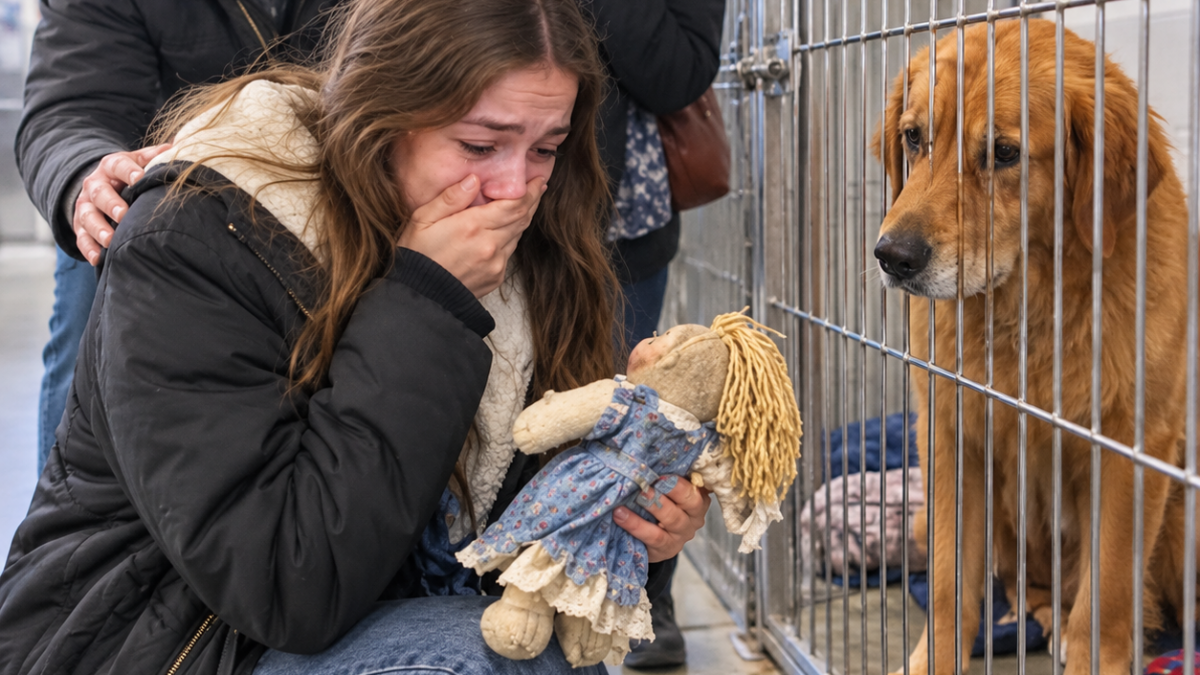
For almost two years, the old dog in kennel fourteen carried a ruined blue doll everywhere he went. He guarded it more carefully than food, blankets, or even his own aching body. I thought grief had made him strange—until a seven-year-old girl walked into our shelter and said one word that changed everything.
My name is Sophie Martin, and I had been working at our small animal shelter in the Yonne region for eleven years when Vasco arrived.
An independent road-maintenance worker found him beneath a bridge in the spring of 2024, nearly fifty kilometers outside Auxerre.
He was lying on a patch of dry dirt with a cloth doll tucked beneath his chin.
When the man approached, the dog struggled to stand.
He picked up the doll.
Then his legs buckled.
By the time Vasco reached us, he was dangerously thin. His paw pads were worn raw from walking. Twigs were tangled through his coat, and his ribs showed beneath fur that should have hidden them.
The doll looked better than he did.
That was the first thing I found strange.
Its cloth face was gray with dirt. Half its yellow yarn hair was missing, and the little blue dress was torn around the waist.
But the doll had been protected from the worst of the rain.
Vasco apparently slept with his body curled around it.
We called him Vasco because every dog needed a name on the intake form.
He had no collar.
No microchip.
There was something that might once have been a tattoo inside one ear, but it was too faded to read.
We posted photographs.
We contacted nearby clinics and shelters.
Nothing.
A month passed.
Then six months.
Then a year.
And every morning at 6:30, I opened kennel fourteen and watched the same ritual.
Vasco stood up with the doll in his mouth.
He carried it outside.
He carried it back.
He never shook it.
Never chewed it.
Never treated it like a toy.
If another dog wandered too close, Vasco simply stepped between them.
He almost never growled.
He protected.
Adoption days were the hardest.
People stopped for puppies first.
Then energetic young dogs.
Vasco was already older, quiet, gray around the muzzle, and uninterested in performing for strangers.
Whenever visitors crowded the aisle, he often turned toward the back wall with the doll between his paws.
As if he had learned that hoping hurt more than being ignored.
Then, one Saturday in March 2026, Claire and Julien walked into our shelter with their seven-year-old daughter, Léa.
They weren’t looking for Vasco.
They were traveling to Burgundy for a family birthday when Léa saw our adoption-day sign from the road.
She had apparently been asking for a dog for months.
“Not a puppy,” Claire told me with a tired smile. “She keeps saying she wants an older dog nobody notices.”
Léa walked slowly past the kennels.
She didn’t squeal.
Didn’t tap on the gates.
She just watched.
When we reached kennel fourteen, Vasco was in his usual position.
His back faced us.
The doll rested between his front paws.
Léa stopped so suddenly that her father nearly walked into her.
She wasn’t looking at Vasco.
She was staring at the doll.
Her face changed.
“Rosie?”
Vasco’s head snapped up.
One ear lifted.
I felt something cold move down my arms.
He turned around.
For months, I had watched Vasco avoid visitors.
This time he stood.
Slowly, almost cautiously, he crossed the kennel.
The doll hung gently from his mouth.
Léa dropped to her knees.
Vasco stopped at the gate.
Then he opened his jaws.
The doll fell onto the concrete.
He pushed it beneath the bottom of the gate with his nose.
Straight toward the little girl.
Léa picked it up with both hands.
“My Rosie,” she whispered.
Claire made a small sound behind her.
I looked at her.
All the color had disappeared from her face.
Léa turned the damaged doll over.
The back of the blue dress had split farther than I had ever noticed.
Beneath two layers of old fabric, four faded hand-stitched letters appeared.
L.
É.
A.
Claire grabbed Julien’s arm so hard her knuckles went white.
Then she looked past me at Vasco.
Not like someone seeing a shelter dog.
Like someone seeing a ghost.
And when she finally spoke, her voice was barely audible.
“That doll disappeared the same day our dog did.”
PART 2
For several seconds, nobody moved.
There are moments when a room doesn’t actually become quieter, but your mind stops accepting sound.
Dogs were barking behind us.
Someone was dragging a bag of food across the reception floor.
A volunteer called my name from the laundry room.
I heard all of it and none of it.
I kept looking at Claire.
She had one hand pressed over her mouth.
Julien stood beside her, staring through the kennel gate at Vasco.
Léa was still on her knees.
She held the doll against her chest.
Then she whispered another name.
“Milo?”
Vasco froze.
His whole body changed.
His ears lifted.
His tail moved once.
Not a wag.
Just one uncertain sweep against the concrete.
Léa’s eyes filled with tears.
“Milo?”
The dog made a sound I had never heard from him before.
It wasn’t a bark.
It wasn’t a whine.
It was a broken little cry from somewhere deep in his chest.
Then he pressed himself against the gate.
Claire collapsed onto the bench behind her.
“Oh my God.”
I unlocked the kennel before I had even fully decided to do it.
Vasco stepped out.
He didn’t run.
He moved carefully, almost painfully, toward Léa.
She stayed still.
He sniffed her sleeve.
Her hands.
Her hair.
Then he pushed his muzzle beneath her chin.
Léa wrapped both arms around his neck.
Vasco’s legs folded beneath him.
He sank onto the floor with her.
The doll lay between them.
Claire began crying.
Not quietly.
The kind of crying that comes when grief you’ve already buried suddenly stands up in front of you.
Julien knelt beside his daughter.
He touched Vasco’s shoulder.
Then he found something beneath the fur near the dog’s left front leg.
A narrow white scar.
His hand stopped.
“Claire.”
She looked.
Julien pointed.
Claire closed her eyes.
“That’s him.”
I felt my stomach drop.
“You’re certain?”
She nodded.
“Our dog had surgery there when he was three.”
She looked at me.
“His name was Milo.”
I turned toward the animal I had called Vasco for nearly two years.
Milo.
He lifted his head at the sound.
Not dramatically.
Just enough.
But enough was enough.
Claire stared at him as if she were trying to fit two years of grief into one breath.
“We thought he was dead.”
That sentence changed the atmosphere completely.
I closed the kennel behind us and led the family into our small consultation room.
Milo refused to leave Léa.
When she walked, he followed.
When she sat, he lowered himself beside her chair.
When she placed Rosie in her lap, he rested his chin against the doll.
I brought water.
Nobody touched it.
Finally I asked the question I had been afraid to ask.
“What happened two years ago?”
Claire looked at Julien.
He nodded.
And she began.
Milo had belonged to Claire’s aunt, Isabelle.
Isabelle had lived outside Melun on a small property with an old stone house, a vegetable garden, and enough land behind it for Milo to spend most afternoons sleeping beneath an apple tree.
When Isabelle died unexpectedly in late 2021, Claire took Milo home.
Technically, the identification paperwork should have been transferred immediately.
It wasn’t.
Isabelle had adopted Milo years earlier from a farmer who had marked him with an old tattoo.
By the time Claire inherited him, the tattoo was already difficult to read.
They planned to have him microchipped during his next veterinary visit.
Then Claire’s mother became ill.
Then Julien changed jobs.
Then life did what life always does.
It turned something important into something they kept promising to handle next week.
Milo became part of the family anyway.
He slept beside Léa’s bed.
He waited beneath her chair at breakfast.
And during thunderstorms, Léa would bring her favorite doll, Rosie, downstairs and place it between Milo’s paws.
“She thought Rosie made him brave,” Claire said.
Léa corrected her.
“She did.”
Claire smiled through her tears.
Then the smile vanished.
In April 2024, Claire’s mother suffered a severe stroke.
The call came before dawn.
They had to leave immediately.
Claire and Julien took Léa to the hospital with them.
Milo couldn’t come.
Claire’s cousin Luc lived twelve minutes away.
He had a key to the house.
He had watched Milo before.
Claire called him from the car.
Luc promised to feed Milo, walk him, and keep him overnight if necessary.
By evening, Claire’s mother had been transferred to another hospital.
Everything became chaos.
It was after nine when Luc called.
Milo was gone.
According to Luc, he had opened the garden gate for less than a minute while moving trash bins.
Milo slipped past him.
Luc chased him.
Lost sight of him.
By the time Claire returned home the following morning, there was no sign of the dog.
Rosie was missing too.
“We assumed Léa had brought the doll in the car,” Julien told me. “Then we thought maybe she’d left it at my mother’s. We weren’t exactly thinking clearly.”
They searched for Milo for months.
They drove every nearby road.
They printed hundreds of flyers.
They contacted veterinarians.
They called shelters.
But they searched around Melun.
Milo was found more than a hundred kilometers away.
“How could he have gotten from Melun to Yonne?” I asked.
Claire looked at me.
“He couldn’t.”
The room went silent again.
Julien leaned forward.
“We never thought he could.”
Then he said the thing that shifted the story from tragedy to something darker.
“But Luc kept telling us dogs travel farther than people realize.”
I looked at Milo.
He was asleep now with his head across Léa’s shoe.
“How well did you trust Luc?”
Claire laughed once.
There was no humor in it.
“Enough to give him the key to my house.”
She explained that Luc was nine years older than she was.
They were cousins, but had grown up more like siblings.
Claire’s father and Luc’s mother had been close, and the families spent holidays together.
Luc could be difficult.
He drank too much when he was stressed.
He borrowed money and took too long to repay it.
He had a habit of resenting anyone who seemed more stable than he was.
But he was family.
And families are often the people we give access to things strangers would never be allowed near.
“He helped us search,” Claire whispered.
That sentence bothered me more than anything else she’d said.
“He helped?”
“For weeks.”
Julien’s jaw tightened.
“He printed posters.”
Claire looked down at her hands.
“He drove around with me calling Milo’s name.”
Léa was listening now.
She was only seven.
Children understand far more than adults want them to.
“Why would Uncle Luc hurt Milo?”
Claire turned toward her daughter.
“We don’t know that he did.”
But her face said something else.
I asked permission to pull Milo’s full intake file.
Claire agreed.
The first report contained little we didn’t already know.
Approximate age.
Weight.
Condition.
Location found.
The maintenance worker’s phone number.
Then I noticed something.
The man who found Milo had written down the exact time.
6:42 a.m.
April 19, 2024.
Claire stopped breathing for a moment.
“Milo disappeared April eighteenth.”
I looked at the location again.
A roadside bridge southwest of Auxerre.
More than a hundred kilometers from Claire’s house.
There was no realistic way an exhausted older dog had crossed that distance overnight.
Someone had transported him.
That didn’t automatically mean Luc.
But it meant Milo had not simply escaped through an open gate and wandered until he collapsed.
Claire asked if she could photograph the report.
I told her she could have a copy.
Then she asked for something I didn’t expect.
“Can we call the man who found him?”
The number was almost two years old.
I doubted it would work.
It did.
His name was Bernard.
When I explained why I was calling, he was silent for so long I thought the connection had dropped.
Then he said, “The dog with the doll?”
Claire began crying again.
Bernard remembered everything.
He had been driving to inspect drainage damage along the road after several days of rain.
He saw Milo beneath the bridge.
At first he thought the dog was dead.
Then Milo lifted his head.
Bernard had also noticed tire marks in the soft shoulder above the ditch.
That detail had never seemed important.
Lots of vehicles pulled off rural roads.
But he remembered something else.
A piece of black plastic had been caught in a bush.
It looked like part of a broken taillight housing or bumper trim.
He had thrown it into the back of his utility vehicle because he didn’t want it left beside the road.
“Do you still have it?” Julien asked.
Bernard laughed sadly.
“No. That was two years ago.”
Our hopes dropped.
Then Bernard said, “But I took pictures.”
Claire leaned toward the phone.
“What?”
“I photograph damage sites before I work. The road shoulder too. The tire marks were inside one of the frames.”
He promised to search his computer.
We ended the call.
Nobody said anything for a while.
Finally Julien stood.
“I’m calling the police.”
Claire stopped him.
“Not yet.”
He stared at her.
“Claire.”
“Not until we know.”
“What else do you need to know?”
She looked toward Léa.
“I need to know before I accuse my own cousin of dumping our dog on the side of a road.”
The distinction mattered to her.
Not because she trusted Luc anymore.
Because once she crossed that line, there would be no going back.
I understood.
Over the years, I had watched enough abandoned animals arrive at shelters to learn something about human cruelty.
The worst acts aren’t always committed by obvious monsters.
Sometimes they’re committed by people who still attend Christmas dinner.
People who send birthday messages.
People whose numbers remain saved in your phone under “family.”
We completed temporary paperwork allowing Milo to leave the kennel area with Claire’s family while we verified ownership.
Legally, there were procedures.
Emotionally, Milo had already made his decision.
When Claire stood to leave the room, Milo stood too.
When Léa went toward the door, he followed immediately.
I watched him hesitate only once.
He looked back toward the kennel.
Then toward the doll in Léa’s arms.
For almost two years, that kennel had been the safest place he knew.
Now he stepped away from it without looking back.
I followed the family outside.
The afternoon sun had come through after morning rain.
Léa sat on the low concrete wall near our entrance.
Milo lowered himself beside her.
She placed Rosie between his front paws.
“You kept her safe.”
Milo licked her wrist.
Léa leaned down.
“I would’ve come sooner if I knew.”
That almost finished me.
I turned away.
Claire was standing behind me.
She had heard it too.
“I told her he was probably with a new family,” she whispered. “Eventually I had to. She kept waiting by the window.”
I didn’t know what to say.
So I said the only true thing I had.
“He waited too.”
Bernard emailed the photographs that evening.
At 8:17 p.m., Claire called me.
Her voice shook.
“Sophie, you need to see this.”
The first photograph showed the ditch, bridge, mud, and flattened grass.
The second showed tire impressions.
The third included the road shoulder farther back.
And at the far edge of the image, partially hidden by trees, was a small reflective object.
A broken piece of plastic.
Bernard had taken a closer photograph of it.
There was a streak of metallic dark-red paint along one edge.
Claire sent another image.
It showed Luc standing beside his car at a family barbecue in 2023.
His car was dark red.
The rear bumper had a patch of mismatched black plastic near the passenger-side taillight.
It was not proof.
Not yet.
But it was enough to make Claire search old messages.
At 11:06 that night, she found something else.
The day after Milo disappeared, Luc had texted her:
*I drove all the back roads east of town again. Nothing. I’m sorry.*
East.
The bridge where Milo was found was southeast, far beyond any reasonable search area.
Again, not proof.
But then Julien remembered a toll receipt.
Luc had borrowed cash from him that week because, according to Luc, his bank card wasn’t working.
Julien kept receipts for business expenses almost obsessively.
He searched old records.
There it was.
A fuel purchase from the morning Milo was found.
A station outside Sens.
Nowhere near Luc’s normal route.
But directly along one of the roads connecting the Paris region toward Yonne.
Claire did not confront him.
That surprised me.
Instead, she contacted an attorney.
Then the police.
Two officers came to the shelter three days later.
They photographed the doll.
They photographed Milo.
They took copies of the intake report.
They spoke to Bernard.
Then they asked whether we had retained the blanket Milo arrived with.
We hadn’t.
But we had something better.
Photographs.
One showed the underside of Rosie’s damaged dress.
I had taken it during intake because we documented belongings attached to abandoned animals.
Back then, the tear was smaller.
The letters were hidden.
That photograph established that Milo had arrived with the same doll in April 2024.
The four letters didn’t prove who abandoned him.
But they connected him unquestionably to Léa.
The officers also looked at the location where Bernard found Milo.
A roadside camera from 2024 was long overwritten.
A nearby business had closed.
The investigation could have ended there.
Instead, Luc made the mistake people often make when they have been lying for too long.
He became offended before anyone accused him.
Claire didn’t call him.
She didn’t message.
She didn’t mention Milo publicly.
Yet four days after the police interviewed Bernard, Luc called Claire.
She recorded the conversation after telling him she was doing so.
“Why are police asking about a dog from two years ago?”
Claire kept her voice calm.
“I didn’t know they had contacted you.”
“Don’t play games.”
“What games?”
“Milo ran away.”
Claire said nothing.
Luc filled the silence.
“I told you exactly what happened.”
“I haven’t accused you of anything.”
Another pause.
Then Luc said, “So why are they asking about my car?”
That was the moment Claire knew.
The police had not told him about the photographs.
They had simply asked whether he still owned the red hatchback he’d driven in 2024.
Claire whispered, “Why would your car matter?”
Luc swore.
Then he hung up.
Two hours later, he called again.
This time he sounded calmer.
He said he had panicked.
He said he understood how things looked.
He said he loved Claire.
He said family should settle family matters privately.
Claire listened for four minutes.
Then she asked one question.
“Did you put Milo in your car?”
Luc stopped talking.
“Luc?”
“I was trying to help.”
Those five words destroyed whatever protection family loyalty had left.
Claire asked again.
“Did you put him in your car?”
“He wouldn’t settle down.”
“That isn’t an answer.”
“You had enough going on with your mother.”
“Did you put Milo in your car?”
“Yes.”
Claire closed her eyes.
Julien was beside her.
Léa was upstairs.
I know this because Claire later told me every detail.
“Where did you take him?”
Luc’s breathing changed.
“I drove around.”
“For more than a hundred kilometers?”
No answer.
“Luc, where did you take our dog?”
He began blaming Milo.
The dog had scratched his door.
Milo had barked all night.
He had knocked over a trash bin.
He had refused to eat.
Luc had an important job interview the next morning.
He was exhausted.
He had already been stressed.
He “lost control.”
Claire asked, “What does that mean?”
“I pulled over.”
“Where?”
“I don’t remember.”
“You remember enough to know police are asking about your car.”
Luc snapped.
“You always do this.”
“Do what?”
“Make me the bad person.”
Claire’s voice became very quiet.
“You drove my daughter’s dog more than a hundred kilometers away and left him under a bridge.”
“I didn’t leave him under the bridge.”
That sentence mattered.
Claire didn’t interrupt.
Luc continued.
“I left him near the road. He went down there himself.”
Julien had to leave the room.
Later he told me that if he’d remained beside the phone, he would have said something he regretted.
Claire stayed calm.
“And Rosie?”
“What?”
“The doll.”
“I don’t know.”
“Milo was found with it.”
Silence.
Then Luc laughed once.
“He wouldn’t get out of the car without that stupid thing.”
Claire stopped breathing.
On the recording, you can hear it.
A tiny intake of breath.
Then her voice.
“You brought the doll with him.”
“I just wanted him out.”
“He wouldn’t leave without Léa’s doll, so you threw both of them out?”
“I didn’t throw anything.”
“What did you do, Luc?”
“I put him out.”
“And the doll?”
Another pause.
“I tossed it onto the grass.”
Claire began crying.
Luc kept talking.
That might have been the worst part.
Once he had admitted enough, he seemed desperate to make the rest sound reasonable.
He said Milo was “just a dog.”
He said somebody would find him.
He said he chose a rural area because there were farms.
He said dogs survived outside all the time.
He said he couldn’t afford boarding fees.
Claire interrupted.
“I gave you money.”
Silence.
I remember when Claire told me that part.
We were sitting in the shelter office two weeks later.
She reached into her purse and placed a printed bank statement on my desk.
On April 18, 2024, the morning her mother had the stroke, Claire had transferred Luc 600 euros.
For Milo’s food.
Emergency veterinary care if necessary.
And boarding if the hospital stay became longer than expected.
Luc had kept the money.
The next morning, bank records later showed, he used part of it to pay an overdue personal bill.
He abandoned Milo for free.
When Claire asked about the money during the recorded phone call, Luc went quiet.
Then he said, “I was going to pay you back.”
“You told me you used it for Milo.”
“I did.”
“You left him beside a road.”
“I bought gas.”
Claire almost laughed.
She didn’t.
Instead she asked, “Why so far away?”
That was the question I had wondered about too.
Luc’s answer was simple.
And because it was simple, it was horrifying.
“So he wouldn’t come back.”
Claire ended the call.
She gave the recording to investigators.
That should have been the end.
In some ways, it was only the beginning.
Milo’s return home was not the perfect reunion people imagine when they hear a lost-dog story.
The first night, he refused to enter Claire’s house.
He stood on the front path trembling.
The place looked different.
There was new paint on the shutters.
A hedge had been removed.
Léa was taller.
The smells had changed.
But perhaps the hardest part was that the last time Milo had been inside that house, Claire had left in a hurry and Luc had arrived with a key.
Milo stared at the doorway.
Then backed away.
Claire sat on the step.
She didn’t pull the leash.
Didn’t coax him with food.
She simply waited.
After fifteen minutes, Léa came outside carrying Rosie.
The doll had been gently cleaned but not repaired.
Léa put it just inside the doorway.
Milo looked at it.
Then at her.
He took one step.
Stopped.
Another.
By the time he crossed the threshold, Claire was crying.
He walked into the hallway.
Turned left.
And went directly upstairs.
Nobody guided him.
He entered Léa’s bedroom.
The room had changed completely since she was five.
A bigger bed.
Different curtains.
Schoolbooks.
Drawings taped to the wall.
But Milo walked to the corner beside the bed.
The place where his old blanket had once been.
He circled twice.
Then lay down.
Léa curled beside him.
Julien took a photograph.
Not to post.
Not to prove anything.
Just because some moments need evidence when you’ve spent years believing they would never happen.
For the first week, Milo slept badly.
At certain engine sounds he woke and paced.
If Julien opened the car hatch, Milo retreated.
If Claire picked up keys unexpectedly, he followed her through the house.
He had learned that people could disappear.
He had also learned that vehicles could take you somewhere you could not return from.
The shelter behaviorist visited twice.
She told the family not to overwhelm him with affection.
“Let him choose closeness.”
Léa understood faster than the adults.
She stopped hugging him unless he leaned into her first.
Instead she read on the floor beside him.
She rebuilt trust the same way children build towers.
One careful piece at a time.
Rosie remained nearby.
Always.
Claire offered to have the doll professionally restored.
Léa refused.
“No.”
“Sweetheart, her dress is almost falling apart.”
“Milo knows her like this.”
Claire looked at me when she told me that.
Sometimes children say the thing adults are circling around but can’t reach.
Milo knew Rosie damaged.
He knew Léa smaller.
He knew one home before betrayal and another home after it.
They didn’t need to erase what happened to prove they were healed.
Three weeks after Milo returned home, Claire came back to the shelter.
Alone.
She carried a cardboard box.
Inside were more than forty printed photographs.
Milo beneath Isabelle’s apple tree.
Milo asleep beside toddler Léa.
Milo wearing a ridiculous paper birthday hat.
Milo in snow.
Milo beside Rosie during a thunderstorm.
In one photograph, Léa was four years old, asleep on the couch.
Rosie was beneath her arm.
Milo lay on the floor with his nose touching the doll’s blue shoe.
I stared at that picture for a long time.
“I wish we’d seen these in 2024,” I said.
“So do I.”
Claire didn’t say it accusingly.
But I still felt guilty.
Every shelter worker carries ghosts.
Animals you couldn’t save.
Families you couldn’t find.
Signs that seem obvious only after someone explains them.
“We posted him everywhere we knew to post,” I said.
“I know.”
“We checked missing-dog databases.”
“I know.”
“We didn’t know.”
“Sophie.”
She reached across the desk.
“You kept him alive.”
That stopped me.
She looked toward kennel fourteen, which now held a terrified beagle mix recently rescued from a hoarding case.
“For almost two years, you kept my daughter’s dog safe.”
“We should’ve found you sooner.”
“And I should’ve gotten him microchipped.”
Her voice cracked.
“I should’ve noticed Luc’s story didn’t make sense. Julien should’ve called farther-away shelters. My mother should’ve never had a stroke. Milo should’ve never been abandoned.”
She wiped her eyes.
“We can spend the rest of our lives building a courtroom for ourselves, or we can save our energy for the person who actually made the choice.”
That was Claire.
She could be gentle.
But gentleness is not weakness.
Luc learned that slowly.
The investigation uncovered more than the abandonment.
After Claire’s mother recovered enough to review her finances, the family discovered two transfers they did not recognize.
The amounts weren’t huge.
But both went to an account associated with Luc.
He claimed they were loans.
Claire’s mother said they weren’t.
Then another relative remembered giving Luc cash to pay a veterinary bill for an elderly cat.
The clinic had no record of the visit.
The pattern became difficult to ignore.
Luc had spent years depending on one assumption:
That family embarrassment would protect him better than innocence ever could.
People knew he lied.
They knew he borrowed.
They knew he manipulated.
But each person thought their experience was isolated.
Nobody compared notes.
Milo changed that.
The dog with the broken doll became the first thing painful enough to make everyone stop protecting Luc from consequences.
He called Claire repeatedly.
She blocked him.
He emailed Julien.
Julien forwarded everything to the attorney without replying.
Then Luc contacted Claire’s mother.
That was his biggest mistake after abandoning Milo.
He arrived at her home on a Tuesday afternoon carrying flowers.
She was seventy-two and still walked with a cane after the stroke.
Luc apparently expected tears.
Forgiveness.
A family conversation.
Instead, she opened the door but left the security chain attached.
“I came to explain.”
She looked at the flowers.
“Explain the dog?”
“All of it.”
“Did Milo bite you?”
“No.”
“Attack you?”
“No.”
“Destroy the house?”
“No.”
“Were you afraid of him?”
“No.”
“Then you left an old dog beside a road because he inconvenienced you.”
Luc said nothing.
Claire’s mother asked another question.
“And my money?”
Luc’s face changed.
That was when he realized the family had compared bank records.
He stepped closer to the door.
She didn’t move.
“Leave.”
“Aunt Marianne—”
“Leave before I call the police.”
“You’re really choosing a dog over family?”
Marianne looked at him for several seconds.
Then she said something Claire later wrote down because she never wanted to forget it.
“No. I’m choosing the family member who never stole from me.”
She closed the door.
Luc’s messages became angrier after that.
He accused Claire of destroying his reputation.
He claimed people were canceling invitations.
His sister stopped allowing him to babysit her children.
His employer had heard rumors.
He insisted Claire was conducting a “revenge campaign.”
But Claire had posted nothing publicly.
She hadn’t contacted his workplace.
She hadn’t called relatives to demand they cut him off.
The truth was moving on its own.
That is something people like Luc never understand.
When you’ve controlled a story through secrecy, the moment people start speaking honestly feels like persecution.
In reality, nobody is attacking you.
They’re simply no longer carrying your lie.
The legal process moved slowly.
Milo didn’t care.
His life became smaller in the best possible way.
Breakfast.
Walk.
Nap.
School pickup.
Dinner.
Rosie.
Every afternoon at 4:20, Milo waited near the front window.
At 4:27, Léa’s school bus stopped at the end of the street.
By the second month, he recognized the sound before anyone else.
His tail began moving before the bus appeared.
Claire sent me videos.
I watched every one.
At the shelter, we had expected Milo to live out his remaining years with us.
Now he had a schedule.
A child.
A sofa.
A garden.
And an appointment with a veterinarian who finally implanted a microchip registered correctly in Claire’s name.
The day after the appointment, Claire sent me a photograph of the registration confirmation.
Her message said:
*This time, nobody gets to erase where he belongs.*
I printed it.
It stayed above my desk.
Summer arrived.
Milo gained weight.
His coat thickened.
He still carried Rosie sometimes.
But not constantly.
That change happened so gradually nobody noticed at first.
One morning Léa came downstairs and found Rosie on her bedroom floor.
Milo was already in the garden.
It was the first time in nearly two years that he had willingly left the doll behind.
Claire called me crying.
“Is that good?”
“Yes.”
“Are you sure?”
I thought about it.
“No,” I admitted. “But I think so.”
A week later, he left Rosie inside while going for a walk.
Then during dinner.
Then overnight.
He still checked for her.
He still sometimes carried her from room to room.
But the desperate vigilance softened.
Rosie had once been the only familiar thing he possessed.
Now the whole house was familiar again.
The legal hearing was scheduled for October.
Luc’s attorney initially tried to minimize everything.
A family misunderstanding.
A regrettable decision made under stress.
No intention to cause lasting harm.
Milo had survived.
He had been recovered.
No permanent physical injury had been proven.
Claire’s attorney responded with the intake photographs.
The judge saw Milo at eight kilograms underweight.
Saw his damaged paw pads.
Saw the brambles in his coat.
Saw Rosie beneath his chin.
Then the recording was played.
Luc’s own voice filled the courtroom.
*So he wouldn’t come back.*
I attended because I had been called as a witness.
I had never liked courtrooms.
Too much waiting.
Too much wood.
Too many people pretending not to be afraid.
Luc sat at the opposite table.
I had seen photographs of him, but this was the first time I saw him in person.
He looked ordinary.
That mattered to me.
Cruelty rarely announces itself with a face that helps you understand it.
Luc wore a gray jacket.
His hair was neatly cut.
He looked like a man who might help you carry groceries.
When the prosecutor asked me to describe Milo’s arrival, I kept my eyes on the judge.
“Severely underweight.”
“Could he walk?”
“Barely.”
“Did he show aggression?”
“No.”
“Did he guard the doll?”
“Yes.”
“How?”
“He kept it close. He positioned his body between the doll and other animals. He never damaged it.”
“Did you consider taking it away?”
“Once.”
Luc finally looked at me.
“What happened?”
“Milo panicked.”
I remembered that day clearly.
We needed to wash his bedding.
I had lifted Rosie from beside him.
Milo didn’t bite.
Didn’t growl.
He simply began trembling so violently that I returned it within seconds.
The prosecutor asked, “In your professional experience, how would you describe the significance of that object to him?”
Luc’s attorney objected to speculation.
The judge allowed me to answer only based on observation.
So I did.
“It was the one thing he behaved as if he could not afford to lose.”
Claire began crying behind me.
I stepped down.
Then Bernard testified.
He described finding Milo.
The mud.
The tire marks.
The photograph.
After him came Julien.
Then Claire.
Luc did not look at her as she walked to the witness stand.
Claire was asked about the night her mother suffered the stroke.
Her phone call to Luc.
The 600-euro transfer.
The search.
The months of posters.
Léa waiting at the window.
Then came Rosie’s photograph.
Claire identified the doll.
“How do you know it belonged to your daughter?”
“My mother helped Léa sew her name into the dress.”
“Where?”
Claire pointed.
“Inside the back seam.”
The original doll was not passed casually around the courtroom.
It had been photographed and documented, and the family kept it safe.
But the images appeared on the screen.
Four letters.
LÉA.
For the first time, Luc looked down.
The prosecutor asked Claire whether she wanted to say anything about discovering Milo alive.
Luc’s attorney objected.
The judge allowed a limited answer.
Claire turned slightly.
Not toward the judge.
Toward Luc.
“I spent almost two years telling my daughter that sometimes love means accepting that you may never know what happened.”
Luc stared at the table.
“I told her Milo might have found another home. I told her he might be safe. I told her not knowing didn’t mean the worst had happened.”
Her voice shook.
“The whole time, you knew.”
Luc finally looked up.
Claire continued.
“You watched us search.”
No one moved.
“You helped me hang posters for a dog you’d deliberately left more than a hundred kilometers away.”
Luc’s mouth tightened.
“You drove around calling his name beside me.”
The judge asked Claire to address the court rather than the defendant.
She nodded.
But the point had landed.
Luc testified later.
That surprised us.
His attorney probably hoped he could humanize himself.
At first it worked.
Luc described his financial problems.
The pressure he had been under.
His failing relationship.
His insomnia.
His fear that Claire’s family constantly judged him.
Then he talked about the night with Milo.
The dog had paced.
Whined.
Scratched the back door.
Carried the doll around.
Wouldn’t settle.
Luc said he “snapped.”
The next morning, he drove.
At first he claimed he only intended to tire Milo out with a long walk somewhere unfamiliar.
Then the prosecutor asked why he drove more than a hundred kilometers.
Luc hesitated.
“To clear my head.”
“Why did you take the dog?”
“He was already in the car.”
“Why?”
“I thought we’d go somewhere.”
“With a child’s doll?”
Luc shifted.
“He picked it up.”
The prosecutor glanced down.
“In your recorded conversation, you said Milo would not get out of the car without the doll.”
“Yes.”
“So you remember him refusing to leave the vehicle.”
“I remember he was difficult.”
“Difficult how?”
“He kept climbing back in.”
Something moved through the courtroom.
I looked at Claire.
Her hand tightened around Julien’s.
The prosecutor stopped.
“I’m sorry?”
Luc realized too late.
He had said more than anyone knew.
“He kept climbing back into the car?”
Luc swallowed.
“Yes.”
“How many times?”
“I don’t know.”
“Once?”
“No.”
“Twice?”
“I don’t remember.”
“More than twice?”
Luc didn’t answer.
The prosecutor waited.
Finally Luc said, “Maybe.”
My stomach turned.
Until that moment, I had imagined Milo being pushed from a parked car and watching it disappear.
The reality was worse.
Milo had tried to get back in.
He trusted the person leaving him.
Again and again, he climbed toward the vehicle because his understanding of the world still told him he belonged inside it.
The prosecutor asked, “What did you do when the dog kept entering the car?”
Luc rubbed his forehead.
“I shut the door.”
“With Milo outside?”
“Yes.”
“And then?”
“I drove away.”
“With the doll?”
“No.”
“Where was the doll?”
Luc whispered something.
The prosecutor asked him to repeat it.
“I threw it out.”
Claire bent forward.
Julien put an arm around her.
The prosecutor’s voice stayed level.
“Why?”
Luc looked irritated now.
“Because he wouldn’t stop trying to get back into the car.”
“So you gave him the doll.”
“I tossed it.”
“And then you left.”
“Yes.”
“Why that location?”
“I told you. I was driving.”
“Why not a shelter?”
Luc said nothing.
“A veterinarian?”
Nothing.
“A police station?”
Nothing.
“Why did you tell the family Milo escaped?”
Luc’s face flushed.
“I panicked.”
“You panicked for two years?”
His attorney objected.
The judge sustained it.
The prosecutor rephrased.
“Why did you continue maintaining that story after the first day?”
Luc stared at his hands.
“Because I knew they’d hate me.”
That was perhaps the most honest answer he gave.
He knew.
Before he helped Claire print the first missing poster, he knew.
Before he drove beside her shouting Milo’s name from an open window, he knew.
Before he accepted Sunday dinner at Marianne’s house while Léa asked whether Milo could find his way home, he knew.
He chose the lie anyway.
The hearing ended late in the afternoon.
No dramatic verdict came that day.
Real justice is rarely timed like television.
There were documents.
Additional reviews.
Financial questions.
Another hearing.
More waiting.
Luc’s attorney approached Claire outside.
I expected hostility.
Instead he looked exhausted.
He said Luc was willing to discuss restitution.
Claire shook her head.
“This isn’t a damaged fence.”
“Mrs. Moreau—”
“You don’t get to calculate two years of my daughter’s grief.”
“I understand.”
“No.”
Claire looked toward the courthouse doors.
“You understand a case file.”
Then she walked away.
I followed her down the steps.
Léa hadn’t attended.
Neither had Milo.
They were at home with Claire’s mother.
When Claire reached the parking lot, she stopped.
“I thought I’d feel better.”
“You might later.”
“I wanted him to hurt.”
She looked ashamed saying it.
I didn’t tell her not to feel that way.
Some emotions don’t need correction.
“They kept asking about restitution,” she said. “As if there’s a number.”
“There isn’t.”
She nodded.
Then something in her face changed.
“But there can be consequences.”
There were.
By the end of the legal process, Luc had admitted abandoning Milo and misleading the family afterward.
The financial matters involving relatives were handled separately.
He was ordered to repay money.
He faced substantial legal costs and restrictions relating to animal ownership.
Part of the money connected to the case eventually went toward organizations caring for abandoned animals.
Claire refused to take anything for herself beyond documented expenses.
When asked what she wanted done with one portion of the restitution, she named our shelter.
We used it to renovate the oldest kennel wing.
Kennel fourteen was included.
That felt appropriate.
But Claire wasn’t finished.
Not with revenge.
At least, not the kind Luc expected.
She never posted his photograph online.
Never published his address.
Never encouraged strangers to harass him.
She didn’t need to.
Instead, she did something much more permanent.
She told the truth.
Every relative who asked received the same factual account.
No exaggeration.
No insults.
No rumors.
Just dates.
Bank transfers.
The shelter report.
The recording.
The photograph of Rosie.
The sentence:
*So he wouldn’t come back.*
Luc had spent years using family silence as shelter.
Claire removed the shelter.
His mother apologized to Claire.
His sister returned money she’d borrowed from Marianne after discovering Luc had been lying about why he needed it.
Two cousins admitted Luc had manipulated them too.
One family member had even paid him to arrange long-term care for an elderly rabbit years earlier.
The rabbit had supposedly died shortly afterward.
Nobody could determine exactly what had happened.
That uncertainty devastated them.
Luc stopped being invited to family gatherings.
Not because Claire demanded it.
Because people finally made informed choices.
At Christmas, nearly nine months after Milo came home, Claire invited me to dinner.
I almost declined.
Shelter workers learn to keep certain boundaries.
But Léa had mailed me a handwritten card.
On the front was a drawing of a dog and a blue doll.
Inside she wrote:
*Please come because Milo remembers you too.*
So I went.
The house was warm and loud.
Claire’s mother sat near the fireplace.
Julien was cooking something in the kitchen and pretending he didn’t need help.
Léa met me at the door.
Milo stood behind her.
For a second, my heart tightened.
His muzzle was whiter.
His movements were slower.
But he looked healthy.
Solid.
Home.
“Vasco,” I whispered before I could stop myself.
His ears lifted.
Léa laughed.
“He still knows that one.”
I knelt.
“Hey, old man.”
Milo came forward.
He sniffed my coat.
Then rested his head against my shoulder.
I held him.
Only for a few seconds.
Then he pulled away and returned to Léa.
That was exactly how it should have been.
“Where’s Rosie?” I asked.
Léa pointed toward the Christmas tree.
The doll was sitting beneath it.
Her torn blue dress had been reinforced from the inside with clear protective fabric, but the original damage remained visible.
The four letters were still there.
LÉA.
Claire handed me a glass of wine.
“We made a decision about her.”
“Rosie?”
She nodded.
“We’re not repairing the dress.”
I smiled.
“Léa won.”
“Léa usually wins.”
From across the room, Léa shouted, “I heard that.”
Everyone laughed.
Later that evening, Claire took me upstairs.
On the wall outside Léa’s bedroom hung two framed photographs.
The first was taken in 2023.
Five-year-old Léa sat on the floor with Milo and Rosie.
The second had been taken that summer.
Same child.
Same dog.
Same doll.
Different time.
Between the frames was a small brass plaque.
I leaned closer.
It read:
HE CARRIED HOME UNTIL HOME FOUND HIM.
I couldn’t speak for several seconds.
Claire stood beside me.
“I wanted Léa to remember.”
“What?”
“That surviving doesn’t mean nothing happened.”
She looked through the open bedroom door.
Milo was asleep on the rug.
“It means what happened didn’t get the last word.”
The following spring, almost exactly one year after Milo returned home, our shelter held another adoption event.
Claire volunteered.
Julien repaired a broken section of fencing.
Marianne sat at a table folding information leaflets.
And Léa spent nearly the entire afternoon sitting beside an elderly dog named Hector.
Hector had been with us seven months.
He was ten years old.
Arthritis.
Cloudy eyes.
No dramatic story.
No broken doll.
Just an old dog nobody seemed to notice.
A family walked past his kennel.
Then another.
Léa stayed.
At closing time, I found her brushing Hector’s coat.
“You know you can’t adopt every old dog,” I told her.
She looked completely serious.
“Why not?”
“Because your mother would kill me.”
Claire called from across the room, “Correct.”
Léa sighed.
Then a woman and her teenage son approached Hector’s kennel.
The boy crouched.
Hector slowly walked toward him.
Léa stood and moved aside.
She didn’t try to sell him.
Didn’t tell them Hector was special.
She simply waited.
The boy put his fingers through the gate.
Hector licked them.
Twenty minutes later, they were filling out an application.
Léa found me near reception.
“See?”
“See what?”
“The dogs nobody looks at are looking back.”
I had to turn away for a moment.
A few weeks later, I visited Milo at home.
He was older.
Much older.
There is no way to tell a story about an aging dog without eventually admitting that time keeps moving even after the happy ending.
He struggled with stairs now.
Julien had built a small ramp from the back door to the garden.
Milo’s hearing was fading.
His hips were stiff.
But every afternoon, he still waited near the window for Léa.
That day, she came home carrying a school project.
She dropped her backpack.
Milo stood slowly.
His tail wagged.
Not once.
Not uncertainly.
Back and forth.
Back and forth.
Léa knelt.
“Hi, Milo.”
He walked to her.
No doll in his mouth.
No need.
Rosie remained upstairs on a shelf beside Léa’s bed.
Milo no longer carried her through the house.
For two years, I had believed that doll represented grief.
Then I thought it represented memory.
Eventually I understood it was something even simpler.
It was a promise.
A dog abandoned in an unfamiliar place had protected the last object that smelled like the child he loved.
He had crossed rain.
Roads.
Cold nights.
Hunger.
Fear.
He had slept beneath bridges.
He had arrived at our shelter barely able to stand.
And still he protected that doll.
Perhaps he did not understand distance.
Or betrayal.
Or why the car had disappeared and never returned.
But somewhere inside him was the stubborn belief that the little girl connected to Rosie still existed.
So he kept one piece of her safe.
Day after day.
Month after month.
Year after year.
And when Léa finally appeared in front of kennel fourteen, Milo didn’t need paperwork.
He didn’t need photographs.
He didn’t need a court to tell him who she was.
He pushed Rosie beneath the gate.
Home had arrived.
Milo lived almost three more years after that reunion.
By the final winter, he could no longer climb the stairs.
Léa moved her favorite blankets downstairs.
Rosie came down too.
Not for Milo.
For her.
On his last morning, snow had covered Claire’s garden.
Milo lay beside the glass doors where he could see the white lawn.
Claire called me early.
I drove to the house.
The veterinarian was already there.
Léa sat on the floor.
She was ten now.
Older in ways children should never have to become.
Milo’s head rested across her legs.
Rosie was beside them.
I sat near his front paws.
He looked at me once.
I scratched the place behind his ear that he had always liked.
“Good boy, Vasco.”
His tail moved weakly.
Léa smiled through tears.
Then she whispered, “Milo.”
His eyes shifted toward her.
Everyone saw it.
Claire covered her mouth.
Julien looked away.
Léa leaned down until her forehead touched his.
“You can leave Rosie with me now.”
Milo exhaled.
A few minutes later, with the people who loved him surrounding him, Milo died peacefully.
Léa cried until she could barely breathe.
So did I.
There are happy endings that don’t end with everyone living forever.
They end with someone finally living where they belong for as long as they are given.
Milo had been betrayed once.
That betrayal mattered.
The hunger mattered.
The fear mattered.
The two lost years mattered.
But Luc did not own the final chapter.
He didn’t get that power.
The final chapter belonged to a girl lying on the floor beside an old dog who had found his way back to her.
It belonged to Claire, who stopped protecting a relative from the consequences of his own choices.
It belonged to every shelter worker who fed Milo when nobody knew his real name.
It belonged to Bernard, who stopped his truck beneath a bridge.
And maybe, in a strange way, it belonged to Rosie.
A ruined little doll with gray fabric skin, half her yellow yarn hair missing, and four crooked letters sewn beneath a torn blue dress.
After Milo died, Léa placed Rosie inside a glass-fronted cabinet in her bedroom.
She added one photograph.
Milo in the garden.
Sunlight across his gray muzzle.
No leash.
No kennel bars.
No road behind him.
Just home.
A year later, our shelter opened the renovated kennel wing that had been partly funded by money recovered after Luc’s case.
Claire and Léa attended the opening.
I asked Léa if she wanted to cut the ribbon.
She shook her head.
“I want Sophie to.”
So I did.
Above the entrance, we installed a small plaque.
It did not mention Luc.
Claire insisted on that.
“He already took enough space in the story,” she said.
Instead, the plaque read:
FOR THE ONES WHO KEEP WAITING.
The first dog housed in the new wing was a twelve-year-old shepherd named Arthur.
His owner had died.
For nearly a month, Arthur refused to sleep anywhere except beside the shelter office door.
Every evening, before I left, I sat beside him.
One night, I brought him an old blue blanket.
He sniffed it.
Turned twice.
Lay down.
And rested his head across my shoe.
I thought about Milo.
About a bridge.
A child.
A doll.
And the strange, impossible distance between losing someone and finding them again.
People sometimes ask me why Milo protected Rosie for so long.
I don’t know.
Anyone who claims to know exactly what a dog remembers is pretending certainty none of us has.
But I know what I witnessed.
I watched a frightened, abandoned dog protect one fragile object for almost two years without tearing it.
I watched him turn away from hundreds of strangers.
I watched him hear a little girl say “Rosie” and stand up.
I watched him push that doll beneath a kennel gate.
And I watched a family discover that the disappearance they had blamed on bad luck had actually been a deliberate betrayal.
Luc wanted Milo far enough away that he could never return.
He almost succeeded.
But he made one mistake.
He underestimated what Milo would carry with him.
Not just the doll.
Memory.
Scent.
Attachment.
The stubborn loyalty of an old dog who had been given every reason to stop trusting people and somehow didn’t.
Luc drove him more than a hundred kilometers away because he believed distance could erase a bond.
Two years later, that bond walked through our shelter door wearing a little girl’s face.
And Milo recognized home before any of us did.
That is the part I remember most.
Not the courtroom.
Not Luc’s punishment.
Not even the moment the letters appeared beneath Rosie’s dress.
I remember Milo standing behind the kennel gate.
Thin gray fur around his face.
One ear raised.
His eyes fixed on Léa.
For almost two years, he had lived as if the person he loved might still be somewhere beyond that door.
Then one Saturday afternoon, she was.
And this time, when Milo followed her out, nobody ever left him behind again.
A few months after we opened the new shelter wing, I received an envelope in the mail.
There was no return address I recognized.
Inside was a photograph.
Léa was sitting beneath the old apple tree that had once stood in Isabelle’s yard. Claire’s family had visited the property before it was sold, and Léa had taken Rosie with her.
The doll sat beside her on the grass.
In Léa’s lap was Milo’s collar.
On the back of the photograph, she had written in careful handwriting:
He found me twice.
I stared at those words for a long time.
The first time Milo had found her, Léa was little more than a toddler.
She couldn’t remember the beginning clearly, but Claire could.
Milo had arrived in their family uncertain and nervous after Isabelle died.
For weeks, he slept near the door.
Then one afternoon, Léa had crawled across the living room with Rosie under one arm and fallen asleep against Milo’s side.
From that day forward, something changed.
He stopped waiting by the door.
He began sleeping outside Léa’s bedroom.
Years later, after betrayal, hunger, miles of unfamiliar road, and nearly two years behind shelter gates, he found her again.
Or maybe she found him.
I’ve stopped trying to decide which version is more accurate.
Some reunions belong to both people at once.
Léa began volunteering at the shelter when she was old enough.
At first, she only came with Claire.
She filled water bowls.
Folded towels.
Sat quietly beside frightened dogs.
She never rushed them.
That was the thing I noticed most.
Most children wanted to touch every animal immediately.
Léa understood waiting.
If a dog hid in the corner of a kennel, she sat outside with a book.
If one refused food from her hand, she placed it on the floor and looked away.
If a dog finally approached after twenty minutes, she acted as if nothing unusual had happened.
One afternoon I asked her where she’d learned to be so patient.
She looked at me as if the answer were obvious.
“Milo.”
Of course.
By then, Rosie no longer lived inside the glass cabinet all the time.
Léa had decided that hiding her away made no sense.
The doll sometimes sat on her desk.
Sometimes on a shelf.
Sometimes beside a framed photograph of Milo.
Her dress still carried the tear across the back.
The letters were still visible if you lifted the fabric.
LÉA.
Claire once asked whether Léa worried the doll would eventually fall apart.
Léa said, “Everything does eventually.”
Claire told me that answer frightened her a little.
Then Léa added, “That doesn’t mean you lock it away.”
I thought about those words often.
People had asked Claire many times whether she regretted trusting Luc.
That question irritated her.
“Trusting someone isn’t the same thing as giving them permission to betray you,” she once told me.
She refused to let Luc rewrite the lesson of what happened.
Léa would not grow up believing kindness made people foolish.
She would grow up learning that kindness and boundaries could exist together.
That forgiveness was not the same as access.
And that consequences were not cruelty.
Luc eventually sent Claire a letter.
He had attempted contact several times after the legal case, but she returned everything unopened.
Years later, she finally read one.
Not because she missed him.
Because she no longer feared what his words could do to her.
She read it alone at the kitchen table.
Then she showed it to Julien.
Luc apologized.
At least, he used the word.
He wrote that he had been jealous of Claire’s life.
Her marriage.
Her house.
The way Marianne trusted her.
He said that caring for Milo during the family emergency had made him feel, in his words, “like everyone’s servant.”
He admitted that he had taken the money because he needed it.
He admitted that after Milo kept whining and searching for the family, Luc became angry.
Then he wrote:
I know now that I didn’t just abandon a dog. I punished all of you because I was angry at my own life.
Claire read that sentence twice.
Then she folded the letter.
She did not answer.
I asked her later whether reading it brought closure.
“No.”
She thought for a moment.
“Closure came before that.”
“When?”
She smiled.
“The day Milo stopped carrying Rosie everywhere.”
I understood immediately.
For months after returning home, Milo had still lived partly in the past.
Every time he picked up that doll, some part of him was still protecting the last piece of life he had before the roadside.
Then one ordinary morning, he left Rosie upstairs and walked into the garden without her.
Nobody applauded.
Nobody knew they were witnessing something important.
But they were.
He had finally learned that home could stay even when he wasn’t guarding it.
Luc’s apology could not give the family that.
Milo had already done it.
Years passed.
The shelter changed.
New volunteers arrived.
Old employees retired.
Kennel fourteen was repainted twice.
The original metal gate was eventually replaced.
But I kept one small section of it.
It sits in my office now.
Most people don’t know why.
Beside it is the first intake photograph of Milo.
The one where he looks exhausted, dirty, and far older than he truly was.
Rosie rests beneath his chin.
I used to hate that photograph.
It reminded me of everything we didn’t know.
Now I see something different.
I see a dog who had lost almost everything and still protected one thing.
That is not weakness.
That is not foolishness.
That is faith stripped down to its simplest form.
Keep what matters.
Protect it if you can.
Wait if you must.
And if the door finally opens, be brave enough to recognize what has returned.
One spring afternoon, years after Milo’s death, Léa came into my office carrying a folder.
She was older now.
Tall enough that I almost failed to recognize her for half a second.
“What’s that?” I asked.
She handed me the folder.
Inside was an application.
Not for adoption.
For a school internship.
At our shelter.
I looked at her.
“You want to work here?”
She shrugged, suddenly looking seven years old again.
“Maybe.”
“Maybe?”
“I want to work with animals.”
Claire stood behind her in the doorway.
“She has wanted this since she was about eight.”
Léa looked embarrassed.
I closed the folder.
“I have one question.”
“What?”
“Can you handle difficult coworkers?”
She laughed.
Claire did too.
Then Léa glanced at the photograph on my wall.
Her smile softened.
“He looks so tired there.”
“He was.”
She stepped closer.
For a moment, neither of us spoke.
Then she touched the corner of the frame.
“Sometimes I wish I could remember more from before he disappeared.”
“You remember enough.”
“What if I forget his bark?”
That question caught me off guard.
I had forgotten sounds before.
Voices.
Laughs.
Small things that once seemed impossible to lose.
“You might,” I told her.
She looked sad.
“But forgetting one thing doesn’t erase everything else.”
I pointed toward the photo.
“You’ll remember how he waited by the window.”
She nodded.
“How he hated having his nails clipped.”
She laughed.
“How he stole bread from Julien.”
“He stole an entire baguette once.”
“I heard.”
“And Rosie.”
Her face changed.
“I’ll remember Rosie.”
“Yes.”
She stood there another moment.
Then she said something I still think about.
“I used to think he kept Rosie because he was waiting for me.”
“Didn’t he?”
“Maybe.”
She turned toward me.
“But I think he kept her because loving me was the last thing he knew for sure.”
I had spent most of my adult life around dogs.
I had read behavioral reports.
Attended training seminars.
Worked with veterinarians, rescuers, investigators, and frightened families.
But a teenage girl said it better than any of us could.
Milo had been abandoned in a place where every familiar scent disappeared.
Every road was wrong.
Every house belonged to someone else.
Every voice belonged to a stranger.
He couldn’t know whether Léa was searching.
He couldn’t know whether she remembered him.
He couldn’t know whether he would ever see her again.
But he knew Rosie.
And Rosie meant Léa.
That was enough.
When Léa’s internship ended, she left me a small gift.
It was a photograph of Rosie sitting beneath the shelter plaque.
Behind the doll were the words:
FOR THE ONES WHO KEEP WAITING.
I placed it beside Milo’s intake photo.
There are still difficult days at the shelter.
Dogs arrive abandoned.
Owners die.
Families break apart.
Sometimes we find happy endings.
Sometimes we don’t.
Sometimes all we can do is give an animal a clean blanket, a full bowl, and one safe night.
But whenever someone asks how I can continue doing this work after seeing so much cruelty, I look at those two photographs.
The first shows Milo when somebody had decided he was disposable.
The second shows the thing he refused to surrender.
Between those photographs lies everything Luc failed to understand.
You can abandon a dog.
You can drive him far enough away that the roads stop being familiar.
You can lie to the people searching for him.
You can steal their money.
You can even convince yourself that enough distance will make what you did disappear.
But some things are harder to erase than that.
A scent.
A memory.
A child’s name hidden beneath torn fabric.
A dog who refuses to let go.
And one Saturday afternoon, almost two years after someone tried to make Milo disappear, a little girl walked into our shelter.
She said one word.
“Rosie.”
Milo lifted his head.
That was all it took.
The lie had lasted almost two years.
Love recognized the truth in a second.
And in the end, that was Milo’s real revenge.
Luc wanted him forgotten.
Instead, Milo became the dog none of us would ever forget.








