For 93 Days, a Starving Dog Slept in His Missing Owner’s Car—Then He Finally Led Us Into the Forest
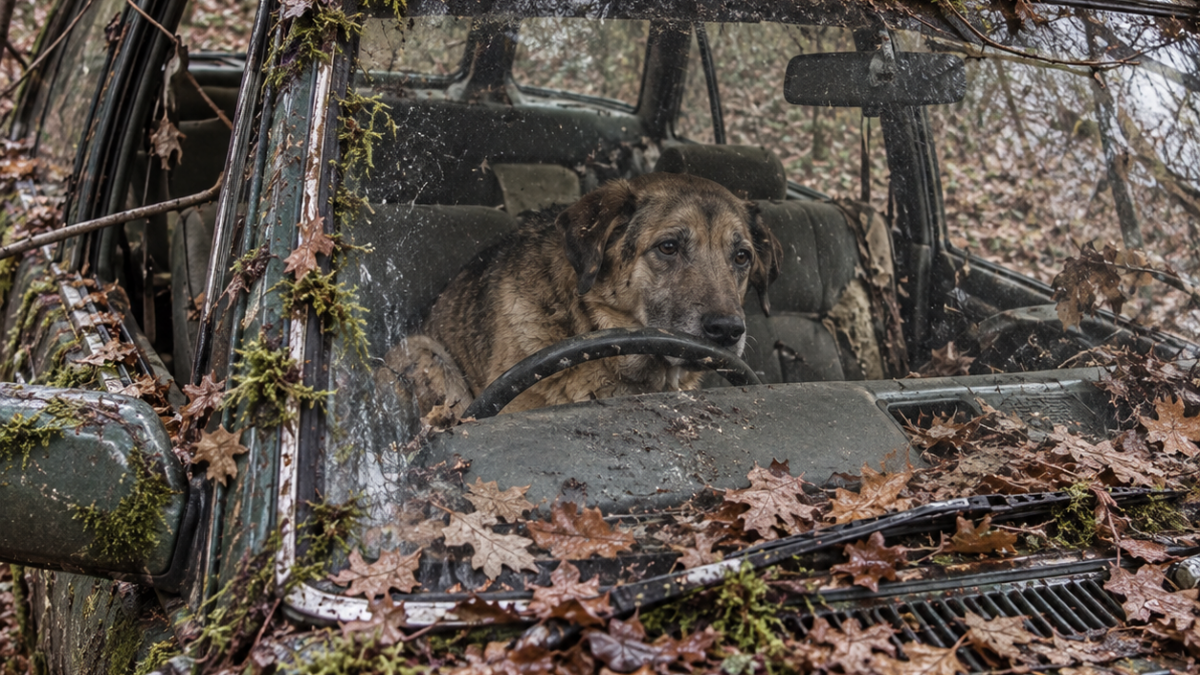
For ninety-three days, a starving dog slept behind the wheel of an abandoned station wagon, even though he was free to leave whenever he wanted.
Everyone thought he was simply waiting for the owner who had vanished into the mountains.
Then, when we tried to take him away, the old dog stood on shaking legs, looked toward the trees, and showed us we had misunderstood everything.
I saw the car before I saw Nestor.
The faded green station wagon was buried beneath fallen leaves beside an abandoned forestry road in the Vercors mountains of southeastern France. One front tire was completely flat. Branches scraped against the doors, and moss had begun creeping along the rocker panels.
The car belonged to Michel Delorme.
Sixty-eight years old.
Retired history teacher.
Missing for ninety-three days.
I had been part of the volunteer search effort almost from the beginning.
For nearly three months, teams had checked hiking trails, villages, hospitals, mountain shelters and isolated parking areas. Michel’s photograph had been taped inside cafés, pharmacies and grocery stores.
His phone had last connected to a tower somewhere in that enormous wooded region.
Then nothing.
The biggest problem was that nobody had found his car.
Without it, we couldn’t determine where Michel had actually started walking.
The day after his disappearance, a violent storm tore through the mountains. Trees came down across several forgotten forestry tracks. One huge pine had blocked the road where Michel’s car was eventually found.
Nobody had bothered clearing it because the road was officially closed to ordinary traffic.
Then, on a cold November morning, a forestry technician noticed something unnatural through the branches.
A reflection.
A straight line where nothing in the forest should have been straight.
He climbed over the fallen tree.
Beneath the leaves sat Michel’s station wagon.
And behind the windshield, two eyes were watching him.
Nestor was alive.
Barely.
He was a nine-year-old German Shepherd–Labrador mix, with a black saddle across his back, tan legs, one ear that folded slightly at the tip and a tiny white mark beneath his chin.
Michel’s daughter, Claire, had mentioned him in every missing-person interview.
She always repeated the same sentence.
“If you find Nestor, you’ll find my father.”
That morning, we had found only one of them.
When I opened the driver’s door, Nestor didn’t run.
He didn’t even growl.
He was so thin I could count his ribs through his coat. His hips looked enormous against his wasted body. Patches of fur were missing from his shoulders where he had rubbed against the center console.
Yet his eyes were alert.
His muzzle rested beside the handbrake, exactly where Michel’s right hand must have rested hundreds of times.
Everything inside the car told the same story.
Waiting.
The driver’s seat was worn in one particular spot where Nestor had curled himself night after night.
Dog hair covered the fabric.
Faint nose marks streaked the steering wheel.
He could have left.
The car wasn’t locked.
A damaged rear window gave him a way in and out even when the doors swung shut.
Around the vehicle, his paw prints created several narrow trails.
One descended toward a rocky depression where rainwater collected.
Another reached wild blackberry bushes.
A third led toward an abandoned picnic area where Nestor had apparently searched for scraps.
He had done whatever he could to survive.
Water.
Berries.
Insects.
Old food.
But he had never truly left the station wagon.
Every trail returned to the driver’s seat.
A veterinarian gave him small amounts of water, then placed soft food on the ground.
Nestor sniffed it.
He turned his head away.
We moved the bowl onto Michel’s seat.
Only then did he eat.
Three bites.
Maybe four.
Nobody said anything.
We all understood.
To Nestor, this wasn’t an abandoned car.
It was the last place where Michel still existed.
Then we tried to lead him toward the rescue vehicle.
Nestor backed away.
He looked toward the woods.
Slowly, painfully, he stood.
His rear legs buckled.
He caught himself.
Then he walked around the hood and entered a gap between the trees so narrow that I hadn’t even noticed it.
Twenty feet later, he stopped.
He turned.
Looked directly at us.
And waited.
“Luc,” one of the rescuers whispered beside me, “I think he wants us to follow him.”
Nestor took another step.
Then another.
He looked back again.
And in that instant, after ninety-three days of waiting, I realized he hadn’t stayed with Michel’s car because he didn’t know where his owner had gone.
He had stayed because the car was the one place from which he could keep returning to the same hidden trail.
A trail he had been waiting three months for someone else to follow.
PART 2
I grabbed my radio.
“Base, this is Luc. Hold the recovery vehicle.”
Static cracked.
“Repeat?”
“The dog is moving into the forest. Purposefully. We think he’s leading us somewhere.”
There was a pause.
Then our coordinator, Alain, answered.
“Do not lose sight of him.”
“I don’t intend to.”
I looked at the veterinarian.
Dr. Moreau was already shaking her head.
“He’s severely dehydrated. He shouldn’t be walking.”
Nestor took another step.
His rear paw dragged through the leaves.
Then he looked back at us.
Dr. Moreau sighed.
“I know.”
We followed.
There were six of us at first.
Me.
Alain.
Two mountain rescue volunteers.
A gendarme named Captain Renaud.
And Dr. Moreau.
Nestor moved slowly enough that we could stay close, but there was no uncertainty in him.
Every thirty or forty feet, he stopped.
Not to rest.
To make sure we were still there.
The trail barely existed.
Sometimes it disappeared beneath ferns.
Sometimes we had to duck under branches or step over fallen trunks.
Michel had apparently known the forest well enough to leave the official hiking routes.
That alone worried me.
Experienced hikers don’t usually wander without reason.
After fifteen minutes, Nestor began breathing heavily.
Dr. Moreau crouched.
“Enough.”
Nestor tried to continue.
She caught his harness gently.
“No.”
He pulled.
For a dog who had barely resisted us at the car, the change was startling.
He planted his front paws in the mud and strained forward.
“Nestor.”
He whimpered.
I knelt beside him.
“What is it, boy?”
His eyes remained fixed on the trees.
Then he barked.
One sharp bark.
The first sound I had heard from him.
Captain Renaud looked at me.
“How far do you think?”
“I don’t know.”
We had GPS units.
Radios.
Thermal equipment.
Search dogs had combed parts of these mountains weeks earlier.
Yet none of that mattered at that moment.
The only creature who seemed to know exactly where we were going weighed maybe half of what he should.
“We carry him,” I said.
Dr. Moreau looked at me.
“He may fight.”
“Then we’ll find out.”
I slid my arms beneath his chest and stomach.
The instant his paws left the ground, he panicked.
He twisted hard.
“Easy.”
He whined.
“Easy, Nestor.”
I turned his body so he faced forward.
Something changed.
He stopped struggling.
I carried him against my chest.
He was shockingly light.
Too light.
He kept his nose raised, smelling the wind.
Whenever we approached a fork in the faint trail, I lowered him enough that his front paws touched the ground.
He chose the direction.
Then I lifted him again.
For another twenty minutes, we descended.
The forest became darker.
Steeper.
The ground under the leaves turned slick.
Then Nestor suddenly began trembling.
Not from weakness.
Something else.
His entire body changed.
His ears rose.
His nose worked furiously.
He let out a low whine.
I set him down.
He stumbled forward.
“Careful.”
Nestor ignored me.
He moved between two limestone outcrops.
And stopped.
Ahead of us was a ravine.
Not enormous.
Maybe thirty feet deep.
But steep enough that a fall could easily kill someone.
At the bottom ran a narrow stream swollen by autumn rain.
Nestor stood at the edge.
Then barked.
Again.
Again.
Again.
Captain Renaud raised his binoculars.
“I don’t see anything.”
Nestor moved along the edge.
Twenty feet.
Thirty.
Then he stopped beside a tree whose roots had been partly exposed by erosion.
He began scratching.
Weakly.
His claws moved leaves aside.
Scratch.
Scratch.
Scratch.
Then he looked at us.
I approached.
At first, I saw nothing.
Then something beneath the leaves caught the light.
Metal.
I reached down.
It was a walking pole.
Blue.
Bent almost ninety degrees near the handle.
Claire had described Michel’s hiking equipment dozens of times.
Blue telescoping poles.
Black backpack.
Red rain jacket.
My stomach tightened.
“Renaud.”
He came beside me.
I held up the pole.
His face changed.
“Call it in.”
—
Within an hour, the ravine was filled with rescuers.
A rope team descended first.
Nestor tried to follow.
Dr. Moreau held him back.
“No, sweetheart.”
He whined.
I sat beside him.
“You brought us here.”
He stared downward.
“You did your job.”
But Nestor didn’t relax.
And soon we understood why.
The first team found blood.
Old.
Barely visible.
A dark stain beneath an overhang.
Then a torn piece of red waterproof fabric caught on a thorn bush.
Michel’s jacket.
But there was no body.
That changed everything.
If Michel had simply fallen, we expected to find him at the base of the ravine.
He wasn’t there.
We searched downstream.
Upstream.
Behind boulders.
Under fallen branches.
Nothing.
Then one of the rope technicians called from below.
“Captain!”
Renaud leaned over.
“What?”
“We’ve got footprints.”
“Human?”
“Looks like it.”
“How many sets?”
A pause.
“At least two.”
The forest went quiet around us.
Renaud’s expression hardened.
“Michel wasn’t alone.”
—
Claire arrived before sunset.
Nobody had wanted to call her until we knew more.
But when she learned the car had been found, there was no keeping her away.
I saw her coming down the blocked forestry road with a gendarme.
She was forty-one.
Dark hair.
Michel’s eyes.
The moment she saw the green station wagon, she stopped.
Her hand covered her mouth.
Then she saw Nestor.
The dog was lying on a blanket beside the rescue van with an IV line taped to his leg.
“Nestor.”
His head shot up.
The reaction was immediate.
His tail hit the blanket.
Once.
Twice.
Then his whole body tried to rise.
Dr. Moreau caught him.
“Slowly.”
Claire ran.
She dropped to her knees.
“Nestor.”
He pressed his face into her chest.
She made a sound I will never forget.
Not crying exactly.
Something deeper.
Three months of fear leaving a human body all at once.
She wrapped both arms around him.
“You’re alive.”
Nestor licked her chin.
“Oh my God, you’re alive.”
Then Claire looked over his shoulder.
At the forest.
Her expression changed.
“Where is my father?”
Nobody answered quickly enough.
She knew.
“You haven’t found him.”
Captain Renaud approached.
“We found evidence that Michel was in the ravine.”
“Evidence?”
“One of his hiking poles. Fabric matching his jacket.”
Claire stood.
“Where is he?”
“We don’t know yet.”
Her eyes moved from one face to another.
“You found the dog.”
“Yes.”
“You found Dad’s car.”
“Yes.”
“You found his pole.”
“Yes.”
“Then where is he?”
Renaud chose his words carefully.
“There are indications another person may have been present.”
Claire went completely still.
“What does that mean?”
“We don’t know yet.”
“What indications?”
“Footprints.”
“After ninety-three days?”
“Protected beneath the rock overhang.”
She stared at him.
“My father didn’t disappear.”
Renaud said nothing.
Claire’s voice lowered.
“Someone did something to him.”
“We are not prepared to say that.”
“You don’t have to.”
She turned toward the ravine.
Nestor whined.
Claire looked down at him.
Then something in her face shifted.
“Wait.”
She knelt again.
“Nestor.”
He looked at her.
“Where’s Dad?”
His ears rose.
“Where’s Michel?”
The dog turned toward the ravine.
Then away from it.
Toward the north.
Claire looked at me.
“He does that.”
“What?”
“When Dad asks him to find me, he looks in the direction I went.”
I crouched.
“Nestor.”
His nose lifted.
Claire repeated, “Find Michel.”
Nestor tried to stand.
Dr. Moreau looked horrified.
“No.”
But he stood.
Barely.
And he didn’t look toward the ravine.
He looked toward a ridge beyond it.
Captain Renaud followed his gaze.
“There are old charcoal-burner shelters up there.”
I knew what he meant.
Centuries earlier, workers had built crude stone huts throughout the mountains.
Most had collapsed.
Some remained half standing.
Few appeared on modern hiking maps.
“How far?”
“Two kilometers, maybe three.”
Claire looked at Nestor.
“He’s been going there.”
We all looked at her.
“How do you know?”
She pointed to his paws.
“The front pads.”
Dr. Moreau examined them.
Scarred.
Split.
Partly healed.
Then Claire touched his belly.
“Burdock seeds.”
Not from the area around the car.
Captain Renaud unfolded a map.
The northern ridge crossed a wetter, brush-covered valley.
Nestor had apparently traveled there repeatedly.
Then returned.
Always returned.
To the car.
Why?
At the time, I thought the answer was loyalty.
Later, I understood it was strategy.
Michel had taught him something years earlier.
Something nobody knew except Claire.
When they hiked together and became separated, Michel had trained Nestor to return to the vehicle.
The car was home base.
If Michel went missing, Nestor was supposed to search.
Then come back.
Never wander indefinitely.
Always come back to the car.
“He wasn’t waiting,” Claire whispered.
She looked at her exhausted dog.
“He was searching every day.”
—
The official team stopped us from continuing after dark.
Claire hated it.
So did I.
But the terrain was dangerous.
Nestor needed treatment.
And if another person had been involved in Michel’s disappearance, Captain Renaud wanted the area preserved.
They transported Nestor to a veterinary clinic.
Claire rode with him.
I stayed at the command post.
That night, I barely slept.
Rain tapped against the temporary operations trailer.
Maps covered the table.
Red circles marked every region previously searched.
Michel’s car had been hidden in the one corridor nobody had accessed properly after the storm.
Bad luck.
Or perhaps something more.
At 1:30 in the morning, Captain Renaud came in carrying a plastic evidence bag.
Inside was a small black object.
“What is that?”
“Camera memory card.”
“Where?”
“Ravine.”
My pulse quickened.
Michel always carried a compact camera.
Claire had mentioned it because her father hated taking photos on a phone.
“Camera?”
“Not found.”
“Can you recover anything?”
“Forensics will try.”
Renaud sat.
He looked exhausted.
“There was something else.”
He laid photographs on the table.
Tire tracks.
Not Michel’s.
A larger vehicle.
Deep tread.
Off-road.
“Could be forestry.”
“Could be.”
“But you don’t think so.”
“Not on that trail.”
I stared at the photos.
“What was Michel doing out there?”
“Hiking.”
“He hiked everywhere.”
Renaud’s eyes remained on me.
“His daughter says he was also documenting illegal dumping.”
I hadn’t known that.
“What kind?”
“Construction waste. Oil drums. Old insulation. Somebody had been dumping material on protected land.”
“Michel reported it?”
“Several times.”
“To whom?”
“Municipality. Forestry office.”
“And?”
“Inspections found nothing.”
That didn’t make sense.
Unless someone removed the evidence before inspections.
Or somebody knew exactly when inspectors were coming.
Renaud gathered the photographs.
“Get some sleep.”
“You think that’s connected.”
“I think ninety-three days is a long time to make assumptions.”
That meant yes.
—
At dawn, Nestor returned.
Dr. Moreau hated the idea.
But Claire insisted he could ride with the search team rather than walk.
He had eaten nearly half a can of recovery food.
For Nestor, that counted as progress.
We carried him across the ravine using a rescue basket.
On the other side, I placed him gently on the ground.
“Find Michel.”
He sniffed.
Then turned north.
We followed.
This time, there were fifteen people.
Two search dogs.
Gendarmes.
Medical personnel.
Nestor still led.
At first, I wondered whether we were asking too much.
Then we reached a patch of thick burdock.
The same seeds in his fur.
After that, doubt disappeared.
Nestor had been here.
Many times.
We found his paw prints preserved in soft soil beneath overhanging rocks.
Old and new.
Some large and deep from before he had lost weight.
Others faint.
Recent.
For ninety-three days, he had made this journey.
Car.
Ravine.
Ridge.
Car.
Again.
Again.
Again.
Then we found the first food wrapper.
It was tucked beneath a stone ledge.
Protein bar.
Expiration date current.
Captain Renaud picked it up with gloves.
“Michel carried these?”
Claire examined it.
“Yes.”
“Brand?”
“Exactly.”
Ten minutes later, we found another.
Then an empty foil medication packet.
Heart tablets.
Michel took medication for an irregular heartbeat.
Claire’s eyes filled.
“He survived the fall.”
Nobody wanted to say it.
But we were all thinking it.
Michel had survived.
At least for a while.
Maybe days.
Maybe weeks.
The possibility was both hopeful and cruel.
If he survived, why had he never returned?
The answer came another half mile up the ridge.
Blood on a stone.
Much fresher than the stain in the ravine.
Renaud crouched.
“Don’t touch.”
Claire whispered, “How fresh?”
“I don’t know.”
“But not three months.”
“No.”
Hope became something dangerous.
Michel might still be alive.
After ninety-three days.
Impossible.
Except suddenly it wasn’t.
—
We reached the first stone hut just before noon.
Collapsed roof.
Empty.
The second was little more than three walls.
Empty.
Then Nestor began whining inside the rescue basket.
I opened the gate.
He pushed out.
Dr. Moreau protested.
But he was already moving.
Thirty yards farther, beneath a slope covered in fir trees, stood a third structure.
Unlike the others, this one had been repaired.
Recent wooden boards covered part of the roof.
A blue tarp hung over the doorway.
Captain Renaud raised his fist.
Everyone stopped.
He drew his sidearm.
That changed the atmosphere instantly.
“Claire stays back.”
“No.”
“Ms. Delorme.”
“My father—”
“Stays back.”
Two gendarmes moved ahead.
Nestor growled.
Low.
His fur rose along his spine.
I had never heard him growl before.
Not when strangers opened his car.
Not when veterinarians examined him.
Not when we carried him through the forest.
But he growled at that hut.
Renaud noticed.
“So did I,” I whispered.
One gendarme called out.
“Gendarmerie!”
No response.
Again.
“Anyone inside?”
Silence.
They reached the tarp.
Pulled it aside.
A smell came out.
Smoke.
Sweat.
Damp wool.
Human habitation.
Renaud disappeared inside.
Five seconds.
Ten.
Then:
“Medic!”
Claire screamed.
“Dad!”
She ran.
Nobody could stop her.
I followed.
Inside, light came through gaps in the roof.
There was an old camp cot.
Plastic water containers.
Blankets.
Food tins.
And against the far stone wall lay a man with a gray beard and a face so thin I almost didn’t recognize him from the missing posters.
Michel Delorme.
Alive.
Claire collapsed beside him.
“Dad!”
Michel’s eyes opened.
Barely.
His lips moved.
No sound.
“Dad, it’s me.”
His gaze shifted.
Past Claire.
Toward the doorway.
Nestor stood there.
The dog froze.
Michel raised one trembling hand.
“Nes…”
That was all he managed.
Nestor crossed the room.
Not running.
He didn’t have enough strength.
But faster than I had seen him move in three months.
He reached Michel.
Pressed his nose into the old man’s hand.
Michel’s fingers closed weakly around his muzzle.
And Nestor lay down beside him.
Claire sobbed.
Michel turned his face toward the dog.
“You stayed.”
Nestor licked his wrist.
Michel’s eyes closed.
For one horrifying second, I thought we had found him only to lose him.
The medic shouted.
“Give me room!”
We moved.
Claire refused to release Michel’s hand.
Nestor refused to leave his side.
The medics worked around both of them.
Blood pressure dangerously low.
Severe weight loss.
Infected wound on his left leg.
Two fractured ribs that had partly healed.
Dehydration.
Malnutrition.
Possible pneumonia.
But alive.
Ninety-three days.
Alive.
Then one medic lifted Michel’s jacket.
And we saw something that told us the story wasn’t over.
Around Michel’s left ankle was a length of chain.
Broken.
—
Captain Renaud’s face changed.
“Everybody out except medical.”
Claire stared at the chain.
“What is that?”
“Claire.”
“Who chained him?”
Michel’s eyes opened.
Fear flashed through them.
He whispered a name.
So softly I barely heard it.
“Vautrin.”
Renaud did.
His head snapped up.
“Pascal Vautrin?”
Michel closed his eyes.
One tiny nod.
I knew the name.
Everybody in that part of the Vercors did.
Pascal Vautrin owned a road construction company.
His trucks handled municipal contracts.
Snow clearance.
Drainage work.
Forest access roads.
He also sponsored youth football, donated to local festivals and smiled beside mayors in newspaper photographs.
And his trucks could go almost anywhere in those mountains without attracting attention.
Including closed forestry roads.
Renaud stepped outside and reached for his radio.
“Command, lock down every exit from sector north-seven.”
A voice answered.
“Reason?”
“Possible unlawful confinement connected to Delorme disappearance.”
Claire stared at him.
“You knew the name.”
“I knew of him.”
“What did he do to my father?”
“We need Michel stable.”
She pointed toward the broken chain.
“Look at his ankle!”
“I see it.”
Nestor growled again.
This time toward the back wall.
I followed his gaze.
There was a wooden crate.
Renaud entered again.
He opened it.
Inside were batteries.
Food cans.
A flashlight.
And Michel’s camera.
—
The memory card recovered from the ravine had been damaged.
The camera had another card inside.
That one changed everything.
But we didn’t know how much until hours later.
Michel was evacuated by helicopter.
Claire went with him.
Nestor couldn’t.
Dr. Moreau transported him by road.
Before they separated, Michel insisted the stretcher be lowered.
He reached toward Nestor.
The dog put his chin into Michel’s palm.
Michel whispered, “Home.”
Nestor’s tail moved.
Claire bent close.
“I’ll bring him.”
Michel closed his eyes.
The helicopter lifted.
Nestor watched until the sound disappeared.
Then, for the first time since we found him, he walked willingly into another vehicle.
He had finished waiting.
Michel had been found.
Now the truth had to be.
—
Michel spent four days in intensive care.
For the first twenty-four hours, he was too weak to give a full statement.
The doctors said his survival bordered on extraordinary.
But when we reconstructed those ninety-three days, it became less miraculous and more a brutal combination of skill, stubbornness, water and one dog who refused to stop searching.
Michel had set out that August morning to photograph what he believed was illegal dumping inside protected forest land.
He had seen Vautrin company trucks there before.
Michel was obsessive about local history and conservation.
Retirement had given him time.
Too much time, Claire sometimes joked.
He noticed things other people ignored.
Fresh tire tracks on closed roads.
Oil residue near streams.
Construction rubble where none should exist.
He submitted complaints.
The dumping stopped before inspections.
Then began again afterward.
Michel became convinced someone inside the local administration was warning Vautrin.
So he bought a wildlife camera.
Then another.
He photographed trucks at night.
License plates.
Drivers.
Barrels.
One image showed a worker burying containers instead of hauling them to regulated disposal sites.
Another showed asbestos roofing sheets dumped beneath soil.
Michel didn’t know whether the material was dangerously contaminated.
He knew enough to keep documenting it.
On the morning he disappeared, Nestor went with him.
Michel parked on the old forestry road.
He hiked toward the ravine after hearing machinery.
There, he photographed one of Vautrin’s trucks.
A driver saw him.
Michel walked away.
He didn’t run.
That probably saved him from immediate violence.
Then Pascal Vautrin himself arrived in a pickup.
Michel knew him socially.
They had attended municipal meetings together.
Michel later remembered Vautrin smiling.
“Professor.”
Michel replied, “Pascal.”
Vautrin asked what he was doing.
Michel said, “Walking.”
Vautrin looked at the camera hanging around his neck.
“With a telephoto lens?”
Michel didn’t answer.
Vautrin asked to see the photographs.
Michel refused.
The argument escalated.
Michel turned to leave.
One of Vautrin’s employees grabbed his backpack.
Nestor lunged.
Not biting.
Warning.
The employee kicked dirt toward him.
Michel shouted.
Then the men struggled.
Michel fell.
He tumbled into the ravine.
That explained the broken walking pole.
The blood.
The torn jacket.
He was conscious at the bottom.
His ribs were broken.
His leg was badly cut.
Nestor scrambled down a gentler section and reached him.
Michel remembered telling the dog:
“Car.”
Nestor refused.
Michel told him again.
“Car, Nestor.”
It was their emergency command.
Return to the vehicle.
Wait.
Nestor climbed out.
Michel expected search teams within hours.
They never came.
Because Vautrin’s employee drove Michel’s station wagon farther down the closed track, behind the fallen pine.
That was the first act of concealment.
The second was worse.
—
That night, Vautrin returned.
Michel heard voices.
He thought rescuers had come.
Instead, two men climbed into the ravine.
They carried him out.
For a brief moment, Michel believed guilt had changed their minds.
Then Vautrin said something he would later repeat word for word to investigators.
“You should have stayed retired.”
They took Michel’s camera.
Searched his backpack.
Asked where the copies were.
Michel refused to answer.
Because there were copies.
His wildlife cameras uploaded low-resolution images whenever they detected a mobile signal.
Not consistently.
But sometimes.
Michel had also mailed printed photographs to himself.
Old-school insurance.
History teachers trust documents.
Vautrin did not know that.
They took Michel to the stone hut.
At first, according to Michel, Vautrin claimed they only wanted time to “sort this out.”
But Michel’s injury became infected.
He developed fever.
One employee, a man named Étienne Roche, panicked.
He wanted to take Michel to a hospital.
Vautrin refused.
“You take him in now, we’re finished.”
Michel heard the argument.
That was the moment he realized they might let him die.
They chained his ankle to a metal ring in the floor.
Not continuously.
When someone came with food, the chain was secured.
When nobody was there, sometimes it wasn’t.
But Michel was initially too injured to walk far anyway.
Nestor found him on the second day.
That detail broke Claire when her father finally told it.
The dog had followed scent from the ravine.
Michel woke to scratching outside the hut.
Then a whine.
“Nestor?”
The tarp moved.
The dog pushed through.
Michel cried.
Nestor climbed onto the cot and pressed against him.
For hours, they stayed together.
Michel shared part of his food.
Then, before dark, he told Nestor:
“Car.”
Because rescuers would look for the dog.
Because the dog could lead them.
Nestor resisted.
Michel insisted.
“Car.”
Nestor returned to the station wagon.
Nobody came.
So the next morning, he went back to Michel.
Then returned to the car.
Every day.
Sometimes twice.
The route we had followed wasn’t random.
It was a bridge.
Nestor had spent ninety-three days moving between the missing man and the place where humans were most likely to find him.
At first, Vautrin’s men tried to chase the dog away from the hut.
Nestor became cautious.
He stopped approaching when vehicles were present.
He learned to wait in the brush.
Michel sometimes left scraps for him.
Later, as Vautrin’s visits became less frequent, Nestor could stay longer.
He still returned to the car.
Always.
Michel had trained him too well.
—
“Why didn’t Vautrin kill him?”
I asked Captain Renaud.
We were standing outside the hospital two days after Michel regained enough strength to speak.
Renaud looked uncomfortable.
“Probably because murder is different from everything else he thought he was doing.”
“Kidnapping isn’t exactly a misunderstanding.”
“No.”
“But he left a sick sixty-eight-year-old chained in a mountain hut.”
“Yes.”
“That’s attempted murder.”
“That’s for the prosecutor.”
I hated the answer.
Renaud saw it.
“You want something simple.”
“I want him punished.”
“So do I.”
He lowered his voice.
“But if we rush, he walks.”
That quieted me.
Renaud continued.
“Vautrin says Michel blackmailed him.”
“What?”
“He claims Michel demanded money not to release the photographs.”
“That’s absurd.”
“Probably.”
“Probably?”
“Evidence, Luc.”
There was that word again.
Evidence.
Vautrin had already hired lawyers.
He admitted confronting Michel.
Denied pushing him.
Denied ordering his confinement.
Claimed Roche and another employee acted without his knowledge.
Every criminal story becomes complicated the moment lawyers enter it.
But Michel had spent his life teaching history.
He understood something Vautrin didn’t.
Memory can be attacked.
Documents are harder.
And Michel had left documents everywhere.
—
The first was inside a book.
Claire found it while searching her father’s house.
Michel owned thousands of books.
Most had notes inside.
Dates.
Names.
Questions.
In a volume about resistance networks in the Vercors during World War II, Claire found an envelope.
On the front:
**IF SOMETHING HAPPENS TO ME.**
Inside were printed photographs.
Vautrin trucks.
Dates.
GPS coordinates.
Waste containers.
A list of vehicle registrations.
Copies of emails Michel had sent to officials.
And one handwritten sentence:
**Someone is warning them before every inspection. Find out who receives the complaints first.**
That shifted the investigation.
The environmental dumping was no longer just about Vautrin.
Someone inside local government might be helping him.
Investigators traced Michel’s complaints.
Almost all had passed through the office of Deputy Mayor Gérard Faure.
Faure denied wrongdoing.
Then phone records showed repeated calls between Faure and Vautrin shortly after Michel submitted complaints.
Once could be coincidence.
Twice could be explanation.
Seven times became difficult.
Still, calls weren’t enough.
Then the wildlife cameras were recovered.
Michel had hidden three.
Vautrin’s crew found only one.
A second contained nothing useful.
The third had been strapped high in a tree, angled downward.
It captured Vautrin’s pickup.
Roche.
Another employee.
And Deputy Mayor Faure.
Not once.
Three times.
One photograph showed Faure standing beside drums marked with hazard labels.
Another showed Vautrin handing him an envelope.
That image appeared in newspapers months later.
It ended Faure’s political career before the trial even began.
But the photograph that mattered most to Claire wasn’t about money.
It showed Michel.
The day he disappeared.
Date and time stamped.
Walking toward the ravine.
Nestor beside him.
Eleven minutes later, the camera captured Vautrin’s truck following.
Forty-three minutes after that, it showed Vautrin’s employee driving Michel’s station wagon away from the direction Michel had parked it.
The lie collapsed.
—
Vautrin was arrested.
Roche was arrested.
The second employee, Thierry Malbec, initially fled.
Police found him three days later at his brother’s house near Lyon.
Deputy Mayor Faure resigned and was later charged in connection with the illegal dumping and corruption investigation.
The newspapers called it the Delorme Affair.
Michel hated that name.
“It sounds like I had an affair,” he told Claire from his hospital bed.
It was the first joke he made after being found.
Claire laughed so hard she cried.
Nestor was allowed to visit him a week later.
Hospital administrators resisted.
Claire argued.
Doctors argued.
A nurse quietly solved the problem.
She brought them into a private rehabilitation courtyard.
Michel sat in a wheelchair beneath a blanket.
He looked twenty years older than his missing posters.
Nestor entered through the gate.
He stopped.
Michel lifted one hand.
“Hey, old thief.”
Nestor ran.
This time, truly ran.
For maybe ten yards.
Then he reached Michel and put both front paws on his knees.
Michel folded over him.
The dog trembled.
So did the man.
“You stupid animal.”
Nestor licked his beard.
“You were supposed to get help.”
Claire stood behind them crying.
I said, “He did.”
Michel looked at me.
“Eventually.”
“He only had to wait ninety-three days for us humans to catch up.”
Michel smiled.
Then he looked at Nestor.
“I owe you.”
Nestor sneezed in his face.
Michel laughed.
It hurt his ribs.
He laughed anyway.
—
Recovery was slow.
Michel had lost thirty-one pounds.
The infection in his leg had damaged muscle.
He needed surgery.
Then another procedure.
For months, he walked with a cane.
Nestor recovered faster physically.
Emotionally, not so quickly.
At Claire’s house, he refused to sleep anywhere except beside the front door.
If Michel went into another room and Nestor couldn’t follow, he panicked.
If a car engine started outside, he stood immediately.
The first time Michel left for a doctor’s appointment without him, Nestor scratched the door until his paws bled.
So they changed the routine.
Michel showed him the car.
Let him sniff it.
Then said:
“Home.”
Claire remained with Nestor.
Michel returned two hours later.
The dog exploded with relief.
They repeated it.
Again.
Again.
Slowly, Nestor relearned something he had forgotten in those ninety-three days.
People could leave.
And still come back.
—
The preliminary hearings began the following spring.
I attended one.
So did Claire.
Michel sat in the front row.
Nestor couldn’t enter the courthouse, of course.
Claire’s husband waited outside with him.
Vautrin looked smaller without his work crews, trucks and mountain roads around him.
Just a man in a dark suit beside two attorneys.
When Michel entered, Vautrin stared.
Michel stared back.
No drama.
No shouting.
Just two old men looking at each other.
Except only one had been expected to survive long enough to be there.
During a recess, Vautrin’s attorney approached Michel.
I was nearby.
“Mr. Delorme.”
Michel turned.
“My client has authorized me to discuss a possible civil resolution.”
Michel blinked.
“A what?”
“Compensation.”
Claire stepped forward.
“For kidnapping him?”
“Claire.”
Michel raised one hand.
The lawyer continued.
“Without prejudice to the criminal proceedings.”
Michel looked amused.
“How much am I worth?”
The attorney avoided answering directly.
Michel said, “Tell Pascal something for me.”
“I can’t relay threats.”
“It’s not a threat.”
Michel leaned on his cane.
“Tell him I spent thirty-five years teaching seventeen-year-olds that powerful men often believe history belongs to whoever controls the story.”
The attorney waited.
Michel continued.
“They’re usually wrong.”
Then he walked away.
That was Michel’s revenge.
Not violence.
Not screaming.
Not seeing Vautrin afraid.
Standing alive inside the courthouse while the evidence spoke for him.
—
Roche eventually cooperated.
That destroyed Vautrin’s final defense.
He admitted Vautrin ordered them to move Michel’s car.
Admitted they carried Michel from the ravine.
Admitted Vautrin ordered the chain.
Admitted Faure warned them before environmental inspections.
Roche claimed he had secretly left extra food and antibiotics at the hut because he believed Michel would die.
Michel confirmed someone had occasionally left medication without speaking to him.
It probably saved his life.
Roche still went to prison.
Cooperation reduced his sentence.
It didn’t erase what he had done.
Vautrin was convicted on multiple charges connected to Michel’s confinement, evidence destruction, environmental offenses and conspiracy.
Faure was convicted separately on corruption-related offenses.
The company lost several municipal contracts.
Cleanup costs for the contaminated sites ran into hundreds of thousands of euros.
Property was seized to satisfy penalties and restitution.
The protected forest was excavated in sections.
Dozens of buried waste containers were removed.
For years, Vautrin had saved money by treating the mountain like a private dump.
In the end, the mountain cost him almost everything.
Claire once asked Michel whether that made him happy.
Michel thought for a long time.
Then said:
“No.”
She looked surprised.
“Nothing?”
“I’d rather none of it happened.”
He scratched Nestor behind the ears.
“But since it did, I’m glad he can’t do it again.”
That answer stayed with me.
Revenge makes a good story.
Justice makes a better ending.
—
The most emotional moment didn’t happen in court.
It happened at the station wagon.
Almost a year after Michel disappeared, the police finally released the car from evidence.
Insurance wanted to write it off.
Michel refused.
Claire thought he was crazy.
“That thing spent three months under a tree.”
“So did Nestor, more or less.”
“It smells.”
“So does Nestor.”
Nestor looked offended.
They had the tire replaced.
The interior professionally cleaned.
The moss removed.
The scratches stayed.
Michel insisted.
“Why?” Claire asked.
“Because they’re part of it.”
The driver’s seat had to be replaced.
Michel said no.
That was the one thing he absolutely refused.
The upholstery was torn.
Stained.
Covered with damage from Nestor’s claws.
Michel put a seat cover over it.
Nothing more.
Then, one cool morning, he drove the station wagon back to the place where we’d found it.
I went with him.
Claire followed in another car.
Nestor rode in the passenger seat.
Not the driver’s seat.
That mattered.
Michel parked before the fallen pine, which had been cut away months earlier.
Nobody spoke.
Nestor looked out the windshield.
His breathing changed.
Claire noticed.
“Dad.”
“I know.”
Michel opened the door.
Nestor didn’t move.
“Nestor.”
The dog stared at the forest.
Michel stepped out.
He walked around the car.
Opened the passenger door.
Nestor remained frozen.
Michel crouched.
His bad leg made it difficult.
“You don’t have to wait here anymore.”
Nestor looked at him.
Michel held out his hand.
“Come on.”
The dog stepped down.
He immediately circled toward the driver’s side.
Sniffed the old door.
Then walked toward the trees.
We followed.
Not all the way to the hut.
Only a few hundred yards.
Nestor reached the beginning of the hidden trail.
Stopped.
He looked down it.
For months, that trail had meant one thing.
Find Michel.
Return to the car.
Find Michel.
Return.
Michel stood beside him.
“It’s over.”
Nestor looked up.
Michel tapped his leg.
“Home.”
Nestor turned.
And walked back toward the station wagon.
No hesitation.
No looking behind him.
He reached the car.
Then climbed into the passenger seat.
Claire began crying.
Michel looked at me.
I probably was too.
He closed Nestor’s door.
Then got behind the wheel.
For the first time since his disappearance, Michel drove his own car out of that forest with his dog beside him.
—
Nestor lived another four years.
People often expected something dramatic when they heard that.
As though a dog who survived ninety-three days in the wilderness should spend the rest of his life doing heroic things.
He didn’t.
He slept.
A lot.
He became fat enough that Dr. Moreau eventually told Michel to stop “compensating for the starvation with cheese.”
Michel ignored her for several months.
Nestor stole bread from the kitchen counter.
He barked at the mail carrier.
He hated baths.
He developed arthritis.
He slept beside Michel’s chair while Michel read.
He rode everywhere in the station wagon.
Passenger seat only.
Never the driver’s seat again.
He no longer had to keep it warm.
Every summer, Michel and Claire took him to a small lake.
Nestor loved standing chest-deep in the water.
He rarely swam.
He just stood there.
Michel claimed he was “contemplating history.”
Claire said he was cooling his belly.
Nestor never clarified.
There were nightmares.
For both of them.
Sometimes Michel woke believing he was chained in the stone hut.
Sometimes Nestor woke barking and ran to the front door.
Michel would sit on the floor beside him.
“I’m here.”
That became their phrase.
Not “It’s okay.”
Not “Don’t be afraid.”
Just:
“I’m here.”
Because after everything they had survived, presence was enough.
—
Three years after the trial, I visited Michel.
He was seventy-two by then.
He walked without a cane most days.
The history teacher in him had returned completely.
His kitchen table was covered in documents for a local conservation group.
“You learned nothing,” I told him.
“About?”
“Leaving things alone.”
He looked offended.
“Civilization collapses when people leave things alone.”
Nestor snored beneath the table.
“Your bodyguard disagrees.”
Michel nudged the dog gently with his shoe.
Nestor opened one eye.
“He’s retired.”
“From what?”
“Search and rescue.”
“He rescued one person.”
“The important one.”
I laughed.
Then Michel became quiet.
“I sometimes wonder why he stayed.”
“At the car?”
“Yes.”
“You trained him to.”
“No.”
He shook his head.
“I trained him to return to the car. Not starve there.”
He looked down at Nestor.
“He could have gone to a village.”
“Maybe.”
“He could have followed people.”
“Maybe.”
“He knew where I was.”
“Yes.”
Michel’s expression changed.
“You know what I think?”
“What?”
“I think every time he came back and didn’t find anyone, he believed he’d failed.”
I hadn’t thought about that.
Michel rubbed his face.
“Ninety-three days.”
Nestor’s tail moved in his sleep.
Michel whispered, “That’s a long time to keep trying.”
I said, “He didn’t fail.”
“I know.”
“He brought us to you.”
“I know.”
“He probably saved your life just by visiting. You said he helped keep you warm.”
Michel nodded.
Some nights in the stone hut, when temperatures dropped, Nestor had curled against him.
Especially after the visits became less supervised.
Michel had hidden pieces of food for him.
Nestor had given him body heat.
Company.
A reason not to stop fighting.
Michel once told investigators that the worst part of captivity wasn’t pain.
It was the belief nobody knew where he was.
Nestor changed that.
Every time the dog returned, Michel knew someone in the world still remembered.
Michel looked at me.
“I think he saved me before he ever brought you there.”
I nodded.
“Yes.”
“So who saved him?”
That answer was easier.
“You did.”
Michel frowned.
“I was chained to a wall.”
“You gave him somewhere to return to.”
Michel looked down at the sleeping dog.
Neither of us spoke for a while.
—
Nestor’s final winter was gentle.
He was thirteen.
Nearly fourteen.
His face had turned almost completely gray.
His hearing faded.
His back legs weakened.
Michel installed carpet runners throughout the house so he wouldn’t slip.
Claire bought a support harness.
Nestor hated it.
Some things never change.
Then, one February morning, he couldn’t stand.
Michel called Dr. Moreau.
She came to the house.
The diagnosis wasn’t surprising.
Age.
Severe arthritis.
Neurological decline.
There were treatments.
But not cures.
Nestor still ate.
Still wanted affection.
Still enjoyed lying in sunlight.
So they gave him time.
Weeks.
Then months.
Spring arrived.
He improved enough to walk slowly through the yard.
Michel followed him everywhere.
People joked that the roles had reversed.
Once, Nestor had refused to leave Michel.
Now Michel refused to leave Nestor.
In May, Nestor stopped eating.
Not completely.
Cheese still worked.
Michel laughed when I visited.
“Apparently terminal illness has standards.”
But the laugh didn’t reach his eyes.
We all knew.
One evening, Claire called me.
“Tomorrow.”
I understood.
I went to Michel’s house the next morning.
The green station wagon was parked outside.
Nestor lay in the yard beneath an apple tree.
Michel sat beside him.
Claire was on his other side.
Dr. Moreau arrived at ten.
It was warm.
Birds moved through the branches.
Nestor’s breathing was shallow.
Michel kept one hand on his chest.
“You know,” he said, “he always hated when I told this story.”
Claire smiled through tears.
“Dad, he’s a dog.”
“He’d leave the room.”
“Because you talked for forty-five minutes.”
“I provided context.”
Nestor opened his eyes.
Michel laughed softly.
“See?”
I sat in the grass.
For a while, nobody said anything.
Then Michel reached into his pocket.
He pulled out his old car keys.
The same keys from the station wagon.
He placed them near Nestor’s nose.
The dog sniffed them.
His tail moved once.
Michel broke.
He bent over him.
“No more waiting.”
Those words brought me back instantly.
The car.
The leaves.
The worn driver’s seat.
The starving dog who refused to leave.
Michel pressed his forehead against Nestor’s.
“You hear me?”
Nestor breathed slowly.
“You don’t wait for me this time.”
Claire covered her mouth.
Michel’s voice cracked.
“You go first.”
Nestor licked his thumb.
“I’ll find you.”
Dr. Moreau gave the sedative.
Nestor relaxed.
Michel kept talking.
He talked about their first walk.
The lake.
The stolen bread.
The forest.
Even the station wagon.
Then he said:
“You did enough.”
Nestor’s breathing slowed.
“You found me.”
A pause.
“You brought me home.”
The final injection was given.
Nestor exhaled.
Michel whispered:
“I’m here.”
And Nestor was gone.
—
For a long time, Michel didn’t move.
Eventually, he placed the old car keys against Nestor’s collar.
Claire asked why.
Michel said, “He guarded them for ninety-three days.”
When Nestor was cremated, Michel kept those keys.
He mounted them in a small wooden frame beside one photograph.
Not the photograph of Nestor starving inside the car.
Michel hated that picture.
Instead, he chose one taken two years later.
Nestor sitting in the passenger seat.
Window open.
Tongue out.
Michel visible behind the wheel.
Underneath, Claire added a small brass plate.
It said:
**HE CAME BACK UNTIL WE FOLLOWED.**
—
Michel still lives near the Vercors.
The protected dumping site has been restored.
Young trees grow where contaminated soil was removed.
A hiking route now passes near the area, though the stone hut itself was demolished after the investigation.
Michel supported that decision.
Some places don’t need monuments.
The forest remembers enough.
Every year, on the anniversary of his rescue, Michel drives the old station wagon to the entrance of the forestry road.
He doesn’t go far.
He parks.
Gets out.
Walks a short distance.
Then returns.
The passenger seat remains empty.
Once I asked why he keeps the car.
He looked at me as though the answer were obvious.
“Nestor kept it for me.”
The upholstery is old.
The paint has faded.
There are scratches along the doors from branches.
If you looked at it without knowing the story, you would see nothing special.
Just an aging green station wagon.
But I can’t look at that driver’s seat without remembering the morning we found it.
The leaves.
The cold.
The thin dog behind the windshield.
The way his muzzle rested beside the handbrake.
The way he refused to eat until we placed food where Michel used to sit.
The way he pulled away when we tried to rescue him.
At first, I thought he was confused.
Traumatized.
Unable to let go of the last place he’d seen his owner.
I was wrong.
Nestor hadn’t stayed because he was waiting helplessly.
He had created a system.
Search.
Return.
Search.
Return.
The car was his anchor.
The hidden trail was his mission.
And every day for ninety-three days, he kept both alive.
He drank rainwater.
Ate berries and scraps.
Lost almost half his body weight.
Crossed steep terrain on bleeding paws.
Visited the man he loved.
Returned to the place where help should eventually arrive.
Then did it again.
People like to say dogs are loyal.
The word feels too small after Nestor.
Loyalty sounds passive.
Nestor’s wasn’t.
His loyalty walked miles.
It starved.
It learned.
It adapted.
It waited when waiting was useful.
It searched when searching was necessary.
And when humans finally arrived, it stood on legs that could barely hold him and said, in the only language he had:
Follow me.
Michel once spent thirty-five years teaching history.
In the end, his greatest lesson never came from a textbook.
It came from a dog sleeping alone inside an abandoned car.
Powerful men tried to hide what they had done.
They moved the car.
Destroyed evidence.
Lied.
Buried waste beneath the mountain.
Chained a witness where they thought nobody would ever find him.
They believed distance and time would erase the truth.
But they forgot one thing.
Michel had brought Nestor.
And Nestor didn’t understand corruption.
He didn’t understand fear.
He didn’t understand why powerful people expected silence.
He understood only one fact.
His person was still in the forest.
So he kept going back.
And because he kept going back, we eventually followed.
Because we followed, Michel came home.
Because Michel came home, his evidence survived.
Because the evidence survived, the men who thought they could bury the truth eventually stood in court and answered for it.
That was the real revenge.
Not violence.
Not hatred.
Not watching another person suffer.
It was a starving old dog refusing to let the truth disappear.
It was Michel walking out of the hospital.
It was Claire getting her father back.
It was contaminated land being cleaned.
It was contracts canceled.
Corrupt officials exposed.
Men who had believed themselves untouchable discovering that one retired teacher had documented everything.
And it was Nestor, years later, sleeping in the passenger seat while Michel drove.
No longer waiting.
No longer searching.
Just going home.
I was there the morning we found him.
I still remember opening that driver’s door and seeing an animal so thin I was afraid touching him might hurt.
I remember thinking we had arrived too late.
I remember believing his stubborn refusal to leave the car was grief.
But some dogs mourn by waiting.
Nestor was doing something else.
He was holding a line between two worlds.
Between where Michel had disappeared and where someone might finally come looking.
For ninety-three days, he kept that line unbroken.
And when help finally arrived, Nestor didn’t celebrate.
He didn’t collapse.
He didn’t ask us to save him first.
He stood.
Looked toward the trees.
Then walked.
That is how I remember him.
Not starving behind a windshield.
Not old beneath an apple tree.
But moving into the forest on trembling legs.
Stopping every few yards.
Turning his head.
Making sure we were still behind him.
As if he had been waiting ninety-three days to tell us one simple thing.
You finally came.
Now follow me.
He’s still out there.
And this time, I’m not going back without him.
The last time I saw the green station wagon on that forest road, the passenger seat was empty.
Michel had parked beneath the same wall of fir trees where, years earlier, we had found Nestor half-starved behind the windshield.
It was late autumn again.
The kind of morning when the mountains seem to hold their breath.
Mist hung low between the trees, and every step through the leaves released the smell of wet earth.
Michel got out slowly.
Age had changed him.
The man who had once hiked these ridges for hours now carried a folding cane in the back of the car. His hair was almost completely white, and the old injury in his leg returned whenever the weather turned cold.
But he refused the cane that morning.
He stood beside the car and stared through the windshield.
I knew what he was seeing.
Not the empty passenger seat.
Nestor.
Head out the window.
One folded ear lifting in the wind.
Eyes bright.
Waiting for Michel to start the engine.
“He used to know the moment I picked up these keys,” Michel said.
He held them in his palm.
The old metal key ring made a faint sound when his hand trembled.
“He could be asleep in another room. Didn’t matter. One jingle and he’d be at the door.”
I smiled.
“He probably thought you weren’t qualified to travel alone.”
Michel looked at me.
“He was right.”
Then he turned toward the forest.
For several minutes, neither of us moved.
There were some memories that became easier when spoken aloud.
Others became heavier.
This forest carried both kinds.
Michel finally started walking.
I followed.
We stopped where the old hidden trail began.
Years earlier, Nestor had stood there on shaking legs, ribs showing beneath his coat, looking back to make sure we were following.
I could still see him.
Sometimes memory doesn’t fade.
Sometimes it becomes sharper because you understand later what you failed to understand in the moment.
I had thought we were rescuing Nestor.
The truth was that Nestor was recruiting us.
Michel crouched slowly and placed his hand against the ground.
“He came through here every day.”
“Almost certainly.”
“Ninety-three days.”
“Yes.”
Michel looked into the trees.
“I’ve tried to calculate how many miles he walked.”
“Don’t.”
“Why?”
“Because you’ll make yourself miserable.”
He smiled faintly.
“Claire says the same thing.”
“She sounds sensible.”
“She takes after her mother.”
We walked farther.
The original stone hut was gone.
Authorities had dismantled what remained of it after the trial.
The place where Michel had been chained was now little more than an uneven patch of ground surrounded by new vegetation.
Saplings grew where the damaged soil had been removed.
Fern covered sections of the old access path.
Nature had no interest in preserving crime scenes.
Michel stopped at the edge of the clearing.
“For a long time I hated this place.”
I waited.
“I thought if I ever came back, I’d feel angry.”
“Do you?”
He considered it.
“No.”
“Nothing?”
“Not nothing.”
He looked around.
“I just don’t want Pascal to own this memory.”
I understood.
Vautrin had already taken enough.
Ninety-three days.
Michel’s health.
Claire’s peace.
Nestor’s body.
Years of security.
He didn’t deserve the mountain too.
Michel looked at me.
“When people heard what happened, they always asked what it was like being trapped.”
“What did you tell them?”
“Whatever would make them stop asking.”
I laughed once.
Then he became serious.
“The truth is, there were days I thought I wouldn’t leave that hut.”
The wind moved through the fir branches.
“I wasn’t afraid of dying every moment. That’s what people misunderstand.”
“What were you afraid of?”
“Being forgotten.”
That answer hurt more than I expected.
Michel continued.
“You think about strange things when you’re alone that long. Whether Claire would believe I abandoned her. Whether people would eventually decide I had driven somewhere and started another life. Whether my students would read a little newspaper article saying I had disappeared and then forget.”
He swallowed.
“Whether Nestor would stop coming.”
“But he didn’t.”
“No.”
Michel smiled through wet eyes.
“That damn dog never did.”
There had been mornings when Nestor arrived soaked with rain.
Days when his paws bled.
Days when he had found almost nothing to eat himself.
Yet he still came.
Michel once told me that hearing Nestor scratch outside the hut became more important than receiving food.
Because food told him he might live another day.
Nestor told him the world still existed.
“He’d push through that tarp,” Michel said, pointing toward where the entrance had been. “And for twenty minutes, I wasn’t a prisoner.”
I could picture it.
Nestor curling beside him.
Michel’s hand buried in the dog’s fur.
Two living creatures sharing warmth in a cold stone room.
“Then you’d send him back.”
Michel nodded.
“That was the hardest part.”
“Why?”
“Because every time I said ‘car,’ he looked at me like I was betraying him.”
His voice broke.
“But I needed him where someone might find him.”
“You made the right choice.”
“I know.”
He looked at me.
“Knowing doesn’t make it easier.”
No.
It rarely does.
We stayed until the mist started lifting.
Then Michel reached inside his jacket.
He removed something wrapped in cloth.
“What is that?”
He opened it.
Nestor’s collar.
The old leather was worn almost smooth.
His identification tag still hung from it.
NESTOR.
MICHEL DELORME.
Underneath was the phone number Michel had refused to change even after moving.
“I thought Claire kept that.”
“She thought I kept it.”
“Does she know you have it?”
“No.”
I looked at him.
“Michel.”
“What?”
“You’re seventy-six years old and still hiding things from your daughter?”
“I have a reputation to maintain.”
He walked toward a young fir near the trail.
For a second, I thought he intended to leave the collar there.
Instead, he simply held it against the bark.
Then pulled it back.
“No.”
I didn’t ask.
After a few seconds, he explained.
“I was going to leave it here.”
“Why didn’t you?”
“Because this isn’t where he belongs.”
He wrapped the collar again.
“Where does he belong?”
Michel looked toward the station wagon.
“Home.”
That afternoon we drove back to Michel’s house.
I followed in my own car.
The station wagon moved slowly through the mountain roads.
Several times I caught myself looking through its rear window expecting to see Nestor’s head.
Old habits survive longer than the things that created them.
Claire was waiting when we arrived.
The moment Michel stepped out, she crossed her arms.
“You went back.”
Michel looked at me.
“Traitor.”
“I didn’t say anything.”
“You didn’t need to.”
Claire pointed at her father.
“You promised you wouldn’t go there alone.”
“I wasn’t alone.”
“That doesn’t make it better.”
“It should.”
“No.”
Michel looked at me again.
“She was less argumentative as a child.”
Claire laughed.
“That is absolutely untrue.”
Then she noticed the cloth in his hand.
Her expression softened.
“Is that his collar?”
Michel nodded.
“I thought you had it.”
“I thought you had it.”
They stared at each other.
Then both laughed.
Michel sat on the porch steps.
Claire joined him.
He gave her the collar.
She ran her thumb over the tag.
For a while, neither spoke.
Then Claire said, “I still dream about that phone call.”
Michel looked at her.
“Which one?”
“The one saying they’d found the car.”
She swallowed.
“I thought they were going to tell me you were dead.”
Michel put his arm around her.
“They didn’t.”
“I know.”
“I’m sitting here.”
“I know.”
She leaned against him.
“But sometimes my body doesn’t know.”
That sentence stayed with me.
Trauma has its own memory.
Long after the facts change, some part of you remains on the worst day.
Michel understood.
He had his own nights.
Claire had hers.
Nestor had spent years reacting to engines, closed doors and separation.
None of them had simply “gotten over it.”
They had learned to live around the scar.
That was different.
Michel handed Claire the collar.
“You keep it.”
She shook her head.
“No.”
“I don’t want it in a drawer.”
“Then don’t put it in one.”
“What should I do?”
Claire looked toward the house.
“Come inside.”
We followed her.
In the living room was the framed set of car keys Michel had mounted after Nestor died.
Beside it hung the photograph of Nestor sitting in the passenger seat, ears back in the wind.
Claire removed the frame from the wall.
“What are you doing?”
“You’ll see.”
She returned ten minutes later with a larger shadow box.
Together, father and daughter placed the keys inside.
Then the collar.
Then Nestor’s tag.
Claire added one small photograph.
Not the famous picture from the abandoned car.
Not the image newspapers had used.
Not Nestor leading rescuers.
This photograph showed Michel asleep in a chair.
Nestor slept on the floor beside him.
Nothing dramatic.
Nothing heroic.
Just home.
Claire looked at it.
“This one.”
Michel nodded.
“Yes.”
Underneath she placed the brass plate that had once sat alone beneath the keys.
HE CAME BACK UNTIL WE FOLLOWED.
Michel stared at it.
Then said, “Add another line.”
Claire found a pen.
“What?”
He thought for a moment.
Then told her.
She wrote the words on a small card and slid it beneath the first inscription.
AND WHEN HE FOUND ME, WE WENT HOME TOGETHER.
Michel touched the glass.
That was the moment he finally cried.
Not at the trial.
Not when Vautrin was convicted.
Not when the forest cleanup ended.
Not even the morning Nestor died.
He cried in his living room, looking at a worn collar and a photograph of an ordinary afternoon.
Claire put her arms around him.
“I miss him too.”
Michel nodded against her shoulder.
“I know.”
“He had a good life after.”
“I know.”
“You gave him four more years.”
“He gave me four.”
Neither corrected the other.
Because both were true.
Michel stopped driving the station wagon the following year.
His doctor blamed his eyesight.
Michel blamed bureaucracy.
Claire sold him a newer car.
He complained about it constantly.
Too many screens.
Too many alarms.
Too many things beeping when he hadn’t asked them to.
But the old green wagon stayed in his garage.
“Why keep it?” I asked once.
He looked genuinely confused.
“Where else would it go?”
“You don’t drive it.”
“So?”
“It needs work.”
“So do I.”
“The insurance alone—”
“Luc.”
“Yes?”
“Stop talking.”
So I did.
Every few weeks, Michel opened the garage.
He started the engine.
Sometimes he sat behind the wheel for five minutes.
The passenger seat remained empty.
But he never filled it with boxes.
Never put groceries there.
Never tossed his coat across it.
That seat belonged to somebody.
Absence can occupy space too.
Years later, when Michel finally sold the house and moved closer to Claire, there was one final argument.
The station wagon.
Claire wanted to sell it.
Michel refused.
She wanted to donate it.
Michel refused.
She suggested a museum connected to the conservation case.
Michel looked horrified.
“It is a terrible car.”
“Dad, you have spent fifteen years defending it.”
“I can love something and recognize that it is terrible.”
In the end, they found another solution.
A local search-and-rescue association accepted it for training displays and educational events.
Not as a monument to Michel.
He insisted on that.
They used it when teaching children and hikers about emergency plans, missing-person searches and why people should always tell someone where they’re going.
A small board beside the vehicle told Nestor’s story.
Michel approved every word.
He removed anything that made him sound heroic.
He added more about the dog.
Of course he did.
The final sentence read:
Sometimes the one who cannot speak is the one trying hardest to tell us where to look.
The first time Michel saw children gathered around the car, he stood at the back.
One boy raised his hand.
“Did the dog really stay ninety-three days?”
The instructor said yes.
“Why?”
The instructor started explaining loyalty.
Michel interrupted.
“He had a job.”
Everyone turned.
The boy stared at him.
“What job?”
Michel pointed toward the driver’s seat.
“To make sure somebody came back.”
The boy considered this.
“Was he scared?”
Michel smiled.
“Probably.”
“Then how did he do it?”
That question silenced the adults.
Michel looked at the child.
“Being brave doesn’t mean you aren’t scared.”
He glanced at Nestor’s photograph.
“It means there is something more important than being scared.”
The boy nodded as though this made perfect sense.
Maybe children understand these things better than adults.
Michel died peacefully many years later.
Claire called me herself.
“He went in his sleep.”
I sat down.
“Was he alone?”
“No.”
That mattered.
“He was at my house.”
She paused.
“There was a picture beside his bed.”
I knew before she told me.
Nestor in the passenger seat.
Window open.
Michel behind the wheel.
Claire laughed softly through her tears.
“Dad always said Nestor went first because somebody needed to know the route.”
My throat closed.
“That sounds like Michel.”
“He left instructions.”
“Of course he did.”
“For everything.”
“Of course.”
“And one note for me.”
Her voice broke.
“What did it say?”
She took a moment before answering.
“Don’t make a fuss. Take care of the books. And if there is such a thing as another side, don’t worry. Nestor knows where to find me.”
I couldn’t speak.
Claire cried.
Then laughed.
Then cried again.
And somewhere inside that mixture of grief and gratitude, I realized their story had finally reached the only ending it ever could.
Michel had spent ninety-three days lost in the forest.
Nestor had spent ninety-three days refusing to let him disappear.
Afterward, they were given years nobody expected them to have.
Ordinary years.
Breakfasts.
Car rides.
Cold mornings.
Veterinary appointments.
Arguments about cheese.
Afternoons beneath trees.
Those were the real reward.
Not headlines.
Not convictions.
Not restitution.
Time.
Time to become ordinary again.
Time for Michel to grow old.
Time for Nestor to sleep without waiting.
Time for Claire to hear her father’s voice on the telephone instead of wondering whether she would ever hear it again.
Whenever I pass through the Vercors now, I sometimes take the old forestry road.
The station wagon is gone.
The hut is gone.
The tracks are gone.
The forest has covered almost everything.
But I still know the place.
I stand where Nestor once stopped and looked back at us.
And I remember those eyes.
Tired.
Hungry.
Absolutely certain.
People say we found Michel because we followed a dog.
That isn’t quite right.
Nestor had been trying to bring somebody to Michel for ninety-three days.
We were simply the first people who finally understood.
That is why, when I remember the story, I never picture Nestor dying beneath the apple tree.
I picture him alive.
Thin.
Shaking.
Standing at the edge of the forest.
He takes a few steps.
Stops.
Turns.
Checks that we’re behind him.
Then continues.
As if he already knows what we don’t.
Someone is still out there.
Someone is waiting.
And as long as Nestor can take one more step, the story isn’t over.
So we follow.
Through the leaves.
Across the ravine.
Up the ridge.
All the way to the man who believed the world had forgotten him.
And somewhere ahead of us, I can almost hear Michel’s voice again.
“Nestor.”
Then the dog moves faster.
Because this time, he knows.
He’s found us.
We’re finally listening.
And nobody is going back without him.








