Firefighters Pulled Her From a Gap Between Two Houses—Then We Saw What Was Moving Beneath Her Fur
# Firefighters Pulled Her From a Gap Between Two Houses—Then We Saw What Was Moving Beneath Her Fur
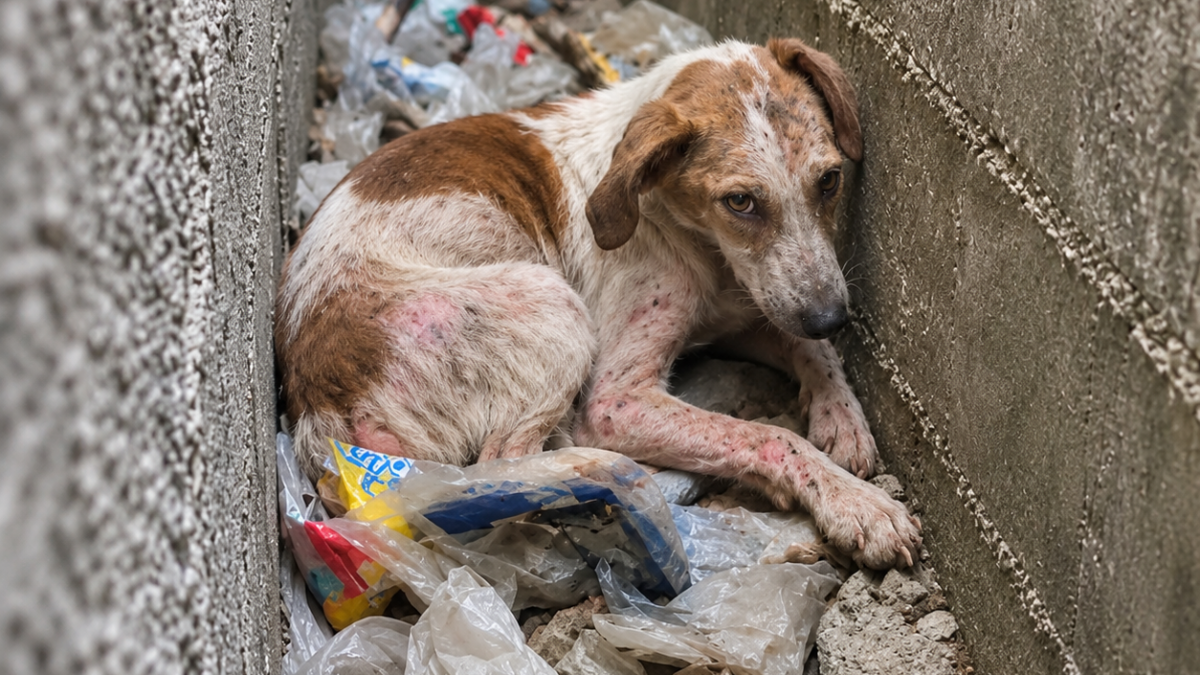
The dog was wedged so tightly between two houses that she couldn’t turn around, lie down properly, or even look back at the people trying to save her.
It took a team of firefighters, ropes, boards, and nearly two hours to bring her into the open—but the moment I finally saw her whole body, I realized being trapped between those walls was not the worst thing she had survived.
And when one firefighter quietly asked me, “How long do you think she was in there?” I looked at what was hidden beneath her filthy coat and knew that whatever had happened to her had started long before anyone called us.
My name is Claire, and I volunteered with a local animal rescue.
The call came early one morning.
A woman living in an older neighborhood said she could hear a dog crying somewhere between her house and the building next door.
At first, she thought the sound was coming from a yard.
Then she stepped outside.
There was no dog in either yard.
The whining came from the narrow gap between the two houses.
When I arrived, two firefighters were already standing near the opening.
One of them shined a flashlight between the walls.
“There,” he said.
I crouched.
For several seconds, I saw nothing.
Then two eyes reflected the light.
My stomach tightened.
The gap couldn’t have been more than a foot wide in some places.
The dog was several yards inside.
She had somehow entered from the back, moved deeper between the buildings, and become stuck where the space narrowed.
“How did she get in there?”
One firefighter shook his head.
“That’s the question.”
I called softly.
“Hey, sweetheart.”
The dog’s eyes moved toward me.
She tried to shift.
A weak scraping sound came from inside.
Then she cried.
Not loudly.
That somehow made it worse.
It was the exhausted sound of an animal that had already tried everything.
“We’re getting you out.”
I don’t know whether she understood.
I needed to say it anyway.
The firefighters tried reaching her from behind first.
No luck.
The walls narrowed too much.
One man climbed a ladder to look down from above.
Another measured the space.
For a while, everyone spoke in short, quiet sentences.
“Can we guide her backward?”
“No room.”
“Can she stand?”
“Barely.”
“What about removing that board?”
“That might give us another few inches.”
Every few minutes, I crouched near the gap and talked to her.
She didn’t bark.
Didn’t growl.
Didn’t try to bite anyone.
Mostly, she stared.
Then I noticed the smell.
I had worked around injured animals before.
I knew that smell.
Infection.
Something was wrong with her skin.
Very wrong.
I moved the flashlight lower.
Her hindquarters were almost hairless.
There were dark wounds along her back and legs.
Flies moved around her.
“Oh no.”
One of the firefighters looked at me.
“What?”
“She needs a hospital as soon as she’s out.”
He didn’t ask why.
He must have seen my face.
The rescue became more urgent.
Boards were positioned along the ground so she wouldn’t scrape herself worse.
A loop was carefully worked beneath her body.
Someone opened part of a rear fence so the firefighters could reach the widest section of the gap.
Slowly, inch by inch, they moved her backward.
Every time she cried, everyone stopped.
“Easy.”
“That’s it.”
“One more.”
“Come on, girl.”
Then, finally, her shoulders reached the opening.
A firefighter slid both arms beneath her.
I supported her hips.
Together, we lifted her free.
The moment she reached open ground, her legs folded beneath her.
I knelt beside her.
For the first time, I could see everything.
She was thin.
Dehydrated.
Her fur was matted against her skin.
Large areas of her body were raw.
And inside several wounds, something was moving.
I leaned closer.
Then pulled back.
Maggots.
Not a few.
Hundreds.
Maybe more.
One firefighter stared.
“Jesus.”
The dog didn’t even try to stand.
She laid her head against my arm.
I looked down at her.
“Don’t worry.”
My voice shook.
“You don’t have to fight those walls anymore.”
At the time, I thought rescuing her from between those houses had been the hard part.
I had no idea that before the day was over, we would remove more than a thousand maggots from her body—and then watch her collapse in front of us.
**— END OF FACEBOOK OPENING —**
We wrapped her loosely in a clean sheet.
Not a blanket.
Her skin was too damaged for anything heavy to rub against it.
The firefighters helped us place her on a stretcher.
One of them, a broad-shouldered man named Daniel, stayed crouched beside her for a moment.
“You got a name for her?”
I shook my head.
“Not yet.”
He looked toward the narrow space between the houses.
“She needs something better than ‘the dog from the wall.’”
I looked down at her.
Her eyes were open.
Exhausted.
Still watching.
“Grace,” I said.
Daniel smiled slightly.
“Grace?”
“Because she deserves some.”
That became her name.
Grace.
The drive to the veterinary hospital lasted less than twenty minutes.
It felt like an hour.
I sat beside her in the back.
Every few seconds, I checked whether her chest was still rising.
“Stay with me.”
Her breathing was shallow.
The smell from her wounds filled the vehicle.
I didn’t care.
I kept one hand near her shoulder.
I was afraid to touch too much.
At the clinic, the veterinary team was waiting.
They lifted her immediately.
The veterinarian, Dr. Hall, took one look at her skin.
“How long has she been like this?”
“We don’t know.”
“Found trapped between two buildings.”
“Abandoned?”
“We don’t know.”
He nodded once.
“Okay. Let’s stabilize first.”
They started fluids.
Checked her temperature.
Drew blood.
Then they began cleaning.
That’s when we understood the true scale of what was happening.
The wounds were deeper than I’d thought.
Some were hidden beneath matted fur.
Some were along her legs.
Others crossed her back and hindquarters.
And everywhere the tissue had been left exposed, flies had found it.
The veterinary technicians began removing larvae.
One.
Ten.
Fifty.
A hundred.
I tried not to count.
Eventually, someone did.
More than a thousand.
At one point, I stepped into the hallway.
I leaned against the wall.
My hands were shaking.
Daniel, the firefighter who had followed us to the hospital, was still there.
He saw my face.
“That bad?”
I nodded.
“Over a thousand.”
His expression hardened.
“Maggots?”
“Yes.”
He swore quietly.
Then looked toward the treatment-room door.
“How long does that take to happen?”
“Not overnight.”
That was what bothered me.
The narrow gap could explain scratches.
It could explain exhaustion.
It could explain dehydration if she’d been trapped there long enough.
It could not explain wounds already filled with larvae when she was found.
Grace had been suffering before she ever entered that space.
The question was how.
And why.
Hours passed.
The veterinary team clipped away damaged fur.
Flushed wounds.
Removed dead tissue.
Picked larvae from places I wish no animal ever had to experience.
Through all of it, Grace barely protested.
At first, I thought that meant she trusted us.
Dr. Hall corrected me.
“She’s weak.”
I looked at him.
“How weak?”
“Very.”
“Can she survive this?”
He paused.
That pause terrified me.
“We’re giving her every chance.”
I hated that answer because I understood what it meant.
No promises.
We continued.
By afternoon, her wounds were cleaner.
Medication had been started.
Her temperature was closer to normal.
For the first time, I allowed myself to believe we might have turned a corner.
Then Grace tried to lift her head.
Her front legs trembled.
Her body shifted.
And suddenly she went limp.
“Grace?”
A monitor began sounding.
Dr. Hall moved immediately.
“Get her back.”
Someone pushed me away from the table.
“What happened?”
“Claire, give us space.”
I stepped backward.
Grace wasn’t responding.
Her breathing changed.
For several terrible minutes, the room became a blur of hands and equipment.
Fluids.
Oxygen.
Voices.
Numbers.
Then Dr. Hall looked at me.
“She’s crashed.”
I felt cold.
“Is she dying?”
“We’re moving her into critical care.”
“That isn’t an answer.”
“No.”
He looked directly at me.
“She is not dying right now.”
It was the best promise he could make.
Grace spent that night under constant observation.
Low body temperature.
Severe dehydration.
Anemia.
Infection.
Malnutrition.
The combined stress had pushed her body almost as far as it could go.
I went home after midnight.
I didn’t sleep.
At 3:12 in the morning, I checked my phone.
Nothing.
At 3:47, again.
Nothing.
At 4:25, I finally called.
The overnight technician answered.
“How is Grace?”
A pause.
“She’s stable.”
I closed my eyes.
“Still stable?”
“Yes.”
“Has she eaten?”
“Not yet.”
That became our next goal.
Food.
After everything dramatic—firefighters, ropes, wounds, hundreds upon hundreds of maggots—the thing we needed most was something incredibly ordinary.
A bite of food.
The next morning, I was at the hospital before visiting hours.
Dr. Hall met me.
“She made it through the night.”
I smiled for the first time in almost twenty-four hours.
“Can I see her?”
“For a few minutes.”
Grace was lying on a thick medical pad.
Bandages covered parts of her body.
Her coat had been shaved in large sections.
She looked fragile.
Smaller than the dog we’d pulled from between those houses.
I sat beside her.
“Hi.”
Her eyes moved toward me.
“Remember me?”
No reaction.
“You owe several firefighters a thank-you card.”
Her ear moved.
I smiled.
The technician brought a bowl with a small amount of soft food.
“We’re going to try again.”
She placed it near Grace.
Grace smelled it.
Then looked away.
My heart sank.
“Come on.”
Nothing.
The technician waited.
Then dipped one finger into the food and held it near Grace’s nose.
Grace sniffed.
Her tongue moved.
One lick.
The technician and I looked at each other.
“Again.”
Grace licked once more.
Then she lifted her head.
Barely.
The bowl moved closer.
Grace took a small bite.
I covered my mouth.
She chewed.
Swallowed.
Then another.
It wasn’t much.
Maybe a few spoonfuls.
But she ate.
After the technician left, I sat there crying over an almost empty bowl.
“You have no idea what you just did.”
Grace’s eyes closed.
“You just made breakfast the most beautiful thing I’ve seen all week.”
The next several days were slow.
No dramatic miracle.
No sudden transformation.
Progress came in inches.
Her temperature stabilized.
She drank.
Her appetite improved.
Her bloodwork stopped getting worse.
The wounds began forming healthy tissue.
The smell of infection faded.
And Grace started showing us who she was.
She liked having her forehead scratched.
She disliked having her paws handled.
She loved chicken.
She tolerated pills only if they were hidden in something she considered worthwhile.
She didn’t bark much.
But when one particular technician was late with breakfast, Grace made a low complaining sound.
The technician laughed.
“Excuse me?”
Grace did it again.
I looked at her.
“Oh, now you have opinions?”
Her tail moved.
Tiny.
But real.
On day seven, Dr. Hall changed several bandages.
He smiled.
“Look.”
I stepped closer.
The wounds were still ugly.
But they were clean.
Pink tissue had begun replacing damaged areas.
“That’s healing?”
“Yes.”
“So we’re winning?”
“We’re moving in the right direction.”
I’ll take that, I thought.
That afternoon, Grace tried to stand.
Her front legs straightened.
Her hind legs followed.
For half a second, she was upright.
Then she sank.
I moved toward her.
Dr. Hall stopped me.
“Let her try.”
Grace pushed again.
Her legs shook violently.
She stood.
One second.
Two.
Three.
Then down.
I started laughing.
“Did you see that?”
Dr. Hall smiled.
“I was standing right here.”
“She stood.”
“She did.”
The next day, she did it again.
Then she took two steps.
The first step was clumsy.
The second looked worse.
On the third attempt, she managed four.
I filmed it for the firefighters.
Daniel replied almost immediately.
**That’s our girl.**
A week earlier, Grace couldn’t stay on her feet.
Now she was walking toward a bowl of chicken like her entire medical team had been personally withholding it.
But as her body improved, another question became harder to ignore.
Who was Grace?
She had no collar.
No tag.
No microchip.
No missing-dog report matching her description.
We posted her photograph.
No legitimate owner came forward.
But someone else did.
A woman named Maria contacted the rescue after seeing the post.
She lived three streets from where Grace had been found.
“I think I’ve seen that dog.”
My pulse quickened.
“When?”
“Before she got trapped.”
“Where?”
“With a man.”
That changed everything.
We met her that evening.
She showed us security-camera footage from the front of her house.
Three weeks before Grace’s rescue, a white-and-brown dog could be seen walking beside a man.
Thin even then.
Head lowered.
The video wasn’t clear enough to see wounds.
But it was Grace.
I was almost certain.
Maria had more.
“I started saving the clips because I thought something was wrong.”
“Why?”
“The man kept pulling her.”
“What do you mean?”
“She’d stop. He’d yank the leash.”
One video showed Grace stumbling.
The man pulled again.
My stomach tightened.
“Do you know him?”
Maria hesitated.
“I think he rents a place near the railroad.”
“Name?”
“No.”
We gave everything to animal control.
An officer recognized the location.
Two days later, they identified the man.
His name was Curtis.
Grace had apparently lived on a property with several dogs.
When officers visited, Grace wasn’t there.
But two other dogs were.
Both thin.
One had untreated skin problems.
They were removed.
Curtis claimed Grace had run away.
“How long ago?” I asked the officer later.
“He says about a month.”
“Did he report her missing?”
“No.”
“Did he look for her?”
“Not that we can confirm.”
My anger started burning again.
Then came another detail.
A neighbor had seen Curtis put Grace into the back of a truck only four days before she was found between the houses.
That didn’t match his story.
Then another camera was found.
A convenience store.
The truck passed near the neighborhood where Grace was rescued.
Grace was visible in the truck bed.
Two hours later, the same truck returned.
No dog.
Curtis changed his story.
He said Grace had jumped out.
The investigators didn’t believe him.
Neither did I.
Eventually, a witness came forward.
A teenager walking home had seen a man pull a dog from a truck near an alley.
The dog resisted.
The man removed the leash.
Drove away.
The teenager hadn’t understood what he’d witnessed.
Now he did.
Grace had been abandoned.
Injured.
Sick.
Too weak to travel far.
She must have wandered into the narrow passage looking for shelter.
Then become trapped.
When I learned that, I went to the hospital.
Grace was lying in sunlight near the glass doors.
She had discovered the warm patch that appeared every afternoon.
I sat beside her.
“So that’s what happened.”
Her eyes opened.
“He left you.”
She stared at me.
“I wish you didn’t know how that feels.”
Grace placed her chin back down.
The legal case took shape slowly.
Medical records.
Security footage.
Witness statements.
Condition of the other dogs.
Curtis denied deliberate cruelty.
He said he couldn’t afford veterinary treatment.
Then he said Grace belonged to someone else.
Then he said she was aggressive.
That lie collapsed quickly.
Grace had been handled by firefighters, rescue workers, technicians, veterinarians, and volunteers.
Nobody had documented aggression.
Fear?
Absolutely.
Pain?
Constantly.
Aggression?
No.
Curtis eventually learned Grace had survived.
That was when he made the mistake I had been waiting for.
He asked for her back.
When the officer told me, I thought I’d misheard.
“What?”
“He says she’s his property.”
I stared.
“He dumped her.”
“That’s part of the investigation.”
“She had more than a thousand maggots in open wounds.”
“I know.”
“He left her.”
“I know.”
“And now he wants her?”
“He may be trying to challenge the seizure.”
I went outside.
I was too angry to stay in the room.
Daniel happened to be visiting Grace that afternoon.
He found me sitting on the curb.
“What happened?”
“He wants her back.”
Daniel stared.
“The guy who dumped her?”
“Yes.”
He sat beside me.
For a while, neither of us spoke.
Then he said, “He’s not getting her.”
“I don’t control that.”
“No.”
He looked toward the clinic.
“But evidence does.”
That sentence changed how I approached everything.
I stopped thinking about Curtis.
I started thinking about proof.
We organized every photograph by date.
Day one.
Wounds.
Weight.
Larvae.
Bloodwork.
Skin condition.
Day seven.
Healing tissue.
First standing attempt.
First steps.
We preserved the firefighter reports.
Emergency-call records.
Video footage.
Witness statements.
Hospital invoices.
Every detail told the same story.
Grace had not become sick after being abandoned.
She had been abandoned because someone had already allowed her to become sick.
That difference mattered.
When Curtis’s attorney argued that the maggots could have developed while Grace was trapped, Dr. Hall testified that the extent and condition of the wounds indicated they had been present beforehand.
When Curtis claimed Grace had always been difficult to handle, clinic records contradicted him.
When he claimed he had planned to seek treatment, investigators found no appointments.
No calls.
No requests for assistance.
Nothing.
Then one of the other dogs removed from his property became crucial.
That dog had a nearly identical untreated skin condition.
The pattern became impossible to explain away.
Grace remained under rescue custody.
Weeks passed.
Her wounds closed.
Her coat slowly returned.
Her muscles strengthened.
She learned stairs.
The first time she tried, she stared upward as though we’d asked her to climb a mountain.
“Two steps.”
I stood beside her.
“That’s all.”
She put one paw up.
Then another.
Stopped.
Looked at me.
“You’re doing it.”
Two more.
She reached the top.
Then turned around and looked incredibly pleased with herself.
Going down was a disaster.
We worked on that later.
As Grace healed, she became playful.
That surprised everyone.
A volunteer dropped a tennis ball one afternoon.
Grace stared at it.
The ball rolled.
Her head followed.
Then she chased it.
Not fast.
Not elegantly.
But she chased it.
Daniel happened to be there again.
He laughed.
“Look at her.”
Grace picked up the ball.
Then refused to return it.
“Fire department spent two hours rescuing you,” Daniel told her. “Least you can do is share.”
Grace walked away with it.
I smiled.
“She remembers who did the hard work.”
“Apparently not.”
The day her adoption status was discussed, I had mixed feelings.
I’d known it was coming.
That was the goal.
Heal her.
Make her safe.
Find her a home.
Still, hearing Dr. Hall say it felt strange.
“Medically, she’s ready.”
“Ready for what?”
He gave me a look.
“You know.”
I did.
“Adoption.”
“Yes.”
I looked through the window.
Grace was outside with a volunteer.
Standing.
Walking.
Tail up.
Her scars were visible beneath shorter areas of fur.
But she looked alive.
Fully alive.
I smiled.
Then immediately felt like crying.
Dr. Hall noticed.
“You can’t keep every one.”
“I know.”
“Do you?”
“No.”
He laughed.
We listed Grace for adoption.
Applications arrived immediately.
Some were excellent.
Some wanted a dramatic rescue story more than they wanted the actual dog.
Those were easy to eliminate.
Grace didn’t need someone who wanted to display her past.
She needed someone willing to live with her future.
Special skin care.
Regular veterinary visits.
Possible long-term sensitivity.
Patience.
A safe yard.
Someone who understood that healing didn’t mean forgetting.
One application stood out.
A woman named Ellen.
Sixty-one.
Widowed.
Recently retired.
She lived alone with an older mixed-breed dog named Charlie.
Her application wasn’t emotional.
It was practical.
She listed her veterinarian.
Her fenced yard.
Her routine.
Her emergency plan.
Then, near the bottom, she wrote:
**I don’t need Grace to be grateful. I just want her to feel safe enough to be ordinary.**
I read that sentence three times.
Ellen came to meet Grace.
I watched closely.
She didn’t rush.
Didn’t kneel immediately.
Didn’t call Grace over in an exaggerated voice.
She sat on a bench.
Waited.
Grace sniffed the yard.
Then noticed her.
Ellen held one hand low.
Grace approached.
Sniffed.
Walked away.
Ellen smiled.
“Fair enough.”
Ten minutes later, Grace returned.
This time she stayed.
Charlie met her next.
He was calm.
Old enough to have no interest in drama.
They sniffed.
Charlie wandered away.
Grace followed.
Then something happened that made the decision for me.
Grace lay down beside him.
Not touching.
Just near.
She closed her eyes.
Ellen looked at me.
“Is that good?”
I nodded.
“Very.”
The adoption was scheduled.
But before Grace could leave, Curtis’s case reached its final hearing.
I attended.
Not because I wanted to see him punished.
At least that’s what I told myself.
Part of me absolutely did.
He sat across the room in clean clothes.
He looked nothing like the monster people online imagined.
That’s what bothered me.
Cruel people rarely look dramatic.
They look ordinary.
The prosecutor described Grace’s condition.
The gap between the houses.
The extraction.
The larvae.
The collapse.
The veterinary findings.
The videos.
The other dogs.
Curtis’s changing statements.
Then Dr. Hall testified.
“How many larvae were removed?”
“More than one thousand.”
A murmur moved through the room.
Curtis looked down.
The attorney asked whether Grace would have been in pain.
“Yes.”
“For how long?”
“Based on the wounds, likely for an extended period.”
“Could a reasonable owner have failed to notice?”
Dr. Hall paused.
“No.”
That was the sentence I had needed.
Not because it was dramatic.
Because it destroyed the last excuse.
He noticed.
Or he chose not to notice.
Either way, Grace had suffered.
The court permanently surrendered Grace and the other seized animals from Curtis’s ownership.
He received penalties for neglect and abandonment and was prohibited from owning animals for a substantial period under the order imposed.
When the decision was read, I looked at Curtis.
I expected satisfaction.
I felt something else.
Relief.
Grace was legally free.
That mattered more.
Outside, a reporter asked me whether I thought the punishment was enough.
I thought about the question.
Then said, “Nothing makes what happened unhappen.”
“So you wanted a harsher sentence?”
“I wanted Grace safe.”
“And now?”
“Now she is.”
That should have been the end.
But Curtis had one final encounter with Grace.
Not intentionally.
The morning before her adoption, I took her for a walk near the rescue.
A car pulled into a nearby parking lot.
A man stepped out.
Grace stopped.
I followed her gaze.
Curtis.
My entire body tightened.
He saw us too.
For a moment, I considered turning around.
Then I looked at Grace.
She wasn’t hiding.
She wasn’t pulling.
She was standing.
Curtis approached several steps.
I raised one hand.
“That’s close enough.”
He stopped.
His eyes stayed on Grace.
“She looks different.”
I almost laughed.
Her coat had grown back.
She’d gained weight.
Her wounds were closed.
She stood on strong legs.
“Yes.”
“She always liked people.”
I stared at him.
“That isn’t what you told investigators.”
His jaw tightened.
“I said she could be difficult.”
“She was dying.”
He looked toward Grace.
“I didn’t know it was that bad.”
“There were maggots in her wounds.”
He said nothing.
“More than a thousand.”
His face changed.
Maybe shame.
Maybe irritation.
I didn’t care.
Then he said something I’ll never forget.
“I had too many dogs.”
I looked at him.
“That was your explanation?”
“Things got out of control.”
“You could’ve surrendered them.”
“No one wants sick dogs.”
I looked at Grace.
Then back at him.
“You’re wrong.”
Curtis frowned.
“What?”
“Someone does.”
He looked confused.
I smiled.
“Grace is being adopted tomorrow.”
For the first time, he seemed genuinely surprised.
“Her?”
That single word told me everything.
Her?
As though Grace were the least likely dog in the world to be chosen.
The dog he’d discarded.
The dog he’d decided wasn’t worth treatment.
The dog who had needed firefighters just to reach open air again.
“Yes,” I said. “Her.”
Curtis looked at Grace.
Then something strange happened.
He crouched.
“Come here.”
My heart stopped.
Grace looked at him.
For perhaps three seconds, she didn’t move.
Then Curtis patted his leg.
“Come on.”
Grace took one step.
I felt sick.
Not because I wanted her to hate him.
But because I knew dogs.
They remember voices.
Smells.
People.
Grace took another step.
Curtis smiled slightly.
Then Grace stopped.
She looked at him.
Looked at me.
Turned around.
And walked back to my side.
She sat.
Curtis’s smile disappeared.
I put my hand on Grace’s head.
Not triumphantly.
Quietly.
“Good girl.”
Curtis stood.
“She doesn’t remember me.”
I looked at him.
“No.”
I thought about it.
“I think she does.”
He walked away without another word.
I watched him leave.
For months, I’d imagined revenge.
I’d imagined Grace somehow understanding what he’d done.
Rejecting him.
Choosing us.
But standing there, I realized I didn’t care whether that moment hurt Curtis.
What mattered was that Grace had a choice.
Between two walls, she had none.
When she was sick, she had none.
When she was abandoned, she had none.
Now she did.
And she chose where she felt safe.
The next morning, Ellen arrived at ten.
She brought a new collar.
Soft.
Purple.
No heavy chain.
No tight strap.
Just a comfortable collar with a small tag.
**GRACE**
On the back:
**HOME**
I cried when I read it.
“You’re trying to make this difficult,” I told Ellen.
She smiled.
“I thought it fit.”
Charlie waited in the car.
Grace recognized Ellen immediately.
Her tail started moving.
Ellen knelt.
“Ready?”
Grace approached.
Sniffed the collar.
Then let Ellen put it on.
I signed the final paperwork.
My hands shook.
Grace looked at me.
I crouched.
“Remember those walls?”
Her head tilted.
“Forget them.”
I touched the side of her face.
“You don’t live between walls anymore.”
She licked my chin.
Then Ellen opened the car.
Grace climbed in beside Charlie.
She turned around once.
Looked at me.
Then lay down.
I shut the door.
Ellen hugged me.
“I’ll take care of her.”
“I know.”
“That’s why you’re letting me leave with her.”
“Exactly.”
I watched the car disappear.
Then I cried harder than I had expected.
Daniel called that afternoon.
“How’d it go?”
“She left.”
“With Ellen?”
“Yes.”
“You crying?”
“No.”
“You sound like you’re crying.”
“Firefighters ask too many questions.”
He laughed.
Then his voice softened.
“You did good.”
“We all did.”
“No.”
“Yes.”
I looked at the empty kennel.
“The woman who called. You guys. The vets. Everyone.”
Daniel paused.
“Send pictures when you get them.”
“I will.”
The first picture arrived that evening.
Grace asleep on a rug.
Charlie beside her.
No medical pads.
No bandages.
No hospital equipment.
Just a dog sleeping in a house.
The second came the next morning.
Grace standing in Ellen’s kitchen waiting for breakfast.
The third made me laugh.
Grace had stolen Charlie’s bed.
Charlie was standing beside it looking offended.
Ellen wrote:
**Apparently she’s comfortable.**
Weeks passed.
Grace settled in.
She learned the yard.
She learned which cabinet held treats.
She learned that Ellen went for coffee every morning and returned every morning.
She learned Charlie’s routine.
And most importantly, she stopped reacting to narrow spaces.
At first, she refused to walk down the side passage beside Ellen’s house.
It wasn’t nearly as tight as the gap where we’d found her.
But she froze.
Ellen didn’t pull.
Didn’t force.
She turned around.
They tried again days later.
Then again.
Eventually, Grace walked through.
One step.
Then another.
Ellen sent me a video.
Grace walked beside the house.
Reached the backyard.
Turned around.
Tail wagging.
I watched it six times.
Months later, I visited.
Grace saw me from across the yard.
For half a second, she froze.
Then she ran.
Actually ran.
Not the shaky four steps we’d once celebrated.
Full speed.
She hit me with enough force to nearly knock me over.
“Grace!”
She jumped.
Charlie barked as if protesting the reunion.
Ellen laughed.
“She remembers you.”
I buried both hands in Grace’s coat.
It had grown back beautifully.
Some scars remained.
They always would.
I traced one gently.
Ellen noticed.
“She doesn’t bother them anymore.”
“Skin problems?”
“Occasional irritation. Nothing major.”
“And everything else?”
“Good.”
Grace dropped a tennis ball at my feet.
I stared.
“You still don’t return these, do you?”
Ellen laughed.
“Oh, she’s become worse.”
I threw it.
Grace chased.
That sight did something to me.
When we’d first pulled her from between those houses, the question was whether she could stand.
Now she was running because she wanted a ball.
That was revenge.
Not punishment.
Life.
Curtis had treated Grace as disposable.
Grace became somebody’s family.
He had left her body to deteriorate.
She grew strong.
He had decided no one would want a sick dog.
Ellen adored her.
He had put her somewhere she could disappear.
Now there were framed photographs of Grace all over Ellen’s house.
Nothing erased what happened.
Nothing needed to.
Grace’s life wasn’t meaningful because she’d suffered.
Her life mattered before that.
What mattered was that suffering didn’t get the final sentence.
Two years after her adoption, the fire department invited Grace back.
They were doing an animal-rescue training day.
Daniel had suggested it.
When Ellen arrived with Grace, several firefighters recognized her immediately.
“That’s her?”
“Look at her!”
Grace walked through the station like she owned it.
Daniel knelt.
“You remember me?”
Grace sniffed him.
Then stole a treat from his hand.
“I’ll take that as yes.”
Someone brought out the old rescue photographs.
I almost didn’t look.
Grace wedged between walls.
Grace on the stretcher.
Grace shaved.
Grace bandaged.
Then I looked at the dog standing in front of me.
Healthy coat.
Strong legs.
Bright eyes.
Purple collar.
Ellen’s hand resting on her back.
The contrast was almost impossible.
One firefighter asked Ellen, “Does she have any problems now?”
Ellen considered it.
“She snores.”
Everyone laughed.
“And she steals my other dog’s bed.”
More laughter.
Then Ellen looked down at Grace.
“She doesn’t like being left alone for very long.”
Her voice softened.
“So I don’t leave her alone for very long.”
That was it.
Simple.
No grand philosophy.
No miracle.
You learn what hurts someone.
Then you try not to hurt them that way again.
Years later, when I think about Grace, I don’t first picture the wounds.
I don’t picture the maggots.
I don’t picture Curtis.
I picture those first four steps.
Her legs shaking.
Her whole body uncertain.
But moving.
That’s what recovery really looked like.
Not before-and-after photos.
Not perfect fur.
Movement.
Forward.
Sometimes only inches.
There was one final photograph Ellen sent me that I keep on my phone.
Grace is lying on a porch.
Sunlight across her back.
Charlie asleep nearby.
Her head rests on the threshold.
Behind her is an open doorway.
In front of her is an open yard.
Nothing trapping her on either side.
I think about that image whenever someone asks whether rescue work is worth the heartbreak.
Of course it hurts.
Sometimes you arrive too late.
Sometimes an animal doesn’t survive.
Sometimes the person responsible never faces the consequence you believe they deserve.
And sometimes you spend hours pulling a dying dog through a space barely wider than her body, only to discover that getting her out is merely the beginning.
But then there are dogs like Grace.
A dog trapped between two walls.
A dog carrying more than a thousand maggots inside untreated wounds.
A dog whose body collapsed after rescue because it had nothing left.
A dog who ate.
Then stood.
Then took four steps.
Then twenty.
Then ran after a tennis ball.
Then walked into a home where someone had written one word on the back of her tag.
**HOME.**
That word was the ending I wanted for her.
Not revenge.
Not court.
Not punishment.
Home.
Still, if someone insists that every cruel story deserves a form of revenge, then this is Grace’s.
The person who abandoned her assumed she was finished.
She wasn’t.
He assumed nobody would take responsibility for what he’d refused to do.
We did.
He assumed a sick, scarred dog wasn’t worth saving.
Firefighters crawled into a space between two buildings for her.
Veterinarians worked through the night for her.
Volunteers learned her medication schedule.
Strangers donated.
An older woman rearranged her life to make room for her.
He left Grace with nothing.
She ended up surrounded by people.
That is the kind of revenge I can live with.
Grace didn’t destroy the person who hurt her.
She simply built a life so much bigger than what he had allowed her to have.
And if you had seen her on that first morning—pressed between brick walls, unable to turn around, too weak to stand once we pulled her free—you might have thought survival itself would be enough.
It wasn’t.
Grace did more than survive.
She learned to expect breakfast.
She learned to steal beds.
She learned to chase tennis balls.
She learned that hands could clean wounds instead of causing them.
She learned that people could leave for an hour and come back.
She learned that narrow spaces could have exits.
Most of all, she learned that home was not somewhere you had to squeeze yourself into and hope nobody threw you away.
Home was where someone noticed when you were hurting.
Where someone stopped.
Where someone stayed.
And after everything Grace had survived, that was exactly where she ended up.








