PART 2: Fake HOA “Cops” Kicked In My Door at 2 A.M.—Then One of Them Saw the FBI Jacket on My Wall
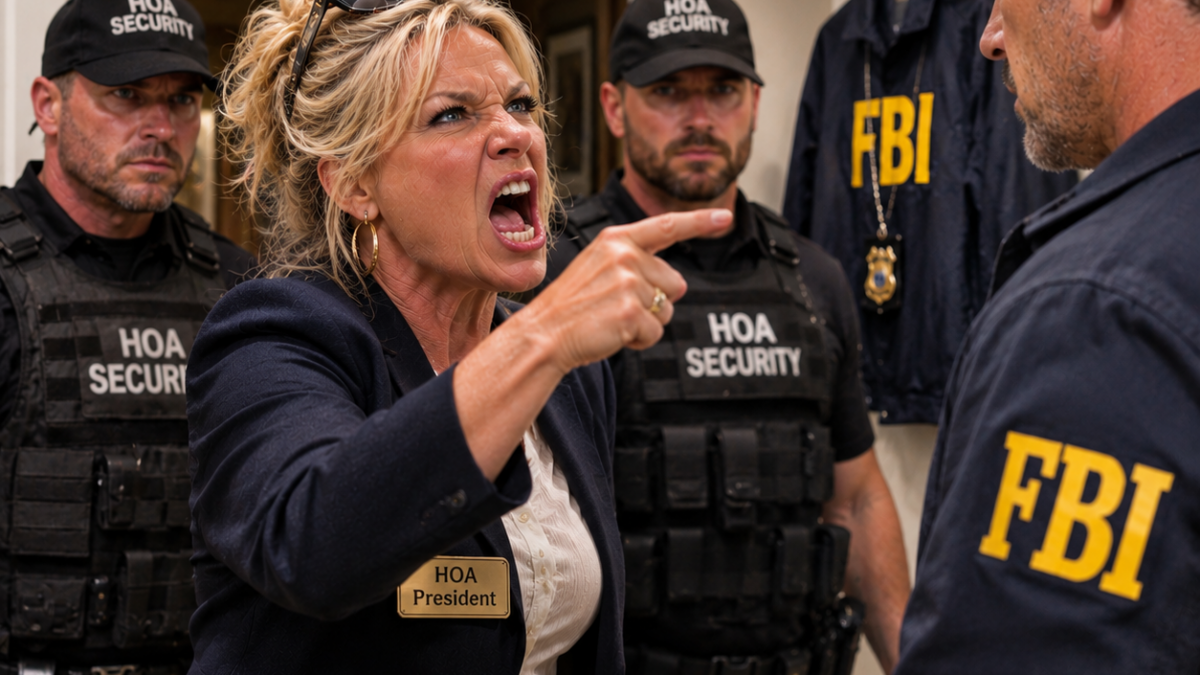
PART 2
## **I Started Documenting Everything**
The old version of me would have called somebody immediately.
Maybe law enforcement.
Maybe a former colleague.
Maybe an attorney.
The version of me who had spent years deliberately building a normal life wanted to believe there was another explanation.
So I started with documentation.
Photographs of every letter.
Dates.
Times.
Screenshots.
I installed another exterior camera covering the side yard.
Then one facing the driveway.
The original doorbell camera already watched the porch.
I created a folder on my computer.
**MAPLE RIDGE SECURITY NONSENSE**
That name became less funny every day.
The black SUV returned twice.
Never for long.
Once at 11:40 in the morning.
Once just after sunset.
Both times the driver remained inside.
Both times it left when I appeared outside.
I recorded the license plate.
That night I searched my HOA emails.
Nothing announced a security department.
Nothing mentioned Leon.
Nothing authorized inspections inside homes.
The Maple Ridge governing documents allowed the association to inspect certain exterior conditions after proper notice.
Exterior.
Not interiors.
Certainly not bedrooms.
Certainly not at two in the morning.
I emailed the HOA management address.
**Please confirm whether Maple Ridge has created a security division with authority to inspect private residences.**
No answer.
I sent it again.
Still nothing.
Then Marla appeared at my house.
## **Marla Comes to the Door**
She rang the bell around six in the evening.
I opened the door but didn’t invite her inside.
“Marla.”
She smiled.
“I wanted to make sure you received the notices.”
“I did.”
“Good.”
“They don’t cite any actual authority.”
Her smile remained.
“You’ve always been very technical.”
“That usually happens when someone threatens consequences.”
She tilted her head.
“No one is threatening you.”
I held up the paper.
“It literally says face consequences.”
“That language is standard.”
“For what?”
“Resistance to compliance review.”
“With what violation?”
Marla’s eyes hardened almost imperceptibly.
“There have been concerns.”
“Name one.”
“Concerns involving security.”
“Name one.”
“Unusual behavior.”
“Meaning?”
“You’re very private.”
For a second, I thought I’d misunderstood.
“Privacy is suspicious now?”
“I didn’t say suspicious.”
“You sent someone to photograph my house.”
Her expression shifted.
“Who told you that?”
Interesting.
I hadn’t said the photographer worked for her.
“I didn’t.”
Marla recovered.
“Residents have reported uncomfortable activity.”
“What activity?”
“You keep irregular hours.”
“I work.”
“You receive visitors.”
“Sometimes humans know other humans, yes.”
She ignored the sarcasm.
“There have been questions about your background.”
That sentence changed the conversation.
“What questions?”
“You haven’t been very transparent.”
“About my employment?”
“You’ve never explained what you used to do.”
I laughed once.
“I didn’t realize the HOA required résumés.”
“This isn’t a joke.”
“No, Marla. It isn’t.”
I stepped closer to the threshold.
“My work history isn’t HOA business. The inside of my home isn’t HOA business. Whoever Leon is, he has no authority to inspect my residence.”
Her jaw tightened.
“You’re making this unnecessarily adversarial.”
“No. I’m defining the boundary.”
“Sometimes boundaries interfere with community safety.”
I stared at her.
“That’s a dangerous sentence.”
For the first time, the smile disappeared completely.
She stepped backward.
“You’ll receive further instructions.”
“No.”
She stopped.
“I won’t comply with an illegal inspection.”
“You should reconsider that.”
“Good night, Marla.”
I closed the door.
Through the camera, I watched her remain on my porch for another twelve seconds.
She stared directly into the lens.
Then walked away.
## **The Neighborhood Rumors**
Within days, people started treating me differently.
Not everyone.
Most neighbors remained normal.
But conversations stopped when I walked past.
A woman from two houses down asked whether I was “having trouble with security.”
“What security?”
She lowered her voice.
“Marla said there’s a safety concern.”
“What kind?”
“She wouldn’t say.”
Of course she wouldn’t.
Vague fear works better than specific accusations.
Another neighbor asked whether I’d refused an inspection.
I said yes.
He looked worried.
“Why?”
“Because nobody has the legal right to search my house because Marla printed a letter.”
He laughed nervously.
“She’s saying the board approved it.”
“Ask her for the minutes.”
He didn’t.
People rarely ask for documentation when a confident person gives them a simpler story.
Then Ray Alvarez did.
Ray lived near the entrance to the cul-de-sac.
Retired city employee.
The sort of neighbor who knew every board member but trusted none of them automatically.
He came over one afternoon.
“I asked Marla for the meeting minutes.”
“And?”
“She said security matters are confidential.”
I laughed.
Ray didn’t.
“I checked last month’s financial report.”
“Why?”
“Because I’m bored and retired.”
“Fair.”
“There are payments to something called MRS Consulting.”
“How much?”
He told me.
It wasn’t huge.
But it was recurring.
“What does MRS do?”
“No clue.”
“Security?”
“Maybe.”
“Who owns it?”
“Working on that.”
I looked at him.
“You’re enjoying this.”
“I was an auditor for twenty-two years.”
That answered everything.
## **Leon Escalates**
Three nights later, Leon called me.
Unknown number.
I answered.
“You were advised to schedule an inspection.”
“Leon.”
“Correct.”
“I asked for your credentials.”
“You’ve been provided sufficient information.”
“No.”
“Failure to cooperate will be documented as resistance.”
“To what legal process?”
He sighed.
“You keep using that word.”
“Legal?”
“Yes.”
“That worries you?”
“I think you’re deliberately obstructive.”
“I think you’re pretending to be an officer.”
“I never said police.”
“Good. Then we’re making progress.”
His voice changed.
“You know, people who have nothing to hide usually cooperate.”
There it was.
The oldest manipulation in the book.
I leaned against the kitchen counter.
“People with nothing to hide still have doors.”
Silence.
Then Leon said:
“This is your final opportunity.”
“For what?”
“To resolve this voluntarily.”
The phrase made my skin crawl.
“Are you threatening to enter my house?”
He didn’t answer.
“Leon?”
Click.
The line went dead.
I saved the recording.
That recording later mattered far more than I knew.
## **I Called an Attorney**
My attorney’s name was Rebecca Sloan.
She specialized in civil litigation and had absolutely no patience for people who tried to sound more powerful than they were.
I sent her everything.
She called the next morning.
“Tell me this isn’t real.”
“I’d love to.”
“Who is Leon?”
“No idea.”
“Licensed security?”
“I can’t find him.”
“Law enforcement?”
“No.”
“Private investigator?”
“No record I can locate.”
“And your HOA is threatening an interior inspection?”
“Yes.”
She paused.
“Don’t let anyone inside.”
“Wasn’t planning to.”
“I’m serious.”
“So am I.”
“I’ll send a cease-and-desist notice.”
“To Marla?”
“To the association, management company, and anyone calling themselves security.”
“What if they ignore it?”
Rebecca sighed.
“Then they make my job easier.”
That sentence should have reassured me.
It didn’t.
## **The Cease-and-Desist Letter**
Rebecca’s letter was brutal precisely because it wasn’t emotional.
It listed the relevant governing provisions.
Noted the absence of authority for warrantless interior entry.
Demanded identification of any security contractor.
Demanded preservation of records.
Warned against harassment, surveillance, impersonation of law enforcement, unauthorized entry, and retaliation.
Marla replied through the HOA email.
**Your counsel’s aggressive tone is disappointing and inconsistent with the cooperative values of Maple Ridge.**
Rebecca forwarded it to me with one line:
**She didn’t answer a single question.**
Two days later, the SUV disappeared.
I thought the letter had worked.
For almost a week, nothing happened.
No notes.
No calls.
No vehicles.
I started sleeping normally again.
That was exactly what they needed.
## **2:07 A.M.**
The first crash woke me instantly.
Years of training disappear slowly.
Some sounds bypass sleep.
Breaking doors are one of them.
I sat upright.
Another impact.
Wood cracked downstairs.
Then voices.
“MOVE!”
“SECURITY!”
“SHOW YOUR HANDS!”
For half a second, my brain tried to impose logic.
Police?
No.
Real police announce agency.
Real police don’t call themselves HOA security.
I reached for my phone.
Didn’t get there.
Footsteps were already on the stairs.
Three men.
Black clothing.
Tactical vests.
One had something resembling a badge hanging from his chest.
Another carried a flashlight.
One had zip restraints.
They looked like people who had purchased an idea of authority rather than earned it.
“Hands where we can see them!”
I raised them.
Not because they were legitimate.
Because three intruders inside your home at two in the morning are dangerous whether they’re competent or not.
“What are you doing?”
“HOA security operation.”
“There is no HOA security authority inside my house.”
“Turn around.”
“No.”
The largest one grabbed my arm.
I didn’t resist immediately.
I needed information.
“How did you enter?”
No answer.
“Where’s your warrant?”
“Association authorization.”
“That’s not a warrant.”
He shoved me against the wall.
The second man tightened a plastic restraint around my wrists.
Too tight.
Pain shot into my hands.
The third started opening drawers.
“What are you looking for?”
“Evidence.”
“Of what?”
No answer.
That should tell you everything.
They had been ordered to search without even understanding the accusation.
## **The Jacket**
They moved me downstairs.
My living room looked wrong with strangers inside it.
One man opened cabinets.
Another went through my desk.
The leader kept telling me not to move.
I kept asking questions.
Names.
Authority.
Who hired them.
They stopped answering.
Then flashlight boy swung his beam toward the far wall.
The light crossed framed photographs.
A map.
An old commendation plaque.
Then stopped.
The jacket.
Black.
Framed behind glass.
Large yellow letters across the back.
**FBI**
I had kept it because it represented another life.
Not because I wanted anybody impressed.
For years, it was almost invisible to me.
That night, it became the loudest object in the room.
The flashlight stopped moving.
One man whispered:
“No way.”
The leader looked.
His face changed.
“Keep searching.”
“Is that real?”
“Shut up.”
The man holding my arm loosened his grip.
I felt it instantly.
Fear transfers through hands.
He stared at the jacket.
Then at me.
“You worked for the Bureau?”
I didn’t answer.
The leader snapped:
“She was office staff.”
Interesting.
I turned my head.
“Who told you that?”
Nobody answered.
I repeated:
“Who told you?”
The youngest one looked toward the leader.
That look was enough.
Then he said it.
“Marla.”
The leader swore.
“Shut your mouth.”
And there it was.
Marla hadn’t just encouraged harassment.
She had briefed them about me.
Poorly.
She had told them enough to make them confident and omitted enough to make them dangerous.
## **The Moment Everything Changed**
The leader tried to recover.
“Tighten the restraints.”
The man behind me hesitated.
“Do it.”
He moved.
I did too.
What happened next lasted seconds, not minutes.
There was no heroic speech.
No choreographed movie fight.
Just panic, movement, furniture crashing, and three men discovering very quickly that home invasion becomes unpredictable when the person inside refuses to remain passive.
I got enough space to break control.
One man hit the floor hard.
Another collided with the coffee table.
The leader reached toward a device on his belt.
I knocked his arm away.
We struggled.
The youngest man shouted something about arrest.
“Who’s arresting me?” I demanded.
He didn’t have an answer.
I reached the leader’s radio.
Pressed transmit.
Old habits returned before I consciously summoned them.
“This is a violent home invasion at fourteen Rose Crest Lane. Three suspects in tactical gear, possibly armed. Send law enforcement immediately.”
Silence over the radio.
Then static.
A voice:
“Repeat address.”
I did.
The intruders froze.
Real dispatch has a sound.
Training has a sound.
Fear recognizes both.
## **The Cameras**
The leader looked toward the front door.
Then at the tiny blue light above it.
Camera.
Then the side camera.
Another.
Then the interior unit I’d installed after the threatening letters.
His face changed completely.
“You recorded this?”
“Yes.”
He backed toward the door.
I said:
“Don’t.”
He ran anyway.
No command.
No attempt to help the others.
Just ran.
The remaining two seemed to lose whatever courage they’d borrowed.
One raised his hands.
“Please.”
The other was on the floor breathing hard.
“We were just following orders.”
I stared at him.
“Whose?”
He didn’t answer.
I already knew.
Outside, porch lights flicked on.
Neighbors began looking through windows.
A dog barked.
Somebody shouted:
“Police are coming!”
Sirens appeared in the distance.
Real ones.
## **When Reality Arrived**
The first patrol vehicle stopped hard near my driveway.
Then another.
Red and blue lights flooded the house through the broken doorway.
A deputy entered cautiously.
He looked at the men.
Looked at me.
Looked at the wrecked room.
“Ma’am, what happened?”
“Three men broke into my house claiming to be HOA security.”
His expression was worth remembering.
“HOA what?”
“Exactly.”
I pointed toward the cameras.
“Everything is recorded.”
The two intruders were handcuffed.
Actual handcuffs.
Issued by people with actual authority.
The contrast would have been funny if I hadn’t still been shaking.
A radio call came in.
Third suspect fleeing north.
I described him.
He was found less than an hour later behind a gas station.
Apparently the brave tactical commander had hidden beside a dumpster.
## **Leon Had a Real Name**
The leader wasn’t actually Leon.
Leon was the man who coordinated calls.
The leader inside my house was Derek Shaw.
The younger two were Mason Tripp and Cody Bell.
None were law enforcement.
None had any authority from the state.
Their badges were novelty-style security shields.
Their gear came from commercial tactical suppliers.
The SUV belonged to a small consulting company.
MRS Consulting.
Ray had been right.
And the initials?
Maple Ridge Security.
A company that did not meaningfully exist until Marla decided she needed one.
## **The Search of My House Became Evidence Against Them**
Detectives reviewed the footage before sunrise.
Front door impact.
Entry.
Commands.
Restraints.
Drawers opening.
Property being moved.
Everything.
The men had documented their own crimes through my cameras.
One detective watched the clip where they saw the jacket.
He paused it.
Looked at me.
“You actually FBI?”
“Former.”
“What division?”
I told him enough.
He nodded.
“That explains the radio call.”
“I’d rather it didn’t.”
He smiled faintly.
Then became serious.
“Did you know these men?”
“No.”
“Ever threaten them?”
“No.”
“Did you invite anyone inside?”
“No.”
“Did the HOA have permission?”
“No.”
“Any court order?”
“No.”
He looked toward the broken frame.
“Then we’ve got a problem.”
For once, it wasn’t my problem alone.
## **The Name They All Gave**
Separately, the men were interviewed.
They didn’t coordinate very well.
Derek claimed Marla had hired them for a “compliance extraction.”
Mason said they were told I posed a potential threat to community safety.
Cody said Marla claimed I had hidden prohibited materials inside the house.
No one could explain what those materials were.
Leon—the phone voice—was identified later as Leon Briggs.
Former event security.
No police authority.
No investigator license that covered what he was doing.
He had recruited the others for what he called “residential compliance support.”
The phrase sounded absurd.
Until detectives found the emails.
## **Marla’s Emails**
Marla was brought in the following afternoon.
At first, she denied ordering a break-in.
She described MRS as a neighborhood safety contractor.
She said she’d authorized only “contact.”
Then investigators showed her an email.
Rebecca later obtained copies through the case.
Subject:
**REED RESIDENCE — FINAL COMPLIANCE**
Marla wrote:
**Resident remains resistant. Proceed with inspection regardless of verbal objections.**
Another:
**If normal access is denied, security should secure entry and control the resident until inspection is complete.**
Another:
**Do not allow her prior employment history to intimidate the team. She performed administrative federal work and has no current authority.**
That was the lie.
I hadn’t used my old career to threaten anybody.
Marla had researched it.
Then minimized it to her contractors.
She had effectively told them:
Don’t worry.
She won’t fight back.
## **The Worst Email**
One message bothered me more than all the others.
It was sent the evening before the break-in.
Marla to Leon:
**This needs to be resolved tonight. If we allow one resident to refuse inspection, others will realize compliance is optional.**
Not safety.
Not evidence.
Not danger.
Compliance.
That was what the entire campaign had been about.
I wasn’t suspected of anything.
I had simply said no.
And Marla couldn’t tolerate the possibility that other homeowners might learn they could do the same.
## **The Board Meeting From Hell**
Maple Ridge called an emergency meeting three days later.
It was standing-room only.
I almost didn’t attend.
Rebecca said I should.
“Why?”
“Because they need to see who Marla turned into an enemy.”
I hated the idea.
Still, I went.
The room became quiet when I entered.
Some people stared.
Some looked embarrassed.
Ray waved me toward the back.
Marla wasn’t there.
She had been advised not to attend while the investigation continued.
The vice president, Charles, chaired the meeting.
He looked ten years older than he had the previous week.
“We need to address recent events involving a contracted security initiative.”
Someone shouted:
“Contracted?”
Another:
“They kicked in her door!”
Charles raised his hands.
“Please.”
A woman stood.
“Did the board approve this?”
Charles hesitated.
That hesitation destroyed him.
“Not in the form that occurred.”
“What form did you approve?”
“Additional compliance assistance.”
Ray called out:
“Did you approve armed fake cops?”
“No.”
“Did you approve forced entry?”
“No.”
“Did you know she created MRS?”
Silence.
Charles finally said:
“Not fully.”
The room erupted.
## **The Money Trail**
The financial documents were worse than anyone expected.
Marla had redirected discretionary HOA funds into MRS Consulting through categories like:
**resident safety services**
**compliance support**
**community risk management**
The amounts weren’t enormous individually.
That was the clever part.
Small enough not to trigger immediate panic.
Repeated enough to build a private enforcement operation.
The board had approved broad safety budgets.
Marla used that authority to create something nobody fully understood.
Leon recruited people.
They watched houses.
Delivered notices.
Photographed residents.
Followed certain homeowners.
Most of the conduct never crossed into obvious criminal territory.
Until my door.
## **Other Residents Started Talking**
Once people realized they weren’t imagining things, stories appeared.
Melissa Graves said a black SUV had followed her teenage son after she challenged a parking fine.
Thomas Wilkins said someone photographed the inside of his garage from the sidewalk.
An elderly woman named Nora said two “security representatives” had pressured her to let them inspect her backyard after she complained about an assessment.
Another resident had received a notice threatening “escalated compliance measures.”
Everyone had assumed their case was isolated.
That isolation protected Marla.
The moment people compared notes, the pattern became obvious.
## **I Became Angry After the Danger Was Over**
That’s the strange part.
During the break-in, I was calm.
Afterward?
I was furious.
Not movie furious.
Not smashing-things furious.
The exhausting kind.
I’d wake at three in the morning because the house made a normal settling noise.
I’d check cameras twice before bed.
I’d stand behind the front door before opening it.
The broken frame had been temporarily repaired, but I kept seeing the first crash whenever I looked at it.
People called me brave.
I hated that word.
Bravery sounds clean.
What I felt wasn’t clean.
I felt violated.
Home is supposed to be where your nervous system shuts down.
Mine didn’t anymore.
## **Rebecca Saw It**
One afternoon, Rebecca was going through documents at my kitchen table.
I checked the front camera twice in five minutes.
She noticed.
“You sleeping?”
“Fine.”
“That means no.”
“I sleep.”
“How much?”
“Enough.”
She closed the folder.
“Talk to somebody.”
“I am talking to you.”
“I’m an attorney. We’re terrible for mental health.”
I laughed.
She continued.
“I’m serious.”
“So am I.”
“You survived something violent.”
“I know.”
“Professional training doesn’t make you immune.”
That irritated me precisely because it was true.
I eventually took her advice.
Not because I was falling apart.
Because I didn’t want Marla living inside my nervous system after she’d already lost access to my house.
## **Derek Wants a Deal**
Derek—the leader—changed his story first.
Faced with video, messages, radio traffic, and the testimony of the other two, his confidence disappeared.
He agreed to cooperate.
That made Leon vulnerable.
Leon cooperated too.
One after another, the layers collapsed upward.
Everybody blamed the person above them.
Derek blamed Leon.
Leon blamed Marla.
Marla blamed misunderstandings.
But emails don’t misunderstand themselves.
## **Marla’s Defense**
Marla’s attorney tried to frame her decisions as misguided but well-intentioned.
Community safety.
Unclear authority.
Overzealous contractors.
She hadn’t personally entered the house.
She hadn’t personally broken the door.
She hadn’t personally restrained me.
Rebecca hated that argument.
“She didn’t have to.”
One of the investigators apparently felt the same way.
The case focused on planning.
Payments.
Instructions.
Knowledge.
Intent.
What had Marla authorized?
What did she expect would happen if I refused?
The emails answered too much.
## **The Line That Finished Her**
During a hearing, one email was read aloud.
Marla to Leon:
**If she resists, control her long enough to complete the inspection. She’ll complain, but she’ll eventually understand that the association cannot permit individual defiance.**
Individual defiance.
That was what I had become in her mind.
Not a neighbor.
Not a homeowner.
A defiance problem.
When that line was read aloud, even Marla looked uncomfortable.
For the first time, I wondered whether she could finally hear how insane it sounded.
## **The Men Who Entered My House**
People asked whether I hated them.
For a while, yes.
Especially Derek.
He had put hands on me.
He had walked into my house believing intimidation made him legitimate.
But court proceedings have a way of shrinking people back down to human scale.
Derek wasn’t a tactical mastermind.
He was a man with debt who liked feeling important.
Mason was twenty-seven and had convinced himself private security work would eventually lead to law enforcement.
Cody was barely older and seemed terrified through most of the hearings.
None of that excused what they did.
They made choices.
They broke the door.
They restrained me.
They searched.
They ignored the obvious signs that none of it was legal.
“Just following orders” is not morality.
It’s not a defense for abandoning judgment.
## **The Consequences**
The exact legal outcomes differed among them.
Cooperation mattered.
Individual conduct mattered.
The available charges mattered.
But none walked away pretending it had been a harmless HOA misunderstanding.
There were convictions and serious legal consequences.
Marla’s case carried broader exposure because she had organized and financed the operation.
Her authority within the HOA disappeared almost immediately.
Then came the financial investigation.
Then civil claims.
Then resignations.
Maple Ridge effectively had to rebuild its governance from scratch.
## **I Didn’t Break Their Bones for Revenge**
The story around the neighborhood became exaggerated.
According to one version, I had beaten three armed men unconscious.
According to another, I’d broken every bone in Derek’s body.
Neither was true.
There were injuries during the struggle.
Including mine.
But the point was survival.
Escape control.
Create distance.
Call real law enforcement.
That mattered to me.
I didn’t want the story to become:
Former federal agent beats up idiots.
That misses everything important.
Three men unlawfully broke into a woman’s home at two in the morning because an HOA president convinced them her authority mattered more than the resident’s consent.
That’s the story.
## **The FBI Jacket**
The jacket became evidence for a while.
Photographed.
Documented.
Eventually returned.
When I got it back, I didn’t immediately hang it on the wall.
I left it folded on a chair for days.
Every time I looked at it, I remembered their faces.
The exact second confidence became fear.
I didn’t want my old career to become some superhero prop.
Eventually, I put it back.
Not because it had scared them.
Because it reminded me of something else.
Training doesn’t make fear disappear.
It gives you something to do while fear is happening.
Breathe.
Observe.
Assess.
Act when necessary.
That lesson saved me more than any jacket did.
## **My Neighbors Replaced the Door**
One Saturday morning, Ray showed up with lumber.
Behind him were six neighbors.
“What is this?”
“Door.”
“I ordered one.”
“Cancel it.”
“I can pay for my own door.”
Ray shrugged.
“Nobody said you couldn’t.”
Then Melissa arrived with breakfast.
Thomas brought tools.
A teenager from two houses down carried hardware.
I stood there watching them.
For weeks, Maple Ridge had felt contaminated by Marla.
Now these people were standing in my driveway because they wanted to help.
That’s when I understood something important.
Marla wasn’t the community.
She had simply convinced herself that she was.
We replaced the entire frame.
Reinforced the strike plate.
Installed a new door.
Someone joked that a tank couldn’t get through it.
I told him not to challenge Arizona.
By sunset, the house looked whole again.
It didn’t feel whole yet.
But it looked closer.
## **The New Board**
Elections happened months later.
Ray refused to run.
“You’d be good at it,” I told him.
“That’s why I refuse.”
A woman named Denise Porter became president.
Her first email to the neighborhood was six paragraphs long.
No threats.
No red letters.
No invented security terminology.
Mostly garbage pickup schedules and landscaping.
I nearly cried from boredom.
Beautiful, glorious boredom.
One of the first changes the new board adopted prohibited any private security contractor from exercising enforcement authority over residents.
Another required board approval and legal review for significant compliance actions.
Financial disclosures became public to owners.
Vendor relationships had to be disclosed.
No single officer could authorize surveillance or residence-related enforcement.
Common sense, converted into policy because somebody had once lived without it.
## **The Civil Case**
I could have sued aggressively.
Some people expected me to.
Rebecca explained every option.
Property damage.
Personal injury.
Potential claims against contractors.
Potential claims involving association conduct and insurance.
“What do you want?” she asked.
“Security.”
“You already replaced the door.”
“Not that kind.”
She understood.
I wanted my costs covered.
Medical bills.
Repairs.
Legal fees where available.
Therapy.
Destroyed furniture.
Security upgrades.
And a formal written acknowledgment that the HOA had no authority to enter my residence or use coercive “security” measures against homeowners.
I also wanted something else.
Records preserved.
Permanent.
So the next board couldn’t pretend none of it had happened.
## **Marla Lost the Thing She Valued Most**
People think prison is what hurt Marla most.
I don’t know.
Maybe.
But I suspect losing authority hurt more.
She had built her identity around being necessary.
President Kendrick.
The person everyone called.
The person who approved.
Denied.
Directed.
Corrected.
Ordered.
Once the case became public, nobody wanted her in charge of anything.
No committee.
No neighborhood board.
No community safety program.
Her name became synonymous with the very abuse she’d claimed she was preventing.
I didn’t engineer that.
She did.
Every email.
Every invoice.
Every order.
All I did was survive long enough for people to read them.
## **Her Letter**
Almost a year later, I received a letter from Marla.
Not HOA stationery.
Plain paper.
Rebecca asked whether I wanted her to screen it.
“No.”
I opened it.
The first half annoyed me.
Marla explained herself.
Pressure.
Responsibility.
Fear of declining property values.
Residents demanding stronger enforcement.
Then she wrote something more honest.
**When you refused the inspection, I stopped seeing your refusal as a legal right and began seeing it as a challenge to me personally.**
I stopped reading.
Then continued.
**Everything after that came from my need to prove that the association still had control.**
There it was.
Control.
Not safety.
She wrote:
**I convinced myself that resistance meant guilt because that belief made my actions easier to justify.**
Then:
**I was wrong.**
No elaborate apology could have mattered more than that sentence.
I folded the letter.
I didn’t respond.
Forgiveness and communication aren’t the same thing.
## **The House Became Mine Again**
Recovery happened slowly.
One ordinary morning, I realized I’d slept through the night.
Another day, the doorbell rang and I answered without checking three cameras first.
Then one evening I sat in the living room reading and suddenly noticed the framed jacket.
I hadn’t looked at it in weeks.
That was progress.
Fear becomes less powerful when it stops demanding constant attention.
## **The SUV**
About two years after the break-in, a black SUV parked halfway down my street.
My entire body reacted before my brain did.
Heart.
Shoulders.
Breathing.
I stood.
Walked toward the window.
A man got out.
Opened the rear door.
Removed a birthday cake.
Then walked into a neighbor’s house.
I started laughing.
Not because the reaction was funny.
Because it was finally ordinary again.
A black SUV could just be a black SUV.
## **What Happened to Maple Ridge**
The neighborhood survived.
Of course it did.
Communities are more durable than the people who claim to represent them.
Kids still rode bikes.
People still argued about trash cans.
Somebody still parked too close to the corner every weekend.
Denise’s biggest controversy became whether desert landscaping rules allowed artificial turf.
Normal problems.
Small problems.
Perfect problems.
Whenever someone complained that board meetings had become too cautious, Ray would say:
“Remember when we accidentally funded a fake tactical unit?”
That usually ended the argument.
## **The People Who Apologized**
Many residents apologized.
Some because they had believed Marla.
Some because they’d seen the strange notices and stayed quiet.
A woman named Karen—ironically—told me:
“I thought if I kept my head down, none of it involved me.”
“I understand.”
“No.”
She shook her head.
“I should’ve asked questions.”
Maybe.
But fear makes people small before it makes them brave.
I didn’t blame everyone.
Marla’s system worked because it isolated targets.
Each person believed:
This is happening only to me.
Once we talked, her control dissolved.
## **The Lesson From Federal Work I Had Forgotten**
Years earlier, a supervisor told me:
“Bad systems don’t survive because everyone inside them is evil. They survive because responsibility gets divided until nobody feels personally responsible.”
Leon blamed Marla.
Derek blamed Leon.
Mason blamed Derek.
Board members blamed incomplete information.
Residents blamed the board.
Everyone had a reason.
But the broken door still existed.
Someone always owns the choice they personally make.
That’s the lesson I carried forward.
## **The Last Meeting I Ever Attended**
I stopped attending HOA meetings after the settlement.
Except one.
Denise asked me to come when the association adopted its final ethics and security reforms.
I sat in the back.
No speech planned.
At the end, she said:
“We’d like to acknowledge the resident whose experience exposed these failures.”
I immediately hated where this was going.
Everyone turned toward me.
I stood reluctantly.
“I don’t want credit.”
Denise smiled.
“Too bad.”
People laughed.
I looked around the room.
Then said:
“If you want to take something useful from what happened, don’t make it about me.”
The room quieted.
“Ask questions before power becomes habit.”
That was all.
I sat down.
Ray whispered:
“Very FBI.”
I elbowed him.
## **The Real Revenge**
People kept asking whether I wanted revenge.
The answer changed over time.
The night of the break-in?
Absolutely.
I wanted Marla frightened.
I wanted Leon humiliated.
I wanted Derek to understand what he’d done.
But revenge is easy when pain is fresh.
Years later, I see it differently.
The most complete revenge was that Marla’s system disappeared.
The people she’d scared started talking.
Her hidden contracts became public records.
Her fake security unit became evidence.
Her orders became prosecution exhibits.
The board rebuilt itself specifically to prevent somebody like her from ever concentrating that kind of power again.
She wanted obedience.
She created skepticism.
She wanted silence.
She created witnesses.
She wanted me isolated.
She accidentally united the neighborhood against what she’d built.
That’s better than revenge.
That’s consequence.
## **The Jacket Stays on the Wall**
People sometimes ask why I still keep the jacket displayed.
I could put it away.
Maybe I should.
But it doesn’t remind me of the fight anymore.
It reminds me of the life before Maple Ridge.
A younger version of me who believed danger always announced itself clearly.
Then Maple Ridge taught me something different.
Sometimes danger wears a cheap vest.
Sometimes it holds a clipboard.
Sometimes it uses words like *community*, *safety*, and *cooperation* until nobody notices those words have been emptied of meaning.
The jacket reminds me to look at actions instead.
## **One Quiet Night**
Three years after the break-in, I woke up at 2:07 a.m.
Exactly.
For a second, panic hit.
Then I listened.
Nothing.
No crash.
No voices.
No boots.
Just the refrigerator downstairs.
Air conditioning.
A distant dog.
I got out of bed and walked into the living room.
Moonlight crossed the floor.
The new door was locked.
The jacket hung quietly on the wall.
I sat on the couch.
The same place that had been overturned during the break-in.
And I realized I was no longer afraid.
Not in that moment.
That mattered more than any courtroom result.
## **What I Would Tell the Woman I Was That Night**
If I could speak to myself seconds before the first crash, I wouldn’t tell her not to be afraid.
She should be afraid.
Three strangers are about to break into her home.
I’d tell her something simpler.
*Pay attention.*
Remember faces.
Remember words.
Don’t let their costumes convince you they’re legitimate.
Stay alive.
Get help.
And afterward, when people try to soften what happened with words like misunderstanding or overreaction, don’t let them.
Names matter.
What happened was a home invasion.
## **Marla’s Biggest Mistake**
People assume her biggest mistake was failing to discover my background.
It wasn’t.
Maybe knowing would’ve made her choose another target.
Maybe she would have told the men to be more careful.
That wouldn’t have made her better.
Her biggest mistake was believing my background should matter at all.
I shouldn’t have needed federal experience.
I shouldn’t have needed training.
I shouldn’t have needed cameras.
I shouldn’t have needed Rebecca.
A seventy-year-old widow should have been equally entitled to say:
“No, you cannot enter my home.”
A young couple.
A single father.
A college student.
Anyone.
Rights shouldn’t depend on whether the person enforcing them looks difficult to intimidate.
That’s what Marla never understood.
## **The Broken Frame**
I kept one piece of the original door frame.
Not the whole thing.
Just a splintered section near where the lock had torn through.
It’s in a box in my garage.
Sometimes I wonder why.
Then I remember.
The jacket represents the life I had before.
The broken wood represents the line Marla crossed.
One reminds me what I knew.
The other reminds me why it mattered.
## **The Ending**
The strangest part is how normal Maple Ridge looks today.
If you drove down Rose Crest Lane on a warm evening, you would never guess that three fake HOA cops once kicked in a door there at two in the morning.
You’d see children playing.
Garage doors open.
Someone grilling.
A dog barking at absolutely nothing.
My house looks ordinary too.
The door is stronger.
The cameras are better.
But nothing about it screams fortress.
That’s important to me.
I didn’t defend my home so I could spend the rest of my life afraid inside it.
I defended it so it could become a home again.
Marla tried to convince people that leadership meant the ability to force compliance.
She hired men who thought tactical clothing turned them into authority.
They entered my house expecting fear to do most of their work for them.
For a few seconds, it did.
Then a flashlight hit an old jacket hanging on my wall.
They saw three yellow letters.
And suddenly the fantasy collapsed.
But the jacket didn’t defeat them.
Training didn’t destroy Marla.
I didn’t destroy Marla.
Evidence did.
Her emails.
Her payments.
Her instructions.
The surveillance.
The fake notices.
The unauthorized security contracts.
The words she wrote when she believed nobody outside her little system would ever read them.
She wanted to build a private force strong enough that no resident would dare say no.
Instead, every step she took to strengthen her control created another piece of evidence proving what she’d become.
And when the real police entered my house, when the real detectives opened her records, when the real courts started asking questions, her title stopped mattering.
“HOA President” didn’t protect her.
“Community security” didn’t become law because she printed it on paper.
A badge bought online didn’t turn a contractor into a cop.
And three men following an illegal order didn’t make that order legitimate.
They learned that at 2:07 in the morning.
Marla learned it more slowly.
I learned something too.
For years after leaving federal work, I thought peace meant getting far enough away from conflict that nobody could reach me.
I was wrong.
Peace isn’t the absence of people who want control.
There will always be somebody who thinks their position makes your consent optional.
Peace is knowing where your line is.
Knowing what you’re willing to defend.
And refusing to let someone else’s costume, title, confidence, or committee vote convince you that you don’t have the right to say no.
The men who entered my house saw the FBI jacket and finally understood they had chosen the wrong night.
But Marla’s mistake had happened much earlier.
She assumed there was such a thing as the right person to terrorize.
There isn’t.
That broken door proved it.
The investigation proved it.
The neighborhood proved it when people who had spent years staying quiet finally stood up.
And years later, when I sit on my porch at dusk with coffee in my hand and watch Maple Ridge become beautifully boring again, I don’t feel victorious.
I feel grateful.
The street is quiet.
The door is closed.
The jacket is on the wall.
And nobody in Maple Ridge ever again needs permission from Marla Kendrick to breathe.
That is enough.
More than enough.
Because the night she sent fake cops into my house, she thought she was teaching one stubborn homeowner what happened when someone challenged her authority.
Instead, she taught an entire neighborhood something far more important:
**Authority that has to break down your door to prove itself was never legitimate in the first place.**








