Everyone Wanted the Golden Puppy—Until They Learned What Her Silent Sister Did Every Night
PART 2
There was a pause on the other end of the phone.
Not a long one.
Maybe three seconds.
But when you are asking strangers to reconsider a decision they are already emotionally invested in, three seconds can feel like an entire conversation.
“Is something wrong with Luna?” the woman asked.
“No,” I said quickly. “Luna is healthy. Nothing has changed with the adoption.”
“Then what is it?”
I looked through the glass toward the kennel room.
Luna had already fallen asleep.
Bella was still awake.
Her chin rested across her sister’s back.
“I just need you to meet Bella properly.”
Another pause.
Then the woman said, “Okay.”
They returned the next morning.
I arrived early.
I cleaned the visitor room myself even though it was already clean.
I put two blankets on the floor.
Two bowls of water.
A couple of toys.
Then I brought Luna and Bella inside.
Luna immediately grabbed a stuffed duck and ran around the room shaking it.
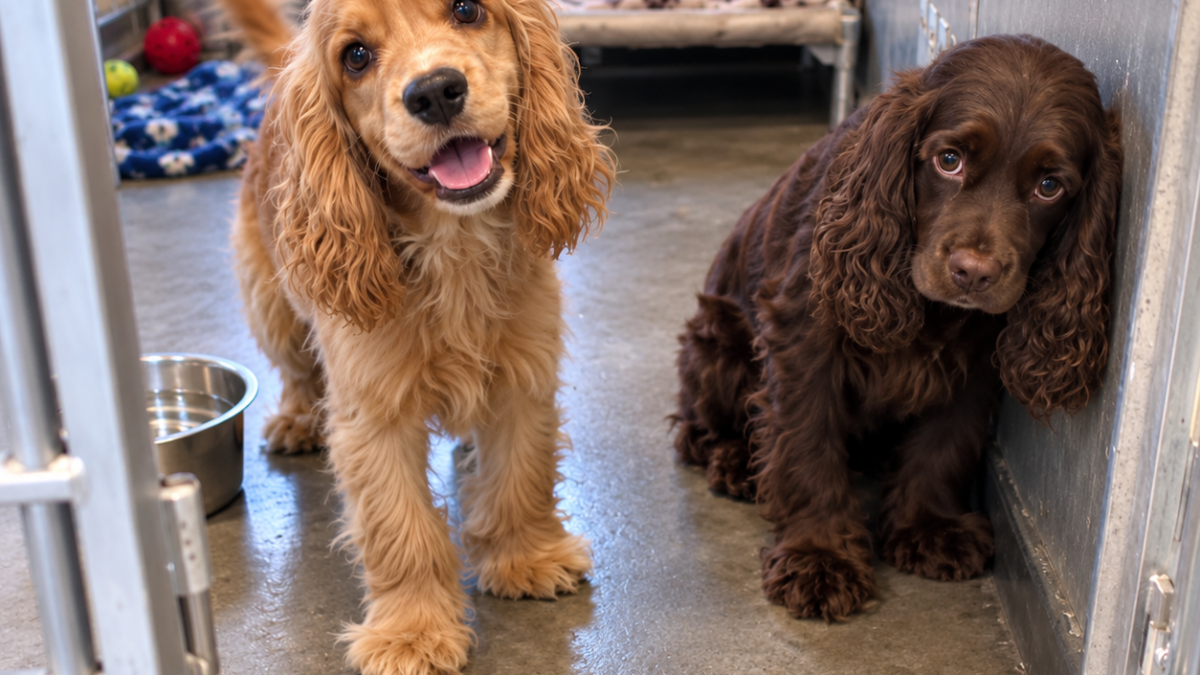
Bella walked to the wall and sat down.
Exactly as I expected.
At ten fifteen, the couple arrived.
Luna heard their voices in the hallway before the door opened.
She went wild.
Her entire body shook with excitement.
When the woman entered, Luna launched herself toward her.
“There’s my girl!”
She dropped to her knees.
Luna climbed into her lap, licking her face.
Her husband laughed.
For several seconds, Bella might as well not have existed.
Then the woman looked up.
She noticed her.
Bella sat several feet away.
Quiet.
Still.
Watching Luna.
The woman’s smile softened.
“Oh,” she said. “I don’t think I really saw her yesterday.”
That sentence nearly broke my heart.
Because it was the most honest thing anyone had said since the sisters arrived.
“No,” I said. “Most people don’t.”
She slowly extended her hand.
Bella remained where she was.
“She’s scared?”
“Not exactly.”
I sat on the floor.
“Can I tell you something about these two?”
They nodded.
So I began at the beginning.
I explained how Bella watched Luna constantly.
How she waited while Luna ate.
How she gave up toys without resistance.
How she slept touching her sister.
How she woke whenever Luna whimpered.
How, during thunderstorms, Bella positioned herself between Luna and the kennel door.
The husband looked surprised.
“She protects her?”
“In every way she knows how.”
I told them about the night Luna had gotten sick.
It had happened only a week earlier.
Nothing serious—an upset stomach, probably caused by Luna eating something too quickly.
But around two in the morning, Luna had started whining.
I found Bella standing over her.
Bella wasn’t barking.
She was scratching softly at the kennel door.
Scratch.
Pause.
Scratch.
Pause.
When I approached, Bella stepped aside.
Luna was trembling.
I took her to the clinic room.
Bella became frantic when I left with her.
Not loud.
That wasn’t Bella.
She paced.
Back and forth.
Back and forth.
She refused food.
She sat by the door.
When I finally returned with Luna several hours later, Bella rushed forward for perhaps the first time since I had known her.
She sniffed Luna from nose to tail.
Then she pressed against her.
Only after Luna fell asleep did Bella eat.
The woman wiped beneath one eye.
“I didn’t know.”
“How could you?” I said. “You only saw them for twenty minutes.”
Luna dropped the toy.
She wandered toward a bowl.
Bella stood.
Her eyes followed her.
The husband noticed.
“She really does watch everything Luna does.”
“Yes.”
Then something small happened.
Something I could never have arranged if I tried.
Luna stepped on the edge of the water bowl.
It tipped.
Water splashed across the floor.
Luna jumped backward, startled.
Before any of us moved, Bella was beside her.
She pressed her shoulder against Luna.
Luna immediately relaxed.
The woman covered her mouth.
Bella stayed beside her sister for several seconds.
Then, as soon as Luna recovered and began sniffing the spilled water, Bella walked back toward the wall.
As though nothing important had happened.
The room became quiet.
The husband finally asked, “What happens if we take Luna?”
I answered carefully.
“Bella stays here.”
“For how long?”
“I don’t know.”
That was the truth.
People sometimes imagine shelters have magical waiting lists full of perfect families.
We don’t.
Some animals are adopted in hours.
Others wait for months.
Some wait much longer.
And quiet dogs can be difficult.
Especially when they are standing beside a dog like Luna.
The woman looked toward Bella.
“Would she be okay?”
I could have lied.
I could have said yes.
Shelter workers learn how to avoid promising things we cannot know.
Instead I said, “She’d survive.”
The woman looked at me.
I continued.
“But I don’t know what losing Luna would do to her.”
Her husband leaned back against the wall.
“So this is why you asked us to come.”
“Yes.”
“You want us to take Bella too.”
I took a breath.
“I want you to understand what separating them means before you decide.”
I didn’t want guilt to make the decision.
Guilt is a terrible foundation for adoption.
Dogs need families who truly want them.
So I added, “If two dogs are too much, tell me. I’ll understand. I mean that.”
The woman looked at Luna.
Then Bella.
“What is Bella like when Luna isn’t around?”
I smiled faintly.
“That’s the interesting part.”
I told them about the afternoons I spent sitting beside Bella.
At first she barely acknowledged me.
Then she began moving closer.
One day she placed a paw on my shoe.
Another day she leaned against my leg.
Eventually, she rested her head on my lap.
“She doesn’t give affection quickly,” I said. “But when she decides you’re safe, she gives you everything.”
The woman stood.
Then she walked toward Bella.
Instead of reaching for her, she sat on the floor several feet away.
Bella watched.
The woman waited.
Luna came bouncing over and tried to climb onto her.
She laughed, petting her with one hand.
But she kept looking at Bella.
“Hi, sweetheart,” she whispered.
Bella tilted her head.
“You don’t have to come over.”
For nearly a minute, nothing happened.
Then Bella stood.
One step.
Another.
She stopped halfway.
The woman didn’t move.
Bella continued.
Finally she reached her.
She sniffed the woman’s knee.
Then her hand.
The woman remained completely still.
Bella looked back toward Luna.
Then something changed.
She sat beside the woman.
Not touching.
But close.
The woman looked at me.
Her eyes were wet.
“Is this good?”
“Very.”
She smiled.
Bella leaned slightly.
Her shoulder touched the woman’s leg.
That was all.
But the husband saw it too.
He walked toward them.
He sat beside his wife.
Luna immediately climbed between them.
For the first time, all four were together.
Bella looked from Luna to the couple.
And then she lay down.
The husband stroked Bella’s ear.
She didn’t pull away.
He looked at his wife.
There are conversations married couples have without speaking.
I watched one happen right in front of me.
His wife gave the smallest nod.
He exhaled.
Then he looked at me.
“What would adopting two dogs involve?”
I almost laughed from relief.
But I forced myself to stay professional.
“Twice the food,” I said.
He smiled.
“Obviously.”
“Twice the veterinary care. Training two puppies at once can be challenging. They’ll need individual attention too. You don’t want them so dependent on each other that they can’t function separately.”
The woman nodded seriously.
“We can do that.”
“Think about it first.”
“We are thinking about it.”
Her husband scratched Luna’s chest.
Then Bella’s.
“We came here because we wanted a dog.”
He looked down at the sisters.
“Maybe we were wrong about the number.”
The woman laughed through her tears.
“We can’t take one half of a family.”
That was when I stopped being professional.
I covered my face.
“Oh no,” the woman said.
“I’m fine.”
“You’re crying.”
“I know.”
She hugged me.
For a few seconds, I stood there between two people I had met less than twenty-four hours earlier, crying over two puppies who probably had no idea their lives had just changed.
When we separated, I crouched beside Bella.
“You hear that?”
Bella looked at me.
“You’re going too.”
She blinked.
Luna barked.
Everyone laughed.
Bella leaned against my knee.
And somehow, that quiet gesture affected me more than Luna’s entire celebration.
The adoption wasn’t finalized that day.
I insisted they go home and prepare.
Two puppies required planning.
The couple—Megan and Daniel—already had a fenced backyard, but they needed another bed, another crate, another leash, more food, and an appointment with their veterinarian.
They promised to return Saturday.
That gave me six days.
Six days sounds like plenty.
It wasn’t.
The moment I knew both sisters were leaving, every ordinary thing became emotional.
Monday morning, Luna knocked over her breakfast bowl.
I laughed and then unexpectedly felt my throat tighten.
Tuesday afternoon, Bella finally brought me a toy.
She didn’t play with it.
She carried the same stuffed duck Luna loved and placed it beside my shoe.
I stared at it.
“Are you giving this to me?”
Bella sat down.
I picked up the duck and gently tossed it two feet.
Luna charged after it.
Bella watched.
I tried again.
This time Bella followed.
She reached the toy after Luna did.
Luna grabbed one side.
Bella grabbed the other.
For ten seconds, the quiet puppy who had spent weeks sitting in corners played tug-of-war.
I laughed so loudly one of my coworkers came running.
“What happened?”
“Look.”
Bella pulled.
Luna pulled back.
Then Bella released the toy and Luna tumbled backward.
We both burst out laughing.
Bella looked confused.
Then her tail moved.
Not much.
Just once.
Then again.
My coworker crouched.
“Oh, Bella.”
That week, people still came through the shelter.
They still noticed Luna first.
But something had changed in me.
Whenever someone said, “That golden puppy is adorable,” I no longer felt frustrated.
Luna was adorable.
She deserved the attention.
The problem had never been that people saw Luna.
The problem was that they stopped looking after they saw her.
There is a difference.
Friday evening, I stayed late.
The building became quiet.
The phones stopped ringing.
The volunteers went home.
Rain tapped softly against the windows.
I sat inside the sisters’ enclosure.
Luna curled against my left leg.
Bella sat on my right.
“This is our last night,” I whispered.
Luna yawned.
Bella looked at me.
“You know what I’m going to miss about you?”
Her ears lifted.
“Everything.”
I laughed at myself.
“That was dramatic.”
Bella leaned into my side.
I ran my fingers through the soft fur behind her ear.
“You scared me.”
Her eyes stayed on mine.
“I thought nobody would see you.”
That sentence carried more weight than I expected.
Because working in a shelter teaches you something painful.
Every animal is worthy.
But worthiness and visibility are not the same thing.
Some dogs sell themselves.
They dance.
They perform.
They press against the bars.
Others shut down.
They retreat.
They make themselves small.
And people sometimes interpret silence as emptiness.
Bella taught me how wrong that can be.
I had known dogs that barked constantly because they were terrified.
Dogs that slept all day because they had stopped expecting visitors.
Dogs that refused eye contact until the moment they decided to trust you.
Bella was different from all of them.
She wasn’t broken.
She wasn’t empty.
She was full of feeling.
She simply spent most of that feeling on someone else.
Luna.
I touched her paw.
“You spent all your time making sure she was okay.”
Bella lowered her chin.
“Tomorrow somebody starts making sure you’re okay too.”
My voice cracked on the final word.
I stayed another hour.
Saturday morning arrived bright and clear.
For the first time in days, there wasn’t a cloud in the sky.
I arrived before opening time.
I packed a bag for the sisters.
Their favorite toys.
Two blankets carrying the familiar smell of the shelter.
Food for the first few days.
Their veterinary records.
Medication instructions.
A list of emergency numbers.
I put the stuffed duck inside last.
Then I changed my mind and took it out.
Luna saw it.
She barked.
“Fine.”
I handed it to her.
She ran around the room.
At eleven, Megan and Daniel pulled into the parking lot.
I knew immediately they had taken the preparation seriously.
The back of their SUV contained two secured travel crates.
There were two new leashes.
Two collars.
Water bottles.
A small bag of treats.
Megan stepped out holding two tags.
One read LUNA.
The other read BELLA.
Seeing Bella’s name nearly undid me.
Daniel noticed.
“Don’t start yet.”
I laughed.
“I’m trying.”
“You’ve got at least ten minutes before crying is allowed.”
“Those are not official shelter rules.”
“They are today.”
Inside, Luna greeted them like celebrities.
Bella stayed back for several seconds.
Then Megan crouched.
Bella walked directly to her.
No waiting.
No cautious approach.
She pressed her head against Megan’s chest.
Megan closed her eyes.
“There you are.”
I looked away.
Daniel saw.
“That counts as crying.”
“I have allergies.”
“You work around dogs.”
“Exactly.”
We signed the final papers.
I explained feeding schedules.
Vaccinations.
Training.
The importance of giving both puppies individual experiences.
I told them Bella might take longer to adjust.
“She needs patience.”
Megan nodded.
“She can have as much as she needs.”
When everything was finished, there was nothing left to do except say goodbye.
I started with Luna.
That was easier.
Luna made everything easier.
I lifted her.
She immediately licked my chin.
“You’re going to destroy their house, aren’t you?”
Luna wagged.
“I knew it.”
I kissed her forehead.
“Be good.”
Then I put her down.
Bella stood several feet away.
For once, she wasn’t watching Luna.
She was watching me.
I crouched.
“Come here.”
Bella walked forward.
I wrapped my arms around her.
She became completely still.
Then she rested her head on my shoulder.
I closed my eyes.
I felt her breathing against my neck.
“You’re going home,” I whispered.
Her body relaxed.
“You don’t have to watch from the corner anymore.”
My tears finally came.
“I hope you understand that.”
Bella pulled back.
She looked directly at me.
Then she licked my cheek once.
One small lick.
Nothing like Luna’s enthusiastic attacks.
Just once.
That was Bella.
She never did anything loudly.
Megan was crying now too.
Daniel pretended he wasn’t.
I attached Bella’s leash.
We walked outside.
Luna jumped into the SUV eagerly.
Bella stopped.
She looked into the vehicle.
Then back at the shelter.
Then at me.
For one horrible second, I wondered if she believed we were abandoning her again.
I knelt.
“It’s okay.”
Megan stood near the open door.
“Bella.”
Bella looked at her.
Megan held out her hand.
“Home.”
Bella walked forward.
She climbed into the SUV.
Luna was waiting.
Bella sat beside her.
Immediately Luna leaned against Bella.
Bella lowered her head across Luna’s shoulders.
Exactly as she had done that terrible afternoon when I thought they would be separated.
Except now they were leaving together.
Megan closed the door.
Through the window, Luna wagged furiously.
Bella watched me.
The SUV began moving.
I raised my hand.
Megan waved from the passenger seat.
Daniel drove slowly toward the exit.
The vehicle turned onto the road.
Luna disappeared from view first.
Bella’s dark face remained visible through the rear window for another second.
Then they were gone.
I stood in the parking lot long after there was nothing left to see.
My coworker opened the shelter door.
“You okay?”
“Yes.”
I wiped my face.
“No.”
She came outside.
We both laughed.
Then she put an arm around me.
“That’s the good kind of goodbye.”
“I know.”
But good goodbyes still hurt.
That afternoon I cleaned their enclosure.
I removed the bedding.
Washed the bowls.
Disinfected the floor.
When I finished, I stood in the empty space.
For weeks, every time I entered that room I had seen Luna bouncing against the gate.
Bella behind her.
Now there was silence.
I found one piece of kibble beneath the bed.
I stared at it for several seconds before laughing.
“This job makes you insane.”
I swept it away.
Then the shelter phone rang.
Another dog needed intake.
Life continued.
That is one of the strange truths about rescue work.
You can be devastated at ten in the morning and bottle-feeding a frightened puppy at eleven.
You can say goodbye to one animal while another is arriving through the same door.
You learn not to think of your heart as something that fills up.
If you did, you would eventually stop.
Instead, somehow, it stretches.
A week passed.
I wondered about the sisters constantly.
I tried not to bother Megan and Daniel.
New adopters need room to become a family without a shelter worker checking on them every six hours.
But on the eighth day, an email arrived.
The subject line said:
THE GIRLS.
I opened it immediately.
There were twelve photographs.
Luna lying upside down on a couch.
Luna carrying a gardening glove.
Luna asleep inside a laundry basket.
Luna standing in the backyard with mud covering all four paws.
I laughed.
Then I reached the fifth photo.
Bella was lying beside a little girl.
I hadn’t known Megan and Daniel had nieces who visited often.
The girl was reading a book.
Bella’s head rested across her ankles.
In the next photo, Bella was sitting beside Daniel at his desk.
Then Bella sleeping against Megan’s feet.
Then Bella and Luna curled together in the same bed despite having two separate beds available.
Below the photographs, Megan had written:
You were right about Bella.
I kept reading.
The first two days, Bella followed Luna everywhere.
If Luna went into another room, Bella went too.
If Luna slept, Bella lay nearby.
But on the third evening, Megan had come home after a difficult day at work.
She sat on the kitchen floor because she didn’t want Daniel to see her crying.
Luna brought her a toy.
Bella did something different.
She walked over.
Sat beside Megan.
And leaned against her.
No licking.
No barking.
No demand for attention.
She simply stayed.
Megan wrote:
I understand now.
That sentence made me stop.
I leaned back in my chair.
Then I continued reading.
Bella had begun exploring the backyard alone.
She had learned where the treats were stored.
She followed Daniel every morning while he made coffee.
At night she still checked Luna before settling down.
But she was no longer only Luna’s shadow.
She was becoming herself.
The final line of the email said:
Thank you for making us come back.
I cried again.
Of course I did.
Apparently that had become my personality.
I printed one photograph.
The one of Bella beside Megan.
I pinned it near my desk.
Over the next month, more updates arrived.
Luna became exactly the dog everyone expected.
Social.
Fearless.
Friendly.
She greeted delivery drivers as though they had come specifically to visit her.
She discovered squirrels and developed a completely unrealistic belief that she might someday catch one.
She learned how to open the laundry room door.
She stole socks.
Constantly.
Bella changed more slowly.
But her changes meant more because each one felt earned.
The first time Bella brought Daniel a ball, he sent me a video.
He sounded more excited than some people sound when their children graduate.
“She brought it to me!”
In the video, Bella stood three feet away.
Daniel rolled the ball.
Bella chased it.
She brought it back.
He cheered.
Bella’s tail wagged.
Then Luna crashed into the frame, stole the ball, and ran away.
Daniel shouted, “Luna!”
I watched that video ten times.
Another month passed.
Then Megan called.
Her voice sounded strange.
My stomach immediately tightened.
Shelter workers never completely lose that reaction when adopters call unexpectedly.
“What happened?”
“Nothing bad.”
“You promise?”
“I promise.”
She laughed.
“We want you to come over.”
“Why?”
“There’s something you need to see.”
Those were almost the exact words I had once said to her.
I smiled.
“All right.”
Their house stood on a quiet residential street about twenty minutes from the shelter.
When I pulled into the driveway that Sunday afternoon, I barely had time to shut my car door.
Luna appeared behind the front window.
Her head vanished.
Seconds later, the front door opened.
“Brace yourself!” Daniel yelled.
Too late.
Luna came flying down the walkway.
She launched herself at me.
I caught her.
“Oh my God!”
She licked my face.
“You got bigger!”
Her tail became a blur.
Then I looked toward the porch.
Bella stood there.
For a moment, neither of us moved.
She was bigger too.
Her dark coat shone in the sunlight.
She looked healthy.
Strong.
But what struck me most was her posture.
At the shelter, Bella always seemed to fold inward.
Head lowered.
Shoulders tucked.
Trying to occupy as little space as possible.
Now she stood upright.
Her head high.
Her ears relaxed.
I knelt.
“Bella.”
She walked toward me.
Not slowly.
Not cautiously.
She walked directly to me.
Then she pressed herself against my chest.
I wrapped my arms around her.
“Hi.”
She pushed harder.
“Oh, you remember me.”
Her entire body trembled.
For half a second, I worried.
Then her tail began moving.
Slowly at first.
Then faster.
I laughed into her fur.
“You do remember.”
When she finally stepped back, she licked my cheek once.
Exactly once.
Daniel grinned.
“She still does that.”
“Of course she does.”
Inside, I saw their new life everywhere.
Two beds beside the fireplace.
Two food bowls.
Four baskets filled with toys because apparently Megan had completely lost control.
Photographs on the refrigerator.
Paw prints on the glass patio door.
The evidence of dogs who didn’t merely live in the house.
They belonged there.
Megan brought coffee.
We went into the backyard.
Luna immediately began running.
Bella stayed near us.
“She still watches her,” Megan said.
“I can see.”
“But she doesn’t worry as much anymore.”
That interested me.
“What changed?”
Megan looked at Bella.
“I think she learned Luna isn’t the only one she has to take care of.”
I smiled.
“Who else?”
Megan pointed toward the house.
“All of us.”
She told me Bella had developed a routine.
Every morning she checked each bedroom.
Whenever Daniel worked late, Bella slept outside his office.
When Megan’s niece stayed overnight, Bella lay near the girl’s bed.
Once Daniel had the flu.
Bella barely left him for two days.
“She’s like a nurse.”
“No,” Daniel called from across the yard. “She’s management.”
Megan laughed.
“That too.”
Then her expression changed.
“There’s another thing.”
“What?”
She led me inside.
On the refrigerator was a photograph I hadn’t seen.
It showed Bella lying beside an elderly woman.
“That’s my mother,” Megan explained.
Her mother had recently lost her husband.
Forty-six years of marriage.
After the funeral, she stopped visiting people.
She stopped answering some calls.
Megan worried constantly.
One afternoon, she convinced her mother to come over.
Luna greeted her enthusiastically.
But the woman was overwhelmed.
She sat on the couch, barely speaking.
Bella stayed across the room.
Watching.
“Of course,” I whispered.
Megan nodded.
“For almost half an hour.”
Then Bella walked over.
She sat beside Megan’s mother.
The woman didn’t pet her.
Bella didn’t ask.
Eventually Bella rested her chin on the woman’s knee.
Megan’s mother began crying.
Not quietly.
The kind of crying grief stores inside the body until something gentle finally gives it permission to escape.
Bella stayed.
Megan told me her mother held Bella for almost an hour.
The next week she came back.
Then again.
Soon she started walking Bella around the neighborhood whenever she visited.
“She says Bella knows when she misses Dad.”
I looked toward the dog.
Bella had followed Luna to the patio door.
But instead of watching her sister, she was watching us.
Megan touched my arm.
“This is what I wanted you to see.”
I swallowed.
“You were right.”
“No.”
“What?”
“You were the one who made the decision.”
“We almost didn’t.”
“But you did.”
Megan shook her head.
“We thought we were doing Bella a favor.”
She smiled.
“We had no idea.”
That afternoon, I stayed for hours.
Luna ran through the yard.
Bella alternated between following her and sitting beside me.
At one point both dogs fell asleep in the grass.
Luna stretched on her side.
Bella lay beside her.
Their paws touched.
I watched them breathing.
For the first time, I could look at Bella without worrying about what would happen next.
She wasn’t waiting anymore.
She was home.
Months became a year.
I continued working at the shelter.
More animals arrived.
More families came.
And Bella changed the way I spoke to every visitor.
I stopped allowing people to rush so quickly.
When families entered and immediately pointed toward the loudest dog, I would sometimes say:
“Take another lap.”
They would look confused.
“Why?”
“Because the dog you notice first isn’t always the dog you’re meant to know.”
I never pressured anyone.
That matters.
An adoption has to fit both sides.
But I became better at introducing the quiet ones.
One afternoon, an older man arrived after losing his wife.
He said he wanted “a calm dog.”
We had a six-year-old mixed breed named Arthur who had spent nearly two months sleeping in the rear of his kennel.
Visitors ignored him.
I thought of Bella.
“Sit with him,” I told the man.
“For how long?”
“As long as it takes.”
Twenty minutes later, Arthur rested his head on the man’s shoe.
The man began crying.
Arthur went home two days later.
Another time, a family wanted a puppy.
Their ten-year-old daughter wandered away from the puppy kennels and sat beside an older beagle named Rosie.
Rosie had barely responded to anyone for weeks.
But she pressed against the child.
The family left with Rosie.
I thought of Bella every time.
Not because every quiet dog was secretly perfect.
That would be dishonest.
Some were frightened.
Some required experienced homes.
Some had behavioral issues needing patience and professional support.
But Bella taught me the danger of mistaking performance for personality.
A shelter shows you animals under stress.
Sometimes the dog barking at the gate becomes quiet in a home.
Sometimes the silent dog becomes playful.
Sometimes the dog hiding in the corner has an entire personality waiting behind fear.
And sometimes a puppy who seems invisible is simply busy watching over someone she loves.
Two years after Bella and Luna left the shelter, Daniel called.
“Are you sitting down?”
My stomach tightened.
“You cannot open with that sentence.”
He laughed.
“Sorry.”
“What happened?”
“Nothing bad.”
“You people always say that after terrifying me.”
“Megan has something planned.”
“What?”
“Saturday. Come over.”
When I arrived, several cars filled the street.
For a moment I wondered whether I had the wrong house.
Then Luna barked from behind the fence.
Definitely the right house.
The backyard was full of people.
Family.
Friends.
Neighbors.
And dogs.
So many dogs.
Megan greeted me.
“What is this?”
She smiled.
“A birthday party.”
“For who?”
She pointed.
Bella and Luna were wearing matching bandanas.
“No.”
“Yes.”
“You threw dogs a birthday party?”
“Daniel objected.”
Daniel walked over carrying a tray.
“I objected to the hats.”
I laughed.
Luna spotted a table containing treats and began trying to climb onto a chair.
Bella sat beside Megan’s mother.
Of course she did.
The older woman stroked her ears.
She looked different from the photograph I remembered.
Brighter.
More present.
When she saw me, she smiled.
“You’re the shelter person.”
“That sounds ominous.”
She laughed.
“You saved my Bella.”
I looked at the dog.
“I didn’t.”
“Yes, you did.”
“No.”
I crouched beside Bella.
“I just made sure somebody looked twice.”
Bella leaned against me.
Megan’s mother watched.
“She saved me, you know.”
Megan had told me.
But hearing the woman say it herself was different.
“After my husband died, everyone tried to make me feel better.”
She looked toward Bella.
“People kept telling me what to do. Get out. Stay busy. Join a group. Travel.”
Her hand moved gently along Bella’s back.
“Bella never told me anything.”
I smiled.
“No. She wouldn’t.”
“She just sat there.”
Her eyes filled.
“That was what I needed.”
Bella placed a paw on her shoe.
The woman laughed softly.
“See?”
I did.
Later that afternoon, Megan brought out a small box.
“What’s this?”
“For you.”
“I didn’t bring gifts.”
“You spent enough money on these two before we adopted them.”
She handed me the box.
Inside was a framed photograph.
Bella and Luna were lying together on the porch.
Luna faced the camera with her mouth open, looking delighted.
Bella rested beside her.
Under the photograph, Megan had written one sentence.
THE QUIET ONES LOVE JUST AS LOUDLY.
I stared at it.
“You’re trying to make me cry at a dog birthday party.”
“Absolutely.”
“It’s working.”
We hugged.
That photograph eventually replaced the first one beside my desk.
Not because the first one mattered less.
Because the new picture told the rest of the story.
Visitors asked about it constantly.
I would tell them about two sisters.
The golden one everyone noticed.
The dark one people overlooked.
The family who came for one dog and went home with two.
But I stopped telling the story as though Bella had been rescued from some terrible fate.
That wasn’t exactly what happened.
Bella would probably have eventually found another family.
We would have cared for her.
We would have protected her.
The real story was about being seen before separation became necessary.
About somebody slowing down long enough to notice a relationship that didn’t announce itself.
And about a dog whose greatest gift was easy to miss because she offered it silently.
Years passed.
Luna remained Luna.
Older, slightly calmer, but only slightly.
Her muzzle slowly began showing white.
She still greeted everyone as if they were returning heroes.
Bella grew confident.
She learned games.
She loved car rides.
She developed an embarrassing obsession with cheese.
She occasionally stole Luna’s toys, proving sainthood had limits.
Once, Megan sent me a photograph of Bella stretched across the entire couch while Luna sat on the floor looking offended.
The caption read:
THE QUIET ONE HAS TAKEN POWER.
I laughed for five minutes.
But Bella never stopped caring for her sister.
When Luna underwent a minor surgery, Bella waited by the front door until she returned.
When Luna developed arthritis years later, Bella slowed her own pace during walks.
If Luna stopped, Bella stopped.
If Luna rested, Bella waited.
They grew older the same way they had grown up.
Together.
One autumn evening, many years after that rainy morning when I first saw them inside the carrier, Megan called again.
This time, she didn’t tell me nothing was wrong.
Her voice was shaking.
“It’s Luna.”
I sat down.
“What happened?”
“She collapsed this morning.”
Luna was elderly by then.
The veterinarian had found serious heart problems.
They were trying medication.
There were options.
But no guarantees.
I closed my eyes.
“How’s Bella?”
There was silence.
Then Megan whispered:
“She won’t leave her.”
Of course she wouldn’t.
I drove over after work.
The house was quieter than usual.
Luna lay on a thick blanket near the fireplace.
Her golden coat had faded.
Her body looked smaller.
But when she saw me, her tail moved.
Once.
Twice.
“Hey, troublemaker.”
I knelt beside her.
She lifted her head and licked my hand.
Even old and sick, Luna was still Luna.
Bella lay beside her.
Dark muzzle now streaked with silver.
Her paw rested across Luna’s leg.
I sat on the floor.
Bella looked at me.
For one instant, I was back in the shelter.
Four-month-old Bella.
Four-month-old Luna.
One bouncing.
One watching.
“You’re still taking care of her,” I whispered.
Bella lowered her head.
Megan sat across from me.
“She barely eats unless Luna eats.”
I looked at Bella.
“That needs to change.”
Megan nodded.
“We’re working with the vet.”
We stayed there most of the evening.
Luna improved during the following days.
Then weeks.
Medication gave them more time.
Not forever.
But time.
And when animals grow old, time becomes a strange currency.
You stop asking for years.
You become grateful for mornings.
For one more walk.
One more meal.
One more nap in a patch of sunlight.
Luna lived nearly another year.
When her final decline came, Megan called me.
I visited the night before their veterinarian was scheduled to come to the house.
Luna could no longer walk comfortably.
Her breathing was difficult.
But she wasn’t alone.
Megan lay beside her.
Daniel sat nearby.
Bella was curled against Luna exactly as she had been the first night I met them.
I stroked Luna’s forehead.
“You did good.”
Her eyes opened.
That tail moved once.
I laughed through tears.
“Still showing off.”
Bella looked at me.
I moved closer to her.
She pressed against my side.
No one talked much.
There are moments when language becomes smaller than what people are feeling.
That night was one of them.
The next morning, Luna died peacefully at home with her family around her.
Bella stayed beside her.
Afterward, Megan told me Bella walked through the house searching.
Kitchen.
Bedroom.
Patio.
Then back again.
For several days she slept near Luna’s empty bed.
She ate less.
She waited by the door.
My heart broke for her.
The thing I had feared all those years earlier had finally happened.
Bella had lost Luna.
But there was one enormous difference.
She wasn’t alone.
Megan slept downstairs beside her.
Daniel took her on slow morning walks.
Megan’s mother visited every afternoon.
They didn’t try to replace Luna.
They didn’t force Bella to cheer up.
They simply stayed.
The way Bella had always stayed for everyone else.
One evening, about two weeks after Luna died, Megan sent me a message.
Bella finally climbed onto the couch.
She had avoided it since losing Luna.
Megan was sitting there crying.
Bella climbed up.
Turned in a circle.
Then lay beside her.
Her head rested on Megan’s lap.
Megan wrote:
She’s comforting me for losing the same dog she lost.
I read that sentence several times.
Then I answered:
That’s Bella.
Months later, I visited.
The house still felt different without Luna.
There was no explosion of golden fur at the door.
No barking.
No stolen sock being carried triumphantly through the hallway.
Bella met me quietly.
She walked forward.
Pressed her head against my legs.
I knelt.
We sat together.
Megan joined us.
For a while, nobody spoke.
Then Bella stood.
She walked toward a shelf in the living room.
On the bottom shelf was a basket containing some of Luna’s old toys.
Bella reached inside.
She pulled out the stuffed duck.
The same kind of toy Luna had loved at the shelter.
It probably wasn’t the original.
After so many years, I couldn’t imagine it had survived.
Bella carried it toward us.
She placed it beside my shoe.
I stopped breathing for a second.
Megan covered her mouth.
“Has she done that before?”
“No.”
I picked up the toy.
Bella watched.
A memory came back.
Two puppies.
A shelter room.
Bella bringing me Luna’s toy.
Me throwing it.
Both of them chasing.
I held the duck.
“You want me to throw it?”
Bella’s tail moved.
I tossed it gently across the room.
Bella ran.
Not fast.
She was old.
But she ran.
She picked up the toy.
Then she turned.
For one impossible second, I expected Luna to appear from somewhere and steal it.
She didn’t.
Bella brought the toy back herself.
I laughed.
Megan cried.
Bella dropped it.
I threw it again.
She chased it.
Again.
For several minutes, the quiet puppy who had spent her whole life watching over everyone else played simply because she wanted to.
When she became tired, she returned.
She lay between Megan and me.
Her breathing slowed.
I stroked her dark fur.
“You did your job,” I whispered.
Megan heard me.
“What?”
I looked at Bella.
“All those years, I thought her purpose was protecting Luna.”
I shook my head.
“But maybe Luna was just the first one she loved.”
Megan smiled through tears.
Bella closed her eyes.
She had protected her sister.
Then Megan.
Daniel.
The children who visited.
Megan’s mother.
Anyone hurting enough for Bella to notice.
She had spent a lifetime doing the same thing she had done inside that tiny shelter cage.
Watching.
Waiting.
Moving closer when somebody needed her.
Bella lived another two years.
She became slower.
She slept more.
Her hearing faded.
But whenever somebody sat beside her, she still leaned against them.
When the day finally came for Bella too, she was very old.
Megan called me.
“You don’t have to come,” she said.
“I’m coming.”
I drove to the house.
Bella lay beneath a blanket near the window.
Sunlight covered the floor.
Megan sat beside her.
Daniel sat on the other side.
Megan’s mother was there too.
On a nearby shelf stood photographs covering almost Bella’s entire life.
Bella and Luna as puppies.
Bella in the backyard.
Bella beside the children.
Bella sleeping near Daniel.
Bella sitting with Megan’s mother.
Bella and Luna gray-faced and old, lying shoulder to shoulder.
I knelt.
Bella’s eyes opened.
Cloudy now.
But still those same deep eyes.
“Hi, sweetheart.”
Her tail didn’t move.
She didn’t have the strength.
I placed my hand beneath her chin.
For several seconds, nothing happened.
Then Bella shifted her head.
Barely.
She rested it against my hand.
I smiled.
“There you are.”
Megan began crying.
I did too.
I leaned close to Bella.
“You were never invisible.”
I wanted her to know that.
Even though she couldn’t understand the words.
“You hear me?”
My voice broke.
“You were never the second dog.”
Bella breathed slowly.
“You were never the one nobody wanted.”
I stroked her forehead.
“You were somebody’s whole world.”
The veterinarian arrived later.
Bella died peacefully surrounded by the family she had spent her life protecting.
Afterward, no one moved for a long time.
Finally Daniel stood.
He walked toward the shelf.
He picked up the photograph Megan had once given me.
They had kept another copy.
The picture of both sisters on the porch.
Luna smiling at the camera.
Bella beside her.
Daniel looked at it.
“We came to that shelter for one dog.”
Megan laughed softly through her tears.
“And almost made the biggest mistake of our lives.”
I looked toward Bella.
“No.”
They both turned toward me.
“You came back.”
That mattered.
People make incomplete decisions all the time because they have incomplete information.
What matters is what they do when they finally see the whole picture.
Megan sat beside me.
“You made us come back.”
I shook my head.
“I asked.”
“You fought for her.”
“I introduced you.”
“She needed someone.”
“She needed you.”
For years I had taken too much responsibility for the good ending.
Maybe because shelter workers sometimes need to believe we control more than we actually do.
But the truth was simpler.
I had seen Bella.
Then Megan and Daniel had seen her too.
Everything else followed.
A few weeks after Bella died, a package arrived at the shelter.
Inside was a framed photograph.
Not the old one.
A new collage.
Bella and Luna through every stage of their lives.
Puppies.
Young dogs.
Muddy dogs.
Sleeping dogs.
Gray dogs.
Loved dogs.
There was also a letter.
I read it alone at my desk.
Megan wrote about how much the sisters had changed their family.
How Luna had brought noise, laughter, chaos and energy.
How Bella had brought something quieter.
Patience.
Presence.
The ability to sit with pain instead of trying to fix it.
Megan wrote:
We thought Luna was the dog we chose and Bella was the dog we decided not to leave behind.
We were wrong.
They were both choices.
They were both gifts.
Luna taught us how loudly joy can enter a room.
Bella taught us how quietly love can stay.
I stopped reading for several minutes.
Then I continued.
The final paragraph said:
There is a new dog sleeping beside my desk while I write this.
My eyes widened.
I grabbed my phone.
Before I could call, I read the next sentence.
She is eight years old, gray around the muzzle, and apparently nobody wanted her because she hid in the back of her kennel whenever visitors came.
I started laughing.
Then crying.
Then laughing again.
Her name was Daisy.
Megan and Daniel had adopted her from another rescue.
When they visited, the staff showed them several younger dogs.
Megan asked one question:
“Which dog does everyone walk past?”
They showed her Daisy.
Daisy stayed in the rear of her kennel.
She didn’t bark.
She didn’t approach.
Daniel sat beside her for forty minutes.
Eventually Daisy walked over.
She placed her head on his knee.
They took her home.
I looked at Bella’s photograph.
“You did that.”
Of course she hadn’t literally done anything.
But that is how love survives sometimes.
Not through grand monuments.
Through changed behavior.
Through what people do differently because someone once showed them another way to see.
Years have passed since that rainy morning.
I still work with rescue animals.
I have forgotten hundreds of paperwork details.
I have forgotten dates.
Names of veterinarians.
Which year we replaced the old kennels.
Which winter the heater failed.
But I have never forgotten opening that carrier.
Luna standing immediately.
Golden tail moving.
Bella sitting behind her.
Silent.
Watching.
For years, I thought Luna had been the lucky one because everyone loved her instantly.
Now I think Bella taught me something more important.
Being loved instantly is wonderful.
Being understood slowly is something else.
There are animals—and people—who do not know how to make themselves easy to choose.
They do not perform.
They do not demand.
They do not know how to walk into a room and convince everyone they belong there.
Sometimes they simply sit quietly and hope somebody stays long enough to discover them.
Bella was one of those souls.
She never needed to become Luna.
That was the mistake I almost made in the beginning.
I kept wondering how I could make people see Bella.
How I could make her more outgoing.
How I could make her more adoptable.
But Bella did not need fixing.
People needed more time.
Once they gave her that time, there she was.
Loyal.
Gentle.
Funny in ways I had never expected.
Stubborn about cheese.
Territorial about couch cushions.
Protective.
Patient.
Capable of loving an entire family without ever asking to be at the center of it.
Every now and then, someone comes into the shelter and asks me the question I’ve heard thousands of times.
“Which dog should I adopt?”
I never point immediately.
Instead, I say:
“Tell me about your life.”
Do you have children?
Other animals?
A quiet home?
An active home?
Do you work long hours?
Do you want a dog that runs with you?
A dog that sleeps beside you?
A dog that needs training?
A dog that simply needs somewhere peaceful to grow old?
Then we look.
Really look.
Sometimes the perfect match is the dog jumping at the front of the kennel.
There is nothing wrong with choosing Luna.
Dogs like Luna deserve homes too.
But sometimes I ask visitors to stand still for another minute.
Look toward the back.
Notice who is watching.
Notice who isn’t asking.
Notice the dog everyone else has passed.
Not because that dog is automatically better.
Not because quiet animals are more deserving than loud ones.
But because every animal deserves to be seen as an individual.
Bella taught me that.
And she taught Megan.
And Daniel.
And eventually Bella taught them to find Daisy.
That is her legacy.
Not sadness.
Not sacrifice.
Not even the years she spent caring for Luna.
Her legacy is attention.
She taught us to look twice.
One evening, after closing the shelter, I was walking through the kennel wing.
Most of the dogs had settled.
A few were sleeping.
One young dog was still barking enthusiastically whenever I passed.
At the end of the row sat a small black dog who had arrived earlier that week.
He had spent every adoption hour hiding.
I almost kept walking.
Then I stopped.
I thought about wet pavement.
A small carrier.
A golden puppy bouncing against the door.
A dark puppy sitting behind her.
I opened the kennel.
I sat on the floor.
The little black dog stayed in the corner.
“That’s okay,” I said.
He watched me.
I didn’t reach toward him.
I didn’t call him repeatedly.
I simply stayed.
Five minutes passed.
Then ten.
Eventually he stood.
He took two steps.
Stopped.
Another step.
I smiled.
“No hurry.”
He came closer.
He sniffed my shoe.
Then he sat beside me.
Not touching.
Not yet.
I looked down at him.
And for a second, I could almost see Bella beside me again.
Those deep eyes.
That quiet patience.
That enormous heart hidden behind silence.
I whispered the words I wish every overlooked animal could hear:
“I see you.”
The dog leaned against my leg.
Outside, the evening light faded across the parking lot.
The shelter was almost completely silent.
I sat there with him for a long time.
And I thought about Luna.
The puppy who entered every room like sunlight.
I thought about Bella.
The puppy who stood quietly in the shadows, making sure the sunlight was safe.
They were sisters.
They were completely different.
And neither needed to become the other to deserve love.
Luna taught me that joy can be loud.
Bella taught me that devotion often isn’t.
Sometimes love barks and jumps and races to meet you at the door.
Sometimes love steals your socks and makes you laugh.
And sometimes love sits quietly beside you while your heart is breaking.
It does not demand that you stop crying.
It does not ask what it will receive in return.
It simply stays.
That was Bella.
She stayed beside Luna when they had nothing.
She stayed beside Megan when she cried.
She stayed beside Daniel when he was sick.
She stayed beside a grieving woman who didn’t know how to begin living without her husband.
And when Bella eventually needed someone to stay beside her, the family she had loved gave every bit of that devotion back.
That is the ending I wanted for her.
Not because it was perfect.
Nothing that contains love is protected from loss.
Luna still grew old.
Bella still had to say goodbye.
Eventually the family had to say goodbye to Bella too.
But being loved does not mean never losing anyone.
It means the time between hello and goodbye mattered.
Bella’s time mattered.
Luna’s time mattered.
Their family mattered.
And somewhere, an older dog named Daisy was sleeping safely in the home Bella had once entered as the puppy nobody noticed.
Whenever I think about that, I smile.
Because Bella never demanded to be remembered.
She never needed applause.
She never fought for the center of the room.
She simply loved.
Quietly.
Faithfully.
Completely.
And somehow, that quiet little dog became one of the loudest lessons my heart has ever heard.
Years later, I still kept Bella and Luna’s photograph beside my desk.
The frame had changed twice.
The first one cracked when a frightened shepherd mix knocked it to the floor. The second faded after years of afternoon sunlight poured through the shelter office window.
But the photograph remained.
Luna was looking straight at the camera with that same bright expression she had carried through most of her life.
Bella was beside her.
Quiet.
Steady.
Watching.
And beneath the photograph was the sentence Megan had once written:
THE QUIET ONES LOVE JUST AS LOUDLY.
I had probably read those words thousands of times.
But one Tuesday morning, they meant something different.
The shelter had opened less than an hour earlier when I saw a familiar SUV pull into the parking lot.
For a second, I just stared through the front window.
Then the driver’s door opened.
Daniel stepped out.
His hair was grayer now.
Megan came around the other side carrying a leash.
And attached to that leash was Daisy.
The senior dog they had adopted after Bella died.
I smiled before they even reached the door.
“Well,” I said when they entered, “look who finally decided to visit.”
Daisy stayed close to Megan’s leg.
She had a white muzzle, cloudy brown eyes, and the careful movements of a dog who had learned that rushing was no longer necessary.
Daniel hugged me.
Megan followed.
Then I crouched.
“Hi, Daisy.”
She sniffed my hand.
For several seconds, she didn’t move.
Then she leaned forward and pressed her forehead against my knee.
I laughed.
“Oh, I know exactly who taught your parents to choose you.”
Megan looked toward Bella’s picture.
“So do we.”
We sat in my office with coffee while Daisy curled beneath Megan’s chair.
They told me about the years since I had last seen them.
Daisy had been harder than they expected.
The rescue staff had warned them.
She had spent years moving between unstable homes before ending up in a kennel.
At first, she hid from almost everything.
Doorbells.
Plastic bags.
Raised voices.
Thunder.
Even the sound of a kitchen cabinet closing too hard could send her into another room.
“She didn’t trust good things,” Megan said.
I looked beneath the desk.
Daisy was sleeping now.
“Some animals need time before safety feels real.”
Daniel nodded.
“The first month, I thought she hated me.”
“She didn’t.”
“I know that now.”
He smiled.
“She was just terrified.”
Megan reached down and stroked Daisy’s side.
“One night, Daniel fell asleep on the couch. Daisy had never willingly gotten close to him before.”
Daniel laughed.
“I woke up around two in the morning and couldn’t move my legs.”
“Why?”
“She was sleeping across both of them.”
I laughed.
“And you stayed there?”
“For three hours.”
“That sounds about right.”
Megan smiled.
“After that, she was his dog.”
“Excuse me,” Daniel said.
Daisy lifted her head at the sound of his voice.
Then she stood.
Walked across the office.
And sat beside him.
Megan raised an eyebrow.
“My point exactly.”
We all laughed.
For a moment, it felt impossibly familiar.
Not because Daisy resembled Bella.
She didn’t.
But because I recognized the rhythm.
The slow trust.
The patience.
The realization that love does not always arrive at full speed.
Sometimes it inches closer.
One safe day at a time.
Then Megan reached into her purse.
“There’s another reason we came.”
She placed an envelope on my desk.
I looked at it.
“What is this?”
“Open it.”
Inside was a check.
I looked at the amount.
Then looked again.
“Megan.”
She smiled.
“Don’t argue.”
“This is too much.”
Daniel leaned back.
“No, it isn’t.”
I stared at them.
The donation was enough to renovate an entire section of our older kennel wing.
For years, we had talked about creating quieter spaces for anxious dogs.
Our shelter had been built decades earlier.
Concrete floors.
Metal gates.
Sound traveled everywhere.
For confident dogs, it was manageable.
For frightened animals, the constant barking could make everything worse.
We had wanted small private rooms.
Soft lighting.
Sound panels.
Comfortable bedding.
Places where dogs could decompress before meeting potential adopters.
We never had enough funding.
Until now.
I looked at the check again.
“I can’t accept this without asking where it came from.”
Daniel glanced at Megan.
Then she said, “My mother.”
I became quiet.
Megan’s mother.
The woman Bella had comforted after the loss of her husband.
“She died last winter,” Megan said softly.
“I’m sorry.”
“She was eighty-four.”
Megan smiled through the sadness.
“She had a good life.”
Daisy moved back toward her.
Megan rested a hand on Daisy’s head.
“Mom never forgot Bella.”
Neither had I.
“She left money in her will,” Megan continued. “Some for family. Some for a few charities.”
Then she looked toward the photograph.
“And some for dogs nobody notices.”
I swallowed.
“She actually wrote that?”
Megan nodded.
“She said she wanted it used for the animals who sit in the back of their kennels.”
Daniel slid another sheet of paper toward me.
There, in shaky handwriting, was a short note.
I read it slowly.
Please use this to give frightened animals somewhere quiet enough to show who they really are.
I couldn’t speak for a few seconds.
Megan’s voice softened.
“She knew exactly what she wanted.”
I looked at Bella.
Then at Daisy.
Then back at the note.
“All because one dog sat beside her.”
Megan shook her head.
“No.”
“What do you mean?”
“Because someone noticed that dog first.”
That hit me harder than I expected.
For years, I had tried to convince myself that Bella’s story belonged entirely to Bella.
It did.
But standing there, I finally understood something else.
Kindness rarely ends where we think it ends.
A worker notices a quiet puppy.
A family changes an adoption decision.
That puppy comforts a grieving woman.
That woman eventually leaves money to help frightened animals she will never meet.
The line continues.
One small act touching another.
Most of us never get to see where it ends.
Bella’s story had not ended when she died.
It had simply moved into other hands.
We accepted the donation.
Construction began three months later.
The old isolation wing was torn apart.
Walls came down.
New ones went up.
Soundproofing was installed.
The cold fluorescent lights were replaced with softer fixtures.
Each room received a raised bed, blankets, enrichment toys, and a small viewing window.
There were no metal bars facing the public hallway.
Dogs could rest without dozens of strangers staring directly at them.
We created separate meeting rooms where potential adopters could sit quietly with animals away from barking.
When the renovations were nearly finished, the shelter director asked what we should call the space.
Everyone offered suggestions.
The Quiet Wing.
The Comfort Rooms.
Second Chance Hall.
I didn’t like any of them.
Finally, one volunteer pointed toward my desk.
“What about Bella’s Rooms?”
The room went silent.
I looked at the photograph.
“No.”
Everyone stared at me.
I smiled.
“The Bella and Luna Rooms.”
Someone laughed.
“Why Luna?”
“Because Bella never wanted to go anywhere without her.”
That settled it.
A small plaque went near the entrance.
Nothing dramatic.
Just their names.
BELLA & LUNA QUIET ADOPTION ROOMS
Below that:
For the animals who need a little more time to be seen.
The first dog moved in on a Thursday.
His name was Murphy.
He was a five-year-old terrier mix who had spent almost six weeks pressed against the rear wall of his kennel.
Whenever visitors approached, Murphy turned away.
Children frightened him.
Men frightened him.
Leashes frightened him.
Almost everything frightened him.
Before the renovation, people passed him constantly.
Some assumed he was unfriendly.
Others said he looked sad.
A few asked if something was “wrong” with him.
There wasn’t.
Murphy had simply learned caution.
We moved him into one of the new rooms.
For two days, he stayed beneath his bed.
Then something changed.
The noise was gone.
He began sleeping on top of the blankets.
He accepted treats from volunteers.
He played with a stuffed rabbit when no one was watching.
A week later, a woman named Claire came to the shelter.
She was in her late fifties.
Recently divorced.
Living alone for the first time in thirty years.
She said she wanted a quiet companion.
I brought her into Murphy’s room.
He retreated immediately.
Claire sat on the floor.
“How long should I wait?”
I smiled.
“As long as you want.”
She waited twenty minutes.
Murphy remained near the wall.
Thirty minutes.
Nothing.
At forty-five minutes, Claire looked at me.
“Maybe he doesn’t like me.”
“Maybe he doesn’t know you yet.”
She stayed.
After nearly an hour, Murphy stood.
He stretched.
Walked halfway toward us.
Stopped.
Claire looked away deliberately.
Murphy continued.
He sniffed her shoe.
Then her hand.
Finally, he sat beside her.
Claire didn’t touch him.
She simply whispered:
“There you are.”
My chest tightened.
Those words.
So simple.
I had heard versions of them before.
Megan saying them to Bella.
Daniel saying them to Daisy.
People finally seeing what was right in front of them.
Murphy went home with Claire three days later.
Six months after that, she sent us a photograph.
Murphy was sprawled across her bed with his head on her pillow.
The note said:
Turns out he isn’t quiet at all. He snores like a chainsaw.
I pinned it beneath Bella and Luna.
More photographs followed.
Dogs that had been overlooked.
Dogs with gray muzzles.
Dogs missing teeth.
Dogs afraid of strangers.
Dogs who needed medication.
Dogs who needed experienced homes.
Not every story was easy.
Not every adoption succeeded on the first attempt.
Some animals stayed for months.
Some needed trainers.
Some needed foster homes.
We still had heartbreak.
We still lost animals to illness.
We still had days when there were too many dogs and not enough space.
Bella had not magically fixed rescue work.
Nothing could.
But the rooms changed something.
They gave certain animals a chance to be themselves.
And they changed the way people looked.
One Saturday afternoon, I saw a little boy sitting outside Murphy’s old room.
His parents were meeting a shy hound named Franklin.
The boy was around nine.
He had been quiet throughout the visit.
Franklin had not approached anyone.
The father finally said, “Maybe we should see another dog.”
The boy shook his head.
“He’s scared.”
The father sighed.
“There are lots of dogs here.”
“But he keeps looking at Mom.”
I stopped walking.
The mother looked toward Franklin.
The dog was indeed watching her.
The boy sat down.
“Maybe we should wait.”
They did.
Twenty minutes later, Franklin walked over and rested his chin on the mother’s knee.
The family adopted him.
I went back to my office afterward.
Bella and Luna’s photograph caught my eye.
“You two are still causing trouble,” I said.
Years passed.
Eventually, I retired.
That day was harder than I expected.
For more than half my life, the shelter had defined my mornings.
The sounds.
The smell.
The endless laundry.
The barking.
The paperwork.
The joy.
The heartbreak.
I packed my desk slowly.
Pens.
Old adoption records I didn’t need.
Photographs.
Letters.
The framed picture of Bella and Luna went into the box last.
Before leaving, I walked through the quiet rooms.
Every room was occupied.
In one, an elderly Labrador slept beneath a blanket.
In another, a nervous shepherd watched me from his bed.
At the very end was a young black spaniel mix.
Dark coat.
Large eyes.
Silent.
For a moment, I stopped breathing.
She wasn’t Bella.
Of course not.
But something in the way she watched me pulled me backward through time.
Rain.
A carrier.
Luna bouncing at the front.
Bella sitting behind her.
I opened the room.
The dog backed away.
I sat down.
My knees complained.
Age does that.
“Don’t worry,” I whispered.
“I’m pretty good at waiting.”
She stared at me.
Five minutes passed.
Then ten.
Eventually, she walked forward.
She sniffed my hand.
I didn’t move.
Then she sat beside me.
Her shoulder touched my leg.
I smiled.
“There you are.”
A volunteer appeared in the doorway.
“We’ve been calling her Rosie.”
“She’s beautiful.”
“She’s been here three weeks.”
“She’ll find someone.”
The volunteer smiled.
“You sound very sure.”
I looked down at Rosie.
“No.”
I stroked her ear.
“I just know somebody has to look twice.”
When I finally walked out of the shelter that evening, I carried the cardboard box against my chest.
I reached my car.
Opened the door.
Then stopped.
I looked back at the building.
For the first time, I wasn’t coming back to work the next morning.
I expected sadness.
And there was some.
But mostly I felt gratitude.
Thousands of dogs had passed through those doors.
Some stayed for hours.
Some for months.
Some I remembered clearly.
Others blurred together with time.
But Bella remained different.
Not because her story was the saddest.
It wasn’t.
Not because her rescue was the most dramatic.
It wasn’t that either.
Bella mattered because she changed how I saw.
And once someone changes how you see, they become part of every choice you make afterward.
I placed the photograph on a shelf in my living room.
It remains there today.
Luna still appears to be seconds away from barking.
Bella still looks calm.
Sometimes visitors ask about them.
I tell the story.
Not every detail.
That would take hours.
I tell them about two sisters who entered a shelter together.
One wanted everyone to notice her.
The other wanted only to make sure her sister was safe.
I tell them about the couple who came for Luna.
How they almost left Bella behind.
How they returned.
How Bella spent her life comforting people.
How her kindness eventually helped create quiet rooms for animals she never met.
And I always end the same way.
Years ago, I thought the happiest ending for Bella would simply be getting adopted with Luna.
I was wrong.
That was only the beginning.
The real ending was bigger.
Bella was loved.
Then she taught people how to love differently.
Those people carried the lesson forward.
Megan and Daniel adopted Daisy.
Megan’s mother helped build the quiet rooms.
Murphy found Claire.
Franklin found his family.
Dogs whose names Bella would never know found homes because one silent puppy once made us slow down and pay attention.
That is what a satisfying ending looks like to me now.
Not a world without grief.
Not a story where nobody grows old.
Not a promise that love prevents loss.
A good ending is knowing the love mattered after the goodbye.
Luna brought joy wherever she went.
Bella brought stillness.
One filled rooms.
The other noticed who was hurting inside them.
They needed each other.
And eventually, the world needed what Bella had quietly taught us.
Some evenings, when the house is silent, I look at their photograph.
I remember holding Bella on adoption day.
I remember whispering:
“You don’t have to watch from the corner anymore.”
I wish I could go back and tell that younger version of myself something.
Bella never stopped watching from the edge of the room.
That was simply who she was.
But eventually, the people around her learned to turn toward the corner.
They learned to notice.
They learned to wait.
And because they did, Bella never became invisible again.
Her name went onto a wall.
Her story entered families.
Her kindness lived in dogs she never met.
And every time someone walks into that shelter today, passes the barking dogs at the front, stops in front of one quiet animal, sits down, and says—
“There you are.”
Bella is still there.
Not in the kennel.
Not in the photograph.
But in the choice to stay.
In the patience to wait.
In the decision to look twice.
Luna showed us how beautiful it is to be welcomed loudly.
Bella showed us something even harder to forget.
Sometimes the deepest love in the room is the one making the least noise.
And sometimes the soul everyone walks past is the one that changes every life it touches.








