Every Time I Hit a Board With My Hammer, a Starving Dog Came Running—Then I Learned Why He Always Walked Away
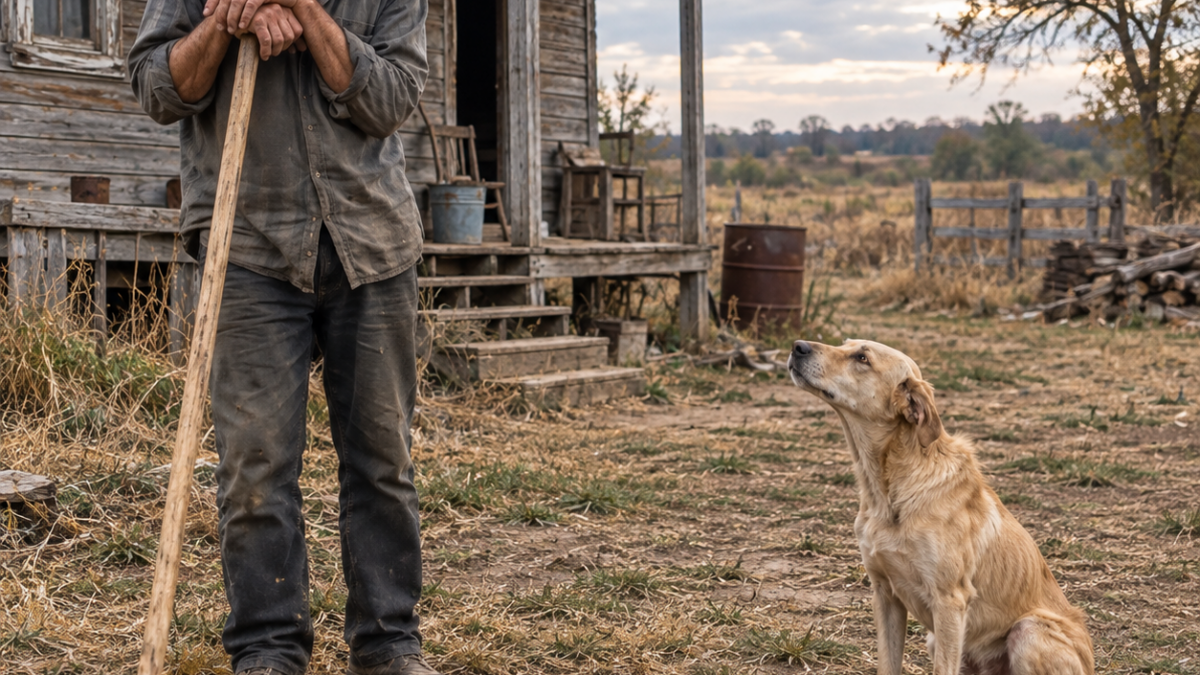
PART 2
Daniel folded his hands on the kitchen table and looked past me toward the window again.
The dog was still there.
Even from that distance I could see the shape of him beside the ditch, sitting with his chest upright and his head angled toward my father’s farmhouse as though he were keeping watch over something the rest of us couldn’t see.
Daniel took a slow breath.
“His name was Walter Bell,” he said. “Most people around here called him Walt. He wasn’t always homeless.”
I didn’t say anything.
Something about the way Daniel said it told me that if I interrupted, he might decide not to finish.
“Walt was a carpenter,” he continued. “A good one. My dad hired him years ago. Framing, porches, barns, repair work. He could look at a crooked doorway and tell you what was wrong before he ever touched a level.”
My eyes moved toward the old farmhouse.
“A carpenter?”
Daniel nodded.
“And here’s the part you probably don’t know. Walt worked for your father.”
That got my attention.
“My father?”
“More than once. Years ago. Walt helped repair that barn. Rebuilt part of the porch too.”
I sat back.
My father had been dead eleven years. During the last few years of his life, we had talked mostly about doctors, taxes, weather, and whether the old Ford tractor would survive another season. I had never asked him who had repaired the barn or replaced the back steps.
Daniel rubbed his thumb against a scratch in the table.
“Walt had a wife named Ellen. From what I heard, they were married a long time. No fancy life, but they had a small place over near Mill Creek. He worked. She worked at a grocery store. They got by.”
“What happened?”
“Cancer.”
One word.
It landed heavier than it should have.
Daniel saw my face and stopped.
I looked down at my hands.
“Mine was cancer too.”
“I’m sorry.”
I nodded once.
There wasn’t anything else to say.
Daniel continued.
“Ellen got sick. Walt started missing jobs because he was taking her to appointments. Then came the bills. Then he sold his truck. Then his tools. After she died, things went downhill fast.”
I knew that part without having lived his exact life.
The part where everyone expected grief to be an event when it was really a country you woke up inside every morning.
Daniel told me Walt had lost the little house near Mill Creek less than a year after Ellen died. For a while he slept in his truck until the transmission failed. Then he stayed with friends. Then in a shelter. Then nowhere permanent at all.
“Where did the dog come from?” I asked.
“Nobody knows exactly. Walt showed up with him one spring. The dog was already grown. Somebody asked where he got him, and Walt said, ‘He found me.’ That was all he ever said.”
“Did he have a name?”
Daniel smiled faintly.
“That’s another weird thing. I never heard Walt use one. He’d whistle or say, ‘Come on, boy,’ and that dog would be beside him before he finished the sentence.”
I looked outside again.
“He never left Walt?”
“Never.”
Daniel leaned back.
“If Walt sat outside the gas station, the dog sat next to him. If Walt walked five miles, the dog walked five miles. If somebody gave Walt a sandwich, he broke it in half before he took one bite. In winter, he put his coat over the dog at night.”
My throat tightened.
“What happened the day Walt died?”
Daniel’s expression changed.
He looked older suddenly.
“It was cold. January. I was leaving for work a little after six in the morning. Walt had been sleeping behind your barn because it blocked the north wind. Your place had been empty so long nobody bothered him there.”
He paused.
“I saw the dog in the road.”
“Running?”
“No. Standing in the middle of it.”
Daniel swallowed.
“He wouldn’t move. Cars were going around him. He kept looking toward the barn, then back at us, then toward the barn again. I knew something was wrong.”
Daniel had followed him.
Behind the barn, Walter Bell lay on an old blanket beside a wooden pallet he had used to keep himself off the frozen ground.
He was still alive, barely.
Daniel called 911.
“When the ambulance came, the dog lost his mind,” he said. “Not mean. Just terrified. He kept trying to climb into the ambulance after them. One of the EMTs had to hold him back.”
I could picture it too clearly.
“What happened to Walt?”
“He died at the hospital that afternoon.”
I closed my eyes.
“And the dog?”
“Waited.”
“How long?”
“Three days in almost the same spot.”
Nobody could catch him.
Daniel tried.
Mrs. Harlan tried.
A woman from the county shelter came with food and a slip lead, but the dog stayed just far enough away. When anybody approached too directly, he vanished into the brush.
But every evening he came back.
He sat behind the barn where Walt had slept.
On the fourth day, he started wandering.
On the fifth, somebody working at a property down the road began repairing a shed.
Hammering.
The dog heard it and ran toward the sound.
“That was the first time,” Daniel said. “I watched him do it. He ran all the way down there, saw the man holding the hammer, and just stopped. Then he walked back.”
I stared at him.
Daniel nodded toward my farmhouse.
“Walt was always fixing something. Even when he didn’t have much left, people gave him little jobs. He carried an old hammer in his backpack. That sound meant Walt was nearby.”
Suddenly every morning of the previous week made sense.
The frantic sprint.
The wagging tail.
The moment he saw my face.
The slow walk away.
He hadn’t been afraid of me.
He had been disappointed by me.
For almost a year, every hammer strike had sounded like a promise.
And every time he followed that promise, it had lied to him.
I sat in Daniel’s kitchen until my water went warm.
When I finally stood, Daniel walked me to the door.
“George?”
I turned.
“Don’t try to grab him.”
“I won’t.”
“He’s had people chase him. Animal control, construction workers, kids. One man threw a shovel at him last summer because he was sleeping under a trailer.”
My jaw tightened.
“Who?”
Daniel hesitated.
“Rick Danner’s crew.”
I knew the name.
Danner Development.
There were signs half a mile down the county road advertising sixty-four new homes on what had once been soybean fields.
Daniel apparently saw recognition on my face.
“They’ve been using the old farm lane beside your property to move equipment. Walt used to sleep near that lane sometimes. Rick didn’t like him there. He liked the dog even less.”
“Did Rick hurt him?”
“I never saw Rick himself do anything. But some of his guys chased the dog. One of them shot a bottle rocket at him.”
I felt anger rise faster than I expected.
Daniel put one hand up.
“I’m telling you because if that dog starts hanging around your place, there could be trouble. Danner already called the county twice claiming he’s aggressive.”
“Is he?”
Daniel actually laughed.
“That dog? He’s scared of his own shadow.”
I walked back across the road without answering.
The dog was gone.
For some reason, that disappointed me.
That night I lay in the back bedroom of the farmhouse listening to wind move through trees that needed trimming.
I thought about Margaret.
Then I thought about Walt.
Two men whose lives had been divided into before and after by women they loved.
One had a house and no reason to stay inside it.
One lost his house and eventually had nowhere to go.
Both of us had kept breathing anyway.
I wondered if that was courage or simply what the body did when the heart hadn’t caught up yet.
At 2:17 in the morning, I got out of bed.
I knew the time because Margaret’s old digital clock was on the nightstand. I had brought it with me without knowing why.
I put on my boots and stepped onto the porch.
Moonlight covered the yard.
At first I saw nothing.
Then I noticed him.
The dog was lying beneath the maple tree near the end of the driveway.
Watching the house.
I sat on the porch step.
He raised his head.
I didn’t call him.
I didn’t offer food.
I simply sat there in the cold.
After maybe ten minutes, he put his head back down.
We stayed that way until I started shivering.
The next morning, I bought proper dog food.
Not cheap scraps.
A twenty-pound bag of chicken-and-rice kibble, two stainless steel bowls, and a package of soft treats.
At the register, the woman looked at the food and asked, “New dog?”
I almost told her no.
Instead I said, “Maybe.”
That morning, I put water and food beneath the maple tree and sat on the porch.
He appeared twenty minutes later.
He approached the same way he always did: quickly at first, then carefully once he saw me.
He drank.
He sniffed the food.
Then he sat beside it and stared down the road.
I remembered what Daniel had said about Walt sharing everything.
“You think he’s coming, don’t you?” I whispered.
The dog’s ear twitched.
I stayed where I was.
After nearly an hour, hunger won.
He ate four pieces of kibble.
Then another five.
Then he stopped and looked toward the road again.
It was the saddest meal I had ever watched.
The next day, I did exactly the same thing.
Food.
Water.
Porch.
No reaching.
No calling.
No demands.
He ate a little more.
On the third day, he came within fifteen feet of me.
The fourth, ten.
On the fifth morning, I was replacing a porch board when he appeared.
I put the hammer down immediately.
He froze.
I moved away from it and sat.
The dog looked at the hammer.
Then at me.
Then at the hammer again.
I don’t know what went through his mind.
Maybe animals don’t remember in stories the way people do.
Maybe they remember in smells and sounds and sensations.
A boot against gravel.
A hand on fur.
A hammer hitting wood.
A voice saying, Come on, boy.
Whatever he remembered, it hurt him.
He walked slowly to the porch.
For the first time, he crossed the point where he usually stopped.
Five feet.
Four.
Three.
I could hear his breathing.
I kept my hands on my knees.
“Nothing bad is going to happen here,” I said quietly.
He stepped closer.
His nose touched my boot.
Then he jumped backward as though he had frightened himself.
But he didn’t run.
I smiled.
“Take your time.”
He sat three feet away.
I stayed there until my backside went numb.
The next morning, he sat beside the bottom step.
Two days later, beside my boot.
On the ninth morning, I felt weight against my foot.
I looked down.
His head rested across my work shoe.
I stopped breathing.
Not because I was afraid he would bite me.
Because I was afraid moving would make him change his mind.
His eyes remained open for a few seconds.
Then they closed.
I don’t know exactly when I started crying.
There was no dramatic sob.
Just tears running down an old man’s face while a half-starved dog used his shoe as a pillow.
My first instinct was embarrassment.
Margaret had always said I treated tears like unpaid parking tickets—something to hide before anybody noticed.
Then I remembered nobody was there to see me.
Except him.
So I let them come.
“I know,” I whispered.
His ear moved.
“I miss somebody too.”
He lifted his head and looked at me.
I swear there are moments when an animal’s eyes can make all human language feel clumsy.
He didn’t understand my words.
But maybe he understood the sound beneath them.
He put his head back on my foot.
That was the morning I stopped calling him “the dog.”
I started calling him Brownie.
It was a foolish name for a sixty-three-year-old man to invent.
Margaret would have laughed at me.
I chose it because his coat reminded me of the brown oak leaves still clinging to the trees after winter had stripped almost everything else away.
Brown, weathered, stubbornly hanging on.
“Brownie,” I said experimentally.
He looked at me.
“Well, that’s unfortunate. Looks like it’s yours now.”
His tail tapped the porch once.
That afternoon, I drove to Daniel’s house.
“I need help getting him to a veterinarian.”
Daniel smiled before I finished.
“You got him close?”
“He slept on my boot.”
“George, that dog hasn’t touched anybody willingly in almost a year.”
“Then I suppose I have expensive boots.”
Daniel laughed.
Two days later, we managed it.
I opened the passenger door of my pickup and placed an old quilt over the seat.
Brownie circled the truck three times.
Daniel crouched twenty feet away.
I sat behind the wheel with the door open.
“Come on, Brownie.”
Nothing.
I patted the seat.
He looked toward the road.
For a terrible second, I thought maybe the open truck reminded him of the ambulance.
Then he walked forward.
One paw on the running board.
Then another.
He climbed inside.
Daniel looked at me through the windshield.
“Don’t make a big deal out of it,” he whispered.
I nodded.
Then Brownie climbed directly into my lap.
Daniel covered his mouth and turned away laughing.
“Not a word,” I said.
The veterinarian was Dr. Laura Chen, a woman about forty with silver-rimmed glasses and the calmest hands I had ever seen.
Brownie trembled through the entire examination.
I kept one hand near his shoulder without holding him down.
He weighed thirty-eight pounds.
Dr. Chen said a healthy weight for his frame was closer to fifty.
He had intestinal parasites, cracked paw pads, an untreated infection in one ear, several broken teeth, and an old rib fracture that had healed badly.
My anger came back.
“Someone beat him?”
Dr. Chen shook her head.
“Could have. Could also be a vehicle impact or an accident. I can’t tell you responsibly from an old healed fracture.”
I appreciated that.
“What can you tell me?”
“That he’s been surviving instead of living.”
She checked for a microchip.
Nothing.
Brownie had no tag, no collar, no record anyone could find.
“Can I keep him?”
Dr. Chen looked at me over her glasses.
“If he’s legally considered a stray, the county has procedures. We’ll document that you’ve found him. There may be a holding period. Get him vaccinated and licensed once ownership is cleared.”
“I’m not giving him to a shelter.”
“I didn’t say you had to. Call animal control and tell them you’re willing to keep him during the stray hold.”
I nodded.
Dr. Chen smiled slightly.
“You already sound like his owner.”
“I’m temporary.”
Brownie leaned against my leg.
Dr. Chen looked at him, then at me.
“Of course.”
For the next few weeks, the farmhouse changed.
Or maybe I did.
I started waking before sunrise because Brownie needed to go outside.
I cooked breakfast because he expected to watch.
I fixed the porch because he liked lying there in the afternoon.
I bought a ridiculous orthopedic dog bed that cost more than the mattress I was sleeping on.
The first night I set it near the wood stove, he stared at it suspiciously and slept on the floor beside my bed.
The second night, same thing.
By the third week, he had taken over the bed and apparently decided it had been his idea from the beginning.
His coat began to shine.
His ribs disappeared.
He learned the sound of my truck.
He learned that the refrigerator opening might mean cheese.
He learned that if he stood beside me while I worked, I would eventually scratch behind his folded ear.
And slowly, hammering stopped making him run toward the road.
At first, every strike still made his head snap up.
Then he would look at me.
I started talking when I worked.
“It’s me, Brownie.”
Tap.
“Still me.”
Tap.
“Nobody disappearing.”
Eventually, he began sleeping through the sound.
That should have been the end of the story.
Two lonely creatures find each other.
House repaired.
Dog rescued.
Old man learns to smile again.
Life, unfortunately, rarely knows when to stop at the pleasant part.
The first sign of trouble came in the form of a black pickup with DANNER DEVELOPMENT printed across the door.
It rolled up my farm lane one Tuesday morning without asking permission.
Brownie was beside me while I replaced a section of fence.
The truck passed within twenty feet.
Brownie stood.
He didn’t bark.
He simply watched.
The truck stopped.
A heavyset man in mirrored sunglasses lowered his window.
“You Hartley?”
“Yes.”
“Rick Danner.”
I already knew.
He pointed toward the lane.
“We’ve been using this access for equipment.”
“I noticed.”
“We’ll have concrete trucks coming through next week.”
“That’s going to be difficult.”
He lowered his sunglasses slightly.
“Why?”
“Because you don’t have permission.”
His expression barely changed.
“We’ve used this road for years.”
“My property’s been vacant for years. That isn’t permission.”
“It’s an established access.”
“Then bring me the easement.”
He smiled.
Not pleasantly.
“You just move in?”
“I own it.”
“Different question.”
“My father left it to me.”
Rick looked past me at the farmhouse.
“Place is pretty run-down. You planning to sell?”
“No.”
“We’d give you a fair price.”
“No.”
“You haven’t heard the number.”
“I don’t need the number.”
Brownie moved slightly closer to my leg.
Rick saw him.
His face hardened.
“That stray still around?”
“He lives here.”
“That animal’s a nuisance.”
“He’s standing on my property.”
“He chased one of my laborers last summer.”
“Daniel tells me one of your laborers fired a bottle rocket at him.”
Rick’s smile disappeared.
“Daniel talks too much.”
“So do people who think empty land belongs to them.”
For several seconds neither of us spoke.
Then Rick put his sunglasses back on.
“We’ll straighten out the road question.”
“You do that.”
He drove away.
Brownie watched until the truck vanished.
Then he looked up at me.
“You have excellent taste in people,” I told him.
The following morning, a county animal control truck arrived.
The officer’s name was Megan Ruiz.
She was professional, polite, and clearly annoyed that she had been sent.
“I received a complaint that a loose dog charged workers along the road.”
“He hasn’t been loose off my land since I started caring for him.”
“Is this Brownie?”
At the sound of his name, Brownie peeked from behind my leg.
Officer Ruiz raised an eyebrow.
“That terrifying beast?”
“Try not to panic.”
Her mouth twitched.
She checked his vaccination paperwork and the temporary stray-hold documentation Dr. Chen had helped me file.
Everything was proper.
“Mr. Hartley, I don’t see a violation here. Keep him contained to your property. If there are more complaints, document where he is.”
“Who complained?”
“I can’t give you everything from the report, but I suspect you already know.”
“I do.”
Before leaving, she crouched sideways, avoiding direct eye contact with Brownie.
He eventually sniffed her hand.
“Scary,” she said.
“Terrifying.”
She stood.
“Put up cameras.”
That advice turned out to be worth more than I knew.
I bought six trail cameras and two security cameras.
Daniel helped install them around the driveway, barn, back field, and farm lane.
For two weeks, nothing happened.
Then one afternoon I heard Brownie barking.
Not his ordinary warning bark.
This was frantic.
I came around the barn and saw a man in a fluorescent construction vest standing near the property line.
He held something in his hand.
Brownie stood twenty feet from him, barking but backing away.
“Hey!”
The man turned.
He dropped what he was holding.
A piece of meat.
He climbed through the fence and ran toward a Danner Development truck parked on the shoulder.
I reached the meat before Brownie did.
There was blue-green liquid on it.
I didn’t touch it.
I photographed it, covered it with an overturned bucket, and called the sheriff.
Deputy Mark Ellison arrived thirty minutes later.
He looked at the meat.
Then at me.
“You have cameras?”
“Yes.”
The footage showed the man clearly.
He had walked onto my property.
Whistled for Brownie.
Thrown the meat toward him.
When Brownie wouldn’t approach, he moved closer.
Then I appeared.
Deputy Ellison took the memory card.
“Don’t post this anywhere yet,” he said.
“You think it’s poison?”
“I think we test before we accuse.”
Dr. Chen helped arrange testing.
The substance contained concentrated automotive coolant.
Ethylene glycol.
Antifreeze.
Enough to kill a dog Brownie’s size.
I sat in my truck outside the veterinary clinic after Dr. Chen told me.
My hands shook on the steering wheel.
Brownie sat beside me.
He looked healthy.
Alive.
Completely unaware that curiosity and a mouthful of meat could have ended everything.
I buried my face in his neck.
He licked my ear.
That nearly broke me.
I had already lost Margaret.
I had spent months teaching myself not to expect anyone when I opened a door.
Now somebody had tried to take away the one living creature who had taught me to expect something again.
I called Daniel.
“What are you going to do?” he asked.
“The legal thing.”
There was a pause.
“That sounded threatening.”
“It is.”
The man in the video was identified as Travis Morrow, a subcontractor working for Danner Development.
Rick denied knowing anything about it.
Travis claimed he had only been trying to “befriend the dog” and had not known the meat was contaminated.
Deputy Ellison did not appear impressed.
Neither did the prosecutor.
But the investigation would take time.
Rick, meanwhile, escalated the other dispute.
I received a letter from an attorney claiming Danner Development possessed a right to use my farm lane based on “historic access and longstanding necessity.”
I hired Margaret’s old friend Susan Blake, a property attorney who had once joked that she preferred deeds to people because deeds lied less often.
She came to the farmhouse with a rolling case full of records.
“George,” she said after three hours at my kitchen table, “there is no recorded easement.”
“Good.”
“Don’t celebrate yet. They’re claiming prescriptive use.”
“Can they win?”
“Not if the historic use was permissive.”
“How do we prove that?”
Susan smiled.
“You keep everything your father ever owned?”
“In boxes in the attic.”
“That’s the first useful symptom of hoarding I’ve encountered this month.”
We spent two days searching.
Receipts.
Tax forms.
Old tractor manuals.
Christmas cards.
Stacks of papers my father should have thrown away in 1987.
Then I found a narrow ledger with FARM ACCESS written across the front.
My father had recorded nearly everything.
In May of 2001, he had written:
*Bell and Mercer crews using south lane during Miller barn repair. Permission through September. No permanent access granted.*
Susan read it twice.
“Bell?”
“Walter Bell.”
“The homeless man?”
“The same.”
She kept reading.
There were later entries.
Temporary permission to a utility contractor.
Permission to farmers during a bridge closure.
And, seven years earlier, temporary access granted to a company that Rick Danner later purchased.
The last sentence was beautifully clear.
*Use is by permission only and may be withdrawn at any time.*
Susan looked at me.
“Your father just reached out from the grave and handed you a gate.”
I laughed for the first time in days.
The following Monday, I had a surveyor mark the boundaries.
Then I installed a steel gate.
At 7:12 the next morning, three Danner Development dump trucks stopped in front of it.
I was drinking coffee on the porch.
Brownie sat beside me.
A horn blasted.
Then again.
I took another sip.
Rick arrived twenty minutes later.
He got out of his truck, marched toward the porch, and pointed at the gate.
“Open it.”
“No.”
“You’re interfering with an active construction project.”
“You’re trying to drive across private property.”
“We have access rights.”
“Show them to my lawyer.”
“We already sent the letter.”
“And she already answered it.”
Rick looked at Brownie.
“Your dog better stay back.”
Brownie was lying down.
I looked at him too.
“He appears to be coping.”
Rick stepped closer.
“You think this is funny?”
“No.”
I stood.
“I think poisoning a dog isn’t funny. I think sending county officers to harass me because I won’t let you use my land isn’t funny. I think treating an old man’s property like your private driveway because nobody lived here for a while isn’t funny.”
“I had nothing to do with that meat.”
“I didn’t say you did.”
His eyes narrowed.
“But your employee is on camera.”
“Subcontractor.”
“That distinction will comfort the dog.”
Rick took another step.
Brownie rose.
I put my hand lightly against his shoulder.
Rick stopped.
For one second, I saw what he wanted.
He wanted Brownie to bark.
Lunge.
Growl.
Anything he could use.
So I said quietly, “Sit.”
Brownie sat.
Rick’s jaw tightened.
I smiled.
“You should try it.”
His face reddened.
Then another vehicle pulled in behind his truck.
Deputy Ellison.
Daniel had been watching from across the road and had apparently made a call.
Rick turned.
Deputy Ellison walked toward us.
“Problem?”
Rick pointed at the gate.
“He’s blocking our access.”
The deputy looked at me.
“Private road?”
“According to the survey.”
Rick interrupted.
“We have historic rights.”
Deputy Ellison shrugged.
“Sounds civil.”
“I need those trucks through.”
“Then I suggest you contact your attorney.”
Rick looked at the deputy, then at me.
“This isn’t over.”
“No,” I said. “I don’t think it is.”
He drove away.
The trucks reversed.
For the next month, Danner Development had to route heavy equipment almost seven miles around my land.
I wish I could tell you I felt noble about that.
I didn’t.
I enjoyed every single truck that turned around.
Not because inconvenience was justice.
Because for nearly a year, people had treated that place as though no one mattered there.
Not Walt.
Not Brownie.
Not the dead man who had owned it before me.
Not me.
Closing that gate was the first time I felt as though somebody had finally said enough.
The county eventually dismissed every nuisance complaint against Brownie.
Travis Morrow was charged over the contaminated meat and trespassing. He accepted a plea agreement that included probation, fines, community service, and an order prohibiting him from entering my property.
Rick continued denying involvement.
I had no evidence connecting him directly to the poisoning, so I never claimed otherwise.
But something else emerged during the property dispute.
The county reviewed Danner Development’s access route, drainage plan, and construction permits.
Investigators discovered that fill material had been placed too close to a protected creek and that several loads of construction debris had been dumped outside the approved disposal area.
Work stopped for twelve days.
Rick blamed me publicly.
I never answered.
Susan told me, “The most irritating thing you can do to a man like that is make him argue with documents.”
So I did.
Eventually, Danner Development completed its road from the opposite side.
My lane remained closed.
The steel gate stayed.
And Brownie learned to lift his leg on the left post.
I considered that his contribution to property law.
By spring, he weighed fifty-one pounds.
Dr. Chen stared at the scale.
“Somebody’s eating well.”
Brownie wagged.
“He has developed strong opinions about bacon.”
“So have most cardiologists’ patients.”
His ear infection was gone. His coat was thick and golden brown instead of dusty tan. He still had the broken teeth and the old rib injury, but he moved without pain.
When Dr. Chen finished examining him, she handed me his file.
“Congratulations.”
“For what?”
“The county hold expired months ago, the notices were completed, his license is registered to you, and no lawful owner came forward.”
I looked down at Brownie.
“So that’s it?”
“That’s it.”
“He’s mine?”
Dr. Chen shook her head.
“I’ve watched you two for four months.”
She scratched Brownie under the chin.
“I’m pretty sure you’re his.”
On the drive home, I kept thinking about Walt.
It felt wrong to celebrate ownership of something that had once meant so much to another man.
That evening, I sat on the porch with Brownie beside me.
“Am I stealing you?” I asked.
He sneezed.
“That’s not legally persuasive.”
His tail thumped.
I scratched his chest.
“I’ll try to do right by you.”
That night, a storm rolled through.
Hard rain.
Wind.
Thunder.
Around midnight, I woke and realized Brownie wasn’t on his bed.
The back door was partly open.
My stomach dropped.
I had latched it.
Or thought I had.
Wind must have caught it.
“Brownie!”
Nothing.
I grabbed a flashlight.
The yard was empty.
I checked beneath the porch.
The barn.
The maple tree.
The ditch.
No dog.
By 12:20, Daniel was helping me search.
By 12:45, Mrs. Harlan’s grandson was driving the roadside.
At one in the morning, I called Deputy Ellison.
He was off duty but answered.
“Where does he go when he’s frightened?” he asked.
That was when I heard it.
Far away.
Through the rain.
Hammering.
Not an actual hammer.
A pneumatic framing gun.
Pop.
Pop.
Pop.
Danner’s new houses.
A crew was working late inside one of the framed structures, trying to secure roofing before the storm worsened.
My blood went cold.
“Daniel.”
He heard it too.
We looked at each other.
Brownie had stopped running to hammer sounds months earlier.
But terror has a way of pulling old memories from places you thought had healed.
I drove.
Daniel followed.
Rain hammered the windshield so hard the wipers barely kept up.
When we reached the construction entrance, a temporary barrier blocked the road.
I went around it.
A security guard stepped from a trailer.
“You can’t come in here.”
“My dog is here.”
“No animals allowed.”
“He ran toward your nail guns.”
“I haven’t seen him.”
Then we heard barking.
Farther inside the development.
Brownie.
I left the truck running and ran.
At sixty-three, in work boots, through mud, during a thunderstorm.
I hadn’t run that hard in twenty years.
“Brownie!”
Bark.
Then a yelp.
I followed the sound toward an old wooden shed at the edge of the original farm property.
The structure was half collapsed.
A section of corrugated roof had fallen across the entrance.
Brownie was inside.
Daniel and I pulled at the metal.
The security guard caught up and shouted that the building was scheduled for demolition.
“I don’t care if it’s scheduled for the moon,” I yelled. “Help me!”
To his credit, he did.
We lifted the metal.
I crawled beneath it.
My flashlight found Brownie in the back corner.
He was shaking.
But he wasn’t alone.
Beside him lay a rotten canvas backpack.
I knew before I touched it.
Walt’s.
Brownie had not run toward the new houses.
He had run back to a place where Walt had once slept.
The old shed must have been another shelter.
And the construction sounds had awakened something inside him that four safe months with me had not erased.
“Brownie.”
He looked at me.
I extended my hand.
“I’m here.”
He didn’t move.
Thunder cracked.
He flinched.
“I know who you’re looking for.”
His eyes stayed on mine.
“I know.”
I crawled another foot.
“But he isn’t coming, buddy.”
Saying it hurt me too.
Because there were still mornings when some foolish part of me listened for Margaret.
“I wish they were.”
Brownie whined.
“So do I.”
I reached him.
This time he did not pull away.
He pressed himself against my chest.
I held him.
“I’m here,” I said again. “That’s what I can promise.”
When we came out, Daniel was crying.
He pretended rain had gotten in his eyes.
I pretended to believe him.
We brought the backpack with us.
Most of what was inside had been ruined by moisture.
A cracked plastic comb.
Work gloves.
A rusted tape measure.
Two shirts.
An empty medicine bottle.
A photograph sealed inside a freezer bag.
And an old carpenter’s hammer.
The wooden handle was worn smooth.
I sat at my kitchen table at two-thirty in the morning staring at it.
Brownie lay against my feet.
Daniel turned the photograph over.
There was writing on the back.
*Walt, Ellen & Sarah — July 2008.*
The picture showed a younger Walt standing beside a woman with dark hair.
Between them stood a girl about sixteen.
Their daughter.
Daniel looked at me.
“I didn’t know he had a kid.”
Neither did I.
The next morning, I began searching.
It took almost three weeks.
Susan helped.
Daniel searched social media.
Mrs. Harlan remembered Walt once mentioning a daughter who had moved to Tennessee.
Eventually we found a Sarah Bell Carter outside Knoxville.
I stared at the phone number for ten minutes before calling.
A woman answered.
“Hello?”
“Is this Sarah Carter?”
“Yes.”
“My name is George Hartley. You don’t know me.”
Silence.
I looked at Brownie.
“I think I knew your father.”
Longer silence.
Then she whispered, “My father is dead.”
“I know.”
Her breathing changed.
“How do you know that?”
I told her.
Not everything.
Not at first.
Just enough.
The farmhouse.
Daniel.
The backpack.
The photograph.
Then I said, “There’s also a dog.”
She made a sound that I will never forget.
A sharp inhale followed by something halfway between a laugh and a sob.
“He still had him?”
“You knew the dog?”
“He sent me one picture. Years ago.”
“What was his name?”
She was quiet.
Then she said, “Charlie.”
I looked down.
Brownie—Charlie—was asleep beside my chair.
“Charlie,” I whispered.
His head lifted instantly.
My heart stopped.
Across the phone, Sarah began crying.
“Oh God.”
I crouched.
“Charlie?”
He stood.
His tail moved slowly.
Not the ordinary happy wag he gave me at breakfast.
Something more uncertain.
Older.
A memory.
Sarah heard my silence.
“He knows it.”
“Yes.”
For months I had believed the dog had no name.
But somewhere under hunger and fear and waiting, he had carried it all along.
Charlie.
Sarah came three days later.
She was thirty-four, with her father’s eyes.
I knew her immediately because of the photograph.
She got out of her car slowly.
Charlie stood beside me on the porch.
She covered her mouth.
“Charlie.”
He froze.
For several seconds, nothing happened.
Then she crouched.
“It’s Sarah.”
Charlie walked toward her.
Not running.
Not panicked.
Slowly.
When he reached her, he sniffed her hands.
Then her jacket.
Then her face.
His tail began moving.
Sarah wrapped both arms around him and cried into his neck.
I turned away.
Some moments belong to the people living them.
She stayed for dinner.
Then overnight.
Then another day.
Sarah told me the part of Walt’s story nobody in town knew.
He had not simply disappeared because he didn’t care about his family.
After Ellen died, Walt had fallen apart.
He owed money.
He felt ashamed.
Sarah was newly married and expecting her first child.
She begged him to move in with her.
He refused.
“He said he wouldn’t become my burden,” she told me.
“I told him he was my father, not a burden.”
Her eyes filled.
“The last time we argued, I said something terrible.”
“What?”
“I told him if he was determined to disappear, maybe he should.”
She stared at the table.
“I was angry. I didn’t mean it.”
“He knew that.”
“You don’t know that.”
“No.”
I looked at her.
“But I was married thirty-eight years. People who love each other say foolish things because they believe there will be time to repair them.”
She wiped her face.
“I searched for him.”
“I believe you.”
“I called shelters. Hospitals. Police departments. He changed phones constantly. Sometimes he’d call from borrowed numbers and tell me he was fine. Then the calls stopped.”
Sarah looked toward Charlie.
“The last picture he ever sent me was that dog sitting beside him.”
I asked if she wanted Charlie.
The question hurt coming out.
She looked at me immediately.
“Do you want him?”
“Yes.”
“Then why are you asking?”
“Because he was your father’s.”
Sarah watched Charlie sleeping by the stove.
After a long silence, she said, “No.”
I tried not to show relief.
She smiled through tears.
“I have two kids, another dog, and a townhouse with almost no yard. But that isn’t the reason.”
“What is?”
She looked at me.
“My father needed Charlie when Charlie found him.”
Then she looked toward the dog.
“Charlie needed my father.”
Her voice softened.
“And now he needs you.”
I swallowed.
“I need him too.”
“I know.”
Before Sarah left, she gave me something.
Her father’s old leather carpenter’s apron.
She had kept it since childhood.
“I think he would want this here.”
I hung it in the barn.
Beside Walt’s hammer.
For a while, Charlie answered to both names.
“Charlie” made him look toward the past.
“Brownie” made him look toward me.
Eventually I started calling him Charlie Brown.
Margaret would have loved that.
Sarah visited again in summer with her children.
Her youngest, a seven-year-old boy named Noah, became Charlie’s shadow.
They threw a tennis ball until Charlie finally lay in the grass and refused to return it.
Sarah stood beside me under the maple tree.
“He looks happy.”
“He is.”
“So do you.”
That caught me off guard.
I looked toward the farmhouse.
The porch no longer sagged.
The fence was straight.
Fresh paint covered the siding.
Flowers grew beneath the windows.
A vegetable garden filled the patch where weeds had stood the year before.
“I suppose I am.”
“Dad would have liked you.”
“I’m not sure about that.”
“He liked stubborn old men with tools.”
“Then we’d have gotten along.”
She laughed.
That evening, after Sarah and the children left, I sat on the porch.
Charlie Brown rested his head on my knee.
The sunset turned the fields orange.
For the first time since Margaret died, I could think about her without feeling as if something inside me was being torn open.
I still missed her.
I always would.
Healing hadn’t erased anything.
It had simply made room around the wound.
A month later, Rick Danner appeared again.
This time he came alone.
He stopped outside the closed gate.
I walked down.
Charlie stayed beside me.
Rick looked older than he had the year before.
Construction delays, fines, and legal bills apparently did what conscience had not.
“We finished the alternate road,” he said.
“I noticed.”
“I’m dropping the access claim.”
“I know. My attorney received the filing.”
His eyes moved toward Charlie.
“He looks different.”
“He gets regular meals now.”
Rick rubbed the back of his neck.
“Look, Hartley, about what happened with Morrow…”
I waited.
Rick seemed to be searching for a sentence that would absolve him without requiring an apology.
He never found one.
“I didn’t tell him to poison your dog.”
“I never said you did.”
“I fired him.”
“After the police identified him.”
Rick looked irritated.
“That’s exactly what I mean with you. Everything has to be some fight.”
“No.”
I stepped closer to the gate.
“Some things are just boundaries.”
I touched the steel bar.
“This is one.”
Then I rested my hand on Charlie’s neck.
“He’s another.”
Rick stared at me.
“You really shut an entire construction access down over a dog?”
I almost laughed.
“No.”
“Then what was it?”
“You crossed land that wasn’t yours because nobody stopped you. Your workers chased a homeless man’s dog because nobody thought the dog mattered. Then one of them walked onto my property with poisoned meat because he assumed nobody would make trouble over a stray.”
Rick said nothing.
“That’s the mistake people like that make. They think something without money, paperwork, a house, or a loud voice belongs to nobody.”
I looked at Charlie.
“He belonged to someone.”
Then back at Rick.
“And now he belongs here.”
Rick stood there for another few seconds.
Then he nodded once.
Not an apology.
But enough to tell me he had finally understood that the conversation was over.
He returned to his truck.
I never saw him on my property again.
The following October marked one year since Margaret’s death.
I dreaded the date for weeks.
On the anniversary morning, I woke before dawn.
For a moment, I lay in bed listening.
Charlie was snoring softly on his dog bed.
Rain touched the windows.
The farmhouse smelled faintly of coffee from the timer I had set the night before.
I expected grief to crush me.
Instead, it sat beside me.
Heavy.
Familiar.
But no longer in control.
I made coffee and drove to the cemetery.
Charlie came with me.
Margaret’s grave was wet with morning rain.
I stood there for a long time.
Then I told her everything.
I told her about the farmhouse.
Daniel.
Walter Bell.
Sarah.
Rick Danner.
The poisoned meat.
The county hearing.
The gate.
I told her I had accidentally spent eighty-four dollars on a dog bed Charlie ignored for three weeks.
I told her I still burned toast.
I told her I missed the way she sang the wrong words to old songs.
Then I looked down.
Charlie sat beside the headstone.
“You would like him,” I said.
His tail moved.
I laughed.
“She would.”
On the drive home, I stopped at a nursery and bought two maple trees.
Daniel helped me plant them near the barn.
One for Margaret.
One for Walt.
Sarah mailed me a small brass plaque for Walt’s tree.
I made Margaret’s myself.
No grand words.
No dates beyond their names.
Just two simple lines.
*Margaret Hartley — Loved deeply.*
*Walter Bell — Remembered.*
Charlie dug near both trees until Daniel shouted, “He’s undoing the memorial!”
I laughed so hard I had to sit down.
That winter was cold.
Charlie slept indoors.
No culverts.
No frozen ground.
No listening for footsteps that would never come.
Whenever I used a hammer in the workshop, he barely raised his head.
Sometimes he didn’t react at all.
The sound had changed meaning.
That mattered to me more than I could explain.
One afternoon, I was replacing shelves when I noticed him sleeping beneath Walt’s old carpenter’s apron.
I struck a nail.
Bang.
Nothing.
Another.
Bang.
His ear twitched.
Then he sighed and went back to sleep.
I stood there holding the hammer.
A year earlier, that sound had sent him racing down a road in desperate hope.
Now it told him only that I was nearby.
Safe sounds.
Safe house.
Safe life.
I set the hammer down and knelt beside him.
“You made it,” I whispered.
Then I realized I wasn’t sure which of us I meant.
The years after that became ordinary in the best possible way.
Sarah visited every few months.
Daniel married a woman named Jessie and held their small wedding reception in my yard.
Mrs. Harlan brought casseroles I never asked for and complained that I was too thin while feeding Charlie slices of roast beef behind my back.
I restored the barn completely.
One wall became a workshop.
I hung Walt’s hammer above the bench.
Not as decoration.
As a reminder.
I also started doing something I had never planned.
Every Saturday morning, I volunteered at the county animal shelter.
Officer Ruiz had suggested it after Charlie’s case closed.
“You’re good with scared dogs,” she said.
“I’m good with one scared dog.”
“That’s usually how it starts.”
She was right.
I learned not to reach over a frightened dog’s head.
I learned to sit sideways.
I learned that patience was an action, not the absence of action.
I learned how many animals had been abandoned because they became inconvenient.
And I learned something else.
Most of them did not need rescuers who felt heroic.
They needed somebody boring.
Somebody who came back at the same time every day.
Somebody whose hands moved predictably.
Somebody who filled the water bowl.
Somebody who didn’t disappear.
I understood that job.
Charlie often came with me and waited in the office.
Eventually, the staff began using him with nervous dogs.
The dog who had once trusted almost nobody became the calm body another frightened animal could sit beside.
Watching him do that was one of the proudest things I ever experienced.
One Saturday, a woman surrendered an old beagle.
She cried while signing the papers.
Her husband had died. She was losing her home. She was moving into assisted living and could not keep him.
The beagle stood at the door after she left.
He stared through the glass.
He would not eat.
I sat beside him.
For a long time, neither of us moved.
Then Charlie lay down on the other side of the kennel gate.
The beagle looked at him.
Charlie looked back.
An hour later, the beagle ate.
I had to leave the room.
Some circles close quietly.
Others close while you are standing inside them.
Charlie grew older.
Gray appeared around his muzzle.
His running slowed.
The stairs became difficult.
So I built him a ramp.
Daniel teased me because I spent two days calculating the angle.
“You built houses for less planning.”
“This is specialized engineering.”
“For a dog ramp.”
“For an elderly gentleman.”
Charlie walked up it once and looked at me as though he had commissioned the project personally.
At thirteen—or somewhere around thirteen, since no one knew his exact age—he developed arthritis.
Dr. Chen prescribed medication.
We shortened our walks.
Instead of going two miles each morning, we went to the mailbox and back.
Then only around the yard.
He still loved sitting beneath the maple trees.
Margaret’s tree grew straighter.
Walt’s leaned slightly east.
I never corrected it.
Something about the crooked tree suited him.
Sarah visited on the fifth anniversary of Walt’s death.
We sat beneath his maple.
Charlie slept between us.
She brought an envelope.
“I found this cleaning out an old box.”
Inside was a letter Walt had mailed her years before he died.
She had read it many times but never noticed one paragraph until recently.
She handed it to me.
I read.
*I’ve got a dog with me now. Don’t worry about him. He takes better care of me than I do of myself. Funny thing is, I thought I rescued him from living behind a gas station, but some nights I think he’s the reason I’m still getting up in the morning.*
I stopped.
Sarah was crying.
So was I.
She pointed toward Charlie.
“Dad thought he rescued him.”
I laughed softly.
“I thought the same thing.”
Charlie opened one eye.
Sarah reached down and scratched his ear.
“Seems to be a pattern.”
That sentence stayed with me.
Years earlier, I had arrived at the farmhouse believing I was there to restore something.
I thought the project was boards and shingles and fences.
Then I thought I was rescuing Charlie.
But the truth was less flattering and more beautiful.
I had been the abandoned thing too.
Not abandoned by Margaret.
Death is not abandonment.
But abandoned by the future I had expected.
I had looked ahead and seen nothing.
No one waiting at dinner.
No one asking when I would be home.
No reason to hurry back from the hardware store.
Charlie gave me that again.
Routine first.
Then responsibility.
Then companionship.
Then, slowly, joy.
The farmhouse became a home not when I finished painting it.
It became a home the first afternoon I pulled into the driveway and saw Charlie standing on the porch waiting for me.
I remember stopping the truck.
He wagged his tail.
Such a small thing.
Someone noticed I had returned.
For a lonely person, that can be enough to rebuild an entire life.
Charlie lived with me for seven years.
Seven years after the morning he first ran toward my hammer.
Seven years of porch naps, muddy paw prints, veterinarian bills, stolen bacon, trips to the shelter, Christmas visits from Sarah’s family, arguments about whether dogs belonged on sofas that he always won.
Then one September morning, he didn’t get up for breakfast.
I knew.
Before Dr. Chen told me.
Before the tests.
Before the words.
I knew.
His heart was failing.
His kidneys were failing too.
We could buy a little time.
Days.
Maybe weeks.
Not good weeks.
I sat on the clinic floor with Charlie’s head across my lap.
Dr. Chen sat beside us.
She had treated him from the beginning.
“How do I know when?” I asked.
She answered carefully.
“When staying becomes something you’re asking him to do for you instead of something he still wants for himself.”
That was the hardest sentence anyone had spoken to me since Margaret died.
I took Charlie home.
Sarah drove up the next day.
Daniel came over.
Mrs. Harlan, now ninety, sent roast beef.
Charlie ate some.
Of course he did.
For two days, we sat outside beneath the maple trees.
On the second evening, Sarah put Walt’s old hammer beside Charlie.
He sniffed it.
Then rested his chin on the grass.
Sarah smiled through tears.
“You know what that is, don’t you?”
His tail moved once.
That night, I slept on the floor beside him.
At 4:30 in the morning, I woke because his nose touched my hand.
His eyes were open.
I knew what he wanted.
Outside.
I helped him stand.
We walked slowly down the ramp.
Across the porch.
Into the yard.
The sky was beginning to lighten.
Charlie stopped beneath Walt’s maple.
Then he looked toward the road.
For a long time.
Seven years earlier, that sight would have terrified me.
I would have thought he was waiting again.
But his body was calm.
No panic.
No trembling.
No desperate need to run.
He simply looked.
Remembering, perhaps.
Then he turned toward me.
He walked the three steps between us.
And laid his head against my leg.
I sat in the grass.
“Yeah,” I whispered.
I put both arms around him.
“I know.”
We stayed there while morning arrived.
At nine, Dr. Chen came to the house.
I couldn’t make Charlie spend his last hour frightened in a clinic.
We placed his bed beneath the two maple trees.
Sarah sat on one side.
I sat on the other.
Daniel stood nearby.
Dr. Chen explained everything, but I barely heard her.
I was looking into Charlie’s eyes.
“Do you remember that first day?” I asked him.
His breathing was slow.
“You came running like I owed you somebody.”
Sarah laughed through her tears.
I stroked his forehead.
“I wasn’t him.”
Charlie blinked.
“I know that disappointed you.”
My voice broke.
“But thank you for staying anyway.”
His tail moved against the blanket.
Once.
I leaned closer.
“You waited long enough, buddy.”
I kissed his head.
“You don’t have to wait anymore.”
Charlie died with my hand resting on him.
Quietly.
Safely.
At home.
For several minutes after Dr. Chen told me he was gone, I didn’t move.
I had believed losing Margaret had prepared me for every grief that could follow.
It had not.
Love does not make grief easier through practice.
It simply proves, again and again, that something mattered.
We buried Charlie between the two maple trees.
Near Margaret.
Near Walt.
Near me.
Daniel helped build a small wooden marker.
Sarah asked what I wanted written on it.
I thought for a long time.
Not “faithful dog.”
Not “best friend.”
Not even his name alone.
Finally, I told her.
Daniel carved the words.
**CHARLIE “BROWNIE” BELL-HARTLEY**
**HE WAITED. THEN HE FOUND HOME.**
For weeks afterward, I kept expecting him.
I opened the refrigerator and waited for nails on the floor.
I pulled into the driveway and looked toward the porch.
I woke in the night and listened for his breathing.
The house talked again.
Just as it had after Margaret.
But this time I understood its language.
An empty room does not mean love failed.
Silence does not erase the years before it.
Missing someone is not proof you have nothing.
It is proof you had something worth missing.
One afternoon, about three months after Charlie died, I went into the workshop.
Walt’s hammer still hung above the bench.
I took it down.
I hadn’t used that particular hammer before.
It felt balanced in my hand.
The wooden grip had been shaped by another man’s palm over thousands of swings.
I placed a board on the bench.
Raised the hammer.
And struck.
Bang.
For one second, my whole body waited.
Some ridiculous part of me expected paws racing through the yard.
Nothing came.
I hit the nail again.
Bang.
Silence.
Then I smiled.
Because I could suddenly see him.
Not sick.
Not old.
Not starving.
The dog from that first week, sprinting through the weeds because he still believed the person he loved might be waiting at the other end of the sound.
I put Walt’s hammer down.
“Good boy,” I said.
The workshop was empty.
But the words did not feel wasted.
Today, I am seventy-one.
I still live in the farmhouse.
Daniel and Jessie have two children now.
Sarah visits every summer.
The Danner subdivision is finished. People who live there walk dogs past my gate and probably have no idea why that gate was ever such a big deal.
Rick Danner sold his company a few years ago.
I haven’t spoken to him since.
The county shelter named one of its quiet rooms the Charlie Room after Sarah donated money in Walt’s memory.
It is used for frightened dogs that need somewhere away from barking and noise.
I still volunteer there twice a week.
Last spring, they brought in a skinny brown dog.
Not exactly like Charlie.
But close enough that I had to look away for a second.
He had been found beside an abandoned trailer.
He was afraid of men.
Wouldn’t eat if anyone stood nearby.
I sat on the floor outside his kennel.
I didn’t call him.
I didn’t reach.
I simply waited.
After forty minutes, he moved closer.
After an hour, he lay down three feet from me.
Officer Ruiz, older now and working as the shelter supervisor, walked past and smiled.
“You’ve done this before.”
“Once or twice.”
“You taking him home?”
“No.”
She raised an eyebrow.
“I’m seventy-one.”
“That wasn’t my question.”
I looked at the dog.
He looked at me.
Three weeks later, he was sleeping beside my wood stove.
His name is Walter.
Sarah chose it.
I complained.
Then kept it.
Walter is younger than Charlie was when I found him.
Loud.
Ridiculous.
He steals socks.
He has dug up one of Mrs. Harlan’s roses and destroyed two garden hoses.
He also waits on the porch when I drive into town.
Every time I see him standing there, I think about the strange path that brought me to this place.
A dead wife.
An empty farmhouse.
A carpenter who lost everything.
A dog who ran toward hammers.
A poisoned piece of meat.
A locked gate.
A daughter who finally learned where her father spent his last days.
Two maple trees.
A grave between them.
People sometimes tell me I saved Charlie.
I correct them.
I fed him.
I gave him medicine.
I protected him when somebody tried to hurt him.
I gave him a warm place to sleep.
Those things matter.
But saving?
Charlie did more of that than I did.
He arrived when I believed the important part of my life was already over.
He forced me to get out of bed.
He gave me someone to worry about besides myself.
He introduced me to neighbors I had never intended to know.
He brought Sarah back to the last place her father had been loved.
He brought me into a shelter where other frightened animals were waiting.
He took a farmhouse full of echoes and turned it into a place where somebody waited at the door.
That was his revenge on everything that had tried to make us believe we were finished.
On grief.
On loneliness.
On people who treated him as disposable.
On the man who tried to poison him.
On everyone who assumed nobody would care enough to stand between a stray dog and the world.
Charlie survived long enough to become loved.
And sometimes surviving well is the most complete revenge life offers.
A few nights ago, I sat beneath the maple trees with Walter beside me.
The sun was going down.
Margaret’s tree is tall now.
Walt’s still leans east.
Charlie’s marker sits between them.
Walter wandered over, sniffed it, and lay down.
I ran my fingers across the carved words.
**HE WAITED. THEN HE FOUND HOME.**
I thought about that first morning again.
Charlie racing toward me.
Hope in every step.
Disappointment when he saw my face.
For almost a year, he had been asking the same question every time a hammer struck wood.
*Is that him?*
*Did he come back?*
I could never give him the answer he wanted.
Nobody could.
But eventually, together, we found a different answer.
You can lose someone and still love again.
You can miss the life you had without refusing the life that remains.
You can carry grief without letting it choose every road for you.
And sometimes the creature standing beside you understands that before you do.
I used to believe a house was wood, nails, walls, property lines, and a roof that kept out the rain.
Then Margaret died, and I learned that four walls could hold nothing but loneliness.
Then Charlie came running.
He taught me what my wife had known all along.
A home is not the place where you keep your belongings.
It is the place where somebody notices you are gone.
The place where somebody listens for your truck.
The place where a light, a voice, a pair of tired eyes, or a wagging tail tells you that your return matters.
At sixty-three, I arrived at an abandoned farmhouse because I thought fixing broken boards might distract me from a broken heart.
Instead, a starving brown dog heard my hammer and came searching for a dead man.
He did not find the man he wanted.
And I did not get the life back that I wanted either.
We found each other instead.
For seven years, that was enough.
More than enough.
And even now, whenever I lift Walt Bell’s old hammer and strike a nail into fresh wood, I sometimes glance toward the yard before I can stop myself.
No frightened brown dog comes racing anymore.
He doesn’t need to.
Charlie finally knows where home is.
And after all these years, so do I.








