Every Night at 6:12, My Adopted Dog Waited at the Window—Then She Broke Through My Door and Led Me to the Truth
PART 2
I didn’t answer immediately.
I couldn’t.
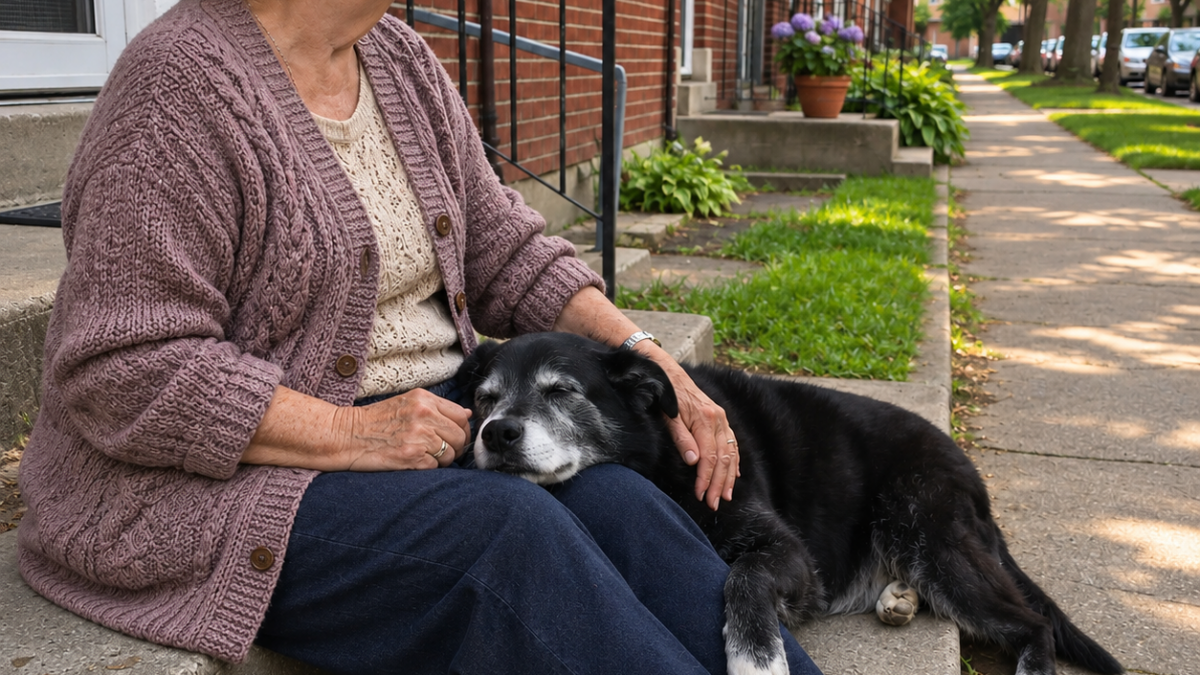
The woman kept one hand buried in Molly’s fur as if she were afraid the dog might disappear again.
“My name is Evelyn Patterson,” she said.
“I’m Patricia Bennett.”
“How long have you had her?”
“Five days.”
“Five?”
“Yes.”
Evelyn shut her eyes.
“Thank God.”
Molly had lowered herself beside her walker now.
Not restless.
Not watching the street.
For the first time since I brought her home, she looked completely settled.
Evelyn touched the silver hair around Molly’s eyes.
“Where have you been?”
Molly leaned into her.
That was when something inside me changed.
Five days wasn’t long.
Still, I’d already started thinking of Molly as mine.
Her bowl was in my kitchen.
Her medicine was beside my coffee maker.
Her bed was beside mine.
I’d signed paperwork.
Paid the adoption fee.
Taken photographs.
Told friends.
But watching Molly beside Evelyn made the word *mine* feel suddenly inappropriate.
I sat down in the second chair.
“I think you need to tell me what happened.”
Evelyn nodded.
Then looked toward her apartment.
“Come inside.”
Molly went first.
No hesitation.
She crossed the threshold, turned left through the living room, passed a small bookcase, and stopped beside a faded braided rug near the kitchen.
Then she lay down in the exact center.
Evelyn covered her mouth.
“That’s where she always sleeps.”
I looked around.
There were photographs everywhere.
An older man beside a fishing boat.
Evelyn at what looked like a wedding.
A younger Molly standing between the same man and Evelyn.
Molly wearing a red bandanna.
Molly in snow.
Molly asleep beneath the table.
This wasn’t simply a place she’d visited.
This was her home.
I looked at Evelyn.
“What did the shelter tell you?”
“They didn’t.”
“What?”
“I didn’t know she was there.”
My stomach tightened.
Evelyn began slowly.
Two months earlier, she’d suffered a serious stroke.
She’d been alone in the apartment when it happened.
A neighbor found her.
Hospital.
Then rehabilitation.
For nearly three weeks, she couldn’t walk independently.
Her speech had been slightly affected.
Her right hand weak.
Her grandson Caleb took over many practical things.
“He paid bills.”
Evelyn’s voice became more guarded.
“Picked up mail. Talked to doctors when Susan couldn’t get here.”
“Susan?”
“My daughter. Caleb’s mother. She lives in Arizona.”
“And Molly?”
“My neighbor Mrs. Gordon fed her for the first few days.”
Then Caleb told everyone he’d make arrangements.
Evelyn looked down.
“At first, I thought that meant temporary care.”
“What happened?”
“I came home.”
She swallowed.
“And Molly wasn’t here.”
Molly lifted her head at the sound of her name.
Evelyn stroked her.
“I asked Caleb where she was.”
“What did he say?”
“That he’d rehomed her.”
My hands tightened in my lap.
“Did you give him permission?”
“No.”
“Did you sign surrender documents?”
“No.”
“Did you tell him you wanted another home for her?”
Evelyn looked offended.
“Never.”
“Then why did he do it?”
She laughed once.
No humor.
“Because he decided I was too old.”
My stomach dropped.
“He said I couldn’t walk her.”
“Molly has arthritis.”
“I know.”
“He said I might fall.”
“Did you ever?”
“No.”
“Did anyone ask whether you wanted help?”
“No.”
Evelyn looked at me.
“He kept saying he was doing it for my safety.”
“Where did he tell you she’d gone?”
“He wouldn’t.”
That surprised me.
“He didn’t tell you anything?”
“He said knowing would make it harder.”
I stared.
Evelyn’s voice shook.
“I begged him.”
Molly pushed her head against Evelyn’s knee.
“I said I wanted to call the family.”
“He told me there wasn’t a family yet.”
“Then?”
“He stopped answering.”
I felt anger rising.
“Why didn’t you call shelters?”
“I did.”
My chest tightened.
Evelyn had called three.
Molly wasn’t listed under her name.
The microchip contact had been changed.
And because Evelyn’s health was still poor, she hadn’t had the strength to search every shelter across the county.
For weeks, she had believed Molly was in some unknown home.
Maybe nearby.
Maybe another state.
Maybe dead.
“Every evening,” Evelyn whispered, “I sat outside.”
I looked toward the patio.
“The 6:12 thing.”
Her eyes met mine.
“You noticed?”
“Every day.”
A sad smile appeared.
“Of course you did.”
“Why 6:12?”
Evelyn leaned back.
“My husband.”
She pointed toward the photograph of the older man.
“Thomas.”
Thomas had worked maintenance at a manufacturing plant.
His shift ended at six.
By the time he drove home, changed, and made coffee, it was usually around 6:12.
“So you all sat outside?”
“Every evening we could.”
“Why?”
She looked surprised by the question.
“Because that was our time.”
Thomas had found Molly as a young stray near the warehouse.
Thin.
Muddy.
Terrified.
For nearly a week, he’d brought her food.
Eventually she followed him to his truck.
Then home.
Evelyn laughed softly.
“I told him we weren’t keeping her.”
“And?”
“Thomas agreed.”
I smiled.
“How long did that last?”
“Twenty minutes.”
Molly’s tail thumped.
Thomas died nine years later.
Heart attack.
Afterward, Molly still went to the patio at 6:12.
For weeks, she waited for the truck.
So Evelyn kept sitting with her.
“We waited together.”
My throat tightened.
“Nine years?”
“Almost.”
Then Evelyn had the stroke.
For the first time since Thomas died, she disappeared.
Then Molly disappeared too.
And despite being taken across town, surrendered, held at the shelter, then adopted by me, Molly still walked to a window every evening at the exact time she’d once sat beside Evelyn.
“She wasn’t waiting for the delivery truck,” I whispered.
Evelyn shook her head.
“She was waiting for me.”
I looked at Molly.
The old dog had fallen asleep.
For nine years, 6:12 had meant:
Everyone is home.
Then suddenly no one was.
I don’t know how long we sat there.
Eventually Evelyn asked:
“What happens now?”
I knew what she meant.
Legally, I had adopted Molly.
The shelter had released her.
I had paid the fee.
Signed the contract.
Technically, ownership had transferred.
But the story underneath that paperwork was suddenly very different.
I looked at Molly.
Then Evelyn.
“First, we figure out what actually happened.”
Evelyn’s face fell.
“You’re going to take her?”
“Tonight?”
She nodded.
I hated the question.
My practical brain said yes.
Until the situation was clarified, I was the legal adopter.
But Molly was asleep beside Evelyn like she had finally stopped holding her breath.
“Do you have her medicine?”
Evelyn looked surprised.
“What medicine?”
“For arthritis.”
She didn’t.
I went home.
Not with Molly.
With an empty leash.
I grabbed the medication.
Food.
Her blanket.
The bed she’d been sleeping on.
Then returned.
When I walked in carrying the bed, Evelyn began crying again.
“You don’t have to do this.”
“I know.”
“Why are you?”
I looked at Molly.
“Because she already answered the question.”
That night, Molly slept in Evelyn’s apartment.
I barely slept at all.
My house felt empty again.
Worse than before Molly came.
Her water bowl sat on the kitchen floor.
Empty bed space beside mine.
The broken screen door hanging crooked.
I should have felt cheated.
Maybe part of me did.
But beneath that was something stronger.
I was angry.
Not at Evelyn.
At whoever had turned two months of medical vulnerability into permission to erase her choices.
The next morning, I called the shelter.
The receptionist remembered Molly.
“How is she settling in?”
“That’s complicated.”
I explained.
The silence on the other end grew longer.
Then:
“I’m getting the director.”
The director’s name was Rebecca Hayes.
I told the story again.
“Are you certain the woman is the prior owner?”
“She has nine years of photographs.”
“Microchip?”
“Yes.”
Rebecca pulled the record.
I heard typing.
Then:
“That’s strange.”
“What?”
“The chip contact was updated before surrender.”
“To whom?”
A pause.
“Caleb Patterson.”
Evelyn’s grandson.
My anger sharpened.
“What did he provide when he surrendered her?”
“Let me open the intake scan.”
Several seconds.
“There’s a signed owner authorization.”
“Signed by Evelyn?”
“Yes.”
“She says she never signed anything.”
Another pause.
“Can I speak with her?”
I was already at Evelyn’s.
I put the phone on speaker.
Rebecca asked several questions.
Date of hospitalization.
Rehabilitation center.
Whether Evelyn had authorized the surrender verbally.
Whether Caleb held legal power of attorney.
Evelyn explained that he’d been given temporary authority to assist with medical communication and finances.
“Did you ever authorize him to dispose of Molly?”
“No.”
“Do you recognize the signature?”
“No.”
Rebecca became careful.
“We need to review this with our legal adviser.”
“How long?”
“As quickly as possible.”
Evelyn asked:
“Is Patricia going to lose money because of this?”
I stared at her.
Rebecca said:
“That’s the least difficult part to fix.”
Good answer.
Over the next several days, the shelter investigated its own records.
The surrender form contained Evelyn’s name.
But the date mattered.
On that date, Evelyn had been in rehabilitation.
Her dominant hand was still too weak to sign consistently.
We obtained a copy of a physical therapy note documenting poor fine-motor control.
A nurse had written:
**Patient unable to complete signature independently; requires assistance.**
That didn’t prove Caleb had forged anything.
But it made the signature questionable.
Then came the microchip account.
Someone had used Evelyn’s email address to reset the password.
Evelyn hadn’t.
Caleb had access to the email.
The address was updated to his.
The phone number changed to his.
Suddenly the shelter had looked up Molly’s chip and seen Caleb as the current contact.
To staff, the surrender seemed normal.
Family member.
Authorization.
Matching chip information.
No reason to suspect anything.
Until Molly ran home.
Three days later, Susan flew in from Arizona.
She arrived exhausted and furious.
Evelyn introduced us.
“This is Patricia.”
Susan hugged me.
Before I could react.
“Thank you.”
“For what?”
“For finding my mother’s dog.”
“Molly found herself.”
Susan looked at the old dog.
“That sounds like her.”
Then her face hardened.
“Where’s Caleb?”
Evelyn looked away.
“He doesn’t know you’re here.”
“He will.”
Susan called him.
He arrived that evening.
I considered leaving.
Evelyn grabbed my wrist.
“Stay.”
So I stayed.
Caleb was thirty-four.
Tall.
Clean clothes.
Expensive watch.
The kind of man you’d trust to explain paperwork.
He came through the door talking.
“Grandma, Mom said—”
Then saw Molly.
Stopped.
His face changed.
“What is she doing here?”
Evelyn’s voice was quiet.
“She lives here.”
Caleb stared at me.
“Who are you?”
“The person who adopted her after you surrendered her.”
His jaw tightened.
“So you’re Patricia.”
Apparently the shelter had already contacted him.
“Yes.”
He turned to Evelyn.
“This is exactly why I didn’t tell you where she went.”
Susan stepped between them.
“Why?”
Caleb looked at his mother.
“Because she’d do this.”
“Do what?”
“Undo everything.”
Evelyn’s hand tightened around her walker.
“You mean take my dog back?”
“You couldn’t take care of her.”
“I can.”
“You just had a stroke!”
“I recovered.”
“You need a walker.”
“So?”
“Molly needs walks.”
“Molly is eleven years old with arthritis.”
“That’s not the point.”
I spoke before I should have.
“Then what is the point?”
He looked at me.
“You don’t know anything about this family.”
“No.”
I gestured toward Molly.
“But I know your grandmother didn’t authorize that surrender.”
Caleb’s eyes narrowed.
“She was confused.”
Evelyn shouted:
“I WAS NOT.”
Molly stood immediately.
Placed herself against Evelyn’s leg.
Caleb lowered his voice.
“See? You’re getting worked up.”
Something about that sentence made me furious.
Not because he raised his voice.
Because he didn’t.
He spoke gently.
Like Evelyn’s anger proved his argument.
Susan noticed too.
“Don’t do that.”
“What?”
“Don’t talk to her like she’s a child.”
“I’m trying to protect her.”
“By taking her dog?”
“She couldn’t manage everything.”
“Then we arrange help.”
“I was the help!”
“No,” Evelyn said.
Everyone stopped.
She looked at Caleb.
“You were supposed to help me make decisions.”
Her voice shook.
“You started making them instead.”
Caleb looked frustrated.
“Grandma—”
“Did I sign that shelter paper?”
Silence.
“Answer me.”
“You weren’t thinking clearly.”
“Did I sign it?”
His eyes shifted.
Susan stepped closer.
“Caleb.”
He sighed.
“It needed to be done.”
The room went completely still.
Evelyn’s face changed.
Not surprise.
Confirmation.
The last little piece of hope disappearing.
“You signed my name.”
“I helped.”
“You signed my name.”
“You couldn’t hold a pen properly!”
“Exactly.”
No one spoke.
Molly leaned harder against Evelyn.
Caleb looked at me.
“You’ve had the dog five days. You have no idea how difficult she is for Grandma.”
I almost laughed.
“Molly moves slower than Evelyn.”
“That’s not funny.”
“No. What’s not funny is taking someone’s animal because caregiving felt inconvenient.”
His face reddened.
“You think you know everything?”
“No.”
I pointed toward Evelyn.
“I think she knows whether she wanted her dog surrendered.”
Caleb’s voice rose.
“She’s eighty-three!”
Evelyn straightened.
“And still in the room.”
That silenced him.
Susan covered her mouth.
Evelyn continued.
“You keep talking about me as though I’ve already died.”
“That’s not what I’m doing.”
“Then stop making funeral decisions.”
Caleb looked away.
Molly sat at Evelyn’s feet.
The blue wind chime moved outside.
Evelyn’s next words were almost a whisper.
“Leave.”
“Grandma.”
“Leave my house.”
“You need me.”
“No.”
“You can’t do this alone.”
Evelyn looked at Susan.
Then at me.
Then Molly.
“I’m not alone.”
That was the moment Caleb truly lost control.
Not because anyone threatened him.
Because isolation had failed.
He left.
Susan sat beside Evelyn afterward.
“I’m sorry.”
Evelyn stared at the floor.
“Did you know?”
“No.”
“Did you suspect?”
“I knew he thought you shouldn’t be living alone.”
“That’s not what I asked.”
Susan’s eyes filled.
“No.”
Evelyn nodded.
Molly rested her chin on her knee.
I went into the kitchen because sometimes families need privacy even when they’ve invited you into the fight.
The legal consequences took weeks.
Not hours.
Reality is mostly paperwork.
The shelter immediately suspended the surrender decision.
After reviewing the questionable authorization and receiving written confirmation from Evelyn, it formally voided the surrender.
My adoption was rescinded.
The adoption fee was refunded.
I signed a statement confirming that I had no ownership claim.
I remember Rebecca, the shelter director, sliding the paper toward me.
“Are you sure?”
I looked at her.
“She’s Evelyn’s.”
“I know.”
“Then why are you asking?”
Rebecca smiled.
“Procedure.”
“Procedure got us here.”
“Exactly why I’m asking.”
I signed.
Best signature I’ve ever written.
Molly legally went home.
But Caleb’s problems didn’t end there.
The disputed signature led Susan and Evelyn to review everything he’d handled during the hospitalization.
There were small cash withdrawals.
A few transfers.
Bills that made sense.
Others that didn’t.
No fortune stolen.
No movie-villain bank account.
Just enough inconsistency to raise questions.
Adult protective services reviewed the situation.
A lawyer helped Evelyn revoke Caleb’s financial authority.
His access to her accounts ended.
Any medical proxy power he held was terminated.
A protective arrangement was created so no one person could make major decisions without Evelyn’s consent unless she was legally determined unable to do so.
Caleb was ordered through a civil settlement to repay expenses he couldn’t document.
The shelter banned him from surrendering an animal belonging to another person without independently verified legal authority.
Evelyn later obtained a temporary protective order when he continued appearing unannounced to argue.
Was it dramatic revenge?
No.
There was no judge shouting.
No handcuffs.
No courtroom applause.
But Caleb lost the exact thing he’d abused.
Authority.
He had treated Evelyn’s vulnerability as permission to control her.
Afterward, he had no control at all.
That satisfied me.
The shelter changed too.
Rebecca called a staff meeting.
She asked Evelyn if Molly’s case could be discussed anonymously for training.
Evelyn agreed.
The new rule was simple:
If someone surrenders an animal on behalf of another adult, staff must verify legal authority.
If the actual owner is hospitalized, elderly, disabled, or living elsewhere, direct confirmation is required whenever possible.
It added work.
Some intake staff complained.
Rebecca’s response was:
“Good.”
One employee laughed.
“Good?”
“Some decisions should be inconvenient.”
I liked her after that.
Molly’s case also triggered another conversation.
Why had surrender been treated as the easiest option?
What if an elderly owner only needed temporary help?
Transportation?
Dog walking?
Food?
A short foster placement during hospitalization?
The shelter began building a small volunteer network.
Not because of a strategic plan.
Because one old Border Collie had broken a screen door.
Meanwhile, Molly returned to her old life as though she had never left.
Almost.
There were changes.
For the first week, she followed Evelyn everywhere.
Even into the bathroom.
Evelyn complained.
“Privacy.”
Molly ignored her.
At night, Molly slept beside the bed.
Sometimes she woke.
Checked Evelyn.
Returned to sleep.
The same behavior she’d shown at my house.
Except now I understood.
She wasn’t clingy.
She was verifying.
Still here?
Still here.
Still here.
Trauma creates routines too.
I began visiting every morning.
At first, because Molly’s medication needed organizing.
Then because Evelyn needed groceries.
Then because the coffee at my own house suddenly tasted worse.
Evelyn’s coffee was objectively terrible.
Instant.
Too much sugar.
Powdered creamer.
I complained constantly.
She said:
“You keep drinking it.”
“I am loyal.”
“You’re cheap.”
“Also true.”
Molly usually lay between us.
Sometimes on my foot.
Sometimes against Evelyn’s chair.
She had apparently decided having two women was efficient.
After physical therapy, Evelyn became stronger.
She progressed from walker to cane inside.
Molly adjusted automatically.
When Evelyn moved slowly, Molly slowed.
When Evelyn stopped, Molly stopped.
When Evelyn dropped something, Molly stared at the object and then at her, contributing absolutely nothing.
“Working dog,” I said.
“Retired,” Evelyn replied.
One afternoon, Molly found an old rope toy beneath the couch.
She brought it to Evelyn.
Evelyn started crying.
“What?”
“Thomas bought that.”
Molly placed it in her lap.
“He bought it the first winter we had her.”
I picked it up.
The rope was faded almost white.
“You kept this?”
“Apparently Molly did.”
We laughed.
That became another object nobody could throw away.
Every evening, 6:12 continued.
The first time I witnessed the ritual after Molly was legally restored, I arrived at 6:05.
Evelyn was already on the patio.
“Early.”
“I wanted to see.”
“She’s not a circus animal.”
“I know.”
6:10.
Molly asleep inside.
6:11.
Her eyes opened.
6:12.
She stood.
Walked through the patio door.
Sat between us.
The wind chime moved.
Molly looked toward the street.
Then up at Evelyn.
Evelyn touched her head.
No panic.
No searching.
No hope mixed with fear.
Just recognition.
I whispered:
“She still does it.”
“Of course.”
“How?”
Evelyn shrugged.
“Love is repetitive.”
I looked at her.
“What?”
“People think love is grand gestures.”
She scratched behind Molly’s ear.
“It isn’t.”
“Then what is it?”
“Breakfast.”
She pointed toward the patio.
“This.”
“6:12.”
“Same chair. Same person. Same dog.”
Molly sighed.
Evelyn smiled.
“You repeat enough kindness and eventually somebody believes you’re staying.”
That sentence followed me for years.
My friendship with Evelyn became real.
Not rescue-friend polite.
Real.
We argued.
She insulted my cooking.
I fixed her printer.
She claimed every television remote was defective.
It wasn’t.
I drove her to appointments.
She forced me to stay for soup afterward.
Susan visited from Arizona every few months.
Eventually she stopped booking hotels.
She slept at my house.
I hadn’t planned any of this.
I had wanted a dog.
Instead, Molly gave me people.
That mattered because after Cooper died, my world had become smaller than I admitted.
Work.
Grocery store.
Television.
Sleep.
Repeat.
I called it independence.
Some of it was loneliness.
Molly cracked that open too.
Evelyn started calling me:
“The woman Molly adopted.”
I replied:
“She was my dog first.”
“Five days.”
“Still counts.”
“I had nine years.”
“Show-off.”
We never settled the argument.
At twelve, Molly’s arthritis worsened.
The veterinarian adjusted medication.
We added rugs because she slipped on hard floors.
Evelyn’s apartment gradually became an accessibility project for both of them.
Handrail for Evelyn.
Rug runner for Molly.
Raised water bowl.
Grab bars.
Low dog bed.
Ramp near the patio step.
I looked around one day.
“This place looks like a rehabilitation clinic.”
Evelyn nodded.
“You’re welcome to leave.”
Molly stayed.
At thirteen, Molly’s hearing started fading.
The first sign was the treat bag.
She had always heard it from another room.
Then one day, nothing.
Evelyn shook the bag.
No Molly.
We looked at each other.
“Maybe she’s asleep.”
She wasn’t.
I walked over.
Touched her shoulder.
Molly woke.
Saw the treats.
Immediate interest.
Evelyn’s expression changed.
“She didn’t hear.”
“No.”
That hurt more than it should have.
Age doesn’t arrive in one dramatic event.
It takes things quietly.
A sound.
A jump.
A longer walk.
One ability at a time.
Yet Molly still knew 6:12.
Maybe body rhythm.
Light.
Routine.
Maybe magic.
I stopped caring about the explanation.
At thirteen and a half, bloodwork showed early kidney changes.
Nothing severe.
Diet adjustment.
More water.
Regular monitoring.
Evelyn became obsessive.
She once called me at 8:04 a.m.
“Molly didn’t finish breakfast.”
“How much?”
“Three pieces.”
I paused.
“She left three pieces of kibble?”
“Yes.”
“You counted?”
“Yes.”
“Have you considered professional help?”
“Patricia.”
“She ate ninety-nine percent of breakfast.”
“It’s not ninety-nine.”
“Close enough.”
Evelyn hung up.
Ten minutes later:
“She finished them.”
“Miracle.”
She hung up again.
Molly turned fourteen.
We celebrated with chicken.
At 6:12, Evelyn placed a paper birthday crown on her.
Molly looked betrayed.
I took photographs.
Those became some of my favorites.
Not because Molly looked happy.
She looked furious.
Alive enough to be annoyed.
Caleb remained on the edge of Evelyn’s life.
At first, not present.
Then occasional mediated calls.
Susan encouraged it.
I stayed out unless Evelyn asked.
One afternoon, Evelyn told me:
“He apologized.”
“Do you believe him?”
“Some of it.”
I waited.
“He said he was scared.”
“Of you keeping Molly?”
“Of everything.”
After the stroke, Caleb had panicked.
He lived forty minutes away.
Worked full time.
Had two children.
He imagined becoming responsible for Evelyn, her apartment, medical care, dog, everything.
Instead of asking for help, he started removing complications.
Molly was one.
“That doesn’t excuse it,” I said.
“I know.”
“What did you tell him?”
“That helping somebody isn’t deciding they don’t get to choose anymore.”
Good.
She continued.
“He said he thought I’d eventually agree.”
I felt anger return.
“Eventually agree.”
“Yes.”
“That’s awful.”
“I told him so.”
“What exactly?”
Evelyn smiled.
“I said, ‘You didn’t save me from a decision, Caleb. You stole one.'”
I sat back.
“I’m writing that down.”
“No royalties.”
Their relationship remained limited.
Caleb was never given financial access again.
Never became medical proxy.
He had to ask before visiting.
Knock.
Wait.
Permission.
Those boundaries mattered.
Over time, he did begin changing.
Not enough to rewrite what happened.
But enough that Evelyn didn’t need to spend the rest of her life in anger.
At fourteen and a half, Evelyn suffered another stroke.
Smaller.
But terrifying.
I was the one who found her.
She missed our morning coffee.
Evelyn never missed coffee.
I called.
No answer.
Drove over.
She was sitting on the floor beside the couch.
Conscious.
Speech slurred.
Molly beside her.
I called 911.
As paramedics carried Evelyn out, Molly tried to follow.
I held her.
“She’s coming back.”
Molly struggled.
Not violently.
Desperately.
The old fear had returned.
The hospital kept Evelyn two nights.
This time, everything was different.
Everyone knew where Molly was.
Susan knew.
Caleb knew.
The shelter wasn’t involved.
No one was surrendering anyone.
I took Molly home with me.
At 6:12, she went to the window.
Just like before.
I sat beside her.
“She’s coming back.”
Molly stared down the street.
“Not tonight.”
No reaction.
“But she is coming back.”
That was the difference.
The first separation had no explanation.
No trust.
This one had a plan.
Still, Molly waited.
Second evening.
Same.
Third day, Evelyn came home.
I brought Molly back before 6:12.
At 6:10, Evelyn sat outside.
Molly was inside.
At 6:12, she walked through the door.
Saw Evelyn.
Tail wag.
Not frantic.
Not desperate.
Certain.
That night I understood something.
Trust doesn’t eliminate grief.
It changes the shape of waiting.
Molly turned fifteen.
Her world became smaller.
Shorter walks.
Longer naps.
No stairs unless necessary.
I built a ramp to my front porch for the afternoons she spent with me.
She refused it.
For two weeks.
Every time, Molly stood beside the ramp and looked at the stairs.
“You’re not taking the stairs.”
Molly stared.
“Use the ramp.”
Nothing.
I bribed her.
Chicken.
One paw.
Then two.
Eventually she walked up.
After that, she acted as though ramps had always been her idea.
At fifteen and a half, Molly woke one morning unable to walk straight.
Evelyn called screaming.
I arrived within ten minutes.
Molly’s head tilted.
Eyes moving rapidly.
She fell when she tried to stand.
We rushed to the emergency veterinarian.
Old-dog vestibular syndrome.
Terrifying.
Often temporary.
The veterinarian explained slowly.
Evelyn heard only one sentence.
“Many dogs improve.”
She grabbed onto that.
For three days, Molly needed help.
Eating.
Walking.
Bathroom.
We used a support harness.
Evelyn wanted to cancel her own therapy.
“No.”
“I’m not leaving her.”
“I’ll stay.”
“What if she needs me?”
“What if you stop walking properly because you skip therapy?”
Evelyn glared.
“You’ve become controlling.”
“Difference is I’m arguing with you.”
She pointed.
“Technicality.”
She went.
At 6:12, Molly tried to stand.
Couldn’t.
I held the harness.
“You’re serious?”
Yes.
She looked toward the patio.
I helped her there.
She lay beside the glass.
Wind chime moving.
At 6:25, Evelyn returned.
Molly couldn’t hear the door.
But she smelled her.
Tail wag.
We both cried.
Two weeks later, Molly was walking again.
A slight permanent head tilt remained.
I thought it made her look curious.
Evelyn called it elegant.
No one else agreed.
At sixteen, kidney disease worsened.
Arthritis too.
A heart murmur appeared.
None individually catastrophic.
Together, they reminded us that Molly was old.
Very old.
I started quietly fearing every phone call from Evelyn.
One evening, sitting at 6:12, Evelyn said:
“I need her to outlive me.”
“No.”
She looked at me.
“No?”
“You remember what happened when you disappeared the first time.”
Evelyn’s face softened.
“You think she’d break again.”
“I think she deserves not to lose you twice.”
Silence.
“Then you’re saying I have to lose her.”
“I’m saying neither one of you gets to order the universe.”
“Terrible system.”
“Agreed.”
Molly slept between us.
Evelyn rested one hand on her back.
“I’m eighty-three.”
“And rude.”
“You’re sixty-three.”
“Middle-aged.”
“If you live to one hundred twenty-six.”
I hated her.
Molly remained neutral.
At sixteen years and three months, Molly stopped finishing meals.
The kidney values worsened.
We began giving fluids at home.
Evelyn’s hands weren’t steady enough for the needle.
So I learned.
Every other day, I came over.
Molly tolerated the process because chicken followed.
“She likes you better,” Evelyn complained.
“Because I’m skilled.”
“Because you’re bribing her.”
“Medicine.”
“Corruption.”
Both true.
For a while, Molly stabilized.
Then she began sleeping through 6:12.
The first time, Evelyn reached down to wake her.
I caught her wrist.
“No.”
“But she’ll miss it.”
“Let her sleep.”
“We’ve never missed it.”
I looked at Molly.
Her breathing slow.
Peaceful.
“Evelyn.”
Her eyes filled.
“If she stops going out, it means—”
“I know.”
She looked away.
I sat beside her.
“Rituals are supposed to hold love.”
She looked at me.
“Not make us afraid.”
Molly slept.
We went outside anyway.
6:12.
Wind chime.
Two chairs.
Dog sleeping inside.
Still everybody present.
Weeks later, the balance shifted.
Good days became less frequent.
Molly ate chicken.
Ignored regular food.
Struggled standing.
Sometimes panted at night.
Rest became restless.
Her veterinarian sat with us.
Explained quality of life.
Eating.
Pain.
Mobility.
Enjoyment.
Sleep.
Anxiety.
More good days than bad.
Evelyn asked:
“What if she has another good day after I decide?”
The veterinarian answered gently.
“She might.”
“Then I’d have stolen that day.”
“Or prevented several painful ones.”
There are no perfect answers at the end.
Only loving guesses.
Molly rallied again.
For almost two weeks.
She ate.
Sat outside.
One afternoon she found the old rope toy.
Carried it halfway across the room.
Evelyn laughed so hard she cried.
“See?”
I smiled.
A gift.
Not a reversal.
We both knew.
Then came Thursday.
Molly couldn’t stand.
She tried once.
Front legs pushed.
Hindquarters failed.
She looked surprised.
Then tired.
Evelyn called me at 5:55.
One word.
“Come.”
I was already reaching for my keys.
When I arrived, Molly was on a blanket by the patio door.
Evelyn sat on the floor beside her.
Her walker lay several feet away.
The veterinarian was scheduled for seven.
Home euthanasia.
No hospital.
No fluorescent room.
No final car ride.
I looked at the clock.
6:08.
Evelyn noticed.
“Can we take her outside?”
It was cold.
Clear.
I nodded.
We wrapped Molly in a blanket.
I lifted her.
She was too light.
Not because she’d ever been heavy.
Because old age had taken muscle quietly.
We set her on a padded bed on the patio.
The blue wind chime moved.
6:10.
Molly’s eyes closed.
6:11.
Opened.
6:12.
She lifted her head.
Only that.
No standing.
No walking to the edge.
Just head up.
Evelyn touched her face.
“I’m here.”
Molly’s tail moved once.
Evelyn broke.
“I’m here, baby.”
The tail moved again.
I looked away because some grief feels too private even when you’re part of the family.
Evelyn leaned close.
“Every day.”
Molly breathed.
“Every day, Molly.”
The wind chime sounded.
Molly rested her head against Evelyn’s knee.
At 6:31—the exact time she’d reached this patio on the night she escaped my house—Molly closed her eyes.
Not dead.
Sleeping.
But the timing crushed me.
Evelyn whispered:
“She came back.”
“Yes.”
“No.”
She looked at me.
“She always came back.”
The veterinarian arrived shortly after seven.
Everything was quiet.
Molly received a sedative first.
Her body relaxed.
No stiffness.
No arthritis.
No effort.
Just rest.
Evelyn kept one hand on her chest.
I put mine along her shoulder.
The veterinarian asked:
“Are you ready?”
No one is.
Evelyn nodded anyway.
The final medication went in.
Molly breathed.
Once.
Again.
Slower.
Then stopped.
The wind chime moved.
Evelyn bent over her.
No sound for several minutes.
Then she whispered:
“Thomas is going to be so happy.”
I cried so hard I couldn’t answer.
Whether there is anything after death, I don’t know.
Neither did Evelyn.
But that sentence wasn’t about certainty.
It was about the shape of her love.
Molly had spent years waiting at 6:12 for Thomas.
Then two months waiting for Evelyn.
Then years with no need to wait at all.
Now there was nothing left unfinished.
After Molly died, 6:12 became painful.
The first evening, I went to Evelyn automatically.
She was already outside.
Empty space beside the chair.
No Molly.
6:11.
Neither spoke.
6:12.
Wind chime.
Evelyn grabbed my hand.
“Don’t say anything.”
“I wasn’t going to.”
We sat.
At 6:30, she whispered:
“I keep thinking I’ll hear her get up.”
“I know.”
“I thought I was ready.”
“No.”
“You weren’t either.”
“No.”
The second evening, I returned.
Third too.
Then a week.
6:12 became ours.
Susan called sometimes.
Neighbor Mrs. Gordon joined once.
Even Caleb eventually sat there years later.
The ritual survived Molly.
Not because we pretended she was still physically present.
Because repetition had always been the language of that family.
Molly’s ashes came home in a simple wooden box.
Only one word engraved.
**MOLLY**
I asked:
“No dates?”
Evelyn shook her head.
“I know when she was here.”
We placed the box near the patio door.
Beside Thomas’s picture.
The rope toy.
For about a month, it looked like a memorial.
Then Evelyn left reading glasses beside it.
A newspaper.
A cup of coffee.
The memorial became ordinary.
I liked that.
Love shouldn’t always live on a shelf where nobody touches it.
Molly’s bed remained beside the couch for three months.
Then one morning it disappeared.
I noticed immediately.
“Where’s her bed?”
“Donated it.”
I swallowed.
“To where?”
“The shelter.”
“Why?”
“Another old dog needed one.”
“What dog?”
“Some Shepherd mix named Ruby.”
I would meet Ruby later.
At the time, she was just a dog sleeping in Molly’s bed.
That was enough.
The shelter’s temporary support network grew.
Volunteers began helping elderly owners during hospital stays.
Walking dogs.
Delivering food.
Temporary fostering.
Transportation to veterinarians.
The goal wasn’t adoption.
It was preventing unnecessary separation.
One woman broke her hip.
Her terrier spent five weeks with a foster family.
Then went home.
Another man had heart surgery.
His cat remained with a neighbor who received food and litter support.
Then went home.
Each case sounded boring.
Good.
The best rescue stories are often the ones where nothing dramatic happens because someone prevented it.
Evelyn loved hearing those updates.
“That’s Molly.”
I nodded.
“That’s Molly.”
Caleb came back into Evelyn’s life slowly.
Not because she forgot.
Because she chose.
That distinction mattered.
He knocked.
Waited.
Asked permission.
Never touched her finances.
Never handled medical decisions.
One afternoon, he came while I was there.
He stood near Molly’s ashes.
Then said:
“She bit me.”
I turned.
“Molly?”
He nodded.
“When I took her.”
Evelyn’s face changed.
Caleb continued.
“Not hard.”
“When?” Evelyn asked.
“The morning I brought her to the shelter.”
My stomach tightened.
“She wouldn’t get in my car.”
He rubbed his hand unconsciously.
“I pulled her collar. She snapped.”
Evelyn stared.
“And you kept going.”
“Yes.”
“Why?”
Caleb looked at the floor.
“Because I’d already decided.”
There it was.
The entire mistake in one sentence.
Already decided.
Anything contradicting him became irrelevant.
Molly’s fear.
Evelyn’s wishes.
Evidence.
Love.
Nothing mattered because the decision had already been made.
Evelyn’s voice became quiet.
“Do you know what you really took?”
Caleb nodded.
“My dog.”
“No.”
He looked at her.
“You took certainty.”
Silence.
“When I came home after the stroke, I couldn’t trust my own body.”
She held up one trembling hand.
“I couldn’t write properly. I forgot words. Everybody kept asking me if I understood.”
Caleb’s eyes filled.
“Then Molly was gone.”
He covered his mouth.
“And you told me I’d agreed.”
I suddenly understood before she finished.
“I spent weeks wondering if I had forgotten.”
Caleb began crying.
“I thought maybe my mind had become unreliable. Maybe I had signed something. Maybe I really was too confused to know what I wanted.”
He whispered:
“I’m sorry.”
Evelyn looked at him.
“You made me doubt myself.”
No one spoke.
That was the deeper injury.
Not only losing Molly.
Losing confidence in her own mind after a stroke.
Caleb had weaponized uncertainty, even if he hadn’t consciously meant to.
He didn’t ask for forgiveness.
Good.
He left quietly.
Months later, Evelyn told me:
“I forgave him.”
I almost dropped my coffee.
“That seems reckless.”
She smiled.
“I didn’t give him my bank password.”
“Good.”
“Forgiveness isn’t giving the keys back.”
I stared.
“You save these lines for me?”
“Obviously.”
Her anger had become heavy.
She didn’t want to carry it forever.
But boundaries stayed.
That was healthy.
Four years after Molly died, Evelyn became ill again.
This time cancer.
Advanced.
Treatment could buy time.
Not much good time.
She chose comfort.
“Are you sure?”
Susan asked.
Evelyn looked offended.
“Don’t start acting like your son.”
Susan immediately raised both hands.
“Fair.”
Hospice began at home.
Later, symptoms required inpatient care.
Evelyn insisted on one object.
The blue wind chime.
I brought it.
A nurse helped hang it near the window.
At 6:12, whenever weather allowed, I opened the window slightly.
The chime moved.
Some evenings Evelyn smiled.
Others she slept.
Caleb visited.
This time, every decision involved a question.
“Do you want the blinds open?”
“Would you like water?”
“Should I stay?”
Evelyn noticed.
So did I.
People can learn.
That doesn’t erase harm.
But accountability without change becomes only punishment.
One evening, Evelyn was very weak.
She hadn’t spoken for hours.
6:11.
Her eyes opened.
I looked at the clock.
“Show-off.”
Her lips moved.
I leaned closer.
“Late.”
I laughed.
“Nobody’s late.”
She looked toward the window.
I opened it.
Wind chime.
6:12.
Evelyn smiled.
“She’s late.”
“Molly?”
A tiny nod.
“She was always the punctual one.”
Her hand found mine.
“Patricia?”
“I’m here.”
“You know what she did?”
“What?”
“Broke your door.”
I laughed through tears.
“I remember.”
“Best thing she ever did.”
“Maybe.”
Her eyes opened wider.
“No maybe.”
“Fine.”
A pause.
“If she hadn’t…”
Her breathing was shallow.
I waited.
“If she hadn’t broken the door, I never get Molly back.”
I nodded.
“I never meet you.”
My throat tightened.
“The shelter doesn’t change.”
Another breath.
“Caleb maybe stays an idiot.”
I laughed loudly enough that the nurse looked in.
“Maybe.”
“He still is sometimes.”
“Definitely.”
Evelyn squeezed my hand weakly.
“Good dog.”
“Best dog.”
Then she whispered:
“You gave her back.”
“She wasn’t mine.”
“She loved you.”
“I know.”
“So did I.”
That broke whatever composure I had left.
I lowered my forehead onto her hand.
“I love you too.”
“Obviously.”
Still Evelyn.
Still winning.
She died the next morning.
Susan held one hand.
Caleb rested his hand on her shoulder.
I stood near the window.
Her breathing slowed.
Then stopped.
Caleb whispered:
“Grandma.”
Susan leaned over her.
No drama.
No fear.
Just grief.
The wind chime was still.
I opened the window.
Cold air moved through the room.
The chime sounded once.
Coincidence.
Probably.
Enough.
Susan handed me an envelope afterward.
“Mom wanted you to have this.”
Inside was a note in shaky handwriting.
**Patricia,**
**The wind chime is yours. Don’t let Caleb decide otherwise.**
I laughed.
Caleb frowned.
“What’s funny?”
“Nothing.”
The note continued:
**You thought you adopted Molly. Molly adopted both of us.**
**Keep 6:12 if you want it. Let it go if you don’t. Love should never become a prison.**
**Thank you for bringing her home.**
At the bottom:
**Everybody present.**
Those were the words Evelyn had once written behind my favorite photograph.
I brought the blue wind chime home.
Hung it beside the repaired screen door.
I had replaced the torn mesh years earlier.
But not the frame.
A small bend remained where Molly had hit it.
I kept that.
History.
Months later, I adopted Ruby.
Twelve-year-old Shepherd mix.
Terrible teeth.
Gray face.
Sweet temperament.
She arrived at my house and immediately found an old dog bed.
The shelter director later told me:
“That used to be Molly’s.”
I stared at her.
“Evelyn donated it.”
“Yes.”
Ruby slept there for years.
Full circle usually looks obvious only afterward.
Ruby had no mystery.
No hidden owner.
No 6:12 obsession.
Good.
She deserved her own story.
Still, every evening, I noticed the clock more often than I admitted.
6:12.
Sometimes the wind chime moved.
I would sit outside with Ruby.
Think about Molly.
Evelyn.
Thomas.
Cooper.
People and animals gone from the physical world but still shaping the furniture of my life.
One year, the shelter formally launched a program supporting older adults and hospitalized pet owners.
Temporary foster.
Transportation.
Food assistance.
Dog walking.
Medication help.
Legal consent verification.
The goal was simple:
**Keep pets with their people whenever safely possible.**
At the launch, Rebecca showed a photograph.
Evelyn on the patio.
Molly beside her.
Blue wind chime above them.
Underneath were the words:
**Before surrender, ask whether separation is actually necessary.**
I cried.
Naturally.
A hospital social worker spoke after Rebecca.
Then an elder-law attorney.
Then a veterinarian.
They talked about boring things.
Emergency care plans.
Temporary guardianship.
Microchip authorization.
Pet trusts.
Consent.
Boring systems.
Beautiful systems.
Because boring systems prevent dramatic heartbreak.
Afterward, a woman approached me.
“My mother has dementia.”
She had two cats.
The family was considering surrender.
The program helped them create another plan.
One cat moved in with the daughter.
The other remained with her mother in assisted living.
Months later, she emailed me.
**Mom forgets my name sometimes. She never forgets the cat.**
I read that message at 6:12.
Molly’s revenge had become larger than Caleb.
Not revenge in the cruel sense.
Correction.
Against the belief that old age cancels attachment.
Against the assumption that disability means someone loses the right to decide.
Against the idea that pets are disposable when caregiving becomes inconvenient.
Caleb had believed removing Molly simplified the problem.
Instead, Molly came back and complicated everything until the people around her became better.
Years after Evelyn’s death, Caleb visited me.
He brought a box of old photographs.
Thomas.
Young Susan.
Caleb as a child.
Molly.
One photograph stopped me.
Thomas and Evelyn sat on the patio.
Molly between them.
The blue wind chime looked almost new.
On the back:
**First summer with Molly. 6:12 club.**
I laughed.
“Club?”
Caleb nodded.
“Grandpa called it that.”
“You remembered.”
“Eventually.”
He looked toward the wind chime outside my door.
“I think Grandma would’ve wanted you to keep these.”
“Some should go to Susan.”
“Already made copies.”
Progress.
I looked at him.
“You’ve changed.”
He gave a tired smile.
“Cost me enough.”
“Consequences aren’t tuition.”
“No.”
He looked down.
“But I learned.”
I believed him.
Not because of the sentence.
Because years had proved it.
He’d learned to help without controlling.
To ask.
To wait.
To let Evelyn say no.
That didn’t erase his mistake.
It meant the mistake didn’t get the final word.
Before leaving, he touched the bent section of my screen-door frame.
“This is where she went through?”
“Yes.”
He laughed.
“She hated me.”
“I don’t think Molly hated anyone.”
“She bit me.”
“Communication.”
“Strong communication.”
We both laughed.
Then he became serious.
“I’m glad she found Grandma.”
“So am I.”
“And you.”
I didn’t answer quickly enough.
He left.
I stood at the door after his car disappeared.
Molly had connected people who never would have chosen one another.
Maybe that was her greatest gift.
Not loyalty.
Connection.
Ruby eventually grew old too.
Kidney disease.
Arthritis.
Then one morning, she stopped eating.
There was no mystery.
No dramatic reveal.
Just time.
When she died, I held her in my living room.
Cried into her fur.
Afterward, at 6:12, I sat outside alone.
The wind chime moved.
For the first time, I truly understood something Evelyn had once told me.
Being alone is not the same as being lonely.
Loneliness is believing your absence would go unnoticed.
Molly had made sure none of us could ever believe that.
She noticed Evelyn.
Evelyn noticed Molly.
I noticed both.
They noticed me.
Even Caleb eventually learned to notice without taking control.
That is family.
Not ownership.
Attention.
These days, the blue wind chime is nearly faded white.
The string needs replacing.
I keep meaning to do it.
The screen-door frame still has the bend.
Neighbors sometimes ask why I don’t replace it.
“Sentimental.”
That’s enough.
The full story is too long for a driveway conversation.
But occasionally somebody who knows the story visits.
We sit outside.
Eventually 6:12 arrives.
And I tell them what was written in Molly’s shelter file:
**Elderly owner moved out of state. Unable to keep pet.**
One sentence.
Completely wrong.
That’s the danger of clean stories.
Bureaucracy loves them.
Owner surrendered.
Dog adopted.
Case closed.
Life isn’t clean.
Love doesn’t respect case closure.
Molly certainly didn’t.
Every evening at 6:12, she reopened the case.
Window.
Street.
Wait.
Until one night she saw something that told her she was close enough to stop waiting.
Then she ran.
Three blocks.
Old body.
Arthritic hips.
Broken screen.
No legal understanding.
No paperwork.
Only memory.
That is home.
She knew.
Humans caught up later.
Sometimes people still tell me:
“You were so generous to give her back.”
I don’t like that.
Generosity implies I gave away something that was mine.
I didn’t.
I corrected a mistake.
The shelter corrected one too.
The legal system corrected part of another.
The only one who had been right from the beginning was Molly.
All the adults had forms.
Authority.
Assumptions.
Molly had 6:12.
And she was right.
For five days, Molly was legally my dog.
For years afterward, she was one of my closest companions.
Evelyn became one of my closest friends.
I entered the shelter looking for an old dog whose chances were running out.
Instead, I found an eleven-year-old Border Collie mix with arthritis, a perfect internal clock, and unfinished business.
She restored Evelyn’s right to choose.
She exposed a wrong decision.
She forced a shelter to rethink surrender procedures.
She gave me a friendship I hadn’t known I needed.
She pushed Caleb toward becoming someone who asked instead of deciding.
She helped create a system that kept future pets with people who loved them.
And after all that, she still had time to spend years doing the simplest thing in the world.
Sitting beside Evelyn.
At 6:12.
People love saying dogs live only in the present.
Maybe they do in ways we don’t understand.
But anyone who has lived with an old dog knows the past lives inside them too.
Certain doors.
Cars.
Blankets.
Meal times.
Voices.
Routes.
And apparently exact minutes on a clock.
Molly remembered Thomas.
Then Evelyn.
She remembered the blue wind chime.
The brick building.
Apartment 104.
She remembered where waiting had once ended.
That memory survived a stroke she didn’t have.
A decision she didn’t understand.
A shelter.
An adoption.
A different house.
Three blocks.
And a broken screen door.
Sometimes I imagine what would have happened if I hadn’t chased her.
Maybe Molly would have found Evelyn anyway.
Probably.
But I might have called the shelter and reported an escape.
Maybe they would have picked Molly up.
Maybe she would have gone back into a kennel.
Maybe Evelyn would have watched from the patio while her dog disappeared a second time.
I hate that version.
Instead, I followed.
That’s the detail I cherish most.
Molly didn’t merely go home.
She dragged a witness behind her.
Smart dog.
She forced someone with paperwork to stand beside someone with history.
Then made us compare the two.
History won.
The day Molly died, she no longer needed to look through a window.
She didn’t need to wait for a truck.
Didn’t need to break anything.
The person she’d searched for was touching her face.
I was beside her.
The blue wind chime moved.
6:12 had already happened.
Everybody present.
That became my definition of a good ending.
Not everyone lives forever.
Not every wrong disappears.
Not every family becomes perfect.
Caleb’s mistake still happened.
Evelyn still had the stroke.
Thomas still died.
Molly still grew old.
But the final chapter belonged to them.
They chose it.
Molly went home.
Evelyn regained her voice.
The shelter learned.
The family changed.
And when Molly’s body finally gave out, nobody could take anything else from her.
Not her home.
Not her person.
Not her routine.
Not her dignity.
Not her choice.
At exactly 6:12, they were together.
After everything they’d been through, that was the only ending that ever mattered.
Sometimes now, years later, the wind chime beside my door moves unexpectedly.
I glance at the clock.
Most times it’s meaningless.
5:48.
7:03.
6:27.
Then once in a while—
6:12.
I smile.
“Hey, Molly.”
No dramatic feeling.
No ghost story.
Just recognition.
Like an old dog seeing the right street after months of searching.
Maybe that’s what memory is.
A place inside us where somebody keeps coming home.
And Molly?
She spent the hardest part of her life waiting for someone who loved her.
Then she spent the rest of it never having to wait alone again.
She broke through my door to make sure of that.
And if you ask me now whether I regret adopting a dog who only belonged to me for five days, the answer is simple.
Never.
Because I didn’t lose Molly.
Molly found Evelyn.
Then she found me.
And somehow, in the process, she brought all of us home.








