Eleven Days After My Husband Died, Our Labrador Dragged Me to a Stranger’s Door Every Morning—Then I Finally Learned Why
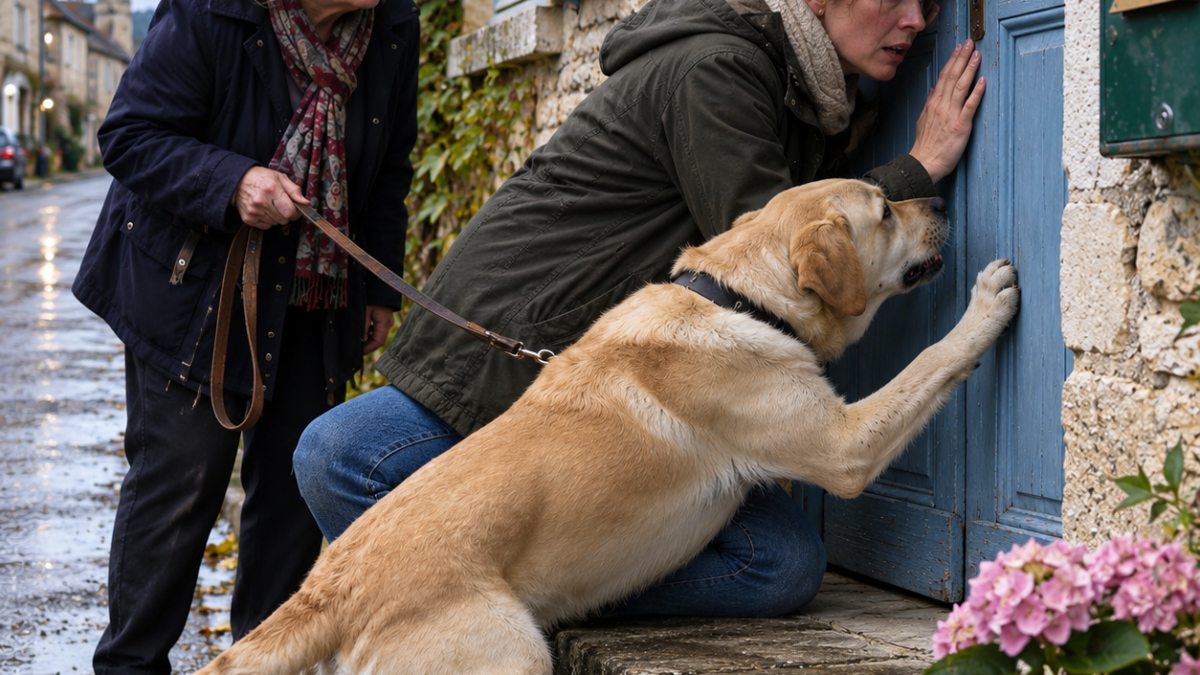
Eleven days after my husband died, our old Labrador stopped eating, slept beside the front door, and began dragging me across our village every morning at exactly 7:25 to the same little house with faded blue shutters, where he would sit on the steps and refuse to leave no matter how much I begged him to come home.
At first, I thought Marcel was simply searching for Bernard, the man who had walked beside him every morning for years, but when our dog began trembling at the sight of that closed door and scratching the wood with a desperation I had never seen before, I realized there might have been an entire part of my husband’s daily life I knew absolutely nothing about.
And when my daughter and I finally heard a faint sound from somewhere inside that silent house, what we discovered forced me to question not only what Marcel had been trying to tell us, but how well I had really known the man I had loved for forty-two years.
My husband, Bernard, had been a mail carrier for thirty-seven years in our small village in the Touraine region of France.
Everybody knew him.
Children waved when his yellow postal van passed. Elderly residents waited near their gates because Bernard always had time for two extra minutes of conversation. He knew who had grandchildren studying abroad, whose husband was in the hospital, who needed help carrying a package inside, and who pretended not to be lonely even when they clearly were.
He retired four years before he died.
But retirement never changed his internal clock.
Every morning before seven, Bernard got up, dressed quietly, put on his walking shoes and whistled for Marcel.
“Thirty-seven years of early mornings don’t disappear because somebody gives you a retirement certificate,” he used to tell me.
They normally came home about an hour later.
Bernard carried a warm baguette under one arm and sometimes a newspaper.
Marcel came in muddy, happy and ready for breakfast.
I never questioned where they went.
Why would I?
After forty-two years of marriage, I thought I knew the rhythm of Bernard’s life better than I knew my own.
Then, on a Tuesday morning, he died of a heart attack.
He was sixty-nine.
The night before, we had argued about something so stupid that remembering it still hurts.
He had forgotten to close the garden gate again.
“One day you’ll forget your own head somewhere,” I told him.
Bernard laughed.
I rolled my eyes.
Those became some of our final words.
After the funeral, the house seemed to lose its voice.
No radio playing in the kitchen.
No shoes left beside the door.
No Bernard walking from room to room looking for his glasses while they sat on top of his head.
And Marcel changed.
Our eleven-year-old Labrador, normally calm and embarrassingly obsessed with food, began leaving meals untouched.
At night, he slept beside the front door.
But the strangest thing happened every morning.
At exactly 7:25, he stood.
Walked directly to the garden gate.
Whined.
The first morning, I opened the back door because I assumed he needed outside.
Marcel went straight to the gate.
Whined again.
Then barked.
So I attached his leash.
He nearly pulled me through the village.
Across the square.
Past the bakery.
Down a narrow street lined with old houses.
Then he stopped in front of number six.
A small house with pale blue shutters, two dying geraniums and an old green mailbox.
Marcel sat on the steps.
And refused to move.
“Come on.”
Nothing.
“Marcel, Bernard isn’t here.”
He looked at the door.
I pulled gently.
He made such a miserable sound that I immediately stopped.
I sat beside him.
“I miss him too.”
Marcel lowered his head onto my knee.
We stayed twenty minutes.
The next morning, the same thing happened.
Then again.
Seven mornings.
Same time.
Same house.
I vaguely knew an older woman lived there, but I had never met her.
The shutters were almost always closed.
No one answered the door.
Our veterinarian examined Marcel and found nothing physically wrong.
“Grief can affect animals deeply,” he told me.
My daughter Julie came from Tours to stay with me.
When she saw Marcel refusing food and waiting by the door every morning, she became frightened.
“Mom, he’s letting himself die.”
“He’s grieving.”
“Then we need to understand what he’s doing.”
On the eleventh morning, Julie came with us.
As we passed the bakery, Madame Renard called from behind the counter.
“Poor Marcel still looking for Bernard?”
I tried to smile.
“He keeps taking me to that house on Rue des Tilleuls.”
“Which house?”
“The one with blue shutters. Number six.”
The cloth in her hand stopped moving.
“Madame Vautrin’s house?”
“I suppose.”
She looked at Marcel.
Then at me.
“Bernard never told you?”
My stomach tightened.
“Told me what?”
“Every morning he bought half an extra baguette.”
I stared at her.
“For whom?”
“For Madame Vautrin.”
Before I could ask anything else, Madame Renard frowned.
“Actually, I haven’t seen her in several days.”
Julie looked at me.
We started walking faster.
Marcel pulled harder with every step.
When we reached number six, he did something different.
He didn’t sit.
He barked three sharp times.
Then began clawing at the door.
“Marcel!”
He wouldn’t stop.
Julie rang the bell.
Nothing.
Again.
Nothing.
Then I noticed the mailbox.
Envelopes were sticking out.
A flyer lay wet on the ground.
Julie crouched beside Marcel.
“What is it?”
He suddenly stopped scratching and pressed his muzzle against the bottom of the door.
A low, broken whine came from his throat.
Then we heard it.
A dull thump from somewhere inside.
Julie pressed her ear to the wood.
“Someone’s in there.”
She pounded on the door.
“Madame? Can you hear me?”
Silence.
Then a woman’s voice, so weak we almost missed it.
“Please…”
Julie and I froze.
The voice came again.
“Please tell Bernard I fell.”
My legs nearly gave way.
The woman inside was calling for my husband.
My husband who had been dead for eleven days.
And Marcel had apparently understood before any of us that someone was still waiting for him.
—
## **[END OF FACEBOOK OPENING — CONTINUE STORY BELOW]**
For several seconds, I couldn’t move.
Julie reacted first.
“Mom, call emergency services.”
I stared at the door.
“Mom!”
Her voice pulled me back.
I grabbed my phone.
Julie shouted through the wood.
“Madame Vautrin, we’re getting help. Stay where you are.”
From inside came something that sounded like:
“Bernard?”
My hand stopped over the screen.
Julie looked at me.
“Call.”
I did.
The emergency operator asked whether the woman was conscious, whether we knew how long she had been down, whether there was another entrance.
I knew nothing.
That made me feel strangely ashamed.
This woman lived a ten-minute walk from my house.
My husband had apparently visited her almost every morning.
And I didn’t even know her first name.
A neighbor heard the commotion and came outside.
Then another.
Someone knew Madame Vautrin had a spare key with the woman across the street.
Within minutes, the front door opened.
Marcel tried to rush inside.
Julie caught his harness.
“Wait.”
Two paramedics entered first.
I stayed near the threshold.
The house smelled closed up.
Dust.
Old furniture.
Something cooked days ago.
Marcel trembled beside me.
One paramedic called from the hallway.
“We found her.”
I followed before anyone could stop me.
Madame Vautrin lay on the floor between the kitchen and sitting room.
She was tiny.
Gray-haired.
Still wearing a faded blue cardigan.
A chair had fallen beside her.
One arm was trapped awkwardly beneath her body.
There was an overturned glass near the wall.
The paramedic knelt.
“Madame, can you tell me your name?”
Her eyes opened.
“Madeleine.”
Good.
Madeleine Vautrin.
“What happened?”
“I fell.”
“When?”
She closed her eyes.
“I don’t know.”
“How many days?”
“I don’t know.”
Marcel whined.
Madeleine’s eyes opened again.
She looked toward the sound.
“Marcel?”
My entire body went cold.
She knew his name.
Not Pacha.
Not “the dog.”
Marcel.
He pulled so hard Julie almost lost her grip.
“Let him,” Madeleine whispered.
The paramedic looked at me.
I nodded.
Julie loosened the leash.
Marcel crossed the room slowly.
Not running now.
He approached Madeleine, sniffed her face, then lay beside her shoulder and pressed his nose beneath her chin.
Madeleine began crying.
“Oh, Marcel.”
I stood there unable to breathe properly.
She touched his head with trembling fingers.
“Where’s Bernard?”
The question came again.
No one answered.
The paramedics were preparing to move her.
Julie looked at me.
I knew I had to say it.
But how do you tell a woman lying on the floor of her own home that the person she has apparently been waiting for every morning is dead?
I crouched.
“Madame Vautrin.”
Her eyes found mine.
“My name is Claire.”
No recognition.
“I’m Bernard’s wife.”
Something changed in her expression.
She knew exactly who I was.
That hurt unexpectedly.
“You’re Claire?”
“Yes.”
She looked behind me.
Then at Marcel.
“Bernard…”
My voice failed.
Julie put one hand on my shoulder.
I forced the words out.
“Bernard died eleven days ago.”
Madeleine stared at me.
Nothing moved in her face.
Then she whispered:
“No.”
“I’m sorry.”
“No.”
Her fingers closed in Marcel’s fur.
“He was here.”
My heart stopped.
“When?”
She looked confused.
“Monday.”
Bernard had died Tuesday morning.
The day before.
“He brought bread.”
The room seemed to tilt.
Madeleine started crying.
“He said he’d see me tomorrow.”
I looked away.
Our last evening together, Bernard had come home with a baguette.
I remembered putting it on the kitchen counter.
I remembered complaining about the gate.
I remembered nothing about him telling me where he had been.
The paramedics lifted Madeleine carefully.
Marcel stood immediately.
He followed the stretcher to the front door.
One paramedic blocked him gently.
“He can’t come.”
Marcel whined.
Madeleine reached one hand out.
“Take care of him.”
I almost laughed at the absurdity.
This woman was being carried away after lying helpless on the floor for days.
And she was worried about our dog.
Our dog.
I still thought of him that way then.
Ours.
When the ambulance left, Marcel sat in the road.
He watched until the vehicle disappeared.
Then he turned toward the blue-shuttered house.
And lay down on the steps.
Julie sat beside him.
I remained standing.
Something ugly had started growing inside me.
Not anger exactly.
Fear.
My husband had spent every morning visiting another woman.
He had never told me.
She knew my name.
She knew my dog’s name.
She had seen Bernard the day before he died.
And I knew almost nothing about her.
Julie looked up.
“Mom?”
“I want to go home.”
“What about Marcel?”
“Bring him.”
We walked back in silence.
Marcel was different.
He no longer pulled.
He walked beside Julie.
When we passed the bakery, Madame Renard came outside.
“Was she there?”
Julie nodded.
“She fell. They took her to the hospital.”
The baker crossed herself.
“Poor Madeleine.”
I looked at her.
“How long had Bernard been bringing her bread?”
Madame Renard’s expression changed.
“I’m not sure.”
“Years?”
“Claire…”
“Years?”
She hesitated.
“At least since his retirement.”
Four years.
Maybe longer.
My face felt hot.
“Every morning?”
“Most mornings.”
“Why?”
“I thought you knew.”
“That isn’t an answer.”
Julie touched my arm.
“Mom.”
I pulled away.
Madame Renard looked embarrassed.
“He never said anything improper, Claire.”
I laughed once.
“That’s comforting.”
“Please.”
“He visited another woman every morning for years and never told me.”
“He brought bread.”
“That’s what you know.”
Her mouth closed.
I walked away.
Julie caught up with me near the square.
“Mom, stop.”
“I don’t want to talk.”
“You’re jumping to conclusions.”
“Am I?”
“Yes.”
“How many secrets does someone need before I’m allowed to ask questions?”
“He’s dead.”
The words struck like a slap.
Julie regretted them immediately.
Her face collapsed.
“I’m sorry.”
I stopped.
Marcel stood between us.
Julie’s eyes filled.
“I’m sorry, Mom.”
I hugged her.
We both cried in the middle of the village street.
Not only because of Madeleine.
Because grief changes shape constantly.
One minute you miss someone.
The next you’re angry they left.
Then guilty for being angry.
Then you discover something you didn’t know and suddenly you’re fighting with a dead man who cannot explain himself.
That night, Marcel ate.
For the first time since Bernard’s funeral, he finished almost half his bowl.
Julie noticed.
“Mom.”
I looked.
Marcel ate slowly.
Then drank.
“He knew.”
I sat beside the kitchen table.
“He wasn’t waiting for Bernard.”
“No.”
“He was trying to continue the walk.”
Julie nodded.
“He knew something was wrong.”
Maybe he did.
Maybe he simply knew that every morning, Bernard took him to number six and Madeleine opened the door.
Then Bernard disappeared.
The door stopped opening.
Marcel kept returning.
Dogs are creatures of routine.
Sometimes routine becomes rescue.
The hospital called that evening.
Madeleine had a fractured hip.
Severe dehydration.
She had likely been on the floor for several days.
If we had arrived much later, the outcome could have been worse.
“How long exactly?” I asked.
The nurse could not say.
Then she added:
“She keeps asking for Bernard.”
I closed my eyes.
“I’ll come tomorrow.”
Julie looked surprised when I told her.
“You’re going?”
“Yes.”
“Why?”
“Because I need answers.”
She nodded.
“Do you want me to come?”
“No.”
This was between me, Madeleine and a man who could no longer participate.
The next afternoon, I entered Madeleine’s hospital room carrying nothing.
I considered flowers.
Then decided flowers would make me feel fake.
Madeleine looked smaller in the hospital bed.
One leg supported.
IV line in her hand.
She recognized me immediately.
“Claire.”
“Yes.”
Her eyes filled.
“I’m sorry.”
“For falling?”
She almost smiled.
“For Bernard.”
I sat.
For a moment, neither of us spoke.
Then I asked the question that had been poisoning me all night.
“How long did you know my husband?”
Madeleine looked confused.
“Know him?”
“How long was he coming to your house?”
“Oh.”
She looked toward the window.
“Many years.”
“How many?”
“Perhaps fifteen.”
My stomach dropped.
Fifteen years.
Not four.
Not since retirement.
Fifteen.
“You knew him for fifteen years.”
“Yes.”
“And I never knew you existed.”
Madeleine’s expression changed.
She understood now.
Not jealousy exactly.
But betrayal.
“Oh, Claire.”
“Please don’t ‘oh, Claire’ me.”
“I’m sorry.”
“Were you having an affair with my husband?”
The question sat between us.
Madeleine stared.
Then, despite everything, she laughed.
Not loudly.
A shocked little laugh.
I became furious.
“You think that’s funny?”
“No.”
She covered her mouth.
“I’m sorry. No.”
“Then explain.”
She looked at me for a long moment.
“Bernard was my mail carrier.”
“I know.”
“My husband died sixteen years ago.”
I waited.
“And then my son.”
Her voice changed.
“When?”
“The following year.”
I said nothing.
“He was forty-one.”
Madeleine stared at her hands.
“Car accident.”
I felt some of my anger loosen, but not disappear.
“After Étienne died, I stopped leaving the house.”
“Étienne was your son?”
“Yes.”
“I stopped eating properly. I stopped answering people. Sometimes I left letters in the mailbox for days because I couldn’t make myself go outside.”
She looked at me.
“Bernard noticed.”
Of course he did.
“He knocked one morning because there was registered mail.”
Madeleine smiled faintly.
“I wouldn’t answer.”
“What did he do?”
“He waited.”
That sounded exactly like him.
“He knocked again. Then again. Finally I opened.”
She wiped her eyes.
“I must have looked terrible.”
“What did he say?”
Madeleine smiled.
“He said, ‘Madame Vautrin, if you plan to die, at least sign for this first because I don’t want the paperwork.’”
A laugh escaped me before I could stop it.
Bernard.
Absolutely Bernard.
Madeleine smiled.
“I became angry.”
“I imagine.”
“I called him rude.”
“Also fair.”
“He said good. Anger meant I wasn’t finished.”
I looked down.
“He began stopping for thirty seconds whenever he had mail for me.”
“Thirty seconds?”
“At first.”
I knew how Bernard’s thirty seconds worked.
They could become twenty minutes.
“Then he retired.”
“Yes.”
“And continued coming.”
Madeleine nodded.
“Not every day at first. Maybe twice a week.”
“How did it become every morning?”
She smiled.
“Marcel.”
I looked up.
“The dog?”
“Bernard brought him one morning. Marcel walked into my kitchen as though he owned the place.”
That also sounded right.
“He ate half my toast.”
I almost laughed.
“Definitely Marcel.”
“After that, he would pull Bernard toward my street during their walks.”
My anger changed shape.
Not gone.
More complicated.
“Why the bread?”
“I have arthritis.”
She lifted one hand.
“Walking to the bakery became difficult. Bernard said he was going there anyway.”
“So he bought you half a baguette.”
“Yes.”
“Every morning.”
“Most mornings.”
“And you never thought maybe his wife should know?”
Madeleine became quiet.
“I asked him once.”
“What did he say?”
She hesitated.
That frightened me.
“What?”
“He said you worried about everyone.”
I stared.
“He said if he told you I was alone, you would begin cooking casseroles.”
I opened my mouth.
Closed it.
Madeleine almost smiled.
“Would you?”
“Yes.”
“Then he was right.”
“That isn’t the point.”
“No.”
She became serious.
“I told Bernard I did not want charity.”
“So he lied to me.”
“He didn’t consider it charity.”
“He hid it.”
“Yes.”
I appreciated that she did not defend him blindly.
“I’m angry.”
“You should be.”
That surprised me.
“You think so?”
“He should have told you.”
“Thank you.”
“But I don’t think he understood it as a secret after so many years.”
“How can something I don’t know not be a secret?”
Madeleine considered that.
“Because Bernard was a man.”
Despite myself, I laughed.
“That is a terrible defense.”
“Yes.”
We sat in silence.
Then Madeleine said:
“He talked about you constantly.”
I looked at her.
“Please don’t say that to make me feel better.”
“I’m not.”
She smiled.
“He complained that you bought decorative cushions no one was allowed to use.”
I stared.
“He told you that?”
“And that you cut his hair too short during the pandemic.”
“He asked me to.”
“He said the same.”
I laughed.
Then cried.
It happened so quickly I couldn’t stop it.
Madeleine reached one hand toward me.
I hesitated.
Then took it.
“He loved you,” she said.
“I know.”
“And Julie.”
“I know.”
“He was very proud of her.”
My tears continued.
“I know.”
“He didn’t come to me because anything was missing at home.”
I looked at her.
“Then why?”
“Because something was missing here.”
She touched her chest.
That sentence stayed with me.
Bernard had not divided love.
He had extended responsibility.
I still wished he had told me.
Both things could be true.
Before I left, I asked:
“Why did you call for him when we found you?”
Madeleine looked embarrassed.
“I was confused.”
“Still.”
She looked toward the hospital door.
“Every morning around seven thirty, Bernard knocked.”
My throat tightened.
“If I didn’t answer quickly, Marcel scratched once.”
“Once?”
“Bernard always told him to stop.”
She smiled.
“I had fallen two days earlier. I couldn’t reach the phone.”
“Two days?”
“Maybe three.”
“You were waiting?”
“I kept thinking…”
She paused.
“What?”
“That Bernard would come.”
I understood.
“And he didn’t.”
“No.”
“Then Marcel did.”
Madeleine began crying.
“The dog came anyway.”
I looked out the window so she would not see my face.
That was the moment my anger toward Bernard finally broke.
Not disappeared.
Broke open enough for grief to come through.
He had built a routine so dependable that when he died, his dog tried to carry it forward.
How many lives do we touch without realizing it?
How many tiny promises do we make simply by showing up regularly?
At home that evening, I opened Bernard’s closet.
For eleven days, I had avoided most of his things.
The smell.
The shirts.
The coat.
Too much.
Now I searched.
I didn’t know what for.
Proof?
Explanation?
I found his old postal satchel on the top shelf.
He had kept it after retirement because Bernard kept everything.
Inside were old stamps.
Pens.
A screwdriver.
Two dog treats hardened into rocks.
Then I found a small black notebook.
My heart began pounding.
The first pages contained ordinary things.
Doctor appointment.
Change lightbulb kitchen.
Buy oil for mower.
Call Julie.
Then names.
Monsieur Laurent — hearing aid battery.
Madame Renard — husband surgery Friday.
Vautrin — bread, 7:25.
Every few pages:
Vautrin — pharmacy.
Vautrin — pension papers.
Vautrin — heater check.
Vautrin — call doctor about knee.
I sat on the floor.
There were other names too.
Not only Madeleine.
Monsieur Aubert.
Madame Collin.
Pierre at number twelve.
Bernard had been checking on half the village.
Quietly.
No announcement.
No praise.
No explanation.
At the very back of the notebook was one sentence:
**If I’m ever late, Marcel knows the route better than I do.**
I stared at it.
Then started sobbing.
Julie found me.
“What happened?”
I handed her the notebook.
She read.
Then looked at me.
“Dad did all this?”
“Yes.”
“Why didn’t he tell us?”
“I don’t know.”
Julie sat beside me.
“He was weird.”
I laughed through tears.
“Yes.”
“He really was.”
Marcel entered the room.
He sniffed the satchel.
Then became suddenly alert.
His tail moved.
He pushed his nose inside.
Found one of the ancient treats.
Julie took it away.
“No.”
Marcel looked betrayed.
“That thing is four years old.”
He stared at her.
“Absolutely not.”
For the first time since Bernard died, the three of us laughed in his closet.
Grief did not disappear.
It simply shared the room with something else.
The next morning, at 7:25, Marcel went to the gate.
Again.
I attached his leash.
Julie looked at me.
“Number six?”
“Yes.”
The house was empty because Madeleine was still hospitalized.
Marcel sat on the steps.
I pulled the black notebook from my coat.
“Your idiot knew you’d do this.”
Marcel looked at me.
We stayed ten minutes.
Then I said:
“Come on.”
This time, he stood.
No crying.
No resistance.
We went to the bakery.
Madame Renard saw us.
She reached automatically for a baguette.
I said:
“Half another one.”
She stopped.
Then smiled.
“For Madeleine?”
“Yes.”
The bread went to the hospital that afternoon.
Madeleine cried when she saw it.
“You don’t have to do this.”
“I know.”
“Claire…”
“Don’t make it strange.”
She laughed.
“You sound like Bernard.”
“That is deeply insulting.”
The truth was more uncomfortable.
I was beginning to understand him.
Not excuse every secret.
Understand.
There is a difference.
Madeleine remained in rehabilitation for three weeks after surgery.
During that time, Marcel changed completely.
His appetite returned.
He stopped sleeping by our front door every night.
At 7:25, he still wanted his walk.
So we walked.
Past the bakery.
Down Rue des Tilleuls.
Sometimes to Madeleine’s empty house.
Sometimes directly to the rehabilitation center when visitors were allowed.
The first time Marcel saw her there, he pulled so hard Julie nearly dropped the leash.
Madeleine sat in a wheelchair near the garden.
“Marcel!”
The dog ran.
He put both front paws carefully beside her chair and pressed his face against her lap.
Madeleine laughed.
Then cried.
I stood behind them.
A nurse said:
“He seems to know her very well.”
“Yes.”
“How long?”
“Longer than I did.”
That sentence used to hurt.
Now it simply felt true.
Madeleine returned home in early spring.
The house at number six had to change.
Grab bars.
A medical alert button.
Meals delivered temporarily.
Her daughter-in-law—whom I had never met—came from Lyon for several days.
That was when the next conflict began.
Her name was Caroline.
She was married to Madeleine’s only surviving child, her daughter Sophie.
Sophie and Madeleine had barely spoken for three years after a family argument neither wanted to explain clearly.
Caroline looked around the house on the first day and said:
“She cannot stay here alone.”
Madeleine’s face hardened.
“I have lived here forty-eight years.”
“You nearly died on the kitchen floor.”
“I know.”
“You need assisted living.”
“No.”
The word was final.
Caroline looked at me.
“You found her?”
“Marcel did.”
She frowned.
“The dog?”
“Yes.”
“Where is his owner?”
The question hit me strangely.
“Dead.”
She became embarrassed.
“I’m sorry.”
“So am I.”
Caroline softened.
But the argument continued.
Sophie arrived the next day.
Mother and daughter barely hugged.
Years of resentment sat between them.
I had no interest in becoming part of another family’s unfinished business.
But Bernard already had.
Of course he had.
Sophie found the black notebook on the table.
“Is that Bernard’s?”
“Yes.”
She flipped through it.
Found her mother’s name repeatedly.
Her eyes filled.
“He was still checking on her?”
“Yes.”
“Even after she stopped speaking to me?”
Madeleine snapped:
“You stopped speaking to me.”
“There it is.”
“I told you I would not leave this house.”
“You told me my husband was waiting for you to die so he could sell it!”
Madeleine looked away.
Caroline closed her eyes.
I suddenly wanted to disappear.
Sophie continued:
“We asked you to move closer to us.”
“I didn’t want to leave Bernard.”
Everyone stopped.
I stared.
Bernard?
Madeleine realized how it sounded.
“Not like that.”
Sophie looked almost amused despite her anger.
“I know, Mom.”
Madeleine wiped her face.
“Bernard was my connection to the village.”
Sophie’s expression changed.
“He told me what happened.”
“What?”
“When your daughter stopped calling.”
Sophie looked at me.
“Bernard called me once.”
I did not know that either.
Of course.
“What did he say?”
“He told me my mother was stubborn.”
Madeleine muttered:
“Traitor.”
Sophie laughed unexpectedly.
“He said I was stubborn too.”
“That sounds like Bernard.”
“He told me neither of us had enough years left to waste proving who was right.”
The room went silent.
“Did you listen?” I asked.
Sophie’s eyes filled.
“No.”
Madeleine looked at her daughter.
For the first time, I saw the regret beneath the pride.
“No,” she whispered.
Neither had.
Bernard died before he could finish fixing that too.
It made me angry.
At him.
At them.
At death.
At everyone who keeps believing there will always be another Tuesday.
I stood.
“I’m going to say something none of you asked me to say.”
Caroline blinked.
Julie later told me that sentence was never a good sign.
I pointed toward Madeleine.
“She almost died waiting for Bernard to knock.”
Then toward Sophie.
“You lost three years because neither of you wanted to call first.”
Sophie looked down.
“And Bernard spent who knows how long trying to keep both of you from being idiots.”
Madeleine opened her mouth.
“No.”
I raised one finger.
“I am currently too angry at my dead husband to allow anyone to interrupt.”
Caroline covered a smile.
I continued.
“Bernard is gone. He does not get another chance to tell either of you anything. I would give almost anything to have one more stupid argument about a garden gate.”
My voice broke.
The room softened.
“Do not wait until there is a funeral to decide who should have called.”
I left.
Not dramatically.
I forgot my handbag and had to come back thirty seconds later.
Caroline laughed.
Even Madeleine laughed.
“I was trying to make an exit,” I said.
“You ruined it,” Sophie replied.
“Your mother has ruined worse.”
That was the first moment all of us laughed together.
Something began healing after that.
Not instantly.
Sophie did not suddenly move home.
Madeleine did not agree to assisted living.
But phone calls resumed.
Once a week.
Then twice.
Caroline arranged a medical alert system.
Madeleine accepted because I told her if she didn’t, I would ask Marcel to move in permanently.
She believed me.
Probably correctly.
Julie began visiting Madeleine on Saturdays.
I accused her of preferring another grandmother.
She replied:
“She gives me cake.”
“I also give you cake.”
“Not as much.”
Traitor.
Marcel divided his time.
Home with me.
Morning walks to number six.
Sometimes long naps in Madeleine’s living room.
At first I worried that maintaining Bernard’s old routine would trap me inside his life.
Instead, it created a new one.
I learned things about the village I had somehow missed despite living there for decades.
Monsieur Laurent really did need hearing-aid batteries.
Madame Collin’s son lived in Canada.
Pierre at number twelve had Parkinson’s and sometimes needed help with groceries.
Bernard had not been secretly living another life.
He had been quietly noticing people.
That distinction changed everything.
One afternoon, Madame Renard handed me Bernard’s usual order.
“Our baguette and half for Madeleine?”
“Yes.”
She smiled.
“You’re becoming him.”
“Absolutely not.”
“You are.”
“I close gates.”
She laughed.
Fair.
Months passed.
Marcel remained old.
That sounds obvious, but grief had made us treat his behavior as though he were permanently broken.
Once his mission to reach Madeleine was understood and she was safe again, he became himself.
He ate.
Snored.
Stole food.
Slept in ridiculous positions.
He still waited at 7:25.
But now the routine no longer looked like madness.
It looked like memory.
Almost a year after Bernard died, something happened that forced us to face the possibility of losing Marcel too.
He collapsed during the morning walk.
One second he was trotting beside me.
The next his back legs gave way.
“Marcel!”
I dropped the baguette.
The dog lay on the pavement.
Eyes open.
Breathing.
I fell beside him.
“No.”
The word came from somewhere ugly inside me.
“No, no, no.”
Madame Renard ran from the bakery.
“What happened?”
“I don’t know.”
Marcel tried to stand.
Couldn’t.
I called the veterinary clinic.
Julie was in Tours.
Madeleine waited at number six, unaware.
The veterinarian discovered a heart condition.
Manageable for a time.
Not curable.
“He’s eleven,” the vet reminded me.
“I know.”
“He may have months. Maybe longer.”
“Years?”
The vet hesitated.
“Maybe.”
I hated maybe again.
When we returned home, Marcel was tired but stable.
At 7:25 the next morning, he went to the gate.
I stared.
“You nearly died yesterday.”
Tail wag.
“No.”
Whine.
“Absolutely not.”
He sat.
Whine.
“You are emotionally abusive.”
Another whine.
I compromised.
We drove.
Marcel hated the car but accepted it.
At number six, Madeleine opened the door.
“There you are.”
Marcel walked inside.
Slowly.
She noticed immediately.
“What happened?”
I told her.
Madeleine sat down heavily.
“No.”
I almost laughed.
Same word.
Same useless protest.
She knelt despite her bad hip and held Marcel’s face.
“You’re not allowed.”
Marcel licked her.
“He doesn’t care about your rules,” I said.
“Neither did Bernard.”
We looked at each other.
Then laughed sadly.
For the next year, we changed the routine.
Shorter walks.
Car rides when needed.
Medication.
Weight management.
No more long routes.
But 7:25 remained sacred.
Some mornings Marcel only reached the bakery.
Other mornings we drove to number six.
On difficult days, Madeleine came to us.
She always brought half a baguette despite being told not to feed him bread.
“You are ruining his diet.”
“He’s old.”
“So are you.”
“Exactly.”
I had heard that argument somewhere before.
Julie eventually moved back closer to us after finishing a training program in Tours.
By then she had begun calling Madeleine “Aunt Madeleine,” though there was no blood relation.
Sophie visited more often too.
That may have been Bernard’s final delivery.
Not mail.
People.
He had spent thirty-seven years connecting houses.
Even after death, somehow he was still doing it.
On the second anniversary of Bernard’s death, I woke before seven.
I expected unbearable sadness.
It came.
But not alone.
At 7:20, Marcel stood.
Old now.
Gray muzzle.
Slower legs.
He looked at me.
I put on my coat.
“All right.”
We walked to the gate.
The sky was pale.
Touraine was quiet.
At 7:25 exactly, we started toward number six.
Halfway there, Marcel stopped.
I looked down.
“What?”
He turned his head toward the cemetery road.
My heart tightened.
We had never taken that direction on Bernard’s morning walk.
Marcel looked at me.
Then began walking.
Slowly.
I followed.
The village cemetery sat beyond the church.
We reached Bernard’s grave.
Marcel sniffed the stone.
Then lay down.
I stopped breathing.
Maybe someone had brought him before.
Julie perhaps.
Maybe scent.
Maybe coincidence.
I don’t know.
I refuse to invent certainty where none exists.
But I sat beside him.
“Your idiot.”
Marcel rested his head on my foot.
“He left us with a lot of work.”
The dog sighed.
“I’m still angry.”
Wind moved through the trees.
“I hope you know that.”
Nothing.
“I also miss you.”
My voice broke.
“I hope you know that too.”
Marcel stayed beside the grave for almost twenty minutes.
Then stood.
Turned toward the village.
Toward number six.
I laughed through tears.
“Yes.”
We still had bread to deliver.
The third year without Bernard came.
Madeleine turned eighty-four.
Marcel turned fourteen.
His heart worsened.
His arthritis worsened.
Eventually the 7:25 walk became a 7:25 ritual at our gate.
He would stand.
I would put on his harness.
We would drive.
He no longer had the strength for the full route.
At number six, he walked only from the car to Madeleine’s door.
She always waited.
The first morning she wasn’t there, Marcel looked confused.
My stomach dropped.
I knocked.
No answer.
For one horrifying moment, every memory returned.
Mail.
Closed shutters.
The faint voice.
“Not again.”
I used the emergency contact Sophie had installed.
Then my phone rang.
Madeleine.
“Where are you?”
“Hospital.”
My knees almost failed.
“What happened?”
“Nothing dramatic.”
“You’re in a hospital.”
“Routine procedure.”
“You didn’t tell me.”
“I forgot.”
I became furious.
“You forgot?”
Marcel whined beside me.
Madeleine sighed.
“I’m sorry.”
“You are worse than Bernard.”
“Thank you.”
“That was not a compliment.”
We drove to the hospital later.
Marcel was allowed into an outdoor visiting area.
Madeleine appeared in a wheelchair.
He wagged so hard his entire body moved.
She hugged him.
“I’m sorry.”
I crossed my arms.
“You should be.”
She looked at Marcel.
“Not you.”
Of course.
Marcel survived another winter.
Then spring.
By summer, he began refusing breakfast occasionally.
For a Labrador, that was alarming.
Bloodwork.
Medication adjustments.
His heart.
Kidneys beginning to change.
Age gathering all its debts.
The veterinarian said:
“We should start watching quality of life.”
I hated the phrase.
I knew it was right.
Still hated it.
“What do I watch?”
“What he loves.”
Food.
Morning routine.
Madeleine.
Julie.
Me.
Lying in Bernard’s old place near the kitchen.
Warm sun.
If those disappeared, we would know.
For months, they didn’t.
Then slowly.
Food became less interesting.
Walks impossible.
Car rides tiring.
But every morning at 7:25, Marcel still lifted his head.
Sometimes that was all.
I began calling Madeleine on video.
“Marcel.”
Her voice came through the phone.
His ears moved.
“Good morning, my boy.”
Tail.
One small thump.
Enough.
One September morning, Marcel did not lift his head at 7:25.
I knew.
Not instantly.
Some part of me refused.
“Marcel?”
His eyes opened.
But he did not stand.
I sat beside him.
“Do you want to go?”
No movement.
I called Julie.
Then Madeleine.
Then the veterinarian.
Julie arrived first.
She fell beside his bed.
“No.”
Again that word.
Humans are very bad at accepting anything final.
She held his face.
“Mama said you’re sick.”
“I didn’t say—”
“I know.”
She cried.
Marcel licked one finger.
Madeleine could not travel easily, so Sophie brought her.
At 10:15, there were five of us in my living room.
Me.
Julie.
Madeleine.
Sophie.
The veterinarian.
And Marcel.
The dog who had spent three years carrying Bernard’s unfinished morning routine.
The vet examined him.
Then looked at me.
“He’s tired.”
“Can we give him more time?”
“Yes.”
The answer surprised me.
“How much?”
“Maybe days.”
“Good days?”
Silence.
There it was.
Not enough.
I looked at Marcel.
His breathing was heavier.
He refused water.
Madeleine sat beside him.
Her fingers moved over his gray head.
“Do you remember?”
She whispered.
“The bread?”
Tail.
Barely.
She cried.
“You saved me.”
That was true.
Not metaphorically.
Literally.
If Marcel had surrendered after Bernard died, if we had dismissed his behavior as grief and forced him to stay home, Madeleine might have died on that floor.
Instead, an old dog remembered a route.
7:25.
Blue shutters.
Number six.
Somewhere inside animal routine and loyalty was enough persistence to save a life.
The veterinarian asked whether we wanted to do it at home.
Yes.
Immediately.
No clinic.
No car.
No final unfamiliar room.
Julie retrieved Bernard’s old postal satchel.
“Why?”
“I don’t know.”
She placed it beside Marcel.
He sniffed.
His eyes opened wider.
Then she pulled out the red leash Bernard had used on their morning walks.
I had kept it in the cupboard.
Marcel smelled it.
Tail.
One thump.
Then another.
My heart broke.
I sat on the floor.
“You really waited for him, didn’t you?”
Marcel breathed.
“For eleven days.”
I stroked his face.
“And when he didn’t come, you decided we were incompetent.”
Julie laughed through tears.
“That sounds right.”
Madeleine said:
“He wasn’t waiting for Bernard.”
We looked at her.
“He was doing Bernard’s job.”
Silence.
That was it.
The sentence I had been searching for for three years.
Marcel had not been losing his mind after the funeral.
He had been continuing the route.
Bernard was gone.
But number six still existed.
Madeleine still expected bread.
So Marcel went.
Again.
Again.
Again.
Until the humans finally listened.
The veterinarian gave the first sedative.
Marcel relaxed.
His breathing softened.
I put one hand beneath his head.
Julie held his paw.
Madeleine touched his shoulder.
“Bernard’s waiting,” she whispered.
I almost corrected her.
I didn’t know what waited anywhere.
Neither did she.
It didn’t matter.
The sentence was love, not theology.
Marcel’s eyes closed.
The veterinarian waited.
I looked around the room.
The people there would not have been together if Bernard had not walked the village every morning.
Madeleine.
Sophie.
Julie.
Me.
Even grief had become connective tissue.
I whispered:
“You can stop now.”
Marcel breathed.
“You finished the route.”
The final medication was given.
His chest rose.
Fell.
Again.
Then stopped.
The house became silent.
But not the empty silence that followed Bernard’s death.
This silence contained witnesses.
Hands.
Memory.
A completed duty.
Madeleine leaned over and kissed Marcel’s head.
“Good boy.”
Julie sobbed.
I did too.
Later, after everyone left, I noticed the clock.
7:25 had passed hours ago.
For the first time in years, nobody was waiting at the gate.
I thought that would destroy me.
Instead, I felt something unexpected.
Peace.
The next morning, I woke at 7:18.
Habit.
I lay in bed until 7:24.
Then got up.
Put on my shoes.
At 7:25, I opened the gate.
No Marcel.
No Bernard.
Just me.
I walked across the square.
Past the bakery.
Madame Renard saw me.
Without asking, she reached for a baguette.
Then half another.
I smiled.
“Yes.”
She wrapped them.
“For Madeleine?”
“Yes.”
I walked down Rue des Tilleuls.
Number six.
Blue shutters.
The door opened before I knocked.
Madeleine stood with her cane.
“You came.”
“Apparently I have a route.”
She smiled.
I handed her the bread.
Then entered.
That became my morning.
Not every day.
I refused to become Bernard completely.
He would have found that hilarious.
But often enough.
Madeleine and I drank coffee.
We argued about politics.
She criticized my cake.
I criticized her medication compliance.
Julie visited.
Sophie called.
The network Bernard had built continued.
Years later, after Madeleine eventually moved closer to Sophie by her own choice, number six was sold.
The blue shutters were repainted white.
I hated that.
Then laughed at myself.
Houses are allowed to move on too.
Before Madeleine left, we stood together on the steps.
The exact place where Marcel had first refused to leave.
“I thought you were sleeping with my husband.”
Madeleine laughed so hard she had to hold the railing.
“You did.”
“For almost twenty-four hours.”
“I’m flattered.”
“You should not be.”
She wiped her eyes.
“Bernard would have loved that.”
“Bernard would have been sleeping in the shed.”
We laughed again.
Then Madeleine became quiet.
“He never wanted anything from me.”
“I know.”
“He just didn’t want me to disappear.”
I looked at the old green mailbox.
“That was who he was.”
“Yes.”
I had once felt betrayed that Bernard possessed a private part of himself.
Later I understood something marriage had never taught me.
Knowing someone deeply does not mean knowing every kindness they ever perform.
Bernard had not kept Madeleine from me because she was more important.
He had kept the arrangement quiet because to him, helping her had become as ordinary as putting on shoes.
That still annoyed me.
I would have preferred honesty.
Love does not require pretending the dead were perfect.
Bernard forgot gates.
Hid things unnecessarily.
Bought terrible anniversary presents.
Snored.
Made promises on behalf of other people.
And apparently maintained an entire unofficial village welfare system without telling his wife.
I loved him.
I remained angry with him.
Both survived his death.
That felt honest.
Julie eventually married.
At the wedding, we placed two photographs near the family table.
Bernard.
And Marcel.
In Bernard’s photograph, he was standing beside the garden gate, laughing.
It was open.
Of course.
In Marcel’s, he sat outside number six beside Madeleine.
Someone asked Julie why there was a dog beside the family photographs.
She answered:
“He was part of the family.”
Then paused.
“And he saved one.”
I heard.
Said nothing.
Years later, I still wake occasionally at 7:25.
I listen.
For nails on the floor.
For Bernard coughing in the kitchen.
For the gate.
Nothing.
But silence no longer frightens me.
Sometimes memory is loud enough.
The part of this story people always want to romanticize is Marcel’s loyalty.
They say he knew.
They say dogs can sense death.
They say Bernard’s spirit guided him.
Maybe.
I don’t know.
I know only what I saw.
Bernard walked the same route with Marcel for years.
They bought bread.
They went to number six.
Madeleine opened the door.
Then one morning Bernard disappeared.
Marcel continued the routine.
When the door stayed closed, he returned.
When it stayed closed again, he returned again.
When humans tried to pull him away, he resisted.
Finally he scratched hard enough for us to listen.
That truth is already extraordinary.
It doesn’t need magic.
Routine became loyalty.
Loyalty became persistence.
Persistence saved Madeleine.
And in saving her, Marcel saved something in me too.
Before that morning, my grief had turned inward.
I replayed the gate argument.
My stupid final words.
All the things Bernard would never hear.
Then I discovered something.
The last day of a life does not get to define the whole marriage.
My final irritated sentence did not erase forty-two years.
Bernard’s final forgotten gate did not erase everything he had closed, carried, delivered and protected.
One bad goodbye is not bigger than a lifetime.
That was the lesson I needed most.
Madeleine needed to learn something similar about Sophie.
Sophie needed to learn it about her mother.
Julie learned not to confuse grief with responsibility.
And Marcel?
I think Marcel already knew the simplest version.
You go where you go every morning.
You check the people who matter.
If a door does not open, you wait.
If it still does not open, you make noise.
And if the humans are too foolish to understand, you keep scratching until they do.
There was no villain for us to punish.
No satisfying enemy to destroy.
Death was the thing we were angry at.
Time.
Pride.
The assumption that tomorrow will always be available.
If there was any revenge in our story, it was against those things.
Bernard died, but his kindness kept moving.
Marcel lost Bernard, but he finished the route anyway.
Madeleine nearly disappeared alone in her house, but she lived long enough to reconcile with her daughter.
I thought my marriage had ended with one stupid argument about a gate.
Instead, Bernard left me a map of the people he had quietly loved.
And every morning for years afterward, whenever I passed the bakery and turned toward Rue des Tilleuls, I understood a little more clearly that grief is not always asking us to let go.
Sometimes it asks us to pick up what someone else was carrying.
The morning Bernard died, his route stopped.
Eleven days later, Marcel showed me where to begin again.








